2024-2025 学年高一上学期第一次月考卷
英语
(考试时间:90分钟 试卷满分:100分)
注意事项:
1、考生务必在答题卡指定区域作答,在试卷上作答无效。
2、考试结束后,将本试卷和答题卡一并交回。
第一部分 知识运用(共两节,30 分)
第一节 (共 10 小题;每小题 1.5 分,共 15 分)
阅读下面短文,掌握其大意,从每题所给的 A 、B 、C 、D 四个选项中,选出最佳选项,并在答题卡
上将该项涂黑。
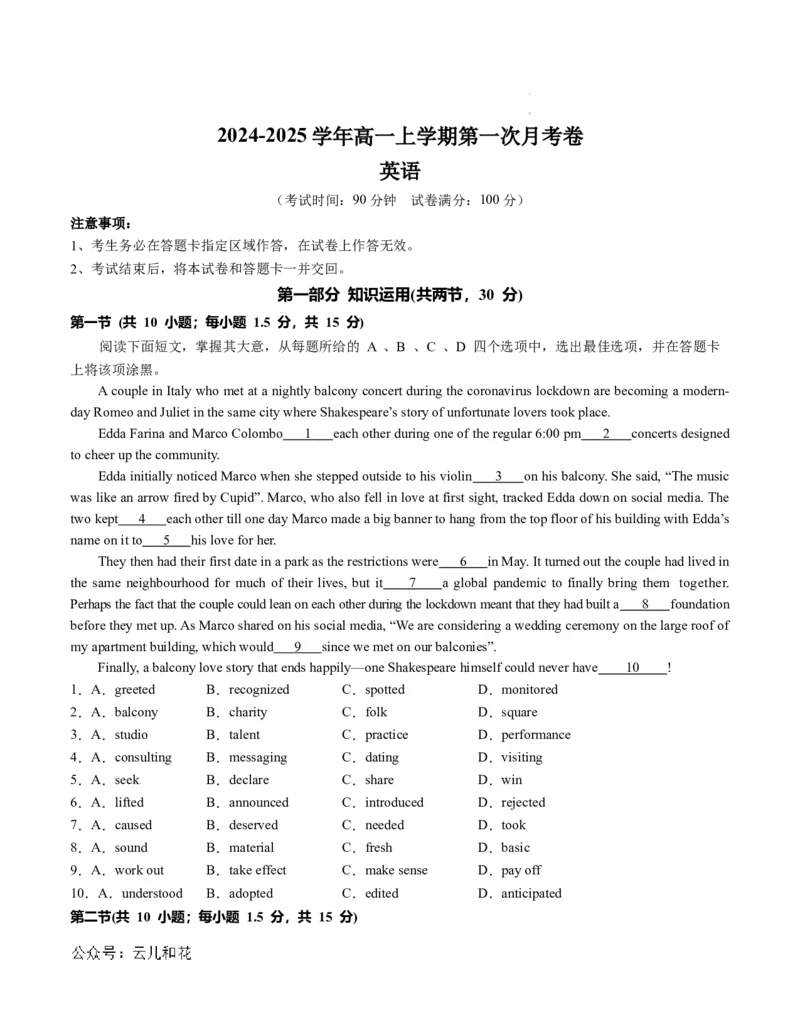
A couple in Italy who met at a nightly balcony concert during the coronavirus lockdown are becoming a modern-
day Romeo and Juliet in the same city where Shakespeare’s story of unfortunate lovers took place.
Edda Farina and Marco Colombo 1 each other during one of the regular 6:00 pm 2 concerts designed
to cheer up the community.
Edda initially noticed Marco when she stepped outside to his violin 3 on his balcony. She said, “The music
was like an arrow fired by Cupid”. Marco, who also fell in love at first sight, tracked Edda down on social media. The
two kept 4 each other till one day Marco made a big banner to hang from the top floor of his building with Edda’s
name on it to 5 his love for her.
They then had their first date in a park as the restrictions were 6 in May. It turned out the couple had lived in
the same neighbourhood for much of their lives, but it 7 a global pandemic to finally bring them together.
Perhaps the fact that the couple could lean on each other during the lockdown meant that they had built a 8 foundation
before they met up. As Marco shared on his social media, “We are considering a wedding ceremony on the large roof of
my apartment building, which would 9 since we met on our balconies”.
Finally, a balcony love story that ends happily—one Shakespeare himself could never have 10 !
1.A.greeted B.recognized C.spotted D.monitored
2.A.balcony B.charity C.folk D.square
3.A.studio B.talent C.practice D.performance
4.A.consulting B.messaging C.dating D.visiting
5.A.seek B.declare C.share D.win
6.A.lifted B.announced C.introduced D.rejected
7.A.caused B.deserved C.needed D.took
8.A.sound B.material C.fresh D.basic
9.A.work out B.take effect C.make sense D.pay off
10.A.understood B.adopted C.edited D.anticipated
第二节(共 10 小题;每小题 1.5 分,共 15 分)
学科网(北京)股份有限公司 学科网(北京)股份有限公司阅读下列短文,根据短文内容填空。在未给提示词的空白处仅填写1个恰当的单词,在给出提示词的空白
处用括号内所给词的正确形式填空。请在答题卡指 定区域作答。
A
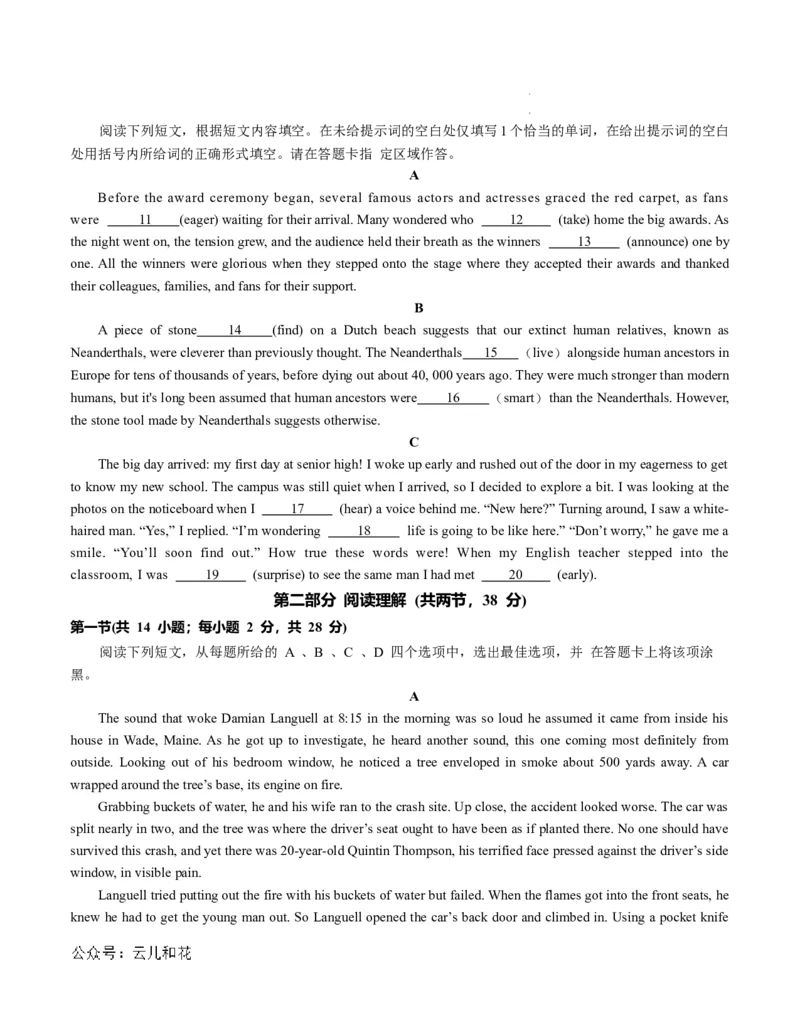
Before the award ceremony began, several famous actors and actresses graced the red carpet, as fans
were 11 (eager) waiting for their arrival. Many wondered who 12 (take) home the big awards. As
the night went on, the tension grew, and the audience held their breath as the winners 13 (announce) one by
one. All the winners were glorious when they stepped onto the stage where they accepted their awards and thanked
their colleagues, families, and fans for their support.
B
A piece of stone 14 (find) on a Dutch beach suggests that our extinct human relatives, known as
Neanderthals, were cleverer than previously thought. The Neanderthals 15 (live)alongside human ancestors in
Europe for tens of thousands of years, before dying out about 40, 000 years ago. They were much stronger than modern
humans, but it's long been assumed that human ancestors were 16 (smart)than the Neanderthals. However,
the stone tool made by Neanderthals suggests otherwise.
C
The big day arrived: my first day at senior high! I woke up early and rushed out of the door in my eagerness to get
to know my new school. The campus was still quiet when I arrived, so I decided to explore a bit. I was looking at the
photos on the noticeboard when I 17 (hear) a voice behind me. “New here?” Turning around, I saw a white-
haired man. “Yes,” I replied. “I’m wondering 18 life is going to be like here.” “Don’t worry,” he gave me a
smile. “You’ll soon find out.” How true these words were! When my English teacher stepped into the
classroom, I was 19 (surprise) to see the same man I had met 20 (early).
第二部分 阅读理解 (共两节,38 分)
第一节(共 14 小题;每小题 2 分,共 28 分)
阅读下列短文,从每题所给的 A 、B 、C 、D 四个选项中,选出最佳选项,并 在答题卡上将该项涂
黑。
A
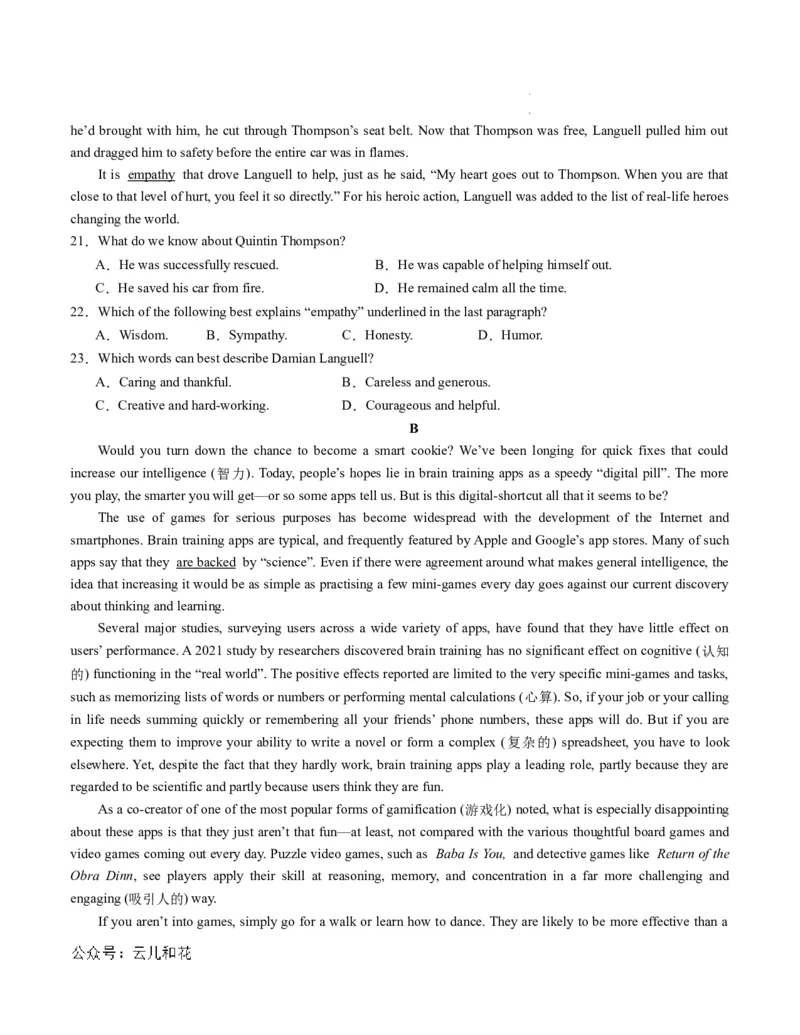
The sound that woke Damian Languell at 8:15 in the morning was so loud he assumed it came from inside his
house in Wade, Maine. As he got up to investigate, he heard another sound, this one coming most definitely from
outside. Looking out of his bedroom window, he noticed a tree enveloped in smoke about 500 yards away. A car
wrapped around the tree’s base, its engine on fire.
Grabbing buckets of water, he and his wife ran to the crash site. Up close, the accident looked worse. The car was
split nearly in two, and the tree was where the driver’s seat ought to have been as if planted there. No one should have
survived this crash, and yet there was 20-year-old Quintin Thompson, his terrified face pressed against the driver’s side
window, in visible pain.
Languell tried putting out the fire with his buckets of water but failed. When the flames got into the front seats, he
knew he had to get the young man out. So Languell opened the car’s back door and climbed in. Using a pocket knife
学科网(北京)股份有限公司 学科网(北京)股份有限公司he’d brought with him, he cut through Thompson’s seat belt. Now that Thompson was free, Languell pulled him out
and dragged him to safety before the entire car was in flames.
It is empathy that drove Languell to help, just as he said, “My heart goes out to Thompson. When you are that
close to that level of hurt, you feel it so directly.” For his heroic action, Languell was added to the list of real-life heroes
changing the world.
21.What do we know about Quintin Thompson?
A.He was successfully rescued. B.He was capable of helping himself out.
C.He saved his car from fire. D.He remained calm all the time.
22.Which of the following best explains “empathy” underlined in the last paragraph?
A.Wisdom. B.Sympathy. C.Honesty. D.Humor.
23.Which words can best describe Damian Languell?
A.Caring and thankful. B.Careless and generous.
C.Creative and hard-working. D.Courageous and helpful.
B
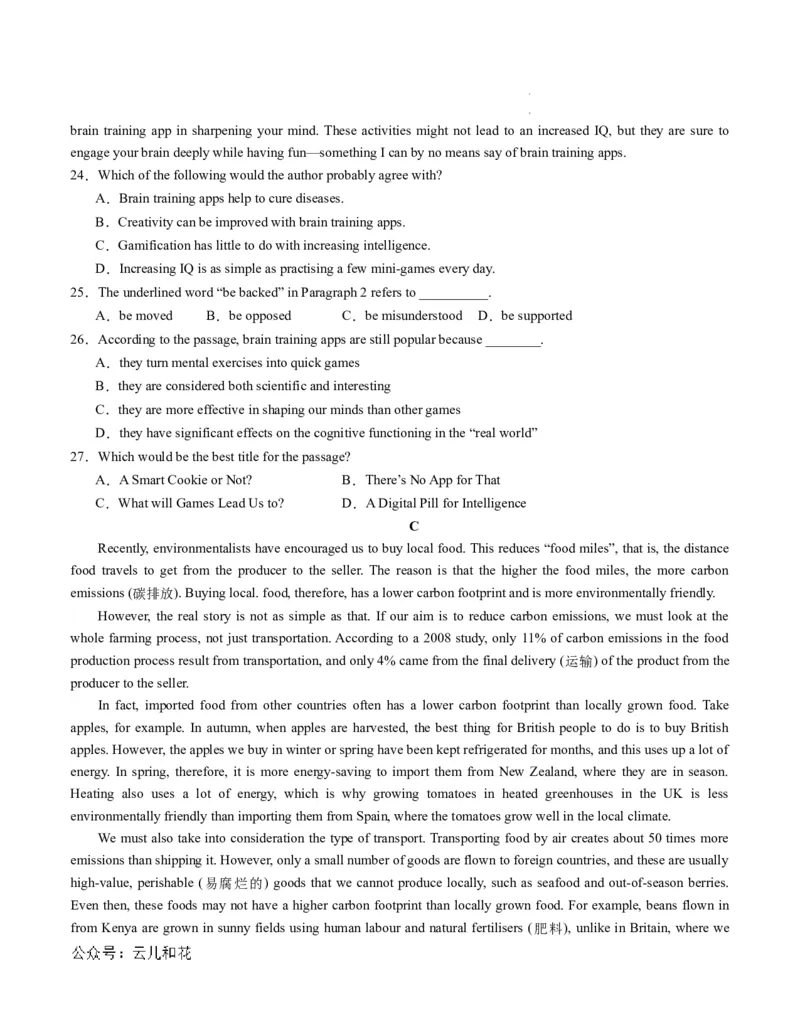
Would you turn down the chance to become a smart cookie? We’ve been longing for quick fixes that could
increase our intelligence (智力). Today, people’s hopes lie in brain training apps as a speedy “digital pill”. The more
you play, the smarter you will get—or so some apps tell us. But is this digital-shortcut all that it seems to be?
The use of games for serious purposes has become widespread with the development of the Internet and
smartphones. Brain training apps are typical, and frequently featured by Apple and Google’s app stores. Many of such
apps say that they are backed by “science”. Even if there were agreement around what makes general intelligence, the
idea that increasing it would be as simple as practising a few mini-games every day goes against our current discovery
about thinking and learning.
Several major studies, surveying users across a wide variety of apps, have found that they have little effect on
users’ performance. A 2021 study by researchers discovered brain training has no significant effect on cognitive (认知
的) functioning in the “real world”. The positive effects reported are limited to the very specific mini-games and tasks,
such as memorizing lists of words or numbers or performing mental calculations (心算). So, if your job or your calling
in life needs summing quickly or remembering all your friends’ phone numbers, these apps will do. But if you are
expecting them to improve your ability to write a novel or form a complex (复杂的) spreadsheet, you have to look
elsewhere. Yet, despite the fact that they hardly work, brain training apps play a leading role, partly because they are
regarded to be scientific and partly because users think they are fun.
As a co-creator of one of the most popular forms of gamification (游戏化) noted, what is especially disappointing
about these apps is that they just aren’t that fun—at least, not compared with the various thoughtful board games and
video games coming out every day. Puzzle video games, such as Baba Is You, and detective games like Return of the
Obra Dinn, see players apply their skill at reasoning, memory, and concentration in a far more challenging and
engaging (吸引人的) way.
If you aren’t into games, simply go for a walk or learn how to dance. They are likely to be more effective than a
学科网(北京)股份有限公司 学科网(北京)股份有限公司brain training app in sharpening your mind. These activities might not lead to an increased IQ, but they are sure to
engage your brain deeply while having fun—something I can by no means say of brain training apps.
24.Which of the following would the author probably agree with?
A.Brain training apps help to cure diseases.
B.Creativity can be improved with brain training apps.
C.Gamification has little to do with increasing intelligence.
D.Increasing IQ is as simple as practising a few mini-games every day.
25.The underlined word “be backed” in Paragraph 2 refers to __________.
A.be moved B.be opposed C.be misunderstood D.be supported
26.According to the passage, brain training apps are still popular because ________.
A.they turn mental exercises into quick games
B.they are considered both scientific and interesting
C.they are more effective in shaping our minds than other games
D.they have significant effects on the cognitive functioning in the “real world”
27.Which would be the best title for the passage?
A.A Smart Cookie or Not? B.There’s No App for That
C.What will Games Lead Us to? D.A Digital Pill for Intelligence
C
Recently, environmentalists have encouraged us to buy local food. This reduces “food miles”, that is, the distance
food travels to get from the producer to the seller. The reason is that the higher the food miles, the more carbon
emissions (碳排放). Buying local. food, therefore, has a lower carbon footprint and is more environmentally friendly.
However, the real story is not as simple as that. If our aim is to reduce carbon emissions, we must look at the
whole farming process, not just transportation. According to a 2008 study, only 11% of carbon emissions in the food
production process result from transportation, and only 4% came from the final delivery (运输) of the product from the
producer to the seller.
In fact, imported food from other countries often has a lower carbon footprint than locally grown food. Take
apples, for example. In autumn, when apples are harvested, the best thing for British people to do is to buy British
apples. However, the apples we buy in winter or spring have been kept refrigerated for months, and this uses up a lot of
energy. In spring, therefore, it is more energy-saving to import them from New Zealand, where they are in season.
Heating also uses a lot of energy, which is why growing tomatoes in heated greenhouses in the UK is less
environmentally friendly than importing them from Spain, where the tomatoes grow well in the local climate.
We must also take into consideration the type of transport. Transporting food by air creates about 50 times more
emissions than shipping it. However, only a small number of goods are flown to foreign countries, and these are usually
high-value, perishable (易腐烂的) goods that we cannot produce locally, such as seafood and out-of-season berries.
Even then, these foods may not have a higher carbon footprint than locally grown food. For example, beans flown in
from Kenya are grown in sunny fields using human labour and natural fertilisers (肥料), unlike in Britain, where we
学科网(北京)股份有限公司 学科网(北京)股份有限公司use oil-based fertilisers and machinery. Therefore, the total carbon footprint is still lower.
It’s also worth remembering that a product’s journey does not end at the supermarket. The distance customers
travel to buy their food, and the kind of transport they use will also add to its carbon footprint. So driving a long way to
shop for food will wipe out any environmental benefits of buying locally grown produce.
Recently, some supermarkets have been trying to raise awareness of food miles by labelling (标记) foods with
stickers that show it has been imported by air. But the message this gives is too simple. Lots of different factors
contribute to a food’s carbon footprint besides the distance it has travelled.
28.What can we learn about “food miles”?
A.It influences how people deliver and transport food.
B.It will increase if people are encouraged to buy local food.
C.It is the key factor contributing to a food’s carbon emissions.
D.It shows how far the food goes from farmland to supermarkets.
29.The author will probably agree that ________.
A.transporting food by air is the most energy-saving type of shipping
B.storing local food creates more carbon emissions than importing food
C.human labour and natural fertilisers can increase the carbon footprint
D.growing out-of-season food takes less energy than importing food in season
30.What is the author’s attitude towards cutting food miles to reduce carbon emissions?
A.Supportive. B.Confused. C.Negative. D.Doubtful.
D
At a museum in Vietnam, Lena Bui’s film Where Birds Dance Their Last reflected on the beauty and vulnerability
of Vietnamese feather farms after Bird Flu. During a festival in Rwanda, Ellen Reid’s audio experience Soundwalk was
shared in a hopeful discussion about music, parks and mental health. These are a few of the things I have helped bring
to life over the years, working at the intersection of scientific research, the arts and advocacy to support science in
solving global health challenges.
Science is key to addressing these issues. But it isn’t the only key. To achieve its potential and for its advances to
be implemented and reach all who could benefit, science depends on trust and good relationships. People might not
always see science as relevant, trustworthy, or meaningful to their lives. There are reasons why some see science as
having a chequered past, from nuclear weapons to eugenics, and are therefore uninterested in, or suspicious of, what it
proposes. Others feel excluded by the incomprehensibility of hyper-specialist knowledge.
In its capacity to build upon and test an evidence base, science is powerful, but researchers and funders haven’t
been as good at ensuring this evidence base responds to the needs and interests of diverse communities or informs
policymakers to take action. Science might be perceived as distancing itself from the personal, the poetic and the
political, yet it is precisely these qualities that can be most influential when it comes to the public interest in atopic or
how a government prioritizes a decision.
A moving story well told can be more memorable than a list of facts. This is where the arts come in. Artists can
学科网(北京)股份有限公司 学科网(北京)股份有限公司give us different perspectives with which to consider and reimagine the world together. They can redress the
proclaimed objectivity in science by bringing stories —subjectivities —into the picture, and these can help foster a
sense of connection and hope.
In 2012, I set up artist residencies in medical research centres around the world. Bui was attached to the Oxford
University Clinical Research Unit in Vietnam. The head of the research team was delighted, finding that Bui, as a
Vietnamese artist, had a license to be in, and to share useful insights from, villages where infectious disease researchers
weren’t welcome. Six years later, I led Wellcome’s Contagious Cities program, which established artist residencies
worldwide to support locally-led explorations of epidemic preparedness. The recent pandemic made this work more
noticeable and has informed our Mindscapes program which is currently sharing experiences of mental health through
the work of artists.
With pandemic, climate and mental health crises upon us, rising inequality and what feels like an increasingly
broken world, never has there been more need to build and nurture hopeful and imaginative spaces to grow human
connection and shared purpose for the common good. Science and the arts can work hand in glove to achieve this.
31.The author lists two works in Paragraph 1 mainly to ______.
A.reveal the gap between science and art B.prove his competence in both science and art
C.introduce successful science-related artworks D.show that science can be promoted in art forms
32.What does the underlined word “chequered” in Paragraph 2 probably mean?
A.Recent and remote. B.Good and bad.
C.Usual and unusual. D.Peaceful and scary.
33.Which of the following would the author agree?
A.Policy-makers base their decisions on science. B.Researchers popularize science effectively.
C.Science is well received among the public.D.The arts help people build connections.
34.Which of the following would be the best title for the passage?
A.The Value of the Arts to Science B.Where Do Science and the Arts Meet?
C.A New Way to Fight Pandemic—the Arts D.Which Matters More, Science or the Arts?
第二节(共 5 小题;每小题 2 分,共 10 分)
根据短文内容,从短文后的七个选项中选出能填入空白处的最佳选项,并在答题卡上将该项涂黑。选项
中有两项为多余选项。
The beauty of confidence is that it is possible to learn it, no matter who you are! Follow these simple steps to be
confident.
Consider your strengths and success. 35 When did you help others? What are you good at? When have
you taken pride in yourselves? What are you working hard for? If you have difficulty thinking of your strengths and
success, ask your family member or a close friend.
Have goals. Sitting around and doing nothing will make you feel worse. Start with a small goal. 36 You'll
get more confidence achieving a small goal. Once you've achieved many smaller goals, you can set bigger goals.
37 Failure is the mother of success. When you fail, view it as a learning experience. Often we have to fail
学科网(北京)股份有限公司 学科网(北京)股份有限公司on our own to gain experience. By failing, you have at least taken a chance.
Pick a role model. Pick a role model that is always confident and always learn from them.
Study their action, their manners and how they communicate with others. 38 However, it's a great place to
start. Smile. Confident people smile often and without much reason. 39 It tells the people around you that you're
comfortable in yourself and enjoying your time
A.Learn from failure.
B.Otherwise, you'll get discouraged.
C.Smiling is a friendly and open gesture.
D.After reaching a goal, reward yourself.
E.Start projecting a more powerful you today.
F.If possible, write them down so that you can look back at them later.
G.Of course you don't want to spend your entire life copying someone else
第三部分 书面表达(共两节,32 分)
第一节 (共 4 小题; 第 40、41 题各 2 分, 第 42 题 3 分, 第 43 题 5 分, 共 12 分)
阅读下面短文,根据题目要求用英文回答问题。请在答题卡指定区域作答。
In the mornings, as I walked from the train station to the office, I planned my day by making a to-do list in my
head: the scientific articles I would read, the data sets I would analyze, and most urgent of all insights into human
nature that it was my job to discover.
Each evening, I went back to the station, again going through my mental checklist but this time sizing up my
performance against the expectations I’d set for myself that morning. Time and again, when comparing my to-do list
with my got-done list, I felt disappointed because I had fallen short.
But one day, something very strange happened. During my trip home, without any conscious intent, my thoughts
began to shift. Instead of feeling bad about my weaknesses, I said aloud very softly: I’m a nice person. I’m a nice
person. I’m a nice person.
By the time I boarded my train, I was done with my little chant until the next day when I walked home. And again,
after counting my failures, I found myself saying quietly: I’m a nice person.
It turns out that there’s a technical term for this practice: values affirmation. And what it boils down to is
recognizing, and strengthening, the personal values you hold most dear.
When you affirm a core personal value, you shore up your sense of self-worth. You broaden your outlook: Instead
of focusing on your shortfalls, you switch to a wide-angle view that includes your resources and opportunities. And the
people who do this are happier, healthier, and more hopeful.
Over time, I made progress in my research and learned a lot about what makes most successful people special,
including this: Nobody has passion and determination unless what they do lines up with their values.
Try values affirmation for yourself and teach the practice to your students. Take a moment and think of a value
学科网(北京)股份有限公司 学科网(北京)股份有限公司you hold dear, whether it’s kindness, creativity, or gratitude. Whatever it is, name it. And then say to yourself: Come
what may, I know who I am. Your values are your foundation and your compass, too. Trust them, and they will lead you
home.
40.How did the author feel when she compared her to-do list with her got-done list?
41.What is values affirmation?
42.Please decide which part is false in the following statement, then underline it and explain why.
People who recognize their shortfalls are happier, healthier, and more hopeful.
43.Apart from speaking out positive words, what else could you do to feel better about yourself? (In about 40 words)
第二节 (20 分)
假设你是红星中学高一学生李华,你的英国笔友Jim在给你的邮件中提到很想了解你的高中生活,请你给
Jim回封邮件,词数100左右;邮件的开头和结尾不计入总词数。
the reason for choosing the school: the excellent teachers; near your home
●classmates are friendly
●listen to the teacher attentively; review the lessons;
your school life:
●join various clubs;
●……
your expectation: improve the ability of communicating with others
Dear Jim,
________________________________________________________________________________________________
________________________________________________________________________________________________
________________________________________________________________________________________________
________________________________________________________________________________________________
________________________________________________________________________________________________
________________________________________________________________________________________________
________________________________________________________________________________________________
Yours,
Li Hua
学科网(北京)股份有限公司 学科网(北京)股份有限公司