



文档内容
绝密★启用前
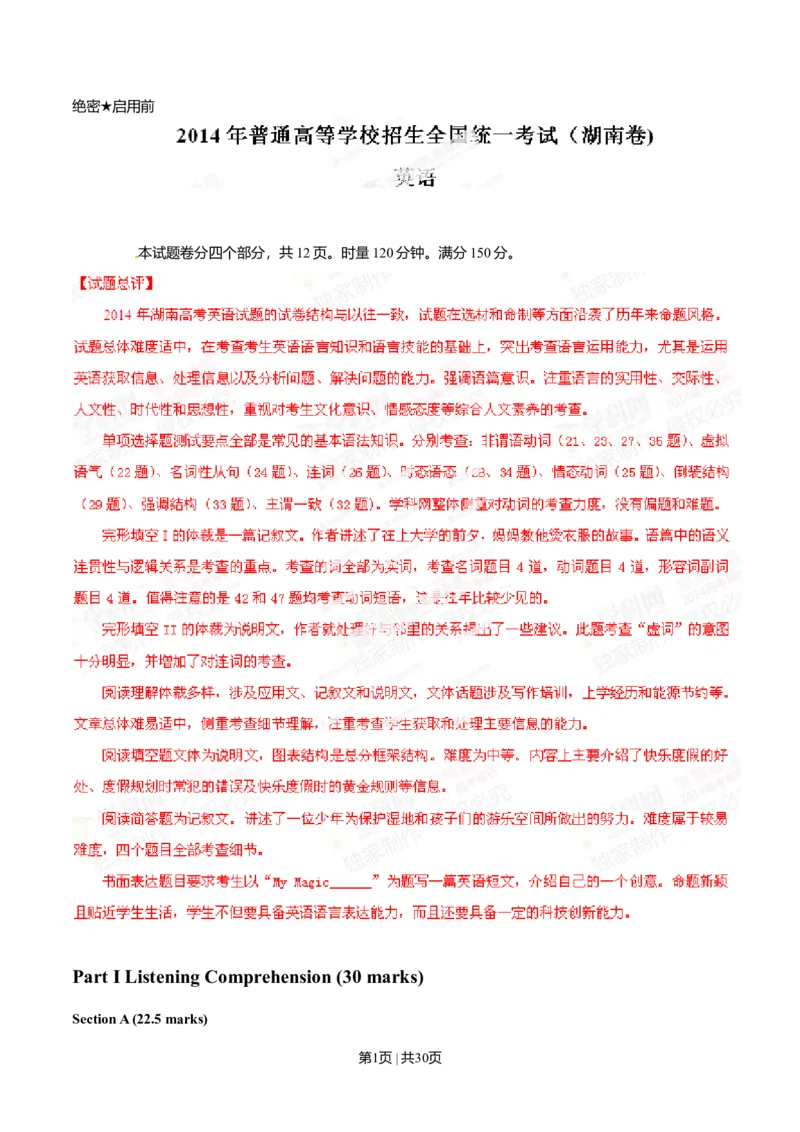
本试题卷分四个部分,共12页。时量120分钟。满分150分。
Part I Listening Comprehension (30 marks)
Section A (22.5 marks)
第1页 | 共30页Directions: In this section,you will hear six conversations between two speakers. For each conversation, there are
several questions and each question is followed by three choices marked A, B and C. Listen carefully and then
choose the best answer for each question.
You will hear each conversation TWICE.
Example:
When will the magazine probably arrive?
A. Wednesday.B. Thursday. C. Friday.
The answer is B.
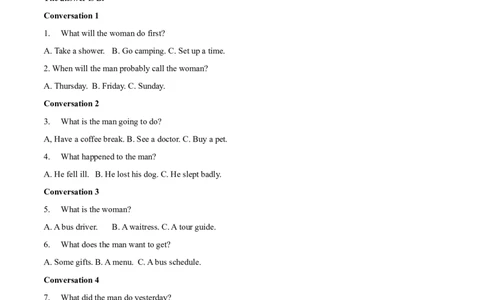
Conversation 1
1. What will the woman do first?
A. Take a shower. B. Go camping. C. Set up a time.
2. When will the man probably call the woman?
A. Thursday. B. Friday. C. Sunday.
Conversation 2
3. What is the man going to do?
A, Have a coffee break. B. See a doctor. C. Buy a pet.
4. What happened to the man?
A. He fell ill. B. He lost his dog. C. He slept badly.
Conversation 3
5. What is the woman?
A. A bus driver. B. A waitress. C. A tour guide.
6. What does the man want to get?
A. Some gifts.B. A menu. C. A bus schedule.
Conversation 4
7. What did the man do yesterday?
A. He saw a movie.B. He watched TV.
C. He visited some friends.
英语试题第1页(共12页)
8. What time will the speakers probably meet this Saturday evening?
A. At 6:30. B. At 7:00. C. At 7:30.
9. Which of the following will the man buy?
A. Some drinks. B. A birthday cake. G. Concert tickets.
第2页 | 共30页Conversation 5
10. What is the woman doing now?
A. She is serving a customer.
B. She is conducting an interview.
C. She is doing some recording.
11 .When does the man go to the nursing home?
A. Tuesdays. B. Thursdays. C. Sundays.
12. Where will the man probably be working next Monday?
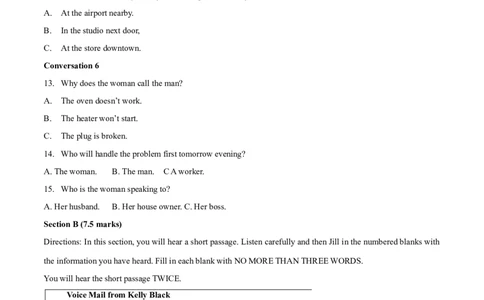
A. At the airport nearby.
B. In the studio next door,
C. At the store downtown.
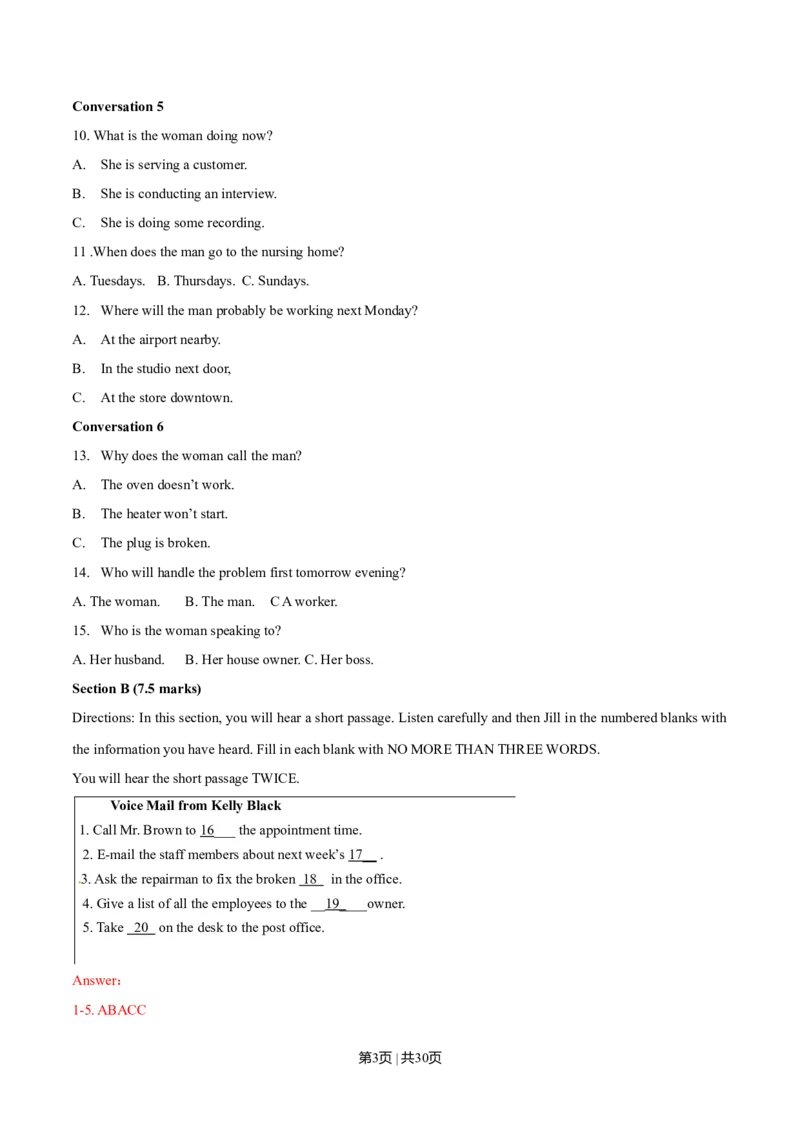
Conversation 6
13. Why does the woman call the man?
A. The oven doesn’t work.
B. The heater won’t start.
C. The plug is broken.
14. Who will handle the problem first tomorrow evening?
A. The woman. B. The man. C A worker.
15. Who is the woman speaking to?
A. Her husband. B. Her house owner. C. Her boss.
[来源:Zxxk.Com]
Section B (7.5 marks)
Directions: In this section, you will hear a short passage. Listen carefully and then Jill in the numbered blanks with
the information you have heard. Fill in each blank with NO MORE THAN THREE WORDS.
You will hear the short passage TWICE.
Voice Mail from Kelly Black
1. Call Mr. Brown to 16___ the appointment time.
2. E-mail the staff members about next week’s 17__ .
3. Ask the repairman to fix the broken 18 in the office.
4. Give a list of all the employees to the __19____owner.
5. Take 20 on the desk to the post office.
Answer:
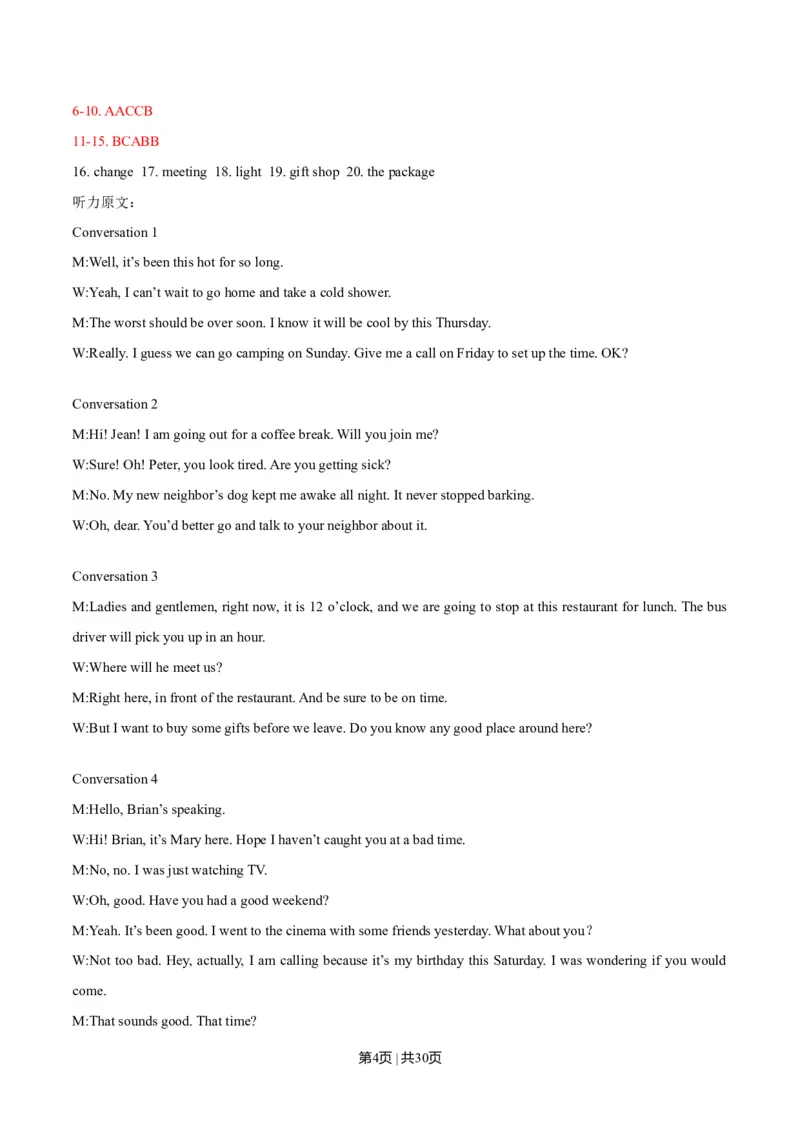
1-5. ABACC
第3页 | 共30页6-10. AACCB
11-15. BCABB
16. change 17. meeting 18. light 19. gift shop 20. the package
听力原文:
Conversation 1
M:Well, it’s been this hot for so long.
W:Yeah, I can’t wait to go home and take a cold shower.
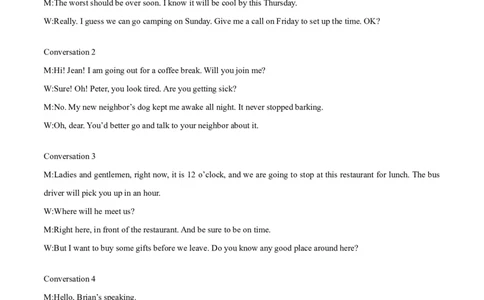
M:The worst should be over soon. I know it will be cool by this Thursday.
W:Really. I guess we can go camping on Sunday. Give me a call on Friday to set up the time. OK?
Conversation 2
M:Hi! Jean! I am going out for a coffee break. Will you join me?
W:Sure! Oh! Peter, you look tired. Are you getting sick?
M:No. My new neighbor’s dog kept me awake all night. It never stopped barking.
W:Oh, dear. You’d better go and talk to your neighbor about it.
Conversation 3
M:Ladies and gentlemen, right now, it is 12 o’clock, and we are going to stop at this restaurant for lunch. The bus
driver will pick you up in an hour.
W:Where will he meet us?
M:Right here, in front of the restaurant. And be sure to be on time.
W:But I want to buy some gifts before we leave. Do you know any good place around here?
Conversation 4
M:Hello, Brian’s speaking.
W:Hi! Brian, it’s Mary here. Hope I haven’t caught you at a bad time.
M:No, no. I was just watching TV.
W:Oh, good. Have you had a good weekend?
M:Yeah. It’s been good. I went to the cinema with some friends yesterday. What about you?
W:Not too bad. Hey, actually, I am calling because it’s my birthday this Saturday. I was wondering if you would
come.
M:That sounds good. That time?
第4页 | 共30页W:It’s 7 o’clock, OK? David won’t finish work until 6:30.
M:Oh, sorry. I am afraid I can’t make it. Is 7:30 all right?
W:Sure. 7:30, then. Do you want me to bring something, like a cake or some drinks?
M:Oh, no. I will get the food and everything. Just come and help me celebrate.
W:Oh, in that case. I will invite you to the piano concert next Friday.
M:That will be great. Thanks.
W:OK, I will get the tickets now.
Conversation 5
M:Do you have any job experience?
W:Only a little. I helped out on my father’s office last year. And I worked in a recording studio last month.
M:That’s good. Can work every day?
W:Yes, I can work any day of the week. Oh, no, except Thursday. I work at a nursing home in the neighborhood
that day.
M:When would you be able to start?
W:Next Monday.
M:OK. That’s great. We have two stores, a very busy one downtown and one near the airport with almost no
customers even on weekends.
W:I want to work near the airport.
M:Good. Everyone now hates it. There are few customers, so you will most likely be doing jobs such as carrying
big boxes and cleaning.
W:Oh, no. Er, wait. er, I like the store downtown.
M:OK. That’s settled. See you next Monday.
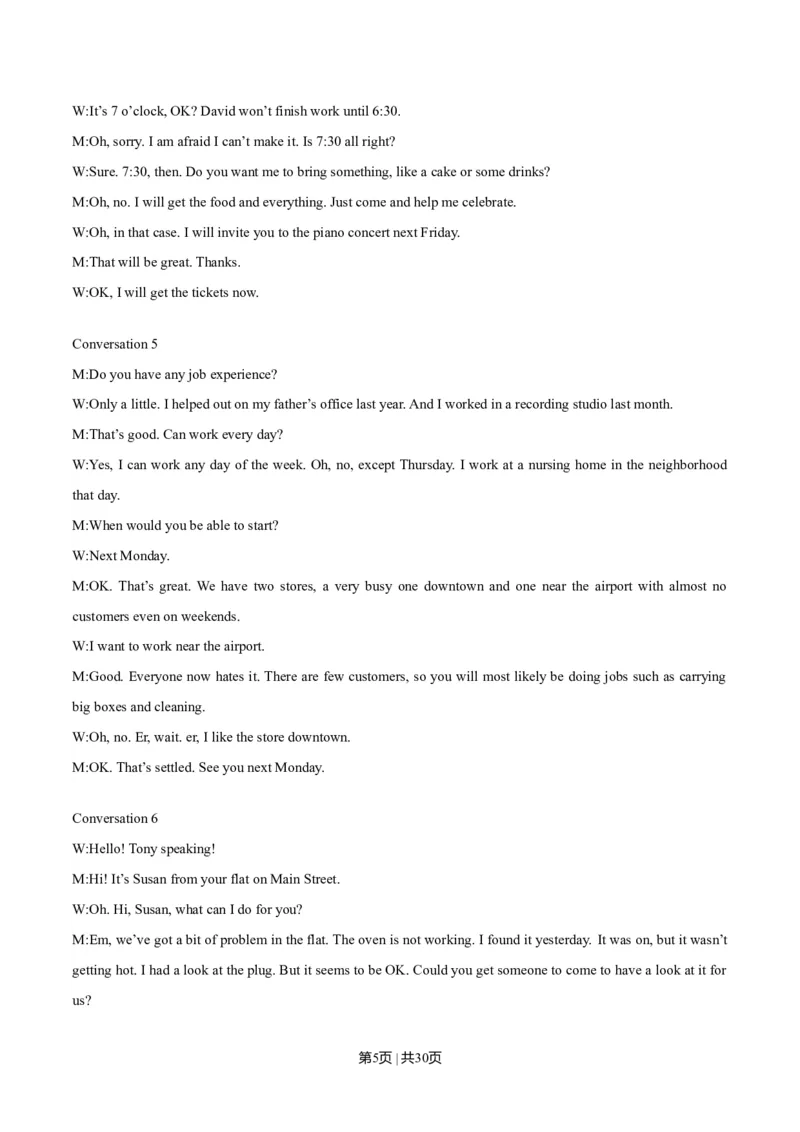
Conversation 6
W:Hello! Tony speaking!
M:Hi! It’s Susan from your flat on Main Street.
W:Oh. Hi, Susan, what can I do for you?
M:Em, we’ve got a bit of problem in the flat. The oven is not working. I found it yesterday. It was on, but it wasn’t
getting hot. I had a look at the plug. But it seems to be OK. Could you get someone to come to have a look at it for
us?
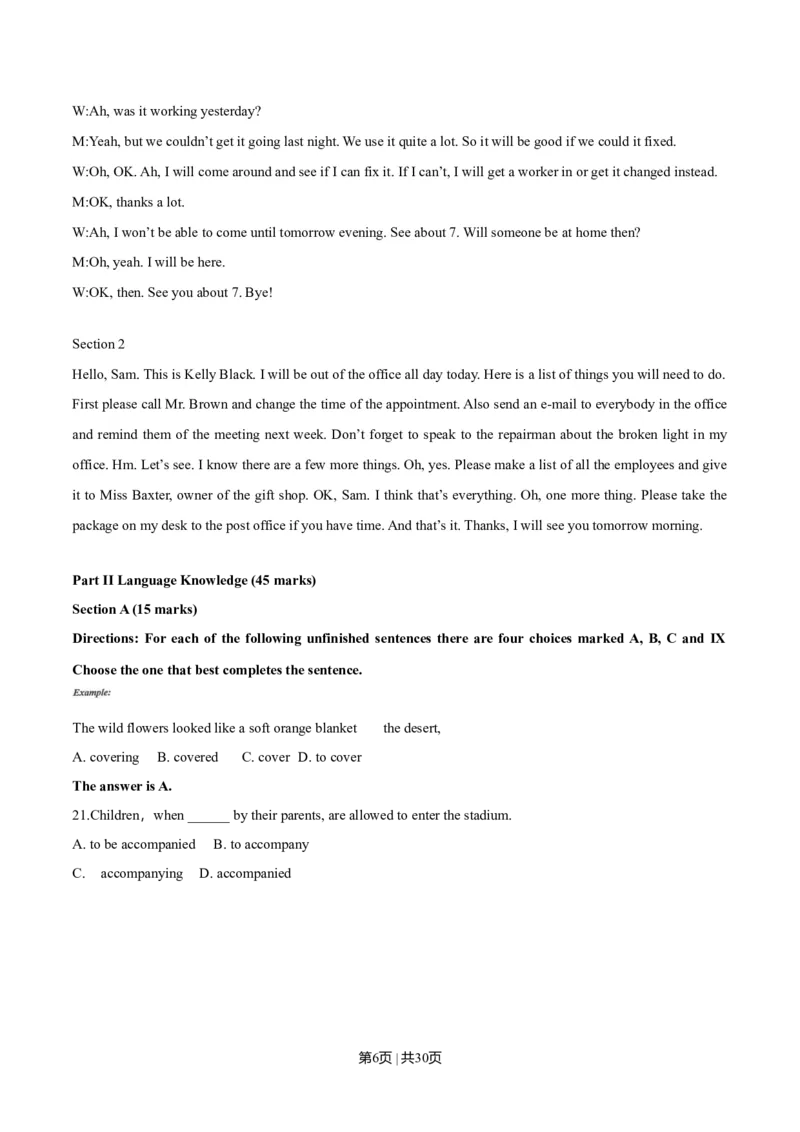
第5页 | 共30页W:Ah, was it working yesterday?
M:Yeah, but we couldn’t get it going last night. We use it quite a lot. So it will be good if we could it fixed.
W:Oh, OK. Ah, I will come around and see if I can fix it. If I can’t, I will get a worker in or get it changed instead.
M:OK, thanks a lot.
W:Ah, I won’t be able to come until tomorrow evening. See about 7. Will someone be at home then?
M:Oh, yeah. I will be here.
W:OK, then. See you about 7. Bye!
Section 2
Hello, Sam. This is Kelly Black. I will be out of the office all day today. Here is a list of things you will need to do.
First please call Mr. Brown and change the time of the appointment. Also send an e-mail to everybody in the office
and remind them of the meeting next week. Don’t forget to speak to the repairman about the broken light in my
office. Hm. Let’s see. I know there are a few more things. Oh, yes. Please make a list of all the employees and give
it to Miss Baxter, owner of the gift shop. OK, Sam. I think that’s everything. Oh, one more thing. Please take the
package on my desk to the post office if you have time. And that’s it. Thanks, I will see you tomorrow morning.
Part II Language Knowledge (45 marks)
Section A (15 marks)
[来源:学科网ZXXK]
Directions: For each of the following unfinished sentences there are four choices marked A, B, C and IX
Choose the one that best completes the sentence.
The wild flowers looked like a soft orange blanket the desert,
A. covering B. covered C. cover D. to cover
The answer is A.
21.Children,when ______ by their parents, are allowed to enter the stadium.
A. to be accompanied B. to accompany
C. accompanying D. accompanied
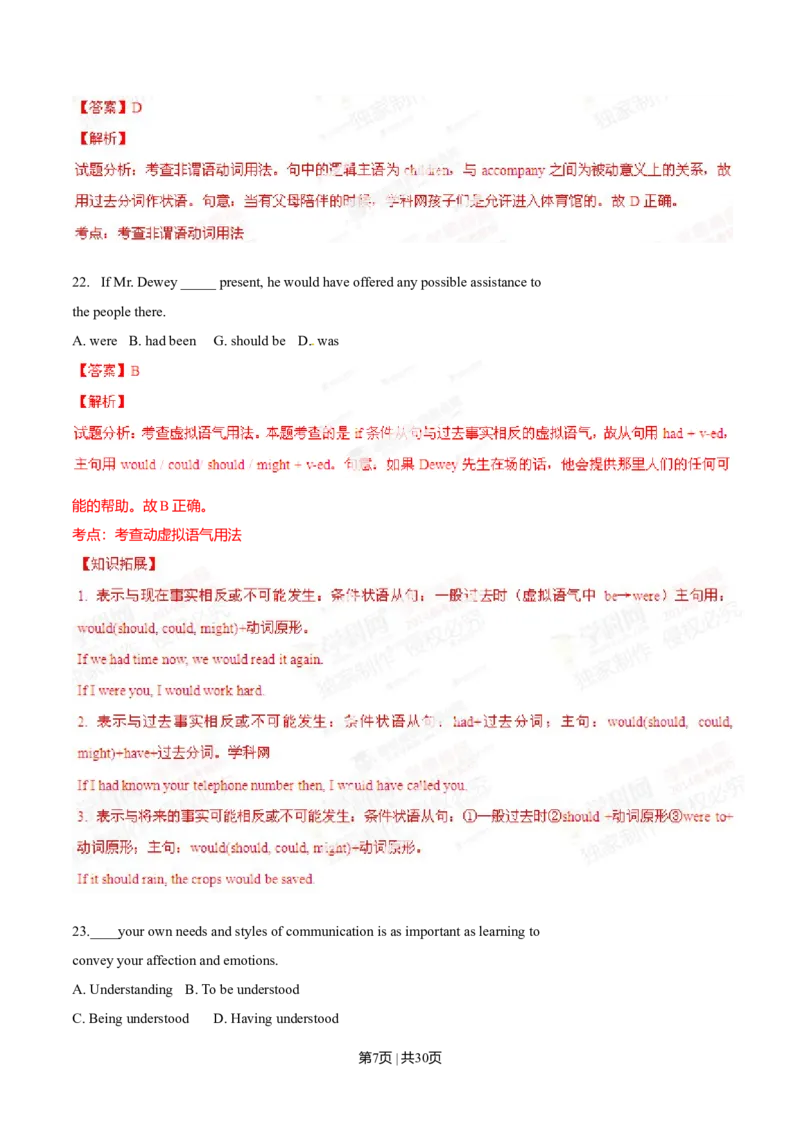
第6页 | 共30页22. If Mr. Dewey _____ present, he would have offered any possible assistance to
the people there.
A. were B. had been G. should be D. was
能的帮助。故B正确。
考点:考查动虚拟语气用法
23.____your own needs and styles of communication is as important as learning to
convey your affection and emotions.
A. Understanding B. To be understood
C. Being understood D. Having understood
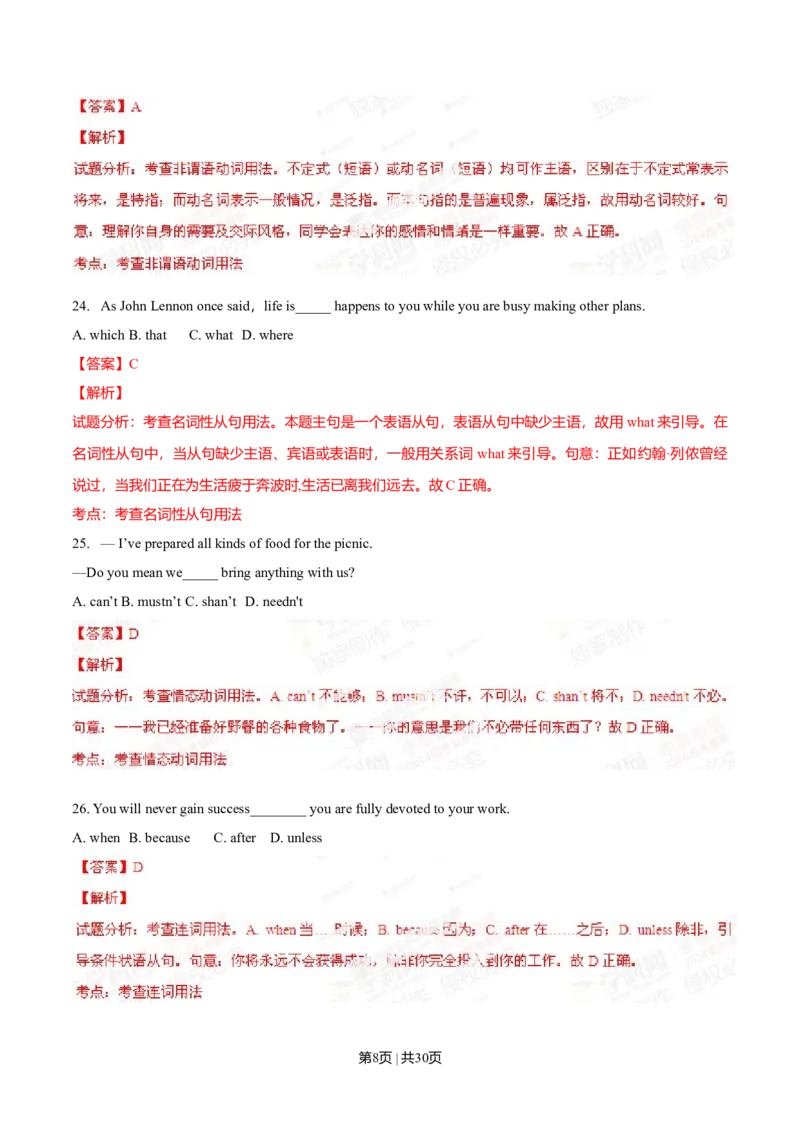
第7页 | 共30页24. As John Lennon once said,life is_____ happens to you while you are busy making other plans.
A. which B. that C. what D. where
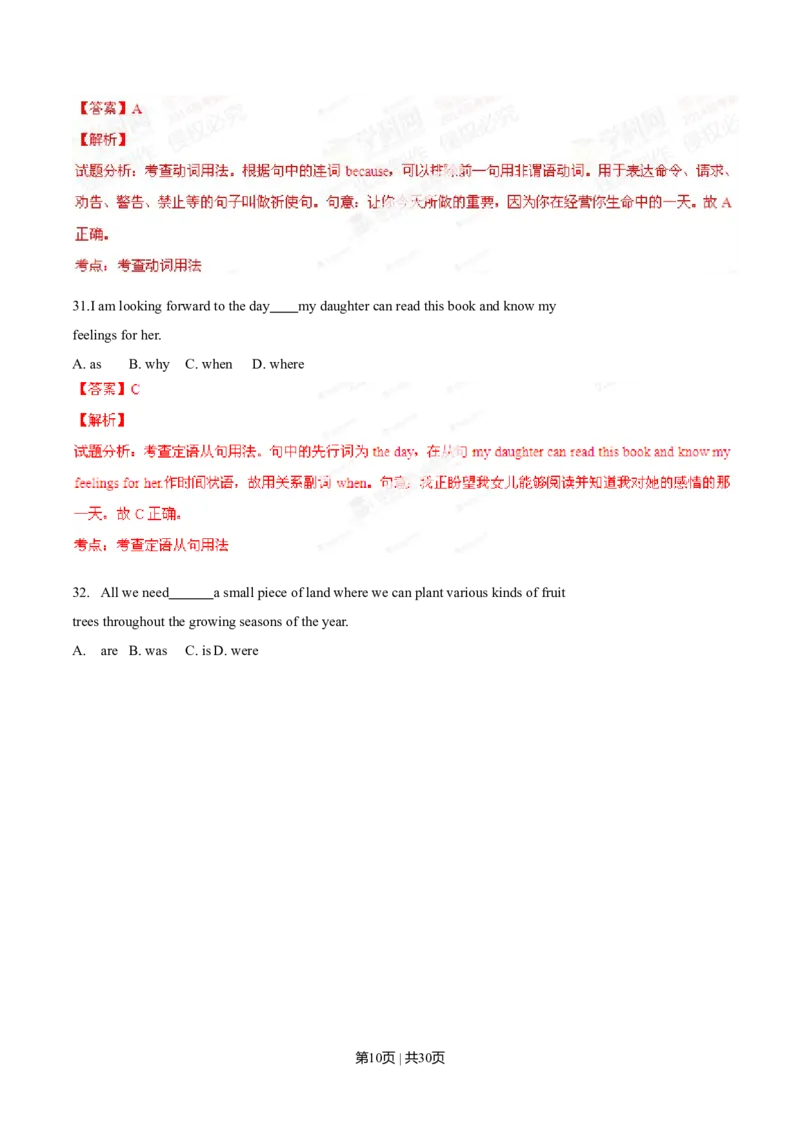
【答案】C
【解析】
试题分析:考查名词性从句用法。本题主句是一个表语从句,表语从句中缺少主语,故用what来引导。在
名词性从句中,当从句缺少主语、宾语或表语时,一般用关系词 what来引导。句意:正如约翰·列侬曾经
说过,当我们正在为生活疲于奔波时,生活已离我们远去。故C正确。
考点:考查名词性从句用法
25. — I’ve prepared all kinds of food for the picnic.
—Do you mean we_____ bring anything with us?
A. can’t B. mustn’t C. shan’t D. needn't
26. You will never gain success________ you are fully devoted to your work.
A. when B. because C. after D. unless
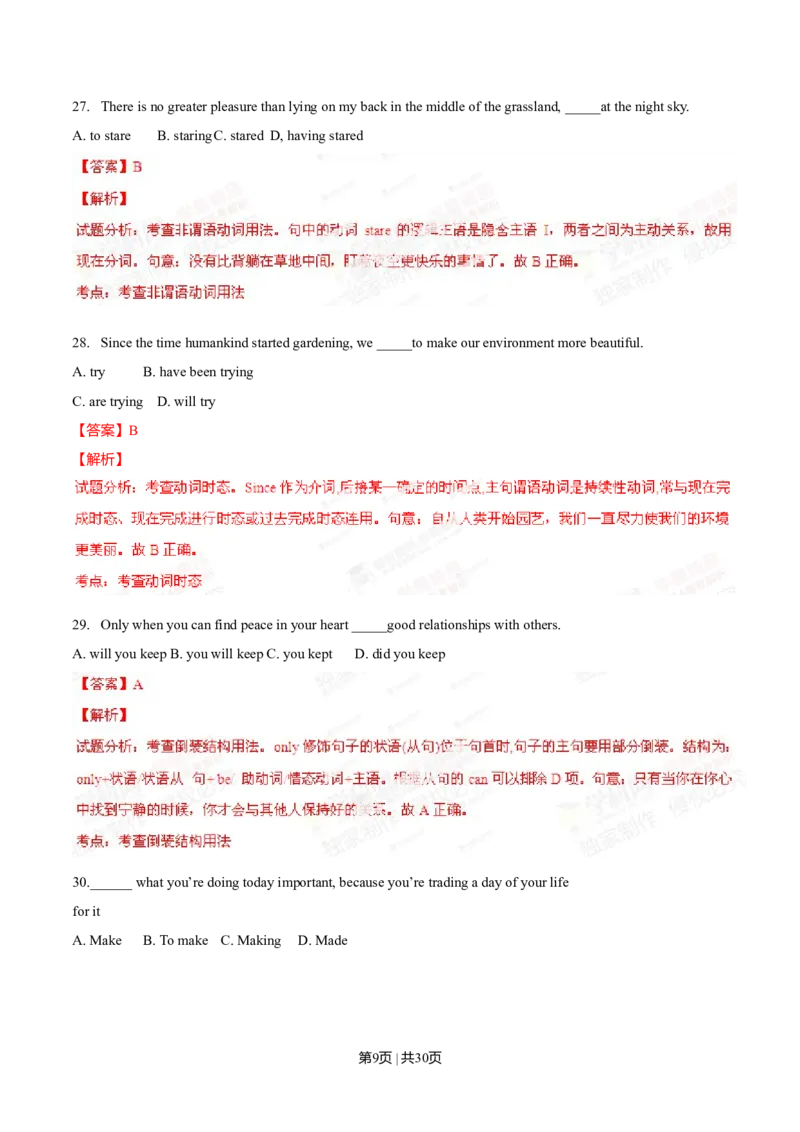
第8页 | 共30页27. There is no greater pleasure than lying on my back in the middle of the grassland, _____at the night sky.
A. to stare B. staringC. stared D, having stared
28. Since the time humankind started gardening, we _____to make our environment more beautiful.
A. try B. have been trying
C. are trying D. will try
【答案】B
【解析】
[来源:学。科。网]
29. Only when you can find peace in your heart _____good relationships with others.
A. will you keep B. you will keep C. you kept D. did you keep
30.______ what you’re doing today important, because you’re trading a day of your life
for it
A. Make B. To make C. Making D. Made
第9页 | 共30页31.I am looking forward to the day my daughter can read this book and know my
feelings for her.
A. as B. why C. when D. where
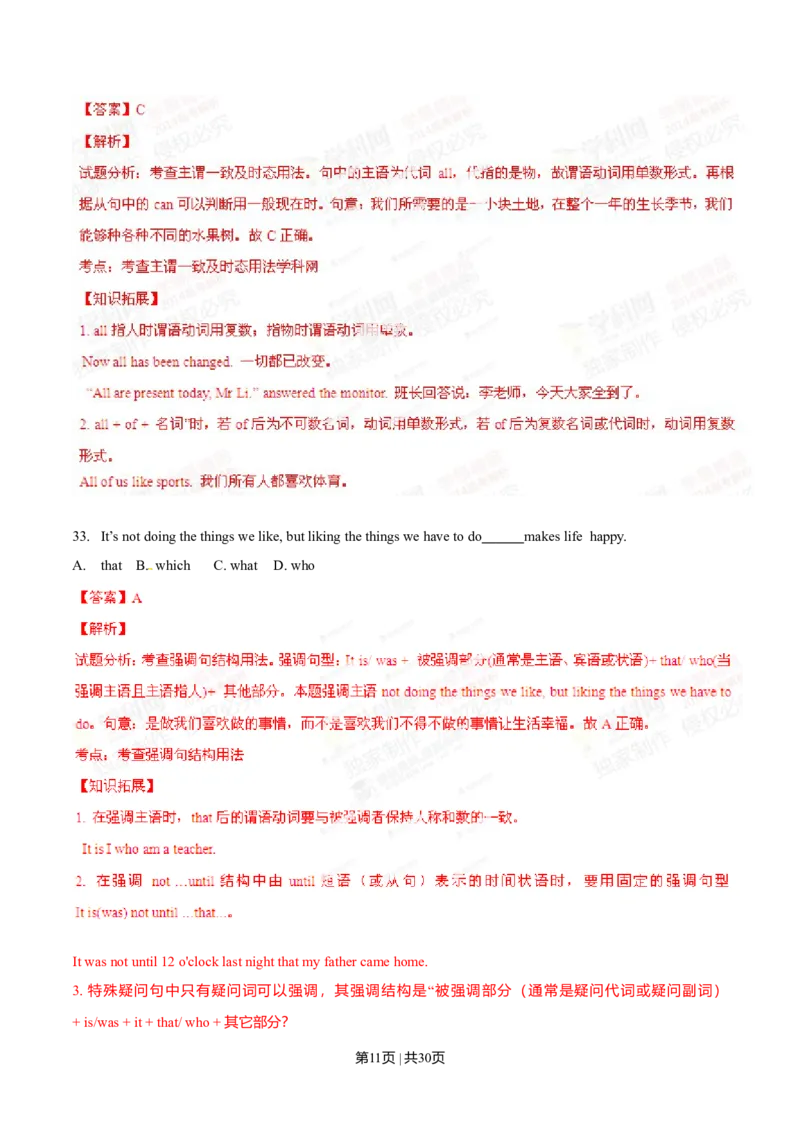
32. All we need a small piece of land where we can plant various kinds of fruit
trees throughout the growing seasons of the year.
A. are B. was C. isD. were
第10页 | 共30页33. It’s not doing the things we like, but liking the things we have to do makes life happy.
A. that B. which C. what D. who
It was not until 12 o'clock last night that my father came home.
3. 特殊疑问句中只有疑问词可以强调,其强调结构是“被强调部分(通常是疑问代词或疑问副词)
+ is/was + it + that/ who + 其它部分?
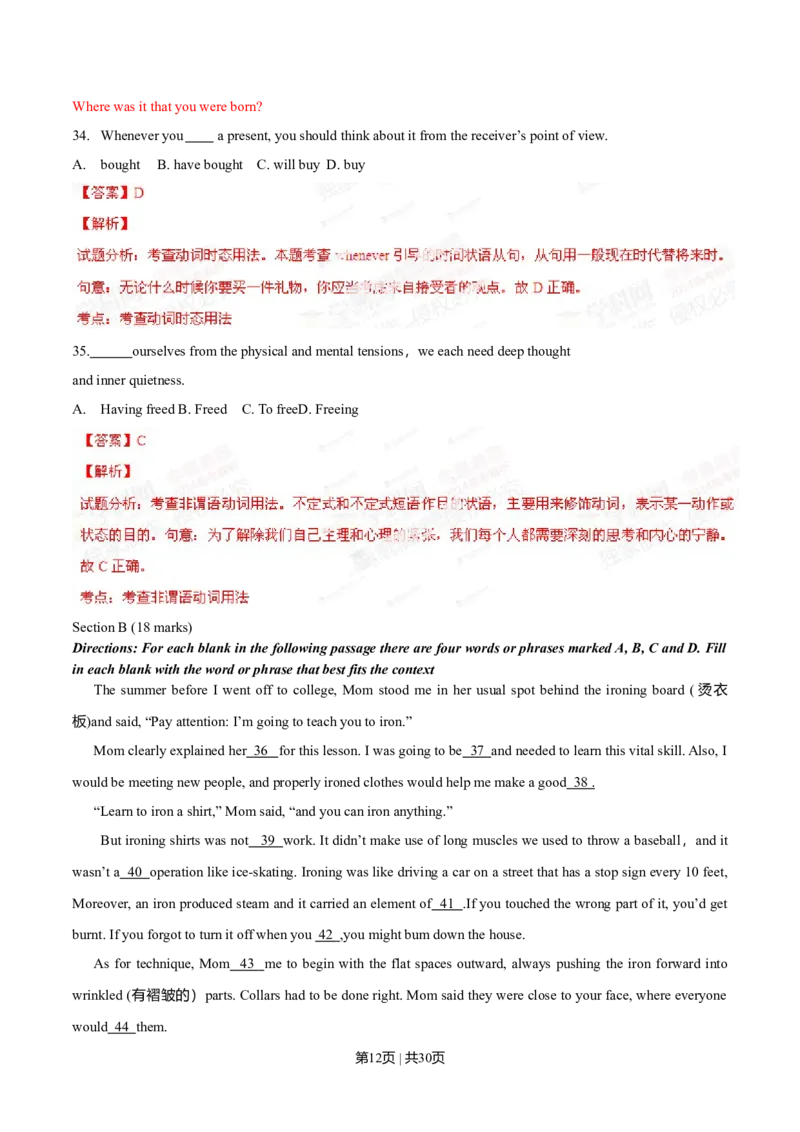
第11页 | 共30页Where was it that you were born?
34. Whenever you a present, you should think about it from the receiver’s point of view.
A. bought B. have bought C. will buy D. buy
35. ourselves from the physical and mental tensions,we each need deep thought
and inner quietness.
A. Having freed B. Freed C. To freeD. Freeing
Section B (18 marks)
Directions: For each blank in the following passage there are four words or phrases marked A, B, C and D. Fill
in each blank with the word or phrase that best fits the context
The summer before I went off to college, Mom stood me in her usual spot behind the ironing board (烫衣
板)and said, “Pay attention: I’m going to teach you to iron.”
Mom clearly explained her 36 for this lesson. I was going to be 37 and needed to learn this vital skill. Also, I
would be meeting new people, and properly ironed clothes would help me make a good 38 .
“Learn to iron a shirt,” Mom said, “and you can iron anything.”
But ironing shirts was not 39 work. It didn’t make use of long muscles we used to throw a baseball,and it
wasn’t a 40 operation like ice-skating. Ironing was like driving a car on a street that has a stop sign every 10 feet,
Moreover, an iron produced steam and it carried an element of 41 .If you touched the wrong part of it, you’d get
burnt. If you forgot to turn it off when you 42 ,you might bum down the house.
As for technique, Mom 43 me to begin with the flat spaces outward, always pushing the iron forward into
wrinkled (有褶皱的)parts. Collars had to be done right. Mom said they were close to your face, where everyone
would 44 them.
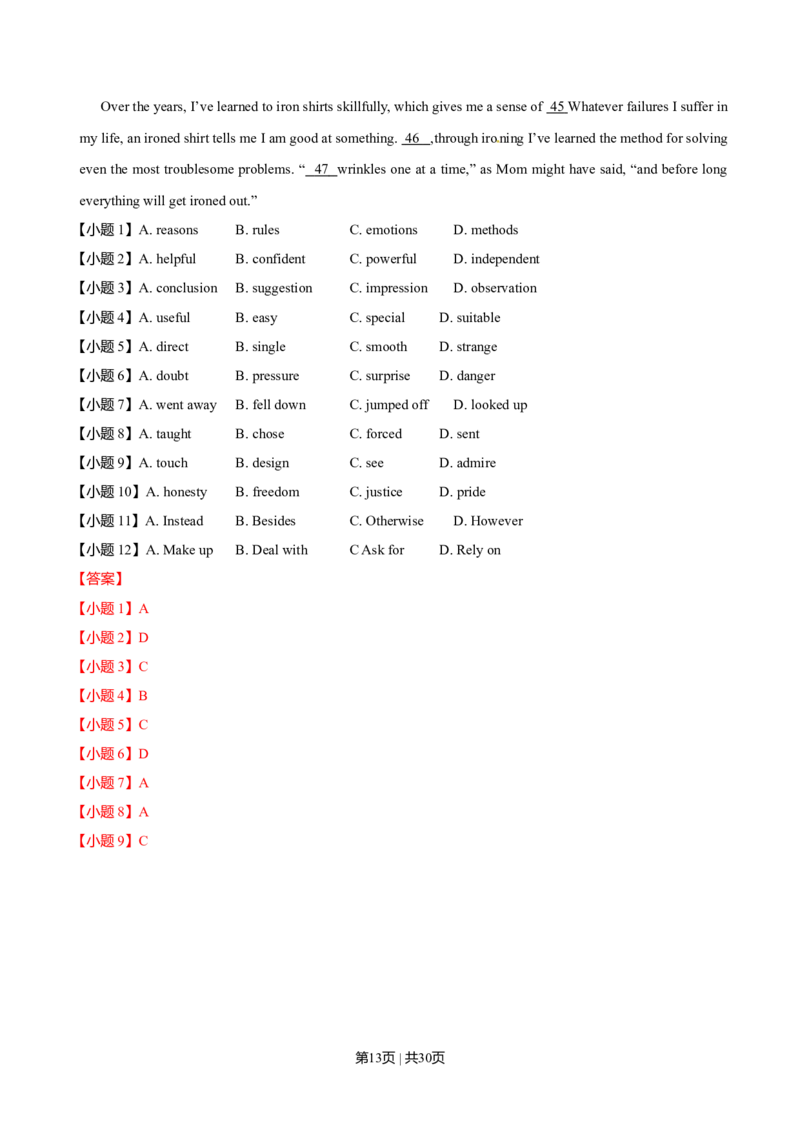
第12页 | 共30页Over the years, I’ve learned to iron shirts skillfully, which gives me a sense of 4 5 Whatever failures I suffer in
my life, an ironed shirt tells me I am good at something. 46 ,through ironing I’ve learned the method for solving
even the most troublesome problems. “ 47 wrinkles one at a time,” as Mom might have said, “and before long
everything will get ironed out.”
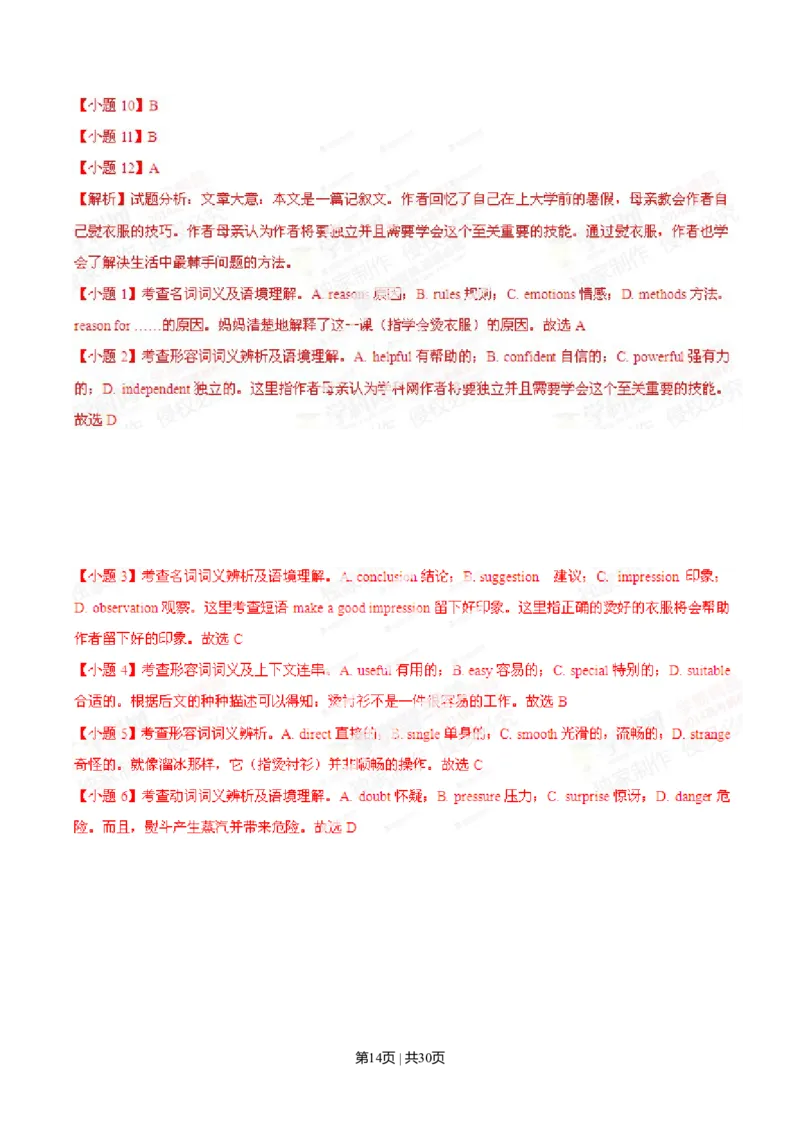
【小题1】A. reasons B. rules C. emotions D. methods
【小题2】A. helpful B. confident C. powerful D. independent
【小题3】A. conclusion B. suggestion C. impression D. observation
【小题4】A. useful B. easy C. special D. suitable
【小题5】A. direct B. single C. smooth D. strange
【小题6】A. doubt B. pressure C. surprise D. danger
【小题7】A. went away B. fell down C. jumped off D. looked up
【小题8】A. taught B. chose C. forced D. sent
【小题9】A. touch B. design C. see D. admire
【小题10】A. honesty B. freedom C. justice D. pride
【小题11】A. Instead B. Besides C. Otherwise D. However
【小题12】A. Make up B. Deal with C Ask for D. Rely on
【答案】
【小题1】A
【小题2】D
【小题3】C
【小题4】B
【小题5】C
【小题6】D
【小题7】A
【小题8】A
【小题9】C
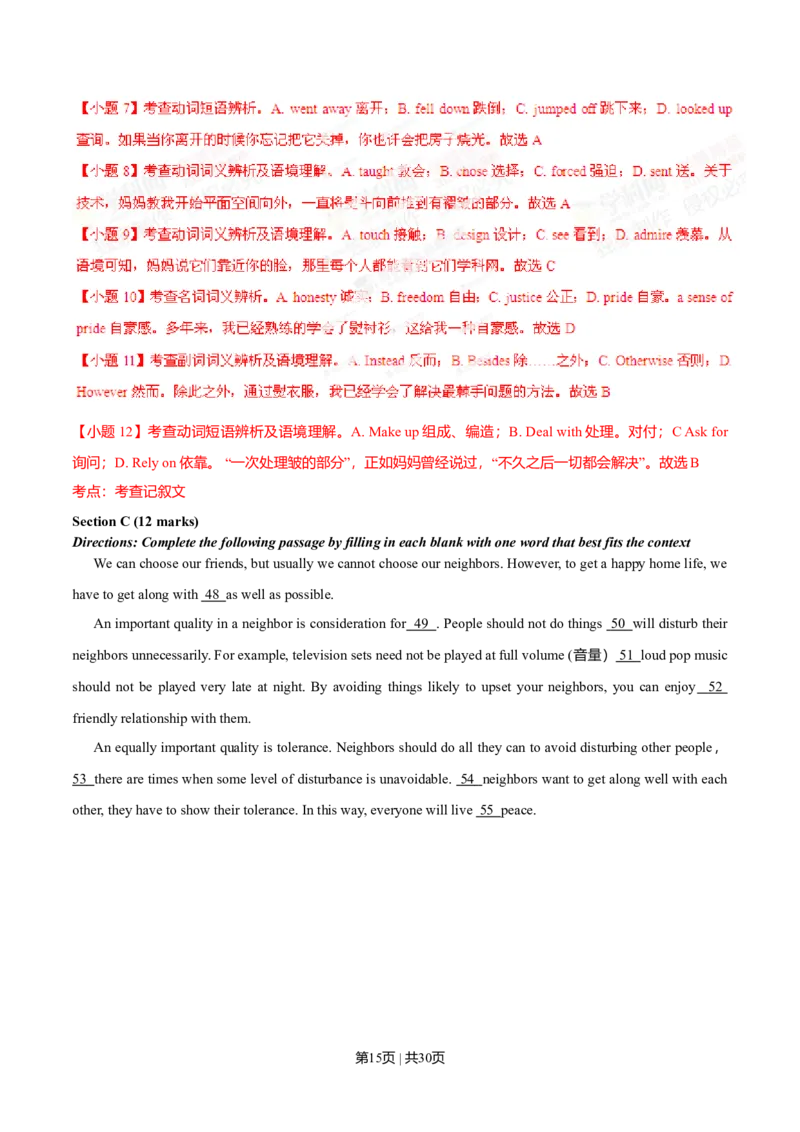
第13页 | 共30页第14页 | 共30页【小题12】考查动词短语辨析及语境理解。A. Make up组成、编造;B. Deal with处理。对付;C Ask for
询问;D. Rely on依靠。 “一次处理皱的部分”,正如妈妈曾经说过,“不久之后一切都会解决”。故选B
考点:考查记叙文
Section C (12 marks)
Directions: Complete the following passage by filling in each blank with one word that best fits the context
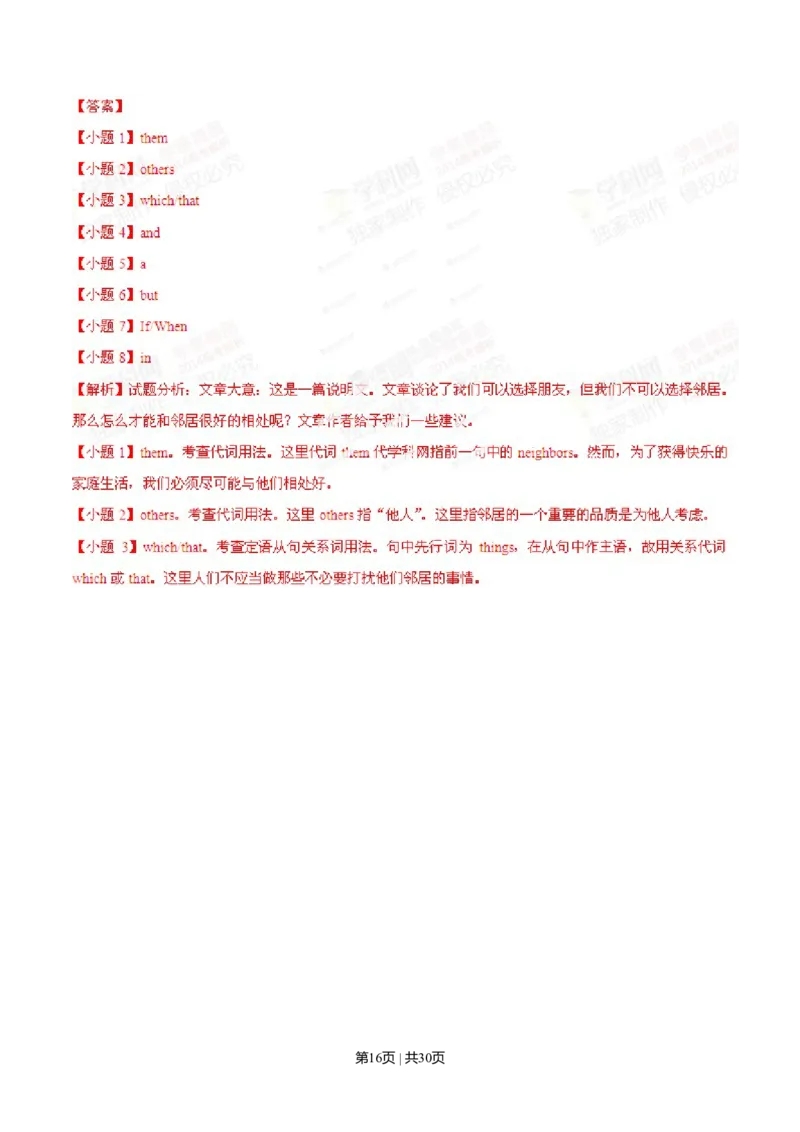
We can choose our friends, but usually we cannot choose our neighbors. However, to get a happy home life, we
have to get along with 48 as well as possible.
An important quality in a neighbor is consideration for 49 . People should not do things 50 will disturb their
neighbors unnecessarily. For example, television sets need not be played at full volume (音量) 51 loud pop music
should not be played very late at night. By avoiding things likely to upset your neighbors, you can enjoy 52
friendly relationship with them.
An equally important quality is tolerance. Neighbors should do all they can to avoid disturbing other people,
53 there are times when some level of disturbance is unavoidable. 54 neighbors want to get along well with each
other, they have to show their tolerance. In this way, everyone will live 55 peace.
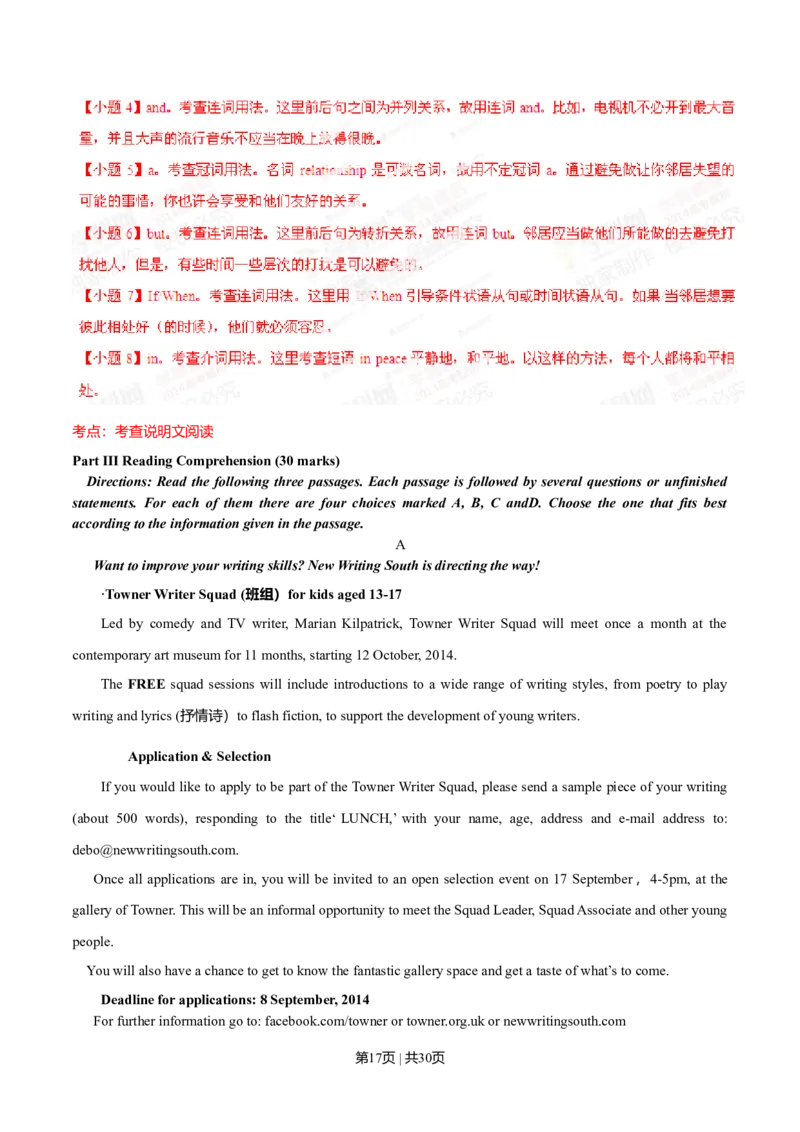
第15页 | 共30页第16页 | 共30页考点:考查说明文阅读
Part Ⅲ Reading Comprehension (30 marks)
Directions: Read the following three passages. Each passage is followed by several questions or unfinished
statements. For each of them there are four choices marked A, B, C andD. Choose the one that fits best
according to the information given in the passage.
A
Want to improve your writing skills? New Writing South is directing the way!
·Towner Writer Squad (班组)for kids aged 13-17
Led by comedy and TV writer, Marian Kilpatrick, Towner Writer Squad will meet once a month at the
contemporary art museum for 11 months, starting 12 October, 2014.
The FREE squad sessions will include introductions to a wide range of writing styles, from poetry to play
writing and lyrics (抒情诗)to flash fiction, to support the development of young writers.
Application & Selection
If you would like to apply to be part of the Towner Writer Squad, please send a sample piece of your writing
(about 500 words), responding to the title‘ LUNCH,’ with your name, age, address and e-mail address to:
debo@newwritingsouth.com.
Once all applications are in, you will be invited to an open selection event on 17 September,4-5pm, at the
gallery of Towner. This will be an informal opportunity to meet the Squad Leader, Squad Associate and other young
people.
You will also have a chance to get to know the fantastic gallery space and get a taste of what’s to come.
Deadline for applications: 8 September, 2014
For further information go to: facebook.com/towner or towner.org.uk or newwritingsouth.com
第17页 | 共30页Any questions 一 feel free to send your e-mail to Towner Writer Squad Associate: whame@towner.gov.uk
﹡ ﹡ ﹡ ﹡ ﹡ ﹡ ﹡ ﹡ ﹡
·Beginner Writing Project for kids aged 10-13
Due to popular demand, a writing project will be started for eager beginners.
Start time: 6 September, 2014
[来源:学科网]
Meet every other Saturday,2-4pm, at the Towner Study Centre.
Study and write at your own pace 一 you do not have to rush 一 as you have a year to go through the project.
Practise under the guidance of some experienced writers and teachers who can help you with basic writing skills.
Most importantly, build confidence and have fun while writing!
No previous experience or special background is required. Many others have been successful this way. If they
can do it, why can’t you?
Fee: £179
For more information go to: newtowner.org.uk or generate.org.uk
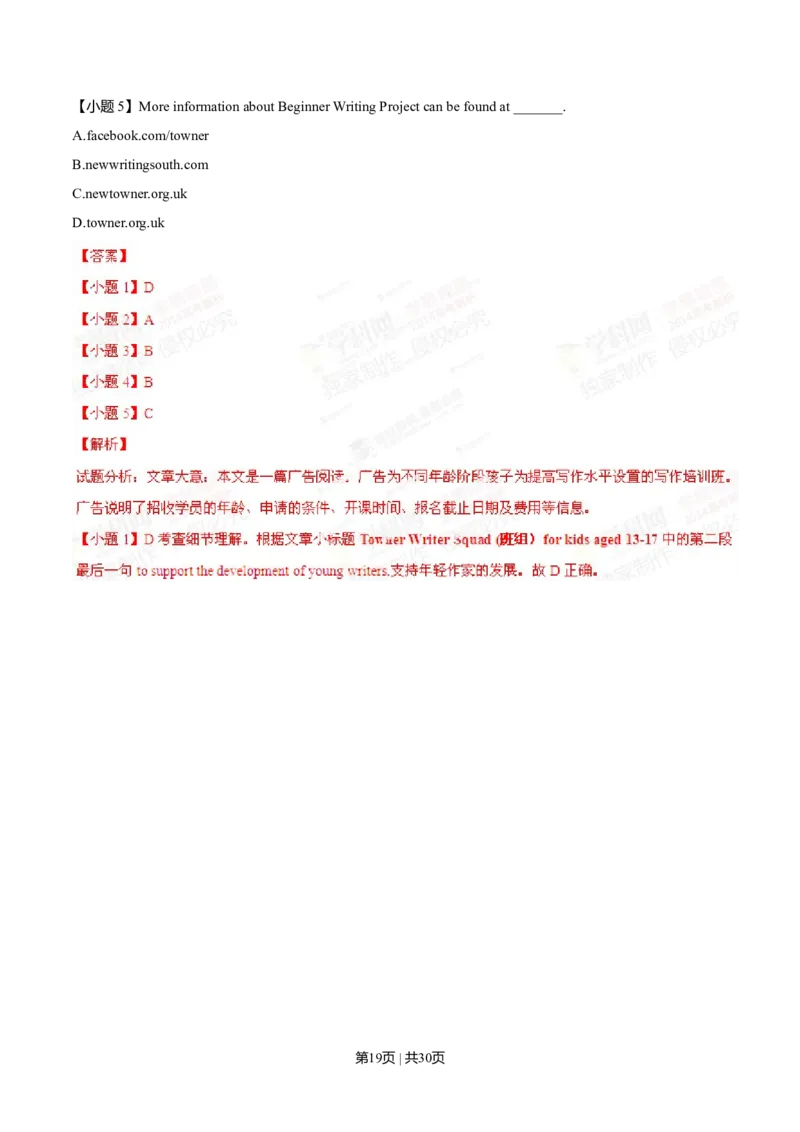
【小题1】Towner Writer Squad will be started _______.
A. to train comedy and TV writers
B.to explore the fantastic gallery space
C.to introduce a contemporary art museum
D.to promote the development of young writers
【小题2】To join the Writer Squad,each applicant should first _______.
A.provide a piece of their writing
B.meet the Writer Squad Leader
C.offer their family information
D.complete an application form
【小题3】Applications for the Writer Squad should be e-mailed no later than _______.
A.6 September, 2014
B.8 September, 2014
C.17 September, 2014
D.12 October, 2014
【小题4】What is most important for the beginners?
A.Practising as much as possible.
B.Gaining confidence and having fun.
C.Studying and writing at their own pace.
D.Learning skills from writers and teachers.
第18页 | 共30页【小题5】More information about Beginner Writing Project can be found at _______.
A.facebook.com/towner
B.newwritingsouth.com
C.newtowner.org.uk
D.towner.org.uk
第19页 | 共30页B
In the mid-1950s, I was a somewhat bored early-adolescent male student who believed that doing an y more
than necessary was wasted effort. One day, this approach threw me into embarrassment
In Mrs. Totten’s eighth-grade math class at Central Avenue School in Anderson, Indiana, we were learning to
add and subtract decimals (小数).
Our teacher typically assigned daily homework, which would be recited in class the following day. On most
days, our grades were based on our oral answer to homework questions.
Mrs. Totten usually walked up and down the rows of desks requesting answers from student after student in
the order the questions had appeared on our homework sheets. She would start either at the front or the back of the
classroom and work toward the other end.
Since I was seated near the middle of about 35 students, it was easy to figure out which questions I might have
to answer. This particular time, I had completed my usual two or three problems according to my calculations.
What I failed to expect was that several students were absent, which threw off my estimate. As Mrs. Totten
made her way from the beginning of the class,I desperately tried to determine which math problem I would get. I
tried to work it out before she got to me, but I had brain freeze and couldn’t function.
When Mrs. Totten reached my desk,she asked what answer I’d got for problem No. 14. “I…I didn’t get
anything,” I answered,and my face felt warm.
“Correct,” she said.
It turned out that the correct answer was zero.
第20页 | 共30页What did I learn that day? First, always do all your homework. Second, in real life it isn’t always what you say
but how you say it that matters. Third,I would never make it as a mathematician.
If I could choose one school day that taught me the most, it would be that one.
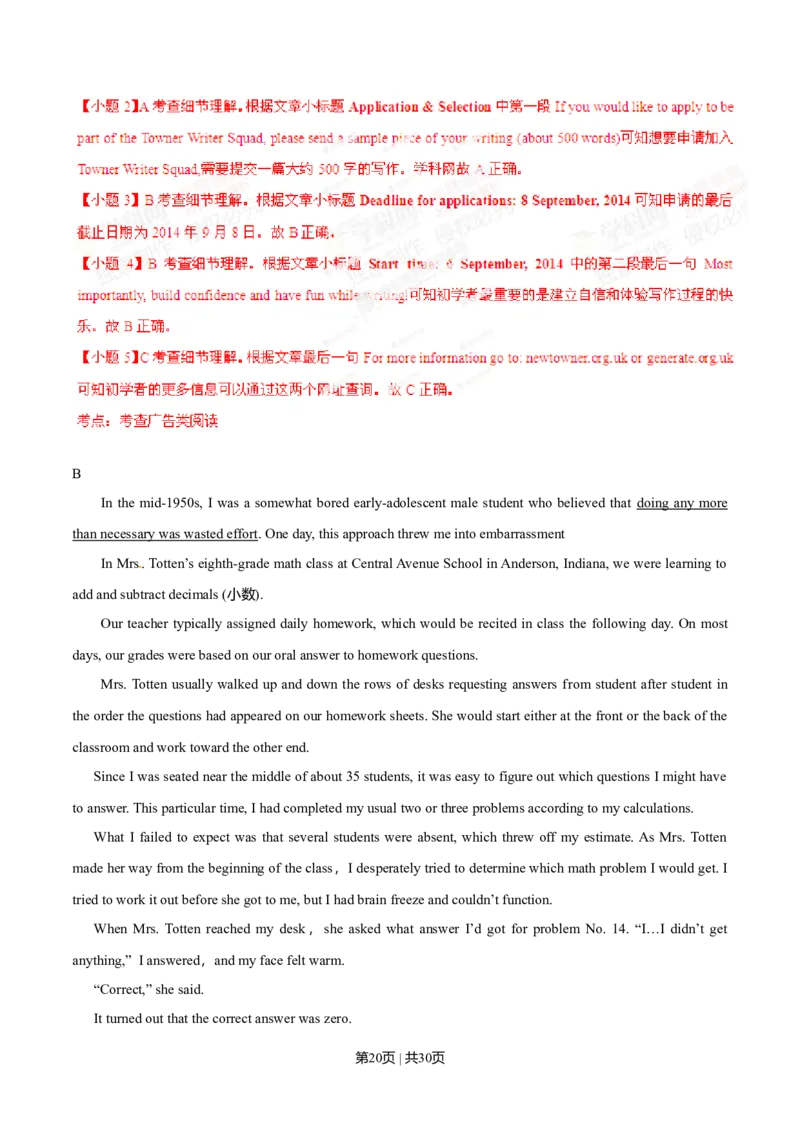
【小题1】What does the underlined part in Paragraph 1 indicate?
[来源:学科网ZXXK]
A.It is wise to value one’s time.
B.It is important to make an effort
C.It is right to stick to one’s belief.
D.It is enough to do the necessary.
【小题2】Usually, Mrs. Totten asked her students to _______.
A. recite their homework together
B.grade their homework themselves
C.answer their homework questions orally
D.check the answers to their homework questions
【小题3】The author could work out which questions to answer since the teacher always _______.
A.asked questions in a regular way
B.walked up and down when asking questions
C.chose two or three questions for the students
D.requested her students to finish their usual questions
【小题4】The author failed to get the questions he had expected because _______.
A.the class didn’t begin as usual
B.several students didn’t come to school
C.he didn’t try hard to make his estimate
D.Mrs. Totten didn’t start from the back of the class
【小题5】 Which of the following can be the best title for the passage?
A.An Unforgettable Teacher
B.A Future Mathematician
C.An Effective Approach
D.A Valuable Lesson
第21页 | 共30页【小题2】C考查细节理解。根据文章第三段最后一句On most days, our grades were based on our oral answer
to homework questions.可知作者的数学老师要求学生口头回答家庭作业的问题。故C正确。
考点:考查记叙文阅读
C
The behaviour of a building’s users may be at least as important as its design when it comes to energy use,
according to new research from the UK Energy Research Centre (UKERC). The UK promises to reduce its carbon
emissions (排放)by 80 percent by 2050, part of which will be achieved by all new homes being zero-carbon by
2016. But this report shows that sustainable building design on its own — though extremely important- is not
enough to achieve such reductions: the behaviour of the people using the building has to change too.
The study suggests that the ways that people use and live in their homes have been largely ignored by existing
第22页 | 共30页efforts to improve energy efficiency (效率),which instead focus on architectural and technological developments.
‘Technology is going to assist but it is not going to do everything,’explains Katy Janda, a UKERC senior
researcher,‘consumption patterns of building users can defeat the most careful design. ’In other words,old
habits die hard, even in the best-designed eco-home.
Another part of the problem is information. Households and bill-payers don’t have the knowledge they need to
change their energy-use habits. Without specific information,it’s hard to estimate the costs and benefits of making
different choices. Feedback (反馈) facilities, like smart meters and energy monitors,could help bridge this
information gap by helping people see how changing their behaviour directly affects their energy use; some studies
have shown that households can achieve up to 15 percent energy savings using smart meters.
Social science research has added a further dimension (方面),suggesting that individuals’behaviour in the
home can be personal and cannot be predicted 一 whether people throw open their windows rather than turn down
the thermostat (恒温器) , for example.
Janda argues that education is the key. She calls for a focused programme to teach people about buildings and
their own behaviour in them.
【小题1】As to energy use, the new research from UKERC stresses the importance of________.
A. zero-carbon homes B. the behaviour of building users
C. sustainable building design D. the reduction of carbon emissions
【小题2】The underlined word “which” in Paragraph 2 refers to”________.”
A. the ways B. their homes
C. developments D. existing efforts
【小题3】What are Katy Janda’s words mainly about?
A. The importance of changing building users, habits.
B. The necessity of making a careful building design.
C. The variety of consumption patterns of building users.
D. The role of technology in improving energy efficiency.
【小题4】The information gap in energy use _______.
A. can be bridged by feedback facilities
B. affects the study on energy monitors
C. brings about problems for smart meters
D. will be caused by building users’ old habits
【小题5】What does the dimension added by social science research suggest?
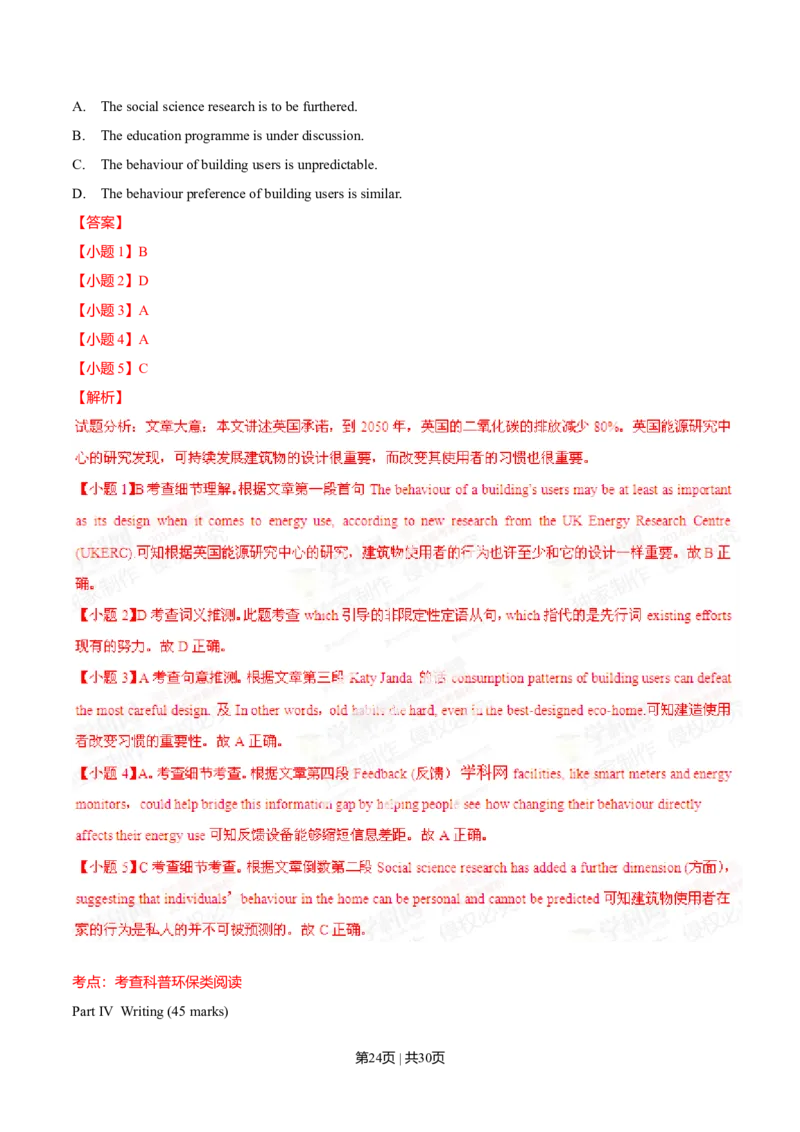
第23页 | 共30页A. The social science research is to be furthered.
B. The education programme is under discussion.
C. The behaviour of building users is unpredictable.
D. The behaviour preference of building users is similar.
【答案】
【小题1】B
【小题2】D
【小题3】A
【小题4】A
【小题5】C
【解析】
考点:考查科普环保类阅读
Part IV Writing (45 marks)
第24页 | 共30页Section A (10 marks)
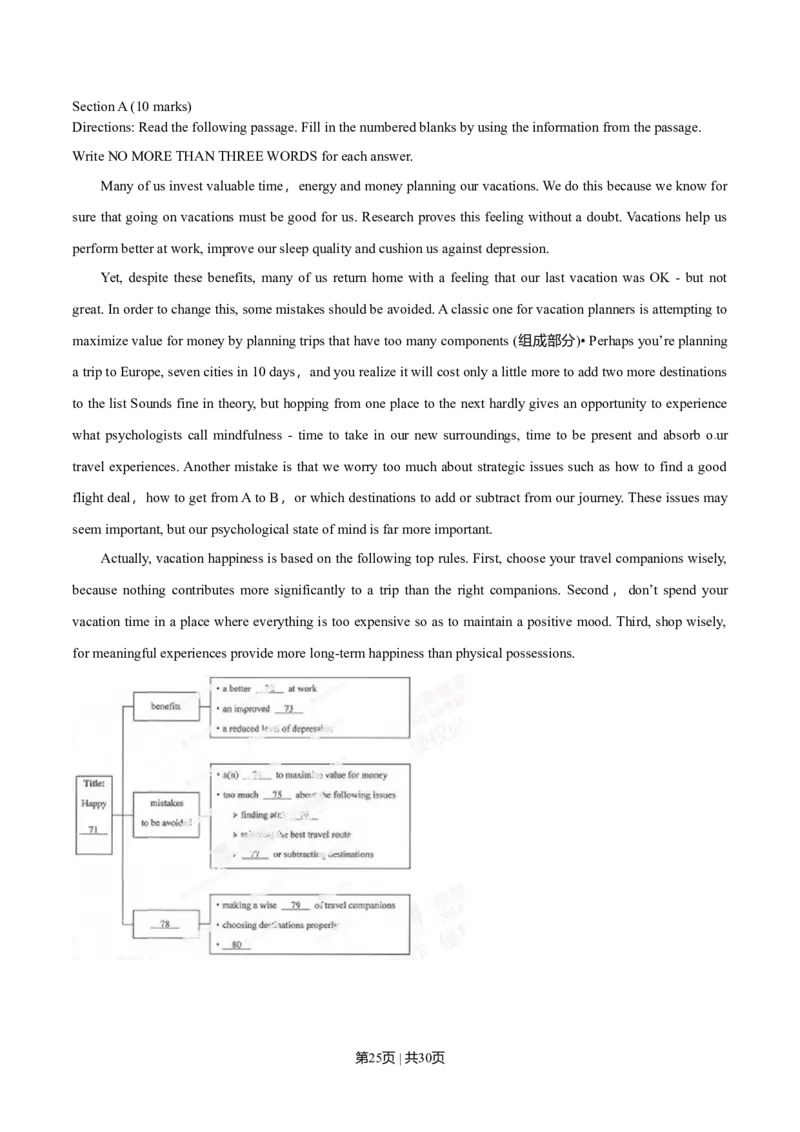
Directions: Read the following passage. Fill in the numbered blanks by using the information from the passage.
Write NO MORE THAN THREE WORDS for each answer.
Many of us invest valuable time,energy and money planning our vacations. We do this because we know for
sure that going on vacations must be good for us. Research proves this feeling without a doubt. Vacations help us
perform better at work, improve our sleep quality and cushion us against depression.
Yet, despite these benefits, many of us return home with a feeling that our last vacation was OK - but not
great. In order to change this, some mistakes should be avoided. A classic one for vacation planners is attempting to
maximize value for money by planning trips that have too many components (组成部分)• Perhaps you’re planning
a trip to Europe, seven cities in 10 days,and you realize it will cost only a little more to add two more destinations
to the list Sounds fine in theory, but hopping from one place to the next hardly gives an opportunity to experience
what psychologists call mindfulness - time to take in our new surroundings, time to be present and absorb our
travel experiences. Another mistake is that we worry too much about strategic issues such as how to find a good
flight deal,how to get from A to B,or which destinations to add or subtract from our journey. These issues may
seem important, but our psychological state of mind is far more important.
Actually, vacation happiness is based on the following top rules. First, choose your travel companions wisely,
because nothing contributes more significantly to a trip than the right companions. Second,don’t spend your
vacation time in a place where everything is too expensive so as to maintain a positive mood. Third, shop wisely,
for meaningful experiences provide more long-term happiness than physical possessions.
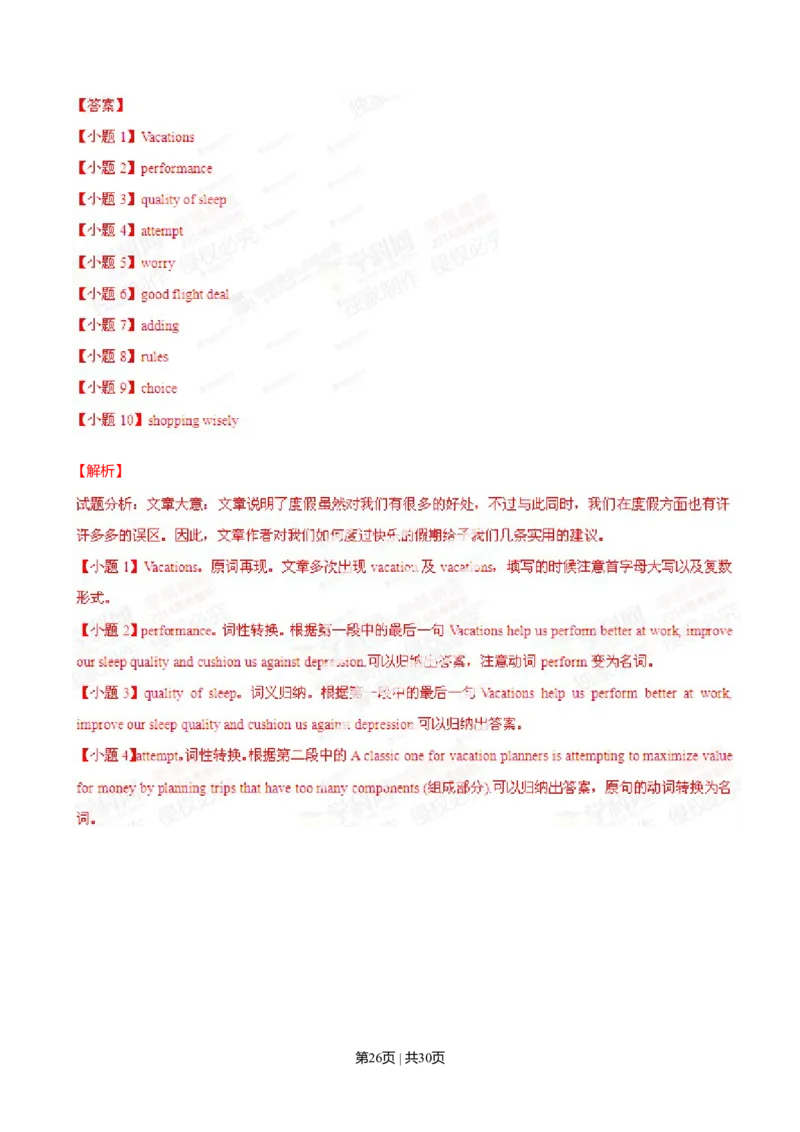
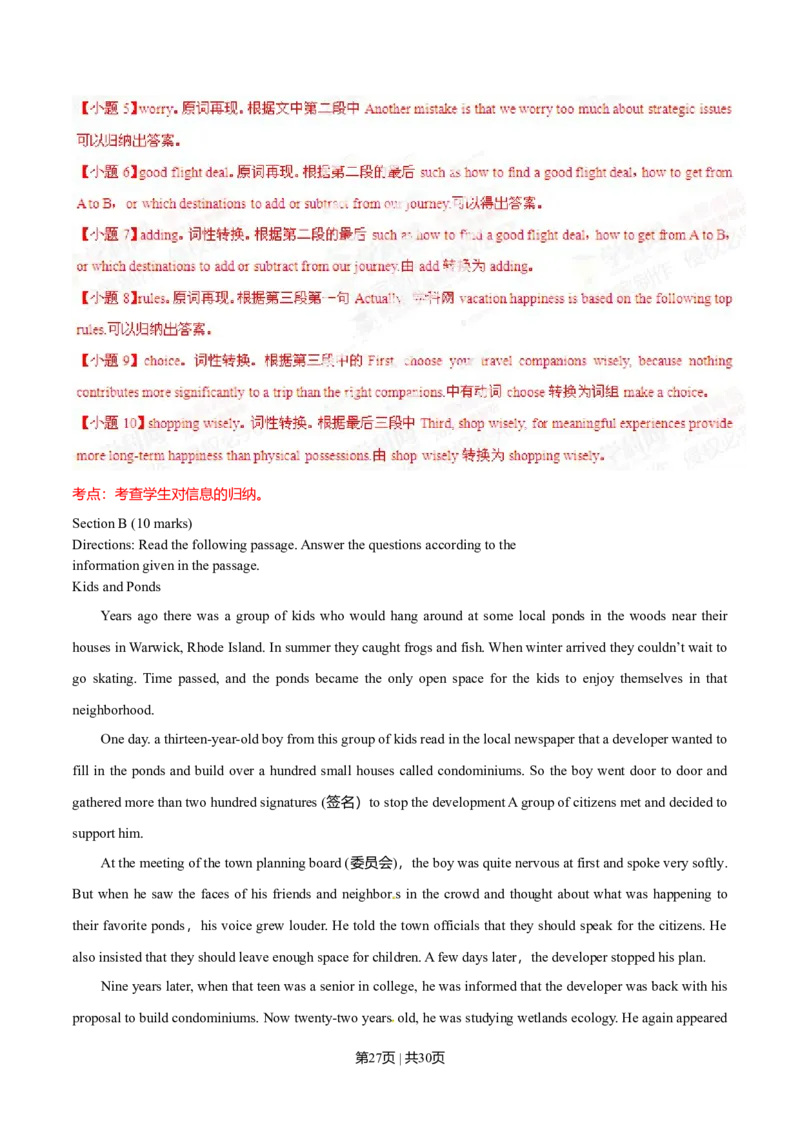
第25页 | 共30页【解析】
第26页 | 共30页考点:考查学生对信息的归纳。
Section B (10 marks)
Directions: Read the following passage. Answer the questions according to the
information given in the passage.
Kids and Ponds
Years ago there was a group of kids who would hang around at some local ponds in the woods near their
houses in Warwick, Rhode Island. In summer they caught frogs and fish. When winter arrived they couldn’t wait to
go skating. Time passed, and the ponds became the only open space for the kids to enjoy themselves in that
neighborhood.
One day. a thirteen-year-old boy from this group of kids read in the local newspaper that a developer wanted to
fill in the ponds and build over a hundred small houses called condominiums. So the boy went door to door and
gathered more than two hundred signatures (签名)to stop the development A group of citizens met and decided to
support him.
At the meeting of the town planning board (委员会),the boy was quite nervous at first and spoke very softly.
But when he saw the faces of his friends and neighbors in the crowd and thought about what was happening to
their favorite ponds,his voice grew louder. He told the town officials that they should speak for the citizens. He
also insisted that they should leave enough space for children. A few days later,the developer stopped his plan.
Nine years later, when that teen was a senior in college, he was informed that the developer was back with his
proposal to build condominiums. Now twenty-two years old, he was studying wetlands ecology. He again appeared
第27页 | 共30页before the town planning board. This time as an expert witness, he used environmental protection laws to explain
restrictions on development in and around wetlands and the knowledge of wetlands ecology to help improve the
development. Finally some condominiums were built, but less than half the number the developer wanted. The
ponds where those kids used to hang around were protected by a strip of natural land,and are still there today.
【小题1】What did the kids like to do at the local ponds in winter?
(No more than 6 words) (2 marks)
_______________________________________________________________________________
【小题1】How did the boy win the citizens’ support?
(No more than 10 words) (2 marks)
_______________________________________________________________________________
【小题1】What did the boy tell the town officials?
(No more than 16 words) (3 marks)
_______________________________________________________________________________
【小题1】What helped the boy to protect the ponds successfully nine years later?
(No more than 12 words) (3 marks)
_______________________________________________________________________________
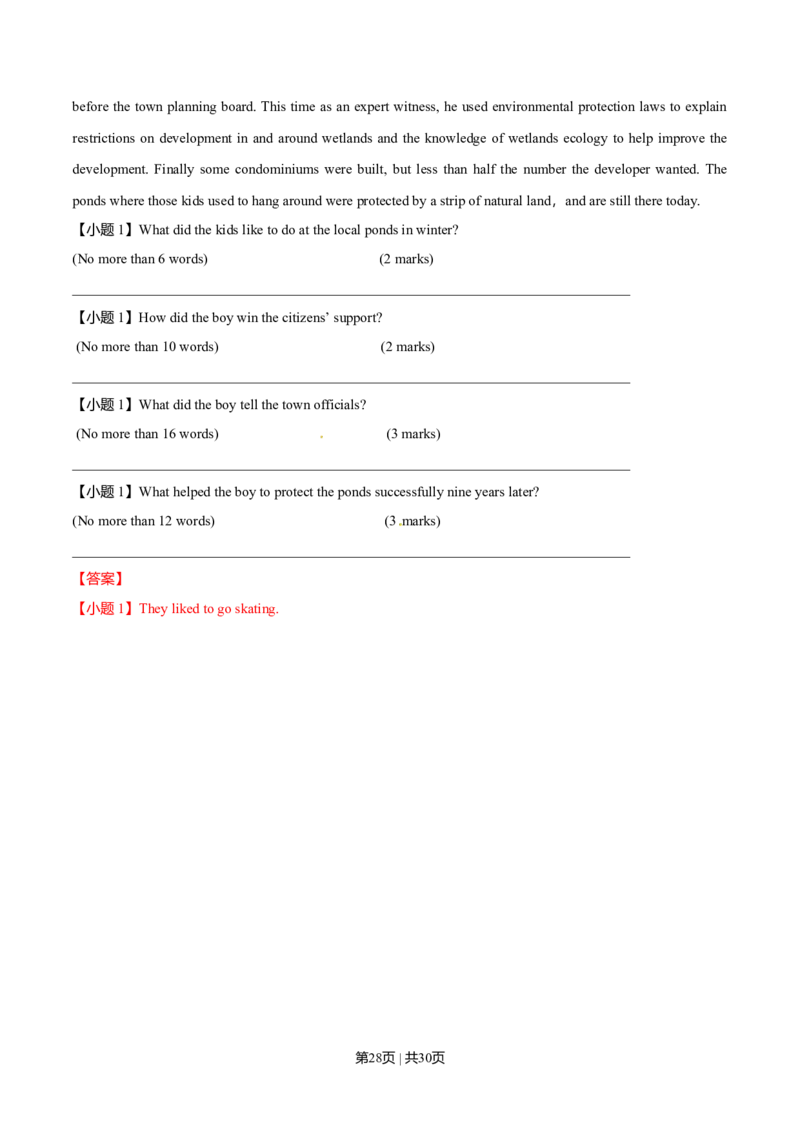
【答案】
【小题1】They liked to go skating.
第28页 | 共30页考点:考查记叙文阅读
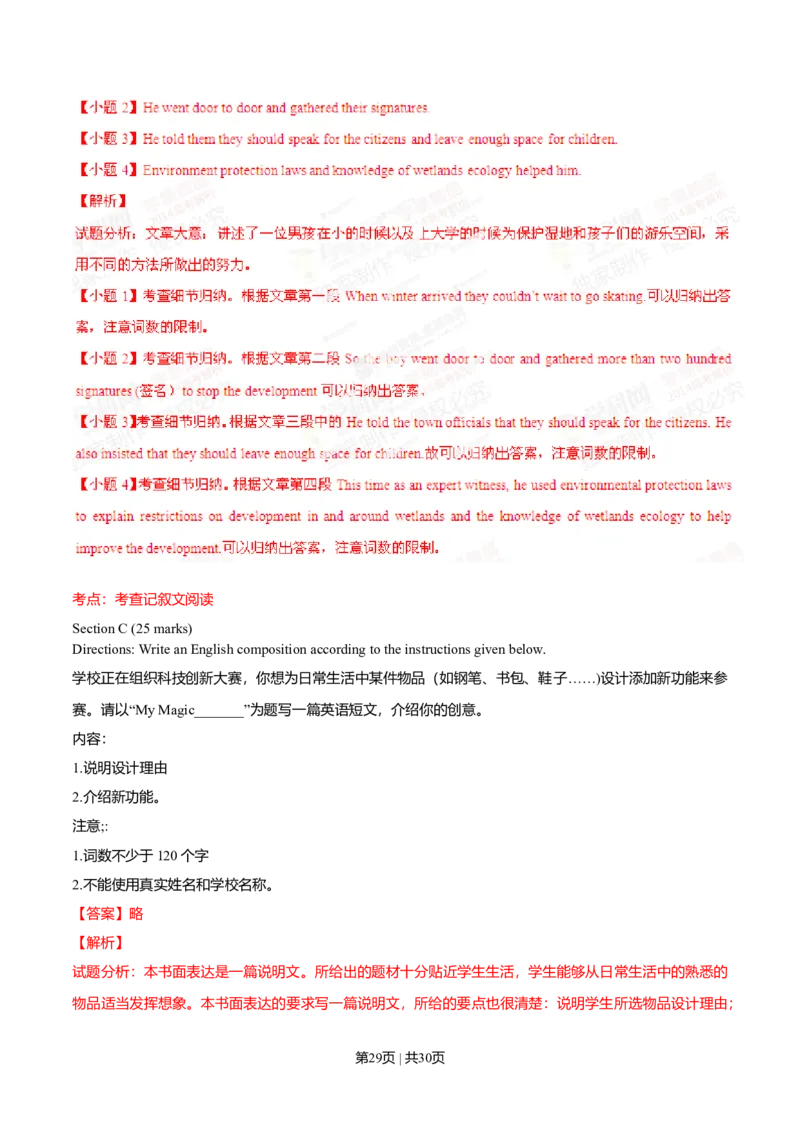
Section C (25 marks)
Directions: Write an English composition according to the instructions given below.
学校正在组织科技创新大赛,你想为日常生活中某件物品(如钢笔、书包、鞋子……)设计添加新功能来参
赛。请以“My Magic_______”为题写一篇英语短文,介绍你的创意。
内容:
1.说明设计理由
2.介绍新功能。
注意;:
1.词数不少于120个字
2.不能使用真实姓名和学校名称。
【答案】略
【解析】
试题分析:本书面表达是一篇说明文。所给出的题材十分贴近学生生活,学生能够从日常生活中的熟悉的
物品适当发挥想象。本书面表达的要求写一篇说明文,所给的要点也很清楚:说明学生所选物品设计理由;
第29页 | 共30页第30页 | 共30页