




文档内容
9. ----How much do I owe you for lunch?
2008 年普通高等学校招生全国统一考试(天
----______. It’s nothing.
A. You’re welcome B. Forget it C. With pleasure D. That’s right
津卷)
10. Many Chinese universities provided scholarships for students ______ financial aid.
A. in favour of B. in honour of C. in face of D. in need of
英语
11. Most air pollution is caused by the burning of ____ like coal, gas and oil.
本试卷分第I卷(选择题)、第II卷(非选择题)和第 A. fuels B. articles C. goods D. products
III卷(选择题)三部分,共150分,考试用时120分钟。第 12. The last time we had great fun was _____ we were visiting the Water Park.
I卷1至10页,第II卷11至12页,第III卷13至16页, A. where B. how C. when D. why
考生务必将答案写在答题卡上,答在试卷上的无效。考试结 13. Her shoes ______ her dress; they look very well together.
束后,将本试卷和答题卡一并交回。 A. suit B. fit C. compare D. match
祝各位考生考试顺利! 14. He _____ football regularly for many years when he was young.
A. was playing B. played C. has played D. had played
第I卷
15. At the railway station, the mother waved goodbye to her daughter until the train was _______.
第一部分:英语知识运用(共两节,满分45分) A. out f sight B. out f reach C. out f order D. out f place
第一节:单项填空(共15小题;每小题1分,满分15分) 第二节:完形填空(共20小题;每小题1.5分,满分30分)
从A、B、C、D四个选项中,选出可以填入空白处的最佳选项。 阅读下面短文,掌握其大意,然后从16-35各题所给的A、B、C、D四个
例:Stand over there _____ you’ll be able to see it before. 选项中,选出最佳选项。
A. or B. and C. but D. while Jenna, a popular girl from Westwood Middle School, had graduated first in her class and was ready for new 16 in high school.
答案是B。 17, high school was different. In the first week, Jenna went to tryouts(选拔赛)for cheerleaders(拉拉队队员). She was competing against very talented girls, and
1. We’ll have a picnic in the park this Sunday _____ it rains or it’s very she knew it would be 18 for her to be selected. Two hours later, the 19 read a list of the girls for a second tryout. Her heart 20 as the list ended without her name.
cold. Feeling 21 , she walked home carrying her schoolbag full of homework.
A. since B. if C. unless D. until Arriving home, she started with math. She had always been a good math student, but now she was 22 . She moved on to English and history, and was 23 to find
2. My brother is really ____. He often works in his office far into the night. that she didn’t have any trouble with those subjects. Feeling better, she decided not to 24 math for the time being.
A. open-minded B. hard-working C. self-confident D. warm-hearted The nest day Jenna went to see Mrs. Biden about being on the school 25 . Mrs. Biden wasn’t as 26 as Jenna. “I’m sorry, but we have enough 27 for the
3. ---- I just can’t stop worrying about the result of the job interview. newspaper already. Come back next year and we’ll talk then.” Jenna smiled 28 and left. “Why is high school so 29 ?” she sighed.
----_____. There’s nothing you can do now but wait. Later in 30 class, Jenna devoted herself to figuring out the problems that had given her so much 31 . By the end of class, she understood how to get them right.
A. Relax B. Go ahead C. Go for it D. Good luck As she gathered her books, Jenna decided she’d continue to try to 32 at her new school. She wasn’t sure if she’d succeed, but she knew she had to 33 . High school
4. _____ their hats into the air, the fans of the winning team let out loud was just as her mom had said: “You will feel like a small fish in a big pond 34 a big fish in a small pond. The challenge is to become the 35 fish you can be.”
shouts of victory. 16. A. processes B. decision C. challenges D. exercises
A. To throw B. Thrown C. Throwing D. Being thrown 17. A. Therefore B. However C. Otherwise D. Besides
5. To know more about the British Museum, you can use the Internet to go 18. A. difficult B. easy C. boring D. interesting
to the library, or _______. 19. A. editor B. boss C. candidate D. judge
A. neither B. some C. all D. both 20. A. jumped B. sank C. stopped D. raced
6. She ______ have left school, for her bike is still here. 21. A. strange B. happy C. awful D. lonely
A. can’t B. wouldn’t C. shouldn’t D. needn’t 22. A. struggling B. improving C. working D. complaining
7. The meal over, the managers went back to the meeting room to ______ 23. A. ashamed B. disappointed C. shocked D. relieved
their discussion. 24. A. put up B. prepare for C. worry about D. give up
A. put away B. take down C. look over D. carry on 25. A. committee B. newspaper C. radio D. team
8. It was along the Mississippi River _______ Mark Twain spent much of 26. A. enthusiastic B. artistic C. sympathetic D. realistic
his childhood. 27. A. speakers B. readers C. cheerleaders D. writers
A. how B. which C. that D. where 28. A. widely B. weakly C. excitedly D. brightly29. A. similar B. ordinary C. different D. familiar C. She was too shy to go to school.
30. A. physics B. history C. English D. math D. She did not have any good teachers.
31. A. pleasure B. hope C. trouble D. sorrow 37. The graduate program gave Cisneros a chance to _____.
32. A. fit in B. look out C. stay up D. get around A. work for a school magazine
33. A. swim B. try C. ask D. escape B. run away from her family
34. A. in return for B. in case of C. in terms of D. instead of C. make a lot of friends
35. A. slimmest B. smallest C. best D. gentlest D. develop her writing style
第二部分:阅读理解(共20小题;每小题2分,满分40分) 38. According to Cisneros, what played the decisive role in her success?
阅读下列短文,从每题所给的A、B、C、D四个选项中,选出 A. Her early years in college.
最佳选项。 B. Her training in the Workshop.
A C. Her feeling of being different.
Sandra Cisneros was born in Chicago in 1954 to a Mexican D. Her childhood experience.
American family. As the only girl in a family of seven children, she often 39. What do we learn about The House on Mango Street?
felt like she had “seven fathers,” because her six brothers, as well as her A. It is quite popular among students.
father, tried to control her. Feeling shy and unimportant, she retreated(躲避) B. It is the only book ever written by Cisneros.
into books. Despite her love of reading, she did not do well in elementary C. It wasn’t success as it was written in Spanish.
school because she was too shy to participate. D. It won an award when Cisneros was twenty-nine.
In high school, with the encouragement of one particular teacher, B
Cisneros improved her grades and worked for the school literary magazine. I love charity(慈善) shops and so do lots of other people in Britain because you find quite a few of them on every high street. The charity shop is a British
Her father encouraged her to go to college because her thought it would be institution, selling everything from clothes to electric goods, all at very good prices. You can get things you won’t find in the shops anymore. The thing I like best about
a good way for her to find a husband. Cisneros did attend college, but them is that your money is going to a good cause and not into the pockets of profit-driven companies, and you are not damaging the planet, but finding a new home for
instead of searching for a husband, she found a teacher who helped her join unwanted goods.
the famous graduate writing program at the University of Iowa. At the The first charity shop was opened in 1947 by Oxfam. The famous charity’s appeal to aid postwar Greece had been so successful it had been flooded with
university’s Writers’ Workshop, however, she felt lonely----a Mexican donations(捐赠物). They decided to set up a shop to sell some of these donations to raise money for that appeal. Now there are over 7,000 charity shops in the UK. My
American from a poor neighborhood among students from wealthy favourite charity shop in my hometown is the Red Cross shop, where I always find children’s books, all 10 or 20 pence each.
families. The feeling of being so different helped Cisneros find her Most of the people working in the charity shops are volunteers, although there is often a manager who gets paid. Over 90% of the goods in the charity shops are
“Creative voice.” donated by the public. Every morning you see bags of unwanted items outside the front of shops, although they don’t encourage this, rather ask people to bring things
“It was not until this moment when I considered myself truly in when the shop is open.
different that my writing acquired a voice. I knew I was a Mexican woman, The shops have very low running costs: all profits go to charity work. Charity shops raise more than £110 million a year, funding(资助)medical research,
but I didn’t think it had anything to do with why I felt so much imbalance in overseas aid, supporting sick and poor children, homeless and disabled people, and much more. What better place to spend your money? You get something special for
my life, but it had everything to do with it! That’s when I decided I would a very good price and a good moral sense. You provide funds to a good cause and tread lightly on the environment.
write about something my classmates couldn’t write about.” 40. The author loves the charity shop mainly because of _______.
Cisneros published her first work, The House on Mango Street, when A. its convenient location
she was twenty-nine. The book tells about a young Mexican American girl B. its great variety of goods
growing up in a Spanish-speaking area in Chicago, much like the C. its spirit of goodwill
neighborhoods in which Cisneros lived as a child. The book won an award D. its nice shopping environment
in 1985 and has been used in classes from high school through graduate 41. The first charity shop in the UK was set up to ____.
school level. Since then, Cisneros has published several books of poetry, a A. sell cheap products
children’s book, and a short-story collection. B. deal with unwanted things
36. Which of the following is TRUE about Cisneros in her childhood? C. raise money for patients
A. She had seven brothers. D. help a foreign country
B. She felt herself a nobody. 42. Which of the following is TRUE about charity shops?A. The operating costs are very low. 44. The passage is most probably taken from _____.
B. The staff are usually well paid. A. a short-story collection
C. 90% of the donations are second-hand. B. a popular science magazine
D. They are open twenty-four hours a day. C. a research paper
43. Which of the following may be the best title for the passage? D. a personal diary
A. What to Buy a Charity Shops. 45. What do we learn from the first four paragraph of the passage?
B. Charity Shop: Its Origin & Development. A. Sharks may be used to predict bad weather.
C. Charity Shop: Where You Buy to Donate. B. Sharks’ behaviour can be controlled.
D. The Public’s Concern about Charity Shops. C. Michael Fish is not qualified for his job.
C D. Lauren Smith will become a weather forecaster.
Michael Fish may soon be replaced as a weather forecaster by 46. Lauren Smith conducted her research by _______.
something truly fishier---the shark(鲨鱼). A. removing hair cells from a shark’s balance system
Research by a British biology student suggests that sharks could be B. measuring the air pressure of weather fronts
used to predict storms. C. recording sharks’ body temperature
Lauren Smith, 24, is close to completing her study on shark’s ability to D. monitoring sharks’ reaction to weather changes
sense pressure. 47. What is the passage mainly about?
If her studies prove the theory, scientists may be able to monitor the A. A popular way of forecasting weather.
behaviour of sharks to predict bad weather. B. A new research effort in predicting storms.
Miss Smith had previously studied the behaviour of lemon sharks in C. Biologists’ interest in the secrets of sharks.
the Bahamas. D. Lauren Smith’s devotion to scientific research.
She then used their close relatives, lesser spotted dogfish, for further D
research at Aberdeen University. We can achieve knowledge either actively or passively(被动地). We achieve it actively by direct experience, by testing and proving an idea, or by reasoning.
Her work---thought to be the first of its kind to test the pressure theory We achieve knowledge passively by being told by someone else. Most of the learning that takes place in the classroom and the kind that happens when we watch
---- resulted from the observation that juvenile blacktip sharks off Florida TV or read newspapers or magazines is passive. Conditioned as we are to passive learning, it’s not surprising that we depend on it in our everyday communication with
moved into deeper water ahead of a violent storm in 2001. friends and co-workers.
Miss Smith said: “I’ve always been crazy about traveling and diving Unfortunately, passive learning has a serious problem. It makes us tend to accept what we are told even when it is little more than hearsay and rumor(谣言).
and this led me to an interest in sharks.” Did you ever play the game Rumor? It begins when one person writes down a message but doesn’t show it to anyone. Then the person whispers it, word for word,
“I was delighted to have been able to research in the area for my to another person. That person, in turn, whispers it to still another, and so on, through all the people playing the game. The last person writes down the message word
degree. I know there’s so much more we need to understand ---- but it for word as he or she hears it. Then the two written statements are compared. Typically, the original message has changed.
certainly opens the way to more research.” That’s what happens in daily life. The simple fact that people repeat a story in their own words changes the story. Then, too, most people listen imperfectly. And
It has been discovered that a shark senses pressure using hair cells in many enjoy adding their own creative touch to a story, trying to improve on it, stamping(打上标记)it with their own personal style. Yet those who hear it think they
its balance system. know.
At the Bimini Shark Lab in the Bahamas, Miss Smith fixed hi-tech This process is also found among scholars and authors: A statement of opinion by one writer may be re-stated as fact by another, who may in turn be quoted by yet
sensors to sharks to record pressure and temperature, while also tracking another; and this process may continue, unless it occurs to someone to question the facts on which the original writer based his opinion or to challenge the
them using GPS (Global Positioning System) technology. interpretation he placed upon those facts.
In Aberdeen, she was able to study the effects of tidal(潮汐的) and 48. According to the passage, passive learning may occur in _______.
temperature changes on dogfish----none of which were harmed. She also A. doing a medical experiment
used a special lab which can mimic(模拟) oceanic pressure changes caused B. solving a math problem
by weather fronts. C. visiting an exhibition
She is due to complete her study and graduate later this year. She says D. doing scientific reasoning
she will be looking for a job which will give her the chance to enrich her 49. The underlined word “it” in Paragraph 2 refers to _____.
experience of shark research. A. active learningB. knowledge school cafeteria.
C. communication 52. The author and his fiends were often out in the woods to _______.
D. passive learning A. spend their free time
50. The author mentions the game Rumor to show that _____. B. play gold and other sports
A. a message may be changed when being passed on C. avoid doing their schoolwork
B. a message should be delivered in different ways D. keep away from their parents
C. people may have problems with their sense of hearing 53. What can we infer from Paragraph 2?
D. people tend not to believe in what they know as rumor A. The activities in the woods were well planned.
51. What can we infer from the passage? B. Human history is not the result of exploration.
A. Active learning is less important. C. Exploration should be a systematic activity.
B. Passive learning may not be reliable. D. The author explored in the woods aimlessly.
C. Active learning occurs more frequently. 54. The underlined word “skeptical” in Paragraph 3 is closest in meaning to ______.
D. Passive learning is not found among scholars. A. calm
E B. doubtful
As kids, my friends and I spent a lot of time out in the woods. “The C. serious
woods” was our part-time address, destination, purpose, and excuse. If I D. optimistic
went to a friend’s house and found him not at home, his mother might say, 55. How does the author feel about his childhood?
“Oh, he’s out in the woods, ” with a tone(语气) of airy acceptance. It’s A. Happy but short.
similar to the tone people sometimes use nowadays to tell me that someone B. Lonely but memorable.
I’m looking for is on the golf course or at the gym, or even “away from his C. Boring and meaningless.
desk.” For us ten-year-olds, “being out in the woods” was just an excuse to D. Long and unforgettable.
do whatever we feel like for a while. 第三部分:写作
We sometimes told ourselves that what we were doing in the woods 第一节:短文改错(共10小题;每小题1分,满分10分)
was exploring(探索). Exploring was a more popular idea back then than it 此题要求改正所给短文中的错误。对标有题号的每一行作出判断:如无错误,在该行右边横线上画一个勾(√);如有错误(每行只有一个错误) ,
is today. History seemed to be mostly about explorers. Our explorations, 则按下列情况改正:
though, seemed to have less system than the historic kind: something 此行多一个词:把多余的词用斜线(\)划掉,在该行右边横线上写出该词,并也用斜线划掉。
usually came up along the way. Say we stayed in the woods, throwing 此行缺一个词:在缺词处加一个漏字符号(∧),在该行右边横线上写出该加的词。
rocks, shooting frogs, picking blackberries, digging in what we were briefly 此行错一个词:在错的词下面画一横线,在该行右边横线上写出改正后的词。
persuaded was an Italian burial mound. Last summer I go to America and studied at a language 56.
Often we got “lost” and had to climb a tree to find out where we school. I had many wonderful experience, but I also 57.
were. If you read a story in which someone does that successfully, be had a sad one. One day, the school held party, where 58.
skeptical: the topmost branches are usually too skinny to hold weight, and I invited to talk about Tianjin. After that they asked me a lot of 59.
we could never climb high enough to see anything except other trees. There Things about China. But I couldn’t explain them with English 60.
were four or five trees that we visited regularly----tall beeches, easy to Clearly. I felt sadly. I learnt a lesson from this experience. I 61.
climb and comfortable to sit in. have already studied English for eight years, I can’t use it 62.
It was in a tree, too, that our days of fooling around in the woods very good. I must work hard to improve my spoken English 63.
came to an end. By then some of us has reached seventh grade and had so that I will not be able to communicate freely with foreigners. 64.
begun the rough ride of adolescence(青春期). In March, the month I hope I can be a bridge between China and others countries 65.
when we usually took to the woods again after winter, two friends and I set in the future.
out to go exploring. We climbed a tree, and all of a sudden it occurred to all 第二节:书面表达(满分25分)
three of us at the same time that were really were rather big to be up in a 66.
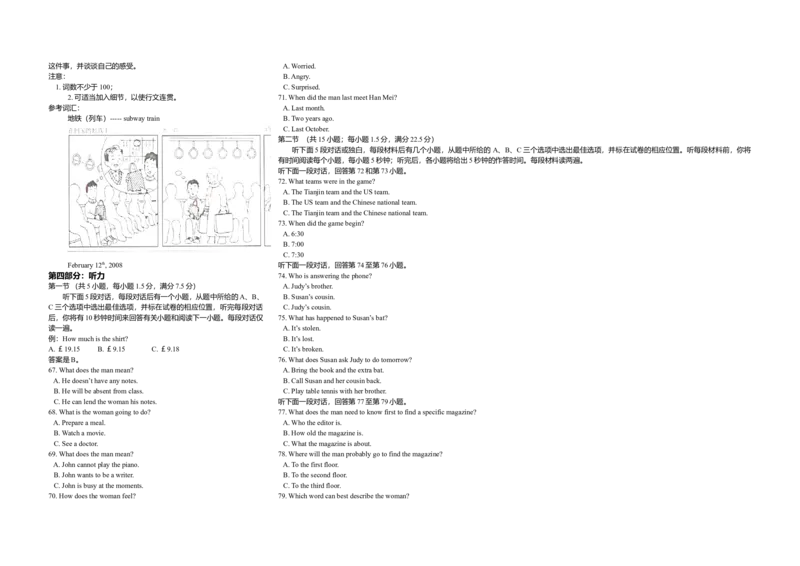
tree. Soon there would be the spring dances on Friday evenings in the high 假设2008年2月12日是你父亲的生日,下面三幅图描绘的是你给父亲买完礼物后乘坐地铁回家时经历的一件事。请根据图示,用英语写一篇日记记叙这件事,并谈谈自己的感受。 A. Worried.
注意: B. Angry.
1. 词数不少于100; C. Surprised.
2. 可适当加入细节,以使行文连贯。 71. When did the man last meet Han Mei?
参考词汇: A. Last month.
地铁(列车)----- subway train B. Two years ago.
C. Last October.
第二节 (共15小题;每小题1.5分,满分22.5分)
听下面5段对话或独白,每段材料后有几个小题,从题中所给的 A、B、C三个选项中选出最佳选项,并标在试卷的相应位置。听每段材料前,你将
有时间阅读每个小题,每小题5秒钟;听完后,各小题将给出5秒钟的作答时间。每段材料读两遍。
听下面一段对话,回答第72和第73小题。
72. What teams were in the game?
A. The Tianjin team and the US team.
B. The US team and the Chinese national team.
C. The Tianjin team and the Chinese national team.
73. When did the game begin?
A. 6:30
B. 7:00
C. 7:30
February 12th, 2008 听下面一段对话,回答第74至第76小题。
第四部分:听力 74. Who is answering the phone?
第一节 (共5小题,每小题1.5分,满分7.5分) A. Judy’s brother.
听下面5段对话,每段对话后有一个小题,从题中所给的A、B、 B. Susan’s cousin.
C三个选项中选出最佳选项,并标在试卷的相应位置,听完每段对话 C. Judy’s cousin.
后,你将有10秒钟时间来回答有关小题和阅读下一小题。每段对话仅 75. What has happened to Susan’s bat?
读一遍。 A. It’s stolen.
例:How much is the shirt? B. It’s lost.
A. £19.15 B. £9.15 C. £9.18 C. It’s broken.
答案是B。 76. What does Susan ask Judy to do tomorrow?
67. What does the man mean? A. Bring the book and the extra bat.
A. He doesn’t have any notes. B. Call Susan and her cousin back.
B. He will be absent from class. C. Play table tennis with her brother.
C. He can lend the woman his notes. 听下面一段对话,回答第77至第79小题。
68. What is the woman going to do? 77. What does the man need to know first to find a specific magazine?
A. Prepare a meal. A. Who the editor is.
B. Watch a movie. B. How old the magazine is.
C. See a doctor. C. What the magazine is about.
69. What does the man mean? 78. Where will the man probably go to find the magazine?
A. John cannot play the piano. A. To the first floor.
B. John wants to be a writer. B. To the second floor.
C. John is busy at the moments. C. To the third floor.
70. How does the woman feel? 79. Which word can best describe the woman?A. Helpful.
B. Impolite.
C. Curious.
听下面一段对话,回答第80至第82小题。
80. What is the probable relationship between the two speakers?
A. Manager and job applicant.
B. Teacher and student.
C. Professor and teaching assistant.
81. When does the woman hope to begin working at a museum?
A. In three years.
B. Nest year.
C. This year.
82. What does the man advise the woman to do?
A. Attend business lectures.
B. Change her major.
C. Reconsider her decision.
听下面一段独白,回答第83至第86小题。
83. Where will the swimming competition be held?
A. At the school swimming pool.
B. At the Jackson Sports Center.
C. At the New Town Swimming Pool.
84. At what time will Grade 7 gather?
A. 9:30
B. 9:35
C. 9:45
85. Which of the following is TRUE according to the speaker?
A. Students don’t have to bring cold drinks?
B. Students can get their lunch for free.
C. Students have to pay for the bus ride.
86. What is the announcement about?
A. The schedule of the competition.
B. The location of the Sports Center.
C. The arrangements for the day.