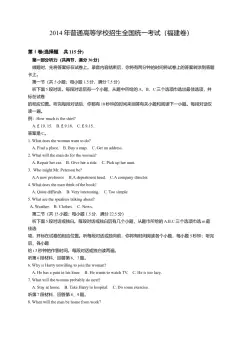
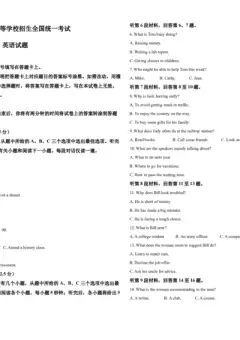
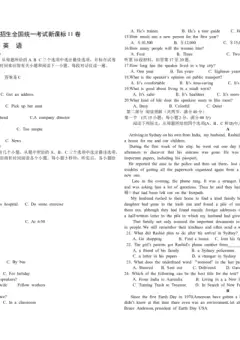
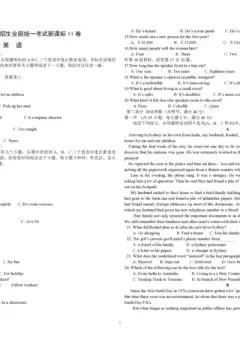
2014年普通高等学校招生全国统一考试新课标II卷
英 语
第一节(共5个小题:每小题1.5分,满分7.5分)
听下面5段对话。每段对话后有一道小题,从每题所给的A B C三个选项中选出最佳选项,并
标在试卷的相应位置。听完每段对话后,你都有10秒钟的时间来回答有关小题和阅读下一小题。每
段对话仅读一遍。
例:How much is the shirt?
A. £19.15 B.£9.18 C. £9.15 答案是C
1.What does the woman want to do?
A .Find a place B. Buy a map C. Get an address
2.What will the man do for the woman?
A. Repair her car B. Give her a ride C. Pick up her aunt
3.Who might Mr. Peterson be?
A. A new professor. B. A departmet head. C.A company director
4.What does the man think of the book?
A. Quite difficult B. Very interesting C. Too simple
5. What are the speakers talking about?
A. Weather B. Clothes C. News
第二节(共15小题:每小题1.5分,满分22.5分)
听下面5段对话或对白,每段对话或对白后有几个小题,从题中所给的 A、B、C三个选项中选
出最佳选项,并标在试卷的相应位置,听每段对话或独白前,你将有时间阅读各个小题。每小题 5秒
钟;听完后,各小题给出5秒钟的作答时间。每段对话或独白读两遍。
听第6断材料,回答第6、7题。
6. Why is Harry unwilling to join woman?
A. He has a pain in his knee.
B. He wants watch TV.
C. He is too lazy.
7. What will the woman probably do next?
A. stay at home B. Take Harry to hospital. C. Do some exercise
听第7段材料,回答第8、9题
8.When will the man be home from work?
A. At 5:45 B. At 6:15 C. At 6:50
9.Where will the speakers go?
A. The Green House Cinema
B. The New State Cinema
C. The UME Cinema
听第8段材料,回答第10至12题。
10.How will the speakers go to New York?
A. By air B. By Taxi C. By bus
11.Why are the speakers making the trip?
A. For business B. For shopping C. For holiday
12.What is the probable relationship between the speakers?
A. Driver and passenger B. Husband and wife Fellow workers
听第9段材料,回答第13至16题。
13.Where does this conversation probably take place?A. In a restaurant B. In an office C. In a classroom
14.What does John do now?
A. He’s trainer. B. He’s a tour guide C. He’s a college student
15.How much can a new person for the first year?
A. $10,500 B. $12,000 C. $15,000
16.How many people will the woman hire?
A. Four B. Three C. Two
听第10段材料,回答第17至20题。
17.How long has the speaker lived in a big city?
A. One year B. Ten years C. Eighteen years.
18.What is the speaker’s opinion on public transport?
A. It’s comfortable B. It’s time-saving C. It’s cheap
19.What is good about living in a small town?
A. It’s safer B. It’s healthier C. It’s more convenient
20.What kind of life does the speakers seem to like most?
A. Busy B. Colorful C. Quiet
第二部分 阅读理解(共两节,满分40分)
第一节 (共15小题;每小题2分,满分40分)
阅读下列短文,从每题所给的四个选项(A、B、C和D)中,选出最佳选项。并在答题卡上将该选
项涂黑.
A
Arriving in Sydney on his own from India, my husband, Rashid, stayed in a hotel for a short time while
looking for a house for me and our children.
During the first week of his stay, he went out one day to do some shopping. He came back in
the late afternoon to discover that his suitcase was gone. He was extremely worried as the suitcase
had all his important papers, including his passport.
He reported the case to the police and then sat there,lost and lonely in strange city, thinking of
the terrible troubles of getting all the paperwork organized again from a distant country while trying
to settle down in a new one.
Late in the evening, the phone rang. It was a stranger. He was trying to pronounce my
husband’s name and was asking him a lot of questions. Then he said they had found a pile of
papers in their trash can(垃圾桶)that had been left out on the footpath.
My husband rushed to their home to find a kind family holding all his papers and documents.
Their young daughter had gone to the trash can and found a pile of unfamiliar papers. Her parents
had carefully sorted them out, although they had found mainly foreign addresses on most of the
documents. At last they had seen a half-written letter in the pile in which my husband had given
his new telephone number to a friend.
That family not only restored the important documents to us that day but also restored our
faith and trust in people. We still remember their kindness and often send a warm wish their way.
21. What did Rashid plan to do after his arrival in Sydney?
A. Go shopping B. Find a house C. Join his family D. Take his family
22. The girl’s parents got Rashid’s phone number from_______.
A. a friend of his family B. a Sydney policeman
C. a letter in his papers D. a stranger in Sydney
23. What does the underlined word “restored” in the last paragraph mean?
A. Showed B. Sent out C. Delivered D. Gave back
24. Which of the following can be the best title for the text?
A. From India to Australia. B. Living in a a New Country.C. Turning Trash to Treasure. D. In Search of New Friends.
B
Since the first Earth Day in 1970,American have gotten a lot “greener” toward the environment
. “We didn’t know at that time there even was an environment, let alone that there was a problem
with it,” says Bruce Anderson, president of Earth Day USA.
But what began as nothing important in public affairs has grown into a social movement
.Business people, political leaders, university professors, and especially millions of grass-roots
Americans are taking part in the movement. “The understanding has increased many, many times,”
says Gaylord Nelson, the former governor from Wisconsin, who thought up the first. According to
US government reports , emissions (排放)from cars and trucks have dropped from 10.3 million tons
a year to 5.5 tons. The number of cities producing CO beyond the standard has been reduced from
40 to 9. Although serious problems still remain and need to be dealt with , the world is a safer
and healthier place. A kind of “Green thinking ” has become part of practices .
Great improvement has been achieved .In 1988 there were only 600 recycling programs ,; today
in 1995 there are about 6,600 .Advanced lights ,motors , and building designs have helped save a
lot of energy and therefore prevented pollution .
Twenty –five years ago , there were hardly any education programs for environment .Today ,
it’s hard to find a public school , university , or law school that does not have such a kind of
program .” Until we do that, nothing else will change! ” say Bruce Anderson .
25 According to Anderson , before 1970, Americans had little idea about ___
A. the social movement B. recycling techniques
C. environmental problems D. the importance of Earth Day
26 Where does the support for environmental protection mainly come from?
A. The grass –roots level B. The business circle
C. Government officials D. University professors
27. What have \Americans achieved in environmental protection ?
A. They have cut car emissions to the lowest
B. They have settled their environmental problems
C. They have lowered their CO levels in forty cities.
D. They have reduced pollution through effective measures .
28. What is especially important for environmental protection according to the last paragraph ?
A. Education B. Planning C. Green living D. CO reduction
C
One of the latest trend(趋势)in American Childcare is Chinese au pairs. Au Pair in Stamford,
for example, has got increasing numbers of request for Chinese au pairs from aero to around 4,000
since 2004. And that’s true all across the country.
“I thought it would be useful for him to learn Chinese at an early age” Joseph Stocke, the
managing director of company, says of his 2-year old son. “I would at least like to give him the
chance to use the language in the future,” After only six months of being cared by 25-year-old
woman from China, the boy can already understand basic Chinese daily expressions, his dad says.
Li Drake, a Chinese native raising two children in Minnesota with an American husband, had
another reason for looking for an au pair from China. She didn’t want her children to miss out on
their roots.” Because I am Chinese, my husband and I wanted the children to keep exposed to(接
触) the language and culture.” she says.
“Staying with a native speaker is better for children than simply sitting in a classroom,” says
Suzanne Flynn, a professor in language education of Children.” But parents must understand that just
one year with au pair is unlikely to produce wonders. Complete mastery demands continued learninguntil the age of 10 or 12.”
The popularity of au pairs from China has been strengthened by the increasing numbers of
American parents who want their children to learn Chinese. It is expected that American demand for
au pairs will continue to rise in the next few years.
29.What does that term” au pair” in the text mean?
A. A mother raising her children on her own B. A child learning a foreign language at
home
C. A professor in language education of children D. A young foreign woman taking care of
children.
30. Li Drake has her children study Chinese because she wants them ______.
A. to live in China some day B. to speak the language at home
C. to catch up wit other children D. to learn about the Chinese culture
31. What can we infer from the text?
A. Learning Chinese is becoming popular In America
B. Educated woman do better in looking after children
C. Chinese au pairs need to improve their English Skills
D. Children can learn a foreign language well in six months
D
Metro Pocket Guide
Metrorail(地铁)
Each passenger needs a farecard to enter and go out. Up to two children under ago five may travel
free with a paying customer.
Farecard machine are in every station, Bring small bills because there are no change machines in
the station and farecard machine only provide up to $ 5 in change.
Get one of unlimited Metrorail rides with a One Day Pass. Buy it from a farecard machine in
Metro stations. Use it after 9:30 a.m. until closing on weekdays, and all day on weekends and
holidays.
Hours of Service
Open: 5 a.m Mon-Fri 7a.m. Sat—Sun .
Close midnight Sun—Thur. 3a.m. Fri—Sat. nights
Last train time vary. To avoid missing the last train, please check the last train time posted in
the station.
Metrobus
When paying with exact change, the fare is $ 1.35 . when paying with a smatTrip CARD the
fare is $1.25
Fares for the Senior /disabled customers
Senior citizens 65 and older and disabled customers may ride for half the regular fare. On
Metrorail and Metrobus, use a senior/disabled farecard or SmarTrip card. For more information
about buying senior/disabled farecards, farecard or SmarTripR card and passes, please visit
MetroOpenDoors.com or call 202-637-7000 and 202-637-8000.
Senior citizens and disabled customers can get free guide on how to use proper Metrobus and
Metrorail services by calling 202-962-1100
Travel tips
. Avoid riding during weekday rush periods –before 9:30 a.m. and between 4 and 6 p.m.
. If you lose something on a bus or train or in a station, please call Lost & Found at 202-962-
1195.
32. What should you know about farecard machine?
A. They start selling tickets at 9:30 a.m. B. They are connected to change machines.C. They offer special service to the elderly. D. They make change for no more than $5.
33. At what time does Metrorail stop service on Saturday?
A. At midnight B. at 3 a.m. C. at 5 am D. at 7 p.m.
34. What is good about a SmarTrip card?
A. It is convenient for old people B. It saves money for its users
C. it can be bought at any time D. it is sold on the Internet.
35. Which number should you call if you lose something on the Metro?
A. 202-962-1195 B.202-962-1100 C.202-673-7000 D.202-673-8000
第二节(共5小题;每小题2分,满分10分)
根据短文内容,从短文后的选项中选出能填入空白处的最佳选项。选项中有两项为多余选项。
Tips for cooking on a Tight Schedule
From my experience, there are three main reasons why people don’t cook more often: ability, money
and time, ____36__Money is a topic I’ll save for another day. So today I want to give you some
wisdom about how to make the most of the time you spend in the kitchen. Here are three tips for
great cooking on a tight schedule:
1. Think ahead. The moments when I think cooking is a pain are when I’m already hungry and
there is nothing ready to eat. So think about of the coming week. When will you have time
to cook? Do you have the right materials ready?____37___
2. Make your time worth it. When you do find time to cook a meal, make the most of it and
save yourself time later on. Are you making one loaf of bread? ___38___ it takes around the
same amount of time to make more of something. So save yourself the effort for a future
meal.
3. __ __39 _ ___ This may surprise you, but one of the best tools for making cooking worth your
time is experimentation. It gives you the chance to hit upon new ideas and recipes that can
work well with your appetite and schedule. The more you learn and the more you try, the
more ability you have to take control of your food and your schedule.
Hopefully that gives you a good start. ____40___ and don’t let a busy schedule discourage
you from making some great changes in the way you eat and live!
A. Try new things.
B. Ability is easily improved.
C. Make three or four instead.
D. Understand your food better.
E. Cooking is a burden for many people.
F. Let cooking and living simply be a joy rather than a burden.
G. A little time planning ahead can save a lot of work later on.
第三部分 英语知识运用(共两节,满分45分)
第一节 完形填空(共20小题;每题1.5分,满分30分)
阅读下面短文,从短文后各题所给的四个选项(A, B, C和D)中,选出可以填入空白处的
最佳选项,并在答题卡上将该项涂黑。
Joe Simpson and Simon Yates were the first people to climb the West Face of the Siula
Grande in the Andes mountains. They reached the top __41___, but on their way back conditions
were very _42____. Joe fell and broke his leg. They both knew that if Simon __43_ alone, he
would probably get back _44___. But Simon decided to risk his __45_____ and try to lower Joe
down the mountain on a rope(绳).
As they __46_____ down, the weather got worse. Then another ___47___ occurred. They
couldn’t see or hear each other and, ___48___, Simon lowered his friend over the edge of a
precipice(峭壁). It was ___49____ for Joe to climb back or for Simon to pull him up. Joe’s_50_____ was pulling Simon slowly towards the precipice. ___51____, after more than an hour in
the dark and the icy cold, Simon had to __52____. In tears, he cut the rope. Joe __53_____ into a
large crevasse(裂缝)in the ice below. He had no food or water and he was in terrible pain. He
couldn’t walk, but he __54___ to get out of the crevasse and started to ___55___ towards their
camp, nearly ten kilometers __56_____.
Simon had ___57____ the camp at the foot of the mountain. He thought that Joe must be
__58_____, but he didn’t want to leave ___59____. Three days later, in the middle of the night, he
heard Joe’s voice. He couldn’t ___60____ it. Joe was there, a few meters from their tent, still alive.
41. A. hurriedly B. carefully C. successfully D. early
42. A. difficult B. similar C. special D. normal
43. A. climbed B. worked C. rested D. continued
44. A. unwillingly B. safely C. slowly D. regretfully
45. A. fortune B. time C. health D. life
46. A. lay B. settled C. went D. looked
47. A. damage B. storm C. change D. trouble
48. A. by mistake B. by chance C. by chance D. by luck
49. A. unnecessary B. practical C. important D. impossible
50. A. height B. weight C. strength D. equipment
51. A. Finally B. Patiently C. Surely D. Quickly
52. A. stand back B. take a rest C. make a decision D. hold on
53. A. jumped B. fell C. escaped D. backed
54. A. managed B. planned C. waited D. hoped
55. A. run B. skate C. move D. march
56. A. around B. away C. above D. along
57. A. headed for B. travelled C. left for D. returned to
58. A. dead B. hurt C. weak D. late
59. A. secretly B. tiredly C. immediately D. anxiously
60. A. find B. believe C. make D. accept
第Ⅱ卷
第三部分 英语知识运用
第二节 (共10分;每小题1.5分,满分15分)
阅读下面材料,在空白处填入适当的内容(不多于3个单词)或括号内单词的正确形式。
One morning, I was waiting at the bus stop, worried about __61___ (be) late for school.
There were many people waiting at the bus stop, ___62____ some of them looked very anxious and
___63__
(disappoint) . when the bus finally came, we all hurried on board. I got a place next ____64___ the
window, so I had a good view of the sidewalk. A boy on a bike ____65___ (catch ) my attention.
He was riding beside the bus and waving his arms. I heard a passenger behind me shouting to the
driver, but he refused ____66___
(stop) until we reached the next stop. Still, the boy kept ____67___(ride). He was carrying
something over his shoulder and shouting. Finally, when we came to the next stop, the boy ran up
the door of the bus. I heard an excited conversation. Then the driver stood up and asked, “___68___
anyone lose a suitcase at the last stop?” A woman on the bus shouted, “Oh, dear! It ‘s
____69___ (I )”. She pushed her way to the driver and took the suitcase thankfully, Five others on
the bus began talking about what the boy had done and the crowd of strangers ___70__(sudden)
became friendly to one another.
第四部分:写作(共两节,满分35分)第一节短文改错(共10小题;每小题1分,满分10分)
注意:1.每处错误及其修改均仅限一词; 2.只允许修改10处,多者(从第11处起)不计分。
My dream school starts at 8:30 a.m and ends at 3:30 p.m. They are three lessons in the
morning and two in the afternoon. We didn’t need to do so many homework. Therefore, we have
more time with after-school activities. For example, we can do reading for one and a half hour and
play sport for one hour every day.
My dream school look like a big garden. There are all kinds of the flowers and trees around
the classroom, buildings. We can lie on the grass for a rest, sat by the lake listening music. The
teachers here are kind and helpfully. They are not only our teachers but also our friends.
第二节 书面表达 (25分)
一家英语报社向中学生征文,主题是“十年后的我”、请根据下列要求和你的想象完成短文。
1.家庭 2. 工作 3. 业余生活
注意:1、次数100左右;2、可以适当增加细节,以使行文连贯;3. 开头语已为你写好
I often imagine what my life will be like in the future.
2014年普通高等学校招生全国统一考试新课标II卷
英 语
参考答案
第一部分
1-5ABCBA 6-10 BCACA 11-15ACBCA 16-20CBCAB
第二部分
21—25 BCDCC 26—300 ADADD 31—35 ADBBA 36—40 BGCAF
第三部分
41—45 CADBD 46—50 CDADB 51—55 ACBAC 56—60 BDACB
61. being 62. and 63. disappointed 64. to 65. caught 66. to stop 67. riding
68.did 69. me/mine 70. suddenly
第四部分
My dream school starts at 8:30 a.m. and ends at 3:30 p.m. They are three lesson
There
in the morning and two in the afternoon. We did n ’ t need to do so many homework.
don’t much
Therefore , we have more time with after-school activities. For example, we can do reading
for
for one and a half hou r and play sport for one hour every day.
hours
My dream school loo k like a big garden. There are all kinds of the flowers
looks
and trees around the classroom, buildings. We can lie on the grass for a rest, sat by the
sitlake listening∧ music. The teachers here are kind and helpfully. They are not only our
to helpful
teachers but also our friends.
one Possible Version
I often imagine what my life will be like in the future. I think my life will be very
different in ten years. I will be twenty-eight years old by then. I will have my own family.
Probably with a lovely child. I hope I will work in a computer company as a program designer. I
will enjoy my work and get along well with my colleagues, I will do a good job in whatever I do.
In my free time, I will continue to take regular exercise, such as swimming, running and various
ball games. On my holidays, I will travel around the world. In a word, my life will be much richer
and more colorful.
英语答题卡
Class: ________ Name: ______________ No. :_________ Score: ___________
第一部分
1-5____________ 6-10 _____________ 11-15____________ 16-20______________
第二部分
21—25 ____________ 26—30____________ 31—35 ____________ 36—40 ____________
第三部分
41—45 ____________ 46—50 ____________ 51—55 ____________ 56—60 _____________
61. ____________ 62. ____________ 63. ____________ 64. ____________
65. ____________ 66. ____________ 67. ____________ 68. ____________
69. ____________ 70. ____________
第四部分
My dream school starts at 8:30 a.m and ends at 3:30 p.m. They are three lesson in the
morning and two in the afternoon. We didn’t need to do so many homework. Therefore, we havemore time with after-school activities. For example, we can do reading for one and a half hour and
play sport for one hour every day.
My dream school look like a big garden. There are all kinds of the flowers and trees around
the classroom, buildings. We can lie on the grass for a rest, sat by the lake listening music. The
teachers here are kind and helpfully. They are not only our teachers but also our friends.
书面表达(25分)
I often imagine what my life will be like in the future.
________________________________________________________________________________________
________________________________________________________________________________________
________________________________________________________________________________________
________________________________________________________________________________________
________________________________________________________________________________________
________________________________________________________________________________________
________________________________________________________________________________________
________________________________________________________________________________________
________________________________________________________________________________________
_______________________________________________________________________________________
________________________________________________________________________________________
________________________________________________________________________________________
________________________________________________________________________________________________________________________________________________________________________________
_______________________________________________________________________________________
________________________________________________________________________________________
________________________________________________________________________________________
________________________________________________________________________________________
________________________________________________________________________________________
_______________________________________________________________________________________
________________________________________________________________________________________
________________________________________________________________________________________
________________________________________________________________________________________
【专家发言】
主题句三要素
I often imagine what my life(主题) will be like(导向) in the future.(制约)
审题规划(提取信息)
I think my life will be very different in ten years. I will be twenty-eight years old by then. I will have my
own family, probably with a lovely child.(30)
I hope I’ll work in a computer company as a program designer. I’ll enjoy my work and get along well
with my colleagues. I’ll do a good job in whatever I do.(38)
In my free time, I’ll continue to take regular exercise, such as swimming, running and various ball
games. On my holidays, I’ll travel around the world. In a word, my life will be much richer and more
colorful.(42)
内容定位(信息表达)
憧憬家庭I think my life will be very different in ten years. I will be twenty-eight years old by then. I
will have my own family, probably with a lovely child.(30)
愉快工作 I hope I’ll work in a computer company as a program designer. I’ll enjoy my work and get
along well with my colleagues. I’ll do a good job in whatever I do.(38)
享受生活In my free time, I’ll continue to take regular exercise, such as swimming, running and various
ball games. On my holidays, I’ll travel around the world. In a word, my life will be much richer and more
colorful.(42)
整体谋篇(信息整合)
先总后分I think my life will be very different in ten years. I will be twenty-eight years old by then. Iwill have my own family, probably with a lovely child.(30)
夹叙夹议 I hope I’ll work in a computer company as a program designer. I’ll enjoy my work and get
along well with my colleagues. I’ll do a good job in whatever I do.(38)
先分后总In my free time, I’ll continue to take regular exercise, such as swimming, running and various
ball games. On my holidays, I’ll travel around the world. In a word, my life will be much richer and more
colorful.(42)
2014年普通高等学校招生全国统一考试新课标II卷解析
阅读理解
A篇
genre
美[ˈʒɑnrə]体裁 a story about kindness of people in Sydney 体现人性的真、善、美
B篇topic:environmental protection(环保)
C篇 hot topic(热门话题): Chinese Fever(汉语热)
au pair [,əu'pεə][法语]
[英国英语](尤指外地来的)以帮做家务换取食宿的年轻女佣工;“互裨”姑娘(以授课、协助家务等只
换取膳宿、学习英语、不取报酬的外国女子)
D篇 地铁小手册/指南 考查学生快速查找提取有用信息的能力
信息匹配题
关于在繁忙中如何烹饪的小建议,难度适宜。
完形填空
41.C 【解析】考察副词。简单题。A.hurriedly意为“匆忙地,仓促地”, B.carefully意为“小心谨慎
地”,C.successfully意为“成功地”D.carly是个错误单词,学生可能会认为是 care去e字母再加ly
变成副词,care本身可做v. n. 意为“关心”,不是adj.所以不能加ly变副词。根据原文第一句话知
道Joe和Simon去爬山,后面一句话里提到“……on their way back……”,说他们回去的路上,知
道他们应该是成功爬到了山顶。
42.A 【解析】考察形容词。中等题。A. difficult意为“困难的”, B. similar意为“相似的”,C.
special意为“特别的”,D. normal意为“正常的”。本句出现转折连词but,前面说成功到达山顶,
后面的感情色彩要是负面的,后面一句说到“Joe fell and broke his leg ”Joe,的腿摔断了,也可
作提示说明“在他们回来的路上,情况非常的困难”。
43.D 【解析】考察动词。中等题。A. climbed意为“爬山”, B. worked意为“工作”,C. rested意
为“休息”,D. continued意为“继续,坚持”。第一句提到top,知道已经到达了山顶,是在下山
的路上 ,不能用climbed,排除A;本文讲的是两个人爬山的事情,爬山与work不搭配,排除B选;
摔断脚的是Joe,所以休息的人应该不是Simon,排除C;原文的意思是“……如果Simon自己独自
继续下去的话……”。
44.B 【解析】考察动词。中等题。A. unwillingly意为“不情愿地”, B. safely意为“安全地”,C.
slowly意为“缓慢地”,D. regretfully意为“后悔地”。 后一句里有转折词but,从感情色彩上排除
A、D,后面有提到“……try to lower Joe down the mountain on a rope(绳).” Simon用绳子帮助Joe下山, 单词量较少的学生易受lower影响选择C选项slowly,lower是高度的降低,slowly是
速度的减缓;本文讲的是两人在山上遇到的险境,有关安全问题。如果Simon自己一个人走的话,
他应该能安全的回去。
45.D 【解析】考察词组搭配。简单题。A. fortune意为“命运、财富”, B. time意为“时间”,C.
health意为“健康”,D. life意为“生命”。 risk one’s life 冒着生命危险做„„,固定搭配。
46.C 【解析】动词短语辨。难度中等。A选项lay down意为躺下,B选项settle down意为安定下来,
C选项 go down 意为下来、下去 ,D选项look down意为看不起,或者向下看。根据前文“on their
way back” “get back”得知他们是要下山,所以选择C。
47.D 【解析】名词辨析。难度简单。A选项 damage意为伤害,B选项storm意为暴风雨,C选项
change意为改变,D选项trouble意为麻烦,困扰。从后文They couldn’t ee or hear each other 可得
知,他们遇到的是另一个麻烦,故选择D。
48.A 【解析】介词短语辨析。难度中等A选项 by mistake意为由于差错,B选项by chance意为偶
然地,C选项by choice意为出于选择,D选项by luck意为侥幸地。从后文“In tears”得知做出这
件事并非处于本意,所以选择A。
49.D 【解析】形容词辨析。难度简单A选项unnecessary意为不必要的,B选项practical意为实际的,
可操作的,C选项意为important意为重要的,D选项impossible意为不可能的。根据后文In tears, he
cut the rope. 得知已经被有不就的办法,所以这里选择D。
50.B 【解析】名词辨析。难度简单A选项height意为高度,B选项weight意为重量,C选项strength
意为力量,D选项equipment意为装备。本句后部分was pulling Simon slowly towards the precipice
得知某个东西正在慢慢地把Simon推向悬崖,根据语境只能是joe的体重。所以此处选B。
51.A 【解析】副词词义辨析,难度中等,得知每个副词的词义即可选出。选项A的意思为“最终、
最后”,选项B为“耐心地”,选项C为“当然、无疑”,选项D为“迅速地”。根据一系列的动
作描写和本句中的时间状语成分“after more than an hour”可知为一连串动作的结束,Finally符合
语境。
52.C 【解析】动词词组辨析,难度中等,得知每个词组的意思再结合下文即可选出。选项A的意思
为“后退”,选项B为“休息”,选项C为“做决定”,选项D为“等等,坚持”,由上文的一句
“In tears, he cut the rope”可知,应该是做了一个决定。
53.B 【解析】动词和介词的固定搭配辨析,难度中等,根据词组意思和上下文动作的承接性即可选
出。选项A的意思为“跳”,选项B为“掉进,掉入”,选项C为“逃脱”,选项D为“后退”,
由上文“切断绳子”可知,Joe应该是掉入了“裂缝”。
54.A 解析】动词词义和语境辨析,难度中等,根据词义和上下文动作的承接性即可选出。选项A的
意思为“设法”,选项B为“计划”,选项C为“等待”,选项D为“希望”。注意横线之前有
“but”表示转折,but两边应为不同的情况,根据上下文动作的承接性,应该是先“逃出裂缝”,再
“回营地”,所以根据下文的并列连词and,得知已出了裂缝,所以“计划”“等待”和“希望”明
显不靠谱,应该为“设法”。
55.C 【解析】动词词义和语境辨析,难度简单,根据词义和上下文动作的承接性即可选出。选项 A
的意思为“跑”,选项B为“滑冰”,选项C为“移动”,选项D为“行军,齐步走”。根据上文
的“他不能走”,这里明显不可能是“跑”“滑冰”和“行军”,应该是朝着营地“移动”。
56.B 【解析】本题考查介词辨析。难度简单。away 表示“在……之外”;ten kilometers away 表
示“10公里之外”;around 表示“在……周围”;above 表示“在……之上”;along 表示“沿着、
顺着……
57.D 【解析】本题考查动词短语辨析。难度中等。head for :表示“前往、去往某地”;travel to:
表示“到某地旅行”;leave for: 表示“离开去往某地”;return to:表示“返回到某地”。根据短
文第一段中的“They reached the top successfully, but on their way back conditions were very
difficult.”此处应该是指Simon 回到了营地,故答案应该是“returned to”。
58.A 【解析】本题考查形容词辨析。难度中等 dead表示“死亡的”;hurt 表示“受伤的”;weak
表示“弱的”;late 表示“晚的”。根据短文第二段中的“Joe fell into a large crevasse(裂缝)in
the ice below. He had no food or water and he was in terrible pain. ”可知Joe 所处的环境十分恶劣,所以按常规思维,Simon 肯定以为Joe 已经死了。
59.C 【解析】本题考查副词词义辨析。难度中等。secretly表示“秘密地”;tiredly 表示“疲劳地”;
immediately 表示“立即地、马上地”;anxiously 表示“忧虑地、担心地、心中不安地”。根据空后
的句子“Three days later, in the middle of the night, he heard Joe’s voice.”可得知虽然Simon猜
测Joe已经死了,但是他没有马上离开营地,而是在那又待了 3天。因此,此题的答案应该为
“immediately”。
60.B 解析】本题考查动词辨析。find表示“发现、找到”;believe 表示“相信”;make 表示 “做、
创造、制造”;accept 表示“接受”。根据本段的句子“He thought that Joe must be dead,”可看
出Simon本来以为Joe已经死了,但是现在他却听到了Joe的声音,所以应该是Simon 难以相信自己
听到的是Joe的声音,难以相信Joe还活着,故答案应该是believe。accept可能会成为干扰选项,但
是Joe 还活着是个事实,不存在Simon接不接受的问题。
语法填空题
41.being(考查点:1. 固定搭配be late for; 2. About是介词,后面接名词/动名词,因此这次把be动
词变成动名词形式being)
42. and (考查并列连词and, 根据上下文判断这里是表顺承,因此填and)
43. disappointed (考查词性转换,过去分词-ed表示“人”)
44. to (考查介词短语next to:在…近旁)
45. caught(考查动词的时态和语态,全文时态为一般过去式,这里也为一般过去式,填catch的一般
过去式,这里注意不规则变化 catch(caught; caught) 此句涉及重要短语 catch one ’ s attention: 引起某人
的注意)
46. to stop(考查动词refuse的搭配使用:refuse to do sth.:拒绝做某事)
47. riding (考查动词keep的搭配使用:keep doing sth.:继续做前面做过的事情。这里有一个小词
still:仍然 起提示作用。)
48.Did (考查助动词do在一般疑问句中的用法,由于是suitcase手提箱已经掉了,所以用一般过去
式did, 因为该词在句首所以首字母要大写,最终正确形式填Did)
49. mine/me (考查代词mine(名词性物主代词,这里相当于my suitcase)/me)
50. suddenly(考查词性转换,这里副词suddenly修饰动词became)
短文改错
1. They →There (there be 句型错用,后面there are 有提示)
2. didn’t →don’t (时态错用,全文时态为一般现在时)
3. many → much (homework是不可数名词,不能用many修饰,应该改成much e.g. How much
homework do you get? 你有多少家庭作业?)
4. with →for (短语中介词使用错误have more time for sth./ have more time to do sth. 有多时间
做…)
5. hour →hours (考查几个半小时的表达。正确为:e.g. two and a half hours:两个半小时;two
and a half kilos:两公斤半;e.g. One and a half hours are allowed for the exam. 考试时间为一个半
小时。 )
6. look →looks (考查第三人称单数谓语动词的一般现在时)
7. 去掉the (文中第一次提到flowers, 不需要用定冠词the)
8. sat →sit (or为并列连词,连接的两个或两个以上的动词时态上都应该一致,前面是can lie
为一般现在时,后面也应为一般现在时sit)
9. 加to (考查动词listen的搭配使用,听音乐:listen to music)
10. helpfully →helpful (are为系动词,后接adj作表语, 且根据and接的平行结构,前面是kind
是adj, 后面也应该是adj.)