北京市西城区九年级统一测试试卷
英 语
2022.4
1. 本试卷共 10 页,共两部分,共 39 题。满分 60 分。考试时间 90 分钟。
2. 在试卷和草稿纸上准确填写姓名、准考证号、考场号和座位号。
3. 试题答案一律填涂或书写在答题卡上,在试卷上作答无效。
4. 在答题卡上,选择题用 2B 铅笔作答,其他试题用黑色字迹签字笔作答。
5.考试结束,请将本试卷、答题卡和草稿纸一并交回。
第一部分
本部分共 33 题,共 40 分。在每题列出的四个选项中,选出最符合题目要求的一项。
一、单项填空(每题 0.5 分,共 6 分)
从下面各题所给的 A、B、C、D 四个选项中,选择可以填入空白处的最佳选项。
1. I enjoy reading with Betty and she often shares ________ favorite books with me.
A. my B. your C. his D. her
2. Tomorrow is my friend’s birthday, so I’m going to buy a gift ________ him.
A. for B. in C. to D. from
3. —________ is your home from school?
—About a 10-minute walk.
A. How far B. How often C. How long D. How soon
4. —________ I park my car here?
—No, you can’t. Look at the “No Parking” sign.
A. Would B. May C. Must D. Should
5. Don’t drink too much cola, ________ you’ll probably put on weight.
.
A but B. if C. or D. so
6. —Did you see the football match yesterday?
—Yes! I think it is ________ game that I have ever seen.
A. exciting B. more exciting C. most exciting D. the most exciting
7. —Tom, could you help me with my art project?
—Give me a second. I ________ on the phone now.
A. talk B. was talking C. am talking D. have talked
8. The boys in our class trained hard and ________ the basketball game last month.
学科网(北京)股份有限公司A. win B. won C. are winning D. will win
9. —Are you ready to do some housework?
—Yes. I ________ my homework already.
A. finish B. was finishing C. will finish D. have finished
10. I ________ for the bus after school when it began to rain cats and dogs.
A. wait B. is waiting C. was waiting D. waited
11. Jenny is a responsible person, so she ________ as the volunteer leader in our community a few days ago.
A. chooses B. chose C. is chosen D. was chosen
12. —Do you know ________ for the sports meeting?
—At 8 o’clock tomorrow morning.
A. when we left B. when we will leave
C. when will we leave D. when did we leave
二、完形填空(每题 1 分,共 8 分)
阅读下面的短文,掌握其大意,然后从短文后各题所给的 A、B、C、D 四个选项中,选择
最佳选项。
Get Out of the Crowd and Reach New Heights
John and his friends decided to go mountain climbing in the Swiss Alps. When they reached one of the famous
,
mountains they were surprised to see many people already climbing it. John and his friends put on their
gear(装备)and started climbing. In no time at all, they reached the top of the mountain.
His friends thought they could ____13____ there for some time and then go back. Then John saw another
mountain that only a handful of people were trying to climb. He told his friends, “Let’s go and climb that mountain
instead of camping here. It will be fun and ____14____!” A friend replied, “No way. It seems very difficult to
climb and only a few people are climbing it now.”
John wanted to take on the challenge and started walking toward the mountain. Two hours later he reached the
top. The people at the top ____15____ John with a round of applause(掌声). John was very happy to see the
beautiful views of ____16____.
He then started talking with people, “This mountain is not so difficult to climb. So why are there so many
people below us? If people could reach that peak(顶峰), they can reach this one if they put in some ____17____!”
An experienced climber smiled and said, “Most people in the crowd down there are happy with what they find
easy. They don’t think that it is possible to ____18____ more. Even people who aren’t happy down there don’t
want to take any risks. They think that if they take risks, they will ____19____ what they already have. The reality
is, to reach a new peak, you just need effort. Many of them do not show any ____20____ and they remain part of
学科网(北京)股份有限公司the crowd their whole life. They also complain about the handful of courageous people by saying that they’re just
lucky!”
After hearing this, John thanked the experienced climber for explaining the importance of courage in life.
13. A. camp B. wait C. live D. walk
14. A. necessary B. difficult C. important D. challenging
15. A. encouraged B. supported C. welcomed D. pleased
16. A. life B. nature C. seasons D. friends
17. A. effort B. emotion C. thought D. attention
18. A. expect B. experience C. change D. achieve
19. A. lose B. hold C. get D. drop
20. A. happiness B. courage C. attitude D. respect
三、阅读理解(每题 2 分,共 26 分)
阅读下列短文,根据短文内容,从短文后各题所给的 A、B、C、D 四个选项中,选择最佳
选项。
A
After-school clubs are a great way to help kids develop themselves in different areas. They will serve kids well
throughout their lives.
It helps build confidence. You have to learn to think ahead and
know when your opponent (对手) makes a mistake.
Beginning age: 6
Time: Thursdays
Chess
It helps improve problem-solving skills. You can never predict what
your opponent will do, so you have to be able to react quickly.
Concentration and focus (注意) are also key to keeping calm under
pressure.
Beginning age: 9 to 11
Fencing Time: Wednesdays
It teaches the basics of robotics technology and encourages
teamwork. Kids are grouped into teams with one coach. The teams
work together to build walking, talking robots.
Beginning age: 9
Time: Tuesdays
First Lego League
学科网(北京)股份有限公司It helps develop attention. It requires focus and concentration,
which can help kids do better in school. Safety is very important, so
kids are expected to be responsible.
Beginning age: 7
Time: Fridays
Archery
21. Which club can a 6-year-old join?
A. Chess. B. Fencing. C. First Lego League. D. Archery.
22. When can kids attend First Lego League?
A. On Fridays. B. On Thursdays.
C. On Tuesdays. D. On Wednesdays.
23. Archery helps kids ________.
A. build teamwork B. develop attention
C. learn to think ahead D. improve problem-solving skills
B
It was Saturday and Juan was going to his friend’s house for the day. He was so excited. He thought it would
be fun to bring some video games to play with his friend, Tom.
Tom lived on the other side of the town and did not own any video games. He didn’t really ever play them, but
he didn’t want to tell Juan. He was afraid Juan would tell the other kids at school. When Juan arrived and suggested
playing video games, Tom looked a bit uncomfortable.
“I thought we could go outside and play tag or hide-and-seek,” said Tom.
“I don’t usually play such kind of games,” said Juan.
“Well, we don’t have a television or a computer because my parents don’t have much money, and we can’t
afford those extra things, so I usually play old-fashioned games, like tag or hide-and-seek, or dodgeball. Would you
please not tell anyone at school that we are poor?” asked Tom.
“You shouldn’t worry about what other people think,” Juan told Tom. “I’m sure the games you play are just as
fun as video games.”
The two boys went outside and began playing hide-and-seek. Tom’s parents had a big backyard with many
cool places to hide. Juan and Tom played for over an hour! After lunch, they played tag. Juan had so much fun. “I
should play these games more often,” he said to Tom.
Three o’clock came and Juan’s mom was there to pick him up. On their way back home, Juan told his mom
about not having a television or a computer at Tom’s home. He also told her that he learned to play some great
games.
学科网(北京)股份有限公司“Sweetie, there are plenty of ways to have fun without video games. When I was growing up, we played
hopscotch,” Juan’s mom said.
.
“What’s hopscotch?” asked Juan
“I’ll show you when we get home. You will like it.” When they got home, Juan’s mom showed him how she
played hopscotch.
“That looks like fun!” said Juan. “Now I have another game to add to my list.”
Juan never told anyone at school that Tom was poor, but thought to himself that Tom was rich in kindness and
honesty.
24. How did Tom feel when Juan suggested playing video games?
A. Excited. B. Unhappy. C. Interested. D. Uncomfortable.
25. What did Tom play with Juan?
A. Video games. B. Hide-and-seek. C. Hopscotch. D. Dodgeball.
26. From this experience, Juan has learned that ________.
A. life can be fun without video games
B. playing games can help one make new friends
C. it is important to spend time doing things with parents
D. people should take action to protect old-fashioned games
C
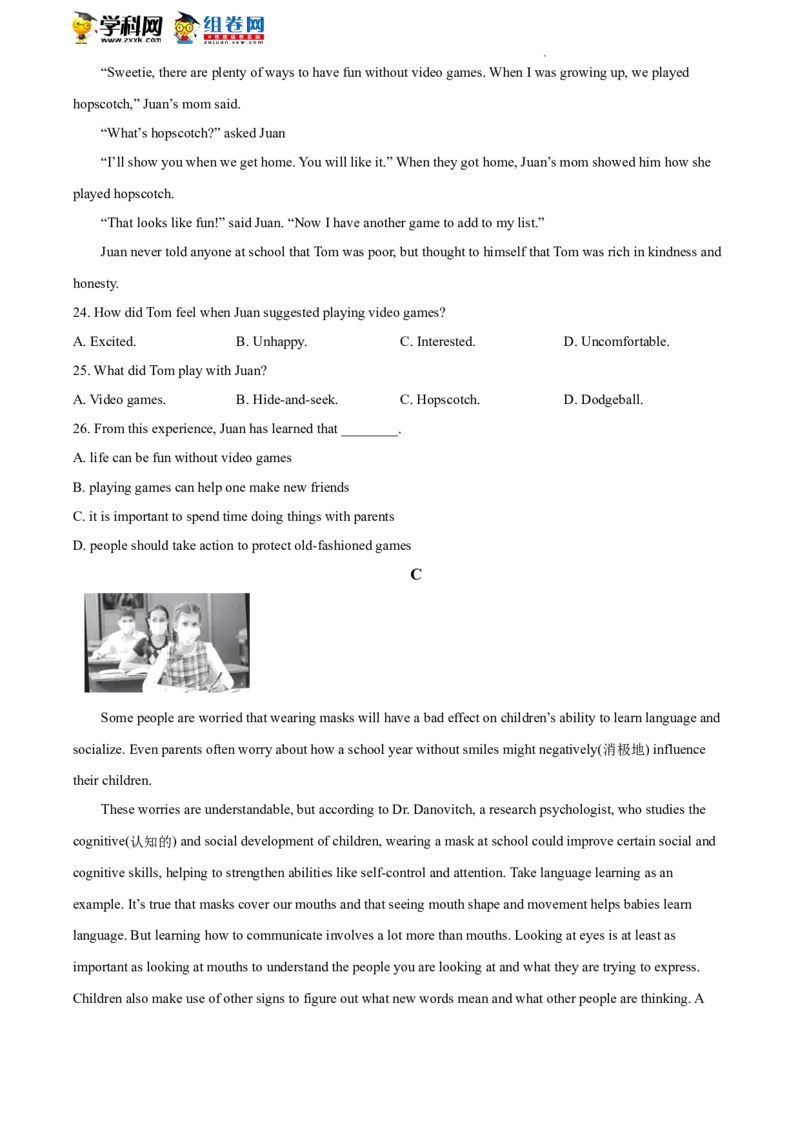
Some people are worried that wearing masks will have a bad effect on children’s ability to learn language and
socialize. Even parents often worry about how a school year without smiles might negatively(消极地) influence
their children.
These worries are understandable, but according to Dr. Danovitch, a research psychologist, who studies the
cognitive(认知的) and social development of children, wearing a mask at school could improve certain social and
cognitive skills, helping to strengthen abilities like self-control and attention. Take language learning as an
example. It’s true that masks cover our mouths and that seeing mouth shape and movement helps babies learn
language. But learning how to communicate involves a lot more than mouths. Looking at eyes is at least as
important as looking at mouths to understand the people you are looking at and what they are trying to express.
Children also make use of other signs to figure out what new words mean and what other people are thinking. A
学科网(北京)股份有限公司classroom full of people wearing masks is a great chance for children to practice paying attention to those signs,
such as a classmate’s tone of voice or a teacher’s body language.
Wearing a mask can also help teach children to pay more attention to their own bodies and physical behaviors.
Keeping a mask on over the course of a school day involves the kind of self-control that many children find
challenging. Needless to say, children will not always be perfect at keeping their masks on, but they have to be
mindful of when their masks are slipping down or when it is OK to take them off. The research on self-control
suggests that children who master the skills needed to keep their masks on will grow up to be better at achieving
their long-term goals.
Perhaps most importantly, wearing masks during a pandemic(流行病) is a chance for children to practice
caring for their community. A recent study shows that children understand the spread of illness better than ever.
Wearing a mask gives young children the ability to do something to help protect other people. For older children,
mask-wearing is a way to teach them about duty and sacrifice(牺牲). They believe that it feels good to make
sacrifices for people in need. Stressing that the discomfort and inconvenience of mask-wearing are forms of caring
and public service might encourage children to address other social problems in their lives.
In fact, how children feel about wearing masks at school, and how much they benefit from wearing them, are
going to depend on how the parents, teachers and caregivers around them present the topic. Masks are hopefully
not here to stay, but while they are still necessary, we should make the most of them.
27. What does the writer tell us in Paragraph 2?
.
A A teacher uses body language to teach what new words mean.
B. Wearing masks gives children a chance to practice paying attention.
C. Dr. Danovitch helps children with their cognitive and social development.
D. Looking at the mouth matters more than looking at the eyes when people talk.
28. What can we learn from the passage?
A. It is unknown if mask-wearing helps children improve social skills.
B. Children believe that the discomfort of mask-wearing is acceptable.
C. People’s thoughts and emotions are hidden when they are wearing masks.
D. Children who know when to keep their masks on will probably be successful.
29. Which of the following would be the best title for the passage?
A. How to Help Children Develop Skills
B. How to Be Perfect at Keeping Masks On
C. Wearing Masks Can Help Children Learn
D. Wearing Masks Can Solve Social Problems
学科网(北京)股份有限公司D
This high school term was supposed to be easier. That is the thought in my mind—after all, this is the first
term that I’m taking less than 20 credits(学分), and I’m enjoying all of my classes. However, this term has felt the
most difficult and my grades are much worse than they were when I was taking two more classes.
I could blame(怪罪) it on the fact that I’ve been busy working in several school clubs and practicing for a
school musical several times a week. Actually, it is important that I don’t overlook(忽视) that because it wouldn’t
be fair to myself to say it doesn’t play a part in my low grades. However, it’s clearly not the only reason. In fact,
study has never been easy for me.
I thought that putting in more effort would change things, but it hasn’t. The exam I studied for hours on comes
back a failure. I fall asleep while working on homework and forget to hand it in. I sit in class taking lots of notes,
and when I look back at them to do my homework, it all reads as gibberish. I start to realize that maybe some of
the work I do is just hard.
I’m learning that it’s okay not to be the best at the work that you do. When you’re used to being naturally
good, it’s hard to realize that throwing the same amount(数量) of effort at something that is more difficult won’t
just automatically(自动地) work. However, we shouldn’t feel bad about that. Even though we’re here for learning,
there are so many things to spend our time on. I think of the things I want as all having a price, and the amount that
I would like to pay at any given time changes, as does the price. It’s not to say that you should stop working hard,
but it’s good to keep in mind that sometimes the price just might be too high for you at a given time.
You don’t have to do everything perfectly, even if it looks easy, and you’re allowed to deal with knowledge
that just doesn’t make sense to you. This is the time to learn how to keep on keeping on. We will be the best of
ourselves once we learn that being our best isn’t a precondition to learning.
30. What was probably the writer’s expectation for her term?
A. To take more classes and be able to enjoy them.
B. To live an easy school life and get good grades.
C. To give up some clubs to have more time to study.
D. To experience a challenging term and get perfect marks.
31. What does the underlined word “gibberish” in Paragraph 3 probably mean?
学科网(北京)股份有限公司A. Something difficult to remember. B. Something funny.
C. Something impossible to understand. D. Something boring.
32. What can we learn from Paragraph 4?
A. People will pay a higher price if they stop working.
B. People have to ask for help if they want to learn well.
C. People shouldn’t give up their goals even though they feel bad.
D. People can’t always make something possible by working hard.
33. The writer would probably agree ________.
.
A we should know how to keep going in the face of challenges
B. we shouldn’t study things that don’t make sense to us
C. we should perform perfectly when our work is easy
D. we shouldn’t take part in school activities
第二部分
本部分共 6 题,共 20 分。根据题目要求,完成相应任务。
四、阅读表达(每题 2 分,共 10 分)
阅读短文,根据短文内容回答问题。
Even the most confident performers can suffer from stage fright(怯场). Stage fright is common for everyone
from Broadway actors to experienced presenters. If you have stage fright, then you may start to feel nervous, shaky,
or even completely frightened at the thought of performing in front of an audience. But don’t worry—you can deal
with your stage fright by training your body and mind to relax and trying a few tips.
1.Fake (假装) confidence. Even if your heart is racing, just act like the coolest person in the world. Walk with
your head high and a big smile on your face, and don’t tell anyone how nervous you are. Keep this posture (姿势)
when you get on the stage and you’ll actually start to feel confident.
2.Create a ritual (仪式). Come up with an effective ritual for the day of your performance. This could be a
five-kilometer jog on the morning of your performance, the same “last meal” before your performance, or even
singing a certain song in the shower or putting on your lucky socks. Do whatever you have to do to lead yourself
toward success. A lucky charm is also a great part of a ritual. It could be a necklace that’s important to you, or a
silly stuffed animal like a teddy bear that cheers you on from your dressing room.
学科网(北京)股份有限公司3.Think positively (积极地). Think about all of the possible amazing results of your presentation or
performance instead of everything that could go wrong. Fight every negative thought with five positive ones. Keep
a small card with encouraging words in your pocket, or do whatever you need to do to focus on all of the benefits
that the performance will give you.
4.Get advice from a professional performer. If you have friends who have experienced performing, ask for
their advice. You may learn some new tips and will be comforted by the fact that everyone gets stage fright, no
matter how confident he or she may appear on stage.
34. Is stage fright common for everyone?
___________________________________________________
35. How should we walk onto the stage in order to fake confidence?
___________________________________________________
36. What should we think about before our presentation or performance?
___________________________________________________
37. Why does the writer encourage us to get advice from a professional performer?
___________________________________________________
38. What’s the main idea of the passage?
___________________________________________________
五、文段表达(10 分)
从下面两个题目中任选一题,根据中文和英文提示,完成一篇不少于50 词的文段写作。所
给提示词语仅供选用。请不要写出你的校名和姓名。
39. 5月18日是国际博物馆日,今年的主题是“博物馆的力量”(The Power of Museums)。
假如你是李华,你校英语社团要开展线上国际交流活动,其公众号正在进行关于中国博物馆的系列推
送。请你用英语给公众号留言,推荐一个你喜欢的中国博物馆,对其做简要介绍并说明推荐理由。
提示词语:exhibition, exciting, history, provide, make, learn 提示问题:
● What is your favorite museum in China?
● What is the museum like?
● Why do you like it?
____________________________________________________________________________________________
____________________________________________________________________________________________
____________________________________________________________________________________________
____________________________________________________________________________________________
学科网(北京)股份有限公司____________________________________________________________________________________________
____________________________________________________________________________________________
____________________________________________________________________________________________
____________________________________________________________________________________________
_
40. 生活有酸甜苦辣,我们的情绪也有喜怒哀乐。合理的情绪管理有助于我们认识自我,并逐步提升。
某英文网站正在开展以“学会管理情绪”为主题的征文活动。假如你是李华,请用英语写一篇短文投稿,
谈谈生活中自己的经历,分享一个你管理情绪的故事,以及你的收获。
提示词语:sad, angry, control, calm, think, lesson
提示问题:● What experience can you share about managing your emotion?
● What have you learned from it?
____________________________________________________________________________________________
____________________________________________________________________________________________
____________________________________________________________________________________________
____________________________________________________________________________________________
____________________________________________________________________________________________
____________________________________________________________________________________________
____________________________________________________________________________________________
____________________________________________________________________________________________
学科网(北京)股份有限公司本试卷的题干、答案和解析均由组卷网(http://zujuan.xkw.com)专业教师团队编校出品。
登录组卷网可对本试卷进行单题组卷、细目表分析、布置作业、举一反三等操作。
试卷地址:在组卷网浏览本卷
组卷网(http://zujuan.xkw.com)是学科网旗下智能题库,拥有小初高全学科超千万精品试题。
微信关注组卷网,了解更多组卷技能
学科网长期征集全国最新统考试卷、名校试卷、原创题,赢取丰厚稿酬,欢迎合作。
钱老师 QQ:537008204 曹老师 QQ:713000635
学科网(北京)股份有限公司