)±~~I.vi:
1. ½:1! 11~ , :::t .'i ~ ~-~4 mc . M; -kLt , ,ii_ :::t iil'-½it~ ,tf %-:1! f---L
2. w :G-:iztit:1!at, :izt tlJ *,J * , :1 !½ ~J6, m ~ ilie:-½:1! f J:xts :1! ma {]½ ~;J:.f.½ it.~ 0 -I;.ri 1r;
r.l -i}J ' mf t ;tAt-f ,t )6 ' izt ¾ Jl:-1.tJ:. %-~ ;j:,f. ½ §] ¾ cl f 12Ut:1! at ' ~4 ¾ ~ ~ 1±-¾ :1! T J:
0 0
*-
~ ,tf U\ t--J: JcAt
0 *
3. :::t 1;\ ti AtJ6 , ~+ *- -i~ t--,lri ¾ :1! f-- 3t w
o
m-!B,t nJf.1.IC:!tWii'S" ,;/iti,t 30 ,t)
~~Bt,~W~~~~~~ko ~*~~~*§,~~~~*#~Bt~W~~~~~~tt
~IIJ~~~_t-0
*)
~-"p (~ 5 ;J\~;'flt/J\~ 1. 5 *,iwi* 7. 5
Jlfr--flfil 5 ~Mi! 4it¥Jtx;fi!§1f--f-;J\!Ml ,bid~ q=r E!rMrB0 A,B, C ~---,t-m;rlJi rrztl:H/Hi:i2f
o
rJJL Jlfr5'c'Bf~x;fi!Fn ,1tt~~ 10 ;t/;'#B"JBtfsJ* @J~lf *1J\~;fill~iiT-1J\~o 1if~xtiti{£i:l
-:iJ!L
{Jtl: How much is the shirt?
A. £19, 15, B. £9. 18. C. £9. 15.
1. How will the speakers go to the City Museum?
A. By bike. B. By bus. C. By underground.
2. Where does the conversation probably take place?
A. At home. B. At school. C. In a bookstore.
3. What are the speakers going to do?
A. Book a table. B. Go out for dinner. C. Open a French restaurant.
4. What does Jenny think of the party?
A. Noisy. B. Wonderful. C. Boring.
5. What is the relationship between the speakers?
A. Clerk and boss. B. Teacher and student. C. Husband and wife.
~=11 c~ 15 1NMI;iif1J\~ 1. 5 *,iwi* 22. 5 ft>
llJrTlm 5 ~xti!~J.r!l El iij;~x;fi!~J.r!l f!Fn~ JL-f-;J\~, JA~q=r Bir~ B'9 A, B, C ? -f-m;J_91
O
q=r:lJl.H±l 1£1-tzrffL 111riif~xti!~tri1 a mr, ft~~~ st rsJ 1~ ii:~-t-1J\~, -Bi1h@ 5 tJ:#; riJrs'ch5, ~
;J\~~~~tf-l 5 fJ:#l'l"Jft~BtlsJ 1if~xtit~Ml ~Jij~jJ!L
o
Jlfr~ 6 fflf,ff]j.,@_J~~ 6, 7
~o
6. What happened to the woman?
A. She lost her purse. B. She lost her way. C. Her money was stolen.
7. Where did the man go just now?
A. To the garbage. B. To the service desk. C. To the corner of the hall.
{#{QQABSYAEogAgQpBAARhCAw3oCAOQkACCCagOQBAIMAABQAFABAA=}#}P}r~ 7 ~;tJ;flj.,@J~~ 8,9
~o
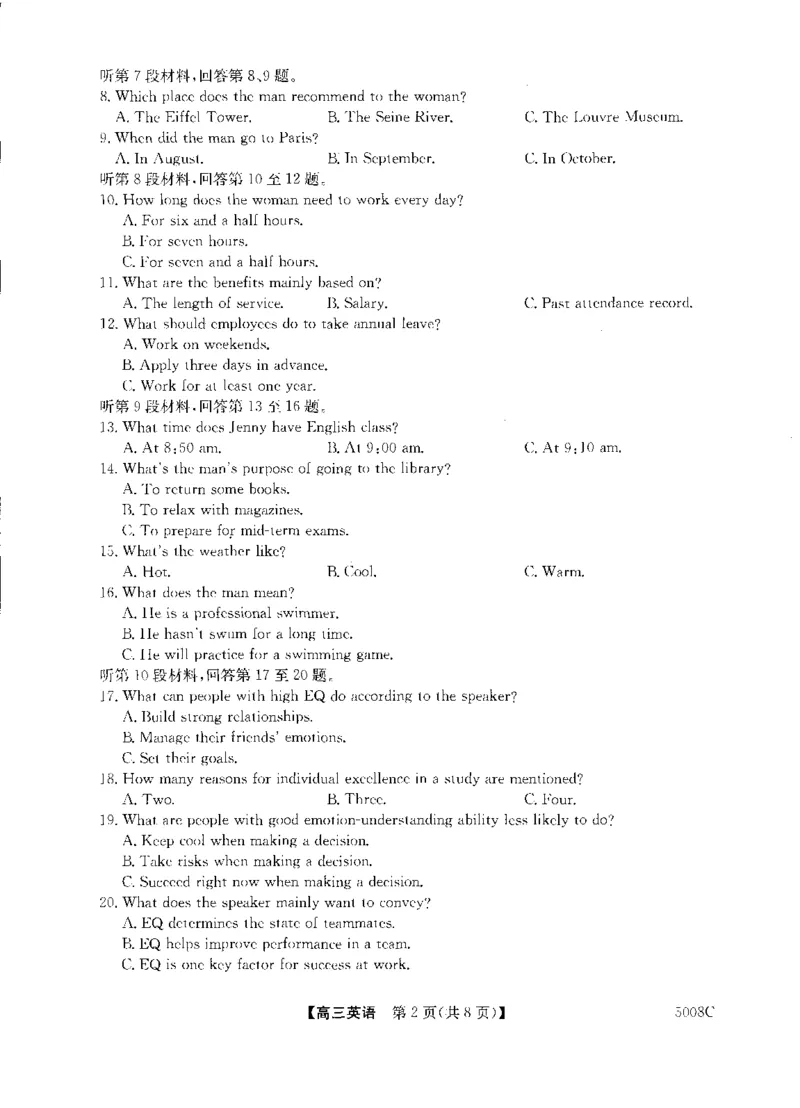
8. Which place does the man recommend to the woman?
A. The Eiffel Tower. B. The Seine River. C. The Louvre Museum.
9. When did the man go to Paris?
A. In August. B. In September. C. In October.
PJrm 8 IBtt/H4,@l~~ 10 ~ 12 ~o
10. How long does the woman need to work every day?
A. For six and a half hours.
B. For seven hours.
C. For seven and a half hours.
11. What are the benefits mainly based on?
A. The length of service. B. Salary. C. Past attendance record.
12. What should employees do to take annual leave?
A. Work on weekends.
B. Apply three days in advance.
C. Work for at least one year.
P}r~ 9 ~:f,,t;flj.,@J~~ 13 ~ 16 ~o
13. What time does Jenny have English class?
A. At 8:50 am. B. At 9:00 am. C. At 9: 10 am.
14. What's the man's purpose of going to the library?
A. To return some books.
B. To relax with magazines.
C. To prepare for mid-term exams.
15. What's the weather like?
A. Hot. B. Cool. C. Warm.
16. What does the man mean?
A. He is a professional swimmer.
B. He hasn't swum for a long time.
C. He will practice for a swimming game.
PJr~ 10 IBtM:f:4,@~~ 17 ~ 20
~o
17. What can people with high EQ do according to the speaker?
A. Build strong relationships.
B. Manage their friends' emotions.
C. Set their goals.
18. How many reasons for individual excellence in a study are mentioned?
A. Two. B. Three. C. Four.
19. What are people with good emotion-understanding ability less likely to do?
A. Keep cool when making a decision.
B. Take risks when making a decision.
C. Succeed right now when making a decision.
20. What does the speaker mainly want to convey?
A. EQ determines the state of teammates.
B. EQ helps improve performance in a team.
C. EQ is one key factor for success at work.
5008C
{#{QQABSYAEogAgQpBAARhCAw3oCAOQkACCCagOQBAIMAABQAFABAA=}#}*)
* ~ ~ = - = = i p fB * lffl~C;!tWj-=p ,ii* 50
c~ 15 1J\!Wf;~1N!J1l 2. 5 5t,m15t 37. 5 5t)
r:r
15?.l ti rJ1Jm x, JA 4ijJMIFJr~ i'!{J A, B, c, o JZ91'-:iztrm :izt 1±\ IHt:izPN
0
A
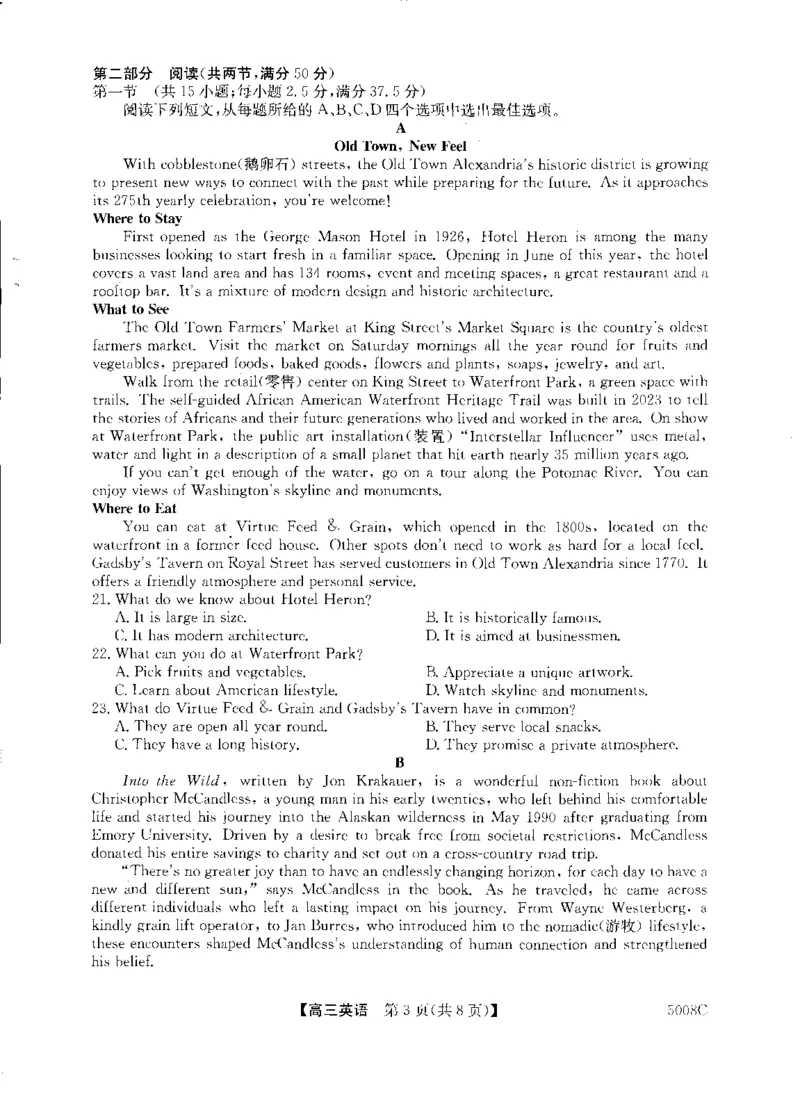
Old Town, New Feel
With cobblestone(~!if~1i) streets, the Old Town Alexandria's historic district is growing
to present new ways to connect with the past while preparing for the future. As it approaches
its 275th yearly celebration, you're welcome!
Where to Stay
First opened as the George Mason Hotel in 1926, Hotel Heron is among the many
businesses looking to start fresh in a familiar space. Opening in June of this year, the hotel
covers a vast land area and has 134 rooms, event and meeting spaces, a great restaurant and a
rooftop bar. It's a mixture of modern design and historic architecture.
What to See
The Old Town Farmers' Market at King Street's Market Square is the country's oldest
farmers market. Visit the market on Saturday mornings all the year round for fruits and
vegetables, prepared foods, baked goods, flowers and plants, soaps, jewelry, and art.
Walk from the retail(~~) center on King Street to Waterfront Park, a green space with
trails. The selrguided African American Waterfront Heritage Trail was built in 2023 to tell
the stories of Africans and their future generations who lived and worked in the area. On show
at Waterfront Park, the public art installation C~ :'!D "Interstellar Influencer" uses metal,
water and light in a description of a small planet that hit earth nearly 35 million years ago.
If you can't get enough of the water, go on a tour along the Potomac River. You can
enjoy views of Washington's skyline and monuments.
Where to Eat
You can eat at Virtue Feed &. Grain, which opened in the 1800s, located on the
waterfront in a form~r feed house. Other spots don't need to work as hard for a local feel.
Gadsby's Tavern on Royal Street has served customers in Old Town Alexandria since 1770. It
offers a friendly atmosphere and personal service.
21. What do we know about Hotel Heron?
A. It is large in size. B. It is historically famous.
C. It has modern architecture. D. It is aimed at businessmen.
22. What can you do at Waterfront Park?
A. Pick fruits and vegetables. B. Appreciate a unique artwork.
C. Learn about American lifestyle. D. Watch skyline and monuments.
23. What do Virtue Feed &. Grain and Gadsby's Tavern have in common?
A. They are open all year round. B. They serve local snacks.
C. They have a long history. D. They promise a private atmosphere.
B
Into the Wild, written by Jon Krakauer, is a wonderful non-fiction book about
Christopher McCandless, a young man in his early twenties, who left behind his comfortable
life and started his journey into the Alaskan wilderness in May 1990 after graduating from
Emory University. Driven by a desire to break free from societal restrictions, McCandless
donated his entire savings to charity and set out on a cross-country road trip.
"There's no greater joy than to have an endlessly changing horizon, for each day to have a
new and different sun," says McCandless in the book. As he traveled, he came across
different individuals who left a lasting impact on his journey. From Wayne Wester berg, a
kindly grain lift operator, to Jan Burres, who introduced him to the nomadic({1ff!tl(:) lifestyle,
these encounters shaped McCandless' s understanding of human connection and strengthened
his belief.
5008C
{#{QQABSYAEogAgQpBAARhCAw3oCAOQkACCCagOQBAIMAABQAFABAA=}#}I'
After months of wandering, McCandless eventually arrived in Alaska in April 1992. He
celebrated his new home "The Magic Bus" and began fighting the cruel realities of nature.
Living off the land, McCandless pushed himself to the limits of physical endurance. He
hunted, gathered eatable plants, and battled the unforgiving elements. Through his struggle,
McCandless learnt about self-reliance and the satisfaction that came from overcoming
challenges.
Despite his great adaptation, he gave in to starvation and was found dead in August 1992
in The Magic Bus by a group of hunters. While his death is undeniably heartbreaking,
McCandlcss's story continues to engage audiences worldwide, raising questions about the
search for meaning and the pursuit of happiness.
While McCandless's actions may seem extreme to some, his story reminds us to reflect on
our own lives and question the choices we make in pursuit of happiness. Anyway, the book is
a reflection on the human condition. It challenges us to examine our own values and the
impact our decisions have on our well-being and the lives of those around us.
24. What made Christopher McCandless decide to travel to the Alaskan wilderness'?
A. His passion for hunting. B. His early graduation.
C. His pursuit of freedom. D. His stressful life.
25. What might be Christopher McCandless's belief according to Paragraph 2'?
A. Living a simple life isn't difficult for us to achieve.
B. Journeys awaken a sense of appreciation for the past.
C. "We are closely connected with other people in daily life.
D. The joy of life is from our encounters with new experiences.
26. What did Christopher McCandless do upon reaching Alaska'?
A. He tested his survival skills. B. He turned to local residents.
C. He made a bus on his own. D. He explored many mysteries.
27. Where can this passage be found'?
A. In an art magazine. B. In a book review.
C. In a non-fiction book. D. In a biography.
C
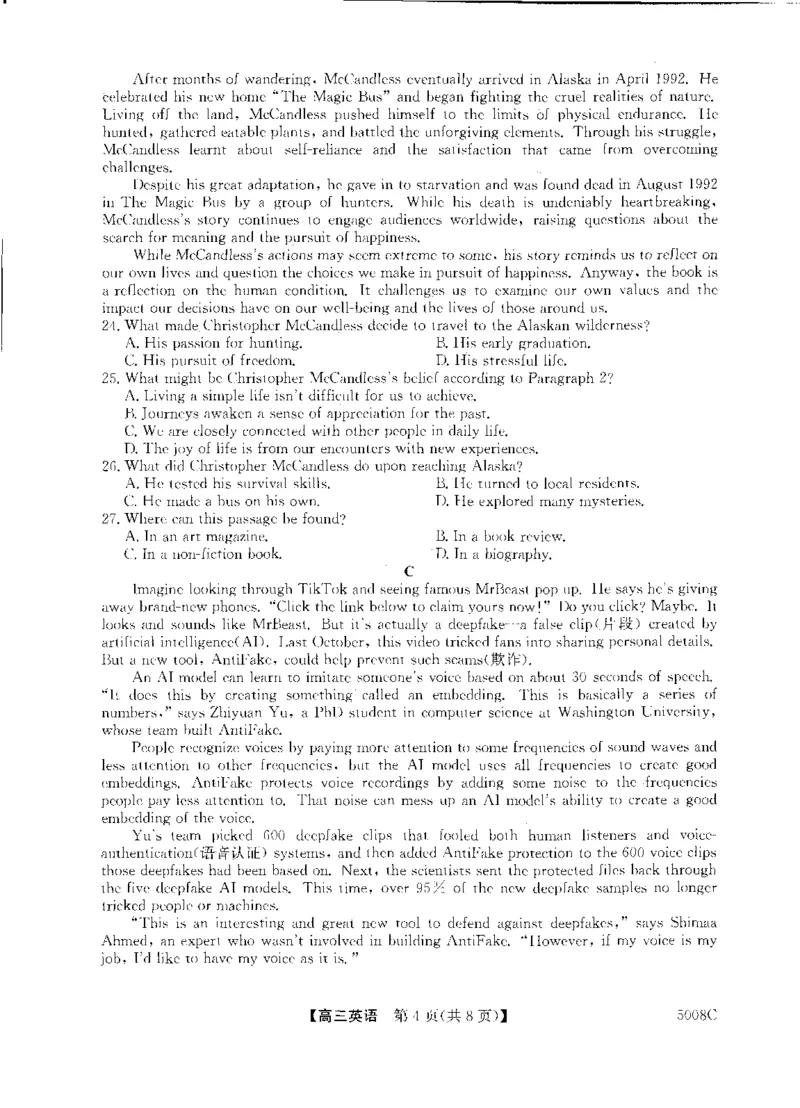
Imagine looking through TikTok and seeing famous MrBeast pop up. He says he's giving
away brand-new phones. "Click the link below to claim yours now!" Do you click'? Maybe. It
looks and sounds like MrB east. But it's actually a deepfake a false clip ( Jt ~) created by
artificial intelligence(AD. Last October, this video tricked fans into sharing personal details.
But a new tool, AntiFake, could help prevent such scams(:Jttt1).
An AI model can learn to imitate someone's voice based on about 30 seconds of speech.
"It does this by creating something called an embedding. This is basically a series of
numbers," says Zhiyuan Yu, a PhD student in computer science at Washing ton University,
whose team built AntiFake.
People recognize voices by paying more attention to some frequencies of sound waves and
less attention to other frequencies, but the AI model uses all frequencies to create good
embeddings. AntiFake protects voice recordings by adding some noise to the frequencies
people pay less attention to. That noise can mess up an AI model's ability to create a good
embedding of the voice.
Yu' s team picked 600 deepfake clips that fooled both human listeners and voice
authentication( ifl-tfiJ-i1EJ systems, and then added AntiFake protection to the 600 voice clips
those deepfakes had been based on. Next, the scientists sent the protected files back through
the five deep fake AI models. This time, over 95 % of the new deepfake samples no longer
tricked people or machines.
"This is an interesting and great new tool to defend against deepfakes," says Shimaa
Ahmed, an expert who wasn't involved in building AntiFake. "However, if my voice is my
job, I'd like to have my voice as it is."
5008C
{#{QQABSYAEogAgQpBAARhCAw3oCAOQkACCCagOQBAIMAABQAFABAA=}#}r
"This is actually a problem we want to address in the future," Yu notes. Instead of
adding noise, he thinks AntiFake could change the rhythm or tone of a voice. The voice would
sound clear and unchanged to listeners. But it would contain carefully-hidden signals to trick
deepfake AI models.
28. How does AntiFake help prevent deepfake voice scams?
A. By making AI models' embeddings damaged.
B. By making voices sound noisy and annoying.
C. By making voice recordings hard to imitate.
D. By making voices difficult to identify and record.
29. What is Paragraph 4 intended to show about AntiFake?
A. Its development. B. Its effectiveness.
C. Its special design. D. Its working principle.
30. What's Shimaa Ahmed's attitude to AntiFake?
A. Objective. B. Disappointed. C. Positive. D. Unclear.
31. What does the text mainly talk about?
A. The role of AI models in scams.
B. A new tool to prevent voice scams.
C. Impacts of deepfake voice scams.
D. An innovation for identifying voice scams.
D
Wes tern wellness influencers suggest that sleeping on the floor could help lessen lower
back pain. But is there evidence to support the accolade given to floor sleeping? It turns out
that resting on the floor may offer advantages for certain people in certain conditions. Some
medical experts say that lying flat on your back with your arms and legs extending out takes
pressure off the back and can stretch it out. Cooler temperatures near the floor may improve
sleep quality and overall comfort.
"But most exper.ts today agree that sleeping on the floor isn't necessarily the best option
for any type of back discomfort," says Peter G. Whang, a professor at the Yale School of
Medicine. "The floor is board-straight, while our spine(~f±) has physiologic curves("=[JJIH1
~[HJ). " One such curve leaves space between the lower back and the floor. Lacking support,
this curve flattens out over time, which can result in back pain. Moreover, without
cushioning(til'rft) to support the shoulders, the upper back is often supported too high, which
can cause joint rigidity( 11HiJ!). Worse still, a hard floor creates pressure points in places like
your hips and heels, which can restrict blood flow to those areas and potentially damage soft
tissue.
So how did our ancestors maintain healthy backs while dreaming on the dirt for thousands
of years? According to Daniel Lieberman, a Harvard University professor, hunter-gatherers
slept on the ground from early childhood and may have built up a tolerance to its ill effects,
unlike present-day people who try it for the first time as adults. Also ancient people got more
physical activity throughout the day, which may have helped prevent pain despite ground
sleeping.
)
So, if your back is giving you nightmares, the real solution could be replacing your worn
j
out mattressC1*W:) instead of sleeping on the floor. The average American's bed is 10 years
old, equal to about three years of sleep time. "No furniture will sustain that type of weight
and abuse," says Bert Jacobson, a kinesiology professor at Oklahoma State University, whose
research suggests that a new, firmer mattress reduced back pain by 47%~63%.
32. What does the underlined word "accolade" in Paragraph 1 mean?
A. Credit. B. Complaint. C. Inspiration. D. Debate.
33. What helped our ancestors adapt to sleeping on the ground?
A. Their shapes. B. Their fitness.
C. Their lifestyle. D. Their living conditions.
5008C
{#{QQABSYAEogAgQpBAARhCAw3oCAOQkACCCagOQBAIMAABQAFABAA=}#}r
34. Why does the author mention Bert Jacobson in the last paragraph?
A. To come up with a new topic.
B. To present a significant finding.
C. To recommend the use of mattresses.
D. To make the author's advice convincing.
35. How is the text mainly organized?
A. By analyzing features of sleep. B. By comparing different opinions.
C. By making a list of relevant findings. D. By citing science-backed viewpoints.
~-=11 C:f¾ 51h'l!fil;~1Nllfil 2. 5 Jt,mHt 12. 5 0-)
~~rffiffi~.~ffiX~~fil~~fililim~~A~s~~-ttfil~ofil~~~~~~$~
filJJ!
0
The first love you ever know often comes from your mother and your immediate family
members. 36 Those loving times you remember hugging your parents, playing ball with
your brother in the backyard, or getting ice cream down the street with your grandmother are
the most cherished memories.
Family love is beneficial. When you feel safe, protected and cared in your family, you
have a good framework for the world. __l_Z____ After all, living in a warm environment that is
surrounded by a family's love, you gain confidence and a high sense of self-esteem, you learn
conflict resolution skills, and you become more adaptable as you and your family get over
challenges.
38 A 2024 study showed that adults with higher levels of positive childhood
experiences had greater adult-reported social and emotional support. It also showed that
enhancing positive childhood experiences may reduce adult mental health problems even when
adverse(~l=~) childhood events happened.
Given the power of family love, why not nurture(i#cff) it? To establish a supportive
family network, ~ake spending time with loved ones a priority, cook and eat meals together,
be sensitive and caring, and tell your loved ones you love them. It's also a good idea to
express your gratitude to them. 39
Additionally, family love can be built with a group outside of your family. The
relationships you form with neighbors, friends from work, or childhood friends who might be
back in your life can serve extremely well as your family. 40 Such close, meaningful
relationships can sustain you as well.
A. This unconditional love seeks nothing in return.
B. Focus your time and attention on those you love.
C. A loving family is crucial for developing empathy for others.
D. Feeling loved by our families when you're young is important.
E. This not only will make them happy but will make you happier.
F. The framework will make great improvements to your social life.
G. So establish your own close ties with people you choose to be with.
~=if~* Wij*
i~~mm c:ttj1:J;j-='p, 30 5t)
~-11 C:f¾ 15 1J,¾fil;~1J\®I 1 0-,m\JJt 15 )t)
1#.li~rffiffiX .~- &¾film~s"J A,B, CD [9,tfilrN 9'1filtil Pf ~tlA~ B ~ 81:fdifilJYL
I had just finished walking my dog as it got dark. We headed home and walked into the
41 . A flicker(JA];l:5f,) of light caught my eye just as I 42 the door. I turned my head to
see that a 43 firefly had flown in with us through the open 44 and was now crazily
trying to 45 . As it flew slowly towards the wall, I quickly but 46 closed my fingers
around it. I could feel its little wings beat against my 4 7 and a flash of light shown
through my fingers. I opened the back door and 48 outside. Then I opened my hand and
watched it fly away flashing its light in the 49
5008C
{#{QQABSYAEogAgQpBAARhCAw3oCAOQkACCCagOQBAIMAABQAFABAA=}#}Before I walked back in, I took the 50 to look over the grassland behind my home.
There were hundreds of fireflies flickering. Each time their lights came on, I smiled. It was so
amazing that such little creatures could _ii_!__ so much light. I stood there in awe.
52 the lightening fireflies made me think of the light each of us 53 inside of
ourselves. Often it flickers and is not steady or even very bright. Yet, every time we shine it,
we grow a little brighter. And every time we 54 the light, we can 55 the light in
others to shine as well.
Do your best to shine your light even if you think it is a mere flicker. You are a lot
brighter than you think.
41. A. forest B. house C. grassland D. garden
42. A. kicked B. repaired C. touched D. closed
43. A. blind B. familiar C. tiny D. dangerous
44. A. cage B. hand C. door D. sky
45. A. get out B. fight back C. speed up D. stay on
46. A. gently B. warmly C. similarly D. regularly
4 7. A. head B. heart C. skin D. eye
48. A. escaped B. stepped C. survived D. waited
49. A. trees B. noise C. crowds D. darkness
50. A. wish B. plan C. time D. promise
51. A. reflect B. produce C. stand D. absorb
52. A. Watching B. Catching C. Guiding D. Rescuing
53. A. misses B. receives C. blocks D. carries
54. A. hide B. share C. avoid D. understand
55. A. awaken B. follow C. request D. permit
*=11 c~ 101J\IN;4lJ:1J\®f 1. 5 ::St,1~::St 15 ::St)
~~TOO~~,ft~~~~Al~~~~·~~ffl~~·~~K-%A.
The ongoing Huazhao Festival, or Flower Festival, at Yuyuan Garden in Shanghai is
offering visitors imn1ersive( VL~AB'9) experiences of traditional Chinese culture.
With a history of over 2,000 years, the Festival usually 56 (fall) on the second month
of the lunar calendar to celebrate the birthday of the flower goddess. According to ancient
beliefs, the flower goddess controls human reproduction, and it became customary 57
( observe) her birthday to invite prosperity(~5R).
Despite regional differences 58 celebration, the Huazhao Festival usually shares a
number of 59 (feature): hanfu, traditional Chinese clothes, flower appreciation and
traditional culture.
60 (run) through late this month, the Festival at Yuyuan Garden impresses visitors
with colorful items 61 ( inspire) by flowers and flower fairies ( {!lJ ,=f). 62 (variety)
activities are also ~king place to help immerse visitors in a traditional Chinese culture
atmosphere, including light shows, performances, markets, parades and interactive events.
According to the Festival's organizers, enthusiasm for traditional culture 63 (grow)
among young people in recent years. Products and activities 64 highlight traditional
elements combined with modern designs-called the "new Chinese style"-are becoming
increasingly popular. Through special events like the Huazhao celebrations, the organizers
aim to promote traditional culture and in ~6_5_ meanwhile boost spending.
JHm ~B ,t £j {1= C~ WTi! , Jllii ,t 4 o ,t)
~-11 O~::St 15 ::St)
{~Ji:{$~*#~, {n,EI"Jft i:f=t 00 l¥f "¥:s"J~ OO_iif ~ Peter s"J :1: B NP~-t:IIJ*, 1$~1tff~ T -15H'l::ri
fi:!r:tittBB"JtL!fm 77.llt,if1$~--H!ll~{4~{m, ~~'EL1?i:
O
1. 1$ 1'!"1 t5UM ;
2. oo113-1rmit:tL!fm;
3. tJtmittL!fms"JJll!FB.
5008C
{#{QQABSYAEogAgQpBAARhCAw3oCAOQkACCCagOQBAIMAABQAFABAA=}#}r.i:if:
1. £ff ftiP]~J1l7'1 80 ii.ti;
2. PJ" ~:u!i3t~JJogai-=p, DJftfi:::t:ii~;
3. ff:*fllia~B~ili ,,:;fltA ,~jP]~o
Dear Peter,
Yours,
Li Hua
~=11 CrMi?t 25 %)
Ii) ii~ 00 M t4 , ;J:fHJ,:Ut l*J ~ fO fir~~ fi ff:* ift~Efp;J;J ~, itZfZJ $:-Jffc~ 89 ~:::to
The sun was setting, casting long shadows across the living room. Emily's eyes focused
on the pages of a book but her mind elsewhere. Her mother, Laura, entered with a cup of
steaming hot chocolate, placing it gently on the coffee table. Emily was a tough girl. Laura
had waited for Emily to share her "secrets". However, Laura thought maybe it was time for
her to start the conversation.
"Emily, honey," Laura said softly, ''you've been so quiet lately. Is everything alright?"
Emily looked up, her eyes reflecting a mixture of emotions. "I'm fine, Mom," she
replied, but the hesitation in her voice indicated that she was not OK.
Concerned, Laura sat down next to her daughter. She gently said, "You know you can
tell me anything, right? We're not just mother and daughter. We're friends too."
Emily hesitated, and then took a deep breath. Laura sensed Emily's worry, so she gave
her a hug and said, "It's OK if you want more time for yourself. But remember, I'm always
here for you." Feeling warm in her heart, Emily decided to open up. "It's about school,
Mom. I'm struggling with my math, and I feel like I'm not good enough." Hearing the
words, Laura took Emily's hand in hers and said, "You are more than enough, Emily. We all
have our strengths and weaknesses. It's okay to ask for help."
The next day, Laura planned to arrange for a tutor(~~) to help Emily with her math in
the evening. She remembered her own struggles with math when she was Emily's age and how
it had affected her confidence. At that time, she had dreamed to be supported by her parents.
Unluckily, Laura's parents had been too busy making money to notice Laura's struggles and
Laura had been feeling helpless and got less and less confident. Because of that, Laura hadn't
caught up on her math, which was still a regret for Laura. Now, Laura's daughter was faced
with the same challenge. Laura knew clearly how Emily was in desperate need of her support.
So Laura decided to do something more herself besides asking for a tutor.
7£~:
1. ~Efi P]~J1l7'1 150 ii.ti;
2. iJ:J'ti: ~rrf ;J:~ :ft :a ~J/2 f-i'l"J t§ J1Z 1.ft:'ii ft~
o
That evening, Laura brought out her old high school math book with notes. l
Over the next few weeks, Laura and Emily spent hours working through math problems
together.
5008C
{#{QQABSYAEogAgQpBAARhCAw3oCAOQkACCCagOQBAIMAABQAFABAA=}#}