顺义区 2024 年初中学业水平考试综合练习(二)
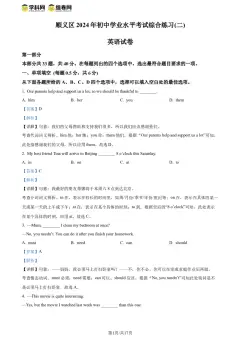
英语试卷
第一部分
本部分共33题,共40分。在每题列出的四个选项中,选出最符合题目要求的一项。
一、单项填空 (每题0.5分,共6分)
从下面各题所给的A、B、C、D四个选项中,选择可以填入空白处的最佳选项。
1. Our parents help and support us a lot, so we should be thankful to ________.
A. him B. her C. you D. them
2. My best friend Tina will arrive in Beijing ________ 8 o’clock this Saturday.
A. in B. on C. at D. to
3. —Mum, ________ I clean my bedroom at once?
—No, you needn’t. You can do it after you finish your homework.
A. must B. need C. can D. should
4. —This movie is quite interesting.
—Yes, but the movie I watched last week was ________ than this one.
A. interesting B. more interesting C. most interesting D. the most interesting
5. —________ is the pencil case?
—It’s about 20 yuan.
A. How long B. How often C. How soon D. How much
6. Mrs. Zhang is over sixty, ________ she works as hard as others.
A. or B. but C. so D. for
7. My sister ________ when I got home.
A. paints B. painted C. will paint D. was painting
8. Amy ________ Chinese for 6 years, so she can speak Chinese very well.
A. is learning B. learned C. has learned D. will learn
9. Tom likes sports. He often ________ football with his friends on weekends.
A. plays B. is playing C. played D. will play
10. —Mike, we ________ to the Palace Museum tomorrow. Would you like to join us?
—Yes. Of course!
A. will go B. went C. have gone D. go
11. Earth Day ________ in 1970 for the first time.
第1页/共10页
学科网(北京)股份有限公司A. celebrates B. was celebrated C. is celebrated D. celebrated
12. —Peter, could you tell me ________ in the Science Club yesterday?
—Well, we did some experiments together.
A. what you will do B. what will you do
.
C what you did D. what did you do
二、完形填空(每题1分,共8分)
阅读下面的短文,掌握其大意,然后从短文后各题所给的A、B、C、D四个选项中,选择最佳选项。
The Magic of a Book
One day when I was 11, my mother gave me an order: I was lo walk to the public library, and borrow at least
one book for the summer. This was one more weapon for her to defeat (战胜) my strange problem—inability to
____13____.
In the library, I found my way into the “Children’s Room”. I sat down on the floor and pulled a few books off
the ____14____ at random (随机的). The cover of a book caught my eye. It presented a picture of a beagle. I had
recently had a beagle, the first and only animal companion I ever had as a child. He was my secret sharer, but one
morning, he was gone. I never forgot my beagle.
There on the book’s cover was a beagle which looked the same to my dog. I ran my fingers over the
____15____ of the dog on the cover. My eyes run across the title, Amos, the Beagle with a Plan. Unknowingly, I
had read the title without ____16____ the book. I borrowed it from the library for the summer.
Under the shade of a bush, I started to read about Amos. I read it with difficulty. Though pages were turned
____17____, I got the main idea of the story about a dog who, like mine, had been separated from his family and
who finally found his way back home. That dog was my dog, and I was the little boy in the book. At the end of the
story, my mind continued the final scene of reunion, on and on, until my own ____18____ dog and I were, in my
mind, running together.
My mother’s call made me ____19____ to the real world. I suddenly realized something: I had read a book,
and I had loved reading that book. Everyone knew I could not read. But I had read it. Books could be incredibly
wonderful and I was going to read them.
I never told my mother about my “miraculous” (奇迹般的) experience that summer, but she saw a slow but
noticeable ____20____ in my classroom performance during the next year.
13. A. draw B. speak C. hear D. read
14. A. box B. table C. board D. shelf
15. A. name B. picture C. toy D. food
16. A. opening B. writing C. packing D. checking
第2页/共10页
学科网(北京)股份有限公司17. A. freely B. quietly C. slowly D. carefully
18. A. clever B. lost C. cute D. wounded
19. A. return B. go C. point D. move
20. A. success B. thought C. improvement D. process
三、阅读理解(每题2分,共26分)
(一)阅读下列关于四本杂志的介绍,请根据人物需求匹配最适合的一本杂志,并将其对应的
A、B、C、D选项填在相应位置上。选项中有一项为多余选项。
A
Colorful Magazines
A Schooling
The magazine is in full color, more than two hundred pages, and packed with support and fun! It gives readers
more choices to learn more about courses and activities in foreign high schools.
B X-File
This monthly magazine brings you real life of detectives. They chase (追捕) criminals across different
countries and find out the truth. It is filled with the stories of adventures.
C National Geography
This monthly magazine can bring the world to your home. It includes geography, natural science, and the
study of world culture and history. This amazing magazine is full of color photos, which is your window to see the
world.
D See-It
Readers can find the latest art news. This magazine is out every Friday. It tells interesting artwork, art design
and art education. The magazine is so interesting that you would not be able to put it down.
21. Sam ________ I dream to be a policeman and I take interest in the stories about detectives.
22. Alice ________ I plan to study abroad and I would like to know the study and life in foreign high schools.
23. John ________ I have travelled many places. I enjoy reading about foreign people, places and customs.
B
阅读下列短文,根据短文内容,从短文后各题所给的A、B、C、D四个选项中,选择最佳选项。
When Laura was twelve, she started taking classes at Miss Grace’s School for Art. At first, she didn’t enjoy it;
the “novice artists”—the kids who hadn’t really done art before—worked mostly with clay, and Laura didn’t do
well in it.
It wasn’t until her third year that Laura found something she was really good at—charcoal drawing (素描).
She loved watching the lines spread across the page as she moved the charcoal back and forth over the paper.
第3页/共10页
学科网(北京)股份有限公司One day, Sophia, the best artist in her class, sat down and set up her easel next to Laura. Laura felt uneasy.
She’d actually found an art form that she enjoyed—and was good at—and now Sophia was going to outshine (胜
过) her again? Laura fought back tears when Miss Grace entered the room.
“Hello class,” Miss Grace said. “We’ll continue to work on the project today.”
What masterpiece (杰作) would Sophia have come up with?
Laura looked at Sophia’s easel and she couldn’t believe it—it was a mess! For a brief moment, Laura couldn’t
actually believe her drawing was better than Sophia’s. But then she looked at Sophia, who was watching Laura with
an anxious expression.
“I... I couldn’t decide what to do,” Sophia said. “And you’re so good. Sometimes I feel like my work is just so
bad in comparison.”
Laura looked to see if Sophia was joking, but she seemed completely serious. Now Laura was shocked. “I’m
not talented... Miss Grace seldom praises me. You’re the best one in our class!”
Sophia raised her eyebrows. “I might be a really good copier, but I have no idea what to do when it comes to
making up my own images. You are so great at making new things out of the old ones. I’ve loved your works.”
“I’ve loved yours, too,” Laura said.
“Well, definitely not this one,” Sophia said.
Laura smiled. “Maybe not right now. But if you move these lines up...” she said, pointing her finger on
Sophia’s paper.
Sophia was quiet for a moment. “That’s a great idea!” she said finally.
Laura smiled and turned back to her drawing, looking every so often at Sophia’s work to see that she was
taking her advice, down to the last line.
24. When Laura started art classes, she ________.
A. didn’t do well in the course B. didn’t feel confident in drawing
C. didn’t like working with clay D. didn’t get along with her classmates
25. Why did Laura feel uneasy when Sophia sat next to her?
A. Because she was punished by her teacher.
B. Because she had not really done art before.
.
C Because she thought Sophia was better than her.
D. Because she had no idea what Sophia wanted to draw.
26. Laura’s story mainly tells us that ________.
.
A failure is the key to success
B. your character is shaped by your beliefs
第4页/共10页
学科网(北京)股份有限公司C. everyone has their own talents and skills
D. interest is the greatest driving force for learning
C
Curiosity—the desire to know, to discover, to learn. Inspired by curiosity, humans are found everywhere on
our planet, and beyond it in space. Yet according to human behaviorist and author of Curious, Ian Leslie, although
we are all born curious, not all of us bring this into adulthood, and we can lose out as a result.
As Leslie explains, curiosity shapes us from the start. By trying new things, we build knowledge, and want to
know more. “We are born aware that we don’t know stuff—we want to experience and discover.” However, the
contrast between childhood and adulthood is clear. “We ask 40,000 questions a year between the ages of two and
five,” says Leslie, “around 110 each day; adults, in comparison, ask just 20.”
As we get older, we may feel hesitant about asking questions, believing this exposes (暴露) gaps in our
knowledge. We can become scared to share untraditional ideas for fear of criticism or misunderstanding. We can
also be a victim of our success, as Leslie explains. “Once you’ve worked out how to do your job, then you don’t
feel curious anymore. The need to learn goes away—in a way, curiosity has done its job. But that doesn’t mean you
shouldn’t cultivate (培养) it.”
Leslie’s tips for cultivating curiosity begin with spending time with the experts—children. “Talk to your kids
,
and try to answer those strange, difficult questions they have—like ‘What is air?’ This makes you think about
things you’ve taken for granted—it reawakens your curiosity in what’s around us and how we perceive (感知) the
world.”
So does finding what Leslie calls an “informal mentor”, through work or other circles, who is happy to share
their expertise, from a skill, technology, to a field of learning. “Try to think of people the way children think of
adults—as sources of secret knowledge, a great store of learning you can tap into,” says Leslie.
Leslie also suggests creating a “spark file” —a digital or physical notebook in which you collect interesting
thoughts. “Fill it with facts you’ve come across, sentences you like, insights that strike you. Let it be random. And
let it build. Over time you’ll build up a rich source of inspiration, and you’ll think, ‘Oh that’s interesting, that
relates to this...’ And suddenly your mind starts firing away with new ideas and ways of thinking.”
27. According to Leslie, when we get older we may ________.
A. try more new things B. fill our knowledge gaps
C. ask some strange questions D. lose our natural curiosity
28. The word “contrast” in Paragraph 2 is closest in meaning to ________.
A. difference B. relationship C. argument D. secret
29. What can we learn from the passage?
第5页/共10页
学科网(北京)股份有限公司A. We can talk to children to reawaken our curiosity.
B. We are willing to share our expert knowledge with others.
C. We can cultivate our curiosity by using a digital notebook.
D. We are afraid of asking questions because of misunderstanding.
D
Everyone looks forward to progress, whether in one’s personal life or in the society. Progress shows a person’s
ability to change the way he is living at the moment. Progress must lead to a better way of doing things. All these,
however, remain true only if people choose to accept technology and find new and more efficient (高效的) ways to
move forward.
However, at the back of the minds of many people, especially those who missed the “good old days”,
efficiency comes with a price. When communication becomes efficient, people are able to contact one another no
matter where they are and whenever they wish to. The click of a button allows people miles apart to talk or to see
each other without even leaving their homes. With the communication tools, such as mobile phones and iPads,
people often do not take the effort to visit one another personally. A personal visit carries with its additional feature
of having to be in the person’s presence for as long as the visit lasts.
With efficiency also comes mass production (大规模生产). Such is the nature of factories and the success of
industrialization today. Factories have improved efficiency. Unskillful tasks are left to machines and products are
better made and produced with greater accuracy (精确) than any human hand. However, with the improvements in
efficiency also comes the loss of the personal touch when making these products. For example, many handicrafts
(手工艺品) are now produced in a factory. Although this means that supply is better able to increase demand, now
that the supply is quick and efficient, the demand might fall because mass production lowers the quality of the
handicraft and it is difficult to find unique designs on each item.
Nevertheless, we must not make the mistake of analyzing progress only from one point of view. In fact,
progress has allowed tradition to keep up. It is only with progress and the invention of new technology that many
old products can be brought back to their old state. New technology is required for old products to stay old.
It is people’s attitude towards progress that causes the type of influence that technology has on society.
Technology is flexible. There is no fixed way of making use of it. Everything depends on people’s attitude. The
worst effects of progress will fall on those who are unable to think again about their attitudes and views of society.
When we accept progress and adapt it to suit our needs, a new “past” is created.
30. Progress can benefit people when they are willing to ________.
A. live a better life than before
B. look for more efficient methods
第6页/共10页
学科网(北京)股份有限公司C. change the way of living at the moment
D. accept technology and find ways to move forward
31. Why does the writer talk about handicrafts in Paragraph 3?
A. To explain supply can increase the demand.
B. To stress efficiency may have a negative effect.
C. To suggest factories should improve efficiency.
D. To show handmade objects may be of low quality.
32. What is the last paragraph mainly about?
A. Progress can meet the needs of daily life.
B. Technology can be used in different ways.
C. A new past can be created by making progress.
D. People’s attitude decides the use of technology.
33. What can we learn from the passage?
A. Technology can make the old products new.
B. Technology may cause fewer personal visits.
C. Technology can lead to higher quality in production.
D. Technology may reduce people’s contact with others.
第二部分
本部分共5题,共20分。根据题目要求,完成相应任务。
四、阅读表达(34至36每题2分,37题4分, 共10分)
阅读短文,根据短文内容回答问题。
Small Talk, Large Effect
Have you ever found yourself waiting at the stop for your bus to arrive and have a stranger ask an ordinary
question? Perhaps you’ve stood in line waiting for a coffee and feel the need to just look over to the person next to
you and ask about the weather.
(This is small talk, and despite the name) it’s actually a big part of daily life.
“Small talk may seem trivial (微不足道的), but it’s a natural way for people to connect. It may seem like a
waste of time. But it serves an important role in our social interactions (交往). Big relationships are built on small
talk,” Lindy Pegler, who has a master’s degree in psychology, wrote on Medium.
In fact, we spend a lot of our time making small talk. Often, we find ourselves making small talk with the
same people on a regular basis. Coming up with small conversations is the foundation (基础) of these relationships.
The benefits of such conversations can actually contribute to our happiness and benefit our lives as a whole. In
a recent study, researchers found that having a healthy amount of acquaintances ( 相识的人) and keeping these
第7页/共10页
学科网(北京)股份有限公司relationships contribute to one’s sense of belonging to a community.
So how does one start making small talk? It can be as simple as admiring one’s shirt, asking about their day or
commenting on the traffic. “First and foremost, small talk is an act of politeness,” Pegler noted. “Our small talk at
our first meeting is our chance to show who we are,” she added.
Who knows where this can lead? Nowadays, the small connections we make can lead to big results. You might
find someone who has a common interest, or maybe even someone who turns out to be a close friend.
There is one thing for sure: Making small talk can brighten our day, even if it’s just a nice comment or a
thoughtful question.
So the next time you find yourself waiting for the bus or checking your watch while you wait in a line, take the
opportunity to look up and talk to someone around you. After all, it takes a small connection to lead to a larger one.
34. What is actually a big part of daily life?
________________________________
35. What did the researchers find in a recent study?
________________________________
36. According to Pegler, why do we make small talk?
________________________________
37. Would you like to try to make small talk in your daily life? Why or why not?
________________________________
五、文段表达 (10分)
从下面两个题目中任选一题,根据中文和英文提示,完成一篇不少于50词的文段写作。文中
已给出内容不计入总词数。所给提示词语仅供选用。请不要写出你的校名和姓名。
题目1
38. 假定你是李华,你的英国笔友Chris所在的学校正在举办“中国文化周”活动。他给你发来邮件,询
问有关中国传统节日的信息,以便在活动中进行分享。
请你用英语回复一封邮件,介绍一个中国的传统节日、节日的庆祝活动及意义。
提示词语:the Spring Festival, dumplings, get together, wish
提示问题:· What festival do you want to share?
· What do you often do to celebrate it?
· Why do people celebrate it?
Dear Chris,
I’m glad to know that you’re interested in our traditional festivals.
____________________________________________________________________________________________
第8页/共10页
学科网(北京)股份有限公司____________________________________________________________________________________________
____________________________________________________________________________________________
____________________________________________________________________________________________
____________________________________________________________________________________________
____________________________________________________________________________________________
____________________________________________________________________________________________
____________________________________________________________________________________________
____________________________________________________________________________________________
____________________________________________________________________________________________
____________________________________________________________________________________________
____________________________________________________________________________________________
I hope the above is helpful. Please feel free to ask for more information.
Yours,
Li Hua
题目2
39. 某英文网站正在开展以“做更好的自己”为主题的征文活动。假定你是李华,请用英语写一篇短文
投稿,谈谈为了成就更好的自己,你做过什么,有什么收获。
,
提示词语:challenge take action, improve, confident
提示问题:
(1) What did you do to make you better?
(2) What have you learned from doing so?
Everyone may look forward to being better.
____________________________________________________________________________________________
____________________________________________________________________________________________
____________________________________________________________________________________________
____________________________________________________________________________________________
____________________________________________________________________________________________
____________________________________________________________________________________________
____________________________________________________________________________________________
____________________________________________________________________________________________
____________________________________________________________________________________________
第9页/共10页
学科网(北京)股份有限公司____________
第10页/共10页
学科网(北京)股份有限公司