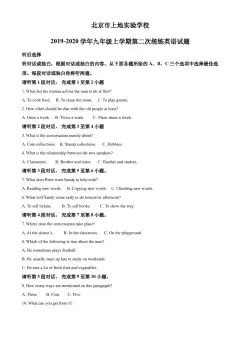
北京市上地实验学校
2019-2020 学年九年级上学期第二次统练英语试题
听后选择
听对话或独白,根据对话或独白的内容,从下面各题所给的A、B、C三个选项中选择最佳选
项。每段对话或独白你将听两遍。
请听第1段对话, 完成第1至第2小题
1. What did the woman advise the man to do at first?
A. To cook food. B. To clean the room. C. To play games.
2. How often should he chat with the old people at least?
.
A Once a week. B. Twice a week. C. Three times a week.
请听第2段对话, 完成第3至第4小题
3. What is the conversation mainly about?
A. Coin collections. B. Stamp collections. C. Hobbies.
4. What is the relationship between the two speakers?
A. Classmates. B. Brother and sister. C. Teacher and student.
请听第3段对话, 完成第5至第6小题。
5. What does Peter want Sandy to help with?
A. Reading new words. B. Copying new words. C. Checking new words.
6. What will Sandy come early to do tomorrow afternoon?
A. To sell tickets. B. To sell books. C. To show the way.
请听第4段对话, 完成第7至第8小题。
7. Where does the conversation take place?
A. At the doctor’s. B. In the classroom. C. On the playground.
8. Which of the following is true about the man?
A. He sometimes plays football.
B. He usually stays up late to study on weekends.
C. He eats a lot of fresh fruit and vegetables.
请听第5段对话, 完成第9至第10小题。
9. How many ways are mentioned on this paragraph?
.
A Three B. Four C. Five.
10. What can you get from it?A. We should ask the strangers direct questions in order to save time.
B. We can ask the strangers to repeat what they say again.
C. We should watch what we are saying when talking to strangers.
单项选择。
1. Many people make _______ houses look scary on Halloween.
A. they B. them C. their D. theirs
2. In America, Father’s Day is ________ the third Sunday of June.
A. in B. of C. at D. on
3. _________ the mooncakes are!
A. What delicious B. How delicious C. What a delicious D. How a delicious
4. Helen really enjoys traveling, and she ________ many countries since 2010.
A. visits B. will visit C. has visited D. was visiting
5. The teacher told us that the moon _______ round the earth.
A. traveled B. has traveled C. travels D. travel
6. Many green parks in our city last year.
A. build B. built C. were built D. are built
7. Aunt Li often asks her son ________ too much meat. It’s bad for his health.
A. eating B. not to eat C. not eating D. to eat
8. Do you know where now?
A. he lives B. does he live
C. he lived D. did he live
9. In the bookstore, a reader asked the shopkeeper _______ Who Moves My Cheese? was an interesting book.
A. how B. what C. if D. that
10. Do you know if _______ back next week? If he ______ back, please let me know.
A. he comes; will come B. will he come; comes
C. he will come; comes D. he will come; will come
11. 一Do you know for vacation?
一Next month.
A. when Mr. Cooper will leave
B. when Mr. Cooper left
C. when will Mr. Cooper leave
D. when did Mr. Cooper leave
完形填空Mickey was a nice, cheerful and optimistic boy. No one could remember ever having seen him ___12___;he
didn't mind whatever people said to him. He seemed unable to say bad words to anyone else. Even his teachers
liked his good disposition(性格).
It is said that Mickey's goodness must come from some special ___13___;They asked Mickey so much that,
one afternoon, he invited his favourite teacher, Mr. Anthony, to tea. When they had finished, Mickey showed Mr.
Anthony around the house. When Mickey opened his bedroom door, the teacher froze, and a big smile spread
across his face.
The huge wall was a unique collage(拼贴画)of thousands of colours and shapes! It was the
___14___decoration (装饰)Mr. Anthony had ever seen.
"Some people at school think I never think badly of anyone, "Mickey started to _____15_____,"and that
nothing at all bothers me, and that I never want to fight with anyone, but that's not true at all. I'm just like anyone
else. I used to get angrier than all the other kids, but years ago,with the help of my parents,I started a small
collage. I could use any kind of material and colour for it. With every little piece I put up, I added some bad thought
or act."
It was true. The teacher looked closely at the___16___.In each one of the small pieces he could read, in tiny
letters,' fool',' idiot', 'pain', 'bore', and a thousand other negative things.
"This is how I started___17___all my bad times into opportunities to add to my collage. Now I like the
collage so much that, each time someone makes me angry, I couldn't be happier. They've given me a new piece for
my work of___18___ "That day they discussed many things, but what the teacher never forgot was how an
ordinary boy had shown him that the secret to having a cheerful and optimistic character is to change the bad times
into chances to smile.
Without telling anyone, on that very day, Mr. Anthony began his own collage. He would introduce it so often
to his students that, years later, they called that neighborhood "Art Town". Each house contained its own beautiful
works, made by those cheerful and optimistic___19___.
12. A. angry B. sorry C. pleased D. excited
13. A. courage B. secret C. idea D. culture
14. A. ugliest B. liveliest C. oldest D. latest
15. A. ask B. require C. suggest D. explain
16. A. table B. door C. window D. wall
17. A. throwing B. turning C. packing D. cutting
18. A. art B. regret C. change D. painting
19. A. friends B. teachers C. parents D. children阅读理解
阅读下面的四篇短文,根据其内容,从短文后各题所给的A、B、C、D四个选项中,选择最
佳选项。
A
Interesting festivals in the world
Throwing tomatoes—Spain
Spain takes "tomatoes fights" to a whole new level. But the tomatoes are thrown, not eaten. The festival takes
place during the last Wednesday in August. Trucks carry tomatoes into the square. People rush to the tomatoes
and throw them into the crowd.
Rolling cheese—England
This festival is celebrated on the last Monday in May. It takes place on Cooper's Hill. A large wheel of cheese is
rolled down Cooper's Hill. The festival is actually a race where people run down the hill after the rolling cheese.
The first person to cross the finish line at the bottom of the hill wins the cheese.
Burning man—The United States
The Burning Man Festival lasts a week, it falls on the first Monday in September in America. The festival takes
place in the Black Rock Desert. The best part of the festival is the burning of a large sculpture(雕塑) of a man.
Pouring water—Thailand
The Songkran Festival is the celebration of the New Year in Thailand. Thailand celebrates the New Year from
April 13th to April 15th. Thai people run after each other and pour water.
Songkran is one of the most important reasons why foreigners travel to the beautiful land.
Enjoying Snow & Ice —China
.
Snow & Ice Festival is held in Harbin in China from Jan 5th to Feb 5th every year. It lasts a month. The Harbin
festival is the largest snow and ice festival in the world. There are all kinds of full-size buildings made of ice and
many ice and snow sports activities. All of the people in Harbin do ice and snow activities.
20. How many festivals are mentioned in the passage?
A. Two. B. Three. C. Four. D. Five.
21. When will you probably go to England to enjoy rolling cheese?
A. In February. B. In April. C. In May. D. In August.
22. Which festival is held in the Black Rock Desert?
A. Throwing tomatoes. B. Rolling cheese. C. Burning man. D. Pouring water.
23. Where will you go if you want to enjoy Snow & Ice in January?
A. China. B. England. C. The United States. D. Thailand.
BHard Work Makes Dreams Come True
Astronaut Ellen Ochoa shows that with a good education and hard work, you can reach for the stars. Ochoa is
the first Hispanic astronaut woman to fly into space.
As a child, Ochoa didn’t know what she wanted to be when she grew up. But her mother always told her to
stay in school and study hard. She listened to her mother. When she was 13 years old, she won a spelling contest. In
high school, Ochoa spent many hours each week studying for all her classes. She finished with the best grades in
her class. After high school, Ochoa went to college. One day in college she heard that the U.S. government had
chosen six women to become astronauts. At that time, Ochoa decided to become an astronaut, too.
Her many years of hard work paid off at last. She was asked to be an astronaut in 1990. In April, 1993 in the
space shuttle(航天飞机) named Discovery, she made history by becoming the first Hispanic woman to travel to
space. Ochoa and the other astronauts had many jobs while on the Discovery. One of her tasks was to use the
shuttle’s robot arm to move large objects. Ochoa used a computer to make the arm pick up a satellite and put it into
space. A satellite is a spacecraft that moves around the earth or some other objects. Satellites can take pictures and
gather information about planets and stars. During her second trip in 1994, she used the robot arm again. She used
the arm to pull in a satellite from space. The satellite had been used to study the air around the earth. Then Ochoa
went to two more shuttle trips. Altogether, she spent a whole month in space. That’s more than 700 hours.
Ochoa knows that she is a hero to many young people. She often tells them the same thing her mother told her
when she was a little girl. “Get a good education and believe in yourself,” says Ochoa.
24. When did Ochoa decide to become an astronaut?
A. When she was in college. B. When she was 13 years old.
C. Before she went to high school. D. After she went to work.
25. On the Discovery, Ochoa used the robot arm to ______ .
A. repair the shuttle’s computer B. take pictures of the earth
C. gather information about planets D. put a satellite into space
26. Ochoa probably advises the young people to ______ .
A. fly into space one day B. become scientists some dayC. do their best in school D. learn how to use robot arms
C
The British love word-play and they’re enthusiastic about protecting the use of their language. In recent years,
books about the grammar, pronunciation and punctuation (标点) of English have been written by the dozen, and
sold extremely well, reflecting people’s love of the English language. People want to protect the “correct” use of
their language, but also to keep its ability to develop along with society. Lynne Truss’s book Eats, Shoots & Leaves
is an excellent example of these two opposite ideas. Its title shows the way that punctuation can change meaning in
a sentence. “Eats shoots and leaves” is a perfectly normal description of a panda’s diet: he eats the shoots(嫩芽)
and leaves of bamboo trees. But the position of the comma (逗号) turns those nouns into verbs, and makes up a
ridiculous little story: the panda eats (his dinner), he shoots (a gun), and he leaves (the building). It’s a silly joke,
but it shows how changing something as simple as a comma can change the entire meaning of a sentence.
Published in 2003, Eats, Shoots & Leaves was an unexpectedly huge success. It is easy to assume the typical
reader of this kind of book as the humourless type. However, the book has sold thousands and thousands of copies
—it must be attractive to a wide range of people. The book’s winning secret is this: it makes some serious points
about language and punctuation, but also has an amusing aspect, and uses stories and jokes to show its points. It has
invited some tough criticism, too, especially from the US. On a broader range, Eats, Shoots & Leaves has opened
up a lot of public argument on Truss’s ideas. Whether they agree with her or not, punctuation and grammar has
become a popular topic to discuss.
In every generation there will be people who think that the standard of language is dropping, and who are
more than happy to write to the newspapers to express their concern and opinions. Truss’s book also interest those
who think that texting and blogging (博客) is lowering the standard of literacy(读写能力). Whether the standard of
the English language is decreasing, or simply evolving into new forms, the success of Eats, Shoots & Leaves proves
that this is a subject that many English speakers find interesting and important.
27. The title of the book Eats, Shoots & Leaves is a joke which shows ______.
A. a funny feeling B. a tradition in writing
C. a grammatical point D. a fact about animals
28. The book has been successful because ______.
.
A it presents the new research on English
B. it solves a serious English language problem
C. it shows the British like to teach English to other people
D. it causes concern for proper use of language in a fun way
29. What can be inferred from the passage?A. The English language was better in the past.
B. The English language is being improved by technology.
C. There is often dissatisfaction with the standard of English.
D. There have always been arguments on the use of punctuation.
D
You’re rushing to school and a man ahead of you suddenly falls down. Do you stop to help? In a study of
,
bystanders it was found that some people look away or keep on walking rather than stop and get involved.
“There is an inclination(倾向) to decide that no action is needed,” says Ervin Staub, a psychologist at the
University of Massachusetts at Amherst, who studies the role of bystanders. “ The first thoughts that come into
your mind often keep you from offering help.”
Time and again, good and caring people fail to come to the aid of others. They know they should act and yet,
for reasons they themselves don’t understand, people sometimes don’t respond. Longtime researchers of bystander
behavior continue to struggle with the question, “Why?”
One thing we do know is that the more ambiguous a situation is, the less likely people are to help. Let’s say
you see vapors(水汽) coming out of a building. You ask yourself, “Is it steam(蒸汽) or smoke?” If you are not sure,
you look to other people for a clue about how to react. If you see other people doing nothing, you think, “Of course,
that’s just steam.” You don’t want it to be smoke, because then you would have to do something about it.
Another one is known as “ the bystander effect”. This says that the more people there are observing an
emergency, the less responsible each one of them personally feels. For example, if you are the only person in the
world who can act to save someone in a dangerous situation, you are more likely to act. However, if you are one of
100,000 people who could save the situation, you would be happier if one of the other 99,999 people did it!
“If you notice trouble, force yourself to stop and judge the situation instead of walking on,” says Ervin Staub.
Then try to involve other people; you don’t have to take on all the responsibility of being helpful. According to
Staub, it is sometimes just a matter of turning to the person next to you and saying, “It looks like we should do
something.” Once you take action, most people will follow you and also offer help.
30. Ervin Staub probably agrees that _____.
A. the bystanders force them to solve the troubles
B. people’s first thoughts usually prevent them from helping
C. the researchers often lead to the embarrassment
D. the person next to you often asks you to deal with emergency
31. The word “ambiguous” in Paragraph 4 probably means “_____”.
A. difficult B. dangerous C. unclear D. unpleasant32. The writer uses “ the bystander effect” to show that _____.
A. people usually think others a lot before the difficulties
B. people like to carry out the responsibility in emergency
C. people often share their ideas when they’re in dangerous situations
D. people are likely to behave in the same way as most other people do
33. Which of the following would be the best title for the passage?
A. Is it important to offer help?
B. Is it difficult to get involved?
C. To stand there or take actions?
D. To change the decision or stick it?
阅读短文,根据短文内容回答问题。
Becoming a Minimalist
I have too many things. My bedroom is often very messy. I have shelves with dirty books I
never read and CDs 1 don't listen to. My drawers are filled with clothes I never wear. I was
getting upset that I never had any space in my bedroom. Then I read about
minimalism. Minimalism suggests that you only keep the most necessary and important
thingsand get rid of (处理掉)everything else. After reading about minimalism I felt
encouraged to solve my problem.
started clearing out a lot of the things which I didn’t use. I collected bags of clothes to give
to charity. I sold some of my CDs and books online.Although I know thatI would never need
thesethings again ,I still foundit very difficutto get rid of them.My brain tried to stop me
from letting them go. I said lo myself I might need them in the future!¨ or won’t I besad if I
lose that?¨But the things was,I knew I couldn’t keep everything.
After getting lots of thing out of my room, I actually became quite excited to see the tidy
room with some fresh space. And on organized bedroom also makes me have a clear and
organized mind! The main idea behind minimalism is to cut down what you own, and
by doing this you can really valuethethings you have, It’s not easy to be a minimalist. We
are often told that it is betterto have more things. Advertisements try to make us
believethat we will only be happy by spending more money to buy more things. Of
course I’m not a perfect minimalist—I’ve only just started I still own a lot of things which I
don’t really need , but 1 think thiswas a good start. In the future I will be more mindful of
what I buy. And I will continue to make an effort to get rid of what I don‘t’l need.34. What does minimalism.suggest?
35. How did the writer get rid of some of her CDs and books?
36. How did the writer feel after getting lots of things out of her room?
37. Why is it hardto be a minimalist?
38. What are the advantages of being a minimalist?
39. 文段表达
请根据英文提示,完成一篇不少于60词的文章。
1.What's your favorite Chinese festival?
2.What do people do and eat during this festival?
3.Why do you like it best?
______________________________________________________________________本试卷的题干、答案和解析均由组卷网(http://zujuan.xkw.com)专业教师团队编校出品。
登录组卷网可对本试卷进行单题组卷、细目表分析、布置作业、举一反三等操作。
试卷地址:在组卷网浏览本卷
组卷网是学科网旗下的在线题库平台,覆盖小初高全学段全学科、超过900万精品解析试题。
关注组卷网服务号,可使用移动教学助手功能(布置作业、线上考试、加入错题本、错题训练)。
学科网长期征集全国最新统考试卷、名校试卷、原创题,赢取丰厚稿酬,欢迎合作。
钱老师 QQ:537008204 曹老师 QQ:713000635