北京市八一学校 C2021 届初三年级阶段性学习反馈
初 三 英 语
听力理解(共34分)
一、听对话或独白,根据对话或独白的内容,从下面各题所给的A、B、C 三个选项中选择
最佳选项。每段对话或独白你将听两遍。(共12分,每小题1.5分)
请听一段对话,完成第1至第2小题。
1. What did the man do last Friday?
A. He went to a talent show.
B. He went to a birthday party.
C. He went to a basketball game.
2. What is the possible relationship between the two speakers?
A. Teacher and student. B. Mother and son. C. Classmates.
请听一段对话,完成第3至第4小题。
3. What can we learn from the conversation?
A. The speakers both have watched the movie.
B. The movie is really popular and successful.
.
C Seven Chinese people acted in the movie.
4. What does the man think of the movie?
A. Touching. B. Scary. C. Funny.
请听一段对话,完成第5至第6小题。
5. What will the boy probably do first?
A. Work as a guide.
B. Give out water or notices.
C. Visit the website to get information.
6. What are the speakers mainly talking about?
A. Being volunteers for the 19th Asian Games.
B. Going to high school before the 19th Asian Games.
C. Searching for information about the 19th Asian Games.
请听一段独白,完成第7至第8小题。
7. What might help people to get a good night’s sleep?
A. Making their rooms quiet and dark.
第1页/共11页
学科网(北京)股份有限公司B. Going out to take a long walk.
C. Reading an article or a book.
8. Why does the speaker give the speech?
A. To explain how to improve reading skills.
B. To tell people how to keep healthy and active.
C. To introduce how to have an effective morning.
二、听对话或独白,根据对话或独白的内容,回答问题。(共10分,每小题2分)
9. How will the speakers book the tickets?
_________________________________
10. What will the woman buy?
_________________________________
11. How long will it take the woman to get to the lecture?
_________________________________
.
12 Where did the boy have a short-term art camp?
_________________________________
13. Why is the boy so happy?
_________________________________
三、听短文,记录关键信息。(共6分,每小题1分)
请听一段短文,根据所听到的短文内容和提示信息,将所缺的关键信息填写在答题卡的相应位置上。短文
你将听两遍。
Be More Cultured
read books of different types
Read books on lots of ________
read about what you find ________
read an article about an unfamiliar topic each day
Take time to learn something new
take a few minutes to get caught up on ________ events
To ________ outside your familiar setting
Get to know people from different backgrounds ♦ spend more time travelling
♦ ________with a pen pal from another country
visit a museum, or ________ a dance performance
Learn to enjoy the beauty of arts
take a class on art history
四、听后转述信息(共6分)
20. I’ve got some advice from Chris on...
____________________________________________________________________________________________
第2页/共11页
学科网(北京)股份有限公司________________________________________
知识运用(共20分)
五、单项填空。(共12分,每小题1分)
从下面各题所给的A、B、C、D四个选项中,选择可以填入空白处的最佳选项。
1. My sister is leaving for Shanghai, but I can’t go with ________.
A. him B. her C. us D. them
2. We need to finish writing a book review__________ English this weekend.
A. in B. at C. off D. by
3. —Kate, ________ did you go yesterday?
—I went to the zoo with my friend.
A. where B. what C. which D. when
4. My Chinese teacher always ________ us to read more books.
A. tell B. is telling C. tells D. told
5. Many people like paper books more ________ they are comfortable to read.
A. or B. and C. but D. because
6. Tina runs __________ than anyone else in her class.
A. fast B. faster C. fastest D. the fastest
7. My classmates ________ as volunteers in the Science Museum last weekend.
A. work B. worked C. will work D. are working
8. The volleyball ________ be Carla’s. She loves volleyball.
A. must B. could C. should D. might
9. My sister ________ TV when I got home yesterday.
A. watch B. watched C. is watching D. was watching
10. I ________ great progress in English since I started to read an English story.
A. made B. make C. have made D. will make
11. The sports meeting _____________because of the bad weather yesterday.
A. cancels B. cancelled
C. is cancelled D. was cancelled
12. —Do you know ________?
—Next Wednesday.
A. when did the winter vacation start B. when will the winter vacation start
C. when the winter vacation will start D. when the winter vacation started
六、完形填空。(共8分,每小题1分)
第3页/共11页
学科网(北京)股份有限公司阅读下面短文,掌握其大意,然后从短文后各题所给的A、B、C、D四个选项中,选择最佳选项。
Sharing Hope with Refugees (难民)
The night before she had a test at school, eight-year-old Trisha Rao was worried. To give herself ____13____,
she wrote a poem about believing in herself. Her words gave her courage, and she ____14____ the test.
One day while listening to the news with her father, Trisha learned about the war in Syria. Conditions in the
country were tough, and many people were leaving for safer areas. “I was ____15____ that they lost their homes
and some of them lost their family,” Trisha said. “They didn’t have enough money to buy lunch even.”
It made Trisha think. If the poem she had written the night before her test had given her ____16____, maybe
it could do the same for the refugee children. Trisha worked on her poem and turned it into a book called Believe
in Yourself. It’s the story of a puppy named sunshine and his father, Papa Dog. The dogs travel around the jungle.
From fellow animals, they learn ____17____ about persistence, teamwork, loyalty, hard work, courage, and
kindness.
Trisha illustrated (加插图) the book, too. With the help of her mother and a family friend, she ____18____
the book in English and Arabic.
For a family vacation, Trisha asked whether she and her family could go to Turkey. Many Syrian children who
lost their homes in the war were living there now, and Trisha wanted to ____19____ their spirits up.
Her family got in touch with Support to Life, an agency that provides emergency relief after a disaster with the
group’s assistance, Trisha was able to meet refugee children and read her book to them.
,
For every book she sells Trisha gives away a free copy of Believe in Yourself to children around the world.
Her purpose is simple but ____20____ “I hope it will give them hope and that they will learn many lessons from
the book and believe in themselves.”
13. A. praise B. awards C. cheers D. confidence
14. A. took B. passed C. prepared D. experienced
15. A. sad B. angry C. scared D. disappointed
16. A. joy B. surprise C. hope D. pride
17. A. skills B. lessons C. stories D. tricks
18. A. read B. shared C. reviewed D. published
19. A. keep B. look C. wake D. call
20. A. creative B. satisfying C. powerful D. clear
阅读理解(共36分)
七、阅读下列短文,根据短文内容,从短文后各题所给的A、B、C、D四个选项中,选择最
佳选项。(共26分,每小题2分)
第4页/共11页
学科网(北京)股份有限公司A
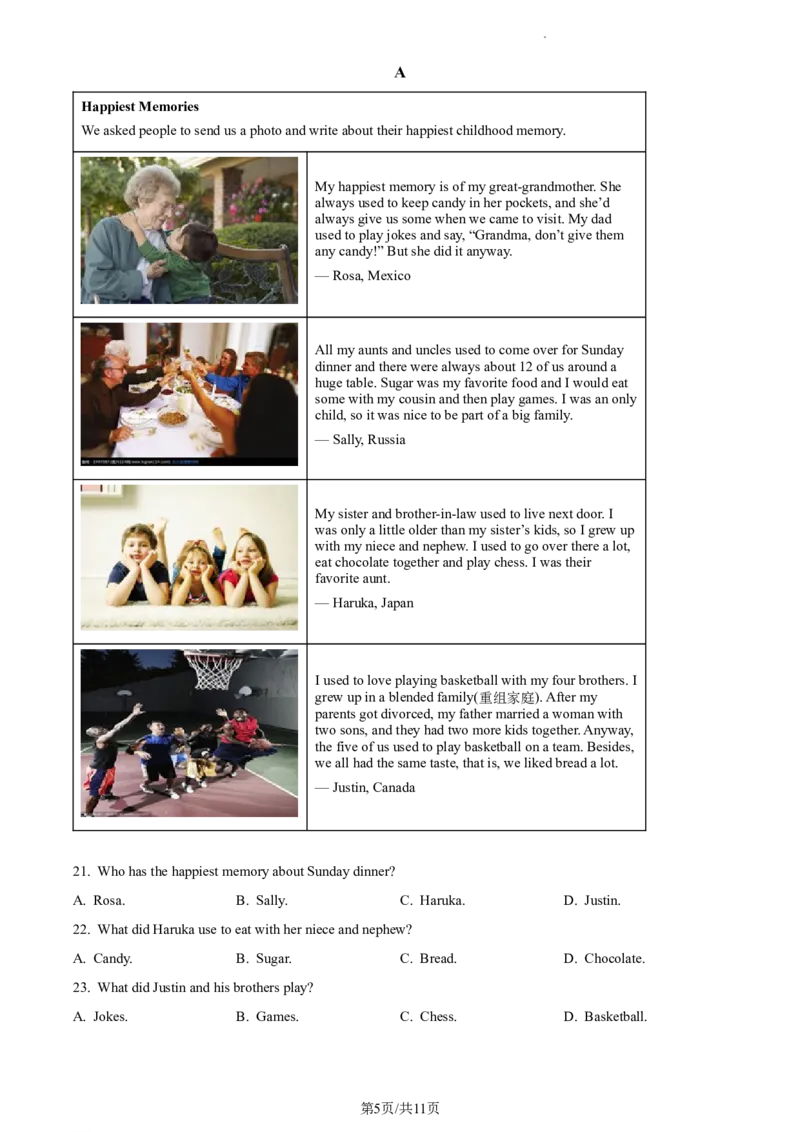
Happiest Memories
We asked people to send us a photo and write about their happiest childhood memory.
My happiest memory is of my great-grandmother. She
always used to keep candy in her pockets, and she’d
always give us some when we came to visit. My dad
used to play jokes and say, “Grandma, don’t give them
any candy!” But she did it anyway.
— Rosa, Mexico
All my aunts and uncles used to come over for Sunday
dinner and there were always about 12 of us around a
huge table. Sugar was my favorite food and I would eat
some with my cousin and then play games. I was an only
child, so it was nice to be part of a big family.
— Sally, Russia
My sister and brother-in-law used to live next door. I
was only a little older than my sister’s kids, so I grew up
with my niece and nephew. I used to go over there a lot,
eat chocolate together and play chess. I was their
favorite aunt.
— Haruka, Japan
I used to love playing basketball with my four brothers. I
grew up in a blended family(重组家庭). After my
parents got divorced, my father married a woman with
two sons, and they had two more kids together. Anyway,
the five of us used to play basketball on a team. Besides,
we all had the same taste, that is, we liked bread a lot.
— Justin, Canada
21. Who has the happiest memory about Sunday dinner?
A. Rosa. B. Sally. C. Haruka. D. Justin.
22. What did Haruka use to eat with her niece and nephew?
A. Candy. B. Sugar. C. Bread. D. Chocolate.
23. What did Justin and his brothers play?
A. Jokes. B. Games. C. Chess. D. Basketball.
第5页/共11页
学科网(北京)股份有限公司B
The students often gather together in small,closed groups.If you are not part of a group,it can be
difficult for you to be accepted.This is especially true if you can't speak to the members of the group in their
language.
This was the situation Sam faced each day as he went to class.Sam and his family moved to France last
month. Before he arrived, he knew there would be many difficulties. But they were even worse than he had
imagined.
Every lunch hour, after arriving at his new school, Sam sat alone in the dining hall.He looked at all the
different groups of students around him. But he had no way to let them know that he was a good person. He
simply couldn't find the right words to reach them.
Sam knew he had to find a way to change the situation. Somehow, he had to adapt (适应) to this
new environment.He did a little research on the Internet and discovered that smiling is universal language,
it is understood everywhere.
One morning, as Sam was walking by a group of students, he smiled at them. A boy in group smiled back at
him. For Sam, this was a good beginning. Later, he noticed the boy coming towards him in the hall with a warm
smile on his face. Sam returned the smile.
Soon the boy asked Sam to join him and his group of friends for lunch.
Although Sam wasn't able to say much in French,everyone smiled and laughed. Before he knew it,
Sam had a group of friends,and they all wanted to help him learn French.
24. Sam and his family _____last month.
A. moved to France B. started a new school
C. accepted a new group D. taught people their language
25. What helped Sam to change his situation?
A. Sitting alone in the dining hall. B. Doing a research on the Internet.
C. Walking by a group of students often. D. Learning French in a language school.
26. What's the passage mainly about?
A. The importance of friendship. B. Difficulties in a new country.
C. The ways to make friends. D. The power of a smile.
C
Is the Mobile Phone a Must-have for Teenagers?
Next time you’re in a public place, take a look around you, and count how many people are using their
mobile phones. I can tell you now that it is probably more than half, whether you’re on public transport, in a café or
第6页/共11页
学科网(北京)股份有限公司simply walking down the street. With the development of technology, we can now do almost anything on the
mobile phones. How does the use of mobile phones affect (影响) the young? Do they really need mobile phones or
not? Some British parents, teachers and teenagers give their opinions on this subject.
Parents want their kids to be safe. Are teenagers safer with a mobile phone or without? William, a parent of
two kids, says, “The great thing about my kids having mobile phones is that I can keep in touch with them. The
worst thing about teenagers having phones is that some young people use them to send impolite messages to each
other.” Some parents have rules about their children’s mobile phone and internet usage. If they break the rules, their
phones will be kept by their parents.
In the UK, students can take their mobile phones to school,but they are not allowed to use them in class.
Some teachers complain (抱怨) that students don’t always follow the rules. They don’t listen carefully in class
because they are using their phones to surf the internet, chat with friends or so on. As for the students, most of them
think phones are part of their lives. They can keep in touch with family and friends, and they can take photos, keep
important information and surf the internet, which is very convenient (方便). Some consider phones as a kind of
fashion (时尚) and they don’t want others to see them as “out” or “different”.
It’s true that mobile phones have become a symbol of the modern life. This form of technology makes
teenagers’ life much more convenient, but if teenagers depend too much on them, it can lead to serious problems.
Increasingly scientists are saying that everyone needs a break from mobile phones — put them away and
experience “the real life”. In fact it can be very easy — next time when you go out with friends, put all of your
phones in the middle of the table. Whoever touches his phone first has to pay the bill!
Indeed, the convenience brought by mobile phones is great, but don’t let your phone become more important
than the “real” people in your “real” life.
27. The mobile phones will probably be kept by parents if the teenagers ________.
A. go out with classmates and friends and pay the bill
B. search for a lot of important information and keep it
C. take them to school and look up new words after class
D. send impolite messages and surf the Internet too much
第7页/共11页
学科网(北京)股份有限公司28. According to the passage which of the following is true?
A. All students consider mobile phones as a kind of fashion.
B. Teachers allow students to use mobile phones in class in the UK.
C. Parents often count how many young people are using mobile phones.
D. More and more scientists think people need a break from mobile phones.
29. What does the writer mainly want to tell us?
A. Schools should stop students from taking their phones to school.
B. The mobile phone is the most important invention in modern life.
C. Mobile phones are useful but teenagers shouldn’t totally depend on them.
D. Talking with friends on mobile phones is better than doing it face to face.
D
If you ever have the desire to break out into song in the shower, in the car, maybe at your neighbor’s karaoke
night—you should embrace it whole-heartedly. This ancient art not only makes you feel good, but it can also
improve your well-being, reduce your feelings of pain, and even extend your life.
Using your voice to sing, rather than simply carrying out a conversation, offers unique benefits because
singing affects our bodies. Also, studies link singing with a lower heart rate decreased blood pressure and reduced
stress according to Patricia Preston-Roberts, a music therapist (治疗师). She uses the song to help patients who
suffer from a variety of problems.
Singing, particularly in a group, seems to benefit the elderly particularly well. As part of a three-year study
examining how singing affects the health of those fifty-five and older, a Senior Singers Chorus was formed by the
Levine School of Music in Washington, D.C. The seniors involved in the chorus, as well as seniors in two separate
arts groups about writing and painting, showed significant health improvements compared to those in the control
groups (控制组). Obviously, the arts groups reported thirty fewer doctors’ visits, fewer eyesight problems, less
depression, and less need for medication.
Even lead researcher Dr. Gene.D.Cohen director of the Center on aging at George Washington University, was
surprised at how big an effect the seniors’ arts participation had on their health. Cohen said, “The average age of all
the subjects was eighty. This is higher than life expectancy. So, if an effect were to be achieved, one would
ordinarily expect to see less decline (下降) compared to the control group. The fact that there was so much
improvement in many areas was the surprising factor.” The seniors also noticed health improvements and they
reported feeling better both in daily life and while singing.
The part of the brain that works with speech is different from the part that processes music. “People seem to
enjoy doing something jointly with other people. There are a lot of facts that being socially involved is good for
第8页/共11页
学科网(北京)股份有限公司people with dementia (老年痴呆).” Ballard said.
,
The arts are showing up as a treatment tool in hospitals across the country. If you are thinking of volunteering
singing at a hospital may be a good choice—not only for the patients, but also for yourself.
30. In the first paragraph the author ________.
A. expresses a desire for singing B. offers some advice on singing
C. puts forward his point of view D. states the importance of health
31. Why was Cohen surprised at the results of the study?
A. The study was not as expensive as expected.
B. Arts acted as a treatment tool in hospitals.
C. People’s health in the arts group improved greatly.
D. The seniors themselves noticed health improvements.
32. What is the writer’s attitude towards arts?
A. Doubtful. B. Positive. C. Negative. D. Worried.
33. What would be the best title for the passage?
A. How to Avoid Getting Dementia
B. How Seniors Live a Healthy Life
C. How to Keep Our Brains Healthy
.
D How Singing Improves Your Health
Later this year, Beijing will start the country’s first driverless(无人驾驶 ) subway trains. The Yanfang Line-
connecting part of Fangshan district center-will be the first to try out driverless technology.
According to the experts(专家) in public transportation, the new trains will make the underground railway
system(系统) better. They will have an upgraded(升级的)operating system. They will reach 80km per hour and
carry more than 1,200 passengers.
The development of driverless technology is opening up in other areas of transport(交通工具). Driverless cars
have been a dream for many people. And in the past few years, big car companies, including Volkswagen and
Toyota, have made lots of studies while they are competing with other companies, such as Google.
But with not racks(轨道) to run on, how will driverless cars be safe? This technology is made up of many
sensors(传感器) including radar and GPS. This gives the car an exact position in the world, as well as what’s
around it. It also allows the car to see moving objects(目标), like other cars and people.
Pilot-free planes have also become a hot technology topic. Yet while these new kinds of technology are seen as
better and safer, they do have problems. They cannot work at all without the help of computers. Just like humans,
computers make mistakes-although less often. And like much of technology, it makes many workers lose their jobs.
第9页/共11页
学科网(北京)股份有限公司What will happen to the future bus drivers and pilots?
34. Will Beijing start the country’s first driverless subway trains?
_____________________________________________________________
35. How many passengers will the driverless subway train carry?
_____________________________________________________________
36. What did the big companies do about the driverless technology?
_____________________________________________________________
37. Why will driverless cars be safe?
_____________________________________________________________
38. What does the writer mainly tell us in the last paragraph?
_____________________________________________________________
书面表达 (共10分)
九、文段表达。(10分)
从下面两个题目中任选一题,根据中文和英文提示,完成一篇不少于50词的文段写作。文中已给出内容不
计入总词数。所给提示词语仅供选用。请不要写出你的校名和姓名。
题目①
39. 假设你是李华,你的英国笔友Jim对中国传统文化感兴趣,他计划在他的学校举办一次中国传统
文化展。他写邮件向你咨询相关信息。请给他回邮件,内容包括:在文化展中,组织哪些活动好,为了更
好的举办这次文化展,建议Jim做什么准备。
提示词语:traditional, Chinese culture, history, Peking Opera, drink tea
提示问题:
● What activities are good to be organized on the show?
● What do you advise Jim to prepare for the show?
Dear Jim,
I’m glad to know that you will hold such a great show.
____________________________________________________________________________________________
____________________________________________________________________________________________
____________________________________________________________________________________________
____________________________________________________________________________________________
____________________________________________________________________________________________
____________________________________________________________________________________________
____________________________________________________________________________________________
第10页/共11页
学科网(北京)股份有限公司____________________________________________________________________________________________
____________________________________________________________________________________________
____________________________________________________________________________________________
________________________________________________________________________________
Yours,
Li Hua
题目②
40. 假如你是李华,学校英语校刊举办“新变化,新规则”的征文活动,现向广大同学征集稿件。请你
投稿,谈谈随着生活环境的变化,社会发展的大环境以及信息技术的发展,学校制定了哪些新校规,并谈
谈你认同哪个新规则及原因。
提示词语:face masks, sort waste, smart phones, COVID-19, environment
提示问题:
● What new rules does your school make?
● Which rule do you agree with? Why?
____________________________________________________________________________________________
____________________________________________________________________________________________
____________________________________________________________________________________________
____________________________________________________________________________________________
____________________________________________________________________________________________
____________________________________________________________________________________________
____________________________________________________________________________________________
____________________________________________________________________________________________
____________________________________________________________________________________________
___________________________________________________________________________________________
第11页/共11页
学科网(北京)股份有限公司