2021—2022 学年第二学期初二年级英语
期中校内练习试题
2022,4
听力理解(共32分)
一、听对话或独白, 根据对话或独白的内容, 从下面各题所给的A、B、C三个选项中选择最
佳选项。每段对话或独白你将听两遍。(共12分, 每小题1.5分)
请听一段对话, 完成第1至第2小题。
1. Why do the speakers need a gift for Linda?
A. For Christmas. B. For her birthday. C. For her friend’s party.
2. What are they going to buy?
A. A T-shirt. B. A teddy bear. C. A music player.
请听一段对话, 完成第3至第4小题。
3. Where is the girl probably now?
A. In the classroom. B. At Xiangshan Park. C. At the shopping mall.
4. What’s the possible relationship between the two speakers?
A. Cousins. B. Neighbors. C. Classmates.
请听一段对话, 完成第5至第6小题。
5. How does the girl usually go to school?
A. By subway. B. By bike. C. By bus.
6. What can we learn about Karl Benz?
A. He didn’t like riding horses.
B. He was an engineer in a machine shop.
C. He invented the car in the year of 1844.
请听一段对话, 完成第7至第8小题。
7. What can we learn from the passage?
A. Blind people expect our help.
B. Guide sticks help blind people be noticed.
C. Guide dogs are raised by blind people as pets.
8. What is the speech mainly about?
A. Why blind people need help while walking.
B. What difficulties blind people might have.C. How blind people get help with walking.
二、听后回答(共10分, 每小题2分)
听对话, 根据对话内容笔头回答问题, 每段对话你将听两遍。
9. When will the meeting begin this morning?
______________________________________
10. What does the boy usually do in his spare time?
______________________________________
11. What does the boy’s father want him to be?
______________________________________
12. Where is the boy going?
______________________________________
13. Whose pencil case is it?
______________________________________
三、听后记录并转写(共10分)
第一节 记录关键信息(共5分, 每小题1分)
请听一段独白, 根据所听到的内容和提示信息, 完成信息表。这段独白你将听两遍。
How to Study History
Use 14 color pens to highlight important points.
Fill colors in the book
Record them in colors.
Create a timeline covering all the events.
Create charts and timelines
Prepare 15 trees and outlines.
Help you create 16 connections and memorize
Use mind map
information easily.
Take down what you learn.
Practice 17 as much as you can
18 each event into causes and results.
第二节 转写(共5分)
19. 请再听一遍独白, 转写你所听到的主要内容。
I’ve got some advice from Chris on…
_______________________________________________________________
知识运用部分(共20分)
四、单项填空(每小题1分, 共12分)
1. Look! That old man is crossing the road. Let’s go and help ______.A. me B. him C. her D. them
2. In order to keep cool, many people go swimming _______ summer.
A. in B. at C. on D. to
3. Hurry up, ________ you will be late for school.
A. and B. but C. or D. so
4. I think skiing is ______ than running.
A. exciting B. more exciting C. most exciting D. the most exciting
5. They went to ________ Great Wall yesterday and had ________ good time.
A. the; a B. a; an C. an; a D. /; a
6. Jack ______ a good rest as soon as he finishes the exam.
A. has B. had C. is having D. will have
7. Every year many foreigners ________ to China to learn Chinese.
A. come B. have come C. came D. will come
8. He ________ in the library when the rainstorm came yesterday.
A. slept B. sleeps C. is sleeping D. was sleeping
9. I _______ a picnic with my brother last Sunday. It was great.
A. have B. had
C. will have D. am having
10. —I’m Daisy, not Jessie.
—Sorry, I have difficulty ________ people’s names.
A. remembering B. to remember C. remember D. remembers
11. Our government is trying to ________ ways to solve the smog (雾霾) problem.
A. catch up with B. put up with C. come up with D. get on with
12. The students decided ________ for a volunteer after-school reading program.
A. trying out B. try out C. to try out D. tried out
五、完形填空(共8分, 每小题1分)
阅读下面的短文, 掌握其大意, 然后从短文后各题所给的 A、B、C、D四个选项中, 选择最
佳选项。
When I was small, my mum used to give the family something special for meals—she would make breakfast
food for dinner.
I still remember one night my mum ____13____ some bread in front of my dad, something very burnt(烤糊
的). I waited to see if anybody noticed. To my surprise, he smiled at my mum and then turned to ask me how my
day at school had been. I ____14____ what I told him that night. But I do remember watching him put some butteron that bread. He ____15____ as usual, every single bite.
After dinner, my mum said sorry to my dad for burning the bread. And I never forget what he said, “I love
burnt bread, dear. It doesn’t ____16____ at all.” Later that night, I went to kiss Dad good night. I asked him if he
really liked his bread burnt. He held me in arms and ____17____ “Your mum worked very hard all day. She’s
really tired. And you see a bit of burnt food never hurt anyone!”
Now I know life is not perfect. Nobody is perfect, either. As for me, I often forget birthdays or some other
special days. But I’ve learned something ____18____ over these years. What we really need is the understanding
of each other, whether between a husband and wife, a parent and ____19____ or just between two friends. This is
the key to a happy life. So, don’t get angry if the bread gets burnt. Remember, burnt bread never hurt anyone. Be
kind to those around you and a happier life will surely come ____20____ to you.
13. A. cooked B. put C. found D. bought
14. A. decided B. knew C. forgot D. finish
15. A. threw it away B. ate it up C. put it away D. looked it up
16. A. work B. hurt C. stop D. matter
17. A. said B. shouted C. laughed D. asked
18. A. important B. difficult C. funny D. easy
19. A. student B. brother C. sister D. child
20. A. harder B. longer C. closer D. farther
阅读理解(共38分)
六、阅读下列短文, 根据短文内容, 从短文后各题所给的A、B、C、D四个选项中, 选择最佳
选项。(共28分, 每小题2分)
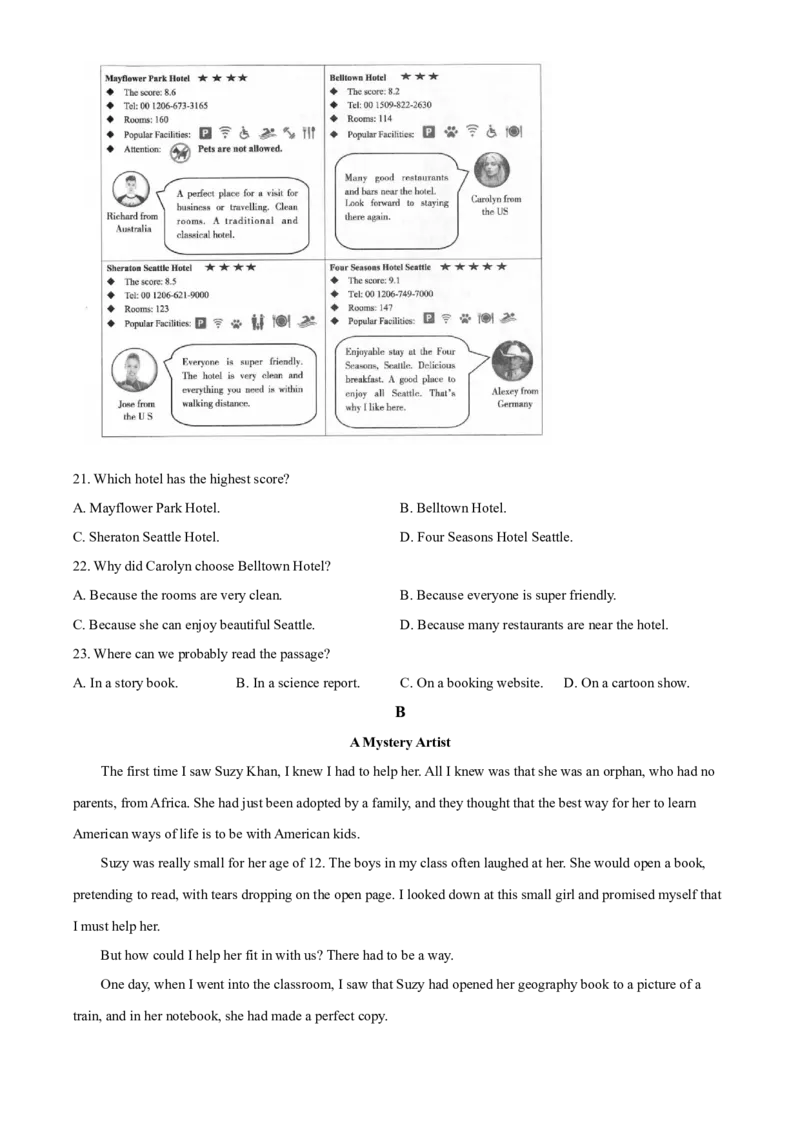
A21. Which hotel has the highest score?
A. Mayflower Park Hotel. B. Belltown Hotel.
C. Sheraton Seattle Hotel. D. Four Seasons Hotel Seattle.
22. Why did Carolyn choose Belltown Hotel?
A. Because the rooms are very clean. B. Because everyone is super friendly.
C. Because she can enjoy beautiful Seattle. D. Because many restaurants are near the hotel.
23. Where can we probably read the passage?
A. In a story book. B. In a science report. C. On a booking website. D. On a cartoon show.
B
A Mystery Artist
The first time I saw Suzy Khan, I knew I had to help her. All I knew was that she was an orphan, who had no
parents, from Africa. She had just been adopted by a family, and they thought that the best way for her to learn
American ways of life is to be with American kids.
Suzy was really small for her age of 12. The boys in my class often laughed at her. She would open a book,
pretending to read, with tears dropping on the open page. I looked down at this small girl and promised myself that
I must help her.
But how could I help her fit in with us? There had to be a way.
One day, when I went into the classroom, I saw that Suzy had opened her geography book to a picture of a
train, and in her notebook, she had made a perfect copy.I was surprised and thought that she could do something in the coming talent show. So, I took her to see the art
teacher, Miss Parker, and showed her what Suzy had drawn. “Why, it’s wonderful,” said Miss Parker, and then
showed us a poster she had painted for the talent show. “I need more of these, but I just don’t have enough time.
Could you help me, Suzy?”
On the day of the talent show, Suzy’s posters were everywhere—all over the hall and all over the school, each
one different.
“And finally,” said Mr. Brown, the schoolmaster, at the end of the show, “We have a special award. I’m sure
you’ve all noticed the wonderful posters.” Everyone nodded. “One of our own students painted them.”
I could hear everyone whispering. “Who in our school could draw that well?”
Mr. Brown waited for a while before saying, “Since this student worked so hard on the posters, she deserves a
prize, too. Our mystery artist is our new student—Suzy Khan!”
Mr. Brown thanked her for all the wonderful posters and gave her a professional artist’s set. “Thank you,” she
cried. I realized, at that time when I was looking at her excited face, she had probably never owned anything in her
whole life.
Everyone started to clap their hands. Suzy Khan gave them a shy smile. I knew then Suzy was going to be all
right.
24. The writer wanted to help Suzy because ________.
A. Suzy was laughed at by the boys in her class B. Suzy couldn’t answer the teacher’s question
C. Suzy was really small for her age of twelve D. Suzy was adopted by the writer at that time
25. Miss Parker asked Suzy Khan to draw more pictures for her, because ________.
A. she was lazy B. she had no time C. she couldn’t draw well D. she didn’t like drawing
26. According to the passage, we can infer that ________.
A. a mystery artist helped Suzy win the prize finally
.
B at first everyone knew that Suzy could draw well
C. the writer thought Suzy wouldn’t own anything
D. Suzy would be more confident than before
C
It happens every night—bedtime. But what if you’re not sleepy? Should you still go to bed if you are just
going to lie there with your eyes wide open? It’s a problem that has been around as long as there are people trying
to sleep.
You might be excited by something you did in the day. You might be nervous about what you’re going to do
the next day. Maybe you don’t like sleeping alone in your room. Maybe you have frightening(吓人的)dreams.All of these are possible reasons for your sleeping problem. However, there are some steps you can take to help you
solve it.
One thing that can help is talking to a parent or another trusted adult about what you’re worrying about at
bedtime. For example, if you’re nervous about taking a test, or upset about being teased(被嘲弄)at school, it can
really help to tell somebody. Knowing that somebody has heard you can help ease your mind so that you can have a
good rest.
Sleeping in a comfortable bed in a quiet and cool room is a good choice. If there’s anything in your room that
makes you feel uneasy or anxious at night, like a picture that looks strange in the dark, or a noisy faucet(水龙
头)in the bathroom, be sure to ask your parents to move or fix it. Make sure electronics, such as mobile phones or
iPads, are kept away from your bed. They can keep you excited, making it harder for you to fall asleep.
If you are usually restless around bedtime, doing certain things to relax beforehand may help you fall asleep.
Try to take more time to wind down by taking a warm bath, or listening to a bedtime story at least 30 minutes
before you go to sleep. It also helps to follow a bedtime routine and go to sleep at the same time every night. As a
result, your body will get the message that it’s almost time to sleep. Your body will know to start feeling tired.
In order to find the right solution for you, it’s important that you understand what exactly is keeping you up at
night. Getting a good night’s sleep is worth the time and effort of finding the right solution to your sleeping
problem.
27. Paragraph 2 is mainly about ________.
A. why people have frightening dreams at night
B. why daytime activities influence people’s sleep
.
C what can help people solve the sleeping problem
D. what may make it difficult for people to fall asleep
28. If you want to feel less nervous about a test and have a good sleep ________.
A. you should study harder at school B. you can go to your parents for help
C. you should sleep in a quiet and cool room D. you can listen to some stories before bedtime
29. What does the phrase “wind down” in Paragraph 5 probably mean?
.
A Keep clean. B. Get relaxed. C. Stay awake. D. Feel excited.
30. To get a good sleep, what does the writer advise you to do first?
A. To go to bed at a certain time every night.
B. To do something to make you tired in the day.
C. To stay away from electronics before going to bed.
D. To know the exact reason why you stay awake at night.D
Everyone wants to be well-liked. As humans, we are born with the need to be valued and liked by others.
Being part of a group has been necessary in a lot of ways. Connection is a basic human need.
Many people feel as though they have to be a certain way to be well-liked. They think others will like them
more if they put their best selves forward, don’t make mistakes, and always know the right thing to say. However,
some surprising science may be putting all this in question.
The Pratfall Effect
It turns out that people who never make mistakes are actually less likeable. According to an experiment by
Elliot Aronson in the 1960s, people who made a small blunder, such as dropping coffee over their shirt, were
considered more likeable than those who didn’t. This was only true for people who were considered competent (有
能力的) in the first place, though. This phenomenon (现象) was termed the Pratfall Effect.
The Pratfall Effect shows that it’s not only okay to make mistakes, but it can actually be helpful to us.
Vulnerability (weakness) is endearing (讨人喜欢的). It helps us form connections with others. When we
understand where someone is coming from an connection with them, we develop a deep emotional bond and like
them more.
Apply this to your own life
You can use this information to your advantage. Firstly, it’s important to know likeability depends on context.
What someone finds endearing in one situation may not work in another, and different people might find different
qualities more likeable. Sometimes the things we dislike the most about ourselves are the most endearing to others.
The same can be true for the opposite. Just be your true self and people will find what they love most about you.
Secondly, vulnerability is a good thing. Sharing the most inner, real parts of yourselves can create meaningful
connections. Pretending (假装) to be perfect is not something that people find endearing. But opening up is
something that people can easily connect with.
Likeability is not as straightforward as you might think. What you think makes you more likeable might
actually make you less likeable. Stop pretending you never make mistakes. It’s the best path to a true and
meaningful human connection.
31. What can we learn from the Pratfall Effect?
A. Life experience can be enriched by making mistakes.
B. The fear of making mistakes makes people more careful.
C. People who make small mistakes may turn out to be more likeable.
D. The ability to learn from mistakes makes a person more competent.
32. What is the writer’s opinion on vulnerability?A. It leads us to the right way to be perfect.
B. It works as a smart way to express our opinions.
C. It makes other people feel better about themselves.
D. It helps us form meaningful connections with others.
33. The writer suggests that we should stay true to ourselves because ________.
A. likeability varies in different cases B. no one can be perfect
C. we should accept and like who we are D. it’s hard to pretend all the time
34. Which of the following would be the best title for the passage?
A. A Secret to Improving Your Quality of Life
B. A Key to Being Likeable When Making Mistakes
C. The Possible Benefits of Building up Connections
D. The Surprising Science Behind Being Well-liked
七. 阅读短文, 根据短文内容回答问题。(共10分, 每小题2分)
A History of English...in Five Words
In 1582, Richard Mulcaster, the headmaster of a British school, wrote that English would not go beyond their
island. However, it didn’t stay that way. Today, English is spoken all over the world. It is a colorful and diverse (多
样的) language that long has picked up words from many other languages. Here are five words that show the
English language’s interesting history.
English
English began in the language spoken by the early Germanic people in the 5th century AD. It is from them that
the word “English” comes.
Beef
Although roast beef is seen as a traditional English dish, the word “beef” was introduced from the French
word boeuf during the Middle Ages. It was one of a group of words, including pork and mutton, that were taken
from the speech of the French who moved to Britain following the Norman Conquest (诺曼底登陆) of 1066.
However, the farmers who kept these animals continued to call them by their old English names: cow, pig and
sheep. This difference passed on till this day.
Dictionary
Dictionary is a borrowing from Latin dictornarius liber, “book of words”. It first appeared in English in the 6th
century, along with a huge number of other words from Latin and Greek. The first English dictionary was written
by Robert Cawdrey in 1604. Cawdrey focused only on the difficult words whose meanings would have caused
problems for those not educated in Latin and Greek.Tea
的
The word tea comes from the Chinese word cha. A love of tea is so ingrained (根深蒂固 ) in British life
that the expression “cup of tea” has come to stand for anything viewed positively. The saying “It’s not my cup of
tea.” means “I don’t like it.”
Emoji
Emoji originated (起源于) in Japan in the 1990s.The word “emoji” is formed by combining the Japanese
“e”—picture and “moji”—letter. Emojis are just another example of the development and diversity of English.
35. What language is the word “beef” from?
_________________________________________
36. Who wrote the first English dictionary?
_________________________________________
37. What does “It’s not my cup of tea” mean?
_________________________________________
38. How is the word “emoji” formed?
_________________________________________
39. What makes English a colorful and diverse language?
_________________________________________
八. 书面表达 (10分)
从下面两个题目中任选一题, 根据中文和英文提示, 完成一篇不少于60词的文段写作。所给
提示词语仅供选用, 可以适当发挥。请不要写出真实班级与姓名。
40. 五一劳动节就要到了,学校志愿服务部正在招募志愿者,拟在五一期间进行志愿活动服务的地点
有:an old people’s home, a city park, the Children’s Hospital, an after-school care center, an animal hospital。假
如你是 Mary,请你写一封自荐信。内容包括你希望参加的一项活动,自己具备的条件(如爱好,特长,
性格特点,可能参加的时间等)以及对参加此次活动的看法。
要求:不少于60词,所给提示词语仅供选用,可以适当发挥。请不要写出真实班级与姓名。
提示问题:
1. Which activity do you like to take part in?
2. What can you do and Why?
.
3 What do you think of the activities?
提示词语:tell jokes, sing, dance, kind, be interested in, meaningful
Dear Sir,
I’mMary________________________________________________________________________________________
____________________________________________________________________________________________
____________________________________________________________________________________________
____________________________________________________________________________________________
____________________________________________________________________________________________
________________________________________________________
Yours,
Mary
41. 假如你是李华,你的英国朋友Mike来信向你诉说他的烦恼,他和妈妈因为做家务的事情吵架了,
他觉得跟妈妈很难沟通,不知道该怎么办。请你写一封回信安慰Mike,表达你对于Mike面临问题的看法,
并提出合理性建议。
要求:不少于60词,所给提示词语仅供选用,可以适当发挥。请不要写出真实班级与姓名。
提示词语:common, share chores, develop, be independent, write a letter, say sorry
提示问题:
What do you think of the problem and why?
What is your advice to Mike?
Dear Mike,
Thanks for trusting me. From your letter, I know you got a fight with your mom because of
chores._______________________________________________________________________________________
____________________________________________________________________________________________
____________________________________________________________________________________________
____________________________________________________________________________________________
____________________________________________________________________________________________
___________________________________________________
Yours,
Li Hua