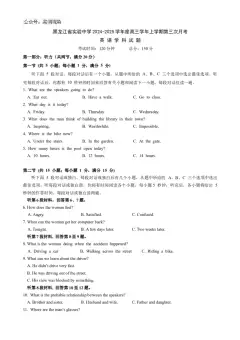
黑龙江省实验中学2024-2025学年度高三学年上学期第三次月考
英 语 学 科 试 题
考试时间:120分钟 总分:150分
第一部分:听力(共两节,满分20分)
第一节 (共 5 小题;每小题 1 分,满分 5 分)
听下面 5 段对话。每段对话后有一个小题,从题中所给的 A、B、C 三个选项中选出最佳选项。听
完每段对话后,你都有 10 秒钟的时间来回答有关小题和阅读下一小题。每段对话仅读一遍。
1. What are the speakers going to do?
A. Eat out. B. Have a walk. C. Go to class.
2. What day is it today?
A. Friday. B. Thursday. C. Wednesday.
3. What does the man think of building the library in their town?
A. Inspiring. B. Worthwhile. C. Impossible.
4. Where is the bike now?
A. Under the stairs. B. In the garden. C. At the gate.
5. How many hours is the pool open today?
A. 10 hours. B. 12 hours. C. 14 hours.
第二节 (共 15 小题;每小题 1 分,满分 15 分)
听下面 5 段对话或独白。每段对话或独白后有几个小题,从题中所给的 A、B、C 三个选项中选出
最佳选项。听每段对话或独白前,你将有时间阅读各个小题,每小题5 秒钟;听完后,各小题将给出 5
秒钟的作答时间。每段对话或独白读两遍。
听第6段材料,回答第6、7题。
6. How does the woman feel?
A. Angry. B. Satisfied. C. Confused.
7. When can the woman get her computer back?
A. Tonight. B. A few days later. C. Two weeks later.
听第7段材料, 回答第8至9题。
8. What is the woman doing when the accident happened?
A. Driving a car B. Walking across the street C. Riding a bike.
9. What can we learn about the driver?
A. He didn’t drive very fast.
B. He was driving out of the street.
C. His view was blocked by something.
听第8段材料, 回答第10至12题。
10. What is the probable relationship between the speakers?
A. Brother and sister. B. Husband and wife. C. Father and daughter.
11. Where are the man’s glasses?
A. In the bathroom. B. In his pocket. C. On his nose.12. What impressed the man most about his forgetfulness?
A. He went fishing without taking the fishing pole.
B. He forgot about his wedding and went fishing.
C. He went out without having pants on.
听第9段材料, 回答第13至16题。
13. What is the man’s problem?
A. He hasn’t had a vacation for three weeks.
B. He doesn’t know where to spend his vacation.
C. He doesn’t have time to go abroad.
14. Which continent does the man dislike?
A. Africa. B. Asia. C. South America.
15. What does the man think are boring?
A. Monuments. B. Hotels. C. Museums.
16. What makes the man interested in Paris?
A. Night clubs. B. Excellent hotels. C. Interesting sights.
听第10段材料, 回答第17至20题。
17. What is the speaker mainly talking about?
A. When and how bicycles began.
B. What a simple means of transportation is.
C. How did the first bicycle appear.
18. What do we know about the first bicycle?
A. It looked like a horse on a wheel.
B. It was easy to ride but uncomfortable.
C. It was difficult to ride and uncomfortable.
19. When did the bicycle become a practical means of transportation?
A. In 1790. B. In 1861. C. In 1900.
20. Why did people like bicycles?
A. They were very fashionable.
B. They were of the same prices as horses.
C. They didn’t need to be fed and were easy to ride.
第二部分 阅读理解(共两节,满分50分)
第一节 (共15小题;每小题2.5分,满分37.5分)
阅读下列短文,从每题所给的A、B、C、D四个选项中选出最佳选项。
A
Writing anything imaginative and questioning usually comes down to one ordinary question: what if? What if
there were ghosts who could move through the walls? What if a man were to turn into salt? What if there was a book
of real predictions? These questions form clear starting points, while character, setting, and the beginning point
are key parts.
In this masterclass with Natasha Pulley, the Sunday Times bestselling author of The Watchmaker of FiligreeStreet and creative writing lecturer, you will be guided through the strategies that help craft magical realism, from
story planning to the final completion.
Combining practical writing exercises with theory and discussion, this masterclass will give you the tools and
inspiration to build your ideas into a novel.
Course content
Finding your ideas quickly and easily
Extending the outline into more complex world-building
How to use historical language to enrich your work
How to think about novel structure
Course Details
Date: Thursday 12 October 2023
Time: 6: 30 pm - 9: 00 pm
You will be sent a link to the online class 24 hours prior to the start time. Please email masterclasses
@theguardian. com if you do not receive the access link 24 hours before the scheduled start time. If you require
any adjustments to enable your participation in this course, please get in touch with us through email as well.
21. What is the main objective of this masterclass?
A. To teach the process of publishing journals.
B. To guide participants in turning ideas into novels.
C. To provide instructions on writing book reviews.
D. To explore and discuss theories of magical realism.
22. What might be taught in this masterclass?
A. Applying historical language to enhance writing.
B. Obtaining inspiration to craft a bestseller.
C. Learning to analyze the structure of a novel.
D. Finding ideas to compose a lecture.
23. What should you do if you don’t receive the link as scheduled?
A. Reach out to Natasha Pulley for help. B. Seek support from fellow participants.
C. Contact the course provider via email. D. Check the course website for updates.
B
Early in the morning, a class of first graders excitedly entered the gym. Waiting for them on the floor lay a
massive, life-sized, inflatable(充气的) whale, complete with eyes, flippers, and all the markings of the real-life
humpback whale, named Nile. This creature is the brainchild of Cynde B. Mclnnis, a whale lover and educator. “There
was always this thing in my mind about taking whales back to Indiana to teach kids,” Mclnnis said in an
interview.
After another educator provided an introduction to Nile, the group headed towards the entrance of the whale
and took off their shoes. Once inside, the kids sat in an organized line as the educator pointed out all the significant
parts of the whale’s interior. As the lesson went on, the kids yelled out answers to questions, clearly thrilled to be
sitting inside this behemoth (巨兽). “The lesson is too cool for the students,” she said. “When they go in the whale,
you just see this childhood excitement on their faces. ” Indeed, inside the whale there certainly was an obvious
excitement. The educator kept everyone engaged with the jaw-dropping facts about whales, such as how they caneat two thousand pounds per day.
To Mclnnis, learning about whales is the most certain path to their effective conservation. “It’s just getting kids
to think that whales are cool, because if they don’t like them, they’re not ever going to be interested in saving them,”
Mclnnis said. Her central message about conservation was the importance of the ocean to all humans. “We think
that half the oxygen that we breathe comes from the ocean. Whether you live in Kansas or the coast of Massachusetts,
you’re breathing,” Mclnnis said. “I think that whales are such an awe-inspiring thing,” Mclnnis added. To her, along
with being beautiful creatures, whales serve as a bridge into environmentalism from a young age.
24. What do we know about Cynde B.Mclnnis?
A. She enjoys organizing outdoor classes. B. She likes to study animal behavior.
C. She is full of love for whales. D. She prefers to spend time with children.
25. Which of the following best describes the teaching activity?
A. Demanding. B. Conventional. C. Profitable. D. Effective.
26. What might Mclnnis agree with according to the last paragraph?
A. Whales are the most awe-inspiring creatures.
B. Protecting the ocean can help the whales.
C. The majority of oxygen supply originates from the ocean.
D. A keen interest helps develop a green mind.
27. What can be a suitable title for the text?
A. Respect the Rights of Animals B. Cultivate Love for Animals in Interests
C. Ocean Conservation Is Urgent D. Whales’ Story Needs to Be Heard
C
Every 40 days a language dies. This “catastrophic” loss is being intensified by the climate crisis, according to
linguists. If nothing is done, conservative estimates suggest half of all the 7000 languages currently spoken will be
extinct by the end of the century.
Speakers of minority languages have experienced a long history of persecution (迫害), with the result that by
the 1920s half of all indigenous (土著的) languages in Australia, the US, South Africa and Argentina were extinct.
The climate crisis is now considered the “final nail in the coffin” for many indigenous languages and the knowledge
they represent.
“Languages are already endangered,” says Anastasia Richl, director of the Strathy language unit at Queen’s
University in Kingston, Ontario. Huge factors are globalization and migration, as communities move to regions
where their language is not spoken or valued, according to Richl. “It seems particularly cruel, ” she says, “ that most
of the world’s languages are in parts of the world that are growing unpleasant to people. ” Vanuatu, a South Pacific
island nation measuring 12,189 km², has 110 languages, the highest density (密度) of languages on the planet. It is
also one of the countries most at risk of sea level rise. “Many small language communities are on islands and
coastlines easily subject to hurricanes and sea level rise,” she says. Others live on lands where rising temperature
threatens traditional farming and fishing practices, leading to migration.
In response to the crisis, the UN launched the International Decade of Indigenous Languages in 2022. Promoting
and conserving languages of indigenous communities is “ not only important for them, but for all humanity, ” said
Csaba Korosi, the UN general assembly president, urging countries to allow access to education in indigenouslanguages.
28. What does the underlined phrase “final nail in the coffin” in paragraph 2 mean?
A. The last straw. B. The last challenge.
B. The last possibility. D. The last opportunity.
29. Why is Vanuatu mentioned in paragraph 3?
A. To explain the main reason for language density.
B. To show the common features of endangered languages.
C. To stress the impact of geographical position on migration.
D. To illustrate the situation of minority language communities.
30. What does the International Decade of Indigenous Languages aim to do?
A. Support migrants to access local education.
B. Discourage people from massive migration.
C. Preserve the languages of indigenous communities.
D. Improve the living conditions of minority groups.
31. Which of the following is the best title for the text?
A. Faced with Disasters: Communities Have to Leave
B. Lost for Words: Climate Crisis Brings Threat of Catastrophe
C. Upset at Extinction: UN Urges International Cooperation
D. Involved in Action: Experts Seek Solutions to Climate Crisis
D
A new study has found that short periods of vigorous (充满活力的) physical activity can reduce cancer risk,
benefiting those with busy schedules or who prefer not to go to the gym. “Vigorous intermittent (间歇的) lifestyle
physical activity” (VILPA) refers to brief—one-or-two-minute—periods of vigorous physical activity mixed into
everyday activities. Stair climbing, or energetic housework, for example.
A new study led by the University of Sydney examined data obtained from wearable fitness trackers to see
whether VILPA affected cancer risk, particularly the risk of physical-activity-related cancers. “VILPA is a bit like
applying the principles of high-intensity interval training (HIIT) to your everyday life,” said Stamatakis, lead author
of the study.
The study included 22,398 testees, all of whom were “ non-exercisers”: they reported no leisure time exercise
and one or fewer casual walks per week. The mean age of them was 62, with men making up 45.2% of the sample,
and women 54.8%. People with a previous cancer diagnosis or those diagnosed within the study’s first year were
excluded.
During a follow-up of over six years, researchers recorded 2,356 new cancer events, with 1,084 in 13 physical-
activity-related cancer sites. A minimum of 3.5 minutes of daily VILPA was associated with an 18% reduction in
cancer incidence compared to no exercise, and 4.5 minutes a day dropped the incidence of physical-activity-related
cancer by 32%
While the study was observational and can’t establish cause and effect, the researchers suggest that the benefits
of VILPA on cancer risk are related to improved cardio-respiratory(心肺的) fitness. “We need to further research
this link through powerful trials, but it appears that VILPA may be a promising cost-free recommendation for
lowering cancer risk,” said Stamatakis. “So whether it’s taking the stairs instead of the elevator or going for aquick walk during lunch, prioritizing movement and making it a part of everyday life is extremely beneficial.”
32. Who does VILPA work best for?
A. Students who need nutrition.
B. Office workers who are too busy to exercise.
C. Patients who want to recover quickly from cancer.
D. Sports fans who are looking to enhance physical fitness.
33. What is paragraph 3 mainly about?
A. The factors influencing VILPA’s benefits. B. The effects of lifestyle on cancer risk.
C. The details about the study participants. D. The process of Stamatakis’ study.
34. What does Stamatakis suggest people do?
A. Engage in high-intensity exercise. B. Pay attention to heart health.
C. Prevent cancer risk at an early stage. D. Fit exercise into a daily routine.
35. Where is the text most probably taken from?
A. An essay in a health magazine. B. An introduction to a scientific book.
C. A report on a medical review. D. A handbook to exercise effective.
第二节(共5小题;每小题2.5分,满分12.5分)
根据短文内容,从短文后的选项中选出能填入空白处的最佳选项。选项中有两项为多余选项。
College admissions experts offer tips on how to write a college essay. For college applicants, the essay is the
place to showcase their writing skills and let their unique voice shine through. 36
Getting Started on the College Essay
A good time for students to begin working on their essays is the summer before senior year, when homework
and extracurricular activities aren’t taking up time and energy. 37 Students can go online to review essay
requirements, such as word limits and essay topics. Many students may start with the Common App, an application
platform accepted by more than ,1000 schools.
How Long Should a College Essay Be?
3 8 “While we won’t stop reading after 650 words, we cannot promise that an overly wordy essay will
hold our attention for as long as you’d hoped,” the Common App states.
39
The most discouraging step in the essay writing process is figuring out what to write about. There are several
topics to choose. The essay isn’t a complete autobiography. It’s overwhelming to think of putting your whole life in
one essay. Rather, students should narrow their focus and write about a specific experience or hobby that reveals
something personal, like how they think, what they value or what their strengths are. Students can also write about
something that illustrates an aspect of their background. 40 What’s most important is that a college essay
is thoughtful and tells a story that offers insight into who a student is as a person.
A. How to Write a College Essay.
B. How to Pick a College Essay Topic.
C. The following are tips on writing a college essay.
D. You should show your respect to the college teachers.
E. These are the types of essays that stand out to admissions officers.F. Starting early will give students plenty of time to work through the essay before deadlines.
G. Though the Common App notes there are no strict word limit for an essay, it suggests no more than 650 words.
第三部分 语言运用(共三节,满分40分)
第一节 (共15小题;每小题1分,满分15分)
阅读下面短文,从短文后各题所给的A、B、C、D四个选项中选出可以填入空白处的最佳选项。
In an inspiring turn of events, a woman in her 70s has become a model thanks to a chance encounter with a
stranger.
Photographer Christopher Ward, who recently started 41 strangers to take their photos as a form of
personal therapy (治疗), launched a project called “Model Strangers.” Through this project, he takes photos and
videos of people he finds “beautiful,” 42 their unique stories.
Earlier this year, Ward met Anne outside of Belfast City Hall. During a video interview, Anne shared that she
is a(n) 43 and retiring person who, like many of us, struggles with self- esteem.
The video of their encounter went 44 , amassing over 40 million views across social media platforms.
“She has become a 45 of sorts around Belfast, being stopped by people who have thanked her for being an
inspiration to them,” Ward shared.
Anne’s 46 fame has led to modeling opportunities with Kindred of Ireland, and she has even been
47 with ACA Models, the longest standing and most successful modelling agency in Northern Ireland.
Anne’s favorite part of her new career is proving to herself that life doesn’t 48 at 70. “It’s not over as
soon as you 49 70,” she told SWNS. She’s been 50 by the positive reactions from people who stop her on
the street. “It’s wonderful to see that an older woman can shine and make a 51 ,” she added.
Anne’s story is a beautiful 52 that it’s never too late to 53 new opportunities and that sometimes, all
it takes is a 54 encounter to change one’s life.
“I can’t 55 how proud I am of her,” Ward said.
41.A.demanding B.approaching C.cornering D.tricking
42.A.highlighting B.inventing C.adapting D.ignoring
43.A.shy B.active C.confident D.proud
44.A.offline B.cold C.sour D.viral
45.A.leader B.celebrity C.target D.millionaire
46.A.worldwide B.hard- won C.lifelong D.new- found
47.A.charged B.concerned C.signed D.awarded
48.A.fail B.end C.progress D.change
49.A.hit B.remain C.celebrate D.appear
50.A.discouraged B.saddened C.thrilled D.amused
51.A.fortune B.point C.difference D.scene
52.A.mistake B.wish C.warning D.reminder
53.A.reject B.embrace C.present D.miss
54.A.chance B.tense C.strange D.worthy
55.A.oversee B.underestimate C.overstate D.underplay第二节 单句填空(共10小题;每小题1分,满分10分)
阅读下面单句,用所给单词的正确形式填空。
56. Modest as well as _______________(ambition), they are admired by many young people.
57. She received a special award in _____________________(acknowledge) of all her hard work.
58. In my spare time, I have been ______________(occupy) in practising my oral English so I speak English
fluently.
59. The local authority has just given final ____________(approve) to a new stadium.
60. She failed to live up to her parents’ __________________(expect).
61. Obviously we’re all absolutely ______________(delight) to welcome another calf to our black rhino family.
62. The area is _________________(remark) for its scenery.
63. After several hours of ______________(aim) searching, they were getting low on fuel.
64. The security system uses facial ________________(recognize) to identify visitors.
65. The theater was over, but my _______________ (curious) remained.
第三节 语法填空(共10小题;每小题1.5分,满分15分)
阅读下面短文,在空白处填入1个适当的单词或括号内单词的正确形式。
Wang Haoze, a crew member of the Shenzhou XIX mission, is China’s first female spaceflight engineer.
During her college years, she was outstanding 66._________________ (academic), ranking at the top of her
class. Additionally, she represented her school in sports competitions.
“67. ___________was my postgraduate mentor who led me to a career in the space industry. Professor Gu Fan
is very interested in spaceflight 68. _______________ often discussed relevant topics with us. He also encouraged
his postgraduate students to apply 69. ____________ jobs in the space industry,” Wang Haoze recalled, explaining
that the professor was so 70. _________________ (influence) to her that she decided to join the spacecraft research
community.
As her graduation approached, Wang 71. ______________(submit) her resume to the Beijing Aerospace
Propulsion Institute, China’s major research body of liquid-propellant rocket engines.
At the institute, Wang was part of the research and development of new models of rocket engines, a new field
72. __________ she had never been involved. 73. ___________(face) with new challenges and knowledge, she
enjoyed learning and overcoming difficulties, which appeared as an attractive game to her.
On October 30, 2024, she embarked on a space journey aboard Shenzhou-19. Her
74._________________(responsibility) include space experiments, material management, and station affairs.
Wang Haoze is 75. ____________ inspiration, demonstrating courage, perseverance, and a passion for space
exploration.
第四部分 写作(共两节,满分40分)
第一节 应用文写作(满分15分)
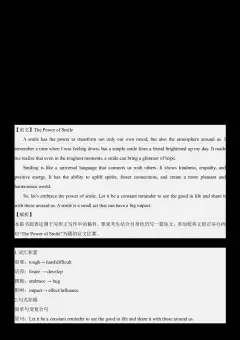
你校英文报正举办以“The Power of Smile”为题的征文比赛,请结合自身经历写一篇短文投稿,内容
包括:
1.自身经历;
2.你的感悟。注意:
1.词数80左右;
2.题目已为你写好。
The Power of Smile
___________________________________________________________________________________________
___________________________________________________________________________________________
___________________________________________________________________________________________
___________________________________________________________________________________________
___________________________________________________________________________________________
___________________________________________________________________________________________
___________________________________________________________________________________________
___________________________________________________________________________________________
___________________________________________________________________________________________
___________________________________________________________________________________________
第二节 读后续写(满分25分)
阅读下面材料,根据其内容和所给段落开头语续写两段,使之构成一篇完整的短文。
My family moved in a small house in Brighton, Colorado on my seventh birthday. My first memory is our
neighbor Bill, an old man, handing me strawberries from his garden through a hole in the chain-link fence. “We
need to make the hole bigger,” he said jokingly. Later I knew that he lived alone.
Bill spent much time working in the garden, and I was always talking to him from our yard. I was a chatterbox. I
think what drew me to Bill is that he never got tired of listening to me. I also think Bill saw a lot of himself in me
— we were both lonely and anxious — and that may be why he always took the time to listen to me. It was a
wonderful connection.
There weren’t any kids of my age in the neighborhood, and my parents were very busy, so I mostly played in
the yard with my dog. I had a lot of imaginary friends — a whole family, actually, with a wife, children, a best
friend... no joke. Weird kid.
One day, my parents asked Bill whether he’d watch me while they were away on business. This worked for
everyone, so it became a somewhat monthly occurrence. Bill had a spare room in his house, which became “my”
room.
Bill promised to teach me to drive the lawn tractor(割草机) someday and I was always looking forward to it.
In winter, Bill would attach a snowplow(铲雪机) to the front of the dawn tractor. I seriously told him that I would
invent a better snowplow when I grew up. “Sure you will. You’ll get a patent certificate(专利证书). It takes a
certificate to prove an important thing,” Bill said with a smile.
One snowy morning, an idea suddenly hit me. My parents were watching TV when I spit it out, “What if I
adopted Bill as my grandpa?” My parents said I could go over and ask him.
注意: 1.续写词数应为 150个左右; 2.请按如下格式在答题卡的相应位置作答。
Paragraph 1:
I knocked on his door, sat down in his living room, and asked, “Can I adopt you as mygrandpa?”__________________________________________________________________________________
___________________________________________________________________________________________
___________________________________________________________________________________________
___________________________________________________________________________________________
___________________________________________________________________________________________
___________________________________________________________________________________________
___________________________________________________________________________________________
___________________________________________________________________________________________
___________________________________________________________________________________________
Paragraph 2:
The next morning, while learning to drive the lawn tractor with a snowplow, I accidentally plowed down our
chain-link fence. _____________________________________________________________________________
___________________________________________________________________________________________
___________________________________________________________________________________________
___________________________________________________________________________________________
___________________________________________________________________________________________
___________________________________________________________________________________________
___________________________________________________________________________________________
___________________________________________________________________________________________
___________________________________________________________________________________________