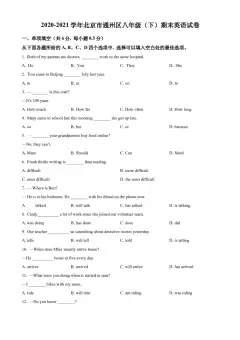
北京市通州区 2021-2022 学年八年级下.期末英语试卷
知识运用共14分.
单项选空每小题0.5分,共6分.
从下面各题所给的A.B、C、D四个选项中,选择可以填入空白处的最佳选项。
1. The lovely girl is from Class 6. ____ name is Alice.
A. Her B. His C. Your D. Its
2. —Is your father home?
—No, he’s working late ________ the office.
A. on B. at C. of D. to
3. —Where were you last Saturday?
—I ____ in the Capital Museum.
A. am B. will be C. was D. have been
4. — Mum, must I clean the room right now?
— No, you ________.
A. shouldn’t B. wouldn’t C. mustn’t D. needn’t
5. I work hard this term, but Peter works much ______.
.
A hard B. harder
C. hardest D. the hardest
6. —May I speak to Mr. Bruce?
—Sorry! He ________ a meeting(会议) now. Can I take a message?
.
A is having B. had C. has D. will have
7. There are no buses, ________ you’ll have to walk.
A. so B. or C. but D. for
8. —________ does it take me to go to the train station?
—About 20 minutes.
A. How old B. How long C. How far D. How much
9. I ____ Mr. Smith since he moved to Shanghai.
A. didn’t hear from B. don’t hear from
C. won’t hear from D. haven’t heard from
10. —Can you tell me ____ the prize, Tom?
—Last year.
A. when you got B. when did you getC. when will you get D. when you will get
11. Kate ________ some cleaning in the community when I met her yesterday afternoon.
A. did B. does C. will do D. was doing
12. We ________ a football match on the playground if it doesn’t rain tomorrow.
A. have had B. had C. will have D. are having
二、完形填空
阅读下面的短文,掌握其大意,然后从短文后各题所给的A、B、C、D四个选项中,选择最佳选项。
On a sunny afternoon, my father and I were reading together in the living room. My father is an amateur (业
余的) ___13___. He likes writing short stories and some of them were published in the newspapers. I read the
stories for a while and then looked at him and said, “Why not write a story myself like them? If you like it, give
me a ___14___!” He agreed happily.
Back to my room, I concentrated (集中精力)on writing. But when the hundredth draft (草稿) still hardly
gave me satisfaction, hopelessness filled my heart. I looked out of the window, and listened to the bird
purposelessly. How could I make my father ___15___? Then I went past the living room to the study ___16___
for help, where I found an interesting story. I was so excited that I took down everything I needed from the book
without thinking. Then I took the story to my father. He finished reading, nodded and smiled, “It is excellent,
Jay. I am quite sure you can get what you want.” Then he pointed at a line, “Writing really takes study and
imagination. I can tell you’re a creative boy from this sentence. So there is nothing I can ___17___.”
I listened to his praise, my heart beating fast and my hands sweating. What he said made me embarrassed
(尴尬的). I didn’t feel like a ___18___.Mark Twain should have won the prize, because he was the writer of the
book.
I stepped back a bit and said, “Dad, I’m sorry. I ___19___ the story from a book, changing the setting and
some words. I guessed you might not have read it, so...” My voice lowered, and the tears ran down the cheeks.
“Jay, I am glad that you can realize your mistake.” He patted my head and continued, “That’s because, I
know, you want to show your passion (热爱). for writing to me and make me happy. But, my boy, no matter
what you want to do, ___20___ always comes first. Remember?”
I nodded, trying to understand his words, which would be the most special prize for me in my life.
13. A. player B. writer C. driver D. actor
14. A. prize B. mark C. suggestion D. book
15. A. relaxed B. perfect C. comfortable D. proud
16. A. secretly B. happily C. politely D. loudly
17. A. practice B. find C. change D. need18. A. trainer B. failure C. explorer D. winner
19. A. wrote B. copied C. understood D. corrected
20. A. talent B. happiness C. honesty D. confidence
三、阅读理解共26分.
阅读下列短文,根据短文内容,从短文后各题所给的A、B、C、D四个选项中,选择最佳选项。
Do you love reading detective stories? If you do, these famous characters in the detective stories you must
be very familiar with. Now let’s meet these famous detectives and their authors.
Sherlock Holmes is probably the most famous detective all over
the world. You might know him from the books, TV shows, or
even the great single—player Sherlock board game. However,
nothing can beat Arthur Conan Doyle’s classic novels since 1887
when it was first published in England. Sherlock is a clever man.
He and his friend John Watson are able to solve all kinds of
problems.
Kinsey Millhone is a former police officer, now a private
investigator(私家侦探), created by Sue Grafton. Her first book
was published in 1982. One of the appealing things about this
series(系列)is that each book is titled after a letter of the alphabet.
Sadly, Grafton died before she finished writing the final book for
the letter Z.
The No. 1 Ladies’ Detective Agency was first published in 1998
the series being named after that novel. The main character is
Mma Precious Ramotswe, who lives in Botswana. She believes
that a good detective should understand people then it is easy to
solve their mysteries(秘密). Because of this character of this
book, it makes the series so good.
If there’s one person you want around when things hit the fan, it’s
Hercule Poirot. He’ll bring his calm, Belgium charm to the
case(案件). Poirot’s adventures appear in more than fifty books
written by Agatha Christie. They’re breezy, easy to understand.
The most famous books include Murder on the Orient Express
and Death on the Nile. They have also been made into films.
21. Who is probably the most famous detective all over the world? ________
A. Kinsey Millhone.
B. Sherlock Holmes.
C. Mma Precious Ramotswe.
D. Hercule Poirot.
.
22 When was The No. 1 ladies’ Detective Agency published? ________
A. In 1982. B. In 1887. C. In 1920. D. In 1998.
23. Hercule Poirot’s adventures appear in ________ books written by Agatha Christie.A. more than 50 B. more than 60 C. less than 40 D. less than 30
My daughter’s birthday is on May 29. She would be 6 by then. As it was Monday, we preferred to
celebrate it earlier, on Saturday May 27. This was easier for me as I’m free on Saturdays. On Thursday the whole
family was busy packing the presents. My daughter prepared some small gifts for her classmates, hoping that
they could share the happiness. I promised my daughter that I would wake her up early in the morning and give
the presents to her classmates.
I woke up at 5:30. After I took a bath, I planned to wake her up, but as I came out from the bathroom, I
realized that there was an earthquake. I screamed to wake my husband up and asked him to carry my daughter.
We ran out of our house quickly. We were watching our house shaking from outside. It lasted for just 3 minutes,
but the piano fell down, tiles (瓷砖) came down, and some cracks (裂缝) appeared on the wall.
Nevertheless, as we had planned, we still went to my daughter’s school at 8:00. But no one was there
except a teacher who warned us to get back to our house as a tsunami might come soon. I was frightened, and
drove my car home. On the way home, I heard a police cry out loud, “Stay calm, no tsunami, it’s only an
earthquake!”
When I arrived at my house, I was wondering about the presents to whom we should deliver?
After some discussion, we decided to give them to the children in hospital. Entering the hospital, I was
really shocked. There were many people crying and lying outside the rooms.
A boy came up with a bandage (绷带) on his head. He looked at my daughter with his questioning eyes as
if he wanted to say, “Could I have one?” Quickly my daughter handed over one present to him. He received it
then ran to his mom, shouting, “Mommy, I have a present!” His eyes glittered (闪耀). We couldn’t ever forget
his glittering eyes! What a PRECIOUS PRESENT he has ever got! My daughter and I continued to give the
presents to other children. She said it was her happiest birthday ever.
24. When did the writer decide to celebrate her daughter’s birthday?
A. On Monday, May 29.
B. On Saturday, May 27.
C. On Monday, May 27.
D. On Saturday, May 29.
25. What happened on that day?
.
A There was a terrible tsunami.
B. They experienced an earthquake.
C. Her daughter was hurt in the accident.
D. The school was closed because of the holiday.26. Why was it the write’s daughter’s happiest birthday?
A. Because a boy gave her a gift in the morning.
B. Because she helped her mom do housework on her birthday.
C. Because her friends had a party for her in the hospital.
D. Because she gave her presents to others and made them happy.
Imagine you are studying English. But then you feel the need to check your phone. Perhaps you look on
social media. You return to your studies, only to look again at your phone a short time later. When you repeated
(重复) it many times, it could reduce (降低) your ability to learn new material and you couldn’t focus (集中) on
your learning material. It is what you might call a bad habit—a custom or repeated action that has a bad
influence on your study. Today, we will explore how you can break bad habits, such as repeatedly checking your
phone.
James Clear, in his book Atomic Habits, describes four steps by which habits are made. These sleeps are
cue (暗示), craving(渴望), response(回复), and reward(奖励).
A cue is a signal. It tells your brain to do something: to begin a behavior. It is a cause that tells your brain to
go into this mode and make the action start. A craving is a desire for something. The response is the habit that
you perform.The response gives you a reward. “Rewards are the end goal of every habit,” Clear writes.
In our cell phone example, the cue is seeing the cell phone. The craving is the desire to check your phone.
The response is checking your phone. The reward might be seeing something interesting on social media, for
example.
James Clear notes that to break bad habits, you need to think about each step in the habit—making process.
To break a habit, he writes, you should think about making the bad habit invisible, unattractive, difficult and
unsatisfying. To make your phone invisible, you could hide it away. To make it unattractive, you could think
about why it is a good idea to stop checking the phone. To make phone use difficult, you can increase the space
between you and your phone. To make your phone unsatisfying, you could ask a family member to watch you
and point out when you check your phone. You could promise to pay that person$2 every time you look at the
phone while you are studying.
Today, we discussed ideas for reducing your cell phone use. But you can use these ideas to break other
behaviors.The important thing to remember is that people can change their habits. Habit changes take time. But
with patience, planning, and repetition (重复) you can do it.
27. The writer uses checking phones as an example to show that ________.
A. what is the best way to use cell phones
B. why cell phones are popular in our lifeC. when we should check our cell phones
D. how bad habits influence our study
28. The word “invisible” in Paragraph 5 means ________.
A. impossible to see
B. hard to read
C. easy to understand
D. difficult to stop
29. The writer wants to tell us ________.
A. we can break our bad habits if we really want to make a change
B. we can change bad habits by improving the environment around us
C. family is the main reason for changing our bad habits
D. stopping using cell phones is easy, but other habits are difficult to change
Have you ever seen a car without a driver? It sounds crazy, but these computer-driven driverless cars will
soon be filling roads near you. Companies like Google and Tesla are testing these cars, and the technology is
there—they just need to see if they’re value for money and run final tests to check they can run alongside
human-driven cars on the road.
So how do they work? The cars have sensors (传感器) all around which can detect other cars in the road.
Sensors on the wheels also help when parking, so the car knows how far it is from other cars. Road signs are
read by cameras, and satellite navigation systems (卫星导航系统) are used so the car knows how to get you
where you need to go. All you have to do is type in the address! Finally, a central computer system takes in all
the information it receives from the sensors and cameras and works out the best route.
Sound like great ideas? Sitting back, looking out of the windows and even watching a film or reading a
book while driving would be possible with this new technology. You wouldn’t worry about remembering
directions to where you’re going. They would also drive more safely than people—they don’t get distracted (分
心) by music or friends, they would obey the speed limit and they have quicker reactions (反应) when they are
in danger situation.
However, there are many drawbacks (缺点) of driverless cars. Computers would have difficulties making
ethical (道德的) decisions: if a child runs into the road, will the computer choose to hit the child or make a turn
and it may kill the car’s passengers? Moreover, people will lose the fun of driving. There are more things people
have to think about—should children, or drunk people, be allowed in a driverless car by themselves? Or would
there need to be an adult with a driving license in the car at all times?
Although driverless cars mean that no one needs a driving license, saving money for everyone, manypeople would be put out of a job by this invention. Bus, taxi, and train drivers may lose their jobs.
I’m not sure I’d want a driverless car—but it’s only a matter of time before they’ll become more affordable
and commonplace on our roads.
30. The second paragraph is about ________.
A. why driverless cars are popular
B. how driverless cars work on the road
C. when people can use driverless cars
D. which services the driverless cars can provide
31. The writer thinks that driverless cars can ________.
A. be safer and react quicker than human drivers
.
B know directions because they can look up the maps while driving
C. type in the address with the help of sensors and cameras
D. make ethical decision with the help of computers
32. What is the writer’s opinion on the driverless cars? ________
A. Driverless cars are now popular on the road.
B. The writer couldn’t have the car because it is too expensive.
C. The writer suggests everyone should have this kind of car.
D. They have a bright future although they have some drawbacks.
33. What is the best title for the passage? ________
A. Driverless cars: an affordable invention
B. Driverless cars: a social improvement?
C. Driverless cars: a great or problematic invention?
D. Driverless cars: the value of this invention
四、书面表达共20分.
阅读下面的短文,并根据短文内容回答问题。
Holidays are a wonderful time to spend with friends and family, eating and sharing stories.
Whether you are staying at home, waiting at airports or spending time on trains, buses or cars, these
situations can give you great chances to learn English. Here are some ideas that you can use to improve your
English over the holidays.
Podcasts(播客)
Listening to the English podcast for 30 minutes every day will help develop your ability to understand
spoken English and keep you informed of news and information.
Once you have finished a program, tell someone what you have learned—tell them about an interestingstory in English or your native language. Either way, you are practicing your understanding of what you heard in
English.
Published materials
Airports and train stations often have stores selling published materials. Buy an English-language magazine
to read it while you are waiting or spending quiet time at a hotel or in a home.
Look at the pictures and read the lines below them. Even if you do not understand all the words, you can
use the pictures to help you understand some of them. Later, you can use an online dictionary to look up the
words you want to learn.
Conversation
While traveling, it is not unusual to see people from other countries who are also waiting or exploring a
new place. If you hear someone asking for information in English, you might offer to help or simply greet them
in English to talk. A friendly conversation is usually welcome as travelers share their experiences.
Writing about your day
Writing about your day in English is a great way in practice your English writing skill. Draw images of
what you see or do in your travels and look up the English words for the places or events later if you cannot
think of them at the time.
Using English to describe how you spent your holiday will help you to put new words to use and make
them slay in your memory longer. And you will have a wonderful record of your ravel after the holiday is over.
34. How long should you listen to the English podcast every day?
________________________________________________
35. What can you do when you hear someone asking for information in English?
________________________________________________
36. What is a great way to practice your English writing skill when traveling?
________________________________________________
37. How many suggestions does the writer give us to improve our English skills?
________________________________________________
38. What is the passage mainly talking about?
________________________________________________
五、文段表达10分.
根据中文和英文提示,完成一篇不少于50词的文段写作。文中已给出内容不计入总词数。所给提示词语仅
供选用。请不要写出你的校名和姓名。
题目1:39. 每个人都有自己难忘的经历,这些经历或者带给我们快乐,或者带给我们成长,请谈谈一段你自
己难忘的经历,内容包含:这个经历是什么?你有何收获和体会?
提示:unforgettable, experience, practice, understand
●What is your unforgettable experience?
●What can you learn from this experience?
____________________________________________________________________________________________
____________________________________________________________________________________________
____________________________________________________________________________________________
_________________________________________________________________
题目2:
40. 假设你是School Kids Times杂志的编辑Peter,你收到了一封读者来信。在信中,一名叫Helen的
读者向你诉说了她的烦恼。请你针对她的问题谈谈你的看法,给她提几点建议。
Dear Peter,
I have some problems with my parents. I don’t want to talk with my parents because they always make me
study and study. They are angry with me when I talk to my friends on the phone or use the computer. They don’t let
me go out with my friends. What can I do?
Yours,
Helen
Hi, Helen,
I am sorry to hear about your problems and hope I can help you.
__________________________________________________________________________
__________________________________________________________________________
__________________________________________________________________________
__________________________________________________________________________
_____________________________________________
If you have more questions, please ask me.
Yours,
Peter