文档文本内容
分类综合训练:阅读理解+完形填空+语法填空
一、阅读理解
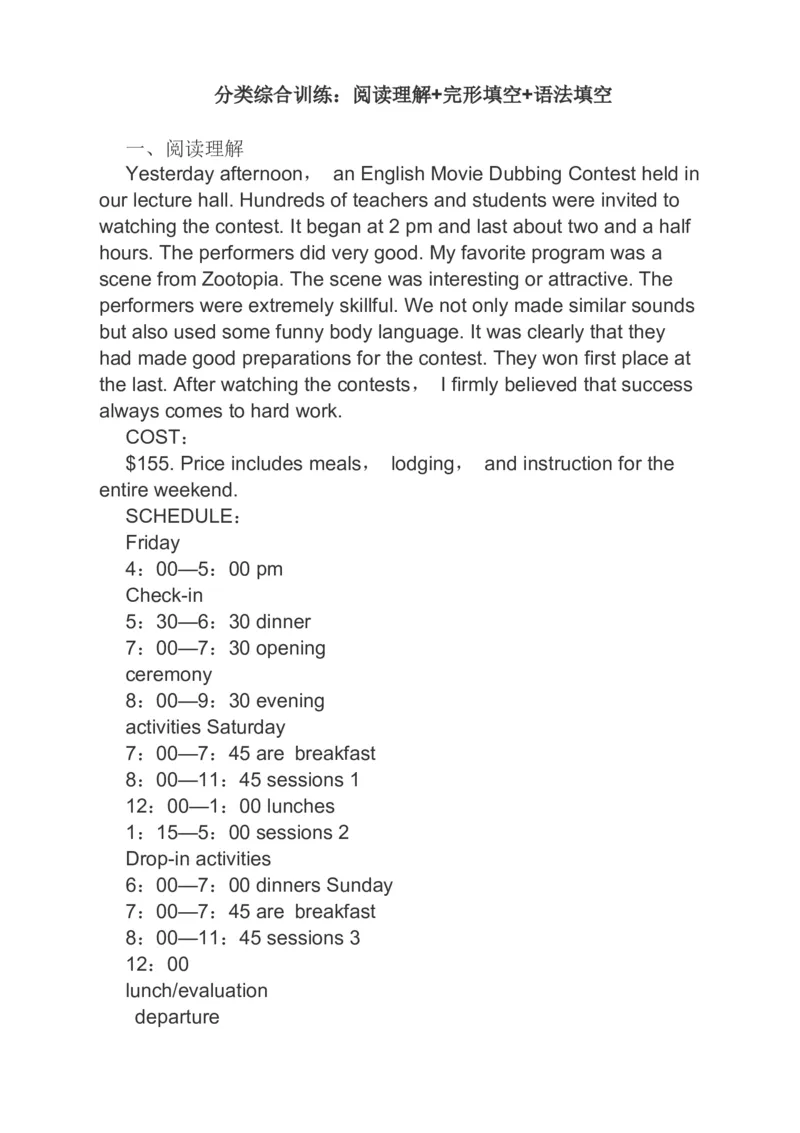
Yesterday afternoon, an English Movie Dubbing Contest held in
our lecture hall. Hundreds of teachers and students were invited to
watching the contest. It began at 2 pm and last about two and a half
hours. The performers did very good. My favorite program was a
scene from Zootopia. The scene was interesting or attractive. The
performers were extremely skillful. We not only made similar sounds
but also used some funny body language. It was clearly that they
had made good preparations for the contest. They won first place at
the last. After watching the contests, I firmly believed that success
always comes to hard work.
COST:
$155. Price includes meals, lodging, and instruction for the
entire weekend.
SCHEDULE:
Friday
4:00—5:00 pm
Check-in
5:30—6:30 dinner
7:00—7:30 opening
ceremony
8:00—9:30 evening
activities Saturday
7:00—7:45 are breakfast
8:00—11:45 sessions 1
12:00—1:00 lunches
1:15—5:00 sessions 2
Drop-in activities
6:00—7:00 dinners Sunday
7:00—7:45 are breakfast
8:00—11:45 sessions 3
12:00
lunch/evaluation
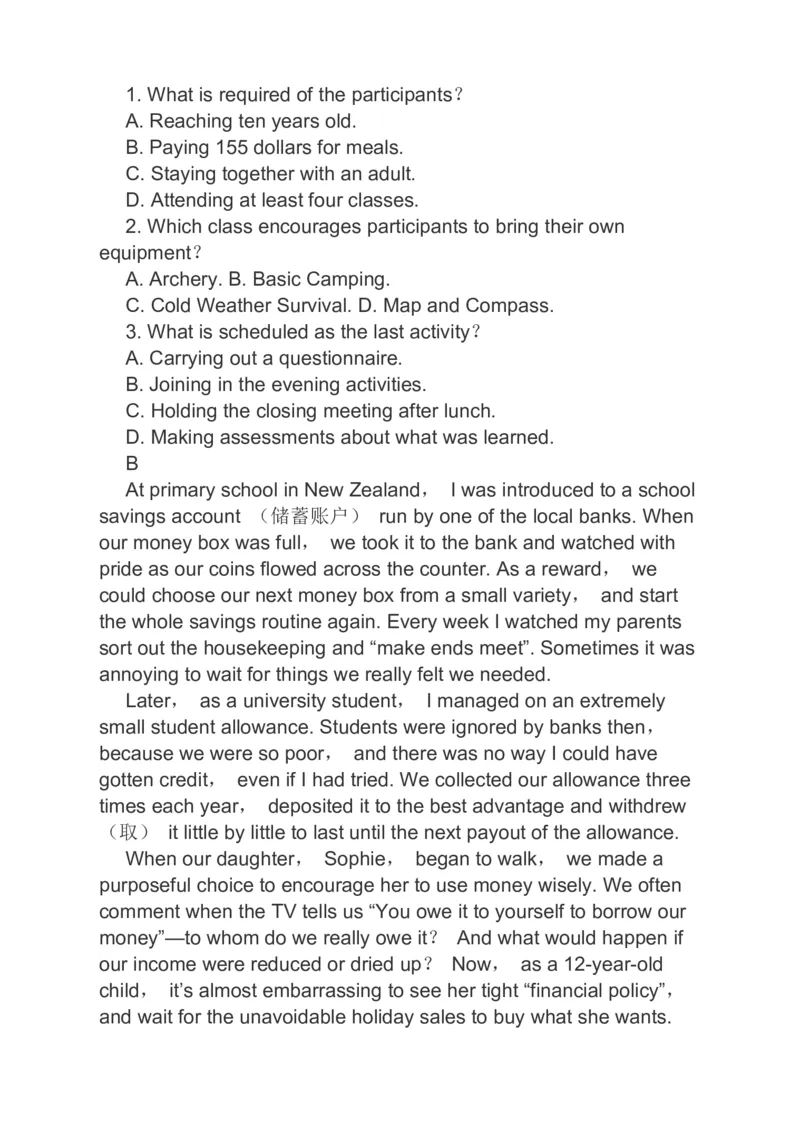
departure1. What is required of the participants?
A. Reaching ten years old.
B. Paying 155 dollars for meals.
C. Staying together with an adult.
D. Attending at least four classes.
2. Which class encourages participants to bring their own
equipment?
A. Archery. B. Basic Camping.
C. Cold Weather Survival. D. Map and Compass.
3. What is scheduled as the last activity?
A. Carrying out a questionnaire.
B. Joining in the evening activities.
C. Holding the closing meeting after lunch.
D. Making assessments about what was learned.
B
At primary school in New Zealand, I was introduced to a school
savings account (储蓄账户) run by one of the local banks. When
our money box was full, we took it to the bank and watched with
pride as our coins flowed across the counter. As a reward, we
could choose our next money box from a small variety, and start
the whole savings routine again. Every week I watched my parents
sort out the housekeeping and “make ends meet”. Sometimes it was
annoying to wait for things we really felt we needed.
Later, as a university student, I managed on an extremely
small student allowance. Students were ignored by banks then,
because we were so poor, and there was no way I could have
gotten credit, even if I had tried. We collected our allowance three
times each year, deposited it to the best advantage and withdrew
(取) it little by little to last until the next payout of the allowance.
When our daughter, Sophie, began to walk, we made a
purposeful choice to encourage her to use money wisely. We often
comment when the TV tells us “You owe it to yourself to borrow our
money”—to whom do we really owe it? And what would happen if
our income were reduced or dried up? Now, as a 12-year-old
child, it’s almost embarrassing to see her tight “financial policy”,
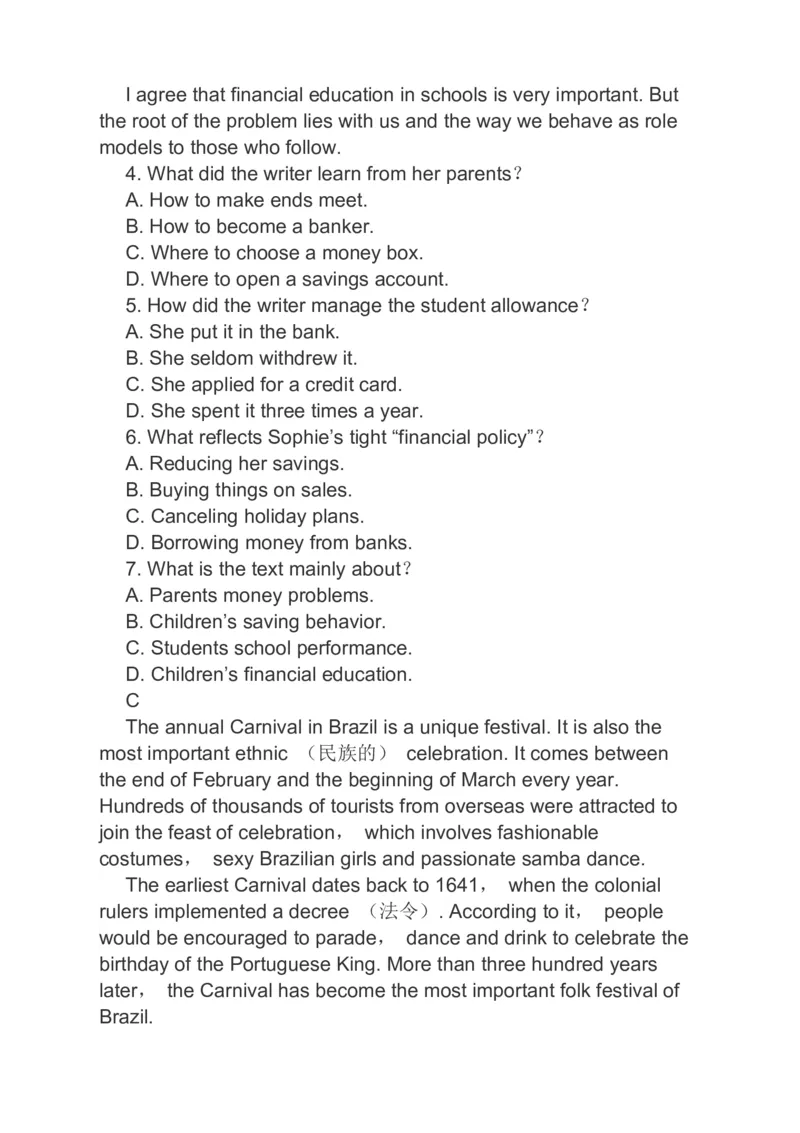
and wait for the unavoidable holiday sales to buy what she wants.I agree that financial education in schools is very important. But
the root of the problem lies with us and the way we behave as role
models to those who follow.
4. What did the writer learn from her parents?
A. How to make ends meet.
B. How to become a banker.
C. Where to choose a money box.
D. Where to open a savings account.
5. How did the writer manage the student allowance?
A. She put it in the bank.
B. She seldom withdrew it.
C. She applied for a credit card.
D. She spent it three times a year.
6. What reflects Sophie’s tight “financial policy”?
A. Reducing her savings.
B. Buying things on sales.
C. Canceling holiday plans.
D. Borrowing money from banks.
7. What is the text mainly about?
A. Parents money problems.
B. Children’s saving behavior.
C. Students school performance.
D. Children’s financial education.
C
The annual Carnival in Brazil is a unique festival. It is also the
most important ethnic (民族的) celebration. It comes between
the end of February and the beginning of March every year.
Hundreds of thousands of tourists from overseas were attracted to
join the feast of celebration, which involves fashionable
costumes, sexy Brazilian girls and passionate samba dance.
The earliest Carnival dates back to 1641, when the colonial
rulers implemented a decree (法令). According to it, people
would be encouraged to parade, dance and drink to celebrate the
birthday of the Portuguese King. More than three hundred years
later, the Carnival has become the most important folk festival of
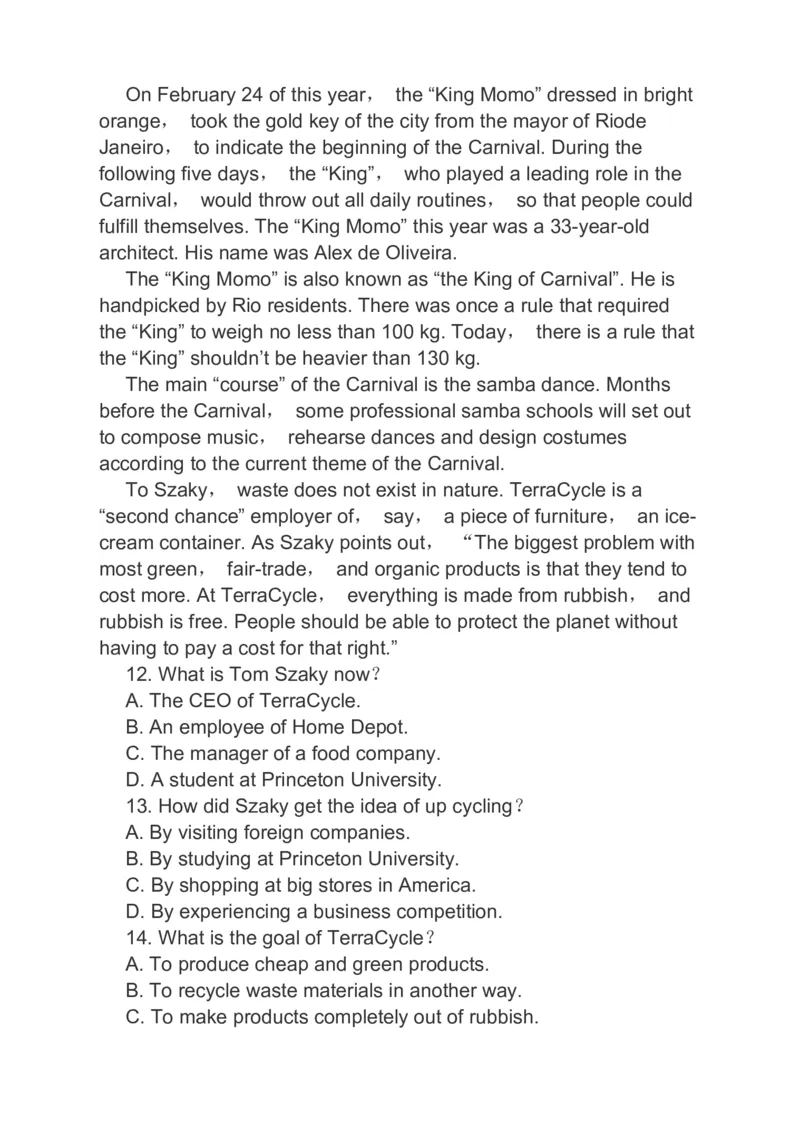
Brazil.On February 24 of this year, the “King Momo” dressed in bright
orange, took the gold key of the city from the mayor of Riode
Janeiro, to indicate the beginning of the Carnival. During the
following five days, the “King”, who played a leading role in the
Carnival, would throw out all daily routines, so that people could
fulfill themselves. The “King Momo” this year was a 33-year-old
architect. His name was Alex de Oliveira.
The “King Momo” is also known as “the King of Carnival”. He is
handpicked by Rio residents. There was once a rule that required
the “King” to weigh no less than 100 kg. Today, there is a rule that
the “King” shouldn’t be heavier than 130 kg.
The main “course” of the Carnival is the samba dance. Months
before the Carnival, some professional samba schools will set out
to compose music, rehearse dances and design costumes
according to the current theme of the Carnival.
To Szaky, waste does not exist in nature. TerraCycle is a
“second chance” employer of, say, a piece of furniture, an ice-
cream container. As Szaky points out, “The biggest problem with
most green, fair-trade, and organic products is that they tend to
cost more. At TerraCycle, everything is made from rubbish, and
rubbish is free. People should be able to protect the planet without
having to pay a cost for that right.”
12. What is Tom Szaky now?
A. The CEO of TerraCycle.
B. An employee of Home Depot.
C. The manager of a food company.
D. A student at Princeton University.
13. How did Szaky get the idea of up cycling?
A. By visiting foreign companies.
B. By studying at Princeton University.
C. By shopping at big stores in America.
D. By experiencing a business competition.
14. What is the goal of TerraCycle?
A. To produce cheap and green products.
B. To recycle waste materials in another way.
C. To make products completely out of rubbish.D. To change worm waste into organic plant fertilizers.
15. What is the advantage of up cycling according to Szaky?
A. The cost is rather low.
B. More materials are available.
C. It has a large promising market.
D. Its products are environmentally friendly.
二、完形填空
Learning to dive is something I’ve always found excuses to not
learn how to do. Something always comes up. I don’t have the
money, I don’t have anyone to go with, I’m too 1 , I’ll learn
when I get to Thailand, etc. The list goes on and on.
Traveling to Fiji with Gary, a French boy, I was finally 2 by
him to go scuba diving. “If you don’t do it, I’ll make fun of you on
Twitter.” he said. With the 3 of public embarrassment and the 4
that had come on my first dive, I 5 . I was going to learn to
scuba dive.
Making our way down the island chain, we found a dive shop.
The dive master, John, had been 6 for 13 years and the
surrounding area had some of the best diving in the Yukawa Islands.
There was no better time or place to 7 .
Dive day came, and the 8 took Gary and me on a shallow dive
across from the island. They taught us how to 9 , put on our
equipment, and what to do in an10 . I took a deep breath, asked
not to get the bends, grabbed the instructors 11 , and began to
descend (下沉).
We began the dive on the surface, and I felt like I was 12 . I
felt I was there for ages. Then I stopped and looked around. Whoa!
I was underwater. I was five meters underwater! We continued 13
down, reaching a depth of about nine meters. The 14 had some
good corals, but the fish were 15 , though their colors were
amazing. And then, before I knew it, it was over. The 16 was
gone, and it was time to 17 .
Reaching the surface, I was grinning (咧嘴笑) from ear to
ear. “Can we 18 again?” I asked. And there it was. I was19.Back on the shore, I went to John and said 20 , “You were
right. I loved it.”
1. A. short B. lonely C. busy D. scared
2. A. attempted B. forced C. fooled D. encouraged
3. A. idea B. thought C. opinion D. advice
4. A. promise B. possibility C. expectation D. evidence
5. A. calmed down B. gave in C. dressed up D. set off
6. A. fishing B. boating C. diving D. sailing
7. A. learn B. rest C. travel D. visit
8. A. guides B. instructors C. teachers D. helpers
9. A. breathe B. gesture C. react D. greet
10. A. explosion B. adventure C. accident D. emergency
11. A. rope B. equipment C. hand D. tube
12. A. floating B. freezing C. flying D. falling
13. A. falling B. swimming C. diving D. keeping
14. A. area B. bottom C. surface D. island
15. A. active B. fresh C. small D. smooth
16. A. water B. coral C. fish D. air
17. A. come up B. move ahead C. slide away D. keep on
18. A. play B. go C. work D. compete
19. A. terrified B. disappointed C. attracted D. confused
20. A. seriously B. gently C. coldly D. gratefully
三、语法填空
Socrates was a famous philosopher in ancient Greece.
However, extremely little is known about his early life. It was not
the custom for people in those days 1 (write) much of anything.
He didn’t talk about himself much, either. The best source for his
thoughts and deeds is 2 (probable) the Dialogues of Plato, a
student of the great teacher.
Socrates was once a soldier in the Athenian army. These soldiers
had to buy 3 (they) own armors (盔甲). Although he wasn’t
rich, he must have had some money to buy that armor. He also 4
(fight) in several major battles in the Peloponnesian War.
When he grew 5 (old), however, he came to hate money
and what it did to people.He seems to have spent most of his time in the marketplace,
discussing all sorts of things. That could partly explain 6 he was
poor; he wasn’t making 7 living. The thing he liked to do most was
to ask people fundamental questions, 8 “What is justice?” or
“What is 9 (true)?” To the answers the people gave,
Socrates would add more questions, until a logical (逻辑的)
case could be made that the people knew far less than they thought
they did about things. This emphasis
(强调) on questions as means of making an argument now
10 (call) the Socratic Method.
1. 2. 3. 4. 5.
6. 7. 8. 9. 10.
答案
阅读理解
A: 1—3 AAD B: 4—7 AABD
C: 8—11 CBCC D: 12—15 ADCA
完形填空
1—5 CBBAB 6—10 CABAD
11—15 CDCAC 16—20 DABCD
语法填空
1. to write 2. probably 3. their 4. fought 5. older
6. why 7. a 8. like 9. truth 10. is called