文档文本内容
阅读理解+完形填空+书面表达分类综合训练
一 阅读理解
阅读下列短文,从每题所给的 A、B、C 和 D 四个选项中,选出最佳选项。
A
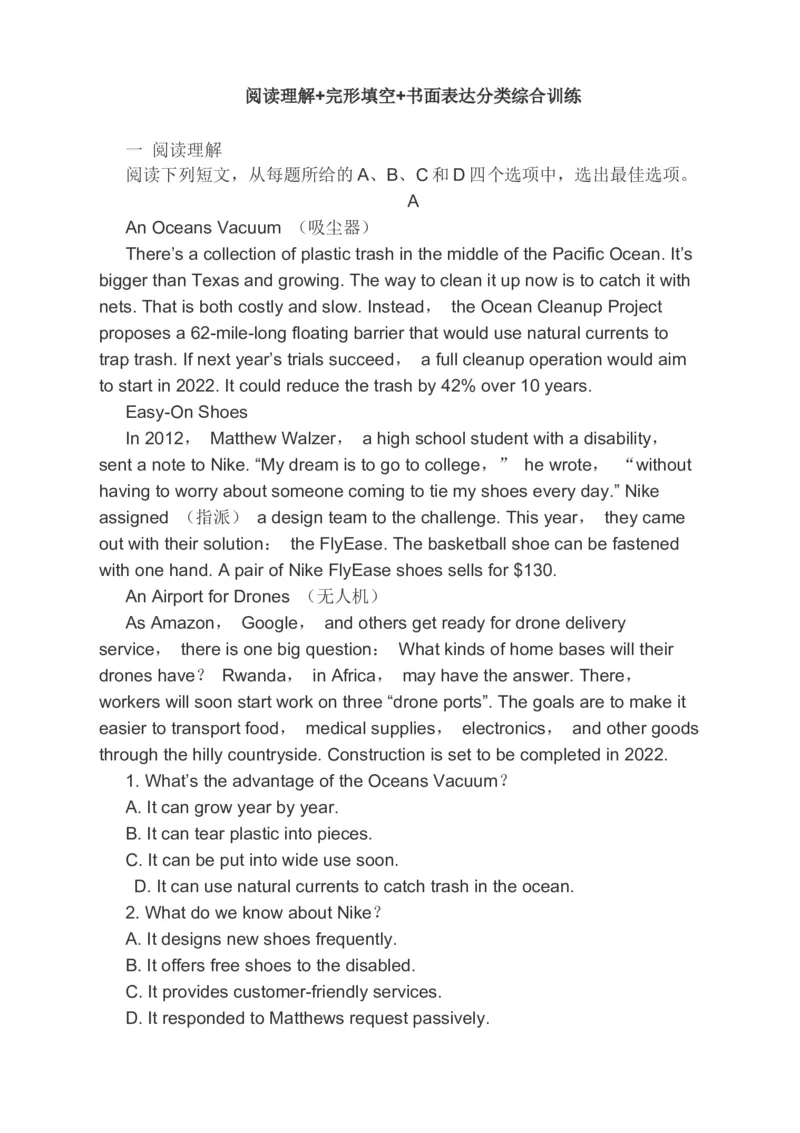
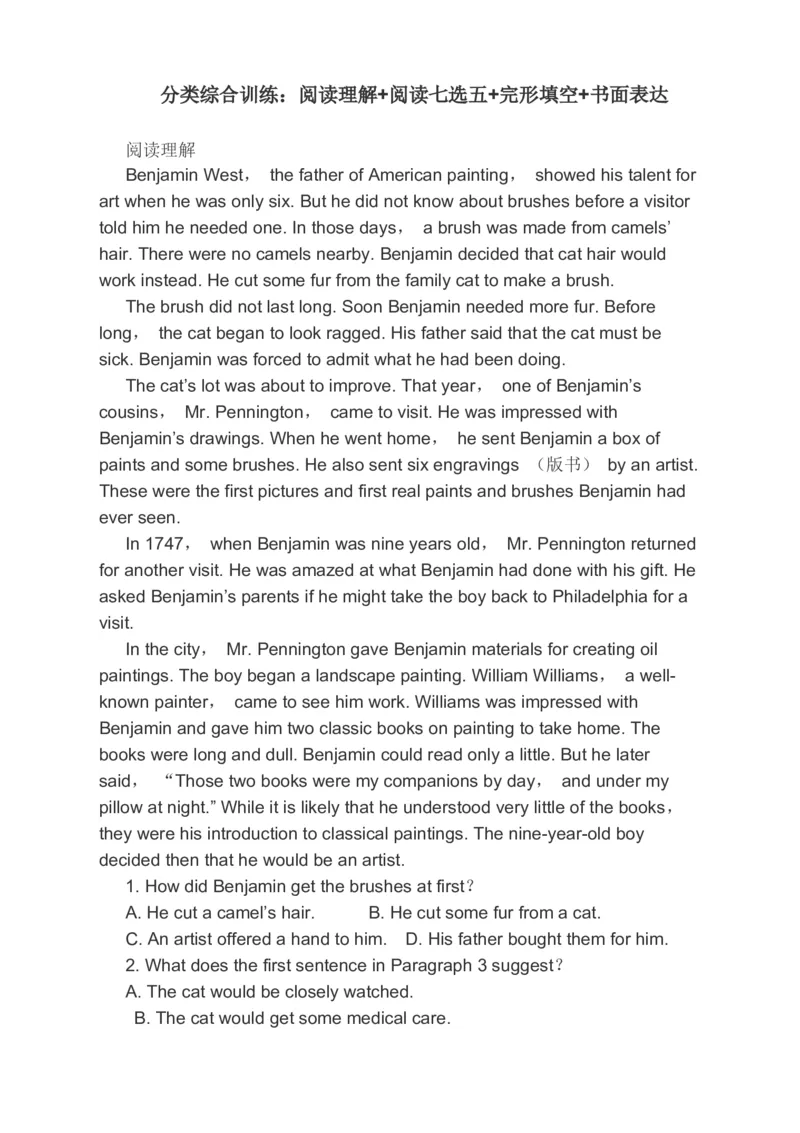
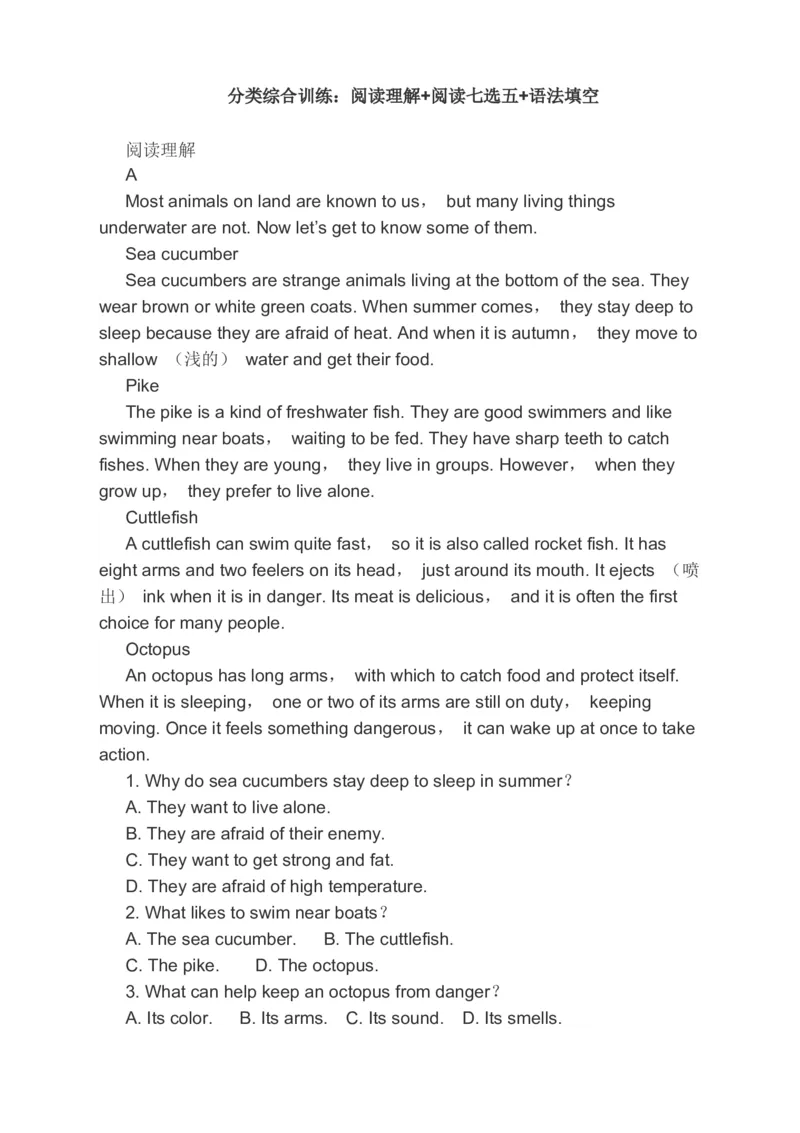
An Oceans Vacuum (吸尘器)
There’s a collection of plastic trash in the middle of the Pacific Ocean. It’s
bigger than Texas and growing. The way to clean it up now is to catch it with
nets. That is both costly and slow. Instead, the Ocean Cleanup Project
proposes a 62-mile-long floating barrier that would use natural currents to
trap trash. If next year’s trials succeed, a full cleanup operation would aim
to start in 2022. It could reduce the trash by 42% over 10 years.
Easy-On Shoes
In 2012, Matthew Walzer, a high school student with a disability,
sent a note to Nike. “My dream is to go to college,” he wrote, “without
having to worry about someone coming to tie my shoes every day.” Nike
assigned (指派) a design team to the challenge. This year, they came
out with their solution: the FlyEase. The basketball shoe can be fastened
with one hand. A pair of Nike FlyEase shoes sells for $130.
An Airport for Drones (无人机)
As Amazon, Google, and others get ready for drone delivery
service, there is one big question: What kinds of home bases will their
drones have? Rwanda, in Africa, may have the answer. There,
workers will soon start work on three “drone ports”. The goals are to make it
easier to transport food, medical supplies, electronics, and other goods
through the hilly countryside. Construction is set to be completed in 2022.
1. What’s the advantage of the Oceans Vacuum?
A. It can grow year by year.
B. It can tear plastic into pieces.
C. It can be put into wide use soon.
D. It can use natural currents to catch trash in the ocean.
2. What do we know about Nike?
A. It designs new shoes frequently.
B. It offers free shoes to the disabled.
C. It provides customer-friendly services.
D. It responded to Matthews request passively.3. Why is Rwanda setting up “drone ports”?
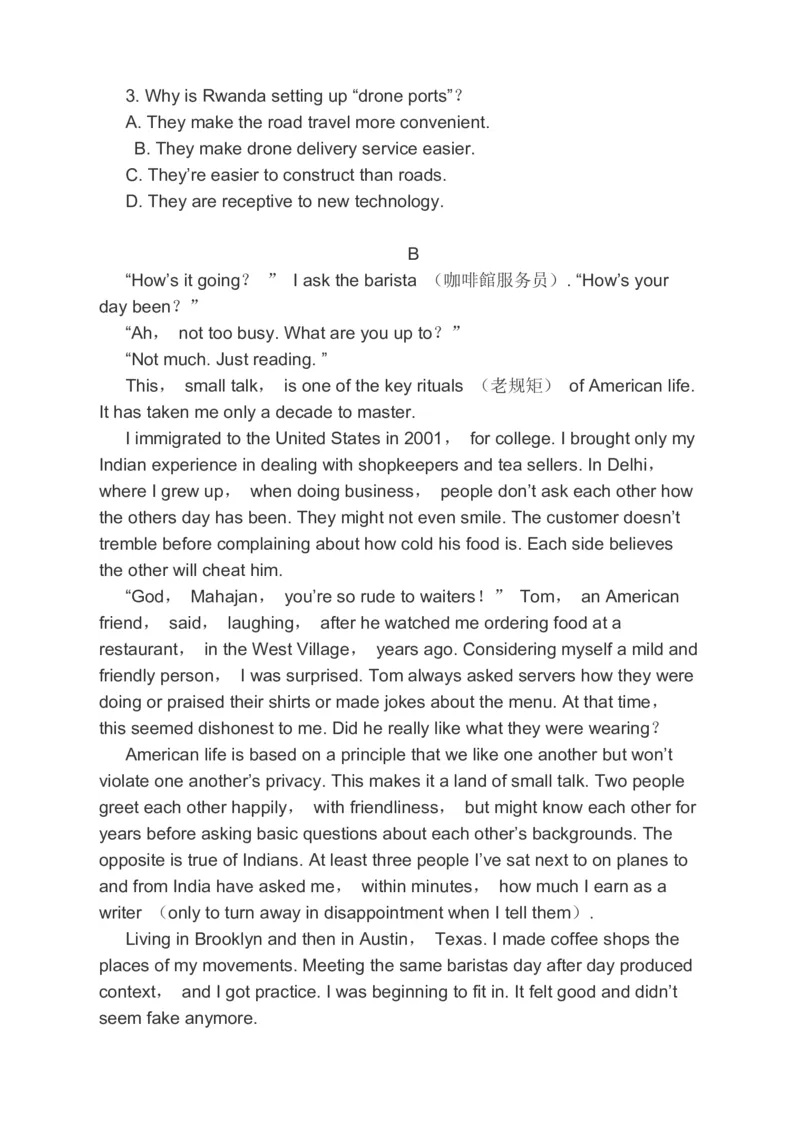
A. They make the road travel more convenient.
B. They make drone delivery service easier.
C. They’re easier to construct than roads.
D. They are receptive to new technology.
B
“How’s it going? ” I ask the barista (咖啡館服务员). “How’s your
day been?”
“Ah, not too busy. What are you up to?”
“Not much. Just reading. ”
This, small talk, is one of the key rituals (老规矩) of American life.
It has taken me only a decade to master.
I immigrated to the United States in 2001, for college. I brought only my
Indian experience in dealing with shopkeepers and tea sellers. In Delhi,
where I grew up, when doing business, people don’t ask each other how
the others day has been. They might not even smile. The customer doesn’t
tremble before complaining about how cold his food is. Each side believes
the other will cheat him.
“God, Mahajan, you’re so rude to waiters!” Tom, an American
friend, said, laughing, after he watched me ordering food at a
restaurant, in the West Village, years ago. Considering myself a mild and
friendly person, I was surprised. Tom always asked servers how they were
doing or praised their shirts or made jokes about the menu. At that time,
this seemed dishonest to me. Did he really like what they were wearing?
American life is based on a principle that we like one another but won’t
violate one another’s privacy. This makes it a land of small talk. Two people
greet each other happily, with friendliness, but might know each other for
years before asking basic questions about each other’s backgrounds. The
opposite is true of Indians. At least three people I’ve sat next to on planes to
and from India have asked me, within minutes, how much I earn as a
writer (only to turn away in disappointment when I tell them).
Living in Brooklyn and then in Austin, Texas. I made coffee shops the
places of my movements. Meeting the same baristas day after day produced
context, and I got practice. I was beginning to fit in. It felt good and didn’t
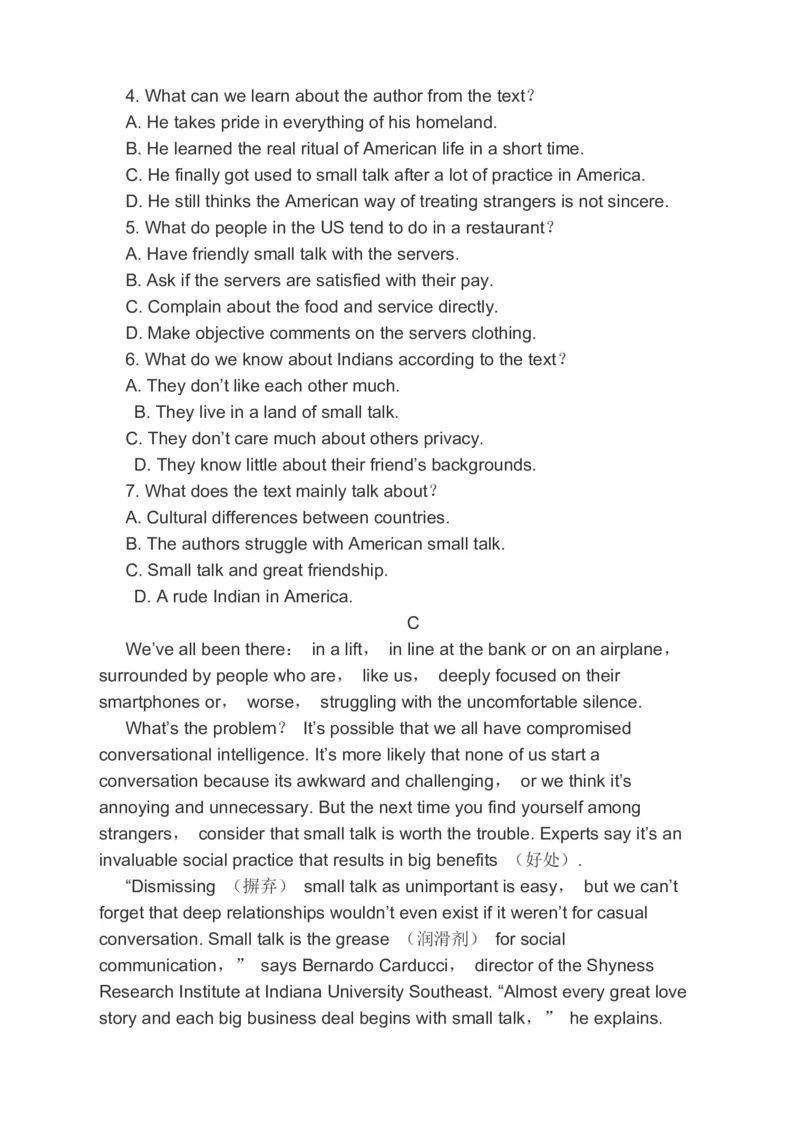
seem fake anymore.4. What can we learn about the author from the text?
A. He takes pride in everything of his homeland.
B. He learned the real ritual of American life in a short time.
C. He finally got used to small talk after a lot of practice in America.
D. He still thinks the American way of treating strangers is not sincere.
5. What do people in the US tend to do in a restaurant?
A. Have friendly small talk with the servers.
B. Ask if the servers are satisfied with their pay.
C. Complain about the food and service directly.
D. Make objective comments on the servers clothing.
6. What do we know about Indians according to the text?
A. They don’t like each other much.
B. They live in a land of small talk.
C. They don’t care much about others privacy.
D. They know little about their friend’s backgrounds.
7. What does the text mainly talk about?
A. Cultural differences between countries.
B. The authors struggle with American small talk.
C. Small talk and great friendship.
D. A rude Indian in America.
C
We’ve all been there: in a lift, in line at the bank or on an airplane,
surrounded by people who are, like us, deeply focused on their
smartphones or, worse, struggling with the uncomfortable silence.
What’s the problem? It’s possible that we all have compromised
conversational intelligence. It’s more likely that none of us start a
conversation because its awkward and challenging, or we think it’s
annoying and unnecessary. But the next time you find yourself among
strangers, consider that small talk is worth the trouble. Experts say it’s an
invaluable social practice that results in big benefits (好处).
“Dismissing (摒弃) small talk as unimportant is easy, but we can’t
forget that deep relationships wouldn’t even exist if it weren’t for casual
conversation. Small talk is the grease (润滑剂) for social
communication,” says Bernardo Carducci, director of the Shyness
Research Institute at Indiana University Southeast. “Almost every great love
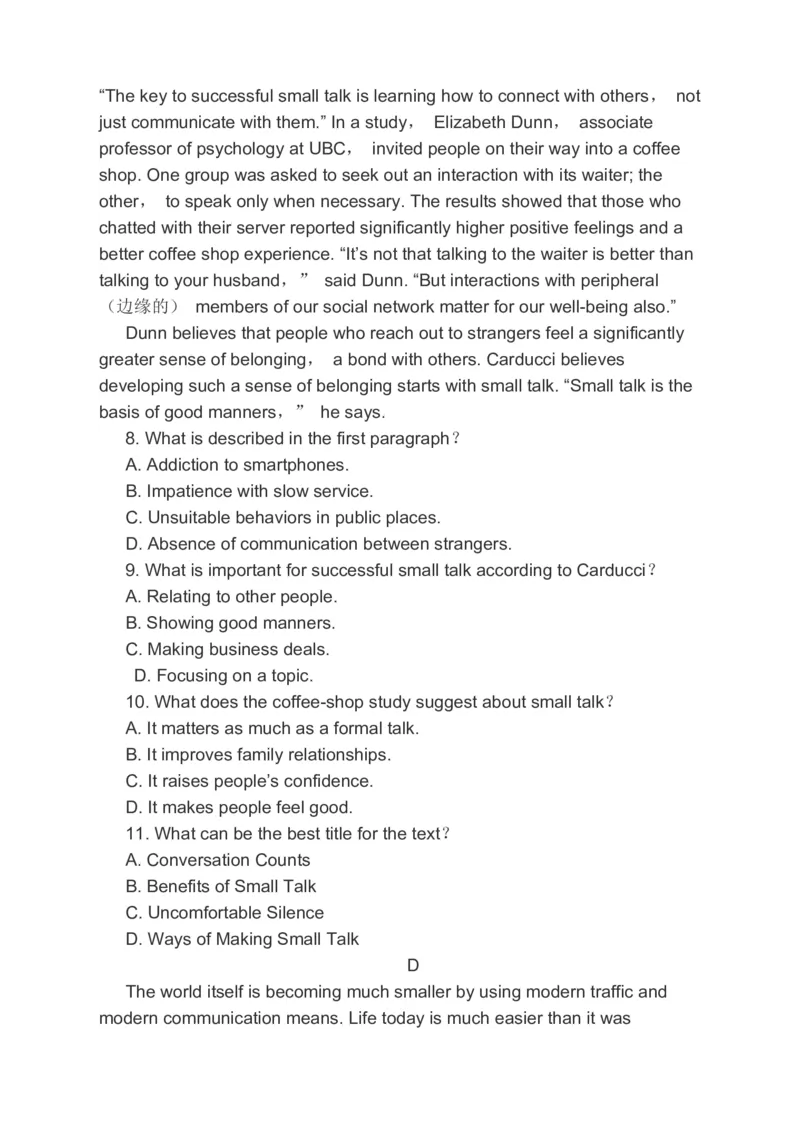
story and each big business deal begins with small talk,” he explains.“The key to successful small talk is learning how to connect with others, not
just communicate with them.” In a study, Elizabeth Dunn, associate
professor of psychology at UBC, invited people on their way into a coffee
shop. One group was asked to seek out an interaction with its waiter; the
other, to speak only when necessary. The results showed that those who
chatted with their server reported significantly higher positive feelings and a
better coffee shop experience. “It’s not that talking to the waiter is better than
talking to your husband,” said Dunn. “But interactions with peripheral
(边缘的) members of our social network matter for our well-being also.”
Dunn believes that people who reach out to strangers feel a significantly
greater sense of belonging, a bond with others. Carducci believes
developing such a sense of belonging starts with small talk. “Small talk is the
basis of good manners,” he says.
8. What is described in the first paragraph?
A. Addiction to smartphones.
B. Impatience with slow service.
C. Unsuitable behaviors in public places.
D. Absence of communication between strangers.
9. What is important for successful small talk according to Carducci?
A. Relating to other people.
B. Showing good manners.
C. Making business deals.
D. Focusing on a topic.
10. What does the coffee-shop study suggest about small talk?
A. It matters as much as a formal talk.
B. It improves family relationships.
C. It raises people’s confidence.
D. It makes people feel good.
11. What can be the best title for the text?
A. Conversation Counts
B. Benefits of Small Talk
C. Uncomfortable Silence
D. Ways of Making Small Talk
D
The world itself is becoming much smaller by using modern traffic and
modern communication means. Life today is much easier than it washundreds of years ago, but it has brought new problems. One of the
biggest problems is pollution. To pollute means to make things dirty. Pollution
comes in many ways. We see it, smell it, drink it and even hear it.
Man has been polluting the earth. The more people, the more pollution.
Many years ago, the problem was not so serious because there were not
so many people. When the land was used up or the river was dirty in one
place, man moved to another place. But this is no longer true.
Man is now slowly polluting the whole world.
Air pollution is still the most serious. Its bad for all living things in the
world, but it is not the only one kind of pollution. Water pollution kills our
fish and pollutes our drinking water. Noise pollution makes us angry more
easily.
Many countries are making rules to fight pollution. They stop people from
burning coal in houses and factories in the city and from putting dirty smoke
into the air. Pollution by SO2 is now the most dangerous kind of air pollution.
It is caused by heavy traffic. We are sure that if there are fewer people
driving, there will be less air pollution.
The earth is our home. We must take care of it. That means keeping the
land, water and air clean. And we must take care of the rise in pollution at
the same time.
12. The writer says the world is becoming much smaller because of
____ .
A. the rise in pollution
B. modern science development
C. more people living in the world
D. more of the earth covered by water
13. What does the underlined word “it” in Paragraph 1 refer to?
A. Light pollution. B. Air pollution.
C. Noise pollution. D. Water pollution.
14. Why is air pollution thought to be the most serious kind of pollution?
A. It is not easy to get rid of.
B. It makes us angry more easily.
C. It makes our rivers and lakes dirty.
D. It is bad for all living things in the world.
15. Which of the following is TRUE about pollution according to the text?
a. Many countries are making rules to fight pollution.b. The pollution of the earth grows as fast as the world population does.
c. Air pollution is so serious mainly because more coal is burnt by people.
d. Public transport would be helpful in fighting against the problem of
SO2.
A. a, b, c B. a, b, d C. a, c, d D. b, c, d
二 完形填空
阅读下面短文,从短文后各题所给的 A、B、C 和 D 四个选项中,选出可以
填入空白处的最佳选项。
You Did More Than Carrying My Books
Mark was walking home from school one day when he noticed the boy
ahead of him had dropped all of the books he was carrying, along with a
baseball bat and several other things. Mark 1 down and helped the boy
pick up these articles. Since they were going the 2 way, he helped to
carry some of them for him. As they walked Mark 3 the boy’s name was
Bill, that he 4 computer games, baseball and history, that he was
having a lot of 5 with his other subjects and that he had just 6 up
with his girlfriend.
They arrived at Bills home first and Mark was 7 in for a glass of
Coke and to watch some television. The afternoon passed
8 with a few laughs and some shared small talk, and then Mark went
home. They 9 to see each other around school, had lunch together
once or twice, and then both 1 0 up from the same high school. Just
three weeks before 1 1 , Bill asked Mark if they could talk.
Bill 1 2 him of the day years ago when they had first met. “Do you
1 3 wonder why I was carrying so many things home that day?” asked
Bill. “You see, I 1 4 out my locker because I didn’t want to leave a
mess 1 5 anyone else. I had planned to run away and I was going home
to 1 6 my things. But after we spent some time together 1 7 and
laughing, I realized that if I had done that, I would have 1 8 a new
friend and all the 1 9 we would have together. So you see, Mark,
when you picked up my books that day, you did a lot more. You 2 0 my
life.”
1. A. fell B. sat C. lay D. bent
2. A. only B. same C. exciting D. remembered
3. A. discovered B. realized C. said D. imagined
4. A. learned B. loved C. tried D. made5. A. questions B. ideas C. trouble D. doubt
6. A. broken B. showed C. come D. fixed
7. A. called B. helped C. invited D. pulled
8. A. peacefully B. willingly C. freely D. pleasantly
9. A. continued B. agreed C. needed D. offered
10. A. got B. grew C. ended D. cheered
11. A. graduation B. movement C. vacation D. divorcement
12. A. demanded B. reminded C. told D. asked
13. A. ever B. usually C. even D. also
14. A. checked B. took C. cleaned D. put
15. A. over B. into C. with D. for
16. A. find B. pick C. pack D. hold
17. A. talking B. listening C. reading D. waiting
18. A. forgotten B. passed C. left D. missed
19. A. favor B. fun C. access D. thought
20. A. saved B. protected C. improved D. changed
三 书面表达
假如你是李华,你的笔友 Peter 来信说自己转入新学校后,在交友上遇到
了困难。请你给他写一封回信,内容包括:
1﹒表达关心和安慰;
2﹒提出交友的建议。
注意:
1﹒词数 100 左右;
2﹒可以适当增加细节,以使行文连贯;
3﹒信的开头与结尾已为你写好。
Dear Peter,
I am glad to learn that you are studying in a new school.
I hope you will find true friendship soon.
Yours sincerely,
Li Hua
答案
阅读理解
1—5 DCBCA 6—10 CBDAD
11—15 BBCDB完形填空
1—5 DBABC
6—10 ACDAC
11—15 ABACD
16—20 CADBD
书面表达
One possible version:
Dear Peter,
I am glad to learn that you are studying in a new school. I think it is a
good chance for you to turn over a new leaf. Do not worry if you have no real
friends right now. Although you are not an outgoing boy and have different
life experiences from your present classmates, it is not impossible to make
good friends as long as you take the following tips.
First of all, you can make friends with others if you share their joys and
sorrows. Secondly, you should open your heart to your friends, holding
back nothing. Last but not least, once you have a friend, you must
constantly maintain your friendship with acts of kindness.
I hope you will find true friendship soon.
Yours sincerely,
Li Hua