







































































































































































































































































































































文档内容
2025版新教材高考英语第二轮
专题一 阅读理解
五年高考
新高考专练
题组一 2024新课标Ⅰ
Passage 1(2024新课标Ⅰ,A) 主题:环境保护
HABITAT RESTORATION TEAM
Help restore and protect Marin’s natural areas from the Marin Headlands to Bolinas Ridge.
We’ll explore beautiful park sites while conducting invasive(侵入的) plant removal, winter
planting, and seed collection. Habitat Restoration Team volunteers play a vital role in restoring
sensitive resources and protecting endangered species across the ridges and valleys.
GROUPS
Groups of five or more require special arrangements and must be confirmed in advance.
Please review the List of Available Projects and fill out the Group Project Request Form.
AGE, SKILLS, WHAT TO BRING
Volunteers aged 10 and over are welcome. Read our Youth Policy Guidelines for youth
under the age of 15.
Bring your completed Volunteer Agreement Form. Volunteers under the age of 18 must
have the parent/guardian approval section signed.
We’ll be working rain or shine. Wear clothes that can get dirty. Bring layers for changing
weather and a raincoat if necessary.
Bring a personal water bottle, sunscreen, and lunch.
No experience necessary. Training and tools will be provided. Fulfills(满足) community
service requirements.
UPCOMING EVENTS
Time Meeting Location
Sunday, Jan. 15
Battery Alexander Trailhead
10:00 am-1:00 pm
Sunday, Jan. 22
Stinson Beach Parking Lot
10:00 am-2:30 pm
Sunday, Jan. 29 Coyote Ridge Trailhead9:30 am-2:30 pm
1. What is the aim of the Habitat Restoration Team?
A. To discover mineral resources.
B. To develop new wildlife parks.
C. To protect the local ecosystem.
D. To conduct biological research.
2. What is the lower age limit for joining the Habitat Restoration Team?
A. 5. B. 10. C. 15. D. 18.
3. What are the volunteers expected to do?
A. Bring their own tools. B. Work even in bad weather.
C. Wear a team uniform. D. Do at least three projects.
Passage 2(2024新课标Ⅰ,B) 主题:跨文化合作
“I am not crazy,” says Dr. William Farber, shortly after performing acupuncture(针灸)
on a rabbit. “I am ahead of my time.” If he seems a little defensive, it might be because even
some of his coworkers occasionally laugh at his unusual methods. But Farber is certain he’ll
have the last laugh. He’s one of a small but growing number of American veterinarians(兽医)
now practicing “holistic”medicine—combining traditional Western treatments with
acupuncture, chiropractic(按摩疗法) and herbal medicine.
Farber, a graduate of Colorado State University, started out as a more conventional
veterinarian.He became interested in alternative treatments 20 years ago when he suffered from
terrible back pain.He tried muscle-relaxing drugs but found little relief. Then he tried
acupuncture,an ancient Chinese practice,and was amazed that he improved after two or three
treatments. What worked on a veterinarian seemed likely to work on his patients. So, after
studying the techniques for a couple of years, he began offering them to pets.
Leigh Tindale’s dog Charlie had a serious heart condition. After Charlie had a heart attack,
Tindale says, she was prepared to put him to sleep, but Farber’s treatments eased her dog’s
suffering so much that she was able to keep him alive for an additional five months. And
Priscilla Dewing reports that her horse, Nappy, “moves more easily and rides more
comfortably” after a chiropractic adjustment.Farber is certain that the holistic approach will grow more popular with time, and if the
past is any indication, he may be right: Since 1982, membership in the American Holistic
Veterinary Medical Association has grown from 30 to over 700. “Sometimes it surprises me
that it works so well,” he says. “I will do anything to help an animal. That’s my job.”
1. What do some of Farber’s coworkers think of him?
A. He’s odd. B. He’s strict.
C. He’s brave. D. He’s rude.
2. Why did Farber decide to try acupuncture on pets?
A. He was trained in it at university.
B. He was inspired by another veterinarian.
C. He benefited from it as a patient.
D. He wanted to save money for pet owners.
3. What does paragraph 3 mainly talk about?
A. Steps of a chiropractic treatment.
B. The complexity of veterinarians’ work.
C. Examples of rare animal diseases.
D. The effectiveness of holistic medicine.
4. Why does the author mention the American Holistic Veterinary Medical Association?
A. To prove Farber’s point.
B. To emphasize its importance.
C. To praise veterinarians.
D. To advocate animal protection.
Passage 3(2024新课标Ⅰ,C) 主题:善于学习
Is comprehension the same whether a person reads a text onscreen or on paper? And are
listening to and viewing content as effective as reading the written word when covering the
same material? The answers to both questions are often “no.” The reasons relate to a variety of
factors, including reduced concentration, an entertainment mindset(心态) and a tendency to
multitask while consuming digital content.
When reading texts of several hundred words or more, learning is generally more
successful when it’s on paper than onscreen. A large amount of research confirms this finding.
The benefits of print reading particularly shine through when experimenters move fromposing simple tasks—like identifying the main idea in a reading passage—to ones that require
mental abstraction—such as drawing inferences from a text.
The differences between print and digital reading results are partly related to paper’s
physical properties. With paper, there is a literal laying on of hands, along with the visual
geography of distinct pages. People often link their memory of what they’ve read to how far
into the book it was or where it was on the page.
But equally important is the mental aspect. Reading researchers have proposed a theory
called “shallowing hypothesis(假说).” According to this theory, people approach digital texts
with a mindset suited to social media, which are often not so serious, and devote less mental
effort than when they are reading print.
Audio(音频) and video can feel more engaging than text, and so university teachers
increasingly turn to these technologies—say, assigning an online talk instead of an article by
the same person. However, psychologists have demonstrated that when adults read news
stories, they remember more of the content than if they listen to or view identical pieces.
Digital texts, audio and video all have educational roles, especially when providing
resources not available in print. However, for maximizing learning where mental focus and
reflection are called for, educators shouldn’t assume all media are the same, even when they
contain identical words.
1. What does the underlined phrase “shine through” in paragraph 2 mean?
A. Seem unlikely to last. B. Seem hard to explain.
C. Become ready to use. D. Become easy to notice.
2. What does the shallowing hypothesis assume?
A. Readers treat digital texts lightly.
B. Digital texts are simpler to understand.
C. People select digital texts randomly.
D. Digital texts are suitable for social media.
3. Why are audio and video increasingly used by university teachers?
A. They can hold students’ attention.
B. They are more convenient to prepare.
C. They help develop advanced skills.
D. They are more informative than text.4. What does the author imply in the last paragraph?
A. Students should apply multiple learning techniques.
B. Teachers should produce their own teaching material.
C. Print texts cannot be entirely replaced in education.
D. Education outside the classroom cannot be ignored.
Passage 4(2024新课标Ⅰ,D) 主题:自然科学研究成果
In the race to document the species on Earth before they go extinct, researchers and
citizen scientists have collected billions of records. Today, most records of biodiversity are
often in the form of photos, videos, and other digital records. Though they are useful for
detecting shifts in the number and variety of species in an area, a new Stanford study has found
that this type of record is not perfect.
“With the rise of technology it is easy for people to make observations of different species
with the aid of a mobile application,” said Barnabas Daru, who is lead author of the study and
assistant professor of biology in the Stanford School of Humanities and Sciences. “These
observations now outnumber the primary data that comes from physical specimens(标本), and
since we are increasingly using observational data to investigate how species are responding to
global change, I wanted to know: Are they usable?”
Using a global dataset of 1.9 billion records of plants, insects, birds, and animals, Daru
and his team tested how well these data represent actual global biodiversity patterns.
“We were particularly interested in exploring the aspects of sampling that tend to bias(使
有偏差) data, like the greater likelihood of a citizen scientist to take a picture of a flowering
plant instead of the grass right next to it,” said Daru.
Their study revealed that the large number of observation-only records did not lead to
better global coverage. Moreover, these data are biased and favor certain regions, time periods,
and species. This makes sense because the people who get observational biodiversity data on
mobile devices are often citizen scientists recording their encounters with species in areas
nearby. These data are also biased toward certain species with attractive or eye-catching
features.
What can we do with the imperfect datasets of biodiversity?
“Quite a lot,” Daru explained. “Biodiversity apps can use our study results to inform users
of oversampled areas and lead them to places—and even species—that are not well-sampled.To improve the quality of observational data, biodiversity apps can also encourage users to
have an expert confirm the identification of their uploaded image.”
1. What do we know about the records of species collected now?
A. They are becoming outdated.
B. They are mostly in electronic form.
C. They are limited in number.
D. They are used for public exhibition.
2. What does Daru’s study focus on?
A. Threatened species. B. Physical specimens.
C. Observational data. D. Mobile applications.
3. What has led to the biases according to the study?
A. Mistakes in data analysis.
B. Poor quality of uploaded pictures.
C. Improper way of sampling.
D. Unreliable data collection devices.
4. What is Daru’s suggestion for biodiversity apps?
A. Review data from certain areas.
B. Hire experts to check the records.
C. Confirm the identity of the users.
D. Give guidance to citizen scientists.
题组二 2024新课标Ⅱ
Passage 5(2024新课标Ⅱ,A) 主题:体育活动
Choice of Walks for Beginner and Experienced Walkers
The Carlow Autumn Walking Festival is a great opportunity for the beginner, experienced
or advanced walker to enjoy the challenges of Carlow’s mountain hikes or the peace of its
woodland walks.
Walk 1—The Natural World
With environmentalist Éanna Lamhna as the guide, this walk promises to be an
informative tour. Walkers are sure to learn lots about the habitats and natural world of the
Blackstairs.
Date and Time: Saturday, 1st October, at 09:00Start Point: Scratoes Bridge
Walk Duration: 6 hours
Walk 2—Introduction to Hillwalking
Emmanuel Chappard, an experienced guide, has a passion for making the great outdoors
accessible to all. This mountain walk provides an insight into the skills required for hillwalking
to ensure you get the most from future walking trips.
Date and Time: Sunday, 2nd October, at 09:00
Start Point: Deerpark Car Park
Walk Duration: 5 hours
Walk 3—Moonlight Under the Stars
Walking at night-time is a great way to step out of your comfort zone. Breathtaking views
of the lowlands of Carlow can be enjoyed in the presence of welcoming guides from local
walking clubs. A torch(手电筒) along with suitable clothing is essential for walking in the
dark. Those who are dressed inappropriately will be refused permission to participate.
Date and Time: Saturday, 1st October, at 18:30
Start Point: The Town Hall
Walk Duration: 3 hours
Walk 4—Photographic Walk in Kilbrannish Forest
This informative walk led by Richard Smyth introduces you to the basic principles of
photography in the wild. Bring along your camera and enjoy the wonderful views along this
well-surfaced forest path.
Date and Time: Sunday, 2nd October, at 11:45
Start Point: Kilbrannish Forest Recreation Area
Walk Duration: 1.5 hours
1. Which walk takes the shortest time?
A. The Natural World.
B. Introduction to Hillwalking.
C. Moonlight Under the Stars.
D. Photographic Walk in Kilbrannish Forest.
2. What are participants in Walk 3 required to do?
A. Wear proper clothes.
B. Join a walking club.C. Get special permits.
D. Bring a survival guide.
3. What do the four walks have in common?
A. They involve difficult climbing.
B. They are for experienced walkers.
C. They share the same start point.
D. They are scheduled for the weekend.
Passage 6(2024新课标Ⅱ,B) 主题:社会服务
Do you ever get to the train station and realize you forgot to bring something to read? Yes,
we all have our phones, but many of us still like to go old school and read something printed.
Well, there’s a kiosk(小亭) for that. In the San Francisco Bay Area, at least.
“You enter the fare gates(检票口) and you’ll see a kiosk that is lit up and it tells you can
get a one-minute, a three-minute, or a five-minute story,” says Alicia Trost, the chief
communications officer for the San Francisco Bay Area Rapid Transit—known as BART. “You
choose which length you want and it gives you a receipt-like short story.”
It’s that simple. Riders have printed nearly 20,000 short stories and poems since the
program was launched last March. Some are classic short stories, and some are new original
works.
Trost also wants to introduce local writers to local riders. “We wanted to do something
where we do a call to artists in the Bay Area to submit stories for a contest,” Trost says. “And
as of right now, we’ve received about 120 submissions. The winning stories would go into our
kiosk and then you would be a published artist.”
Ridership on transit(交通) systems across the country has been down the past half century,
so could short stories save transit?
Trost thinks so.
“At the end of the day all transit agencies right now are doing everything they can to
improve the rider experience. So I absolutely think we will get more riders just because of
short stories,” she says.
And you’ll never be without something to read.
1. Why did BART start the kiosk program?A. To promote the local culture.
B. To discourage phone use.
C. To meet passengers’ needs.
D. To reduce its running costs.
2. How are the stories categorized in the kiosk?
A. By popularity. B. By length.
C. By theme. D. By language.
3. What has Trost been doing recently?
A. Organizing a story contest.
B. Doing a survey of customers.
C. Choosing a print publisher.
D. Conducting interviews with artists.
4. What is Trost’s opinion about BART’s future?
A. It will close down.
B. Its profits will decline.
C. It will expand nationwide.
D. Its ridership will increase.
Passage 7(2024新课标Ⅱ,C) 主题:技术创新
We all know fresh is best when it comes to food. However, most produce at the store went
through weeks of travel and covered hundreds of miles before reaching the table. While
farmer’s markets are a solid choice to reduce the journey, Babylon Micro-Farm (BMF)
shortens it even more.
BMF is an indoor garden system. It can be set up for a family. Additionally, it could serve
a larger audience such as a hospital, restaurant or school. The innovative design requires little
effort to achieve a reliable weekly supply of fresh greens.
Specifically, it’s a farm that relies on new technology. By connecting through the Cloud,
BMF is remotely monitored. Also, there is a convenient app that provides growing data in real
time. Because the system is automated, it significantly reduces the amount of water needed to
grow plants. Rather than watering rows of soil, the system provides just the right amount to
each plant. After harvest, users simply replace the plants with a new pre-seeded pod(容器) to
get the next growth cycle started.Moreover, having a system in the same building where it’s eaten means zero emissions(排
放) from transporting plants from soil to salad. In addition, there’s no need for pesticides and
other chemicals that pollute traditional farms and the surrounding environment.
BMF employees live out sustainability in their everyday lives. About half of them walk or
bike to work. Inside the office, they encourage recycling and waste reduction by limiting
garbage cans and avoiding single-use plastic. “We are passionate about reducing waste, carbon
and chemicals in our environment,” said a BMF employee.
1. What can be learned about BMF from paragraph 1?
A. It guarantees the variety of food.
B. It requires day-to-day care.
C. It cuts the farm-to-table distance.
D. It relies on farmer’s markets.
2. What information does the convenient app offer?
A. Real-time weather changes.
B. Current condition of the plants.
C. Chemical pollutants in the soil.
D. Availability of pre-seeded pods.
3. What can be concluded about BMF employees?
A. They have a great passion for sports.
B. They are devoted to community service.
C. They are fond of sharing daily experiences.
D. They have a strong environmental awareness.
4. What does the text mainly talk about?
A. BMF’s major strengths.
B. BMF’s general management.
C. BMF’s global influence.
D. BMF’s technical standards.
Passage 8(2024新课标Ⅱ,D) 主题:社会热点问题
Given the astonishing potential of AI to transform our lives, we all need to take action to
deal with our AI-powered future, and this is where AI by Design: A Plan for Living with
Artificial Intelligence comes in. This absorbing new book by Catriona Campbell is a practicalroadmap addressing the challenges posed by the forthcoming AI revolution(变革).
In the wrong hands, such a book could prove as complicated to process as the computer
code(代码) that powers AI but, thankfully, Campbell has more than two decades’ professional
experience translating the heady into the understandable. She writes from the practical angle of
a business person rather than as an academic, making for a guide which is highly accessible
and informative and which, by the close, will make you feel almost as smart as AI.
As we soon come to learn from AI by Design, AI is already super-smart and will become
more capable, moving from the current generation of “narrow-AI” to Artificial General
Intelligence. From there, Campbell says, will come Artificial Dominant Intelligence. This is
why Campbell has set out to raise awareness of AI and its future now—several decades before
these developments are expected to take place. She says it is essential that we keep control of
artificial intelligence, or risk being sidelined and perhaps even worse.
Campbell’s point is to wake up those responsible for AI—the technology companies and
world leaders—so they are on the same page as all the experts currently developing it. She
explains we are at a “tipping point” in history and must act now to prevent an extinction-level
event for humanity. We need to consider how we want our future with AI to pan out. Such
structured thinking, followed by global regulation, will enable us to achieve greatness rather
than our downfall.
AI will affect us all, and if you only read one book on the subject, this is it.
1. What does the phrase “In the wrong hands” in paragraph 2 probably mean?
A. If read by someone poorly educated.
B. If reviewed by someone ill-intentioned.
C. If written by someone less competent.
D. If translated by someone unacademic.
2. What is a feature of AI by Design according to the text?
A. It is packed with complex codes.
B. It adopts a down-to-earth writing style.
C. It provides step-by-step instructions.
D. It is intended for AI professionals.
3. What does Campbell urge people to do regarding AI development?
A. Observe existing regulations on it.B. Reconsider expert opinions about it.
C. Make joint efforts to keep it under control.
D. Learn from prior experience to slow it down.
4. What is the author’s purpose in writing the text?
A. To recommend a book on AI.
B. To give a brief account of AI history.
C. To clarify the definition of AI.
D. To honor an outstanding AI expert.
题组三 2023新课标Ⅰ
Passage 9(2023新课标Ⅰ,A) 主题:社会服务
Bike Rental & Guided Tours
Welcome to Amsterdam, welcome to MacBike. You see much more from the seat of a
bike! Cycling is the most economical, sustainable and fun way to explore the city, with its
beautiful canals, parks, squares and countless lights. You can also bike along lovely landscapes
outside of Amsterdam.
Why MacBike
MacBike has been around for almost 30 years and is the biggest bicycle rental company in
Amsterdam. With over 2,500 bikes stored in our five rental shops at strategic locations, we
make sure there is always a bike available for you. We offer the newest bicycles in a wide
variety, including basic bikes with foot brake(刹车), bikes with hand brake and gears(排挡),
bikes with child seats, and children’s bikes.
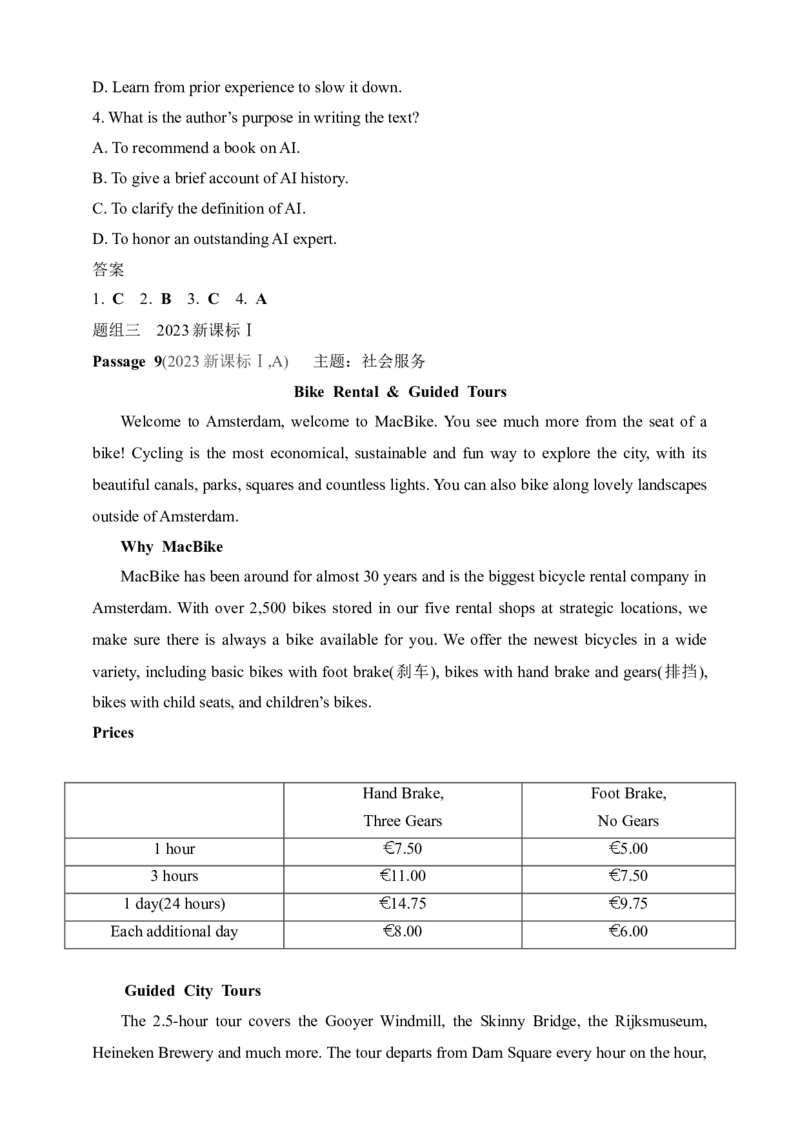
Prices
Hand Brake, Foot Brake,
Three Gears No Gears
1 hour 7.50 5.00
3 hours 11.00 7.50
1 day(24 hours) 14.75 9.75
Each additional day 8.00 6.00
Guided City Tours
The 2.5-hour tour covers the Gooyer Windmill, the Skinny Bridge, the Rijksmuseum,Heineken Brewery and much more. The tour departs from Dam Square every hour on the hour,
starting at 1:00 pm every day. You can buy your ticket in a MacBike shop or book online.
1. What is an advantage of MacBike?
A. It gives children a discount.
B. It offers many types of bikes.
C. It organizes free cycle tours.
D. It has over 2,500 rental shops.
2. How much do you pay for renting a bike with hand brake and three gears for two days?
A. 15.75. B. 19.50. C. 22.75. D. 29.50.
3. Where does the guided city tour start?
A. The Gooyer Windmill. B. The Skinny Bridge.
C. Heineken Brewery. D. Dam Square.
Passage 10(2023新课标Ⅰ,B) 主题:环境保护
When John Todd was a child, he loved to explore the woods around his house, observing
how nature solved problems. A dirty stream, for example, often became clear after flowing
through plants and along rocks where tiny creatures lived. When he got older, John started to
wonder if this process could be used to clean up the messes people were making.
After studying agriculture, medicine, and fisheries in college, John went back to observing
nature and asking questions. Why can certain plants trap harmful bacteria(细菌)? Which kinds
of fish can eat cancer-causing chemicals? With the right combination of animals and plants, he
figured, maybe he could clean up waste the way nature did. He decided to build what he would
later call an eco-machine.
The task John set for himself was to remove harmful substances from some sludge(污泥).
First, he constructed a series of clear fiberglass tanks connected to each other. Then he went
around to local ponds and streams and brought back some plants and animals. He placed them
in the tanks and waited. Little by little, these different kinds of life got used to one another and
formed their own ecosystem. After a few weeks, John added the sludge.
He was amazed at the results. The plants and animals in the eco-machine took the sludge
as food and began to eat it! Within weeks, it had all been digested, and all that was left was
pure water.
Over the years, John has taken on many big jobs. He developed a greenhouse-like facilitythat treated sewage(污水) from 1,600 homes in South Burlington. He also designed an eco-
machine to clean canal water in Fuzhou, a city in southeast China.
“Ecological design” is the name John gives to what he does. “Life on Earth is kind of a
box of spare parts for the inventor,” he says. “You put organisms in new relationships and
observe what’s happening. Then you let these new systems develop their own ways to self-
repair.”
1. What can we learn about John from the first two paragraphs?
A. He was fond of traveling.
B. He enjoyed being alone.
C. He had an inquiring mind.
D. He longed to be a doctor.
2. Why did John put the sludge into the tanks?
A. To feed the animals. B. To build an ecosystem.
C. To protect the plants. D. To test the eco-machine.
3. What is the author’s purpose in mentioning Fuzhou?
A. To review John’s research plans.
B. To show an application of John’s idea.
C. To compare John’s different jobs.
D. To erase doubts about John’s invention.
4. What is the basis for John’s work?
A. Nature can repair itself.
B. Organisms need water to survive.
C. Life on Earth is diverse.
D. Most tiny creatures live in groups.
Passage 11(2023新课标Ⅰ,C) 主题:健康生活
The goal of this book is to make the case for digital minimalism, including a detailed
exploration of what it asks and why it works, and then to teach you how to adopt this
philosophy if you decide it’s right for you.
To do so, I divided the book into two parts. In part one, I describe the philosophical
foundations of digital minimalism, starting with an examination of the forces that are makingso many people’s digital lives increasingly intolerable, before moving on to a detailed
discussion of the digital minimalism philosophy.
Part one concludes by introducing my suggested method for adopting this philosophy: the
digital declutter. This process requires you to step away from optional online activities for
thirty days. At the end of the thirty days, you will then add back a small number of carefully
chosen online activities that you believe will provide massive benefits to the things you value.
In the final chapter of part one, I’ll guide you through carrying out your own digital
declutter. In doing so, I’ll draw on an experiment I ran in 2018 in which over 1,600 people
agreed to perform a digital declutter. You’ll hear these participants’ stories and learn what
strategies worked well for them, and what traps they encountered that you should avoid.
The second part of this book takes a closer look at some ideas that will help you
cultivate(培养) a sustainable digital minimalism lifestyle. In these chapters, I examine issues
such as the importance of solitude(独处) and the necessity of cultivating high-quality leisure to
replace the time most now spend on mindless device use. Each chapter concludes with a
collection of practices, which are designed to help you act on the big ideas of the chapter. You
can view these practices as a toolbox meant to aid your efforts to build a minimalist lifestyle
that works for your particular circumstances.
1. What is the book aimed at?
A. Teaching critical thinking skills.
B. Advocating a simple digital lifestyle.
C. Solving philosophical problems.
D. Promoting the use of a digital device.
2. What does the underlined word “declutter” in paragraph 3 mean?
A. Clear-up. B. Add-on.
C. Check-in. D. Take-over.
3. What is presented in the final chapter of part one?
A. Theoretical models. B. Statistical methods.
C. Practical examples. D. Historical analyses.
4. What does the author suggest readers do with the practices offered in part two?
A. Use them as needed.
B. Recommend them to friends.
C. Evaluate their effects.D. Identify the ideas behind them.
Passage 12(2023新课标Ⅰ,D) 主题:社会交往
On March 7, 1907, the English statistician Francis Galton published a paper which
illustrated what has come to be known as the “wisdom of crowds” effect. The experiment of
estimation he conducted showed that in some cases, the average of a large number of
independent estimates could be quite accurate.
This effect capitalizes on the fact that when people make errors, those errors aren’t always
the same. Some people will tend to overestimate, and some to underestimate. When enough of
these errors are averaged together, they cancel each other out, resulting in a more accurate
estimate. If people are similar and tend to make the same errors, then their errors won’t cancel
each other out. In more technical terms, the wisdom of crowds requires that people’s estimates
be independent. If, for whatever reasons, people’s errors become correlated or dependent, the
accuracy of the estimate will go down.
But a new study led by Joaquin Navajas offered an interesting twist(转折) on this classic
phenomenon. The key finding of the study was that when crowds were further divided into
smaller groups that were allowed to have a discussion, the averages from these groups were
more accurate than those from an equal number of independent individuals. For instance, the
average obtained from the estimates of four discussion groups of five was significantly more
accurate than the average obtained from 20 independent individuals.
In a follow-up study with 100 university students, the researchers tried to get a better sense
of what the group members actually did in their discussion. Did they tend to go with those
most confident about their estimates? Did they follow those least willing to change their
minds? This happened some of the time, but it wasn’t the dominant response. Most frequently,
the groups reported that they “shared arguments and reasoned together.” Somehow, these
arguments and reasoning resulted in a global reduction in error.
Although the studies led by Navajas have limitations and many questions remain, the
potential implications for group discussion and decision-making are enormous.
1. What is paragraph 2 of the text mainly about?
A. The methods of estimation.
B. The underlying logic of the effect.
C. The causes of people’s errors.D. The design of Galton’s experiment.
2. Navajas’ study found that the average accuracy could increase even if .
A. the crowds were relatively small
B. there were occasional underestimates
C. individuals did not communicate
D. estimates were not fully independent
3. What did the follow-up study focus on?
A. The size of the groups.B. The dominant members.
C. The discussion process. D. The individual estimates.
4. What is the author’s attitude toward Navajas’ studies?
A. Unclear. B. Dismissive. C. Doubtful.D. Approving.
题组四 2023新课标Ⅱ
Passage 13(2023新课标Ⅱ,A) 主题:环境保护
Yellowstone National Park offers a variety of ranger programs throughout the park, and
throughout the year. The following are descriptions of the ranger programs this summer.
Experiencing Wildlife in Yellowstone (May 26 to September 2)
Whether you’re hiking a backcountry trail (小径), camping, or just enjoying the park’s
amazing wildlife from the road, this quick workshop is for you and your family. Learn where
to look for animals and how to safely enjoy your wildlife watching experience. Meet at the
Canyon Village Store.
Junior Ranger Wildlife Olympics (June 5 to August 21)
Kids can test their skills and compare their abilities to the animals of Yellowstone. Stay for
as little or as long as your plans allow. Meet in front of the Visitor Education Center.
Canyon Talks at Artist Point (June 9 to September 2)
From a classic viewpoint, enjoy Lower Falls, the Yellowstone River, and the breathtaking
colors of the canyon (峡谷) while learning about the area’s natural and human history.
Discover why artists and photographers continue to be drawn to this special place. Meet on the
lower platform at Artist Point on the South Rim Drive for this short talk.
Photography Workshops (June 19 & July 10)
Enhance your photography skills—join Yellowstone’s park photographer for a hands-on
program to inspire new and creative ways of enjoying the beauty and wonder of Yellowstone.6/19—Waterfalls & Wide Angles: meet at Artist Point.
7/10—Wildflowers & White Balance: meet at Washburn Trailhead in Chittenden parking
area.
1. Which of the four programs begins the earliest?
A. Photography Workshops.
B. Junior Ranger Wildlife Olympics.
C. Canyon Talks at Artist Point.
D. Experiencing Wildlife in Yellowstone.
2. What is the short talk at Artist Point about?
A. Works of famous artists. B. Protection of wild animals.
C. Basic photography skills. D. History of the canyon area.
3. Where will the participants meet for the July 10 photography workshop?
A. Artist Point. B. Washburn Trailhead.
C. Canyon Village Store. D. Visitor Education Center.
Passage 14(2023新课标Ⅱ,B) 主题:健康生活
Turning soil, pulling weeds, and harvesting cabbage sound like tough work for middle
and high school kids. And at first it is, says Abby Jaramillo, who with another teacher started
Urban Sprouts, a school garden program at four low-income schools. The program aims to
help students develop science skills, environmental awareness, and healthy lifestyles.
Jaramillo’s students live in neighborhoods where fresh food and green space are not easy
to find and fast food restaurants outnumber grocery stores. “The kids literally come to school
with bags of snacks and large bottles of soft drinks,” she says. “They come to us thinking
vegetables are awful, dirt is awful, insects are awful.” Though some are initially scared of the
insects and turned off by the dirt, most are eager to try something new.
Urban Sprouts’ classes, at two middle schools and two high schools, include hands-on
experiments such as soil testing, flower-and-seed dissection, tastings of fresh or dried produce,
and work in the garden. Several times a year, students cook the vegetables they grow, and they
occasionally make salads for their entire schools.
Program evaluations show that kids eat more vegetables as a result of the classes. “We
have students who say they went home and talked to their parents and now they’re eating
differently,”Jaramillo says.She adds that the program’s benefits go beyond nutrition. Some students get so interested
in gardening that they bring home seeds to start their own vegetable gardens. Besides, working
in the garden seems to have a calming effect on Jaramillo’s special education students, many of
whom have emotional control issues. “They get outside,” she says, “and they feel successful.”
1. What do we know about Abby Jaramillo?
A. She used to be a health worker.
B. She grew up in a low-income family.
C. She owns a fast food restaurant.
D. She is an initiator of Urban Sprouts.
2. What was a problem facing Jaramillo at the start of the program?
A. The kids’ parents distrusted her.
B. Students had little time for her classes.
C. Some kids disliked garden work.
D. There was no space for school gardens.
3. Which of the following best describes the impact of the program?
A. Far-reaching. B. Predictable.
C. Short-lived. D. Unidentifiable.
4. What can be a suitable title for the text?
A. Rescuing School Gardens
B. Experiencing Country Life
C. Growing Vegetable Lovers
D. Changing Local Landscape
Passage 15(2023新课标Ⅱ,C) 主题:艺术
Reading Art:Art for Book Lovers is a celebration of an everyday object—the book,
represented here in almost three hundred artworks from museums around the world. The image
of the reader appears throughout history, in art made long before books as we now know them
came into being. In artists’ representations of books and reading, we see moments of shared
humanity that go beyond culture and time.
In this “book of books,” artworks are selected and arranged in a way that emphasizes these
connections between different eras and cultures. We see scenes of children learning to read at
home or at school, with the book as a focus for relations between the generations. Adults areportrayed (描绘) alone in many settings and poses—absorbed in a volume, deep in thought or
lost in a moment of leisure. These scenes may have been painted hundreds of years ago, but
they record moments we can all relate to.
Books themselves may be used symbolically in paintings to demonstrate the intellect(才
智), wealth or faith of the subject. Before the wide use of the printing press, books were
treasured objects and could be works of art in their own right. More recently, as books have
become inexpensive or even throwaway,artists have used them as the raw material for artworks
—transforming covers, pages or even complete volumes into paintings and sculptures.
Continued developments in communication technologies were once believed to make the
printed page outdated. From a 21st-century point of view, the printed book is certainly ancient,
but it remains as interactive as any battery-powered e-reader. To serve its function, a book must
be activated by a user: the cover opened, the pages parted, the contents reviewed, perhaps
notes written down or words underlined. And in contrast to our increasingly networked lives
where the information we consume is monitored and tracked, a printed book still offers the
chance of a wholly private, “off-line” activity.
1. Where is the text most probably taken from?
A. An introduction to a book.
B. An essay on the art of writing.
C. A guidebook to a museum.
D. A review of modern paintings.
2. What are the selected artworks about?
A. Wealth and intellect.
B. Home and school.
C. Books and reading.
D. Work and leisure.
3. What do the underlined words “relate to” in paragraph 2 mean?
A. Understand. B. Paint.
C. Seize. D. Transform.
4. What does the author want to say by mentioning the e-reader?
A. The printed book is not totally out of date.
B. Technology has changed the way we read.
C. Our lives in the 21st century are networked.D. People now rarely have the patience to read.
Passage 16(2023新课标Ⅱ,D) 主题:人与环境
As cities balloon with growth, access to nature for people living in urban areas is
becoming harder to find. If you’re lucky, there might be a pocket park near where you live, but
it’s unusual to find places in a city that are relatively wild.
Past research has found health and wellness benefits of nature for humans, but a new study
shows that wildness in urban areas is extremely important for human well-being.
The research team focused on a large urban park. They surveyed several hundred park-
goers, asking them to submit a written summary online of a meaningful interaction they had
with nature in the park. The researchers then examined these submissions, coding( 编码)
experiences into different categories. For example, one participant’s experience of “We sat and
listened to the waves at the beach for a while” was assigned the categories “sitting at beach”
and “listening to waves.”
Across the 320 submissions, a pattern of categories the researchers call a “nature
language” began to emerge. After the coding of all submissions, half a dozen categories were
noted most often as important to visitors. These include encountering wildlife, walking along
the edge of water, and following an established trail.
Naming each nature experience creates a usable language, which helps people recognize
and take part in the activities that are most satisfying and meaningful to them. For example, the
experience of walking along the edge of water might be satisfying for a young professional on
a weekend hike in the park. Back downtown during a workday, they can enjoy a more
domestic form of this interaction by walking along a fountain on their lunch break.
“We’re trying to generate a language that helps bring the human-nature interactions back
into our daily lives. And for that to happen, we also need to protect nature so that we can
interact with it,” said Peter Kahn, a senior author of the study.
1. What phenomenon does the author describe at the beginning of the text?
A. Pocket parks are now popular.
B. Wild nature is hard to find in cities.
C. Many cities are overpopulated.
D. People enjoy living close to nature.
2. Why did the researchers code participant submissions into categories?A. To compare different types of park-goers.
B. To explain why the park attracts tourists.
C. To analyze the main features of the park.
D. To find patterns in the visitors’ summaries.
3. What can we learn from the example given in paragraph 5?
A. Walking is the best way to gain access to nature.
B. Young people are too busy to interact with nature.
C. The same nature experience takes different forms.
D. The nature language enhances work performance.
4. What should be done before we can interact with nature according to Kahn?
A. Language study.
B. Environmental conservation.
C. Public education.
D. Intercultural communication.
题组五 2022新高考Ⅰ
Passage 17(2022新高考Ⅰ,A) 主题:学校生活
Grading Policies for Introduction to Literature
Grading Scale
90-100, A;80-89, B;70-79, C;60-69, D;Below 60, E.
Essays (60%)
Your four major essays will combine to form the main part of the grade for this
course:Essay 1=10%;Essay 2=15%;Essay 3=15%;Essay 4=20%.
Group Assignments (30%)
Students will work in groups to complete four assignments during the course. All the
assignments will be submitted by the assigned date through Blackboard, our online learning
and course management system.
Daily Work/In-Class Writings and Tests/Group Work/Homework (10%)
Class activities will vary from day to day, but students must be ready to complete short in-
class writings or tests drawn directly from assigned readings or notes from the previous class’
lecture/discussion, so it is important to take careful notes during class. Additionally, from time
to time I will assign group work to be completed in class or short assignments to be completedat home, both of which will be graded.
Late Work
An essay not submitted in class on the due date will lose a letter grade for each class
period it is late. If it is not turned in by the 4th day after the due date, it will earn a zero. Daily
assignments not completed during class will get a zero. Short writings missed as a result of an
excused absence will be accepted.
1. Where is this text probably taken from?
A. A textbook. B. An exam paper.
C. A course plan. D. An academic article.
2. How many parts is a student’s final grade made up of?
A. Two. B. Three. C. Four. D. Five.
3. What will happen if you submit an essay one week after the due date?
A. You will receive a zero. B. You will lose a letter grade.
C. You will be given a test. D. You will have to rewrite it.
Passage 18(2022新高考Ⅰ,B) 主题:环境保护
Like most of us, I try to be mindful of food that goes to waste. The arugula(芝麻菜) was
to make a nice green salad, rounding out a roast chicken dinner. But I ended up working late.
Then friends called with a dinner invitation. I stuck the chicken in the freezer. But as days
passed, the arugula went bad. Even worse, I had unthinkingly bought way too much;I could
have made six salads with what I threw out.
In a world where nearly 800 million people a year go hungry, “food waste goes against the
moral grain,” as Elizabeth Royte writes in this month’s cover story. It’s jaw-dropping how
much perfectly good food is thrown away—from “ugly” (but quite eatable) vegetables rejected
by grocers to large amounts of uneaten dishes thrown into restaurant garbage cans.
Producing food that no one eats wastes the water, fuel, and other resources used to grow it.
That makes food waste an environmental problem. In fact, Royte writes, “if food waste were a
country, it would be the third largest producer of greenhouse gases in the world.”
If that’s hard to understand, let’s keep it as simple as the arugula at the back of my
refrigerator. Mike Curtin sees my arugula story all the time—but for him, it’s more like 12
boxes of donated strawberries nearing their last days. Curtin is CEO of DC Central Kitchen in
Washington, D.C., which recovers food and turns it into healthy meals. Last year it recoveredmore than 807,500 pounds of food by taking donations and collecting blemished(有瑕疵的)
produce that otherwise would have rotted(腐烂) in fields. And the strawberries? Volunteers
will wash, cut, and freeze or dry them for use in meals down the road.
Such methods seem obvious, yet so often we just don’t think. “Everyone can play a part
in reducing waste, whether by not purchasing more food than necessary in your weekly
shopping or by asking restaurants to not include the side dish you won’t eat,” Curtin says.
1. What does the author want to show by telling the arugula story?
A. We pay little attention to food waste.
B. We waste food unintentionally at times.
C. We waste more vegetables than meat.
D. We have good reasons for wasting food.
2. What is a consequence of food waste according to the text?
A. Moral decline. B. Environmental harm.
C. Energy shortage. D. Worldwide starvation.
3. What does Curtin’s company do?
A. It produces kitchen equipment.
B. It turns rotten arugula into clean fuel.
C. It helps local farmers grow fruits.
D. It makes meals out of unwanted food.
4. What does Curtin suggest people do?
A. Buy only what is needed.
B. Reduce food consumption.
C. Go shopping once a week.
D. Eat in restaurants less often.
Passage 19(2022新高考Ⅰ,C) 主题:社会服务
The elderly residents in care homes in London are being given hens to look after to stop
them feeling lonely.
The project was dreamed up by a local charity to reduce loneliness and improve elderly
people’s wellbeing. It is also being used to help patients suffering dementia, a serious illness of
the mind. Staff in care homes have reported a reduction in the use of medicine where hens are
in use.Among those taking part in the project is 80-year-old Ruth Xavier. She said:“I used to
keep hens when I was younger and had to prepare their breakfast each morning before I went
to school.
“I like the project a lot. I am down there in my wheelchair in the morning letting the hens
out and down there again at night to see they’ve gone to bed.
“It’s good to have a different focus. People have been bringing their children in to see the
hens and residents come and sit outside to watch them. I’m enjoying the creative activities, and
it feels great to have done something useful.”
There are now 700 elderly people looking after hens in 20 care homes in the North East,
and the charity has been given financial support to roll it out countrywide.
Wendy Wilson, extra care manager at 60 Penfold Street, one of the first to embark on the
project, said:“Residents really welcome the idea of the project and the creative sessions. We
are looking forward to the benefits and fun the project can bring to people here.”
Lynn Lewis, director of Notting Hill Pathways, said:“We are happy to be taking part in the
project. It will really help connect our residents through a shared interest and creative
activities.”
1. What is the purpose of the project?
A. To ensure harmony in care homes.
B. To provide part-time jobs for the aged.
C. To raise money for medical research.
D. To promote the elderly people’s welfare.
2. How has the project affected Ruth Xavier?
A. She has learned new life skills.
B. She has gained a sense of achievement.
C. She has recovered her memory.
D. She has developed a strong personality.
3. What do the underlined words“embark on” mean in paragraph 7?
A. Improve. B. Oppose. C. Begin. D. Evaluate.
4. What can we learn about the project from the last two paragraphs?
A. It is well received.
B. It needs to be more creative.
C. It is highly profitable.D. It takes ages to see the results.
Passage 20(2022新高考Ⅰ,D) 主题:人类文明
Human speech contains more than 2,000 different sounds, from the common “m” and “a”
to the rare clicks of some southern African languages. But why are certain sounds more
common than others? A ground-breaking, five-year study shows that diet-related changes in
human bite led to new speech sounds that are now found in half the world’s
languages.
More than 30 years ago, the scholar Charles Hockett noted that speech sounds called
labiodentals, such as “f” and “v”, were more common in the languages of societies that ate
softer foods. Now a team of researchers led by Damin Blasi at the University of Zurich,
Switzerland, has found how and why this trend arose.
They discovered that the upper and lower front teeth of ancient human adults were
aligned(对齐), making it hard to produce labiodentals, which are formed by touching the lower
lip(嘴唇)to the upper teeth. Later, our jaws changed to an overbite structure, making it easier to
produce such sounds.
The team showed that this change in bite was connected with the development of
agriculture in the Neolithic period. Food became easier to chew at this point. The jawbone
didn’t have to do as much work and so didn’t grow to be so large.
Analyses of a language database also confirmed that there was a global change in the
sound of world languages after the Neolithic age, with the use of “f” and “v” increasing
remarkably during the last few thousand years. These sounds are still not found in the
languages of many hunter-gatherer people today.
This research overturns the popular view that all human speech sounds were present when
human beings evolved(进化) around 300,000 years ago. “The set of speech sounds we use has
not necessarily remained stable since the appearance of human beings, but rather the huge
variety of speech sounds that we find today is the product of a complex interplay of things like
biological change and cultural evolution,” said Steven Moran, a member of the research team.
1. Which aspect of the human speech sound does Damin Blasi’s research focus on?
A. Its variety. B. Its distribution.
C. Its quantity. D. Its development.
2. Why was it difficult for ancient human adults to produce labiodentals?A. They had fewer upper teeth than lower teeth.
B. They could not open and close their lips easily.
C. Their jaws were not conveniently structured.
D. Their lower front teeth were not large enough.
3. What is paragraph 5 mainly about?
A. Supporting evidence for the research results.
B. Potential application of the research findings.
C. A further explanation of the research methods.
D. A reasonable doubt about the research process.
4. What does Steven Moran say about the set of human speech sounds?
A. It is key to effective communication.
B. It contributes much to cultural diversity.
C. It is a complex and dynamic system.
D. It drives the evolution of human beings.
题组六 2022新高考Ⅱ
Passage 21(2022新高考Ⅱ,A) 主题:社会服务
Children’s Discovery Museum
General Information about Group Play
Pricing
Group Play $7/person
Scholarships
We offer scholarships to low-income schools and youth organizations, subject to
availability. Participation in a post-visit survey is required.
Scholarships are for Group Play admission fees and/or transportation. Transportation
invoices(发票) must be received within 60 days of your visit to guarantee the scholarship.
Group Size
We require one chaperone(监护人) per ten children. Failure to provide enough chaperones
will result in an extra charge of $50 per absent adult.
Group Play is for groups of 10 or more with a limit of 35 people. For groups of 35 or
more, please call to discuss options.
Hours
The Museum is open daily from 9:30 am to 4:30 pm.Group Play may be scheduled during any day or time the Museum is open.
Registration Policy
Registration must be made at least two weeks in advance.
Register online or fill out a Group Play Registration Form with multiple date and start time
options.
Once the registration form is received and processed, we will send a confirmation email
within two business days.
Guidelines
●Teachers and chaperones should model good behavior for the group and remain with
students at all times.
●Children are not allowed unaccompanied in all areas of the Museum.
●Children should play nicely with each other and exhibits.
●Use your indoor voice when at the Museum.
1. What does a group need to do if they are offered a scholarship?
A. Prepay the admission fees.
B. Use the Museum’s transportation.
C. Take a survey after the visit.
D. Schedule their visit on weekdays.
2. How many chaperones are needed for a group of 30 children to visit the Museum?
A. One. B. Two. C. Three. D. Four.
3. What are children prohibited from doing at the Museum?
A. Using the computer. B. Talking with each other.
C. Touching the exhibits. D. Exploring the place alone.
Passage 22(2022新高考Ⅱ,B) 主题:科技发展
We journalists live in a new age of storytelling, with many new multimedia tools. Many
young people don’t even realize it’s new. For them, it’s just normal.
This hit home for me as I was sitting with my 2-year-old grandson on a sofa over the
Spring Festival holiday. I had brought a children’s book to read. It had simple words and
colorful pictures—a perfect match for his age.
Picture this: my grandson sitting on my lap as I hold the book in front so he can see the
pictures. As I read, he reaches out and pokes(戳) the page with his finger.What’s up with that? He just likes the pictures, I thought. Then I turned the page and
continued. He poked the page even harder. I nearly dropped the book. I was confused: Is there
something wrong with this kid?
Then I realized what was happening. He was actually a stranger to books. His father
frequently amused the boy with a tablet computer which was loaded with colorful pictures that
come alive when you poke them. He thought my storybook was like that.
Sorry, kid. This book is not part of your high-tech world. It’s an outdated, lifeless thing.
An antique. Like your grandfather. Well, I may be old, but I’m not hopelessly challenged,
digitally speaking. I edit video and produce audio. I use mobile payment. I’ve even
built websites.
There’s one notable gap in my new-media experience, however: I’ve spent little time in
front of a camera, since I have a face made for radio. But that didn’t stop China Daily from
asking me last week to share a personal story for a video project about the integration of
Beijing, Tianjin and Hebei province.
Anyway, grandpa is now an internet star—two minutes of fame! I promise not to let it go
to my head. But I will make sure my 2-year-old grandson sees it on his tablet.
1. What do the underlined words “hit home for me” mean in paragraph 2?
A. Provided shelter for me.
B. Became very clear to me.
C. Took the pressure off me.
D. Worked quite well on me.
2. Why did the kid poke the storybook?
A. He took it for a tablet computer.
B. He disliked the colorful pictures.
C. He was angry with his grandpa.
D. He wanted to read it by himself.
3. What does the author think of himself?
A. Socially ambitious. B. Physically attractive.
C. Financially independent. D. Digitally competent.
4. What can we learn about the author as a journalist?
A. He lacks experience in his job.
B. He seldom appears on television.C. He manages a video department.
D. He often interviews internet stars.
Passage 23(2022新高考Ⅱ,C) 主题:社会热点问题
Over the last seven years, most states have banned texting by drivers, and public service
campaigns have tried a wide range of methods to persuade people to put down their phones
when they are behind the wheel.
Yet the problem, by just about any measure, appears to be getting worse. Americans are
still texting while driving, as well as using social networks and taking photos. Road accidents,
which had fallen for years, are now rising sharply.
That is partly because people are driving more, but Mark Rosekind, the chief of the
National Highway Traffic Safety Administration, said distracted( 分心) driving was “only
increasing, unfortunately.”
“Big change requires big ideas,” he said in a speech last month, referring broadly to the
need to improve road safety. So to try to change a distinctly modern behavior, lawmakers and
public health experts are reaching back to an old approach: They want to treat distracted
driving like drunk driving.
An idea from lawmakers in New York is to give police officers a new device called the
Textalyzer. It would work like this: An officer arriving at the scene of a crash could ask for the
phones of the drivers and use the Textalyzer to check in the operating system for recent
activity. The technology could determine whether a driver had just texted, emailed or done
anything else that is not allowed under New York’s hands-free driving laws.
“We need something on the books that can change people’s behavior,” said Félix W. Ortiz,
who pushed for the state’s 2001 ban on hand-held devices by drivers. If the Textalyzer bill
becomes law, he said, “people are going to be more afraid to put their hands on the cell phone.”
1. Which of the following best describes the ban on drivers’ texting in the US?
A. Ineffective. B. Unnecessary.
C. Inconsistent. D. Unfair.
2. What can the Textalyzer help a police officer find out?
A. Where a driver came from.
B. Whether a driver used their phone.
C. How fast a driver was going.D. When a driver arrived at the scene.
3. What does the underlined word “something” in the last paragraph refer to?
A. Advice. B. Data. C. Tests. D. Laws.
4. What is a suitable title for the text?
A. To Drive or Not to Drive? Think Before You Start
B. Texting and Driving? Watch Out for the Textalyzer
C. New York Banning Hand-Held Devices by Drivers
D. The Next Generation Cell Phone:The Textalyzer
Passage 24(2022新高考Ⅱ,D) 主题:健康生活
As we age, even if we’re healthy, the heart just isn’t as efficient in processing oxygen as it
used to be. In most people the first signs show up in their 50s or early 60s. And among people
who don’t exercise, the changes can start even sooner.
“Think of a rubber band. In the beginning, it is flexible, but put it in a drawer for 20 years
and it will become dry and easily broken,” says Dr. Ben Levine, a heart specialist at the
University of Texas. That’s what happens to the heart. Fortunately for those in midlife, Levine
is finding that even if you haven’t been an enthusiastic exerciser, getting in shape now may
help improve your aging heart.
Levine and his research team selected volunteers aged between 45 and 64 who did not
exercise much but were otherwise healthy. Participants were randomly divided into two
groups. The first group participated in a program of nonaerobic( 无氧) exercise—balance
training and weight training—three times a week. The second group did high-intensity aerobic
exercise under the guidance of a trainer for four or more days a week. After two years, the
second group saw remarkable improvements in heart health.
“We took these 50-year-old hearts and turned the clock back to 30- or 35-year-old hearts,”
says Levine. “And the reason they got so much stronger and fitter was that their hearts could
now fill a lot better and pump(泵送) a lot more blood during exercise.” But the hearts of those
who participated in less intense exercise didn’t change, he says.
“The sweet spot in life to start exercising, if you haven’t already, is in late middle age
when the heart still has flexibility,” Levine says. “We put healthy 70-year-olds through a
yearlong exercise training program, and nothing happened to them at all.”
Dr. Nieca Goldberg, a spokeswoman for the American Heart Association, says Levine’sfindings are a great start. But the study was small and needs to be repeated with far larger
groups of people to determine exactly which aspects of an exercise routine make the biggest
difference.
1. What does Levine want to explain by mentioning the rubber band?
A. The right way of exercising.
B. The causes of a heart attack.
C. The difficulty of keeping fit.
D. The aging process of the heart.
2. In which aspect were the two groups different in terms of research design?
A. Diet plan.B. Professional background.
C. Exercise type.D. Previous physical condition.
3. What does Levine’s research find?
A. Middle-aged hearts get younger with aerobic exercise.
B. High-intensity exercise is more suitable for the young.
C. It is never too late for people to start taking exercise.
D. The more exercise we do, the stronger our hearts get.
4. What does Dr. Nieca Goldberg suggest?
A. Making use of the findings.
B. Interviewing the study participants.
C. Conducting further research.
D. Clarifying the purpose of the study.
题组七 2021新高考Ⅰ
Passage 25(2021新高考Ⅰ,A) 主题:社会服务
Rome can be pricey for travelers, which is why many choose to stay in a hostel(旅社).
The hostels in Rome offer a bed in a dorm room for around $25 a night, and for that, you’ll
often get to stay in a central location(位置) with security and comfort.
Yellow Hostel
If I had to make just one recommendation for where to stay in Rome, it would be Yellow
Hostel. It’s one of the best-rated hostels in the city, and for good reason. It’s affordable, and it’s
got a fun atmosphere without being too noisy. As an added bonus, it’s close to the main train
station.Hostel Alessandro Palace
If you love social hostels, this is the best hostel for you in Rome. Hostel Alessandro Palace
is fun. Staff members hold plenty of bar events for guests like free shots, bar crawls and
karaoke. There’s also an area on the rooftop for hanging out with other travelers during the
summer.
Youth Station Hostel
If you’re looking for cleanliness and a modern hostel, look no further than Youth Station.
It offers beautiful furnishings and beds. There are plenty of other benefits, too; it doesn’t
charge city tax; it has both air conditioning and a heater for the rooms; it also has free Wi-Fi in
every room.
Hotel and Hostel Des Artistes
Hotel and Hostel Des Artistes is located just a 10-minute walk from the central city station
and it’s close to all of the city’s main attractions. The staff is friendly and helpful, providing
you with a map of the city when you arrive, and offering advice if you require some. However,
you need to pay 2 euros a day for Wi-Fi.
1. What is probably the major concern of travelers who choose to stay in a hostel?
A. Comfort. B. Security. C. Price. D. Location.
2. Which hotel best suits people who enjoy an active social life?
A. Yellow Hostel.
B. Hostel Alessandro Palace.
C. Youth Station Hostel.
D. Hotel and Hostel Des Artistes.
3. What is the disadvantage of Hotel and Hostel Des Artistes?
A. It gets noisy at night. B. Its staff is too talkative.
C. It charges for Wi-Fi. D. It’s inconveniently located.
Passage 26(2021新高考Ⅰ,B) 主题:丰富自我
By day, Robert Titterton is a lawyer. In his spare time though he goes on stage beside
pianist Maria Raspopova—not as a musician but as her page turner. “I’m not a trained
musician, but I’ve learnt to read music so I can help Maria in her performance.”
Mr Titterton is chairman of the Omega Ensemble but has been the group’s official page
turner for the past four years. His job is to sit beside the pianist and turn the pages of the scoreso the musician doesn’t have to break the flow of sound by doing it themselves. He said he
became just as nervous as those playing instruments on stage.
“A lot of skills are needed for the job. You have to make sure you don’t turn two pages at
once and make sure you find the repeats in the music when you have to go back to the right
spot,”Mr Titterton explained.
Being a page turner requires plenty of practice. Some pieces of music can go for 40
minutes and require up to 50 page turns, including back turns for repeat passages. Silent
onstage communication is key, and each pianist has their own style of “nodding” to indicate a
page turn which they need to practise with their page turner.
But like all performances, there are moments when things go wrong. “I was turning the
page to get ready for the next page, but the draft wind from the turn caused the spare pages to
fall off the stand,” Mr Titterton said. “Luckily I was able to catch them and put them back.”
Most page turners are piano students or up-and-coming concert pianists, although Ms
Raspopova has once asked her husband to help her out on stage.
“My husband is the worst page turner,” she laughed. “He’s interested in the music, feeling
every note, and I have to say:‘Turn, turn!’”“Robert is the best page turner I’ve had in my entire
life.”
1. What should Titterton be able to do to be a page turner?
A. Read music. B. Play the piano.
C. Sing songs. D. Fix the instruments.
2. Which of the following best describes Titterton’s job on stage?
A. Boring. B. Well-paid. C. Demanding. D. Dangerous.
3. What does Titterton need to practise?
A. Counting the pages.
B. Recognizing the “nodding”.
C. Catching falling objects.
D. Performing in his own style.
4. Why is Ms Raspopova’s husband “the worst page turner”?
A. He has very poor eyesight.
B. He ignores the audience.
C. He has no interest in music.
D. He forgets to do his job.Passage 27(2021新高考Ⅰ,C) 主题:环境保护
When the explorers first set foot upon the continent of North America, the skies and lands
were alive with an astonishing variety of wildlife. Native Americans had taken care of these
precious natural resources wisely. Unfortunately, it took the explorers and the settlers who
followed only a few decades to decimate a large part of these resources. Millions of
waterfowl(水禽) were killed at the hands of market hunters and a handful of overly ambitious
sportsmen. Millions of acres of wetlands were dried to feed and house the ever-increasing
populations, greatly reducing waterfowl habitat(栖息地).
In 1934,with the passage of the Migratory Bird Hunting Stamp Act (Act), an increasingly
concerned nation took firm action to stop the destruction of migratory(迁徙的)waterfowl and
the wetlands so vital to their survival. Under this Act, all waterfowl hunters 16 years of age and
over must annually purchase and carry a Federal Duck Stamp. The very first Federal Duck
Stamp was designed by J.N. “Ding” Darling, a political cartoonist from Des Moines, Iowa,
who at that time was appointed by President Franklin Roosevelt as Director of the Bureau of
Biological Survey. Hunters willingly pay the stamp price to ensure the survival of our natural
resources.
About 98 cents of every duck stamp dollar goes directly into the Migratory Bird
Conservation Fund to purchase wetlands and wildlife habitat for inclusion into the National
Wildlife Refuge System—a fact that ensures this land will be protected and available for all
generations to come. Since 1934, better than half a billion dollars has gone into that Fund to
purchase more than 5 million acres of habitat. Little wonder the Federal Duck Stamp Program
has been called one of the most successful conservation programs ever initiated.
1. What was a cause of the waterfowl population decline in North America?
A. Loss of wetlands.
B. Popularity of water sports.
C. Pollution of rivers.
D. Arrival of other wild animals.
2. What does the underlined word “decimate” mean in the first paragraph?
A. Acquire. B. Export. C. Destroy. D. Distribute.
3. What is a direct result of the Act passed in 1934?
A. The stamp price has gone down.B. The migratory birds have flown away.
C. The hunters have stopped hunting.
D. The government has collected money.
4. Which of the following is a suitable title for the text?
A. The Federal Duck Stamp Story
B. The National Wildlife Refuge System
C. The Benefits of Saving Waterfowl
D. The History of Migratory Bird Hunting
Passage 28(2021新高考Ⅰ,D) 主题:完善自我
Popularization has in some cases changed the original meaning of emotional( 情感
的)intelligence. Many people now misunderstand emotional intelligence as almost everything
desirable in a person’s makeup that cannot be measured by an IQ test, such as character,
motivation, confidence, mental stability, optimism and “people skills.” Research has shown
that emotional skills may contribute to some of these qualities, but most of them move far
beyond skill-based emotional intelligence.
We prefer to describe emotional intelligence as a specific set of skills that can be used for
either good or bad purposes. The ability to accurately understand how others are feeling may
be used by a doctor to find how best to help her patients, while a cheater might use it to control
potential victims.Being emotionally intelligent does not necessarily make one a moral person.
Although popular beliefs regarding emotional intelligence run far ahead of what research
can reasonably support, the overall effects of the publicity have been more beneficial than
harmful. The most positive aspect of this popularization is a new and much needed emphasis
(重视) on emotion by employers,educators and others interested in promoting social well-
being. The popularization of emotional intelligence has helped both the public and researchers
re-evaluate the functionality of emotions and how they serve people adaptively in everyday
life.
Although the continuing popular appeal of emotional intelligence is desirable, we hope
that such attention will excite a greater interest in the scientific and scholarly study of emotion.
It is our hope that in coming decades, advances in science will offer new perspectives(视
角)from which to study how people manage their lives. Emotional intelligence, with its focus
on both head and heart, may serve to point us in the right direction.1. What is a common misunderstanding of emotional intelligence?
A. It can be measured by an IQ test.
B. It helps to exercise a person’s mind.
C. It includes a set of emotional skills.
D. It refers to a person’s positive qualities.
2. Why does the author mention “doctor” and “cheater” in paragraph 2?
A. To explain a rule. B. To clarify a concept.
C. To present a fact. D. To make a prediction.
3. What is the author’s attitude to the popularization of emotional intelligence?
A. Favorable. B. Intolerant. C. Doubtful. D. Unclear.
4. What does the last paragraph mainly talk about concerning emotional intelligence?
A. Its appeal to the public.
B. Expectations for future studies.
C. Its practical application.
D. Scientists with new perspectives.
题组八 2021新高考Ⅱ
Passage 29(2021新高考Ⅱ,A) 主题:完善自我
Things to Do in Yorkshire This Summer
Harrogate Music Festival
Since its birth, Harrogate Music Festival has gone from strength to strength. This year, we
are celebrating our 50th anniversary. We begin on 1st June with Manchester Camerata and
Nicola Benedetti, presenting an amazing programme of Mozart pieces.
Dates:1 June-31 July Tickets:£12-£96
Jodie’s Fitness Summer Classes
As the summer months roll in, our Georgian country estate makes the perfect setting for an
outdoor fitness session. Come and work out with our qualified personal trainer, Jodie
McGregor, on the grounds of the Middleton Lodge estate.
We will be holding a free taster session on 23rd May, at 10 am, to demonstrate the variety
of effective and active exercises. There are eight spaces available for the taster session.
Advance bookings are required (info@middletonlodge.co.uk).
Dates: 23 May-11 July Tickets:£7.50 per session
Felt Picture MakingWorking from an inspirational picture, this workshop at Helmsley Arts Centre will teach
you the techniques you will need to recreate your picture in wool.
We will also discuss the origins of felt (毛毡), what enables wool fibres to become felt and
how the processes we use work.
Dates: 12 June-12 July Tickets:£40 including materials
Figure It Out!—Playing with Math
A new exhibition in Halifax uses everyday activities to explain the hidden math principles
we all use on a regular basis. Pack a bag, cut a cake, guess which juice container holds the
most liquid, and much more. Discover how architects, product designers and scientists use
similar skills in their work.
Dates:7 May-10 June Tickets:Free
1. What should you do if you want to attend the taster session of Jodie’s fitness classes?
A. Join a fitness club.
B. Pay a registration fee.
C. Make a booking.
D. Hire a personal trainer.
2. How much is the ticket for Felt Picture Making?
A. £7.50. B. £12. C. £40. D. £96.
3. Which of the following starts earliest?
A. Harrogate Music Festival.
B. Jodie’s Fitness Summer Classes.
C. Felt Picture Making.
D. Figure It Out!—Playing with Math.
Passage 30(2021新高考Ⅱ,B) 主题:人与动物
I have worked as a keeper at the National Zoo for 11 years. Spot and Stripe are the first
tiger cubs(幼兽) that have ever been born here. Globally, a third of Sumatran cubs in zoos
don’t make it to adulthood, so I decided to give them round-the-clock care at home.
I’ve got two children—the younger one, Kynan, was extremely happy about the tigers
arriving—but all of us really looked forward to being part of their lives and watching them
grow. I wasn’t worried about bringing them into my home with my wife and kids. These were
cubs. They weighed about 2.5 kg and were so small that there was absolutely no risk.As they grew more mobile, we let them move freely around the house during the day, but
when we were asleep we had to contain them in a large room, otherwise they’d get up to
mischief. We’d come down in the morning to find they’d turned the room upside down, and
left it looking like a zoo.
Things quickly got very intense due to the huge amount of energy required to look after them.
There were some tough times and I just felt extremely tired. I was grateful that my family was
there to help. We had to have a bit of a production line going, making up “tiger milk”, washing
baby bottles, and cleaning the floors.
When Spot and Stripe were four months old, they were learning how to open doors and jump
fences, and we knew it really was time for them to go. It was hard for us to finally part with
them. For the first few days, Kynan was always a bit disappointed that the cubs weren’t there.
I’m not sad about it. I’m hands-on with them every day at the zoo, and I do look back very
fondly on the time that we had them.
1. Why did the author bring the tiger cubs home?
A. To ensure their survival.
B. To observe their differences.
C. To teach them life skills.
D. To let them play with his kids.
2. What do the underlined words “get up to mischief” mean in paragraph 3?
A. Behave badly.B. Lose their way.
C. Sleep soundly.D. Miss their mom.
3. What did the author think of raising the tiger cubs at home?
A. Boring. B. Tiring. C. Costly. D. Risky.
4. Why did the author decide to send Spot and Stripe back to the zoo?
A. They frightened the children.
B. They became difficult to contain.
C. They annoyed the neighbours.
D. They started fighting each other.
Passage 31(2021新高考Ⅱ,C) 主题:社会热点问题
A British woman who won a $1 million prize after she was named the World’s Best
Teacher will use the cash to bring inspirational figures into UK schools.Andria Zafirakou, a north London secondary school teacher, said she wanted to bring
about a classroom revolution(变革). “We are going to make a change,” she said. “I’ve started a
project to promote the teaching of the arts in our schools.”
The project results from the difficulties many schools have in getting artists of any sort—
whether an up-and-coming local musician or a major movie star—into schools to work with
and inspire children.
Zafirakou began the project at Alperton Community School, her place of work for the past
twelve years. “I’ve seen those magic moments when children are talking to someone they are
inspired by—their eyes are shining and their faces light up,” she said. “We need artists, more
than ever in our schools.”
Artist Michael Craig-Martin said: “Andria’s brilliant project to bring artists from all fields
into direct contact with children is particularly welcome at a time when the arts are being
downgraded in schools.” It was a mistake to see the arts as unnecessary, he added.
Historian Sir Simon Schama is also a supporter of the project. He said that arts education
in schools was not just an add-on. “It is absolutely necessary. The future depends on creativity
and creativity depends on the young. What will remain of us when artificial intelligence takes
over will be our creativity, and it is our creative spirit, our visionary sense of freshness, that has
been our strength for centuries.”
1. What will Zafirakou do with her prize money?
A. Make a movie. B. Build new schools.
C. Run a project. D. Help local musicians.
2. What does Craig-Martin think of the teaching of the arts in UK schools?
A. It is particularly difficult.
B. It increases artists’ income.
C. It opens children’s mind.
D. It deserves greater attention.
3. What should be stressed in school education according to Schama?
A. Moral principles. B. Interpersonal skills.
C. Creative abilities. D. Positive worldviews.
4. Which of the following is a suitable title for the text?A. Bring Artists to Schools
B. When Historians Meet Artists
C. Arts Education in Britain
D. The World’s Best Arts Teacher
Passage 32(2021新高考Ⅱ,D) 主题:科技发展
An Australian professor is developing a robot to monitor the health of grazing cattle, a
development that could bring big changes to a profession that’s relied largely on a low-tech
approach for decades but is facing a labor shortage.
Salah Sukkarieh, a professor at the University of Sydney, sees robots as necessary given
how cattlemen are aging. He is building a four-wheeled robot that will run on solar and electric
power. It will use cameras and sensors to monitor the animals. A computer system will analyze
the video to determine whether a cow is sick. Radio tags(标签)on the animals will measure
temperature changes. The quality of grassland will be tracked by monitoring the shape, color
and texture(质地)of grass. That way, cattlemen will know whether they need to move their
cattle to another field for nutrition purposes.
Machines have largely taken over planting, watering and harvesting crops such as corn and
wheat, but the monitoring of cattle has gone through fewer changes.
For Texas cattleman Pete Bonds, it’s increasingly difficult to find workers interested in
watching cattle. But Bonds doesn’t believe a robot is right for the job. Years of experience in
the industry—and failed attempts to use technology—have convinced him that the best way to
check cattle is with a man on a horse. Bonds, who bought his first cattle almost 50 years ago,
still has each of his cowboys inspect 300 or 400 cattle daily and look for signs that an animal is
getting sick.
Other cattlemen see more promise in robots. Michael Kelsey, vice president of the
Oklahoma Cattlemen’s Association, said a robot could be extremely useful given rising
concerns about cattle theft. Cattle tend to be kept in remote places and their value has risen,
making them appealing targets.
1. What is a problem with the cattle-raising industry?
A. Soil pollution. B. Lack of workers.
C. Aging machines. D. Low profitability.
2. What will Sukkarieh’s robot be able to do?A. Monitor the quality of grass.
B. Cure the diseased cattle.
C. Move cattle to another field.
D. Predict weather changes.
3. Why does Pete Bonds still hire cowboys to watch cattle?
A. He wants to help them earn a living.
B. He thinks men can do the job better.
C. He is inexperienced in using robots.
D. He enjoys the traditional way of life.
4. How may robots help with cattle watching according to Michael Kelsey?
A. Increase the value of cattle.
B. Bring down the cost of labor.
C. Make the job more appealing.
D. Keep cattle from being stolen.
题组九 2020新高考Ⅰ
Passage 33(2020新高考Ⅰ,A) 主题:文学
POETRY CHALLENGE
Write a poem about how courage, determination, and strength have helped you face
challenges in your life.
Prizes
3 Grand Prizes:Trip to Washington, D.C. for each of three winners, a parent and one other
person of the winner’s choice. Trip includes round-trip air tickets, hotel stay for two nights,
and tours of the National Air and Space Museum and the office of National Geographic World.
6 First Prizes:The book Sky Pioneer:A Photobiography of Amelia Earhart signed by author
Corinne Szabo and pilot Linda Finch.
50 Honorable Mentions:Judges will choose up to 50 honorable mention winners, who will
each receive a T-shirt in memory of Earhart’s final flight.
Rules
Follow all rules carefully to prevent disqualification.
■Write a poem using 100 words or fewer. Your poem can be any format, any number of
lines.
■Write by hand or type on a single sheet of paper. You may use both the front and back ofthe paper.
■On the same sheet of paper, write or type your name, address, telephone number, and
birth date.
■Mail your entry to us by October 31 this year.
1. How many people can each grand prize winner take on the free trip?
A. Two. B. Three. C. Four. D. Six.
2. What will each of the honorable mention winners get?
A. A plane ticket.
B. A book by Corinne Szabo.
C. A special T-shirt.
D. A photo of Amelia Earhart.
3. Which of the following will result in disqualification?
A. Typing your poem out.
B. Writing a poem of 120 words.
C. Using both sides of the paper.
D. Mailing your entry on October 30.
Passage 34(2020新高考Ⅰ,B) 主题:终身学习
Jennifer Mauer has needed more willpower than the typical college student to pursue her
goal of earning a nursing degree. That willpower bore fruit when Jennifer graduated from
University of Wisconsin-Eau Claire and became the first in her large family to earn a
bachelor’s degree.
Mauer, of Edgar, Wisconsin, grew up on a farm in a family of 10 children. Her dad worked
at a job away from the farm, and her mother ran the farm with the kids. After high school,
Jennifer attended a local technical college, working to pay her tuition (学费), because there
was no extra money set aside for a college education. After graduation, she worked to help her
sisters and brothers pay for their schooling.
Jennifer now is married and has three children of her own. She decided to go back to
college to advance her career and to be able to better support her family while doing something
she loves:nursing. She chose the UW-Eau Claire program at Ministry Saint Joseph’s Hospital
in Marshfield because she was able to pursue her four-year degree close to home. She could
drive to class and be home in the evening to help with her kids. Jennifer received great supportfrom her family as she worked to earn her degree: Her husband worked two jobs to cover the
bills, and her 68-year-old mother helped take care of the children at times.
Through it all, she remained in good academic standing and graduated with honors.
Jennifer sacrificed(牺牲) to achieve her goal, giving up many nights with her kids and missing
important events to study. “Some nights my heart was breaking to have to pick between my
kids and studying for exams or papers,” she says. However, her children have learned an
important lesson witnessing their mother earn her degree. Jennifer is a first-generation
graduate and an inspiration to her family—and that’s pretty powerful.
1. What did Jennifer do after high school?
A. She helped her dad with his work.
B. She ran the family farm on her own.
C. She supported herself through college.
D. She taught her sisters and brothers at home.
2. Why did Jennifer choose the program at Ministry Saint Joseph’s Hospital in Marshfield?
A. To take care of her kids easily.
B. To learn from the best nurses.
C. To save money for her parents.
D. To find a well-paid job there.
3. What did Jennifer sacrifice to achieve her goal?
A. Her health. B. Her time with family.
C. Her reputation. D. Her chance of promotion.
4. What can we learn from Jennifer’s story?
A. Time is money.
B. Love breaks down barriers.
C. Hard work pays off.
D. Education is the key to success.
Passage 35(2020新高考Ⅰ,C) 主题:跨文化包容
In the mid-1990s, Tom Bissell taught English as a volunteer in Uzbekistan. He left after
seven months, physically broken and having lost his mind. A few years later, still attracted to
the country, he returned to Uzbekistan to write an article about the disappearance of the Aral
Sea.His visit, however, ended up involving a lot more than that. Hence this book, Chasing the
Sea:Lost Among the Ghosts of Empire in Central Asia, which talks about a road trip from
Tashkent to Karakalpakstan, where millions of lives have been destroyed by the slow drying up
of the sea. It is the story of an American travelling to a strange land, and of the people he meets
on his way:Rustam, his translator, a lovely 24-year-old who picked up his colorful English in
California, Oleg and Natasha, his hosts in Tashkent, and a string of foreign aid workers.
This is a quick look at life in Uzbekistan, made of friendliness and warmth, but also its
darker side of society. In Samarkand, Mr Bissell admires the architectural wonders, while on
his way to Bukhara he gets a taste of police methods when suspected of drug dealing. In
Ferghana, he attends a mountain funeral (葬礼) followed by a strange drinking party. And in
Karakalpakstan, he is saddened by the dust storms, diseases and fishing boats stuck miles from
the sea.
Mr Bissell skillfully organizes historical insights and cultural references, making his tale a
well-rounded picture of Uzbekistan, seen from Western eyes. His judgment and references are
decidedly American, as well as his delicate stomach. As the author explains, this is neither a
travel nor a history book, or even a piece of reportage. Whatever it is, the result is a fine and
vivid description of the purest of Central Asian traditions.
1. What made Mr Bissell return to Uzbekistan?
A. His friends’ invitation.
B. His interest in the country.
C. His love for teaching.
D. His desire to regain health.
2. What does the underlined word “that” in paragraph 2 refer to?
A. Developing a serious mental disease.
B. Taking a guided tour in Central Asia.
C. Working as a volunteer in Uzbekistan.
D. Writing an article about the Aral Sea.
3. Which of the following best describes Mr Bissell’s road trip in Uzbekistan?
A. Romantic. B. Eventful. C. Pleasant. D. Dangerous.
4. What is the purpose of this text?
A. To introduce a book.
B. To explain a cultural phenomenon.C. To remember a writer.
D. To recommend a travel destination.
Passage 36(2020新高考Ⅰ,D) 主题:健康生活
According to a recent study in the Journal of Consumer Research, both the size and
consumption habits of our eating companions can influence our food intake. And contrary to
existing research that says you should avoid eating with heavier people who order large
portions (份), it’s the beanpoles with big appetites you really need to avoid.
To test the effect of social influence on eating habits, the researchers conducted two
experiments. In the first, 95 undergraduate women were individually invited into a lab to
ostensibly (表面上) participate in a study about movie viewership. Before the film began, each
woman was asked to help herself to a snack. An actor hired by the researchers grabbed her
food first. In her natural state, the actor weighed 105 pounds. But in half the cases she wore a
specially designed fat suit which increased her weight to 180 pounds.
Both the fat and thin versions of the actor took a large amount of food. The participants
followed suit, taking more food than they normally would have. However, they took
significantly more when the actor was thin.
For the second test, in one case the thin actor took two pieces of candy from the snack
bowls. In the other case, she took 30 pieces. The results were similar to the first test:the
participants followed suit but took significantly more candy when the thin actor took 30 pieces.
The tests show that the social environment is extremely influential when we’re making
decisions. If this fellow participant is going to eat more, so will I. Call it the “I’ll have what
she’s having” effect. However, we’ll adjust the influence. If an overweight person is having a
large portion, I’ll hold back a bit because I see the results of his eating habits. But if a thin
person eats a lot, I’ll follow suit. If he can eat much and keep slim, why can’t I?
1. What is the recent study mainly about?
A. Food safety. B. Movie viewership.
C. Consumer demand. D. Eating behavior.
2. What does the underlined word “beanpoles” in paragraph 1 refer to?
A. Big eaters. B. Overweight persons.
C. Picky eaters. D. Tall thin persons.
3. Why did the researchers hire the actor?A. To see how she would affect the participants.
B. To test if the participants could recognize her.
C. To find out what she would do in the two tests.
D. To study why she could keep her weight down.
4. On what basis do we “adjust the influence” according to the last paragraph?
A. How hungry we are. B. How slim we want to be.
C. How we perceive others. D. How we feel about the food.
题组十 2020新高考Ⅱ
Passage 37(2020新高考Ⅱ,A) 主题:丰富自我
Pali Overnight Adventures offers children and teens exciting experiences this summer.
From broadcasting to street art, these are just 4 of the 17 highly unique camps being offered.
Broadcasting Camp
Become the next star reporter, news writer, director or producer. While running every
aspect of our own news station, kids and their fellow campers will create and host a broadcast
airing each night at dinner for the entire camp. Every night it goes on the web, keeping parents
and the world informed of the happenings at Pali.
Secret Agent Camp
In the movie Mission Impossible, Tom Cruise made being a secret agent seem like the
coolest job ever. Campers who sign up for the 2-week secret agent camp can get to know about
the life of real secret agents by learning strategies and military skills on the paintball field.
Culinary Camp
If your child enjoys being in the kitchen, then the culinary camp is definitely the right fit.
Campers learn technical skills of roasting, frying and cutting, as well as some recipes that they
can take home and share with their families.
Street Art Camp
This camp takes creative license to an entirely new level. Campers will share their colorful
ideas and imagination with each other and work together to visualize, sketch and paint with
non-traditional techniques to create the coolest mural(壁画) which will be displayed in public
for all to see.
1. How many camps does Pali Overnight Adventures offer this summer?
A. 2. B. 4. C. 17. D. 21.2. What will campers do at the Broadcasting Camp?
A. Create a website. B. Run a news station.
C. Meet a star reporter. D. Hold a dinner party.
3. Which camp will attract children who are interested in cooking?
A. Broadcasting Camp. B. Secret Agent Camp.
C. Culinary Camp. D. Street Art Camp.
Passage 38(2020新高考Ⅱ,B) 主题:社会交往
The end of the school year was in sight and spirits were high. I was back teaching after an
absence of 15 years, dealing with the various kinds of “forbidden fruit” that come out of book
bags. Now was the spring of the water pistol(手枪).
I decided to think up a method of dealing with forbidden fruit.
“Please bring that pistol to me,” I said.“I’m going to put it in my Grandma’s Box.”
“What’s that?” they asked.
“It’s a large wooden chest full of toys for my grandchildren,” I replied.
“You don’t have grandchildren,” someone said.
“I don’t now,” I replied. “But someday I will. When I do, my box will be full of wonderful
things for them.”
My imaginary Grandma’s Box worked like magic that spring, and later. Sometimes
students would ask me to describe all the things I had in it. Then I would try to remember the
different possessions I supposedly had taken away—since I seldom actually kept them. Usually
the offender would appear at the end of the day, and I would return the belonging.
The years went by, and my first grandchild Gordon was born. I shared my joy with that
year’s class. Then someone said, “Now you can use your Grandma’s Box.” From then on,
instead of coming to ask their possessions back, the students would say, “That’s okay.
Put it in your Grandma’s Box for Gordon.”
I loved talking about the imaginary box, not only with my students but also with my own
children. They enjoyed hearing about all the forbidden fruit I had collected. Then one
Christmas I received a surprise gift—a large, beautifully made wooden chest. My son Bruce
had made my Grandma’s Box a reality.
1. What was the author’s purpose in having the conversation with the students?
A. To collect the water pistol.B. To talk about her grandchildren.
C. To recommend some toys.
D. To explain her teaching method.
2. What do the underlined words “the offender” in paragraph 8 refer to?
A. The student’s parent.
B. The maker of the Grandma’s Box.
C. The author’s grandchild.
D. The owner of the forbidden fruit.
3. What did the students do after they learned about the birth of Gordon?
A. They went to play with the baby.
B. They asked to see the Grandma’s Box.
C. They made a present for Gordon.
D. They stopped asking their toys back.
4. What can we infer about the author?
A. She enjoys telling jokes.
B. She is a strict and smart teacher.
C. She loves doing woodwork.
D. She is a responsible grandmother.
Passage 39(2020新高考Ⅱ,C) 主题:社会进步
In May 1987 the Golden Gate Bridge had a 50th birthday party. The bridge was closed to
motor traffic so people could enjoy a walk across it. Organizers expected perhaps 50,000
people to show up. Instead, as many as 800,000 crowded the roads to the bridge. By the time
250,000 were on the bridge, engineers noticed something terrible:the roadway was flattening
under what turned out to be the heaviest load it had ever been asked to carry. Worse, it was
beginning to sway(晃动). The authorities closed access to the bridge and tens of thousands of
people made their way back to land. A disaster was avoided.
The story is one of scores in To Forgive Design:Understanding Failure, a book that is at
once a love letter to engineering and a paean(赞歌) to its breakdowns. Its author, Dr. Henry
Petroski, has long been writing about disasters. In this book, he includes the loss of the space
shuttles(航天飞机)Challenger and Columbia, and the sinking of the Titanic.
Though he acknowledges that engineering works can fail because the person who thoughtthem up or engineered them simply got things wrong, in this book Dr. Petroski widens his view
to consider the larger context in which such failures occur. Sometimes devices fail because a
good design is constructed with low quality materials incompetently applied. Or perhaps a
design works so well it is adopted elsewhere again and again, with seemingly harmless
improvements, until, suddenly, it does not work at all anymore.
Readers will encounter not only stories they have heard before, but some new stories and a
moving discussion of the responsibility of the engineer to the public and the ways young
engineers can be helped to grasp them.
“Success is success but that is all that it is,” Dr. Petroski writes. It is failure that brings
improvement.
1. What happened to the Golden Gate Bridge on its 50th birthday?
A. It carried more weight than it could.
B. It swayed violently in a strong wind.
C. Its roadway was damaged by vehicles.
D. Its access was blocked by many people.
2. Which of the following is Dr. Petroski’s idea according to paragraph 3?
A. No design is well received everywhere.
B. Construction is more important than design.
C. Not all disasters are caused by engineering design.
D. Improvements on engineering works are necessary.
3. What does the last paragraph suggest?
A. Failure can lead to progress.
B. Success results in overconfidence.
C. Failure should be avoided.
D. Success comes from joint efforts.
4. What is the text?
A. A news report.
B. A short story.
C. A book review.
D. A research article.
Passage 40(2020新高考Ⅱ,D) 主题:环境保护
Rainforests are home to a rich variety of medicinal plants, food, birds and animals. Canyou believe that a single bush(灌木丛) in the Amazon may have more species of ants than the
whole of Britain! About 480 varieties of trees may be found in just one hectare of rainforest.
Rainforests are the lungs of the planet—storing vast quantities of carbon dioxide and
producing a significant amount of the world’s oxygen. Rainforests have their own perfect
system for ensuring their own survival; the tall trees make a canopy(树冠层) of branches and
leaves which protect themselves, smaller plants, and the forest animals from heavy rain,
intense dry heat from the sun and strong winds.
Amazingly, the trees grow in such a way that their leaves and branches, although close
together, never actually touch those of another tree. Scientists think this is the plants’ way to
prevent the spread of any tree diseases and make life more difficult for leaf-eating insects like
caterpillars. To survive in the forest, animals must climb, jump or fly across the gaps. The
ground floor of the forest is not all tangled leaves and bushes, like in films, but is actually
fairly clear. It is where dead leaves turn into food for the trees and other forest life.
They are not called rainforests for nothing! Rainforests can generate 75% of their own
rain. At least 80 inches of rain a year is normal—and in some areas there may be as much as
430 inches of rain annually. This is real rain—your umbrella may protect you in a shower, but
it won’t keep you dry if there is a full rainstorm. In just two hours, streams can rise ten to
twenty feet. The humidity(湿气) of large rainforests contributes to the formation of rainclouds
that may travel to other countries in need of rain.
1. What can we learn about rainforests from the first paragraph?
A. They produce oxygen. B. They cover a vast area.
C. They are well managed. D. They are rich in wildlife.
2. Which of the following contributes most to the survival of rainforests?
A. Heavy rains. B. Big trees.
C. Small plants. D. Forest animals.
3. Why do the leaves and branches of different trees avoid touching each other?
A. For more sunlight. B. For more growing space.
C. For self-protection. D. For the detection of insects.
4. What can be a suitable title for the text?
A. Life-Giving Rainforests B. The Law of the Jungle
C. Animals in the Amazon D. Weather in Rainforests其他卷加练
题组一 细节理解
Passage 41(2024全国甲,A) 主题:学校生活
Each ARTS FIRST festival is a unique annual celebration of the Harvard community’s artistic
creativity. We invite you to join us for the coming ARTS FIRST. We look forward to
welcoming you as we showcase the creativity of the Harvard arts community through
performances, art exhibitions and art-making activities. The festival is a public event for
Harvard and community members of all ages.
Light Awash in Watercolor
Learn about the materials and qualities of watercolor paint with experts from the Harvard Art
Museums Materials Lab. Try your hand at some of the painting tricks used by artists whose
works will be in the upcoming exhibition of American Watercolors,1880-1990:Into the Light.
Spineless Artists:Invertebrate Creativity
From webs to cocoons, invertebrates(无脊椎动物) create some of nature’s most delicate and
beautiful designs. Join Javier Marin from the Harvard Museum of Natural History to learn how
insects and other invertebrates dance, inspire fashion and create art, while making your own
spineless artists out of craft (手工艺) materials.
Wheel Throwing
Join instructors from the Ceramics Program and great potters from Quincy, Cabot and Mather
Houses for demonstrations using the potter’s wheel. Then create your own masterpiece!
Knitting and Pom-Pom Making
Join the Harvard Undergraduate Knitting Circle to make pom-poms and tassels out of thread,
or pick up a pair of needles and learn to knit(编织).
1. What do we know about ARTS FIRST?
A. It is an exhibition of oil paintings.
B. It offers art courses for all ages.
C. It presents recreational activities.
D. It is a major tourist attraction.
2. Which program will you join if you’re interested in drawing pictures?
A. Light Awash in Watercolor.
B. Spineless Artists:Invertebrate Creativity.C. Wheel Throwing.
D. Knitting and Pom-Pom Making.
3. What can you do together with Javier Marin?
A. Practice a traditional dance.
B. Make handcrafts.
C. Visit a local museum.
D. Feed invertebrates.
Passage 42(2024浙江一考,A) 主题:艺术
Tom Sawyer Play Is an Adventure
A 35-minute hand-clapping, foot-stomping musical version of a Mark Twain favorite
returns with this Tall Stacks festival.
“Tom Sawyer: A River Adventure” has all the good stuff, including the fence painting, the
graveyard, the island and the cave. It is adapted by Joe McDonough, with music by David
Kisor. That’s the local stage writing team that creates many of the Children’s Theatre of
Cincinnati’s original musicals, along with the holiday family musicals at Ensemble Theatre.
This year Nathan Turner of Burlington is Tom Sawyer, and Robbie McMath of Fort
Mitchell is Huck Finn.
Turner, a 10th-grader at School for Creative and Performing Arts, is a familiar presence on
Cincinnati’s stages. He is a star actor of Children’s Theatre, having played leading roles in
“The Legend of Sleepy Hollow” and “The Wizard of Oz,” and is fresh from Jersey Production
“Ragtime.”
McMath is a junior at Beechwood High School. He was in the cast of “Tom Sawyer” when
it was first performed and is a Children’s Theatre regular, with five shows to his credit. This
summer he attended Kentucky’s Governor’s School for the Arts in Musical Theatre.
Note to teachers: Children’s Theatre has a study guide demonstrating how math and
science can be taught through “Tom Sawyer.” For downloadable lessons, visit the official
website of Children’s Theatre.
1. Who wrote the music for “Tom Sawyer: A River Adventure”?
A. David Kisor. B. Joe McDonough.
C. Nathan Turner. D. Robbie McMath.
2. What can we learn about the two actors?A. They study in the same school.
B. They worked together in “Ragtime”.
C. They are experienced on stage.
D. They became friends ten years ago.
3. What does Children’s Theatre provide for teachers?
A. Research funding. B. Training opportunities.
C. Technical support.D. Educational resources.
Passage 43(2023全国乙,A) 主题:著名人物
PRACTITIONERS
Jacqueline Felice de Almania(c. 1322) James Barry(c. 1789-1865) was born Margaret
highlights the suspicion that women practicing Bulkley in Ireland but, dressed as a man, she
medicine faced. Born to a Jewish family in was accepted by Edinburgh University to study
Florence, she moved to Paris where she worked as medicine. She qualified as a surgeon in 1813,
a physician and performed surgery. In 1322 she then joined the British Army, serving overseas.
was tried for practicing unlawfully. In spite of the Barry retired in 1859, having practiced her
court hearing testimonials(证明) of her ability as a entire medical profession living and working as
doctor, she was banned from medicine. a man.
Tan Yunxian(1461-1554) was a Chinese
Rebecca Lee Crumpler(1831-1895) worked
physician who learned her skills from her
as a nurse for eight years before studying in
grandparents. Chinese women at the time could
medical college in Boston in 1860. Four years
not serve apprenticeships(学徒期) with doctors.
later, she was the first African American woman
However, Tan passed the official exam. Tan
to receive a medical degree. She moved to
treated women from all walks of life. In 1511, Tan
Virginia in 1865, where she provided medical
wrote a book, Sayings of a Female Doctor,
care to freed slaves.
describing her life as a physician.
1. What did Jacqueline and James have in common?
A. Doing teaching jobs.
B. Being hired as physicians.
C. Performing surgery.
D. Being banned from medicine.
2. How was Tan Yunxian different from the other practitioners?
A. She wrote a book. B. She went through trials.
C. She worked as a dentist. D. She had formal education.
3. Who was the first African American with a medical degree?
A. Jacqueline Felice de Almania. B. Tan Yunxian.C. James Barry. D. Rebecca Lee Crumpler.
Passage 44(2023浙江一考,A) 主题:个人成长
Explorers Camp
•Full day camp for kids aged 5-13.
•Monday-Friday, July 8-26, 9 am-4 pm.
Week 1 | July 8-12
Week 2 | July 15-19
Week 3 | July 22-26
•Register for a single week or multiple weeks.
•Fees: $365 per week.
•The last day to cancel registration and receive a full refund (退款) is June 15.
Camp Structure
The day is divided into two thematic sessions per age group. Campers have a three-hour
morning class engaging with a morning theme (9 am to 12 noon) and a one-hour lunch break,
followed by another three-hour class engaging with an afternoon theme (1 pm to 4 pm).Snack
periods are held throughout the day. All campers should bring their own bagged lunch and
snacks.
Camp Content
Explorers Camp organizes engaging arts, history and science-related activities in every
class, and focuses on a range of topics that emphasize active learning, exploration and,most of
all, fun! All camp sessions are created with age-appropriate activities that are tailored to the
multiple ways that kids learn.
Camp Staff
Campers enjoy a staff-to-child ratio ranging from 1∶4 to 1∶7 depending on the age group.
Instructors are passionate educators who are experts in their fields and have undergone training
and a background check.
1. On which of the following dates can you cancel your registration with a full
refund?
A. June 12. B. June 22. C. July 19. D. July 26.
2. How are campers divided into different groups?
A. By gender. B. By nationality.C. By interest. D. By age.
3. How many hours of class will you have altogether if you register for a single
week?
A. 15. B. 21. C. 30. D. 42.
Passage 45(2022全国乙,A) 主题:艺术
Henry Raeburn(1756-1823)
The Exhibition
This exhibition of some sixty masterpieces celebrating the life and work of Scotland’s best
loved painter, Sir Henry Raeburn, comes to London. Selected from collections throughout the
world, it is the first major exhibition of his work to be held in over forty years.
Lecture Series
Scottish National Portrait(肖像画) Gallery presents a series of lectures for the general
public. They are held in the Lecture Room. Admission to lectures is free.
An Introduction to Raeburn Raeburn’s English Contemporaries
Sunday 26 Oct., 15.00 Thursday 30 Oct., 13.10
DUNCAN THOMSON JUDY EGERTON
Characters and Characterisation in
Raeburn and Artist’s Training in the 18th Century
Raeburn’s Portraits
Thursday 13 Nov., 13.10
Thursday 6 Nov., 13.10
MARTIN POSTLE
NICHOLAS PHILLIPSON
Exhibition Times
Monday-Saturday 10.00-17.45 Sunday 12.00-17.45
Last admission to the exhibition:17.15. There is no re-admission.
Closed:24-26 December and 1 January
Admission
£4. Children under 12 years accompanied by an adult are admitted free.
Schools and Colleges
A special low entrance charge of £2 per person is available to all in full-time education,
up to and including those at first degree level, in organised groups with teachers.
1. What is the right time for attending Raeburn’s English Contemporaries?
A. Sun. 26 Oct. B. Thurs. 30 Oct.C. Thurs. 6 Nov. D. Thurs. 13 Nov.
2. How much would a couple with two children under 12 pay for admission?
A. £4. B. £8. C. £12. D. £16.
3. How can full-time students get group discounts?
A. They should go on Sunday mornings.
B. They should come from art schools.
C. They must be led by teachers.
D. They must have ID cards with them.
Passage 46(2021全国乙,A) 主题:建筑
The Biggest Stadiums in the World
People have been pouring into stadiums since the days of ancient Greece. In around 80
A.D., the Romans built the Colosseum, which remains the world’s best known stadium and
continues to inform contemporary design. Rome’s Colosseum was 157 feet tall and had 80
entrances, seating 50,000 people. However, that was small fry compared with the city’s Circus
Maximus, which accommodated around 250,000 people.
These days, safety regulations—not to mention the modern sports fan’s desire for a good
view and a comfortable seat—tend to keep stadium capacities(容量) slightly lower. Even
soccer fans tend to have a seat each; gone are the days of thousands standing to watch the
match.
For the biggest stadiums in the world, we have used data supplied by the World Atlas list
so far, which ranks them by their stated permanent capacity, as well as updated information
from official stadium websites.
All these stadiums are still functional, still open and still hosting the biggest events in
world sport.
·Rungrado 1st of May Stadium, Pyongyang, D.P.R. Korea. Capacity:150,000.
Opened: May 1, 1989.
·Michigan Stadium, Ann Arbor, Michigan, U.S. Capacity:107,601. Opened:October 1,
1927.
·Beaver Stadium, State College, Pennsylvania, U.S. Capacity:106,572.
Opened:September 17, 1960.
·Ohio Stadium, Columbus, Ohio, U.S. Capacity:104,944. Opened:October 7, 1922.·Kyle Field, College Station, Texas, U.S. Capacity:102,512. Opened:September 24,1927.
1. How many people could the Circus Maximus hold?
A. 104,944. B. 107,601.
C. About 150,000. D. About 250,000.
2. Of the following stadiums, which is the oldest?
A. Michigan Stadium.
B. Beaver Stadium.
C. Ohio Stadium.
D. Kyle Field.
3. What do the listed stadiums have in common?
A. They host big games.
B. They have become tourist attractions.
C. They were built by Americans.
D. They are favored by architects.
Passage 47(2021全国甲,A) 主题:艺术
Take a view, the Landscape(风景)Photographer of the Year Award, was the idea of
Charlie Waite, one of today’s most respected landscape photographers. Each year, the high
standard of entries has shown that the Awards are the perfect platform to showcase the very
best photography of the British landscape. Take a view is a desirable annual competition for
photographers from all corners of the UK and beyond.
It was an extremely cold winter’s evening and freezing fog hung in the air. I
Mike Shepherd
climbed to the top of a small rise and realised that the mist was little more
than a few feet deep, and though it was only a short climb, I found myself
(2011)
completely above it and looking at a wonderfully clear view of Skiddaw with
Skiddaw in Winter
the sun setting in the west. I used classical techniques, translated from my
college days spent in the darkroom into Photoshop, to achieve the black-and-
Cumbria, England
white image(图像).
Timothy Smith
I was back in my home town of Macclesfield to take some winter images.
(2014) Walking up a path through the forest towards Shutlingsloe, a local high point,
I came across a small clearing and immediately noticed the dead yellow
Macclesfield
grasses set against the fresh snow. The small pine added to the interest and I
Forest placed it centrally to take the view from the foreground right through into the
forest.
Cheshire, England
1. Who would most probably enter for Take a view?A. Writers. B. Photographers.
C. Painters. D. Tourists.
2. What do the works by Shepherd and Smith have in common?
A. They are winter images.
B. They are in black and white.
C. They show mountainous scenes.
D. They focus on snow-covered forests.
3. Where can the text be found?
A. In a history book. B. In a novel.
C. In an art magazine. D. In a biography.
题组二 推理判断
Passage 48(2024全国甲,C) 主题:社会服务
The Saint Lukas train doesn’t accept passengers—it accepts only the sick. The Saint
Lukas is one of five government-sponsored medical trains that travel to remote towns in
central and eastern Russia. Each stop lasts an average of two days, and during that time the
doctors and nurses on board provide rural(乡村的) populations with basic medical care, X-ray
scans and prescriptions.
“People started queuing to make an appointment early in the morning,” says Emile Ducke,
a German photographer who traveled with the staff of the Saint Lukas for a two-week trip in
November through the vast regions(区域) of Krasnoyarsk and Khakassia.
Russia’s public health care service has been in serious need of modernization. The
government has struggled to come up with measures to address the problem, particularly in the
poorer, rural areas east of the Volga River, including arranging doctor’s appointments by video
chat and expanding financial aid programs to motivate doctors to practice medicine in remote
parts of the country like Krasnoyarsk.
The annual arrival of the Saint Lukas is another attempt to improve the situation. For 10
months every year, the train stops at about eight stations over two weeks, before returning to
the regional capital to refuel and restock(补给). Then it starts all over again the next month.
Most stations wait about a year between visits.
Doctors see up to 150 patients every day. The train’s equipment allows for basic checkups.
“I was very impressed by the doctors and their assistants working and living in such little spacebut still staying focused and very concerned,” says Ducke. “They were the best chance for
many rural people to get the treatment they want.”
1. How is the Saint Lukas different from other trains?
A. It runs across countries.
B. It reserves seats for the seniors.
C. It functions as a hospital.
D. It travels along a river.
2. What can we infer from paragraph 3 about Krasnoyarsk?
A. It is heavily populated.
B. It offers training for doctors.
C. It is a modern city.
D. It needs medical aid.
3. How long can the Saint Lukas work with one supply?
A. About a year. B. About ten months.
C. About two months. D. About two weeks.
4. What is Ducke’s attitude toward the Saint Lukas’ services?
A. Appreciative. B. Doubtful.
C. Ambiguous. D. Cautious.
Passage 49(2024全国甲,D) 主题:文学与艺术
“I didn’t like the ending,” I said to my favorite college professor. It was my junior year
of undergraduate, and I was doing an independent study on Victorian literature. I had just
finished reading The Mill on the Floss by George Eliot, and I was heartbroken with the ending.
Prof. Gracie, with all his patience, asked me to think about it beyond whether I liked it or not.
He suggested I think about the difference between endings that I wanted for the characters and
endings that were right for the characters, endings that satisfied the story even if they didn’t
have a traditionally positive outcome. Of course, I would have preferred a different ending for
Tom and Maggie Tulliver, but the ending they got did make the most sense for them.
This was an ah-ha moment for me, and I never thought about endings the same way again.
From then on, if I wanted to read an ending guaranteed to be happy, I’d pick up a love
romance. If I wanted an ending I couldn’t guess, I’d pick up a mystery(悬疑). One where Ikind of knew what was going to happen, historical fiction. Choosing what to read became
easier.
But writing the end—that’s hard. It’s hard for writers because endings carry so much
weight with readers. You have to balance creating an ending that’s unpredictable, but
doesn’t seem to come from nowhere, one that fits what’s right for the characters.
That’s why this issue(期) of Writer’s Digest aims to help you figure out how to write the
best ending for whatever kind of writing you’re doing. If it’s short stories, Peter Mountford
breaks down six techniques you can try to see which one helps you stick the landing. Elizabeth
Sims analyzes the final chapters of five great novels to see what key points they include and
how you can adapt them for your work.
This issue won’t tell you what your ending should be—that’s up to you and the story
you’re telling—but it might provide what you need to get there.
1. Why did the author go to Prof. Gracie?
A. To discuss a novel. B. To submit a book report.
C. To argue for a writer. D. To ask for a reading list.
2. What did the author realize after seeing Prof. Gracie?
A. Writing is a matter of personal preferences.
B. Readers are often carried away by characters.
C. Each type of literature has its unique ending.
D. A story which begins well will end well.
3. What is expected of a good ending?
A. It satisfies readers’ taste.
B. It fits with the story development.
C. It is usually positive.
D. It is open for imagination.
4. Why does the author mention Peter Mountford and Elizabeth Sims?
A. To give examples of great novelists.
B. To stress the theme of this issue.
C. To encourage writing for the magazine.
D. To recommend their new books.Passage 50(2024浙江一考,C) 主题:发展与环境
On September 7, 1991, the costliest hailstorm(雹暴) in Canadian history hit Calgary’s
southern suburbs. As a result, since 1996 a group of insurance companies have spent about $2
million per year on the Alberta Hail Suppression Project. Airplanes seed threatening storm
cells with a chemical to make small ice crystals fall as rain before they can grow into
dangerous hailstones. But farmers in east-central Alberta—downwind of the hail project flights
—worry that precious moisture(水分) is being stolen from their thirsty land by the cloud
seeding.
Norman Stienwand, who farms in that area, has been addressing public meetings on this
issue for years. “Basically, the provincial government is letting the insurance companies
protect the Calgary-Edmonton urban area from hail,” Mr. Stienwand says, “but they’re
increasing drought risk as far east as Saskatchewan.”
The Alberta hail project is managed by Terry Krauss, a cloud physicist who works for
Weather Modification Inc. of Fargo, North Dakota. “We affect only a very small percentage of
the total moisture in the air, so we cannot be causing drought,” Dr. Krauss says. “In fact, we
may be helping increase the moisture downwind by creating wetter ground.”
One doubter about the safety of cloud seeding is Chuck Doswell, a research scientist who
just retired from the University of Oklahoma. “In 1999, I personally saw significant
tornadoes(龙卷风) form from a seeded storm cell in Kansas,” Dr. Doswell says. “Does cloud
seeding create killer storms or reduce moisture downwind? No one really knows, of course, but
the seeding goes on.”
Given the degree of doubt, Mr. Stienwand suggests, “it would be wise to stop cloud
seeding.” In practice, doubt has had the opposite effect. Due to the lack of scientific proof
concerning their impacts, no one has succeeded in winning a lawsuit against cloud-seeding
companies. Hence, private climate engineering can proceed in relative legal safety.
1. What does the project aim to do?
A. Conserve moisture in the soil.
B. Prevent the formation of hailstones.
C. Forecast disastrous hailstorms.
D. Investigate chemical use in farming.
2. Who are opposed to the project?
A. Farmers in east-central Alberta.B. Managers of insurance companies.
C. Provincial government officials.
D. Residents of Calgary and Edmonton.
3. Why does Dr. Doswell mention the tornadoes he saw in 1999?
A. To compare different kinds of seeding methods.
B. To illustrate the development of big hailstorms.
C. To indicate a possible danger of cloud seeding.
D. To show the link between storms and moisture.
4. What can we infer from the last paragraph?
A. Scientific studies have proved Stienwand right.
B. Private climate engineering is illegal in Canada.
C. The doubt about cloud seeding has disappeared.
D. Cloud-seeding companies will continue to exist.
Passage 51(2023全国乙,B) 主题:个人经历
Living in Iowa and trying to become a photographer specializing in landscape(风景) can
be quite a challenge, mainly because the corn state lacks geographical variation.
Although landscapes in the Midwest tend to be quite similar, either farm fields or
highways, sometimes I find distinctive character in the hills or lakes. To make some of my
landscape shots, I have traveled up to four hours away to shoot within a 10-minute time frame.
I tend to travel with a few of my friends to state parks or to the countryside to go on adventures
and take photos along the way.
Being at the right place at the right time is decisive in any style of photography. I often
leave early to seek the right destinations so I can set up early to avoid missing the moment I
am attempting to photograph. I have missed plenty of beautiful sunsets/sunrises due to being
on the spot only five minutes before the best moment.
One time my friends and I drove three hours to Devil’s Lake, Wisconsin, to climb the
purple quartz(石英) rock around the lake. After we found a crazy-looking road that hung over
a bunch of rocks, we decided to photograph the scene at sunset. The position enabled us to
look over the lake with the sunset in the background. We managed to leave this spot to climb
higher because of the spare time until sunset. However, we did not mark the route(路线) so we
ended up almost missing the sunset entirely. Once we found the place, it was stressful gettinglights and cameras set up in the limited time. Still, looking back on the photos, they are some
of my best shots though they could have been so much better if I would have been prepared
and managed my time wisely.
1. How does the author deal with the challenge as a landscape photographer in the Midwest?
A. By teaming up with other photographers.
B. By shooting in the countryside or state parks.
C. By studying the geographical conditions.
D. By creating settings in the corn fields.
2. What is the key to successful landscape photography according to the author?
A. Proper time management.
B. Good shooting techniques.
C. Adventurous spirit.
D. Distinctive styles.
3. What can we infer from the author’s trip with friends to Devil’s Lake?
A. They went crazy with the purple quartz rock.
B. They felt stressed while waiting for the sunset.
C. They reached the shooting spot later than expected.
D. They had problems with their equipment.
4. How does the author find his photos taken at Devil’s Lake?
A. Amusing. B. Satisfying.
C. Encouraging. D. Comforting.
Passage 52(2023全国乙,C) 主题:饮食文化
What comes into your mind when you think of British food? Probably fish and chips, or a
Sunday dinner of meat and two vegetables. But is British food really so uninteresting? Even
though Britain has a reputation for less-than-impressive cuisine, it is producing more top class
chefs who appear frequently on our television screens and whose recipe books frequently top
the best seller lists.
It’s thanks to these TV chefs rather than any advertising campaign that Britons are turning
away from meat-and-two-veg and ready-made meals and becoming more adventurous in their
cooking habits. It is recently reported that the number of those sticking to a traditional diet is
slowly declining and around half of Britain’s consumers would like to change or improve theircooking in some way. There has been a rise in the number of students applying for food
courses at UK universities and colleges. It seems that TV programmes have helped change
what people think about cooking.
According to a new study from market analysts, 1 in 5 Britons say that watching cookery
programmes on TV has encouraged them to try different food. Almost one third say they now
use a wider variety of ingredients(配料) than they used to, and just under 1 in 4 say they now
buy better quality ingredients than before. One in four adults say that TV chefs have made
them much more confident about expanding their cookery knowledge and skills, and young
people are also getting more interested in cooking. The UK’s obsession(痴迷) with food is
reflected through television scheduling. Cookery shows and documentaries about food are
broadcast more often than before. With an increasing number of male chefs on TV, it’s no
longer “uncool” for boys to like cooking.
1. What do people usually think of British food?
A. It is simple and plain.
B. It is rich in nutrition.
C. It lacks authentic tastes.
D. It deserves a high reputation.
2. Which best describes cookery programmes on British TV?
A. Authoritative. B. Creative.
C. Profitable. D. Influential.
3. Which is the percentage of the people using more diverse ingredients now?
A. 20%. B. 24%. C. 25%. D. 33%.
4. What might the author continue talking about?
A. The art of cooking in other countries.
B. Male chefs on TV programmes.
C. Table manners in the UK.
D. Studies of big eaters.
Passage 53(2023全国甲,C) 主题:哲学
I was about 13 when an uncle gave me a copy of Jostein Gaarder’s Sophie’s World. It was
full of ideas that were new to me, so I spent the summer with my head in and out of that book.
It spoke to me and brought me into a world of philosophy(哲学).That love for philosophy lasted until I got to college. Nothing kills the love for philosophy
faster than people who think they understand Foucault, Baudrillard, or Confucius better than
you—and then try to explain them.
Eric Weiner’s The Socrates Express:In Search of Life Lessons from Dead Philosophers
reawakened my love for philosophy. It is not an explanation, but an invitation to think and
experience philosophy.
Weiner starts each chapter with a scene on a train ride between cities and then frames each
philosopher’s work in the context(背景) of one thing they can help us do better. The end result
is a read in which we learn to wonder like Socrates, see like Thoreau, listen like Schopenhauer,
and have no regrets like Nietzsche. This, more than a book about understanding philosophy, is
a book about learning to use philosophy to improve a life.
He makes philosophical thought an appealing exercise that improves the quality of our
experiences, and he does so with plenty of humor. Weiner enters into conversation with some
of the most important philosophers in history, and he becomes part of that crowd in the process
by decoding(解读) their messages and adding his own interpretation.
The Socrates Express is a fun, sharp book that draws readers in with its apparent simplicity
and gradually pulls them in deeper thoughts on desire, loneliness, and aging. The invitation is
clear: Weiner wants you to pick up a coffee or tea and sit down with this book. I encourage you
to take his offer. It’s worth your time, even if time is something we don’t have a lot of.
1. Who opened the door to philosophy for the author?
A. Foucault. B. Eric Weiner.
C. Jostein Gaarder. D. A college teacher.
2. Why does the author list great philosophers in paragraph 4?
A. To compare Weiner with them.
B. To give examples of great works.
C. To praise their writing skills.
D. To help readers understand Weiner’s book.
3. What does the author like about The Socrates Express?
A. Its views on history are well-presented.
B. Its ideas can be applied to daily life.
C. It includes comments from readers.
D. It leaves an open ending.4. What does the author think of Weiner’s book?
A. Objective and plain.
B. Daring and ambitious.
C. Serious and hard to follow.
D. Humorous and straightforward.
Passage 54(2022全国乙,B) 主题:文学
In 1916, two girls of wealthy families, best friends from Auburn, N.Y.—Dorothy
Woodruff and Rosamond Underwood—traveled to a settlement in the Rocky Mountains to
teach in a one-room schoolhouse. The girls had gone to Smith College. They wore expensive
clothes. So for them to move to Elkhead, Colo. to instruct the children whose shoes were held
together with string was a surprise. Their stay in Elkhead is the subject of Nothing
Daunted:The Unexpected Education of Two Society Girls in the West by Dorothy Wickenden,
who is a magazine editor and Dorothy Woodruff’s granddaughter.
Why did they go then? Well, they wanted to do something useful. Soon, however, they
realized what they had undertaken.
They moved in with a local family, the Harrisons, and, like them, had little privacy, rare
baths, and a blanket of snow on their quilt when they woke up in the morning. Some mornings,
Rosamond and Dorothy would arrive at the schoolhouse to find the children weeping from the
cold. In spring, the snow was replaced by mud over ice.
In Wickenden’s book, she expanded on the history of the West and also on feminism,
which of course influenced the girls’ decision to go to Elkhead. A hair-raising section concerns
the building of the railroads, which entailed(牵涉) drilling through the Rockies, often in
blinding snowstorms. The book ends with Rosamond and Dorothy’s return to Auburn.
Wickenden is a very good storyteller. The sweep of the land and the stoicism(坚忍) of the
people move her to some beautiful writing. Here is a picture of Dorothy Woodruff, on her
horse, looking down from a hill top:“When the sun slipped behind the mountains, it shed a
rosy glow all around them. Then a full moon rose. The snow was marked only by small
animals: foxes, coyotes, mice, and varying hares, which turned white in the winter.”
1. Why did Dorothy and Rosamond go to the Rocky Mountains?
A. To teach in a school.
B. To study American history.C. To write a book.
D. To do sightseeing.
2. What can we learn about the girls from paragraph 3?
A. They enjoyed much respect.
B. They had a room with a bathtub.
C. They lived with the local kids.
D. They suffered severe hardships.
3. Which part of Wickenden’s writing is hair-raising?
A. The extreme climate of Auburn.
B. The living conditions in Elkhead.
C. The railroad building in the Rockies.
D. The natural beauty of the West.
4. What is the text?
A. A news report. B. A book review.
C. A children’s story. D. A diary entry.
Passage 55(2021全国乙,C) 主题:环境保护
You’ve heard that plastic is polluting the oceans—between 4.8 and 12.7 million tonnes
enter ocean ecosystems every year. But does one plastic straw or cup really make a difference?
Artist Benjamin Von Wong wants you to know that it does. He builds massive sculptures out of
plastic garbage, forcing viewers to re-examine their relationship to single-use plastic products.
At the beginning of the year, the artist built a piece called “Strawpocalypse,”a pair of 10-
foot-tall plastic waves, frozen mid-crash. Made of 168,000 plastic straws collected from
several volunteer beach cleanups, the sculpture made its first appearance at the Estella Place
shopping center in Ho Chi Minh City, Vietnam.
Just 9% of global plastic waste is recycled. Plastic straws are by no means the biggest
source(来源) of plastic pollution, but they’ve recently come under fire because most people
don’t need them to drink with and, because of their small size and weight, they cannot be
recycled. Every straw that’s part of Von Wong’s artwork likely came from a drink that someone
used for only a few minutes. Once the drink is gone,the straw will take centuries to disappear.
In a piece from 2018,Von Wong wanted to illustrate(说明) a specific statistic:Every 60
seconds,a truckload’s worth of plastic enters the ocean. For this work, titled “Truckload ofPlastic,” Von Wong and a group of volunteers collected more than 10,000 pieces of plastic,
which were then tied together to look like they’d been dumped(倾倒)from a truck all at once.
Von Wong hopes that his work will also help pressure big companies to reduce their plastic
footprint.
1. What are Von Wong’s artworks intended for?
A. Beautifying the city he lives in.
B. Introducing eco-friendly products.
C. Drawing public attention to plastic waste.
D. Reducing garbage on the beach.
2. Why does the author discuss plastic straws in paragraph 3?
A. To show the difficulty of their recycling.
B. To explain why they are useful.
C. To voice his views on modern art.
D. To find a substitute for them.
3. What effect would “Truckload of Plastic” have on viewers?
A. Calming. B. Disturbing.
C. Refreshing. D. Challenging.
4. Which of the following can be the best title for the text?
A. Artists’ Opinions on Plastic Safety
B. Media Interest in Contemporary Art
C. Responsibility Demanded of Big Companies
D. Ocean Plastics Transformed into Sculptures
Passage 56(2021全国乙,D) 主题:生活与学习
During an interview for one of my books, my interviewer said something I still think
about often. Annoyed by the level of distraction(干扰) in his open office, he said, “That’s why
I have a membership at the coworking space across the street—so I can focus.” His comment
struck me as strange. After all, coworking spaces also typically use an open office layout(布局).
But I recently came across a study that shows why his approach works.
The researchers examined various levels of noise on participants as they completed tests of
creative thinking. They were randomly divided into four groups and exposed to various noise
levels in the background, from total silence to 50 decibels(分贝), 70 decibels, and 85 decibels.The differences between most of the groups were statistically insignificant; however, the
participants in the 70 decibels group—those exposed to a level of noise similar to background
chatter in a coffee shop—significantly outperformed the other groups. Since the effects were
small, this may suggest that our creative thinking does not differ that much in response to total
silence and 85 decibels of background noise.
But since the results at 70 decibels were significant, the study also suggests that the right
level of background noise—not too loud and not total silence—may actually improve one’s
creative thinking ability. The right level of background noise may interrupt our normal patterns
of thinking just enough to allow our imaginations to wander, without making it impossible to
focus. This kind of “distracted focus” appears to be the best state for working on creative tasks.
So why do so many of us hate our open offices? The problem may be that, in our offices,
we can’t stop ourselves from getting drawn into others’ conversations while we’re trying to
focus. Indeed, the researchers found that face-to-face interactions and conversations affect the
creative process, and yet a coworking space or a coffee shop provides a certain level of noise
while also providing freedom from interruptions.
1. Why does the interviewer prefer a coworking space?
A. It helps him concentrate.
B. It blocks out background noise.
C. It has a pleasant atmosphere.
D. It encourages face-to-face interactions.
2. Which level of background noise may promote creative thinking ability?
A. Total silence. B. 50 decibels.
C. 70 decibels. D. 85 decibels.
3. What makes an open office unwelcome to many people?
A. Personal privacy unprotected.
B. Limited working space.
C. Restrictions on group discussion.
D. Constant interruptions.
4. What can we infer about the author from the text?
A. He’s a news reporter.
B. He’s an office manager.
C. He’s a professional designer.D. He’s a published writer.
Passage 57(2021全国甲,D) 主题:认识自我
Who is a genius? This question has greatly interested humankind for centuries.
Let’s state clearly:Einstein was a genius. His face is almost the international symbol for
genius. But we want to go beyond one man and explore the nature of genius itself. Why is it
that some people are so much more intelligent or creative than the rest of us? And who are
they?
In the sciences and arts, those praised as geniuses were most often white men, of European
origin. Perhaps this is not a surprise. It’s said that history is written by the victors, and those
victors set the standards for admission to the genius club. When contributions were made by
geniuses outside the club—women, or people of a different color or belief—they were
unacknowledged and rejected by others.
A study recently published by Science found that as young as age six, girls are less likely
than boys to say that members of their gender(性别) are “really, really smart.” Even worse, the
study found that girls act on that belief:Around age six they start to avoid activities said to be
for children who are “really, really smart.” Can our planet afford to have any great thinkers
become discouraged and give up? It doesn’t take a genius to know the answer:absolutely not.
Here’s the good news. In a wired world with constant global communication,
we’re all positioned to see flashes of genius wherever they appear. And the more we look, the
more we will see that social factors(因素) like gender, race, and class do not determine the
appearance of genius. As a writer says, future geniuses come from those with “intelligence,
creativity, perseverance(毅力), and simple good fortune, who are able to change the world.”
1. What does the author think of victors’ standards for joining the genius club?
A. They’re unfair. B. They’re conservative.
C. They’re objective. D. They’re strict.
2. What can we infer about girls from the study in Science?
A. They think themselves smart.
B. They look up to great thinkers.
C. They see gender differences earlier than boys.
D. They are likely to be influenced by social beliefs.
3. Why are more geniuses known to the public?A. Improved global communication.
B. Less discrimination against women.
C. Acceptance of victors’ concepts.
D. Changes in people’s social positions.
4. What is the best title for the text?
A. Geniuses Think Alike B. Genius Takes Many Forms
C. Genius and Intelligence D. Genius and Luck
Passage 58(2020全国Ⅰ,C) 主题:体育与健康
Race walking shares many fitness benefits with running, research shows, while most
likely contributing to fewer injuries. It does, however, have its own problem.
Race walkers are conditioned athletes. The longest track and field event at the Summer
Olympics is the 50-kilometer race walk, which is about five miles longer than the marathon.
But the sport’s rules require that a race walker’s knees stay straight through most of the leg
swing and one foot remain in contact(接触) with the ground at all times. It’s this strange form
that makes race walking such an attractive activity, however, says Jaclyn Norberg, an assistant
professor of exercise science at Salem State University in Salem, Mass.
Like running, race walking is physically demanding, she says. According to most
calculations, race walkers moving at a pace of six miles per hour would burn about 800
calories(卡路里) per hour, which is approximately twice as many as they would burn walking,
although fewer than running, which would probably burn about 1,000 or more calories per
hour.
However, race walking does not pound the body as much as running does, Dr. Norberg
says. According to her research, runners hit the ground with as much as four times their body
weight per step, while race walkers, who do not leave the ground, create only about 1.4 times
their body weight with each step.
As a result, she says, some of the injuries associated with running, such as
runner’s knee, are uncommon among race walkers. But the sport’s strange form does place
considerable stress on the ankles and hips, so people with a history of such injuries might want
to be cautious in adopting the sport. In fact, anyone wishing to try race walking should
probably first consult a coach or experienced racer to learn proper technique, she says. It takes
some practice.1. Why are race walkers conditioned athletes?
A. They must run long distances.
B. They are qualified for the marathon.
C. They have to follow special rules.
D. They are good at swinging their legs.
2. What advantage does race walking have over running?
A. It’s more popular at the Olympics.
B. It’s less challenging physically.
C. It’s more effective in body building.
D. It’s less likely to cause knee injuries.
3. What is Dr. Norberg’s suggestion for someone trying race walking?
A. Getting experts’ opinions.
B. Having a medical checkup.
C. Hiring an experienced coach.
D. Doing regular exercises.
4. Which word best describes the author’s attitude to race walking?
A. Skeptical. B. Objective.
C. Tolerant. D. Conservative.
Passage 59(2020全国Ⅲ,D) 主题:人与环境
We are the products of evolution, and not just evolution that occurred billions of years
ago. As scientists look deeper into our genes(基因), they are finding examples of human
evolution in just the past few thousand years. People in Ethiopian highlands have adapted to
living at high altitudes. Cattle-raising people in East Africa and northern Europe have gained a
mutation(突变)that helps them digest milk as adults.
On Thursday in an article published in Cell, a team of researchers reported a new kind of
adaptation—not to air or to food, but to the ocean. A group of sea-dwelling people in Southeast
Asia have evolved into better divers. The Bajau, as these people are known, number in the
hundreds of thousands in Indonesia, Malaysia and the Philippines. They have traditionally
lived on houseboats;in recent times, they’ve also built houses on stilts(支柱)in coastal waters.
“They are simply a stranger to the land,” said Rodney C. Jubilado, a University of Hawaii
researcher who studies the Bajau.Dr. Jubilado first met the Bajau while growing up on Samal Island in the Philippines. They
made a living as divers, spearfishing or harvesting shellfish.“We were so amazed that they
could stay underwater much longer than us local islanders,” Dr. Jubilado said. “I could see
them actually walking under the sea.”
In 2015, Melissa Ilardo, then a graduate student in genetics at the University of
Copenhagen, heard about the Bajau. She wondered if centuries of diving could have led to the
evolution of physical characteristics that made the task easier for them.“It seemed like the
perfect chance for natural selection to act on a population,”said Dr. Ilardo. She also said there
were likely a number of other genes that help the Bajau dive.
1. What does the author want to tell us by the examples in paragraph 1?
A. Environmental adaptation of cattle raisers.
B. New knowledge of human evolution.
C. Recent findings of human origin.
D. Significance of food selection.
2. Where do the Bajau build their houses?
A. In valleys. B. Near rivers.
C. On the beach. D. Off the coast.
3. Why was the young Jubilado astonished at the Bajau?
A. They could walk on stilts all day.
B. They had a superb way of fishing.
C. They could stay long underwater.
D. They lived on both land and water.
4. What can be a suitable title for the text?
A. Bodies Remodeled for a Life at Sea
B. Highlanders’ Survival Skills
C. Basic Methods of Genetic Research
D. The World’s Best Divers
题组三 主旨要义
Passage 60(2024浙江一考,D) 主题:完善自我
The Stanford marshmallow(棉花糖) test was originally conducted by psychologist Walter
Mischel in the late 1960s. Children aged four to six at a nursery school were placed in a room.A single sugary treat, selected by the child, was placed on a table. Each child was told if they
waited for 15 minutes before eating the treat, they would be given a second treat. Then they
were left alone in the room. Follow-up studies with the children later in life showed a
connection between an ability to wait long enough to obtain a second treat and various forms
of success.
As adults we face a version of the marshmallow test every day. We’re not tempted(诱
惑)by sugary treats, but by our computers, phones, and tablets—all the devices that connect us
to the global delivery system for various types of information that do to us what marshmallows
do to preschoolers.
We are tempted by sugary treats because our ancestors lived in a calorie-poor world, and
our brains developed a response mechanism to these treats that reflected their value—a feeling
of reward and satisfaction. But as we’ve reshaped the world around us, dramatically reducing
the cost and effort involved in obtaining calories, we still have the same brains we had
thousands of years ago, and this mismatch is at the heart of why so many of us struggle to
resist tempting foods that we know we shouldn’t eat.
A similar process is at work in our response to information. Our formative environment as
a species was information-poor, so our brains developed a mechanism that prized new
information. But global connectivity has greatly changed our information environment. We are
now ceaselessly bombarded(轰炸) with new information. Therefore, just as we need to be
more thoughtful about our caloric consumption, we also need to be more thoughtful about our
information consumption, resisting the temptation of the mental “junk food” in order to
manage our time most effectively.
1. What did the children need to do to get a second treat in Mischel’s test?
A. Take an examination alone.
B. Show respect for the researchers.
C. Share their treats with others.
D. Delay eating for fifteen minutes.
2. According to paragraph 3, there is a mismatch between .
A. the calorie-poor world and our good appetites
B. the shortage of sugar and our nutritional needs
C. the rich food supply and our unchanged brains
D. the tempting foods and our efforts to keep fit3. What does the author suggest readers do?
A. Absorb new information readily.
B. Be selective information consumers.
C. Use diverse information sources.
D. Protect the information environment.
4. Which of the following is the best title for the text?
A. Eat Less, Read More
B. The Bitter Truth about Early Humans
C. The Later, the Better
D. The Marshmallow Test for Grownups
Passage 61(2023浙江一考,D) 主题:人与环境
According to the Solar Energy Industry Association, the number of solar panels
installed(安装) has grown rapidly in the past decade, and it has to grow even faster to meet
climate goals. But all of that growth will take up a lot of space, and though more and more
people accept the concept of solar energy, few like large solar panels to be installed near them.
Solar developers want to put up panels as quickly and cheaply as possible, so they haven’t
given much thought to what they put under them. Often, they’ll end up filling the area with
small stones and using chemicals to control weeds. The result is that many communities,
especially in farming regions, see solar farms as destroyers of the soil.
“Solar projects need to be good neighbors,” says Jordan Macknick,the head of the
Innovative Site Preparation and Impact Reductions on the Environment (InSPIRE) project.
“They need to be protectors of the land and contribute to the agricultural economy.” InSPIRE
is investigating practical approaches to “low-impact” solar development,which focuses on
establishing and operating solar farms in a way that is kinder to the land. One of the easiest
low-impact solar strategies is providing habitat for pollinators (传粉昆虫).
Habitat loss, pesticide use, and climate change have caused dramatic declines in pollinator
populations over the past couple of decades, which has damaged the U.S. agricultural
economy. Over 28 states have passed laws related to pollinator habitat protection and pesticide
use. Conservation organizations put out pollinator-friendliness guidelines for home gardens,
businesses, schools, cities—and now there are guidelines for solar farms.
Over the past few years, many solar farm developers have transformed the space undertheir solar panels into a shelter for various kinds of pollinators, resulting in soil improvement
and carbon reduction. “These pollinator-friendly solar farms can have a valuable impact on
everything that’s going on in the landscape,” says Macknick.
1. What do solar developers often ignore?
A. The decline in the demand for solar energy.
B. The negative impact of installing solar panels.
C. The rising labor cost of building solar farms.
D. The most recent advances in solar technology.
2. What does InSPIRE aim to do?
A. Improve the productivity of local farms.
B. Invent new methods for controlling weeds.
C. Make solar projects environmentally friendly.
D. Promote the use of solar energy in rural areas.
3. What is the purpose of the laws mentioned in paragraph 4?
A. To conserve pollinators.
B. To restrict solar development.
C. To diversify the economy.
D. To ensure the supply of energy.
4. Which of the following is the best title for the text?
A. Pollinators: To Leave or to Stay
B. Solar Energy: Hope for the Future
C. InSPIRE: A Leader in Agriculture
D. Solar Farms: A New Development
Passage 62(2022全国甲,B) 主题:人与动物
Goffin’s cockatoos, a kind of small parrot native to Australasia, have been shown to have
similar shape-recognition abilities to a human two-year-old. Though not known to use tools in
the wild, the birds have proved skilful at tool use while kept in the cage. In a recent
experiment, cockatoos were presented with a box with a nut inside it. The clear front of the box
had a “keyhole” in a geometric shape, and the birds were given five differently shaped “keys”
to choose from. Inserting the correct “key” would let out the nut.
In humans, babies can put a round shape in a round hole from around one year of age, butit will be another year before they are able to do the same with less symmetrical(对称的)
shapes. This ability to recognize that a shape will need to be turned in a specific direction
before it will fit is called an “allocentric frame of reference”. In the experiment, Goffin’s
cockatoos were able to select the right tool for the job, in most cases, by visual recognition
alone. Where trial-and-error was used, the cockatoos did better than monkeys in similar tests.
This indicates that Goffin’s cockatoos do indeed possess an allocentric frame of reference
when moving objects in space, similar to two-year-old babies.
The next step, according to the researchers, is to try and work out whether the cockatoos
rely entirely on visual clues(线索), or also use a sense of touch in making their shape
selections.
1. How did the cockatoos get the nut from the box in the experiment?
A. By following instructions.
B. By using a tool.
C. By turning the box around.
D. By removing the lid.
2. Which task can human one-year-olds most likely complete according to the text?
A. Using a key to unlock a door.
B. Telling parrots from other birds.
C. Putting a ball into a round hole.
D. Grouping toys of different shapes.
3. What does the follow-up test aim to find out about the cockatoos?
A. How far they are able to see.
B. How they track moving objects.
C. Whether they are smarter than monkeys.
D. Whether they use a sense of touch in the test.
4. Which can be a suitable title for the text?
A. Cockatoos:Quick Error Checkers
B. Cockatoos:Independent Learners
C. Cockatoos:Clever Signal-Readers
D. Cockatoos:Skilful Shape-Sorters
Passage 63(2022全国甲,D) 主题:社会发展Sometime in the early 1960s, a significant thing happened in Sydney, Australia. The city
discovered its harbor. Then, one after another, Sydney discovered lots of things that were just
sort of there—broad parks, superb beaches, and a culturally diverse population. But it is the
harbor that makes the city.
Andrew Reynolds, a cheerful fellow in his early 30s, pilots Sydney ferryboats for a living.
I spent the whole morning shuttling back and forth across the harbor. After our third run
Andrew shut down the engine, and we went our separate ways—he for a lunch break, I to
explore the city.
“I’ll miss these old boats,” he said as we parted.
“How do you mean?” I asked.
“Oh, they’re replacing them with catamarans. Catamarans are faster, but they’re not so
elegant, and they’re not fun to pilot. But that’s progress, I guess.”
Everywhere in Sydney these days, change and progress are the watchwords(口号), and
traditions are increasingly rare. Shirley Fitzgerald, the city’s official historian, told me that in
its rush to modernity in the 1970s, Sydney swept aside much of its past, including many of its
finest buildings. “Sydney is confused about itself,” she said. “We can’t seem to make up our
minds whether we want a modern city or a traditional one. It’s a conflict that we aren’t getting
any better at resolving(解决).”
On the other hand, being young and old at the same time has its attractions. I considered
this when I met a thoughtful young businessman named Anthony. “Many people say that we
lack culture in this country,” he told me. “What people forget is that the Italians, when they
came to Australia, brought 2000 years of their culture, the Greeks some 3000 years, and the
Chinese more still. We’ve got a foundation built on ancient cultures but with a drive and
dynamism of a young country. It’s a pretty hard combination to beat.”
He is right, but I can’t help wishing they would keep those old ferries.
1. What is the first paragraph mainly about?
A. Sydney’s striking architecture.
B. The cultural diversity of Sydney.
C. The key to Sydney’s development.
D. Sydney’s tourist attractions in the 1960s.
2. What can we learn about Andrew Reynolds?
A. He goes to work by boat.B. He looks forward to a new life.
C. He pilots catamarans well.
D. He is attached to the old ferries.
3. What does Shirley Fitzgerald think of Sydney?
A. It is losing its traditions.
B. It should speed up its progress.
C. It should expand its population.
D. It is becoming more international.
4. Which statement will the author probably agree with?
A. A city can be young and old at the same time.
B. A city built on ancient cultures is more dynamic.
C. Modernity is usually achieved at the cost of elegance.
D. Compromise should be made between the local and the foreign.
Passage 64(2020全国Ⅰ,D) 主题:人与植物
The connection between people and plants has long been the subject of scientific research.
Recent studies have found positive effects. A study conducted in Youngstown, Ohio, for
example, discovered that greener areas of the city experienced less crime. In another,
employees were shown to be 15% more productive when their workplaces were decorated with
houseplants.
The engineers at the Massachusetts Institute of Technology(MIT)have taken it a step
further—changing the actual composition of plants in order to get them to perform diverse,
even unusual functions. These include plants that have sensors printed onto their leaves to
show when they’re short of water and a plant that can detect harmful chemicals in
groundwater. “We’re thinking about how we can engineer plants to replace functions of the
things that we use every day,”explained Michael Strano, a professor of chemical engineering at
MIT.
One of his latest projects has been to make plants glow(发光)in experiments using some
common vegetables. Strano’s team found that they could create a faint light for three-and-a-
half hours. The light, about one-thousandth of the amount needed to read by, is just a start. The
technology, Strano said, could one day be used to light the rooms or even to turn trees into self-
powered street lamps.In the future, the team hopes to develop a version of the technology that can be sprayed
onto plant leaves in a one-off treatment that would last the plant’s lifetime. The engineers are
also trying to develop an on and off “switch” where the glow would fade when exposed to
daylight.
Lighting accounts for about 7% of the total electricity consumed in the US. Since lighting
is often far removed from the power source(电源)—such as the distance from a power plant to
street lamps on a remote highway—a lot of energy is lost during transmission(传输). Glowing
plants could reduce this distance and therefore help save energy.
1. What is the first paragraph mainly about?
A. A new study of different plants.
B. A big fall in crime rates.
C. Employees from various workplaces.
D. Benefits from green plants.
2. What is the function of the sensors printed on plant leaves by MIT engineers?
A. To detect plants’ lack of water.
B. To change compositions of plants.
C. To make the life of plants longer.
D. To test chemicals in plants.
3. What can we expect of the glowing plants in the future?
A. They will speed up energy production.
B. They may transmit electricity to the home.
C. They might help reduce energy consumption.
D. They could take the place of power plants.
4. Which of the following can be the best title for the text?
A. Can we grow more glowing plants?
B. How do we live with glowing plants?
C. Could glowing plants replace lamps?
D. How are glowing plants made pollution-free?
Passage 65(2020全国Ⅱ,B) 主题:善于学习
Some parents will buy any high-tech toy if they think it will help their child, but
researchers said puzzles help children with math-related skills.
Psychologist Susan Levine, an expert on mathematics development in young children atthe University of Chicago, found children who play with puzzles between ages 2 and 4 later
develop better spatial skills. Puzzle play was found to be a significant predictor of cognition(认
知) after controlling for differences in parents’ income, education and the amount of parent
talk, Levine said.
The researchers analyzed video recordings of 53 child-parent pairs during everyday
activities at home and found children who play with puzzles between 26 and 46 months of age
have better spatial skills when assessed at 54 months of age.
“The children who played with puzzles performed better than those who did not, on tasks
that assessed their ability to rotate(旋转) and translate shapes,” Levine said in a statement.
The parents were asked to interact with their children as they normally would, and about
half of the children in the study played with puzzles at one time. Higher-income parents tended
to have children play with puzzles more frequently, and both boys and girls who played with
puzzles had better spatial skills. However, boys tended to play with more complex puzzles than
girls, and the parents of boys provided more spatial language and were more active during
puzzle play than the parents of girls.
The findings were published in the journal Developmental Science.
1. In which aspect do children benefit from puzzle play?
A. Building confidence.
B. Developing spatial skills.
C. Learning self-control.
D. Gaining high-tech knowledge.
2. What did Levine take into consideration when designing her experiment?
A. Parents’ age. B. Children’s imagination.
C. Parents’ education. D. Child-parent relationship.
3. How do boys differ from girls in puzzle play?
A. They play with puzzles more often.
B. They tend to talk less during the game.
C. They prefer to use more spatial language.
D. They are likely to play with tougher puzzles.
4. What is the text mainly about?
A. A mathematical method. B. A scientific study.
C. A woman psychologist. D. A teaching program.Passage 66(2020全国Ⅲ,C) 主题:生活方式
With the young unable to afford to leave home and the old at risk of isolation(孤独), more
families are choosing to live together.
The doorway to peace and quiet, for Nick Bright at least, leads straight to his mother-in-
law: she lives on the ground floor, while he lives upstairs with his wife and their two
daughters.
Four years ago they all moved into a three-storey Victorian house in Bristol—one of a
growing number of multigenerational families in the UK living together under the same roof.
They share a front door and a washing machine, but Rita Whitehead has her own kitchen,
bathroom, bedroom and living room on the ground floor.
“We floated the idea to my mum of sharing a house,” says Kathryn Whitehead. Rita cuts
in:“We spoke more with Nick because I think it’s a big thing for Nick to live with his mother-
in-law.”
And what does Nick think? “From my standpoint, it all seems to work very well. Would I
recommend it? Yes, I think I would.”
It’s hard to tell exactly how many people agree with him, but research indicates that the
numbers have been rising for some time. Official reports suggest that the number of
households with three generations living together had risen from 325,000 in 2001 to 419,000 in
2013.
Other varieties of multigenerational family are more common. Some people live with their
elderly parents; many more adult children are returning to the family home, if they ever left. It
is said that about 20% of 25-34-year-olds live with their parents, compared with 16% in 1991.
The total number of all multigenerational households in Britain is thought to be about 1.8
million.
Stories like that are more common in parts of the world where multigenerational living is
more firmly rooted. In India, particularly outside cities, young women are expected to move in
with their husband’s family when they get married.
1. Who mainly uses the ground floor in the Victorian house in Bristol?
A. Nick. B. Rita.
C. Kathryn. D. The daughters.
2. What is Nick’s attitude towards sharing the house with his mother-in-law?A. Positive. B. Carefree. C. Tolerant. D. Unwilling.
3. What is the author’s statement about multigenerational family based on?
A. Family traditions. B. Financial reports.
C. Published statistics. D. Public opinions.
4. What is the text mainly about?
A. Lifestyles in different countries.
B. Conflicts between generations.
C. A housing problem in Britain.
D. A rising trend of living in the UK.
题组四 词义猜测
Passage 67(2024全国甲,B) 主题:人与动物
Animals can express their needs using a lot of ways. For instance, almost all animals have
distinct vocals(声音) that they rely on to either ask for help, scare away any dangerous animals
or look for shelter. But cats are special creatures who possess amazing vocalization skills. They
are able to have entire conversations with humans using meows and you’re able to interpret it.
If a pet cat is hungry, it will keep meowing to attract attention and find food. However, when a
cat is looking for affection, they tend to produce stretched and soft meows. Meowing starts as
soon as a baby cat is brought to life and uses it to get the mother’s attention and be fed.
Cats have many heightened senses, but their sense of smell is quite impressive. They use
their noses to assess their environment and look out for any signs of danger. They will sniff out
specific areas before they choose a place to relax. However, another way the cats are able to
distinguish between situations is by looking for familiar smells. Your cat will likely smell your
face and store the smell in its memory and use it to recognize you in the future. That’s why
most pet cats are able to tell immediately if their owners were around any other cats, which
they don’t usually like.
Dogs are known for their impressive fetching habit, but cats take this behavior up a notch.
Many cats will find random objects outside and bring them to their owners. This is a very old
habit that’s been present in all kinds of predators(食肉动物). Cats bring gifts for their owners
to show they love you. These adorable little hunters are just doing something that it’s been in
their nature since the beginning of time. So just go along with it!1. What can be learned about cats’ meowing from the first paragraph?
A. It’s a survival skill. B. It’s taught by mother cats.
C. It’s hard to interpret. D. It’s getting louder with age.
2. How does a pet cat assess different situations?
A. By listening for sounds.
B. By touching familiar objects.
C. By checking on smells.
D. By communicating with other cats.
3. Which best explains the phrase “take...up a notch” in paragraph 3?
A. Perform appropriately.B. Move faster.
C. Act strangely. D. Do better.
4. What is a suitable title for the text?
A. Tips on Finding a Smart Cat
B. Understanding Your Cat’s Behavior
C. Have Fun with Your Cat
D. How to Keep Your Cat Healthy
Passage 68(2024浙江一考,B) 主题:社会发展
When was the last time you used a telephone box? I mean to make an actual phone call—
not to shelter from the rain. Ages ago, right? The last time I used a phone box for its intended
purpose was...2006. I was conducting auditions(试演) for my play in my tiny old shared house
in London. Hoping to impress some talented actors to come and work for me for nothing, I
spread some throws over the sofas and lit candles to make it seem a bit more “young
professional”.
As I rushed outdoors to empty the wastepaper baskets, the door swung shut behind me.
Suddenly I was locked outside. My mobile phone was inside, but luckily there was a telephone
box across the street. So, I called Directory Assistance, got put through to our landlady’s
managing agent, and had a spare key sent to me with just enough time to get back in before the
actors arrived.
As it has been many years since I last used one, I should hardly be surprised that there are
no longer any public telephones near my house. The last one standing has just been turned into
a “mini community library”: any passer-by can “borrow” a book from its shelves, and return itlater, or replace it with another title from their own collection.
For a few months after the “library” opened, I didn’t bother taking a look, as I had
assumed that it would be stuffed full of cheesy love stories. Then I noticed folk conducting
spring cleans dropping boxes of voluminous books on various subjects there. And these books
were free. This unbeatable price-point encouraged me to experiment with dozens of titles that I
would never normally consider buying. And I’ve discovered some great books!
If I ever get trapped outside my house again, my local telephone box will, sadly, no longer
be able to connect me with my keys. But it can certainly keep me entertained while I wait for
my wife to rescue me.
1. What does the word “it” underlined in the first paragraph refer to?
A. The play. B. The shared house.
C. The sofa. D. The telephone box.
2. Why did the author use the telephone box in 2006?
A. To place an urgent call. B. To put up a notice.
C. To shelter from the rain. D. To hold an audition.
3. What do we know about the “mini community library”?
A. It provides phone service for free.
B. Anyone can contribute to its collection.
C. It is popular among young readers.
D. Books must be returned within a month.
4. Why did the author start to use the “library”?
A. He wanted to borrow some love stories.
B. He was encouraged by a close neighbour.
C. He found there were excellent free books.
D. He thought it was an ideal place for reading.
Passage 69(2023全国乙,D) 主题:人类文明
If you want to tell the history of the whole world, a history that does not privilege one part
of humanity, you cannot do it through texts alone, because only some of the world has ever had
texts, while most of the world, for most of the time, has not. Writing is one of humanity’s later
achievements, and until fairly recently even many literate(有文字的) societies recorded their
concerns not only in writing but in things.Ideally a history would bring together texts and objects, and some chapters of this book
are able to do just that, but in many cases we simply can’t. The clearest example of this
between literate and non-literate history is perhaps the first conflict, at Botany Bay, between
Captain Cook’s voyage and the Australian Aboriginals. From the English side, we have
scientific reports and the captain’s record of that terrible day. From the Australian side, we
have only a wooden shield(盾) dropped by a man in flight after his first experience of gunshot.
If we want to reconstruct what was actually going on that day, the shield must be questioned
and interpreted as deeply and strictly as the written reports.
In addition to the problem of miscomprehension from both sides, there are victories
accidentally or deliberately twisted, especially when only the victors know how to write. Those
who are on the losing side often have only their things to tell their stories. The Caribbean
Taino, the Australian Aboriginals, the African people of Benin and the Incas, all of whom
appear in this book, can speak to us now of their past achievements most powerfully through
the objects they made:a history told through things gives them back a voice. When we consider
contact(联系) between literate and non-literate societies such as these, all our first-hand
accounts are necessarily twisted, only one half of a dialogue. If we are to find the other half of
that conversation, we have to read not just the texts, but the objects.
1. What is the first paragraph mainly about?
A. How past events should be presented.
B. What humanity is concerned about.
C. Whether facts speak louder than words.
D. Why written language is reliable.
2. What does the author indicate by mentioning Captain Cook in paragraph 2?
A. His report was scientific.
B. He represented the local people.
C. He ruled over Botany Bay.
D. His record was one-sided.
3. What does the underlined word “conversation” in paragraph 3 refer to?
A. Problem. B. History. C. Voice. D. Society.
4. Which of the following books is the text most likely selected from?
A. How Maps Tell Stories of the World
B. A Short History of AustraliaC. A History of the World in 100Objects
D. How Art Works Tell Stories
Passage 70(2023全国甲,B) 主题:个人生活
Terri Bolton is a dab hand when it comes to DIY (do-it-yourself). Skilled at putting up
shelves and piecing together furniture, she never pays someone else to do a job she can do
herself.
She credits these skills to her late grandfather and builder Derek Lloyd. From the age of
six, Terri, now 26, accompanied Derek to work during her school holidays. A day’s
work was rewarded with £5 in pocket money. She says:“I’m sure I wasn’t much of a help to
start with. But when Derek built our family house about eight years ago, I was heavily
involved(参与), painting the rooms and putting down the flooring throughout the house. It
took weeks and it was backbreaking work, but I know he was proud of my skills.”
Terri, who now rents a house with friends in Wandsworth, South West London, says DIY
also saves her from losing any deposit when a tenancy(租期) comes to an end. She adds:“I’ve
moved house many times and I always like to personalise my room and put up pictures. So, it’s
been useful to know how to cover up holes and repaint a room to avoid any charges when I’ve
moved out.”
With millions of people likely to take on DIY projects over the coming weeks, new
research shows that more than half of people are planning to make the most of the long, warm
summer days to get jobs done. The average spend per project will be around £823. Two
thirds of people aim to improve their comfort while at home. A fifth wish to increase the value
of their houses. Though DIY has traditionally been seen as a male hobby, the research shows it
is women now leading the charge.
1. Which is closest in meaning to “a dab hand” in paragraph 1?
A. An artist. B. A winner. C. A specialist. D. A pioneer.
2. Why did Terri’s grandfather give her £5 a day?
A. For a birthday gift.
B. As a treat for her work.
C. To support her DIY projects.
D. To encourage her to take up a hobby.
3. How did Terri avoid losing the deposit on the house she rented?A. By making it look like before.
B. By furnishing it herself.
C. By splitting the rent with a roommate.
D. By cancelling the rental agreement.
4. What trend in DIY does the research show?
A. It is becoming more costly.
B. It is getting more time-consuming.
C. It is turning into a seasonal industry.
D. It is gaining popularity among females.
Passage 71(2023浙江一考,B) 主题:健康生活
Live with roommates? Have friends and family around you? Chances are that if you’re
looking to live a more sustainable lifestyle, not everyone around you will be ready to jump on
that bandwagon.
I experienced this when I started switching to a zero waste lifestyle five years ago, as I
was living with my parents, and I continue to experience this with my husband, as he is not
completely zero waste like me. I’ve learned a few things along the way though, which I hope
you’ll find encouraging if you’re doing your best to figure out how you can make the change
in a not-always-supportive household.
Zero waste was a radical lifestyle movement a few years back. I remember showing my
parents a video of Bea Johnson, sharing how cool I thought it would be to buy groceries with
jars, and have so little trash! A few days later, I came back with my first jars of zero waste
groceries, and my dad commented on how silly it was for me to carry jars everywhere. It came
off as a bit discouraging.
Yet as the months of reducing waste continued, I did what I could that was within my own
reach. I had my own bedroom, so I worked on removing things I didn’t need. Since I had my
own toiletries (洗漱用品), I was able to start personalising my routine to be more sustainable.
I also offered to cook every so often, so I portioned out a bit of the cupboard for my own zero
waste groceries. Perhaps your household won’t entirely make the switch, but you may have
some control over your own personal spaces to make the changes you desire.
As you make your lifestyle changes, you may find yourself wanting to speak up for
yourself if others comment on what you’re doing, which can turn itself into a whole householddebate. If you have individuals who are not on board, your words probably won’t do much and
can often leave you feeling more discouraged.
So here is my advice: Lead by action.
1. What do the underlined words “jump on that bandwagon” mean in the first
paragraph?
A. Share an apartment with you.
B. Join you in what you’re doing.
C. Transform your way of living.
D. Help you to make the decision.
2. What was the attitude of the author’s father toward buying groceries with jars?
A. He disapproved of it. B. He was favorable to it.
C. He was tolerant of it. D. He didn’t care about it.
3. What can we infer about the author?
A. She is quite good at cooking.
B. She respects others’ privacy.
C. She enjoys being a housewife.
D. She is a determined person.
4. What is the text mainly about?
A. How to get on well with other family members.
B. How to have one’s own personal space at home.
C. How to live a zero waste lifestyle in a household.
D. How to control the budget when buying groceries.
Passage 72(2023浙江一考,C) 主题:科技发展
A machine can now not only beat you at chess, it can also outperform you in debate. Last
week, in a public debate in San Francisco, a software program called Project Debater beat its
human opponents, including Noa Ovadia, Israel’s former national debating champion.
Brilliant though it is, Project Debater has some weaknesses. It takes sentences from its
library of documents and prebuilt arguments and strings them together. This can lead to the
kinds of errors no human would make. Such wrinkles will no doubt be ironed out, yet they
also point to a fundamental problem. As Kristian Hammond, professor of electrical engineering
and computer science at Northwestern University, put it: “There’s never a stage at which thesystem knows what it’s talking about.”
What Hammond is referring to is the question of meaning, and meaning is central to what
distinguishes the least intelligent of humans from the most intelligent of machines. A computer
works with symbols. Its program specifies a set of rules to transform one string of symbols into
another. But it does not specify what those symbols mean. Indeed, to a computer, meaning is
irrelevant. Humans, in thinking, talking, reading and writing, also work with symbols. But for
humans, meaning is everything. When we communicate, we communicate meaning. What
matters is not just the outside of a string of symbols, but the inside too, not just how they are
arranged but what they mean.
Meaning emerges through a process of social interaction, not of computation, interaction
that shapes the content of the symbols in our heads. The rules that assign meaning lie not just
inside our heads, but also outside, in society, in social memory, social conventions and social
relations. It is this that distinguishes humans from machines. And that’s why, however
astonishing Project Debater may seem, the tradition that began with Socrates and Confucius
will not end with artificial intelligence.
1. Why does the author mention Noa Ovadia in the first paragraph?
A. To explain the use of a software program.
B. To show the cleverness of Project Debater.
C. To introduce the designer of Project Debater.
D. To emphasize the fairness of the competition.
2. What does the underlined word “wrinkles” in paragraph 2 refer to?
A. Arguments. B. Doubts. C. Errors. D. Differences.
3. What is Project Debater unable to do according to Hammond?
A. Create rules.
B. Comprehend meaning.
C. Talk fluently.
D. Identify difficult words.
4. What can we learn from the last paragraph?
A. Social interaction is key to understanding symbols.
B. The human brain has potential yet to be developed.
C. Ancient philosophers set good examples for debaters.
D. Artificial intelligence ensures humans a bright future.Passage 73(2022全国甲,C) 主题:个人生活
As Ginni Bazlinton reached Antarctica, she found herself greeted by a group of little
Gentoo penguins(企鹅) longing to say hello. These gentle, lovely gatekeepers welcomed her
and kick-started what was to be a trip Ginni would never forget.
Ever since her childhood, Ginni, now 71, has had a deep love for travel. Throughout her
career (职业) as a professional dancer, she toured in the UK, but always longed to explore
further. When she retired from dancing and her sons eventually flew the nest, she decided it
was time to take the plunge.
After taking a degree at Chichester University in Related Arts, Ginni began to travel the
world, eventually getting work teaching English in Japan and Chile. And it was in Chile she
discovered she could get last-minute cheap deals on ships going to Antarctica from the islands
off Tierra del Fuego, the southernmost tip of the South American mainland. “I just decided I
wanted to go,” she says. “I had no idea about what I’d find there and I wasn’t nervous, I just
wanted to do it. And I wanted to do it alone as I always prefer it that way.”
In March 2008, Ginni boarded a ship with 48 passengers she’d never met before, to begin
the journey towards Antarctica. “From seeing the wildlife to witnessing sunrises, the whole
experience was amazing. Antarctica left an impression on me that no other place has,” Ginni
says. “I remember the first time I saw a humpback whale; it just rose out of the water like some
prehistoric creature and I thought it was smiling at us. You could still hear the operatic sounds
it was making underwater.”
The realization that this is a precious land, to be respected by humans, was one of the
biggest things that hit home to Ginni.
1. Which of the following best explains “take the plunge” underlined in paragraph
2?
A. Try challenging things. B. Take a degree.
C. Bring back lost memories. D. Stick to a promise.
2. What made Ginni decide on the trip to Antarctica?
A. Lovely penguins. B. Beautiful scenery.
C. A discount fare. D. A friend’s invitation.
3. What does Ginni think about Antarctica after the journey?
A. It could be a home for her.B. It should be easily accessible.
C. It should be well preserved.
D. It needs to be fully introduced.
4. What is the text mainly about?
A. A childhood dream.
B. An unforgettable experience.
C. Sailing around the world.
D. Meeting animals in Antarctica.
Passage 74(2021全国甲,C) 主题:社会交往
When I was 9, we packed up our home in Los Angeles and arrived at Heathrow, London
on a gray January morning. Everyone in the family settled quickly into the city except me.
Without my beloved beaches and endless blue-sky days, I felt at a loss and out of place. Until I
made a discovery.
Southbank, at an eastern bend in the Thames, is the center of British skateboarding, where
the continuous crashing of skateboards left your head ringing. I loved it. I soon made friends
with the local skaters. We spoke our own language. And my favorite: Safe. Safe meant cool. It
meant hello. It meant don’t worry about it. Once, when trying a certain trick on the beam(横
杆), I fell onto the stones, damaging a nerve in my hand, and Toby came over, helping me up:
Safe, man. Safe. A few minutes later, when I landed the trick, my friends beat their boards
loud, shouting: “Safe!Safe!Safe!” And that’s what mattered—landing tricks, being a good
skater.
When I was 15, my family moved to Washington. I tried skateboarding there, but the
locals were far less welcoming. Within a couple of years, I’d given it up.
When I returned to London in 2004, I found myself wandering down to Southbank,
spending hours there. I’ve traveled back several times since, most recently this past spring. The
day was cold but clear; tourists and Londoners stopped to watch the skaters. Weaving ( 穿
梭)among the kids who rushed by on their boards, I found my way to the beam. Then a rail-
thin teenager, in a baggy white T-shirt, skidded(滑)up to the beam. He sat next to me. He
seemed not to notice the man next to him. But soon I caught a few of his glances. “I was a
local here 20 years ago,” I told him. Then, slowly, he began to nod his head. “Safe, man. Safe.”
“Yeah,” I said. “Safe.”1. What can we learn about the author soon after he moved to London?
A. He felt disappointed.
B. He gave up his hobby.
C. He liked the weather there.
D. He had disagreements with his family.
2. What do the underlined words “Safe!Safe!Safe!” probably mean?
A. Be careful! B. Well done!
C. No way! D. Don’t worry!
3. Why did the author like to spend time in Southbank when he returned to London?
A. To join the skateboarding. B. To make new friends.
C. To learn more tricks. D. To relive his childhood days.
4. What message does the author seem to convey in the text?
A. Children should learn a second language.
B. Sport is necessary for children’s health.
C. Children need a sense of belonging.
D. Seeing the world is a must for children.
Passage 75(2020全国Ⅱ,C) 主题:人与动物
When you were trying to figure out what to buy for the environmentalist on your holiday
list, fur probably didn’t cross your mind. But some ecologists and fashion(时装)enthusiasts are
trying to bring back the market for fur made from nutria(海狸鼠).
Unusual fashion shows in New Orleans and Brooklyn have showcased nutria fur made
into clothes in different styles. “It sounds crazy to talk about guilt-free fur—unless you
understand that the nutria are destroying vast wetlands every year,” says Cree McCree, project
director of Righteous Fur.
Scientists in Louisiana were so concerned that they decided to pay hunters $5 a tail. Some
of the fur ends up in the fashion shows like the one in Brooklyn last month.
Nutria were brought there from Argentina by fur farmers and let go into the wild. “The
ecosystem down there can’t handle this non-native species( 物 种 ). It’s destroying the
environment. It’s them or us,” says Michael Massimi, an expert in this field.
The fur trade kept nutria in check for decades, but when the market for nutria collapsed in
the late 1980s, the cat-sized animals multiplied like crazy.Biologist Edmond Mouton runs the nutria control program for Louisiana. He says it’s
not easy to convince people that nutria fur is green, but he has no doubt about it. Hunters bring
in more than 300,000 nutria tails a year, so part of Mouton’s job these days is trying to promote
fur.
Then there’s Righteous Fur and its unusual fashions. Model Paige Morgan says, “To give
people a guilt-free option that they can wear without someone throwing paint on them—I think
that’s going to be a massive thing, at least here in New York.” Designer Jennifer Anderson
admits it took her a while to come around to the opinion that using nutria fur for her creations
is morally acceptable. She’s trying to come up with a label to attach to nutria fashions to show
it is eco-friendly.
1. What is the purpose of the fashion shows in New Orleans and Brooklyn?
A. To promote guilt-free fur.
B. To expand the fashion market.
C. To introduce a new brand.
D. To celebrate a winter holiday.
2. Why are scientists concerned about nutria?
A. Nutria damage the ecosystem seriously.
B. Nutria are an endangered species.
C. Nutria hurt local cat-sized animals.
D. Nutria are illegally hunted.
3. What does the underlined word “collapsed” in paragraph 5 probably mean?
A. Boomed. B. Became mature.
C. Remained stable. D. Crashed.
4. What can we infer about wearing fur in New York according to Morgan?
A. It’s formal. B. It’s risky.
C. It’s harmful. D. It’s traditional.
Passage 76(2020全国Ⅱ,D) 主题:终身学习
I have a special place in my heart for libraries. I have for as long as I can remember. I was
always an enthusiastic reader, sometimes reading up to three books a day as a child. Stories
were like air to me and while other kids played ball or went to parties, I lived out adventures
through the books I checked out from the library.My first job was working at the Ukiah Library when I was 16 years old. It was a dream job
and I did everything from shelving books to reading to the children for story time.
As I grew older and became a mother, the library took on a new place and an added
meaning in my life. I had several children and books were our main source( 来源 ) of
entertainment. It was a big deal for us to load up and go to the local library, where my kids
could pick out books to read or books they wanted me to read to them.
I always read, using different voices, as though I were acting out the stories with my voice
and they loved it! It was a special time to bond with my children and it filled them with the
wonderment of books.
Now, I see my children taking their children to the library and I love that the excitement of
going to the library lives on from generation to generation.
As a novelist, I’ve found a new relationship with libraries. I encourage readers to go to
their local library when they can’t afford to purchase a book. I see libraries as a safe haven(避
风港) for readers and writers, a bridge that helps put together a reader with a book. Libraries,
in their own way, help fight book piracy(盗版行为) and I think all writers should support
libraries in a significant way when they can. Encourage readers to use the library. Share library
announcements on your social media. Frequent them and talk about them when you can.
1. Which word best describes the author’s relationship with books as a child?
A. Cooperative. B. Uneasy.
C. Inseparable. D. Casual.
2. What does the underlined phrase “an added meaning” in paragraph 3 refer to?
A. Pleasure from working in the library.
B. Joy of reading passed on in the family.
C. Wonderment from acting out the stories.
D. A closer bond developed with the readers.
3. What does the author call on other writers to do?
A. Sponsor book fairs. B. Write for social media.
C. Support libraries. D. Purchase her novels.
4. Which can be a suitable title for the text?
A. Reading:A Source of Knowledge
B. My Idea about Writing
C. Library:A Haven for the YoungD. My Love of the Library
三年模拟
考点基础练
题组一 细节理解
Passage 1(2024浙江温州二模,A) 主题:艺术
Art Gallery of NSW (New South Wales) Exhibition
Louise Bourgeois: Has the Day Invaded
the Night or Has the Night Invaded the Day?
25 November 2023-28 April 2024
Day and night, love and rage, calm and chaos. Enter a world of emotional extremes in this
exhibition of the art of Louise Bourgeois, one of the most influential artists of the past century.
Born in Paris in 1911 and living and working in New York until her death in 2010, Bourgeois
is well-known for her fearless exploration of human relationships across a seven-decade career.
Louise Bourgeois: Has the Day Invaded the Night or Has the Night Invaded the Day?
reveals the extraordinary reach and intensity of Bourgeois’ art, from unforgettable sculptures of
the 1940s to her tough yet tender weaving works of the 1990s and 2000s. It also reveals the
psychological tensions that powered her search, through a dramatic presentation in two
contrasting exhibition spaces. Moving from the well-lit rooms of “Day” to the darkened area of
“Night”, viewers will encounter more than 120 works, including many never seen before in
Australia.
Tickets can be booked online via the exhibition or event page on our website, or in person
at the welcome desk at the Art Gallery. Tickets cannot be exchanged, but if something
unexpected happens that prevents you from attending, you can change the date of your
reservation in your confirmation email.
1. What do we know about Louise Bourgeois?
A. Her art is conservative.B. She was an emotional artist.
C. She was raised in Paris.
D. Her art explores human relationships.
2. What does the exhibition feature?
A. Various themes. B. Contrasting layout.
C. Intensive colors. D. Extraordinary paintings.
3. What can you do if you can’t attend the exhibition?
A. Reschedule the date. B. Cancel the booking.
C. Claim the money back. D. Exchange the event.
Passage 2(2024安徽安庆二模,D) 主题:环境保护
Nobody knows yet what the best way of removing all that carbon will be, but scientists
around the world are developing a new method. The Swiss company Climeworks is building
big extractor fans(排气扇) to remove carbon.
But other scientists are looking to nature’s carbon cycle for inspiration. They’re looking
for ways to improve it, speed it up and help it take more carbon out of the air permanently.
One of those scientists is Professor Luke Mackinder, a plant biologist at the University of
York. His research into carbon removal is inspired by ocean algae(海藻). “About half of
carbon absorption takes place in the ocean,” he says. “Algae are extremely efficient at
absorbing it.”
In order to do this, his team has studied the genetic code(基因密码) of algae to work out
which genes play a vital role in carbon absorption. He believes they have now figured this out.
“Now we have a list and we can start thinking about how to bring them together in different
living things,” he says. “We place the genes into those of other plants. It’s genetic
modification.”
Mackinder anticipates adding them to a range of crops and trees. The resulting increased
production could be good for food security. Alternatively, they could help to enhance the
influence of climate change. It all depends on what we do with the carbon once it’s trapped in
those plants. Eating them would quickly return it to the atmosphere. But if instead we find
ways to store it, we could keep it out of the atmosphere for good.
Dave Hillyard, chief administrator of the Carbon Technology Research Foundation that isfunding Mackinder’s research, says that it is important to fund work on a wide range of carbon
removal methods, because “some will not get the results they’re looking for and some will
succeed. There are a lot of opportunities here but very little funding and research going into it.”
1. What is discussed in the first paragraph?
A. An approach to carbon removal.
B. A way to improve big extractor fans.
C. A means of joining a company.
D. A method of doing scientific research.
2. Why does Professor Luke Mackinder focus on ocean algae?
A. It is secure. B. It is effective.
C. It is sufficient.D. It is accessible.
3. What can we know about the genes of algae from the fourth paragraph?
A. They bring about great side effects.
B. They are useless for carbon absorption.
C. They help increase food production.
D. They have been put into other plants.
4. What is required according to Dave Hillyard?
A. The government’s permission.
B. More scientists’ participation.
C. Increasing experimental chances.
D. The input into the research.
Passage 3(2024广东湛江一模,B) 主题:人际关系
The Robbers Cave Experiment was part of a series of studies conducted by social
psychologist Muzafer Sherif and his workmates in the 1940s and 1950s. The researchers
divided boys at a summer camp into two groups, and they studied how conflict developed
between them. They also investigated what did and didn’t work to reduce group conflict. The
boys were left in the dark about the experiment.
In the 1954 study, boys who were approximately 11~12 years old thought that they were
participating in a typical summer camp, which took place at Robbers Cave State Park.
However, the campers’ parents knew that their children were actually participating in a
research study.The boys arrived at the camp in two separate groups: for the first part of the study, they
spent time with members of their own group, without knowing that the other group existed.
The groups chose names, the Eagles and the Rattlers.
After a short period of time, the boys became aware of the existence of the other group
and began to speak negatively about the other group. Then the researchers arranged a
competitive tournament between the groups, consisting of games such as baseball and tug-of-
war, and the relationship between the two groups quickly became tense. The campers rated
their own group more positively than the rival(对立) group.
To determine the factors that could reduce group conflict, the researchers first brought the
campers together for fun activities such as having a meal or watching a movie together.
However, this didn’t work to reduce conflict.
Next, Sherif and his workmates tried having the two groups work on common goals. For
example, the camp’s water supply was cut off purposely by the researchers, and the Eagles and
the Rattlers worked together to fix the problem. Working on shared goals eventually reduced
conflict and friendships began to form with members of the other group. In the end, some of
the campers requested that everyone from both groups take the bus home together, and one
group bought drinks for the other group.
1. What can be inferred about the campers in the 1954 experiment?
A. Their parents held something back from them.
B. They were asked to take part in a social practice.
C. They were participating in a typical summer camp.
D. Their groups were formed by the names they chose.
2. What is the beginning of the boys’ negative attitude to the other group?
A. Being asked to rate the other group.
B. Hearing negative remarks from the other group.
C. Competing in a tournament against the other group.
D. Becoming aware of the existence of the other group.
3. Why was the camp’s water supply cut off?
A. To cause a conflict between the two groups.
B. To test the campers’ problem-solving ability.
C. To get the two groups to work towards a common goal.
D. To see how much the campers care about each other.4. What can be a conclusion from Sherif’s experiment?
A. Fights between different groups are unavoidable.
B. One should seek friendship with out-group members.
C. Fun activities are the best ways to reduce group conflict.
D. Group members tend to be against out-group members.
Passage 4(2024江苏镇江期初适应性练习,D) 主题:技术创新
Active noise control technology is used by noise-canceling headphones to minimize or
completely block out outside noise. However, despite the many advancements in technology,
people still don’t have much control over which sounds their headphones block out and which
they let pass.
Now, deep learning algorithms(算法) have been developed by a group of academics at the
University of Washington (UW) that enable users to select which noises to filter(过滤) through
their headphones in real time. The system has been named “semantic hearing” by its creators.
The AI-powered headphones remove all background noise by streaming recorded audio(音
频) to a smartphone that is linked to the devices. Through this process, the headphone users
can choose to strengthen or cancel out 20 types of sounds, using voice commands or a
smartphone app. The headphones will then only let through the sounds that have been chosen
by the wearer.
“The challenge is that the sounds headphone wearers hear need to sync(同步) with their
visual senses. This means the neural(神经的) algorithms must process sounds in under a
hundredth of a second,” said senior author Shyam Gollakota, a UW professor.
Due to this time constraint, the semantic hearing system chooses a process that relies on
noises communicated on a device like a linked smartphone. Furthermore, in order for
humans to continue to effectively experience sounds in their environment, the system needs
to maintain these delays because sounds coming from different directions enter people’s ears
at different times.
Trials were undertaken by the researchers in a variety of settings. The semantic hearing
system was able to isolate target sounds, while at the same time removing background noise. In
terms of the system’s audio output for the desired sounds, 22 participants gave it an average
rating higher than they assigned to the original noise recordings.
There were, however, a few disadvantages: the AI-powered system occasionally hadtrouble recognizing sounds that were too similar. The researchers said that the system could
produce better results if its machine learning models were trained on more real-world data.
1. What can deep learning algorithms do?
A. Improve users’ listening ability.
B. Help users remove unwanted noise.
C. Stop people from entering noisy areas.
D. Create communication between users.
2. What should the neural algorithms do according to Shyam Gollakota?
A. Select headphone users.
B. Process data without noticeable delay.
C. Follow the way people speak.
D. Improve the quality of smartphones.
3. What did the researchers find about the system in the trials?
A. It has improvement in sound quality.
B. It helps them recognize participants’ voices.
C. It has more disadvantages than advantages.
D. It’s suitable to strengthen background noise.
4. Which is the most suitable title for the text?
A. The semantic hearing system still has some drawbacks
B. The semantic hearing system can recognize human speech
C. AI noise-canceling headphones let you choose what you hear
D. AI noise-canceling headphones now have a commercial version
题组二 推理判断(一)
Passage 5(2024湖南邵阳一模,C) 主题:科技发展
Some people worry that there’s too much technology in our lives. And they may have a
point, given how countless people now carry the internet around in their pocket and use it as a
primary form of communication. It’s practically difficult to shun technology in our world.
There are computer microchips(微芯片) in our watches, our cars, light switches, even our pets!
Where will it end?
Well, if certain people have their way, it’ll go even further. We’ll have microchips
implanted(植入) into our brains that can interact with the computers by thought alone. It maysound like something from science fiction, but in many ways, things look quite promising.
Thanks to the ability to send and receive information remotely via computers, microchips and
other related devices have long been put into brains.
For example, electrodes have been implanted in the brains of epilepsy patients to better
record and even predict the abnormal neurological activity. Similarly, deep-brain stimulation,
through implanted devices that cause activity in key brain regions, is an established treatment
for things like Parkinson’s disease, and is even being looked into for illnesses like depression.
However, it’s another thing to place such devices in healthy individuals. There are the
practical concerns, not least of which is what these chips will be made of. The inside of the
brain is a mass of highly reactive chemicals and electrical activity. Implants would need to be
inert(静止的) enough to not upset the delicate processes by their presence, but also sensitive
enough to read and process the activity around them. Current technology has made impressive
progress with this, but if it were to be rolled out to millions of people, we’d need to be 100 per
cent certain that it’s safe.
How many people will actually want to have technology literally put into their brain? A
surprising 60 per cent of Americans say they’d be okay with it, but that’s when it’s
purely theoretical. In reality, the possibility of having strangers stick chips in your brain is
likely to prove unattractive, especially for a population where millions get mad at fictional
microchips in vaccines(疫苗), and even more are frightened of dentists.
Ultimately, the technology of computer-brain interface(接口) implants is still far away
from us.
1. What’s the function of the first paragraph?
A. A summary of the article.
B. An introduction to the main topic.
C. An overview of the whole article.
D. An argument over the main topic.
2. What does the author want to tell us by the examples in paragraph 3?
A. The process of human-computer interaction.
B. The possible treatment for particular diseases.
C. The future of microchips and devices alike.
D. The existing application of microchip implants.
3. How may most Americans react to implanting chips in the brain in reality?A. They may reject it.
B. They may expect it.
C. They may adjust to it.
D. They may feel curious about it.
4. Which word can best describe the technology of computer-brain interface
implants?
A. Imaginary. B. Practical.
C. Unfulfilled. D. Impossible.
Passage 6(2024江苏扬州中学开学考,C) 主题:学习方法
Two and a half millennia ago, Socrates complained that writing would harm students.
With a way to store ideas permanently and externally, they would no longer need to memorize
them. However, studies today have found that writing on paper can improve everything from
recalling a random series of words to better understanding complex concepts.
For learning material by repetition, the benefits of using a pen or pencil lie in how the
motor and sensory memory of putting words on paper reinforces that material. The
scribbling(涂鸦) on a page feeds into visual memory: people might remember a word they
wrote down in French class as being at the bottom-left of a page.
One of the best demonstrated advantages of writing by hand seems to be in note-taking.
Students typing on computers wrote down almost twice as many words directly from lectures,
suggesting they were not understanding so much as rapidly copying the material. However,
handwriting forces note-takers to process and organize ideas into their own words. This aids
conceptual understanding at the moment of writing, resulting in better performance on tests.
Many studies have confirmed handwriting’s benefits, and policymakers have taken note.
Though America’s curriculum from 2010 does not require handwriting instruction past first
grade (roughly age six), about half the states since then have required more teaching of it. In
Sweden there is a push for more handwriting and printed books and fewer devices. England’s
national curriculum already includes the teaching of basic cursive writing(连写体) skills by
age seven.
However, several school systems in America have gone so far as to ban most laptops. This
is too extreme. Some students have disabilities that make handwriting especially hard. Nearly
all will eventually need typing skills. Virginia Berninger, professor of psychology at theUniversity of Washington, is a longtime advocate of handwriting. But she is not a purist; she
says there are research-tested benefits for “manuscript” print-style writing but also for typing.
Socrates may or may not have had a point about the downsides of writing. But no one
would remember, much less care, if his student Plato had not noted it down for the benefit of
future generations.
1. According to the text, why does writing on paper have benefits for learning?
A. It provides visual enjoyment in class.
B. It improves the effect of memorization.
C. It promotes the motor and sensory ability.
D. It helps to remember the information forever.
2. How does the author show the emphasis on handwriting instruction at school?
A. By giving examples. B. By providing statistics.
C. By making comparisons. D. By making classification.
3. What is paragraph 5 mainly about?
A. Difficulties faced by the disabled.
B. Unreasonableness of forbidding typing.
C. The research-tested benefits of typing.
D. The longtime advocacy of handwriting.
4. Why does the writer mention Socrates and Plato in the last paragraph?
A. To thank Plato for his efforts.
B. To defend Socrates’ point of view.
C. To show people’s indifference to typing.
D. To confirm the importance of handwriting.
Passage 7(2024浙江温州二模,D) 主题:完善自我
Studies have shown the mere exposure effect, also referred to as the familiarity principle,
inspires our decisions. It is a helpful psychological mechanism that helps us sustain our energy
and focus our attention on other things. Getting used to new things takes effort and it can be
exhausting. So unless we have a terrible experience, we are likely to buy from companies
we’ve got used to. That is why companies spend so much money on advertising and marketing
and why insurance companies openly charge existing customers more than new ones.
It’s not the case that we only desire things we already know. Some studies suggest wheninvited to share our preferences, we sometimes see less familiar options as more desirable. But
when acting on that preference, we fall back to what we know. This might explain why
sometimes the things we want and the things we do don’t quite match up. We might even
return to companies that treated us poorly in the past or stay in bad relationships.
It’s easy to paint the familiarity principle as an enemy or something to battle as if it is
something that holds us back from living out our dreams. But this attitude might be
overwhelming because it tends to encourage us toward big-picture thinking. Where we imagine
that change requires a substantial dramatic swing that we don’t feel ready for. Some articles
suggest the solution to familiarity frustration is complete exposure to novelty. While this can
appear effective in the short run, we may only end up replacing one problem with another. It
also risks being overwhelmed and burnout.
So what if we can work with the familiarity principle instead? Familiarity is something we
can learn to play with and enjoy. It is a setting for creativity and a pathway to expansion. We
can broaden the zone of familiarity bit by bit. If we think of familiarity as something that can
expand, we can consider changing the conditions in and around our lives to make more space
for our preferences to take root and grow gently. From here, we will start to make decisions,
drawing from an ever-deepening pool of valuable options.
1. What allows insurance companies to charge old customers more?
A. The improved service.
B. The advertising cost.
C. The familiarity principle.
D. The law of the market.
2. What can be learned from paragraph 2?
A. Our preferences affect our decisions.
B. Familiarity tends to generate disrespect.
C. The familiarity principle is a double-edged sword.
D. There can be a mismatch between desires and actions.
3. What is the author’s attitude towards the solution in some articles?
A. Disapproving. B. Tolerant.
C. Objective. D. Reserved.
4. Which of the following is the best title for the text?
A. Step Out of Your Familiarity ZoneB. Spare a Thought for Your Preference
C. Gently Expand Your Familiarity Zone
D. Give Priority to the Mere Exposure Effect
Passage 8(2024江苏苏锡常镇四市一模,C) 主题:完善自我
Digital mindfulness is the application of mindfulness practices in your digital life.
According to Jon Kabat-Zinn, mindfulness is “a means of paying attention in a particular way,
on purpose, in the present moment, and non-judgmentally”. Here two main key points are
emphasized when it comes to mindfulness as a practice in your digital life.
The first point is that you must learn to do things on purpose. For instance, you use your
phone as a habitual escape from boredom or stress, which is thought by many as a quick
solution to all those negative feelings. But what if you get only negative responses from your
phone—the news or posts are negative? Instead of finding peace, you find more boredom and
more stress. The solution that mindfulness provides is purposeful and intentional choice.
Therefore, you are empowered to choose how to respond to the stimulus(刺激) behind such
feelings as boredom, loneliness and stress, and not just treat the symptoms(症状).
The other key is going through the experience non-judgmentally. When you feel sad or
angry because of a post on social media, all you ever do is go through the experience and let it
flow. At its core, mindfulness involves the acceptance of your memories, feelings, and
thoughts minus any judgment on yourself or others because of those things. These feelings,
memories, and experiences come and go. After they have passed, you are still you and in
control. You will become more aware of your inner world. It’s this internal monologue(独白)
that pushes you to grab your digital technology (phone, Alexa speaker, TV, etc.).
Digital mindfulness is not about avoiding the negative things in life. Through mindfulness
practice, you regain the power to learn from these experiences and healthily deal with the
negative. Mindfulness will also teach you to be aware of all your emotions, so you learn to
deal with the things that you used to avoid. Finally, digital mindfulness brings you peace of
mind in an ever-changing and increasingly connected world.
Now, I would rather prefer to think of it as one of many tools that we can use in our daily
life.
1. What does the author suggest readers do when they feel stressed in their digital
life?A. Find something interesting to do.
B. Use the phone as a habitual escape.
C. Keep away from the negative responses.
D. Deal with the root cause of the problem.
2. What can we infer from paragraph 3?
A. Negative feelings should be avoided or controlled.
B. Mindfulness involves both acceptance and judgment.
C. Mindfulness helps us fully experience life as it happens.
D. Digital technology is the key to understanding our inner world.
3. Which of the following is a suitable title for the text?
A. How Can You Avoid Negative Feelings?
B. How Can You Define Digital Mindfulness?
C. How Can Digital Mindfulness Help You?
D. How Can Digital Mindfulness Harm You?
4. What will probably be discussed in the next paragraph?
A. Applications of mindfulness in communication.
B. Ways of practising mindfulness in the digital age.
C. Development of mindfulness in the medical field.
D. Benefits of practising digital mindfulness in daily life.
题组三 推理判断(二)
Passage 9(2024福建部分地市第一次质量检测,D) 主题:人与植物
On the streets of Manhattan and Washington, D.C., in neighborhoods in Seoul and parks
in Paris, ginkgo(银杏) trees are losing their leaves in reaction to the first gust of cold winter
air. This leaf drop, gradual at first, and then sudden, carpets streets with golden, fan-shaped
leaves. Scientists are documenting evidence of the event happening later and later, a possible
indication of climate change. But the story of ginkgos is not the familiar one of human
carelessness with nature.
Thanks to fossils found in North Dakota, scientists found a ginkgo has genetically similar
ancestors dating back 170 million years to the Jurassic period. “It almost went extinct. Then
humans rescued it and spread it around the world. It’s such a great evolutionary(进化) and
cultural story,” says Peter Crane, a ginkgo expert.One theory is that the decline of the ginkgo species began 130 million years ago, when
flowering plants began spreading. They grew faster and attracted more pollinators(传粉者)
than ginkgos. “It’s possible that ginkgos were elbowed out of the way,” says Crane. Already
competing to survive, ginkgos began to disappear during a time of global cooling that began
around 66 million years ago. By the time the last ice age ended 11,500 years ago, the
remaining survivors were found in China.
Ginkgo fruits are smelly. “My guess is that they were eaten by animals that liked smelly
things. They then passed through their body and grew,” Crane says. Those same seeds may
have helped ginkgos find favor with humans 1,000 years ago. Without their outer layer, ginkgo
seeds are safe to eat. It’s then, when the trees had long since disappeared elsewhere, that
people in China may have begun planting them and eating their seeds. Then gradually ginkgos
spread across the world. Now it’s seemingly naturally resistant to insects and high levels of air
pollution.
Crane isn’t worried about its future, though: The popularity of the species will help it
survive. “Though its status in the wild may be difficult to access, it’s a plant that’s unlikely to
ever go extinct,” he says.
1. What may have caused the further delay of ginkgos’ leaf drop?
A. The colder weather in winter.
B. The protection from city councils.
C. The global warming phenomenon.
D. The careless interaction with humans.
2. What does paragraph 3 mainly talk about?
A. The reasons why ginkgos almost died out.
B. The advantages of ginkgos over other plants.
C. The theories of experts in multiplying ginkgos.
D. The competition between various flowering plants.
3. What might have contributed to ginkgos’ survival?
A. Their eatable seeds. B. Their unpleasant smell.
C. The natural evolution. D. The careful planting.
4. How does Crane feel about ginkgos’ future?
A. Worried. B. Optimistic. C. Uncertain. D. Hopeless.Passage 10(2024江苏南通一模,D) 主题:跨文化沟通
Ramírez Castañeda, a Colombian biologist, spends her time in the Amazon studying how
snakes eat poisonous frogs without getting ill. Although her findings come in many shapes and
sizes, she and her colleagues have struggled to get their biological discoveries out to the wider
scientific community. With Spanish as her mother tongue, her research had to be translated into
English to be published. That wasn’t always possible because of budget or time—and it means
that some of her findings were never published.
“It’s not that I’m a bad scientist,” she says. “It’s just because of the language.”
Castañeda is not alone. There is plenty of research in non-English-language papers that
gets lost in translation, or is never translated. A piece of research looked through more than
400,000 peer-reviewed papers in 16 different languages and found 1,234 studies providing
evidence on biodiversity conservation which, because they weren’t in English, may have been
overlooked. These included Japanese-language findings on the effectiveness of relocating the
endangered Blakiston’s fish owl.
Some experts argue that for the sake of the bigger picture, scientific knowledge should
converge(集中) into one common language. Science is very globalised and becoming more so,
so the use of a global language is enormous for that.
Of course, scientists can work with an English partner, or use a translator—but this
ultimately strengthens the cycle of dependency on the global north, leading to inequality in
international influence. The specific meanings of words can also pose a problem in translation.
For example, it is difficult to find in English one single word to describe forest snakes and
frogs in the work Castañeda does with indigenous(土著的) communities in the Amazon.
“So we’re losing observations for science, too,” says Castañeda. “For me, it’s not possible
to just have everything translated into English. We need multilingual(多语种的) science, and
we need people that feel comfortable doing science in their own languages. It could be possible
to switch to a world where, say, Chinese, English and Spanish are the three languages of
science, just as English, French and German were the languages of science in the 19th
century.”
1. What prevented Castañeda’s discoveries from being more widely known?
A. Poor management.
B. Opposition from her colleagues.
C. Her bad reputation.D. The language barrier.
2. What’s the consequence of the dominant focus on English in scientific research?
A. Inefficient wildlife conservation.
B. A knowledge gap in the scientific world.
C. A growing interest in non-English papers.
D. Inadequate job opportunities for translators.
3. What does the author want to illustrate by mentioning forest snakes and frogs?
A. The urgency to protect rare species.
B. The need to adopt one global language.
C. The challenges in translating scientific texts.
D. The biodiversity on the South American continent.
4. What is presented in the last paragraph of the text?
A. A potential solution. B. A theoretical model.
C. A popular belief. D. A global trend.
Passage 11(2024湖南长沙新高考适应性考试,D) 主题:动物保护
Nothing earns attention like rarity. In the natural world, rarity is most clearly represented
by the last members of a declining species. These scarce( 稀有) plants and animals are
extremely valuable; they represent the final hope of preventing extinction. The efforts to
conserve rare species have made an enormous difference. In the past few decades, declines of
many endangered plants and animals have been reversed(逆转). But the attention to scarcity
could come at the expense of overlooking the ordinary.
If we are to conserve nature, we must maintain our focus on the familiar. Increasingly,
conservation is turning its sights in this direction—to safeguard what is common, not just what
is rare.
There are good reasons to consider the common. A study of North American birds
uncovered that we have lost three billion birds on this continent within the past two
generations.
These declines include species once considered widespread and secure, like the common
redpoll, whose numbers are down by 29 million and the common nighthawk, down by 26
million. The shocking losses are a reminder that the mark of a species in trouble is not rarity,
but the rate of decline.Notably, the shifts in the abundance of common species can translate into sizeable shifts in
ecosystem functioning. One caribou herd( 北美驯鹿群 ), numbering in the hundreds of
thousands, removes millions of kilograms of food for animals every year and returns nutrients
to the soil in the form of millions of kilograms of animal waste.
The value of common species is not just ecological and economic, but psychological.
Study after study demonstrates that encounters with the natural world improve our mental
state. Losing familiar species—whether birds in our backyard or butterflies on our doorstep—
is likely to shrink(收缩) such opportunities for engagement.
Rarity will always occupy a significant place in conservation. But in pursuit of a
sustainable and biodiverse future, we must avoid “the extinction of commonness”.
1. What is the purpose of the first paragraph?
A. To make a survey. B. To offer a suggestion.
C. To introduce the topic. D. To provide an example.
2. What does the example of bird study suggest according to the text?
A. Species loss balances the ecosystem.
B. Birds produce many nutrients to the soil.
C. Species’ rate of decline arouses people’s concern.
D. Birds are described as widespread and secure animals.
3. What can we conclude from the passage?
A. Rarity matters most in conservation.
B. Familiar species shouldn’t be ignored.
C. Biodiversity results in the extinction of commonness.
D. People’s physical state shrinks for sustainable development.
4. Where is this text most probably taken from?
A. A news report. B. A health column.
C. A biology magazine. D. A travel brochure.
Passage 12(2024华大新高考联盟二模,D) 主题:科技发展
Neuroengineer Silvestro Micera develops advanced technological solutions to help people
regain sensory and motor functions that have been lost due to injury events or neurological
disorders. Until now, he has never before worked on strengthening the human body and
cognition with the help of technology.Now in a study published in Science Robotics, Micera and his team report on how
diaphragm( 膈 膜 ) movement can be monitored for successful control of an extra arm,
essentially augmenting a healthy individual with a third robotic arm.
For further exploration, the researchers first built a virtual environment to test a healthy
user’s capacity to control a virtual arm using movement of his or her diaphragm. They found
that diaphragm control does not interfere with actions like controlling one’s physiological(生
理的) arms, one’s speech or gaze.
In this virtual reality setup, the user is equipped with a belt that measures diaphragm
movement. Wearing a virtual reality headset, the user sees three arms: the right arm and hand,
the left arm and hand, and a third arm between the two with a symmetric(对称的), six-fingered
hand.
In the virtual environment, the user is then hinted to reach out with either the left hand, the
right hand, or the symmetric hand in the middle. In the real environment, the user holds onto
an exoskeleton with both arms, which allows for control of the virtual left and right arms.
Movement detected by the belt around the diaphragm is used for controlling the virtual middle,
symmetric arm. The setup was tested on 61 healthy subjects(受试者) in over 150 sessions.
Previous studies regarding the control of robotic arms have been focused on helping the
disabled. The latest Science Robotics study is a step beyond repairing the human body towards
augmentation. “Our next step is to explore the use of more complex robotic devices using our
various control strategies, to perform real-life tasks, both inside and outside of the laboratory.
Only then will we be able to grasp the real potential of this approach,” concludes Micera.
1. What does the author intend to do in Paragraph 2?
A. To provide some advice.
B. To show an evidence.
C. To summarize the following paragraphs.
D. To offer some background.
2. What are the fourth and fifth paragraphs probably about?
A. A virtual reality game.
B. A new medical device.
C. A new treatment method.
D. An experiment on animals.
3. How does the author support the theme of the text?A. By listing some related data.
B. By offering some examples.
C. By making some comparisons.
D. By describing research processes.
4. What is probably continued with the text?
A. How to expand controllable robotic devices.
B. Where to find new and exciting opportunities.
C. How to further develop the robot market potential.
D. Why to balance the inside and outside of the laboratory.
题组四 主旨要义(一)
Passage 13(2024山东菏泽一模,D) 主题:社会交往
As people hold different views on almost anything, we live in a judgmental world where
people are quick to point out the faults and imperfections of others, yet seem unaware of their
own. Some misguided souls believe they have a duty to help you to be a better person by
telling you what a failure you really are first and then offering suggestions as to how you can
improve.
So what is the possible solution to criticism?
If you are the one forcing others to feel ashamed of themselves, STOP. Make a conscious
decision rather than focus on the negative aspect of a person’s performance or attitudes. You
are more likely to offer helpful suggestions from the beginning. If you are on the receiving end
of criticism, the “OK” response is a perfect solution. When someone comments negatively on a
task you are doing or a personality issue of yours, a natural response is to defend and attack.
However, this approach is rarely effective as it puts both parties on the defensive. Instead,
simply reply with “OK”. This brief one-word response acknowledges the other person’s
comment without agreeing with it or feeling necessary to engage in a debate about it.
It is important to remain emotionally attached to what the other person is saying, to listen
without feeling, and to be an objective observer. In fact, there is much that one can learn from
a negative review. You can ask yourself: Did I make a mistake? Could I have done better? Did
I give 100% of myself to the task at hand? If so, how can I improve myself? As for chronic(习
惯性的) criticizers: It is important to set strict boundaries with them. Remove yourself from
their presence when necessary.In any case, one can learn to be “OK” with criticism and not allow it to negatively impact
your life or relationship with the other party.
1. What may the author think of people who prefer to judge others?
A. Warm-hearted. B. Self-centered.
C. Talkative. D. Responsible.
2. What does a person probably convey by saying “OK” according to paragraph 3?
A. He thinks the suggestions are helpful.
B. He defends himself with the response.
C. He agrees with the comments completely.
D. He wants to avoid unnecessary arguments.
3. What is the key to making an objective observer according to paragraph 4?
A. Having debates. B. Accepting criticism.
C. Keeping calm. D. Avoiding criticizers.
4. What is the purpose of the text?
A. To make a judgment on others.
B. To explain some social behavior.
C. To call for action against attack.
D. To give advice on facing criticism.
Passage 14(2024浙江宁波十校二模,C) 主题:发展与环境
Students at the Calhoun School in New York City have much more than a roof over their
heads. They have a rooftop garden, with lush grass, colorful flowers and fragrant herbs. “Green
roofs” are sprouting up all over, from schools to city skyscrapers. And roofs aren’t the only
things going green. Architects are finding all sorts of new ways to build buildings that are
easier on the environment. These schools, homes, and offices are called “green buildings”.
Normally it takes a lot of energy to run appliances. Too often, that energy comes from
burning fossil fuels. So green buildings are designed to do all these things with much less
energy. An energy-smart building starts with thick walls. A layer of insulation(隔热材料) traps
air to stop heat from passing through. That keeps heat inside in the winter, and keeps heat
outside in the summer. This saves energy for heating and cooling.
Heat pumps are another power-saving way to stay comfortable. A ground heat pump
moves heat through pipes that run through the ground next to the building. A few feet under theground, the temperature stays around 10℃ all year round. Water flowing around the pipes
helps heat the building in winter and cool it in summer.
Another way to build green is to use recycled materials. That saves the cost and pollution
of manufacturing something new. In the Chicago Center for Green Technology, the ceiling
tiles(瓷砖) are made of pressed newspaper. The bathroom floors are tiled with recycled glass,
and the stall walls are recycled plastic. Builders have found many creative ways to reuse old
materials.
As more people become concerned about climate change, more buildings are going green.
Green buildings produce less of the gases that warm the planet. City planners like green
buildings because they save money. And they are healthier for the people who work and live
inside. But you don’t need to build a whole new building. Simple changes like shading
windows and planting trees can make any home greener—and a better Earth home for us all.
1. How are green buildings designed to keep warm in the winter?
A. By burning fossil fuels.
B. By using thick walls with insulators.
C. By running heating devices.
D. By equipping buildings with appliances.
2. According to the passage, the advantages of green buildings include the following EXCEPT
.
A. saving water
B. using recycled materials
C. using less energy
D. reducing greenhouse gas emissions
3. In which section of a magazine can we read the text?
A. Education. B. Culture. C. Economy. D. Technology.
4. Which of the following might be the best title for the text?
A. Recycling: to make a better earth for us all
B. Heat Pumps: a new approach to saving energy
C. Green Roofs: more than a roof over our heads
D. Green Building: to hug the earth more kindly
Passage 15(2024江苏南京、盐城一模,D) 主题:生活方式Recently, I accidentally found a set of Hanfu I only wore once from the bottom of the
cupboard. I remember buying them simply to match the ancient-style hair accessories(配饰) a
friend gave me. It occurred to me that I had been trapped in the “birdcage effect”.
“Birdcage effect” means that when you get an item one day, you will prepare more things
to match it. Weeks ago, I was in the company of friends engaged in shopping. One said that she
wanted to buy a good writing pen to match the delicate notebook that her sister had given her,
so that she would fall in love with taking notes on reading, and thus love reading, not just
reading. I joked that she must have fallen for the “birdcage effect”. But the friend said with a
smile: “Why not use the ‘birdcage effect’ instead?”
For the first time, I heard that the “birdcage effect” can be used in reverse( 反向).
However, this can’t help but remind me of middle school, and I seem to have used the
“birdcage effect”. Passing by a bookstore one day, I purchased a magazine and saw the call for
contributions published in the magazine, so I started writing with eager hands, and then I fell in
love with writing.
After shopping with my friends that time, I began to proceed to use the “birdcage effect”. I
bought a small fresh tablecloth to decorate my desk, and a beautiful notebook to record my
inspiration. When everything was ready, I started writing again.
But how can we get rid of the “birdcage effect” in many things, and even use the “birdcage
effect” in the opposite way? Various “birdcages” unavoidably appear in life, but we can
distinguish them. If it is not in line with the actual situation, it is a “negative birdcage”, then
we must learn to stop losses in time and maintain a heart of abandonment and separation. If it
is a “positive birdcage” that motivates us to develop upward, we can clarify our goals, shop or
decorate appropriately, and motivate ourselves to move towards our goals. At this time, you
will find that the “birdcage effect” is actually not so terrible!
1. What is paragraph 2 mainly about?
A. The application of the “birdcage effect” in life.
B. The necessity of using the “birdcage effect” in life.
C. The turning point of the author’s idea on the “birdcage effect”.
D. The author’s conflict with her friend over the “birdcage effect”.
2. What is the author’s purpose in mentioning her middle school experience?
A. To recall her delightful days at school.
B. To explain the reason for her love for writing.C. To confirm the positive of the “birdcage effect”.
D. To prove her knowledge of the “birdcage effect”.
3. How can we make use of the “birdcage effect” positively?
A. By realizing this effect has two sides.
B. By promoting our personal consumption.
C. By recognizing this effect is not so terrible.
D. By guiding our acts to go with reasonable goals.
4. What can be a suitable title for the text?
A. Getting Rid of the Birdcage Effect Confidently
B. Motivating Ourselves to Move Towards Our Goals
C. The Birdcage Effect: Influence on Consumer Behavior
D. The Birdcage Effect: How to Use It to Your Advantage
Passage 16(2024山东潍坊一模,C) 主题:环境保护
People have come to understand the enormous impacts—beneficial as well as harmful—
plastics have on human lives and the environment. As polymer(聚合物) scientists committed
to inventing sustainable solutions for real-world problems, we set out to tackle the issue of
plastic waste by rethinking the way polymers are designed so we could make plastics with
recyclability built right in.
Everyday items including milk jugs, grocery bags, and takeout containers are made from a
class of polymers called polyolefins. These plastics are really durable(耐用的) because the
chemical bonds in those polymers are extremely stable. In a world set up for disposable(一次
性的) items, durability is no longer a design feature but rather a design drawback. Imagine if
half the plastics used today were recyclable through twice as many processes as they are now.
Also conventional recycling requires careful sorting of all the collected materials, which can be
challenging with so many different plastics. For example, separating paper from metal doesn’t
require complex technology, but sorting a container from a milk jug of a different polyolefin is
difficult to do without the occasional mistake.
In a study published in Science in October 2023, we described a series of polymers with
only two building blocks—one soft polymer and one hard polymer—that behave like
polyolefins but could be chemically recycled. Connecting two different polymers multiple
times until they form a single, long molecule( 分子) creates what’s called a multiblockpolymer. By changing how much of each polymer type goes into the multiblock polymer, our
team produced a wide range of materials with properties that covered all polyolefin types.
Using the same strategy but by adding hydrogen, we could disconnect the polymers back
into their building blocks and easily separate them to use again. When we made new polymers
out of these recycled plastics, they performed just as well as the original materials even after
several rounds of chemical recycling. So we were able to create materials with similar
properties of the plastics the world relies on. We believe this work is a step toward more
sustainable plastics.
1. What is paragraph 2 mainly about concerning plastics?
A. Their multiple uses.
B. Their chemical properties.
C. Their recycling challenges.
D. Their classification criteria.
2. A key factor of producing diverse multiblock polymers is .
A. mixing building blocks with long molecules
B. integrating chemicals into the two polymers
C. combining two different multiblock polymers
D. adjusting the percentage of the two polymers
3. Which is a feature of multiblock polymers?
A. They are made from sustainable materials.
B. They can be recycled by adding hydrogen.
C. Their reliability outperforms traditional plastics.
D. Their properties change with rounds of recycling.
4. Which of the following might be the best title?
A. Designing for Recycling
B. Classifying Plastic Waste
C. Replace Plastics with Polymers
D. Technology Creates the Future
题组五 主旨要义(二)
Passage 17(2024福建高中毕业班适应性练习,D) 主题:人与植物
Common water plants could provide a green energy source. Scientists have figured outhow to get large amounts of oil from duckweed, one of nature’s fastest-growing water plants.
Transferring such plant oil into biodiesel(生物柴油) for transportation and heating could be a
big part of a more sustainable future.
For a new study, researchers genetically engineered duckweed plants to produce seven
times more oil per acre than soybeans. John Shanklin, a biochemist says further research could
double the engineered duckweed’s oil output in the next few years.
Unlike fossil fuels, which form underground, biofuels can be refreshed faster than they are
used. Fuels made from new and used vegetable oils, animal fat and seaweed can have a lower
carbon footprint than fossil fuels do, but there has been a recent negative view against them.
This is partly because so many crops now go into energy production rather than food; biofuels
take up more than 100 million acres of the world’s agricultural land.
Duckweed, common on every continent but Antarctica, is among the world’s most
productive plants, and the researchers suggest it could be a game-changing renewable energy
source for three key reasons. First, it grows readily in water, so it wouldn’t compete with food
crops for agricultural land. Second, duckweed can grow fast in agricultural pollution released
into the water. Third, Shanklin and his team found a way to avoid a major biotechnological
barrier: For the new study, Shanklin says, the researchers added an oil-producing gene,
“turning it on like a light switch” by introducing a particular molecule(分子) only when the
plant had finished growing. Shanklin says, “If it replicates(复制) in other species—and there’s
no reason to think that it would not—this can solve one of our biggest issues, which is how we
can make more oil in more plants without negatively affecting growth.”
To expand production to industrial levels, scientists will need to design and produce large-
scale bases for growing engineered plants and obtaining oil—a challenge, Shanklin says,
because duckweed is a non-mainstream crop without much existing infrastructure(基础设施).
1. What can people get from duckweed first hand?
A. Plant oil. B. Stable biodiesel.
C. Sustainable water. D. Natural heat.
2. What does paragraph 4 mainly convey?
A. Options for renewable energy.
B. Reasons for engineering genes.
C. The potential of a revolutionary energy source.
D. The approach to avoiding agricultural pollution.3. What is the decisive factor to mass-produce the plant?
A. Industrial levels. B. Unique design.
C. Academic research. D. Basic facilities.
4. What would be the best title for the text?
A. Duckweed Power B. Duckweed Production
C. Genetic Engineering D. Genetic Testing
Passage 18(2024九省联考,D) 主题:社会交往
For lots of kids, toddlerhood(幼儿期) is an important time for friendship. Studies show
that the earlier kids learn to form positive relationships, the better they are at relating to others
as teenagers and adults. Playing together also helps these kids practice social behaviors, such
as kindness, sharing, and cooperation.
Even so, how quickly your child develops into a social creature may also depend on his
temperament(性格). Some toddlers are very social, but others are shy. In addition, the way that
toddlers demonstrate that they like other children is markedly different from what adults think
of as expressions of friendship. Research at Ohio State University in Columbus found that a
toddler’s way of saying “I like you” during play is likely to come in the form of copying a
friend’s behavior.
This seemingly unusual way of demonstrating fondness can result in unpleasant behavior.
Regardless of how much they like a playmate, they may still grab his toys, refuse to share, and
get bossy. But experts say that this is a normal and necessary part of friendship for kids this
age. Through play experiences, toddlers learn social rules. That’s why it’s so important to take
an active role in your toddler’s social encounters by setting limits and offering frequent
reminders of what they are. When you establish these guidelines, explain the reasons behind
them.
Begin by helping your child learn sympathy(“Ben is crying. What’s making him so sad?”),
then suggest how he could resolve the problem (“Maybe he would feel better if you let him
play the ball.”). When your child shares or shows empathy(同理心) toward a friend, praise him
(“Ben stopped crying! You made him feel better.”).
Another way to encourage healthy social interaction is by encouraging kids to use words
—not fists—to express how they feel. It’s also important to be mindful of how your child’s
personality affects playtime. Kids are easy to get angry when they’re sleepy or hungry, soschedule playtime when they’re refreshed.
1. What does it indicate when toddlers copy their playmates’ behavior?
A. They are interested in acting.
B. They are shy with the strangers.
C. They are fond of their playmates.
D. They are tired of playing games.
2. What does the author suggest parents do for their kids?
A. Design games for them.
B. Find them suitable playmates.
C. Play together with them.
D. Help them understand social rules.
3. What is the function of the quoted statements in paragraph 4?
A. Giving examples. B. Explaining concepts.
C. Providing evidence. D. Making comparisons.
4. Which of the following is the best title for the text?
A. How Children Adapt to Changes
B. How to Be a Role Model for Children
C. How Your Baby Learns to Love
D. How to Communicate with Your Kid
Passage 19(2024江苏宿迁一模,D) 主题:科技发展
Reunions offer a chance to reflect on how much has changed. One happened in
Hollywood when Here premiered(首映), bringing together the actors, director and writer
behind Forrest Gump 30 years later for a new film. The stars were “de-aged” using new AI
tools, making them more youthful in some scenes and enabling the filmmakers to see the
transformation in real time while shooting.
With the use of generative AI in filmmaking come things worth watching. The first is how
AI will be used to tell new types of stories, as storytelling becomes more personalised and
interactive. No one is quite sure how the nature of storytelling will change, but it is sure to.
David Thomson, a film historian, compares generative AI to the advent of sound. When
movies were no longer silent, it changed the way plot points were made and how deeply
viewers could connect with characters. Cristóbal Valenzuela, who runs a company providingAI-enhanced software, says AI is like a “new kind of camera”, offering a fresh “opportunity to
reimagine what stories are like”. Both are right.
Another big development to watch is how AI will be used as a time-saving tool.
Generative AI will automate and simplify complex tasks like film-editing and special effects.
For a glimpse into the future, watch Everything Everywhere All at Once, which won the
Academy Award for Best Picture in 2023. It featured a scene that used a “rotoscoping” tool to
edit out the green-screen background and make a talking rock more believable. It shortened to
hours what might have otherwise taken days of video-editing.
What is also noticeable is more dramatic conflicts between creators and those running AI
platforms. This year is likely to bring floods of lawsuits(诉讼) from authors, musicians and
actors about how their works have been used to train AI systems without permission or
payment. Perhaps they can agree on some sort of licensing arrangement, in which AI
companies start paying copyright-holders.
It will probably be a few years before a full-length film is produced entirely by AI, but it is
just a matter of time.
1. What can we learn about the film Here?
A. It relates a story about youth.
B. The theme of the film is reunion.
C. AI tools are employed in the film.
D. It is adapted from Forrest Gump.
2. What does David think of AI’s application in filmmaking?
A. Transformative. B. Destructive.
C. Representative. D. Irreplaceable.
3. Why does the author mention the film Everything Everywhere All at Once?
A. To show the high efficiency of AI tools.
B. To demonstrate the influence of the film.
C. To analyse a novel way of video-editing.
D. To praise the hard work behind the scenes.
4. What is the article mainly about?
A. Conflicts between man and machines.
B. AI’s huge effects on film production.
C. Drawbacks of dependence on AI tools.D. Hot debate on the use of technology.
Passage 20(2024安徽“江南十校”联考,D) 主题:创新意识
Power often boosts an employee’s creativity because being powerful liberates the
individual from restrictions. However, new research shows that employees who are not in
positions of power can become more creative when given time to “warm up” to a task by
engaging in the creative task more than once.
“This is important because when people with more power are able to express their creative
ideas more than those with less power, it leads to rich-get-richer dynamics that strengthen these
power imbalances,” said Brian Lucas, assistant professor in Cornell University.
“Understanding ways to boost the creativity of lower-power workers can help them find the
right way to deal with this low-power disadvantage,” Lucas said.
Lucas and his colleagues conducted two studies to reach their conclusion. In the first
study, they divided the creative idea generation session into two rounds consisting of a one-
minute “warm up” followed by a second round in which the participants could take as long as
they wanted. Participants were randomly assigned to a high-power condition or a low-power
condition, and feelings of power were generated with a role manipulation( 操纵 ) where
participants were given a leadership role and control over resources (high power) or an
employee role with no control over resources (low power). The study found that high-power
individuals were more creative than low-power individuals in the warm-up round. There was
no difference, though, in creativity in the second round.
In the second study, the researchers gave them a different creative task and increased the
number of rounds from two sessions to five, taking as long as they like to complete the task.
Similar to the first study, the study found that high-power individuals were more creative than
low-power individuals in the first round. But the creativity of low-power individuals caught up
to the creativity of the high-power individuals after the first round.
“The low-power warm-up effect suggests a simple intervention that empowers all
employees to tap their creative potential and overcomes power imbalances in the workplace:
when pursuing creative work, let employees warm up first,” Lucas said.
1. Why does Lucas think it important to boost the creativity of lower-power workers?
A. It maintains power imbalances.
B. It motivates their ambition to catch up.C. It creates a competitive work environment.
D. It encourages a workplace with more equality.
2. How did Lucas and his co-authors stimulate feelings of power in the participants?
A. Through a creative task with time limits.
B. Through providing them with different positions.
C. Through a competition between leaders and employees.
D. Through assigning them to different conditions intentionally.
3. How did the second study differ from the first study?
A. It had fewer rounds.
B. It involved more participants.
C. Participants had a changed task.
D. Participants’ creativity gap became wider.
4. Which of the following is the best title for the text?
A. Power tends to encourage creative ideas
B. Changing tasks boosts all the employees’ creativity
C. Warm-up time corrects creativity power imbalances
D. Low-power individuals outperform the high-power ones
题组六 词义猜测(一)
Passage 21(2024江苏南京、盐城二模,C) 主题:生存与环境
Since the last ice age, humans have cleared nearly half of the earth’s forests and
grasslands for agriculture. With the world population expanding, there’s ever-increasing
pressure on farmland to produce not only more food but also clean energy. In places such as
Yakima County, Washington, it’s created competition for space as land-hungry solar panels(太
阳能电池板) consume available fields. Last month, the state approved plans to cover 1,700
acres of agricultural land with solar panels, fueling concerns over the long-term impacts of
losing cropland.
A recent study from the University of California, however, shows how farmers may soon
harvest crops and energy together. One researcher, Majdi Abou Najm, explains that the visible
light spectrum(光谱) can be separated into blue and red light waves, and their photons(光子)
have different properties. Blue ones have higher energy than red ones. While that gives the
blue light what is needed to generate power, it also results in higher temperatures. “From aplant angle, red photons are the efficient ones,” says Abou Najm. “They don’t make the plant
feel hot.”
A goal of the study is to create a new generation of solar panels. He sees potential in the
organic solar cells, which come from carbon-based materials. Thin and transparent, the cells
are applied like a film onto various surfaces. This new technology could be used to develop
special solar panels that block the blue light to generate power while passing the red light on to
crops planted directly below. These panels could also provide shade for heat-sensitive fruits
during the hottest part of the day.
By 2050, we’ll have about two billion more people, and we’ll need more food and more
energy. By maximizing the solar spectrum, “we’re making full use of an endlessly sustainable
resource,” says Abou Najm. “If a technology kicks in that can develop these panels, then the
sky’s the limit on how efficient we can be.”
1. What problem does the first paragraph focus on?
A. Losing cropland to solar panels.
B. Distribution of the world population.
C. Reduction in forests and grasslands.
D. Competing for land between farmers.
2. What does the underlined word “that” in paragraph 2 refer to?
A. Generation of solar power.
B. Hot weather increasing efficiency.
C. Blue photons having higher energy.
D. Separation of the visible light spectrum.
3. What do we know about the organic solar cells?
A. They make fruits heat-sensitive.
B. They can cool down in hot days.
C. They allow the red light to pass through.
D. They can store carbon-based materials.
4. What does Abou Najm think of the future of the new solar panels?
A. Limited. B. Promising.
C. Uncertain. D. Challenging.
Passage 22(2024湖南师大附中月考七,D) 主题:自然科学研究成果Caribbean box jellyfish(水母)can learn to spot and avoid obstacles(障碍) despite lacking
a central brain, according to a new study. This is the first evidence that jellyfish can do
something called associative learning. The nervous systems of Caribbean box jellyfish are
fairly simple, including four “rhopalia(视神经束)” on a jellyfish’s body, each of which has six
“eyes”, by which the jellyfish judge a mangrove root’s distance based on how dark it looks
compared to the water and make their way round it. In common water, nearby roots have high
contrast. Only distant roots fade into the background. But in murky water, even nearby roots
can blend into their surroundings and have low contrast. The researchers wondered if
Caribbean box jellyfish could learn that low-contrast objects—which might at first seem
distant—were actually close by.
To find out, the team put 12 jellyfish into a round water tank. The tank was surrounded by
low-contrast gray and white stripes(条纹), which might appear to a jellyfish to be roots in clear
water. A camera filmed the animals for about seven minutes. At first, they seemed to see the
gray stripes as distant roots and continued to swim, ending up bumping against the tank wall.
But those collisions(碰撞) seemed to lead the jellyfish to reconsider the stripes. Soon, the
creatures treated the gray stripes more like close roots in murky water—and avoided them.
This suggests that the rhopalia alone can learn that seemingly distant, low-contrast objects
are in fact close enough to avoid. That, in turn, hints that these nerve centers are behind
Caribbean box jellyfish learning.
“That’s the coolest part of the paper,” says Ken Cheng, a biologist at Macquarie
University, Sydney, Australia. “That gets us one step down into the wiring of how it works.”
For Gaëlle Botton-Amiot, tracing learning to the rhopalia raises new questions. “They have
four of these things in their bodies. So how does that work?” asks this neurobiologist. If a
jellyfish loses one of its rhopalia, does it forget everything those “eyes” saw and the neurons
had learned? Or do the other rhopalia remember it?
1. Jellyfish are able to avoid obstacles because .
A. they use brain cells to process information gathered
B. they rely on different levels of visual signal input
C. they have unique organs to measure the distance
D. they are driven by excellent survival instinct
2. Which of the following words has the closest meaning to the underlined word
in paragraph 1?A. Unusual. B. Cloudy. C. Deep. D. Rapid.
3. What can we infer from paragraphs 2 and 3?
A. Jellyfish usually tend to be scared off by the gray color.
B. Jellyfish tend to compare stripes with mangrove roots.
C. Stimulation in controlled environment backed the finding.
D. Rhopalia are in control of the jellyfish’s memory system.
4. Which can be the best title for the article?
A. No brain, no gain? Denies the jellyfish
B. Unique “eyes” help jellyfish survive
C. Evolution of learning: from nerve to brain
D. White or gray? Creature’s decision-making
Passage 23(2024广东汕头一模,C) 主题:人与动物
A wild African bird that will lead people to trees with honeycomb( 蜂巢) seems to
somehow learn the distinct whistles and calls of the human foragers(觅食者) who live near
them.
This bird species has far more information about what the bees are doing than humans
ever could. In Tanzania, Hadza foragers can use a special whistle to attract this bird, which will
then fly down and start leading them to honey. With its noisy chattering sound, the bird is very
conspicuous. Once the bird arrives at a tree with honey inside, it will rest near the beehive
silently, seemingly not to disturb the bees. “That’s the signal to the Hadza to really start
searching,” says Brian Wood, an anthropologist at the University of California, Los Angeles.
Pretty soon, the foragers will locate the hive and cut open the tree trunk.
It is found that the birds are more likely to show up when the familiar signal used by the
locals is being broadcast. According to the research, the birds appear 82% of the time when
Hadza whistles are being played. But they appear only 24% of the time when the researchers
play the whistles traditionally used in a different nation.
This makes it clear that the birds have learned what their human neighbors do when they
want to partner up and go honey-hunting. “This is a very strong result which supports the idea
that there’s a learning process involved,” says Wood.
But how do the birds learn? It’s still unclear. What is clear is that this human-animal
communication seems to benefit both parties, and it may go back many thousands of years.When the honeycomb is out, the birds get some of the beeswax, which they love to eat. And
the human foragers get the honey—which is an enormously important food for the Hadza.
Wood has calculated that the Hadza get about 10% of the calories in their annual diet with the
help of the birds.
1. What does the underlined word “conspicuous” in paragraph 2 mean?
A. Eye-catching. B. Carefree.
C. Naughty. D. Attractive.
2. What can we know about the birds?
A. They are raised by humans.
B. They help cut open the tree trunk.
C. They feed on honey as their annual diet.
D. They can distinguish different whistles.
3. Which of the following can best describe the honey gathering?
A. A complex dilemma. B. An unfair trade.
C. A double-edged sword. D. Win-win cooperation.
4. Which can be a suitable title for the text?
A. The familiar signal in the forest.
B. A talented expert in hunting the bees.
C. A wonderful guide to collecting honey.
D. The human-animal communication in Tanzania.
Passage 24(2024湖北武汉二调,D) 主题:奥秘探索
If you live on this planet, there’s a decent chance you’ve seen the classic Star Trek
episode, in which Captain Kirk and several members find themselves in what appears to be
another universe.
These days, it seems the idea of the multiverse—many worlds—is having its Hollywood
moment. Its appeal as a storytelling device is obvious—characters explore worlds with varying
degrees of similarity to our own, as well as different versions of themselves. Hence, it has been
fully established in mainstream pop culture.
While Hollywood can’t seem to get enough of the multiverse, it remains deeply
controversial(有争议的) among scientists. Advocates on the two sides show no mercy toward
each other in their books and on their blogs. But physicists didn’t pull the idea out of thin air—rather, several distinct lines of reasoning seem to point to the multiverse’s existence.
However, critics warn that legitimizing(使合法化) the multiverse could make it harder for the
public to distinguish speculative(推测性的) theories from established facts, making it more
difficult to keep pseudo-science(伪科学) at bay. Giving credit to such speculation risks
“turning fundamental physics into pseudo-science”.
The multiverse controversy is rooted in the idea of testability. If we can’t interact with
these other universes, or detect them in any way, some experts insist that reduces them to mere
philosophical speculation. But Carroll, an advocate for “many worlds”, argues that
mathematics is the language describing our physical theories. Since Schrödinger equation(方
程), on which quantum mechanics(量子力学) rests, predicts the existence of many worlds, so
be it.
Could a more expansive view of the universe itself be the next breakthrough? As Siegfried
puts it: “Every time in the past we’ve thought, ‘We’ve got it; this is what the whole universe
is’, the people who’ve said, ‘Maybe there’s more than one of those’ have always turned out to
be right.”
1. Why is Hollywood so occupied with the multiverse?
A. It makes for engaging plots.
B. It is a much-talked-about topic.
C. It is helpful to popularize science.
D. It dominates the mainstream pop culture.
2. What do the underlined words in paragraph 3 probably mean?
A. Out of date. B. Out of place.
C. Out of nowhere. D. Out of question.
3. According to the opponents, the basic standard of fundamental physics is that .
A. it can be detected somehow
B. it can be reasoned logically
C. it can be interpreted philosophically
D. it can be predicted by mathematical equations
4. What might be the author’s attitude toward the multiverse?
A. Doubtful. B. Dismissive. C. Unclear. D. Approving.
题组七 词义猜测(二)Passage 25(2024广东广州一模,C) 主题:自然科学研究成果
When adult humans meet a baby, many can’t help speaking in a higher-pitched(更高音
的), sing-song voice. This shift, known as parentese, is not unique to humans—it has also been
observed in animals like monkeys and gorillas. Now, scientists are adding one more species to
that list: bottlenose dolphins.
Dolphins are intelligent animals that live and hunt in groups. They communicate in a
unique way: every individual produces its own signature sound that acts much like an ID card,
usually by its first birthday. But how does each come up with its distinctive whistle? For
babies, it might have something to do with listening to Mum. To solve this mystery,
researchers examined the sounds mother dolphins make.
Scientists studied 34 years’ worth of recordings of sounds made by 19 female bottlenose
dolphins. When the mother dolphins were near their young, they continued to make their
signature sound, but at a higher frequency. They also used a wider range of frequencies than
they did when their babies were not nearby.
This discovery suggests that using these modifications mother dolphins assist their young
in learning how to produce these calls themselves. Since dolphin babies often spend some
years with their mothers before living on their own, it makes sense that this adaptation would
help them learn to communicate. At the very least, the higher-pitched whistle likely gets the
babies’ attention. “It’s important for a baby to know, ‘Oh, Mum’s talking to me now,’” says
marine biologist June Mann.
This kind of research could help us understand how language developed in dolphins. “It is
absolutely essential to have basic knowledge about other species and how they communicate,”
says Mann. “I would be really interested to see whether dolphins also change their sounds
when interacting with babies of others, which is what happens in humans.”
1. What do the underlined words “this mystery” refer to in paragraph 2?
A. Why dolphins live and play in groups.
B. How dolphins develop their unique sounds.
C. What aspects of intelligence dolphins possess.
D. Whether dolphins can use parentese like humans.
2. How did the researchers carry out their study of dolphins?
A. By analyzing mother dolphins’ sound features.
B. By recording parent-child interaction frequency.C. By measuring the distance between parent and child.
D. By examining the speech organs of mother dolphins.
3. What is a suggested reason why dolphin mothers use parentese with their young?
A. To help them learn to talk.
B. To teach them hunting skills.
C. To express worry and care.
D. To distract their attention.
4. What is the purpose of the text?
A. To compare the parentese of humans and dolphins.
B. To illustrate the development of dolphin intelligence.
C. To share new findings about dolphin communication.
D. To highlight the value of studying dolphins’ language.
Passage 26(2024安徽皖南八校第二次联考,D) 主题:技术创新
The measurement of blood pressure goes back almost three centuries, leading to the
procedure that we all know and that our family doctor performs when we have checkups: A
cuff(袖带) goes around our arm, which is first inflated(充气), and then deflated(放气), in a
controlled manner, to determine our maximum and minimum blood pressure.
But the use of inflatable-cuff blood pressure monitors has some disadvantages. For one
thing, unless people have home monitors, they must go to a chemistry shop, doctor’s
office or health center to learn what their blood pressure is. Another barrier is that repeated
inflation and deflation of the cuff can cause difficulties when, for example, a patient is in the
hospital and needs frequent blood pressure monitoring. And the last one is that since cuffs
don’t allow continuous measurement of blood pressure, they’re only providing a measurement
at a specific moment.
Today, a new generation of blood pressure devices have been developed and their aim is to
make it easier to judge high blood pressure. Unlike traditional devices, they do without the arm
cuff and offer blood pressure values on demand. Users just press their finger on a sensor on a
watch and ring.
The various cuffless measuring devices are based on methods that, instead of directly
determining blood pressure, use sensors to capture various indirect signals. These signals are
processed by different sets of mathematical procedures to obtain the blood pressure values. It islike inferring fever by measuring an increase in heartbeat and sweating instead of using a
thermometer(体温表), or divining the result of a soccer match from outside the stadium by
listening to the screams of the soccer fans.
The development of devices for measuring blood pressure without a blood pressure cuff is
progressing rapidly, but that doesn’t mean they are ready used to make diagnostic and
treatment decisions. “The road to clinical application may be some day in the near future, but
not now,” Avolio says.
1. How many drawbacks of inflatable-cuff blood pressure monitors are there in the text?
A. Two. B. Three. C. Four. D. Five.
2. Which word can replace the underlined word in paragraph 4?
A. Changing. B. Describing.
C. Guessing. D. Remembering.
3. What’s the fourth paragraph mainly about?
A. The working principle of cuffless measuring devices.
B. The different methods for setting mathematical procedures.
C. The way of cuffless measuring devices measuring indirect signals.
D. The connection between inferring fever and measuring blood pressure.
4. What will the writer most probably talk about on cuffless measuring devices next?
A. The issue of mass-producing them.
B. The processing techniques of them.
C. The competitive intensity among their producers.
D. The reasons for them not being used in the medical world currently.
Passage 27(2024浙江嘉兴二模,D) 主题:社会热点问题
It’s commonly acknowledged that our lives are ruled by algorithms(算法), but have we
really collectively understood how they have transformed our culture and personality?
In Filterworld: How algorithms flattened culture, Kyle Chayka argues convincingly that
the rise of algorithm-driven feeds, used everywhere online from Instagram to Spotify, has led
to a more uniform culture. Our tastes and desires increasingly don’t belong to us, but to
algorithms that are designed to keep people engaged at all costs. If the collection of our tastes
truly shapes our entire personality, then this loss is more psychologically damaging than it first
appears. Aimlessly scrolling(滚屏) through Netflix or TikTok may seem harmless, but overdays, months or years, we lose touch with what we like and enjoy.
Taste-making algorithms are inescapable. Chayka shows this by working through all
corners of life: what we wear (TikTok), where we eat (Google Maps), music we listen to
(Spotify), even who we date or marry (Tinder). This universe of algorithm-driven decisions has
society-wide implications: “It extends to influence our physical spaces, our cities, and the
routes we move through...flattening them in turn.” No one gets out of the Filterworld
untouched.
If you’re lucky enough not to need any sort of algorithm-based system for your work, then
you have the option to step back from algorithms for a while. But if your friend suggests a film
recommended on X/Twitter or you feel the need to buy those shoes suddenly everyone has
started wearing after social media advertisements, what are you to do? It all feels fruitless.
This Filterworld may be inescapable, but there is hope. You can start by engaging more
with the media you do choose to consume. This could mean reading up on a film you watched
or paying artists you like directly. Even the thoughtful act of recommending an album to a
friend is more rewarding than a random TikTok feed. As Chayka says, resistance to algorithms
“requires an act of willpower, a choice to move through the world in a different way.”
1. What is Kyle Chayka’s opinion on algorithms?
A. They improve our tastes.
B. They make our culture more alike.
C. They help to identify our personality.
D. They contribute to psychological problems.
2. What does the underlined part in paragraph 3 refer to?
A. The society with advanced technology.
B. The world without social media platforms.
C. The network of algorithm-driven decisions.
D. The community free from algorithmic influence.
3. Which of the following is a way to resist the impact of algorithms?
A. Limiting the use of social media platforms.
B. Making choices based on friends’ suggestions.
C. Getting more involved with the selected media.
D. Disconnecting from social media advertisements.
4. What is the best title for the text?A. Algorithms: Cultural Takeover
B. The Secret of Algorithms
C. Social Media: Cultural Messenger
D. The Rise of Digital Platforms
Passage 28(2024江苏南通二模,C) 主题:动物保护
The science of why insects gather around lights at night has never been nailed down.
Popular theories propose that moths and other insects navigate(导航) by the moon and mistake
lamps for moonlight, or that the insects fly towards light to escape coming danger. Now
researchers believe they have a more convincing answer: contrary to current theories, insects
are not attracted to light from far away, but become trapped if they fly close to an artificial
light source.
According to Dr Samuel Fabian, study co-author and Imperial College London
entomologist, moths and many other insects that fly at night evolved into tilting(倾斜) their
backs to wherever is the brightest. For hundreds of millions of years, this was the sky rather
than the ground. The trick told insects which way was up and ensured they flew level. But then
came artificial lighting. Moths found themselves tilting their backs to street lamps. This caused
them to circle around the lamps endlessly, the insects trapped by their evolution.
Fabian and his colleagues filmed insect flight paths around lights in the lab. The videos
reveal that time and again, moths and dragonflies turned their backs to artificial lights, which
appeared to greatly change their flight paths. If the light is above them, they might start
orbiting it, but if it’s behind them, they start tilting backwards and end up flying in circles or
diving toward the ground.
Researchers have long warned that light pollution is a big driving force in the dramatic
decline in insect populations. Moths and other insects that become trapped around lamps
become easily caught by bats. The artificial lighting can also fool them into thinking it is
daytime, causing them to bed down and skip a night’s feeding.
There are,Fabian believes, helpful lessons from the research. “What this tells us is that the
direction of artificial light matters. Could we change lighting environments to not trap insects?
For we’re facing a massive decline in insects around the world, and artificial light at night is
one of the factors that could potentially be leading to this decline,” Fabian said.
1. What do the underlined words “nailed down” in paragraph 1 mean?A. Popularized widely.
B. Discussed openly.
C. Defined accurately.
D. Explored academically.
2. Fabian’s study found that moths circle around the lamps endlessly because .
A. they can’t keep their balance
B. they use improper flight attitudes
C. they lose track of which way is up
D. they are attracted to lights from far away
3. What is the significance of the research finding?
A. It may lead to better conservation of insects.
B. Natural enemies of insects will be got rid of.
C. Artificial lighting will be greatly reduced at night.
D. It may raise concerns for insects’ eating behavior.
4. What is the text mainly about?
A. Why insects lose their ability to fly at night.
B. Why artificial light and evolution trap insects.
C. How artificial light impacts insect populations.
D. How insects evolved distinct strategies of flight.
综合提升练
题组一
Passage 29(2024广东湛江一模,A) 主题:文化渊源
Top Coffee-producing Countries
Brazil
Back in the 18th century, Brazil started growing coffee. Now, around 300,000 coffee
farmers in Brazil produce about 40% of the world’s coffee. Arabica takes up 70% of the coffee
beans grown in the country. In Brazil, 3% of export income is from coffee beans. Brazilians are
wild about drinking their coffee and consume it all day long.
Vietnam
Coffee found its way to Vietnam in the 1800s. Now the coffee industry employs almost 3
million people. Most of Vietnam’s coffee production is the less appreciated Robusta variety.Because of that, most coffee beans grown in Vietnam are for instant coffee. Despite coffee’s
popularity as an export crop, the Vietnamese still prefer tea. They also make a famous
cappuccino not found elsewhere—famous because it gets a dose of raw egg if that’s to your
liking.
Colombia
Coffee was introduced into Colombia in the early 1700s. In Colombia, about 2.3 million
acres of land are planted with coffee. Coffee is the most important agricultural export. There
are around 555,000 coffee growers in Colombia. The majority of Colombian coffee plantations
are owned by families. Colombians typically start their morning with a tinto. It’s a small cup of
black coffee that’s sweetened with sugars. They may add cinnamon or other spices to jazz it
up.
Indonesia
Indonesia has a long coffee history that goes back to the 1600s, which has its share of ups
and downs. In the late 19th century, the terrible coffee rust disease wiped out many of the high-
quality coffee plants. To prevent this from happening again, Indonesia replanted with the
disease-resistant Robusta coffee. Arabica beans still play a part in the Indonesian coffee
market, representing about 25% of coffee beans grown there.
1. Which of the four countries started growing coffee earliest?
A. Brazil. B. Vietnam. C. Colombia. D. Indonesia.
2. What is special about Vietnam?
A. A unique kind of coffee drink is made there.
B. High-quality coffee beans are produced there.
C. Coffee was produced for the home market there.
D. Coffee planting met with problems in the 1990s there.
3. What do Brazil and Colombia have in common?
A. Coffee exports are growing in both countries.
B. They both have a coffee-loving population.
C. They share the same number of coffee growers.
D. Coffee farms are owned by families in both countries.
Passage 30(2024山东淄博一模,B) 主题:对社会有突出贡献的人物There was no way to escape when they spotted a polar bear. Verena Mohaupt and a
handful of colleagues were trapped on floating sea ice while the bear gazed at them, smelling
the air—a dangerous sign.
“That’s when everything kicks in,” Mohaupt says, “and you focus on what’s important.”
As a colleague fired into the sky as a warning shot, Mohaupt radioed their research ship a few
kilometres away, whose helicopter luckily arrived quickly and Mohaupt didn’t have to use the
gun that was hanging over her shoulder.
Keeping a lookout for bears was a regular duty for Mohaupt, the logistics coordinator(后
勤 协 调 员 ) for a year-long mission known as MOSAiC—the largest Arctic research
exploration in history. The project, consisting of roughly 300 scientists, led by scientist Markus
Rex, has collected massive measurements that will help better forecast how warming will
transform the globe in the coming decades. For months, the exploration operated in constant
darkness while polar bears wandered nearby, storms rocked the ship and the ice shifted and
cracked. Then, when the Sun returned, the ice began to melt, creating a life-threatening risk
and a nightmare for researchers who needed to keep their instruments from sinking.
Tasked with the security of the mission, Mohaupt designed an extensive training course for
the participants in which they learnt how to avoid the danger, like storm-rocking and ice-
cracking. They jumped into a Norwegian channel in their survival suits and climbed out of the
freezing waters using only their ice picks. They learnt how to escape from a crashed helicopter.
And they discussed the psychological effects of being far from home. Mohaupt brought
knitting equipment, a yoga mat and an accordion for her own mental health—although having
been prepared for the isolation.
Mohaupt didn’t expect a career in polar regions, but says she has always been drawn to the
north. “She was there to make sure that we were protected,” says a scientist. “Mohaupt is
certainly the champion in the field.”
1. Why does the author mention a polar bear in the beginning?
A. To show the threat of bears.
B. To tell an interesting story.
C. To introduce Mohaupt’s job.
D. To describe the polar scenery.
2. What can we know from paragraph 3?
A. The working conditions were tough.B. Mohaupt helped to collect massive data.
C. The exploration went on in total darkness.
D. Mohaupt’s duty was to protect polar bears.
3. Which of the following best describes Mohaupt?
A. Ambitious and brave.
B. Passionate and dependent.
C. Considerate and modest.
D. Professional and responsible.
4. What is a suitable title for the text?
A. A Potential Danger in the Exploration
B. A Guardian Angel for Polar Researchers
C. A Great Scientific Exploration in History
D. A Great Female Scientist in Polar Research
Passage 31(2024云南一模,C) 主题:人与动物
Almost all new parents struggle to get enough sleep while caring for their newborns. For
some penguin(企鹅) parents, though, periods of sleep are especially short.
Researchers recently found that Chinstrap penguins only sleep for about four seconds at a
time in order to protect their eggs and newborn chicks. They do this thousands of times
throughout the day. The short “microsleeps” total around 11 hours each day. The microsleeps
appear to be enough to keep the parents going for many weeks.
Niels Rattenborg, a sleep researcher at the Max Planck Institute for Biological Intelligence
in Germany, said, “What’s surprising is that the penguins are able to function okay and
successfully raise their young.”
Chinstrap penguins usually lay their eggs in November in nests made up of small rocks.
Mated(交配的) pairs share parenting responsibilities. One parent usually watches the eggs
and chicks alone while the other goes off to fish for family meals. Adult penguins
don’t face many natural enemies in the mating season. But large birds called brown skuas eat
the penguin eggs and small chicks. Other adult penguins may also try to steal the small rocks
from the nests, so penguin parents must always be on guard.
For the first time, scientists tracked the sleeping behavior of Chinstrap penguins. They did
this by attaching devices that measure brain waves. They collected data on 14 adults over 11days on King George Island off the coast of Antarctica.
Won Young Lee, a biologist at the Korean Polar Research Institute, thought of the idea for
the study when he saw breeding penguins often blinking( 眨 ) their eyes and apparently
sleeping. But the team needed to record brain waves to confirm the animals were sleeping.
“For these penguins, microsleeps have some restorative functions,” he said. He added that they
couldn’t make it without microsleeps.
The researchers didn’t collect sleep data outside the mating season. But they suspect that
the penguins may sleep for longer periods at other times of the year.
1. What have researchers found about Chinstrap penguins?
A. They take turns to take care of the young.
B. They can sleep for several seconds at a time.
C. They rest for 11 hours in a row every day.
D. They behave poorly due to lack of sleep.
2. What is paragraph 4 mainly about?
A. The habitats of the penguins.
B. The living habits of the penguins.
C. The mating seasons of the penguins.
D. The natural enemies of the penguins.
3. Which of the following might Won Young Lee agree with?
A. Microsleeps of the penguins matter in the mating season.
B. It’s difficult to record brain waves of the penguins.
C. The penguins may sleep longer than people believe.
D. More funds are needed to further study the penguins.
4. Where is the text most probably taken from?
A. A book review. B. A travel brochure.
C. A science journal. D. A chemistry textbook.
Passage 32(2024江西赣州一模,D) 主题:认识自我
You laugh out loud when a friend misses a step on the stairs, but soon you feel guilty of
laughing at their clumsiness. You may ask yourself “Shouldn’t I feel empathetic(共情的) to the
person involved?” Don’t worry. Your laughter is not provoked by lack of empathy. As a
clinical psychologist, I’d like to shed light on different aspects of such a situation which canbring our usually well-meaning laughter.
The first of these ingredients is surprise. The unexpected situation surprises us and creates
a departure from the predictable, from what we expected to see. This incongruous(不一致的)
situation highlights our errors of prediction. Laughing at the situation is a way of resolving the
incongruity by making a new and comic interpretation of what we witnessed.
Besides, we react according to how we interpret the person’s facial expression. A study
explored this. Participants were asked to view 210 images representing three types of faces:
faces expressing a puzzled look, faces expressing pain or anger, and people whose bodies were
placed in awkward positions, without the face being visible.
At the end of the study, participants rated the images with puzzled faces as funnier than
images in which the faces expressed pain or anger, and funnier than images in which bodies
were shown in ridiculous positions but no facial expression was seen.
So when we perceive puzzlement in the facial expression of the victim of clumsiness, this
information creates a context that makes us laugh. On the other hand, if we can read suffering
or anger in the facial expression, we will be touched by the pain of the victim of the fall and be
empathetic, which will prevent us from laughing.
Let’s forgive ourselves for laughing at comical situations involving other people’s
clumsiness! Having learnt that they are not actually in danger and have not really hurt
themselves, we aren’t laughing at the other person’s suffering.
1. What does the underlined word “provoked” in Paragraph 1 mean?
A. Determined. B. Confirmed.
C. Caused. D. Prevented.
2. What makes us laugh at other people’s clumsiness?
A. Unpredictability. B. Visibility.
C. Dignity. D. Identity.
3. What do we know about the study?
A. The faces expressing pain or anger were often ignored.
B. Awkward positions seemed funnier than puzzled expressions.
C. People laughed at others’ suffering in unfortunate situations.
D. Participants were asked to indicate how funny the images were.
4. What does the author think of laughing at people’s awkwardness?
A. Praiseworthy. B. Unacceptable.C. Forgivable. D. Ridiculous.
题组二
Passage 33(2024湖南邵阳一模,A) 主题:社会服务
Welcome to American United Travel Company. We’ll help you spend a perfect holiday.
For over 6 years, we have been organizing value-for-money summer holidays, whether it’s a
late holiday deal or your main summer holiday. Whether you’re looking for a romantic
getaway, a luxury five-star holiday, or you just want to relax and soak up the sun, we’ve got
access to the very best flight and hotel deals throughout the world. We are proud to offer you
various services unlike other tour companies where we offer a one-stop shop for complete
tourism.
Our Services Include
Tours. Meet & Assist Services. Airport Transfer. MICE (Meetings, Incentives,
Conferences, Exhibitions). Private Jets. Ground handling (24 hours). VIP services on arrival &
departure. Adventure Tours.
Means of Transportation Reservations
We operate for all means of transportation available in the country, starting with buses for
groups to car rental to individuals.
Guidance
We have the most qualified guides who speak French, English, German, Italian, Spanish,
etc. We bank on their communication skills as well as their knowledge in various fields.
Fancy Dinners
We prepare outdoor dinners in particular places such as castles, beaches, old and
traditional houses, etc. Usually, these dinners are arranged according to the clients’ choices.
Luggage Concierge
Don’t worry about luggage size and weight when travelling. Give your bags to Luggage
Concierge in advance and they will be waiting for you at your destination when you arrive.
Call one of our experienced travel consultants on 18884700610 to secure one of these fantastic
deals.
1. What is special about the company?
A. It provides one-stop complete tourism.
B. It supplies the best flight and hotels.C. It offers transfer service.
D. Its guides speak various languages.
2. What can you do with your luggage before travelling?
A. Send it to your destination directly.
B. Carry it by yourself.
C. Keep it as light as possible.
D. Hand it to Luggage Concierge.
3. What’s the purpose of the text?
A. To diversify the economy.
B. To attract tourists.
C. To conserve the environment.
D. To entertain readers.
Passage 34(2024浙江湖丽衢二模,D) 主题:语言学习
Babies as young as 4 months old who are born into a bilingual(双语的) environment
show distinct and potentially advantageous brain patterns for speech processing. Our early-life
experiences can have lifelong effects on our behavior. The brain is most sensitive to its
environment during the first year of life, which is thought to be a critical period for language
development.
Previous studies have looked into the brain mechanisms that underlie speech processing in
babies who hear just one language. To understand this in bilingual-exposed infants, Borja
Blanco at the University of Cambridge and his colleagues compared how 31 babies who only
heard Spanish and 26 babies who heard Spanish and Basque, all aged 4 months, responded to
Spanish recordings of The Little Prince by Antoine de Saint-Exupéry.
The team used an imaging technique called functional near-infrared spectroscopy (fNIRS)
to measure changes in brain activities. In the Spanish-only babies, the recordings caused
activation in areas which play a role in speech processing. In the bilingual-exposed babies, the
recordings similarly evoked responses in these areas, but they were larger and wider. These
infants also had activation in equivalent areas of their brains’ right hemispheres(半球). When
the recordings were then played backwards as a control of the experiment, the infants exposed
to just Spanish had larger responses to the backward speech, while those to Spanish and
Basque had similar brain patterns as before. This may be because the bilingual infants takelonger to recognize their primary language, in this case Spanish, as hearing both this and
Basque reduces their overall exposure to either language.
If this is the case, it could help them be sensitive to linguistic differences and enable them
to learn to distinguish between languages at a younger age. The researchers note that a
bilingual environment stimulates changes in the brain mechanisms underlying speech
processing in young infants, adding weight to the idea that the neural basis of learning two or
more languages is established very early in life.
1. Why was the study conducted?
A. To reveal the impact of bilingual exposure.
B. To confirm the pattern of brain mechanisms.
C. To conclude the factors for speech processing.
D. To explore potential for language development.
2. What is paragraph 3 mainly about?
A. Theory basis. B. Study methods.
C. Research findings. D. Technical assistance.
3. What can we learn from the research?
A. Bilingual-exposed babies are more sensitive.
B. Bilingual-exposed babies are more linguistically sensible.
C. Bilingual-exposure reduces babies’ linguistic competence.
D. Bilingual-exposure reduces babies’ overall language exposure.
4. Which of the following statements might the researchers agree with?
A. Immigrants speak better languages.
B. Mixed-race families own more linguistic potential.
C. Exchange students show greater learning capabilities.
D. Overseas workers have higher language proficiency.
Passage 35(2024山东聊城一模,C) 主题:科技发展
Crowded streets, noise, and unattractive grey buildings can be boring and stressful. A
solution to such problems may lie in nature, which can have calming and renewing power.
Introducing vegetation or colorful designs may make cities more livable. However,
growing plants or covering buildings in paint to test these approaches is expensive and
inconvenient. Moreover, studying these phenomena outdoors can be tricky, as many factorscan affect the final results. “Measuring pleasure and motivation in natural settings is extremely
hard,” explained Prof. Yvonne Delevoye-Turrell of the University of Lille. “Human reactions
are sensitive to environmental changes, such as weather or traffic. Consequently, we used
virtual reality to measure reactions to these factors in a virtual urban space.”
Using virtual reality, the team created an immersive(沉浸式的) urban environment with
either no vegetation or some green vegetation, as well as introducing colorful patterns onto a
path. Then they invited students to participate in the study. Wearing a VR headset and walking
on the spot, the students spent time exploring the virtual environment. To find out where the
volunteers were looking and for how long, each headset included an eye tracker.
The researchers found that the students walked more slowly when there was green
vegetation present in the experiment, and their heart rate increased. They would spend less
time looking at the ground and more time observing their surroundings. These results indicate
a pleasurable experience. Colorful patterns alone did not have quite the same uplifting effect as
the green vegetation, but they inspired interest and passion in the students and attracted their
stare while increasing their heart rate.
Virtual reality could be a valuable tool for urban planners, enabling them to virtually test
the impact of various factors. In the future, the researchers hope to make the VR experience
even more immersive to obtain the most accurate results.
1. What does Delevoye-Turrell think is difficult about the solution to boring city life?
A. Sensing people’s reactions to pleasure.
B. Having reasonable designs for buildings.
C. Applying VR technology to city planning.
D. Testing the effects in the real world.
2. How does virtual reality work in the study?
A. By creating an immersive virtual urban environment.
B. By inviting students to walk in the street.
C. By covering the path with colorful patterns.
D. By creating virtual participants.
3. What can be inferred about colorful patterns?
A. They guided students to find greens in real life.
B. They helped students control their strong emotions.
C. They awakened students’ enthusiasm.D. They weakened the impact of vegetation.
4. What is the main idea of the text?
A. City buildings take pleasure away from people.
B. Nature empowers people in special ways.
C. VR helps test the effect of colorful patterns and greens in cities.
D. Colorful patterns and greens in cities promote human health.
Passage 36(2024东北三省四市教研联合体一模,D) 主题:自然科学研究成果
German-born physicist Albert Einstein is one of the most famous scientists of all time, the
personification of genius and the subject of a whole industry of scholarship. In The
Einsteinian Revolution, two experts on Einstein’s life and his theory of relativity—Israeli
physicist Hanoch Gutfreund and German historian of science Jürgen Renn—offer an original
and penetrating(犀利的) analysis of Einstein’s revolutionary contributions to physics and our
view of the physical world.
For the first time ever, by setting Einstein’s work in the long course of the evolution of
scientific knowledge, Gutfreund and Renn discover the popular misconception of Einstein as
an unconventional scientific genius who single-handedly created modern physics—and by pure
thought alone.
As a large part of the book explains, Einstein typically argued that science progresses
through steady evolution, not through a revolutionary break with the past. He saw his theory of
relativity not as something from scratch, but a natural extension of classical physics developed
by pioneers such as Italian astronomer Galileo Galilei and English physicist Isaac Newton in
the sixteenth to eighteenth centuries, as well as nineteenth-century physicists.
The authors highlight how classical physics cannot be separated cleanly from modern
Einsteinian physics. The book also includes substantial sections on Polish astronomer Nicolaus
Copernicus and Galileo whose methods inspired Einstein. When Einstein considered himself
as standing on their shoulders, he meant that, without their contributions, he would not have
formulated(创立) the theory of relativity.
The Einsteinian Revolution is an important and thought-provoking contribution to the
scholarly literature on Einstein and his surprising scientific creativity. Gutfreund and Renn
might not have given the final answer as to why Einstein, of all people, revolutionized physics
in the way that he did. But they argue in fascinating detail that, to understand his genius, onemust take into account not just the earlier history of physics but also the history of knowledge
more broadly. Although not always an easy read, the book will interest physicists and
historians alike.
1. What’s the attitude of Gutfreund and Renn to the popular viewpoint on Einstein?
A. Opposing. B. Favorable. C. Ambiguous. D. Indifferent.
2. What does the underlined phrase “from scratch” probably mean?
A. From nothing. B. Up to a certain standard.
C. By learning from others. D. With previous knowledge.
3. What does the author mean to say by mentioning the famous physicists?
A. Their ideas were rejected by Einstein.
B. Their devotion to physics impressed Einstein.
C. Their research contributed to Einstein’s success.
D. Their hard work deserved worldwide respect.
4. Where is the text most probably taken from?
A. A guidebook to a course.
B. An introduction to a book.
C. An essay on Albert Einstein.
D. A review of physics development.
题组三
Passage 37(2024安徽A10联盟质量检测,A) 主题:人与环境
Summer Day Camps
Join the Environmental Learning Center(ELC) this summer for adventure in the outdoors!
We can’t wait to be part of your summer!
Young Experimenters June 17-21 $200
Participate in hands-on experiments from environmental disciplines of science. By using the
scientific method, recording data and running experiments, students will study and connect with the
natural world.
The Wildness Week June 24-28 $220
Do you know how to catch a fish, where to find frogs or how to copy the call of a red-winged
blackbird? Do you want to learn how to find pure water and build a temporary living place? We’ll
give you the outdoor skills to discover the hidden wonders of nature.
Animal Antics July 8-12 $230From the common squirrel to the mysterious wind scorpion, the ELC is home to an abundance
of wildlife. We’ll spend the week studying them through exploration, observation and
experimentation.
Outdoor-ologists July 22-26 $260
Ever wonder what it takes to spend a career out in nature? This week of camp will focus on
learning about all the different sorts of people who work outside.
Refund Policy
Cancellations made on or prior to March 20 will be refunded at 100%. Cancellations made
between March 21 and April 17 will lose the $50 deposit. After April 17 and up to two weeks prior to
the first day of camp, a 50% refund will be given. After two weeks prior, no refunds will be given.
1. What ability can you learn from The Wildness Week?
A. To interpret the singing of birds.
B. To experiment on wild animals.
C. To get along with wild animals.
D. To survive well in the wild.
2. Which camp will provide information relevant to working in the wild?
A. Outdoor-ologists. B. Animal Antics.
C. The Wildness Week. D. Young Experimenters.
3. How much will you get if you cancel your reservation for Animal Antics on April 6?
A. $230. B. $180. C. $115. D. $50.
Passage 38(2024江苏南通二模,D) 主题:文学
I’m a layperson with a love of science who occasionally reads science magazines. My
approach was from an author’s angle, spending months on research before writing a single
word for Pig-Heart Boy.
So where did I get the idea? Whenever I attend a school event, that question is asked. The
answer is simple. Back in the mid 1990s, I read a newspaper article written by a doctor who
guessed that we would eventually have to turn to xenotransplantation(异种器官移植) as a
possible solution to the lack of human organ donors. It left my mind filled with questions.
What are the consequences? Do we really have the right to treat animals as mere organ sources
for humans? So I headed to my nearest bookshop and bought all the books I could on heart
transplants in particular.
I’ve found questions are one of the best places to start from when writing a novel. In mystory, Cameron, who needs a heart transplant, knows he is unlikely to see his next birthday
unless he receives one, but he is a long way down the waiting list. When a genetically modified
(GM) pig’s heart is offered by a pioneering doctor, Cameron decides to go for it—and his new
heart completely changes his life in unexpected ways.
Now some people think that the subject matter is not suitable for children, criticizing the
cruel and inhuman ways of xenotransplantation. I completely disagree. As a
children’s author, it never ceases to amaze me how some adults underestimate what subject
matter will interest and stimulate children. I wanted to write a story that provided no right or
wrong answers, a story that would allow the reader to walk in Cameron’s shoes for a while and
think about what decisions they would make and how they would react if they too were faced
with his situation.
Fictional stories that explore new ideas when it comes to STEM (science, technology,
engineering and mathematics) subjects also have a part to play in enriching
our children’s reading and learning. Various studies have shown that reading fiction enhances
our children’s ability to grasp new concepts. Pig-Heart Boy was my attempt to incorporate
science into a believable, thought-provoking(令人深思的) story.
1. Where did the author get inspiration from to write Pig-Heart Boy?
A. A school event. B. A news item.
C. Science magazines. D. Books on heart transplants.
2. What might be a major concern of those who disagree with Pig-Heart Boy?
A. Animal rights. B. GM technology.
C. Organ transplant risks. D. Organ shortage crisis.
3. What are the last two paragraphs of the text mainly about?
A. Ways of tapping children’s intelligence.
B. Potential application of fictional stories.
C. Supporting evidence for justifying the book.
D. Influence of fictional stories on STEM subjects.
4. What is Pig-Heart Boy?
A. An author profile.
B. A science fiction novel.
C. A guidebook to xenotransplantation.
D. An essay on writing children’s literature.Passage 39(2024安徽安庆二模,C) 主题:生活方式
A middle-aged woman playing by herself in the snow is an undeniably odd sight, but
maybe it shouldn’t be. New research suggests that modern adults are suffering from overmuch
depression, so play may be as essential to our health as sleep.
It’s believed that adult play can lead to useful discoveries, which is supported by a study
on Bali’s long-tailed monkeys. For her doctoral paper at the University of Lethbridge, animal
researcher Camilla Cenni left two types of puzzle boxes for the monkeys to solve. To get the
food inside, they had to drop a rock into the container or use it to hit the box. She found the
monkeys that previously had been observed dropping rocks for fun were more likely to solve
the rock-dropping puzzle, while those that had discovered the joy of tapping rocks together
think of the answer to the tapping puzzle.
This finding also suggests that somewhere, deep in our evolutionary history, a playful
proto-human(原始人) came up with the concept of stone tools. “Even today, the urge to play
underlies most of humanity’s greatest inventions, artworks, and scientific breakthroughs,” play
researcher Stuart Brown says. “When I interviewed Nobel winners, I was struck by how most
of them didn’t separate work and play. Their labs were their playgrounds.”
“The opposite of play isn’t work; it’s depression,” says Brown. “Play is all about looking
at a tough world with creativity and optimism. It gives us the ability to cooperate and get along
with people who differ from us.” He goes so far as to declare that “adult play is necessary for
our survival as a species.”
The next time I’m caught playing, I know exactly what I’ll say: “I am not wasting time, or
acting immature. I’m playing for the benefit of all humanity. You’re welcome.”
1. What is the phenomenon the author describes at the beginning of the text?
A. Playing with snow is strange.
B. Wild nature is difficult to find.
C. Many people are stressed out.
D. People enjoy living close to nature.
2. What is paragraph 2 of the text mainly about?
A. The necessity of the study.
B. The importance of adult play.
C. Main activities of monkeys.D. Various functions of a rock.
3. What is the author’s purpose in mentioning a playful proto-human?
A. To explain the concept of play.
B. To compare two research findings.
C. To highlight scientific breakthroughs.
D. To offer some background information.
4. Which of the following best describes the author in the last paragraph?
A. Humorous. B. Optimistic. C. Caring. D. Active.
Passage 40(2024浙江台州二模,D) 主题:认识自我
When instant cake mixes first appeared in the 1950s, American housewives were
doubtful. These mixes, promising easy cake-baking, felt too easy. The manufacturers
discovered that requiring the addition of an egg in the baking process was just enough to make
the housewives happy with their work. The great effort gained from a little extra labor is
believed to have been essential to the later success of the cake mix.
This reflects the IKEA effect(宜家效应), which is identified by psychologist Michael I.
Norton and his colleagues, suggesting we place greater value on things we have worked to
create. They conducted four studies in which they asked participants to fold paper cranes and
frogs, assemble IKEA boxes, and build sets of Lego. They then asked the builders to bid(出价)
for their creations, and compared the prices with bids from people who hadn’t built them.
The builders consistently outbid the non-builders.
Interestingly, the IKEA effect works even when people have no opportunity to fully
personalize their creations. While most participants’ folding skills left much to be desired, they
loved their imperfectly personalized products all the more. Builders valued their wrinkled
crane-like creations nearly five times as much as non-builders. Beauty, it seems, is in the eye
of the builder.
Today, as cities are suffering from severe housing crises, the IKEA effect can give us
insight into the well-being benefits of a self-building approach to housing development.
Projects like WikiHouse and the “half-a-house” approach pioneered by Alejandro Aravena’s
architecture company Elemental are working to make housing more affordable and sustainable
by making it easier for people to build and personalize their own homes.
“The moment people are involved with their built environment, they have a totallydifferent relationship to it,” WikiHouse co-founder Alastair Parvin explained. “When the roof
starts leaking or a door starts creaking, they have the power to fix it themselves.”
1. What brought customers the joy of cake-baking according to paragraph 1?
A. A better taste. B. An easy approach.
C. A detailed recipe. D. An additional effort.
2. What does the underlined sentence in paragraph 3 imply?
A. Creations are based on skills.
B. Extra labor increases perceived value.
C. Beauty is found through contrast.
D. Strict management brings good quality.
3. What is Alastair Parvin’s attitude towards public involvement in housing?
A. Critical. B. Objective. C. Doubtful. D. Supportive.
4. What’s the purpose of this text?
A. To promote a brand. B. To make a proposal.
C. To explain a concept. D. To introduce a study.
题组四
Passage 41(2024江苏南通二模,A) 主题:旅游冒险
Ayung River Rafting
About the trip
Explore Ayung River Rafting, the longest river rafting in Ayung River, white-water
rafting! The river is classified to level Ⅱ to Ⅲ and your rafting trip will be approximately 2
hours. Our friendly and experienced raft guides will take you on a safe and fun trip. You’ll find
a level of professionalism that offers unique insights into Bali’s natural wonders and
memorable experiences through the rainforest. Don’t miss out on this unforgettable adventure
that showcases the beauty of Ayung River and the excitement and thrills of tackling the rapids
of Ayung River.
Prices
Ayung River Rafting Packages Price
Ayung River Rafting Own Transport IDR 350/Person
Ayung River Rafting Group of 2,
IDR 550/Person
including Return Hotel TransferAyung River Rafting Group of 3-4,
IDR 485/Person
including Return Hotel Transfer
Ayung River Rafting Group of 5+,
IDR 430/Person
including Return Hotel Transfer
Tips
•We suggest you bring short pants or a swimsuit, a pair of changing clothes, sunscreen and
extra money for drinks and souvenirs(纪念品).
•Steep road lies at the beginning and at the end of the tour, please be ready to walk with
reliable shoes!
•Plastic bags for wet clothes are available, but you are advised to bring your own to reduce
plastic use.
•Single-use raincoats are available if it rains. However, please bring your own to reduce
plastic use.
1. What do we know about Ayung River Rafting?
A. It’s an exciting guided adventure.
B. It helps to conserve the rainforest.
C. It offers unique insights into society.
D. It’s operated in the world’s fastest river.
2. What’s the charge for an Ayung River Rafting Group of 4 including Return Hotel Transfer?
A. IDR 430. B. IDR 485. C. IDR 1940. D. IDR 2200.
3. What are the tourists advised to wear on a walk?
A. Swimsuits. B. Strong shoes.
C. Raincoats. D. Wet clothes.
Passage 42(2024浙江绍兴二模,C) 主题:社会进步
To build a prosperous(繁荣的) society, a fundamental understanding of the modern
economy as a driving force in today’s world is essential.
What kind of prosperity have we achieved so far? The widespread definition of prosperity
focuses on economic power and growth as measures of success. Let’s take a look at history.
The Second Industrial Revolution enabled mass production and created a sufficient supply of
goods. This has greatly increased the importance of money in its role as “a store of value” and
“a medium of exchange”. As a result, we have pursued economic power as the only indicatorof prosperity, such as GDP. Waves of globalization and technological evolution have promoted
overall economic growth, but have allowed the few who are strong to achieve greater power
while exploiting the many who are weak. Consequently, inequality has worsened, and disunity
has intensified.
The path to a truly prosperous world requires a shift in focus towards the most suitable
happiness for all, in addition to economic power. Defining happiness, however, is a complex
task. What makes people happy? The degree to which the same thing creates happiness differs
from person to person. Happiness is subjective and complicated. This is a world of “multiple
values” where each of us determines worth as opposed to “one fixed price” based merely on an
economic perspective. Individuals shouldn’t be defined by a single identity or role but by
multidimensional nature as well as multiple roles making independent choices and taking
action for their happiness in different aspects.
Businesses must be pioneers in pursuing not only economic growth but also the happiness
of all citizens of society. Companies can contribute through the pursuit of social values as well
as economic profit. At the heart of this lies “purpose”. A company’s purpose defines the value
it brings to society. The true worth of a company should be determined not just by the returns it
creates for shareholders but by the value it creates for society as a whole.
1. What is the author’s attitude to the widely accepted standard of prosperity?
A. Indifferent. B. Critical. C. Uncertain. D. Approving.
2. What is the side effect of technological evolution?
A. The slower economic growth speed.
B. The sharp reduction of job opportunities.
C. The enlarged gap between the rich and the poor.
D. The increasing conflict between different nations.
3. Which statement will the author agree with according to the passage?
A. Happiness is changeable and beyond control.
B. Happiness largely depends on economic power.
C. The pursuit of profit determines a company’s true worth.
D. A prosperous world should be measured by multiple values.
4. Who are the main intended readers of the text?
A. Social psychologists. B. Enterprise administrators.
C. School educators. D. Technological researchers.Passage 43(2024湖南长沙新高考适应性考试,C) 主题:体育运动
For the rapidly decreasing number of Americans who’ve never heard of pickleball, the
little-known game is one of America’s fastest-growing sports.
Invented in 1965 by three middle-aged fathers in Washington state, pickleball is an odd
cross among tennis, ping-pong and badminton, played with a paddle and a perforated(穿孔的)
plastic ball. The founders are said to have named the game after a family dog called Pickles.
Most of pickleball’s core players—those who play more than eight times per year—are
over age 65, but the game is getting younger, with the strongest growth among players under
55, according to USA Pickleball. But with so many new players, the US is struggling to keep
up with the demand for courts. The country has only about 10,000 places to play, by USA
Pickleball’s count, but that continues to grow by several dozen every month.
Pickleball is also fast becoming a spectator sport(观赏性运动). Its first professional
tournament, the Professional Pickleball Association (PPA) Tour, was formed in 2018 and the
professional players are being able to really become celebrities in the spotlight. Traditional
broadcasters’ interest in the sport is growing. So far, pickleball fans can watch amateur and
professional matches on sports or social channels, mostly online.
“The ability for a sport to find an audience quickly via social media is unprecedented(前所
未有的),” says Ben Shields, who lectures at the MIT Sloan School of Management and studies
the sports industry. Shields adds that pickleball still needs a famous star to draw in a wider
audience, as has been the key to success for other sports leagues—that also started with
grassroots and unusual names. “I think if pickleball, in its own humble way, can continue to
grow its participation and find ways to make the sport an appealing fan product, who knows,
10 or 20 years, it could be a big competitor in the global sports industry.”
1. What do we know about the pickleball game from the text?
A. It was named after a dog.
B. It was popular among young kids.
C. It’s a cross between tennis and volleyball.
D. It was invented by three ordinary women.
2. What does the underlined word “that” in paragraph 3 refer to?
A. The playing time. B. The form of matches.
C. The number of courts. D. The participation rate.3. Which best describes “a famous star” to pickleball according to Ben Shields?
A. Humble. B. Inflexible. C. Harmful. D. Influential.
4. Which of the following can be the best title for the text?
A. The History of Pickleball
B. The Growing Popularity of Pickleball
C. The Rise and Fall of Pickleball
D. The Rules of Playing Pickleball
Passage 44(2024广东佛山一模,D) 主题:认识自我
Suppose you come across two doctors. One is handsome while the other looks plain. Who
would you trust with your surgery? Most people would probably want to get treated by the
handsome one. And most people are likely to be wrong about that.
When you look at the sun, you sometimes see it clearly. But sometimes you’ll see it
shining way bigger than its actual shape. That circle of light called a halo makes it look bigger.
This effect, known as the halo effect, also happens when a person, product, or company shines
like the sun. Then we don’t see them clearly and associate all sorts of unrelated qualities with
them.
The halo effect was once studied by the psychologist Edward Thorndike, who asked flight
commanders to evaluate their pilots in various distinct aspects such as physical appearance,
intelligence, and leadership. He found that the pilots who got high scores for their physical
appearance, also got rated high on intelligence and leadership skills—a link that seemed
wrong. It appears that the commanders were unable to evaluate specific qualities
independently of others. They thought of their pilots in broad terms, either “good” or “bad”,
and allowed this general feeling to influence the specific qualities they credited to their pilots.
Some pilots profited from their halo.
The halo effect also explains why some teachers give better-looking students higher
grades. One study looked at the grades of 4,500 pupils, who were sorted by volunteers into
three groups: below-average, average, and above-average looking. The researchers then
compared students’ grades between classes taken in conventional classrooms and those taken
online where there was no face-to-face interaction. The researchers found that students who
were rated as good-looking earned significantly lower grades in online courses compared to
conventional classrooms.Since the physical appearance of good-looking people seems to naturally make them also
appear intelligent, strong, and trustworthy, here is one good rule. If you meet with an accident
and have to choose between two equally qualified doctors, ignore their halo and choose the
less handsome one. He might have worked twice as hard to gain the same reputation and is
likely better at his job.
1. What is the purpose of the second paragraph?
A. To explore a natural wonder.
B. To spread scientific knowledge.
C. To explain a psychological tendency.
D. To interpret social rules at the workplace.
2. How did the commanders tend to evaluate their pilots in Thorndike’s study?
A. In a general way. B. With common sense.
C. From a specific aspect. D. By an objective criterion.
3. What does the 4,500-pupil study find about better-looking students?
A. They were fairly treated by their teachers.
B. They were less attentive in online courses.
C. They probably had natural learning abilities.
D. They were overvalued in conventional classes.
4. What can be learned about the halo effect?
A. It relieves appearance anxiety.
B. It leads to inaccurate judgments.
C. It causes trust crisis among people.
D. It intensifies workplace competition.
题组五
Passage 45(2024浙江台州二模,A) 主题:丰富自我
Students to Compete in 34th National Science Bowl
Thousands of students from middle and high schools across the country have committed
themselves to extra study hours as they prepare to compete in the Department of
Energy’s (DOE’s) 34th National Science Bowl(NSB). These students are hard at work now to
win their regional competitions, hoping to advance to the final competition.
The first regional event will take place on January 13th with high schools from theD.C./Maryland area. Teams will face off in a fast-paced, question-and-answer format, and their
knowledge in all areas of science and mathematics will be tested. Regionals will continue
weekly until mid-March.
The winning team from each qualifying regional competition will be qualified to compete
in the National Finals to be held in Washington,D.C., from April 25-29, with all expenses paid
by DOE. The national event consists of several days of science activities and sightseeing,
along with the competitions.
In the National Finals, the top two teams will earn $5,000 for their schools’ math and
science departments. Schools ranking in the top 16 will receive $1,000 for their science
departments. But to many, the ultimate prize is simply the honor of winning the National
Championship.
Today, the NSB annually draws about 10,000 middle and high school competitors. Since
the first competition in 1991, approximately 344,000 students have faced off in the NSB. The
2024 competitors will follow in the footsteps of previous NSB contestants and will blaze a trail
for students in science, math, and engineering. For more information, please visit the Office of
Science website.
1. Which word can best describe the regional competitions?
A. Fair. B. Interesting. C. Special. D. Challenging.
2. What can we learn about the National Finals?
A. The championship victory is highly valued.
B. The event only involves fierce competitions.
C. Most of the expenses will be covered by DOE.
D. The prize money will be awarded to individuals.
3. What is the text?
A. A news release. B. A survey report.
C. A learning project. D. A scientific review.
Passage 46(2024江苏泰州一模,D) 主题:科技发展
A satellite is an object in space that orbits around another. It has two kinds—natural
satellites and artificial satellites. The moon is a natural satellite that moves around the earth
while artificial satellites are those made by man.
Despite their widespread impact on daily life, artificial satellites mainly depend oncomplicated makeup. On the outside, they may look like a wheel, equipped with solar panels
or sails. Inside, the satellites contain mission-specific scientific instruments, which include
whatever tools the satellites need to perform their work. Among them, high-resolution cameras
and communication electronics are typical ones. Besides, the part that carries the load and
holds all the parts together is called the bus.
Artificial satellites operate in a systematic way just like humans. Computers function as
the satellite’s brain, which receive information, interpret it, and send messages back to the
earth. Advanced digital cameras serve as the satellite’s eyes. Sensors are other important parts
that not only recognize light, heat, and gases, but also record changes in what is being
observed. Radios on the satellite send information back to the earth. Solar panels provide
electric power for the computers and other equipment, as well as the power to move the
satellite forward.
Artificial satellites use gravity to stay in their orbits. Earth’s gravity pulls everything
toward the center of the planet. To stay in the earth’s orbit, the speed of a satellite must adjust
to the tiniest changes in the pull of gravity. The satellite’s speed works against earth’s gravity
just enough so that it doesn’t go speeding into space or falling back to the earth.
Rockets carry satellites to different types and heights of orbits, based on the tasks they
need to perform. Satellites closer to the earth are in low-earth orbit, which can be 120-1,200
miles high. The closer to the earth, the stronger the gravity is. Therefore, these satellites must
travel at about 17,000 miles per hour to keep from falling back to the earth, while higher-
orbiting satellites can travel more slowly.
1. What is Paragraph 2 of the text mainly about?
A. The appearance of artificial satellites.
B. The components of artificial satellites.
C. The basic function of artificial satellites.
D. The specific mission of artificial satellites.
2. What is the role of computers in artificial satellites?
A. Providing electric power.
B. Recording changes observed.
C. Monitoring space environment.
D. Processing information received.
3. How do artificial satellites stay in their orbits?A. By relying on powerful rockets to get out of gravity.
B. By orbiting at a fixed speed regardless of gravity’s pull.
C. By changing speed constantly based on the pull of gravity.
D. By resisting the pull of gravity with advanced technologies.
4. Why do satellites in higher-earth orbit travel more slowly?
A. They are more affected by earth’s gravity.
B. They take advantage of rockets more effectively.
C. They feel weaker pull of gravity in higher orbits.
D. They are equipped with more advanced instruments.
Passage 47(2024江苏南京、盐城二模,D) 主题:完善自我
“Anxiety.” The very word invites discomfort. Its effects—shortness of breath, the
pounding heart, muscle tension—are outright upsetting. But, as a clinician, I find that we tend
to miss out on many valuable opportunities presented by this human emotion. In and of itself,
anxiety is not deadly, nor is it a disease. Quite the contrary: it is an indicator of brain and
sensory health. Once we accept that it is a normal, though uncomfortable, part of life, we can
use it to help us.
We all know working out at the gym is hard. By its nature, a good workout is
uncomfortable, since it involves pushing our physical strength past what we can easily do. The
sweet spot of exercise is always a somewhat challenging experience. Similarly, if you want to
be emotionally stronger, you need to face some tension. For example, one effective treatment
for fear is exposure therapy(疗法), which involves gradually encountering things that make
one anxious, reducing fear over time.
Humans are social creatures. When my patients learn to open up to their partners about
their anxieties, they almost always report a greater sense of emotional closeness. Also, as
international relationship expert Sue Johnson teaches, when we express our need for
connection during challenging moments (e.g. “I’m having a hard time right now and could
really use your support”), it creates greater connection and turns our anxiety into love.
From time to time, we find ourselves at the end of our rope. Our responsibilities pile up,
our resources break down, and we feel uncomfortably anxious—what we’re experiencing is
called stress. Simply put, the demands placed upon us outweigh our available resources, just
like a set of scales(天平) going out of balance. Focusing on work and pretending everything isOK only leads to disastrous results. Medical treatment for stress may function for a while, but
it tends to make things worse in the long run. The only solution to stress is to do the
mathematics to balance the scales.
1. What does the author say about anxiety?
A. It is an invitation to diseases.
B. It indicates stable mental health.
C. It costs us many valuable chances.
D. It is a natural emotional expression.
2. Why does the author mention “a good workout” in paragraph 2?
A. To prove how exercise influences emotions.
B. To suggest an effective way to challenge limits.
C. To explain how anxiety builds emotional strength.
D. To show a positive connection between mind and body.
3. What is paragraph 3 mainly about?
A. The key to closeness is partners’ support.
B. Sharing anxieties improves relationships.
C. Humans are defined by their social nature.
D. Expressing feelings keeps us off anxieties.
4. According to the last paragraph, how can we deal with stress?
A. Devote more energy to our work.
B. Increase resources available to us.
C. Seek professional medical treatment.
D. Master advanced mathematical skills.
Passage 48(2024江苏苏锡常镇四市一模,D) 主题:动物保护
New research shows that removing black rhinos’ horns(犀牛角) to make them less
attractive to illegal hunters is reducing their territory( 领地) sizes and making them less
sociable with each other.
The study, published in the journal PNAS, found that de-horned South African rhinos have
home ranges that are 45 percent smaller than those of complete animals, and that they were 37
percent less likely to engage in social interactions.
“The big, dominant bulls that used to have very large territories that overlapped with a lot
of females may now have much less territory and much less reproductive(繁殖的) success,”says Vanessa Duthé, who led the work at Switzerland’s University of Neuchâtel.
“It’s really hard to predict the effects of this,” she says. “It doesn’t mean that population
success will necessarily decline, because it might open up gaps for younger males that would
not have had the space or the means before.” Indeed, a University of Bristol study published
last year showed that de-horning does not negatively affect populations overall.
But such unintended behavioral consequences necessarily feed into judgments about
whether this highly invasive procedure is worthwhile. Remarkably, perhaps, there is little hard
evidence either way. “No one’s put all the data together to say whether it’s a really effective
measure,” says Duthé.
“What is clear is that the introduction of de-horning and a decline in illegal hunting has
occurred at the same time,” she adds. “But de-horning has been accompanied by other
conservation measures that may be more effective.”
“It’s incredibly complicated,” says Lucy Chimes, a member of the Bristol team. “There are
so many other factors involved. You have to consider what other security measures are being
carried out—fencing, patrols, staff numbers—and poverty levels surrounding parks, their
nearness to national borders and whether there is community engagement.” Chimes is
currently planning a project that aims to separate these and other factors. In the meantime,
Duthé believes that de-horning is a worthwhile tool of last course of action. “A rhino that is
behaving a little bit strangely is better than a dead rhino.”
1. What is the purpose of removing the horns of black rhinos?
A. To make them less sociable.
B. To protect them from being hunted.
C. To reduce their home ranges.
D. To affect their reproductive success.
2. What does the underlined phrase “invasive procedure” in paragraph 5 refer to?
A. The removal of rhino horns.
B. The loss of rhino territories.
C. The impact on rhino population.
D. The change of rhino behavior.
3. What is Chimes’ attitude toward the de-horning of black rhinos?
A. Supportive. B. Opposed.
C. Unconcerned. D. Uncertain.4. What can we learn from the last paragraph?
A. De-horning rhinos shows satisfying effects.
B. Various factors lead to the decline in illegal hunting.
C. De-horning is the last action researchers will take.
D. Rhinos are supposed to behave a little bit strangely.
专题一 阅读理解
五年高考
新高考专练
题组一 2024新课标Ⅰ
Passage 1(2024新课标Ⅰ,A) 主题:环境保护
HABITAT RESTORATION TEAM
Help restore and protect Marin’s natural areas from the Marin Headlands to Bolinas Ridge.
We’ll explore beautiful park sites while conducting invasive(侵入的) plant removal, winterplanting, and seed collection. Habitat Restoration Team volunteers play a vital role in restoring
sensitive resources and protecting endangered species across the ridges and valleys.
GROUPS
Groups of five or more require special arrangements and must be confirmed in advance.
Please review the List of Available Projects and fill out the Group Project Request Form.
AGE, SKILLS, WHAT TO BRING
Volunteers aged 10 and over are welcome. Read our Youth Policy Guidelines for youth
under the age of 15.
Bring your completed Volunteer Agreement Form. Volunteers under the age of 18 must
have the parent/guardian approval section signed.
We’ll be working rain or shine. Wear clothes that can get dirty. Bring layers for changing
weather and a raincoat if necessary.
Bring a personal water bottle, sunscreen, and lunch.
No experience necessary. Training and tools will be provided. Fulfills(满足) community
service requirements.
UPCOMING EVENTS
Time Meeting Location
Sunday, Jan. 15
Battery Alexander Trailhead
10:00 am-1:00 pm
Sunday, Jan. 22
Stinson Beach Parking Lot
10:00 am-2:30 pm
Sunday, Jan. 29
Coyote Ridge Trailhead
9:30 am-2:30 pm
1. What is the aim of the Habitat Restoration Team?
A. To discover mineral resources.
B. To develop new wildlife parks.
C. To protect the local ecosystem.
D. To conduct biological research.
2. What is the lower age limit for joining the Habitat Restoration Team?A. 5. B. 10. C. 15. D. 18.
3. What are the volunteers expected to do?
A. Bring their own tools. B. Work even in bad weather.
C. Wear a team uniform. D. Do at least three projects.
答案
1. C 2. B 3. B
Passage 2(2024新课标Ⅰ,B) 主题:跨文化合作
“I am not crazy,” says Dr. William Farber, shortly after performing acupuncture(针灸)
on a rabbit. “I am ahead of my time.” If he seems a little defensive, it might be because even
some of his coworkers occasionally laugh at his unusual methods. But Farber is certain he’ll
have the last laugh. He’s one of a small but growing number of American veterinarians(兽医)
now practicing “holistic”medicine—combining traditional Western treatments with
acupuncture, chiropractic(按摩疗法) and herbal medicine.
Farber, a graduate of Colorado State University, started out as a more conventional
veterinarian.He became interested in alternative treatments 20 years ago when he suffered from
terrible back pain.He tried muscle-relaxing drugs but found little relief. Then he tried
acupuncture,an ancient Chinese practice,and was amazed that he improved after two or three
treatments. What worked on a veterinarian seemed likely to work on his patients. So, after
studying the techniques for a couple of years, he began offering them to pets.
Leigh Tindale’s dog Charlie had a serious heart condition. After Charlie had a heart attack,
Tindale says, she was prepared to put him to sleep, but Farber’s treatments eased her dog’s
suffering so much that she was able to keep him alive for an additional five months. And
Priscilla Dewing reports that her horse, Nappy, “moves more easily and rides more
comfortably” after a chiropractic adjustment.
Farber is certain that the holistic approach will grow more popular with time, and if the
past is any indication, he may be right: Since 1982, membership in the American Holistic
Veterinary Medical Association has grown from 30 to over 700. “Sometimes it surprises me
that it works so well,” he says. “I will do anything to help an animal. That’s my job.”
1. What do some of Farber’s coworkers think of him?
A. He’s odd. B. He’s strict.
C. He’s brave. D. He’s rude.
2. Why did Farber decide to try acupuncture on pets?A. He was trained in it at university.
B. He was inspired by another veterinarian.
C. He benefited from it as a patient.
D. He wanted to save money for pet owners.
3. What does paragraph 3 mainly talk about?
A. Steps of a chiropractic treatment.
B. The complexity of veterinarians’ work.
C. Examples of rare animal diseases.
D. The effectiveness of holistic medicine.
4. Why does the author mention the American Holistic Veterinary Medical Association?
A. To prove Farber’s point.
B. To emphasize its importance.
C. To praise veterinarians.
D. To advocate animal protection.
答案
1. A 2. C 3. D 4. A
Passage 3(2024新课标Ⅰ,C) 主题:善于学习
Is comprehension the same whether a person reads a text onscreen or on paper? And are
listening to and viewing content as effective as reading the written word when covering the
same material? The answers to both questions are often “no.” The reasons relate to a variety of
factors, including reduced concentration, an entertainment mindset(心态) and a tendency to
multitask while consuming digital content.
When reading texts of several hundred words or more, learning is generally more
successful when it’s on paper than onscreen. A large amount of research confirms this finding.
The benefits of print reading particularly shine through when experimenters move from
posing simple tasks—like identifying the main idea in a reading passage—to ones that require
mental abstraction—such as drawing inferences from a text.
The differences between print and digital reading results are partly related to paper’s
physical properties. With paper, there is a literal laying on of hands, along with the visual
geography of distinct pages. People often link their memory of what they’ve read to how far
into the book it was or where it was on the page.
But equally important is the mental aspect. Reading researchers have proposed a theorycalled “shallowing hypothesis(假说).” According to this theory, people approach digital texts
with a mindset suited to social media, which are often not so serious, and devote less mental
effort than when they are reading print.
Audio(音频) and video can feel more engaging than text, and so university teachers
increasingly turn to these technologies—say, assigning an online talk instead of an article by
the same person. However, psychologists have demonstrated that when adults read news
stories, they remember more of the content than if they listen to or view identical pieces.
Digital texts, audio and video all have educational roles, especially when providing
resources not available in print. However, for maximizing learning where mental focus and
reflection are called for, educators shouldn’t assume all media are the same, even when they
contain identical words.
1. What does the underlined phrase “shine through” in paragraph 2 mean?
A. Seem unlikely to last. B. Seem hard to explain.
C. Become ready to use. D. Become easy to notice.
2. What does the shallowing hypothesis assume?
A. Readers treat digital texts lightly.
B. Digital texts are simpler to understand.
C. People select digital texts randomly.
D. Digital texts are suitable for social media.
3. Why are audio and video increasingly used by university teachers?
A. They can hold students’ attention.
B. They are more convenient to prepare.
C. They help develop advanced skills.
D. They are more informative than text.
4. What does the author imply in the last paragraph?
A. Students should apply multiple learning techniques.
B. Teachers should produce their own teaching material.
C. Print texts cannot be entirely replaced in education.
D. Education outside the classroom cannot be ignored.
答案
1. D 2. A 3. A 4. CPassage 4(2024新课标Ⅰ,D) 主题:自然科学研究成果
In the race to document the species on Earth before they go extinct, researchers and
citizen scientists have collected billions of records. Today, most records of biodiversity are
often in the form of photos, videos, and other digital records. Though they are useful for
detecting shifts in the number and variety of species in an area, a new Stanford study has found
that this type of record is not perfect.
“With the rise of technology it is easy for people to make observations of different species
with the aid of a mobile application,” said Barnabas Daru, who is lead author of the study and
assistant professor of biology in the Stanford School of Humanities and Sciences. “These
observations now outnumber the primary data that comes from physical specimens(标本), and
since we are increasingly using observational data to investigate how species are responding to
global change, I wanted to know: Are they usable?”
Using a global dataset of 1.9 billion records of plants, insects, birds, and animals, Daru
and his team tested how well these data represent actual global biodiversity patterns.
“We were particularly interested in exploring the aspects of sampling that tend to bias(使
有偏差) data, like the greater likelihood of a citizen scientist to take a picture of a flowering
plant instead of the grass right next to it,” said Daru.
Their study revealed that the large number of observation-only records did not lead to
better global coverage. Moreover, these data are biased and favor certain regions, time periods,
and species. This makes sense because the people who get observational biodiversity data on
mobile devices are often citizen scientists recording their encounters with species in areas
nearby. These data are also biased toward certain species with attractive or eye-catching
features.
What can we do with the imperfect datasets of biodiversity?
“Quite a lot,” Daru explained. “Biodiversity apps can use our study results to inform users
of oversampled areas and lead them to places—and even species—that are not well-sampled.
To improve the quality of observational data, biodiversity apps can also encourage users to
have an expert confirm the identification of their uploaded image.”
1. What do we know about the records of species collected now?
A. They are becoming outdated.
B. They are mostly in electronic form.C. They are limited in number.
D. They are used for public exhibition.
2. What does Daru’s study focus on?
A. Threatened species. B. Physical specimens.
C. Observational data. D. Mobile applications.
3. What has led to the biases according to the study?
A. Mistakes in data analysis.
B. Poor quality of uploaded pictures.
C. Improper way of sampling.
D. Unreliable data collection devices.
4. What is Daru’s suggestion for biodiversity apps?
A. Review data from certain areas.
B. Hire experts to check the records.
C. Confirm the identity of the users.
D. Give guidance to citizen scientists.
答案
1. B 2. C 3. C 4. D
题组二 2024新课标Ⅱ
Passage 5(2024新课标Ⅱ,A) 主题:体育活动
Choice of Walks for Beginner and Experienced Walkers
The Carlow Autumn Walking Festival is a great opportunity for the beginner, experienced
or advanced walker to enjoy the challenges of Carlow’s mountain hikes or the peace of its
woodland walks.
Walk 1—The Natural World
With environmentalist Éanna Lamhna as the guide, this walk promises to be an
informative tour. Walkers are sure to learn lots about the habitats and natural world of the
Blackstairs.
Date and Time: Saturday, 1st October, at 09:00
Start Point: Scratoes Bridge
Walk Duration: 6 hours
Walk 2—Introduction to Hillwalking
Emmanuel Chappard, an experienced guide, has a passion for making the great outdoors
accessible to all. This mountain walk provides an insight into the skills required for hillwalkingto ensure you get the most from future walking trips.
Date and Time: Sunday, 2nd October, at 09:00
Start Point: Deerpark Car Park
Walk Duration: 5 hours
Walk 3—Moonlight Under the Stars
Walking at night-time is a great way to step out of your comfort zone. Breathtaking views
of the lowlands of Carlow can be enjoyed in the presence of welcoming guides from local
walking clubs. A torch(手电筒) along with suitable clothing is essential for walking in the
dark. Those who are dressed inappropriately will be refused permission to participate.
Date and Time: Saturday, 1st October, at 18:30
Start Point: The Town Hall
Walk Duration: 3 hours
Walk 4—Photographic Walk in Kilbrannish Forest
This informative walk led by Richard Smyth introduces you to the basic principles of
photography in the wild. Bring along your camera and enjoy the wonderful views along this
well-surfaced forest path.
Date and Time: Sunday, 2nd October, at 11:45
Start Point: Kilbrannish Forest Recreation Area
Walk Duration: 1.5 hours
1. Which walk takes the shortest time?
A. The Natural World.
B. Introduction to Hillwalking.
C. Moonlight Under the Stars.
D. Photographic Walk in Kilbrannish Forest.
2. What are participants in Walk 3 required to do?
A. Wear proper clothes.
B. Join a walking club.
C. Get special permits.
D. Bring a survival guide.
3. What do the four walks have in common?
A. They involve difficult climbing.
B. They are for experienced walkers.C. They share the same start point.
D. They are scheduled for the weekend.
答案
1. D 2. A 3. D
Passage 6(2024新课标Ⅱ,B) 主题:社会服务
Do you ever get to the train station and realize you forgot to bring something to read? Yes,
we all have our phones, but many of us still like to go old school and read something printed.
Well, there’s a kiosk(小亭) for that. In the San Francisco Bay Area, at least.
“You enter the fare gates(检票口) and you’ll see a kiosk that is lit up and it tells you can
get a one-minute, a three-minute, or a five-minute story,” says Alicia Trost, the chief
communications officer for the San Francisco Bay Area Rapid Transit—known as BART. “You
choose which length you want and it gives you a receipt-like short story.”
It’s that simple. Riders have printed nearly 20,000 short stories and poems since the
program was launched last March. Some are classic short stories, and some are new original
works.
Trost also wants to introduce local writers to local riders. “We wanted to do something
where we do a call to artists in the Bay Area to submit stories for a contest,” Trost says. “And
as of right now, we’ve received about 120 submissions. The winning stories would go into our
kiosk and then you would be a published artist.”
Ridership on transit(交通) systems across the country has been down the past half century,
so could short stories save transit?
Trost thinks so.
“At the end of the day all transit agencies right now are doing everything they can to
improve the rider experience. So I absolutely think we will get more riders just because of
short stories,” she says.
And you’ll never be without something to read.
1. Why did BART start the kiosk program?
A. To promote the local culture.
B. To discourage phone use.
C. To meet passengers’ needs.
D. To reduce its running costs.2. How are the stories categorized in the kiosk?
A. By popularity. B. By length.
C. By theme. D. By language.
3. What has Trost been doing recently?
A. Organizing a story contest.
B. Doing a survey of customers.
C. Choosing a print publisher.
D. Conducting interviews with artists.
4. What is Trost’s opinion about BART’s future?
A. It will close down.
B. Its profits will decline.
C. It will expand nationwide.
D. Its ridership will increase.
答案
1. C 2. B 3. A 4. D
Passage 7(2024新课标Ⅱ,C) 主题:技术创新
We all know fresh is best when it comes to food. However, most produce at the store went
through weeks of travel and covered hundreds of miles before reaching the table. While
farmer’s markets are a solid choice to reduce the journey, Babylon Micro-Farm (BMF)
shortens it even more.
BMF is an indoor garden system. It can be set up for a family. Additionally, it could serve
a larger audience such as a hospital, restaurant or school. The innovative design requires little
effort to achieve a reliable weekly supply of fresh greens.
Specifically, it’s a farm that relies on new technology. By connecting through the Cloud,
BMF is remotely monitored. Also, there is a convenient app that provides growing data in real
time. Because the system is automated, it significantly reduces the amount of water needed to
grow plants. Rather than watering rows of soil, the system provides just the right amount to
each plant. After harvest, users simply replace the plants with a new pre-seeded pod(容器) to
get the next growth cycle started.
Moreover, having a system in the same building where it’s eaten means zero emissions(排
放) from transporting plants from soil to salad. In addition, there’s no need for pesticides and
other chemicals that pollute traditional farms and the surrounding environment.BMF employees live out sustainability in their everyday lives. About half of them walk or
bike to work. Inside the office, they encourage recycling and waste reduction by limiting
garbage cans and avoiding single-use plastic. “We are passionate about reducing waste, carbon
and chemicals in our environment,” said a BMF employee.
1. What can be learned about BMF from paragraph 1?
A. It guarantees the variety of food.
B. It requires day-to-day care.
C. It cuts the farm-to-table distance.
D. It relies on farmer’s markets.
2. What information does the convenient app offer?
A. Real-time weather changes.
B. Current condition of the plants.
C. Chemical pollutants in the soil.
D. Availability of pre-seeded pods.
3. What can be concluded about BMF employees?
A. They have a great passion for sports.
B. They are devoted to community service.
C. They are fond of sharing daily experiences.
D. They have a strong environmental awareness.
4. What does the text mainly talk about?
A. BMF’s major strengths.
B. BMF’s general management.
C. BMF’s global influence.
D. BMF’s technical standards.
答案
1. C 2. B 3. D 4. A
Passage 8(2024新课标Ⅱ,D) 主题:社会热点问题
Given the astonishing potential of AI to transform our lives, we all need to take action to
deal with our AI-powered future, and this is where AI by Design: A Plan for Living with
Artificial Intelligence comes in. This absorbing new book by Catriona Campbell is a practical
roadmap addressing the challenges posed by the forthcoming AI revolution(变革).
In the wrong hands, such a book could prove as complicated to process as the computercode(代码) that powers AI but, thankfully, Campbell has more than two decades’ professional
experience translating the heady into the understandable. She writes from the practical angle of
a business person rather than as an academic, making for a guide which is highly accessible
and informative and which, by the close, will make you feel almost as smart as AI.
As we soon come to learn from AI by Design, AI is already super-smart and will become
more capable, moving from the current generation of “narrow-AI” to Artificial General
Intelligence. From there, Campbell says, will come Artificial Dominant Intelligence. This is
why Campbell has set out to raise awareness of AI and its future now—several decades before
these developments are expected to take place. She says it is essential that we keep control of
artificial intelligence, or risk being sidelined and perhaps even worse.
Campbell’s point is to wake up those responsible for AI—the technology companies and
world leaders—so they are on the same page as all the experts currently developing it. She
explains we are at a “tipping point” in history and must act now to prevent an extinction-level
event for humanity. We need to consider how we want our future with AI to pan out. Such
structured thinking, followed by global regulation, will enable us to achieve greatness rather
than our downfall.
AI will affect us all, and if you only read one book on the subject, this is it.
1. What does the phrase “In the wrong hands” in paragraph 2 probably mean?
A. If read by someone poorly educated.
B. If reviewed by someone ill-intentioned.
C. If written by someone less competent.
D. If translated by someone unacademic.
2. What is a feature of AI by Design according to the text?
A. It is packed with complex codes.
B. It adopts a down-to-earth writing style.
C. It provides step-by-step instructions.
D. It is intended for AI professionals.
3. What does Campbell urge people to do regarding AI development?
A. Observe existing regulations on it.
B. Reconsider expert opinions about it.
C. Make joint efforts to keep it under control.D. Learn from prior experience to slow it down.
4. What is the author’s purpose in writing the text?
A. To recommend a book on AI.
B. To give a brief account of AI history.
C. To clarify the definition of AI.
D. To honor an outstanding AI expert.
答案
1. C 2. B 3. C 4. A
题组三 2023新课标Ⅰ
Passage 9(2023新课标Ⅰ,A) 主题:社会服务
Bike Rental & Guided Tours
Welcome to Amsterdam, welcome to MacBike. You see much more from the seat of a
bike! Cycling is the most economical, sustainable and fun way to explore the city, with its
beautiful canals, parks, squares and countless lights. You can also bike along lovely landscapes
outside of Amsterdam.
Why MacBike
MacBike has been around for almost 30 years and is the biggest bicycle rental company in
Amsterdam. With over 2,500 bikes stored in our five rental shops at strategic locations, we
make sure there is always a bike available for you. We offer the newest bicycles in a wide
variety, including basic bikes with foot brake(刹车), bikes with hand brake and gears(排挡),
bikes with child seats, and children’s bikes.
Prices
Hand Brake, Foot Brake,
Three Gears No Gears
1 hour 7.50 5.00
3 hours 11.00 7.50
1 day(24 hours) 14.75 9.75
Each additional day 8.00 6.00
Guided City Tours
The 2.5-hour tour covers the Gooyer Windmill, the Skinny Bridge, the Rijksmuseum,
Heineken Brewery and much more. The tour departs from Dam Square every hour on the hour,starting at 1:00 pm every day. You can buy your ticket in a MacBike shop or book online.
1. What is an advantage of MacBike?
A. It gives children a discount.
B. It offers many types of bikes.
C. It organizes free cycle tours.
D. It has over 2,500 rental shops.
2. How much do you pay for renting a bike with hand brake and three gears for two days?
A. 15.75. B. 19.50. C. 22.75. D. 29.50.
3. Where does the guided city tour start?
A. The Gooyer Windmill. B. The Skinny Bridge.
C. Heineken Brewery. D. Dam Square.
答案
1. B 2. C 3. D
Passage 10(2023新课标Ⅰ,B) 主题:环境保护
When John Todd was a child, he loved to explore the woods around his house, observing
how nature solved problems. A dirty stream, for example, often became clear after flowing
through plants and along rocks where tiny creatures lived. When he got older, John started to
wonder if this process could be used to clean up the messes people were making.
After studying agriculture, medicine, and fisheries in college, John went back to observing
nature and asking questions. Why can certain plants trap harmful bacteria(细菌)? Which kinds
of fish can eat cancer-causing chemicals? With the right combination of animals and plants, he
figured, maybe he could clean up waste the way nature did. He decided to build what he would
later call an eco-machine.
The task John set for himself was to remove harmful substances from some sludge(污泥).
First, he constructed a series of clear fiberglass tanks connected to each other. Then he went
around to local ponds and streams and brought back some plants and animals. He placed them
in the tanks and waited. Little by little, these different kinds of life got used to one another and
formed their own ecosystem. After a few weeks, John added the sludge.
He was amazed at the results. The plants and animals in the eco-machine took the sludge
as food and began to eat it! Within weeks, it had all been digested, and all that was left was
pure water.Over the years, John has taken on many big jobs. He developed a greenhouse-like facility
that treated sewage(污水) from 1,600 homes in South Burlington. He also designed an eco-
machine to clean canal water in Fuzhou, a city in southeast China.
“Ecological design” is the name John gives to what he does. “Life on Earth is kind of a
box of spare parts for the inventor,” he says. “You put organisms in new relationships and
observe what’s happening. Then you let these new systems develop their own ways to self-
repair.”
1. What can we learn about John from the first two paragraphs?
A. He was fond of traveling.
B. He enjoyed being alone.
C. He had an inquiring mind.
D. He longed to be a doctor.
2. Why did John put the sludge into the tanks?
A. To feed the animals. B. To build an ecosystem.
C. To protect the plants. D. To test the eco-machine.
3. What is the author’s purpose in mentioning Fuzhou?
A. To review John’s research plans.
B. To show an application of John’s idea.
C. To compare John’s different jobs.
D. To erase doubts about John’s invention.
4. What is the basis for John’s work?
A. Nature can repair itself.
B. Organisms need water to survive.
C. Life on Earth is diverse.
D. Most tiny creatures live in groups.
答案
1. C 2. D 3. B 4. A
Passage 11(2023新课标Ⅰ,C) 主题:健康生活
The goal of this book is to make the case for digital minimalism, including a detailed
exploration of what it asks and why it works, and then to teach you how to adopt this
philosophy if you decide it’s right for you.
To do so, I divided the book into two parts. In part one, I describe the philosophicalfoundations of digital minimalism, starting with an examination of the forces that are making
so many people’s digital lives increasingly intolerable, before moving on to a detailed
discussion of the digital minimalism philosophy.
Part one concludes by introducing my suggested method for adopting this philosophy: the
digital declutter. This process requires you to step away from optional online activities for
thirty days. At the end of the thirty days, you will then add back a small number of carefully
chosen online activities that you believe will provide massive benefits to the things you value.
In the final chapter of part one, I’ll guide you through carrying out your own digital
declutter. In doing so, I’ll draw on an experiment I ran in 2018 in which over 1,600 people
agreed to perform a digital declutter. You’ll hear these participants’ stories and learn what
strategies worked well for them, and what traps they encountered that you should avoid.
The second part of this book takes a closer look at some ideas that will help you
cultivate(培养) a sustainable digital minimalism lifestyle. In these chapters, I examine issues
such as the importance of solitude(独处) and the necessity of cultivating high-quality leisure to
replace the time most now spend on mindless device use. Each chapter concludes with a
collection of practices, which are designed to help you act on the big ideas of the chapter. You
can view these practices as a toolbox meant to aid your efforts to build a minimalist lifestyle
that works for your particular circumstances.
1. What is the book aimed at?
A. Teaching critical thinking skills.
B. Advocating a simple digital lifestyle.
C. Solving philosophical problems.
D. Promoting the use of a digital device.
2. What does the underlined word “declutter” in paragraph 3 mean?
A. Clear-up. B. Add-on.
C. Check-in. D. Take-over.
3. What is presented in the final chapter of part one?
A. Theoretical models. B. Statistical methods.
C. Practical examples. D. Historical analyses.
4. What does the author suggest readers do with the practices offered in part two?
A. Use them as needed.
B. Recommend them to friends.C. Evaluate their effects.
D. Identify the ideas behind them.
答案
1. B 2. A 3. C 4. A
Passage 12(2023新课标Ⅰ,D) 主题:社会交往
On March 7, 1907, the English statistician Francis Galton published a paper which
illustrated what has come to be known as the “wisdom of crowds” effect. The experiment of
estimation he conducted showed that in some cases, the average of a large number of
independent estimates could be quite accurate.
This effect capitalizes on the fact that when people make errors, those errors aren’t always
the same. Some people will tend to overestimate, and some to underestimate. When enough of
these errors are averaged together, they cancel each other out, resulting in a more accurate
estimate. If people are similar and tend to make the same errors, then their errors won’t cancel
each other out. In more technical terms, the wisdom of crowds requires that people’s estimates
be independent. If, for whatever reasons, people’s errors become correlated or dependent, the
accuracy of the estimate will go down.
But a new study led by Joaquin Navajas offered an interesting twist(转折) on this classic
phenomenon. The key finding of the study was that when crowds were further divided into
smaller groups that were allowed to have a discussion, the averages from these groups were
more accurate than those from an equal number of independent individuals. For instance, the
average obtained from the estimates of four discussion groups of five was significantly more
accurate than the average obtained from 20 independent individuals.
In a follow-up study with 100 university students, the researchers tried to get a better sense
of what the group members actually did in their discussion. Did they tend to go with those
most confident about their estimates? Did they follow those least willing to change their
minds? This happened some of the time, but it wasn’t the dominant response. Most frequently,
the groups reported that they “shared arguments and reasoned together.” Somehow, these
arguments and reasoning resulted in a global reduction in error.
Although the studies led by Navajas have limitations and many questions remain, the
potential implications for group discussion and decision-making are enormous.
1. What is paragraph 2 of the text mainly about?
A. The methods of estimation.B. The underlying logic of the effect.
C. The causes of people’s errors.
D. The design of Galton’s experiment.
2. Navajas’ study found that the average accuracy could increase even if .
A. the crowds were relatively small
B. there were occasional underestimates
C. individuals did not communicate
D. estimates were not fully independent
3. What did the follow-up study focus on?
A. The size of the groups.B. The dominant members.
C. The discussion process. D. The individual estimates.
4. What is the author’s attitude toward Navajas’ studies?
A. Unclear. B. Dismissive. C. Doubtful.D. Approving.
答案
1. B 2. D 3. C 4. D
题组四 2023新课标Ⅱ
Passage 13(2023新课标Ⅱ,A) 主题:环境保护
Yellowstone National Park offers a variety of ranger programs throughout the park, and
throughout the year. The following are descriptions of the ranger programs this summer.
Experiencing Wildlife in Yellowstone (May 26 to September 2)
Whether you’re hiking a backcountry trail (小径), camping, or just enjoying the park’s
amazing wildlife from the road, this quick workshop is for you and your family. Learn where
to look for animals and how to safely enjoy your wildlife watching experience. Meet at the
Canyon Village Store.
Junior Ranger Wildlife Olympics (June 5 to August 21)
Kids can test their skills and compare their abilities to the animals of Yellowstone. Stay for
as little or as long as your plans allow. Meet in front of the Visitor Education Center.
Canyon Talks at Artist Point (June 9 to September 2)
From a classic viewpoint, enjoy Lower Falls, the Yellowstone River, and the breathtaking
colors of the canyon (峡谷) while learning about the area’s natural and human history.
Discover why artists and photographers continue to be drawn to this special place. Meet on the
lower platform at Artist Point on the South Rim Drive for this short talk.Photography Workshops (June 19 & July 10)
Enhance your photography skills—join Yellowstone’s park photographer for a hands-on
program to inspire new and creative ways of enjoying the beauty and wonder of Yellowstone.
6/19—Waterfalls & Wide Angles: meet at Artist Point.
7/10—Wildflowers & White Balance: meet at Washburn Trailhead in Chittenden parking
area.
1. Which of the four programs begins the earliest?
A. Photography Workshops.
B. Junior Ranger Wildlife Olympics.
C. Canyon Talks at Artist Point.
D. Experiencing Wildlife in Yellowstone.
2. What is the short talk at Artist Point about?
A. Works of famous artists. B. Protection of wild animals.
C. Basic photography skills. D. History of the canyon area.
3. Where will the participants meet for the July 10 photography workshop?
A. Artist Point. B. Washburn Trailhead.
C. Canyon Village Store. D. Visitor Education Center.
答案
1. D 2. D 3. B
Passage 14(2023新课标Ⅱ,B) 主题:健康生活
Turning soil, pulling weeds, and harvesting cabbage sound like tough work for middle
and high school kids. And at first it is, says Abby Jaramillo, who with another teacher started
Urban Sprouts, a school garden program at four low-income schools. The program aims to
help students develop science skills, environmental awareness, and healthy lifestyles.
Jaramillo’s students live in neighborhoods where fresh food and green space are not easy
to find and fast food restaurants outnumber grocery stores. “The kids literally come to school
with bags of snacks and large bottles of soft drinks,” she says. “They come to us thinking
vegetables are awful, dirt is awful, insects are awful.” Though some are initially scared of the
insects and turned off by the dirt, most are eager to try something new.
Urban Sprouts’ classes, at two middle schools and two high schools, include hands-on
experiments such as soil testing, flower-and-seed dissection, tastings of fresh or dried produce,
and work in the garden. Several times a year, students cook the vegetables they grow, and theyoccasionally make salads for their entire schools.
Program evaluations show that kids eat more vegetables as a result of the classes. “We
have students who say they went home and talked to their parents and now they’re eating
differently,”Jaramillo says.
She adds that the program’s benefits go beyond nutrition. Some students get so interested
in gardening that they bring home seeds to start their own vegetable gardens. Besides, working
in the garden seems to have a calming effect on Jaramillo’s special education students, many of
whom have emotional control issues. “They get outside,” she says, “and they feel successful.”
1. What do we know about Abby Jaramillo?
A. She used to be a health worker.
B. She grew up in a low-income family.
C. She owns a fast food restaurant.
D. She is an initiator of Urban Sprouts.
2. What was a problem facing Jaramillo at the start of the program?
A. The kids’ parents distrusted her.
B. Students had little time for her classes.
C. Some kids disliked garden work.
D. There was no space for school gardens.
3. Which of the following best describes the impact of the program?
A. Far-reaching. B. Predictable.
C. Short-lived. D. Unidentifiable.
4. What can be a suitable title for the text?
A. Rescuing School Gardens
B. Experiencing Country Life
C. Growing Vegetable Lovers
D. Changing Local Landscape
答案
1. D 2. C 3. A 4. C
Passage 15(2023新课标Ⅱ,C) 主题:艺术
Reading Art:Art for Book Lovers is a celebration of an everyday object—the book,
represented here in almost three hundred artworks from museums around the world. The image
of the reader appears throughout history, in art made long before books as we now know themcame into being. In artists’ representations of books and reading, we see moments of shared
humanity that go beyond culture and time.
In this “book of books,” artworks are selected and arranged in a way that emphasizes these
connections between different eras and cultures. We see scenes of children learning to read at
home or at school, with the book as a focus for relations between the generations. Adults are
portrayed (描绘) alone in many settings and poses—absorbed in a volume, deep in thought or
lost in a moment of leisure. These scenes may have been painted hundreds of years ago, but
they record moments we can all relate to.
Books themselves may be used symbolically in paintings to demonstrate the intellect(才
智), wealth or faith of the subject. Before the wide use of the printing press, books were
treasured objects and could be works of art in their own right. More recently, as books have
become inexpensive or even throwaway,artists have used them as the raw material for artworks
—transforming covers, pages or even complete volumes into paintings and sculptures.
Continued developments in communication technologies were once believed to make the
printed page outdated. From a 21st-century point of view, the printed book is certainly ancient,
but it remains as interactive as any battery-powered e-reader. To serve its function, a book must
be activated by a user: the cover opened, the pages parted, the contents reviewed, perhaps
notes written down or words underlined. And in contrast to our increasingly networked lives
where the information we consume is monitored and tracked, a printed book still offers the
chance of a wholly private, “off-line” activity.
1. Where is the text most probably taken from?
A. An introduction to a book.
B. An essay on the art of writing.
C. A guidebook to a museum.
D. A review of modern paintings.
2. What are the selected artworks about?
A. Wealth and intellect.
B. Home and school.
C. Books and reading.
D. Work and leisure.
3. What do the underlined words “relate to” in paragraph 2 mean?
A. Understand. B. Paint.C. Seize. D. Transform.
4. What does the author want to say by mentioning the e-reader?
A. The printed book is not totally out of date.
B. Technology has changed the way we read.
C. Our lives in the 21st century are networked.
D. People now rarely have the patience to read.
答案
1. A 2. C 3. A 4. A
Passage 16(2023新课标Ⅱ,D) 主题:人与环境
As cities balloon with growth, access to nature for people living in urban areas is
becoming harder to find. If you’re lucky, there might be a pocket park near where you live, but
it’s unusual to find places in a city that are relatively wild.
Past research has found health and wellness benefits of nature for humans, but a new study
shows that wildness in urban areas is extremely important for human well-being.
The research team focused on a large urban park. They surveyed several hundred park-
goers, asking them to submit a written summary online of a meaningful interaction they had
with nature in the park. The researchers then examined these submissions, coding( 编码)
experiences into different categories. For example, one participant’s experience of “We sat and
listened to the waves at the beach for a while” was assigned the categories “sitting at beach”
and “listening to waves.”
Across the 320 submissions, a pattern of categories the researchers call a “nature
language” began to emerge. After the coding of all submissions, half a dozen categories were
noted most often as important to visitors. These include encountering wildlife, walking along
the edge of water, and following an established trail.
Naming each nature experience creates a usable language, which helps people recognize
and take part in the activities that are most satisfying and meaningful to them. For example, the
experience of walking along the edge of water might be satisfying for a young professional on
a weekend hike in the park. Back downtown during a workday, they can enjoy a more
domestic form of this interaction by walking along a fountain on their lunch break.
“We’re trying to generate a language that helps bring the human-nature interactions back
into our daily lives. And for that to happen, we also need to protect nature so that we can
interact with it,” said Peter Kahn, a senior author of the study.1. What phenomenon does the author describe at the beginning of the text?
A. Pocket parks are now popular.
B. Wild nature is hard to find in cities.
C. Many cities are overpopulated.
D. People enjoy living close to nature.
2. Why did the researchers code participant submissions into categories?
A. To compare different types of park-goers.
B. To explain why the park attracts tourists.
C. To analyze the main features of the park.
D. To find patterns in the visitors’ summaries.
3. What can we learn from the example given in paragraph 5?
A. Walking is the best way to gain access to nature.
B. Young people are too busy to interact with nature.
C. The same nature experience takes different forms.
D. The nature language enhances work performance.
4. What should be done before we can interact with nature according to Kahn?
A. Language study.
B. Environmental conservation.
C. Public education.
D. Intercultural communication.
答案
1. B 2. D 3. C 4. B
题组五 2022新高考Ⅰ
Passage 17(2022新高考Ⅰ,A) 主题:学校生活
Grading Policies for Introduction to Literature
Grading Scale
90-100, A;80-89, B;70-79, C;60-69, D;Below 60, E.
Essays (60%)
Your four major essays will combine to form the main part of the grade for this
course:Essay 1=10%;Essay 2=15%;Essay 3=15%;Essay 4=20%.
Group Assignments (30%)Students will work in groups to complete four assignments during the course. All the
assignments will be submitted by the assigned date through Blackboard, our online learning
and course management system.
Daily Work/In-Class Writings and Tests/Group Work/Homework (10%)
Class activities will vary from day to day, but students must be ready to complete short in-
class writings or tests drawn directly from assigned readings or notes from the previous class’
lecture/discussion, so it is important to take careful notes during class. Additionally, from time
to time I will assign group work to be completed in class or short assignments to be completed
at home, both of which will be graded.
Late Work
An essay not submitted in class on the due date will lose a letter grade for each class
period it is late. If it is not turned in by the 4th day after the due date, it will earn a zero. Daily
assignments not completed during class will get a zero. Short writings missed as a result of an
excused absence will be accepted.
1. Where is this text probably taken from?
A. A textbook. B. An exam paper.
C. A course plan. D. An academic article.
2. How many parts is a student’s final grade made up of?
A. Two. B. Three. C. Four. D. Five.
3. What will happen if you submit an essay one week after the due date?
A. You will receive a zero. B. You will lose a letter grade.
C. You will be given a test. D. You will have to rewrite it.
答案
1. C 2. B 3. A
Passage 18(2022新高考Ⅰ,B) 主题:环境保护
Like most of us, I try to be mindful of food that goes to waste. The arugula(芝麻菜) was
to make a nice green salad, rounding out a roast chicken dinner. But I ended up working late.
Then friends called with a dinner invitation. I stuck the chicken in the freezer. But as days
passed, the arugula went bad. Even worse, I had unthinkingly bought way too much;I could
have made six salads with what I threw out.
In a world where nearly 800 million people a year go hungry, “food waste goes against the
moral grain,” as Elizabeth Royte writes in this month’s cover story. It’s jaw-dropping howmuch perfectly good food is thrown away—from “ugly” (but quite eatable) vegetables rejected
by grocers to large amounts of uneaten dishes thrown into restaurant garbage cans.
Producing food that no one eats wastes the water, fuel, and other resources used to grow it.
That makes food waste an environmental problem. In fact, Royte writes, “if food waste were a
country, it would be the third largest producer of greenhouse gases in the world.”
If that’s hard to understand, let’s keep it as simple as the arugula at the back of my
refrigerator. Mike Curtin sees my arugula story all the time—but for him, it’s more like 12
boxes of donated strawberries nearing their last days. Curtin is CEO of DC Central Kitchen in
Washington, D.C., which recovers food and turns it into healthy meals. Last year it recovered
more than 807,500 pounds of food by taking donations and collecting blemished(有瑕疵的)
produce that otherwise would have rotted(腐烂) in fields. And the strawberries? Volunteers
will wash, cut, and freeze or dry them for use in meals down the road.
Such methods seem obvious, yet so often we just don’t think. “Everyone can play a part
in reducing waste, whether by not purchasing more food than necessary in your weekly
shopping or by asking restaurants to not include the side dish you won’t eat,” Curtin says.
1. What does the author want to show by telling the arugula story?
A. We pay little attention to food waste.
B. We waste food unintentionally at times.
C. We waste more vegetables than meat.
D. We have good reasons for wasting food.
2. What is a consequence of food waste according to the text?
A. Moral decline. B. Environmental harm.
C. Energy shortage. D. Worldwide starvation.
3. What does Curtin’s company do?
A. It produces kitchen equipment.
B. It turns rotten arugula into clean fuel.
C. It helps local farmers grow fruits.
D. It makes meals out of unwanted food.
4. What does Curtin suggest people do?
A. Buy only what is needed.
B. Reduce food consumption.
C. Go shopping once a week.D. Eat in restaurants less often.
答案
1. B 2. B 3. D 4. A
Passage 19(2022新高考Ⅰ,C) 主题:社会服务
The elderly residents in care homes in London are being given hens to look after to stop
them feeling lonely.
The project was dreamed up by a local charity to reduce loneliness and improve elderly
people’s wellbeing. It is also being used to help patients suffering dementia, a serious illness of
the mind. Staff in care homes have reported a reduction in the use of medicine where hens are
in use.
Among those taking part in the project is 80-year-old Ruth Xavier. She said:“I used to
keep hens when I was younger and had to prepare their breakfast each morning before I went
to school.
“I like the project a lot. I am down there in my wheelchair in the morning letting the hens
out and down there again at night to see they’ve gone to bed.
“It’s good to have a different focus. People have been bringing their children in to see the
hens and residents come and sit outside to watch them. I’m enjoying the creative activities, and
it feels great to have done something useful.”
There are now 700 elderly people looking after hens in 20 care homes in the North East,
and the charity has been given financial support to roll it out countrywide.
Wendy Wilson, extra care manager at 60 Penfold Street, one of the first to embark on the
project, said:“Residents really welcome the idea of the project and the creative sessions. We
are looking forward to the benefits and fun the project can bring to people here.”
Lynn Lewis, director of Notting Hill Pathways, said:“We are happy to be taking part in the
project. It will really help connect our residents through a shared interest and creative
activities.”
1. What is the purpose of the project?
A. To ensure harmony in care homes.
B. To provide part-time jobs for the aged.
C. To raise money for medical research.
D. To promote the elderly people’s welfare.
2. How has the project affected Ruth Xavier?A. She has learned new life skills.
B. She has gained a sense of achievement.
C. She has recovered her memory.
D. She has developed a strong personality.
3. What do the underlined words“embark on” mean in paragraph 7?
A. Improve. B. Oppose. C. Begin. D. Evaluate.
4. What can we learn about the project from the last two paragraphs?
A. It is well received.
B. It needs to be more creative.
C. It is highly profitable.
D. It takes ages to see the results.
答案
1. D 2. B 3. C 4. A
Passage 20(2022新高考Ⅰ,D) 主题:人类文明
Human speech contains more than 2,000 different sounds, from the common “m” and “a”
to the rare clicks of some southern African languages. But why are certain sounds more
common than others? A ground-breaking, five-year study shows that diet-related changes in
human bite led to new speech sounds that are now found in half the world’s
languages.
More than 30 years ago, the scholar Charles Hockett noted that speech sounds called
labiodentals, such as “f” and “v”, were more common in the languages of societies that ate
softer foods. Now a team of researchers led by Damin Blasi at the University of Zurich,
Switzerland, has found how and why this trend arose.
They discovered that the upper and lower front teeth of ancient human adults were
aligned(对齐), making it hard to produce labiodentals, which are formed by touching the lower
lip(嘴唇)to the upper teeth. Later, our jaws changed to an overbite structure, making it easier to
produce such sounds.
The team showed that this change in bite was connected with the development of
agriculture in the Neolithic period. Food became easier to chew at this point. The jawbone
didn’t have to do as much work and so didn’t grow to be so large.
Analyses of a language database also confirmed that there was a global change in the
sound of world languages after the Neolithic age, with the use of “f” and “v” increasingremarkably during the last few thousand years. These sounds are still not found in the
languages of many hunter-gatherer people today.
This research overturns the popular view that all human speech sounds were present when
human beings evolved(进化) around 300,000 years ago. “The set of speech sounds we use has
not necessarily remained stable since the appearance of human beings, but rather the huge
variety of speech sounds that we find today is the product of a complex interplay of things like
biological change and cultural evolution,” said Steven Moran, a member of the research team.
1. Which aspect of the human speech sound does Damin Blasi’s research focus on?
A. Its variety. B. Its distribution.
C. Its quantity. D. Its development.
2. Why was it difficult for ancient human adults to produce labiodentals?
A. They had fewer upper teeth than lower teeth.
B. They could not open and close their lips easily.
C. Their jaws were not conveniently structured.
D. Their lower front teeth were not large enough.
3. What is paragraph 5 mainly about?
A. Supporting evidence for the research results.
B. Potential application of the research findings.
C. A further explanation of the research methods.
D. A reasonable doubt about the research process.
4. What does Steven Moran say about the set of human speech sounds?
A. It is key to effective communication.
B. It contributes much to cultural diversity.
C. It is a complex and dynamic system.
D. It drives the evolution of human beings.
答案
1. D 2. C 3. A 4. C
题组六 2022新高考Ⅱ
Passage 21(2022新高考Ⅱ,A) 主题:社会服务
Children’s Discovery Museum
General Information about Group Play
Pricing
Group Play $7/personScholarships
We offer scholarships to low-income schools and youth organizations, subject to
availability. Participation in a post-visit survey is required.
Scholarships are for Group Play admission fees and/or transportation. Transportation
invoices(发票) must be received within 60 days of your visit to guarantee the scholarship.
Group Size
We require one chaperone(监护人) per ten children. Failure to provide enough chaperones
will result in an extra charge of $50 per absent adult.
Group Play is for groups of 10 or more with a limit of 35 people. For groups of 35 or
more, please call to discuss options.
Hours
The Museum is open daily from 9:30 am to 4:30 pm.
Group Play may be scheduled during any day or time the Museum is open.
Registration Policy
Registration must be made at least two weeks in advance.
Register online or fill out a Group Play Registration Form with multiple date and start time
options.
Once the registration form is received and processed, we will send a confirmation email
within two business days.
Guidelines
●Teachers and chaperones should model good behavior for the group and remain with
students at all times.
●Children are not allowed unaccompanied in all areas of the Museum.
●Children should play nicely with each other and exhibits.
●Use your indoor voice when at the Museum.
1. What does a group need to do if they are offered a scholarship?
A. Prepay the admission fees.
B. Use the Museum’s transportation.
C. Take a survey after the visit.
D. Schedule their visit on weekdays.
2. How many chaperones are needed for a group of 30 children to visit the Museum?
A. One. B. Two. C. Three. D. Four.
3. What are children prohibited from doing at the Museum?A. Using the computer. B. Talking with each other.
C. Touching the exhibits. D. Exploring the place alone.
答案
1. C 2. C 3. D
Passage 22(2022新高考Ⅱ,B) 主题:科技发展
We journalists live in a new age of storytelling, with many new multimedia tools. Many
young people don’t even realize it’s new. For them, it’s just normal.
This hit home for me as I was sitting with my 2-year-old grandson on a sofa over the
Spring Festival holiday. I had brought a children’s book to read. It had simple words and
colorful pictures—a perfect match for his age.
Picture this: my grandson sitting on my lap as I hold the book in front so he can see the
pictures. As I read, he reaches out and pokes(戳) the page with his finger.
What’s up with that? He just likes the pictures, I thought. Then I turned the page and
continued. He poked the page even harder. I nearly dropped the book. I was confused: Is there
something wrong with this kid?
Then I realized what was happening. He was actually a stranger to books. His father
frequently amused the boy with a tablet computer which was loaded with colorful pictures that
come alive when you poke them. He thought my storybook was like that.
Sorry, kid. This book is not part of your high-tech world. It’s an outdated, lifeless thing.
An antique. Like your grandfather. Well, I may be old, but I’m not hopelessly challenged,
digitally speaking. I edit video and produce audio. I use mobile payment. I’ve even
built websites.
There’s one notable gap in my new-media experience, however: I’ve spent little time in
front of a camera, since I have a face made for radio. But that didn’t stop China Daily from
asking me last week to share a personal story for a video project about the integration of
Beijing, Tianjin and Hebei province.
Anyway, grandpa is now an internet star—two minutes of fame! I promise not to let it go
to my head. But I will make sure my 2-year-old grandson sees it on his tablet.
1. What do the underlined words “hit home for me” mean in paragraph 2?
A. Provided shelter for me.
B. Became very clear to me.
C. Took the pressure off me.D. Worked quite well on me.
2. Why did the kid poke the storybook?
A. He took it for a tablet computer.
B. He disliked the colorful pictures.
C. He was angry with his grandpa.
D. He wanted to read it by himself.
3. What does the author think of himself?
A. Socially ambitious. B. Physically attractive.
C. Financially independent. D. Digitally competent.
4. What can we learn about the author as a journalist?
A. He lacks experience in his job.
B. He seldom appears on television.
C. He manages a video department.
D. He often interviews internet stars.
答案
1. B 2. A 3. D 4. B
Passage 23(2022新高考Ⅱ,C) 主题:社会热点问题
Over the last seven years, most states have banned texting by drivers, and public service
campaigns have tried a wide range of methods to persuade people to put down their phones
when they are behind the wheel.
Yet the problem, by just about any measure, appears to be getting worse. Americans are
still texting while driving, as well as using social networks and taking photos. Road accidents,
which had fallen for years, are now rising sharply.
That is partly because people are driving more, but Mark Rosekind, the chief of the
National Highway Traffic Safety Administration, said distracted( 分心) driving was “only
increasing, unfortunately.”
“Big change requires big ideas,” he said in a speech last month, referring broadly to the
need to improve road safety. So to try to change a distinctly modern behavior, lawmakers and
public health experts are reaching back to an old approach: They want to treat distracted
driving like drunk driving.
An idea from lawmakers in New York is to give police officers a new device called the
Textalyzer. It would work like this: An officer arriving at the scene of a crash could ask for thephones of the drivers and use the Textalyzer to check in the operating system for recent
activity. The technology could determine whether a driver had just texted, emailed or done
anything else that is not allowed under New York’s hands-free driving laws.
“We need something on the books that can change people’s behavior,” said Félix W. Ortiz,
who pushed for the state’s 2001 ban on hand-held devices by drivers. If the Textalyzer bill
becomes law, he said, “people are going to be more afraid to put their hands on the cell phone.”
1. Which of the following best describes the ban on drivers’ texting in the US?
A. Ineffective. B. Unnecessary.
C. Inconsistent. D. Unfair.
2. What can the Textalyzer help a police officer find out?
A. Where a driver came from.
B. Whether a driver used their phone.
C. How fast a driver was going.
D. When a driver arrived at the scene.
3. What does the underlined word “something” in the last paragraph refer to?
A. Advice. B. Data. C. Tests. D. Laws.
4. What is a suitable title for the text?
A. To Drive or Not to Drive? Think Before You Start
B. Texting and Driving? Watch Out for the Textalyzer
C. New York Banning Hand-Held Devices by Drivers
D. The Next Generation Cell Phone:The Textalyzer
答案
1. A 2. B 3. D 4. B
Passage 24(2022新高考Ⅱ,D) 主题:健康生活
As we age, even if we’re healthy, the heart just isn’t as efficient in processing oxygen as it
used to be. In most people the first signs show up in their 50s or early 60s. And among people
who don’t exercise, the changes can start even sooner.
“Think of a rubber band. In the beginning, it is flexible, but put it in a drawer for 20 years
and it will become dry and easily broken,” says Dr. Ben Levine, a heart specialist at the
University of Texas. That’s what happens to the heart. Fortunately for those in midlife, Levine
is finding that even if you haven’t been an enthusiastic exerciser, getting in shape now may
help improve your aging heart.Levine and his research team selected volunteers aged between 45 and 64 who did not
exercise much but were otherwise healthy. Participants were randomly divided into two
groups. The first group participated in a program of nonaerobic( 无氧) exercise—balance
training and weight training—three times a week. The second group did high-intensity aerobic
exercise under the guidance of a trainer for four or more days a week. After two years, the
second group saw remarkable improvements in heart health.
“We took these 50-year-old hearts and turned the clock back to 30- or 35-year-old hearts,”
says Levine. “And the reason they got so much stronger and fitter was that their hearts could
now fill a lot better and pump(泵送) a lot more blood during exercise.” But the hearts of those
who participated in less intense exercise didn’t change, he says.
“The sweet spot in life to start exercising, if you haven’t already, is in late middle age
when the heart still has flexibility,” Levine says. “We put healthy 70-year-olds through a
yearlong exercise training program, and nothing happened to them at all.”
Dr. Nieca Goldberg, a spokeswoman for the American Heart Association, says Levine’s
findings are a great start. But the study was small and needs to be repeated with far larger
groups of people to determine exactly which aspects of an exercise routine make the biggest
difference.
1. What does Levine want to explain by mentioning the rubber band?
A. The right way of exercising.
B. The causes of a heart attack.
C. The difficulty of keeping fit.
D. The aging process of the heart.
2. In which aspect were the two groups different in terms of research design?
A. Diet plan.B. Professional background.
C. Exercise type.D. Previous physical condition.
3. What does Levine’s research find?
A. Middle-aged hearts get younger with aerobic exercise.
B. High-intensity exercise is more suitable for the young.
C. It is never too late for people to start taking exercise.
D. The more exercise we do, the stronger our hearts get.
4. What does Dr. Nieca Goldberg suggest?
A. Making use of the findings.B. Interviewing the study participants.
C. Conducting further research.
D. Clarifying the purpose of the study.
答案
1. D 2. C 3. A 4. C
题组七 2021新高考Ⅰ
Passage 25(2021新高考Ⅰ,A) 主题:社会服务
Rome can be pricey for travelers, which is why many choose to stay in a hostel(旅社).
The hostels in Rome offer a bed in a dorm room for around $25 a night, and for that, you’ll
often get to stay in a central location(位置) with security and comfort.
Yellow Hostel
If I had to make just one recommendation for where to stay in Rome, it would be Yellow
Hostel. It’s one of the best-rated hostels in the city, and for good reason. It’s affordable, and it’s
got a fun atmosphere without being too noisy. As an added bonus, it’s close to the main train
station.
Hostel Alessandro Palace
If you love social hostels, this is the best hostel for you in Rome. Hostel Alessandro Palace
is fun. Staff members hold plenty of bar events for guests like free shots, bar crawls and
karaoke. There’s also an area on the rooftop for hanging out with other travelers during the
summer.
Youth Station Hostel
If you’re looking for cleanliness and a modern hostel, look no further than Youth Station.
It offers beautiful furnishings and beds. There are plenty of other benefits, too; it doesn’t
charge city tax; it has both air conditioning and a heater for the rooms; it also has free Wi-Fi in
every room.
Hotel and Hostel Des Artistes
Hotel and Hostel Des Artistes is located just a 10-minute walk from the central city station
and it’s close to all of the city’s main attractions. The staff is friendly and helpful, providing
you with a map of the city when you arrive, and offering advice if you require some. However,
you need to pay 2 euros a day for Wi-Fi.
1. What is probably the major concern of travelers who choose to stay in a hostel?
A. Comfort. B. Security. C. Price. D. Location.2. Which hotel best suits people who enjoy an active social life?
A. Yellow Hostel.
B. Hostel Alessandro Palace.
C. Youth Station Hostel.
D. Hotel and Hostel Des Artistes.
3. What is the disadvantage of Hotel and Hostel Des Artistes?
A. It gets noisy at night. B. Its staff is too talkative.
C. It charges for Wi-Fi. D. It’s inconveniently located.
答案
1. C 2. B 3. C
Passage 26(2021新高考Ⅰ,B) 主题:丰富自我
By day, Robert Titterton is a lawyer. In his spare time though he goes on stage beside
pianist Maria Raspopova—not as a musician but as her page turner. “I’m not a trained
musician, but I’ve learnt to read music so I can help Maria in her performance.”
Mr Titterton is chairman of the Omega Ensemble but has been the group’s official page
turner for the past four years. His job is to sit beside the pianist and turn the pages of the score
so the musician doesn’t have to break the flow of sound by doing it themselves. He said he
became just as nervous as those playing instruments on stage.
“A lot of skills are needed for the job. You have to make sure you don’t turn two pages at
once and make sure you find the repeats in the music when you have to go back to the right
spot,”Mr Titterton explained.
Being a page turner requires plenty of practice. Some pieces of music can go for 40
minutes and require up to 50 page turns, including back turns for repeat passages. Silent
onstage communication is key, and each pianist has their own style of “nodding” to indicate a
page turn which they need to practise with their page turner.
But like all performances, there are moments when things go wrong. “I was turning the
page to get ready for the next page, but the draft wind from the turn caused the spare pages to
fall off the stand,” Mr Titterton said. “Luckily I was able to catch them and put them back.”
Most page turners are piano students or up-and-coming concert pianists, although Ms
Raspopova has once asked her husband to help her out on stage.
“My husband is the worst page turner,” she laughed. “He’s interested in the music, feeling
every note, and I have to say:‘Turn, turn!’”“Robert is the best page turner I’ve had in my entirelife.”
1. What should Titterton be able to do to be a page turner?
A. Read music. B. Play the piano.
C. Sing songs. D. Fix the instruments.
2. Which of the following best describes Titterton’s job on stage?
A. Boring. B. Well-paid. C. Demanding. D. Dangerous.
3. What does Titterton need to practise?
A. Counting the pages.
B. Recognizing the “nodding”.
C. Catching falling objects.
D. Performing in his own style.
4. Why is Ms Raspopova’s husband “the worst page turner”?
A. He has very poor eyesight.
B. He ignores the audience.
C. He has no interest in music.
D. He forgets to do his job.
答案
1. A 2. C 3. B 4. D
Passage 27(2021新高考Ⅰ,C) 主题:环境保护
When the explorers first set foot upon the continent of North America, the skies and lands
were alive with an astonishing variety of wildlife. Native Americans had taken care of these
precious natural resources wisely. Unfortunately, it took the explorers and the settlers who
followed only a few decades to decimate a large part of these resources. Millions of
waterfowl(水禽) were killed at the hands of market hunters and a handful of overly ambitious
sportsmen. Millions of acres of wetlands were dried to feed and house the ever-increasing
populations, greatly reducing waterfowl habitat(栖息地).
In 1934,with the passage of the Migratory Bird Hunting Stamp Act (Act), an increasingly
concerned nation took firm action to stop the destruction of migratory(迁徙的)waterfowl and
the wetlands so vital to their survival. Under this Act, all waterfowl hunters 16 years of age and
over must annually purchase and carry a Federal Duck Stamp. The very first Federal Duck
Stamp was designed by J.N. “Ding” Darling, a political cartoonist from Des Moines, Iowa,
who at that time was appointed by President Franklin Roosevelt as Director of the Bureau ofBiological Survey. Hunters willingly pay the stamp price to ensure the survival of our natural
resources.
About 98 cents of every duck stamp dollar goes directly into the Migratory Bird
Conservation Fund to purchase wetlands and wildlife habitat for inclusion into the National
Wildlife Refuge System—a fact that ensures this land will be protected and available for all
generations to come. Since 1934, better than half a billion dollars has gone into that Fund to
purchase more than 5 million acres of habitat. Little wonder the Federal Duck Stamp Program
has been called one of the most successful conservation programs ever initiated.
1. What was a cause of the waterfowl population decline in North America?
A. Loss of wetlands.
B. Popularity of water sports.
C. Pollution of rivers.
D. Arrival of other wild animals.
2. What does the underlined word “decimate” mean in the first paragraph?
A. Acquire. B. Export. C. Destroy. D. Distribute.
3. What is a direct result of the Act passed in 1934?
A. The stamp price has gone down.
B. The migratory birds have flown away.
C. The hunters have stopped hunting.
D. The government has collected money.
4. Which of the following is a suitable title for the text?
A. The Federal Duck Stamp Story
B. The National Wildlife Refuge System
C. The Benefits of Saving Waterfowl
D. The History of Migratory Bird Hunting
答案
1. A 2. C 3. D 4. A
Passage 28(2021新高考Ⅰ,D) 主题:完善自我
Popularization has in some cases changed the original meaning of emotional( 情感
的)intelligence. Many people now misunderstand emotional intelligence as almost everything
desirable in a person’s makeup that cannot be measured by an IQ test, such as character,motivation, confidence, mental stability, optimism and “people skills.” Research has shown
that emotional skills may contribute to some of these qualities, but most of them move far
beyond skill-based emotional intelligence.
We prefer to describe emotional intelligence as a specific set of skills that can be used for
either good or bad purposes. The ability to accurately understand how others are feeling may
be used by a doctor to find how best to help her patients, while a cheater might use it to control
potential victims.Being emotionally intelligent does not necessarily make one a moral person.
Although popular beliefs regarding emotional intelligence run far ahead of what research
can reasonably support, the overall effects of the publicity have been more beneficial than
harmful. The most positive aspect of this popularization is a new and much needed emphasis
(重视) on emotion by employers,educators and others interested in promoting social well-
being. The popularization of emotional intelligence has helped both the public and researchers
re-evaluate the functionality of emotions and how they serve people adaptively in everyday
life.
Although the continuing popular appeal of emotional intelligence is desirable, we hope
that such attention will excite a greater interest in the scientific and scholarly study of emotion.
It is our hope that in coming decades, advances in science will offer new perspectives(视
角)from which to study how people manage their lives. Emotional intelligence, with its focus
on both head and heart, may serve to point us in the right direction.
1. What is a common misunderstanding of emotional intelligence?
A. It can be measured by an IQ test.
B. It helps to exercise a person’s mind.
C. It includes a set of emotional skills.
D. It refers to a person’s positive qualities.
2. Why does the author mention “doctor” and “cheater” in paragraph 2?
A. To explain a rule. B. To clarify a concept.
C. To present a fact. D. To make a prediction.
3. What is the author’s attitude to the popularization of emotional intelligence?
A. Favorable. B. Intolerant. C. Doubtful. D. Unclear.
4. What does the last paragraph mainly talk about concerning emotional intelligence?
A. Its appeal to the public.
B. Expectations for future studies.C. Its practical application.
D. Scientists with new perspectives.
答案
1. D 2. B 3. A 4. B
题组八 2021新高考Ⅱ
Passage 29(2021新高考Ⅱ,A) 主题:完善自我
Things to Do in Yorkshire This Summer
Harrogate Music Festival
Since its birth, Harrogate Music Festival has gone from strength to strength. This year, we
are celebrating our 50th anniversary. We begin on 1st June with Manchester Camerata and
Nicola Benedetti, presenting an amazing programme of Mozart pieces.
Dates:1 June-31 July Tickets:£12-£96
Jodie’s Fitness Summer Classes
As the summer months roll in, our Georgian country estate makes the perfect setting for an
outdoor fitness session. Come and work out with our qualified personal trainer, Jodie
McGregor, on the grounds of the Middleton Lodge estate.
We will be holding a free taster session on 23rd May, at 10 am, to demonstrate the variety
of effective and active exercises. There are eight spaces available for the taster session.
Advance bookings are required (info@middletonlodge.co.uk).
Dates: 23 May-11 July Tickets:£7.50 per session
Felt Picture Making
Working from an inspirational picture, this workshop at Helmsley Arts Centre will teach
you the techniques you will need to recreate your picture in wool.
We will also discuss the origins of felt (毛毡), what enables wool fibres to become felt and
how the processes we use work.
Dates: 12 June-12 July Tickets:£40 including materials
Figure It Out!—Playing with Math
A new exhibition in Halifax uses everyday activities to explain the hidden math principles
we all use on a regular basis. Pack a bag, cut a cake, guess which juice container holds the
most liquid, and much more. Discover how architects, product designers and scientists use
similar skills in their work.
Dates:7 May-10 June Tickets:Free1. What should you do if you want to attend the taster session of Jodie’s fitness classes?
A. Join a fitness club.
B. Pay a registration fee.
C. Make a booking.
D. Hire a personal trainer.
2. How much is the ticket for Felt Picture Making?
A. £7.50. B. £12. C. £40. D. £96.
3. Which of the following starts earliest?
A. Harrogate Music Festival.
B. Jodie’s Fitness Summer Classes.
C. Felt Picture Making.
D. Figure It Out!—Playing with Math.
答案
1. C 2. C 3. D
Passage 30(2021新高考Ⅱ,B) 主题:人与动物
I have worked as a keeper at the National Zoo for 11 years. Spot and Stripe are the first
tiger cubs(幼兽) that have ever been born here. Globally, a third of Sumatran cubs in zoos
don’t make it to adulthood, so I decided to give them round-the-clock care at home.
I’ve got two children—the younger one, Kynan, was extremely happy about the tigers
arriving—but all of us really looked forward to being part of their lives and watching them
grow. I wasn’t worried about bringing them into my home with my wife and kids. These were
cubs. They weighed about 2.5 kg and were so small that there was absolutely no risk.
As they grew more mobile, we let them move freely around the house during the day, but
when we were asleep we had to contain them in a large room, otherwise they’d get up to
mischief. We’d come down in the morning to find they’d turned the room upside down, and
left it looking like a zoo.
Things quickly got very intense due to the huge amount of energy required to look after them.
There were some tough times and I just felt extremely tired. I was grateful that my family was
there to help. We had to have a bit of a production line going, making up “tiger milk”, washing
baby bottles, and cleaning the floors.
When Spot and Stripe were four months old, they were learning how to open doors and jump
fences, and we knew it really was time for them to go. It was hard for us to finally part withthem. For the first few days, Kynan was always a bit disappointed that the cubs weren’t there.
I’m not sad about it. I’m hands-on with them every day at the zoo, and I do look back very
fondly on the time that we had them.
1. Why did the author bring the tiger cubs home?
A. To ensure their survival.
B. To observe their differences.
C. To teach them life skills.
D. To let them play with his kids.
2. What do the underlined words “get up to mischief” mean in paragraph 3?
A. Behave badly.B. Lose their way.
C. Sleep soundly.D. Miss their mom.
3. What did the author think of raising the tiger cubs at home?
A. Boring. B. Tiring. C. Costly. D. Risky.
4. Why did the author decide to send Spot and Stripe back to the zoo?
A. They frightened the children.
B. They became difficult to contain.
C. They annoyed the neighbours.
D. They started fighting each other.
答案
1. A 2. A 3. B 4. B
Passage 31(2021新高考Ⅱ,C) 主题:社会热点问题
A British woman who won a $1 million prize after she was named the World’s Best
Teacher will use the cash to bring inspirational figures into UK schools.
Andria Zafirakou, a north London secondary school teacher, said she wanted to bring
about a classroom revolution(变革). “We are going to make a change,” she said. “I’ve started a
project to promote the teaching of the arts in our schools.”
The project results from the difficulties many schools have in getting artists of any sort—
whether an up-and-coming local musician or a major movie star—into schools to work with
and inspire children.
Zafirakou began the project at Alperton Community School, her place of work for the past
twelve years. “I’ve seen those magic moments when children are talking to someone they are
inspired by—their eyes are shining and their faces light up,” she said. “We need artists, morethan ever in our schools.”
Artist Michael Craig-Martin said: “Andria’s brilliant project to bring artists from all fields
into direct contact with children is particularly welcome at a time when the arts are being
downgraded in schools.” It was a mistake to see the arts as unnecessary, he added.
Historian Sir Simon Schama is also a supporter of the project. He said that arts education
in schools was not just an add-on. “It is absolutely necessary. The future depends on creativity
and creativity depends on the young. What will remain of us when artificial intelligence takes
over will be our creativity, and it is our creative spirit, our visionary sense of freshness, that has
been our strength for centuries.”
1. What will Zafirakou do with her prize money?
A. Make a movie. B. Build new schools.
C. Run a project. D. Help local musicians.
2. What does Craig-Martin think of the teaching of the arts in UK schools?
A. It is particularly difficult.
B. It increases artists’ income.
C. It opens children’s mind.
D. It deserves greater attention.
3. What should be stressed in school education according to Schama?
A. Moral principles. B. Interpersonal skills.
C. Creative abilities. D. Positive worldviews.
4. Which of the following is a suitable title for the text?
A. Bring Artists to Schools
B. When Historians Meet Artists
C. Arts Education in Britain
D. The World’s Best Arts Teacher
答案
1. C 2. D 3. C 4. A
Passage 32(2021新高考Ⅱ,D) 主题:科技发展
An Australian professor is developing a robot to monitor the health of grazing cattle, a
development that could bring big changes to a profession that’s relied largely on a low-techapproach for decades but is facing a labor shortage.
Salah Sukkarieh, a professor at the University of Sydney, sees robots as necessary given
how cattlemen are aging. He is building a four-wheeled robot that will run on solar and electric
power. It will use cameras and sensors to monitor the animals. A computer system will analyze
the video to determine whether a cow is sick. Radio tags(标签)on the animals will measure
temperature changes. The quality of grassland will be tracked by monitoring the shape, color
and texture(质地)of grass. That way, cattlemen will know whether they need to move their
cattle to another field for nutrition purposes.
Machines have largely taken over planting, watering and harvesting crops such as corn and
wheat, but the monitoring of cattle has gone through fewer changes.
For Texas cattleman Pete Bonds, it’s increasingly difficult to find workers interested in
watching cattle. But Bonds doesn’t believe a robot is right for the job. Years of experience in
the industry—and failed attempts to use technology—have convinced him that the best way to
check cattle is with a man on a horse. Bonds, who bought his first cattle almost 50 years ago,
still has each of his cowboys inspect 300 or 400 cattle daily and look for signs that an animal is
getting sick.
Other cattlemen see more promise in robots. Michael Kelsey, vice president of the
Oklahoma Cattlemen’s Association, said a robot could be extremely useful given rising
concerns about cattle theft. Cattle tend to be kept in remote places and their value has risen,
making them appealing targets.
1. What is a problem with the cattle-raising industry?
A. Soil pollution. B. Lack of workers.
C. Aging machines. D. Low profitability.
2. What will Sukkarieh’s robot be able to do?
A. Monitor the quality of grass.
B. Cure the diseased cattle.
C. Move cattle to another field.
D. Predict weather changes.
3. Why does Pete Bonds still hire cowboys to watch cattle?
A. He wants to help them earn a living.
B. He thinks men can do the job better.
C. He is inexperienced in using robots.D. He enjoys the traditional way of life.
4. How may robots help with cattle watching according to Michael Kelsey?
A. Increase the value of cattle.
B. Bring down the cost of labor.
C. Make the job more appealing.
D. Keep cattle from being stolen.
答案
1. B 2. A 3. B 4. D
题组九 2020新高考Ⅰ
Passage 33(2020新高考Ⅰ,A) 主题:文学
POETRY CHALLENGE
Write a poem about how courage, determination, and strength have helped you face
challenges in your life.
Prizes
3 Grand Prizes:Trip to Washington, D.C. for each of three winners, a parent and one other
person of the winner’s choice. Trip includes round-trip air tickets, hotel stay for two nights,
and tours of the National Air and Space Museum and the office of National Geographic World.
6 First Prizes:The book Sky Pioneer:A Photobiography of Amelia Earhart signed by author
Corinne Szabo and pilot Linda Finch.
50 Honorable Mentions:Judges will choose up to 50 honorable mention winners, who will
each receive a T-shirt in memory of Earhart’s final flight.
Rules
Follow all rules carefully to prevent disqualification.
■Write a poem using 100 words or fewer. Your poem can be any format, any number of
lines.
■Write by hand or type on a single sheet of paper. You may use both the front and back of
the paper.
■On the same sheet of paper, write or type your name, address, telephone number, and
birth date.
■Mail your entry to us by October 31 this year.
1. How many people can each grand prize winner take on the free trip?A. Two. B. Three. C. Four. D. Six.
2. What will each of the honorable mention winners get?
A. A plane ticket.
B. A book by Corinne Szabo.
C. A special T-shirt.
D. A photo of Amelia Earhart.
3. Which of the following will result in disqualification?
A. Typing your poem out.
B. Writing a poem of 120 words.
C. Using both sides of the paper.
D. Mailing your entry on October 30.
答案
1. A 2. C 3. B
Passage 34(2020新高考Ⅰ,B) 主题:终身学习
Jennifer Mauer has needed more willpower than the typical college student to pursue her
goal of earning a nursing degree. That willpower bore fruit when Jennifer graduated from
University of Wisconsin-Eau Claire and became the first in her large family to earn a
bachelor’s degree.
Mauer, of Edgar, Wisconsin, grew up on a farm in a family of 10 children. Her dad worked
at a job away from the farm, and her mother ran the farm with the kids. After high school,
Jennifer attended a local technical college, working to pay her tuition (学费), because there
was no extra money set aside for a college education. After graduation, she worked to help her
sisters and brothers pay for their schooling.
Jennifer now is married and has three children of her own. She decided to go back to
college to advance her career and to be able to better support her family while doing something
she loves:nursing. She chose the UW-Eau Claire program at Ministry Saint Joseph’s Hospital
in Marshfield because she was able to pursue her four-year degree close to home. She could
drive to class and be home in the evening to help with her kids. Jennifer received great support
from her family as she worked to earn her degree: Her husband worked two jobs to cover the
bills, and her 68-year-old mother helped take care of the children at times.
Through it all, she remained in good academic standing and graduated with honors.
Jennifer sacrificed(牺牲) to achieve her goal, giving up many nights with her kids and missingimportant events to study. “Some nights my heart was breaking to have to pick between my
kids and studying for exams or papers,” she says. However, her children have learned an
important lesson witnessing their mother earn her degree. Jennifer is a first-generation
graduate and an inspiration to her family—and that’s pretty powerful.
1. What did Jennifer do after high school?
A. She helped her dad with his work.
B. She ran the family farm on her own.
C. She supported herself through college.
D. She taught her sisters and brothers at home.
2. Why did Jennifer choose the program at Ministry Saint Joseph’s Hospital in Marshfield?
A. To take care of her kids easily.
B. To learn from the best nurses.
C. To save money for her parents.
D. To find a well-paid job there.
3. What did Jennifer sacrifice to achieve her goal?
A. Her health. B. Her time with family.
C. Her reputation. D. Her chance of promotion.
4. What can we learn from Jennifer’s story?
A. Time is money.
B. Love breaks down barriers.
C. Hard work pays off.
D. Education is the key to success.
答案
1. C 2. A 3. B
4. C
Passage 35(2020新高考Ⅰ,C) 主题:跨文化包容
In the mid-1990s, Tom Bissell taught English as a volunteer in Uzbekistan. He left after
seven months, physically broken and having lost his mind. A few years later, still attracted to
the country, he returned to Uzbekistan to write an article about the disappearance of the Aral
Sea.
His visit, however, ended up involving a lot more than that. Hence this book, Chasing theSea:Lost Among the Ghosts of Empire in Central Asia, which talks about a road trip from
Tashkent to Karakalpakstan, where millions of lives have been destroyed by the slow drying up
of the sea. It is the story of an American travelling to a strange land, and of the people he meets
on his way:Rustam, his translator, a lovely 24-year-old who picked up his colorful English in
California, Oleg and Natasha, his hosts in Tashkent, and a string of foreign aid workers.
This is a quick look at life in Uzbekistan, made of friendliness and warmth, but also its
darker side of society. In Samarkand, Mr Bissell admires the architectural wonders, while on
his way to Bukhara he gets a taste of police methods when suspected of drug dealing. In
Ferghana, he attends a mountain funeral (葬礼) followed by a strange drinking party. And in
Karakalpakstan, he is saddened by the dust storms, diseases and fishing boats stuck miles from
the sea.
Mr Bissell skillfully organizes historical insights and cultural references, making his tale a
well-rounded picture of Uzbekistan, seen from Western eyes. His judgment and references are
decidedly American, as well as his delicate stomach. As the author explains, this is neither a
travel nor a history book, or even a piece of reportage. Whatever it is, the result is a fine and
vivid description of the purest of Central Asian traditions.
1. What made Mr Bissell return to Uzbekistan?
A. His friends’ invitation.
B. His interest in the country.
C. His love for teaching.
D. His desire to regain health.
2. What does the underlined word “that” in paragraph 2 refer to?
A. Developing a serious mental disease.
B. Taking a guided tour in Central Asia.
C. Working as a volunteer in Uzbekistan.
D. Writing an article about the Aral Sea.
3. Which of the following best describes Mr Bissell’s road trip in Uzbekistan?
A. Romantic. B. Eventful. C. Pleasant. D. Dangerous.
4. What is the purpose of this text?
A. To introduce a book.
B. To explain a cultural phenomenon.
C. To remember a writer.D. To recommend a travel destination.
答案
1. B 2. D 3. B 4. A
Passage 36(2020新高考Ⅰ,D) 主题:健康生活
According to a recent study in the Journal of Consumer Research, both the size and
consumption habits of our eating companions can influence our food intake. And contrary to
existing research that says you should avoid eating with heavier people who order large
portions (份), it’s the beanpoles with big appetites you really need to avoid.
To test the effect of social influence on eating habits, the researchers conducted two
experiments. In the first, 95 undergraduate women were individually invited into a lab to
ostensibly (表面上) participate in a study about movie viewership. Before the film began, each
woman was asked to help herself to a snack. An actor hired by the researchers grabbed her
food first. In her natural state, the actor weighed 105 pounds. But in half the cases she wore a
specially designed fat suit which increased her weight to 180 pounds.
Both the fat and thin versions of the actor took a large amount of food. The participants
followed suit, taking more food than they normally would have. However, they took
significantly more when the actor was thin.
For the second test, in one case the thin actor took two pieces of candy from the snack
bowls. In the other case, she took 30 pieces. The results were similar to the first test:the
participants followed suit but took significantly more candy when the thin actor took 30 pieces.
The tests show that the social environment is extremely influential when we’re making
decisions. If this fellow participant is going to eat more, so will I. Call it the “I’ll have what
she’s having” effect. However, we’ll adjust the influence. If an overweight person is having a
large portion, I’ll hold back a bit because I see the results of his eating habits. But if a thin
person eats a lot, I’ll follow suit. If he can eat much and keep slim, why can’t I?
1. What is the recent study mainly about?
A. Food safety. B. Movie viewership.
C. Consumer demand. D. Eating behavior.
2. What does the underlined word “beanpoles” in paragraph 1 refer to?
A. Big eaters. B. Overweight persons.
C. Picky eaters. D. Tall thin persons.
3. Why did the researchers hire the actor?A. To see how she would affect the participants.
B. To test if the participants could recognize her.
C. To find out what she would do in the two tests.
D. To study why she could keep her weight down.
4. On what basis do we “adjust the influence” according to the last paragraph?
A. How hungry we are. B. How slim we want to be.
C. How we perceive others. D. How we feel about the food.
答案
1. D 2. D 3. A 4. C
题组十 2020新高考Ⅱ
Passage 37(2020新高考Ⅱ,A) 主题:丰富自我
Pali Overnight Adventures offers children and teens exciting experiences this summer.
From broadcasting to street art, these are just 4 of the 17 highly unique camps being offered.
Broadcasting Camp
Become the next star reporter, news writer, director or producer. While running every
aspect of our own news station, kids and their fellow campers will create and host a broadcast
airing each night at dinner for the entire camp. Every night it goes on the web, keeping parents
and the world informed of the happenings at Pali.
Secret Agent Camp
In the movie Mission Impossible, Tom Cruise made being a secret agent seem like the
coolest job ever. Campers who sign up for the 2-week secret agent camp can get to know about
the life of real secret agents by learning strategies and military skills on the paintball field.
Culinary Camp
If your child enjoys being in the kitchen, then the culinary camp is definitely the right fit.
Campers learn technical skills of roasting, frying and cutting, as well as some recipes that they
can take home and share with their families.
Street Art Camp
This camp takes creative license to an entirely new level. Campers will share their colorful
ideas and imagination with each other and work together to visualize, sketch and paint with
non-traditional techniques to create the coolest mural(壁画) which will be displayed in public
for all to see.1. How many camps does Pali Overnight Adventures offer this summer?
A. 2. B. 4. C. 17. D. 21.
2. What will campers do at the Broadcasting Camp?
A. Create a website. B. Run a news station.
C. Meet a star reporter. D. Hold a dinner party.
3. Which camp will attract children who are interested in cooking?
A. Broadcasting Camp. B. Secret Agent Camp.
C. Culinary Camp. D. Street Art Camp.
答案
1. C 2. B 3. C
Passage 38(2020新高考Ⅱ,B) 主题:社会交往
The end of the school year was in sight and spirits were high. I was back teaching after an
absence of 15 years, dealing with the various kinds of “forbidden fruit” that come out of book
bags. Now was the spring of the water pistol(手枪).
I decided to think up a method of dealing with forbidden fruit.
“Please bring that pistol to me,” I said.“I’m going to put it in my Grandma’s Box.”
“What’s that?” they asked.
“It’s a large wooden chest full of toys for my grandchildren,” I replied.
“You don’t have grandchildren,” someone said.
“I don’t now,” I replied. “But someday I will. When I do, my box will be full of wonderful
things for them.”
My imaginary Grandma’s Box worked like magic that spring, and later. Sometimes
students would ask me to describe all the things I had in it. Then I would try to remember the
different possessions I supposedly had taken away—since I seldom actually kept them. Usually
the offender would appear at the end of the day, and I would return the belonging.
The years went by, and my first grandchild Gordon was born. I shared my joy with that
year’s class. Then someone said, “Now you can use your Grandma’s Box.” From then on,
instead of coming to ask their possessions back, the students would say, “That’s okay.
Put it in your Grandma’s Box for Gordon.”
I loved talking about the imaginary box, not only with my students but also with my own
children. They enjoyed hearing about all the forbidden fruit I had collected. Then one
Christmas I received a surprise gift—a large, beautifully made wooden chest. My son Brucehad made my Grandma’s Box a reality.
1. What was the author’s purpose in having the conversation with the students?
A. To collect the water pistol.
B. To talk about her grandchildren.
C. To recommend some toys.
D. To explain her teaching method.
2. What do the underlined words “the offender” in paragraph 8 refer to?
A. The student’s parent.
B. The maker of the Grandma’s Box.
C. The author’s grandchild.
D. The owner of the forbidden fruit.
3. What did the students do after they learned about the birth of Gordon?
A. They went to play with the baby.
B. They asked to see the Grandma’s Box.
C. They made a present for Gordon.
D. They stopped asking their toys back.
4. What can we infer about the author?
A. She enjoys telling jokes.
B. She is a strict and smart teacher.
C. She loves doing woodwork.
D. She is a responsible grandmother.
答案
1. A 2. D 3. D 4. B
Passage 39(2020新高考Ⅱ,C) 主题:社会进步
In May 1987 the Golden Gate Bridge had a 50th birthday party. The bridge was closed to
motor traffic so people could enjoy a walk across it. Organizers expected perhaps 50,000
people to show up. Instead, as many as 800,000 crowded the roads to the bridge. By the time
250,000 were on the bridge, engineers noticed something terrible:the roadway was flattening
under what turned out to be the heaviest load it had ever been asked to carry. Worse, it was
beginning to sway(晃动). The authorities closed access to the bridge and tens of thousands of
people made their way back to land. A disaster was avoided.
The story is one of scores in To Forgive Design:Understanding Failure, a book that is at
once a love letter to engineering and a paean(赞歌) to its breakdowns. Its author, Dr. HenryPetroski, has long been writing about disasters. In this book, he includes the loss of the space
shuttles(航天飞机)Challenger and Columbia, and the sinking of the Titanic.
Though he acknowledges that engineering works can fail because the person who thought
them up or engineered them simply got things wrong, in this book Dr. Petroski widens his view
to consider the larger context in which such failures occur. Sometimes devices fail because a
good design is constructed with low quality materials incompetently applied. Or perhaps a
design works so well it is adopted elsewhere again and again, with seemingly harmless
improvements, until, suddenly, it does not work at all anymore.
Readers will encounter not only stories they have heard before, but some new stories and a
moving discussion of the responsibility of the engineer to the public and the ways young
engineers can be helped to grasp them.
“Success is success but that is all that it is,” Dr. Petroski writes. It is failure that brings
improvement.
1. What happened to the Golden Gate Bridge on its 50th birthday?
A. It carried more weight than it could.
B. It swayed violently in a strong wind.
C. Its roadway was damaged by vehicles.
D. Its access was blocked by many people.
2. Which of the following is Dr. Petroski’s idea according to paragraph 3?
A. No design is well received everywhere.
B. Construction is more important than design.
C. Not all disasters are caused by engineering design.
D. Improvements on engineering works are necessary.
3. What does the last paragraph suggest?
A. Failure can lead to progress.
B. Success results in overconfidence.
C. Failure should be avoided.
D. Success comes from joint efforts.
4. What is the text?
A. A news report.
B. A short story.
C. A book review.D. A research article.
答案
1. A 2. C 3. A 4. C
Passage 40(2020新高考Ⅱ,D) 主题:环境保护
Rainforests are home to a rich variety of medicinal plants, food, birds and animals. Can
you believe that a single bush(灌木丛) in the Amazon may have more species of ants than the
whole of Britain! About 480 varieties of trees may be found in just one hectare of rainforest.
Rainforests are the lungs of the planet—storing vast quantities of carbon dioxide and
producing a significant amount of the world’s oxygen. Rainforests have their own perfect
system for ensuring their own survival; the tall trees make a canopy(树冠层) of branches and
leaves which protect themselves, smaller plants, and the forest animals from heavy rain,
intense dry heat from the sun and strong winds.
Amazingly, the trees grow in such a way that their leaves and branches, although close
together, never actually touch those of another tree. Scientists think this is the plants’ way to
prevent the spread of any tree diseases and make life more difficult for leaf-eating insects like
caterpillars. To survive in the forest, animals must climb, jump or fly across the gaps. The
ground floor of the forest is not all tangled leaves and bushes, like in films, but is actually
fairly clear. It is where dead leaves turn into food for the trees and other forest life.
They are not called rainforests for nothing! Rainforests can generate 75% of their own
rain. At least 80 inches of rain a year is normal—and in some areas there may be as much as
430 inches of rain annually. This is real rain—your umbrella may protect you in a shower, but
it won’t keep you dry if there is a full rainstorm. In just two hours, streams can rise ten to
twenty feet. The humidity(湿气) of large rainforests contributes to the formation of rainclouds
that may travel to other countries in need of rain.
1. What can we learn about rainforests from the first paragraph?
A. They produce oxygen. B. They cover a vast area.
C. They are well managed. D. They are rich in wildlife.
2. Which of the following contributes most to the survival of rainforests?
A. Heavy rains. B. Big trees.
C. Small plants. D. Forest animals.
3. Why do the leaves and branches of different trees avoid touching each other?
A. For more sunlight. B. For more growing space.C. For self-protection. D. For the detection of insects.
4. What can be a suitable title for the text?
A. Life-Giving Rainforests B. The Law of the Jungle
C. Animals in the Amazon D. Weather in Rainforests
答案
1. D 2. B 3. C 4. A
其他卷加练
题组一 细节理解
Passage 41(2024全国甲,A) 主题:学校生活
Each ARTS FIRST festival is a unique annual celebration of the Harvard community’s artistic
creativity. We invite you to join us for the coming ARTS FIRST. We look forward to
welcoming you as we showcase the creativity of the Harvard arts community through
performances, art exhibitions and art-making activities. The festival is a public event for
Harvard and community members of all ages.
Light Awash in Watercolor
Learn about the materials and qualities of watercolor paint with experts from the Harvard Art
Museums Materials Lab. Try your hand at some of the painting tricks used by artists whose
works will be in the upcoming exhibition of American Watercolors,1880-1990:Into the Light.
Spineless Artists:Invertebrate Creativity
From webs to cocoons, invertebrates(无脊椎动物) create some of nature’s most delicate and
beautiful designs. Join Javier Marin from the Harvard Museum of Natural History to learn how
insects and other invertebrates dance, inspire fashion and create art, while making your own
spineless artists out of craft (手工艺) materials.
Wheel Throwing
Join instructors from the Ceramics Program and great potters from Quincy, Cabot and Mather
Houses for demonstrations using the potter’s wheel. Then create your own masterpiece!
Knitting and Pom-Pom Making
Join the Harvard Undergraduate Knitting Circle to make pom-poms and tassels out of thread,
or pick up a pair of needles and learn to knit(编织).
1. What do we know about ARTS FIRST?A. It is an exhibition of oil paintings.
B. It offers art courses for all ages.
C. It presents recreational activities.
D. It is a major tourist attraction.
2. Which program will you join if you’re interested in drawing pictures?
A. Light Awash in Watercolor.
B. Spineless Artists:Invertebrate Creativity.
C. Wheel Throwing.
D. Knitting and Pom-Pom Making.
3. What can you do together with Javier Marin?
A. Practice a traditional dance.
B. Make handcrafts.
C. Visit a local museum.
D. Feed invertebrates.
答案
1. C 2. A 3. B
Passage 42(2024浙江一考,A) 主题:艺术
Tom Sawyer Play Is an Adventure
A 35-minute hand-clapping, foot-stomping musical version of a Mark Twain favorite
returns with this Tall Stacks festival.
“Tom Sawyer: A River Adventure” has all the good stuff, including the fence painting, the
graveyard, the island and the cave. It is adapted by Joe McDonough, with music by David
Kisor. That’s the local stage writing team that creates many of the Children’s Theatre of
Cincinnati’s original musicals, along with the holiday family musicals at Ensemble Theatre.
This year Nathan Turner of Burlington is Tom Sawyer, and Robbie McMath of Fort
Mitchell is Huck Finn.
Turner, a 10th-grader at School for Creative and Performing Arts, is a familiar presence on
Cincinnati’s stages. He is a star actor of Children’s Theatre, having played leading roles in
“The Legend of Sleepy Hollow” and “The Wizard of Oz,” and is fresh from Jersey Production
“Ragtime.”
McMath is a junior at Beechwood High School. He was in the cast of “Tom Sawyer” when
it was first performed and is a Children’s Theatre regular, with five shows to his credit. Thissummer he attended Kentucky’s Governor’s School for the Arts in Musical Theatre.
Note to teachers: Children’s Theatre has a study guide demonstrating how math and
science can be taught through “Tom Sawyer.” For downloadable lessons, visit the official
website of Children’s Theatre.
1. Who wrote the music for “Tom Sawyer: A River Adventure”?
A. David Kisor. B. Joe McDonough.
C. Nathan Turner. D. Robbie McMath.
2. What can we learn about the two actors?
A. They study in the same school.
B. They worked together in “Ragtime”.
C. They are experienced on stage.
D. They became friends ten years ago.
3. What does Children’s Theatre provide for teachers?
A. Research funding. B. Training opportunities.
C. Technical support.D. Educational resources.
答案
1. A 2. C 3. D
Passage 43(2023全国乙,A) 主题:著名人物
PRACTITIONERS
Jacqueline Felice de Almania(c. 1322) James Barry(c. 1789-1865) was born Margaret
highlights the suspicion that women practicing Bulkley in Ireland but, dressed as a man, she
medicine faced. Born to a Jewish family in was accepted by Edinburgh University to study
Florence, she moved to Paris where she worked as medicine. She qualified as a surgeon in 1813,
a physician and performed surgery. In 1322 she then joined the British Army, serving overseas.
was tried for practicing unlawfully. In spite of the Barry retired in 1859, having practiced her
court hearing testimonials(证明) of her ability as a entire medical profession living and working as
doctor, she was banned from medicine. a man.
Tan Yunxian(1461-1554) was a Chinese
Rebecca Lee Crumpler(1831-1895) worked
physician who learned her skills from her
as a nurse for eight years before studying in
grandparents. Chinese women at the time could
medical college in Boston in 1860. Four years
not serve apprenticeships(学徒期) with doctors.
later, she was the first African American woman
However, Tan passed the official exam. Tan
to receive a medical degree. She moved to
treated women from all walks of life. In 1511, Tan
Virginia in 1865, where she provided medical
wrote a book, Sayings of a Female Doctor,
care to freed slaves.
describing her life as a physician.1. What did Jacqueline and James have in common?
A. Doing teaching jobs.
B. Being hired as physicians.
C. Performing surgery.
D. Being banned from medicine.
2. How was Tan Yunxian different from the other practitioners?
A. She wrote a book. B. She went through trials.
C. She worked as a dentist. D. She had formal education.
3. Who was the first African American with a medical degree?
A. Jacqueline Felice de Almania. B. Tan Yunxian.
C. James Barry. D. Rebecca Lee Crumpler.
答案
1. C 2. A 3. D
Passage 44(2023浙江一考,A) 主题:个人成长
Explorers Camp
•Full day camp for kids aged 5-13.
•Monday-Friday, July 8-26, 9 am-4 pm.
Week 1 | July 8-12
Week 2 | July 15-19
Week 3 | July 22-26
•Register for a single week or multiple weeks.
•Fees: $365 per week.
•The last day to cancel registration and receive a full refund (退款) is June 15.
Camp Structure
The day is divided into two thematic sessions per age group. Campers have a three-hour
morning class engaging with a morning theme (9 am to 12 noon) and a one-hour lunch break,
followed by another three-hour class engaging with an afternoon theme (1 pm to 4 pm).Snack
periods are held throughout the day. All campers should bring their own bagged lunch and
snacks.
Camp Content
Explorers Camp organizes engaging arts, history and science-related activities in every
class, and focuses on a range of topics that emphasize active learning, exploration and,most of
all, fun! All camp sessions are created with age-appropriate activities that are tailored to themultiple ways that kids learn.
Camp Staff
Campers enjoy a staff-to-child ratio ranging from 1∶4 to 1∶7 depending on the age group.
Instructors are passionate educators who are experts in their fields and have undergone training
and a background check.
1. On which of the following dates can you cancel your registration with a full
refund?
A. June 12. B. June 22. C. July 19. D. July 26.
2. How are campers divided into different groups?
A. By gender. B. By nationality.
C. By interest. D. By age.
3. How many hours of class will you have altogether if you register for a single
week?
A. 15. B. 21. C. 30. D. 42.
答案
1. A 2. D 3. C
Passage 45(2022全国乙,A) 主题:艺术
Henry Raeburn(1756-1823)
The Exhibition
This exhibition of some sixty masterpieces celebrating the life and work of Scotland’s best
loved painter, Sir Henry Raeburn, comes to London. Selected from collections throughout the
world, it is the first major exhibition of his work to be held in over forty years.
Lecture Series
Scottish National Portrait(肖像画) Gallery presents a series of lectures for the general
public. They are held in the Lecture Room. Admission to lectures is free.
An Introduction to Raeburn Raeburn’s English Contemporaries
Sunday 26 Oct., 15.00 Thursday 30 Oct., 13.10
DUNCAN THOMSON JUDY EGERTON
Characters and Characterisation in
Raeburn and Artist’s Training in the 18th Century
Raeburn’s Portraits
Thursday 13 Nov., 13.10
Thursday 6 Nov., 13.10
MARTIN POSTLE
NICHOLAS PHILLIPSONExhibition Times
Monday-Saturday 10.00-17.45 Sunday 12.00-17.45
Last admission to the exhibition:17.15. There is no re-admission.
Closed:24-26 December and 1 January
Admission
£4. Children under 12 years accompanied by an adult are admitted free.
Schools and Colleges
A special low entrance charge of £2 per person is available to all in full-time education,
up to and including those at first degree level, in organised groups with teachers.
1. What is the right time for attending Raeburn’s English Contemporaries?
A. Sun. 26 Oct. B. Thurs. 30 Oct.
C. Thurs. 6 Nov. D. Thurs. 13 Nov.
2. How much would a couple with two children under 12 pay for admission?
A. £4. B. £8. C. £12. D. £16.
3. How can full-time students get group discounts?
A. They should go on Sunday mornings.
B. They should come from art schools.
C. They must be led by teachers.
D. They must have ID cards with them.
答案
1. B 2. B 3. C
Passage 46(2021全国乙,A) 主题:建筑
The Biggest Stadiums in the World
People have been pouring into stadiums since the days of ancient Greece. In around 80
A.D., the Romans built the Colosseum, which remains the world’s best known stadium and
continues to inform contemporary design. Rome’s Colosseum was 157 feet tall and had 80
entrances, seating 50,000 people. However, that was small fry compared with the city’s Circus
Maximus, which accommodated around 250,000 people.
These days, safety regulations—not to mention the modern sports fan’s desire for a good
view and a comfortable seat—tend to keep stadium capacities(容量) slightly lower. Even
soccer fans tend to have a seat each; gone are the days of thousands standing to watch the
match.For the biggest stadiums in the world, we have used data supplied by the World Atlas list
so far, which ranks them by their stated permanent capacity, as well as updated information
from official stadium websites.
All these stadiums are still functional, still open and still hosting the biggest events in
world sport.
·Rungrado 1st of May Stadium, Pyongyang, D.P.R. Korea. Capacity:150,000.
Opened: May 1, 1989.
·Michigan Stadium, Ann Arbor, Michigan, U.S. Capacity:107,601. Opened:October 1,
1927.
·Beaver Stadium, State College, Pennsylvania, U.S. Capacity:106,572.
Opened:September 17, 1960.
·Ohio Stadium, Columbus, Ohio, U.S. Capacity:104,944. Opened:October 7, 1922.
·Kyle Field, College Station, Texas, U.S. Capacity:102,512. Opened:September 24,1927.
1. How many people could the Circus Maximus hold?
A. 104,944. B. 107,601.
C. About 150,000. D. About 250,000.
2. Of the following stadiums, which is the oldest?
A. Michigan Stadium.
B. Beaver Stadium.
C. Ohio Stadium.
D. Kyle Field.
3. What do the listed stadiums have in common?
A. They host big games.
B. They have become tourist attractions.
C. They were built by Americans.
D. They are favored by architects.
答案
1. D 2. C 3. A
Passage 47(2021全国甲,A) 主题:艺术
Take a view, the Landscape(风景)Photographer of the Year Award, was the idea of
Charlie Waite, one of today’s most respected landscape photographers. Each year, the high
standard of entries has shown that the Awards are the perfect platform to showcase the verybest photography of the British landscape. Take a view is a desirable annual competition for
photographers from all corners of the UK and beyond.
It was an extremely cold winter’s evening and freezing fog hung in the air. I
Mike Shepherd
climbed to the top of a small rise and realised that the mist was little more
than a few feet deep, and though it was only a short climb, I found myself
(2011)
completely above it and looking at a wonderfully clear view of Skiddaw with
Skiddaw in Winter
the sun setting in the west. I used classical techniques, translated from my
college days spent in the darkroom into Photoshop, to achieve the black-and-
Cumbria, England
white image(图像).
Timothy Smith
I was back in my home town of Macclesfield to take some winter images.
(2014) Walking up a path through the forest towards Shutlingsloe, a local high point,
I came across a small clearing and immediately noticed the dead yellow
Macclesfield
grasses set against the fresh snow. The small pine added to the interest and I
Forest placed it centrally to take the view from the foreground right through into the
forest.
Cheshire, England
1. Who would most probably enter for Take a view?
A. Writers. B. Photographers.
C. Painters. D. Tourists.
2. What do the works by Shepherd and Smith have in common?
A. They are winter images.
B. They are in black and white.
C. They show mountainous scenes.
D. They focus on snow-covered forests.
3. Where can the text be found?
A. In a history book. B. In a novel.
C. In an art magazine. D. In a biography.
答案
1. B 2. A 3. C
题组二 推理判断
Passage 48(2024全国甲,C) 主题:社会服务
The Saint Lukas train doesn’t accept passengers—it accepts only the sick. The Saint
Lukas is one of five government-sponsored medical trains that travel to remote towns in
central and eastern Russia. Each stop lasts an average of two days, and during that time the
doctors and nurses on board provide rural(乡村的) populations with basic medical care, X-ray
scans and prescriptions.“People started queuing to make an appointment early in the morning,” says Emile Ducke,
a German photographer who traveled with the staff of the Saint Lukas for a two-week trip in
November through the vast regions(区域) of Krasnoyarsk and Khakassia.
Russia’s public health care service has been in serious need of modernization. The
government has struggled to come up with measures to address the problem, particularly in the
poorer, rural areas east of the Volga River, including arranging doctor’s appointments by video
chat and expanding financial aid programs to motivate doctors to practice medicine in remote
parts of the country like Krasnoyarsk.
The annual arrival of the Saint Lukas is another attempt to improve the situation. For 10
months every year, the train stops at about eight stations over two weeks, before returning to
the regional capital to refuel and restock(补给). Then it starts all over again the next month.
Most stations wait about a year between visits.
Doctors see up to 150 patients every day. The train’s equipment allows for basic checkups.
“I was very impressed by the doctors and their assistants working and living in such little space
but still staying focused and very concerned,” says Ducke. “They were the best chance for
many rural people to get the treatment they want.”
1. How is the Saint Lukas different from other trains?
A. It runs across countries.
B. It reserves seats for the seniors.
C. It functions as a hospital.
D. It travels along a river.
2. What can we infer from paragraph 3 about Krasnoyarsk?
A. It is heavily populated.
B. It offers training for doctors.
C. It is a modern city.
D. It needs medical aid.
3. How long can the Saint Lukas work with one supply?
A. About a year. B. About ten months.
C. About two months. D. About two weeks.
4. What is Ducke’s attitude toward the Saint Lukas’ services?
A. Appreciative. B. Doubtful.C. Ambiguous. D. Cautious.
答案
1. C 2. D 3. D 4. A
Passage 49(2024全国甲,D) 主题:文学与艺术
“I didn’t like the ending,” I said to my favorite college professor. It was my junior year
of undergraduate, and I was doing an independent study on Victorian literature. I had just
finished reading The Mill on the Floss by George Eliot, and I was heartbroken with the ending.
Prof. Gracie, with all his patience, asked me to think about it beyond whether I liked it or not.
He suggested I think about the difference between endings that I wanted for the characters and
endings that were right for the characters, endings that satisfied the story even if they didn’t
have a traditionally positive outcome. Of course, I would have preferred a different ending for
Tom and Maggie Tulliver, but the ending they got did make the most sense for them.
This was an ah-ha moment for me, and I never thought about endings the same way again.
From then on, if I wanted to read an ending guaranteed to be happy, I’d pick up a love
romance. If I wanted an ending I couldn’t guess, I’d pick up a mystery(悬疑). One where I
kind of knew what was going to happen, historical fiction. Choosing what to read became
easier.
But writing the end—that’s hard. It’s hard for writers because endings carry so much
weight with readers. You have to balance creating an ending that’s unpredictable, but
doesn’t seem to come from nowhere, one that fits what’s right for the characters.
That’s why this issue(期) of Writer’s Digest aims to help you figure out how to write the
best ending for whatever kind of writing you’re doing. If it’s short stories, Peter Mountford
breaks down six techniques you can try to see which one helps you stick the landing. Elizabeth
Sims analyzes the final chapters of five great novels to see what key points they include and
how you can adapt them for your work.
This issue won’t tell you what your ending should be—that’s up to you and the story
you’re telling—but it might provide what you need to get there.
1. Why did the author go to Prof. Gracie?
A. To discuss a novel. B. To submit a book report.
C. To argue for a writer. D. To ask for a reading list.
2. What did the author realize after seeing Prof. Gracie?A. Writing is a matter of personal preferences.
B. Readers are often carried away by characters.
C. Each type of literature has its unique ending.
D. A story which begins well will end well.
3. What is expected of a good ending?
A. It satisfies readers’ taste.
B. It fits with the story development.
C. It is usually positive.
D. It is open for imagination.
4. Why does the author mention Peter Mountford and Elizabeth Sims?
A. To give examples of great novelists.
B. To stress the theme of this issue.
C. To encourage writing for the magazine.
D. To recommend their new books.
答案
1. A 2. C 3. B 4. B
Passage 50(2024浙江一考,C) 主题:发展与环境
On September 7, 1991, the costliest hailstorm(雹暴) in Canadian history hit Calgary’s
southern suburbs. As a result, since 1996 a group of insurance companies have spent about $2
million per year on the Alberta Hail Suppression Project. Airplanes seed threatening storm
cells with a chemical to make small ice crystals fall as rain before they can grow into
dangerous hailstones. But farmers in east-central Alberta—downwind of the hail project flights
—worry that precious moisture(水分) is being stolen from their thirsty land by the cloud
seeding.
Norman Stienwand, who farms in that area, has been addressing public meetings on this
issue for years. “Basically, the provincial government is letting the insurance companies
protect the Calgary-Edmonton urban area from hail,” Mr. Stienwand says, “but they’re
increasing drought risk as far east as Saskatchewan.”
The Alberta hail project is managed by Terry Krauss, a cloud physicist who works for
Weather Modification Inc. of Fargo, North Dakota. “We affect only a very small percentage of
the total moisture in the air, so we cannot be causing drought,” Dr. Krauss says. “In fact, we
may be helping increase the moisture downwind by creating wetter ground.”One doubter about the safety of cloud seeding is Chuck Doswell, a research scientist who
just retired from the University of Oklahoma. “In 1999, I personally saw significant
tornadoes(龙卷风) form from a seeded storm cell in Kansas,” Dr. Doswell says. “Does cloud
seeding create killer storms or reduce moisture downwind? No one really knows, of course, but
the seeding goes on.”
Given the degree of doubt, Mr. Stienwand suggests, “it would be wise to stop cloud
seeding.” In practice, doubt has had the opposite effect. Due to the lack of scientific proof
concerning their impacts, no one has succeeded in winning a lawsuit against cloud-seeding
companies. Hence, private climate engineering can proceed in relative legal safety.
1. What does the project aim to do?
A. Conserve moisture in the soil.
B. Prevent the formation of hailstones.
C. Forecast disastrous hailstorms.
D. Investigate chemical use in farming.
2. Who are opposed to the project?
A. Farmers in east-central Alberta.
B. Managers of insurance companies.
C. Provincial government officials.
D. Residents of Calgary and Edmonton.
3. Why does Dr. Doswell mention the tornadoes he saw in 1999?
A. To compare different kinds of seeding methods.
B. To illustrate the development of big hailstorms.
C. To indicate a possible danger of cloud seeding.
D. To show the link between storms and moisture.
4. What can we infer from the last paragraph?
A. Scientific studies have proved Stienwand right.
B. Private climate engineering is illegal in Canada.
C. The doubt about cloud seeding has disappeared.
D. Cloud-seeding companies will continue to exist.
答案
1. B 2. A 3. C 4. D
Passage 51(2023全国乙,B) 主题:个人经历
Living in Iowa and trying to become a photographer specializing in landscape(风景) canbe quite a challenge, mainly because the corn state lacks geographical variation.
Although landscapes in the Midwest tend to be quite similar, either farm fields or
highways, sometimes I find distinctive character in the hills or lakes. To make some of my
landscape shots, I have traveled up to four hours away to shoot within a 10-minute time frame.
I tend to travel with a few of my friends to state parks or to the countryside to go on adventures
and take photos along the way.
Being at the right place at the right time is decisive in any style of photography. I often
leave early to seek the right destinations so I can set up early to avoid missing the moment I
am attempting to photograph. I have missed plenty of beautiful sunsets/sunrises due to being
on the spot only five minutes before the best moment.
One time my friends and I drove three hours to Devil’s Lake, Wisconsin, to climb the
purple quartz(石英) rock around the lake. After we found a crazy-looking road that hung over
a bunch of rocks, we decided to photograph the scene at sunset. The position enabled us to
look over the lake with the sunset in the background. We managed to leave this spot to climb
higher because of the spare time until sunset. However, we did not mark the route(路线) so we
ended up almost missing the sunset entirely. Once we found the place, it was stressful getting
lights and cameras set up in the limited time. Still, looking back on the photos, they are some
of my best shots though they could have been so much better if I would have been prepared
and managed my time wisely.
1. How does the author deal with the challenge as a landscape photographer in the Midwest?
A. By teaming up with other photographers.
B. By shooting in the countryside or state parks.
C. By studying the geographical conditions.
D. By creating settings in the corn fields.
2. What is the key to successful landscape photography according to the author?
A. Proper time management.
B. Good shooting techniques.
C. Adventurous spirit.
D. Distinctive styles.
3. What can we infer from the author’s trip with friends to Devil’s Lake?
A. They went crazy with the purple quartz rock.
B. They felt stressed while waiting for the sunset.C. They reached the shooting spot later than expected.
D. They had problems with their equipment.
4. How does the author find his photos taken at Devil’s Lake?
A. Amusing. B. Satisfying.
C. Encouraging. D. Comforting.
答案
1. B 2. A 3. C 4. B
Passage 52(2023全国乙,C) 主题:饮食文化
What comes into your mind when you think of British food? Probably fish and chips, or a
Sunday dinner of meat and two vegetables. But is British food really so uninteresting? Even
though Britain has a reputation for less-than-impressive cuisine, it is producing more top class
chefs who appear frequently on our television screens and whose recipe books frequently top
the best seller lists.
It’s thanks to these TV chefs rather than any advertising campaign that Britons are turning
away from meat-and-two-veg and ready-made meals and becoming more adventurous in their
cooking habits. It is recently reported that the number of those sticking to a traditional diet is
slowly declining and around half of Britain’s consumers would like to change or improve their
cooking in some way. There has been a rise in the number of students applying for food
courses at UK universities and colleges. It seems that TV programmes have helped change
what people think about cooking.
According to a new study from market analysts, 1 in 5 Britons say that watching cookery
programmes on TV has encouraged them to try different food. Almost one third say they now
use a wider variety of ingredients(配料) than they used to, and just under 1 in 4 say they now
buy better quality ingredients than before. One in four adults say that TV chefs have made
them much more confident about expanding their cookery knowledge and skills, and young
people are also getting more interested in cooking. The UK’s obsession(痴迷) with food is
reflected through television scheduling. Cookery shows and documentaries about food are
broadcast more often than before. With an increasing number of male chefs on TV, it’s no
longer “uncool” for boys to like cooking.
1. What do people usually think of British food?
A. It is simple and plain.
B. It is rich in nutrition.C. It lacks authentic tastes.
D. It deserves a high reputation.
2. Which best describes cookery programmes on British TV?
A. Authoritative. B. Creative.
C. Profitable. D. Influential.
3. Which is the percentage of the people using more diverse ingredients now?
A. 20%. B. 24%. C. 25%. D. 33%.
4. What might the author continue talking about?
A. The art of cooking in other countries.
B. Male chefs on TV programmes.
C. Table manners in the UK.
D. Studies of big eaters.
答案
1. A 2. D 3. D 4. B
Passage 53(2023全国甲,C) 主题:哲学
I was about 13 when an uncle gave me a copy of Jostein Gaarder’s Sophie’s World. It was
full of ideas that were new to me, so I spent the summer with my head in and out of that book.
It spoke to me and brought me into a world of philosophy(哲学).
That love for philosophy lasted until I got to college. Nothing kills the love for philosophy
faster than people who think they understand Foucault, Baudrillard, or Confucius better than
you—and then try to explain them.
Eric Weiner’s The Socrates Express:In Search of Life Lessons from Dead Philosophers
reawakened my love for philosophy. It is not an explanation, but an invitation to think and
experience philosophy.
Weiner starts each chapter with a scene on a train ride between cities and then frames each
philosopher’s work in the context(背景) of one thing they can help us do better. The end result
is a read in which we learn to wonder like Socrates, see like Thoreau, listen like Schopenhauer,
and have no regrets like Nietzsche. This, more than a book about understanding philosophy, is
a book about learning to use philosophy to improve a life.
He makes philosophical thought an appealing exercise that improves the quality of our
experiences, and he does so with plenty of humor. Weiner enters into conversation with some
of the most important philosophers in history, and he becomes part of that crowd in the processby decoding(解读) their messages and adding his own interpretation.
The Socrates Express is a fun, sharp book that draws readers in with its apparent simplicity
and gradually pulls them in deeper thoughts on desire, loneliness, and aging. The invitation is
clear: Weiner wants you to pick up a coffee or tea and sit down with this book. I encourage you
to take his offer. It’s worth your time, even if time is something we don’t have a lot of.
1. Who opened the door to philosophy for the author?
A. Foucault. B. Eric Weiner.
C. Jostein Gaarder. D. A college teacher.
2. Why does the author list great philosophers in paragraph 4?
A. To compare Weiner with them.
B. To give examples of great works.
C. To praise their writing skills.
D. To help readers understand Weiner’s book.
3. What does the author like about The Socrates Express?
A. Its views on history are well-presented.
B. Its ideas can be applied to daily life.
C. It includes comments from readers.
D. It leaves an open ending.
4. What does the author think of Weiner’s book?
A. Objective and plain.
B. Daring and ambitious.
C. Serious and hard to follow.
D. Humorous and straightforward.
答案
1. C 2. D 3. B 4. D
Passage 54(2022全国乙,B) 主题:文学
In 1916, two girls of wealthy families, best friends from Auburn, N.Y.—Dorothy
Woodruff and Rosamond Underwood—traveled to a settlement in the Rocky Mountains to
teach in a one-room schoolhouse. The girls had gone to Smith College. They wore expensive
clothes. So for them to move to Elkhead, Colo. to instruct the children whose shoes were held
together with string was a surprise. Their stay in Elkhead is the subject of Nothing
Daunted:The Unexpected Education of Two Society Girls in the West by Dorothy Wickenden,who is a magazine editor and Dorothy Woodruff’s granddaughter.
Why did they go then? Well, they wanted to do something useful. Soon, however, they
realized what they had undertaken.
They moved in with a local family, the Harrisons, and, like them, had little privacy, rare
baths, and a blanket of snow on their quilt when they woke up in the morning. Some mornings,
Rosamond and Dorothy would arrive at the schoolhouse to find the children weeping from the
cold. In spring, the snow was replaced by mud over ice.
In Wickenden’s book, she expanded on the history of the West and also on feminism,
which of course influenced the girls’ decision to go to Elkhead. A hair-raising section concerns
the building of the railroads, which entailed(牵涉) drilling through the Rockies, often in
blinding snowstorms. The book ends with Rosamond and Dorothy’s return to Auburn.
Wickenden is a very good storyteller. The sweep of the land and the stoicism(坚忍) of the
people move her to some beautiful writing. Here is a picture of Dorothy Woodruff, on her
horse, looking down from a hill top:“When the sun slipped behind the mountains, it shed a
rosy glow all around them. Then a full moon rose. The snow was marked only by small
animals: foxes, coyotes, mice, and varying hares, which turned white in the winter.”
1. Why did Dorothy and Rosamond go to the Rocky Mountains?
A. To teach in a school.
B. To study American history.
C. To write a book.
D. To do sightseeing.
2. What can we learn about the girls from paragraph 3?
A. They enjoyed much respect.
B. They had a room with a bathtub.
C. They lived with the local kids.
D. They suffered severe hardships.
3. Which part of Wickenden’s writing is hair-raising?
A. The extreme climate of Auburn.
B. The living conditions in Elkhead.
C. The railroad building in the Rockies.
D. The natural beauty of the West.
4. What is the text?A. A news report. B. A book review.
C. A children’s story. D. A diary entry.
答案
1. A 2. D 3. C 4. B
Passage 55(2021全国乙,C) 主题:环境保护
You’ve heard that plastic is polluting the oceans—between 4.8 and 12.7 million tonnes
enter ocean ecosystems every year. But does one plastic straw or cup really make a difference?
Artist Benjamin Von Wong wants you to know that it does. He builds massive sculptures out of
plastic garbage, forcing viewers to re-examine their relationship to single-use plastic products.
At the beginning of the year, the artist built a piece called “Strawpocalypse,”a pair of 10-
foot-tall plastic waves, frozen mid-crash. Made of 168,000 plastic straws collected from
several volunteer beach cleanups, the sculpture made its first appearance at the Estella Place
shopping center in Ho Chi Minh City, Vietnam.
Just 9% of global plastic waste is recycled. Plastic straws are by no means the biggest
source(来源) of plastic pollution, but they’ve recently come under fire because most people
don’t need them to drink with and, because of their small size and weight, they cannot be
recycled. Every straw that’s part of Von Wong’s artwork likely came from a drink that someone
used for only a few minutes. Once the drink is gone,the straw will take centuries to disappear.
In a piece from 2018,Von Wong wanted to illustrate(说明) a specific statistic:Every 60
seconds,a truckload’s worth of plastic enters the ocean. For this work, titled “Truckload of
Plastic,” Von Wong and a group of volunteers collected more than 10,000 pieces of plastic,
which were then tied together to look like they’d been dumped(倾倒)from a truck all at once.
Von Wong hopes that his work will also help pressure big companies to reduce their plastic
footprint.
1. What are Von Wong’s artworks intended for?
A. Beautifying the city he lives in.
B. Introducing eco-friendly products.
C. Drawing public attention to plastic waste.
D. Reducing garbage on the beach.
2. Why does the author discuss plastic straws in paragraph 3?
A. To show the difficulty of their recycling.
B. To explain why they are useful.C. To voice his views on modern art.
D. To find a substitute for them.
3. What effect would “Truckload of Plastic” have on viewers?
A. Calming. B. Disturbing.
C. Refreshing. D. Challenging.
4. Which of the following can be the best title for the text?
A. Artists’ Opinions on Plastic Safety
B. Media Interest in Contemporary Art
C. Responsibility Demanded of Big Companies
D. Ocean Plastics Transformed into Sculptures
答案
1. C 2. A 3. B 4. D
Passage 56(2021全国乙,D) 主题:生活与学习
During an interview for one of my books, my interviewer said something I still think
about often. Annoyed by the level of distraction(干扰) in his open office, he said, “That’s why
I have a membership at the coworking space across the street—so I can focus.” His comment
struck me as strange. After all, coworking spaces also typically use an open office layout(布局).
But I recently came across a study that shows why his approach works.
The researchers examined various levels of noise on participants as they completed tests of
creative thinking. They were randomly divided into four groups and exposed to various noise
levels in the background, from total silence to 50 decibels(分贝), 70 decibels, and 85 decibels.
The differences between most of the groups were statistically insignificant; however, the
participants in the 70 decibels group—those exposed to a level of noise similar to background
chatter in a coffee shop—significantly outperformed the other groups. Since the effects were
small, this may suggest that our creative thinking does not differ that much in response to total
silence and 85 decibels of background noise.
But since the results at 70 decibels were significant, the study also suggests that the right
level of background noise—not too loud and not total silence—may actually improve one’s
creative thinking ability. The right level of background noise may interrupt our normal patterns
of thinking just enough to allow our imaginations to wander, without making it impossible to
focus. This kind of “distracted focus” appears to be the best state for working on creative tasks.
So why do so many of us hate our open offices? The problem may be that, in our offices,we can’t stop ourselves from getting drawn into others’ conversations while we’re trying to
focus. Indeed, the researchers found that face-to-face interactions and conversations affect the
creative process, and yet a coworking space or a coffee shop provides a certain level of noise
while also providing freedom from interruptions.
1. Why does the interviewer prefer a coworking space?
A. It helps him concentrate.
B. It blocks out background noise.
C. It has a pleasant atmosphere.
D. It encourages face-to-face interactions.
2. Which level of background noise may promote creative thinking ability?
A. Total silence. B. 50 decibels.
C. 70 decibels. D. 85 decibels.
3. What makes an open office unwelcome to many people?
A. Personal privacy unprotected.
B. Limited working space.
C. Restrictions on group discussion.
D. Constant interruptions.
4. What can we infer about the author from the text?
A. He’s a news reporter.
B. He’s an office manager.
C. He’s a professional designer.
D. He’s a published writer.
答案
1. A 2. C 3. D 4. D
Passage 57(2021全国甲,D) 主题:认识自我
Who is a genius? This question has greatly interested humankind for centuries.
Let’s state clearly:Einstein was a genius. His face is almost the international symbol for
genius. But we want to go beyond one man and explore the nature of genius itself. Why is it
that some people are so much more intelligent or creative than the rest of us? And who are
they?
In the sciences and arts, those praised as geniuses were most often white men, of European
origin. Perhaps this is not a surprise. It’s said that history is written by the victors, and thosevictors set the standards for admission to the genius club. When contributions were made by
geniuses outside the club—women, or people of a different color or belief—they were
unacknowledged and rejected by others.
A study recently published by Science found that as young as age six, girls are less likely
than boys to say that members of their gender(性别) are “really, really smart.” Even worse, the
study found that girls act on that belief:Around age six they start to avoid activities said to be
for children who are “really, really smart.” Can our planet afford to have any great thinkers
become discouraged and give up? It doesn’t take a genius to know the answer:absolutely not.
Here’s the good news. In a wired world with constant global communication,
we’re all positioned to see flashes of genius wherever they appear. And the more we look, the
more we will see that social factors(因素) like gender, race, and class do not determine the
appearance of genius. As a writer says, future geniuses come from those with “intelligence,
creativity, perseverance(毅力), and simple good fortune, who are able to change the world.”
1. What does the author think of victors’ standards for joining the genius club?
A. They’re unfair. B. They’re conservative.
C. They’re objective. D. They’re strict.
2. What can we infer about girls from the study in Science?
A. They think themselves smart.
B. They look up to great thinkers.
C. They see gender differences earlier than boys.
D. They are likely to be influenced by social beliefs.
3. Why are more geniuses known to the public?
A. Improved global communication.
B. Less discrimination against women.
C. Acceptance of victors’ concepts.
D. Changes in people’s social positions.
4. What is the best title for the text?
A. Geniuses Think Alike B. Genius Takes Many Forms
C. Genius and Intelligence D. Genius and Luck
答案
1. A 2. D 3. A 4. B
Passage 58(2020全国Ⅰ,C) 主题:体育与健康Race walking shares many fitness benefits with running, research shows, while most
likely contributing to fewer injuries. It does, however, have its own problem.
Race walkers are conditioned athletes. The longest track and field event at the Summer
Olympics is the 50-kilometer race walk, which is about five miles longer than the marathon.
But the sport’s rules require that a race walker’s knees stay straight through most of the leg
swing and one foot remain in contact(接触) with the ground at all times. It’s this strange form
that makes race walking such an attractive activity, however, says Jaclyn Norberg, an assistant
professor of exercise science at Salem State University in Salem, Mass.
Like running, race walking is physically demanding, she says. According to most
calculations, race walkers moving at a pace of six miles per hour would burn about 800
calories(卡路里) per hour, which is approximately twice as many as they would burn walking,
although fewer than running, which would probably burn about 1,000 or more calories per
hour.
However, race walking does not pound the body as much as running does, Dr. Norberg
says. According to her research, runners hit the ground with as much as four times their body
weight per step, while race walkers, who do not leave the ground, create only about 1.4 times
their body weight with each step.
As a result, she says, some of the injuries associated with running, such as
runner’s knee, are uncommon among race walkers. But the sport’s strange form does place
considerable stress on the ankles and hips, so people with a history of such injuries might want
to be cautious in adopting the sport. In fact, anyone wishing to try race walking should
probably first consult a coach or experienced racer to learn proper technique, she says. It takes
some practice.
1. Why are race walkers conditioned athletes?
A. They must run long distances.
B. They are qualified for the marathon.
C. They have to follow special rules.
D. They are good at swinging their legs.
2. What advantage does race walking have over running?
A. It’s more popular at the Olympics.
B. It’s less challenging physically.
C. It’s more effective in body building.D. It’s less likely to cause knee injuries.
3. What is Dr. Norberg’s suggestion for someone trying race walking?
A. Getting experts’ opinions.
B. Having a medical checkup.
C. Hiring an experienced coach.
D. Doing regular exercises.
4. Which word best describes the author’s attitude to race walking?
A. Skeptical. B. Objective.
C. Tolerant. D. Conservative.
答案
1. C 2. D 3. A 4. B
Passage 59(2020全国Ⅲ,D) 主题:人与环境
We are the products of evolution, and not just evolution that occurred billions of years
ago. As scientists look deeper into our genes(基因), they are finding examples of human
evolution in just the past few thousand years. People in Ethiopian highlands have adapted to
living at high altitudes. Cattle-raising people in East Africa and northern Europe have gained a
mutation(突变)that helps them digest milk as adults.
On Thursday in an article published in Cell, a team of researchers reported a new kind of
adaptation—not to air or to food, but to the ocean. A group of sea-dwelling people in Southeast
Asia have evolved into better divers. The Bajau, as these people are known, number in the
hundreds of thousands in Indonesia, Malaysia and the Philippines. They have traditionally
lived on houseboats;in recent times, they’ve also built houses on stilts(支柱)in coastal waters.
“They are simply a stranger to the land,” said Rodney C. Jubilado, a University of Hawaii
researcher who studies the Bajau.
Dr. Jubilado first met the Bajau while growing up on Samal Island in the Philippines. They
made a living as divers, spearfishing or harvesting shellfish.“We were so amazed that they
could stay underwater much longer than us local islanders,” Dr. Jubilado said. “I could see
them actually walking under the sea.”
In 2015, Melissa Ilardo, then a graduate student in genetics at the University of
Copenhagen, heard about the Bajau. She wondered if centuries of diving could have led to the
evolution of physical characteristics that made the task easier for them.“It seemed like the
perfect chance for natural selection to act on a population,”said Dr. Ilardo. She also said therewere likely a number of other genes that help the Bajau dive.
1. What does the author want to tell us by the examples in paragraph 1?
A. Environmental adaptation of cattle raisers.
B. New knowledge of human evolution.
C. Recent findings of human origin.
D. Significance of food selection.
2. Where do the Bajau build their houses?
A. In valleys. B. Near rivers.
C. On the beach. D. Off the coast.
3. Why was the young Jubilado astonished at the Bajau?
A. They could walk on stilts all day.
B. They had a superb way of fishing.
C. They could stay long underwater.
D. They lived on both land and water.
4. What can be a suitable title for the text?
A. Bodies Remodeled for a Life at Sea
B. Highlanders’ Survival Skills
C. Basic Methods of Genetic Research
D. The World’s Best Divers
答案
1.B 2. D 3. C 4. A
题组三 主旨要义
Passage 60(2024浙江一考,D) 主题:完善自我
The Stanford marshmallow(棉花糖) test was originally conducted by psychologist Walter
Mischel in the late 1960s. Children aged four to six at a nursery school were placed in a room.
A single sugary treat, selected by the child, was placed on a table. Each child was told if they
waited for 15 minutes before eating the treat, they would be given a second treat. Then they
were left alone in the room. Follow-up studies with the children later in life showed a
connection between an ability to wait long enough to obtain a second treat and various forms
of success.
As adults we face a version of the marshmallow test every day. We’re not tempted(诱
惑)by sugary treats, but by our computers, phones, and tablets—all the devices that connect usto the global delivery system for various types of information that do to us what marshmallows
do to preschoolers.
We are tempted by sugary treats because our ancestors lived in a calorie-poor world, and
our brains developed a response mechanism to these treats that reflected their value—a feeling
of reward and satisfaction. But as we’ve reshaped the world around us, dramatically reducing
the cost and effort involved in obtaining calories, we still have the same brains we had
thousands of years ago, and this mismatch is at the heart of why so many of us struggle to
resist tempting foods that we know we shouldn’t eat.
A similar process is at work in our response to information. Our formative environment as
a species was information-poor, so our brains developed a mechanism that prized new
information. But global connectivity has greatly changed our information environment. We are
now ceaselessly bombarded(轰炸) with new information. Therefore, just as we need to be
more thoughtful about our caloric consumption, we also need to be more thoughtful about our
information consumption, resisting the temptation of the mental “junk food” in order to
manage our time most effectively.
1. What did the children need to do to get a second treat in Mischel’s test?
A. Take an examination alone.
B. Show respect for the researchers.
C. Share their treats with others.
D. Delay eating for fifteen minutes.
2. According to paragraph 3, there is a mismatch between .
A. the calorie-poor world and our good appetites
B. the shortage of sugar and our nutritional needs
C. the rich food supply and our unchanged brains
D. the tempting foods and our efforts to keep fit
3. What does the author suggest readers do?
A. Absorb new information readily.
B. Be selective information consumers.
C. Use diverse information sources.
D. Protect the information environment.
4. Which of the following is the best title for the text?
A. Eat Less, Read MoreB. The Bitter Truth about Early Humans
C. The Later, the Better
D. The Marshmallow Test for Grownups
答案
1. D 2. C 3. B 4. D
Passage 61(2023浙江一考,D) 主题:人与环境
According to the Solar Energy Industry Association, the number of solar panels
installed(安装) has grown rapidly in the past decade, and it has to grow even faster to meet
climate goals. But all of that growth will take up a lot of space, and though more and more
people accept the concept of solar energy, few like large solar panels to be installed near them.
Solar developers want to put up panels as quickly and cheaply as possible, so they haven’t
given much thought to what they put under them. Often, they’ll end up filling the area with
small stones and using chemicals to control weeds. The result is that many communities,
especially in farming regions, see solar farms as destroyers of the soil.
“Solar projects need to be good neighbors,” says Jordan Macknick,the head of the
Innovative Site Preparation and Impact Reductions on the Environment (InSPIRE) project.
“They need to be protectors of the land and contribute to the agricultural economy.” InSPIRE
is investigating practical approaches to “low-impact” solar development,which focuses on
establishing and operating solar farms in a way that is kinder to the land. One of the easiest
low-impact solar strategies is providing habitat for pollinators (传粉昆虫).
Habitat loss, pesticide use, and climate change have caused dramatic declines in pollinator
populations over the past couple of decades, which has damaged the U.S. agricultural
economy. Over 28 states have passed laws related to pollinator habitat protection and pesticide
use. Conservation organizations put out pollinator-friendliness guidelines for home gardens,
businesses, schools, cities—and now there are guidelines for solar farms.
Over the past few years, many solar farm developers have transformed the space under
their solar panels into a shelter for various kinds of pollinators, resulting in soil improvement
and carbon reduction. “These pollinator-friendly solar farms can have a valuable impact on
everything that’s going on in the landscape,” says Macknick.
1. What do solar developers often ignore?
A. The decline in the demand for solar energy.
B. The negative impact of installing solar panels.C. The rising labor cost of building solar farms.
D. The most recent advances in solar technology.
2. What does InSPIRE aim to do?
A. Improve the productivity of local farms.
B. Invent new methods for controlling weeds.
C. Make solar projects environmentally friendly.
D. Promote the use of solar energy in rural areas.
3. What is the purpose of the laws mentioned in paragraph 4?
A. To conserve pollinators.
B. To restrict solar development.
C. To diversify the economy.
D. To ensure the supply of energy.
4. Which of the following is the best title for the text?
A. Pollinators: To Leave or to Stay
B. Solar Energy: Hope for the Future
C. InSPIRE: A Leader in Agriculture
D. Solar Farms: A New Development
答案
1. B 2. C 3. A 4. D
Passage 62(2022全国甲,B) 主题:人与动物
Goffin’s cockatoos, a kind of small parrot native to Australasia, have been shown to have
similar shape-recognition abilities to a human two-year-old. Though not known to use tools in
the wild, the birds have proved skilful at tool use while kept in the cage. In a recent
experiment, cockatoos were presented with a box with a nut inside it. The clear front of the box
had a “keyhole” in a geometric shape, and the birds were given five differently shaped “keys”
to choose from. Inserting the correct “key” would let out the nut.
In humans, babies can put a round shape in a round hole from around one year of age, but
it will be another year before they are able to do the same with less symmetrical(对称的)
shapes. This ability to recognize that a shape will need to be turned in a specific direction
before it will fit is called an “allocentric frame of reference”. In the experiment, Goffin’s
cockatoos were able to select the right tool for the job, in most cases, by visual recognitionalone. Where trial-and-error was used, the cockatoos did better than monkeys in similar tests.
This indicates that Goffin’s cockatoos do indeed possess an allocentric frame of reference
when moving objects in space, similar to two-year-old babies.
The next step, according to the researchers, is to try and work out whether the cockatoos
rely entirely on visual clues(线索), or also use a sense of touch in making their shape
selections.
1. How did the cockatoos get the nut from the box in the experiment?
A. By following instructions.
B. By using a tool.
C. By turning the box around.
D. By removing the lid.
2. Which task can human one-year-olds most likely complete according to the text?
A. Using a key to unlock a door.
B. Telling parrots from other birds.
C. Putting a ball into a round hole.
D. Grouping toys of different shapes.
3. What does the follow-up test aim to find out about the cockatoos?
A. How far they are able to see.
B. How they track moving objects.
C. Whether they are smarter than monkeys.
D. Whether they use a sense of touch in the test.
4. Which can be a suitable title for the text?
A. Cockatoos:Quick Error Checkers
B. Cockatoos:Independent Learners
C. Cockatoos:Clever Signal-Readers
D. Cockatoos:Skilful Shape-Sorters
答案
1. B 2. C 3. D 4. D
Passage 63(2022全国甲,D) 主题:社会发展
Sometime in the early 1960s, a significant thing happened in Sydney, Australia. The city
discovered its harbor. Then, one after another, Sydney discovered lots of things that were just
sort of there—broad parks, superb beaches, and a culturally diverse population. But it is the
harbor that makes the city.Andrew Reynolds, a cheerful fellow in his early 30s, pilots Sydney ferryboats for a living.
I spent the whole morning shuttling back and forth across the harbor. After our third run
Andrew shut down the engine, and we went our separate ways—he for a lunch break, I to
explore the city.
“I’ll miss these old boats,” he said as we parted.
“How do you mean?” I asked.
“Oh, they’re replacing them with catamarans. Catamarans are faster, but they’re not so
elegant, and they’re not fun to pilot. But that’s progress, I guess.”
Everywhere in Sydney these days, change and progress are the watchwords(口号), and
traditions are increasingly rare. Shirley Fitzgerald, the city’s official historian, told me that in
its rush to modernity in the 1970s, Sydney swept aside much of its past, including many of its
finest buildings. “Sydney is confused about itself,” she said. “We can’t seem to make up our
minds whether we want a modern city or a traditional one. It’s a conflict that we aren’t getting
any better at resolving(解决).”
On the other hand, being young and old at the same time has its attractions. I considered
this when I met a thoughtful young businessman named Anthony. “Many people say that we
lack culture in this country,” he told me. “What people forget is that the Italians, when they
came to Australia, brought 2000 years of their culture, the Greeks some 3000 years, and the
Chinese more still. We’ve got a foundation built on ancient cultures but with a drive and
dynamism of a young country. It’s a pretty hard combination to beat.”
He is right, but I can’t help wishing they would keep those old ferries.
1. What is the first paragraph mainly about?
A. Sydney’s striking architecture.
B. The cultural diversity of Sydney.
C. The key to Sydney’s development.
D. Sydney’s tourist attractions in the 1960s.
2. What can we learn about Andrew Reynolds?
A. He goes to work by boat.
B. He looks forward to a new life.
C. He pilots catamarans well.
D. He is attached to the old ferries.
3. What does Shirley Fitzgerald think of Sydney?A. It is losing its traditions.
B. It should speed up its progress.
C. It should expand its population.
D. It is becoming more international.
4. Which statement will the author probably agree with?
A. A city can be young and old at the same time.
B. A city built on ancient cultures is more dynamic.
C. Modernity is usually achieved at the cost of elegance.
D. Compromise should be made between the local and the foreign.
答案
1. C 2. D 3. A 4. A
Passage 64(2020全国Ⅰ,D) 主题:人与植物
The connection between people and plants has long been the subject of scientific research.
Recent studies have found positive effects. A study conducted in Youngstown, Ohio, for
example, discovered that greener areas of the city experienced less crime. In another,
employees were shown to be 15% more productive when their workplaces were decorated with
houseplants.
The engineers at the Massachusetts Institute of Technology(MIT)have taken it a step
further—changing the actual composition of plants in order to get them to perform diverse,
even unusual functions. These include plants that have sensors printed onto their leaves to
show when they’re short of water and a plant that can detect harmful chemicals in
groundwater. “We’re thinking about how we can engineer plants to replace functions of the
things that we use every day,”explained Michael Strano, a professor of chemical engineering at
MIT.
One of his latest projects has been to make plants glow(发光)in experiments using some
common vegetables. Strano’s team found that they could create a faint light for three-and-a-
half hours. The light, about one-thousandth of the amount needed to read by, is just a start. The
technology, Strano said, could one day be used to light the rooms or even to turn trees into self-
powered street lamps.
In the future, the team hopes to develop a version of the technology that can be sprayed
onto plant leaves in a one-off treatment that would last the plant’s lifetime. The engineers are
also trying to develop an on and off “switch” where the glow would fade when exposed todaylight.
Lighting accounts for about 7% of the total electricity consumed in the US. Since lighting
is often far removed from the power source(电源)—such as the distance from a power plant to
street lamps on a remote highway—a lot of energy is lost during transmission(传输). Glowing
plants could reduce this distance and therefore help save energy.
1. What is the first paragraph mainly about?
A. A new study of different plants.
B. A big fall in crime rates.
C. Employees from various workplaces.
D. Benefits from green plants.
2. What is the function of the sensors printed on plant leaves by MIT engineers?
A. To detect plants’ lack of water.
B. To change compositions of plants.
C. To make the life of plants longer.
D. To test chemicals in plants.
3. What can we expect of the glowing plants in the future?
A. They will speed up energy production.
B. They may transmit electricity to the home.
C. They might help reduce energy consumption.
D. They could take the place of power plants.
4. Which of the following can be the best title for the text?
A. Can we grow more glowing plants?
B. How do we live with glowing plants?
C. Could glowing plants replace lamps?
D. How are glowing plants made pollution-free?
答案
1. D 2. A 3. C 4. C
Passage 65(2020全国Ⅱ,B) 主题:善于学习
Some parents will buy any high-tech toy if they think it will help their child, but
researchers said puzzles help children with math-related skills.
Psychologist Susan Levine, an expert on mathematics development in young children at
the University of Chicago, found children who play with puzzles between ages 2 and 4 later
develop better spatial skills. Puzzle play was found to be a significant predictor of cognition(认知) after controlling for differences in parents’ income, education and the amount of parent
talk, Levine said.
The researchers analyzed video recordings of 53 child-parent pairs during everyday
activities at home and found children who play with puzzles between 26 and 46 months of age
have better spatial skills when assessed at 54 months of age.
“The children who played with puzzles performed better than those who did not, on tasks
that assessed their ability to rotate(旋转) and translate shapes,” Levine said in a statement.
The parents were asked to interact with their children as they normally would, and about
half of the children in the study played with puzzles at one time. Higher-income parents tended
to have children play with puzzles more frequently, and both boys and girls who played with
puzzles had better spatial skills. However, boys tended to play with more complex puzzles than
girls, and the parents of boys provided more spatial language and were more active during
puzzle play than the parents of girls.
The findings were published in the journal Developmental Science.
1. In which aspect do children benefit from puzzle play?
A. Building confidence.
B. Developing spatial skills.
C. Learning self-control.
D. Gaining high-tech knowledge.
2. What did Levine take into consideration when designing her experiment?
A. Parents’ age. B. Children’s imagination.
C. Parents’ education. D. Child-parent relationship.
3. How do boys differ from girls in puzzle play?
A. They play with puzzles more often.
B. They tend to talk less during the game.
C. They prefer to use more spatial language.
D. They are likely to play with tougher puzzles.
4. What is the text mainly about?
A. A mathematical method. B. A scientific study.
C. A woman psychologist. D. A teaching program.
答案
1. B 2. C 3. D 4. BPassage 66(2020全国Ⅲ,C) 主题:生活方式
With the young unable to afford to leave home and the old at risk of isolation(孤独), more
families are choosing to live together.
The doorway to peace and quiet, for Nick Bright at least, leads straight to his mother-in-
law: she lives on the ground floor, while he lives upstairs with his wife and their two
daughters.
Four years ago they all moved into a three-storey Victorian house in Bristol—one of a
growing number of multigenerational families in the UK living together under the same roof.
They share a front door and a washing machine, but Rita Whitehead has her own kitchen,
bathroom, bedroom and living room on the ground floor.
“We floated the idea to my mum of sharing a house,” says Kathryn Whitehead. Rita cuts
in:“We spoke more with Nick because I think it’s a big thing for Nick to live with his mother-
in-law.”
And what does Nick think? “From my standpoint, it all seems to work very well. Would I
recommend it? Yes, I think I would.”
It’s hard to tell exactly how many people agree with him, but research indicates that the
numbers have been rising for some time. Official reports suggest that the number of
households with three generations living together had risen from 325,000 in 2001 to 419,000 in
2013.
Other varieties of multigenerational family are more common. Some people live with their
elderly parents; many more adult children are returning to the family home, if they ever left. It
is said that about 20% of 25-34-year-olds live with their parents, compared with 16% in 1991.
The total number of all multigenerational households in Britain is thought to be about 1.8
million.
Stories like that are more common in parts of the world where multigenerational living is
more firmly rooted. In India, particularly outside cities, young women are expected to move in
with their husband’s family when they get married.
1. Who mainly uses the ground floor in the Victorian house in Bristol?
A. Nick. B. Rita.
C. Kathryn. D. The daughters.
2. What is Nick’s attitude towards sharing the house with his mother-in-law?
A. Positive. B. Carefree. C. Tolerant. D. Unwilling.3. What is the author’s statement about multigenerational family based on?
A. Family traditions. B. Financial reports.
C. Published statistics. D. Public opinions.
4. What is the text mainly about?
A. Lifestyles in different countries.
B. Conflicts between generations.
C. A housing problem in Britain.
D. A rising trend of living in the UK.
答案
1. B 2. A 3. C 4. D
题组四 词义猜测
Passage 67(2024全国甲,B) 主题:人与动物
Animals can express their needs using a lot of ways. For instance, almost all animals have
distinct vocals(声音) that they rely on to either ask for help, scare away any dangerous animals
or look for shelter. But cats are special creatures who possess amazing vocalization skills. They
are able to have entire conversations with humans using meows and you’re able to interpret it.
If a pet cat is hungry, it will keep meowing to attract attention and find food. However, when a
cat is looking for affection, they tend to produce stretched and soft meows. Meowing starts as
soon as a baby cat is brought to life and uses it to get the mother’s attention and be fed.
Cats have many heightened senses, but their sense of smell is quite impressive. They use
their noses to assess their environment and look out for any signs of danger. They will sniff out
specific areas before they choose a place to relax. However, another way the cats are able to
distinguish between situations is by looking for familiar smells. Your cat will likely smell your
face and store the smell in its memory and use it to recognize you in the future. That’s why
most pet cats are able to tell immediately if their owners were around any other cats, which
they don’t usually like.
Dogs are known for their impressive fetching habit, but cats take this behavior up a notch.
Many cats will find random objects outside and bring them to their owners. This is a very old
habit that’s been present in all kinds of predators(食肉动物). Cats bring gifts for their owners
to show they love you. These adorable little hunters are just doing something that it’s been in
their nature since the beginning of time. So just go along with it!1. What can be learned about cats’ meowing from the first paragraph?
A. It’s a survival skill. B. It’s taught by mother cats.
C. It’s hard to interpret. D. It’s getting louder with age.
2. How does a pet cat assess different situations?
A. By listening for sounds.
B. By touching familiar objects.
C. By checking on smells.
D. By communicating with other cats.
3. Which best explains the phrase “take...up a notch” in paragraph 3?
A. Perform appropriately.B. Move faster.
C. Act strangely. D. Do better.
4. What is a suitable title for the text?
A. Tips on Finding a Smart Cat
B. Understanding Your Cat’s Behavior
C. Have Fun with Your Cat
D. How to Keep Your Cat Healthy
答案
1. A 2. C 3. D 4. B
Passage 68(2024浙江一考,B) 主题:社会发展
When was the last time you used a telephone box? I mean to make an actual phone call—
not to shelter from the rain. Ages ago, right? The last time I used a phone box for its intended
purpose was...2006. I was conducting auditions(试演) for my play in my tiny old shared house
in London. Hoping to impress some talented actors to come and work for me for nothing, I
spread some throws over the sofas and lit candles to make it seem a bit more “young
professional”.
As I rushed outdoors to empty the wastepaper baskets, the door swung shut behind me.
Suddenly I was locked outside. My mobile phone was inside, but luckily there was a telephone
box across the street. So, I called Directory Assistance, got put through to our landlady’s
managing agent, and had a spare key sent to me with just enough time to get back in before the
actors arrived.
As it has been many years since I last used one, I should hardly be surprised that there are
no longer any public telephones near my house. The last one standing has just been turned intoa “mini community library”: any passer-by can “borrow” a book from its shelves, and return it
later, or replace it with another title from their own collection.
For a few months after the “library” opened, I didn’t bother taking a look, as I had
assumed that it would be stuffed full of cheesy love stories. Then I noticed folk conducting
spring cleans dropping boxes of voluminous books on various subjects there. And these books
were free. This unbeatable price-point encouraged me to experiment with dozens of titles that I
would never normally consider buying. And I’ve discovered some great books!
If I ever get trapped outside my house again, my local telephone box will, sadly, no longer
be able to connect me with my keys. But it can certainly keep me entertained while I wait for
my wife to rescue me.
1. What does the word “it” underlined in the first paragraph refer to?
A. The play. B. The shared house.
C. The sofa. D. The telephone box.
2. Why did the author use the telephone box in 2006?
A. To place an urgent call. B. To put up a notice.
C. To shelter from the rain. D. To hold an audition.
3. What do we know about the “mini community library”?
A. It provides phone service for free.
B. Anyone can contribute to its collection.
C. It is popular among young readers.
D. Books must be returned within a month.
4. Why did the author start to use the “library”?
A. He wanted to borrow some love stories.
B. He was encouraged by a close neighbour.
C. He found there were excellent free books.
D. He thought it was an ideal place for reading.
答案
1. B 2. A 3. B 4. C
Passage 69(2023全国乙,D) 主题:人类文明
If you want to tell the history of the whole world, a history that does not privilege one partof humanity, you cannot do it through texts alone, because only some of the world has ever had
texts, while most of the world, for most of the time, has not. Writing is one of humanity’s later
achievements, and until fairly recently even many literate(有文字的) societies recorded their
concerns not only in writing but in things.
Ideally a history would bring together texts and objects, and some chapters of this book
are able to do just that, but in many cases we simply can’t. The clearest example of this
between literate and non-literate history is perhaps the first conflict, at Botany Bay, between
Captain Cook’s voyage and the Australian Aboriginals. From the English side, we have
scientific reports and the captain’s record of that terrible day. From the Australian side, we
have only a wooden shield(盾) dropped by a man in flight after his first experience of gunshot.
If we want to reconstruct what was actually going on that day, the shield must be questioned
and interpreted as deeply and strictly as the written reports.
In addition to the problem of miscomprehension from both sides, there are victories
accidentally or deliberately twisted, especially when only the victors know how to write. Those
who are on the losing side often have only their things to tell their stories. The Caribbean
Taino, the Australian Aboriginals, the African people of Benin and the Incas, all of whom
appear in this book, can speak to us now of their past achievements most powerfully through
the objects they made:a history told through things gives them back a voice. When we consider
contact(联系) between literate and non-literate societies such as these, all our first-hand
accounts are necessarily twisted, only one half of a dialogue. If we are to find the other half of
that conversation, we have to read not just the texts, but the objects.
1. What is the first paragraph mainly about?
A. How past events should be presented.
B. What humanity is concerned about.
C. Whether facts speak louder than words.
D. Why written language is reliable.
2. What does the author indicate by mentioning Captain Cook in paragraph 2?
A. His report was scientific.
B. He represented the local people.
C. He ruled over Botany Bay.
D. His record was one-sided.
3. What does the underlined word “conversation” in paragraph 3 refer to?A. Problem. B. History. C. Voice. D. Society.
4. Which of the following books is the text most likely selected from?
A. How Maps Tell Stories of the World
B. A Short History of Australia
C. A History of the World in 100Objects
D. How Art Works Tell Stories
答案
1. A 2. D 3. B 4. C
Passage 70(2023全国甲,B) 主题:个人生活
Terri Bolton is a dab hand when it comes to DIY (do-it-yourself). Skilled at putting up
shelves and piecing together furniture, she never pays someone else to do a job she can do
herself.
She credits these skills to her late grandfather and builder Derek Lloyd. From the age of
six, Terri, now 26, accompanied Derek to work during her school holidays. A day’s
work was rewarded with £5 in pocket money. She says:“I’m sure I wasn’t much of a help to
start with. But when Derek built our family house about eight years ago, I was heavily
involved(参与), painting the rooms and putting down the flooring throughout the house. It
took weeks and it was backbreaking work, but I know he was proud of my skills.”
Terri, who now rents a house with friends in Wandsworth, South West London, says DIY
also saves her from losing any deposit when a tenancy(租期) comes to an end. She adds:“I’ve
moved house many times and I always like to personalise my room and put up pictures. So, it’s
been useful to know how to cover up holes and repaint a room to avoid any charges when I’ve
moved out.”
With millions of people likely to take on DIY projects over the coming weeks, new
research shows that more than half of people are planning to make the most of the long, warm
summer days to get jobs done. The average spend per project will be around £823. Two
thirds of people aim to improve their comfort while at home. A fifth wish to increase the value
of their houses. Though DIY has traditionally been seen as a male hobby, the research shows it
is women now leading the charge.
1. Which is closest in meaning to “a dab hand” in paragraph 1?
A. An artist. B. A winner. C. A specialist. D. A pioneer.
2. Why did Terri’s grandfather give her £5 a day?A. For a birthday gift.
B. As a treat for her work.
C. To support her DIY projects.
D. To encourage her to take up a hobby.
3. How did Terri avoid losing the deposit on the house she rented?
A. By making it look like before.
B. By furnishing it herself.
C. By splitting the rent with a roommate.
D. By cancelling the rental agreement.
4. What trend in DIY does the research show?
A. It is becoming more costly.
B. It is getting more time-consuming.
C. It is turning into a seasonal industry.
D. It is gaining popularity among females.
答案
1. C 2. B 3. A 4. D
Passage 71(2023浙江一考,B) 主题:健康生活
Live with roommates? Have friends and family around you? Chances are that if you’re
looking to live a more sustainable lifestyle, not everyone around you will be ready to jump on
that bandwagon.
I experienced this when I started switching to a zero waste lifestyle five years ago, as I
was living with my parents, and I continue to experience this with my husband, as he is not
completely zero waste like me. I’ve learned a few things along the way though, which I hope
you’ll find encouraging if you’re doing your best to figure out how you can make the change
in a not-always-supportive household.
Zero waste was a radical lifestyle movement a few years back. I remember showing my
parents a video of Bea Johnson, sharing how cool I thought it would be to buy groceries with
jars, and have so little trash! A few days later, I came back with my first jars of zero waste
groceries, and my dad commented on how silly it was for me to carry jars everywhere. It came
off as a bit discouraging.
Yet as the months of reducing waste continued, I did what I could that was within my own
reach. I had my own bedroom, so I worked on removing things I didn’t need. Since I had myown toiletries (洗漱用品), I was able to start personalising my routine to be more sustainable.
I also offered to cook every so often, so I portioned out a bit of the cupboard for my own zero
waste groceries. Perhaps your household won’t entirely make the switch, but you may have
some control over your own personal spaces to make the changes you desire.
As you make your lifestyle changes, you may find yourself wanting to speak up for
yourself if others comment on what you’re doing, which can turn itself into a whole household
debate. If you have individuals who are not on board, your words probably won’t do much and
can often leave you feeling more discouraged.
So here is my advice: Lead by action.
1. What do the underlined words “jump on that bandwagon” mean in the first
paragraph?
A. Share an apartment with you.
B. Join you in what you’re doing.
C. Transform your way of living.
D. Help you to make the decision.
2. What was the attitude of the author’s father toward buying groceries with jars?
A. He disapproved of it. B. He was favorable to it.
C. He was tolerant of it. D. He didn’t care about it.
3. What can we infer about the author?
A. She is quite good at cooking.
B. She respects others’ privacy.
C. She enjoys being a housewife.
D. She is a determined person.
4. What is the text mainly about?
A. How to get on well with other family members.
B. How to have one’s own personal space at home.
C. How to live a zero waste lifestyle in a household.
D. How to control the budget when buying groceries.
答案
1. B 2. A 3. D 4. C
Passage 72(2023浙江一考,C) 主题:科技发展
A machine can now not only beat you at chess, it can also outperform you in debate. Lastweek, in a public debate in San Francisco, a software program called Project Debater beat its
human opponents, including Noa Ovadia, Israel’s former national debating champion.
Brilliant though it is, Project Debater has some weaknesses. It takes sentences from its
library of documents and prebuilt arguments and strings them together. This can lead to the
kinds of errors no human would make. Such wrinkles will no doubt be ironed out, yet they
also point to a fundamental problem. As Kristian Hammond, professor of electrical engineering
and computer science at Northwestern University, put it: “There’s never a stage at which the
system knows what it’s talking about.”
What Hammond is referring to is the question of meaning, and meaning is central to what
distinguishes the least intelligent of humans from the most intelligent of machines. A computer
works with symbols. Its program specifies a set of rules to transform one string of symbols into
another. But it does not specify what those symbols mean. Indeed, to a computer, meaning is
irrelevant. Humans, in thinking, talking, reading and writing, also work with symbols. But for
humans, meaning is everything. When we communicate, we communicate meaning. What
matters is not just the outside of a string of symbols, but the inside too, not just how they are
arranged but what they mean.
Meaning emerges through a process of social interaction, not of computation, interaction
that shapes the content of the symbols in our heads. The rules that assign meaning lie not just
inside our heads, but also outside, in society, in social memory, social conventions and social
relations. It is this that distinguishes humans from machines. And that’s why, however
astonishing Project Debater may seem, the tradition that began with Socrates and Confucius
will not end with artificial intelligence.
1. Why does the author mention Noa Ovadia in the first paragraph?
A. To explain the use of a software program.
B. To show the cleverness of Project Debater.
C. To introduce the designer of Project Debater.
D. To emphasize the fairness of the competition.
2. What does the underlined word “wrinkles” in paragraph 2 refer to?
A. Arguments. B. Doubts. C. Errors. D. Differences.
3. What is Project Debater unable to do according to Hammond?
A. Create rules.
B. Comprehend meaning.C. Talk fluently.
D. Identify difficult words.
4. What can we learn from the last paragraph?
A. Social interaction is key to understanding symbols.
B. The human brain has potential yet to be developed.
C. Ancient philosophers set good examples for debaters.
D. Artificial intelligence ensures humans a bright future.
答案
1. B 2. C 3. B 4. A
Passage 73(2022全国甲,C) 主题:个人生活
As Ginni Bazlinton reached Antarctica, she found herself greeted by a group of little
Gentoo penguins(企鹅) longing to say hello. These gentle, lovely gatekeepers welcomed her
and kick-started what was to be a trip Ginni would never forget.
Ever since her childhood, Ginni, now 71, has had a deep love for travel. Throughout her
career (职业) as a professional dancer, she toured in the UK, but always longed to explore
further. When she retired from dancing and her sons eventually flew the nest, she decided it
was time to take the plunge.
After taking a degree at Chichester University in Related Arts, Ginni began to travel the
world, eventually getting work teaching English in Japan and Chile. And it was in Chile she
discovered she could get last-minute cheap deals on ships going to Antarctica from the islands
off Tierra del Fuego, the southernmost tip of the South American mainland. “I just decided I
wanted to go,” she says. “I had no idea about what I’d find there and I wasn’t nervous, I just
wanted to do it. And I wanted to do it alone as I always prefer it that way.”
In March 2008, Ginni boarded a ship with 48 passengers she’d never met before, to begin
the journey towards Antarctica. “From seeing the wildlife to witnessing sunrises, the whole
experience was amazing. Antarctica left an impression on me that no other place has,” Ginni
says. “I remember the first time I saw a humpback whale; it just rose out of the water like some
prehistoric creature and I thought it was smiling at us. You could still hear the operatic sounds
it was making underwater.”
The realization that this is a precious land, to be respected by humans, was one of thebiggest things that hit home to Ginni.
1. Which of the following best explains “take the plunge” underlined in paragraph
2?
A. Try challenging things. B. Take a degree.
C. Bring back lost memories. D. Stick to a promise.
2. What made Ginni decide on the trip to Antarctica?
A. Lovely penguins. B. Beautiful scenery.
C. A discount fare. D. A friend’s invitation.
3. What does Ginni think about Antarctica after the journey?
A. It could be a home for her.
B. It should be easily accessible.
C. It should be well preserved.
D. It needs to be fully introduced.
4. What is the text mainly about?
A. A childhood dream.
B. An unforgettable experience.
C. Sailing around the world.
D. Meeting animals in Antarctica.
答案
1. A 2. C 3. C 4. B
Passage 74(2021全国甲,C) 主题:社会交往
When I was 9, we packed up our home in Los Angeles and arrived at Heathrow, London
on a gray January morning. Everyone in the family settled quickly into the city except me.
Without my beloved beaches and endless blue-sky days, I felt at a loss and out of place. Until I
made a discovery.
Southbank, at an eastern bend in the Thames, is the center of British skateboarding, where
the continuous crashing of skateboards left your head ringing. I loved it. I soon made friends
with the local skaters. We spoke our own language. And my favorite: Safe. Safe meant cool. It
meant hello. It meant don’t worry about it. Once, when trying a certain trick on the beam(横
杆), I fell onto the stones, damaging a nerve in my hand, and Toby came over, helping me up:
Safe, man. Safe. A few minutes later, when I landed the trick, my friends beat their boards
loud, shouting: “Safe!Safe!Safe!” And that’s what mattered—landing tricks, being a goodskater.
When I was 15, my family moved to Washington. I tried skateboarding there, but the
locals were far less welcoming. Within a couple of years, I’d given it up.
When I returned to London in 2004, I found myself wandering down to Southbank,
spending hours there. I’ve traveled back several times since, most recently this past spring. The
day was cold but clear; tourists and Londoners stopped to watch the skaters. Weaving ( 穿
梭)among the kids who rushed by on their boards, I found my way to the beam. Then a rail-
thin teenager, in a baggy white T-shirt, skidded(滑)up to the beam. He sat next to me. He
seemed not to notice the man next to him. But soon I caught a few of his glances. “I was a
local here 20 years ago,” I told him. Then, slowly, he began to nod his head. “Safe, man. Safe.”
“Yeah,” I said. “Safe.”
1. What can we learn about the author soon after he moved to London?
A. He felt disappointed.
B. He gave up his hobby.
C. He liked the weather there.
D. He had disagreements with his family.
2. What do the underlined words “Safe!Safe!Safe!” probably mean?
A. Be careful! B. Well done!
C. No way! D. Don’t worry!
3. Why did the author like to spend time in Southbank when he returned to London?
A. To join the skateboarding. B. To make new friends.
C. To learn more tricks. D. To relive his childhood days.
4. What message does the author seem to convey in the text?
A. Children should learn a second language.
B. Sport is necessary for children’s health.
C. Children need a sense of belonging.
D. Seeing the world is a must for children.
答案
1. A 2. B 3. D 4. C
Passage 75(2020全国Ⅱ,C) 主题:人与动物
When you were trying to figure out what to buy for the environmentalist on your holiday
list, fur probably didn’t cross your mind. But some ecologists and fashion(时装)enthusiasts aretrying to bring back the market for fur made from nutria(海狸鼠).
Unusual fashion shows in New Orleans and Brooklyn have showcased nutria fur made
into clothes in different styles. “It sounds crazy to talk about guilt-free fur—unless you
understand that the nutria are destroying vast wetlands every year,” says Cree McCree, project
director of Righteous Fur.
Scientists in Louisiana were so concerned that they decided to pay hunters $5 a tail. Some
of the fur ends up in the fashion shows like the one in Brooklyn last month.
Nutria were brought there from Argentina by fur farmers and let go into the wild. “The
ecosystem down there can’t handle this non-native species( 物 种 ). It’s destroying the
environment. It’s them or us,” says Michael Massimi, an expert in this field.
The fur trade kept nutria in check for decades, but when the market for nutria collapsed in
the late 1980s, the cat-sized animals multiplied like crazy.
Biologist Edmond Mouton runs the nutria control program for Louisiana. He says it’s
not easy to convince people that nutria fur is green, but he has no doubt about it. Hunters bring
in more than 300,000 nutria tails a year, so part of Mouton’s job these days is trying to promote
fur.
Then there’s Righteous Fur and its unusual fashions. Model Paige Morgan says, “To give
people a guilt-free option that they can wear without someone throwing paint on them—I think
that’s going to be a massive thing, at least here in New York.” Designer Jennifer Anderson
admits it took her a while to come around to the opinion that using nutria fur for her creations
is morally acceptable. She’s trying to come up with a label to attach to nutria fashions to show
it is eco-friendly.
1. What is the purpose of the fashion shows in New Orleans and Brooklyn?
A. To promote guilt-free fur.
B. To expand the fashion market.
C. To introduce a new brand.
D. To celebrate a winter holiday.
2. Why are scientists concerned about nutria?
A. Nutria damage the ecosystem seriously.
B. Nutria are an endangered species.
C. Nutria hurt local cat-sized animals.
D. Nutria are illegally hunted.3. What does the underlined word “collapsed” in paragraph 5 probably mean?
A. Boomed. B. Became mature.
C. Remained stable. D. Crashed.
4. What can we infer about wearing fur in New York according to Morgan?
A. It’s formal. B. It’s risky.
C. It’s harmful. D. It’s traditional.
答案
1. A 2. A 3. D 4. B
Passage 76(2020全国Ⅱ,D) 主题:终身学习
I have a special place in my heart for libraries. I have for as long as I can remember. I was
always an enthusiastic reader, sometimes reading up to three books a day as a child. Stories
were like air to me and while other kids played ball or went to parties, I lived out adventures
through the books I checked out from the library.
My first job was working at the Ukiah Library when I was 16 years old. It was a dream job
and I did everything from shelving books to reading to the children for story time.
As I grew older and became a mother, the library took on a new place and an added
meaning in my life. I had several children and books were our main source( 来源 ) of
entertainment. It was a big deal for us to load up and go to the local library, where my kids
could pick out books to read or books they wanted me to read to them.
I always read, using different voices, as though I were acting out the stories with my voice
and they loved it! It was a special time to bond with my children and it filled them with the
wonderment of books.
Now, I see my children taking their children to the library and I love that the excitement of
going to the library lives on from generation to generation.
As a novelist, I’ve found a new relationship with libraries. I encourage readers to go to
their local library when they can’t afford to purchase a book. I see libraries as a safe haven(避
风港) for readers and writers, a bridge that helps put together a reader with a book. Libraries,
in their own way, help fight book piracy(盗版行为) and I think all writers should support
libraries in a significant way when they can. Encourage readers to use the library. Share library
announcements on your social media. Frequent them and talk about them when you can.
1. Which word best describes the author’s relationship with books as a child?
A. Cooperative. B. Uneasy.C. Inseparable. D. Casual.
2. What does the underlined phrase “an added meaning” in paragraph 3 refer to?
A. Pleasure from working in the library.
B. Joy of reading passed on in the family.
C. Wonderment from acting out the stories.
D. A closer bond developed with the readers.
3. What does the author call on other writers to do?
A. Sponsor book fairs. B. Write for social media.
C. Support libraries. D. Purchase her novels.
4. Which can be a suitable title for the text?
A. Reading:A Source of Knowledge
B. My Idea about Writing
C. Library:A Haven for the Young
D. My Love of the Library
答案
1. C 2. B 3. C 4. D
三年模拟
考点基础练
题组一 细节理解
Passage 1(2024浙江温州二模,A) 主题:艺术
Art Gallery of NSW (New South Wales) Exhibition
Louise Bourgeois: Has the Day Invaded
the Night or Has the Night Invaded the Day?
25 November 2023-28 April 2024
Day and night, love and rage, calm and chaos. Enter a world of emotional extremes in this
exhibition of the art of Louise Bourgeois, one of the most influential artists of the past century.
Born in Paris in 1911 and living and working in New York until her death in 2010, Bourgeois
is well-known for her fearless exploration of human relationships across a seven-decade career.Louise Bourgeois: Has the Day Invaded the Night or Has the Night Invaded the Day?
reveals the extraordinary reach and intensity of Bourgeois’ art, from unforgettable sculptures of
the 1940s to her tough yet tender weaving works of the 1990s and 2000s. It also reveals the
psychological tensions that powered her search, through a dramatic presentation in two
contrasting exhibition spaces. Moving from the well-lit rooms of “Day” to the darkened area of
“Night”, viewers will encounter more than 120 works, including many never seen before in
Australia.
Tickets can be booked online via the exhibition or event page on our website, or in person
at the welcome desk at the Art Gallery. Tickets cannot be exchanged, but if something
unexpected happens that prevents you from attending, you can change the date of your
reservation in your confirmation email.
1. What do we know about Louise Bourgeois?
A. Her art is conservative.
B. She was an emotional artist.
C. She was raised in Paris.
D. Her art explores human relationships.
2. What does the exhibition feature?
A. Various themes. B. Contrasting layout.
C. Intensive colors. D. Extraordinary paintings.
3. What can you do if you can’t attend the exhibition?
A. Reschedule the date. B. Cancel the booking.
C. Claim the money back. D. Exchange the event.
答案
1. D 2. B 3. A
Passage 2(2024安徽安庆二模,D) 主题:环境保护
Nobody knows yet what the best way of removing all that carbon will be, but scientists
around the world are developing a new method. The Swiss company Climeworks is building
big extractor fans(排气扇) to remove carbon.
But other scientists are looking to nature’s carbon cycle for inspiration. They’re looking
for ways to improve it, speed it up and help it take more carbon out of the air permanently.
One of those scientists is Professor Luke Mackinder, a plant biologist at the University ofYork. His research into carbon removal is inspired by ocean algae(海藻). “About half of
carbon absorption takes place in the ocean,” he says. “Algae are extremely efficient at
absorbing it.”
In order to do this, his team has studied the genetic code(基因密码) of algae to work out
which genes play a vital role in carbon absorption. He believes they have now figured this out.
“Now we have a list and we can start thinking about how to bring them together in different
living things,” he says. “We place the genes into those of other plants. It’s genetic
modification.”
Mackinder anticipates adding them to a range of crops and trees. The resulting increased
production could be good for food security. Alternatively, they could help to enhance the
influence of climate change. It all depends on what we do with the carbon once it’s trapped in
those plants. Eating them would quickly return it to the atmosphere. But if instead we find
ways to store it, we could keep it out of the atmosphere for good.
Dave Hillyard, chief administrator of the Carbon Technology Research Foundation that is
funding Mackinder’s research, says that it is important to fund work on a wide range of carbon
removal methods, because “some will not get the results they’re looking for and some will
succeed. There are a lot of opportunities here but very little funding and research going into it.”
1. What is discussed in the first paragraph?
A. An approach to carbon removal.
B. A way to improve big extractor fans.
C. A means of joining a company.
D. A method of doing scientific research.
2. Why does Professor Luke Mackinder focus on ocean algae?
A. It is secure. B. It is effective.
C. It is sufficient.D. It is accessible.
3. What can we know about the genes of algae from the fourth paragraph?
A. They bring about great side effects.
B. They are useless for carbon absorption.
C. They help increase food production.
D. They have been put into other plants.
4. What is required according to Dave Hillyard?
A. The government’s permission.B. More scientists’ participation.
C. Increasing experimental chances.
D. The input into the research.
答案
1. A 2. B 3. D 4. D
Passage 3(2024广东湛江一模,B) 主题:人际关系
The Robbers Cave Experiment was part of a series of studies conducted by social
psychologist Muzafer Sherif and his workmates in the 1940s and 1950s. The researchers
divided boys at a summer camp into two groups, and they studied how conflict developed
between them. They also investigated what did and didn’t work to reduce group conflict. The
boys were left in the dark about the experiment.
In the 1954 study, boys who were approximately 11~12 years old thought that they were
participating in a typical summer camp, which took place at Robbers Cave State Park.
However, the campers’ parents knew that their children were actually participating in a
research study.
The boys arrived at the camp in two separate groups: for the first part of the study, they
spent time with members of their own group, without knowing that the other group existed.
The groups chose names, the Eagles and the Rattlers.
After a short period of time, the boys became aware of the existence of the other group
and began to speak negatively about the other group. Then the researchers arranged a
competitive tournament between the groups, consisting of games such as baseball and tug-of-
war, and the relationship between the two groups quickly became tense. The campers rated
their own group more positively than the rival(对立) group.
To determine the factors that could reduce group conflict, the researchers first brought the
campers together for fun activities such as having a meal or watching a movie together.
However, this didn’t work to reduce conflict.
Next, Sherif and his workmates tried having the two groups work on common goals. For
example, the camp’s water supply was cut off purposely by the researchers, and the Eagles and
the Rattlers worked together to fix the problem. Working on shared goals eventually reduced
conflict and friendships began to form with members of the other group. In the end, some of
the campers requested that everyone from both groups take the bus home together, and one
group bought drinks for the other group.1. What can be inferred about the campers in the 1954 experiment?
A. Their parents held something back from them.
B. They were asked to take part in a social practice.
C. They were participating in a typical summer camp.
D. Their groups were formed by the names they chose.
2. What is the beginning of the boys’ negative attitude to the other group?
A. Being asked to rate the other group.
B. Hearing negative remarks from the other group.
C. Competing in a tournament against the other group.
D. Becoming aware of the existence of the other group.
3. Why was the camp’s water supply cut off?
A. To cause a conflict between the two groups.
B. To test the campers’ problem-solving ability.
C. To get the two groups to work towards a common goal.
D. To see how much the campers care about each other.
4. What can be a conclusion from Sherif’s experiment?
A. Fights between different groups are unavoidable.
B. One should seek friendship with out-group members.
C. Fun activities are the best ways to reduce group conflict.
D. Group members tend to be against out-group members.
答案
1. A 2. D 3. C 4. D
Passage 4(2024江苏镇江期初适应性练习,D) 主题:技术创新
Active noise control technology is used by noise-canceling headphones to minimize or
completely block out outside noise. However, despite the many advancements in technology,
people still don’t have much control over which sounds their headphones block out and which
they let pass.
Now, deep learning algorithms(算法) have been developed by a group of academics at the
University of Washington (UW) that enable users to select which noises to filter(过滤) through
their headphones in real time. The system has been named “semantic hearing” by its creators.
The AI-powered headphones remove all background noise by streaming recorded audio(音
频) to a smartphone that is linked to the devices. Through this process, the headphone users
can choose to strengthen or cancel out 20 types of sounds, using voice commands or asmartphone app. The headphones will then only let through the sounds that have been chosen
by the wearer.
“The challenge is that the sounds headphone wearers hear need to sync(同步) with their
visual senses. This means the neural(神经的) algorithms must process sounds in under a
hundredth of a second,” said senior author Shyam Gollakota, a UW professor.
Due to this time constraint, the semantic hearing system chooses a process that relies on
noises communicated on a device like a linked smartphone. Furthermore, in order for
humans to continue to effectively experience sounds in their environment, the system needs
to maintain these delays because sounds coming from different directions enter people’s ears
at different times.
Trials were undertaken by the researchers in a variety of settings. The semantic hearing
system was able to isolate target sounds, while at the same time removing background noise. In
terms of the system’s audio output for the desired sounds, 22 participants gave it an average
rating higher than they assigned to the original noise recordings.
There were, however, a few disadvantages: the AI-powered system occasionally had
trouble recognizing sounds that were too similar. The researchers said that the system could
produce better results if its machine learning models were trained on more real-world data.
1. What can deep learning algorithms do?
A. Improve users’ listening ability.
B. Help users remove unwanted noise.
C. Stop people from entering noisy areas.
D. Create communication between users.
2. What should the neural algorithms do according to Shyam Gollakota?
A. Select headphone users.
B. Process data without noticeable delay.
C. Follow the way people speak.
D. Improve the quality of smartphones.
3. What did the researchers find about the system in the trials?
A. It has improvement in sound quality.
B. It helps them recognize participants’ voices.
C. It has more disadvantages than advantages.
D. It’s suitable to strengthen background noise.4. Which is the most suitable title for the text?
A. The semantic hearing system still has some drawbacks
B. The semantic hearing system can recognize human speech
C. AI noise-canceling headphones let you choose what you hear
D. AI noise-canceling headphones now have a commercial version
答案
1. B 2. B 3. A 4. C
题组二 推理判断(一)
Passage 5(2024湖南邵阳一模,C) 主题:科技发展
Some people worry that there’s too much technology in our lives. And they may have a
point, given how countless people now carry the internet around in their pocket and use it as a
primary form of communication. It’s practically difficult to shun technology in our world.
There are computer microchips(微芯片) in our watches, our cars, light switches, even our pets!
Where will it end?
Well, if certain people have their way, it’ll go even further. We’ll have microchips
implanted(植入) into our brains that can interact with the computers by thought alone. It may
sound like something from science fiction, but in many ways, things look quite promising.
Thanks to the ability to send and receive information remotely via computers, microchips and
other related devices have long been put into brains.
For example, electrodes have been implanted in the brains of epilepsy patients to better
record and even predict the abnormal neurological activity. Similarly, deep-brain stimulation,
through implanted devices that cause activity in key brain regions, is an established treatment
for things like Parkinson’s disease, and is even being looked into for illnesses like depression.
However, it’s another thing to place such devices in healthy individuals. There are the
practical concerns, not least of which is what these chips will be made of. The inside of the
brain is a mass of highly reactive chemicals and electrical activity. Implants would need to be
inert(静止的) enough to not upset the delicate processes by their presence, but also sensitive
enough to read and process the activity around them. Current technology has made impressive
progress with this, but if it were to be rolled out to millions of people, we’d need to be 100 per
cent certain that it’s safe.
How many people will actually want to have technology literally put into their brain? A
surprising 60 per cent of Americans say they’d be okay with it, but that’s when it’spurely theoretical. In reality, the possibility of having strangers stick chips in your brain is
likely to prove unattractive, especially for a population where millions get mad at fictional
microchips in vaccines(疫苗), and even more are frightened of dentists.
Ultimately, the technology of computer-brain interface(接口) implants is still far away
from us.
1. What’s the function of the first paragraph?
A. A summary of the article.
B. An introduction to the main topic.
C. An overview of the whole article.
D. An argument over the main topic.
2. What does the author want to tell us by the examples in paragraph 3?
A. The process of human-computer interaction.
B. The possible treatment for particular diseases.
C. The future of microchips and devices alike.
D. The existing application of microchip implants.
3. How may most Americans react to implanting chips in the brain in reality?
A. They may reject it.
B. They may expect it.
C. They may adjust to it.
D. They may feel curious about it.
4. Which word can best describe the technology of computer-brain interface
implants?
A. Imaginary. B. Practical.
C. Unfulfilled. D. Impossible.
答案
1. B 2. D 3. A 4. C
Passage 6(2024江苏扬州中学开学考,C) 主题:学习方法
Two and a half millennia ago, Socrates complained that writing would harm students.
With a way to store ideas permanently and externally, they would no longer need to memorize
them. However, studies today have found that writing on paper can improve everything from
recalling a random series of words to better understanding complex concepts.
For learning material by repetition, the benefits of using a pen or pencil lie in how themotor and sensory memory of putting words on paper reinforces that material. The
scribbling(涂鸦) on a page feeds into visual memory: people might remember a word they
wrote down in French class as being at the bottom-left of a page.
One of the best demonstrated advantages of writing by hand seems to be in note-taking.
Students typing on computers wrote down almost twice as many words directly from lectures,
suggesting they were not understanding so much as rapidly copying the material. However,
handwriting forces note-takers to process and organize ideas into their own words. This aids
conceptual understanding at the moment of writing, resulting in better performance on tests.
Many studies have confirmed handwriting’s benefits, and policymakers have taken note.
Though America’s curriculum from 2010 does not require handwriting instruction past first
grade (roughly age six), about half the states since then have required more teaching of it. In
Sweden there is a push for more handwriting and printed books and fewer devices. England’s
national curriculum already includes the teaching of basic cursive writing(连写体) skills by
age seven.
However, several school systems in America have gone so far as to ban most laptops. This
is too extreme. Some students have disabilities that make handwriting especially hard. Nearly
all will eventually need typing skills. Virginia Berninger, professor of psychology at the
University of Washington, is a longtime advocate of handwriting. But she is not a purist; she
says there are research-tested benefits for “manuscript” print-style writing but also for typing.
Socrates may or may not have had a point about the downsides of writing. But no one
would remember, much less care, if his student Plato had not noted it down for the benefit of
future generations.
1. According to the text, why does writing on paper have benefits for learning?
A. It provides visual enjoyment in class.
B. It improves the effect of memorization.
C. It promotes the motor and sensory ability.
D. It helps to remember the information forever.
2. How does the author show the emphasis on handwriting instruction at school?
A. By giving examples. B. By providing statistics.
C. By making comparisons. D. By making classification.
3. What is paragraph 5 mainly about?
A. Difficulties faced by the disabled.B. Unreasonableness of forbidding typing.
C. The research-tested benefits of typing.
D. The longtime advocacy of handwriting.
4. Why does the writer mention Socrates and Plato in the last paragraph?
A. To thank Plato for his efforts.
B. To defend Socrates’ point of view.
C. To show people’s indifference to typing.
D. To confirm the importance of handwriting.
答案
1. B 2. A 3. B 4. D
Passage 7(2024浙江温州二模,D) 主题:完善自我
Studies have shown the mere exposure effect, also referred to as the familiarity principle,
inspires our decisions. It is a helpful psychological mechanism that helps us sustain our energy
and focus our attention on other things. Getting used to new things takes effort and it can be
exhausting. So unless we have a terrible experience, we are likely to buy from companies
we’ve got used to. That is why companies spend so much money on advertising and marketing
and why insurance companies openly charge existing customers more than new ones.
It’s not the case that we only desire things we already know. Some studies suggest when
invited to share our preferences, we sometimes see less familiar options as more desirable. But
when acting on that preference, we fall back to what we know. This might explain why
sometimes the things we want and the things we do don’t quite match up. We might even
return to companies that treated us poorly in the past or stay in bad relationships.
It’s easy to paint the familiarity principle as an enemy or something to battle as if it is
something that holds us back from living out our dreams. But this attitude might be
overwhelming because it tends to encourage us toward big-picture thinking. Where we imagine
that change requires a substantial dramatic swing that we don’t feel ready for. Some articles
suggest the solution to familiarity frustration is complete exposure to novelty. While this can
appear effective in the short run, we may only end up replacing one problem with another. It
also risks being overwhelmed and burnout.
So what if we can work with the familiarity principle instead? Familiarity is something we
can learn to play with and enjoy. It is a setting for creativity and a pathway to expansion. We
can broaden the zone of familiarity bit by bit. If we think of familiarity as something that canexpand, we can consider changing the conditions in and around our lives to make more space
for our preferences to take root and grow gently. From here, we will start to make decisions,
drawing from an ever-deepening pool of valuable options.
1. What allows insurance companies to charge old customers more?
A. The improved service.
B. The advertising cost.
C. The familiarity principle.
D. The law of the market.
2. What can be learned from paragraph 2?
A. Our preferences affect our decisions.
B. Familiarity tends to generate disrespect.
C. The familiarity principle is a double-edged sword.
D. There can be a mismatch between desires and actions.
3. What is the author’s attitude towards the solution in some articles?
A. Disapproving. B. Tolerant.
C. Objective. D. Reserved.
4. Which of the following is the best title for the text?
A. Step Out of Your Familiarity Zone
B. Spare a Thought for Your Preference
C. Gently Expand Your Familiarity Zone
D. Give Priority to the Mere Exposure Effect
答案
1. C 2. D 3. A 4. C
Passage 8(2024江苏苏锡常镇四市一模,C) 主题:完善自我
Digital mindfulness is the application of mindfulness practices in your digital life.
According to Jon Kabat-Zinn, mindfulness is “a means of paying attention in a particular way,
on purpose, in the present moment, and non-judgmentally”. Here two main key points are
emphasized when it comes to mindfulness as a practice in your digital life.
The first point is that you must learn to do things on purpose. For instance, you use your
phone as a habitual escape from boredom or stress, which is thought by many as a quick
solution to all those negative feelings. But what if you get only negative responses from your
phone—the news or posts are negative? Instead of finding peace, you find more boredom andmore stress. The solution that mindfulness provides is purposeful and intentional choice.
Therefore, you are empowered to choose how to respond to the stimulus(刺激) behind such
feelings as boredom, loneliness and stress, and not just treat the symptoms(症状).
The other key is going through the experience non-judgmentally. When you feel sad or
angry because of a post on social media, all you ever do is go through the experience and let it
flow. At its core, mindfulness involves the acceptance of your memories, feelings, and
thoughts minus any judgment on yourself or others because of those things. These feelings,
memories, and experiences come and go. After they have passed, you are still you and in
control. You will become more aware of your inner world. It’s this internal monologue(独白)
that pushes you to grab your digital technology (phone, Alexa speaker, TV, etc.).
Digital mindfulness is not about avoiding the negative things in life. Through mindfulness
practice, you regain the power to learn from these experiences and healthily deal with the
negative. Mindfulness will also teach you to be aware of all your emotions, so you learn to
deal with the things that you used to avoid. Finally, digital mindfulness brings you peace of
mind in an ever-changing and increasingly connected world.
Now, I would rather prefer to think of it as one of many tools that we can use in our daily
life.
1. What does the author suggest readers do when they feel stressed in their digital
life?
A. Find something interesting to do.
B. Use the phone as a habitual escape.
C. Keep away from the negative responses.
D. Deal with the root cause of the problem.
2. What can we infer from paragraph 3?
A. Negative feelings should be avoided or controlled.
B. Mindfulness involves both acceptance and judgment.
C. Mindfulness helps us fully experience life as it happens.
D. Digital technology is the key to understanding our inner world.
3. Which of the following is a suitable title for the text?
A. How Can You Avoid Negative Feelings?
B. How Can You Define Digital Mindfulness?
C. How Can Digital Mindfulness Help You?D. How Can Digital Mindfulness Harm You?
4. What will probably be discussed in the next paragraph?
A. Applications of mindfulness in communication.
B. Ways of practising mindfulness in the digital age.
C. Development of mindfulness in the medical field.
D. Benefits of practising digital mindfulness in daily life.
答案
1. D 2. C 3. C 4. B
题组三 推理判断(二)
Passage 9(2024福建部分地市第一次质量检测,D) 主题:人与植物
On the streets of Manhattan and Washington, D.C., in neighborhoods in Seoul and parks
in Paris, ginkgo(银杏) trees are losing their leaves in reaction to the first gust of cold winter
air. This leaf drop, gradual at first, and then sudden, carpets streets with golden, fan-shaped
leaves. Scientists are documenting evidence of the event happening later and later, a possible
indication of climate change. But the story of ginkgos is not the familiar one of human
carelessness with nature.
Thanks to fossils found in North Dakota, scientists found a ginkgo has genetically similar
ancestors dating back 170 million years to the Jurassic period. “It almost went extinct. Then
humans rescued it and spread it around the world. It’s such a great evolutionary(进化) and
cultural story,” says Peter Crane, a ginkgo expert.
One theory is that the decline of the ginkgo species began 130 million years ago, when
flowering plants began spreading. They grew faster and attracted more pollinators(传粉者)
than ginkgos. “It’s possible that ginkgos were elbowed out of the way,” says Crane. Already
competing to survive, ginkgos began to disappear during a time of global cooling that began
around 66 million years ago. By the time the last ice age ended 11,500 years ago, the
remaining survivors were found in China.
Ginkgo fruits are smelly. “My guess is that they were eaten by animals that liked smelly
things. They then passed through their body and grew,” Crane says. Those same seeds may
have helped ginkgos find favor with humans 1,000 years ago. Without their outer layer, ginkgo
seeds are safe to eat. It’s then, when the trees had long since disappeared elsewhere, that
people in China may have begun planting them and eating their seeds. Then gradually ginkgos
spread across the world. Now it’s seemingly naturally resistant to insects and high levels of airpollution.
Crane isn’t worried about its future, though: The popularity of the species will help it
survive. “Though its status in the wild may be difficult to access, it’s a plant that’s unlikely to
ever go extinct,” he says.
1. What may have caused the further delay of ginkgos’ leaf drop?
A. The colder weather in winter.
B. The protection from city councils.
C. The global warming phenomenon.
D. The careless interaction with humans.
2. What does paragraph 3 mainly talk about?
A. The reasons why ginkgos almost died out.
B. The advantages of ginkgos over other plants.
C. The theories of experts in multiplying ginkgos.
D. The competition between various flowering plants.
3. What might have contributed to ginkgos’ survival?
A. Their eatable seeds. B. Their unpleasant smell.
C. The natural evolution. D. The careful planting.
4. How does Crane feel about ginkgos’ future?
A. Worried. B. Optimistic. C. Uncertain. D. Hopeless.
答案
1. C 2. A 3. A 4. B
Passage 10(2024江苏南通一模,D) 主题:跨文化沟通
Ramírez Castañeda, a Colombian biologist, spends her time in the Amazon studying how
snakes eat poisonous frogs without getting ill. Although her findings come in many shapes and
sizes, she and her colleagues have struggled to get their biological discoveries out to the wider
scientific community. With Spanish as her mother tongue, her research had to be translated into
English to be published. That wasn’t always possible because of budget or time—and it means
that some of her findings were never published.
“It’s not that I’m a bad scientist,” she says. “It’s just because of the language.”
Castañeda is not alone. There is plenty of research in non-English-language papers that
gets lost in translation, or is never translated. A piece of research looked through more than
400,000 peer-reviewed papers in 16 different languages and found 1,234 studies providingevidence on biodiversity conservation which, because they weren’t in English, may have been
overlooked. These included Japanese-language findings on the effectiveness of relocating the
endangered Blakiston’s fish owl.
Some experts argue that for the sake of the bigger picture, scientific knowledge should
converge(集中) into one common language. Science is very globalised and becoming more so,
so the use of a global language is enormous for that.
Of course, scientists can work with an English partner, or use a translator—but this
ultimately strengthens the cycle of dependency on the global north, leading to inequality in
international influence. The specific meanings of words can also pose a problem in translation.
For example, it is difficult to find in English one single word to describe forest snakes and
frogs in the work Castañeda does with indigenous(土著的) communities in the Amazon.
“So we’re losing observations for science, too,” says Castañeda. “For me, it’s not possible
to just have everything translated into English. We need multilingual(多语种的) science, and
we need people that feel comfortable doing science in their own languages. It could be possible
to switch to a world where, say, Chinese, English and Spanish are the three languages of
science, just as English, French and German were the languages of science in the 19th
century.”
1. What prevented Castañeda’s discoveries from being more widely known?
A. Poor management.
B. Opposition from her colleagues.
C. Her bad reputation.
D. The language barrier.
2. What’s the consequence of the dominant focus on English in scientific research?
A. Inefficient wildlife conservation.
B. A knowledge gap in the scientific world.
C. A growing interest in non-English papers.
D. Inadequate job opportunities for translators.
3. What does the author want to illustrate by mentioning forest snakes and frogs?
A. The urgency to protect rare species.
B. The need to adopt one global language.
C. The challenges in translating scientific texts.
D. The biodiversity on the South American continent.4. What is presented in the last paragraph of the text?
A. A potential solution. B. A theoretical model.
C. A popular belief. D. A global trend.
答案
1. D 2. B 3. C 4. A
Passage 11(2024湖南长沙新高考适应性考试,D) 主题:动物保护
Nothing earns attention like rarity. In the natural world, rarity is most clearly represented
by the last members of a declining species. These scarce( 稀有) plants and animals are
extremely valuable; they represent the final hope of preventing extinction. The efforts to
conserve rare species have made an enormous difference. In the past few decades, declines of
many endangered plants and animals have been reversed(逆转). But the attention to scarcity
could come at the expense of overlooking the ordinary.
If we are to conserve nature, we must maintain our focus on the familiar. Increasingly,
conservation is turning its sights in this direction—to safeguard what is common, not just what
is rare.
There are good reasons to consider the common. A study of North American birds
uncovered that we have lost three billion birds on this continent within the past two
generations.
These declines include species once considered widespread and secure, like the common
redpoll, whose numbers are down by 29 million and the common nighthawk, down by 26
million. The shocking losses are a reminder that the mark of a species in trouble is not rarity,
but the rate of decline.
Notably, the shifts in the abundance of common species can translate into sizeable shifts in
ecosystem functioning. One caribou herd( 北美驯鹿群 ), numbering in the hundreds of
thousands, removes millions of kilograms of food for animals every year and returns nutrients
to the soil in the form of millions of kilograms of animal waste.
The value of common species is not just ecological and economic, but psychological.
Study after study demonstrates that encounters with the natural world improve our mental
state. Losing familiar species—whether birds in our backyard or butterflies on our doorstep—
is likely to shrink(收缩) such opportunities for engagement.
Rarity will always occupy a significant place in conservation. But in pursuit of a
sustainable and biodiverse future, we must avoid “the extinction of commonness”.1. What is the purpose of the first paragraph?
A. To make a survey. B. To offer a suggestion.
C. To introduce the topic. D. To provide an example.
2. What does the example of bird study suggest according to the text?
A. Species loss balances the ecosystem.
B. Birds produce many nutrients to the soil.
C. Species’ rate of decline arouses people’s concern.
D. Birds are described as widespread and secure animals.
3. What can we conclude from the passage?
A. Rarity matters most in conservation.
B. Familiar species shouldn’t be ignored.
C. Biodiversity results in the extinction of commonness.
D. People’s physical state shrinks for sustainable development.
4. Where is this text most probably taken from?
A. A news report. B. A health column.
C. A biology magazine. D. A travel brochure.
答案
1. C 2. C 3. B 4. C
Passage 12(2024华大新高考联盟二模,D) 主题:科技发展
Neuroengineer Silvestro Micera develops advanced technological solutions to help people
regain sensory and motor functions that have been lost due to injury events or neurological
disorders. Until now, he has never before worked on strengthening the human body and
cognition with the help of technology.
Now in a study published in Science Robotics, Micera and his team report on how
diaphragm( 膈 膜 ) movement can be monitored for successful control of an extra arm,
essentially augmenting a healthy individual with a third robotic arm.
For further exploration, the researchers first built a virtual environment to test a healthy
user’s capacity to control a virtual arm using movement of his or her diaphragm. They found
that diaphragm control does not interfere with actions like controlling one’s physiological(生
理的) arms, one’s speech or gaze.
In this virtual reality setup, the user is equipped with a belt that measures diaphragmmovement. Wearing a virtual reality headset, the user sees three arms: the right arm and hand,
the left arm and hand, and a third arm between the two with a symmetric(对称的), six-fingered
hand.
In the virtual environment, the user is then hinted to reach out with either the left hand, the
right hand, or the symmetric hand in the middle. In the real environment, the user holds onto
an exoskeleton with both arms, which allows for control of the virtual left and right arms.
Movement detected by the belt around the diaphragm is used for controlling the virtual middle,
symmetric arm. The setup was tested on 61 healthy subjects(受试者) in over 150 sessions.
Previous studies regarding the control of robotic arms have been focused on helping the
disabled. The latest Science Robotics study is a step beyond repairing the human body towards
augmentation. “Our next step is to explore the use of more complex robotic devices using our
various control strategies, to perform real-life tasks, both inside and outside of the laboratory.
Only then will we be able to grasp the real potential of this approach,” concludes Micera.
1. What does the author intend to do in Paragraph 2?
A. To provide some advice.
B. To show an evidence.
C. To summarize the following paragraphs.
D. To offer some background.
2. What are the fourth and fifth paragraphs probably about?
A. A virtual reality game.
B. A new medical device.
C. A new treatment method.
D. An experiment on animals.
3. How does the author support the theme of the text?
A. By listing some related data.
B. By offering some examples.
C. By making some comparisons.
D. By describing research processes.
4. What is probably continued with the text?
A. How to expand controllable robotic devices.
B. Where to find new and exciting opportunities.
C. How to further develop the robot market potential.D. Why to balance the inside and outside of the laboratory.
答案
1. C 2. B 3. D 4. A
题组四 主旨要义(一)
Passage 13(2024山东菏泽一模,D) 主题:社会交往
As people hold different views on almost anything, we live in a judgmental world where
people are quick to point out the faults and imperfections of others, yet seem unaware of their
own. Some misguided souls believe they have a duty to help you to be a better person by
telling you what a failure you really are first and then offering suggestions as to how you can
improve.
So what is the possible solution to criticism?
If you are the one forcing others to feel ashamed of themselves, STOP. Make a conscious
decision rather than focus on the negative aspect of a person’s performance or attitudes. You
are more likely to offer helpful suggestions from the beginning. If you are on the receiving end
of criticism, the “OK” response is a perfect solution. When someone comments negatively on a
task you are doing or a personality issue of yours, a natural response is to defend and attack.
However, this approach is rarely effective as it puts both parties on the defensive. Instead,
simply reply with “OK”. This brief one-word response acknowledges the other person’s
comment without agreeing with it or feeling necessary to engage in a debate about it.
It is important to remain emotionally attached to what the other person is saying, to listen
without feeling, and to be an objective observer. In fact, there is much that one can learn from
a negative review. You can ask yourself: Did I make a mistake? Could I have done better? Did
I give 100% of myself to the task at hand? If so, how can I improve myself? As for chronic(习
惯性的) criticizers: It is important to set strict boundaries with them. Remove yourself from
their presence when necessary.
In any case, one can learn to be “OK” with criticism and not allow it to negatively impact
your life or relationship with the other party.
1. What may the author think of people who prefer to judge others?
A. Warm-hearted. B. Self-centered.
C. Talkative. D. Responsible.
2. What does a person probably convey by saying “OK” according to paragraph 3?
A. He thinks the suggestions are helpful.B. He defends himself with the response.
C. He agrees with the comments completely.
D. He wants to avoid unnecessary arguments.
3. What is the key to making an objective observer according to paragraph 4?
A. Having debates. B. Accepting criticism.
C. Keeping calm. D. Avoiding criticizers.
4. What is the purpose of the text?
A. To make a judgment on others.
B. To explain some social behavior.
C. To call for action against attack.
D. To give advice on facing criticism.
答案
1. B 2. D 3. C 4. D
Passage 14(2024浙江宁波十校二模,C) 主题:发展与环境
Students at the Calhoun School in New York City have much more than a roof over their
heads. They have a rooftop garden, with lush grass, colorful flowers and fragrant herbs. “Green
roofs” are sprouting up all over, from schools to city skyscrapers. And roofs aren’t the only
things going green. Architects are finding all sorts of new ways to build buildings that are
easier on the environment. These schools, homes, and offices are called “green buildings”.
Normally it takes a lot of energy to run appliances. Too often, that energy comes from
burning fossil fuels. So green buildings are designed to do all these things with much less
energy. An energy-smart building starts with thick walls. A layer of insulation(隔热材料) traps
air to stop heat from passing through. That keeps heat inside in the winter, and keeps heat
outside in the summer. This saves energy for heating and cooling.
Heat pumps are another power-saving way to stay comfortable. A ground heat pump
moves heat through pipes that run through the ground next to the building. A few feet under the
ground, the temperature stays around 10℃ all year round. Water flowing around the pipes
helps heat the building in winter and cool it in summer.
Another way to build green is to use recycled materials. That saves the cost and pollution
of manufacturing something new. In the Chicago Center for Green Technology, the ceiling
tiles(瓷砖) are made of pressed newspaper. The bathroom floors are tiled with recycled glass,
and the stall walls are recycled plastic. Builders have found many creative ways to reuse oldmaterials.
As more people become concerned about climate change, more buildings are going green.
Green buildings produce less of the gases that warm the planet. City planners like green
buildings because they save money. And they are healthier for the people who work and live
inside. But you don’t need to build a whole new building. Simple changes like shading
windows and planting trees can make any home greener—and a better Earth home for us all.
1. How are green buildings designed to keep warm in the winter?
A. By burning fossil fuels.
B. By using thick walls with insulators.
C. By running heating devices.
D. By equipping buildings with appliances.
2. According to the passage, the advantages of green buildings include the following EXCEPT
.
A. saving water
B. using recycled materials
C. using less energy
D. reducing greenhouse gas emissions
3. In which section of a magazine can we read the text?
A. Education. B. Culture. C. Economy. D. Technology.
4. Which of the following might be the best title for the text?
A. Recycling: to make a better earth for us all
B. Heat Pumps: a new approach to saving energy
C. Green Roofs: more than a roof over our heads
D. Green Building: to hug the earth more kindly
答案
1. B 2. A 3. D 4. D
Passage 15(2024江苏南京、盐城一模,D) 主题:生活方式
Recently, I accidentally found a set of Hanfu I only wore once from the bottom of the
cupboard. I remember buying them simply to match the ancient-style hair accessories(配饰) a
friend gave me. It occurred to me that I had been trapped in the “birdcage effect”.
“Birdcage effect” means that when you get an item one day, you will prepare more things
to match it. Weeks ago, I was in the company of friends engaged in shopping. One said that shewanted to buy a good writing pen to match the delicate notebook that her sister had given her,
so that she would fall in love with taking notes on reading, and thus love reading, not just
reading. I joked that she must have fallen for the “birdcage effect”. But the friend said with a
smile: “Why not use the ‘birdcage effect’ instead?”
For the first time, I heard that the “birdcage effect” can be used in reverse( 反向).
However, this can’t help but remind me of middle school, and I seem to have used the
“birdcage effect”. Passing by a bookstore one day, I purchased a magazine and saw the call for
contributions published in the magazine, so I started writing with eager hands, and then I fell in
love with writing.
After shopping with my friends that time, I began to proceed to use the “birdcage effect”. I
bought a small fresh tablecloth to decorate my desk, and a beautiful notebook to record my
inspiration. When everything was ready, I started writing again.
But how can we get rid of the “birdcage effect” in many things, and even use the “birdcage
effect” in the opposite way? Various “birdcages” unavoidably appear in life, but we can
distinguish them. If it is not in line with the actual situation, it is a “negative birdcage”, then
we must learn to stop losses in time and maintain a heart of abandonment and separation. If it
is a “positive birdcage” that motivates us to develop upward, we can clarify our goals, shop or
decorate appropriately, and motivate ourselves to move towards our goals. At this time, you
will find that the “birdcage effect” is actually not so terrible!
1. What is paragraph 2 mainly about?
A. The application of the “birdcage effect” in life.
B. The necessity of using the “birdcage effect” in life.
C. The turning point of the author’s idea on the “birdcage effect”.
D. The author’s conflict with her friend over the “birdcage effect”.
2. What is the author’s purpose in mentioning her middle school experience?
A. To recall her delightful days at school.
B. To explain the reason for her love for writing.
C. To confirm the positive of the “birdcage effect”.
D. To prove her knowledge of the “birdcage effect”.
3. How can we make use of the “birdcage effect” positively?
A. By realizing this effect has two sides.
B. By promoting our personal consumption.C. By recognizing this effect is not so terrible.
D. By guiding our acts to go with reasonable goals.
4. What can be a suitable title for the text?
A. Getting Rid of the Birdcage Effect Confidently
B. Motivating Ourselves to Move Towards Our Goals
C. The Birdcage Effect: Influence on Consumer Behavior
D. The Birdcage Effect: How to Use It to Your Advantage
答案
1. C 2. C 3. D 4. D
Passage 16(2024山东潍坊一模,C) 主题:环境保护
People have come to understand the enormous impacts—beneficial as well as harmful—
plastics have on human lives and the environment. As polymer(聚合物) scientists committed
to inventing sustainable solutions for real-world problems, we set out to tackle the issue of
plastic waste by rethinking the way polymers are designed so we could make plastics with
recyclability built right in.
Everyday items including milk jugs, grocery bags, and takeout containers are made from a
class of polymers called polyolefins. These plastics are really durable(耐用的) because the
chemical bonds in those polymers are extremely stable. In a world set up for disposable(一次
性的) items, durability is no longer a design feature but rather a design drawback. Imagine if
half the plastics used today were recyclable through twice as many processes as they are now.
Also conventional recycling requires careful sorting of all the collected materials, which can be
challenging with so many different plastics. For example, separating paper from metal doesn’t
require complex technology, but sorting a container from a milk jug of a different polyolefin is
difficult to do without the occasional mistake.
In a study published in Science in October 2023, we described a series of polymers with
only two building blocks—one soft polymer and one hard polymer—that behave like
polyolefins but could be chemically recycled. Connecting two different polymers multiple
times until they form a single, long molecule( 分子) creates what’s called a multiblock
polymer. By changing how much of each polymer type goes into the multiblock polymer, our
team produced a wide range of materials with properties that covered all polyolefin types.
Using the same strategy but by adding hydrogen, we could disconnect the polymers back
into their building blocks and easily separate them to use again. When we made new polymersout of these recycled plastics, they performed just as well as the original materials even after
several rounds of chemical recycling. So we were able to create materials with similar
properties of the plastics the world relies on. We believe this work is a step toward more
sustainable plastics.
1. What is paragraph 2 mainly about concerning plastics?
A. Their multiple uses.
B. Their chemical properties.
C. Their recycling challenges.
D. Their classification criteria.
2. A key factor of producing diverse multiblock polymers is .
A. mixing building blocks with long molecules
B. integrating chemicals into the two polymers
C. combining two different multiblock polymers
D. adjusting the percentage of the two polymers
3. Which is a feature of multiblock polymers?
A. They are made from sustainable materials.
B. They can be recycled by adding hydrogen.
C. Their reliability outperforms traditional plastics.
D. Their properties change with rounds of recycling.
4. Which of the following might be the best title?
A. Designing for Recycling
B. Classifying Plastic Waste
C. Replace Plastics with Polymers
D. Technology Creates the Future
答案
1. C 2. D 3. B 4. A
题组五 主旨要义(二)
Passage 17(2024福建高中毕业班适应性练习,D) 主题:人与植物
Common water plants could provide a green energy source. Scientists have figured out
how to get large amounts of oil from duckweed, one of nature’s fastest-growing water plants.
Transferring such plant oil into biodiesel(生物柴油) for transportation and heating could be a
big part of a more sustainable future.
For a new study, researchers genetically engineered duckweed plants to produce seventimes more oil per acre than soybeans. John Shanklin, a biochemist says further research could
double the engineered duckweed’s oil output in the next few years.
Unlike fossil fuels, which form underground, biofuels can be refreshed faster than they are
used. Fuels made from new and used vegetable oils, animal fat and seaweed can have a lower
carbon footprint than fossil fuels do, but there has been a recent negative view against them.
This is partly because so many crops now go into energy production rather than food; biofuels
take up more than 100 million acres of the world’s agricultural land.
Duckweed, common on every continent but Antarctica, is among the world’s most
productive plants, and the researchers suggest it could be a game-changing renewable energy
source for three key reasons. First, it grows readily in water, so it wouldn’t compete with food
crops for agricultural land. Second, duckweed can grow fast in agricultural pollution released
into the water. Third, Shanklin and his team found a way to avoid a major biotechnological
barrier: For the new study, Shanklin says, the researchers added an oil-producing gene,
“turning it on like a light switch” by introducing a particular molecule(分子) only when the
plant had finished growing. Shanklin says, “If it replicates(复制) in other species—and there’s
no reason to think that it would not—this can solve one of our biggest issues, which is how we
can make more oil in more plants without negatively affecting growth.”
To expand production to industrial levels, scientists will need to design and produce large-
scale bases for growing engineered plants and obtaining oil—a challenge, Shanklin says,
because duckweed is a non-mainstream crop without much existing infrastructure(基础设施).
1. What can people get from duckweed first hand?
A. Plant oil. B. Stable biodiesel.
C. Sustainable water. D. Natural heat.
2. What does paragraph 4 mainly convey?
A. Options for renewable energy.
B. Reasons for engineering genes.
C. The potential of a revolutionary energy source.
D. The approach to avoiding agricultural pollution.
3. What is the decisive factor to mass-produce the plant?
A. Industrial levels. B. Unique design.
C. Academic research. D. Basic facilities.
4. What would be the best title for the text?A. Duckweed Power B. Duckweed Production
C. Genetic Engineering D. Genetic Testing
答案
1. A 2. C 3. D 4. A
Passage 18(2024九省联考,D) 主题:社会交往
For lots of kids, toddlerhood(幼儿期) is an important time for friendship. Studies show
that the earlier kids learn to form positive relationships, the better they are at relating to others
as teenagers and adults. Playing together also helps these kids practice social behaviors, such
as kindness, sharing, and cooperation.
Even so, how quickly your child develops into a social creature may also depend on his
temperament(性格). Some toddlers are very social, but others are shy. In addition, the way that
toddlers demonstrate that they like other children is markedly different from what adults think
of as expressions of friendship. Research at Ohio State University in Columbus found that a
toddler’s way of saying “I like you” during play is likely to come in the form of copying a
friend’s behavior.
This seemingly unusual way of demonstrating fondness can result in unpleasant behavior.
Regardless of how much they like a playmate, they may still grab his toys, refuse to share, and
get bossy. But experts say that this is a normal and necessary part of friendship for kids this
age. Through play experiences, toddlers learn social rules. That’s why it’s so important to take
an active role in your toddler’s social encounters by setting limits and offering frequent
reminders of what they are. When you establish these guidelines, explain the reasons behind
them.
Begin by helping your child learn sympathy(“Ben is crying. What’s making him so sad?”),
then suggest how he could resolve the problem (“Maybe he would feel better if you let him
play the ball.”). When your child shares or shows empathy(同理心) toward a friend, praise him
(“Ben stopped crying! You made him feel better.”).
Another way to encourage healthy social interaction is by encouraging kids to use words
—not fists—to express how they feel. It’s also important to be mindful of how your child’s
personality affects playtime. Kids are easy to get angry when they’re sleepy or hungry, so
schedule playtime when they’re refreshed.
1. What does it indicate when toddlers copy their playmates’ behavior?
A. They are interested in acting.B. They are shy with the strangers.
C. They are fond of their playmates.
D. They are tired of playing games.
2. What does the author suggest parents do for their kids?
A. Design games for them.
B. Find them suitable playmates.
C. Play together with them.
D. Help them understand social rules.
3. What is the function of the quoted statements in paragraph 4?
A. Giving examples. B. Explaining concepts.
C. Providing evidence. D. Making comparisons.
4. Which of the following is the best title for the text?
A. How Children Adapt to Changes
B. How to Be a Role Model for Children
C. How Your Baby Learns to Love
D. How to Communicate with Your Kid
答案
1. C 2. D 3. A 4. C
Passage 19(2024江苏宿迁一模,D) 主题:科技发展
Reunions offer a chance to reflect on how much has changed. One happened in
Hollywood when Here premiered(首映), bringing together the actors, director and writer
behind Forrest Gump 30 years later for a new film. The stars were “de-aged” using new AI
tools, making them more youthful in some scenes and enabling the filmmakers to see the
transformation in real time while shooting.
With the use of generative AI in filmmaking come things worth watching. The first is how
AI will be used to tell new types of stories, as storytelling becomes more personalised and
interactive. No one is quite sure how the nature of storytelling will change, but it is sure to.
David Thomson, a film historian, compares generative AI to the advent of sound. When
movies were no longer silent, it changed the way plot points were made and how deeply
viewers could connect with characters. Cristóbal Valenzuela, who runs a company providing
AI-enhanced software, says AI is like a “new kind of camera”, offering a fresh “opportunity to
reimagine what stories are like”. Both are right.Another big development to watch is how AI will be used as a time-saving tool.
Generative AI will automate and simplify complex tasks like film-editing and special effects.
For a glimpse into the future, watch Everything Everywhere All at Once, which won the
Academy Award for Best Picture in 2023. It featured a scene that used a “rotoscoping” tool to
edit out the green-screen background and make a talking rock more believable. It shortened to
hours what might have otherwise taken days of video-editing.
What is also noticeable is more dramatic conflicts between creators and those running AI
platforms. This year is likely to bring floods of lawsuits(诉讼) from authors, musicians and
actors about how their works have been used to train AI systems without permission or
payment. Perhaps they can agree on some sort of licensing arrangement, in which AI
companies start paying copyright-holders.
It will probably be a few years before a full-length film is produced entirely by AI, but it is
just a matter of time.
1. What can we learn about the film Here?
A. It relates a story about youth.
B. The theme of the film is reunion.
C. AI tools are employed in the film.
D. It is adapted from Forrest Gump.
2. What does David think of AI’s application in filmmaking?
A. Transformative. B. Destructive.
C. Representative. D. Irreplaceable.
3. Why does the author mention the film Everything Everywhere All at Once?
A. To show the high efficiency of AI tools.
B. To demonstrate the influence of the film.
C. To analyse a novel way of video-editing.
D. To praise the hard work behind the scenes.
4. What is the article mainly about?
A. Conflicts between man and machines.
B. AI’s huge effects on film production.
C. Drawbacks of dependence on AI tools.
D. Hot debate on the use of technology.
答案1. C 2. A 3. A 4. B
Passage 20(2024安徽“江南十校”联考,D) 主题:创新意识
Power often boosts an employee’s creativity because being powerful liberates the
individual from restrictions. However, new research shows that employees who are not in
positions of power can become more creative when given time to “warm up” to a task by
engaging in the creative task more than once.
“This is important because when people with more power are able to express their creative
ideas more than those with less power, it leads to rich-get-richer dynamics that strengthen these
power imbalances,” said Brian Lucas, assistant professor in Cornell University.
“Understanding ways to boost the creativity of lower-power workers can help them find the
right way to deal with this low-power disadvantage,” Lucas said.
Lucas and his colleagues conducted two studies to reach their conclusion. In the first
study, they divided the creative idea generation session into two rounds consisting of a one-
minute “warm up” followed by a second round in which the participants could take as long as
they wanted. Participants were randomly assigned to a high-power condition or a low-power
condition, and feelings of power were generated with a role manipulation( 操纵 ) where
participants were given a leadership role and control over resources (high power) or an
employee role with no control over resources (low power). The study found that high-power
individuals were more creative than low-power individuals in the warm-up round. There was
no difference, though, in creativity in the second round.
In the second study, the researchers gave them a different creative task and increased the
number of rounds from two sessions to five, taking as long as they like to complete the task.
Similar to the first study, the study found that high-power individuals were more creative than
low-power individuals in the first round. But the creativity of low-power individuals caught up
to the creativity of the high-power individuals after the first round.
“The low-power warm-up effect suggests a simple intervention that empowers all
employees to tap their creative potential and overcomes power imbalances in the workplace:
when pursuing creative work, let employees warm up first,” Lucas said.
1. Why does Lucas think it important to boost the creativity of lower-power workers?
A. It maintains power imbalances.
B. It motivates their ambition to catch up.
C. It creates a competitive work environment.D. It encourages a workplace with more equality.
2. How did Lucas and his co-authors stimulate feelings of power in the participants?
A. Through a creative task with time limits.
B. Through providing them with different positions.
C. Through a competition between leaders and employees.
D. Through assigning them to different conditions intentionally.
3. How did the second study differ from the first study?
A. It had fewer rounds.
B. It involved more participants.
C. Participants had a changed task.
D. Participants’ creativity gap became wider.
4. Which of the following is the best title for the text?
A. Power tends to encourage creative ideas
B. Changing tasks boosts all the employees’ creativity
C. Warm-up time corrects creativity power imbalances
D. Low-power individuals outperform the high-power ones
答案
1. D 2. B 3. C 4. C
题组六 词义猜测(一)
Passage 21(2024江苏南京、盐城二模,C) 主题:生存与环境
Since the last ice age, humans have cleared nearly half of the earth’s forests and
grasslands for agriculture. With the world population expanding, there’s ever-increasing
pressure on farmland to produce not only more food but also clean energy. In places such as
Yakima County, Washington, it’s created competition for space as land-hungry solar panels(太
阳能电池板) consume available fields. Last month, the state approved plans to cover 1,700
acres of agricultural land with solar panels, fueling concerns over the long-term impacts of
losing cropland.
A recent study from the University of California, however, shows how farmers may soon
harvest crops and energy together. One researcher, Majdi Abou Najm, explains that the visible
light spectrum(光谱) can be separated into blue and red light waves, and their photons(光子)
have different properties. Blue ones have higher energy than red ones. While that gives the
blue light what is needed to generate power, it also results in higher temperatures. “From aplant angle, red photons are the efficient ones,” says Abou Najm. “They don’t make the plant
feel hot.”
A goal of the study is to create a new generation of solar panels. He sees potential in the
organic solar cells, which come from carbon-based materials. Thin and transparent, the cells
are applied like a film onto various surfaces. This new technology could be used to develop
special solar panels that block the blue light to generate power while passing the red light on to
crops planted directly below. These panels could also provide shade for heat-sensitive fruits
during the hottest part of the day.
By 2050, we’ll have about two billion more people, and we’ll need more food and more
energy. By maximizing the solar spectrum, “we’re making full use of an endlessly sustainable
resource,” says Abou Najm. “If a technology kicks in that can develop these panels, then the
sky’s the limit on how efficient we can be.”
1. What problem does the first paragraph focus on?
A. Losing cropland to solar panels.
B. Distribution of the world population.
C. Reduction in forests and grasslands.
D. Competing for land between farmers.
2. What does the underlined word “that” in paragraph 2 refer to?
A. Generation of solar power.
B. Hot weather increasing efficiency.
C. Blue photons having higher energy.
D. Separation of the visible light spectrum.
3. What do we know about the organic solar cells?
A. They make fruits heat-sensitive.
B. They can cool down in hot days.
C. They allow the red light to pass through.
D. They can store carbon-based materials.
4. What does Abou Najm think of the future of the new solar panels?
A. Limited. B. Promising.
C. Uncertain. D. Challenging.
答案
1. A 2. C 3. C 4. BPassage 22(2024湖南师大附中月考七,D) 主题:自然科学研究成果
Caribbean box jellyfish(水母)can learn to spot and avoid obstacles(障碍) despite lacking
a central brain, according to a new study. This is the first evidence that jellyfish can do
something called associative learning. The nervous systems of Caribbean box jellyfish are
fairly simple, including four “rhopalia(视神经束)” on a jellyfish’s body, each of which has six
“eyes”, by which the jellyfish judge a mangrove root’s distance based on how dark it looks
compared to the water and make their way round it. In common water, nearby roots have high
contrast. Only distant roots fade into the background. But in murky water, even nearby roots
can blend into their surroundings and have low contrast. The researchers wondered if
Caribbean box jellyfish could learn that low-contrast objects—which might at first seem
distant—were actually close by.
To find out, the team put 12 jellyfish into a round water tank. The tank was surrounded by
low-contrast gray and white stripes(条纹), which might appear to a jellyfish to be roots in clear
water. A camera filmed the animals for about seven minutes. At first, they seemed to see the
gray stripes as distant roots and continued to swim, ending up bumping against the tank wall.
But those collisions(碰撞) seemed to lead the jellyfish to reconsider the stripes. Soon, the
creatures treated the gray stripes more like close roots in murky water—and avoided them.
This suggests that the rhopalia alone can learn that seemingly distant, low-contrast objects
are in fact close enough to avoid. That, in turn, hints that these nerve centers are behind
Caribbean box jellyfish learning.
“That’s the coolest part of the paper,” says Ken Cheng, a biologist at Macquarie
University, Sydney, Australia. “That gets us one step down into the wiring of how it works.”
For Gaëlle Botton-Amiot, tracing learning to the rhopalia raises new questions. “They have
four of these things in their bodies. So how does that work?” asks this neurobiologist. If a
jellyfish loses one of its rhopalia, does it forget everything those “eyes” saw and the neurons
had learned? Or do the other rhopalia remember it?
1. Jellyfish are able to avoid obstacles because .
A. they use brain cells to process information gathered
B. they rely on different levels of visual signal input
C. they have unique organs to measure the distance
D. they are driven by excellent survival instinct
2. Which of the following words has the closest meaning to the underlined wordin paragraph 1?
A. Unusual. B. Cloudy. C. Deep. D. Rapid.
3. What can we infer from paragraphs 2 and 3?
A. Jellyfish usually tend to be scared off by the gray color.
B. Jellyfish tend to compare stripes with mangrove roots.
C. Stimulation in controlled environment backed the finding.
D. Rhopalia are in control of the jellyfish’s memory system.
4. Which can be the best title for the article?
A. No brain, no gain? Denies the jellyfish
B. Unique “eyes” help jellyfish survive
C. Evolution of learning: from nerve to brain
D. White or gray? Creature’s decision-making
答案
1. B 2. B 3. C 4. A
Passage 23(2024广东汕头一模,C) 主题:人与动物
A wild African bird that will lead people to trees with honeycomb( 蜂巢) seems to
somehow learn the distinct whistles and calls of the human foragers(觅食者) who live near
them.
This bird species has far more information about what the bees are doing than humans
ever could. In Tanzania, Hadza foragers can use a special whistle to attract this bird, which will
then fly down and start leading them to honey. With its noisy chattering sound, the bird is very
conspicuous. Once the bird arrives at a tree with honey inside, it will rest near the beehive
silently, seemingly not to disturb the bees. “That’s the signal to the Hadza to really start
searching,” says Brian Wood, an anthropologist at the University of California, Los Angeles.
Pretty soon, the foragers will locate the hive and cut open the tree trunk.
It is found that the birds are more likely to show up when the familiar signal used by the
locals is being broadcast. According to the research, the birds appear 82% of the time when
Hadza whistles are being played. But they appear only 24% of the time when the researchers
play the whistles traditionally used in a different nation.
This makes it clear that the birds have learned what their human neighbors do when they
want to partner up and go honey-hunting. “This is a very strong result which supports the idea
that there’s a learning process involved,” says Wood.But how do the birds learn? It’s still unclear. What is clear is that this human-animal
communication seems to benefit both parties, and it may go back many thousands of years.
When the honeycomb is out, the birds get some of the beeswax, which they love to eat. And
the human foragers get the honey—which is an enormously important food for the Hadza.
Wood has calculated that the Hadza get about 10% of the calories in their annual diet with the
help of the birds.
1. What does the underlined word “conspicuous” in paragraph 2 mean?
A. Eye-catching. B. Carefree.
C. Naughty. D. Attractive.
2. What can we know about the birds?
A. They are raised by humans.
B. They help cut open the tree trunk.
C. They feed on honey as their annual diet.
D. They can distinguish different whistles.
3. Which of the following can best describe the honey gathering?
A. A complex dilemma. B. An unfair trade.
C. A double-edged sword. D. Win-win cooperation.
4. Which can be a suitable title for the text?
A. The familiar signal in the forest.
B. A talented expert in hunting the bees.
C. A wonderful guide to collecting honey.
D. The human-animal communication in Tanzania.
答案
1. A 2. D 3. D 4. C
Passage 24(2024湖北武汉二调,D) 主题:奥秘探索
If you live on this planet, there’s a decent chance you’ve seen the classic Star Trek
episode, in which Captain Kirk and several members find themselves in what appears to be
another universe.
These days, it seems the idea of the multiverse—many worlds—is having its Hollywood
moment. Its appeal as a storytelling device is obvious—characters explore worlds with varying
degrees of similarity to our own, as well as different versions of themselves. Hence, it has been
fully established in mainstream pop culture.While Hollywood can’t seem to get enough of the multiverse, it remains deeply
controversial(有争议的) among scientists. Advocates on the two sides show no mercy toward
each other in their books and on their blogs. But physicists didn’t pull the idea out of thin air
—rather, several distinct lines of reasoning seem to point to the multiverse’s existence.
However, critics warn that legitimizing(使合法化) the multiverse could make it harder for the
public to distinguish speculative(推测性的) theories from established facts, making it more
difficult to keep pseudo-science(伪科学) at bay. Giving credit to such speculation risks
“turning fundamental physics into pseudo-science”.
The multiverse controversy is rooted in the idea of testability. If we can’t interact with
these other universes, or detect them in any way, some experts insist that reduces them to mere
philosophical speculation. But Carroll, an advocate for “many worlds”, argues that
mathematics is the language describing our physical theories. Since Schrödinger equation(方
程), on which quantum mechanics(量子力学) rests, predicts the existence of many worlds, so
be it.
Could a more expansive view of the universe itself be the next breakthrough? As Siegfried
puts it: “Every time in the past we’ve thought, ‘We’ve got it; this is what the whole universe
is’, the people who’ve said, ‘Maybe there’s more than one of those’ have always turned out to
be right.”
1. Why is Hollywood so occupied with the multiverse?
A. It makes for engaging plots.
B. It is a much-talked-about topic.
C. It is helpful to popularize science.
D. It dominates the mainstream pop culture.
2. What do the underlined words in paragraph 3 probably mean?
A. Out of date. B. Out of place.
C. Out of nowhere. D. Out of question.
3. According to the opponents, the basic standard of fundamental physics is that .
A. it can be detected somehow
B. it can be reasoned logically
C. it can be interpreted philosophically
D. it can be predicted by mathematical equations
4. What might be the author’s attitude toward the multiverse?A. Doubtful. B. Dismissive. C. Unclear. D. Approving.
答案
1. A 2. C 3. A 4. D
题组七 词义猜测(二)
Passage 25(2024广东广州一模,C) 主题:自然科学研究成果
When adult humans meet a baby, many can’t help speaking in a higher-pitched(更高音
的), sing-song voice. This shift, known as parentese, is not unique to humans—it has also been
observed in animals like monkeys and gorillas. Now, scientists are adding one more species to
that list: bottlenose dolphins.
Dolphins are intelligent animals that live and hunt in groups. They communicate in a
unique way: every individual produces its own signature sound that acts much like an ID card,
usually by its first birthday. But how does each come up with its distinctive whistle? For
babies, it might have something to do with listening to Mum. To solve this mystery,
researchers examined the sounds mother dolphins make.
Scientists studied 34 years’ worth of recordings of sounds made by 19 female bottlenose
dolphins. When the mother dolphins were near their young, they continued to make their
signature sound, but at a higher frequency. They also used a wider range of frequencies than
they did when their babies were not nearby.
This discovery suggests that using these modifications mother dolphins assist their young
in learning how to produce these calls themselves. Since dolphin babies often spend some
years with their mothers before living on their own, it makes sense that this adaptation would
help them learn to communicate. At the very least, the higher-pitched whistle likely gets the
babies’ attention. “It’s important for a baby to know, ‘Oh, Mum’s talking to me now,’” says
marine biologist June Mann.
This kind of research could help us understand how language developed in dolphins. “It is
absolutely essential to have basic knowledge about other species and how they communicate,”
says Mann. “I would be really interested to see whether dolphins also change their sounds
when interacting with babies of others, which is what happens in humans.”
1. What do the underlined words “this mystery” refer to in paragraph 2?
A. Why dolphins live and play in groups.
B. How dolphins develop their unique sounds.
C. What aspects of intelligence dolphins possess.D. Whether dolphins can use parentese like humans.
2. How did the researchers carry out their study of dolphins?
A. By analyzing mother dolphins’ sound features.
B. By recording parent-child interaction frequency.
C. By measuring the distance between parent and child.
D. By examining the speech organs of mother dolphins.
3. What is a suggested reason why dolphin mothers use parentese with their young?
A. To help them learn to talk.
B. To teach them hunting skills.
C. To express worry and care.
D. To distract their attention.
4. What is the purpose of the text?
A. To compare the parentese of humans and dolphins.
B. To illustrate the development of dolphin intelligence.
C. To share new findings about dolphin communication.
D. To highlight the value of studying dolphins’ language.
答案
1. B 2. A 3. A 4. C
Passage 26(2024安徽皖南八校第二次联考,D) 主题:技术创新
The measurement of blood pressure goes back almost three centuries, leading to the
procedure that we all know and that our family doctor performs when we have checkups: A
cuff(袖带) goes around our arm, which is first inflated(充气), and then deflated(放气), in a
controlled manner, to determine our maximum and minimum blood pressure.
But the use of inflatable-cuff blood pressure monitors has some disadvantages. For one
thing, unless people have home monitors, they must go to a chemistry shop, doctor’s
office or health center to learn what their blood pressure is. Another barrier is that repeated
inflation and deflation of the cuff can cause difficulties when, for example, a patient is in the
hospital and needs frequent blood pressure monitoring. And the last one is that since cuffs
don’t allow continuous measurement of blood pressure, they’re only providing a measurement
at a specific moment.
Today, a new generation of blood pressure devices have been developed and their aim is to
make it easier to judge high blood pressure. Unlike traditional devices, they do without the armcuff and offer blood pressure values on demand. Users just press their finger on a sensor on a
watch and ring.
The various cuffless measuring devices are based on methods that, instead of directly
determining blood pressure, use sensors to capture various indirect signals. These signals are
processed by different sets of mathematical procedures to obtain the blood pressure values. It is
like inferring fever by measuring an increase in heartbeat and sweating instead of using a
thermometer(体温表), or divining the result of a soccer match from outside the stadium by
listening to the screams of the soccer fans.
The development of devices for measuring blood pressure without a blood pressure cuff is
progressing rapidly, but that doesn’t mean they are ready used to make diagnostic and
treatment decisions. “The road to clinical application may be some day in the near future, but
not now,” Avolio says.
1. How many drawbacks of inflatable-cuff blood pressure monitors are there in the text?
A. Two. B. Three. C. Four. D. Five.
2. Which word can replace the underlined word in paragraph 4?
A. Changing. B. Describing.
C. Guessing. D. Remembering.
3. What’s the fourth paragraph mainly about?
A. The working principle of cuffless measuring devices.
B. The different methods for setting mathematical procedures.
C. The way of cuffless measuring devices measuring indirect signals.
D. The connection between inferring fever and measuring blood pressure.
4. What will the writer most probably talk about on cuffless measuring devices next?
A. The issue of mass-producing them.
B. The processing techniques of them.
C. The competitive intensity among their producers.
D. The reasons for them not being used in the medical world currently.
答案
1. B 2. C 3. A 4. D
Passage 27(2024浙江嘉兴二模,D) 主题:社会热点问题
It’s commonly acknowledged that our lives are ruled by algorithms(算法), but have we
really collectively understood how they have transformed our culture and personality?In Filterworld: How algorithms flattened culture, Kyle Chayka argues convincingly that
the rise of algorithm-driven feeds, used everywhere online from Instagram to Spotify, has led
to a more uniform culture. Our tastes and desires increasingly don’t belong to us, but to
algorithms that are designed to keep people engaged at all costs. If the collection of our tastes
truly shapes our entire personality, then this loss is more psychologically damaging than it first
appears. Aimlessly scrolling(滚屏) through Netflix or TikTok may seem harmless, but over
days, months or years, we lose touch with what we like and enjoy.
Taste-making algorithms are inescapable. Chayka shows this by working through all
corners of life: what we wear (TikTok), where we eat (Google Maps), music we listen to
(Spotify), even who we date or marry (Tinder). This universe of algorithm-driven decisions has
society-wide implications: “It extends to influence our physical spaces, our cities, and the
routes we move through...flattening them in turn.” No one gets out of the Filterworld
untouched.
If you’re lucky enough not to need any sort of algorithm-based system for your work, then
you have the option to step back from algorithms for a while. But if your friend suggests a film
recommended on X/Twitter or you feel the need to buy those shoes suddenly everyone has
started wearing after social media advertisements, what are you to do? It all feels fruitless.
This Filterworld may be inescapable, but there is hope. You can start by engaging more
with the media you do choose to consume. This could mean reading up on a film you watched
or paying artists you like directly. Even the thoughtful act of recommending an album to a
friend is more rewarding than a random TikTok feed. As Chayka says, resistance to algorithms
“requires an act of willpower, a choice to move through the world in a different way.”
1. What is Kyle Chayka’s opinion on algorithms?
A. They improve our tastes.
B. They make our culture more alike.
C. They help to identify our personality.
D. They contribute to psychological problems.
2. What does the underlined part in paragraph 3 refer to?
A. The society with advanced technology.
B. The world without social media platforms.
C. The network of algorithm-driven decisions.
D. The community free from algorithmic influence.3. Which of the following is a way to resist the impact of algorithms?
A. Limiting the use of social media platforms.
B. Making choices based on friends’ suggestions.
C. Getting more involved with the selected media.
D. Disconnecting from social media advertisements.
4. What is the best title for the text?
A. Algorithms: Cultural Takeover
B. The Secret of Algorithms
C. Social Media: Cultural Messenger
D. The Rise of Digital Platforms
答案
1. B 2. C 3. C 4. A
Passage 28(2024江苏南通二模,C) 主题:动物保护
The science of why insects gather around lights at night has never been nailed down.
Popular theories propose that moths and other insects navigate(导航) by the moon and mistake
lamps for moonlight, or that the insects fly towards light to escape coming danger. Now
researchers believe they have a more convincing answer: contrary to current theories, insects
are not attracted to light from far away, but become trapped if they fly close to an artificial
light source.
According to Dr Samuel Fabian, study co-author and Imperial College London
entomologist, moths and many other insects that fly at night evolved into tilting(倾斜) their
backs to wherever is the brightest. For hundreds of millions of years, this was the sky rather
than the ground. The trick told insects which way was up and ensured they flew level. But then
came artificial lighting. Moths found themselves tilting their backs to street lamps. This caused
them to circle around the lamps endlessly, the insects trapped by their evolution.
Fabian and his colleagues filmed insect flight paths around lights in the lab. The videos
reveal that time and again, moths and dragonflies turned their backs to artificial lights, which
appeared to greatly change their flight paths. If the light is above them, they might start
orbiting it, but if it’s behind them, they start tilting backwards and end up flying in circles or
diving toward the ground.
Researchers have long warned that light pollution is a big driving force in the dramatic
decline in insect populations. Moths and other insects that become trapped around lampsbecome easily caught by bats. The artificial lighting can also fool them into thinking it is
daytime, causing them to bed down and skip a night’s feeding.
There are,Fabian believes, helpful lessons from the research. “What this tells us is that the
direction of artificial light matters. Could we change lighting environments to not trap insects?
For we’re facing a massive decline in insects around the world, and artificial light at night is
one of the factors that could potentially be leading to this decline,” Fabian said.
1. What do the underlined words “nailed down” in paragraph 1 mean?
A. Popularized widely.
B. Discussed openly.
C. Defined accurately.
D. Explored academically.
2. Fabian’s study found that moths circle around the lamps endlessly because .
A. they can’t keep their balance
B. they use improper flight attitudes
C. they lose track of which way is up
D. they are attracted to lights from far away
3. What is the significance of the research finding?
A. It may lead to better conservation of insects.
B. Natural enemies of insects will be got rid of.
C. Artificial lighting will be greatly reduced at night.
D. It may raise concerns for insects’ eating behavior.
4. What is the text mainly about?
A. Why insects lose their ability to fly at night.
B. Why artificial light and evolution trap insects.
C. How artificial light impacts insect populations.
D. How insects evolved distinct strategies of flight.
答案
1. C 2. B 3. A 4. B
综合提升练
题组一
Passage 29(2024广东湛江一模,A) 主题:文化渊源
Top Coffee-producing CountriesBrazil
Back in the 18th century, Brazil started growing coffee. Now, around 300,000 coffee
farmers in Brazil produce about 40% of the world’s coffee. Arabica takes up 70% of the coffee
beans grown in the country. In Brazil, 3% of export income is from coffee beans. Brazilians are
wild about drinking their coffee and consume it all day long.
Vietnam
Coffee found its way to Vietnam in the 1800s. Now the coffee industry employs almost 3
million people. Most of Vietnam’s coffee production is the less appreciated Robusta variety.
Because of that, most coffee beans grown in Vietnam are for instant coffee. Despite coffee’s
popularity as an export crop, the Vietnamese still prefer tea. They also make a famous
cappuccino not found elsewhere—famous because it gets a dose of raw egg if that’s to your
liking.
Colombia
Coffee was introduced into Colombia in the early 1700s. In Colombia, about 2.3 million
acres of land are planted with coffee. Coffee is the most important agricultural export. There
are around 555,000 coffee growers in Colombia. The majority of Colombian coffee plantations
are owned by families. Colombians typically start their morning with a tinto. It’s a small cup of
black coffee that’s sweetened with sugars. They may add cinnamon or other spices to jazz it
up.
Indonesia
Indonesia has a long coffee history that goes back to the 1600s, which has its share of ups
and downs. In the late 19th century, the terrible coffee rust disease wiped out many of the high-
quality coffee plants. To prevent this from happening again, Indonesia replanted with the
disease-resistant Robusta coffee. Arabica beans still play a part in the Indonesian coffee
market, representing about 25% of coffee beans grown there.
1. Which of the four countries started growing coffee earliest?
A. Brazil. B. Vietnam. C. Colombia. D. Indonesia.
2. What is special about Vietnam?
A. A unique kind of coffee drink is made there.
B. High-quality coffee beans are produced there.
C. Coffee was produced for the home market there.D. Coffee planting met with problems in the 1990s there.
3. What do Brazil and Colombia have in common?
A. Coffee exports are growing in both countries.
B. They both have a coffee-loving population.
C. They share the same number of coffee growers.
D. Coffee farms are owned by families in both countries.
答案
1. D 2. A 3. B
Passage 30(2024山东淄博一模,B) 主题:对社会有突出贡献的人物
There was no way to escape when they spotted a polar bear. Verena Mohaupt and a
handful of colleagues were trapped on floating sea ice while the bear gazed at them, smelling
the air—a dangerous sign.
“That’s when everything kicks in,” Mohaupt says, “and you focus on what’s important.”
As a colleague fired into the sky as a warning shot, Mohaupt radioed their research ship a few
kilometres away, whose helicopter luckily arrived quickly and Mohaupt didn’t have to use the
gun that was hanging over her shoulder.
Keeping a lookout for bears was a regular duty for Mohaupt, the logistics coordinator(后
勤 协 调 员 ) for a year-long mission known as MOSAiC—the largest Arctic research
exploration in history. The project, consisting of roughly 300 scientists, led by scientist Markus
Rex, has collected massive measurements that will help better forecast how warming will
transform the globe in the coming decades. For months, the exploration operated in constant
darkness while polar bears wandered nearby, storms rocked the ship and the ice shifted and
cracked. Then, when the Sun returned, the ice began to melt, creating a life-threatening risk
and a nightmare for researchers who needed to keep their instruments from sinking.
Tasked with the security of the mission, Mohaupt designed an extensive training course for
the participants in which they learnt how to avoid the danger, like storm-rocking and ice-
cracking. They jumped into a Norwegian channel in their survival suits and climbed out of the
freezing waters using only their ice picks. They learnt how to escape from a crashed helicopter.
And they discussed the psychological effects of being far from home. Mohaupt brought
knitting equipment, a yoga mat and an accordion for her own mental health—although having
been prepared for the isolation.
Mohaupt didn’t expect a career in polar regions, but says she has always been drawn to thenorth. “She was there to make sure that we were protected,” says a scientist. “Mohaupt is
certainly the champion in the field.”
1. Why does the author mention a polar bear in the beginning?
A. To show the threat of bears.
B. To tell an interesting story.
C. To introduce Mohaupt’s job.
D. To describe the polar scenery.
2. What can we know from paragraph 3?
A. The working conditions were tough.
B. Mohaupt helped to collect massive data.
C. The exploration went on in total darkness.
D. Mohaupt’s duty was to protect polar bears.
3. Which of the following best describes Mohaupt?
A. Ambitious and brave.
B. Passionate and dependent.
C. Considerate and modest.
D. Professional and responsible.
4. What is a suitable title for the text?
A. A Potential Danger in the Exploration
B. A Guardian Angel for Polar Researchers
C. A Great Scientific Exploration in History
D. A Great Female Scientist in Polar Research
答案
1. C 2. A 3. D 4. B
Passage 31(2024云南一模,C) 主题:人与动物
Almost all new parents struggle to get enough sleep while caring for their newborns. For
some penguin(企鹅) parents, though, periods of sleep are especially short.
Researchers recently found that Chinstrap penguins only sleep for about four seconds at a
time in order to protect their eggs and newborn chicks. They do this thousands of times
throughout the day. The short “microsleeps” total around 11 hours each day. The microsleeps
appear to be enough to keep the parents going for many weeks.
Niels Rattenborg, a sleep researcher at the Max Planck Institute for Biological Intelligence
in Germany, said, “What’s surprising is that the penguins are able to function okay andsuccessfully raise their young.”
Chinstrap penguins usually lay their eggs in November in nests made up of small rocks.
Mated(交配的) pairs share parenting responsibilities. One parent usually watches the eggs
and chicks alone while the other goes off to fish for family meals. Adult penguins
don’t face many natural enemies in the mating season. But large birds called brown skuas eat
the penguin eggs and small chicks. Other adult penguins may also try to steal the small rocks
from the nests, so penguin parents must always be on guard.
For the first time, scientists tracked the sleeping behavior of Chinstrap penguins. They did
this by attaching devices that measure brain waves. They collected data on 14 adults over 11
days on King George Island off the coast of Antarctica.
Won Young Lee, a biologist at the Korean Polar Research Institute, thought of the idea for
the study when he saw breeding penguins often blinking( 眨 ) their eyes and apparently
sleeping. But the team needed to record brain waves to confirm the animals were sleeping.
“For these penguins, microsleeps have some restorative functions,” he said. He added that they
couldn’t make it without microsleeps.
The researchers didn’t collect sleep data outside the mating season. But they suspect that
the penguins may sleep for longer periods at other times of the year.
1. What have researchers found about Chinstrap penguins?
A. They take turns to take care of the young.
B. They can sleep for several seconds at a time.
C. They rest for 11 hours in a row every day.
D. They behave poorly due to lack of sleep.
2. What is paragraph 4 mainly about?
A. The habitats of the penguins.
B. The living habits of the penguins.
C. The mating seasons of the penguins.
D. The natural enemies of the penguins.
3. Which of the following might Won Young Lee agree with?
A. Microsleeps of the penguins matter in the mating season.
B. It’s difficult to record brain waves of the penguins.
C. The penguins may sleep longer than people believe.
D. More funds are needed to further study the penguins.4. Where is the text most probably taken from?
A. A book review. B. A travel brochure.
C. A science journal. D. A chemistry textbook.
答案
1. B 2. B 3. A 4. C
Passage 32(2024江西赣州一模,D) 主题:认识自我
You laugh out loud when a friend misses a step on the stairs, but soon you feel guilty of
laughing at their clumsiness. You may ask yourself “Shouldn’t I feel empathetic(共情的) to the
person involved?” Don’t worry. Your laughter is not provoked by lack of empathy. As a
clinical psychologist, I’d like to shed light on different aspects of such a situation which can
bring our usually well-meaning laughter.
The first of these ingredients is surprise. The unexpected situation surprises us and creates
a departure from the predictable, from what we expected to see. This incongruous(不一致的)
situation highlights our errors of prediction. Laughing at the situation is a way of resolving the
incongruity by making a new and comic interpretation of what we witnessed.
Besides, we react according to how we interpret the person’s facial expression. A study
explored this. Participants were asked to view 210 images representing three types of faces:
faces expressing a puzzled look, faces expressing pain or anger, and people whose bodies were
placed in awkward positions, without the face being visible.
At the end of the study, participants rated the images with puzzled faces as funnier than
images in which the faces expressed pain or anger, and funnier than images in which bodies
were shown in ridiculous positions but no facial expression was seen.
So when we perceive puzzlement in the facial expression of the victim of clumsiness, this
information creates a context that makes us laugh. On the other hand, if we can read suffering
or anger in the facial expression, we will be touched by the pain of the victim of the fall and be
empathetic, which will prevent us from laughing.
Let’s forgive ourselves for laughing at comical situations involving other people’s
clumsiness! Having learnt that they are not actually in danger and have not really hurt
themselves, we aren’t laughing at the other person’s suffering.
1. What does the underlined word “provoked” in Paragraph 1 mean?
A. Determined. B. Confirmed.
C. Caused. D. Prevented.2. What makes us laugh at other people’s clumsiness?
A. Unpredictability. B. Visibility.
C. Dignity. D. Identity.
3. What do we know about the study?
A. The faces expressing pain or anger were often ignored.
B. Awkward positions seemed funnier than puzzled expressions.
C. People laughed at others’ suffering in unfortunate situations.
D. Participants were asked to indicate how funny the images were.
4. What does the author think of laughing at people’s awkwardness?
A. Praiseworthy. B. Unacceptable.
C. Forgivable. D. Ridiculous.
答案
1. C 2. A 3. D 4. C
题组二
Passage 33(2024湖南邵阳一模,A) 主题:社会服务
Welcome to American United Travel Company. We’ll help you spend a perfect holiday.
For over 6 years, we have been organizing value-for-money summer holidays, whether it’s a
late holiday deal or your main summer holiday. Whether you’re looking for a romantic
getaway, a luxury five-star holiday, or you just want to relax and soak up the sun, we’ve got
access to the very best flight and hotel deals throughout the world. We are proud to offer you
various services unlike other tour companies where we offer a one-stop shop for complete
tourism.
Our Services Include
Tours. Meet & Assist Services. Airport Transfer. MICE (Meetings, Incentives,
Conferences, Exhibitions). Private Jets. Ground handling (24 hours). VIP services on arrival &
departure. Adventure Tours.
Means of Transportation Reservations
We operate for all means of transportation available in the country, starting with buses for
groups to car rental to individuals.
Guidance
We have the most qualified guides who speak French, English, German, Italian, Spanish,
etc. We bank on their communication skills as well as their knowledge in various fields.Fancy Dinners
We prepare outdoor dinners in particular places such as castles, beaches, old and
traditional houses, etc. Usually, these dinners are arranged according to the clients’ choices.
Luggage Concierge
Don’t worry about luggage size and weight when travelling. Give your bags to Luggage
Concierge in advance and they will be waiting for you at your destination when you arrive.
Call one of our experienced travel consultants on 18884700610 to secure one of these fantastic
deals.
1. What is special about the company?
A. It provides one-stop complete tourism.
B. It supplies the best flight and hotels.
C. It offers transfer service.
D. Its guides speak various languages.
2. What can you do with your luggage before travelling?
A. Send it to your destination directly.
B. Carry it by yourself.
C. Keep it as light as possible.
D. Hand it to Luggage Concierge.
3. What’s the purpose of the text?
A. To diversify the economy.
B. To attract tourists.
C. To conserve the environment.
D. To entertain readers.
答案
1. A 2. D 3. B
Passage 34(2024浙江湖丽衢二模,D) 主题:语言学习
Babies as young as 4 months old who are born into a bilingual(双语的) environment
show distinct and potentially advantageous brain patterns for speech processing. Our early-life
experiences can have lifelong effects on our behavior. The brain is most sensitive to its
environment during the first year of life, which is thought to be a critical period for language
development.
Previous studies have looked into the brain mechanisms that underlie speech processing inbabies who hear just one language. To understand this in bilingual-exposed infants, Borja
Blanco at the University of Cambridge and his colleagues compared how 31 babies who only
heard Spanish and 26 babies who heard Spanish and Basque, all aged 4 months, responded to
Spanish recordings of The Little Prince by Antoine de Saint-Exupéry.
The team used an imaging technique called functional near-infrared spectroscopy (fNIRS)
to measure changes in brain activities. In the Spanish-only babies, the recordings caused
activation in areas which play a role in speech processing. In the bilingual-exposed babies, the
recordings similarly evoked responses in these areas, but they were larger and wider. These
infants also had activation in equivalent areas of their brains’ right hemispheres(半球). When
the recordings were then played backwards as a control of the experiment, the infants exposed
to just Spanish had larger responses to the backward speech, while those to Spanish and
Basque had similar brain patterns as before. This may be because the bilingual infants take
longer to recognize their primary language, in this case Spanish, as hearing both this and
Basque reduces their overall exposure to either language.
If this is the case, it could help them be sensitive to linguistic differences and enable them
to learn to distinguish between languages at a younger age. The researchers note that a
bilingual environment stimulates changes in the brain mechanisms underlying speech
processing in young infants, adding weight to the idea that the neural basis of learning two or
more languages is established very early in life.
1. Why was the study conducted?
A. To reveal the impact of bilingual exposure.
B. To confirm the pattern of brain mechanisms.
C. To conclude the factors for speech processing.
D. To explore potential for language development.
2. What is paragraph 3 mainly about?
A. Theory basis. B. Study methods.
C. Research findings. D. Technical assistance.
3. What can we learn from the research?
A. Bilingual-exposed babies are more sensitive.
B. Bilingual-exposed babies are more linguistically sensible.
C. Bilingual-exposure reduces babies’ linguistic competence.
D. Bilingual-exposure reduces babies’ overall language exposure.4. Which of the following statements might the researchers agree with?
A. Immigrants speak better languages.
B. Mixed-race families own more linguistic potential.
C. Exchange students show greater learning capabilities.
D. Overseas workers have higher language proficiency.
答案
1. A 2. C 3. B 4. B
Passage 35(2024山东聊城一模,C) 主题:科技发展
Crowded streets, noise, and unattractive grey buildings can be boring and stressful. A
solution to such problems may lie in nature, which can have calming and renewing power.
Introducing vegetation or colorful designs may make cities more livable. However,
growing plants or covering buildings in paint to test these approaches is expensive and
inconvenient. Moreover, studying these phenomena outdoors can be tricky, as many factors
can affect the final results. “Measuring pleasure and motivation in natural settings is extremely
hard,” explained Prof. Yvonne Delevoye-Turrell of the University of Lille. “Human reactions
are sensitive to environmental changes, such as weather or traffic. Consequently, we used
virtual reality to measure reactions to these factors in a virtual urban space.”
Using virtual reality, the team created an immersive(沉浸式的) urban environment with
either no vegetation or some green vegetation, as well as introducing colorful patterns onto a
path. Then they invited students to participate in the study. Wearing a VR headset and walking
on the spot, the students spent time exploring the virtual environment. To find out where the
volunteers were looking and for how long, each headset included an eye tracker.
The researchers found that the students walked more slowly when there was green
vegetation present in the experiment, and their heart rate increased. They would spend less
time looking at the ground and more time observing their surroundings. These results indicate
a pleasurable experience. Colorful patterns alone did not have quite the same uplifting effect as
the green vegetation, but they inspired interest and passion in the students and attracted their
stare while increasing their heart rate.
Virtual reality could be a valuable tool for urban planners, enabling them to virtually test
the impact of various factors. In the future, the researchers hope to make the VR experience
even more immersive to obtain the most accurate results.
1. What does Delevoye-Turrell think is difficult about the solution to boring city life?A. Sensing people’s reactions to pleasure.
B. Having reasonable designs for buildings.
C. Applying VR technology to city planning.
D. Testing the effects in the real world.
2. How does virtual reality work in the study?
A. By creating an immersive virtual urban environment.
B. By inviting students to walk in the street.
C. By covering the path with colorful patterns.
D. By creating virtual participants.
3. What can be inferred about colorful patterns?
A. They guided students to find greens in real life.
B. They helped students control their strong emotions.
C. They awakened students’ enthusiasm.
D. They weakened the impact of vegetation.
4. What is the main idea of the text?
A. City buildings take pleasure away from people.
B. Nature empowers people in special ways.
C. VR helps test the effect of colorful patterns and greens in cities.
D. Colorful patterns and greens in cities promote human health.
答案
1. D 2. A 3. C 4. C
Passage 36(2024东北三省四市教研联合体一模,D) 主题:自然科学研究成果
German-born physicist Albert Einstein is one of the most famous scientists of all time, the
personification of genius and the subject of a whole industry of scholarship. In The
Einsteinian Revolution, two experts on Einstein’s life and his theory of relativity—Israeli
physicist Hanoch Gutfreund and German historian of science Jürgen Renn—offer an original
and penetrating(犀利的) analysis of Einstein’s revolutionary contributions to physics and our
view of the physical world.
For the first time ever, by setting Einstein’s work in the long course of the evolution of
scientific knowledge, Gutfreund and Renn discover the popular misconception of Einstein as
an unconventional scientific genius who single-handedly created modern physics—and by purethought alone.
As a large part of the book explains, Einstein typically argued that science progresses
through steady evolution, not through a revolutionary break with the past. He saw his theory of
relativity not as something from scratch, but a natural extension of classical physics developed
by pioneers such as Italian astronomer Galileo Galilei and English physicist Isaac Newton in
the sixteenth to eighteenth centuries, as well as nineteenth-century physicists.
The authors highlight how classical physics cannot be separated cleanly from modern
Einsteinian physics. The book also includes substantial sections on Polish astronomer Nicolaus
Copernicus and Galileo whose methods inspired Einstein. When Einstein considered himself
as standing on their shoulders, he meant that, without their contributions, he would not have
formulated(创立) the theory of relativity.
The Einsteinian Revolution is an important and thought-provoking contribution to the
scholarly literature on Einstein and his surprising scientific creativity. Gutfreund and Renn
might not have given the final answer as to why Einstein, of all people, revolutionized physics
in the way that he did. But they argue in fascinating detail that, to understand his genius, one
must take into account not just the earlier history of physics but also the history of knowledge
more broadly. Although not always an easy read, the book will interest physicists and
historians alike.
1. What’s the attitude of Gutfreund and Renn to the popular viewpoint on Einstein?
A. Opposing. B. Favorable. C. Ambiguous. D. Indifferent.
2. What does the underlined phrase “from scratch” probably mean?
A. From nothing. B. Up to a certain standard.
C. By learning from others. D. With previous knowledge.
3. What does the author mean to say by mentioning the famous physicists?
A. Their ideas were rejected by Einstein.
B. Their devotion to physics impressed Einstein.
C. Their research contributed to Einstein’s success.
D. Their hard work deserved worldwide respect.
4. Where is the text most probably taken from?
A. A guidebook to a course.
B. An introduction to a book.C. An essay on Albert Einstein.
D. A review of physics development.
答案
1. A 2. A 3. C 4. B
题组三
Passage 37(2024安徽A10联盟质量检测,A) 主题:人与环境
Summer Day Camps
Join the Environmental Learning Center(ELC) this summer for adventure in the outdoors!
We can’t wait to be part of your summer!
Young Experimenters June 17-21 $200
Participate in hands-on experiments from environmental disciplines of science. By using the
scientific method, recording data and running experiments, students will study and connect with the
natural world.
The Wildness Week June 24-28 $220
Do you know how to catch a fish, where to find frogs or how to copy the call of a red-winged
blackbird? Do you want to learn how to find pure water and build a temporary living place? We’ll
give you the outdoor skills to discover the hidden wonders of nature.
Animal Antics July 8-12 $230
From the common squirrel to the mysterious wind scorpion, the ELC is home to an abundance
of wildlife. We’ll spend the week studying them through exploration, observation and
experimentation.
Outdoor-ologists July 22-26 $260
Ever wonder what it takes to spend a career out in nature? This week of camp will focus on
learning about all the different sorts of people who work outside.
Refund Policy
Cancellations made on or prior to March 20 will be refunded at 100%. Cancellations made
between March 21 and April 17 will lose the $50 deposit. After April 17 and up to two weeks prior to
the first day of camp, a 50% refund will be given. After two weeks prior, no refunds will be given.
1. What ability can you learn from The Wildness Week?
A. To interpret the singing of birds.
B. To experiment on wild animals.
C. To get along with wild animals.
D. To survive well in the wild.
2. Which camp will provide information relevant to working in the wild?
A. Outdoor-ologists. B. Animal Antics.C. The Wildness Week. D. Young Experimenters.
3. How much will you get if you cancel your reservation for Animal Antics on April 6?
A. $230. B. $180. C. $115. D. $50.
答案
1. D 2. A 3. B
Passage 38(2024江苏南通二模,D) 主题:文学
I’m a layperson with a love of science who occasionally reads science magazines. My
approach was from an author’s angle, spending months on research before writing a single
word for Pig-Heart Boy.
So where did I get the idea? Whenever I attend a school event, that question is asked. The
answer is simple. Back in the mid 1990s, I read a newspaper article written by a doctor who
guessed that we would eventually have to turn to xenotransplantation(异种器官移植) as a
possible solution to the lack of human organ donors. It left my mind filled with questions.
What are the consequences? Do we really have the right to treat animals as mere organ sources
for humans? So I headed to my nearest bookshop and bought all the books I could on heart
transplants in particular.
I’ve found questions are one of the best places to start from when writing a novel. In my
story, Cameron, who needs a heart transplant, knows he is unlikely to see his next birthday
unless he receives one, but he is a long way down the waiting list. When a genetically modified
(GM) pig’s heart is offered by a pioneering doctor, Cameron decides to go for it—and his new
heart completely changes his life in unexpected ways.
Now some people think that the subject matter is not suitable for children, criticizing the
cruel and inhuman ways of xenotransplantation. I completely disagree. As a
children’s author, it never ceases to amaze me how some adults underestimate what subject
matter will interest and stimulate children. I wanted to write a story that provided no right or
wrong answers, a story that would allow the reader to walk in Cameron’s shoes for a while and
think about what decisions they would make and how they would react if they too were faced
with his situation.
Fictional stories that explore new ideas when it comes to STEM (science, technology,
engineering and mathematics) subjects also have a part to play in enriching
our children’s reading and learning. Various studies have shown that reading fiction enhances
our children’s ability to grasp new concepts. Pig-Heart Boy was my attempt to incorporatescience into a believable, thought-provoking(令人深思的) story.
1. Where did the author get inspiration from to write Pig-Heart Boy?
A. A school event. B. A news item.
C. Science magazines. D. Books on heart transplants.
2. What might be a major concern of those who disagree with Pig-Heart Boy?
A. Animal rights. B. GM technology.
C. Organ transplant risks. D. Organ shortage crisis.
3. What are the last two paragraphs of the text mainly about?
A. Ways of tapping children’s intelligence.
B. Potential application of fictional stories.
C. Supporting evidence for justifying the book.
D. Influence of fictional stories on STEM subjects.
4. What is Pig-Heart Boy?
A. An author profile.
B. A science fiction novel.
C. A guidebook to xenotransplantation.
D. An essay on writing children’s literature.
答案
1. B 2. A 3. C 4. B
Passage 39(2024安徽安庆二模,C) 主题:生活方式
A middle-aged woman playing by herself in the snow is an undeniably odd sight, but
maybe it shouldn’t be. New research suggests that modern adults are suffering from overmuch
depression, so play may be as essential to our health as sleep.
It’s believed that adult play can lead to useful discoveries, which is supported by a study
on Bali’s long-tailed monkeys. For her doctoral paper at the University of Lethbridge, animal
researcher Camilla Cenni left two types of puzzle boxes for the monkeys to solve. To get the
food inside, they had to drop a rock into the container or use it to hit the box. She found the
monkeys that previously had been observed dropping rocks for fun were more likely to solve
the rock-dropping puzzle, while those that had discovered the joy of tapping rocks together
think of the answer to the tapping puzzle.
This finding also suggests that somewhere, deep in our evolutionary history, a playful
proto-human(原始人) came up with the concept of stone tools. “Even today, the urge to playunderlies most of humanity’s greatest inventions, artworks, and scientific breakthroughs,” play
researcher Stuart Brown says. “When I interviewed Nobel winners, I was struck by how most
of them didn’t separate work and play. Their labs were their playgrounds.”
“The opposite of play isn’t work; it’s depression,” says Brown. “Play is all about looking
at a tough world with creativity and optimism. It gives us the ability to cooperate and get along
with people who differ from us.” He goes so far as to declare that “adult play is necessary for
our survival as a species.”
The next time I’m caught playing, I know exactly what I’ll say: “I am not wasting time, or
acting immature. I’m playing for the benefit of all humanity. You’re welcome.”
1. What is the phenomenon the author describes at the beginning of the text?
A. Playing with snow is strange.
B. Wild nature is difficult to find.
C. Many people are stressed out.
D. People enjoy living close to nature.
2. What is paragraph 2 of the text mainly about?
A. The necessity of the study.
B. The importance of adult play.
C. Main activities of monkeys.
D. Various functions of a rock.
3. What is the author’s purpose in mentioning a playful proto-human?
A. To explain the concept of play.
B. To compare two research findings.
C. To highlight scientific breakthroughs.
D. To offer some background information.
4. Which of the following best describes the author in the last paragraph?
A. Humorous. B. Optimistic. C. Caring. D. Active.
答案
1. C 2. B 3. D 4. A
Passage 40(2024浙江台州二模,D) 主题:认识自我
When instant cake mixes first appeared in the 1950s, American housewives were
doubtful. These mixes, promising easy cake-baking, felt too easy. The manufacturers
discovered that requiring the addition of an egg in the baking process was just enough to makethe housewives happy with their work. The great effort gained from a little extra labor is
believed to have been essential to the later success of the cake mix.
This reflects the IKEA effect(宜家效应), which is identified by psychologist Michael I.
Norton and his colleagues, suggesting we place greater value on things we have worked to
create. They conducted four studies in which they asked participants to fold paper cranes and
frogs, assemble IKEA boxes, and build sets of Lego. They then asked the builders to bid(出价)
for their creations, and compared the prices with bids from people who hadn’t built them.
The builders consistently outbid the non-builders.
Interestingly, the IKEA effect works even when people have no opportunity to fully
personalize their creations. While most participants’ folding skills left much to be desired, they
loved their imperfectly personalized products all the more. Builders valued their wrinkled
crane-like creations nearly five times as much as non-builders. Beauty, it seems, is in the eye
of the builder.
Today, as cities are suffering from severe housing crises, the IKEA effect can give us
insight into the well-being benefits of a self-building approach to housing development.
Projects like WikiHouse and the “half-a-house” approach pioneered by Alejandro Aravena’s
architecture company Elemental are working to make housing more affordable and sustainable
by making it easier for people to build and personalize their own homes.
“The moment people are involved with their built environment, they have a totally
different relationship to it,” WikiHouse co-founder Alastair Parvin explained. “When the roof
starts leaking or a door starts creaking, they have the power to fix it themselves.”
1. What brought customers the joy of cake-baking according to paragraph 1?
A. A better taste. B. An easy approach.
C. A detailed recipe. D. An additional effort.
2. What does the underlined sentence in paragraph 3 imply?
A. Creations are based on skills.
B. Extra labor increases perceived value.
C. Beauty is found through contrast.
D. Strict management brings good quality.
3. What is Alastair Parvin’s attitude towards public involvement in housing?
A. Critical. B. Objective. C. Doubtful. D. Supportive.
4. What’s the purpose of this text?A. To promote a brand. B. To make a proposal.
C. To explain a concept. D. To introduce a study.
答案
1. D 2. B 3. D 4. C
题组四
Passage 41(2024江苏南通二模,A) 主题:旅游冒险
Ayung River Rafting
About the trip
Explore Ayung River Rafting, the longest river rafting in Ayung River, white-water
rafting! The river is classified to level Ⅱ to Ⅲ and your rafting trip will be approximately 2
hours. Our friendly and experienced raft guides will take you on a safe and fun trip. You’ll find
a level of professionalism that offers unique insights into Bali’s natural wonders and
memorable experiences through the rainforest. Don’t miss out on this unforgettable adventure
that showcases the beauty of Ayung River and the excitement and thrills of tackling the rapids
of Ayung River.
Prices
Ayung River Rafting Packages Price
Ayung River Rafting Own Transport IDR 350/Person
Ayung River Rafting Group of 2,
IDR 550/Person
including Return Hotel Transfer
Ayung River Rafting Group of 3-4,
IDR 485/Person
including Return Hotel Transfer
Ayung River Rafting Group of 5+,
IDR 430/Person
including Return Hotel Transfer
Tips
•We suggest you bring short pants or a swimsuit, a pair of changing clothes, sunscreen and
extra money for drinks and souvenirs(纪念品).
•Steep road lies at the beginning and at the end of the tour, please be ready to walk with
reliable shoes!
•Plastic bags for wet clothes are available, but you are advised to bring your own to reduce
plastic use.
•Single-use raincoats are available if it rains. However, please bring your own to reduceplastic use.
1. What do we know about Ayung River Rafting?
A. It’s an exciting guided adventure.
B. It helps to conserve the rainforest.
C. It offers unique insights into society.
D. It’s operated in the world’s fastest river.
2. What’s the charge for an Ayung River Rafting Group of 4 including Return Hotel Transfer?
A. IDR 430. B. IDR 485. C. IDR 1940. D. IDR 2200.
3. What are the tourists advised to wear on a walk?
A. Swimsuits. B. Strong shoes.
C. Raincoats. D. Wet clothes.
答案
1. A 2. C 3. B
Passage 42(2024浙江绍兴二模,C) 主题:社会进步
To build a prosperous(繁荣的) society, a fundamental understanding of the modern
economy as a driving force in today’s world is essential.
What kind of prosperity have we achieved so far? The widespread definition of prosperity
focuses on economic power and growth as measures of success. Let’s take a look at history.
The Second Industrial Revolution enabled mass production and created a sufficient supply of
goods. This has greatly increased the importance of money in its role as “a store of value” and
“a medium of exchange”. As a result, we have pursued economic power as the only indicator
of prosperity, such as GDP. Waves of globalization and technological evolution have promoted
overall economic growth, but have allowed the few who are strong to achieve greater power
while exploiting the many who are weak. Consequently, inequality has worsened, and disunity
has intensified.
The path to a truly prosperous world requires a shift in focus towards the most suitable
happiness for all, in addition to economic power. Defining happiness, however, is a complex
task. What makes people happy? The degree to which the same thing creates happiness differs
from person to person. Happiness is subjective and complicated. This is a world of “multiple
values” where each of us determines worth as opposed to “one fixed price” based merely on an
economic perspective. Individuals shouldn’t be defined by a single identity or role but by
multidimensional nature as well as multiple roles making independent choices and takingaction for their happiness in different aspects.
Businesses must be pioneers in pursuing not only economic growth but also the happiness
of all citizens of society. Companies can contribute through the pursuit of social values as well
as economic profit. At the heart of this lies “purpose”. A company’s purpose defines the value
it brings to society. The true worth of a company should be determined not just by the returns it
creates for shareholders but by the value it creates for society as a whole.
1. What is the author’s attitude to the widely accepted standard of prosperity?
A. Indifferent. B. Critical. C. Uncertain. D. Approving.
2. What is the side effect of technological evolution?
A. The slower economic growth speed.
B. The sharp reduction of job opportunities.
C. The enlarged gap between the rich and the poor.
D. The increasing conflict between different nations.
3. Which statement will the author agree with according to the passage?
A. Happiness is changeable and beyond control.
B. Happiness largely depends on economic power.
C. The pursuit of profit determines a company’s true worth.
D. A prosperous world should be measured by multiple values.
4. Who are the main intended readers of the text?
A. Social psychologists. B. Enterprise administrators.
C. School educators. D. Technological researchers.
答案
1. B 2. C 3. D 4. B
Passage 43(2024湖南长沙新高考适应性考试,C) 主题:体育运动
For the rapidly decreasing number of Americans who’ve never heard of pickleball, the
little-known game is one of America’s fastest-growing sports.
Invented in 1965 by three middle-aged fathers in Washington state, pickleball is an odd
cross among tennis, ping-pong and badminton, played with a paddle and a perforated(穿孔的)
plastic ball. The founders are said to have named the game after a family dog called Pickles.
Most of pickleball’s core players—those who play more than eight times per year—are
over age 65, but the game is getting younger, with the strongest growth among players under
55, according to USA Pickleball. But with so many new players, the US is struggling to keepup with the demand for courts. The country has only about 10,000 places to play, by USA
Pickleball’s count, but that continues to grow by several dozen every month.
Pickleball is also fast becoming a spectator sport(观赏性运动). Its first professional
tournament, the Professional Pickleball Association (PPA) Tour, was formed in 2018 and the
professional players are being able to really become celebrities in the spotlight. Traditional
broadcasters’ interest in the sport is growing. So far, pickleball fans can watch amateur and
professional matches on sports or social channels, mostly online.
“The ability for a sport to find an audience quickly via social media is unprecedented(前所
未有的),” says Ben Shields, who lectures at the MIT Sloan School of Management and studies
the sports industry. Shields adds that pickleball still needs a famous star to draw in a wider
audience, as has been the key to success for other sports leagues—that also started with
grassroots and unusual names. “I think if pickleball, in its own humble way, can continue to
grow its participation and find ways to make the sport an appealing fan product, who knows,
10 or 20 years, it could be a big competitor in the global sports industry.”
1. What do we know about the pickleball game from the text?
A. It was named after a dog.
B. It was popular among young kids.
C. It’s a cross between tennis and volleyball.
D. It was invented by three ordinary women.
2. What does the underlined word “that” in paragraph 3 refer to?
A. The playing time. B. The form of matches.
C. The number of courts. D. The participation rate.
3. Which best describes “a famous star” to pickleball according to Ben Shields?
A. Humble. B. Inflexible. C. Harmful. D. Influential.
4. Which of the following can be the best title for the text?
A. The History of Pickleball
B. The Growing Popularity of Pickleball
C. The Rise and Fall of Pickleball
D. The Rules of Playing Pickleball
答案
1. A 2. C 3. D 4. B
Passage 44(2024广东佛山一模,D) 主题:认识自我Suppose you come across two doctors. One is handsome while the other looks plain. Who
would you trust with your surgery? Most people would probably want to get treated by the
handsome one. And most people are likely to be wrong about that.
When you look at the sun, you sometimes see it clearly. But sometimes you’ll see it
shining way bigger than its actual shape. That circle of light called a halo makes it look bigger.
This effect, known as the halo effect, also happens when a person, product, or company shines
like the sun. Then we don’t see them clearly and associate all sorts of unrelated qualities with
them.
The halo effect was once studied by the psychologist Edward Thorndike, who asked flight
commanders to evaluate their pilots in various distinct aspects such as physical appearance,
intelligence, and leadership. He found that the pilots who got high scores for their physical
appearance, also got rated high on intelligence and leadership skills—a link that seemed
wrong. It appears that the commanders were unable to evaluate specific qualities
independently of others. They thought of their pilots in broad terms, either “good” or “bad”,
and allowed this general feeling to influence the specific qualities they credited to their pilots.
Some pilots profited from their halo.
The halo effect also explains why some teachers give better-looking students higher
grades. One study looked at the grades of 4,500 pupils, who were sorted by volunteers into
three groups: below-average, average, and above-average looking. The researchers then
compared students’ grades between classes taken in conventional classrooms and those taken
online where there was no face-to-face interaction. The researchers found that students who
were rated as good-looking earned significantly lower grades in online courses compared to
conventional classrooms.
Since the physical appearance of good-looking people seems to naturally make them also
appear intelligent, strong, and trustworthy, here is one good rule. If you meet with an accident
and have to choose between two equally qualified doctors, ignore their halo and choose the
less handsome one. He might have worked twice as hard to gain the same reputation and is
likely better at his job.
1. What is the purpose of the second paragraph?
A. To explore a natural wonder.
B. To spread scientific knowledge.
C. To explain a psychological tendency.D. To interpret social rules at the workplace.
2. How did the commanders tend to evaluate their pilots in Thorndike’s study?
A. In a general way. B. With common sense.
C. From a specific aspect. D. By an objective criterion.
3. What does the 4,500-pupil study find about better-looking students?
A. They were fairly treated by their teachers.
B. They were less attentive in online courses.
C. They probably had natural learning abilities.
D. They were overvalued in conventional classes.
4. What can be learned about the halo effect?
A. It relieves appearance anxiety.
B. It leads to inaccurate judgments.
C. It causes trust crisis among people.
D. It intensifies workplace competition.
答案
1. C 2. A 3. D 4. B
题组五
Passage 45(2024浙江台州二模,A) 主题:丰富自我
Students to Compete in 34th National Science Bowl
Thousands of students from middle and high schools across the country have committed
themselves to extra study hours as they prepare to compete in the Department of
Energy’s (DOE’s) 34th National Science Bowl(NSB). These students are hard at work now to
win their regional competitions, hoping to advance to the final competition.
The first regional event will take place on January 13th with high schools from the
D.C./Maryland area. Teams will face off in a fast-paced, question-and-answer format, and their
knowledge in all areas of science and mathematics will be tested. Regionals will continue
weekly until mid-March.
The winning team from each qualifying regional competition will be qualified to compete
in the National Finals to be held in Washington,D.C., from April 25-29, with all expenses paid
by DOE. The national event consists of several days of science activities and sightseeing,
along with the competitions.
In the National Finals, the top two teams will earn $5,000 for their schools’ math andscience departments. Schools ranking in the top 16 will receive $1,000 for their science
departments. But to many, the ultimate prize is simply the honor of winning the National
Championship.
Today, the NSB annually draws about 10,000 middle and high school competitors. Since
the first competition in 1991, approximately 344,000 students have faced off in the NSB. The
2024 competitors will follow in the footsteps of previous NSB contestants and will blaze a trail
for students in science, math, and engineering. For more information, please visit the Office of
Science website.
1. Which word can best describe the regional competitions?
A. Fair. B. Interesting. C. Special. D. Challenging.
2. What can we learn about the National Finals?
A. The championship victory is highly valued.
B. The event only involves fierce competitions.
C. Most of the expenses will be covered by DOE.
D. The prize money will be awarded to individuals.
3. What is the text?
A. A news release. B. A survey report.
C. A learning project. D. A scientific review.
答案
1. D 2. A 3. A
Passage 46(2024江苏泰州一模,D) 主题:科技发展
A satellite is an object in space that orbits around another. It has two kinds—natural
satellites and artificial satellites. The moon is a natural satellite that moves around the earth
while artificial satellites are those made by man.
Despite their widespread impact on daily life, artificial satellites mainly depend on
complicated makeup. On the outside, they may look like a wheel, equipped with solar panels
or sails. Inside, the satellites contain mission-specific scientific instruments, which include
whatever tools the satellites need to perform their work. Among them, high-resolution cameras
and communication electronics are typical ones. Besides, the part that carries the load and
holds all the parts together is called the bus.
Artificial satellites operate in a systematic way just like humans. Computers function as
the satellite’s brain, which receive information, interpret it, and send messages back to theearth. Advanced digital cameras serve as the satellite’s eyes. Sensors are other important parts
that not only recognize light, heat, and gases, but also record changes in what is being
observed. Radios on the satellite send information back to the earth. Solar panels provide
electric power for the computers and other equipment, as well as the power to move the
satellite forward.
Artificial satellites use gravity to stay in their orbits. Earth’s gravity pulls everything
toward the center of the planet. To stay in the earth’s orbit, the speed of a satellite must adjust
to the tiniest changes in the pull of gravity. The satellite’s speed works against earth’s gravity
just enough so that it doesn’t go speeding into space or falling back to the earth.
Rockets carry satellites to different types and heights of orbits, based on the tasks they
need to perform. Satellites closer to the earth are in low-earth orbit, which can be 120-1,200
miles high. The closer to the earth, the stronger the gravity is. Therefore, these satellites must
travel at about 17,000 miles per hour to keep from falling back to the earth, while higher-
orbiting satellites can travel more slowly.
1. What is Paragraph 2 of the text mainly about?
A. The appearance of artificial satellites.
B. The components of artificial satellites.
C. The basic function of artificial satellites.
D. The specific mission of artificial satellites.
2. What is the role of computers in artificial satellites?
A. Providing electric power.
B. Recording changes observed.
C. Monitoring space environment.
D. Processing information received.
3. How do artificial satellites stay in their orbits?
A. By relying on powerful rockets to get out of gravity.
B. By orbiting at a fixed speed regardless of gravity’s pull.
C. By changing speed constantly based on the pull of gravity.
D. By resisting the pull of gravity with advanced technologies.
4. Why do satellites in higher-earth orbit travel more slowly?
A. They are more affected by earth’s gravity.
B. They take advantage of rockets more effectively.C. They feel weaker pull of gravity in higher orbits.
D. They are equipped with more advanced instruments.
答案
1. B 2. D 3. C 4. C
Passage 47(2024江苏南京、盐城二模,D) 主题:完善自我
“Anxiety.” The very word invites discomfort. Its effects—shortness of breath, the
pounding heart, muscle tension—are outright upsetting. But, as a clinician, I find that we tend
to miss out on many valuable opportunities presented by this human emotion. In and of itself,
anxiety is not deadly, nor is it a disease. Quite the contrary: it is an indicator of brain and
sensory health. Once we accept that it is a normal, though uncomfortable, part of life, we can
use it to help us.
We all know working out at the gym is hard. By its nature, a good workout is
uncomfortable, since it involves pushing our physical strength past what we can easily do. The
sweet spot of exercise is always a somewhat challenging experience. Similarly, if you want to
be emotionally stronger, you need to face some tension. For example, one effective treatment
for fear is exposure therapy(疗法), which involves gradually encountering things that make
one anxious, reducing fear over time.
Humans are social creatures. When my patients learn to open up to their partners about
their anxieties, they almost always report a greater sense of emotional closeness. Also, as
international relationship expert Sue Johnson teaches, when we express our need for
connection during challenging moments (e.g. “I’m having a hard time right now and could
really use your support”), it creates greater connection and turns our anxiety into love.
From time to time, we find ourselves at the end of our rope. Our responsibilities pile up,
our resources break down, and we feel uncomfortably anxious—what we’re experiencing is
called stress. Simply put, the demands placed upon us outweigh our available resources, just
like a set of scales(天平) going out of balance. Focusing on work and pretending everything is
OK only leads to disastrous results. Medical treatment for stress may function for a while, but
it tends to make things worse in the long run. The only solution to stress is to do the
mathematics to balance the scales.
1. What does the author say about anxiety?
A. It is an invitation to diseases.
B. It indicates stable mental health.C. It costs us many valuable chances.
D. It is a natural emotional expression.
2. Why does the author mention “a good workout” in paragraph 2?
A. To prove how exercise influences emotions.
B. To suggest an effective way to challenge limits.
C. To explain how anxiety builds emotional strength.
D. To show a positive connection between mind and body.
3. What is paragraph 3 mainly about?
A. The key to closeness is partners’ support.
B. Sharing anxieties improves relationships.
C. Humans are defined by their social nature.
D. Expressing feelings keeps us off anxieties.
4. According to the last paragraph, how can we deal with stress?
A. Devote more energy to our work.
B. Increase resources available to us.
C. Seek professional medical treatment.
D. Master advanced mathematical skills.
答案
1. D 2. C 3. B 4. B
Passage 48(2024江苏苏锡常镇四市一模,D) 主题:动物保护
New research shows that removing black rhinos’ horns(犀牛角) to make them less
attractive to illegal hunters is reducing their territory( 领地) sizes and making them less
sociable with each other.
The study, published in the journal PNAS, found that de-horned South African rhinos have
home ranges that are 45 percent smaller than those of complete animals, and that they were 37
percent less likely to engage in social interactions.
“The big, dominant bulls that used to have very large territories that overlapped with a lot
of females may now have much less territory and much less reproductive(繁殖的) success,”
says Vanessa Duthé, who led the work at Switzerland’s University of Neuchâtel.
“It’s really hard to predict the effects of this,” she says. “It doesn’t mean that population
success will necessarily decline, because it might open up gaps for younger males that would
not have had the space or the means before.” Indeed, a University of Bristol study publishedlast year showed that de-horning does not negatively affect populations overall.
But such unintended behavioral consequences necessarily feed into judgments about
whether this highly invasive procedure is worthwhile. Remarkably, perhaps, there is little hard
evidence either way. “No one’s put all the data together to say whether it’s a really effective
measure,” says Duthé.
“What is clear is that the introduction of de-horning and a decline in illegal hunting has
occurred at the same time,” she adds. “But de-horning has been accompanied by other
conservation measures that may be more effective.”
“It’s incredibly complicated,” says Lucy Chimes, a member of the Bristol team. “There are
so many other factors involved. You have to consider what other security measures are being
carried out—fencing, patrols, staff numbers—and poverty levels surrounding parks, their
nearness to national borders and whether there is community engagement.” Chimes is
currently planning a project that aims to separate these and other factors. In the meantime,
Duthé believes that de-horning is a worthwhile tool of last course of action. “A rhino that is
behaving a little bit strangely is better than a dead rhino.”
1. What is the purpose of removing the horns of black rhinos?
A. To make them less sociable.
B. To protect them from being hunted.
C. To reduce their home ranges.
D. To affect their reproductive success.
2. What does the underlined phrase “invasive procedure” in paragraph 5 refer to?
A. The removal of rhino horns.
B. The loss of rhino territories.
C. The impact on rhino population.
D. The change of rhino behavior.
3. What is Chimes’ attitude toward the de-horning of black rhinos?
A. Supportive. B. Opposed.
C. Unconcerned. D. Uncertain.
4. What can we learn from the last paragraph?
A. De-horning rhinos shows satisfying effects.
B. Various factors lead to the decline in illegal hunting.
C. De-horning is the last action researchers will take.D. Rhinos are supposed to behave a little bit strangely.
答案
1. B 2. A 3. D 4. B