话题 07 策略感悟
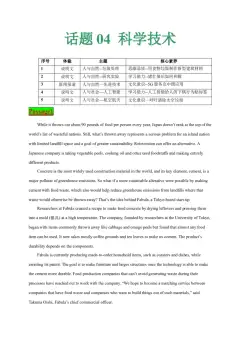
序号 体裁 主题 核心素养
1 应用文 人与自我--读书 思维品质-- 帮助缓解焦虑的书籍
2 议论文 人与社会—善于求助 学习能力--寻求帮助不是一件羞耻的事情
3 记叙文 人与自然—写作提升- 文化意识--真实的自己,写发自内心的东西
4 议论文 人与社会---健康保健- 文化意识--谨慎追求自我保健
5 说明文 人与社会---提升自我 思维品质--拥有高逆商的几个好处
Passage1
In recent times, the sales of self-help books have soared in popularity. Here are our picks of the best,
and most highly rated self-help books to help tackle that new year anxiety.
Atomic Habits by James Clear
Nowadays people spend so much time planning, journaling, and writing in our diaries, rather than
taking action towards actually achieving our goals. This book is a step-by-step guide to fixing up your
routine. It digs into the psychology behind habits — how to form good ones and break the bad ones. If
you’re a victim of procrastination (拖延症), this may be the push you need.
How to Win Friends and Influence People by Dale Carnegie
This book is all about improving the relationships you have with others in your life, making you a
better listener, and overall a better friend. With simple tips such as including the person’s name in
conversation and making sure you’re genuinely interested in what they’re saying, you can ensure they will
remember you. The core idea is that you can change other people’s behaviour by changing your own,
therefore building stronger relationships.
Untamed-Stop Pleasing, Start Living by Glennon Doyle
Part autobiographical and part self-help, it’s the perfect book to kickstart your year and start living for
yourself. Although this book could be enjoyed by anyone, the prime audience is women, as Doyle talks a
lot about doubts during motherhood, and the overwhelming need women feel to put everyone before
themselves. Doyle shows us our lives in a new light that without even realising it, we may be working hard
to please everyone around us, forgetting the most important person — ourselves.
The 4-Hour Work Week by Timothy Ferriss
“Escape the 9-5, live anywhere and join the new rich”. This best seller proposes the idea that you don’tneed to wait for retirement and delay your life plan. Instead, you can trade a long career for short work
bursts and frequent “mini-retirements”. Ferris says that people don’t want to be millionaires. They want to
experience what they think only millionaires can buy.
1.What can we learn from Atomic Habits?
A.How to keep a diary.
B.How to learn psychology.
C.How to arrange your routine.
D.How to satisfy your needs.
2.Which book may attract housewives most?
A.Atomic Habits.
B.Untamed-Stop Pleasing, Start Living.
C.The 4-Hour Work Week.
D.How to Win Friends and Influence People.
3.Which of the following may Timothy Ferriss agree with?
A.No pains, no gains. B.Idle young, needy old.
C.Live in the moment. D.Fortune favors the bold.
Passage2
Everyone needs it, but no one wants to ask for it.“ Help” has become a sort of dirty word, implying
weakness and neediness, that we can’t handle our problems on our own. However, whether it is for your
physical, mental or academic health, getting words of advice or encouragement from an outside-source can
make all the difference.
During a time of such uncertainty, the frequency of people requesting help for anxiety and depression
has increased. The current situation has made people realize that asking for help from professionals is the
best way to get their problems off their chests and their minds on the road to wellness.
Still, requesting help carries a societal weight. The British Psychology Soeiety found that two types of
stigmas(耻辱) exist: public stigma and self stigma. A “public stigma” is external, a collection of beliefs
from around us, which holds a heavy weight on our ideas on seeking help. A “self stigma” is internal,
assigning ourselves labels based on our state of mental health, claiming we are worthless and undeserving
of help.“ Public” and “self” stigmas go hand in hand, and when we hear the stigmas being voiced by those
around us, we tend to apply them to ourselves because of social influences.To be our better selves, we have to break the stigma around “help” and accept the fact that some
problems are too ough to overcome on our own. If we fail elevant necessity of getting ourselves ‘assistance
in times of need. Despite what society may tell us, it’s not odd or wrong o get help—it’s probably one of
the most insightful and courageous things we can do for ourselves.
Each one of us should be able to openly admit that we need help. Sometimes we need support,and that
isn’t bad—’s healthy,and remarkably brave.
4.Why is“help”considered a dirty word?
A.It has bad impacts on our health.
B.It makes us confused by an outside source.
C.It prevents us from handling our problems.
D.It implies our inability to solve problems alone.
5.What can we know about two types of stigmas according to Paragraph 3?
A.We can’t ignore the two stigmas. B.Public stigma weighs over self stigma.
C.We are easily affected by public stigma. D.The two stigmas are based on mental health.
6.What is the benefit of breaking the stigma around“help”?
A.Improving ourselves. B.Becoming more confident.
C.Overcoming problems by ourselves. D.Facing problems bravely.
7.What can be a suitable title for the text?
A.Help:A Dirty Word B.Help:Feel Free to Seek It
C.Help:A Way to Better Us D.Help:Keep a Distance from It
Passage3
“I can’t connect with your characters.”
I kept hearing the same feedback and was unable to understand why and not sure what to do. I was a
character-driven writer. How could I mess up the one thing I was supposed to be good at? I was determined
to convince my agent that these characters were real. After all, I knew they were real. My main character
Lotus had lived inside me for years. I just needed to clarify her on the page.
I wrote and edited for a year, trying to respond to this agent’s feedback. But Lotus’ personality began
to disappear. I tried to have her make “better” decisions, wear smarter fashion, and have more friends, as
my agent said she acted “immature” and was “isolated”. And when this agent ultimately parted ways with
me, I felt like I had failed. Now with time and distance, I realize I tried to fit Lotus into a neurotypical styleto please my agent. And as a result, Lotus lost her Lotus-ness.
When that agent discouraged me from writing Lotus as autistic(自闭的), he said that would make
Lotus seem more “vulnerable(脆弱的)” or an “obvious victim”. I didn’t want Lotus to seem vulnerable.
Lotus’ autism is what makes her powerful, I tried to explain. But from a neurotypical perspective, Lotus’
autism could only be seen as a weakness.
Unsure of how to convince my agent of the strength and power autistic women hold, I began to write
Lotus as “neurotypical”. And I failed miserably. After all, what do I know about being neurotypical? My
whole life, autism was my default. Not being diagnosed until 2020, I assumed the way I saw the world was
“normal”.
My current agent encourages me to write from my neurodivergent(神经多样性的) experience. With
this invitation, I revisited Lotus and saw her the way I first wrote her. And when I did, the characters and
the entire narrative began to make more sense.
Identifying my characters as neurodivergent not only gives me joy as a writer, but it has produced my
strongest writing. For so long. I’ve combatted the advice to “write what I know”, in part because I didn’t
know what I actually knew. I didn’t know I was neurodivergent. But as I mine the specificity of my lived
experience, my writing is stronger. There is a power to our lived experience. It’s not a limitation on our
craft, but a swinging open of the gates.
8.How did the author feel when receiving the repeated response from the first agent?
A.Confused. B.Convinced. C.Determined. D.Disappointed.
9.Lotus’ personality got lost because ______
A.Lotus no longer lived inside the author B.the author attempted to please the agent
C.the agent failed to sympathize with Lotus D.Lotus was considered childish and lonely
10.What do we know about the author?
A.She regretted parting with the agent.
B.She owed her success in life to autism.
C.She was aware of her autism in the early years.
D.She was empowered by her autistic experience.
11.What has the author learned from her own experience?
A.Stick to your dream despite discouragement.
B.Be true to yourself and write from your heart.
C.Giving in to authority is the barrier to success.D.Everyone is born an original instead of a copy.
Passage4
On TikTok, “#Selfcare” has 28.2 billion views, while the hashtag (主题标签) can be found on over 66
million Instagram posts. Also, books about self-care often top many people s shopping lists.
On the surface, it makes complete sense. Who wouldn’t like the idea of making oneself feel better and
taking care of their mind, body and soul? Yet, we have to be careful not to view self-care as a cure-all
solution to our problems. Self-care pursued without awareness of your specific needs and consistent
evaluation can cause emotional, financial, mental and physical consequences.
According to Zishan Khan, a psychologist with Mindpath Health, self-care can lead to a person
becoming overwhelmed (不知所措的) when met with a sea of advice, emerging everywhere from podcasts
to self-help books. “So don’t allow what others suggest to cloud your internal voice,” says Khan. “Self-care
can only benefit a person if it’s consistent with their goals and values.”
Khan further emphasizes the danger of unregulated physically-centered self-care advice, such as from
influencers. “Their content often overly focuses on beauty and improving one’s looks. This can
unintentionally lead to body image concerns and thus actually worsen one’s mental health,” she says.
Another danger can come when self-care actions reach the level of obsession or addiction, says
Melissa Boudin, a psychologist of Choosing Therapy. “When you spend a large amount of time thinking
about or practising a certain self-care behavior, this may be a sign that self-care has gone from beneficial to
harmful,” she says, using the example of self-care through healthy eating and then going so far as to
develop an eating disorder.
Lena Suarez-Angelino, a licensed clinical social worker, recommends creating a list of activities that
make you feel better but don’t overextend you. Worthwhile and beneficial self-care may include anything
from time with loved ones to walking. If you can’t really afford to buy dinner for the fifth time this week,
that’s not it.
12.What does paragraph 1 mainly suggest?
A.Self-care pursuit needs restricting.
B.Online interaction becomes popular.
C.Awareness of personal needs matters.
D.People attach much attention to self-care.
13.What can do harm to the self-care practice in Zishan Khan’s opinion?A.Being open to new self-care ideas.
B.Always keeping your goals in mind.
C.Taking up too many responsibilities.
D.Caring too much about others’ advice.
14.Why does Melissa Boudin mention the example about eating in paragraph 5?
A.To prove addiction to self-care actions can be harmful.
B.To warn physically-centered self-care advice is useless.
C.To show how to make yourself feel better in a right way.
D.To tell the reason for people’s worry about others’ views.
15.What is the author’s purpose in writing the text?
A.To introduce the dangers of self-care advice.
B.To encourage us to read more self-help books.
C.To remind us to be cautious to pursue self-care.
D.To discuss some ways to make ourselves better.
Passage5
Adversity quotient (AQ逆商) is one’s ability to handle adversities well. It is known by other names
such as resilience (适应力) and persistence. ____16____. A person with high AQ is tough and will not
easily give up in the face of hardship, and often has the following qualities:
____17____
As we all know, change is the only constant in life. In the natural world, a creature that cannot adapt to
changing circumstances eventually comes to an end. An employee who refuses to adapt to great changes
such as heavier workloads will give up and leave. ____18____. The ups and downs of life will not crush
them.
High emotional quotient (EQ)
____19____. Poor emotional control can make a situation worse than it already is. A person with a
high EQ usually knows that the emotional impact of an adverse situation is only temporary. It is the classic
“this too shall pass” mode of psychology.
A positive attitude toward life
A person with a high AQ has a positive outlook on life. They will see the half-full glass instead of the
half-empty one. ____20____.The concept of AQ is becoming increasingly relevant as the world goes through tough times. People
with high AQs are an asset to any organization.
A.Sensitivity to changes
B.Adaptability to changes
C.However, a person with high AQ will stay no matter what
D.Without high AQ, anxiety and depression are usually not far behind
E.They will see even criticism in a positive and constructive spirit
F.AQ is the capacity to bounce back after you have been pushed down
G.The ability to regulate one’s emotions is important when faced with adversity
【参考答案】
1 . C 2 . B 3 . C
【导语】本文是一篇应用文。文章介绍了帮助缓解焦虑的书籍。
1.细节理解题。根据Atomic Habits by James Clear部分中“This book is a step-by-step guide to fixing
up your routine. (这本书一步一步地指导你调整日常生活)”可知,Atomic Habits主要是指导读者们如
何安排自己的日常生活。故选C。
2.细节理解题。根据Untamed-Stop Pleasing, Start Living by Glennon Doyle部分中“Although this
book could be enjoyed by anyone, the prime audience is women, as Doyle talks a lot about doubts during
motherhood, and the overwhelming need women feel to put everyone before themselves. (尽管任何人都可
以喜欢这本书,但主要的读者是女性,因为道尔谈到了很多当母亲时的疑虑,以及女性觉得把所有
人都放在自己之前的强烈需求)”可知,Untamed-Stop Pleasing, Start Living适合女性读者。故选B。
3.推理判断题。根据The 4-Hour Work Week by Timothy Ferriss部分中“This best seller proposes the
idea that you don’t need to wait for retirement and delay your life plan. Instead, you can trade a long career
for short work bursts and frequent “mini-retirements”. (这本畅销书提出的观点是,你不需要等待退休,
推迟你的人生计划。相反,你可以用漫长的职业生涯换取短暂的工作爆发和频繁的“迷你退休”)”
可知,该书作者认为人们不必要等待退休而推迟自己的人生计划,而是应该用短暂的工集中工作和
“迷你退休”模式,实现自己的人生。由此推知,也许Timothy Ferriss同意“活在当下”的观点。
故选C。
4 . D 5 . C 6 . A 7 . B
【导语】本文为议论文。主要告诉我们当一个人处于困难时,寻求帮助并不是一件令人羞耻的事情。
4.细节理解题。由第一段第二句““Help” has become a sort of dirty word,implying weakness andneediness,that we can’t handle our problems on our own. (“帮助”已经成为一个肮脏的词,意味着软弱
和需要,我们无法独自处理我们的问题)”可知大家不愿寻求帮助是因为这意味着我们没能力自己解
决问题。故选D项。
5.细节理解题。由第三段最后一句话““Public” and “self” stigmas go hand in hand, and when we
hear the stigmas being voiced by those around us, we tend to apply them to ourselves because of social
influences. (“公共”和“自我”的污名是齐头并进的,当我们听到周围人表达的污名时,由于社会
影响,我们倾向于将它们应用于自己。)”可知,我们容易受到公众污名的影响。故选C项。
6.细节理解题。由第四段第一句话“To be our better selves, we have to break the stigma around “help”
and accept the fact that some problems are too tough to overcome on our own. (为了成为更好的自己,我
们必须打破围绕“帮助”的污名,并接受这样一个事实,即:有些问题太难靠自己克服了。)”可知,
当我们打破了寻求帮助的这种羞耻感就会让自己变得更好。故选A项。
7.主旨大意题。通读全文可知,本文围绕“帮助”一词被污名化而展开,主要告诉我们当一个人
遇到困难时,向别人求助并不是一件羞耻的事情,在有需要的时候要毫不犹豫地去寻求帮助。故选
B项。
8 . A 9 . B 10 . D 11 . B
【导语】这是一篇记叙文。文章讲述了患有自闭症的作者写作的经历,告诉我们在写作时做真实的
自己,写发自内心的东西。
8.推理判断题。根据文章第一段““I can’t connect with your characters.”(“我无法与你的角色产生
共鸣。”)”和第二段“I kept hearing the same feedback and was unable to understand why and not sure
what to do.( 我一直听到同样的反馈,不明白为什么,也不知道该怎么做。)”可以推知,当收到经纪
人的反复回应时,作者感到不解。故选A。
9.细节理解题。根据文章第三段“I wrote and edited for a year, trying to respond to this agent’s
feedback. But Lotus’ personality began to disappear.( 我写了一年,编辑了一年,试图回应这位经纪人
的反馈。但是Lotus的个性开始消失。)”和“Now with time and distance, I realize I tried to fit Lotus
into a neurotypical style to please my agent.(随着时间和距离的推移,我意识到我试图把Lotus塑造成
一种典型的风格,以取悦我的经纪人。)”可知,Lotus的个性开始消失是因为作者试图取悦经纪人。
故选B。
10.推理判断题。根据文章第五段“After all, what do I know about being neurotypical? My whole life,
autism was my default. Not being diagnosed until 2020, I assumed the way I saw the world was “normal”.(
毕竟,我对正常神经又有什么了解呢?在我的一生中,自闭症是我的默认症状。直到2020年我才被确诊,我以为我看世界的方式是“正常的”。)”和文章最后一段“But as I mine the specificity of
my lived experience, my writing is stronger.( 但当我挖掘我的生活经历的特殊性时,我的写作就更强
大了。)”可知,作者的自闭症经历给了她力量。故选D。
11.推理判断题。根据文章倒数第二段“My current agent encourages me to write from my
neurodivergent(神经多样性的) experience. With this invitation, I revisited Lotus and saw her the way I
first wrote her. And when I did, the characters and the entire narrative began to make more sense.(我现在
的经纪人鼓励我根据我的神经发散经验来写作。带着这份邀请,我重新“拜访”了Lotus,看到了
我第一次塑造她的样子。当我这样做的时候,角色和整个叙事开始变得更有意义。)”和文章最后一
段“Identifying my characters as neurodivergent not only gives me joy as a writer, but it has produced my
strongest writing. (把我的角色定位为神经发散者,不仅给了我作为作家的快乐,也让我写出了最精
彩的作品。)”以及“But as I mine the specificity of my lived experience, my writing is stronger. There is a
power to our lived experience. It’s not a limitation on our craft, but a swinging open of the gates.(但当我挖
掘我的生活经历的特殊性时,我的写作就更强大了。我们的生活经历有一种力量。这并不是对我们
的技术的限制,而是一扇敞开的大门。)”可知,作者从自己的经历中学到做真实的自己,写发自内
心的东西。故选B。
12 . D 13 . D 14 . A 15 . C
【导语】这是一篇议论文。文章谈论了在自我保健中的误区,并建议人们谨慎追求自我保健。
12.推理判断题。根据第一段中“On TikTok, ‘#Selfcare’ has 28.2 billion views, while the hashtag(主题
标签) can be found on over 66 million Instagram posts. Also, books about self-care often top many people
s shopping lists. (在TikTok上,‘#自我保健’的浏览量为282亿次,而在超过6600万条Instagram
帖子上可以找到该标签。此外,关于自我保健的书往往是许多人购物清单上的首选。)”可知,人们
非常注重自我保健。故选D项。
13.推理判断题。根据第三段中“So don’t allow what others suggest to cloud your internal voice. (所以
不要让别人的建议影响你的内在声音。)”以及“Self- care can only benefit a person if it’s consistent
with their goals and values. (自我保健只有在符合一个人的目标和价值观的情况下才能让他受益。)”
可知,Zishan Khan认为过度在意别人的建议会损害自我保健。故选D项。
14.推理判断题。根据第五段中“Another danger can come when self-care actions reach the level of
obsession or addiction, says Melissa Boudin, a psychologist of Choosing Therapy. ‘When you spend a large
amount of time thinking about or practising a certain self-care behavior, this may be a sign that self-care
has gone from beneficial to harmful,’ she says, using the example of self-care through healthy eating andthen going so far as to develop an eating disorder. (选择疗法的心理学家Melissa Boudin说,另一种危险
是当自我保健行为达到痴迷或上瘾的程度时。她说:‘当你花大量时间思考或实践某种自我保健行
为时,这可能是自我保健已经从有益走向有害的迹象。’她以通过健康饮食自我保健为例,然后发
展到饮食失调的程度。)”可知,Melissa Boudin提到了关于吃的例子是为了证明沉迷于自我保健行
为是有害的。故选A项。
15.推理判断题。通读全文,根据第二段中“Yet, we have to be careful not to view self-care as a cure-
all solution to our problems. Self-care pursued without awareness of your specific needs and consistent
evaluation can cause emotional, financial, mental and physical consequences. (然而,我们必须小心,不
要把自我保健视为解决我们问题的万灵药。在没有意识到自己的具体需求和持续评估的情况下追求
自我保健会导致情感、经济、精神和身体上的后果。)”可知,文章的目的是为了提醒我们要谨慎地
追求自我保健。故选C项。
16 . F 17 . B 18 . C 19 . G 20 . E
【导语】这是一篇说明文,作者介绍了拥有高逆商的几个好处。
16.上文“Adversity quotient (AQ逆商) is one’s ability to handle adversities well. It is known by other
names such as resilience (适应力) and persistence. (逆商是一个人很好地应对逆境的能力。它也被称为
其他名字,如适应力和持久性)”说明此处介绍的是逆商概念,因此F项“逆商是在你被击倒后反弹
的能力”符合语境,故选F。
17.根据下文“As we all know, change is the only constant in life. In the natural world, a creature that
cannot adapt to changing circumstances eventually comes to an end. (众所周知,变化是生活中唯一不变
的。在自然世界中,一个无法适应不断变化的环境的生物最终会走到尽头)”可知,本段主要说明适
应变化的重要性,因此B项“对变化的适应性”概括段意,故选B。
18.上文“An employee who refuses to adapt to great changes such as heavier workloads will give up and
leave. (一个拒绝适应巨大变化,如更大的工作量,的员工会放弃并离开)”说明什么样的员工会离开,
下文应该是什么样的员工会留下,因此C项“然而,逆商高的人无论如何都会留下来”符合语境,
故选C。
19.主旨句“High emotional quotient (EQ) (高情商)”以及下文“Poor emotional control can make a
situation worse than it already is. (情绪控制能力差会使情况变得更糟)”说明拥有高情商进行情绪调节
的重要性, Poor emotional control和regulate one’s emotions是关键词,因此G项“面对逆境时,调
节情绪的能力很重要”符合语境,故选G。
20.上文“A person with a high AQ has a positive outlook on life. They will see the half-full glass insteadof the half-empty one. (逆商高的人有积极的人生观。他们会看到半满的杯子,而不是半空的杯子)”
说明的是逆商高的人的人生观,因此E项“他们甚至会以积极和建设性的精神看待批评”是对这一
人生观的具体解释,故选E。