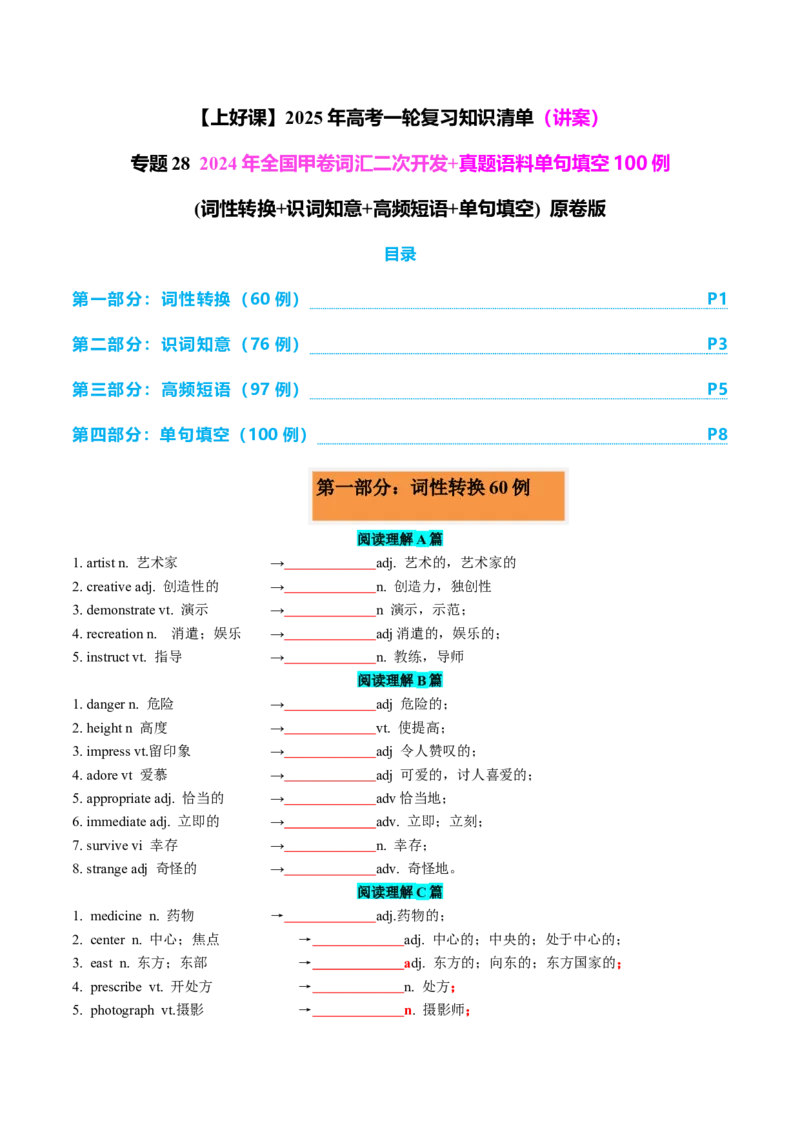
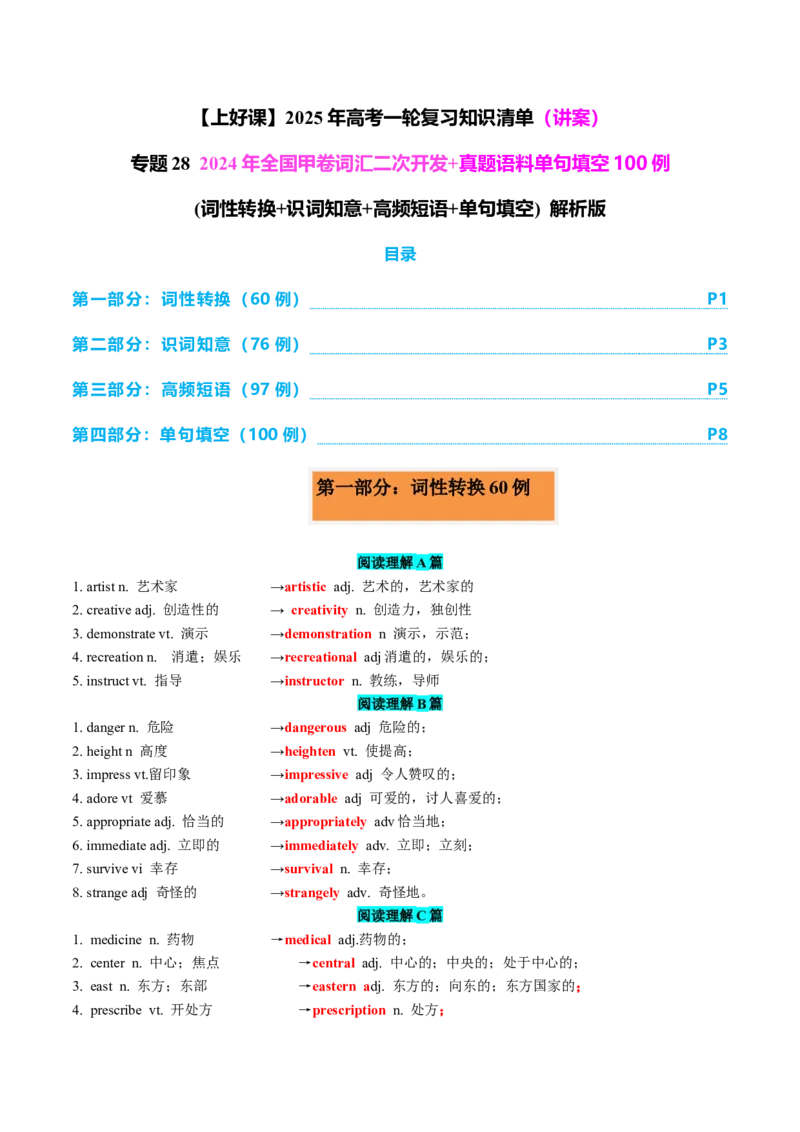
【上好课】2025年高考一轮复习知识清单(讲案)
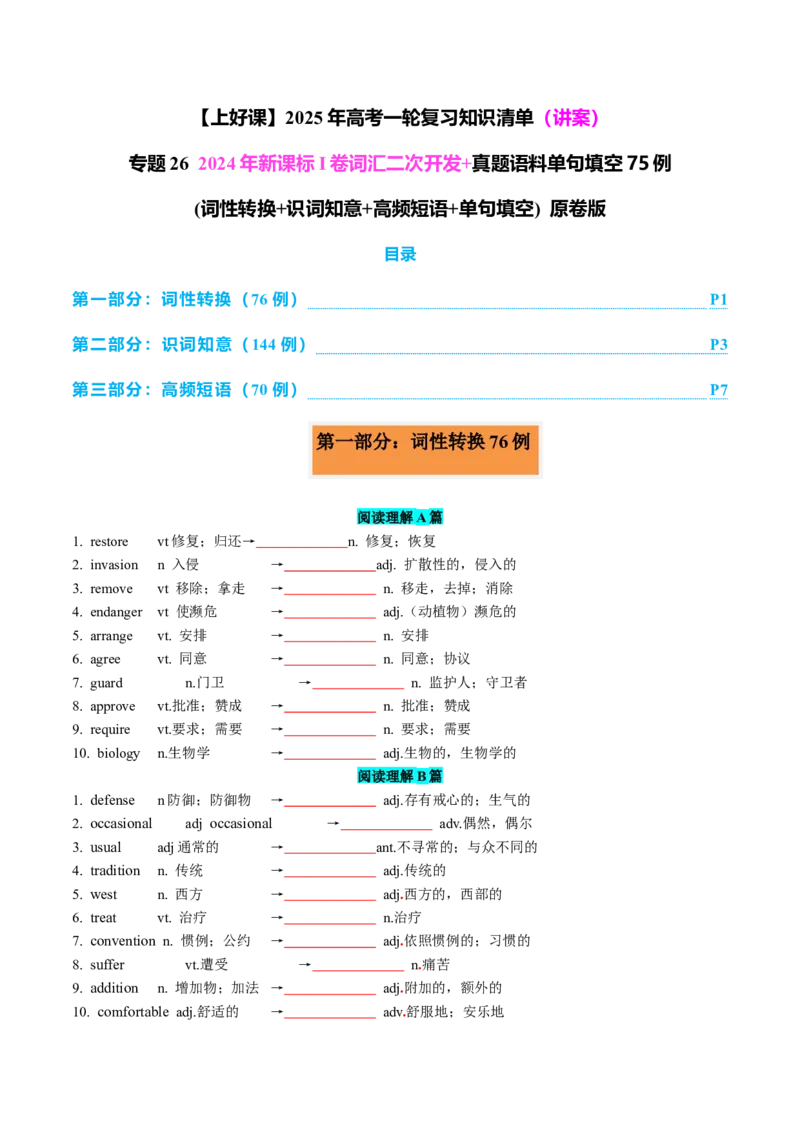
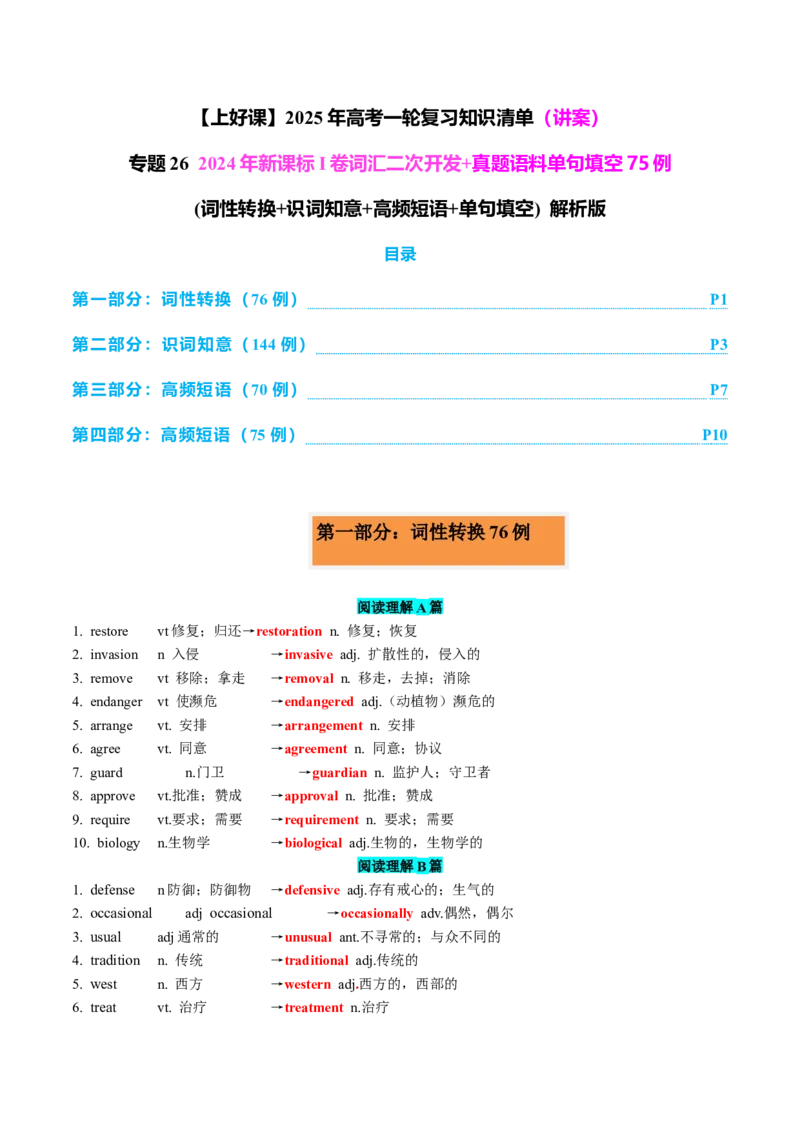
专题28 2024年全国甲卷词汇二次开发+真题语料单句填空100例
(词性转换+识词知意+高频短语+单句填空) 原卷版
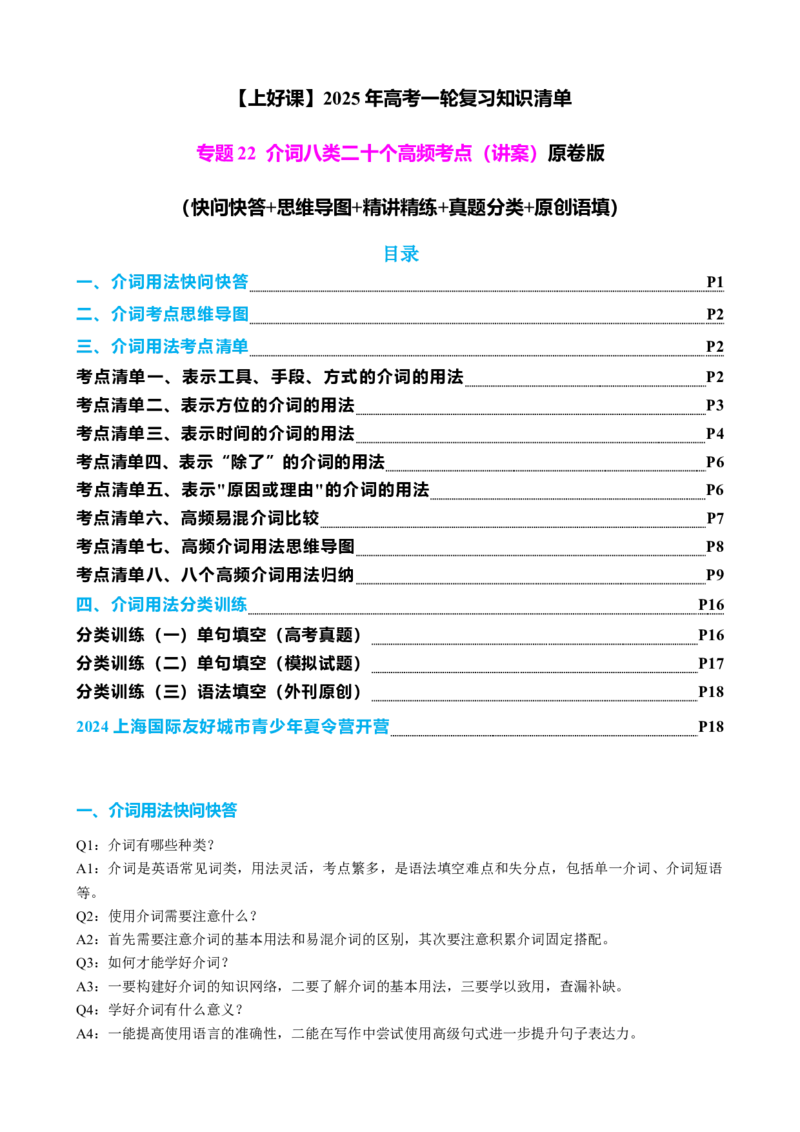
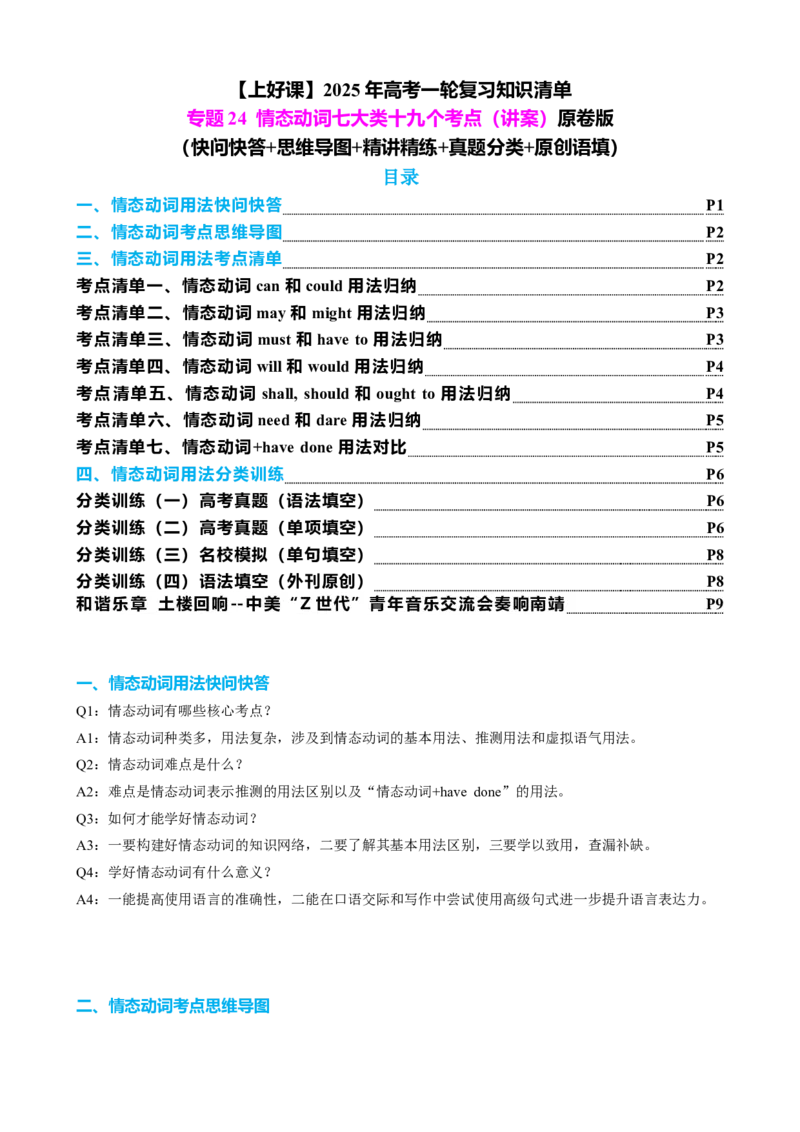
目录
第一部分:词性转换(60 例) P1
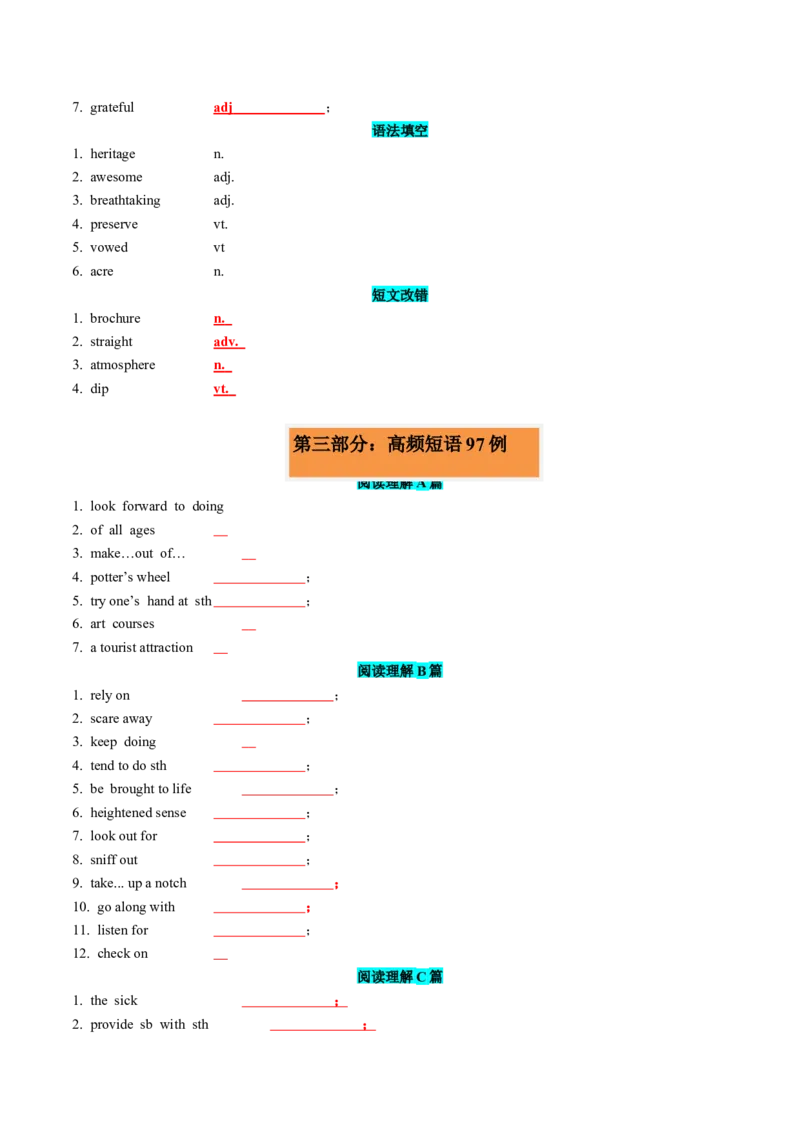
第二部分:识词知意(76 例) P 3
第三部分:高频短语(97 例) P 5
第四部分:单句填空(100 例) P 8
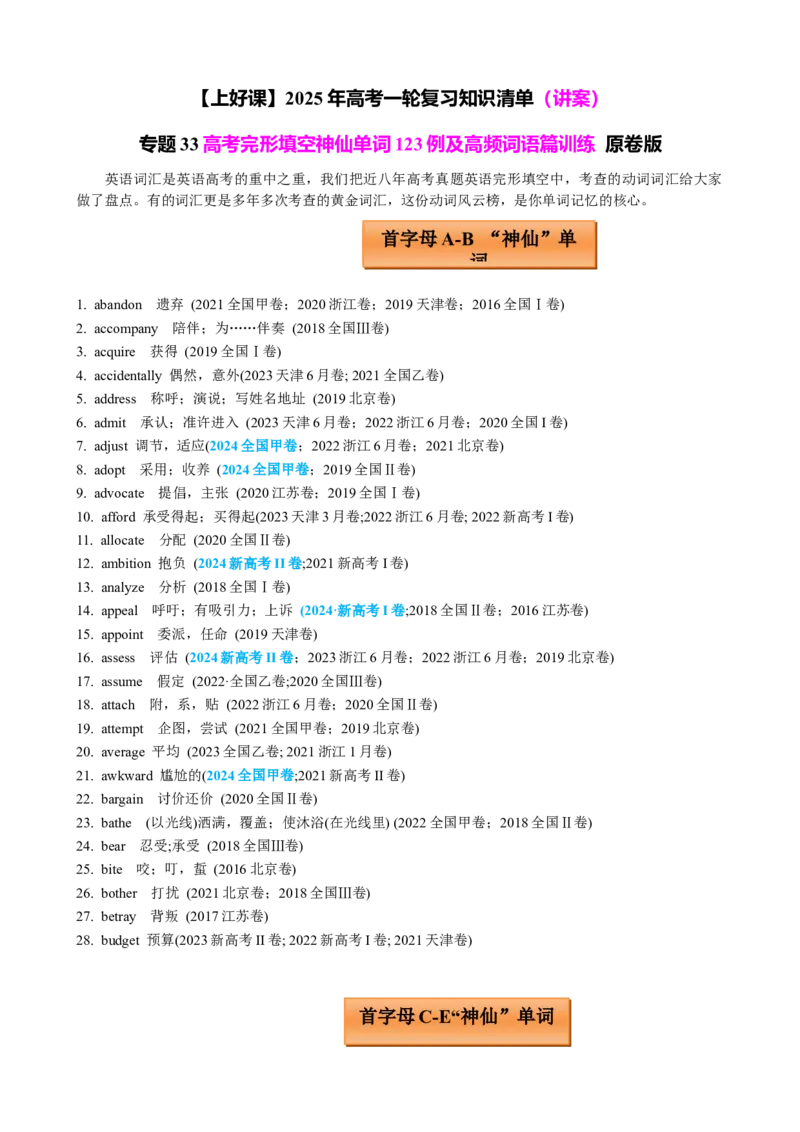
第一部分:词性转换60例
阅读理解A篇
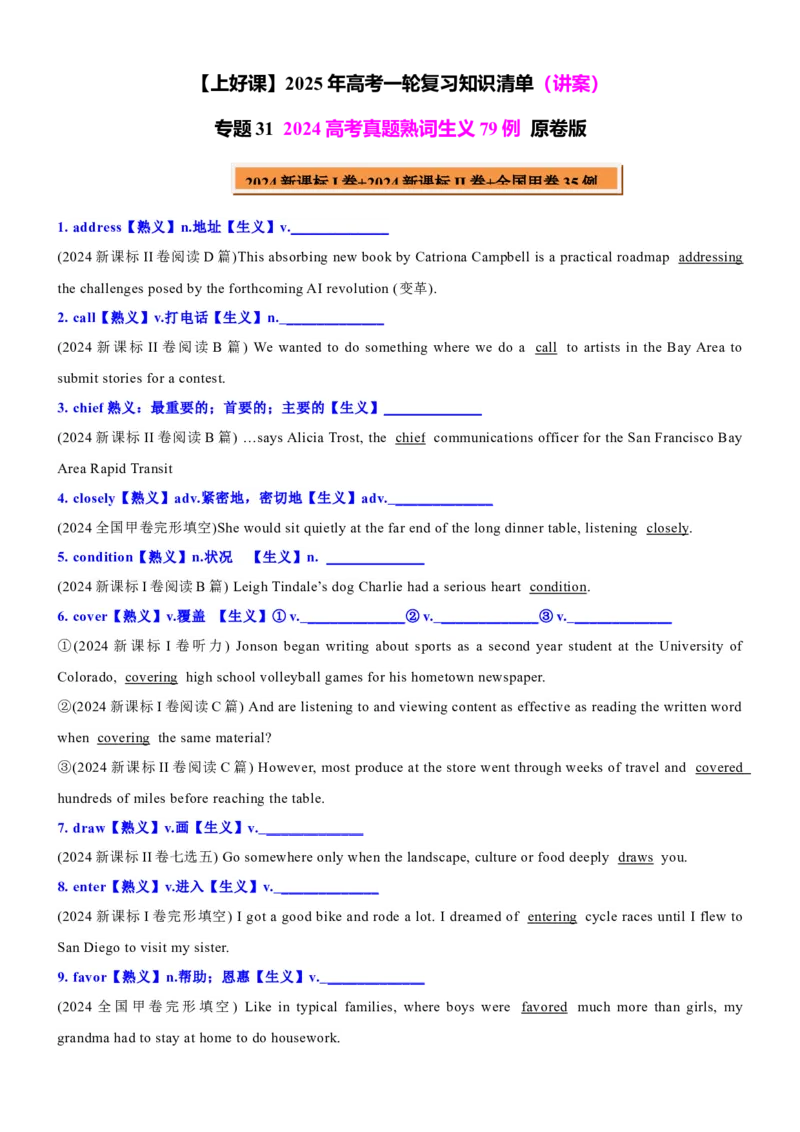
1. artist n. 艺术家 → adj. 艺术的,艺术家的
2. creative adj. 创造性的 → n. 创造力,独创性
3. demonstrate vt. 演示 → n 演示,示范;
4. recreation n. 消遣;娱乐 → adj消遣的,娱乐的;
5. instruct vt. 指导 → n. 教练,导师
阅读理解B篇
1. danger n. 危险 → adj 危险的;
2. height n 高度 → vt. 使提高;
3. impress vt.留印象 → adj 令人赞叹的;
4. adore vt 爱慕 → adj 可爱的,讨人喜爱的;
5. appropriate adj. 恰当的 → adv恰当地;
6. immediate adj. 立即的 → adv. 立即;立刻;
7. survive vi 幸存 → n. 幸存;
8. strange adj 奇怪的 → adv. 奇怪地。
阅读理解C篇
1. medicine n. 药物 → adj.药物的;
2. center n. 中心;焦点 → adj. 中心的;中央的;处于中心的;
3. east n. 东方;东部 → adj. 东方的;向东的;东方国家的;
4. prescribe vt. 开处方 → n. 处方;
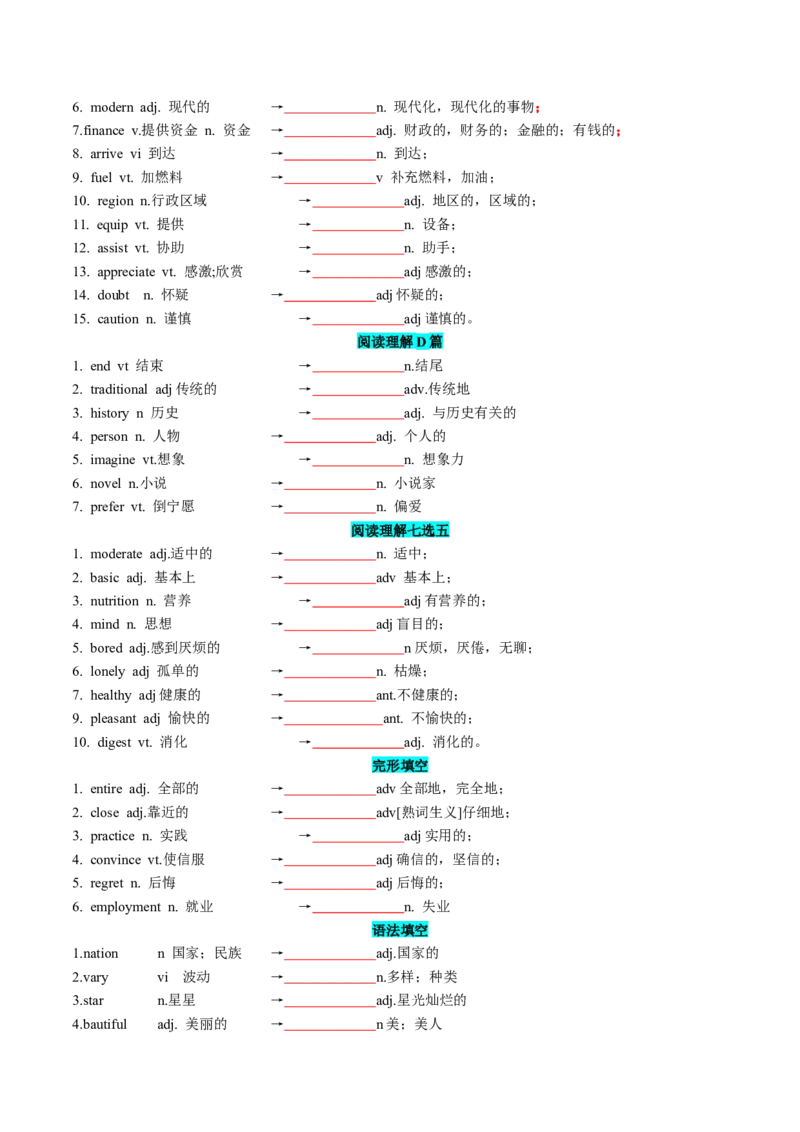
5. photograph vt.摄影 → n. 摄影师;6. modern adj. 现代的 → n. 现代化,现代化的事物;
7.finance v.提供资金 n. 资金 → adj. 财政的,财务的;金融的;有钱的;
8. arrive vi 到达 → n. 到达;
9. fuel vt. 加燃料 → v 补充燃料,加油;
10. region n.行政区域 → adj. 地区的,区域的;
11. equip vt. 提供 → n. 设备;
12. assist vt. 协助 → n. 助手;
13. appreciate vt. 感激;欣赏 → adj感激的;
14. doubt n. 怀疑 → adj怀疑的;
15. caution n. 谨慎 → adj谨慎的。
阅读理解D篇
1. end vt 结束 → n.结尾
2. traditional adj传统的 → adv.传统地
3. history n 历史 → adj. 与历史有关的
4. person n. 人物 → adj. 个人的
5. imagine vt.想象 → n. 想象力
6. novel n.小说 → n. 小说家
7. prefer vt. 倒宁愿 → n. 偏爱
阅读理解七选五
1. moderate adj.适中的 → n. 适中;
2. basic adj. 基本上 → adv 基本上;
3. nutrition n. 营养 → adj有营养的;
4. mind n. 思想 → adj盲目的;
5. bored adj.感到厌烦的 → n厌烦,厌倦,无聊;
6. lonely adj 孤单的 → n. 枯燥;
7. healthy adj健康的 → ant.不健康的;
9. pleasant adj 愉快的 → ant. 不愉快的;
10. digest vt. 消化 → adj. 消化的。
完形填空
1. entire adj. 全部的 → adv全部地,完全地;
2. close adj.靠近的 → adv[熟词生义]仔细地;
3. practice n. 实践 → adj实用的;
4. convince vt.使信服 → adj确信的,坚信的;
5. regret n. 后悔 → adj后悔的;
6. employment n. 就业 → n. 失业
语法填空
1.nation n 国家;民族 → adj.国家的
2.vary vi 波动 → n.多样;种类
3.star n.星星 → adj.星光灿烂的
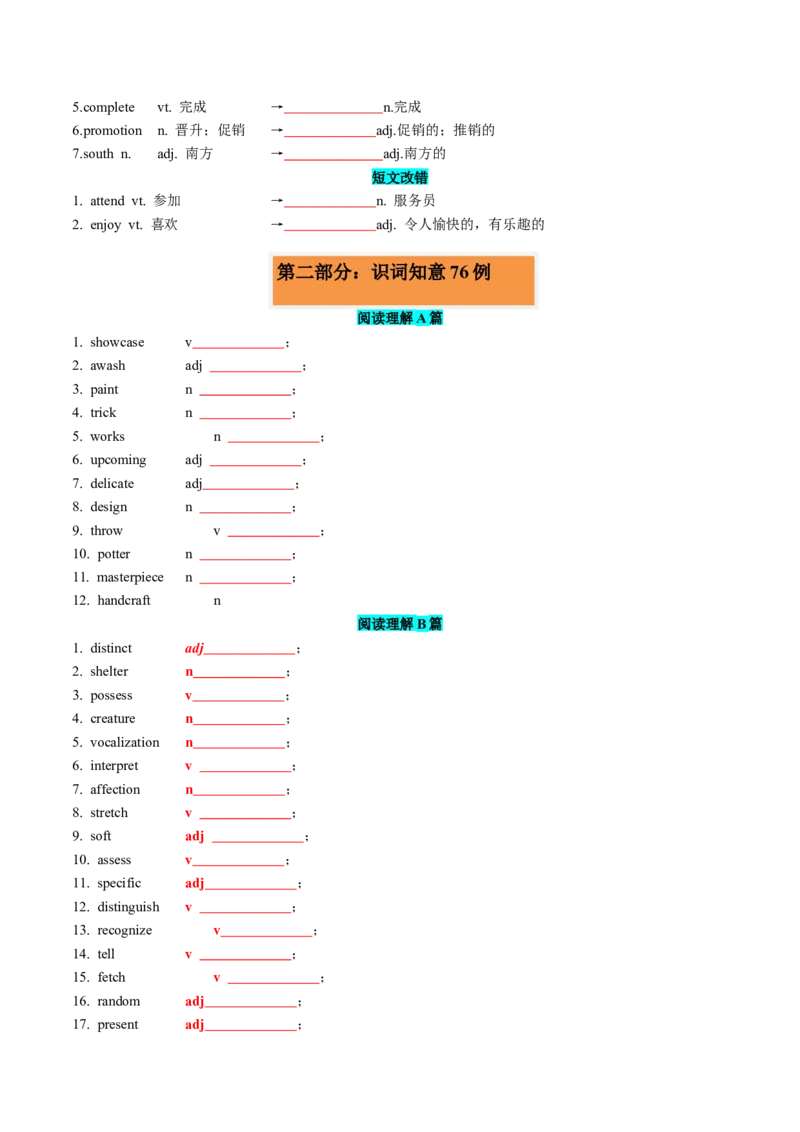
4.bautiful adj. 美丽的 → n美;美人5.complete vt. 完成 → n.完成
6.promotion n. 晋升;促销 → adj.促销的;推销的
7.south n. adj. 南方 → adj.南方的
短文改错
1. attend vt. 参加 → n. 服务员
2. enjoy vt. 喜欢 → adj. 令人愉快的,有乐趣的
第二部分:识词知意76例
阅读理解A篇
1. showcase v ;
2. awash adj ;
3. paint n ;
4. trick n ;
5. works n ;
6. upcoming adj ;
7. delicate adj ;
8. design n ;
9. throw v ;
10. potter n ;
11. masterpiece n ;
12. handcraft n
阅读理解B篇
1. distinct adj ;
2. shelter n ;
3. possess v ;
4. creature n ;
5. vocalization n ;
6. interpret v ;
7. affection n ;
8. stretch v ;
9. soft adj ;
10. assess v ;
11. specific adj ;
12. distinguish v ;
13. recognize v ;
14. tell v ;
15. fetch v ;
16. random adj ;
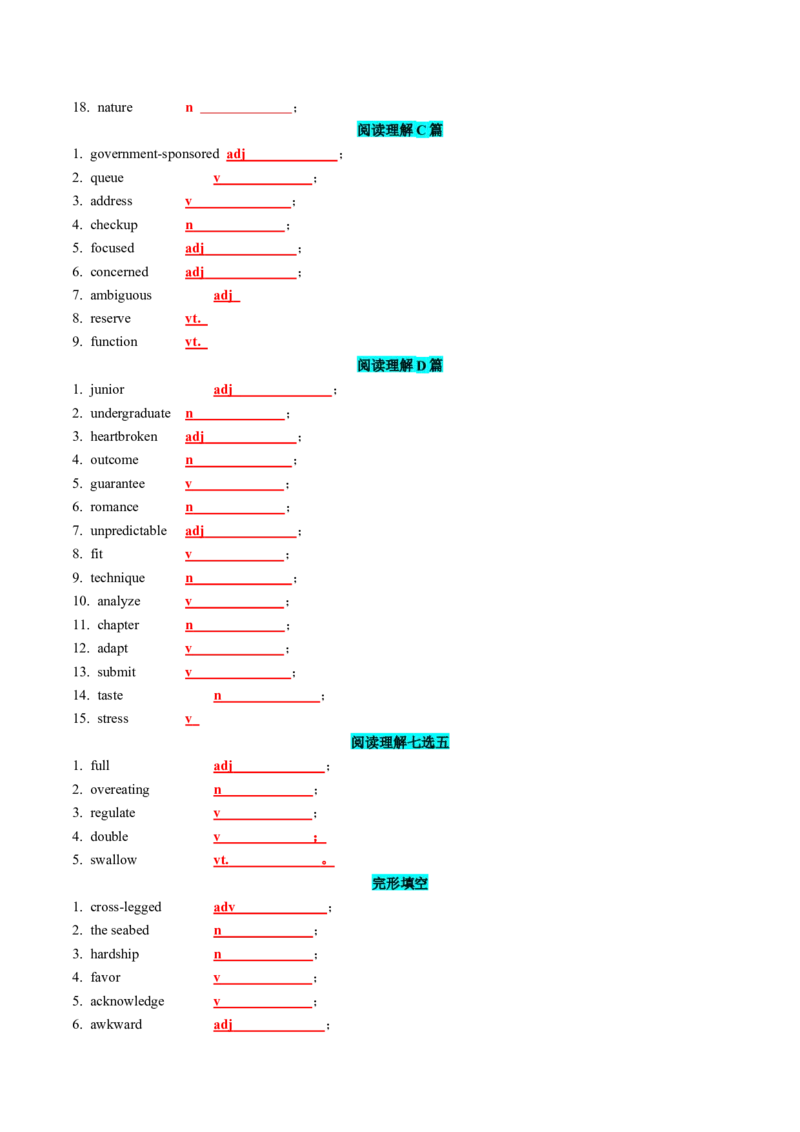
17. present adj ;18. nature n ;
阅读理解C篇
1. government-sponsored adj ;
2. queue v ;
3. address v ;
4. checkup n ;
5. focused adj ;
6. concerned adj ;
7. ambiguous adj
8. reserve vt.
9. function vt.
阅读理解D篇
1. junior adj ;
2. undergraduate n ;
3. heartbroken adj ;
4. outcome n ;
5. guarantee v ;
6. romance n ;
7. unpredictable adj ;
8. fit v ;
9. technique n ;
10. analyze v ;
11. chapter n ;
12. adapt v ;
13. submit v ;
14. taste n ;
15. stress v
阅读理解七选五
1. full adj ;
2. overeating n ;
3. regulate v ;
4. double v ;
5. swallow vt . 。
完形填空
1. cross-legged adv ;
2. the seabed n ;
3. hardship n ;
4. favor v ;
5. acknowledge v ;
6. awkward adj ;7. grateful adj ;
语法填空
1. heritage n.
2. awesome adj.
3. breathtaking adj.
4. preserve vt.
5. vowed vt
6. acre n.
短文改错
1. brochure n.
2. straight adv.
3. atmosphere n.
4. dip vt.
第三部分:高频短语97例
阅读理解A篇
1. look forward to doing
2. of all ages
3. make…out of…
4. potter’s wheel ;
5. try one’s hand at sth ;
6. art courses
7. a tourist attraction
阅读理解B篇
1. rely on ;
2. scare away ;
3. keep doing
4. tend to do sth ;
5. be brought to life ;
6. heightened sense ;
7. look out for ;
8. sniff out ;
9. take... up a notch ;
10. go along with ;
11. listen for ;
12. check on
阅读理解C篇
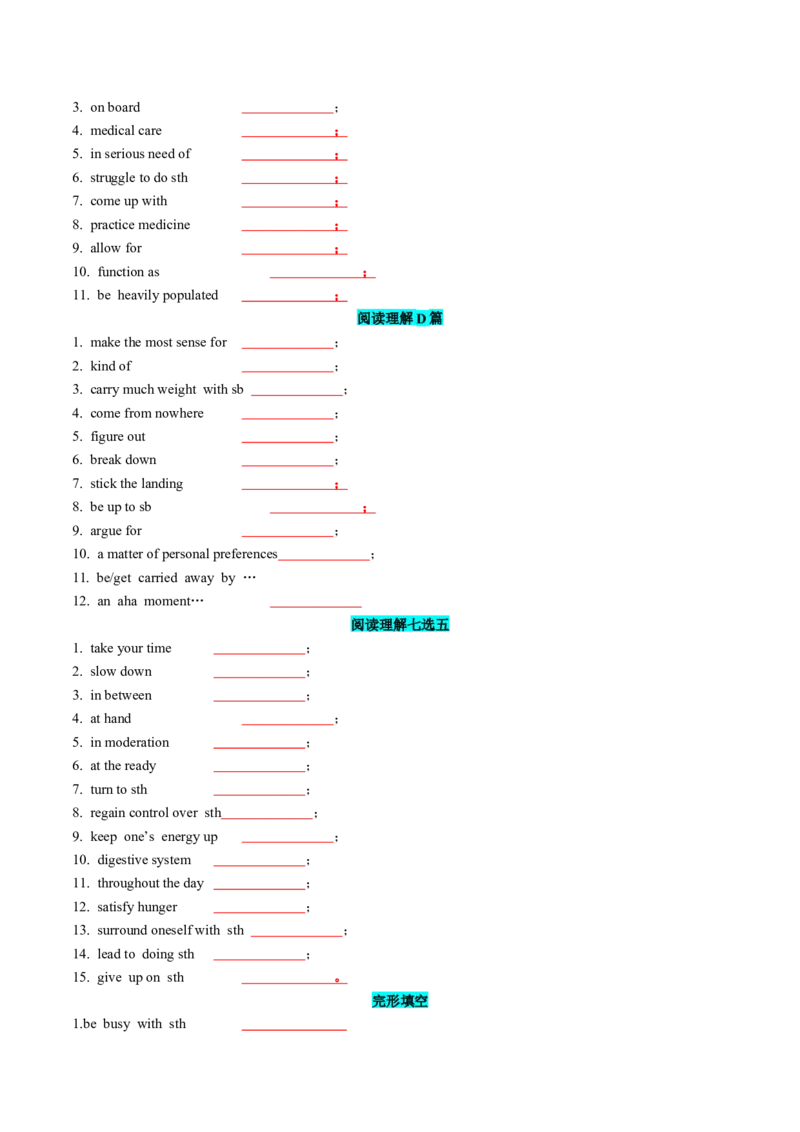
1. the sick ;
2. provide sb with sth ;3. on board ;
4. medical care ;
5. in serious need of ;
6. struggle to do sth ;
7. come up with ;
8. practice medicine ;
9. allow for ;
10. function as ;
11. be heavily populated ;
阅读理解D篇
1. make the most sense for ;
2. kind of ;
3. carry much weight with sb ;
4. come from nowhere ;
5. figure out ;
6. break down ;
7. stick the landing ;
8. be up to sb ;
9. argue for ;
10. a matter of personal preferences ;
11. be/get carried away by …
12. an aha moment…
阅读理解七选五
1. take your time ;
2. slow down ;
3. in between ;
4. at hand ;
5. in moderation ;
6. at the ready ;
7. turn to sth ;
8. regain control over sth ;
9. keep one’s energy up ;
10. digestive system ;
11. throughout the day ;
12. satisfy hunger ;
13. surround oneself with sth ;
14. lead to doing sth ;
15. give up on sth 。
完形填空
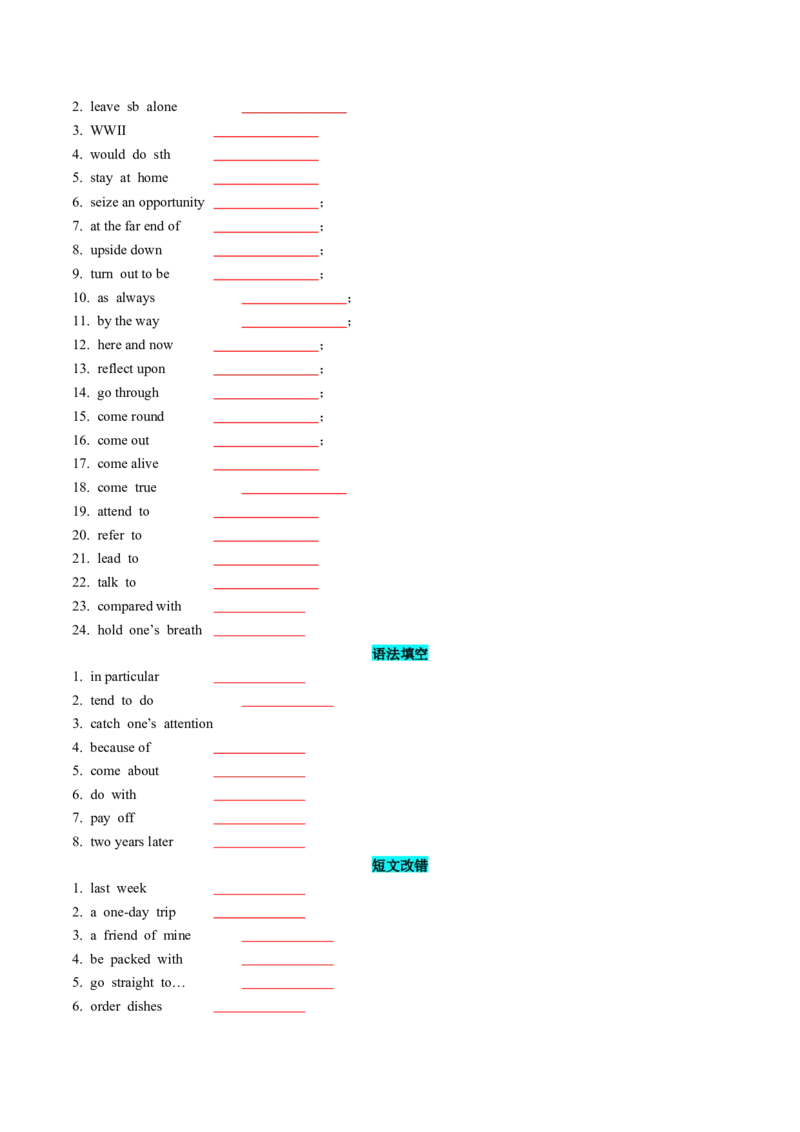
1.be busy with sth2. leave sb alone
3. WWII
4. would do sth
5. stay at home
6. seize an opportunity ;
7. at the far end of ;
8. upside down ;
9. turn out to be ;
10. as always ;
11. by the way ;
12. here and now ;
13. reflect upon ;
14. go through ;
15. come round ;
16. come out ;
17. come alive
18. come true
19. attend to
20. refer to
21. lead to
22. talk to
23. compared with
24. hold one’s breath
语法填空
1. in particular
2. tend to do
3. catch one’s attention
4. because of
5. come about
6. do with
7. pay off
8. two years later
短文改错
1. last week
2. a one-day trip
3. a friend of mine
4. be packed with
5. go straight to…
6. order dishes7. taste great
8. be meant for…
第四部分:阅读真理题解语A篇料单句填空100例
1. Each ARTS FIRST festival is __________ unique annual __________(celebrate) of the Harvard community's
__________(artist) creativity.
2. We invite you __________(join) us for the coming ARTS FIRST.
3. We look forward to __________(welcome) you as we showcase the __________(creative) of the Harvard arts
community through __________(performance), art exhibitions and art-making activities.
4. The festival is a public event for Harvard and community members of all __________(age).
5. Learn about the materials and qualities of watercolor paint with __________(expert) from the Harvard Art
Museums Materials Lab.
6. Try your hand at some of the painting tricks __________(use) by artists __________ works will be in the
upcoming exhibition of American Watercolors 1880-1990: Into the Light.
7. From webs to cocoons, invertebrates (无脊椎动物) create some of __________(nature) most delicate and
beautiful designs.
8. Join Javier Marin from the Harvard Museum of Natural History to learn how insects and other invertebrates
dance, inspire fashion __________ create art, while __________(make) your own spineless artists out of craft
(手工艺) materials.
9. Join instructors from the Ceramics Program and great __________(potter) from Quincy, Cabot and Mather
Houses for demonstrations __________(use) the potter's wheel. Then create your own masterpiece!
10. Join the Harvard Undergraduate Knitting Circle __________(make) pom-poms and tassels out of thread, or
pick up a pair of needles and learn to knit (编织).
阅读理解B篇
1. Animals can express their needs ___________(use) a lot of ways.
2. ___________ instance, almost all animals have distinct vocals (声音) ___________ they rely on to either ask
for help, scare away any ___________(danger) animals ___________ look for shelter.
3. But cats are special creatures who possess ___________(amaze) vocalization skills.
4. They are able to have entire conversations with ___________(human) using meows and you're able to interpret
it.
5. If a pet cat is hungry, it will keep meowing ___________(attract) attention and find food.
6. However, when a cat is looking ___________ affection, they tend ___________(produce) stretched and soft
meows.
7. Meowing starts as soon as a baby cat ___________(bring) to life and uses it to get the mother's attention and
___________(feed).
8. Cats have many heightened senses, but their sense of smell is quite___________(impress) .
9. They use their noses___________(assess) their environment and look out ___________for any signs of danger.10. They will sniff out specific areas before they choose a place ___________(relax).
11. However, ___________ way the cats are able to distinguish between situations is by looking for familiar
smells.
12. Your cat will likely smell your face and store the smell in ___________(it) memory and use it
___________(recognize) you in the future.
13. That's ___________ most pet cats are able to tell immediately if their owners were around any other cats,
___________ they don't usually like.
14. Dogs are known ___________ their impressive fetching habit, but cats take this behavior up a notch.
15. Many cats will find random objects outside and bring___________(they) to their owners.
16. This is a very old habit___________ has been present in all kinds of predators (食肉动物). Cats bring gifts for
their owners___________(show) to show they love you.
17. These ___________(adore) little hunters are just doing something that it ___________(be) in their nature
since the beginning of time. So just go along with it!
阅读理解C篇
1. The Saint Lukas train doesn’t accept passengers—it accepts only _________ sick.
2. The Saint Lukas is one of five government-sponsored medical trains ________ travel to remote towns in
_________(centre) and eastern Russia.
3. Each stop lasts _________ average of two days, and during that time the doctors and nurses _________ board
provide rural (乡村) populations _________ basic medical care, X-ray scans and prescriptions.
4. “People started queuing to make an _________(appoint) early in the morning,” says Emile Ducke, a German
_________(photograph) who traveled with the staff of the Saint Lukas for a two-week trip in November through
the vast regions (区域) of Krasnoyarsk and Khakassia.
5. Russia’s public health care service has been in serious need of _________(modern).
6. The government has struggled to come up with measures _________(address) the problem, particularly in the
poorer, rural areas east of the Volga River, including _________(arrange) doctor’s appointments by video chat and
expanding _________(finance) aid programs to motivate doctors _________(practice) medicine in remote parts
of the country like Krasnoyarsk.
7. The annual _________(arrive) of the Saint Lukas is another attempt _________(improve) the situation.
8. For 10 months every year, the train _________(stop) at about eight stations over two weeks, before returning to
the _________(region) capital to refuel and restock(补给).
9. Then it _________(start) all over again the next month. Most stations wait about a year between visits.
10. Doctors see up to 150 patients every day. The train’s _________(equip) allows _________ basic checkups.
11. “I was very impressed by the doctors and their assistants _________(work) and living in such little space but
still staying _________(focus) and very concerned,” says Ducke. “They were the best chance for many rural
people _________(get) the treatment they want. ”
阅读理解D篇
1. “I didn’t like the ending,” I said to my __________(favor) college professor.
2. It was my junior year of undergraduate, and I was doing an __________(dependent) study on Victorianliterature.
3. I had just finished __________(read) The Mill on the Floss by George Eliot, and I was heartbroken with the
ending.
4. Prof. Gracie, with all his __________(patient), asked me to think about it beyond __________ I liked it or not.
5. He suggested I __________(think) about the difference between endings that I wanted for the characters and
endings that were right for the characters, endings that __________(satisfy) the story even if they didn’t have a
__________(traditional) positive outcome.
6. Of course, I would __________(prefer) a different ending for Tom and Maggie Tulliver, but the ending they
got did make the most sense for them.
7. This was __________ aha moment for me, and I never thought about endings __________ same way again.
8. From then on, if I wanted to read an ending __________(guarantee) to be happy, I’d pick up a love romance.
9. If I wanted an ending I couldn’t guess, I’d pick __________ a mystery (悬疑小说).
10. One where I kind of knew what was going to happen, __________(history) fiction. Choosing __________ to
read became easier.
11. But writing the end—that’s hard. It’s hard for writers because endings carry so much __________(weigh)
with readers.
12. You have to balance creating an ending that's __________(predictable), but doesn’t seem to come from
__________, one that fits what’s right for the characters.
13. That’s __________ this issue (期) of Writer’s Digest aims to help you figure out how to write the best ending
for whatever kind of writing you’re doing.
14. If it’s short stories, Peter Mountford breaks __________ six techniques you can try to see __________ one
helps you stick the landing.
15. Elizabeth Sims analyzes the final chapters of five great novels __________(see) what key points they include
and how you can adapt them for your work.
16. This issue won’t tell you what your ending should be—that’s up to you and the story you’re telling—but it
might provide __________ you need to get there.
阅读理解七选五
1. What is moderation (适度)? __________(basic), it means __________(eat) only as much food as your body
needs.
2. You should feel __________(satisfy) at the end of a meal, but not too full.
3. For many of us, moderation means eating __________(little) than we do now.
4. But it doesn't mean __________(say) saying goodbye to the foods you love.
5. Take your time. It's important __________(slow) down and think about food as something
__________(nutrition) rather than just something __________(eat) in between meetings.
6. Don't swallow a meal __________ the way to work. __________ actually takes a few minutes for your brain
to tell your body that it has had enough food, so eat slowly and stop__________(eat) before you feel full.
7. Eat with others whenever possible. Eating alone, “specially in front of the TV or computer, often
__________(lead) to __________(mind) overeating.8. And be careful about the foods you keep __________ hand.
9. It's more challenging to eat in moderation if you have__________(healthy) snacks at the ready, like cookies.
Instead, surround yourself __________ healthy choices.
10. Control emotional (情绪的) eating. We don't always eat just__________(satisfy) hunger.
11. Many of us also turn __________ food to deal with __________(pleasant) emotions such as sadness,
loneliness, or __________(bore).
12. But by learning healthier ways __________(manage) emotions, you can regain control __________ the food
you eat and your feelings.
13. Eat __________(proper) throughout the day. A healthy breakfast can start your metabolism (新陈代谢),
while __________(eat) small, healthy meals keeps your energy up all day.
14. Avoid eating late at night. Try to eat dinner __________(early) and fast for 14-16 hours until breakfast the
next morning.
15. Studies suggest that eating only when you're most active __________ giving your digestive system a long
break each day may help to regulate weight.
完形填空
1. One day, we had a family dinner. While the adults were busy ___________ their serious talk outside, I
___________(leave) alone in the kitchen to help my grandmother wash dishes.
2. As always my grandmother ___________(tell) me stories about her childhood.
3. Born just before WWII, my grandmother experienced an ___________(entire) different childhood lifestyle
from mine. She did not have a chance ___________(go) to school.
4. Like in typical families, ___________ boys were favored much more ___________ girls, my grandma had to
stay at home to do housework.
5. The only opportunity (机会) she could seize to study was ___________ her brother was having Chinese
lessons with the family tutor.
6.She would sit ___________(quiet) at the far end of the long dinner table, listening ___________(close).
7. This training taught her to read and write her Chinese upside down — a skill ___________ has turned out to be
quite ___________(practical), especially whenever we share the newspaper.
8. On most weekends, my grandmother, a young girl then, and her brother ___________(go) to the beach. There,
they would walk through deep water, sit down cross-legged underwater and hold their ___________breath while
they watched all action going on around them.
9. This is something I admire— her ability ___________(open) her mouth underwater and still sit
___________(comfortable) on the seabed.
10. My childhood is quite happy ___________(compare) with hers. I am grateful that I did not need to go
through the hardships like she did. I've never faced the problem of education.
11. I guess our different childhood background is ___________ makes my grandmother such an
___________(amaze) person to talk ___________: her stories always make my history textbooks come alive.
语法填空
1. Although parks of all sizes and types exist at any level, the national parks, in particular, tend__________ (catch) our attention because of their large size and variety.
2. They are __________ (treasure) of American heritage (遗产). How did the national park system come
__________?
3. On a cool, starry night in mid-September 1870, four men relaxed before a campfire along the Firehole River in
__________is now northwestern Wyoming.
4. They __________ (be) part of a 15-member exploring party that had spent almost five awesome weeks in
witness of the natural beauties there.
5. What should __________ (do) with such a beautiful place? They wondered out loud.
6. This area, with __________ (it) unique and breathtaking natural beauty, must be well preserved __________
all people of the nation to enjoy - as a national park.
7. They all agreed and vowed (承诺) to promote the idea at the __________ (complete) of their journey. Their
promotional work paid off.
8. Two years __________, 18 years before Wyoming became a state, Yellowstone became the first national park
in the United States and the world.
9. Yellowstone was the __________ (large) United States national park - 2.2 million acres - __________
Wrangell-Saint Elias in southern Alaska, __________ a national monument in 1978, took the honors as a national
park in 1980 with 12.3 million acres.
短文改错
1. Last week, I _________(see) a program about Chongqing hotpot on TV.
2. I was curious and ___________(plan) a special one-day trip there with a friend of ___________(I).
3. Our fast train ___________(pack) with passengers. ___________ attendant gave us some travel brochures
about Chongqing.
4. When we arrived, we went straight ___________ a famous restaurant and ordered dishes, ___________ tasted
great. The atmosphere there made the meal all the more ___________(enjoy).
5. Hotpot is meant ___________ families and friends to sit together, dip everything ___________they like in one
pot, and share ___________(friend) and love.
书面表达
1. From the vehicle of horses to ___________(today) convenient transport, Chinese transport has seen enormous
development. Chinese transport has undergone ___________(remark) transformations, giving the Chinese people
access ___________ different ways of travelling.
2. Firstly, ___________(share) bicycles have emerged as a symbol of urban ___________(mobile), offering an
___________(afford) and green alternative for short trips.
3. Secondly, the ___________(introduce) of high-speed trains has ___________(dramatic) shortened travel
times, making intercity travel ___________(fast) and more comfortable.
4. Lastly, the proliferation of new energy vehicles underscores China’s ___________(dedicate) to environmental
sustainability, reducing ___________(rely) on fossil fuels.
5. These developments illustrate China’s journey towards a modern and efficient transportation network that
___________(balance) convenience with environmental ___________(responsible).6. In short, China’s transport system is embracing ___________(innovate) and eco-friendliness.