





文档内容
单元提升卷 04 Unit 4 Body Language
单元基础知识巩固
Ⅰ. 核心单词
1. ________________________ vi. (根据情况)变化; 改变
2. ________________________ adj. 合适的; 恰当的
3. ________________________ vi. 赞成; 同意vt. 批准; 通过
4. ________________________ vt. 表现; 表达; 说明; 证明
5. ________________________ vt. 当场看到; 目击; 见证n. 目击者; 证人
6. ________________________ n. 隔阂; 障碍
7. ________________________ adj. 可靠的; 可信赖的
8. ________________________ vt. 揭示; 显示; 露出
9. ________________________ vt. 占据; 占用
10. ________________________ vt. 调整; 调节vi. &vt. 适应; (使)习惯
Ⅱ. 拓展单词
1. anxious adj. 焦虑的; 不安的; 渴望的→________________________ n. 焦虑; 担心; 害怕
2. employ vt. 使用, 应用, 雇用→____________________ n. 雇主→________________________ n. 雇员
3. differ vi. 不同于; 相异→_____________________ n. 不同之处→_____________________ adj. 不同的
4. assess vt. 评估; 评价→________________________ n. 评价; 评定
5. favour vt. 较喜欢; 选择; 有利于 n. 恩惠, 帮助, 赞同→________________________ adj. 赞同的
→________________________ adj. & n. 特别喜爱的(东西)
6. clarify vt. 使更清晰易懂; 阐明; 澄清→________________________ n. 澄清; 解释
7. educate v. 教育→ ________________________ n. 教师; 教育工作者; 教育家
→________________________ n. 教育
8. tend vi. 趋向→________________________ n. 趋势; 倾向
9. embarrass vt. 使尴尬→________________________ adj. 尴尬的; 难堪的
10. slight adj. 轻微的; 略微的; 细小的→ ________________________ adv. 略微; 稍微
III.核心短语
1. ________________________ 相比之下
2. ________________________ (与……)相比较
3. ________________________ 推理; 推断
4. ________________________ 消除; 分解; 打破5. ________________________ 直起来; 整理; 收拾整齐
6. ________________________ 换句话说; 也就是说
7. ________________________ (短暂地)访问; 要求(某人讲话等); 正式邀请
8. ________________________ 有某种影响; 在工作
9. ________________________ 因……而感到羞愧
10. ________________________ (在某事上)与某人相冲突/有争执/不一致
一、单句语法填空
1.She received many (approve) glances.
2.For (vary) of reasons, I am afraid I can’t adopt your advice.
3.His anxiety (succeed) made him study harder than before.
4.With the help of my teacher , I got used to (revise) for the exam.
5.The invitations are almost ready. I just need to make a couple of (adjust).
6.There is a growing (tend) for mothers these days to stay at home to look after their children.
7.It turned out that his proposal received a generally favourable (react).
8.If two people are (embarrass), their conversation can be slow and awkward.
9.By (compare), in Bulgaria and southern Albania, the gestures have the opposite meaning.
10.In Japan, it may demonstrate respect to look down when (talk) to an older person.
11.In many Middle Eastern countries, men and women are not (social) permitted to make eye contact.
12.I sincerely hope my suggestion will meet with your (approve).
13.Although they differ each other in many ways, they have been friends for many years.
14.Much to my , the question he asked me was too . I felt so that my face was red.
(embarrass)
15.Advertising is distinguished other forms of communication in that the advertiser pays for the
message to be delivered.
16.We need not feel (shame) of our failure. We may face it realistically and accept it optimistically.
17.You should learn to say to yourself, “This is (mere) uncomfortable, not intolerable.”
18.The questionnaire takes ten to fifteen minutes to complete and can be used along with the
(assess) interview.
19.Anger is a particularly strong feeling and maybe people think that they have reasons to feel
(anger).
20.I had forgotten all about it because I had been so (occupy) with other things.
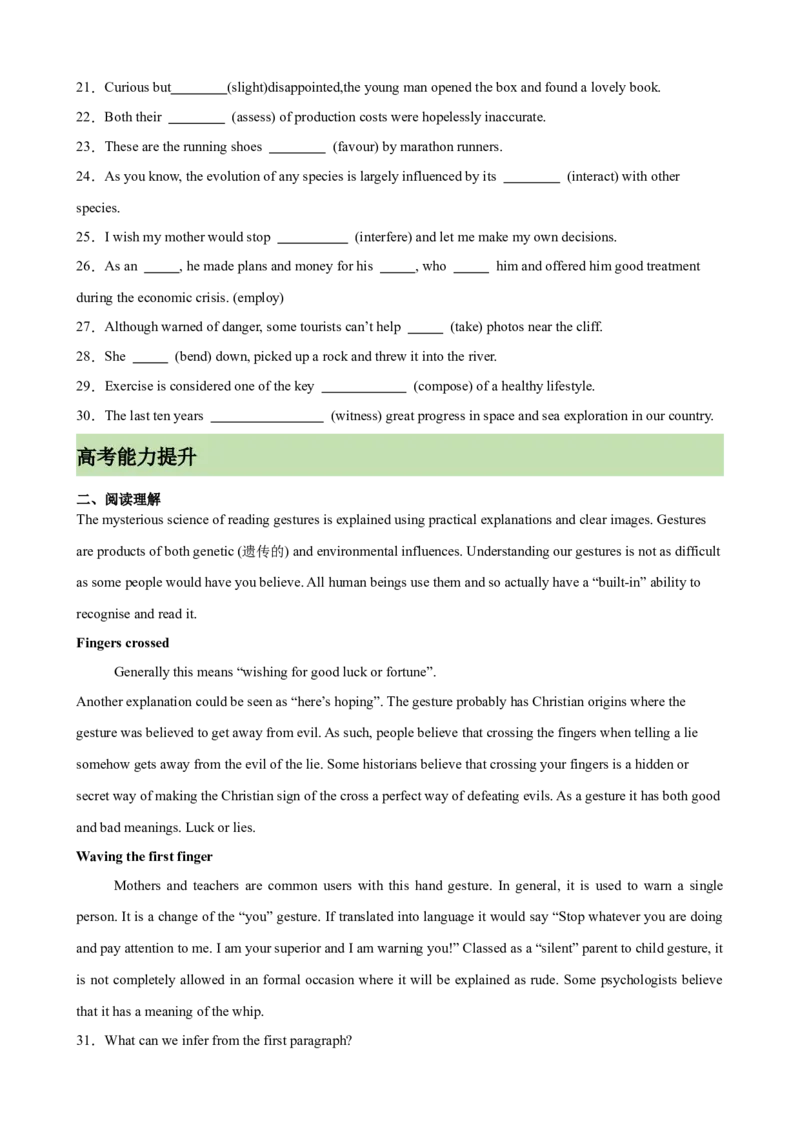
答案第2页,共2页21.Curious but (slight)disappointed,the young man opened the box and found a lovely book.
22.Both their (assess) of production costs were hopelessly inaccurate.
23.These are the running shoes (favour) by marathon runners.
24.As you know, the evolution of any species is largely influenced by its (interact) with other
species.
25.I wish my mother would stop (interfere) and let me make my own decisions.
26.As an , he made plans and money for his , who him and offered him good treatment
during the economic crisis. (employ)
27.Although warned of danger, some tourists can’t help (take) photos near the cliff.
28.She (bend) down, picked up a rock and threw it into the river.
29.Exercise is considered one of the key (compose) of a healthy lifestyle.
30.The last ten years (witness) great progress in space and sea exploration in our country.
高考能力提升
二、阅读理解
The mysterious science of reading gestures is explained using practical explanations and clear images. Gestures
are products of both genetic (遗传的) and environmental influences. Understanding our gestures is not as difficult
as some people would have you believe. All human beings use them and so actually have a “built-in” ability to
recognise and read it.
Fingers crossed
Generally this means “wishing for good luck or fortune”.
Another explanation could be seen as “here’s hoping”. The gesture probably has Christian origins where the
gesture was believed to get away from evil. As such, people believe that crossing the fingers when telling a lie
somehow gets away from the evil of the lie. Some historians believe that crossing your fingers is a hidden or
secret way of making the Christian sign of the cross a perfect way of defeating evils. As a gesture it has both good
and bad meanings. Luck or lies.
Waving the first finger
Mothers and teachers are common users with this hand gesture. In general, it is used to warn a single
person. It is a change of the “you” gesture. If translated into language it would say “Stop whatever you are doing
and pay attention to me. I am your superior and I am warning you!” Classed as a “silent” parent to child gesture, it
is not completely allowed in an formal occasion where it will be explained as rude. Some psychologists believe
that it has a meaning of the whip.
31.What can we infer from the first paragraph?A.Reading gestures is secret. B.Gestures are formed in daily life.
C.Some people make reading gestures difficult on purpose. D.It is hard to explain gestures by images.
32.If a Christian crosses his fingers, he wants to .
A.show he isn’t lucky B.wish to succeed
C.gets away from the evil of the lie D.cross the street
33.If your mum waves her first finger, she wants to .
A.wish for good luck B.stop you
C.praise you D.help you
Ross Griffiths woke up one morning only to find himself unable to speak.This five-year-old boy was only
two weeks ago diagnosed (诊断) with a condition so unusual that it hasn’t been named and is instead known as
15q11.2.
Ross Griffiths has struggled to get back his communication skills, but has always been too shy to use his
sign language away from home and school. But after seeing a video of Middlesbrough’s Cleveland Centre Father
Christmas signing with three-year-old Mali Williams, Ross told his mum that he wanted to sign with Father
Christmas, too.
Ross and his family went to see Father Christmas yesterday, along with Mali, who was invited back for a
second visit.Father Christmas set up the special second meeting with Mali where he gave her a lovely doll.
As crowds of children and parents awaited the arrival of the big man at the shopping centre, Father
Christmas took some time out before his duties to meet again with Mali and with Ross before going on to see all
the other children.
Ross’s mum Becky Lane hoped that a visit to the special Father Christmas would help Ross get over his
shyness. The Father Christmas everyone believes in even learned Makaton specially for his meeting with Ross, as
this is the communication method the young boy uses.
“He was too frightened to use his sign language outside the house, but when he saw the video of the girl
signing with Father Christmas, it showed him he didn’t have to be shy. He did really well. And he got a PacMan
game as a gift. Now he’s not a shy boy any more,” Becky said.
34.According to the text, we can learn that Ross Griffiths ________.
A.caught a deadly disease
B.was afraid of communicating with strangers
答案第4页,共2页C.found it hard to learn sign language
D.dreamed of becoming a Father Christmas
35.Seeing the video, Ross might feel ________.
A.proud B.angry C.calm D.excited
36.What does the underlined word “Makaton” most probably refer to?
A.A form of signing. B.A foreign language.
C.A Christmas song. D.A kind of dance.
37.After meeting Father Christmas, we can learn that Ross ________.
A.knew how to shop wisely B.wanted to go to school again
C.rebuilt confidence in himself D.could speak like normal people
三、完形填空
When we communicate with other people, we often use not only words but also body language. Body
language is the quiet, secret and most powerful language of all! It speaks 38 than words. According to
specialists, our bodies send out more messages than we realize. In fact, nonverbal communication takes up about
50% of what we really 39 . And body language is particularly 40 when we attempt to
communicate across cultures. Indeed, what is called body language is so 41 a part of us that it’s actually
often unnoticed. And misunderstandings occur as a result of it. For example, different societies treat the 42
between people differently. Northern Europeans usually do not like having bodily contact even with friends, and
certainly not with 43 . People from Latin American countries, 44 , touch each other quite a lot.
Therefore, it’s possible that in conversation, it may look like a Latino is 45 a Norwegian all over the room.
The Latino, trying to express friendship, will keep moving 46 . The Norwegian, very probably seeing this
as pushiness, will keep 47 — which the Latino will in return regard as 48 .
Clearly, a great deal is going on when people 49 . And only a part of it is in the words themselves.
And when parties are from different cultures, there’s a strong possibility of 50 . But whatever the
situation is, the best 51 is to obey the Golden Rule: treat others as you would like to be 52 .
38.A.straighter B.louder C.harder D.further
39.A.hope B.receive C.discover D.mean
40.A.immediate B.misleading C.important D.difficult
41.A.well B.far C.much D.long
42.A.trade B.distance C.connections D.greetings
43.A.strangers B.relatives C.neighbours D.enemies44.A.in other words B.on the other hand C.in a similar way D.by all means
45.A.disturbing B.helping C.guiding D.following
46.A.closer B.faster C.in D.away
47.A.stepping forward B.going on C.backing away D.coming out
48.A.weakness B.carelessness C.friendliness D.coldness
49.A.talk B.travel C.laugh D.think
50.A.curiosity B.excitement C.misunderstanding D.nervousness
51.A.chance B.time C.result D.advice
52.A.noticed B.treated C.respected D.pleased
阅读下面短文,在空白处填入1个适当的单词或括号内单词的正确形式。
We use both words and body language to express 53 (we) thoughts and opinions in interactions
with other people. Just like spoken language, body language 54 (vary) from culture to culture. For
example, making eye contact — looking into someone’s eyes — in some countries is a way 55 (display)
interest. In other countries, eye contact is not always approved 56 . For example, in many Middle Eastern
countries, men and women are not 57 (social) permitted to make eye contact. In Japan, it may
demonstrate respect to look down when talking to 58 old. The gesture for “OK” has different 59
(meaning) in different cultures. In Japan, someone 60 witnesses another person employing the gesture
might think it means money. However, you should avoid making this gesture in Brazil and Germany. Even the
gestures we use for “yes” and “no” differ around the world. In many countries, 61 (shake) one’s head
means “no”, and nodding means “yes”. By 62 (compare), in Bulgaria and southern Albania, the
gestures have the opposite meaning.
四、书面表达
63.根据提示,写一篇80词左右的短文。
人们通常使用口头语言进行交流,但是在日常生活中,人们也会广泛地使用肢体语言。你认为肢体语言
重要吗?
常生活中你会使用它与其他人进行交流吗?
1.肢体语言贯穿人类历史,人们都会使用肢体语言进行交流。肢体语言像口头语言一样重要。
2.当你的朋友伤心的时候,一个微笑或许比语言更有用。
3.在嘈杂的环境中,使用肢体语言去交流会更加容易。
答案第6页,共2页___________________________________________________________________________________________
___________________________________________________________________________________________
___________________________________________________________________________________________
___________________________________________________________________________________________
_________________________________________________________________________________________
64.阅读下面材料,根据其内容和所给段落开头语续写两段,使之构成一篇完整的短文。
“Not fair.” Wendi was rather angry. “You promised we could go to the climbing park.”
“But, it is going to rain, and the climbing park is outdoors.” Mum shook her head.
Wendi looked out of the window. “But it isn’t raining, just clouds.”
“The weather lady says so, and she knows, rain in the afternoon,” Mum said.
“The weather lady must get it wrong,” Wendi complained in a low voice, but suddenly, the rain started. “Oh.”
Wendi was surprised, looking up at the sky.
“We’ll go to the climbing park another day.” Mum watched the rain.
“How does the weather lady know about the weather?” Wendi asked.
“Well, she has got a weather station, I think.” Mum was not sure.
“Grandpa might know. I’ll ask him tomorrow,” Wendi said.
“We can build a little weather station in the garden if you like, Wendi,” Grandpa explained. “You’ll need a
wind vane (风向标) to see how the wind is blowing, and we can make it by ourselves. And we also need to
prepare a rain gauge (雨量计) to measure how much rain has fallen. And, I’ve got a good thermometer (温度计)
for outdoors.”
“A thermometer ... what is that?” Wendi asked.
Grandpa laughed. “A thermometer measures the temperature.”
“Thermometer.” Wendi was pleased with her new word.
“And last of all, we need a barometer (气压计). That’s a big word, too, Wendi,” Grandpa explained. “A
barometer tells us what the air pressure is. I’ve got one, too.”
“But what is air pressure?” Wendi asked.
“Well, if the air pressure changes, the weather will change,” Grandpa answered.
When everything was ready, Grandpa and Wendi got down to business, and soon a little garden weather
station came into being.
Grandpa gave Wendi a list and said, “You have to keep a list of all the wind, rain and temperature changes.
That’s when you’ll see how the weather is changing. And then you really will be a weathergirl.”
Rainy, Windy, Sunny, Snowy, Hot, Cold, Cloudy, Stormy, Very Windy ... Wendi painted many cards for allthe things a weathergirl has to say.
Hearing the news, all Wendi’s friends visited her garden weather station.
注意:1. 续写词数应为150左右;
2. 请按如下格式在相应位置作答。
Wendi was a very good weathergirl until one icy cold winter day.
___________________________________________________________________________________________
___________________________________________________________________________________________
___________________________________________________________________________________________
___________________________________________________________________________________________
_______________________________
After seeing this, Grandpa said to Wendi, “No weathergirl is always right, but it will snow soon, I am sure.”
___________________________________________________________________________________________
___________________________________________________________________________________________
___________________________________________________________________________________________
___________________________________________________________________________________________
_______________________________
答案第8页,共2页