必修三 Unit 3 Diverse Cultures
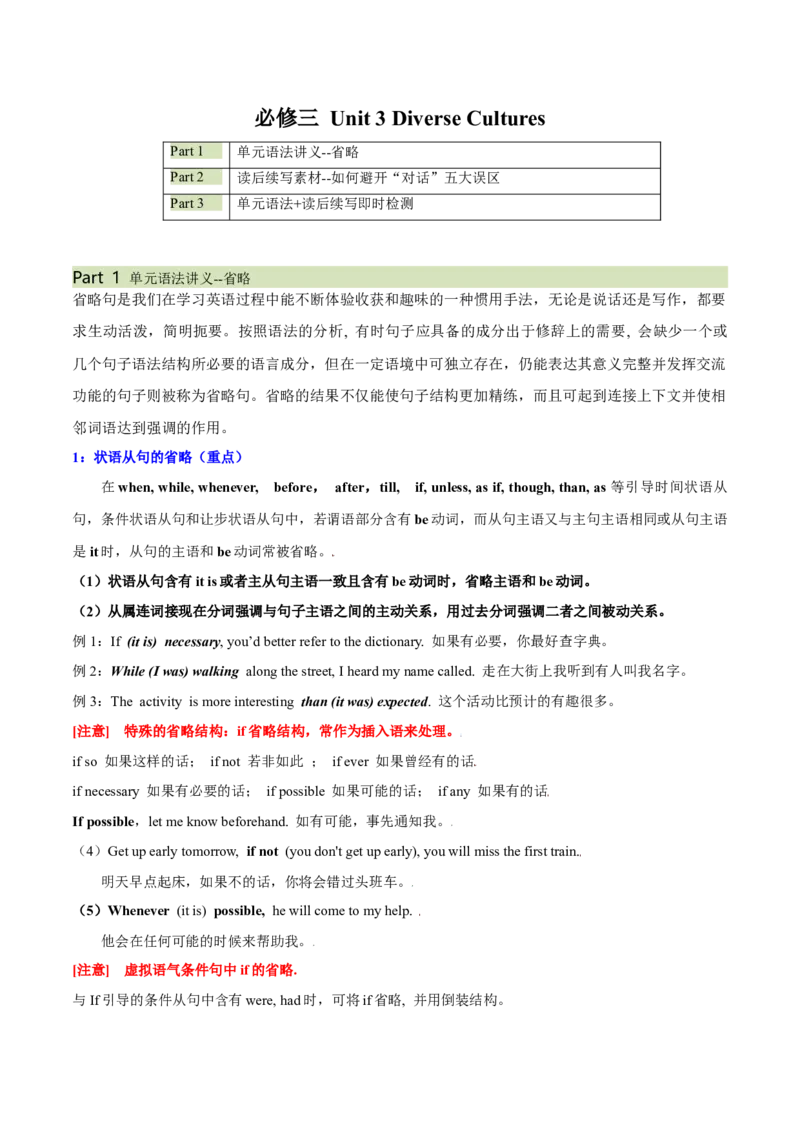
Part 1 单元语法讲义--省略
Part 2 读后续写素材--如何避开“对话”五大误区
Part 3 单元语法+读后续写即时检测
Part 1 单元语法讲义--省略
省略句是我们在学习英语过程中能不断体验收获和趣味的一种惯用手法,无论是说话还是写作,都要
求生动活泼,简明扼要。按照语法的分析, 有时句子应具备的成分出于修辞上的需要, 会缺少一个或
几个句子语法结构所必要的语言成分,但在一定语境中可独立存在,仍能表达其意义完整并发挥交流
功能的句子则被称为省略句。省略的结果不仅能使句子结构更加精练,而且可起到连接上下文并使相
邻词语达到强调的作用。
1:状语从句的省略(重点)
在when, while, whenever, before, after,till, if, unless, as if, though, than, as等引导时间状语从
句,条件状语从句和让步状语从句中,若谓语部分含有be动词,而从句主语又与主句主语相同或从句主语
是it时,从句的主语和be动词常被省略。
(1)状语从句含有it is或者主从句主语一致且含有be动词时,省略主语和be动词。
(2)从属连词接现在分词强调与句子主语之间的主动关系,用过去分词强调二者之间被动关系。
例1:If (it is) necessary, you’d better refer to the dictionary. 如果有必要,你最好查字典。
例2:While (I was) walking along the street, I heard my name called. 走在大街上我听到有人叫我名字。
例3:The activity is more interesting than (it was) expected. 这个活动比预计的有趣很多。
[注意] 特殊的省略结构:if省略结构,常作为插入语来处理。
if so 如果这样的话; if not 若非如此 ; if ever 如果曾经有的话
if necessary 如果有必要的话; if possible 如果可能的话; if any 如果有的话
If possible,let me know beforehand. 如有可能,事先通知我。
(4)Get up early tomorrow, if not (you don't get up early), you will miss the first train.
明天早点起床,如果不的话,你将会错过头班车。
(5)Whenever (it is) possible, he will come to my help.
他会在任何可能的时候来帮助我。
[注意] 虚拟语气条件句中if的省略.
与If引导的条件从句中含有were, had时,可将if省略, 并用倒装结构。Were I you , I wouldn’t go with him.
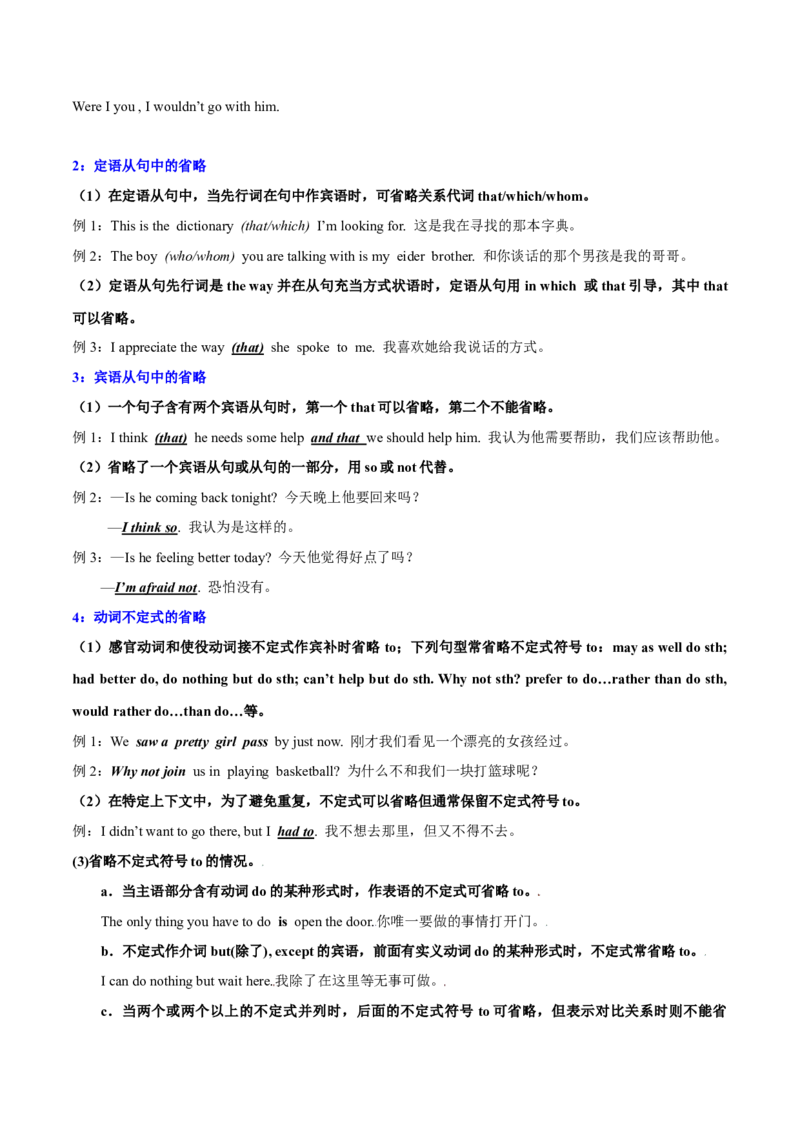
2:定语从句中的省略
(1)在定语从句中,当先行词在句中作宾语时,可省略关系代词that/which/whom。
例1:This is the dictionary (that/which) I’m looking for. 这是我在寻找的那本字典。
例2:The boy (who/whom) you are talking with is my eider brother. 和你谈话的那个男孩是我的哥哥。
(2)定语从句先行词是the way并在从句充当方式状语时,定语从句用in which 或that引导,其中that
可以省略。
例3:I appreciate the way (that) she spoke to me. 我喜欢她给我说话的方式。
3:宾语从句中的省略
(1)一个句子含有两个宾语从句时,第一个that可以省略,第二个不能省略。
例1:I think (that) he needs some help and that we should help him. 我认为他需要帮助,我们应该帮助他。
(2)省略了一个宾语从句或从句的一部分,用so或not代替。
例2:—Is he coming back tonight? 今天晚上他要回来吗?
—I think so. 我认为是这样的。
例3:—Is he feeling better today? 今天他觉得好点了吗?
—I’m afraid not. 恐怕没有。
4:动词不定式的省略
(1)感官动词和使役动词接不定式作宾补时省略 to;下列句型常省略不定式符号to:may as well do sth;
had better do, do nothing but do sth; can’t help but do sth. Why not sth? prefer to do…rather than do sth,
would rather do…than do…等。
例1:We saw a pretty girl pass by just now. 刚才我们看见一个漂亮的女孩经过。
例2:Why not join us in playing basketball? 为什么不和我们一块打篮球呢?
(2)在特定上下文中,为了避免重复,不定式可以省略但通常保留不定式符号to。
例:I didn’t want to go there, but I had to. 我不想去那里,但又不得不去。
(3)省略不定式符号to的情况。
a.当主语部分含有动词do的某种形式时,作表语的不定式可省略to。
The only thing you have to do is open the door.你唯一要做的事情打开门。
b.不定式作介词but(除了), except的宾语,前面有实义动词do的某种形式时,不定式常省略to。
I can do nothing but wait here.我除了在这里等无事可做。
c.当两个或两个以上的不定式并列时,后面的不定式符号 to可省略,但表示对比关系时则不能省略。
I'm really puzzled what to think of and express.我真的不知道想什么和表达什么。
It is easier to make a plan than to carry it out.制订计划比执行计划容易。
[名师点睛] 省略句中to的遗漏
【误】She was reading in bed, and her mother told her not.
【正】She was reading in bed, and her mother told her not to.
[分析] 动词不定式在 like, love, care, want, hope, wish, expect, prefer, refuse, decide, mean, intend, try,
promise等动词后作宾语时,为了避免重复,常常省略不定式后的内容,但要保留不定式符号to。
d.在see, watch, hear, feel, observe, notice, look at, listen to等感官动词及使役动词let, make, have后
作宾语补足语的不定式不加to,但当宾语补足语变为主语补足语时,不定式要加上to。
She saw him walk into the house.她看到他走进了那座房子。
He was seen to walk into the house.有人看到他走进了那座房子。
He had two boys wash his car.他让两个男孩给他洗车。
e.you'd better/why not后跟不带to的不定式。
Why not try it again?为什么不再试试?
注意:do what we can to do... 全力以赴去做...
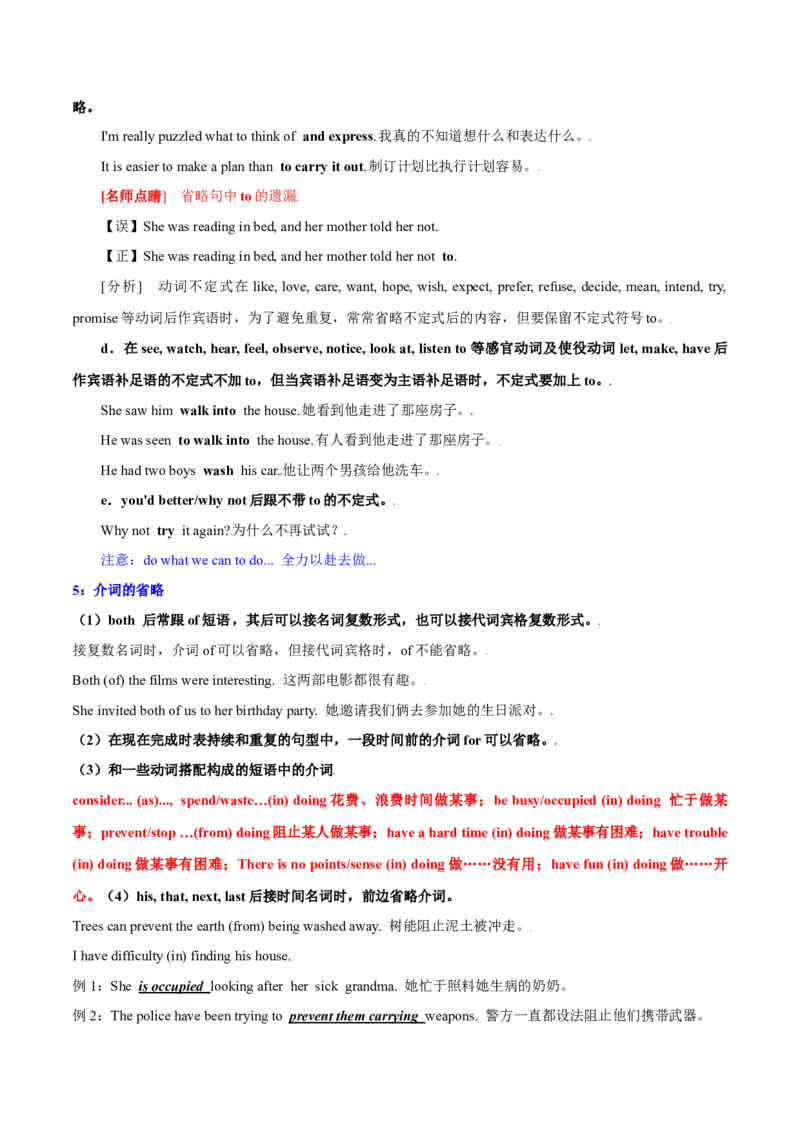
5:介词的省略
(1)both 后常跟of短语,其后可以接名词复数形式,也可以接代词宾格复数形式。
接复数名词时,介词of可以省略,但接代词宾格时,of不能省略。
Both (of) the films were interesting. 这两部电影都很有趣。
She invited both of us to her birthday party. 她邀请我们俩去参加她的生日派对。
(2)在现在完成时表持续和重复的句型中,一段时间前的介词for可以省略。
(3)和一些动词搭配构成的短语中的介词
consider... (as)..., spend/waste…(in) doing花费、浪费时间做某事;be busy/occupied (in) doing 忙于做某
事;prevent/stop …(from) doing阻止某人做某事;have a hard time (in) doing做某事有困难;have trouble
(in) doing做某事有困难;There is no points/sense (in) doing做……没有用;have fun (in) doing做……开
心。(4)his, that, next, last后接时间名词时,前边省略介词。
Trees can prevent the earth (from) being washed away. 树能阻止泥土被冲走。
I have difficulty (in) finding his house.
例1:She is occupied looking after her sick grandma. 她忙于照料她生病的奶奶。
例2:The police have been trying to prevent them carrying weapons. 警方一直都设法阻止他们携带武器。用括号内所给单词的适当形式填空或单句改错。
6:比较句中的省略
以than/as引起的从句中,常会省略主语。因为主语省略了,所以尤其要注意识别哪个词是省略了的主语,
进而选择谓语的数、时态和语态。
He is more of a writer than a historian. 他是历史学家,但更可以说是位作家。
He is more brilliant than ever before.他比以往更高明。
7: I'm afraid, I think, I believe, I hope, I guess等作答句,后面跟so与not分别相当于肯定或否定,宾语从
句可省去。
(1)Do you think it will snow?
—I hope not/that it will not snow.
——你认为会下雪吗?
——我希望不要下。
(2)—Do you believe Jim will come?
—I think so.
——你相信Jim会来吗?
——我想会赢。
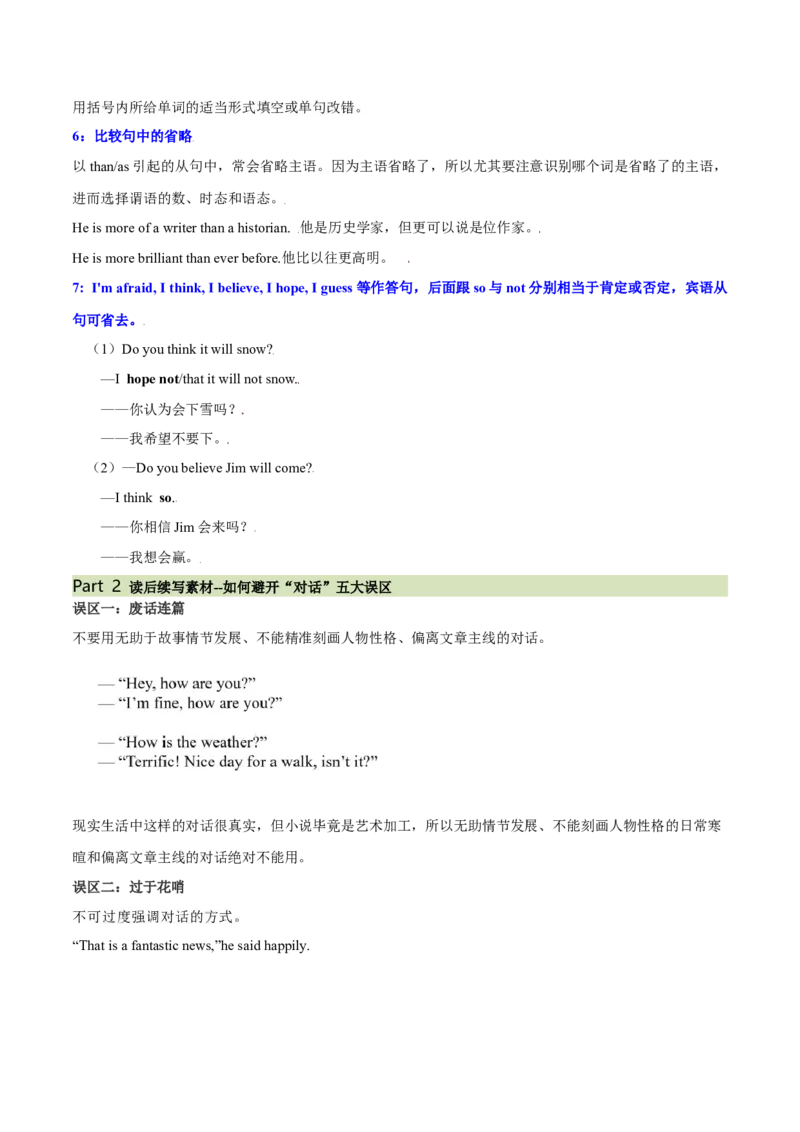
Part 2 读后续写素材--如何避开“对话”五大误区
误区一:废话连篇
不要用无助于故事情节发展、不能精准刻画人物性格、偏离文章主线的对话。
现实生活中这样的对话很真实,但小说毕竟是艺术加工,所以无助情节发展、不能刻画人物性格的日常寒
暄和偏离文章主线的对话绝对不能用。
误区二:过于花哨
不可过度强调对话的方式。
“That is a fantastic news,”he said happily.此句完全没有必要加上一个happily来表达说话的方式,因为句中的fantastic一词足以说明说话人的表情,
过度强调会让读者的注意力集中在“说话的方式”而不是“说话的内容”上。可改为:“That is a fantastic
news!” he said/screamed/exclaimed.一个感叹号和一个fantastic已经足以让读者想象当时的情景。
适当的“艺术留白”也是需要的,这样会留给读者想象的空间,
另一种避免过度使用对话的方法就是运用动作描写来取代。如:Her eyes reflected the candlelight as she smiled
at her son. Everyone is unique. Just follow your heart and be yourself!’,
误区三:用词不当
禁止错误使用引出对话的单词。
(1)“I can't believe it,, Emma gasped.
(2)“That's hilarious," Henry chuckled.
以上两句是把动作描写和对话混淆了,试想一下,谁能gasp(喘息)、chuckle(轻笑)出一句话?显然这样用词
是不恰当的。可改为:
(1) “I can't believe it,”Emma said with a gasp.(用来引出对话的单词said+with介词短语Emma gasped.)
“I can't believe it.”(动作描写+句号)
“I can't believe it.”Emma gasped.(句号结尾的对话+动作描写
(2) “That's hilarious!”Henry chuckled.(感叹句结束+动作描写)
“That's hilarious,” Henry said, chuckling(用来引出对话的单词said+分词作伴随状语定要注意对话中的标点符
号)
误区四:多此一举
对话对象十分明确的情况下,无须添加用来引出对话的单词。
“I told you already,” I said, glaring.
此句对话中的主语“I”已经清晰地说明了说话者,完全没有必要用“I said”来说明说话对象。
可改为:I glared at him.“I told you already.’加上一些动作描写就可以避免这种错误,还可以让语言更生动。
误区五:频用副词
不可频用副词,让阅卷人觉得词汇匮乏。
“How can you do this?’ she said angrily, looking at me furiously.
此句很短却用了两个副词。过度使用副词只会让阅卷老师觉得学生词汇匮乏。
以下有两种避免过度使用副词的方法:(1)积累相关的能突出表达各种情景和情感的词汇。(3) 穿插动作描写辅助对话,刻画人物心情比较:she said, her voice implying.
“That's not what you said yesterday,’”she was withdrawing.
“That's not what you said yesterday.’She hesitated, turned and walked to the window.
评析:两句话都不错,但第二句更高一筹。第一句用了imply和withdraw两个单词来说明主语she的心情,
而第二句hesitate和后面的动作描写让主语she的犹豫心情跃然纸上。小说要的就是这种表达方式。
分析对话实例,揭示对话秘诀
Example 1
原文内容:作者爸爸在阳台种植康乃馨,悉心呵护,作者一家都非常喜欢这些花。爸妈再三强调不允许作者
和他姐姐触碰这些花。
To our surprise, Dad was mad about it, yelling at us, “Don't you know touching is not allowed? What on earth have
you done?,
赏析:反意疑问句和on earth的使用加强了语气,凸显了父亲的生气。
Example 2
原文内容:母亲去世,哥哥外出。父女相约吃饭,引发了女儿对母亲和哥哥的思念,父亲读懂了女儿内心的
想法,安慰女儿: 母亲在天堂一定希望他们过得快乐,现在他们需要做的就是珍惜身边的人。
Seeing this, my father lovingly held my hands and said to me, “Sweetheart, I believe your mother must want you to
live happily, so say goodbye to the past and embrace the present. Your brother and I will always be with you.”
赏析:情感类的对话要求感人,触及内心,这点此对话做得不错。
对此对话提出两点建议:
①文中的and said to me可删去,因为对话对象非常清楚,肯定是和我说。②文中的your mother显得太疏远,亲人间相互称呼用Mom即可,这样更真实,贴近生活。
Example 3
原文内容:作者家里突然停电,虽然弟弟觉得停电期间非常无聊,但是作者却非常享受停电的时间,享受
“没有现代电子科技带来的干扰的”宁静片刻。
Bzzz! The lights return. “Yeah, no more candles!’ My mother yells, pulling me away from my fantasy.
赏析:对话简洁自然,表达了说话者恢复用电时候的兴奋,对话外的词汇用得也很出色,分词的使用既丰富
了语言也推动了情节的进一步发展。
Example 4
原文内容:主人公Jenny通过自身的劳动获得了心爱的项链,形影不离。父亲每日给她讲睡前故事。父亲故
意试探女儿,问是否可以把项链给他。Jenny深爱爸爸但不舍得自己努力得来的项链。
A week later, her father once again asked Jenny after her story. “Jenny, you love me, don't you? Give me your
pearls, okay?” “Daddy, why must you ask for the pearls?" Jenny refused again. “Not only did I finish all those
chores, but also I spent the dollar bill given for my birthday just to pay for it.” They both fell into silence. Then
her father smiled, comforting her with a warm hug. “That's okay.darling. Good night.”
赏析:此文运用了大量的对话,主要是考虑到与前文的协同。大量的父女间的对话穿插一些旁白或动作描写
很好地刻画了人物之间的冲突,细腻生动地刻画了人物心情。一般的读后续写不建议用太多的对话。适当
的对话可以打破单调,推动情节,刻画人物性格。
建议:
①“Not only did I finish all those chores, but also I spent the dollar bill given for my birthday just to pay for it.”此
句似乎为了使用not only..., but also的倒装句型而写对话,显得很不自然。语句太长反而不能表达小女孩当
时的生气。建议改为“It's mine! My efforts!” 会显得更加简洁自然,同样起到了表达效果,符合人在生气
时候的说话方式:短句、不完整句!
②“Jenny raised her head,”此处的逗号要改为句号。此句只能作为动作描写,而不能当作用来引出对话的句
子。
Part 3 单元语法+读后续写即时检测
一、语法填空
1.(2024高三下·全国·专题练习)The new hybrid grains are firmer than natural grains, and when
(cook) they maintain their traditional appearance.
2.(2024高三·全国·专题练习)I learned this while (take) care of a seagull unfortunate enough to
swallow a hook.
3.(2024高三·全国·专题练习)When (speak) by a stranger, they can function as a(mean) of attracting your attention.
4.(2024高三·全国·专题练习)They could be interpreted a welcoming greeting from a close friend,
especially if (accompany) by a gentle smile.
5.(23-24高三上·福建·期末)To any neighboring countries, border issues, unless (handle) properly,
will directly affect the relationship between them and even lead to conflicts.
6.(23-24高三下·全国·课后作业)Though (major) in engineering, the lady made every
effort to learn calligraphy which (regard) as an art form.
7.(23-24高三下·全国·课后作业)These mountains are a splendid sight when (view) from the
valley floor.
8.(2024高三下·全国·专题练习)As (plan), it will be held on the playground from 5 p. m. to 8 p.
m. next Sunday.
9.(2024高三下·全国·专题练习)Get up early tomorrow. If , you will miss the early bus.
10.(2024高三下·全国·专题练习)I learned a lot about agriculture when (pick) fruit on the farm.
11.(2023高三·全国·专题练习)If (leave) alone outside, dogs and cats can be very smart in their
search for warm shelter.
12.(2024高三下·全国·专题练习)The Losar celebrations come to an end with a grand ceremony. People
gather in public spaces and light incense (香) and candles offering food, drinks and other items to the
gods.
13.(2024高三·北京·专题练习)When (see) from afar, the mangrove forests appear more splendid.
14.(2024高三下·全国·专题练习)You’d better take the price, the quality and so on into consideration when
(buy).
15.(2024高三下·全国·专题练习)When (ask) a question in class, you shouldn’t keep silent but
actively answer it.
16.(23-24高三上·陕西西安·阶段练习)Though (attack) with cancer, he still keeps optimistic.
17.(23-24高三上·河南南阳·阶段练习)When (refer) to that incident of last year, he still felt very
frightened.
18.(23-24高三上·黑龙江哈尔滨·开学考试)They landed safely on the island in the Pacific. Everything went
on better than previously (expect).
19.(23-24高三上·河北石家庄·开学考试)Though (lack) money, her parents managed to send
her to college.20.(23-24高一上·全国·课后作业)As a matter of fact, the sense of smell is used much more frequently than
generally (assume).
二、(23-24高三下·广东韶关·阶段练习)阅读下面材料,根据其内容和所给段落开头语续写两段,使之构
成一篇完整的短文。
For more than 20 years I have been traveling the world, preferring often to spend a year or two in different
countries rather than to just visit as a tourist. It has become an important part of my personality as I grew older and
shaped the way I saw the world and myself.
My little taste of this amazing life was when I was 19 years old. I was selected among a small group of
college classmates to spend a year abroad. This was long before people could travel the world through social media
like Facebook and Twitter. In order to see a place, you had to go there and experienced it.
I was raised in a middle-class family and couldn’t afford to travel around the world the way I wished I could.
The only way I knew about the world outside was through letters I wrote to pen pals from over a dozen countries as
a kid, and from television. Growing up, I always loved the very funny British comedies that were shown on local
public television every Saturday night. So when I got the chance to apply for a study abroad program, I chose
London.
Living abroad can be exciting, scary and challenging. I thought it would be easier because I spoke the same
language as the local people did. But I also like to relish (享受) the little differences between the British and
American culture and language. I also learned that in England, they spell words differently than in the U. S. In
British spelling, they put a “u” in words like favor to make it “favour” and an “s” in words like analyze to make it
“analyse”. I was able to adapt quickly to this new way of writing since I was submitting papers all the time for my
classes.
Academically, I got to take classes that weren’t offered at my college back home. For example, I had a
course in sociology and learned about the native people of Papua New Guinea.
注意:
1. 续写词数应为150左右;
2. 请按如下格式在答题卡的相应位置作答。
Paragraph 1: But there were also challenges that year too.
____________________________________________________________________________________________
____________________________________________________________________________________________
________________________________________________________________________________________________________________________________________________________________________________________
____________________________________________________________________________________________
___________________________________
Paragraph 2: Sometimes the difficult times made me sad and homesick.
____________________________________________________________________________________________
____________________________________________________________________________________________
____________________________________________________________________________________________
____________________________________________________________________________________________
____________________________________________________________________________________________
___________________________________