Unit 1 A land of diversity
Ⅰ. 单元教学目标
技能目标Skill Goals
▲Talk about the USA
▲Talk about (going) places
▲Learn the words about the USA
▲Learn how to ask questions and make comments
▲Learn the usage of the Noun Clauses
▲Write an introduction to places
▲Study the culture and people of the USA
Ⅱ. 目标语言
Talk about (going) places
Where have you visited recently?
When did people first live there?
What is the climate like?
功 Why is it so warm / cold / dry / wet there?
能 What’s the population of...?
句 How many nationalities live there?
式 What did you think about the people?
What is the most important festival there?
How do they celebrate it?
What other interesting things did you see?
That’s interesting / terrific / marvelous / cool / lovely / beautiful,
wonderful!
You’re exciting / wonderful. Good / Creative /Fantastic / Super job!
1. 四会词汇
Strait distinct Arctic means majority ministry Catholic
hardship elect federal rail percentage Italy Denmark boom aircraft
Korea Korean Pakistan immigration racial crossing vice
nephew pole applicant customs socialist occur cattle indicate
luggage shave tram apparent apparently brake conductor slip bakery
词
ferry hire seagull angle nowhere punishment justice mourn civil
汇
authority reform grasp thankful insert
2. 认读词汇
illustrate, Alaska, prehistoric, immigrant, Hollywood, Laotian, conqueror,
cable, Andrew, wharf, Alcatraz
13. 词组
Live on, the Arctic, by means of, make a life, keep up, back to
back, team up with, mark out, take in a great/good many, apply for
结 Learn to use the Noun Clauses
构
1. However, it is likely that Native Americans were living in California...
P2
2. Of the first Spanish to go to..., the majority were... P2
重
3. That is why... P2
点
4. Some died or returned home, but... P2
句
5. Although Chinese immigrants..., it was the building of... P2
子
6. It is believed that before long... P3
7. Built in 1873... was invented by... P8
8. It’s a... that takes in... P8
9. He was noticed by... and to find... P51
10. He spoke publicly about..., using his fame to help... P51
Ⅲ. 教材分析和教材重组
1. 教材分析
本单元以“地域文化”为主题, 旨在通过单元教学,使学生了解有关美国地理方面的知识;
学习加利福尼亚州的简介,使学生对美国的文明史略见一斑;通过阅读名人传记,研究美国的
民族文化,使学生对美国有全方位的认识,掌握有关美国的历史、地理、文化、民族等方面的词
汇;学会运用名词性从句等语法知识,并通过相关练习,提高学生的语言运用能力;通过阅读一
篇图文并茂的美国游记,学会书写电子邮件或明信片,介绍某一名胜古迹和人文景观;通过学
习、探究我国少数民族地区的多种文化,以及撰写我国某一城市、省份或地区的简介,加深对祖
国地域文化的了解,提高写作能力。
本单元旨在通过对世界各地的名胜古迹、风土人情的研究与学习,丰富学生的世界地域文化知
识,开扩视野,培养他们热爱祖国、热爱大自然、保护名胜古迹、造福人类的高尚情操。
1.1 Warming Up要求学生查阅美国地图,讨论有关美国地理方面的知识,为下一步的学习做好
热身准备。
1.2 Pre-reading要求学生讨论有关加利福尼亚州的几张图片,了解当地风土人情、民俗文化。
1.3 Reading主要介绍了加利福尼亚州人口及民族、种族构成、融合、变迁的历史。通过学习,使
学生了解加州不仅是美国人口最多的州,同时也是民族、种族最多、文化最为多元的州。
21.4 Comprehending要求学生在理解课文的基础上,写出发生在加州的重大历史事件,并分析讨
论新世纪加州为什么会成为多种文化交织的共同体的原因。
1.5 Learning about Language 由 Discovering useful words and expressions 和 Discovering useful
structures两部分组成。并设计了词性转换、用课文中所学习的重点词汇填空、补全对话等练习。
1.6 Using Language由Reading and writing, Listening and speaking组成,通过对学生听说读写综
合能力培养,要求学生在了解相关知识的基础上,阅读并改写部分游记;想象自己在某地度假,
给朋友发一封电子邮件或寄一张贺卡介绍该地区的相关情况。
1.7 SUMMING UP 要求学生总结本单元所学的词汇、结构、话题等知识和内容。
1.8 LEARNING TIP从对话时应该注意的问题这一角度,对学生进行学法指导。
2. 教材重组
2.1 Warming Up, Pre-reading, Reading和Comprehending四部分,都是关于美国加利福尼亚
州简介的内容,整合为一节精读课。
2.2 Learning about Language中的Discovering useful words and expressions 以及Workbook中的
USING WORDS AND EXPRESSIONS 都是关于形容词、动词和名词后缀及其三者之间的相互
转换,讲解与练习这三种词性用法, 以及课文重点词汇运用方面的相关练习,整合为一节语言
学习课。
2.3 Learning about Language 中 的 Discovering useful structures 和 Workbook 中 的 USING
STRUCTURES,都是有关名词性从句的用法的讲解与练习,整合为一节语法课。
2.4 Using Language中的Reading and writing, Listening and speaking,都是与假日旅游相关的知
识,整合为一节综合课(I)。
2.5 Workbook中的LISTENING, LISTERNING TASK AND READING TASK,都是关于新奥尔
良以及爵士乐及其创始人等相关内容, 整合为一节泛读课。
2.6 Workbook中的TALKING以及SPEAKING TASK与WRITING TASK四个部分, 都是关于
中国城市、省份或地区的简介等方面的内容, 整合为一节综合课(二)。
3. 课型设计与课时分配
1st Period Reading
2nd Period Language study
3rd Period Grammar
4th Period Integrating skills (Ⅰ)
5th Period Extensive reading
36th Period Integrating skills (Ⅱ)
Ⅳ. 分课时教案
The First Period Reading
Teaching goals教学目标
1. Target language 目标语言
a. 重点词汇和短语
strait, means, slavery, Spain, majority, Catholic, Mexico, immigration, percentage, Denmark,
Danish, aircraft, Korea, Korean, Pakistan, Pakistani, mix, mixture, nationality, racial, the Bering, by
means of, the Pacific Islands, make a life
b. 重点句子
However, it is likely that Native Americans were living in California... P2
Of the first Spanish to go to..., the majority were... P2
That is why... P2
Some died or returned home, but... P2
Although Chinese immigrants..., it was the building of... P2
It is believed that before long... P3
2. Ability goals能力目标
Enable the students to talk about the history of California.
3. Learning ability goals 学能目标
Enable the students learn how to talk about the history of California.
Teaching important points 教学重点
Enable the students learn how to talk about the important events in Californian history.
Teaching difficult points教学难点
Enable the students to explain the reasons why California is such a multicultural community in the
21st century.
Teaching methods教学方法
Skimming, scanning and discussion.
Teaching aids教具准备
A recorder, a computer, a projector and some pictures.
Teaching procedures & ways教学过程与方式
4Step Ⅰ Lead-in
T: Boys and girls, we’ve learned English several years. We know that English is mainly used in
England, Australia, the United States of America, etc. And we’re now learning American English.
But how much do you know about the United States of America — a land of diversity? As we all
know, the US is a world power with the most developed economy. It lies in the North America,
bordering both the North Atlantic Ocean and the North Pacific Ocean, between Canada and Mexico.
There are fifty states in the US. Forty-eight of them are in the single region between Canada and
Mexico; this group is referred to, as the continental or contiguous United States. Two of the 50
states, Alaska (a state in northwestern North America) and Hawaii (a state in the central Pacific on
the Hawaiian Islands), are not contiguous with any of the other states. In the past few years, we’ve
seen or heard many of the world’s events which have something to do with the US, such as the
September 11 attacks, Iraqi war, Kartrina Hurricane, etc. Today we are going to learn more about
this powerful country. First, look at the following pictures.
Show some pictures on the screen.
T: All right. Now please tell me what you know about them? Who wants to have a try?
S1: The American flag is the Star - Spangled Banner. There are 50 stars with white and red strips on
the rest of the flag.
S2: The stars stand for 50 states. The red color symbolizes courage; the white symbolizes freedom
and the blue means loyalty and justice.
S3: The White House is the executive mansion of the President of the United States. The American
President lives and works in the building.
S4: There are many important places in it, such as the pressroom and the oval office.
S5: The Statue of Liberty is standing on a small island in New York Harbor.
S6: In 1886, French sent it as a gift for American Independence Day on her 100th anniversary.
S7: The crowned lady is 46 meters high, with a torch in her right hand holding aloft and Declaration
of Independence in her left.
5S8: For a century, the Liberty has been standing on the Island proudly symbolizing the spirit of
independence of the USA.
T: Very exactly. What else do you know about the USA?
S9: A federal republic, United States of America is composed of a federal district, Washington DC
and 50 states. All the states except for Hawaii islands are situated in mainland America.
S10: It has a population of about 2,900 million. Its area is 9,370,000 sq km.
S11: The climate of USA is mainly temperate in nature but in Hawaii and Florida, it is tropical.
S12: The language they mainly use is English.
Step Ⅱ Warming up
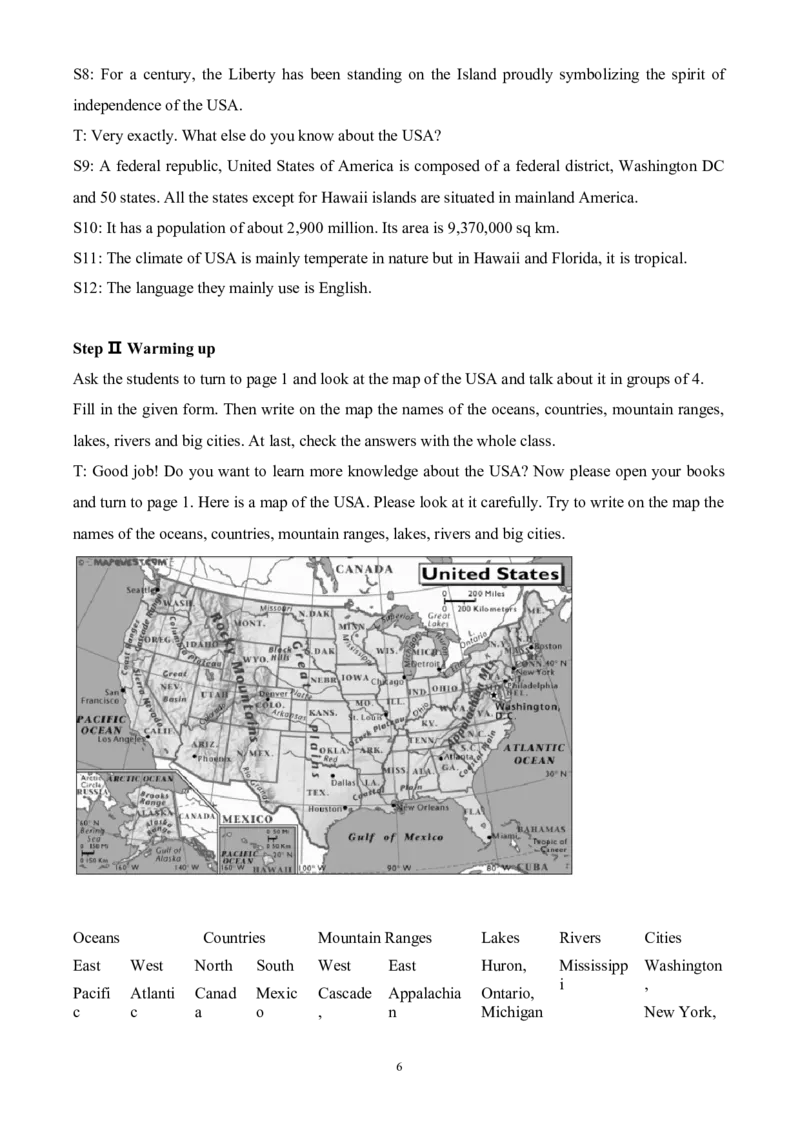
Ask the students to turn to page 1 and look at the map of the USA and talk about it in groups of 4.
Fill in the given form. Then write on the map the names of the oceans, countries, mountain ranges,
lakes, rivers and big cities. At last, check the answers with the whole class.
T: Good job! Do you want to learn more knowledge about the USA? Now please open your books
and turn to page 1. Here is a map of the USA. Please look at it carefully. Try to write on the map the
names of the oceans, countries, mountain ranges, lakes, rivers and big cities.
Oceans Countries Mountain Ranges Lakes Rivers Cities
East West North South West East Huron, Mississipp Washington
i ,
Pacifi Atlanti Canad Mexic Cascade Appalachia Ontario,
c c a o , n Michigan New York,
6Coast, , Los
Angeles,
Brook, Erie,
Chicago,
Alaska, Superior
Houston,
Rocky
Philadelphia
,
Miami,
Atlanta,
San
Francisco
Step Ⅲ Pre-reading
T: Can you find the location of California? Where does it lie?
S1: Yes, it is lying on the Pacific Ocean in the west and on Mexico in the south.
S2: California is on the west coast of the United States, which is diverse in topography, climate and
ecological environment.
T: Correct. Anything else do you know about the state?
S2: It has an area of 411 square kilometers. And it is one of the American states of the largest
population, with the most developed economy.
S3: You are right. Its economy takes the first place among all the states. So it’s one of the most
important states.
S4: The pleasant weather, long beach and graceful natural landscape make the tourism prosperous.
T: Well done! Just as people go to the USA from many places today, so did in ancient times. Today
we’re going to learn the short history of California. Now please look at the pictures about California.
And discuss in groups of 4 what each picture means to you. A few minutes later, I’ll ask some of you
to say something about them.
A few minutes later.
T: OK, now I’d like some of you to say something about the pictures.
S1: I can see a Native American farmer in the left picture on page 1. He was standing beside a camp
in the forest. It seemed that he felt very happy. Maybe he had a good harvest.
S2: The villagers moved to these various camps in the forests during the harvest season, depending
on the type of crop being gathered.
S3: In the middle picture, a man was panning gold. He looked not only thin and weak, but also
thirsty and tired.
7S4: I think it was difficult for them to achieve the dream of becoming rich.
S5: He might have to give up, leave California and go back home.
S6: The right picture illustrates modern California with beautiful buildings and busy street.
S7: By 1990, the nations being immigrated from different parts of the world had made California
into the most racially and ethnically diverse state in the country.
S8: The picture on page 2 shows us a Spanish religious man.
S9: The picture on page 3 shows us Indian children were allowed to attend public schools.
S10: The number of African Americans in California increased dramatically following the turn of
the 20th century.
Step Ⅳ Reading
Scanning
Ask the students to read the text silently and then ask some questions about the text.
T: Today we’re going to read a short history of western painting. Now let’s read it quickly and find
out the answers to the questions on the screen with your partners.
Show the questions on the screen.
1. Who were the first to arrive in California to rush for gold?
2. When and why did the large number of Chinese immigrate to California?
3. What attracted people from different parts of the world to immigrate to California?
T: Now who can answer Question 1?
S1: South Americans and people from the United States.
T: Good! Who’d like to answer Question 2?
S2: During the Gold Rush Period, many Chinese immigrated to California to achieve their dream of
becoming rich.
S3: In the 1860s, a large number of Chinese went there to build the railway from the west to east
coast.
T: Exactly. How about the third question?
S4: I think the temperate climate attracted immigrants to California.
S5: Maybe the modern lifestyle there is more attractive to people from other parts of the world.
T: Good job!
Skimming
8In this part, the students will read the text again and try to get the main idea in groups of 4. Then
show the following form on the screen. Give them a few minutes to fill in the form. Then check the
answers with the whole class.
T: Now please read the text again. And then let’s try to get the main idea of the text. I’ll show the
form on the screen and give you a few minutes to fill in it.
Show the form with blanks on the screen.
CALIFORNIA
Stage People Time Event
Native Asians 15,000 Arrived first
Americans Natives 1600s Suffered by
Europeans
Spanish Spanish 1600s Took native’s land
Ruled by Spain
1800s Became part of
Mexico
1821 Declared war &
Given back
1846 Settled in
Russians Russians 1800s Settled in
Gold miners South 1848 Discovered & Rush
for gold
Americans
Americans,
Europeans,
1850 Became a state
Asians
Africans 1800s Moved from
Mexico
Chinese 1860s Built the railway
Japanese Early 1900 Farmed
Denmark 1911 Established a town
Jewish By 1920s Developed industry
Italians Late 1900s Fished and made
wine
Africans 1942~1945 Worked in ship &
aircraft industries
Recent arrivals Indians, 1970s Worked in
Computer industry
9Pakistanis
Cambodians, Recent Immigrated
Koreans, decades
Vietnamese,
Laotians
Future Different parts Future Immigrated
Explanation
T: Now let’s deal with some language points in the text. Look at the sentences on the screen. Who
can explain the sentences?
Show the following.
1. However, it is likely that Native Americans were living in California... P2
2. Of the first Spanish to go to..., the majority were... P2
3. That is why... P2
4. Some died or returned home, but... P2
5. Although Chinese immigrants..., it was the building of... P2
6. It is believed that before long... P3
Step Ⅴ Comprehending
Ask the students to read the passage again and try to know more about the pictures, the people and
the events in different history periods. First ask students to practice Activities 1-3 in pairs. And then
check the answers with the whole class.
T: Read the passage again. Now I’d like you to practice Activity 1.
S1: The first picture on page 2 shows us some life-styles of the Native Americans in California.
Native Americans first arrived and have lived in California for thousands of years.
S2: They established their homes along the central California coast long before the Europeans
arrived.
S3: They suffered a lot by Europeans, thousands were killed or forced into slavery.
S4: The middle picture on page 2 is about the Gold Rush in California.
S5: One of the largest human migrations in history as a half-million people from around the world
descended upon California in search of instant wealth.
S6: Many died or returned home, but most of them remained in California.
10S7: The right one shows that California is a multicultural city with architectures of different styles.
S8: Attracted by the climate and lifestyle, more and more people from different parts of the world
like to immigrate to California.
S9: In the 21st century California will become such a multicultural state with a mixture of many
races and cultures.
S10: The picture on page 3 shows us a Catholic religious man who came to California to teach the
natives.
S11: In the early 16th century, Spanish fought against the naive people, took their land and settled in
California.
S12: We can see so many African Americans were having classes in the school.
S13: In 1924, the United States Congress gave Native Americans the same rights as other citizens
for the first time.
S14: School segregation and discrimination in housing were banned, but African Americans still
encountered prejudice and hostility.
T: Read the passage again. And do Activities 2~3 in pairs.
A few minutes later.
T: OK, I’ll ask some of you to show your answers.
Sample answers: (Refer to the above form)
Step Ⅵ Consolidation
First ask the students to talk about the writing style and techniques, writing characteristic of this text
in groups of 4, and check the answers with the whole class. Then ask the students to find out the
main idea of the passage and try to retell the text in pairs. A few minutes later, ask some of them to
retell it to the whole class.
T: Now I’d like you to talk about the writing style and techniques, writing characteristic of this text
in groups of 4.
A few minutes later.
T: All right, what’s the writing style and techniques, writing characteristics of this text? Who can tell
me?
Ss: Writing style and techniques: The passage is a historical narrative article. It introduces briefly the
main history events of different periods of times in California. It also describes when, how and why
11the people from different parts of the world immigrated to California. The short history of California
is described clearly and accurately, which gives the readers a deep impression.
Ss: Writing characteristics:
1. The text is arranged well in the order of time.
2. The text catches the feature of people and things and uses adjectives.
3. The text centers on the subject and the purpose.
4. The text seems more vivid and lively with the inserted pictures.
T: Well done! Now I’ll give you a few minutes to find out the main idea of the passage and practice
retelling the text in pairs with the help of the form about the text.
Show the above form again on the screen.
T: All right. I’d like some of you to tell us the main idea.
Ss: Main idea: The text mainly introduces the short history of California. It describes the great
history events happened in various times. It also tells us when, how and why different people from
all over the world having been immigrating to California. It explains to us the reasons why it will be
a simple multicultural community in the 21st century.
T: OK, it’s time for us to do some retelling work. Who’d like to have a try?
Ss: California is the third largest state in the USA with the most developed economy. 15,000 years
ago, the first settlers crossed the Bering Strait from Asia and arrived in California. The Native
Americans suffered greatly after the arrival of Europeans in the 16th century. In the 18th century,
California was ruled by Spain until 1821 the people of Mexico gained their independence from
Spain. California then became part of Mexico. But after the American-Mexican war in 1846,
California was given back to the USA. In 1848, in California Gold was discovered, which attracted
people from all over the world to arrive there to achieve their dreams of becoming rich. In 1850,
California became the 31st state of the USA as a multicultural society. Attracted by the climate and
lifestyle, more and more people from different parts of the world having been immigrating to
California, including Asians, Africans, Americans and Europeans. In the near future, California will
become a mixture of many races and cultures without any major racial or cultural groups.
Step Ⅶ Homework
1. Ask the students to discuss the question in Activity3 on page 3, trying to explain the reasons in
their own words and write 3 ~ 4 sentences.
122. Ask the students to prepare for the word formations and collect suffixes of the nouns, verbs and
adjectives.
The Second Period Language study
Teaching goals教学目标
1. Target language 目标语言
重点词汇和短语
Catholic, slavery, Spanish, mix, mixture, nationality, majority, immigrant, percentage, make a life, a
great many
2. Ability goals能力目标
Enable the students to learn about the word transformation between the nouns, adjectives and verbs.
3. Learning ability goals 学能目标
Help the students learn how to know the parts of speech according to the suffixes.
Teaching important points 教学重点
Get the students to know the word about the USA.
Teaching difficult points教学难点
Get the students to know the word formation by adding suffixes.
Teaching methods教学方法
Study individually, practice in groups.
Teaching aids教具准备
A computer and a recorder.
Teaching procedures & ways教学过程与方式
Step Ⅰ Revision
Ask the students to discuss the question in Activity 3 on page 3, trying to explain the reasons in their
own words and write 3 ~ 4 sentences. Ask them to share their answers and show their opinions.
T: First of all, let’s deal with our homework. Now work in groups and discuss the question in
Activity 3 on page 3, trying to explain the reasons in your own words and write 3 ~ 4 sentences.
Share your answers with your group members.
A sample discussion:
S1: The Native Americans of California are continuing to heal from the wounds of the past. As
California recognizes the value of its multi-ethnic diversity, its native people are encouraged to
13celebrate their heritage and share it with the wider California culture.
S2: The number of African Americans in California increased dramatically following the turn of the
20th century. Although old patterns of prejudice persisted, African Americans advanced in politics,
business, sports and entertainment. School segregation and discrimination in housing were banned,
but problems of unemployment, underemployment and racism continue to be addressed in the
African-American community.
S3: By 1990, the number of European and Canadian immigrants had fallen dramatically, to less than
10 percent, and the number of immigrants from Mexico and Central America had climbed to well
over half of the total.
S4: Additionally, California’s share of Asian immigrants doubled and now accounts for 40 percent
of new immigrants in the state.
T: Excellent! These trends have transformed California into the most racially and ethnically diverse
state in the country, so that by the year 2000, if not already, no racial group will constitute a
majority.
Step Ⅱ Suffixation
First, ask the students to show their collected suffixes. Ask them to review the function of verbs,
nouns and adjectives. And then ask them to fill in the charts with the proper forms of the words by
practicing Activity 1 on page 4. At last, check the answers with the whole class.
T: Today we’re going to learn about suffixes. Do you know what a suffix is?
S1: A suffix is a particle, which is added to the end of a root.
T: Good. Do you know anything more about it?
S2: Generally, suffixes do not change the meaning of the root, but its part of speech. e.g. lead
(v.)→leadership (n.) ill (adj.) → illness (n.)
S3: Although each suffix has its own meaning, it can’t be used separately without the root.
S4: However, some suffixes add new meanings to the newly formed words. e.g. meaning →
meaningless think → thinker
T: Very good! Now who’d like to share your collected suffixes with us?
Ss: The following are some of the most commonly used suffixes.
1. Suffixes used as a noun signifier
14Verb Adjective Suffix Noun
read -er reader
act -or actor
train -ee trainee
build -ing building
attend -ance attendance
punish -ment punishment
invent -tion invention
sick -ness sickness
special -ist specialist
true -th truth
2. Suffixes used as an adjective signifier
Noun Verb Suffix Adjective
wind -y windy
hope -ful hopeful
adventure -ous adventurous
hero -ic (-ical) heroic
nation -al national
care -less careless
trouble depend -some troublesome
comfort -ent/-ant dependent
active, -able/-ible comfortable
imagine -ive/-tive/-ative/-itive attentive,
imaginative
second -ary secondary
change -able changeable
annoy -ing annoying
excite -ed excited
3. Suffixes used as a verb signifier
Adjective Noun Suffix Verb
broad fright -en broaden , frighten
15simple -fy simplify
modern -ize (-ise) modernize
T: Excellent! Now let’s fill in the chart with your partners. Please open your books and turn to page
4 and practice Activity 1 in Discovering words and expressions. Later we’ll check the answers with
the whole class.
Step III Homework
1. Ask the students to finish Activities 1-3 on page 48 in the workbook.
2. Ask the students to prepare for the grammar about the Noun Clauses.
The Third Period Grammar
Teaching goals教学目标
1. Target language 目标语言
重点词汇和短语
The Noun Clauses, occur to
2. Ability goals能力目标
Enable the students to identify the different types of the Noun Clauses and learn to use them.
3. Learning ability goals 学能目标
Help the students learn how to use the Noun Clauses.
Teaching important points 教学重点
Enable the students to use the Noun Clauses.
Teaching difficult points教学难点
Enable the students to distinguish different types of noun clauses.
Teaching methods教学方法
Comparing and practice.
Teaching aids教具准备
A projector, a computer and a blackboard.
Teaching procedures & ways教学过程与方式
16Step Ⅰ Revision
Check the homework.
Step Ⅱ Presentation
At first, get the students to know what a noun clause is and what role it plays in the sentences. Then,
discuss noun clauses as objects. Next, give them an example to show what are Noun Clauses and in
what situations they should use them. At last show them the sentence structures of the Noun Clauses.
T: Today’s topic is noun clauses. A noun clause is an entire clause which takes the place of a noun in
another clause or phrase. Like a noun, a noun clause acts as the subject or object of a verb or the
object of a preposition, answering the questions “who(m)?” or “what?”. There are many types of
noun clauses. Today we’re going to discuss only noun clauses as objects.
Show the following.
He knows that noun clauses are difficult.
T: OK. Please look at the sentence on the blackboard. There is a that-clause in the sentence. Do you
know what clause it is called?
Ss: Yes. It is an object clause.
T: Right. How do you know this?
S: I think the clause is used as the object of the verb “knows”.
T: Very good. There are three types of common noun clauses, which I’ll eventually cover. Now I’d
like to show you more examples about them.
Show the following on the screen.
· That-clauses:
I believe that you can learn noun clauses well.
· If / whether clauses:
The teacher must determine if / whether they are ready to study noun clauses.
· Wh-clauses begin with words like who, what, how, whenever, which, etc:
First you need to explain what a noun clause is.
I know how I can make you learn noun clauses.
T: As for punctuation, the clause determines whether it’s a question or statement. How do you use
them correctly?
Ss: That clauses are made from statements and are introduced by the word that. If / whether clauses
are made from general questions and are introduced by the words if or whether. Wh-clauses are
17made from special questions and are introduced by the wh- words.
T: Quite right. If the clause is used as subject, we call it the subject clause. This kind of clause is also
used as the predicative, the appositive or the attributive. Are you clear about that?
Step Ⅲ Practice
Ask the students to practice Activities 1~4 on page 5. For Activities 1~2, discuss what role these
clauses play in the sentences in pairs. For Activity 3, ask them to make sentences containing noun
clauses on their own. For Activity 4, complete the dialogue with the given sentences in pairs. At last,
check the answers with the whole class.
T: In English we often find clauses acting as subject, object, appositive and predicative. Here are
some more examples about them. Now please open your books and turn to page 5, let’s look at the
underlined noun clauses. Please discuss what role these clauses play in the sentences in pairs.
A few minutes later.
T: In the sentences, what types of noun clauses are they?
Ss: In the first sentence, the underlined part is used as subject. It is the subject clause.
In the second sentence, the underlined part is used as predicative. It is the predicative clause.
In the third sentence, the underlined part is used as object of the verb “know”. It is the object clause.
Go on with the Activities 2-4. Then check the answers with the students.
Step IV Homework
Ask the students to do the following.
1. Finish Activity 2 on page 49 in the workbook.
2. Sum up all the conjunctions used with noun clauses and compare it with the conjunctions used
with attributive clauses. Then tell the differences between them. Practice Activity 2 on page 49
(Workbook).
3. Prepare for the “Using Language” part on pages 6~9 and surf the Internet to find the related
information.
The Fourth Period Integrating skills(Ⅰ)
Teaching goals教学目标
1.Target language 目标语言
a. 重点词汇和短语
luggage, tram, apparent, apparently, slip, bakery, ferry, hire, seagull, insert, react, team up with,
18mark out, take in, a great / good many
b. 重点句式
Talk about traveling to some places
Where have you visited recently?
What is the climate like?
What did you think about the people?
What other interesting things did you see?
That’s interesting / terrific / marvelous / cool / lovely!
You’re exciting / excellent.
Good / Creative / Fantastic / Super job!
2. Ability goals能力目标
Enable students to talk about places and learn to write an email or a postcard.
3. Learning ability goals 学能目标
Help students learn how to talk about places and learn to write an email or a postcard.
Teaching important points 教学重点
How to talk about places.
Teaching difficult points教学难点
How to write an email or a postcard.
Teaching methods教学方法
Listening, speaking and discussion.
Teaching aids 教具准备
A projector, a computer and a recorder.
Teaching procedures & ways教学过程与方式
Step Ⅰ Revision
Check the homework.
Sample answers to Activity 2:
1. A clause is called a noun clause when an entire clause takes the place of a noun in another clause
or phrase.
I know that Latin is no longer spoken as a native language.
Where they are going is unknown.
Whoever broke the vase will have to pay for it.
19The Toronto fans hope that the Blue Jays will win again.
2. A clause is called an attributive clause when a dependent clause which takes the place of an
adjective in another clause or phrase.
The books that people read were mainly religious.
Some firefighters never meet the people whom they save.
Did I tell you about the author whom I met?
They are searching for the one who borrowed the book.
Then ask them to sum up all the conjunctions used in noun clauses, comparing them with the
conjunctions used in attributive clauses and tell the differences between them. Fill in the given chart
in groups of 4. Then check the answers.
T: Last class we learned the usage of noun clauses. Have you finished the exercises about the noun
clauses?
Ss: Yes.
T: Attributive clauses share conjunctions with noun clauses. What are the differences between them?
Now please fill in the given chart in groups of 4.
Show the following on the screen.
Conjunctions Noun Clauses Attributive Clauses
Whose Only refer to a person Refer to a person or a
thing
Whom Can’t be omitted Can be omitted
Which Can’t be omitted Can be omitted
That Can be omitted in the Can be omitted
object clauses
Meaningless Have meanings
Don’t play a role in Play a role in clauses
clauses
What Containing meanings and Can’t be used
functions
If / whether Containing meanings
As if / though, Containing meanings;
Only used in the
Because
predicative clauses
Who, how, when, Containing meanings and functions; can’t be omitted
where, why
20Step Ⅱ Listening and speaking
Listening
Ask the students to listen to a conversation about the George’s tour around California. Then ask
them to practice Activities 1~4 on pages 6~7. For the first time, ask the students to number the
things they talk about.
T: Today we’re going to listen to a conversation about the George’s tour around California. He is
phoning home to talk to his friend Christie. What are they talking about? Now listen and find out.
Then number the things you hear on the tape.
Then ask them to complete the postcard George wrote.
T: Now listen again and complete the postcard George wrote.
Check the answers by asking some students to read the completed postcard.
Ask the students to listen to the tape and discuss the questions in pairs and write some of the things
Christie says in pairs.
Check the answers.
Speaking
For Activity 5, let them discuss in groups of 4 and later ask some of them to give their opinions.
Show the following.
1. The function of comments and questions:
· Encourage and stimulate others to further efforts;
· Follow up correct or incorrect answers;
· Arouse others’ imagination and creation;
· Motivate others to search out new knowledge;
· Make the students think and help them clarify concepts, thoughts and problems;
· Get them to master an array of techniques for effective questioning in class;
· Have others to express their ideas and views thoroughly;
· Show respect by making sure you understand the listener’s words.
2. It’s important to indicate that you are paying attention to others’ words.
· It’s good manners to be polite to others with good education;
· Make your communication smoothly;
· Improve your relationship with each other;
· Show your respect to others’ opinions and statements;
21· Get others to feel happy and comfortable;
· Encourage others to develop their fullest level;
· Ask others to be self-confident to be successful;
· Have others to make the fullest expressions.
2. While you are listening to others, you can ask questions and make comments according different
situations.
Situations Expressions
Complementing That’s interesting / terrific / marvelous /
cool / lovely / beautiful, wonderful!
You’re exciting / excellent.
Good / Creative /Fantastic / Super job!
Making replies Yes, not really? Uh, huh, hmmm; Well...
Asking for opinions How do you feel about...?
What do you think about / of...?
Restatement What you mean is...
In other words...
Entering a conversation Excuse / Pardon me, but...
Sorry to interrupt / for interrupting, but...
Introducing and I think... because...
supporting ideas It seems to me... because...
Recommendations I think we should... because...
Giving opinions I think / feel...
Making requests We need you to...
Can / Could you...?
I would like you to...
Accepting and All right.
refusing requests I’m sorry / afraid I can’t...
Agreement and Sounds good. / Good idea.
disagreement That’s what I think.
I’m sorry / afraid I disagree.
Showing understanding I see /understand.
I see what you mean.
22Step Ⅲ Reading
Ask the students to look at the given photos and read the George’s diary on pages 8 quickly. Then
practice Activity 1 and fill in the chart in pairs.
T: Look at George’s photos on page 8. These are things he saw in San Francisco. Now read the diary
he wrote quickly and find out the day he saw these things under the photos.
Ask the students to check the answers with their partners.
Show the following on the screen.
Mon. 12, June Tues. 13, June Wed. 14, June
Dropped luggage Drove around city Took ferry to Angel
Island
Went exploring
Golden Gate Bridge
Rode on a cable car Went to Chinatown
Visited Fisherman’s
Wharf.
For Activity 2, ask students to read the George’s diary on page 8 carefully and then answer the
questions in pairs. Check the answers with the whole class.
Ask the students to read the diary again by themselves. Then discuss in groups of 4 and practice
Activities 3~4. A few minutes later, ask some of them to show their work.
Sample answers:
Reasons for omitting:
1. Some unimportant, unnecessary, uninteresting little words like pronouns “we”, “I”, articles “a”,
“the”, or prepositions. If omitted, the meaning can’t be affected and misunderstood by others.
2. Just keep the key words without explaining more in details.
Ask students to rewrite the diary entry.
A sample version:
On the next day, I teamed up with a couple from my hotel (Peter and Terri) and hired a car. We
spent all day driving around city. There’s a great drive marked out for tourists. It has blue and white
signs with seagulls on them to show way to go. It’s a 79km round-trip that takes in all the famous
spots. We stopped many times to admire the view and take photographs. Now we have really good
idea of what the city’s like.
23In the evening, I went to Chinatown with Peter and Terri. Chinese immigrants settled in this area in
the 1850s. The fronts of the buildings are decorated to look like old buildings in southern China.
There are some interesting temples here, and a number of markets and a great many restaurants. Also
there are art galleries and a museum containing documents, photographs and all sorts of objects
about the history of Chinese immigration, but it’s closed in the evening. We will go back during the
day. We had a delicious meal and then walked back down the hill to our hotel.
Step Ⅳ Homework
Ask the students to finish Activity 5 on page 9.
Show the following on the screen.
Description of a place
Just as an artist uses paint to create a picture, a writer uses words to create a description... Desriptive
writing creates a picture of a person, place, thing or event. A description essay is generally
developed through sensory details. Here are some tips about the description.
1. Selecting details: The writer should choose those that help to bring out the dominant
characteristic.
2. Catching the features of the place: You should mainly write about the things that make it different
from other places.
3. Giving your view points: Places may be described for their own sake, as in essays on visits to
famous scenic places.
4. Giving your purpose: You should describe the place for the purpose of revealing the personality
and character of a person, or creating a feeling or mood.
The Fifth Period Extensive reading
Teaching goals 教学目标
1. Target language目标语言
a. 重点词汇和短语
consider, achievement, personality, enthusiastic, autobiography, musician, recording, trumpet,
funeral, ceremony, coffin, march, ceremony
b. 重点句子
24He was noticed by... called... who... to teach... and to find...
He spoke publicly about..., using his fame to help...
2. Ability goals 能力目标
Enable the students to find the topic of each paragraph and find the clue to show the important
events.
3. Learning ability goals 学能目标
Help the students learn how to find the topic of each paragraph and find the clue to show the
important events.
Teaching important points教学重点
How to find the clue to show the important events.
Teaching difficult points教学难点
How to find the topic of each paragraph.
Teaching methods教学方法
Skimming, scanning and discussion.
Teaching aids教具准备
A recorder, a computer and a projector.
Teaching procedures & ways教学过程与方式
Step Ⅰ Revision
Check the homework by asking some students to show their work.
T: Last period, you were asked to write an email or a postcard to a friend telling him about the place
where you are on holiday. Have you finished? Now who’d like to present your descriptions to the
class?
A sample version:
The place I would like to visit would be Mars. I only know that it is the closest planet to the
Earth, and it is most similar to the Earth. Although Mars is the fourth closest planet to the sun, it is
still much colder than the Earth. Like the satellites pictures showed that Mars has lots of craters, and
scientists speculate that perhaps Mars used to be like the Earth billions of years ago. I think there is
more to Mars than what the scientists believe. I believe there is life on Mars. Perhaps the definition
of life on Mars is different from the Earth. It could be that the life there does not need oxygen, but
other kinds of gases. I would imagine that life may not be active, because Mars has been hit by
25meteorites and the surface has been very much bombarded. So I presume the life that still exists
would not be like life on the Earth. I have no idea what the weather would be like, but I can presume
it would be very cold, since Mars is much further from the sun than the Earth. As for its special
features, I think if one stands on the surface of Mars, we can see the whole universe clearer than on
the Earth. And perhaps it’s a million times more beautiful than the Earth. I hope one day we can
have more exploration on Mars and solve the mystery.
Step Ⅱ Listening (Ⅰ)
First, ask the students to listen to the tape and complete the notes. Check the answers by asking some
students to read their notes.
Then get them to discuss the questions in Activity 2 and talk about New Orleans.
T: What do you know about the place mentioned in the radio interview? Now work in groups and
discuss the questions in Activity 2.
Sample answers to the questions in Activity 2:
1. New Orleans, one of North America’s most distinctive and culturally diverse cities, located in
southeastern Louisiana on the Mississippi River, about 180 km from the Gulf of Mexico. The city
was founded in 1718 on the east bank of the Mississippi. New Orleans has been a leading
commercial center since its founding and has one of the most active ports in the United States.
2. The Gulf of Mexico provides New Orleans with plenty of moisture—the city receives about 150
cm of rainfall annually and no season is immune from it.
Spring has sunny, mild days that are perfect for the festivals.
Summer is hot, sticky and steamy, often with thundershowers.
September and October days are the most likely to offer clear, temperate weather.
Winter temperatures average a comfortable 12°C (54°F), yet occasional drops in temperature,
combined with the damp atmosphere, can chill you to the bone. Snow is rare but December’s short
days, fog and rain conspire to allow only a few hours of daily sunshine.
3. It is famous for sweet-tasting cocktails and jazz bands.
4. Nomadic Paleo-Indians probably spent time in the New Orleans area over 10,000 years ago. By
the time the French founded the city in 1718, seven small tribes known as the Muskogeans inhabited
the Florida Parishes north of Lake Pontchartrain and, occasionally, the banks of the Mississippi
River. Other tribes south of New Orleans inhabited the bayous in Barataria and the lower course of
26the Mississippi River.
Ask the students to tick the boxes in Activity 3 and complete Activity 4; complete the activities after
listening again.
Then check the answers with the whole class.
Step Ⅲ Listening (Ⅱ)
Ask the students to listen to the music and discuss the questions in Activity 1 on page 50. Then ask
them to look at the pictures in Activity 2, learn the meanings of the words and discuss what they
think is happening. Next, complete the sentences according to the tape about jazz funerals in
Activity 3. At last, ask them to listen to the tape again and make notes in Activity 4 and write a short
paragraph about it. Check the answers with the whole class.
T: Next we’ll listen to a piece of music. After listening, please discuss the questions in Activity 1 on
page 50.
Sample discussion dialogues:
1. S1: Yes, I’ve ever heard it in a CD shop near my home.
S2: No, this is my first time to listen to it.
2. S: I think it is called jazz.
3. S: The birthplace of that combination, Jazz, is said to be New Orleans. Originated in the early
1600s, Jazz is deeply rooted in American social history.
4. S1: Jazz started out with a mixture of many types of music. Jazz combines elements of African
music with elements of Western European music.
S2: Yes. Created and developed primarily by African Americans, jazz is the derivative of various
kinds of musical forms and cultural experiences.
S3: Their music was based on simple melodies and complex cross-rhythms mixed in with verbal
slurs, vibrato, syncopated rhythms, and “blues notes”.
S4: The songs they sang were mostly spiritual or sung to pass the time of hardship and hard labor.
The songs were actually encouraged because the workers seem to work better with the soothing
effects of the music.
S5: Their music was characterized more by memorization and improvisation, and not of formal
training.
5. S1: I love jazz music very much. I have tens of Jazz CDs in my house and listen to jazz everyday.
27S2: Me, too. I own a World Space Radio and listen to “Riff”. If you have chance to enjoy them,
you’ll be amazed how soothing it is to the soul. That’s the effect of good music.
S3: I just love the sound of Davis’ trumpet. His interpretations of Spanish classics in Sketches of
Spain chill me to the bone and bring tears to my eyes.
S4: If I need some real emotions, Davis Kind of Blue is probably the standard to beat when it comes
to improvising. Absolutely stunning.
S5: I don’t like ‘listening’ music but I love ‘dance’ music’. Jazz is an art that can only be enjoyed by
a matured mind... a mind that can comprehend its message.
T: What do you think of future’s jazz?
S1: I think that the music fans are much more open-minded today in comparison with the times of
“jazz-rock”.
S2: Because now the situation has changed a lot, especially because the modern music schools have
sprouted everywhere in the world.
S3: The result is that now we have such artists like John Patitucci, Marcus Miller, Greg Osby that
range from the jazz tradition to the contemporary urban music with the same excellent artistic
results.
S4: I’d say the trend is that we won’t have anymore a specialized jazz audience in the future but
simply a different level of competence in listeners, including or excluding jazz (but also classical
music, opera, ethnic and folk).
S5: On the other side, when the level is high, everybody enjoys it and nobody cares about
categorizations and styles except critics...
S6: I think it’s necessary to be cool in music, on stage and in front of it as well like us jazz fans.
…
T: Now, please look at the pictures in Activity 2. Let’s learn some new words first. Please look at the
screen. I’ll ask you to discuss what they think is happening in each picture.
Show the following on the screen.
trumpet: brass musical instrument with a bright ringing tone
drummer: a person who plays the instrument consisting of a hollow round frame
funeral: ceremony of burying, burning dead people
coffin: a box holding a dead body
march: v. walk as soldiers do, with regular steps of equal length
28n. piece of music written for marching
T: Now try to use the given words to describe what you can see.
Ss: When holding a funeral ceremony, the New Orleans Jazz band usually plays the trumpets and the
drummer was trying his best to play music while along with the coffins and marching parade on the
street. This is a wonderful CD recorded in New Orleans. This is also a super value and offers a good
way to sample this music. The music is wonderful. It makes feet tap. It plants tunes in the brain that
the listener will hum for many days.
T: Well done. Now let’s go on to do Activity 3, using the words to complete the definitions.
Check the answers by asking some students to read the completed sentences. .
T: Now let’s go on with Activity 4, listen to the tape again and make notes. Then write a short
paragraph about jazz funerals.
A sample version about jazz funerals:
One of the more distinguished aspects of New Orleans Culture is the Jazz Funeral. Architect
Benjamin Henry Latrobe noted in 1819 that the New Orleans Jazz funerals were, “peculiar to New
Orleans alone among all American cities”. The late Jazzman Danny Barker writing in his book
Bourbon Street Black noted the funeral is seen as a major celebration. The roots of the Jazz Funeral
date back to Africa. Four centuries ago, the Dahomeans of Benin and the Yoruba of Nigeria, West
Africa were laying the foundation for one of today’s most novel social practices on the North
American Continent, the Jazz Funeral.
The secret societies of the Dahomeans and Yoruba people assured fellow tribesmen that a
proper burial would be performed at the time of death. To accomplish this guarantee, resources were
pooled to form what many have labeled an early form of insurance.
When slaves were brought to America, the idea of providing a proper burial to your fellow
brother or sister remained strong. As time passed, these very same concepts that were rooted in
African ideology became one of the basic principles of the social and pleasure club. The social and
pleasure club guaranteed proper burial conditions as did many fraternal orders and lodges to any
member who passed. These organizations were precursors to the concept of burial insurance and the
debit insurance companies.
The practice of having music during funeral processions, Danny Barker said, was added to the
basic African pattern of celebration for most aspects of life including death. As the Brass Band
29became increasingly popular during the early 18th Century, they were frequently called on to play
professional music. Eileen Southern in The Music of Black American wrote, “On the way to the
cemetery it was customary to play very slowly and mournfully a dirge, or an ‘old Negro spiritual’
such as Nearer My God to Thee, but on the return from the cemetery, the band would strike up a
rousing, when the Saints Go Marching In, or a ragtime song such as Didn’t He Ramble.” Sidney
Bechet, the renown New Orleans Jazzman after observing the celebrations of the jazz funeral stated,
“music here is as much a part of death as it is of life.”
The traditional New Orleans Jazz Funeral is as much a part of the fabric and rich cultural
traditions of New Orleans as red beans and rice.
Step Ⅳ Pre-reading
T: “You can’t play anything on modern trumpet that doesn’t come from him. I can’t even remember
a time when he sounded bad playing the trumpet. Never. Not even one time. He had great feeling up
in his playing and he always played on the beat. I just loved the way he played and sang.” This is a
comment about a jazz musician. Can you guess who the jazz musician was?
S1: Louis Armstrong. I still think no one can beat Louis Armstrong and Chet Baker when it comes to
trumpets, and when it comes to saxophone, Buddy Arnold is my fellow anything.
T: What else do you know about him?
S2: Louis Armstrong was the greatest of all Jazz musicians.
S3: Armstrong defined what it was to play Jazz. His amazing technical abilities, the joy and
spontaneity, and amazingly quick, inventive musical mind still dominate Jazz to this day.
T: He was the grandfather of jazz. He was very successful because he always thought, “What we
play is life.” Today we’re going to learn more about the famous musician.
Step Ⅴ Reading
Skimming
Ask the students to read through the whole passage and then do Activity 1 on page 52 and discuss
the main topic of each paragraph in groups of 4. At last, check the answers with the whole class.
T: Now, read the passage about the grandfather of Jazz. Please look through the whole passage
quickly and do Activity 1 on page 52 and discuss the main topic of each paragraph in groups of 4.
Show the following on the screen.
30Paragraphs Topics
1 Great jazz musician
2 Childhood
3 Learning to play music
4 Playing & recording
5 Acting & writing
6 Death
Scanning
For Activity 2, get the students to read the text again and then work together with their partners to
make a time chart to show the important events in Louis Armstrong’s life. Give them a few minutes
to fill in the form. Check the answers with the whole class.
T: Now please read the passage carefully to make a time chart with your partners. I’ll give you a few
minutes to fill in the form about the whole text. Check the answers with the whole class.
Show the following on the screen.
Time Event
1901 Born
Childhood Sang to earn money
12 years old Arrested and sent to school
Learn how to play music
14 years old Worked in bands
Learned jazz
1917 Worked in a best band
Next few years Became a musician
1922 Traveled in the USA
Introduced his jazz
1924 Recorded his music
Popular as a jazz star
1932 Traveled to Europe
Played, recorded, acted, wrote,
By 1960s Traveled aboard as a ambassador,
Spoke publicly
1971 Died
Step Ⅵ Homework
311. Ask the students to read the passage again after class and do Activity 3 and list the reasons why
the writer says that Louis Armstrong was considered great.
2. Ask the students to talk about and write about some places in China.
The Sixth Period Integrating skills(Ⅱ)
Teaching goals教学目标
1. Target language 目标语言
a. 重点词汇和短语
nationality, location, geographical fractures, production, interview, culture
b. 重点句式
Talk about places
When did people first live there?
What’s the climate like?
Why is it so warm/cold/dry/wet there?
What’s the population of the city or province?
How many nationalities live there?
What is the most important festival there? How do they celebrate it?
2. Ability goals能力目标
Enable the students to talk about and write about places.
3. Learning ability goals 学能目标
Help the students learn how to talk about and write about places.
Teaching important points 教学重点
How to talk about places.
Teaching difficult points教学难点
How to write about places.
Teaching methods教学方法
Discussion.
Teaching aids 教具准备
A projector, a computer and a recorder.
Teaching procedures & ways教学过程与方式
Step Ⅰ Revision
32Check the homework. First ask the students to discuss Activity 3 in groups of 4. Then share the
reasons why the writer says that Louis Armstrong was considered great.
T: Like almost all early Jazz musicians, Louis was from New Orleans. He was from a very poor
family and was sent to a reform school when he was twelve after firing a gun in the air on New
Year’s Eve. Louis Armstrong was the greatest of all Jazz musicians. Armstrong defined what it was
to play Jazz. His amazing technical abilities, the joy and spontaneity, and amazingly quick, inventive
musical mind still dominate Jazz to this day. In Activity 3 the writer says that Louis Armstrong was
considered great, too. Why? Discuss in groups and find out.
A sample answer:
Reasons for being considered great
Achievement Quality
Playing with his band Upright & pure
Traveling to introduce style of jazz Strong-willed & ambitious
Recording his music Diligent & energetic
Acting in movies Gracious& enthusiastic
Writing autobiographies Kind & warm-hearted
Being a goodwill ambassador Simple & easy-going
Helping to fight for equal rights Versatile & talented
Step Ⅱ Talking
For Activity 1 on page 47, ask the students to discuss a city or province in China that has a mixture
of different cultures in groups of 4, filling in the given chart and answering the questions in the
textbook.
T: It is well known that Chinese are a big family of 56 peoples. Next please choose one of the cities
or provinces in China that has a mixture of different cultures and discuss the questions in Activity 1
on page 47.
Show the following on the screen.
33Yunnan province
First people Yunnan was home to Yuanmou Man 1.7
million years ago, and its land is filled
with cultural relics and places of cultural
interest
Climate Yunnan belongs to the temperate-tropical
highland monsoon climate
Climatic features: from north to south the
province spans three climatic zones:
temperate, subtropical, and tropical;
conspicuous changes in climate; two
clear-cut seasons, dry and humid; rainy
season from May to October
Population Population: 34.6 million
Urban population: 10 million
two-thirds Han Chinese and one-third
minorities
Nationality The 26 minority peoples including Han,
Yi, Bai, Hani, Zhuang, Dai , Miao, Lisu,
Hui, Lahu ,Va, Naxi, Yao, Tibetan,
Jingpo, Bulang, Pumi, Nu, Achang,
De’eng, Mongolian, Zhuang and Jinuo
Festival Torch Festival: Festival activities include
horse racing, bull fighting, wrestling,
singing and dancing, and the festivities
culminating in a night-time torch parade
A sample conversation:
A: When did people first live in Yunnan?
B: 1.7 million years ago Yuanmou Man began to live in Yunnan.
A: What’s the climate like there?
B: Yunnan belongs to the temperate-tropical highland monsoon climate.
A: Why is it so?
B: From north to south the province spans three climatic zones: temperate, subtropical, and tropical;
conspicuous changes in climate; two clear-cut seasons, dry and humid; rainy season from May to
34October.
A: What’s the population of the city or province?
B: There are 34.6 million people in the province.
A: What is the percentage of the population of each nationality?
B: Two-thirds are Han Chinese and one-third minorities. The 26 minority peoples including Han, Yi,
Bai, Hani, Zhuang, Dai , Miao, Lisu, Hui, Lahu ,Va, Naxi, Yao, Tibetan, Jingpo, Bulang, Pumi, Nu,
Achang, De’eng, Mongolian, Zhuang and Jinuo.
A: What is the most important festival there?
B: Torch Festival: Festival activities include horse racing, bull fighting, wrestling, singing and
dancing, and the festivities culminating in a night-time torch parade.
For Activity 2, ask the students to design an interview for an English language radio program about a
place in China in pairs, and then ask them to present them to the whole class.
T: All right let’s come to Activity 2. I’d like you to design an interview for an English language
radio program about a place in China in pairs. You can use the sentences in Activity 1, adding some
background music, and trying to make your interview interesting, lively and humorous. A few
minutes later, I’ll ask some of you to present them before the whole class.
A sample interview dialogue:
A: Good morning. Welcome to our English radio programme “Around China”. Today we invite a
Chinese guest, Wang Jianguo, to talk about his hometown. Hello, Jianguo, welcome. I’d like you to
introduce your hometown to our audience. First of all, would you like to tell me where you are from?
B: Here’s some part of the record of a film and some scenes taken in my hometown. (Play some part
of the record of a film and show some pictures to the interviewer)Can you guess the name of the
film?
A: (Looking at the photos) How beautiful the scenery is! It’s interesting that there are two kinds of
shields. The round-shape one is used most likely for charging the enemy and the chevron-shape one
is used likely for holding position against enemy attack. Oh, I see, “Hero”, which is directed by
Zhang Yimou.
35B: How about the place?
A: Sorry, I don’t know.
B: The photos were taken in Jiuzhaigou, Sichuan Province.
A: Can you tell us the exact location?
B: Here’s a map of Sichuan. Jiuzhaigou, known as a “fairyland”, is situated in the central south part
of the Jiuzhaigou County of the Aba Tibetan and Qiang autonomous prefecture in Sichuan province,
China, being a tributary of the Baishuihe River on the Jialing River which belongs to the Yangtze
river system. Jiuzhaigou is actually a huge nature and scenery reserve covering approximately
60,000 hectares situated in the Min Shan mountain range.
A: The view is great. Would you please introduce more in detail?
B: Jiuzhaigou offers dramatic scenery and landscapes with lofty mountains, heavy woods, lush
forests and numerous lakes scattered about the area. In Jiuzhaigou waterfalls and trees are mingled
together, we call the rare scenery “forest waterfall”. The water in Jiuzhaigou is the soul of
Jiuzhaigou. As it is purely and fairly clear and rich in colours, there goes the saying that no water is
worth is your attention after your visit to Jiuzhaigou. The water, the reflections on the lake, the stone
mill, the Tibetan villages, the Buddhist streamers and the songs and dances of the Tibetan and Qiang
people constitute the unique tourist culture of Jiuzhaigou.
A: What a fantastic place!
B: And there was an old story about it. Ancient Chinese legend has it that the goddess Semo
accidentally smashed her mirror here and the pieces which fell down the mountain formed beautiful
lakes, streams and waterfalls. Despite official attempts to attract thousands of tourists, Jiuzhaigou
remains a surprisingly peaceful and traditional place. Yaks, shrines and prayer wheels are all
common sights.
A: How wonderful! But I wonder why it is called Jiuzhaigou.
B: It is so named because the scenic area consists of nine Tibetan villages In the “Y”-shape valley
organized by Shuzheng Gully, Rize Gully and Zezhawa Gully of the scenic area are distributed
36green lakes, springs, waterfalls, streams and Tibetan villages.
A: What’s the climate like?
B: The scenic area enjoys pleasant climate and beautiful colours all the year round, being one of the
world’s famous scenic areas with the best tourist environment.
A: What is the most comfortable season to go traveling to Jiuzhaigou?
B: The scenery in Juzhaigou is impressive all year round but the most popular time to visit is
between spring and autumn when the maple leaves are on the trees and the rainfall is minimal.
A: Sounds good! By the way, are there any special living things there?
B: The scenic area has an area of 1320 square kms including 30,000 hectares of primitive forest
where exists 2576 protospecies, including scores of state-protected animals and plants such as the
giant panda, golden monkey and mono-leaf grass.
A: That’s interesting. Are there any other nationalities besides Han?
B: Yes, Tibetan. What impresses visitors is the beauty of the professional performances at night.
A: What other special things about your hometown?
B: Apart from the valley’s natural beauty valley was its sound management and its staff’s sense of
environmental protection. No children misbehaving by trying to catch the fish.
A: So I think it must be one of the best spots in China.
B: Yes, you are right. The Jiuzhaigou Scenic Area was listed into the world Nature Heritage Catalog
in 1992, approved as a man-and-biosphere reserve in the world in 1997, evaluated as one of the first
4A state level sceneries in China in 2000, and awarded the certificate of Sustainable 21st Century
Tourism in February, 2001.
A: You are super to bring us so excellent introduction. I feel excited about your hometown. By the
end of our interview, what else do you want to say to our audiences?
B: I can’t describe all the excellence there. If you have a chance to travel there yourself, you can
understand what I want to say.
A: Thank you very much for joining us, Jianguo.
B: It’s my pleasure. Welcome to Jiuzhaigou, every audience friend.
A: If possible, I plan to go there next holiday. How about you? Why not visit Jiuzhaigou soon?
AB: Jiuzhaigou welcomes you. Yacht…
(While talking, play some beautiful background music.)
Step Ⅲ Speaking and writing task
37Ask the students to read the tips and steps given in the textbook and talk about a Chinese city,
province or zone in groups of 4. Then ask them to write a description.
T: Now we’ve learned some new language to talk and write about the USA. We can use this
language to discuss about other countries or places. Next work in groups of 4, follow the tips and
steps given in the textbook and talk about a Chinese city, province or zone. Read the instructions in
the book first.
A sample discussion:
(Take Shanghai as an example)
S1: Shanghai, Hu for short, is situated on the estuary of Yangtze River of China. It is the largest
industrial city in China. Covering an area of 5,800 square kilometers (2,239 square miles), Shanghai
has a population of 18.7 million people, including 2 million floating population.
S2: Shanghai is China’s most comprehensive industrial and commercial city, ranking the first in
population and population density. As a tourist city, it attracts travelers from both home and abroad
by its commercial activity rather than scenic beauty.
S3: Originally, Shanghai was a seaside fishing village and in time its gradual development led to it
being granted County status on August 19th, 1291 during the Yuan Dynasty (1271-1368). Hence this
day became the anniversary of the founding of Shanghai. Today’s Shanghai is a multi-cultural
metropolis with both modern and traditional Chinese features. Bubbling Shanghai shows off every
aspect of her unique beauty.
S4: Serving as the largest base of Chinese industrial technology, the important seaport and China’s
largest commercial and financial center, shanghai draws the attention of the whole world.
S1: Modern Shanghai has three key areas of interest to the visitor. These comprise Sightseeing,
Business and Shopping centered upon People’s Square and along the Huangpu River. The city’s
Cultural Center with its public activities and community facilities and finally the main Entertainment
and Holiday Tourism area located at Mt. Sheshan, Chongming Island, Dingshan Lake and
Shenshuigang Area.
S2: Known as “the Oriental Paris”, Shanghai is a shopper’s paradise. One of the musts for tourists is
Nanjing Road. Huaihai Road intrigues those with modern and fashionable tastes, while Sichuan
North Road meets the demands of ordinary folk. In addition, Xujiahui Shopping Center, Yuyuan
Shopping City, Jiali Sleepless City are thriving and popular destinations for those who are seeking to
buy something special as a memento of their visit.
38S3: A wide variety of cuisines can be found in the City and today Shanghai offers a plethora of
culinary delights focusing on the traditions of Beijing, Yangzhou, Sichuan, Guangzhou as well as its
own local dishes. Shanghai’s restaurants are among the finest to be found in China and they
welcome diners from anywhere at any time.
S4: Shanghai continues to grow and prosper meeting the aspirations of the 21st century while
retaining its proud traditions of service and hospitality. The Oriental Pearl TV Tower, Jinmao
Mansion and Pudong International Airport are the modern symbols of an international metropolis
while the Shanghai Museum, Shanghai Grand Theatre and Shanghai City Planning Exhibition
Center are evidence of the extensive and deep passion of a great city that extends a warm welcome
to friends from all over the world.
After discussion.
T: All right. Please prepare to write a description of the Chinese city, province or zone. Before
writing, please read the tips and follow the steps given in the textbooks.
A sample version:
Shanghai Introduction
▲Shanghai is a very beautiful and famous city.
▲Shanghai literally means “a port on the sea”. It is known as the “Oriental Pearl”.
▲Shanghai is one of the largest cities in the world with a population of 17 million people.
▲In the past 10 years, Shanghai’s GDP grew over 10% each year.
Local Area Information
Shanghai is situated on the bank of the Yangtze River Delta, with East River in the east and
Hangzhou delta in the south. Housing a population of over 16 million at present, it was once a small
town supported by fishing and weaving before the first Opium War. Late in 1990, the central
government started developing the area, and has since became the well-known booming metropolis
39city.
Climate
Shanghai’s weather is moderate (annual average temperature is about 15 degrees centigrade) and the
seasons are not as distinct as in the North. Shanghai is characterized by a warm spring, hot summer,
cool autumn and cold winter.
Shanghai receives abundant rainfall and the average annual precipitation is over 1000 cm. The
“Plum Flower Rain” season (frequent light rain) is from mid-June to early July with an average daily
rainfall of 259 mm. During July and September, strong storms with torrential rain become frequent.
However, it seldom snows in Shanghai.
Shanghai summers are hot and humid. July and August are Shanghai’s hottest months with average
highs of 27.4 degrees centigrade.
The temperature in autumn is mild and rain is less likely than in spring and summer.
In winter, January is the coldest month, with a temperature average of 3 degrees centigrade.
All in all, it is best to go prepared with light clothing in summer and warm, heavy clothing in winter.
Also, always prepare for rain by keeping an umbrella, but most hotels can equip you with one if
needed!
Geography
Shanghai occupies 6,200 sq. km. and lies in central-eastern China, facing the East China Sea.
Population: 14 million
History
Shanghai began as a fishing village in the 11th century, but by the mid-18th century it was an
important area for growing cotton and by the 1800s it was becoming the largest city in China.
Foreigners came into Shanghai due to foreign trade after the Opium Wars. The British, along with
the Americans and French, were allowed to live in certain territorial zones without being under the
Chinese laws. As a result of all the foreigners, Shanghai became greatly influenced by Western
culture, but things changed dramatically after Communism took over.
During the 1900s, opium sales along with the gambling and prostitution that went with it brought in
very big profits. After the end of Shanghai’s subjugation by the Japanese, the Nationalist Chinese
government was given control of the city. The foreigners no longer had control and by 1949,
Shanghai was transformed by the Communist Chinese government. As the foreigners left, the
businesses that were left behind were one by one taken over by the government. After losing ground
40during the Cultural Revolution from 1966 to 1976, Ding Xiaopeng’s open door policy allowed for
the advancement back to being an international force in business and finance.
Culture
In recent times Shanghai has become a prominent city and a cultural center. Both Chinese and
western culture have merged and developed here since the mid-19th century AD.
A) Religions
Catholicism has a long history in Shanghai dating back as early as the Ming Dynasty (1595 AD).
Among Catholic churches built here is the Dongjiadu Church, which was the first Catholic Church in
China. The church built in 1940 in Xujiahui district was one of the largest Catholic churches in
Shanghai. The Xujiahui district used to be the largest diocese of Catholicism in China.
Shanghai also has Buddhist temples. The best are the Longhua Temple in the south, the Jade Buddha
Temple in the north, and the Jing’an Temple in the middle. They are active throughout the year and
ceremonies are held at Spring Festival and other holidays.
B) Architecture Styles
Shanghai is a city mixing China and European architecture styles. Some hotels, office buildings,
museums and houses built by Europeans are replicas of traditional European architecture.
Traditional Chinese landscape structures, such as the Mandarin Garden, the Qiuxia Garden, the Guyi
Garden, the Qushui Garden, and the Zuibaichi Garden, exemplify Chinese architectural art. The
Mandarin Garden is an example of a traditional Garden. It combines Ming and Qing architecture
styles. The elaborate design includes pavilions, halls, rocks, fountains, and flowing water.
C) Arts
Dramas performed in Shanghai include Kunqu, Beijing, Yue, Hu, Huai, Yong, Xi and Shao operas,
as well as farce and Pingtan, Shanghai is the cradle of plays and movies.
Traditional Chinese paintings flourished in Shanghai and became a special style. Examples can be
seen in the Shanghai Museum in People’s Park, which also displays comprehensive collections of
jade, bronze vessels, ceramics, sculptures, money, and ancient paintings.
D) Handicrafts
Shanghai is famous for silk embroidery of the Gu family style. It was created earlier than the other
four famous embroidery styles (the Su, Ting, Yue, and Shu) which were influenced by the Gu
embroidery.
Production
41Local products like, Gu Embroidery, also called Luxiang Yuan Embroidery, from the Ming Dynasty
(1368-1644), is now used in producing clothes, ornaments and bedding. Shanghai was one of the
original producers and exporters of Chinese silk and silk produced here remains unique owing to its
age old traditions as well as new means of production and design.
Step Ⅳ Homework: Project
After class, ask the students to study small pieces of the USA, its culture and its people and then put
all the pieces together to form a more complete picture. In this project, each student should choose a
different aspect of America to research and then present his or her information to the rest of the
class. They can use the library or search for information on the Internet.
A sample version:
1. The area to study: an American festival
2. Thanksgiving
3. Research and presentation:
Thanksgiving
Thanksgiving Day in America is a time to offer thanks, of family gatherings and holiday meals. A
time of turkeys, stuffing, and pumpkin pie. A time for Indian corn, holiday parades and giant
balloons.
So here are some holiday things for you and your family. We’ve got stories of the Pilgrims and
the first Thanksgiving, turkeys to take home, holiday pictures
for the kids to print and color, tasty holiday recipes and e-greeting cards to send your friends and
family. We hope you find something you like!
Thanksgiving is celebrated on the 4th Thursday of November, which this year (2005) is
November 24th.
So bring your kids and tell your friends. And please stop by again. Don’t forget to sign our
Guestbook before you leave.
附 件
文化背景知识
The United States
42Background:
Britain’s American colonies broke with the mother country in 1776 and were recognized as the new
nation of the United States of America following the Treaty of Paris in 1783. During the 19th and
20th centuries, 37 new states were added to the original 13 as the nation expanded across the North
American continent and acquired a number of overseas possessions. The two most traumatic
experiences in the nation’s history were the Civil War (1861-65) and the Great Depression of the
1930s. Buoyed by victories in World Wars I and II and the end of the Cold War in 1991, the US
remains the world’s most powerful nation state. The economy is marked by steady growth, low
unemployment and inflation, and rapid advances in technology.
Location: North America, bordering both the North Atlantic Ocean and the North Pacific Ocean,
between Canada and Mexico.
Geographic coordinates: 38 00 N, 97 00 W
Area: about half the size of Russia; about three-tenths the size of Africa; about half the size of South
America (or slightly larger than Brazil); slightly larger than China; almost two and a half times the
size of the European Union.
total: 9,631,418 sq km
land: 9,161,923 sq km
water: 469,495 sq km
note: includes only the 50 states and District of Columbia
Climate: mostly temperate, but tropical in Hawaii and Florida, arctic in Alaska, semiarid in the great
plains west of the Mississippi River, and arid in the Great Basin of the southwest; low winter
temperatures in the northwest are ameliorated occasionally in January and February by warm
chinook winds from the eastern slopes of the Rocky Mountains.
Population: 295,734,134 (July 2005 est.)
Ethnic groups: white 81.7%, black 12.9%, Asian 4.2%, Amerindian and Alaska native 1%, native
Hawaiian and other Pacific islander 0.2% (2003 est.)
note: a separate listing for Hispanic is not included because the US Census Bureau considers
Hispanic to mean a person of Latin American descent (including persons of Cuban, Mexican, or
Puerto Rican origin) living in the US who may be of any race or ethnic group (white, black, Asian,
etc.).
Languages:
43English 82.1%, Spanish 10.7%, other Indo-European 3.8%, Asian and Pacific island 2.7%, other
0.7% (2000 census)
Administrative divisions:
50 states and 1 district; Alabama, Alaska, Arizona, Arkansas, California, Colorado, Connecticut,
Delaware, District of Columbia, Florida, Georgia, Hawaii, Idaho, Illinois, Indiana, Iowa, Kansas,
Kentucky, Louisiana, Maine, Maryland, Massachusetts, Michigan, Minnesota, Mississippi, Missouri,
Montana, Nebraska, Nevada, New Hampshire, New Jersey, New Mexico, New York, North
Carolina, North Dakota, Ohio, Oklahoma, Oregon, Pennsylvania, Rhode Island, South Carolina,
South Dakota, Tennessee, Texas, Utah, Vermont, Virginia, Washington, West Virginia, Wisconsin,
Wyoming
National holiday: Independence Day, 4 July (1776)
Flag description: 13 equal horizontal stripes of red (top and bottom) alternating with white; there is a
blue rectangle in the upper hoist-side corner bearing 50 small, white, five-pointed stars arranged in
nine off-set horizontal rows of six stars (top and bottom) alternating with rows of five stars; the 50
stars represent the 50 states, the 13 stripes represent the 13 original colonies; known as Old Glory;
the design and colors have been the basis for a number of other flags, including Chile, Liberia,
Malaysia, and Puerto Rico
Agriculture products: wheat, corn, other grains, fruits, vegetables, cotton; beef, pork, poultry, dairy
products; forest products; fish
Economy overview:
The US has the largest and most technologically powerful economy in the world, with a per head
GDP of $40,100. In this market-oriented economy, private individuals and business firms make most
of the decisions, and the federal and state governments buy needed goods and services
predominantly in the private marketplace. US business firms enjoy considerably greater flexibility
than their counterparts in Western Europe and Japan in decisions to expand capital plant, to lay off
surplus workers, and to develop new products. At the same time, they face higher barriers to entry in
their rivals’ home markets than the barriers to entry of foreign firms in US markets. US firms are at
or near the forefront in technological advances, especially in computers and in medical, aerospace,
and military equipment; their advantage has narrowed since the end of World War II. The onrush of
technology largely explains the gradual development of a “two-tier labor market” in which those at
the bottom lack the education and the professional/technical skills of those at the top and, more and
44more, fail to get comparable pay raises, health insurance coverage, and other benefits. Since 1975,
practically all the gains in household income have gone to the top 20% of households. The response
to the terrorist attacks of 11 September 2001 showed the remarkable resilience of the economy. The
war in March/April 2003 between a US-led coalition and Iraq, and the subsequent occupation of
Iraq, required major shifts in national resources to the military. The rise in GDP in 2004 was under
girded by substantial gains in labor productivity. The economy suffered from a sharp increase in
energy prices in the second half of 2004. Long-term problems include inadequate investment in
economic infrastructure, rapidly rising medical and pension costs of an aging population, sizable
trade and budget deficits, and stagnation of family income in the lower economic groups.
45名词性从句
在句子中起名词作用的句子叫名词性从句。名词性从句的功能相当于名词词组,它在复合句中
能担任主语、宾语、表语、同位语、介词宾语等, 因此根据它在句中不同的语法功能,名词从句又
可分为主语从句、宾语从句、表语从句和同位语从句。
主语从句的用法
一. 主语从句在复合句中作主语, 它可以位于句首, 但常见的主语从句多放在句末,句首则用形
式主语it。
1. That the earth is round is true.
= It is true that the earth is round.
2. Whether he will come hasn’t been decided.
= It hasn’t been decided whether he will come.
注意: 连词that, whether在从句中不担任句子成分,只起连接作用,不能省略 (注:if 不可用来
引导主语从句)
二. 用it 作形式主语的结构
(1) It is+名词+从句
It is a fact that … 事实是…
It is an honor that …非常荣幸
It is common knowledge that…是常识
(2) It is+形容词+从句 (多用 should)
It is natural that… 很自然…
It is strange that… 奇怪的是…
(3) It is + 不及物动词+从句
It seems that… 似乎…
It happened that… 碰巧…
It appears that… 似乎…
(4) It is + 过去分词+从句
It is reported that… 据报道…
It has been proved that… 已证实…
It is said that… 据说…
it 作形式主语和it引导强调句的比较
it 作形式主语代替主语从句,主要是为了平衡句子结构, 主语从句的连接词有变化。而it引
46导的强调句则是对句子某一部分进行强调,无论强调的是什么成分,都可用连词that。被强调部
分指人是也可用who/whom。例如:
判断:
It is a pity that you didn’t go to see the film.
It doesn’t interest me whether you succeed or not.
It is in the morning that the murder took place.
It is John that broke the window
宾语从句的用法:
句子结构:
主句 + 连接词(引导词) + 宾语从句
连接词:从属连词that, whether, if
连接代词 Who, whom, whose, which, what
连接副词 where, how, why, when
一. 连词 (引导词)
1. 当宾语从句是陈述句时(包括肯定句和否定句), 连词由that引导, 因为that在从句中不作
任何成分, 也没有任何具体意思, 因此在口语或非正式文体中常省略。
Jane said (that) she wasn’t late for the meeting.
2. 当宾语从句是特殊疑问句时, 由特殊疑问词充当连接词, 因为该特殊疑问词(即连接词)在从
句中担任一定的句子成分, 具有一定的意义, 所以不可以省略。
Do you know what he said just now?
I don’t remember when we arrived
3. 当宾语从句是一般疑问句时,由连词whether或if引导(口语中常用if),因为if/whether翻译成
是否,具有一定的意义,所以不能省略。
Lily wanted to know if /whether her grandma liked the handbag .
Let’s see if /whether we can find out some information about that city
注意:
① 关联词只能用whether不能用if 表示 “是否”的情况如下:
A) 在表语从句和同位语从句中。如:
The question is whether the film is
worth seeing.
The news whether our team has
won the match is unknown.
47B) 在主语从句中,只有用it 作形式主语时, whether和if 都能引导主语从句, 否则, 也只能用
whether。如:
Whether we shall attend the meeting hasn’t been decided yet.
It hasn’t been decided whether (if) we shall attend the meeting.
C) 在介词之后。(介词往往可以省略) 如:
It all depends (on) whether they will support us.
D) 后面直接跟动词不定式时。如:
He doesn’t know whether to stay or not.
E) 后面紧接or not 时。如:
We didn’t know whether or not
she was ready.
② 关联词if, whether均可使用的情况如下:
A) 引导宾语从句。如:
I wonder if (whether) the news is
true or not.
B) 在 “be+形容词” 之后。如:
He was not sure whether (if) it is
right or wrong.
宾语从句要注意的几个问题
• 1. 时态呼应
• 2. 否定转移:
• 3. 形式宾语it的使用
注:在think, believe, suppose, expect 等动词之后,宾语从句中谓语的否定常转移到主句的谓语上。
I don’t think he will see you.
I don’t believe he will go.
注:在接复合宾语的句子中( S+Vt+O+Oc), 为了保持句子平衡, 用it 作形式宾语,将从句放于句
尾, 常接复合宾语的动词有: make, find, see, hear, feel, think...
I think it necessary that we take plenty of hot water every day.
I think it a pity to waste the food
表语从句的用法
在复合句中用作表语的从句是表语从句, 引导表语从句的关联词与引导主语从句的关联词大致
一样,表语从句位于连系动词后,有时用as if引导。其基本结构为:主语 + 系动词 + that从句。
48That’s what we should do.
That’s why I want to see you.
1. be, seem, look等动词后均可跟表语从句:
My suggestion is that we should go shopping.
It seems that it is going to rain.
2. as if, because 也可引导表语从句。
It looks as if it’s going to rain.
It was because I got up late.
3. 在非正式文体中,引导表语从句的that可以省略。如:
The trouble is (that) he is ill.
注意:在表语从句中,当reason做主语时, 引导词只能用that,不能用because,如:他迟到的原因是
因为他没有赶上早班车。
The reason why he was late was that he didn’t catch the early bus.
同位语从句
同位语从句一般跟在名词 fact, news, promise, truth, belief, thought, idea, answer, information,
knowledge, doubt, hope, law, opinion, plan, suggestion后面, 用以说明或解释前面的名词.
The news that our team has won the match is true.
His delay is due to the fact that the car went wrong halfway.
注: 1. that 引导同位语从句与that 引导定语从句的区别: 引导同位语从句的that 无实际意义, 不
作从句的任何成分, 而引导定语从句的that 从句的某个成分
He told me the news that our team won the match.
He told me the news that was very exciting.
We are interested in the news that some foreigners would visit our school.
We are interested in the news that he told us.
2. 在have no idea 之后常用wh-引导同位语从句.
I have no idea where he has gone.
I have no idea when he did it.
I have no idea what he did.
4950