Period 1 Reading
The General Idea of This Period
This period includes Warming up,Reading and Comprehending of the Reading.It introduces a day of Jane
Goodall and her colleagues in the forests,observing the chimps.After reading the passage the students can know
about Jane Goodall’s working methods,her great achievements and her attitude towards wild animals.Reading the
passage,the students can also learn some reading strategies such as predicting,skimming and drawing
conclusions.
Teaching Important Points
Help he students to comprehend the story of Jane Goodall’s protecting the African wildlife.
Get the students to learn from Jane Goodall’s story and come to the idea that great personality is of
importance to one’s success.
Learn and master some important words,phrases and sentence patterns in this period.
Teaching Difficult Points
Get the students to comprehend the story and understand what Jane Goodall has done to gain the
achievements.
Get the students to believe that one’s personality as well as luck and ability is important to one’s success.
Teaching Methods
Predicting to guess the content of the passage.
Skimming to get the general idea of the text.
Scanning to get detailed information and get to understand the passage better.
Task-based activities to get the students to comprehend the passage and be able to debate about whether
women can do a better job than men.
Teaching Aids
A tape recorder
A multimedia computer
Three Dimensional Teaching Aims
Knowledge and Skills
Enable the students to comprehend the story of Jane Goodall’s protecting the African wildlife.
Enable the students to learn from Jane Goodall to treat animals in a human way and come to the idea that
great personality is of importance to one’s success.
Learn some useful words and
expressions:achieve,achievement,condition,welfare,connection,behave,behavior,worthwhile,specialist,observe,obs
ervation argue,inspire,support,devote ... to,etc.
Learn some sentence patterns:
Watching a family wake up is our first activity of the day.
Only after her mother came to help her for the first months was she allowed to begin her project.
Process and Strategies
Group work to encourage the students to participate in class activities.
Fast reading to make the students get the main idea of the passage.
Feelings and Value
For forty years Jane Goodall has been helping the rest of the world understand and respect the life of these
animals.People will do something that can satisfy their feelings and make a better world.
Teaching Procedures
Step 1 Lead-in
1.Greet the students.
T:Good morning/ afternoon,boys and girls!
1Ss:Good morning/ afternoon,Miss./Mr...
2.Introduce the topic of great women.
1)Show some pictures of women for the students to guess who they are and tell whether they are great women or
not.
T:Do you have idols?Now I would like to show you some pictures of women to see whether they are your idols
and try to tell me whether they are great women.
Show some pictures of some famous people.
The students might be very excited to see the pictures.They will tell their names and the reasons why they are so
famous.But they will have the same point of view that they are famous and important but they are not great
women.
2) Get the students to have a discussion about the qualities needed to be a great woman.
T:Although they are so famous and important in a certain field,they are not great women.So what do you think is
needed in order to be a great woman?
(Give the students two minutes to discuss in pairs.)
T:Now what do you think is needed in order to be a great woman?Who would like to share the opinions with us?
S:Let me have a try.In my opinion,a great woman should be intelligent and hard-working,otherwise she will not
achieve her goals.
S:I think a great woman should be determined and consistent.Because sometimes she might come across a lot of
difficulties before her idea and invention are accepted by the public or other specialists.If she can’t stick to her
opinion,she may fail in achieving her goals.
S:According to me,I think a great woman should be modest and responsible.I don’t think an arrogant and
irresponsible woman will become a great woman.
Other students add their opinions.
T:I agree with all of you.But in my opinion,most importantly a great woman should be unselfish and willing to
sacrifice.Otherwise they will not overcome different difficulties and make great contributions to humans and our
society.Do you think so?
Ss:Yes.
3) Talk about great women.
T:Now can you name some famous women?
S:I think Madam Curie is a great woman.She discovered radium( 镭 )with her husband and made great
contributions to the field of science and also our society.She won the Nobel Prize for Chemistry and Physics.
T:Good.Who else would like to express your idea?
S:I think Mother Teresa is a great woman.She worked in India to help the poor,took care of the disabled people
and won the Nobel Peace Prize in 1979.
(Some other students express their opinions.)
T:Now I would like to show you some more pictures to see whether you know them and their achievements.
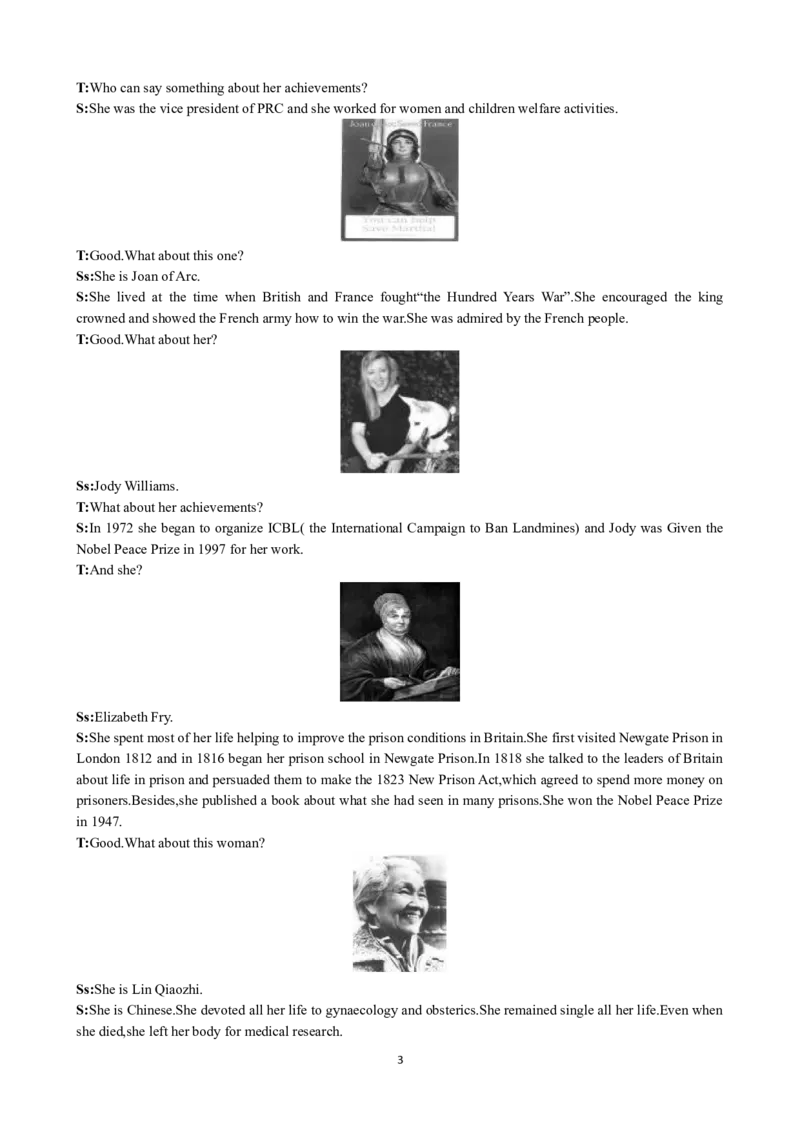
T:Who is she?
Ss:Song Qingling.
2T:Who can say something about her achievements?
S:She was the vice president of PRC and she worked for women and children welfare activities.
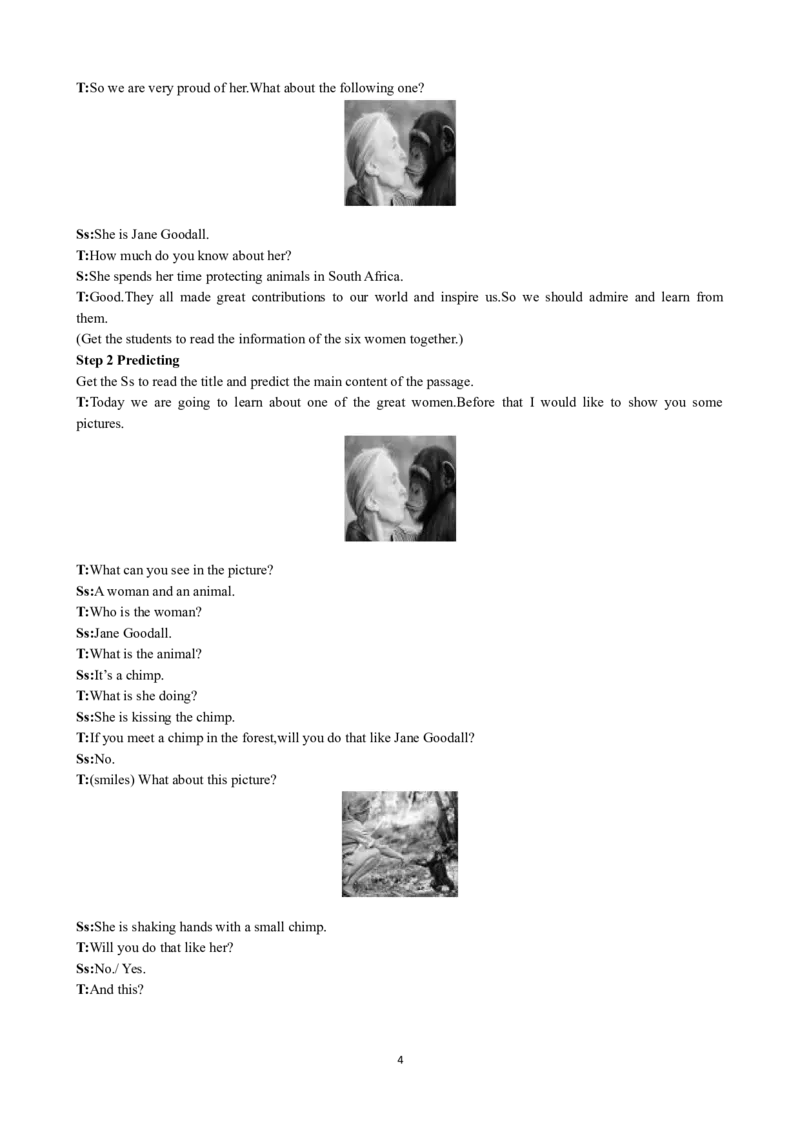
T:Good.What about this one?
Ss:She is Joan of Arc.
S:She lived at the time when British and France fought“the Hundred Years War”.She encouraged the king
crowned and showed the French army how to win the war.She was admired by the French people.
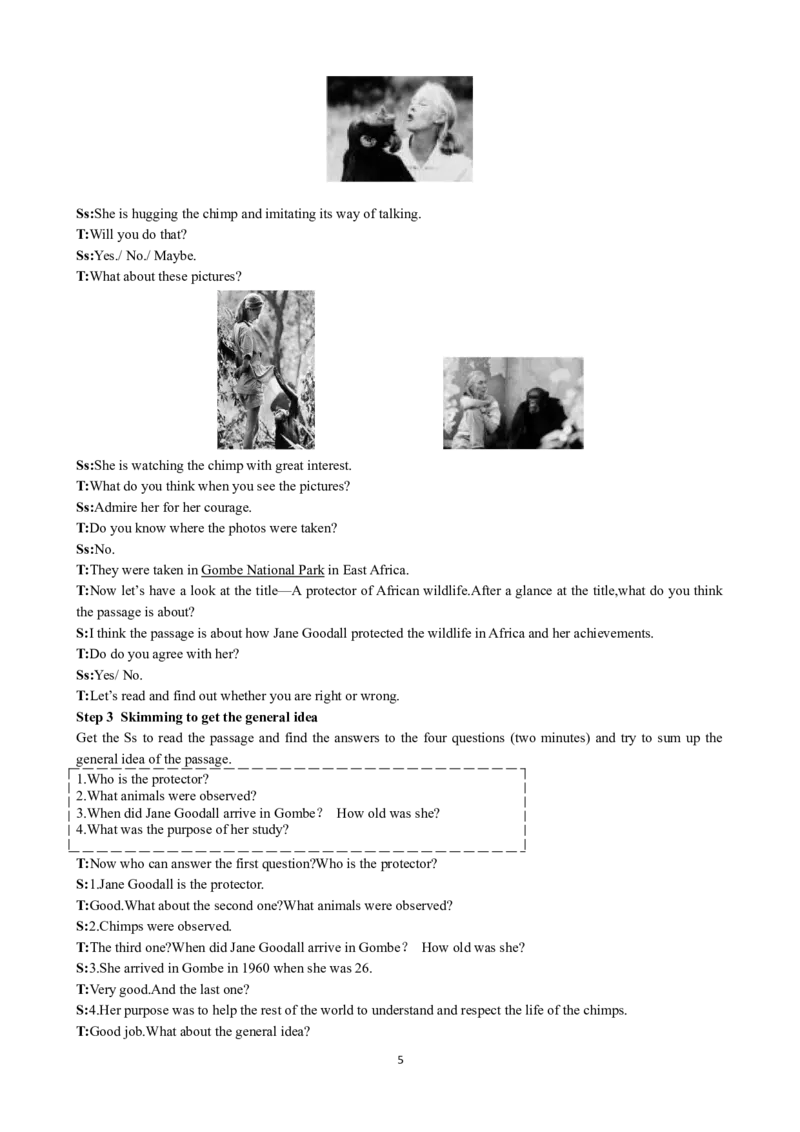
T:Good.What about her?
Ss:Jody Williams.
T:What about her achievements?
S:In 1972 she began to organize ICBL( the International Campaign to Ban Landmines) and Jody was Given the
Nobel Peace Prize in 1997 for her work.
T:And she?
Ss:Elizabeth Fry.
S:She spent most of her life helping to improve the prison conditions in Britain.She first visited Newgate Prison in
London 1812 and in 1816 began her prison school in Newgate Prison.In 1818 she talked to the leaders of Britain
about life in prison and persuaded them to make the 1823 New Prison Act,which agreed to spend more money on
prisoners.Besides,she published a book about what she had seen in many prisons.She won the Nobel Peace Prize
in 1947.
T:Good.What about this woman?
Ss:She is Lin Qiaozhi.
S:She is Chinese.She devoted all her life to gynaecology and obsterics.She remained single all her life.Even when
she died,she left her body for medical research.
3T:So we are very proud of her.What about the following one?
Ss:She is Jane Goodall.
T:How much do you know about her?
S:She spends her time protecting animals in South Africa.
T:Good.They all made great contributions to our world and inspire us.So we should admire and learn from
them.
(Get the students to read the information of the six women together.)
Step 2 Predicting
Get the Ss to read the title and predict the main content of the passage.
T:Today we are going to learn about one of the great women.Before that I would like to show you some
pictures.
T:What can you see in the picture?
Ss:A woman and an animal.
T:Who is the woman?
Ss:Jane Goodall.
T:What is the animal?
Ss:It’s a chimp.
T:What is she doing?
Ss:She is kissing the chimp.
T:If you meet a chimp in the forest,will you do that like Jane Goodall?
Ss:No.
T:(smiles) What about this picture?
Ss:She is shaking hands with a small chimp.
T:Will you do that like her?
Ss:No./ Yes.
T:And this?
4Ss:She is hugging the chimp and imitating its way of talking.
T:Will you do that?
Ss:Yes./ No./ Maybe.
T:What about these pictures?
Ss:She is watching the chimp with great interest.
T:What do you think when you see the pictures?
Ss:Admire her for her courage.
T:Do you know where the photos were taken?
Ss:No.
T:They were taken in Gombe National Park in East Africa.
T:Now let’s have a look at the title—A protector of African wildlife.After a glance at the title,what do you think
the passage is about?
S:I think the passage is about how Jane Goodall protected the wildlife in Africa and her achievements.
T:Do do you agree with her?
Ss:Yes/ No.
T:Let’s read and find out whether you are right or wrong.
Step 3 Skimming to get the general idea
Get the Ss to read the passage and find the answers to the four questions (two minutes) and try to sum up the
general idea of the passage.
1.Who is the protector?
2.What animals were observed?
3.When did Jane Goodall arrive in Gombe? How old was she?
4.What was the purpose of her study?
T:Now who can answer the first question?Who is the protector?
S:1.Jane Goodall is the protector.
T:Good.What about the second one?What animals were observed?
S:2.Chimps were observed.
T:The third one?When did Jane Goodall arrive in Gombe? How old was she?
S:3.She arrived in Gombe in 1960 when she was 26.
T:Very good.And the last one?
S:4.Her purpose was to help the rest of the world to understand and respect the life of the chimps.
T:Good job.What about the general idea?
5S:The passage is mainly about how Jane Goodle worked with chimps in their environment and helped people
understand and respect the life of these animals.
T:Wonderful job.So did you get the right prediction?
Ss:Yes.
Step 4 Main ideas
Get the students to read the whole passage and sum up the main idea of each paragraph.At the same time,instruct
them the way of finding or summing up the main idea.
T:Now we have a rough idea about the passage.How will the writer introduce Jane Goodall’s story to us?How will
she organize the passage?I would like you to read the story carefully and sum up the main idea of each
paragraph.How can we sum up the main idea easily?
S:Try to see whether there are any topic sentences,which are usually at the beginning or the end of a paragraph.If
there are not any topic sentences,try to sum up the main idea according to the content of the paragraph.
T:Good.Now read the passage and try to find out the main ideas.
(after 4 minutes)
T:How many paragraphs are there in the passage?
Ss:Four.
T:What are the main ideas of them?
S:1.The first paragraph is about a day in the Combe National Park.
S:2.The second paragraph tells us Jane’s way to study chimps and her achievements.
S:3.The third paragraph tells us her attitude to the animals.
S:4.The last paragraph is a short summary of the whole passage,telling us that she has achieved everything she
wanted to do.
T:Wonderful job.
Step 5 Scanning
Get the students to read the whole passage to get some detailed information.
T:Now we have formed an overview of the whole passage.Next I would like you to read and get more information
about Jane Goodall.Please try to find out the answers to the following questions.If there are some sentences that
you cannot understand,put them down and we shall solve your problems later.
1.What did the group do in the morning in the
forest?
2.Where did Jane Goodall suggest that the chimps
be left?
3.What did she achieve?
T:(four minutes later) Now who can answer the questions?
S:1.They watched the chimps wake up in the morning in the forest.
S:2.She suggested the chimps should be left in the wild.
S:3.She discovered that chimps hunt and eat meat,how chimps communicate with each other and worked out their
social system.
(Not all the students can find the answer to the third question,or some of them can only find part of the
answers.The teacher should instruct them the way of finding them accurately.First get them to find the possible
sentences where the answer lies—“For example,one thing she discovered was that chimps hunt and eat meat...She
also discovered how chimps communicate with each other and her study of their body language helped her work
out their social system.” Remind them to pay attention to the transitional words like“one thing”,“also” and
“and”.)
Step 6 Competition (True or False consolidation exercises)
Divide the students into four groups.Each student tries to tell whether the statements are true or false as soon
as possible in order to gain points for their group.If he tells the right answer,he shall get one point.If the statement
6is wrong and he can tell the reason,he gets double of the point.The group that get the highest points shall be the
winners and get some prizes.
1.With university training,she has achieved what she wanted.
2.The chimps show love in their family by talking with each
other.
3.She hopes that chimps can be left in the zoo.
4.She supposes that people should not use chimps for
entertainment.
5.She has spent more than forty years helping people understand
her work.
6.She has not built homes for the wild animals to live in.
KeyS:
1.False.Because she did not study at a university to get any university training.She achieved what she wanted
without getting any formal university training.
2.False.The chimps show love to each other by either feeding or cleaning each other.
3.False.Jane Goodall has argued for the chimps to be left in the wild and not used for entertainment.
4.True.
5.True.
6.False.Because she has set up special places where the chimps can live safely.
T:Good job.So we can see you have a good understanding of Jane Goodall’s life.Do you think Jane Goodall was
brave to go and live in the forest?
Ss:Yes.
T:Would you have done what she did if you had the chance?
Ss share their views.
T:What can we learn from Jane Goodall?
S:We should show true love to others,as well as to animals.Everything is equal,no matter what they are.It isn’t
because we are human beings that we are superior to the animals.We don’t have the right to control the other
living things on the earth.They are our friends and relatives.The only difference is that we have different
appearances and different intelligence.Only if we show true love towards them can we make the world a better
one.
S:I admire her for her belief and personality.
Step 7 Story retelling
Divide the students into groups of four and get them to choose a slip of paper on which their characters are
designed( for example,suppose you are Jane Goodall/ Jane Goodall’s colleague/ Jane Goodall’s mother etc.).Get
them to discuss and retell the passage.Try to describe what she thinks.Among the four students,one should be
chosen to make a record and give a report.
Step 8 Language points focus
1.The students raise questions about the passage and the others try to answer the questions.When necessary,the
teacher helps to illustrate.
2.The students find the important words,phrases and structures from the reading and the teacher explains.Try to
use effective examples to illustrate the points.After illustration,teacher can give the students some exercises to
consolidate their understanding.
Step 9 Debate
After the explanation of the language points,the students have got the total understanding of the reading
text.Then the teacher draws the students’ attention back to the text and puts forward a topic for them to
discuss.Divide the students into two groups— boys and girls and let them debate with each other about the
topic:Women are able to do more than men.The girls are for the idea while the boys are against the idea.Each
group tries to think of as many arguments as possible to defeat the other side.After their debate,get some students
7to give their report for their groups.
Step 10 Summary and homework
T:Time is running out.Today we learned about Jane Goodall’s story and we have learnt a lot from her.Our world
will become a more beautiful one if we all treat the animals equally and show our love to them.We will succeed in
overcoming any difficulties and achieving our goals if we can be as strong-willed as her.
Homework:
1.Read the passage fluently and recite the key sentences in the text.
2.Retell the story of Jane Goodall.
3.Finish the word exerciseS:Ex 1,2&3 on Page 4 and Ex 4 on Page 5.
The Design of the Writing on the Blackboard
Unit 1 Period 1 A protector of African wildlife
Language Focus
1.behave
(1)vi.to act;bear oneself 行为;举止
(2)vt.& vi.to bear (oneself) in a socially accepted or polite way
举止适当或有礼
(3)vi.(of things) to act in a particular way
(指事物)有某种作用
2.worthwhile adj.值得的 可作定语和表语
be worthy of +n.
be worthy to be done
3.花费 spend Sb.spend sth.(on sth.)/ (in) doing sth.
pay Sb.pay some money for sth.
cost Sth.cost sb.some money
take It takes sb....to do sth.
4.observe
(1)vi.&vt. to notice/ watch carefully 观察,注意到
observe+n./pron.
observe sb.doing/do sth.
observe +that-clause
(2)vt. to obey;to act in accordance with 遵守,顺从
(3)vt. to hold or celebrate 举行(仪式等),庆祝(节日等)
5.Only+状语+ 部分倒装 “只有……才”
6.现在完成进行时 have/ has been doing
7.argue (vi.) +with sb.about/over sth.同某人辩论某事
argue (vt.)+n./clause(从句)/sb.to be...
8.support 1) 支持 2)承受 3) 供养
Record after Teaching
Activities and Research
This unit is about important and great women.The students may not know a lot about them,which might
make the talking of the topic quite boring and difficult.In order to arouse their interest and creation,one activity
about women of achievement is designed.
Divide the students into groups of four.Assign each group to cooperate with their group mates to do some
research on a certain woman of achievement.They are to find as much information as possible and as many
pictures as possible by reading books,surfing the Internet or even doing an interview.They are to find out in the
8project the woman’s appearance,qualities and achievements,etc.
Get the students to arrange what they have found in a well-organized order and make the information into a
courseware or a web page,with clear and vivid pictures and examples to illustrate each point.
Have the students share their courseware or web pages.
Have the students write a report (entitled with“...,a woman of achievement”) on how they have carried out
the research and what they have found.
Show their reports on the walls,sharing them with the class.
Reference for Teaching
Background Information
Women of Achievement
1.Mother Teresa(1910-1997)
Mother Teresa founded the Missionaries of Charity in 1948.Through it,she has dedicated her life to helping
the poor,the sick and the dying around the world,particularly those in India.She founded the Kalighat Home for
the Dying and a leper colony was established under her guidance.Her selfless work has brought her many
awards,including the Nobel Peace Prize in 1979.
2.Madame Curie (1867-1934 )
Marie Curie,a great woman scientist,was born in Poland in 1867.From her early childhood Marie loved to
study and hoped to become a scientist.Her interest in science was encouraged by her father,a teacher of physics.
In 1891,she left Poland for France and entered the University of Paris.Four years later,she graduated with the
highest grade in her class.After graduation she remained in the same university,doing scientific research work.In
order to discover something that gave off a kind of radiation,she did experiments most carefully again and
again.She failed many times,but she didn’ t lose heart.Finally in 1902,she,together with her husband,succeeded in
finding the radioactive element— radium.Owing to their achievement,the Curies received the Nobel Prize in
Physics in 1903.
In 1911,she won another Nobel Prize,this time all by herself in chemistry and thus she became the first
woman scientist to win a Nobel awards.
She died in 1934,obviously as a result of the effects of the radiations with which she worked for over 30
years.
3.Elizabeth Fry ( May 21,1780-October 12,1845)
Elizabeth Fry was a prison reformer,social reformer and philanthropist.She was born in a Quaker family on
May 21,1780.She took an interest in her teenager years in the poor,the sick,and the prisoners.In 1812 she first
visited Newgate Prison in London and was very shocked at the conditions she found there.From then on she began
to work to improve prison conditions in Britain.She supplied the women of Newgate Prison with clothes and
established a school and a chapel.In 1817 Elizabeth Fry and eleven others,formed the Association for the
Improvement of the Female Prisoners in Newgate.The next year she was invited to give evidence to a House of
Commons Committee on London Prisons.She described in detail the lives of the prisoners,and recommended that
women prisoners should be looked after by women instead of men,and stressed her belief in the importance of
useful employment.By the 1820s Elizabeth Fry and her work had become very well known in Britain.She faced
criticism and problems at various times.Elizabeth Fry’s work was very important because it started the movement
for prison improvement.Her idea was that people in prison could not change their ways and lead useful lives if
you did not give them a legal way of earning money.She aimed at changing the prisoners by educating them and
changing the way they were treated.Her work was mentioned as one of the reasons that the Quakers got the Nobel
Peace Prize in 1947 and she was remembered in Britain by being put on the new five pound note in 2000.
4.Soong Chingling (1893-1981)
Soong Chingling was one of the Soong sisters,also known as Madame Sun Yet-sen.She was born into a rich
Christian family which played an important role in Chinese politics in the first half of the 20th century.She and her
9two sisters had a good education.She went to study in Georgia,USA.In 1915 she married Dr Sun Yat-sen,founder
of the Republic of China.
After Sun’s death in 1925,she was elected to the Kuomingtang Central Executive Committee in 1926.After
the establishment of the People’s Republic of China,she became the Vice president of the People’s Republic of
China,head of the Sino-Soviet Friendship Association and Honorary President of the All-China Women’s
Federation.In 1951 she was awarded the Satlin Peace Prize.From 1968 to 1972 she acted jointly with Dong Biwu
as head of state.
On May 16,1981,two weeks before her death,she was admitted to the Communist Party and was named
Honorary President of the People’s Republic of China.
5.Jane Goodall
Jane Goodall was appointed peace messenger of the United Nations(联合国和平使者) on April
16,2002.She was famous for her creative work started 42 years ago in protecting chimpanzees in
Tanzania.Goodall went to Tanzania and studied chimps from the 1960s.She went with three African helpers (and
her mother for the first month) to live in the Gombe National Park in East Africa.She made friends with the local
African people after setting up a clinic to help cure minor illnesses.Her life was spent following and recording the
social life and relationships of the chimps.Her supplies and the care of her base camp were managed by her
African helpers.Jane uncovered many aspects of chimpanzee behaviour during her first years in the Gombe
National Park.Because of her research,we now know that chimpanzees hunt for meat,use tools,and have different
personalities.
In 1965,Jane earned her PhD in Ethology from Cambridge University.Soon she returned to Tanzania to
continue her research and to establish a research center.Later,she became the Scientific Director of the Gombe
Stream Research Centre,Tanzania.In 1977,Jane founded the Jane Goodall Institute for Wildlife
Research,Education and Conservation,USA to provide support for field research on wild chimps and encourage
wildlife research.
6.Jody Williams (1950- USA)
Jody Williams was born in the United States in 1950.After she got her Master’s degree of Arts,she went to
work for two years as a language teacher in Mexico,where she for the first time saw the miserable life of the
poor.She has worked for many years to help people in South America by organizing medical care (Medical Aid for
El Salvador) and education (Nicaragua-Honduras Education Project).In 1992 she began to organize the
International Campaign to Ban Landmines (ICBL).As an ICBL coordinator,she has written and spoken
extensively on the problem of landmines and the movement to ban them.She worked with groups in different
countries.In 1992 she was working with six groups but by 1997 more than 1000 groups from over sixty countries
had joined ICBL.Although the organization became very large,the friendly way of organizing ICBL continued and
has proved very successful.Working in a unprecedented cooperative way with governments and other international
groups,the ICBL achieved its goal of an international treaty banning landmines during the diplomatic conference
held in Oslo in September 1997.In 1997 ICBL was given the Nobel Peace Prize and the work of Jody Williams
was recognized and rewarded.She still works for ICBL today.
7.Joan of Arc (1412-1431)
Joan of Arc was born in the small village of Domremy in France.She lived at the time when there was a war
between England and France called “The Hundred Years War”.Joan of Arc was important because she encouraged
the old French king’s son,the Dauphin,to be crowned in Rheims as the only King of France.The French people
accepted him as the true king of France.Joan also showed the French army how to win battles and inspired them
with the confidence to win.So Joan of Arc began the process by which the English left France and it became a
country in its own right.
At the time Joan lived it was considered wrong for women to fight in the army.But Joan argued that God had
spoken to her and sent her to help the French army.She said God had spoken to her through two messengers and
10they had encouraged her in her mission.When she was captured by the English,they did not believe her stories of
the messengers from God and criticized her for fighting and wearing men’s clothes.After a trial she was put to
death.She was very patriotic and did inspire the French to win against the English.She showed how brave she was
by what she did just like Hua Mulan in China.
8.Lin Qiaozhi (1901-1983)
Lin Qiaozhi was born in Xiamen in Fujian Province.Her parents were Christians and her father worked at a
university of Singapore.He believed in the education of women.Lin Qiaozhi’s mother died when she was five and
she went to live with her brother and his family.They fulfilled their father’s wishes by supporting her education
even when they could no longer support the education of their own children.At elementary school one of her
teachers noticed how quick and neat her knitting was and encouraged her to become a doctor.
1921 She entered the Peking Union Medical College.
1929 She graduated from the University with a PhD degree in gynaecology.
1932 She went to London University Medical School and Manchester University Medical School for further
studies.
1933 She studied in Vienna and then returned to China to work for women and children’s diseases.
1933 She studied abroad in the USA at the Chicago University Medical School.
1940 She returned to China as the Head of Gynaecology and ObstetricS:the first female head of such a
department.
1941 War between Japan and the USA forced the hospital to close so she opened a private hospital in the
hutongs for patients.After the war she returned to the hospital when it reopened.
1949 After the Liberation she went to study diseases of women in the countryside and wrote a book to help
them keep their babies healthy.She was very important in inspiring women to become doctors and was one of the
founders of modern gynaecology in China.She did important research and used the methods she had learned
abroad to improve Chinese medicine.
1983 She died leaving her body for medical research.Her work was recognized when on the 100th
anniversary of her birth a copper statue to honour her was placed in the Great Hall of the People,Beijing.
Language Points
1.Jane has studied these animals for many years and helped people understand how much they behave
like humans.
简已经研究它们很多年了,她帮助人们了解了黑猩猩跟人类的行为是多么的相似。
behave
(1)vi.to act;bear oneself 行为;举止
她表现出了很大的勇气。She behaved with great courage.
他对顾客的态度不好。He __________ to the customers.(behaved badly)
(2)vt.&vi.to bear (oneself) in a socially accepted or polite way举止适当或有礼
你应该学会举止得体。You should __________.(learn to behave)
(3)vi.(of things) to act in a particular way
(指事物)有某种作用
我的摄像机自从修好后一直很正常。
My camera __________ (has been behaving well) since it was repaired.
2.This means going back to a place where we left the chimp family sleeping in a tree the night before.
这意味着我们要返回我们前一天晚上我们离开时黑猩猩睡觉的大树旁。
动名词
百闻不如一见。Seeing is believing.
他喜欢在余暇听音乐。He __________ (enjoys listening to music) in his spare time.
他现在正在游泳池里练习游泳。He __________ in the swimming pool now.(is practising swimming)
113.But the evening makes it all worthwhile.
但是到傍晚时候我们觉得这一切都是值得的。
worthwhile adj.值得的 可作定语和表语
a worthwhile experiment/job
The experiment is worthwhile.
It is worthwhile to do sth./doing sth.
It is worthwhile to do the job/ doing the job.
比较worth prep./n.
be worth (doing) sth.常主动表被动
这本书很值得一读。
The book is _________.(well worth reading)
= It is worthwhile to read the book.
比较:worthy
be worthy of doing sth.
be worthy to to be done
这本书很值得一读。
The book is _________.(well worthy of being read)= The book is worthy to be read.
4.Jane spent many years observing and recording their daily activities.
简花了多年时间来观察和纪录黑猩猩的日常活动。
spend vt.用(钱);花(钱)
你暑假怎么打发?How will _________ (you spend your summer holiday)?
他把钱都花光了。 He has spent all his money.
他将全部积蓄花在一辆新车上。He spent all his savings on a new car.
花费 spend Sb.spend sth.(on sth.)/ (in) doing sth.
pay Sb.pay some money for sth.
cost Sth.cost sb.some money
take It takes sb....to do sth.
He _________ (spent)about a third of his salary in drinking.
She _________ (paid) 3000 dollars for the dress.
The DVD _________ (cost) her 150 yuan.
It _________ (took) him ten days to finish the work.
5.observe
(1)vi.&vt.to notice/ watch carefully 观察,注意到
observe + n./pron.
observe sb.doing/do sth.
observe +that-clause
这位科学家一生都在观察星星。The scientist has observed the stars all his life.
我看到一个陌生人进了、正在进办公室。
I observed a stranger go/going into the office.
我注意到班上有几个学生睡着了。
I observed that several students were asleep in class.
(2)vt.to obey;to act in accordance with 遵守,顺从
我们必须遵守交通规则。We must _________ ( observe the traffic rules).
(3)vt.to hold or celebrate 举行(仪式等),庆祝(节日等)
你们国家的人庆祝圣诞节吗?
Do you _________ in your country?(observe Christmas Day)
126.Only after her mother came to help her for the first few months was she allowed to begin her
project.
她母亲头几个月来帮忙,这才使得她得以开展自己的计划。
Only+状语+部分倒装 “只有……才”
Exercise:
只有这样,我们才能学好英语。Only in this way _________(can we learn English well).
到那时我才意识到我的错误。Only then _________(did I realize my mistakes).
只有你了解我。Only you _________(understand me).
但Only+主语时不倒装
Multiple choice
1) I failed in the final examination last term and only then _________ the importance of studies.(D)
A.I realized B.I had realized
C.had I realized D.did I realize
2)It was _________ back home after the experiment.(C)
A.not until midnight did he go B.until midnight that he didn’t go
C.not until midnight that he went D.until midnight when he didn’t go
7.For forty years Jane Goodall has been helping the rest of the world understand and respect the life of
these animals.
40年来,简·古多尔帮助世人了解并尊重这些动物的生活。
现在完成进行时 have/ has been doing
表示过去某一时刻开始的动作或状态一直持续到现在,甚至到将来,强调进行的过程或表示到现在为止
的一段时间内一再反复进行的动作或存在的状态。
He has been lying in bed for two weeks.
译:他已经卧床两周了。(现在还躺着)
Exercise:
他累了。一天来他一直在学习。(现在还在学习)
He is tired.He has been studying all day.
这些天他不断地给我们的杂志写文章。
All these days _________ to our magazine.(he has been writing)
几个月以来,汤姆每天晚间都给艾丽斯打电话。
Tom _________ for several months.( has been phoning Alice every night)
Multiple choice:
1)Now that she is out of a job,Lucy _________ going back to school,but she hasn’t decided yet.(B)
A.had considered B.has been considering
C.considered D.is going to consider
2) He went to Beijing in 1990 and _________ there ever since.(B)
A.is working B.has been working
C.works D.worked
8.She has argued for them to be left in the wild and not used for entertainment or advertisement.
她一直主张他们应该留在野外生活,而不是为娱乐和广告所利用。
argue (vi.) +with sb.about/over sth.同某人辩论某事
They are arguing with their classmates about the solution to the problem.
They are arguing with each other about the justice of the war.
argue (vt.)+n./clause(从句)/sb.to be...
We argued that we should be paid more.
The way he spends money argues him to be rich.
13argue for/against 为、为反对……而辩论
The workers argued for the right to strike.
Some people argue against free trade.
9.She inspires those who want to cheer the achievements of women.
她激励着人们为妇女的成就而欢呼喝彩。
inspire= encourage
inspired/inspiring adj.
inspiration n.
eg:She was an inspiration to all of us.
Her _________ speech yesterday made us _________.We are determined to learn from her and try to do our
job better.(inspiring,inspired)
Multiple choice:
He was an _________ poet at that time and his _________ poems spread through all the country.(D)
A.inspired;inspired B.inspiring;inspired
C.inspired;inspiring D.inspiring;inspiring
10.Her mother came to support her.
她母亲来支持她。
support 1) 支持 2)承受 3) 供养
I wonder if the Americans support the new political party.
I think it’s important to support local businesses.
That bench won’t support four people.
Translation:
The old man supports himself with a stick.
那位老人拄着手杖。
He support a big family.
他支撑着一个大家庭。
He can support himself after graduation from college.
他大学毕业后就能自力谋生。
Period 2 Learning about Language
The General Idea of This Period
This period help will consolidate the words and expressions the students learnt in the reading part and deal
with the grammar part:word formation and subject-verb agreement.Systematic explanation shall be given and
some exercises shall be assigned for the students to complete to consolidate their knowledge on them.
Teaching Important Points
Noun suffixes in word formation.
Subject-verb agreement rules,especially of collective nouns.
Teaching Difficulties
Noun suffixes in word formation.
Subject-verb agreement rules,especially of collective nouns.
Teaching Method
Recognize the rules independently and practice.
Teaching Aids
A multi-media computer.
A blackboard.
Three Dimensional Teaching Aims
Knowledge and Skills
14Enable the students to recognize and learn by heart the useful words and expressions learnt in the Reading
part.(behave,behavior,respect,achieve,achievement,connect,connection,inspire,
worthwhile,observe,observation,condition,argue,entertainment,communicate,communication etc.)
Enable the students to grasp some rules of word formation to enlarge their vocabulary or guess the meanings
of some new words by recognizing some suffixes such as -tion,-ion,-ment,-ist,-er and -or etc.
Enable the students to apply the subject-verb agreement correctly.
Process and Strategies
Systematic explanation to make the students know how to apply the subject-verb agreement correctly.
Feelings and Value
Through the study of this period the students are sure to have a better understanding of the subject-verb
agreement.
Teaching Procedures
Step 1 Revision
1.Revise the content of the reading passage by asking the students some questions.
T:Good morning,boys and girls!Last class we talked about some great women in the world,remember?
Ss:Yes.
T:If I want to become a great woman,what is most important?
Ss:You should be unselfish and willing to sacrifice and make contributions to the society.
T:Good.Yesterday we talked about one of the great women and her life.Who is the great woman?
Ss:Jane Goodall.
T:What did she do?
S:She protected the wildlife in Africa.
S:She studied chimps and helped people understand chimp behavior and respect the lives of chimps.
T:Right.Did she have to spend a lot of time achieving her goal?
Ss:Yes.She has been doing that for forty years.
T:With hard work,what did she discovered?
S:She discovered that chimps hunt and eat meat.
S:She discovered how chimps communicate with each other.
S:She worked out their social system with the help of their body language.
T:Wonderful job.Do you admire her?
Ss:Of course.We will all follow her example and make ourselves useful persons.
2.Check the assigned homework.
T:Yesterday,you were expected to complete the exercises independently in Discovering useful words and
expressions.Have you finished?
Ss:Yes.
T:Good.Now let’s check the answers.Please turn to Page 4.Let’s have a look at exercise 2 first.
Now let’s check the answers.
(Ask some students to the blackboard to write down their answers,then ask the other students to correct.)
In the same way,check exercises 3 and 4.
Step 2 Noun suffixes in word formation
1.Brainstorm word formation
T:We know that Jane Goodall has done a lot for the chimps.She has argued for the chimps to be left in the
wild.That is to say,what has she made for the chimps to be left in the wild?
Ss:Arguments.She has made arguments for the chimps to be left in the wild.
T:(writes argue and argument on the blackboard and underlines -ment) Good.She did a lot and finally achieved
her goal.That is to say,she made...?
15Ss:She made achievements.
T:(writes achieve and achievement on the black board and underlines -ment) Good.
Now let’s have a look at the blackboard.Can you see anything in common in the two pairs of words?
S:Yes.The noun “argument” comes from the verb “argue”,adding “-ment”.The noun “achievement” comes from
the verb “achieve”,adding “-ment” too.We can see “-ment” can be added to a verb to make a noun.
T:Very good.You have very keen eyes.This way to form a new word is called word formation.Here,“-ment” is
called a suffix,which can be added to another word to form a new word.Do you want to know more about
suffixes?
Ss:Yes.
T:OK.Today we will talk about suffixes which can make another word into a noun.We call them noun suffixes.
2.Introducing more noun suffixes.
T:Now please have a look at the screen.Here are some groups of verbs.Say their meanings,please.
(Ss say the meanings of the verbs.)
organize determine
discuss examine
decide educate
direct
T:Good.What about their nouns?Can you tell me?
Ss:(say the nouns)
organization determination
discussion
direction education
decision
T:What is in common among these words?
Ss:Suffix “-ion”,“-tion”,“-sion” or “-ation” is added to the verb to make a noun.
T:Very good.So we can see “-ion”,“-tion”,“-sion” and “-ation” are some of the noun suffixes.Do you know more
suffixes?Can you give me some examples?
S:Let me have a try.If I feel bad,that is to say,I have a feeling which is bad.If the word means right,that is to say
the word have the meaning which is right.So we can see,“-ing” is also a noun suffix.
T:(writes “feel”,“feeling”,“mean” and“meaning” on the blackboard and underlines “-ing”)Terrific job.Are there
any other nouns with “ -ing”?
Ss:Warning,finding etc.
T:Who else will say something about other suffixes?
S:You teach us English.That is to say,you are our English teacher.“-er” is a noun suffix.
T:Good.Any more examples with “-er”?
Ss:Writer,organizer etc.
T:(writes down “-er” on the blackboard) What about other noun suffixes?
S:Thomas Edison invented the way of giving electricity.He was an inventor.“-or” is a noun suffix for a
person.Another example is “sailor”from “sail”.
T:(writes down “-or” on the blackboard) Right.
S:I remember one more suffix for a person.For example,Yang Zhenning has made great contributions to the field
of science.He is a scientist.“-ist” is a suffix for a person.
T:(writes down “ ist” on the blackboard) Good job.In fact we have one more suffix for a person.For example,if I
interview you,you are my interviewee.“-ee”means a person too.( writes down “-ee” on the blackboard)
3.Practice
161)Check exercise 1 on Page 4.Show the table on the screen and get the students to say the answers aloud in chorus
so that everyone will be aware of the suffixes.If they have any questions,give further explanation.
2)Show some more words on the screen and get the students to guess their meanings according to the rules of
word formation.They should be able to tell their meanings at the first sight.Instruct them to find out the root first
and then guess the meanings of the words,taking the suffixes into consideration.
pianist,typist,physicist,educationalist
protection,imagination,separation,education
punishment,management,statement,requirement,entertainment,
payment
prisoner,adviser,lecturer,climber
4.Summary
T:Now we can see it is not really difficult to remember words as long as we master some rules.With the
knowledge of word formation,we can enlarge our vocabulary.Today,we focus our attention on the Noun Suffix.In
fact there are much more suffixes in English,later we will come across some of them.
Step 3 Discovering useful structures (Subject-verb agreement)
1.Brainstorm Subject-verb agreement by giving simple examples.
T:Now watch me.What am I doing?(draws a picture on the blackboard)
Ss:You are drawing on the blackboard.
T:Yes.The teacher is drawing on the blackboard.(Writes the sentence “The teacher is drawing on the blackboard”.)
What about you?What are you doing?
Ss:We are watching and listening to you.
T:(Writes the sentence “We are watching and listening to you.”)
The teacher is drawing on the blackboard.
We are watching and listening to you.
Now please have a look at these two sentences.Can we say the teacher are drawing or we is watching and listening
to the teacher?
Ss:No.
T:Why?
Ss:There are some rules for us to follow when we write sentences.
T:You are right.When we write a sentence the predicate should agree with the subject,which is called subject-verb
agreement.If we can not apply the rules correctly,we might not get ourselves understood.
2.Instruct the students to discover the rules for subject-verb agreement.
T:There are three main principles for us to follow.语法一致 就近一致 意义一致
Show the students some sentences and get them to complete the sentences by filling in the predicate.Get them to
observe the sentences and sum up the rules.
T:Now please look at the screen and complete the sentences by filling in the blanks.
A boy _________ sitting there.(be)
Water _________ important to us.(be)
S:Both the two blanks should be filled in “is”.
T:Is he right?
Ss:Yes.
T:Now observe the sentences.Can you sum up one rule according to the two sentences?
S:Let me have a try.When the subject is a noun in single form or is an abstract noun,the predicate should be in
single form.
T:Very good.
After being introduced to the rules,the students are asked to finish exercise 1 on Page 5.Here are the exercises
with keys.
171.The family is (be) very big.
The family are (be) early risers.
2.This class has (have) eighteen girls and twenty-five boys.
This class are (be) very bright,especially in science subjects.
3.The government is (be) made up of six high officials.
The government were (be) having an important meeting when I got there.
4.It was late,but the audience was (be) still entering the hall.
The audience were (be) dressed in different ways.
When the students are doing the exercises,the teacher leads them to pay more attention to the second and third
groups of rules.
3.Consolidation
1) Get the students to do exercises 2 on Page 5.
Dear Xiaoyu,
I think everyone is (is/are) settled in London,although neither the weather nor the food is(is/are) good.Either
rain or snow fell every day this week but everybody has (has/ have) tried to ignore it.My friends and my mother
have(has/have) visited the theatre almost every night.None of them carries(carry/carries) an umbrella but nobody
has(has/have) let that affect their activities.We are enjoying ourselves so much that I wonder if anybody
wants(want/wants)to come home.This group of tourists love (love/loves) the culture and is (is/are) happy in
England and would like to visit London every summer!
See you soon,
Dong Xianshun
2)Divide the students into four groups and have a competition.The group that gets the most points will be the
winners.
1.The whole family _________ (be)watching TV.(are)
2.Five minutes _________ (be) enough to do this exercise.( is)
3.The news _________ (be)exciting.(was/is)
4.The number of errors _________ (be)surprising.(was/ is)
5.The crowd _________ (be)running for their lives.(are)
6.Either your students or Mr.Wang _________ (know) this.(knows)
7.The police _________ the murderer everywhere when he suddenly appeared in a theatre.(B)
A.is searching for
B.were searching for
C.are searching for
D.were searching
8.The teacher,with 6 girls and 8 boys of her class, _________ visiting a museum when the earthquake struck.
(A)
A.was B.were
C.had been D.would be
Step 4 Homework
1.Page 43 Ex 1 Choose the best answers for the blanks.
2.Page 44 Ex 2 Choose the right words and complete the short texts.
3.Surf the Internet to find as much information as possible about Lin Qiaozhi.
T:That’s all for this class,after class I hope you’ll prepare for the Speaking and Writing part,and finish the
exercises on your exercise books.
18