Unit 1 Friendship
(1) 课题:Friendship
(2) 教材分析与学生分析: 本单元的中心话题是“友谊”,几乎所有的内容都是围绕这一中
心话题展开的。Warming Up部分以调查问卷的形式引导学生了解日常生活中朋友之间
发生的真实问题以及解决这些问题的方法;Pre-Reading部分的几个问题启发学生对“友
谊”和“朋友”进行思考,使学生明确不仅人与人之间可以做朋友,日记也可以成为人
们的朋友;Reading部分Anne’s Best Friend以日记形式讲述了犹太女孩安妮的故事;
Comprehending部分通过连句、多项选择和问答形式帮助学生对课文内容、细节进行更深
入的理解; Using about Language 部分教学本课重点词汇和重点语法项目。
(3) 课时安排:The first period: Speaking: Warming Up and Pre-Reading
The second period: Reading
The third period: Grammar
The forth Period:Listening
The fifth period: Writing
(4)教学目标:榆林教学资源网
① 知识与技能:Talk about friends and friendship; Practise talking about
agreement and disagreement, giving advice and making decisions; Use
direct speech and indirect speech; Learn to write an essay to express
and support an opinion.
② 过程与方法:本单元在读前阶段就提出问题,让学生思考是不是只有人与人之间才
能交朋友,然后在阅读中通过安妮的日记向学生说明我们也可以与动物及无生命的
日记交朋友。在深刻理解、充分训练的基础上,可以再引导学生深入讨论几个与本单
元话题有关的问题:1.描述朋友; 2. 结交网友;3. 观点交流;4. 善\不善交朋友;
5. 朋友的重要性。
③ 情感态度与价值观:学完本单元后要求学生进行自我评价,主要评价自己在本单元
中的学习情况。对书中的内容是否感兴趣,有哪些收获,解决了什么问题。使学生加
深对友谊、友情的理解,以及如何正确交友,处理朋友之间发生的问题等。
(5) 教学重点和难点:
词汇:add point upset ignore calm concern cheat share reason list
series crazy nature purpose dare thunder entirely power
according trust suffer advice situation communicate habit
短语: add up calm down have got to be concerned about go through
hide away set down on purpose in order to face to face
according to get along with fall in love join in
重点语法项目: 直接引语和间接引语的互相转换
难点:Understand the real meaning of friends and friendship;
Discuss the answers to the questions (Reading);
How to teach the Ss to master the usage of Direct Speech and
Indirect
Speech(Statement and Questions).
(6) 教学策略: Discussion, Student-centered vocabulary, learning, listening,
pair work, teach grammar in real situation
(7) 教学煤体设计: A projector and a tape recorder.
(8) 教学过程:详见以下分课时教学设计。
1(9) 课堂练习与课外作业设计: 穿插于分课时教学设计中
(10)教学反思或值得改进的地方: 见每个课时最后部分。
Period One:Speaking (Warming Up and Pre-Reading)
Aims
Talk about friends and friendship.
Practise talking about agreement and disagreement.
Step I Revision
Ask some of the students to read his / her composition for the class, describing one of the
problems between friends and how it is solved. Then give some comments.
T: Now, let's check up your homework for last class. I'd like some of you to read his / her
composition for the class, describe one of the problems between friends and how it is solved.
Step II Warming up
T: / think most of us have some good friends. Do you know why people make friends with one
another?
Step III Talking(WB P41)
First get the students to listen to what a Canadian say about making friends. Then ask them to
discuss the two questions.
T: Now we're going to listen to what Leslie Clark, a Canadian has got to say about making
friends. After listening, please talk about the two questions in groups of 4. Try to use the following
expressions.
1 Do you agree with her? 找教案
2 What do you think of people from foreign countries?
Agreement Disagreement
I think so, I don't think so.
I agree. I don't agree
That's correct. Of course not.
That's exactly my opinion. I'm afraid not.
You're quite right. I don't think you are right.
Step IV Speaking(B P6)
First, get the students to think of four situations among friends in groups of 4 and design a
questionnaire to find out what kind of friends their classmates are. Second, try it out on their own
group, checking the questionnaire through and adding up their score and see how many points
they can get. Ask them to fill in the form prepared before class. Show the instructions and decide
what kind of friends their classmates are. Third, ask each student to stand up and walk around the
classroom to make a survey on four of other classmates. Show the instructions and decide what
kind of friends other classmates are. They can share your questionnaire with one or two other
groups and try each other's questionnaires.
At last, show the instructions to help your classmates to know how to improve his or her skills of
making good friends with others if necessary.
T: Friends come in many flavors. There are best friends, school friends, fair-weather friends,
forever friends and many more. Do you want to know what kind of friends your classmates are?
Now let's make a survey. First, please think of four situations among friends and design a
2questionnaire to find out what kind of friends your classmates are.
1. Your friend borrowed 100 Yuan from you last week and hasn't returned it. You will
A. ask him / her to pay back as soon as possible; or you'll end the friendship.
B. ask him / her to pay back if he / she has.
C. tell him / her not to return it.
2. Your friend said your bad words behind you. You will
A. ask him / her to say sorry to you , or you'll stop your friendship.
B. excuse him / her and forget it.
C. ask others to tell him / her that he/she is wrong.
3. You promised to meet your friend at five o'clock but your parents ask you to do homework at
home. You will榆林教学资源网
A. tell him your parents ask you to do homework at home.
B. tell him / her a lie that you are ill.
C. say sorry to him / her and plan to meet him / her another time.
4. You borrowed a bike from your friend, but you had it stolen. You will
A. buy a new one which is the same as his / hers.
B. just tell him / her you had it stolen.
C. say sorry to him/her and buy him/her an old one
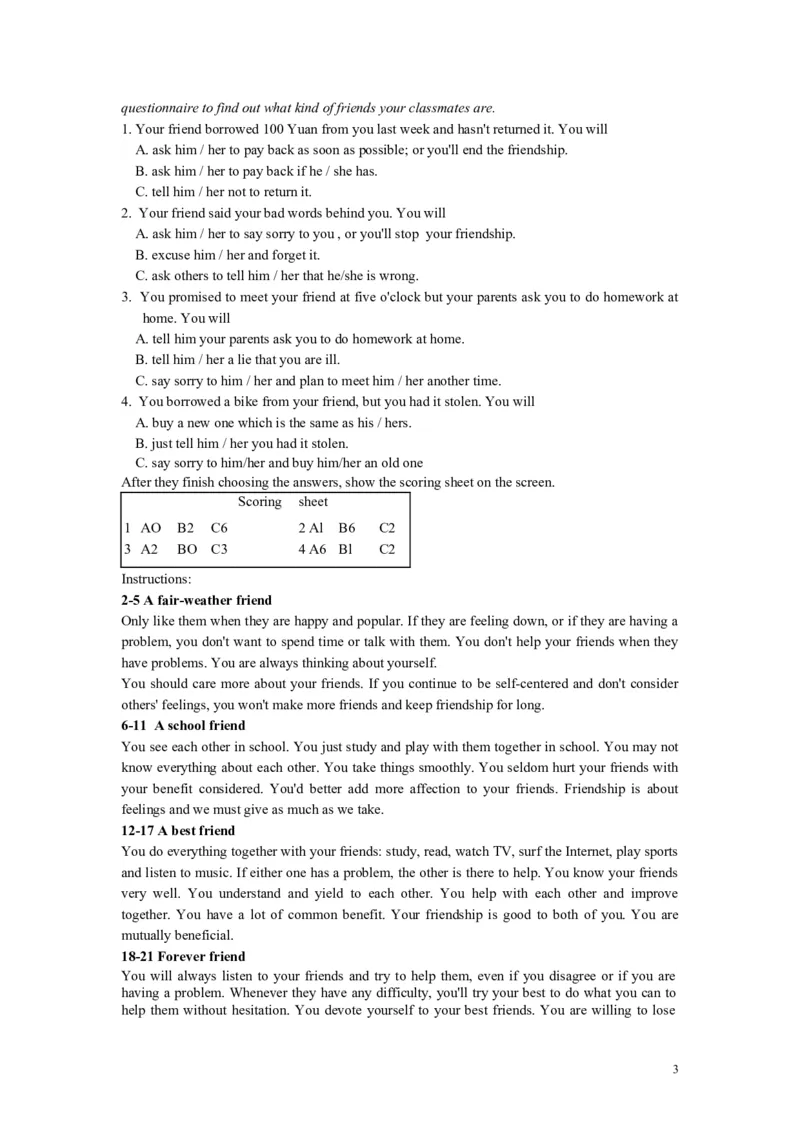
After they finish choosing the answers, show the scoring sheet on the screen.
Scoring sheet
1 AO B2 C6 2 Al B6 C2
3 A2 BO C3 4 A6 Bl C2
Instructions:
2-5 A fair-weather friend 找教案
Only like them when they are happy and popular. If they are feeling down, or if they are having a
problem, you don't want to spend time or talk with them. You don't help your friends when they
have problems. You are always thinking about yourself.
You should care more about your friends. If you continue to be self-centered and don't consider
others' feelings, you won't make more friends and keep friendship for long.
6-11 A school friend
You see each other in school. You just study and play with them together in school. You may not
know everything about each other. You take things smoothly. You seldom hurt your friends with
your benefit considered. You'd better add more affection to your friends. Friendship is about
feelings and we must give as much as we take.
12-17 A best friend
You do everything together with your friends: study, read, watch TV, surf the Internet, play sports
and listen to music. If either one has a problem, the other is there to help. You know your friends
very well. You understand and yield to each other. You help with each other and improve
together. You have a lot of common benefit. Your friendship is good to both of you. You are
mutually beneficial.
18-21 Forever friend
You will always listen to your friends and try to help them, even if you disagree or if you are
having a problem. Whenever they have any difficulty, you'll try your best to do what you can to
help them without hesitation. You devote yourself to your best friends. You are willing to lose
3what you have, even your life.
课后反思:本课教学设计容量和密度较大,但难度适中,大部分学生都能接受。体现全面照顾
大部分学生的教学理念。注意培养学生开口说英语的的信心。
The second period: Reading
Aims:
1. to master the new words and some useful expressions.
2. to understand the text and finish the exercises in Comprehending.
Step 1. Looking and guessing
Work in pairs. Look at the pictures and the heading and guess what the text
might be about.
1). Imagine what it might be like if you had to stay in your bedroom for a
whole year. You could not leave it even to go to the WC or to get a cup of tea.
How would you feel?
2). What would you choose if you are only allowed to have five things with
you in the hiding place because there is very little room?
Step 2
Reading to summarise the main idea of each paragraph.
Skim the text and summarise the main idea of each paragraph in one
sentence.
Para. One: Anne made her diary her best friend whom she could tell
everything.
Para. Two: Anne’s diary acted as her true friend during the time she and
her family had to hide away for a long time.
Para. Three: Having been kept indoors for so long, Anne grew so crazy about
everything to do with nature.
Step 3 Language points
1. add (to) v. 1) to put together with something else so as to increase the number,
size, or importance; 2) to join (numbers or amounts ) so as to find the total.
eg: The fire is going out; will you add some wood?
The snowstorm added to our difficulties.
Add up these figures for me, please.
2. ignore v. to take no notice of; refuse to pay attention to
eg: His letters were ignored.
Even the best of men ignored that simple rule.
My advice was completely ignored.
3. concern v. 使担心;使不安 (+about/for); 涉及,关系到;影响到
eg: The boy's poor health concerned his parents.
He is concerned for her safety.
The news concerns your brother.
He was very concerned about her.
4. loose adj. not firmly or tightly fixed.
She wore loose garments in the summer.
4I have got a loose tooth.
Some loose pages fell out of the book.
5. purpose n. [C] an intention or plan; a person’s reason for an action.
What is the purpose of his visit?
The purpose of a trap is to catch and hold animals.
Did you come to London to see your family, or for business purpose?
6. series n. (of) a group of things of the same kind or related in some way, coming
one after another or in order.
Then began a series of wet days that spoiled our vacation.
This publishing firm is planning a new series of school textbooks.
They carried out a series of experiments to test the new drug.
7. cheat. 1) v. to behave in a dishonest way in order to win an advantage;
2) n. a person who cheats; dishonest persons
They cheated the old woman of her house and money.
The salesman cheated me into buying a fake.
He never cheated in exams.
I see you drop that card, you cheat!
I never thought that Sam is a cheat.
8. share 1) vt.&vi. (in\with\ amount\between) to have, use or take part in something with
others or among a group.
2) n. (in\of) the part belongs to, owed to or done by a particular person.
The money was shared out between them.
Sam and I share a room.
We shared in his joy.
They always share their happiness and sorrow.
I have done my share of the work.
9. crazy adj. 1) mad ; foolish 2) [+about] wildly excited; very interested
You're crazy to go out in this stormy weather.
John's crazy about that girl.
She is just crazy about dancing.
10. dare v.& v.aux.. 1) + to do; 2) + v
to be brave enough or rude enough (to do sth. dangerous, difficult or
unpleasant).
How dare you accuse me of lying!
How dare you ask me such a question?
My younger sister dare not go out alone.
He did not dare to leave his car there.
11. trust 1) n. [U] (in) form believe in the honesty, goodness or worth etc, of
someone or something
2) v. to believe in the honesty and worth of someone or something;
have confidence in
I have no trust in him.
I don’t place any trust in the government’s promises.
Why do you trust a guy like him?
5I trust your wife will soon get well.
12. suffer v. (for) to experience pain, difficulty or loss
I cannot suffer such rudeness.
He suffered from poverty all his life.
My father suffers from high blood pressure.
They suffered a great deal in those days.
13. advice n. [U] opinion given to someone about what they should do in a
particular situation 找教案
→v. advise to give advice to
I want your advice, sir. I don't know what to do.
I asked the doctor for her advice.
I f you take my advice, you won’t tell anyone about this.
He gave them some good\ sound advice.
14. communicate v. 1) (to) to make (opinions, feelings, information etc. ) known or
understood by others. e.g. by speech, writing or body
movements;
2) (with) to share or exchange opinions, feelings, information
etc.
Our teacher communicates his idea very clearly.
He had no way to communicate with his brother.
Did she communicate my wishes to you?
We learn a language in order to communicate.
Deaf people use sign language to communicate.
15. calm 1) adj. free from excitement, nervous activity or strong feelings; quiet
2) n. [U] peace and quiet
3) v. to make calm
You must try to be calm.
The high wind passed and the sea was calm again.
The police chief advised his men to stay \ keep calm and not lose their
tempers.
There was a calm on the sea.
She calmed the baby by giving him some milk.
We calmed the old lady down.
Useful expressions:
1. add up
to join (numbers or amounts ) so as to find the total.
Add up 3, 4 and 5 and you'll get 12.
Add up your score and see how many points you can get.
If we add these marks up, we'll get a total of 90.
2. calm down
to make or become calm
Calm down, sir. What's the trouble?
Just calm down, there’s nothing to worry about!
We tried to calm him down, but he keep shouting.
63. be concerned about \with
to worry or interest
My parents are concerned about my studies.
Don’t concern yourself about \ with other people’s affairs.
She’s concerned about his son’s future.
4. go through
1) to suffer or experience; 2) to look at or examine carefully;
3) to pass through or be accepted
The country has gone through too many wars.
The new law did not go through.
Let’s go through it again, this time with the music.
5. set down
1) to make a written record of; write down 2) put down
I have set down everything that happened.
I will set down the story as it was told to me.
Please set me down at the next corner.
6. a series of + pl. & n 做主语时,谓语动词用单数
一连串的,一系列的,连续的
There has been a series of car accidents at the crossing.
These days I have read a series of articles on reading.
A series of TV play is on Channel 1 these days.
7. on purpose
intentionally; with a particular stated intention
He did it on purpose.
“I am sorry I stepped on your toe; it was an accident.” “It wasn’t! You do
it on purpose.”
I came here on purpose to see you.
8. according to
as stated by sb. or sth.
They divided themselves into three groups according to age.
Please arrange the books according to size.
According to the Bible, Adam was the first man.
According to her, grandfather called at noon.
9. fall in love
begin to be in love (with sb.)
They fell in love at once; it was love at first sight.
What will he do if his daughter falls in love with a poor man?
They fell in love with each other for years.
10. join in
to take part in (an activity)
They are going to join in the singing.
She started dancing and we all joined in.
Would you like to join in my birthday party?
课后反思:本节课分层教学,在阅读课文,理解课文的基础上进行课文知识点的细致处理。需
7要改进的地方:单词短语部分讲解过多,占了很多时间,可以将其改为课后练习的形式。在以
后的教学中要注意改进。
Period 3: Grammar
Step I Revision
Check students' homework.
Step II Word study
This part is a consolidation of the words learnt in this unit. Ask the students to do the exercise
independently.
T: Now please open your books and turn to Page 4. First let's learn about language. Use the
word they've learnt in this unit to fill in the blanks. Complete the sentences with suitable words in
correct forms.
Step III Preparation
Get a pair of students to stand up and act as Anne and Kitty. It's time for the teacher to be the
interpreter between them. Encourage both sides to give different sentences, including statements
and questions.
Step IV Grammar 找教案
The students will learn the use of Direct Speech and Indirect Speech (statements and questions).
First try to make clear to the students what direct and indirect speech is, with the help of the
practice in Step III. Then give them some examples. At last get them to summarize the rules of
Direct Speech and Indirect Speech (statements and questions).
T: In this part, we are to learn the use of Direct Speech and Indirect Speech (statements and
questions). When do we use Direct Speech and when do we use Indirect Speech?
Step V Practice
For Ex 1, get the students to look at the sentences carefully in pairs in order to find out the
difference between direct speech and indirect speech. Guide the students to find out the changes
in pronoun forms, word order, adverbials and so on, especially the verb tenses, the underline parts.
Ask the students to pay attention to the reporting clause.
For Ex 2, ask the students to do it by themselves, then check.
Step VI Homework
1. Practice of WB (P42.1 &P 43.2)
2. Ask the students to think out different ways to solve the problems about making friends,
preparing the materials about the debate. Get the students to know the problem was that Anne
had made a friend in the hiding place 8 the son of another family hiding with them, but her
father was not happy about this. The topic is: how do you help to solve the problem between
Anne and her father. Do you agree with Anne or her father? Use specific reasons to support
your solutions.
课后反思:本节课是语法课,能以学生为主体,通过指导学生观察、体验探究、合作等积极主
动的学习方式,发现语言的规律并运用到各种语言实践活动中。做到精讲多练,使学生掌握
直接引语和间接引语(祈使句和疑问句)的相互转化。
Period 4: Listening
Step I Revision
After checking the WB Exx, the teacher asks the students to read the letter on Page 6 first, and
then ask them to discuss what was upsetting Lisa.
T: Here is a letter written to Miss Wang of radio by Lisa. Read the letter, please. Try to find out
what was upsetting her with your partners, using the indirect speech.
S: Lisa made a friend with a boy in her class. But her classmates said they fell in love. Lisa said
8she didn't want to end the friendship. Lisa asked what she should do.
Step II Listening (Using language) The students will hear what Miss Wang says, then ask the
students to answer the questions, using the indirect speech. At last, get them to spell out the words
and fill in the blanks.
T: OK, we've already known the Lisa's problems on making friends. Miss Wang has suggested
some possible solutions. Please look at page 6. We 're going to listen to what Miss Wang says, and
then answer the questions of Ex 2. Go through the questions quickly.
Write down the key words as quickly as possible.
Listen again and check the answers with the whole class.
T: Now let's listen to it again and try to spell out the words and fill in the blanks.
Step III Listening (WB P41)
The students will hear a passage about Anne's best friend, her diary Kitty. They are asked to
complete the passage according to the tape.
T: In the following part, we are going to listen to a passage about Anne's diary. Listen to the tape
carefully and fill in the blanks.
Listen to it again and check the answers with the whole class.
Step IV Listening Task(WB P43)
The task can be divided into three parts. First, the students will hear a story about an argument
between Anne and her father about her boyfriend. After listening, they just write down their
different thoughts. Then they can have a debate to find out a better solution to solve Anne and her
father's problem. The activity should be prepared carefully beforehand. During the class, the two
teams just do the final preparations.
StepV Assignment
1. Today we have learnt how to solve the problems on making friends. For the homework,
describe one of the problems between friends and how it is solved.
2. What does cool mean?
What do you think should do with your friends?
课后反思:本节是听力课,从帮助学生形成有效学习策略的角度出发,培养学生如何去获取
信息,处理信息的能力。通过训练逐步提高学生的听力能力。
Period 5: WRITING
Step I Revision
Check the homework, asking them to read out their ideas for the class.
T: Let's check the homework. I'd like some of you to read out their ideas.
For the class. Volunteer!
Step II Warming up 找教案
T: Have you ever read The 21st Century ?
S: Yes, I have. It's a popular paper among teenagers in China.
T: If you have any problem, you can write to the editor and ask for advice. Here is a letter from a
student.
Step lII Writing (B P7)
This part asks the students to write their advice to Xiao Dong as an editor. First, let the students to
discuss how to write a letter to offer some advice with their partners. Second, teacher shows the
instructions on how to write a proposal letter on the screen. Third, ask the students to read the
letter on Page 7. Ask them to discuss what Xiao Dong's problem is and what is the solution they
can offer in groups of 4, with the help of the points given on the books. Fourth, give them ten
9minutes to write the letter. At last, ask some of the students to read their letters for the class
while the teacher gives some comments.
T: Today we're going to write your advice to Xiao Dong as an editor. Do you know how to
write a proposal letter? Now, let's have a discussion on it with your partners. Students are talking
about how to write a proposal letter.
T: Who'd like to answer this question?
S: The problem should be presented first. Then we must analyze the reasons to cause the
problem. Proposing the solution must be the main, which should be well explained.
T: Exactly. The discussion of the solution itself, based on the analysis of the problem, is the
core of a proposal. I'll give you some instructions about how to write the body part of a proposal
letter as follows.
T: AH right, let's read the letter on Page 7. And try to find out what Xiao Dong's problem is
and what is the solution they can offer in groups of 4, with the help of the points given on the
books.
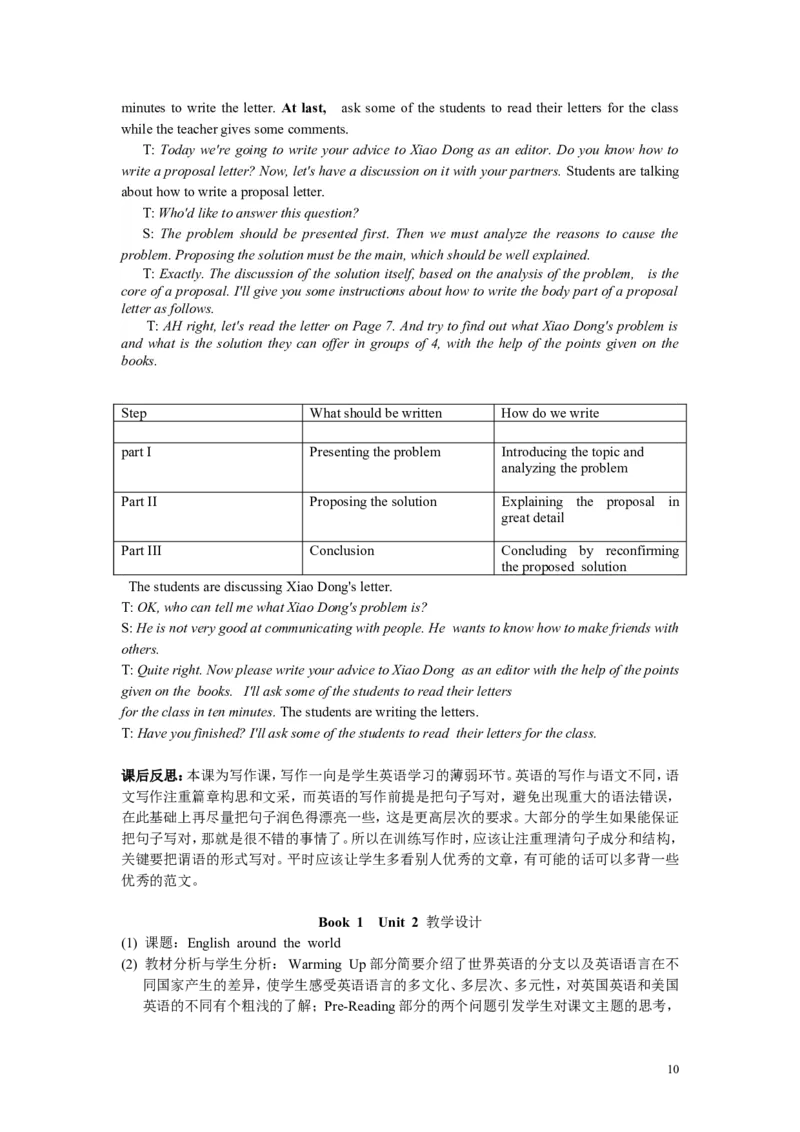
Step What should be written How do we write
part I Presenting the problem Introducing the topic and
analyzing the problem
Part II Proposing the solution Explaining the proposal in
great detail
Part III Conclusion Concluding by reconfirming
the proposed solution
The students are discussing Xiao Dong's letter. 找教案
T: OK, who can tell me what Xiao Dong's problem is?
S: He is not very good at communicating with people. He wants to know how to make friends with
others.
T: Quite right. Now please write your advice to Xiao Dong as an editor with the help of the points
given on the books. I'll ask some of the students to read their letters
for the class in ten minutes. The students are writing the letters.
T: Have you finished? I'll ask some of the students to read their letters for the class.
课后反思:本课为写作课,写作一向是学生英语学习的薄弱环节。英语的写作与语文不同,语
文写作注重篇章构思和文采,而英语的写作前提是把句子写对,避免出现重大的语法错误,
在此基础上再尽量把句子润色得漂亮一些,这是更高层次的要求。大部分的学生如果能保证
把句子写对,那就是很不错的事情了。所以在训练写作时,应该让注重理清句子成分和结构,
关键要把谓语的形式写对。平时应该让学生多看别人优秀的文章,有可能的话可以多背一些
优秀的范文。
Book 1 Unit 2 教学设计
(1) 课题:English around the world
(2) 教材分析与学生分析: Warming Up部分简要介绍了世界英语的分支以及英语语言在不
同国家产生的差异,使学生感受英语语言的多文化、多层次、多元性,对英国英语和美国
英语的不同有个粗浅的了解;Pre-Reading部分的两个问题引发学生对课文主题的思考,
10以便参加课堂活动; Reading部分The Road to Modern English 简要说明了英语语言的
起源、发展变化、形成原因,以及它的发展趋势。Comprehending部分旨在检查学生对课文
基本内容的理解程度; Learning about Language 部分主要通过各种练习帮助学生重温本
单元前几个部分的所学习的新单词和短语,同时也通过新的例子展现了美国英语、英国
英语的差异,并着重介绍了半单元的语法项目(祈使句及其间接引语);Using Language
部分中的Reading and talking主要介绍了当今世界各国各地说英语都有自己的特色,即
便是美国东西部、南北部说话均有所不同。
(3) 课时安排:The first period: Speaking: Warming Up and Pre-Reading
The second period: Reading The Road to modern English
The third period: Reading (Language points)
The forth Period:Learning about Language
The fifth period: Using Language
The sixth period: Listening
(4)教学目标:
① 知识与技能:了解英语在世界上的发展状况,认识各种各样带有民族、地域特色的英
语;对英国英语和美国英语的差异有所了解,尤其是一些常用词汇,比如 falt和
apartment, lift 和elevator, rubber 和eraser等; 掌握本单元中出现的词汇、
短语的用法; 学会语言交际困难的表达法,如pardon, I beg your pardon?; 掌
握祈使句及其间接引语的表达法。
② 过程与方法:本单元通过对“世界英语”这一话题的探讨,以加强学生对英语语言
的了解,对当代语言特别是英语的发展趋势的了解。在教授本单元时必须强调美国
英语、澳大利亚英语、印度英语、新加坡英语等都有各自的规律和和惯用法。要提防
学生认为可以滥用英语词汇,随意违反英语语法规则或惯用法,不顾正常的发音、语
调等。在学生用书中的听力部分,原文真实的反映了灭国南部地区英语的方言和语
音,旨在让学生感受一下将英语作为母语的本国人说话的一个侧面。要注意掌握尺
度,让学生感受一下、了解一下,点到为止,不提倡硬性模仿。
③ 情感态度与价值观:了解英国英语和美国英语的区别,两种英语不存在那种好与不
好的问题。可以给学生布置以下任务:通过对话形式,将所学过的英美说法的不同之
处,按实际生活和想象编一段对话。尽可能运用语言功能中表达语言困难的说法。
(5) 教学重点和难点:
词汇: include role international native elevator flat apartment
rubber petrol gas modern culture actually present rule
vocabulary usage identity government rapidly candy lorry
command request retell polite boss standard Midwestern
Spanish eastern southeastern northwestern recognize accent
lightning direction subway block
短语: play a role (in) because of come up such as play a part
(in)
重点语法项目:祈使句及其间接引语
难点:Expressing one’s idea on which kind of English one should learn;
guess the name of speaker’s country by listening; how to tell
the differences between a command and a request; how to change
the pronoun when turning the direct speech into indirect speech.
(6) 教学策略: Discussion, Student-centered vocabulary, learning, listening,
11pair work, teach grammar in real situation
(7) 教学煤体设计: A projector and a tape recorder.
(8) 教学过程:详见以下分课时教学设计。
(9) 课堂练习与课外作业设计: 穿插于分课时教学设计中
(10) 教学反思或值得改进的地方: 见每个课时最后部分。
Period 1: Speaking Warming Up and Pre-Reading
Aims
To talk about varieties of English
To discuss why do so many people speak English
Procedures
I. Warming up 找教案
1. Warming up by answering a questionnaire
1). Tell the students they are going to answer a questionnaire about why
they are learning English.
2). Write the words: Reasons for learning a foreign language on the center
of the board:
3). Ask the students to suggest as many reasons as they can think of, for
example, for work, as a hobby, to learn about other people, to travel, to read
literature in the original, to read research papers, to meet foreigners, to
surf the Internet, to pass exams, etc. Write their suggestions on the board as
they make them.
4). Divide the class into pairs.
5). Give out each student one questionnaire paper.
6). Explain the task. The students must question each other about their
language learning needs (or motivations). Tell them that you are going to take
in the questionnaires at the end, and that you’d like them to make clear
notes. It works better if the two partners swap tasks (questions and answers)
after each section of the questionnaire. If they wait till the end to swap, one
student may use up all the time available.
7). When the task is finished, ask a couple of students to summarize their
partners’ answers. (This may develop into a class discussion about language
needs).
8). The students write five sentences on their feeling about learning
English.
9). Collect the questionnaires. Needs Analysis Questionnaire
Interviewer_______________
Interviewee_______________
Present use: situations and skills
Reading (faxes, letters & reports)
Listening & speaking (telephoning, meetings, negotiations, public speaking,
socializing)
Writing (faxes, letters & reports)
Future use: expectations & ambitions
课后反思:本课能比较好地完成教学目标,训练了学生说的能力,懂得如何表达自己的思想
12和意见。使学生了解了世界各地的英语是有所不同的,特别是了解英国英语和美国英语的区
别。 同时使学生感受到学习英语的重要性。由于学生的口语水平有限,所以探讨的时候不是
很深入。
Period 2 Reading:The Road to modern English
Aims
To talk about English
To read about the history of English language
Step 1 Skimming
Read quickly to get the main idea of the text.
Let the students find out key sentence of each paragraph or ask them to
summarize the main point for each paragraph in their own words.
Paragraph 1: The spread of the English language in the world
Paragraph 2: Native speaker can understand each other but they may not be
able to understand everything.
Paragraph 3: All languages change when cultures communicate with one
another.
Paragraph 4: English is spoken as a foreign language or second language in
Africa and Asia.
Step 2 Scanning
Read to locate particular information and complete the comprehending
Exercise One.
Step 3 Comprehending
1. Check the answers to exercise 1 (page 10
2. Answer these questions (Page 11)
Work in groups. Discuss the two questions and then ask two groups to report
their answers to the class.
1). Do you think it matters what kind of English you learn? Why?
Possible answer:
I don’t think so. Here are the reasons:
★ Native speakers from different parts of the world have no difficulty in
understanding each other despite the fact that they speak a bit differently.
★ It is necessary for us to learn the narrow difference between different
kinds of English if we hope to communicate fluently with native speakers of
English from all over the world.
★ Different kinds of English have the same language core. If you have got
a good command of one kind, you will almost have no difficulty understanding
another kind of English.
(Any persuasive and supporting reason the students give can be accepted.)
2) Why do you think people all over the world want to learn English?
Possible answer:
The reasons why people all over the world want to learn English:
★ With economy globalization, English has become the best bridge to serve
the purpose of people all over the world communicating with one another.
★ However, like all major languages in the world, English is always
changing. In order to adjust to native speakers from different parts of the
world, it is a must for people all over the world to learn English, whether in
English speaking countries or in non-English speaking countries.
★ Also, people from different parts of the world speak English with
various accent and dialects, and people have to learn about the difference
between different kinds of English in order to avoid misunderstanding while
communicating.
13课后反思:本课是阅读课。英语阅读教学是高中教学的重中之重。许多英语教师对阅读训练
也给予了足够的重视,但是在训练方式上却存在较多的问题。多数教师过分注重语法结构的
分析和句子的机械翻译而忽视技巧培养。只有在阅读教学中教给学生一些学习策略,培养阅
读技巧,才能让学生有可能通过课外自学来扩大知识的摄取量,从而弥补课堂英语阅读教学
的不足。由于时间仓促以及学生口语水平的局限,本课时在学生让学生讨论的环节上,气氛
不够热烈,讨论时间不足,今后应尽量鼓励学生多开口说英语,以弥补这方面的缺陷。
Period 3: Reading (Language points)
Aim 找教案
to master some words and phrases
1. include v.
a) contain
eg. The price includes both house and furniture.
b) embrace thing as part of whole
eg. I include him among my friends.
2. present
a) adj: being at hand; being now出席的, 在场的;现在的, 当前的 该词可做前置定语也
可做后置定语,当它做前置定语其义为“现在的”, 做后置定语其义为“出席的”
eg. The present members 现在的成员
The members present 在场的成员
b) n: gift
eg. He often gave his neighbor's kids little presents.
C)vt: to offer赠送,呈献[(+to/with)]
eg. They presented him with a bunch of flowers.
3. culture
n: [C][U] understanding of literature, art, music, etc
eg. He has studied the cultures of many western countries.
4.identity n: who or what a person or thing is
eg. You should show your identity card before you enter it.
5.rule
a) n:custom or statement about what must not be done
eg. He’s made it a rule to rise early.
It’s against the rules of the school to smoke.
b) vt: to govern or control
c) eg. The queen ruled her country for 20 years.
6.Request
vt: to ask for
eg. They requested financial support.
注意:这个词所接的宾语从句要用虚拟语气
I requested that he (should) come an hour earlier.
B )n: asking or being asked
eg. Mr. Paine made a request that I should help him.
7.command
a) vt: give orders to
eg. I command you to start at once.
14注意:这个词所接的宾语从句要用虚拟语气
I command that you (should) start at once.
b) n: order
eg. The army received the command to fire.
8.Actually adv
eg. She looks young, but she's actually 50.
Did you actually see him break the window?
9.International adj: of relating to or involving two or more countries in the world 国
际的
eg. They are dealing with the international affairs.
Many African countries received international help.
10.modern adj: recent
eg. This is a book of modern history.
There is a modern hospital.
11. vocabulary n: all the words of language
eg. Wide reading will increase your vocabulary.
My English vocabulary is limited.
12.rapidly adv: quickly
eg. Our country develops rapidly.
The number of learning English is increasing rapidly.
13.retell v: tell something once more
eg. Can you retell the story in your own word?
The teacher asked you to retell it.
14.recognize v: to identify from previous experience
eg. He looked at the envelope and recognized Jenny's handwriting immediately.
The policeman recognized her as a thief.
15. government n: group which govern a country or a certain area
eg. The government will decide the matter.
The government is discussing the problem. 找教案
Useful expressions
1.play a part/ role in: to act or to be involved in an activity
eg. He has played an important part in carrying out the whole plan.
English plays an important role in international communication.
2. because of:by reason of sb or sth
eg. Because of the storm he didn't go there.
because of 与because 的区别,前者后接名词或代词,后者接句子
eg. He didn’t go to school because he was ill.
He didn’t go to school because of his illness.
3.come up
eg. She came up and said, "Glad to meet you."
The moon came up gradually.
I'll let him know if anything comes up.
4. such as: like; for example
eg. I like drinks such as tea and coffee.
15such as 与for example 的区别,前者用来罗列事物或人后者用来举例说明
eg. English is also spoken in many places, such as Africa and Asia.
For example, Tom has the same opinion.
课后反思:本节课是课文知识点的传授。着重讲解课文中重要单词和短语的运用。不足之处,
教学设计任务比较单一,练习不多。
Period 4 : Learning about Language
(Indirect Speech (II) requests & commands)
Aims
To discover useful words and expressions
To discover useful structures
Procedures
I. Direct and Indirect Speech
Direct Speech Indirect Speech
simple present simple past
He said, “I go to school every He said (that) he went to school every
day.” day.
simple past past perfect
He said, “I went to school every He said (that) he had gone to school every
day.” day.
present perfect past perfect
He said, “I have gone to school He said (that) he had gone to school every
every day.” day.
present progressive past progressive
He said, “I am going to school He said (that) he was going to school
every day.” every day.
past progressive perfect progressive
He said, “I was going to school He said (that) he had been going to school
every day.” every day,
future (will) would + verb name
He said, “I will go to school every He said (that) he would go to school every
day.” day.
future (going to) present progressive
He said, “I am going to school He said (that) he is going to school every
every day.” day.
past progressive
He said (that) he was going to school
every day
Direct Speech Indirect Speech
auxiliary + verb name simple past
He said, “Do you go to school every He asked me if I went to school every
day?” day.*
He said, “Where do you go to He asked me where I went to school.
school?”
imperative infinitive
16He said, “Go to school every day.” He said to go to school every day.
Direct Speech Indirect Speech
simple present + simple simple present + simple present
present He says (that) he goes to school every day.
He says, “I go to school
every day.”
present perfect + simple present perfect + simple present
present He has said (that) he goes to school every day.
He has said, “I go to school
every day.”
past progressive + simple past past progressive + simple past
He was saying, “I went to school every day.” He was saying (that) he went to
school every day.
past progressive + past perfect
He was saying (that) he had gone to
school every day.
Direct Speech Indirect Speech
can could
He said, “I can go to school every He said (that) he could go to school
day.” every day.
may might
He said, “I may go to school every He said (that) he might go to school
day.” every day.
might
He said, “I might go to school every
day.”
must had to
He said, “I must go to school every He said (that) he had to go to school
day.” every day.
have to
He said, “I have to go to school
every day.”
should should
He said, “I should go to school He said (that) he should go to school
every day.” every day.
ought to ought to
He said, “I ought to go to school He said (that) he ought to go to school
every day.” every day.
Discovering useful words and expressions
1. Work in pairs. Do exercises 1, 2, 3 and 4. Then check the answer you’re
your classmates. The teacher helps the students discover the difference in
prepositions.
172. Play the tape for the students to listen and ask them to mark the
sentence stress and intonation. Then practice reading in pairs.
(The teacher brings the students’ attention to the British and American
words that are different but have the same meaning.)
III. Discovering useful structures
(Making commands and requests using indirect speech)
1. In groups of four, think of at least three commands your teachers and
parents usually give.
You may follow these steps.
1) Choose one who is to give the first command.
2) Ask another person in your group to tell somebody what you said.
3) The third person will change the request or command from direct into
indirect speech.
4) Change role so that each person gets the chance to give commands and
turn them into indirect speech.
Example:
T: Please don’t talk in class.
S1: What did our teacher tell us? / What did our teacher say?
S2: He told/asked us not to talk in class. / She said not to talk in
class.
2. Get the students thinking about the difference between the request and
command.
Then read the replies and decide whether they are in answer to a request or
a command. Write the sentence down.
★ A: _______________________________________
B: I’ll go and collect some wood right now, master.
★ A: _______________________________________
B: Of course I’ll be happy to collect your shopping for you.
★ A:__________________________________________
B: Yes. I’ll shut the door at once, Mr. Zhang.
★ A:_________________________________________
B: No, I won’t get your coat if you talk to me like that.
★ A:_________________________________________
B: Sorry. I’ll get that book for you right now.
课后反思:本节为语法课,主要讲述直接引语和间接引语的相互转换。教学设计依据《新课程
标准理念》设计各种任务,使学生在完成这些任务的过程中理解、体验实际语言的运用,掌握
好直接引语和间接引语的相互转换。
Period 5: Using Language
(STANDARD ENGLISH AND DIALECTS)
Aims
To read out and talk about STANDARD ENGLISH AND DIALECTS
To write about learning English by brainstorming
Procedures
I. Warming up
1. Introduction: In China there’re so many dialects that the government
18encourages the whole nation to speak Putonghua, which is regarded as standard
Chinese.
2. Role-play: Get students to work in pairs. Let one student be a Chinese
and the other a foreigner. Role-play a conversation about the Chinese language
to have them discuss why Putonghua has to be used in China.
II. Reading
1. Get the students thinking about the topic of the text to predict what it
says.
2. Skimming:
Read quickly to find the topic sentence for each paragraph.
Para. 1: There is no such a thing as Standard English.
Para. 2: American English has many dialects whose words and expressions
are different from “standard English”.
Para. 3: Geography plays a part in making dialects.
3. Scanning: Work in pairs. Read the text to locate particular information.
1). Do you know what Standard English is from the text?
2). What is a dialect? Why does American English have so many dialects?
4. Language focus:
1)believe it or not: used when you are going to say something that is true
but surprising: Believe it or not, John cheated in the exam.
2). there is no such a …as: used to say that a particular person or thing
does not exist: These days there is no such a thing as a job for life.
3). standard English: the form of English that most people in Britain use,
and that is not limited to one area or group of people
4). dialect: a variety of a language spoken only in one area, in which
words, or grammar are slightly different from other forms of the same language
5). play a part/role in: be one of the causes that make something happen:
Besides dieting, exercising plays an important part in losing weight.
III. Listening
To introduce the students to a dialect and a form of standard “English”.
You may follow these steps:
1). Set the context for the students by describing the situation;
2). Tell the class: you are going to listen to a boy named Buford. He
speaks a Southern dialect of AmE with an East, Texas accent. Remember:
pronunciation is determined by accent. On the other hand, Buford’s teacher,
Jane, speaks standard BrE. (i.e. what is heard on the BBC.)
3). Play the tape for the students to listen.
4). Encourage the students to give the standard equivalents for the
dialectic words from Buford’s story, using the context.
Dialectic words
Standard English
from Buford’s
equivalents
story
hey hello
y’all everyone
ain’t aren’t
yer your
ya you
19pup child
swimmin’ swimming
jumpin’ jumping
feelin’ feeling
‘bout about
‘nough enough
shoulda seen should have seen
got outta got out of
6). Play the tape again and let the students answer the questions in pairs
after listening.
7). Check the answers. (Variant: you may also ask the students to retell
Buford’s story in Standard English in pairs.)
IV. Speaking
1. Make sure the students know that the word used for directions often vary
depending on what kind of English the speaker uses. Present the list to the
students:
Amy (American) Lady (British)
subway underground
left left-hand side
keep going straight go straight on
two blocks two streets
right right-hand side
Prepare their role-play in pairs: Be sure that one plays a speaker of
British English and the other a speaker of American English. Ask students to
select actual streets and location in their hometown for giving directions.
Performance: Ask two pairs to perform their dialogue in class.
Sample version:
S1: Excuse me, sir. But I can’t find the drugstore?
S2: Pardon?
S1: I said I couldn’t find the chemist’s shop.
S2: Well, go round the corner on your right-hand side, straight on and
cross the flyover. You will find it ahead.
S1: Thank you very much.
S3: What did he say?
S1: He told us to go round the corner on the right, go straight on and
then cross the overpass. The drugstore will be ahead.
Self-assessment criteria:
Did you cooperate well with your partner(s) while practicing?
Can you ask for directions and give directions clearly?
Can you express your ideas fluently? If not, what’s your main
problem?
Did you go naturally between American English and British English
while talking to each other.
V. Writing
1. Making a poster
First ask the students to make educated guesses about how English can help
some aspect of Chinese life, in particular its economy.
Then, in pairs students work on their poster.
Finally, ask several pairs to present their poster in class for assessment.
A Sample poster
20CHINA’S FUTURE LIES WITH LEARNING ENGLISH
Reasons for learning English:
World trade is done in English;
International organization (such as the UN) use English;
We need contact with the developed Western world to build our country;
The developed world uses English in its dealings.
Why the Chinese language will not do?
Very few people in the West speak Chinese;
Chinese is a difficult language to learn;
Most businessmen do not have time to learn new languages every time they
enter a new international market.
SO CHINA’S FUTURE LIES WITH LEARNING ENGLISH
2.Writing Assessment
Can you give persuasive reasons for the topic on your poster?
Can you verbalize your ideas fluently?
Can you put your own English learning experiences into a broader
perspective?
Can you organize your ideas in a logical way?
Have you made a brainstorming map before you set out to design your poster?
Do you think it helps your writing?
What kind of mistakes have you made in your writing? What can you do to
avoid such mistakes?
Further Applying
The teacher may also guide the students to do the writhing task in the
Workbook on page 53. You may take the following steps:
Step 1: Students divided into groups of four share their own learning
experiences and ideas about English learning.
Step 2: Students make a list as follows:
My problems Ideas for Why I like My future
improvement English with
English
Step 3: Make notes about the paragraphs for the writing.
Step 4: The teacher helps develop ideas in a positive and encouraging way.
Step 5: Students write about the topic after class as homework.
Sample version:
My experience of learning English
Many people all over the world speak English as their second language. It
is not too much to say that it has become an international language.
Studying English can make life fun. It enables you to watch American
movies, read English books and listen to English songs. Moreover, as English
is an international language, you will be able to communicate with foreigners
when you are on a trip abroad. Traveling will be more interesting that way.
It is a good idea to make friends with foreigners. In my opinion, it is
the best way to improve your English. In addition, it will be fun and it will
expand your view of the world. If you make friends with a native speaker, you
can practice your spoken English more often and then you can communicate with
21people around the world. You can also become familiar with the customs and
habits of different cultures.
There are some people who are afraid to make friends with foreigners
because they are not confident of their English. However, many foreigners do
not care about grammar. They will get your key words in the sentence and
figure out the whole meanings. Therefore, it is unnecessary to be afraid to
make friends with them; just go head!
Learning English helps us meet different people and learn more about their
culture, thus facilitating mutual understanding and harmony. Briefly said,
English is so useful to us that we should all learn it.
课后反思:本节为泛读课,能体现新课程标准的精神,帮助学生“进一步明确学习英语的目
的,发展自主学习和合作学习的能力,形成有效的英语策略”。教学过程中注意师生互动:教
师有效讲授引导,学生有效倾听并适时反应,注重学生阅读能力的培养。
Period 6: Listening
Step I Describe the picture and the boys.
T: Any volunteers to describe the picture?
S1: There is a river in the picture. At the bank, there is a tall tree. We can see a very big fish in the
river.
S2: The two boys laughing are Buford and Big Billy Bob. A boy was frightened and fleeing. He is
Little Lester.
T: Could you find the answers to the four questions?
Ss: Yes.
T: Good. What does Buford think of Texas? How do you know it?
S: He believes it’s almost a different country from the US. The text tells us so.
T: How large was the catfish?
S: The catfish was almost the size of a house.
T: Why did Lester get out of the water very quickly?
S: He thought the catfish would eat him.
T: Why did Buford and Big Billy Bob laugh?
S: Because the fish is harmless but Lester was so frightened and fled so fast.
找教案
Step II Listening and writing (P14)
Task Listen and answer questions.
T: Another two persons will describe this story. One is Buford, who is from Texas and believes
bigger is always better. He is speaking with one kind of Southern dialects. The other is his
teacher, Jane, who speaks standard British English. First, listen and know of standard British
English and Southern dialects.
Students listen to the tape and try to understand.
T: Now listen for a second time and answer the last two questions. Make notes while listening.
A few minutes later, check their answers.
T: A, Can you answer question5?
S: Yes. Jane, Buford’s teacher, is the second speaker. She is from Britain.
T: Well done! Buford says “Hey, y’all” to greet you. What does the second speaker say to greet
you?
22S: She says “Hello”.
Step III Listening
Task 1 Listen and write the AE words.
T: Last lesson we separate some AE words from BE words. Today, let’s go on listening and write
down the AE words which have the same meanings as the BE words. Turn to page 48
LISTENING. The BE words have been written down. Read it. Then listen to the dialogue. In
the conversation, “rush hour” is the name of a popular Hollywood film.
After listening.
T: Please read your answers together. ( Write down the answers.)
Ss: pictures-movies, lorry- truck, underground-subway, sweets-candy, autumn-fall.
Task 2 Listen and write down answers to questions.
Students read the questions to find out the listening point first, and then listen to the tape to get the
answers.
T: Now the recorder will introduce a new way of English learning. Before listen to the tape, please
read the questions to find out the listening point. Make notes of the answers while listening.
Play the tape for the first time so that the students can get a general idea. The second and third
time, the students write and check their answers. Pause and repeat the key sentences.
T: Can you answer questions now?
Ss: Yes.
T: Good. What TV programme is Zhao Li listening?
S1: CCTV-9 World Wide Watch.
T: Excellent! Who would like to answer the next questions?
S2: 2. Zhao Li thinks that listening to TV programs will improve her English.
3. She thinks that Cao Ri is a good speaker. He uses American English.
4. The more listening practice you have, the better your listening skills will get, especially if you
hear variety of speakers.
5. You should be patient and keep trying. Soon you will understand more and more.
Teacher checks the answers and explains some difficult listening points if necessary.
Step IV Listening task
Task 1 Read the map and listen and find where the students come from.
T: Please turn to page 51 and read the map. What does it tell us?
S: It marks the places where English is spoken an a first or second language. Maube it is about
world English.
T: Very clever! Now six foreign students come to our class to learn Chinese, and they are
introducing themselves. Please listen carefully, and then write their names on the proper places
on the map.
It is a little difficult to finish the task individually. Teacher may do the first one with the students.
While listening, repeat the key sentences.
T: Let’s guess the first one together.
Play the tape.
23T: From the first sentences and “British rulers”, we know S1 comes from India. Go on listening
and write down your answer on the map.
Students listen to the tape and write down their answers.
Teacher plays the tape twice. A few minutes later.
T: Check your answers with your partner. Listen to the tape again.
T: OK. Where is S2 from?
S: S2 is from Louisiana in the US.
T: What about the others?
Ss: S3 is from Jamaica, S4 Ireland, S5 Philippines, and S6 Singapore.
T: Very good.
Step V Homework
1. Make a short list of reasons why English is spoken in so many places around the world. 找教案
Sample
Why is English spoken in so many places around the world?
English is the language most widely spoken and used in the world. Why? Industrial revolution
impelled the development of England and it colonized much of the world. English began to be
spoken in many other countries. America’s development also contributes to the extension of
English. With the development of economy, countries communicate with each other more
frequently. English is widely used and is one of the official languages of the Olympic Games and
the United Nations. People realize the importance of English learning. Everywhere in the world
children go to school to learn English. More people speak English as their first, second or foreign
language.
2. Preview page 15 Speaking. List the words that were confusing to Amy.
课后反思:本课为听力课,能依据新课程标准进行教学设计,训练和提高学生的听力水平的
能力,比较好地完成教学目标。
Book 1 Unit 3 教学设计
(1) 课题:Travel journal
(2) 教材分析与学生分析: 本单元的中心话题是旅游,通过旅游日记的方法描述旅行见闻。
Warming Up部分让学生想象自己住在青海,要去东南亚旅游。要求他们选择三个不同的
地方并查出不同交通方式及所需费用。然后与同学讨论六个话题,使学生了解旅游的必
要手段和必须备的费用。Pre-Reading部分的两个问题主要是引导学生向阅读部分过度;
Reading部分“湄公河旅行日记(Journey Down the Mekong)”的第一部分讲述了王昆
和王薇梦想往湄公河做自行车旅行,并为之做准备的过程;文章的第二部分A Night in
the Mountain放在“语言运用部分”中,主要讲述了他们在西藏山中度过的一宿,爬山路
的艰苦和乐趣;Comprehending部分通过回答问题、让学生填写表格在课文中找到王薇和
王昆对旅行的相同和不同看法,加强学生对课文细节的进一步理解; Learning about
Language 部分讲述了主要词汇及其运用和主要语法项目(用现在进行时表示将来)。
(3) 课时安排:The first period: Speaking: Warming Up and Pre-Reading
The second period: Reading: Journey down the Mekong
The third period: Learning about Language
The forth Period:Using Language (A NIGHT IN THE MOUNTAINS)
24The fifth period: Listening and writing
(4)教学目标:
④ 知识与技能:了解旅游所需的准备工作,其中包括精神与物质准备。选择旅游时间、
景点、路线、交通工具(火车、汽车、轮船、飞机、自行车等); 掌握旅游常识,学会解
决旅游中出现的一些问题; 掌握和运用本单元出现的新词汇和短语;学会向别人告
别和祝愿;掌握用现在进行时表示将来时的用法。
⑤ 过程与方法:根据课文和所提供地图的提示,给学生布置一些任务:Imagine you
are planning a trip. 1. What are you planning for the trip? 2. Where
are you going and what are you planning to do each day? 3. How are you
getting there?
4. When you leave home, what will your family and your friends say to
you?布置这一任务的主要目的是让学生在理解课文的基础上学会如何安排旅行,知
道旅游需要什么准备,采用什么方式旅游,以及离开家时家人和朋友对他们说什么。
⑥ 情感态度与价值观:在实际生活中运用所学知识去安排旅游、选择地点和路线、选择
旅游方式。学会写旅游日志。
(5) 教学重点和难点:
词汇: journal fare transport Vietnam finally cycle persuade
stubborn insist proper properly determine determined
altitude valley attitude shorts camp record topic
familiar brave
短语: change one’s mind give in
重点语法项目:现在进行时表将来 When are you leaving? How are you
going there? Where are you staying? How long are you
staying there? When are you coming back?
难点:1. How to grasp the main idea of the text and how to tell the
host’s attitude. 2. How to use the words and the Present
Continuous Tense expressing futurity. 3. How describe what they
see and hear. 4. How to write a short letter and how to give best
wishes to sb.
(6) 教 学 策 略 : Reading and discussion, speaking and listening, pair
work, explaining and practising
(7) 教学煤体设计: A projector and a tape recorder.
(8) 教学过程:详见以下分课时教学设计。
(9) 课堂练习与课外作业设计: 穿插于分课时教学设计中
(10) 教学反思或值得改进的地方: 见每个课时最后部分。
The first period: Speaking: Warming Up and Pre-Reading
Aims
To talk about traveling
Procedures
I. Warming up
1. Warming up by discussing
Good morning, class. Do you like traveling? Why do you like traveling? And why
25not? Where have you ever been before? How did you get there? If you are given a
chance to travel around the world, what kind of transportations will you use
and why? Now look at the following pictures and discuss it in pairs.
Name of the transportations Means of transportation Reasons
by car (in a car); by bike; by plane (by air;) by train ( on a train); by bus
( on a bus); by ship (by water or by boat);in a hot balloon; by motorbike (on a
motorbike); by jeep; by truck; in a plate
2. Warming up by looking and speaking
Now boys and girls, what do you need to take with you if you are preparing for
a bike trip along the Changjiang River? Look at the pictures and tell the whole
class which object you think is the most useful and which one is the least
useful. Give a reason why you think so.
3. Warming up by asking and answering
Now suppose you live in Qinghai. You plan to spend a holiday with a friend
somewhere in Southeast Asia. You have been given a chance to choose three
places to visit. Please find out the one-way fare to get there for different
kinds of transportation. Perhaps you may not know the exact fare, but you can
guess how much the fare is. Please have a short discussion with your partners
and then decide where to go.
Ok, now I’d like you to ask your partner the following questions.
II. Pre-reading
1. Imaging and sharing
Do you like traveling along a river, a great river? What role does a river play
in people’s life? In other words, how do people who live along a river use it?
The suggested answers:
People can drink the water in a river or wash their clothes.
People can swim in a river in summer.
People can use a river to irrigate their fields.
People can use a river to produce electricity.
People can travel along a river.
2. Talking and sharing
As we all know, there are a lot of rivers in the world and also there are many
great rivers. Now look at the chart. In the left column are names of some great
rivers. In the right column are locations where the rivers lie. Please match
them.
match answer
Names of River Location Names of River Location
Mekong India Mekong China,SE Asia
Rhine France Rhine Germany
26Ganges Russia Ganges India
Seine England Seine France
Nile Central Africa Nile Egypt
Thames Germany Thames England
Congo Brazil Congo Central Africa
Niger China, SE Asia Niger West Africa
Volga US Volga Russia
Danube Egypt Danube Central Europe
Amazon West Africa Amazon Brazil
Mississippi Central Europe Mississippi US
课后反思:此节为口语课,教学设计的任务能较地完成,学生积极参与,分工合作。教学过程
很自然,鼓励学生开口说英语,帮助他们建立使用英语的自信。对于错误,采用跟进一个正确
表达方式的办法,既提点了学生,有保护了他们的积极性。找教案
The second period: Reading: Journey down the Mekong
Aim: To read about traveling
To understand the text
Step 1. Reading aloud to the recording
Do you know what countries the Mekong River flows through? Now look at the map
of the Mekong River and point out the countries it flows through.
(China, Laos, Thailand, Cambodia, Burma Vietnam)
Ok, today we’re going to read a passage about JOURNEY DOWN THE MEKONG. Please listen
and read aloud about the recording of the text JOURNEY DOWN THE MEKONG. Pay attention
to the pronunciation of each word and the pauses within each sentence. I will play the tape twice
and you shall read aloud twice, too.
Step 2. Reading and underlining
Now please read and underline all the useful expressions or collocations in the passage. Copy
them to your notebook after class as homework.
Collocations from JOURNEY DOWN THE MEKONG
dream about, take a great bike trip, graduate from, got the chance to do sth., cycle along the river,
go for long bike rides, mountain bike, persuade sb. to do sth., grow up, get sb. interested in sth., be
stubborn, know the best way of getting to places, the source of the river, care about, give sb. a
determined look, change one’s mind, at an altitude of, seem to do, the air be hard to breathe, an
interesting experience, make up ones mind, give in, a large atlas with good maps, keep doing sth.,
at first, pass through, be surprised to do sth., half of, at last, the South China Sea
Step 3. Reading aloud and understanding
Next we are going to read aloud the text and then answer some questions.
1) Who are Wang Kun and Wang Wei? (They are brother and sister, and both are college
students.)
2) What was their dream? (Their dream was to take a great bike trip.)
3) Who are Dao Wei and Yu Hang? (They are Wang Kun’s cousins who are at a college in
27Kunming.)
4) Where is the source of the Mekong River and which sea does it enter?(The source of the river is
in Qinghai Province and it enters the South China Sea.)
5) What can you see when you travel along the Mekong?(You can see glacier, rapids, hill, valleys,
waterfalls and plains.)
6) Is it a difficult journey to cycle along the Mekong? Why? (Yes. The journey begins at an
altitude of more than 5,000 meters, where it is hard to breathe and very cold.)
step 4. Discussing
We have got the general meaning of the passage, and we know Wang Wei and Wang Kun have
some similar and different attitudes about the trip. You may have a short discussion with your
partners and then fill in the chart.
Similar attitudes about the trip Different attitudes about the trip
Both Wang Wei and Wang Kun thinks:
1). taking this trip is a dream that comes true.
2). that they will enjoy this trip a lot.
3). they should see a lot of the Mekong.
4). that most of the Mekong will be found in Southeast Asia. Wang Wei believes:
1). they must start in Qinghai where the river begins/see all of the Mekong.
2). that they don’t need to prepare much.
Wang Kun believes:
1). it is too cold and high to start in Qinghai.
2). that using an atlas is very important.
step 5. Closing down
Closing down by answering questions
What should you do before traveling? (Before traveling, we should make good preparations, that
is, to make a plan, decide the place to visit and get enough information about the place. With full
preparations we’ll have a good time during the trip.)
What will your family and your fiends say when you leave home to travel? (When we leave home,
my family and my friends will say, “Have a good trip. /Have a good journey. /Have a good time.”)
Closing down by translating
In the last few minutes you are asked to translate some difficulty sentences in the passage.
Step 6. Assignment
Revise the contents of the passage
Complete the passage on Page 56 in Workbook
Do exercise 2 on page 57 in you exercise books.
课后反思:本节课能根据《英语课程标准》的精神进行教学设计,并采用任务型教学法进行教
学。在教学过程中注意“教”与“学”的关系,各个教学环节的设计都考虑到让学生在活动
中发挥其主题地位,让他们去发现问题,分析问题和解决问题。在设计活动时,能充分考虑到
学生的情感态度,使学生在快乐的学习气氛中得到能力的培养。
The third period: Learning about Language
28Aims
To learn about the Present Continuous Tense
To discover and use some useful words and expressions
Procedures
I. Warming up
Warming up by discovering useful words and expressions
Hello everyone. After reading the passage, we have got to know the usage of the
words and expressions, but we should do more practice. Now turn to page 20 to
find the correct words and expressions from the passage to finish the
sentences. You are given two minutes to finish them and discuss with your
partners. Two minutes later, check in pairs and then check with the whole
class.
II. Learning about language
1. Reading and finding
Good, you have mastered these words and expressions. Let’s turn to page 17 and
look at the questions in Warming up 4. Underline the verbs in the questions,
and pay attention to the verb forms and do some explanations by yourselves.
2. Learning Grammar
We can see that the verbs are all used in the “-ing” form. They are “the
present continuous tense”, but they express future actions or plans. The
Present Continuous Tense may be used to denote an action that can be pre-
planned or prearranged instead of the future indefinite in colloquial English.
But please note that, not all verbs can be used in the “-ing” form to express
future actions. Such verbs as come, go, leave, fly, walk, ride, drive, stay,
meet, die, see, have, arrive etc. are mainly used in the “-ing” form to
express future actions.
3. Doing exercises No. 2 and 3 on page 21
Now turn to page 21 and do exercise 2. In the dialogue a newspaper reporter is
interviewing Wang Wei about her plans for the trip along the Mekong River.
However, they are not sure about some of the verb tenses. Can you help them
complete their conversation?
Let’s continue to do exercise 3. Do you have any plans for the future
yourselves? If you have any, please use the Present Continuous Tense to express
your future actions. Give as much information as you can.
III. Ready used materials for the present continuous tense for future actions
or plans
be + v.-ing与表示将来的时间连用,表示不久的将来,含义是“预定要做”。(这种结构中
常用动作动词或去向动词:go, come, leave, start, arrive, travel, fly等,不适用于
状态动词)找教案
I’m leaving for Beijing this Friday.
My friends came over last night, and they are coming over this evening, too.
We are going to Laoshan this May Day holiday.
We had an English class this morning, and we are having another English class
tomorrow.
29We took six subjects last term, and we are taking seven subjects next term.
I have arrived in Beijing. I’m visiting the Great Wall tomorrow morning.
After class we are playing football on the playground.
We are flying to Shanghai next Friday.
IV. Closing down
Closing down by making a dialogue
To end the period you are going to make a dialogue in pairs to tell the whole
class your plan on this Sunday.
Closing down by writing
Suppose you are planning a holiday trip. Write a short passage about your plan.
You must pay great attention to the tense. The following questions can help
you.
Where are you going for your holiday? Who are you going with?
How are you getting there? What are you doing there?
Where are you staying? What are taking with you?
When are you returning?
课后反思:本节着重传授用现在进行时表将来的意义。能比较顺利的完成教学任务,学生能
积极参与。不足之处是练习过少。
The forth Period:Using Language (A NIGHT IN THE MOUNTAINS)
Aims
To read the passage A NIGHT IN THE MOUNTAINS
To use the language by reading, listening, speaking and writing
Procedures
I. Warming up by talking about Tibet
Have you ever been to Tibet? Do you want to travel in Tibet? Can you tell me
something about Tibet?
Tibet lies on the Qinghai-Tibet Plateau of the southwest border of China. The
average height of the whole region is more than 4,000 meters above sea level,
for which Tibet is known as “Roof of the World”. The highest peak of Tibet,
also the highest in Himalayas and in the whole world, is Everest Peak, which is
as high as 8,846.27 meters above sea level.
Although a part of China, Tibet has a unique culture of all its own. It is
mainly inhabited by Tibetans, a minority nationality of old and mysterious
people. Tourist attractions include the Potala Palace in Lhasa, Jokhang Temple,
and a number of Buddhist sacred places.
Tibet (Xi Zang in Chinese) is to the south of Xin Jiang Uygur Autonomous Region
and Qing Hai Province, to the west of Sichuan, to the northwest of Yunnan and
to the north of India and Nepal. Its population of 2.3 million people come from
a variety of ethnic groups including Tibetan, Han, Monba and Lhota. Its capital
city is Lhasa.
Northwest Tibet, mainly Qing Hai plateau, is home to a variety of unusual and
unique animals. Across the northern expanse of Tibet, you can see vast
30grasslands where horses, yak and sheep roam freely. The world's lowest valley,
the Grand Yarlun-tzanpo River Valley lies in east Tibet.
It is freezing cold in most time of the year. Most tourists come to visit Tibet
only in the warmest seasons, June, July, August and early September.
II. Reading
1. Reading and underlining
Now let’s go on with Journey Down The Mekong with Wang Wei and Wang Kun. They are in
Tibet now. Please turn to Page 22. Read the passage quickly and underline all the useful
expressions and collocations in it. Copy them to your notebook after class as homework.
Collocations from JOURNEY DOWN THE MEKONG (II)
although, ride bicycles, in front of, as usual, need to do sth., to climb the mountain road was hard ,
be great fun, reach a valley, much warmer, change… into, T-shirts, shorts, in the early evening,
stop to do sth., make camp, put up, after supper, go to sleep, stay awake, at midnight, become
clear, so …that, the sound of the fire, travel so far, join sb., hardly wait to see, change one’s
attitude.
2. Reading and translating
Next you are going to read the text JOURNEY DOWN THE MEKONG and translate it into
Chinese.
3. Speaking
Read the passage again and find the answers to the questions:
1) How does Wang Kun feel about the trip? (He is starting to like the trip.)
2) What do you think has changed his attitude? (seeing the beautiful land)
3) Is it natural for Wang Kun not to feel lonely? (Yes. Because the scene Wang Kun saw is
beautiful. The sky was clear and the stars were bright. Also their cousins are waiting for him.)
4) Would you feel the same way in this situation? Why or why not? (You may have different
opinions about this. Just speak it out and let us share your idea, will you?)
Imagine that the dialogue happens the next morning before Wang Kun and Wang Wei leave their
camp. Write a short dialogue between them with your partner.
Wei: You look so tired Kun: Yes, I stayed up late last night.
Wei: Really? What did you do? Kun: I watched the clear sky and the bright stars.
Wei: That’s nice. They must be pretty. Kun: Yes, they were.
课后反思:本节课的设计与实施以《英语课程标准》的理念为指导,注重培养学生“优化学习
方式,提高自主学习能力”。在教学过程中,能引导学生通过观察、体验、探究等积极主动的
的学习方法,充分发挥自己的学习潜能,形成有效的学习策略,提高自主学习的能力。
The fifth period: Listening and writing
Aim:
Grasp the main idea of the passage and get to know what the author saw and heard
To write a letter
Procedures
Step 1 Listening 找教案
Let’s go on with Journey Down The Mekong River (part 3) with Wang Wei. Turn to page 23 and
do the listening text. Before listening to the tape, please read the words fast, then tick the words
31you hear on the tape. After that I’ll play the tape for the second time and then finish the chart. You
should look through the chart and find out the listening points. The following questions can help
you understand the listening text.
Where is the girl from?
What do people in Laos use the river for?
Why do people in Laos call the river “the sea of Laos”?
What is the river called in Tibet and Vietnam?
What other beautiful sights along the Mekong River in Laos?
Step 2 Guided writing
1. Reading and underlining
In this unit, we have read the first two parts of a travel journal and have listened to the third part of
the travel journal. What is the difference between a journal and a diary? Let’ read the passage on
page 23 and find out the difference between the two. Underline all the useful expressions and
collocations in it. Copy them in your notebook after class as homework.
Collocations from Reading and Writing
put one’s thoughts into a diary, travel journey, the difference between, for on thing… for another,
record one’s experiences, soon after, be familiar to, make a list of, compare…with, agree to.
Read the passage quickly and then fill in the information on the chart.
A diary A travel journal
1). Personal;
2). To try to record how the writers feel very soon after things happen 1). Isn’t as personal as a
diary
2). To record the writers experiences, ideas and afterthought about what they have seen
3). Is written for a lot of readers
4). It’s topics includes people, things, and events less familiar to readers.
Step 3 Writing a letter
Now let’s do a writing practice. Imagine that you are a friend of Wang Wei. Write a short letter to
her and ask her to describe: how she feels, what she is doing, and some place you want to know
about. Then wish her well on her journey by using at least two of these expressions:
Have a nice/good time. Have a nice/good trip. Take care.
Good luck on your journey. Say “Hello” to …. Write to me.
Give my best/love wishes to …. Have fun.
You can refer to the following steps.
In pairs choose the details from the journey that are most interesting. Think of what else you
would like to know about the journey. Write these ideas down as questions.
Now choose two or three of the best questions for your letter. Each question should have another
sentence explaining why you want to know this information.
Put them in an order that makes sense.
Begin your letter as shown in the textbook and add your questions for Wang Wei. Your writing
should not be more than one paragraph.
Finish your letter as shown in the textbook.
A sample writing:
Hi, brave little Wei,
How I worry about you and Wang Kun! Do you have a good time now? I hope so. What are you
32doing now? Are you still in Laos? Can you tell me something about people’s life there? When are
you leaving for Cambodia? When you get there, tell me about the Buddhist temples there. Please
send some photos with your next letter! Well, Have a good trip and don’t forget to write to me!
Give my best wishes to Wang Kun. Good luck on your journey.
Take care!
Yours,
Wang Lin
step 4. Homework: write a travel journal
课后反思:本节是听力加写作课,能按照《英语课程标准》的理念进行教学设计。旨在训练学
生的听和写能力。体现了以教师为主导,学生为主体的原则。教师的指导主要帮助学生如何
去取材,让学生进行布局谋篇,组织语言完成写作任务。还从帮助学生形成有效学习策略的
角度出发,培养学生如何去获取信息,处理信息的能力。提高学生的听力能力。
Book 1 Unit 4 教学设计
(1) 课题:Earthquakes
(2) 教材分析与学生分析: 本单元的主题是“地震”。 Warming Up部分Pre-Reading部分
要求学生描述、讨论与地震有关的话题。Reading部分是一篇新闻报道,介绍了唐山大地
震前的预兆、地震造成的城市建筑和人畜损失以及地震后的救援情况。Learning about
Language 部分涉及了本单元的词汇和语法。该部分主要通过阅读和句型练习帮助学生学
习单词、数字的表达法以及有that, which, who, whose引导的定语从句,培养学生的自主
学习能力。Using Language部分的“读写说(Reading, writing and speaking)”训练提供
了一封信,要求学生阅读后写一篇大地震纪念公园落成仪式上的演讲稿,接着说一说唐
山大地震纪念邮票。随后的听力(Listening)是一位美国人以第一人称叙述他在1906年旧
金山大地震中的可怕经历。写作(Writing)部分训练学生如何写新闻报道,学会拟地定写
作提纲。
(3) 课时安排:The first period: Reading
The second period: Reading 找教案
The third period: Listening
The forth Period:Grammar
The fifth period: Extensive reading
The sixth period: Summary
(4)教学目标:
⑦ 知识与技能:了解地震的成因、预兆,地震造成的损失,地震时的应急措施以及震后
的救援; 掌握和运用本单元出现的新词汇和短语以及数字的表达法;熟练运用that,
which, who, whose引导的定语从句;学会写英文新闻报道,拟订写作提纲。
⑧ 过程与方法:在学习阅读部分时,可以根据教学的需要和教学班级的实际,从不同的
角度设计目的明确的任务。阅读材料提及了很多孩子失去双亲成为孤儿,矿工在地
震中的遭遇。救护人员和解放军官兵不顾自身安危,奋力抢险的事迹,地震无情人有
情,感人至深。因此可以将他们作为素材,设计多种任务,展开课堂教学活动。如:1.
组织学生讨论震后孤儿的安置2. 模拟采访被抢救的矿工。 3. 写一篇新闻故事,
描述救护人员和军队救灾的感人故事。
⑨ 情感态度与价值观:培养日常对自然现象的观察能力和思考能力,对地震等灾难中
逃生和救生方法的了解。
33(5) 教学重点和难点:
词汇:shake rise smelly pond burst canal steam dirt ruin
injure destroy brick dam useless steel shock quake
rescue electricity disaster army organize bury coal mine
shelter fresh percent speech honor prepare Europe
短语:at an end right away dig out a (great) number of give out
thousands of
重点语法项目:由that, which, who, whose引导的定语从句.
难点: 1. Teach the students how to enjoy an article 2. Teach the
students the way to express themselves. 3. The usage of the
words of that, which, who and whose.
(6) 教学策略:Student-centered method, asking and answering, explaining and
practicing, reading and discussion, speaking and listening,
pair work
(7) 教学煤体设计:A projector and a tape recorder.
(8) 教学过程:详见以下分课时教学设计。
(9) 课堂练习与课外作业设计:穿插于分课时教学设计中
(10) 教学反思或值得改进的地方:见每个课时最后部分。
THE FIRST PERIOD: READING
Step I. Revision
Check the homework with the whole class.
Step II. Warming up
Ask the students to read the instructions and make sure they know what to do, and then
have a discussion about the two pictures.
T: Today, before we begin our reading, I’d like to ask you a question, “What is the
biggest sound you have heard in your life?”
S1: The sound of wind that blew in a winter night when I was very young. It sounded
like a ghost who was howling. I was very frightened at that time.
S2: The biggest noise was the one that I heard when my neighbor was quarrelling with
his wife. Perhaps, they broke their TV set.
T: That’s too terrible.
S3: The noise when planes take off.
S4: The sound of trains.
T: Good! I agree that all of them are big sound. But did you once heard the sound that
the heaven falls and the earth cracks, in Chinese it is 天崩地裂?
Ss: No, we have no chance to hear that.
T: If there is a sound like this, what is it?
S5: When someone hears something unexpected and terrible. For example, when one of
his loved families dies, he will feel this sound.
T: Terrific! You are using a literary way to express the sound.
34S6: When an earthquake happens.
T: Great! I have waited for this answer for a long time. Today we’ll learn something
about earthquakes. I think most of us have heard of earthquakes. Can you imagine how
terrible it is ?
S7: The earth is shaking . All the buildings will fall down.
S8: Many people will die. And perhaps many children will lose their parents.
T: Yeah, earthquakes are disasters to everybody. Now look at the two pictures of
Tangshan and San Francisco. Can you describe what you see in the pictures?
S1: Tangshan is a beautiful city. It has beautiful gardens, broad roads and some tall
buildings.
S2: From the picture of San Francisco,I can see that it is a very big city. There are
many tall buildings thickly standing on the earth. I think the population of the city is
very large.
T: Good! What will happen if there has been a big earthquake in these two cities? Work
in pairs and discuss it. Then I’ll ask so me of you to show your opinion.
Step III. Pre-reading
There are two questions in this part. Both are very interesting. The first one c
an more or less reveal the students’ values; while the second one can enlarge their
imagination. No matter what their answers are, as long as they have given careful
thoughts to the situations, their answers should be good.
T: Now, let’s look at the pictures. What are the predictions of an earthquake?
S1: Before an earthquake animals will become nervous. Cows, pigs, horses and dogs will
be upset. And people can see mice running about. If the earthquake happens during
winter, people can even see snakes.
T: Terrific! Where did you get this knowledge?
S1: From geography. I like it.
T: good. Sit down please.
S2: Madam, I don’t know the meaning of the picture with two women.
T: It doesn’t matter. You will know it soon after reading our text. OK. Imagine there is
an earthquake now, and your home is shaking, at this moment you have no time to take
any other things but one, what will it be?
S3: I’ll take all my money. People can’t live without money.
S4: I will take as much water as possible. Because it is said that people can keep alive
for nearly 7 days by drinking without any food
S5: In that case, I’d rather take some apples, so that besides drinking, I can also eat.
S6: I will carry my grandma. She is my most loved person in this world. She brought
me up. 找教案
T: What a dutiful child you are! I’m very glad to hear that. Sit down please! It seems
that all of you know what you should do during an earthquake. OK. Let’s read our text,
and see what it tells us.
Step IV. Reading
In this part, teacher should ask the students to read the passage quickly for the first time
to get the general idea of the passage. Ask them to pay attention to the first sentence of
each paragraph. This can help them finish exercise3 in Comprehention. It is about the
35main idea of each paragraph. Then ask them to read the text again carefully to obtain
some details. Before reading for the second time, show some questions on the screen, and
let the students read the questions first. These questions can guide them to have a good
understanding about the text. They can also make preparations for Exs1-2,which are about
details.
Skimming
T: At first I’d like to read the text quickly to get the general idea of the article. While
reading, you should pay attention to the sentence of each paragraph.
T: Have you got the general idea of the text?
Ss: Yes.
T: What is it?
S1: There is no quick answer to this question . Are you suggesting us that the general
idea is the mixture of the first sentences of each paragraph?
T: Sure.
S1:OK. That’s easy. The main idea of the passage is some signs of the earthquake, and
what would happen during the quake.
T: Good, sit down please. In fact, while we are answering the questions, we have
involved the sequence, the functional item for this unit. (Teacher writes the word on the
blackboard ) Do you understand the meaning of the word?
Ss: No.
T: Sequence means the order of the events. It can tell us which event happens first, and
which happens later. Do you know the sequence that is used in our text?
S3: Yes. At first, the text tells us something that happened before the quake, then it tells
us the things that happened during the quake and at last it tells us the things that
happened after the earthquake.
T: Quite right! Now please look at the screen, these are the first sentences of each
paragraph. Read them and think if they are the main idea of the text. If necessary, you
may make some changes to make more exact.
Teacher shows the screen and gives a little time to think it over.
1. Strange things were happening in the countryside in the northeast Hebei.
2. The disaster happened and caused a lot of loss.
3. All hope was not lost.
Careful reading
T: Now, it’s time for us to read the text carefully. But before reading, you should read
some questions first. These questions may help you get some information quickly and
easily. Now look at the screen, and read the questions.
36Show on the screen
1. What natural signs of a coming disaster were there?
2. Can you think of some reasons why these signs weren’t noticed?
3. What events probably made the disaster worse?
4. What situations probably made the disaster worse?
5. How were the survivors held?
Step V. Extension
Show the questions on the screen.
1. From whose point of view are events described? How do you know?
2. What is the mood of this passage? How is it created?
3. Why do you think the writer chooses to express his feelings about the quake rather
than simply reporting what had happened?
4. Why is the title A NIGHT THE EARTH DIDN’T SLEEP?
5. What does the sentence “Slowly, the city began to breathe again.” mean?
Answers:
1. He uses third-person to describe the quake. His description is very objective. For
example, the second sentence in the third paragraph. The writer says: “Everywhere
they looked nearly everything was destroyed.” The writer uses they instead of we.
2. The mood is serious and a bit sad. It is created by giving details of how many
people and animals were killed or injured, and how many buildings were destroyed.
3. Although the writer was not there, he felt sad for the people of Tangshan. He knows
that some personal feelings will make the reading more interesting.
4. I think the reason is that, as usual, night is the time to sleep, and night should be
safe and quiet. But that night everything changed. The writer uses A NIGHT THE
EARTH DIDN’T SLEEP as a title to show how terrible and how unusual the night
was.
5. Here we can see that the writer compared the city to a person who suffered a lot in
the disaster. He felt her pain, and he worried about her. So when he said that people
came to help her, we can feel his feelings to the city. The city will not die, she has
hope and she can recover from the pain.
Step VI Comprehending
Answers to Exx1-3
1. 1. C 2. E 3.B 4.D 5.A
2. 1. The walls of the villages wells had cracks in them.
2 .Roads got huge cracks
3. Brick buildings were destroyed.
4. The army helped the survivors.
5. Shelters were put up for those with no homes.
3. 1. Strange things were happening in the countryside in northeast Hebei..
1. The disaster happened and caused a lot of loss.
2. All hope was not lost.
37Step VII Homework
课后反思:总体感觉上,本节课上得比较成功,心情愉快。基本上完成了教学任务。学生们不
但对地震有了一定的了解,而且能用英语进行简单的描述。但是同学们在讨论、汇报、回答问
题时词汇单一,句式多是中国方的英语。在今后的教学中要加强语句表达方面的训练。
THE SECOND PERIOD: READING
Step I Revision
Teacher check the students’ homework by showing the answers to exercises1-2 in
the Learning about language.
Answers to Exercise 1.
1. pipe 2. dam 3. shocked 4.injured 5. well 6. canal 7. ruins 8. a great number of 9. at
an end 10. bury 11. rise 12.rescue 13.steam
Answers to Exercise 2.
A great number of, dam, well, canals, steam, ruins injured, shocked, bury
T: OK. Before we begin today’s class, please guess the meaning of these sentences.
1. Small incidents foretell big events.
2 Blessings never come in pairs and misfortunes never come singly
3. Where there is life, there is hope. 找教案
S1: The first sentence means people should pay attention to the small things, because
these things often cause unexpected events. Just like what we have learned in the text.
S2: The most important thing in the world is life. Without life, everything will lose its
meaning.
S3: It means everything has its two sides. Although the disaster is terrible, and we cannot
avoid it, it can force us to try our best to foretell it more exactly and reduce the loss
caused by the disaster.
Step II. Reading, writing and speaking
A thank speech
The teacher’s main task is to tell students some problems that appeared in their writings.
Show the sample on the screen, and ask the students to read it, and find something that
are useful.
Sample
Good morning, Ladies and Gentlemen. My name is Wang Wei. At first, I’d like to
thank Mr. Zhang and the city of Tangshan for the honor of talking to you. I’d also
38like to thank each of you to come here today for this special occasion. Twenty-nine
years ago, we experienced the terrible earthquake, which completely destroyed
everything in the city. And twenty-nine years later, we get together in this beautiful
park. This park makes me believe that we are indeed in the “Brave City of China”.
Here I’d like to thank all of you, especially those who worked hard to save the
survivors. During those days, you forgot the danger and devoted yourselves to
digging out those who were trapped in ruins. Burying the dead, and building shelters
and so on. I’m sure the people in Tangshan will never forget you! When I walk in
the broad street, and see the new houses and offices, I can’t help expressing my
thanks for those who rebuilt the city within 13 years. Also we can’t forget you. I
believe our city become more beautiful in future. The spirit of its people has been
and will always be strong forever! Thank you.
Two minutes later.
T: What do you think of the speech?
S1: The speech is very fluent.
S2: The writer uses many Attributive Clauses. I don’t know how to use the structure.
T: It doesn’t matter. We’ll learn it next time. Now let’s go through exercise 4, it’s
another writing task.
A little talk
A model speech has been given to the students. The students should complete the
sentences after looking at the design of the new Tangshan stamps. The speeches may
have many different contents. Let the students pay attention to this point: the audience is
the same with the one In the last speech.
T: We can see there are four stamps showing new Tangshan. Can you describe each of
them with a few words?
S1: Housing conditions for the first stamp.
S2: Street scenery of new Tangshan for the second stamp.
S3: Industry for the third one.
S4: Ocean transport for the last one.
An outline
Show the questions on the screen.
1. Why is an outline important?
2. What should an outline include?
3. Why is a headline important?
4. What are the steps to finish a newspaper story?
5. What is the feature of a newspaper story?
Answers:
1. Because an outline will prepare you to write a better story.
2. A good outline should have a headline, a list of main idea and a list of important
details.
393. A headline can tell the reader what the topic is, so it can attract the readers’ attention
since the reader may not have bought the newspaper before they read the headline.
4. First, organize the main ideas. Next, put some details into each paragraph.
5. A newspaper story gives the most important news first and the least important news
last.
Teacher show more examples of some newspapers on the screen and ask the students to
read them and try to find the outlines in the stories.
A short story找教案
This integrated language activity enables students to use their imaginations and to write in
a literary way. You may want to encourage students to use a literary device, such as
simile, personification or metaphor.
T: Now, please turn to page 62, look at the TALKING part. Read it carefully, and then
tell me what the feature of this talking is.
Give them two minutes to think about this question.
S1: This talking needs us to imagine.
S2: We should write it in a literary way.
T: Good! You’ve got the point of the talking. In this task, the most important thing you
should do is to make full use of your imaginations and try to use a literary way. For
example, you may use simile, personification or metaphor. Now, work in groups to write
down your own short stories. Attention! The stories are about the cause of earthquakes.
After you’ve finished, I’ll ask some of you to read out your work..
Group One
In the center of the earth lives an evil ghost. He usually sleeps for many years. During
these years, people on the earth live a happy life. But when he wakes up, he shall howl.
And then people feel an earthquake.
Group Two
Some people believe that there is a magic world in the center of our earth, where lives a
kind of wiser living thing. They can make UFO. When the UFO comes out to visit our
world, there is an earthquake.
Group There
There are too many people on the earth, and people are building too many buildings.
Besides, they dig too many and too deep holes. The earth can’t stand. She shakes, and an
earthquake happens.
Step III Homework
Write an outline for China Daily
40课后反思:本节对教材的处理整合较好,能够合理增减。训练了学生对课文所学单词短语的
运用,另外学生的听说能力和书面表达能力也得到比较充分的训练。
The Third Period: Listening
Step I Greeting and leading in
T: Now, we will listen to a non-fiction article common to science textbooks. This article
is on geology. It provides many facts and describes cause and effect relationships.
Step II Listening (P62)
T: You will listen to the tape three times. First, listen and try to get some details that
Exx1-2 request. Second, listen and finish the exercises. Third, listen and check your
answers.
Answers to Exercise 1.
The true sentences are: 4,5,6 and 7.
Answers to Exercise 2
Show the answers on the screen
Cause of earthquakes Earth plates jump and
produce shock waves.
Moving speed of the Moving at 5.3 cm a year
Pacific plate
In 1906 the Pacific 5-6 meters to the north.
plate suddenly
jumped
The Pacific plate China from the east to the
pushes on west.
The Indian plate China from the southwest to
pushed on the northwest.
Ways of reducing Not building where plates
losses from meet;buildingon
earthquake rock;building strong houses.
Step III Listening (P66) 找教案
This listening material gives the students a chance to learn more knowledge about
earthquake. The way and steps of listening are the same with the ones in Step II.
Step IV Speaking task
This part comes after the Listening. In content they have the same topic. It’s better to put
them together. Also this exercise gives students practice in taking words and phrases from
the reading passage and putting them into a short dialogue.
T: Just now we have a listening, in which we learnt what to do during an earthquake.
Now you will work in pairs to choose eight things from the list below to put into your
personal earthquake bag. Remember these may be the only things you have, so make sure
41that you only take essential things with you. They must make you last for five days
S1: Our earthquake bag will contain the following things:
1. bottle of water 2. fruit 3. torch light 4.blanket 5. mobile phone 6. identity card
7.scissors 8. bowl and chopsticks
Step V. Homework
Preview the USING WORDS AND EXPRESSIONS on page 63, and do Exx 1-2 on
page 28 in Discovering useful structures.
课后反思:本节是听力课,从帮助学生形成有效学习策略的角度出发,培养学生如何去获取
信息,处理信息的能力。提高学生的听力能力。
The Fourth period Grammar
Step I Revision
Teacher shows the screen
Answers to Exercise 1
As usual, shake, cracked, pipes, holes fell, disaster, trapped, hit, quakes, escape, destroyed,
a great number of
Answers to Exercise 2
1. She was too nervous to eat anything the evening before.
2. When the second quake was felt, people ran out of their houses right away.
3. After that terrible disaster, 60 percent of homeless children were sent to live in other
safe cities.
4. They used candles all the time instead of electricity.
5. A little girl was dug out of the ruins to the north of the factory.
6. We were very proud of the soldiers who rescued the boys from the rushing water.
7. We need to honour those who organized the rescue work.
Step II Discovering useful structures
T: By now we have reviewed some useful words and sentences. Today’s another
important task is to learn the Attributive Clause.
There are two kinds of this clause. One is the Restrictive Attributive Clause, which
modifies the noun; the other is the Non-Restrictive Clause, which gives extra information,
and is written with commas.
Teacher shows some sentences on the screen and asks students to translate them one by
one.
1. But the one million people of the city, who thought little of these events, went to
bed as usual that night.
2. It was heard in Beijing, which is one hundred kilometers away.
3. A huge crack that was eight kilometers long and thirty meters wide cut across houses,
42roads and canals.
4. The number of people who were killed or injured reached more than 400,000.
5. The army organized teams to dig out those who were trapped and to bury the dead.
6. Workers built shelters for survivors whos e homes had been destroyed.
Teacher gives more knowledge about the clause to the students.
定语从句
1. 限制性定语从句
大多数定语从句对所修饰词的意思加以限制,表示 “……的人(或东西)”,称为限定性定语从
句.如:
The man who robbed him has been arrested.
抢劫他的人已经被逮捕了.
The girl whom I saw told me to come back today.
我见到的那个姑娘叫我今天来.
That’s the best hotel (that) I know.
这是我所知道的最好的旅馆
These are the books (which ) you ordered.
这些是你订购的书
这类从句多由关系(a)或关系(b)引导
a. Everyone who (that) knew him liked him.
The friend with whom I was traveling spoke French.
The car which (that) I hired broke down.
b. At the time when I saw him, he was quiet strong.
That is the village where I was born.
These are the reasons why we do it.
在限定性定语从句中,当关系代词在从句中作宾语时,在绝大多数情况下都可以省略,特别
是口语中, 在被修饰的词为all, everything 等词时尤其如此.
Have you got the postcard (which) I sent you?
These are the things (that) you need.
Anything I can do for you ?
All you have to do is to fill out this form.
That’s the only thing we can do now.
You can take any room you like.
2. 非限定性定语从句
对所修饰的词没有限定词义的作用,而是作一些补充说明,通常都有一个逗号把它和句
子的其他部分分开,在译成中文时,这个从句多译成一个并列句.限定性定语从句去掉以
后,句子意思常发生变化,甚至不能成立,而非限定性定语从句去掉以后对剩下部分没有
太大的影响.如:
Peter, who had been driving all day, suggested stopping at the next town.
This house, for which he paid $150,000, is now worth $300,000.
They went to the Royal Theatre, where they saw Ibsen’s Peer Gent.
Sunday is a holiday, when people do not go to work.
应注意的是,在这类从句中不能省略任何关系副词why和关系代词that,也不能省略任何
关系副词,这类从句主要出现在书面语中.
在书面语中whose有时指某样东西.如:
43His house, whose windows were all broken, was a depressing sight.
The car, whose handbrake wasn’t very reliable, began to slide backward.
It was an island, whose name I have forgotten..
Exercise 1 Fill in the blanks with who, whose, which and that.
1. The girl ( ) served in the shop were the owner’s daughters.
2. The man ( ) I saw told me to come back today.
3. The girl ( ) spoke is my best friend.
4. The man with ( ) I was traveling didn’t speak English.
5. The man ( ) I saw told me to wait.
6. The girl ( ) I spoke to was a student.
7. The man to ( ) I spoke was a foreigner.
8. The man from ( ) I bought it told me to read the instructions.
9. I know a boy ( ) father is an acrobat.
10. He saw a house ( ) windows were all broken.
11. All the apples ( ) fall are eaten by wild boars.
12. Can you think of anyone ( ) could look after him?
13. This is the best hotel ( )I know.
14. He showed a machine ( ) parts are too small to be seen.
15. You can take any room ( ) you like.
Answers to Exercise 1
1. who 2. whom 3.who 4. whom 5. whom 6. whom 7. whom 8.whom 9.whose 11. that
12. that 13. that 14. whose 15. that
Exercise 2 Discovering useful structures (28)
Answers to Exercise2找教案
1. who 2. that/which 3. which/that 4. whose 5.whose
Step III Using structures
This is advice on how to protect one’s home from an earthquake. The main purpose is to
practice the Attributive Clause. This exercise is a kind of procreative activity for students,
which can be done only after the students read and understand the passage. So perhaps
it is difficult for some students.
T: Just now we had a translation exercise and filled some blanks. That’s the basic
exercise for the Attributive Clause. Now I’ll give you 5 minutes to read A SAFE HOME
, and finish the sentences below the article.
Five minutes later, the teacher check the answers.
Answers to Exercise 1
1. whose pipes are not tied to the wall
2. of the house that you want to buy
443. who move into a new house
4. which are not tied to the tables or stuck to them
5. who buy a house, which is built badly
6. whom building houses is their work
Step IV Homework
课后反思:本节课是语法课,能以学生为主体,通过指导学生观察、体验探究、合作等积极主
动的学习方式,发现语言的规律并运用到各种语言实践活动中。做到精讲多练,使学生区分
两种定语从句的区别。
The Fifth Period: Extensive Reading
Step I. Revision
Show the exercise on the screen.
Fill in the blank with a correct word.
1. He made another wonderful discovery, _____ was more than we could expect.
A. which I think is B. which I think it is C. which I think it D. I think which
is
2. ____ I drove to Zhuhai for the air show last week.
____ Is that the reason _____ you had a few days off?
A. why B. who C. what D. where
3. In the dark street, there wasn’t a single person _____ she could turn for help.
A. that B. who C. from whom D. to whom
4. All of the flowers now raised here have developed from those _____ in the forest.
A. once they grew B. they grew once C. that once grew D. once grew
5. I don’t like _____ you speak to her.
A. the way B. the way in that C. the way which D. the way of which
6. The weather turned out to be very good, _____ was more than we expected.
A. what B. which C. that D. it
7. He paid the boy $10 for washing ten windows; most of _____ hadn’t been cleaned
for ten years.
A. these B. those C. that D. which
Answers to the exercise
1. A 2. A 3. D. 4.C 5. A 6. B 7.D
Step II. Pre-reading
T: At the first period, we learned the earthquake happened in Tangshan. In that article
the writer mainly described what happened during the quake. And the descriptions are
objective. Now, we will read a story written by America’s most popular writer, Jack
45London. In the article he expressed his own feeling about the San Francisco quake. His
account of the disaster is both factual and literary. You may feel it when you are reading
the article. At first I’d like to show you some background of this article. Please look at
the screen and read the passage.
As luck would have it, at the time of the quake, America’s most famous writer, Jack London just
happened to be living near San Francisco. His account of the disaster is both factual and literary, that
is he tried to write not only for readers of that time but readers yet to come. London, like most great
writers and former journalists, knew a good story when he saw it. He and his wife rode on horseback
at a fast gallop from their ranch to the hills overlooking the “ city by the bay.” What they saw both
horrified and fascinated them.
Step III. Reading
T: Now that we have known the background of the article, and something about the
writer. Let’s read the article carefully, with these questions on the screen. Then you can
have a discussion. After that we’ll check them together. 找教案
Show the questions on the screen
1. Who is the man in the picture?
2. What can we see from the word never in the sentence “Never before in history has
a city been so completely destroyed”?
3. How many negative words are used in the first paragraph, and what can we know
from these words?
4. What’s the feature of the sentences in the first paragraph?
5. What’s the main idea of the second paragraph?
6. What can we learn from the first sentence and the last sentence?
Answers:
1. Maybe he is the writer, Jack London.
2. From the word never, we can feel that the writer was very sad.
3. There are six words. They are never, nothing, gone, no, useless and burst.
4. All the sentences in this paragraph are short ones.
5. Out at sea it was calm.
6. The two sentences give us a contrast. Although the city was destroyed, the people
were not nervous or upset. They just did what they should do.
Step IV Answering questions
Answers to Exercise 1
1. shocked
London is both greatly surprised and frightened by what he sees, so “shocked” is a good
word to describe his feelings.
2. sad
London knows that many families lost their loved ones and all their possessions.
Answers to Exercise 2
461. B
Because he is an eyewitness. He is also writing a personal report, not a history lesson.
2. The people hurt by the quake and the things it destroyed
3. C
4. B
Step V Listening
Answers to Exercise 1
True: 3,4 False: 1,2,5,6
Answers to Exercise 2
1. After the earthquake had happened. The last sentence gives information about the next
day after the
Yes, the man is calm because he is writing about something a long time after it
happened. 找教案
2. The falling buildings were his biggest danger and he didn’t know when one might
fall on him. He could at least see the fires and cows coming towards him.
3. He was going to the bay to get on a boat.
4. Answers will vary but should demonstrate an understanding of the listening text.
Step VI Homework
课后反思:本节为泛读课,主要培养学生良好的阅读习惯。课前注意复习巩固前面学过的内
容,能根据课文设计各种阅读任务,使学生较好的理解课文的大意。
The Sixth period: Summary
Step I Revision
What have you learned in { the listening materials?
{ the reading materials?
{ the writing?
Step II Summing up
T: What did you learn in the listening materials?
S1: We learned some listening steps: before listening, we should know what we’ll listen
by reading the exercises first. And while listening, we should try to get the key words
and details that appear in the exercises.
S2: We learned the ways to talk about past experiences and also the problem of
sequence, which appears in the Listening part on page 30.
47T: What did you learn in the reading materials?
S3: We learned some basic knowledge of earthquake and how people have coped with
these sudden natural disasters.
S4: We learned the ways to describe an event in a literary way. For example, “ Never
before in history has a city been completely destroyed. San Francisco is gone. Nothing is
left it .” and so on.
T: What did you learn in the writing?
S5: We learned how to write a speech.
S6: We learned how to write a story in a literary way, and an outline.
Step III. Writing
Give the students 5 minutes to write a poster.
Possible Sample
Poster
Earthquakes are terrible natural disasters. Although we cannot avoid it, we can
survive by making preparations. Here are the essential things you should always take
during an earthquake.
You should take a bottle of water. It can keep you alive for a long time, if you
are trapped under the ruins. Take some fruit, in case you are hungry.
And also take a torch light and a mobile. These can help you keep in touch with
the outside world, and it is easy for rescue workers to find you quickly.
Don’t put fresh fruit in the bag as they will go bad quickly and cause problems.
Don’t take money, especially don’t go back to take money when the house is shaking.
You may be caught in the ruins.
Step IV Project
This project begins by asking students to review what they have learned about
earthquakes and how people have coped with these sudden natural disasters. It then asks
them to apply that knowledge by making a checklist of things that should be done before,
during and after a quake hits. The functional item of the unit is reviewed as students are
discussing and deciding the order of their checklists. It is not necessary or likely that
students will number their checklists the same. What matters is whether the sequence is
logical or not. Finally, the students must choose one action from the checklist to discuss
in more detail.
Answers to the PROJECT
1. How to plan for future disaster;
2. How to make new buildings after;
3. How to teach children about earthquake safety;
4. How to rescue those who still trapped in the ruins;
5. How to take care of the survivors
486. How to recognize shelters for survivors;
7. Where to put information for survivors and their families;
What to do with the ruins; 找教案
8. What to do with the buildings that survived the quake;
9. How to repair buildings that survived the quake;
10. Where to get money to build again;
11. Where to find people to help rebuild;
12. How to honor those killed in the quake;
13. How to honor the rescue workers.
Step V Homework
课后反思:本节为单元小结。帮助学生回顾本单元所学知识,使学生养成及时复习的习惯,懂
得英语学习需要总结和不断的多次反复的重要性,通过总结回顾使自己感觉学有所成,获取
成就感。
Book 1 Unit 5教学设计
(1) 课题:Nelson Mandela---a modern hero找教案
(2) 教材分析与学生分析: 本单元以Nelson Mandela---a modern hero为话题,目的在于使
学生了解一个伟大的人应具备怎样的品质,学会表达自己的观点,并用所学的句型来描
写一个伟人。Warming Up部分利用图表的形式让学生判断一下自己是哪种类型的人,由
此得出一个伟人应具备怎样的品质;Pre-Reading部分给学生提供了六个名人的图片,要
求利用图片下面标注的人物的重要事迹以及学生对他们的了解,来判断这六个人谁是伟
人; Reading部分介绍Elias的生平,向学生展示Nelson Mandela是一个怎样的人。这是
一篇记叙文,让学生学会利用时间顺序描述一个人一生的主要活动。Comprehending部分
利用判断正误和时间顺序来整体理解课文。Learning about Language分词汇和语法两部
分其中Discovery useful words and expressions是根据课文语境在运用中掌握词汇,
Grammar部分是有关关系副词where, when, why引导定语从句的用法,并通过练习加以
巩固;Using Language部分,一是listening, 练习听力可配合p72的listening task 进行。
二是reading,这也是一篇精读文章,更详细地了解曼德拉。三是writing,要求写一封信。
注意信的格式。
(3) 课时安排:The first period: Reading
The second period: speaking
The third period: Grammar
The forth Period:Extensive reading
The fifth period: Listening
The sixth period: Writing
(4)教学目标:
⑩ 知识与技能:了解Nelson Mandela的生平事迹,认识伟人所应具备的优秀品质,向
他们学习,以提高自身的素质。掌握和运用本单元的新词汇和短语以及由when,
where, why,介词加which\ whom 引导的定语从句。学会发表评论和表达自己的看
法。
⑪ 过程与方法:充分利用Warming up 提供的问卷调查表,让学生分组进行活动。教师
可根据班级的情况让学生适当再增加一些问题,如:Are you ready to help
others? Do you always try your best to get along well with your
49classmates? What qualities do you have? What qualities do you think you
should have?
⑫ 情感态度与价值观:对Neil Armstrong等六人是伟人还是重要人物的判断,理解伟
人与重要人物的区别和联系;对照伟人的品质,提高自身素养。
(5) 教学重点和难点:
词汇:hero quality willing active republic principle fight
peaceful prison prisoner period law advise continue fee
stage vote violence accept blanket degree guard terror
fear cruelty reward right(n.) criminal leader president
sentence(v.) sincerely
短语:lose heart in trouble worry about out of work as a matter
of fact blow up put…into prison come to poverty set up
be sentenced to
重点语法项目:由where, when, why, 介词加which\ whom引导的定语从句.
难点: 1. The characteristic of the writing of this unit 2. How to tell
an important person from a great person. 3. The differences
between where\when\why\and that\which. 4. Let the students know
how to choose a great person in their eyes and write a short
passage.
(6) 教学策略:Task-based teaching, listening and fast reading, asking and
answering, explaining and practicing, reading and discussing,
careful reading
Asking and answering activity to check the student’s understanding of the
text. Individual, pair or group work.
(7) 教学煤体设计:A projector and a tape recorder.
(8) 教学过程:详见以下分课时教学设计。
(9) 课堂练习与课外作业设计:穿插于分课时教学设计中
(10) 教学反思或值得改进的地方:见每个课时最后部分。
The First Period Reading
Aims:
Talk about great people
Express your points of view
Understand the real meaning of the hero / heroine
Teaching procedures and ways 教学过程
Step 1 Revision
Go over what has been learned in the last period.
Who do you admire greatly? Yao ming Luxun Newton
Step 2 Background about some characters
William Tyndale
William Tyndale ( 1484-1536 ) was a 16th century priest and scholar who translated the
Bible into an early form of Modern English. Although numerous partial and complete
English translations had been made from the 7th century onward, Tyndale’s was the first
50to take advantage of the new medium of print, which allowed for its wide distribution.
Beside translating the Bible, he also held and published views which were considered
heretical, first by the Catholic Church, and later by the Church of England which was
established by Henry VIII. Because his Bible translation also include notes and
commentary promoting these views. His translation was banned by the authorities, and he
himself was burned at the stake in 1536, at the instigation of agents of Henry VIII and
the Anglican Church .
Gandhi
Gandhi ( Oct,2 1869- Jan, 30, 1948 ) was one of the founding fathers of the modern
Indian state and an influential advocate of pacifism as a means of revolution. He helped
bring about India’s independence from British rule, inspiring other colonial peoples to
work for their own independence and ultimately dismantle the British Empire and replace
it with the Commonwealth .His principle of satyagraha , often roughly translated as “
way of truth ”, has inspired generations of democratic anti-racist activities including
Martin Luther King , Jr and Nelson Mandela . He often stated his values were simple:
truth and non –violence.
Neil Alden Armstrong
Neil Alden Armstrong ( Aug, 5 1930 ) is an American pilot , astronaut, and the first
person to walk on the moon .He was born in Wapakoneta , Ohio and served in the
Korean War as a jet fighter pilot for the US. Navy. He attended Purdue University, where
he was a member of a fraternity, Phi Delta Theta , and received a Bachelor of Science
degree in 1955. The he became a civilian test pilot for NASA and piloted the 4000 mi/h
X-15 rocket plane. From 1960 to 1962 he was a pilot involved in the cancelled U.S
During the actual mission, he took manual control of the Lunar Module Eagle and piloted
it away from a rocky area to a safe landing. Several hours later he climbed out of the
LM and became the first person to flub line on the moon, with the words “That’s one
small step for a man, one giant leap for mankind.”
Abraham Lincoln
President Abraham Lincoln, the sixteenth president of the United States (1861- 1865 )
Albert Einstein
Albert Einstein is one of the greatest scientists of the century in the world. He was born
in Germany. His theory in physics helped the world to know more about the universe. So
he was given the Noble Prize in 1921. However , in 1930s , because of Hitler’s rule, he
was forced to leave his homeland and go to the U.S.A. He lived the rest of his life there
and died in 1955, at the age of 76.
Marie Curie
Marie Curie ( 1867- 1934 ) , Polish scientist , ws born in Warsaw , on Nov 7th , 1867 ,
and died in France, on 4th July 1934. She graduated in Mathematics and Physical Science
and got married in 1895 with the French physicist , Pierre Curie. During her work , the
Curie couple discovered a new radioactive element named polonium in honor to Marie’s
homeland . Together with Becquerel, she obtained the Noble Prize for Physics in 1903.
She founded the Radium Institute of Paris , and was the main responsible until her death.
In 1911 she was awarded the Noble Prize for Chemistry.
Sun Yatwen
51Sun Yatwen ( Sun Yixian , Sun Zhongshan , SunWen 1866- 1925 ) is considered the
founding father of modern China. Born in a peasant family . He was accorded the
appellant of “ pioneer of the revolution ”
Qian Xuesen
He is widely considered as the “ father of the Chinese space program ”. As one of the
leading rocket engineers at the California Institute of Technology. In the 1990s , he , who
had worked on top-secret projects all his life, become one of the most well – known
intellectuals.
Step 3 Reading
Get the students to comprehend the passage quickly and accurately, and
meanwhile help the Ss to form a good habit of reading. Read the passage on P34 to
get the answers to Part 1 and Part 2 of comprehending.
Silent reading
Read the text through in 3 mins, and then try to find the main idea of the text:
It tells us sth. that happened before Read the passage on Page 34 to get the answers to
Part 1 and Part 2 of comprehending. ( 5 mins )
Understanding ideas
1. Why did Elias support Nelson Mandela?
2. What problems did Elias have?
3. Why did he support violence when he did not agree with it?
4. What would you have done if you were Elias?
Discussion of ideas
Here are some possible questions students could talk about:
1. Why did the white people not treat black people fairly in South Africa?
2. How do you think the white people stopped the black people from being treated
fairly?
3. Is it right for some people in one country to treat other people in the same
country differently? Give a reason
Read the text again and summarize the main idea of each part. (work in group of four). Ask the Ss
to pay attention to the first sentence of each paragraph.
How many parts can this text be divided into? (2 parts )
Give the main idea of each paragraph
Part 1: (Para. 1----2 ) The life of Elias’ life before he met Nelson Mandela.
Part 2: ( Para. 3 and 5) The change of Elias life after he met Nelson Mandela and what
Mandela did.
Do Exercises 1, 2 and 3
Careful study
Read the text again carefully, after that, answer the following questions
Step 4 Extensive Reading
Get the Ss to learn more about Nelson Mandela from P38
Finish the related exercise
Who do you think is a great person?
What do you think I should do then?
Which food do you think is healthy and which is unhealthy?
52Choose the answer which you think is correct in the following.
Are you willing to do public service work without pay?
Step 5 Speaking & talking
Talk about your hero/heroine
Discuss in pairs to talk about the qualities great people have.
Sa: In my opinion, a great person is someone who should be hardworking, determined,
unselfish and generous. If he/she works hard, no matter how great the difficulty he/she
meets, he/she will try to deal with it. If he/she is unselfish and generous, he/she will
help others without pay and get respect from others. If he/she is determined /she will
never lose heart when he/she is in trouble.
Sb: As far as I know, a great person is someone who should be kind, brave, determined
and confident. As a great person, he first should be kind-hearted. Only when he is
kindhearted, he can help others when they are in trouble. Second, he should be brave.
When he is facing danger, fear or terror, he would no be afraid. And he should be
determined and confident. When he has confidence he will never lose heart in front of
failure.
T: I think both of you said are very good, thank you.
Step 6 Language points
1. be willing to do sth
be willing for sb. to do sth.
will n. 意志, 意愿 wish n. 心愿, 愿望
I’m willing to help you.
I’m quite willing for your brother to join us.
Where there is a will, there is a way.
It’s my best wish to you !
2. Do you easily lose heart when you are in trouble?
lose heart ( 不可数 ) 灰心, 泄气
lose one’s heart to 爱上, 喜欢
Please don’t lose heart, you still have more chances.
She lost her heart to him as soon as she saw the handsome soldier.
at heart 从内心来说
heart and soul 全心全意
break one’s heart 心碎
put one’s heart into 把全部心思放在
learn / know by heart记熟
3. in trouble
ask for trouble 自寻麻烦
make trouble 制造麻烦
take trouble to do sth. 费心做某事
get into trouble 遇到麻烦
have trouble (in) doing sth. 做某事有困难
save / spare trouble 省事
1) He never came except when he is __________ ( 有麻烦 )
2) Don’t imagine that you’re the only person _________ ( 不幸 )
533) The boy _______ ( 出事了 ) when he left home to live in London.
4) That’s none of your business. Please don’t _______ (自寻麻烦)
Keys:
1. in trouble 2. in trouble 3. got into trouble 4 ask for trouble
4. he fought against the German Nazis and Japanese invaders during World War
fight +n. 与------ 作战 / 打架
fight for 为了----- 而战
fight against 与------作战 / 斗争
fight with 与------作战 / 并肩作战
fight back 还击, 忍住
fight a battle. 战斗
fight one’s way back ( out ) 费很大劲恢复, 打回去
They told the workers to fight for their rights.
We will have to fight against difficulties.
If the enemy comes, we’ll fight back.
5. He gave up a rich life for his ideas and fought for his country to be free from
the UK in a peaceful way.
give up 放弃
give in 让步
She has given up her life to nursing the sick.
Don’t give up halfway.
You can’t win the game, so you may as well give in.
6. He fought for the black people and was in prison for thirty years.
be in prison 在狱中
go to prison 入狱
put ----- in prison
send ---- to prison
throw ---- into prison 把 ----- 投入监狱
be taken to prison 被关进监狱
They broke into prison and set free the soldiers who had been imprisoned.
He has thrown in prison for five years and you may see him at home nest year.
注意: 以上短语prison前不带冠词,若表示在监狱工作或去办事,就要加冠词
7….only then did we decide to answer violence with violence.
当修饰状语位于句首时, 句子采用部分倒装的结构,而修饰主语时句子不用.
Only by practicing a few hours every day will you be be able to master English.
Only when the war was over was he able to return home
Only in this way can you hope to make improvement in the operating system.
8. advise vt.
advise + n.
advise sb. to do
advise doing
advise sb. on sth.
advise + wh- + to do
advise + that ( should ) + do that-----
54a piece of advice
1. We are often advised _____ notes in class, but few do so.
A. taking B. take C. to take D. took
2. My sister advised me that I ______ accept the job.
A. would B. might C. could D. should
3. The old man often advised the young workers on ______ the machine and they learned
quickly.
A. to operate B. how operate C. how operating D. how to operate
4. I advised _____ until the right time but they wouldn’t listen .
A. to wait B. waiting C. waited D. on wait
Keys : CDDB
9. We choose to attack the law.
choose + n . 选中
choose from / between 从------选择
choose sb. + as / for 选某人当-----
choose sb. sth. = choose sth. for sb. 为某人选物
choose + wh- + to do
cannot choose but do 只好做----
1. Some people say that they _______ to live in the countryside.
A. enjoy B. feel like C. choose D. don’t to
2. No doubt her husband could have told her , but he didn’t ______ .
A. choose B. choose to C. choose from D. choose to do
3. There are five pairs _______ , but I’m at a loss which to buy.
A. to be chosen B. to choose from C. to choose D. for choosing
Keys : CBB
Step 7: Homework
Exercise 1 and 2 on page 71
Copy the left new words and expressions
课后反思:新课标强调学生自主探究学习,合作学习,教师在课堂的活动如果只是单纯的照
本宣科,唱独角戏,机械的照搬教材内容,那么学生的学习方式就很难改变。因此,在上课时,
要努力达到新课标的要求,在快读细读的环节中培养学生自主探究的能力,通过讨论难点和
讨论曼德拉的优秀品质等活动来培养学生的合作精神。不足之处是由于内容太多,时间比较
紧迫,因此有中意犹未尽的感觉。
The Second Period Speaking
Aims:
How to express one’s point of view
Enable the students to tell what a great person is and help the students develop a good
quality.
教学过程(teaching procedures)
Step 1 Revision
Check the homework exercise
Have a dictation of the following sentences.
551. The time when I met Nelson Mandela was a very difficult period of
my life.
2. Mandela had opened a black law firm to advise poor black people on
their problems.
3. I was worried about whether I would be out of work.
4. we were put in a position in which we had either to accept we were
less important, or to fight the government.
5. it was very dangerous because if I was caught I could be put in prison
for years.
6. I knew it was to realize our dream of making black and white people
equal.
Step II Warming-up
Pair-based activity
Ss work in pairs to ask each other the questions shown on the screen. They should
give each other marks according to the answers, one Yes one point, No no point. Finally
everyone’s mark will be shown on the screen. The higher the better. The highest 5 will
be the heroes.
Step III Pre-reading
Show the pictures of some important or great persons to the whole class. Each group
will describe what they see. Collect as much information as possible. Sometimes hint is
necessary.
Then discuss: are they all great people? Why?
Step IV Talking (p69)
1. In groups talk about your hero/heroine. Some pictures provided for choice.
Use the following questions to help.
Who is your hero/heroine?
Why do you like him/her so much?
What are his/her best qualities?
2. share some of their stories together.
Step V Speaking task (p74)
Maybe great people have some of the following qualities.
intelligent determined generous kind
unselfish hard-working brave confident
Discuss in pairs to choose 4 necessary qualities that great people should have and
explain why.
Step V Homework
Preview ELIAS’ STORY and finish comprehending ex
课后反思:本课能比较好地完成教学目标,训练了学生说的能力,懂得如何表达自己的思想
和意见。还使学生懂得伟人应该具备什么样的优秀品质。
The Third Period Grammar
Aims:
Knowledge aim: Learn the attributive clauses by Where, When and Why.
56Ability Aim: Let the students learn how to use the relative adverbs.
教学过程(Teaching Procedures):
Step 1 Revision
Revise what we have learnt about the attributive clause by asking questions.
Step 2 Lead-in
Show the students the sentence structure of the attributive clause by when, where
and why. Ask the students to discover how to join two simple sentences into a
compound sentence with when, where and why.
Step 3 Explanation
The teacher explain to the students how and why we choose a relative adverbs.
关系副词有when, where, why
关系副词when,where,why 分别表示时间,地点和原因,在定语从句中起状语的作用。
如:He told me the date when the meeting would be held. ( 相 当on which)
This is the place where he works.( 相当于at which)
No one knows the reason why he suddenly died.
• 注意:如果先行词是reason,关系词为why, that 或省略。
The reason why/that/ he changed his mind is not clear.
The reason why/that/she didn’t get the job was that her
English was not good.
Step 4 Practice
Show the students the exercises of the attributive clause “Choose the right
answers” on the screen.
选择 :
1. Is that the house __ you bought last year?
A. where B. Which
2. Is that the picture__ you are laughing at?
A. Which B. where
3. It is the most interesting book __ I’ll ever read.
A. which B. that
4. The street----is to the park is very narrow.
A. where B. which
5. The person __finds my watch will get a reward.
A. who B. when
6. This is the room__ we listened to the lecture.
A. which B. where
7. The boy __mother is ill can not come to the party.
A. Who B. Whose
8. Tell me the reason__ you are late.
A. which B. why
Key: 1.B 2.A 3.B 4.B 5.A 6.B 7.B 8.B
翻译:1. 他指给我看他丢钱包的地方.
2. 你记不记得我们到这儿的那一天?
573. 这就是我丢失钱包的公园。
Keys: 1. He showed me the place where he lost his wallet.
2. Do you remember the day when we arrived here?
3. This is the park where I lost my wallet.
Step 5 Homework
Do the Exercise 1, 2 on Page 71.
课后反思:本节课是语法课,能以学生为主体,通过指导学生观察、体验探究、合作等积极主
动的学习方式,发现语言的规律并运用到各种语言实践活动中。做到精讲多练,使学生区分
关系代词和关系副词的用法。
The fourth period: Extensive Reading
Aims:
Integrating skills on reading
Help the Ss to comprehend the text through different ways of reading skills.
Get the students to learn the rest life of Elias and more about Nelson Mandela.
Teaching important points:
1. The general idea of the text.
2. Enlarge the knowledge of the different great people in different field.
3. Let the Ss talk about the great people in different fields.
Teaching methods:
Skimming, fast reading and comprehension, task-based, explaining.
教学步骤 Teaching procedure:
Step I. Greetings
Step II. Extensive Reading
1. Lead-in question: What do you think the people in the prison will do?
Have a discussion in groups.
2. Get the students to learn more about Nelson Mandela.
Read the text on Page38, then do the exercises and check it out.
3. Answer some questions about Elias.
1). How did Mr. Mandela help Elias in the prison?
2). When did Elias lose his job?
3). Does Elias like his present work?
Step III. Leading in.
Get the Ss to know whether Bill Gates is a great man or not.
Show the pictures of Bill Gates on the screen, ask the Ss whether they know
and what they know about the man on the screen. Ask the Ss to answer whether
he is a great man or not.
Step IV. Reading Task.
Whether Bill Gates is a great man or not, let the Ss keep their idea and read
the passage carefully in page 73. After reading the passage, finish the
information sheet.
58Five minutes later, check the answers together.
Step V. Afterthoughts
Ask the Ss to think about the question again, whether Bill Gates is a great man
or not in their eye after the reading of two evidence giving.
Step VI. Homework.
1. Recite the key sentences in the text.
2. Find more information about Bill Gates after class.
课后反思:本节为泛读课,主要培养学生良好的阅读习惯。能根据课文设计各种阅读任务,使
学生较好的理解课文的大意,进一步了解曼德拉的优秀品质。
The Fifth Period Listening
Teaching aims
Improve the students’ listening ability
Tell the Ss’how to get the information about listening in advance.
According to the contents of listening, let the students get the skills of listening.
Teaching important points
Listen to the three materials about Elias, Bible and Accidents and choose the correct
answers.
Work together with partners and write down their reasons of accidents.
Teaching methods
Listening and cooperative learning
教学步骤Teaching procedures
Step I: Revision
Get the Ss’ to retell Elias’ story with their own words
Step II: Listening (P37)
Ss’ are asked to read the questions and multiple answers to find out the listening points
first, then listen to the tape three times to choose the best answers and answer the two
questions.
T: Please open your books and turn to Pages. Before you listen to the tape, please read
first the questions and multiple answers to find out your listening points. Pay attention to
these important points while listening. Now, I’ll play the tape twice. Please listen carefully
and pay much attention to the important points. You may choose the best answers while
listening the second time.
Check the answers together.
T: Listen to the tape a third time and the following two questions:
1. Do you think Elias was right to join the ANC Youth League? Give your reason
2. Imagine you are Elias, what would you do? Give your reason.
Ask some Ss to answer them..
Step III: Listening
T: Let’s come to Page69, look at the questions before you listen to the text, and answer
them..
Play the tape three times.
Step IV : Listening Task
59Listen and answer the questions in Part1.
T: Now turn to Page72. .In the listening task, there are four questions. You should form the habit
of going through the questions to get the important listening points. And make notes if necessary.
After listening, check the Ss’ work. The teacher gives the answers.
T: Now look at the two tables in Part2. I’ll play the tape a third time
.After listening, the Ss check their answers with their partners.
Step V: Homework:
Write down the cause of the accident.
Preview Writing
课后反思:本节是听力课,从帮助学生形成有效学习策略的角度出发,培养学生如何去获取
信息,处理信息的能力。提高学生的听力能力。
Period 6: writing
Aims:
Learn to write a short passage of a great man.
Let them know how to choose a great person in their eyes and how to write a short
passage.
Teaching important points
Let the students know how to choose a great person in their eyes and how to write a
short passage .
Teaching methods
Task- based method, group work
教学步骤Teaching procedures
Step I. Greeting:
Greetings
Step II. Lead in
Ask the students to play a game. (This will get the students to know how to
describe a person.)
Show some pictures of some important or great people to the whole class.
Each group will choose one student standing with his back to
the blackboard. If he or she can guess the name of the person
by listening to other students’ description, he or she will get one point. (We can ask
the students to choose only some of the pictures describe.)
Step III. Writing (p.39)
1. Tell the Ss some steps when writing:
Before writing you can follow these steps:
• collect ideas for the letter
• write them down in any order
• Sort them out in an order
• Put those idea into a form so that you can easily see them
• Use the form to help you as you write.
602. Show them how to get some ideas before writing:
1) In this unit we have learned a lot about the modern hero--- Nelson Mandela. Can you
give me some information about him?
2) After the Ss give some information about Nelson Mandela with the
help of the text, the teacher may add some more information in a form.
3) Enjoy the sample letter.
Suggested answer
Jinan No. 1 Middle School
Shandong, China
May 27, 1989
Dear President,
I am writing to ask you to free Nelson Mandela. Here are some reasons why I think
he should be free.
As we all know, people with different colors should be equal. Nelson Mandela
devoted all his life to realize this dream. In 1944, he founded the ANC Youth League
to call on people to struggle for their rights to vote. In 1952, he opened a law office
to help the poor black people in Johannesburg on their problems. The black people
loved him.
In 1962, Mandela encouraged people to use violence against anti-black laws to get
their rights, so he was sentenced to 5 years hard labor. One year later, as one of the
leaders of ANC, he led them to blow up the government buildings to realize their
dream of making black and white people equal, so that he was again sentenced to
prison for life on Robben Island until now.
I think, what he did was for his people, his country, not for himself. He has an
unselfish and brave heart. As he is a great man, you should set him free.
Best whishes!
Yours truly,
Li Hua
4) After reading the sample, ask them to tell me how to write a persuasion letter.
5) Tell them the structure of a persuasion letter in general to make the writing easy.
Structure of such letters
Part 1. A small paragraph (Reason for the letter)
Part 2. Body paragraphs (reasons in detail )
Personal information
Hard work achievements
Good qualities
Part 3. Closing paragraph
( your opinion)
Step IV. Writing Task
Ask them to try to write a persuasion letter
1. Suppose you are going to write a letter to the senior organizers of the Nobel Prize to
persuade them to give the Nobel Peace Prize to Mother Teresa.
612. Read the information given below.
Mother Teresa
Personal Was born in Yugoslavia, on August 27, 1910, a
information nurse,
Hard work Help the poor and comforting the dying in the street
achievement of the city; her work spread to other part of India
Good qualities hard-working, kind-hearted, persistent
Your opinion A well-known person, worth the prize
3. Pay attention to the structure of such letters .
4. Give them some time and ask to write the letter in groups.
5. Share their ideas with the class by reading their letters aloud.
6. Correct the writings together.
Suggested answers:
Dear senior organizers:
I am writing to ask you to give the Nobel Peace Prize to Mother Teresa. Here are some
reasons why I think she should be given the prize.
Mother Teresa was born in Yugoslavia, on August 27, 1910. When she was 20 years old,
she went to India, Where she began to be a teacher. After the training, she was sent to
Calcutta, where she taught geography at a school and soon after she became headmistress.
However, although she loved teaching, in 1946 Mother Teresa left the school and trained to
become a nurse in Patna, and then began her work helping the poor and comforting the dying
in the streets of the city. Slowly others came to help her, and her work spread to other parts of
Indian. She became a well-known person. When she travels the world, she opens many new
schools and hospitals in poor countries.
She is known for many great achievements . because of her hard work, kindness and
persistence. I think she is really a great person in my eyes. We should give her the Nobel
Peace Prize.
Step V. Homework:
Read a passage about a great person or write a short passage about a great person in your
hometown.
课后反思: 本节为写作课,体现了英语课程标准的理念。旨在训练学生的书面表达能力。体
现了以教师为主导,学生为主体的原则。教师的指导主要帮助学生如何去取材,让学生进行
布局谋篇,组织语言完成写作任务。
62