Unit 1 Festivals around the world
Teaching goals
1. To help students learn to talk about festivals
2. To help students learn to read festivals and celebrations.
3. To help students learn to make phone calls, invitations and express “thanks”
4. To help students learn to use some important words and expressions
5. To help students identify examples of “The modal verbs” in the text
Topic
Festivals; how festivals began; how festivals are celebrated
Vocabulary
beauty, harvest, celebration, starve, origin, religious, ancestor, Mexico, feast, bone, belief,
trick, poet, arrival, gain, independence, independent, gather, agriculture, agricultural, award,
rooster, admire, energetic, Easter, clothing, Christian, custom, worldwide, fool, permission,
parking, apologize, drown, sadness, obvious, wipe, weep, remind, forgive
Expressions
take place, in memory of, dress up, play a trick on, look forward to, day and night, as though,
have fun with, parking lot, turn up , keep one’s word, hold one’s breath, set off, remind --- of---
Function
1. Making phone calls: May I speak to ---? Can I ring/ call back later? Hold / Hang on,
please. I’ll ring him/ her up again. Just a moment, please. Sorry, he / she isn’t here right
now.
2. Invitations: I wonder if you are inerested in--- I’d like to invite you to --- Would you
like---? Could/ Would you please ---? I’m looking forward to--- I’d love to, but----
3. Thanks: Thank you so much. Thanks a lot. That’s very kind of you. You’re most
welcome. Don’t mention it. It’s a pleasure.
Grammar
The modal verbs (can,could, may, might, will, would, shall, should, must, can’t)
Teaching Aids
Multimedia facilities, tape-recorder, photos, tape-recorder, photos, diagrams
Period One
Procedure
Step1 Warming up
⑴Warming up by Brainstorming holidays around the world.
⑵Warming up by guessing which picture matches with which festival.
⑶Warming up by discussing and listing
Students are required to work in groups and list three more Chinese festivals that they know.
Discuss when they take place, what they celebrate and what people do at that time. Then tell the
group which festival is his/ her favourite and why.
Step 2 Pre-reading
Discussing and answering
Ask students to discuss and answer the two questions on P1
1) It is intended to help students bring their personal experience into the discussion of festivals.
2) Students are directed to predict the content of the reading passage, based on the title and
pictures.Step 3 Reading
1.Skimming
Ask students to read the Ex1 on P3, have them understand four kinds of festivals, and then ask
them to skim the reading passage. After reading, ask the whole class to fill the first line of the
chart together. Then get them to finish the chart by themselves. At last, have three students tell the
class his/ her answers.
2. Scanning for the detailed information
1) Ask students to Scan the passage and finish the true and false exercise.
1. The ancient people needn’t worry about their food. F
2. Halloween used to be a festival intended to honour the dead. T
3. Qu Yuan was a great poet who people honour a lot in China. T
4. Mid-autumn Festival is held to celebrate the end of autumn. F
5. Easter celebrates the birth of Jesus. F
2)Ask students to scan the passage again to find out the answers to the first three questions of the
Ex2 on P3. And then ask one student to answer the questions and check with the whole class.
Suggested answers:
1.Festivals of the dead are for honouring or satisfying dead ancesters ancestors or others, who
some people believe might return to help or harm living people.
2.Auturn festivals are happy events because people are thankful that food is ready for winter and
the hard farm work is finished.
3. At spring festivals, people usually have dances, carnivals and other activities to celebrate the
end of winter and the coming of spring.
3. Discussion (group work)
Ask students to discuss Question 4 and 5 in Ex2 on P3.
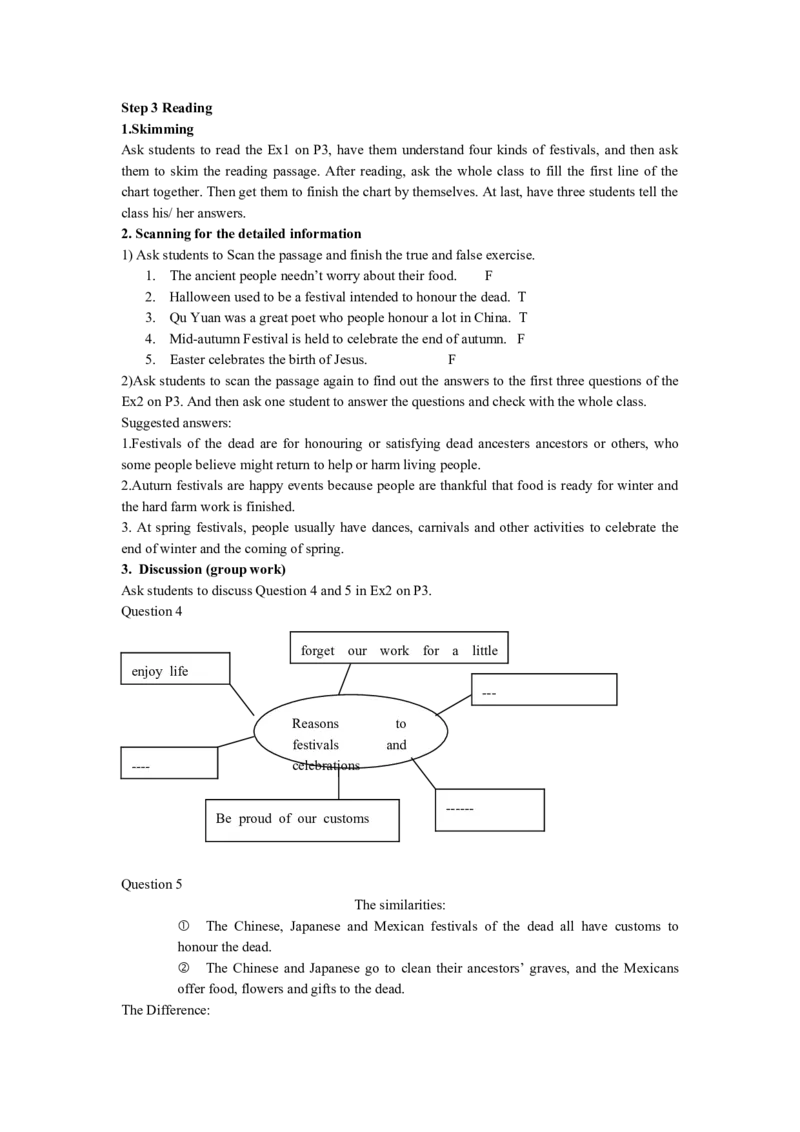
Question 4
forget our work for a little
enjoy life
---
Reasons to
festivals and
---- celebrations
------
Be proud of our customs
Question 5
The similarities:
① The Chinese, Japanese and Mexican festivals of the dead all have customs to
honour the dead.
② The Chinese and Japanese go to clean their ancestors’ graves, and the Mexicans
offer food, flowers and gifts to the dead.
The Difference:The Mexicans eat special food that looks like bones, something the Chinese and Japanese do
not do.
Step 4. Post reading
1. Summarize and fill in the chart
Ancient why the end of the cold winter;planting in spring and harvest in
Festivals autumn
how light fire and make music
Festivals of why to honour the dead or satisfy and please the ancestors
the dead
how light lamps, play music, eat food in the shapes of skulls and cakes
with bones, go to their neighbors to ask for sweets,dress up
Festivals to why for their great contributions to the societyor the country
honour
people
how Dragon boat racing, eat zongzi
Harvest why Food is gathered for the winter. A season of agricultural work is
Festivals over.
how decorate churches and town halls, get together to have big meals,
admire the moon and eat mooncakes
Spring why celebrate the end of winter and the coming of spring
Festivals
how eat delicious food; have exciting carnivals
2. Ex4 on P3
Have students discuss in pairs which kinds of festival they think are the most important and which
are the most fun.
Period Two & Period Three
Language focus
1. be meant to : 应该, 得要,必须, 应做
You are meant to leave a tip. 你得留下小费。
I believe he is meant to be a soldier. 我相信他天生是要当军人的。
I was meant to be working on Sunday, but I just fooled around all day.
星期日我本应工作的,但却闲混了一整天。
辨析:mean doing 与mean to do
1)mean doing “意味着(必须要做某事或导致某种结果)”,其主语通常是指事物的词。如:
Being a student means studying hard. 作为一个学生,就意味着你要努力学习
Success means working hard. 成功意味着工作努力。
2)mean to do “本意要做某事”,主语通常是表示人的名词或代词,其否定形式表示“无意做
某事”,其过去完成式表示“本来打算做某事”
What do you mean to do with it?你打算把它怎样处理?
We mean to call on you tomorrow. 我们打算明天看望你。
Don't be too hard on the boy; he didn't mean to do it.
"对这个小男孩不要太严厉了,他不是故意这么做的。"
Breaking the vase is purely accidental; she does not mean to do it.打碎花瓶纯粹是偶然失手;她无意弄坏它。
I'm sorry I hurt you: I didn't mean to.
对不起,我弄伤了你;我不是故意的。
He had meant to leave on Sunday, but has stayed on.
他本来想星期天走的,但又留了下来。
2. celebrate vt.
(1) 庆祝;祝贺
celebrate Christmas / one’s birthday / a victory
(2) 赞扬;称颂
The names of many heroes are celebrated by the poets.
词语辨析:celebrate, congratulate
celebrate后常接日期,事情或场合
congratulate后常接人
表示为某事而祝贺某人congratulate sb. on/upon sth.
ex:congratulate you on your marriage.
有时还表示私自庆幸的意思。
ex:I congratulated myself on my escape from being punished.
3. take place/ happen/ occur/ come about, break out 区别
英语中表示“发生”的词或短语均为不及物,不用于被动语态。主语为所发生的事。
1) take place发生,举行; 侧重安排或计划而发生的事,带有“非偶然”的意思
The wedding will take place tomorrow.
In 1919, the May 4th Movement took place in China.
但take place偶尔也可以用来表示偶然发生的事情。如:
The accident took place only a block from their home.
事故发生的地方离他们家只有一个街区的距离。
2)happen “发生”,普通用词,含义很广。常指具体客观事物或情况的发生,含有“偶然”的
意味。
What has happened to her?
It happened to rain that day.
3)occur “发生,出现”,较正式用词,指事情偶然地、意外地发生或思想突然浮在心头。当以
具体事物、事件作主语时,happen 和 occur可以换用.
The traffic accident occurred / happened on Wednesday.
That plane crash occurred only minutes after take-off.
空难在起飞几分钟后就发生了。
Didn't it occur to you that he was lying? 你当时没想到他在撒谎吗?
但当happen用作“碰巧”之意时,不能用occur代替,但可以与come about 互换
4) come about “发生”, 常指偶然发生的事情。且很多时候与how 连用。与happen 用法较接
近
How did this come about? 这是怎么发生的?
How did it come about that he knew where we were?
他是怎么知道我们在什麽地方的呢?
How does it come about that you were caught by the police?
5) break out (火灾、战争、疾病)突然发生、爆发
The Second World War broke out in 1939.His face broke out in a rash. 他的脸上突然长满了皮疹。
4. Most ancient festivals would celebrate the end of cold weather, planting in spring and
harvest in autumn.
最古老的节日是庆祝寒冷季节的结束、春种和秋收。
would在句中表示过去经常做某事或者过去的某种习惯,是“常,有……的习惯”的意思。如:
He would lose the key whenever she went out alone.
他一个人出去时,总是把钥匙弄丢。
辨析:would与used to
1)两者都可用来表示过去经常性或习惯的动作,常常可以互换。如:
He used to/ would spend every penny he earned on books.
过去,他通常把挣来的钱全花在买书上。
2)used to表示过去经常性或习惯性的动作或状态现在已经结束,着重现在与过去的对比,
would只能与表示动作的动词连用,不与表示状态和意识的动词连用;would表示有可能再
发生。如:
People used to believe that the earth was flat.
过去人们总以为地球是扁平的。(现在已经不再这样认为)
He would go to the park as soon as he was free.
过去,他一有空就去公园。(现在有可能还去)
5. At that time people would starve if food was difficult to find especially during the cold
winter months.
在那个时代,如果食物难以找到,特别是在寒冷的冬季,人们就会挨饿。
1) starve: suffer or die from hunger (v.)
Millions of people starved to deathduring the war.战争中数百万人饿死了。
2)be starved of / starve for sth.;starve sb of sth : long for; be in great need of (使某人)得不
到某事物而受苦或渴望获得某事物;缺乏
starve for news渴望消息
She's lonely, and starving for companionship(friendship).
她很寂寞,渴望友谊。
The motherless children were starved of/ were starving for love.
失去母亲的孩子渴望得到爱。
3)感觉很饿。to feel very hungry. 仅用于进行时态。如:
When will dinner be ready? I’m starving.
晚饭什么时候做好?我快饿死了。
n. starvation die of starvation 饿死
2)food was difficult to find的to find为动词不定式,作状语,修饰表语形容词difficult,并且
find与主语之间构成动宾关系,主动形式表示被动含义。如:
Habits are easy to make but hard to break. 习惯养成容易戒掉难。
The water is fit to drink.这水适合饮用。
修饰宾语补足语形容词时候也是一样的,如:
I found the car comfortable to ride in. 我觉得这种车很好坐。
That makes poetry difficult to write. 那就使得诗很难写。
6. Some festivals are held to honour the dead or to satisfy the ancestors, who might return
either to help or to do harm.有些节日,是为了纪念死者,或者使祖先得到满足,因为祖先们有可能回到世上(给人们)提
供帮助,也有可能带来危害。
句中的to honour the dead or to satisfy the ancestors 是不定式作目的状语。后边跟了一个由
who引导的非限制性定语从句,修饰ancestors。
a. honour
1) 光荣,荣誉(n)
They fight for the honour of the country.
One must show honour to one’s parents.
2) in honour of 为了纪念
A festival is set in honour of the hero.
3) an honour 光荣的人或事情
Liu Xiang is an honour to our country.
4) 尊敬,给以荣誉(v)
Children should honour their parents.
b. satisfy vt. & vi. 使满意,使满足
Nothing can satisfy him except the best.
Some people are really hard to satisfy.
sb.be satisfied with 对…满意
e.g. She’s not satisfied with her new house.
satisfying satisfactory
c.do harm 损害;危害;伤害。多与to搭配使用,表示“对……有害处”。类似短语还有do
good to sb. 对某人有好处;do damage to对……构成破坏
Hard work never did anyone any harm. 努力工作对任何人都绝无害处。
The treatment they gave him did him more harm than good.
他们的治疗反而使他的病更重。
Doing morning exercises will do good to our health.
做早操对我们的健康有好处。
7. in memory of = to the memory of sb 为了纪念
The museum was built in memory of the famous scientist.
We named the lake Rebecca in memory of her.
为了纪念她, 我们把这个湖命名为“丽贝卡”。
拓展:in honor of in search of sb. / sth.
8.On this important feast day, people eat food in the shape of skulls and cakes with “bones”
on them. 在这个重要的节日里,人们会吃制成颅骨形状的食物,和装点有“骨头”的蛋糕。
1)in the shape of呈现某种形状;以某种形状 如:
The shells on the sand were placed in the shape of the letters PKU.
贝壳摆放在沙地上组成字母PKU。
Tom’s birthday cake was in the shape of a train.
汤姆的生日蛋糕是火车形状。
2) with “bones” on them.是with的复合结构
with +名词或代词+现在分词;过去分词;形容词;副词;不定式;介词短语;名词
Last night he was so tired that he fell asleep with the lamp burning.
She felt nervous, with so many eyes fixed on her.
Frank stared at her friend, with his mouth open.He stood before his teacher, with his head down.
With him to give us a lead, our team is bound to turn out well.
The old man stood there, with his back against the wall.
He died, with his daughter yet a little girl.
9. They offer food, flowers and gift….
词语辨析:offer, provide, supply
offer 主动提供。offer sth to sb; offer sb sth
provide供给(所需物,尤指生活必需品)
provide sth (for sb); provide sb with sth.
supply: 供应(所需要或所要求之物)。supply sth to sb; supply sb with sth
When I meet difficulty, my roommates will offer me help.
他们悬赏找回丢失的珠宝。
They offered a reward for the return of the lost jewels.
政府得提供这些老人们吃穿。
The government need to provide these old people with food and clothes.
每个月都得供应足够的电。
Electricity should be supplied enough every month.
10. dress up 盛装打扮,化装打扮
You don’t have to dress up. Come as you are.
用不著穿讲究衣服--就穿平常的衣服来吧。
Children love dressing up in Halloween.
She wears a beautiful evening dress. n. 她穿着一件漂亮的晚礼服。
She always dresses in black. vi. 她总穿着黑衣服。
She hurriedly dressed the child and took him downstairs. vt.
她匆忙给孩子穿好衣服,把他带下楼来。
She is dressed in red. 她穿着红衣服。
11. play tricks / a trick on sb. 搞恶作剧;诈骗;开玩笑
These children loved playing tricks on their teacher. 孩子们喜欢捉弄老师。
That was an unfair trick to play on her. 跟她开那样的玩笑太不好了。
The boy hid Jone’s bike jto play a trick on him.
孩子们把乔恩的自行车藏起来捉弄他。
12. 辨析:gather与collect
gather是最概括的说法,因此也是应用最广泛的。collect通常可与gather互换。如:
A teacher will collect / gather the examination papers at the end of the hour.
教师将于一小时之后收考卷。
Tears collected/ gathered in her eyes. 她眼中含泪。
但是通常colect指的是仔细选择相似或有联系的东西,以变成有组织的整体的一部分。如:
The department collects information on education reform.
这个部门搜集有关教育改革的信息。
collect antiques 搜集古物 collect stamps 集邮
13. award n. 奖品,奖项,奖金, 助学金 ……
She showed us the awards she had won.
Mary got an award and was able to finish her study.vt. 授予……裁定……award sb sth= award sth to sb
The judges awarded both teams equal points. reward 回报,报
14.admire sb/sth (for …) 钦佩,羡慕,赞美
We all admired her for the way she saved the children from the fire.
她把孩子们从大火中救出来,我们都钦佩不已。
I admire him for his success in business.
我们对他在商业上取得的成功羡慕不已。
admirer n. 赞赏者
admiring adj. 赞赏的,钦佩的
admiration n. 钦佩,羡慕,赞美
15.look forward to(介词) + n/ v-ing 盼望,期待
I’m looking forward to his coming.
--ward 向着…方向
backward 向后 forward 向前
辨析:look forward to与expect
look forward to作“盼望,期望”解,常用于表示愉快或满足的心情,期望或向往某事。to 为
介词,故接动词时应使用动名词。如:
We are looking forward to seeing each other soon.
我们期盼着不久再次见面。
expect 作“期待,期望”解,侧重于相信或认为有实现可能的愿望。可接名词、不定式、不定
式的复合结构以及宾语从句。如:
I never expected his coming/ help.我从未期待过他的到来或帮助。
He expected that he could get there on time. 他希望能按时到达那里。
She expects to come back next week. 她预计下个星期回来。
I expect him to come. 我盼望他来。
16.辨析:clothing ,clothes与 dress
1) clothes的意思是“衣服”,意指全身衣服的各个部分,故永远用复数形式,它是个不可数
名词,前面不可以用不定冠词,也不能用数词修饰,但可以被many,those和these等词修饰。
所指的往往是比较具体的衣物。如:
My wife has folded my clothes and put them in the drawer.
我妻子已把我的衣服叠好并放在抽屉里了。
2)clothing意为“衣着”,意指衣服的整体而言,它是衣服的总称,统指男女老少各式各样的
衣物。是不可数名词,永远用单数形式;如同clothes一样,不可以和数词或不定冠词连用。如:
They do not have enough warm clothing for the winter.
他们没有足够的过冬衣服。
注意:
“一套衣服”是a suit of clothes; “一件衣服”是an article of clothing,这里的suit和article不
能互换使用,但warm clothing也可以说成warm clothes。分别是前者泛指,后者是具体的。
3) dress 作可数名词时,指的是连衣裙、上下连身的女装或童装;作不可数名词时,指的是男
女均可的衣服(尤指外衣)。如:
She makes all the dresses for her daughter.她女儿的连衣裙都是她做的。
She wears a beautiful evening dress. 她穿着一件漂亮的晚礼服。
He doesn’t care much about dress.他不太注重衣着。
casual dress 便服17. as though= as if 好像,仿佛
1)虚拟语气(从句所用的时态比前面真实句所用的时态倒退一个时态.)
He behaved as if/ though nothing had happened.
He talks as if/though he knew everything.
He looks as if he were ill.
2)陈述语气表(示很可能的事实就用陈述语气,)
It looks as if/ though it is going to rain.
Period Four
Teaching goals
To help students understand and use the modal verbs.
Step 1 The use of can and could
1. Show students three sentences and ask them to complete the sentences with modal verbs.Then
have them discuss the reasons why they choose them.
______ you offer me some kind of job?
______ you help me?
______ I use your pen?
2. Show students another four sentences and ask them to complete and discuss again as before.
_______ you ride a bike?
_______ I help you?
How _______ you say that?
_______ he be at home?
3. Ask some students to tell the whole class what and why they choose the modal verbs to
complete the sentences.
4. Help students to find out the six funtions of the modal verbs: can and could.
Could you offer me some kind of job?(request)
Can you help me? (request)
Can(May) I use your pen? (request)
Can you ride a bike? (ability)
Can I help you? (offering help)
How could you say that? (blaming)
Can he be at home? (possibility)
Step 2 The use of may and might
May I come in ? (request)
You may go now. (permission)
--I believe the man is from England.
--But I may be wrong. (possibility)
The guest may arrive this afternoon. (possibility)
May you have a good journey! (wish)
She said that he might take her bike. (permission)
She might go home tomorrow. (possibility)
Might I have a word with you? (permission)
May we see the awards for the teams? (permission; request)
Step3 The use of will and wouldWill you tell her that I'm here? (request)
If you want help - let me know, will you? (request)
Won't you sit down? (request)
Would you help us, please? (request)
I’d go there with you. (promise)
Teacher wouldn’t allow it. (permission)
The Spring Festival is the most fun. The whole family will come for dinner. (promise; agreement)
Sometimes celebrations would be held after hunters had caught animals.
(past habit; custom)
Step 4 The use of shall and should
Shall we go by train, Mom? (permission; request)
I shall go at once. (determination)
The harvest festival begins on Saturday. We shall be there with our friends. (promise)
You should keep your promise. (responsibility)
You should arrive at the airport two hours before he goes. (advice)
Step 5 The use of must and can’t
We must all die. (inevitability) 必然性
You must get up early. (enforcement; responsibility) 强制或者义务
We mustn’t waste our time. (forbiddance)
It must be eleven o’clock now. (prediction)
If Mary didn’t leave here until five o’clock, she can’t be home yet. (guessing)
---- May I take this magazine out?
---- No, you mustn’t. (forbiddance)
He must be crazy. (guessing)
Step6 Check the exercises on Page5
Step7 Take a quiz on the modal verbs
1.. ----____ I go out to play, mum?
----No, you___. You should do your homework first.
A. Might; wouldn’t B. May; had better not
C. Must; mustn’t D. Need; mustn’t
2. ---Where is Emma?
---I can’t say for sure where she is, but she___ be out shopping.
A. can B. should C. must D. may
3. The room is in a terrible mess; it ____ cleaned.
A. can’t have been B. couldn’t be
C. may have been D. would be
4. How____ you say that you really understand the whole story if you
have covered only part of the article?
A. can B. must C. need D. may
5. There ____ be any difficulty about passing the road test since you have
practised a lot in the driving school.
A. mustn’t B. shan’t C. shouldn’t D. needn’t
Keys: BDAAC
Period Five
Step 1. Skimming
Have students read three questions in the Ex1 on Page 7, and then read the passage as quickly as
possible.
Step 2 Pair workDiscuss the questions in group of two and then write down their answers on their exercise book.
Step3 Discussion
Discuss the questions with the whole class, and encourage them to explain their reasons. And
teacher can offer students some more questions about the text.
1) Why is the story of Zhinü and Niulang called a Chinese Valentine’s story?
2) Do you think Li Fang is sure about his love for Hu Jin?
3) If you were Li Fang, what would you have done when HuJin didn’t turn up?
4) If you were hu Jin, what would you do?
5) According to the story you read, will it have a happy ending or a sad one? Why ?
Step4 Writing
Ask students to read the story about Li Fang again. Try to write down the ending to the story.
Students can use the hints on Page 8 to help them to prepare for writing.
Step5 Language focus.
1. turn up 1) 出现;露面
He's still hoping something (eg a job or a piece of good luck) will turn up.
他仍在期待机会出现(如得到工作或好运).
We invited her to dinner but she didn't even bother to turn up.
我们请她吃饭她都不露面.
2)旋大(灯火、煤气);开大(收音机、电视机)音量
I can't hear the radio very well; could you turn it up a bit?
收音机我听不太清楚, 你把声音开大点行吗?
3)发生(情况);(财政、商业)好转、上升
I’ll meet you on Friday unless anything special turns up.
我星期五和你见面,除非发生特殊情况。
We don’t know what may turn up tomorrow.
我们不知道明天会发生什么情况。
2. keep her word
keep one’s word/ promise遵守诺言
break one’s word食言;失信
say a word for 为……说好话
have words with与……吵嘴、争论
eat one’s words收回前言、食言
have a word in one’s ear和……耳语
weigh one’s words推敲或掂量某人的话
in a / one word总而言之
in other words换句话说
on/ with the word一说完就
3. Well, he was not going to hold his breath for her to apologize. He would drown his sadness in
coffee.
他不想心平气和地等她来道歉,他要用咖啡来解愁。
1)breath n. [ breθ ]呼吸,气息
I was out of breath after running for the bus.
我因为追赶公共汽车,弄得上气不接下气。Let's go out for a breath of fresh air. 我们出去吸口新鲜空气吧。
The audience held its/their breath as the acrobat walked along the tightrope. 杂技演员在钢丝绳
上表演时,观众们屏息观看。
breathe vt. &vi. [ bri:ð ]呼吸;低声说
Fish cannot breathe out of water. 鱼离开水就不能呼吸。
breathless: [ 'breθlis ] adj.
I was completely breathless when I got to the top of the mountain.
当我到达山顶上时,我已经上气不接下气了。
2) apologize vi. 道歉,谢罪vt. 道歉,谢罪,辩白
apologize也可写成apologise,apologize to sb. (for sth. )(因某事)向某人道歉
Apologize to your sister! 给你姐姐赔个不是!
I must apologize for not being able to meet you.
我因为没能接你而向你道歉.
You must apologize to your sister for being so rude.
你太无理了, 必须向你姐姐道歉。
3) drown
v. 淹死;淹没
The little girl drowned in the river. 小女孩在河里淹死了。
It is cruel to drown the cat in the river. 把猫淹死在河里是件残忍的事。
The band drowned our conversation.
乐队的演奏声把我们谈话的声音淹没了。
drown --- in 埋头于;浸泡在……里
He decided to drown his sorrow in work. 他决定埋头工作以忘掉悲伤。
Don’t drown yourself in drink. It’s no use. 别借酒消愁,这没有用的。
4. It is/ was obvious/ clear/ true/ possible/ certain…that…
……是明显/清楚/真的/可能/肯定的
这是主语从句最常见的一种结构。句中it作先行代词,代替名词性从句。该结构中的名词性
从句可用that, what, when 等引导。如:
It is obvious that she is very clever. 很明显,她挺聪明的。
It is not certain what caused the accident.还不肯定那个事故是什么引起的。
It isn't remotely possible that you will be chosen to go.
挑选你去的可能性并非很小.
5. Finding that Zhinu was heart-broken, her mother finally decided to let the couple cross the
Milky Way to meet once a year.
看到织女伤心欲绝,王母娘娘决定让这对夫妻每年跨过银河相会一次。
1) Finding that Zhinu was heart-broken分词短语在句中作状语,表示原因。有时候也可以作时
间或条件状语。如:
Reading attentively, he forgot the time for lunch.
由于专心读书,他忘记了吃午饭的时间。(原因)
Reading carefully, he found something he had not known before.
他仔细读书时,发现了一些从前不知道的东西。(时间)
Reading carefully, you’ll learn something new.
只要你仔细阅读,你会学到一些新的东西的。(条件)
vi./ vt 应受,值得 to have earned something by good or bad actions or behavior2)由非谓语动词构成的复合词的常见的形式有:
a. 名词+过去分词或动词-ing形式。如:
man-made dog-tired English-speaking insect-eating
b. 形容词+动词-ing形式。 如:
good-looking bad-looking easy-doing
c. 副词+过去分词。 如:
newly-built well-dressed
well-skilled highly-qualified
6.set off (for)出发、启程(前往某地)
One afternoon she set off/ our from the coast in a small boat and was caught in a storm. 一天下午,
她乘坐小船从海岸出发,遇到了一场暴风雨。
The children set/ out for school. 孩子们上学去了。
If you want to catch that train we'd better set off for the station immediately.
如果你想要赶上那班火车的话你最好要立即出发前往车站。
set out 着手;开始
set about 开始或出发;着手解决问题
set down 记录;写下
set up 建立;引起;使产生
set an example to 给……树立榜样
set one’s heart on 决心做某事
set sail 扬帆起航
set oneself to do 想做……
7. remind
1) remind sb. about sth.= remind sb. to do sth.
Will you remind me about the appointment?
请你提醒我不要忘了约会,好吗?
Remind me to write to mother. 提醒我给妈妈写信。
2)remind sb. + 宾语从句 如:
Remind me what I shall do. I haven’t used the machine before.
提醒我该怎么操作,我以前没有用过这种机器。
3) remind sb. of sth. 提醒某人某事
Hearing the song always reminds me of a certain night in Shanghai.
听到这首歌就使我想起在上海的一个晚上。
Please remind me again of the interview.
请再提醒我面试的事情。
8. forgive v. 原谅;宽恕
We forgave him his mistakes.
I forgave him for stealing the money.
My advice is that it’s best to forgive and forget.
forgivable adj. 可宽恕的,可原谅的
forgiving adj. 宽仁的, 宽大的
forgiveness n. 宽恕,饶恕
ask for forgiveness 请求宽恕
receive forgiveness 受到宽恕full of forgiveness 富有宽仁之心
Unit 2 Healthy eating (必修三)
Objectives
To help students understand the text’s forms and contents and learn about healthy
eating
To help students communicate on the topic in focus with the words, expressions and
structures learned in this unit
Focus
重点单词: diet, balance, fry, ought, raw, strength, consult, debt , limit, benefit, combine
重点短语: ought to 应当;应该 lose weight 体重减轻;减肥 get away with 被放过;(做
坏事)不受惩罚 tell a lie 说谎 win…back 赢回;重新获得 earn one’s living
谋生 in debt 欠债 cut down 削减;删节 before long 不久以后 put on
weight 增加体重
重点句型: 1. Wang Peng sat in his empty restaurant feeling very frustrated.
2.“Nothing could be better.”he thought.
3. He could not have Yong Hui getting away with telling people lies!
4. Wang Peng was amazed at this and especially at the prices.
5.He had better do some research.
6. It cost more than a good meal in his own restaurant.
7. The competition between the two restaurants was on!
8. His restaurant ought to be full of people.
9.I don’t want them to remind me of her.
重点语法: 情态动词(二) ought to/ought not to; have to/ don’t have to;
mustn’t ;needn’t等的用法。
Procedures
Warming up
We have heard of the proverb “You are what you eat!” This means that our health and strength are
directly related to our diet. So this unit encourages us to examine our own eating practice and see
whether we are eating a healthy diet or not.
Step 1 Health Survey
Complete the questionnaire below by choosing the answers that best describe you. Then, compare
your answers with a partner.
How Healthy Are You?
1. I .
a. don’t eat any meat; I’m a vegetarian
b. eat red meat maybe once or twice a week
c. eat red meat at least once a day
2. In my family, we have a history of heart disease and diabetes.
a. Not true. b. I’m not sure. c. Yes, we do.
3. I try to have at least two servings each of fruit and vegetables .
a. every day b. every week c. every month
4. I try to avoid things that will affect my health negatively, such as smoking, drinking, and
eating junk food.
a. always b. sometimes c. never
5. I vitamins.
a. take b. sometimes take c. don’t takeThe key to your health: A=3 points, B=2, C=1. Now add up your score, and
read the results below.
12—15 points: You’re in great health! Keep up the good work.
7—11 points: You’re pretty healthy, but remember, there are always ways that
we can take better care of ourselves! There are some things you need to do to
be healthier.
6 or fewer points: Do you get sick often? It might be your diet. You should
think about changing your eating habits and perhaps your lifestyle—soon!
Step 2 sharing opinions
This activity shows students how different kinds of food are grouped according to the benefit they
give us. This is important as it allows us to talk about the value of particular food to our health.
Everybody has to eat, but do you eat a healthy diet? Do you know that the food you eat
helps you grow in different ways?
provide energy grow bones and help the body fight
Benefit (Energy) muscles diseases
(Building) (Protective)
rice noodles bread meat eggs cheese most vegetables most
spaghetti, potatoes milk fruit
Food chocolate tofu
cream oils nuts
My favorite
meal
What will happen to you if you don’t eat a balanced diet?
Suggested answers:
1. If you eat too much energy-giving foods you will become fat and suffer from high blood
pressure.
2. If you eat too much body-building food you will grow taller and stronger but not necessarily
healthier.
3.If you eat too much protective foods for every meal you may lack energy. However without
protective food (over a long period of time) you can get serious illnesses like scurvy (lack of
vitamin C ) or rickets (lack of vitamin D).
4. If you don’t eat enough food of any of the three kinds you may get anorexia (too thin).
Pre-reading
1. What do you think should go into a good meal?
(A good meal should contain some food from each of the three categories above.)
2. Imagine you and your partner are going to invite some friends for dinner. What special food of
your place would you offer them? Plan a menu.
Reading COME AND EAT HERE (1)
Task 1: Fast reading—Main idea
Being driven by curiosity, Wang Peng, an restaurant owner, spied on Yong Hui’s restaurant and
put on a competition with Yong Hui.Task 2: Main idea of each part
The passage can be divided into 3 parts. Give the main idea in each part.
1 Wang Peng is worried because his restaurant is not as full as it usually is.
2 He follows his friend to a newly opened restaurant which is very popular.
3 Worried, he does some research to win his customers back.
Task 3: Careful reading—Detailed information
Answer these questions:
1. The weakness of the diet in Wang Peng’s restaurant was that it did not
give_____________________. (enough protective food)
2. The strength of the diet in Wang Peng’s restaurant was that it provided________________.
( plenty of energy-giving food)
3. The weakness of the diet in Yong Hui’s restaurant was that it did not give________________.
(enough energy-giving food)
4. The strength of the diet in Yong Hui’s restaurant was that it provided_____________________.
(plenty of protective food)
Task 4: The information of the two restaurants
Wang Peng’s Yong Hui’s
mutton kebabs, roast pork,
fruit, water, raw vegetables
menu fried rice
energy foods, fit fiber foods, slim
strength
fat, not enough fiber not enough energy, feel tired fast
weakness
not very expensive expensive
price
Task 5: Discussion
Discuss these questions in pairs. Write down your main points and compare them with those of
another pair.
1 What do you think Wang Peng will provide to win his customers back?
2 How do you think the story will end?
Language Points in Warming up:
1. diet[C]sort of food that is usually eaten (个人、社区等) 通常所吃的食物;节食
diet是可数名词,常与不定冠词a连用。
The doctor put him on a diet after operation. 手术之后,医生规定了他的饮食。
She is on a special diet to lose weight. 她为了减肥而吃特别规定的饮食。
The Japanese diet often includes rice, fish and vegetables.日本人的饮食常包括大米、鱼和蔬菜
等。
Proper diet and exercise are both important for health. 适当的饮食和锻炼对健康很重要。
◆be(go) on a diet意为“节食”“吃限定的食品”。
2. energy n.(1)ability to act or work with strength and eagerness精力、活力。
He had so much energy that he did the work of three men.
他精力旺盛,能做三个人的工作。
He is full of energy.他精力充沛。
(2)fuel and other resources used for operating machinery,etc.能量,能源
This kind of food can give you a lot of energy.
这种食物能为你提供大量的能量。
Plants absorb energy from the sun.
植物吸收太阳的能量。
3. balance n.& v.
(1) n. steadiness平衡状态
keep the balance of nature保持生态平衡
A small child has to learn to keep its balance before it can walk.
小孩在能走远之前,必须先学会保持平衡。
(2) vt. keep or put (sth) in a state of balance保持平衡,权衡
How long can you balance yourself on one foot?
你用一只脚能站多久?
We must balance the two plans.
我们必须把这两个计划比较一下。
◆be in the balance成败未定,前途未卜
lose one’s balance失去平衡,心慌意乱
keep one’s balance 保持平衡
Language Points in Come And Eat Here (1):
1. Wang Peng sat in his empty restaurant feeling very frustrated.
王鹏坐在他那空荡荡的餐馆里,感到很沮丧。
在此句中,feeling very frustrated是现在分词短语作伴随状语。如:
He sat at the table reading China Daily.
他坐在桌旁边看《中国日报》。
Laughing and talking, they went into the room.
他们有说有笑地走进房间。
单项选择
(1)The secretary worked late into the night, a long speech for the president.
A. to prepare B. preparing C. prepared D. was preparing 答案: B
(2 ) from the top of the hill, the city looks very beautiful.
A. Seen B. Seeing C. To see D. See 答案: A
2. By now his restaurant ought to be full of people.
ought to: 应当;应该
I think there's a train at 8:20 but you ought to make certain.
我想8点20分有一班火车, 不过你应该打听清楚.
China ought to make a greater contribution to humanity. 中国应当对于人类有较大的贡献。
3.“Nothing could be better.”he thought. 他想,“再没有比这些更好吃的了”。此句子用比较级形式表示最高级的意义。含义是All his foods could be the best.
(1) He is taller than any other boy in his class.=He is the tallest boy in his class.
他是班上最高的男生。
(2)A:How are you getting on? 你怎么样?
B:Nothing could be better. (Everything is OK.) 再好不过了。
(3)“Did you sleep well last night?” “你昨夜睡得怎样?”
“Never better, like a rock.” “从未这么好过,睡得很死。”
【注意】 否定句与比较级连用,实际上表示的是最高级的含义。
Nobody loved money better than he.
没人比他更贪财。(他最贪财。)
I think nothing is more pleasant than traveling.
我想没有什么比旅行更令人愉快。(旅行最令人愉快。)
单项选择
(1)—Go for a picnic this weekend, OK?
— . I love getting close to nature.
A. I couldn’t agree more B. I’m afraid not C. I believe not D. I don’ t think so 答案: A
(2)—How do you like our hotel?
—I couldn’t have found a one.
A. good B. better C. best D. fine 答案: B
4. Something terrible must have happened if Li Chang was not coming to eat in his restaurant as
he always did. 如果李昌不像往常一样来他的餐馆吃饭,那一定就是发生了可怕的事情。
must have done表示对过去已发生的事情作出肯定猜测,译为“一定做过”,只能用于肯定
句,其否定式为can’t/couldn’t have done.’
I posted a book to her three weeks ago. She must have received it.
三周前我邮给她一本书,她一定收到了。
He can’t have been to your house. He doesn’t know your address.
他不可能去你家,他不知道你的地址。
情态动词+have done常见的还有should have done,表示本来应该做某事(但实际上没做)。
could have done本来能够做某事(但实际没做)
needn’t have done本没必要做某事(但实际做了)
must have done肯定做了某事
can’t/couldn’t have done不可能做某事
might have done可能做了某事(可能性小一些)
5. curiosity : eager to know n.好奇心;求知欲
He is burning with curiosity to know what has happened.
他极渴望知道发生了什么事。
His curiosity to learn new knowledge is quite strong.
他对新知识的求知欲很强。
adj. curious 好奇的,好打听(隐私)的
Many people are curious about the origin of mankind.
很多人对于人类的起源很感兴趣。短语或句型
out of/from curiosity出于好奇
be curious to do sth.极想做某事
be curious about sth.对……感到好奇
It’s curious that… 真奇怪……
6. Wang Peng was amazed at this and especially at the prices.
王鹏感到吃惊,尤其是对它们的价格。
be amazed at表示“对……感到惊讶”。
Everybody was amazed at his words. 大家都对他的话感到惊讶。
◆be amazed之后除接介词at,还可接不定式,that从句等。
I was amazed to hear that you were leaving. 听说你要离开,我很吃惊。
She was amazed that I was only twenty. 我只有二十岁,她对此感到很惊讶。
◆be surprised at对……感到吃惊
be delighted at对……感到高兴
be sad at对……感到难过
7. It cost more than a good meal in his own restaurant. 这比在他自己的餐馆里吃顿好饭还要贵。
more than意为“多于……”;“不止”;“不仅仅……”
More than one man knows about it.不止一人知道此事。
He is more than a teacher.他不仅仅是位老师。
归纳:
(1)形容词比较级用于两者或双方之间的比较,常用句型有:
“比较级+than...”表示两者程度有差异。
“as+原级形容词+as...”表示双方程度相同。
“比较级+and+比较级”表示“越来越……”。
“the+比较级+of the two + n .”表示两者中更……的那一个。
(2)no more than与not more than的区别:
①no more than意为“和……一样不……”指前后两者都差不多;
not more than意为“并不比……更……。”
not只否定前者,表示前者不如后者。
②接数字时,no more than意为“仅仅”(指少的意义);
not more than意为“至多”“不多于”(指事实)。
单项选择
(1)Boris has brains. In fact, I doubt whether anyone in the class has IQ.
A. a high B. higher C. the higher D. the highest 答案: B
(2)The patient feels better today.
A. much; than B. much C. very D. very; than 答案: B
(3)Of the two toys,the child chose .
A. the less expensive one B. the one most expensive
C. the less expensive D. the most expensive of them 答案: A
8. He could not have Yong Hui getting away with telling people lies!他可不能让咏慧欺骗人们后跑掉。
have sb. doing sth.让某人做某事。(强调持续做某事)
She always has the TV going the whole night. 她总是让电视机整晚开着。
【注意】 have sb doing sth.与won’t或cannot连用时,表示“制止”或“拒绝”。
I won’t have you talking to me that way. 不准你用这种方式跟我讲话。
① have+sb+过去分词
I’m not going to have you mixed up with this sort of business.
我不会允许你同这种事搅在一起。
② have+sb+动词原形
Have Li Ping do it. 叫(让)李平做此事。
③have+sb+副词
will you have him in? 你把他请进来好吗?
④have+sb+介词短语
I had her at the house. 我让他呆在家里。
⑤have+sb+形容词
Please have them ready for class. 请让他们做好上课准备。
9. get away with (做了某事)而不受惩罚;携带……跑掉
They got away with having damaged the car.
他们损坏了汽车却逃之夭夭。
相关短语:
get across 解释清楚,使人了解
get along/on... 靠……为生
get along/on with 进展……,与……相处
get around/round 走动,(消息)传开
get down to... 开始,着手……
get to到达
get down 写下,从……下来
get up起床,上去
get out of逃避,改掉
10. tell a lie 撒谎
Of course it’s true. I wouldn’t tell you a lie. 当然这是真的,我不会对你说谎的。
◆(1)说谎 lie→lied→lied→lying
(2) 躺;位于lie→lay→lain→lying
(3)(lay放置;下蛋 )lay→laid→laid→laying
I laid a book on the desk.我把一本书放在书桌上了。
Hens can lay eggs.母鸡能下蛋。
单项选择
(1)—what did Joe do?
—He asleep all morning.
A. lain B. laid C. lay D. lying 答案:C
(2)Do you know the boy under the tree?
A. lay B. lain C. laying D. lying 答案:D
11. He had better do some research. 他最好做一番调查。
had better do sth.最好做某事You had better set out at once.你最好立即动身。
had better应看作情态动词,通用于所有人称,其否定式为had better not。
He is doing his homework and you had better not trouble him.
他正在做作业,你最好别打扰他了。
12. Perhaps with a discount and a new sign he would win his customers back.
(1)discount: n. amount of money taken off the cost of sth折扣
These goods will be sold at a discount. 这些货物将减价出售。
Better reduce the price than allow a discount. 与其给折扣,不如减价。
(2) win back: 赢回; 重新获得
The party must try to win back the support it has lost. 该党须设法重获人心.
13. The competition between the two restaurants was on! 这两个餐馆之间的竞争开始了!
on adv. 进行中,在做,上演。与be和have连用,表示各种含义。
(1)What’s on? (=What’s happening?或What’s the programme?)
发生了什么事?有什么节目?
(2)What’s on (=What films are being shown)at the local cinema this week?
这个星期本地电影院上演什么片子?
(3)Have you anything on tonight?你今晚有事吗?(你今晚有约会吗?)
Language Points in Comprehending(P11):
strength n. quality of being strong力,力量;体力;实力,长处
She doesn’t have enough strength to walk upstairs.
她没有足够的力气走上楼梯。
Chinese is his strength. 擅长中文是他的长处。
v. strengthen : become stronger加强,变强;使强壮
We want to strengthen our ties with them.
我们想加强与他们的关系。
Language Points in Learning about Language (P12):
consult vt. go to (a person, book, etc) for information请教,咨询;查阅,参考
You had better consult your doctor about your rash.
你长疹子的事最好去咨询医生。
I consulted the telephone book for his address.
我查阅电话簿找他的住址。
vi. discuss matters with sb (与人)商量;协议
He consulted with his business partners about the matter.
他与事业合伙人商议这件事。
Come And Eat Here (2)
Pre-reading
Learn these proverbs:
You are what you eat. 人如其食。
First wealth is health. 健康是人生的第一财富。
An apple a day keeps the doctor away. 一天一个苹果,医生不来找。Reading
Step1 In pairs discuss these questions after reading the passage.
1. How did Yong Hui feel when she came to Wang Peng’s restaurant? Why?
She felt angry because she thought Wang Peng had come into her restaurant to spy on her.
2. How did they solve their problems and become good friends?
(a) Wang Peng showed that he wanted to cooperate and not compete with Yong Hui.
(b) They succeeded in finding a menu that provided a balanced menu.
3. Why was their cooperation a success?
(a) They cooperated successfully in business.
(b) They liked each other.
Step 2 Fill in the chart below.
What did they do? Result
Combine their menu and provide a balanced one 1. cut down the fat
1. raw vegetables with hamburgers 2. increase the fiber
2. the boiled potatoes, not fried 3. a big success
3. fresh fruit with ice cream
Step 3 Language Points in Come And Eat Here (2):
1. Perhaps he would be able to earn his living after all and not have to close his restaurant.
也许他仍然能够谋生,而不至于关闭自己的餐馆。
after all在此意为“虽然……但是仍然……”。
After all his efforts, he also failed this time. 虽然他很努力,但他这次仍然失败了。
After all my care, it was broken. 虽然我已尽量小心,仍然把它打破了。
归纳:
(1)after all“结果;终究”,表示结果与预想不同,通常置于句尾。
(2)after all“毕竟,究竟”,导出原因,通常置于句首。这种用法的after all可以译为“别忘了;
须知;应记住;要知道”。
2. earn one’s living 谋生;以……为生
She used to earn her living by selling drinks. 她曾经以卖饮料来维持生活。
归纳:
earn a living谋生
make a/one’s living谋生
earn one’s own living自食其力
earn one’s bread谋生 【注意】 bread不可数,不能说earn a bread
3. in debt 欠债;负债;欠人情
He was always in debt when he was young. 他年轻时,经常负债。
He is heavily in debt.他负债累累。
归纳:
(1)be/get out of debt 还清负债;没欠债
(2)get/run/fall into debt借债;负债
(3)be in debt to sb. 欠某人的债
4. glare v . angry or fierce look怒目而视
They stood glaring at each other. 他们站着互相怒目而视。辨析: glare, stare, gaze 与 glance
(1)glare作动词时意为“瞪视,凝视”,指愤怒或威胁地凝视,强调威胁或敌对的态度。
(2)stare 意为“注视,凝视”,指目不转睛地盯着看,带有好奇、惊喜、沉思或恐惧等感情,常
有意或无意地带有贬义。
(3)gaze 表示注意力很集中。
(4)glance 意为“一瞥,看一眼,粗略地看一看”,指一看的结果。
They didn’t fight, but stood there glaring at each other.
他们没有打起来,但却站在那儿怒目而视。
He glanced at his watch and left in a hurry.
他看了看表,然后匆忙离开了。
“I’m going to get married,” he said. I stared at him in disbelief.
“我要结婚了。”他说。我盯着他,难以置信。
单项选择
(1)The tiger angrily at the cat.
A. stared B. gazed C. glared D. watched 答案:C
(2) I only at your work, but it seems to be good.
A. glared B. glanced C. stared D. gazed 答案:B
5. I thought you were a new customer and now I find you came only to spy on me and my menu.
我本来以为你是一为新顾客,现在我才发现你知识过来打探我和我的菜谱的。
only to spy... 在句中做目的状语
only to do sth. 和 only doing sth.
◆only to do sth. 表示一个与主语愿望相反的或出乎主语医疗的结果,或用来暗示最初的未能
实现的动作。
only doing sth. 表示谓语动词本身的动作造成的结果。
6. benefit n.
(1)[U] profit ; gain 益处;帮助
Did you get much benefit from your holiday? 你的假期是否对你有很大的益处?
(2)[C]好处;恩惠
We should be aware of the benefits of a good education. 我们应该知道良好的教育的好处。
Never forget the benefits we receive from our parents. 决不要忘记父母给我们的恩惠。
benefit v. do good to sb 有益于;对……有益
The new railway will benefit the district.新铁路对于该地区将有益处。
You will benefit from these books. 你将得益于这些书。
归纳:
benefit from 从……中受益
for the benefit of 为了某人的利益
be of (great/much) benefit to …= be (very) beneficial to … 对……有利/有益
7. combine : join or mix together to form a whole
(1) vt. & vi. 联合;结合;合并
常用结构:
combine A and/with B 使A与B结合/联合
Hydrogen combines with oxygen to form water. 氢与氧化合成水。
Combine the eggs with a little flour and heat the mixture gently.把鸡蛋和少量面粉调匀,用温火加热。
He combines arrogance and incompetence in his dealings with the staff.
他在与工作人员交往中既傲慢又无能。
combine 还可以和against 连用
Everything combined against him. 事事都和他作对。
The three countries combined together against their enemy.
这三个国家联合起来反对他们的敌人。
(2)combination n.结合;混合;混合物;联合体
Pink is a combination of red and white.
粉红色是红色与白色的混合色。
8. cut down 削减,删节,砍倒
We must cut down our expenses. 我们必须削减开支。
Your article’s too long---please cut it down to 1000 words.你的文章太长―请把它删减到1000
字。
归纳:
cut in 插话;打断
cut up 切碎;挫伤
cut off 切断;断绝;隔绝
cut through 抄近路穿过
cut out 割断;删掉
单项选择
(1). I won’t have a cigarette, thanks---- I am trying to .
A. cut in B. cut down C. cut out D. cut up 答案: B
(2) I was just talking to Margaret when Jackson .
A. cut in B. cut down C. cut out D. cut up 答案: A
9. before long 不久以后
before long 单独作状语,相当于soon.
You will understand this before long. 不久你会明白这一点的。
long before 很久以前
I had known her long before. 我很久就认识她了。
… long before … 的固定句式
It took/was long before… 过了很久才……
It didn’t take/wasn’t long before… 过了不久就……
It will take/be long before… 要过很久才……
It won’t take/be long before… 不久就会……
It took long before he came to help me. 过了很久他才来帮我。
It didn’t take long before the fire was put out. 不久就把火扑灭了。
It will be long before the new school is built up. 要过很久才能建成新校。
It won’t be a long time before someone comes to see you. 不久就会有人来看你。
(1)Mary came to France in 1940, and it wasn’t long she became a French citizen.
A. while B. before C. since D. when 答案: B
(2) her death in 1886, the poet Emily Dickenson had become a legend (传奇人物) in the
hometown of Amberst Massachusetts.
A. It was before long B. Before long C. When long before D. Long before 答案:D语法: modal verbs 情态动词
1. ought to/should
◆ought to表示“应该”,口气比should还要强。它的否定式为ought not to/oughtn’t to。
You ought to take care of yourself when I’m away. 我不在的时候你一定要照顾好自己。
You oughtn’t to have let out the secret. 你本来不应该泄露这个秘密。
◆should 和ought to 后面跟动词不定式的完成式,其肯定句表示”过去应该做而未做”, 其
否定句则表示”过去不该做但做了”。
You should/ought to have made the decision a week ago.
I shouldn't have made such a foolish mistake.
2. must和have to
◆have to表示“不得不”。与must不同的是,must表示说话人主观上的看法,即主观上的必
要;而have to则表示客观要求。
I must stay at home and take care of my old grandma.
我必须呆在家里照顾我的老奶奶。(主观上要做这件事)
You will have to be punished if you can not hand in your paper on time.
如果你不能按时交上试卷,你将不得不受到惩罚。(客观上需要做这件事)
◆ don’t have to表示“不必要”,和needn’t意思相近。
You don’t have to stay up late preparing for the exam. I heard it’s quite simple.
你没必要熬夜准备考试,我听说考试很简单。
◆mustn’t 表示“不准,禁止”。
You mustn’t smoke in the hospital.在医院里禁止吸烟。
— Must I finish the task right now? 我现在必须完成这个工作吗?
—Yes, you must. / Yes, you have to. 是的。
(—No, you needn’t. / No, you don’t have to. 不,不必。)
【注意】 在这些情态动词中,只有have to可以有人称、数、时态的变化。如:
You will have to be there before 10 :00. 你必须在十点之前到那里。
As he had broken his leg, he had to stay in bed. 由于摔坏了腿,他不得不呆在床上。
3. 几种特殊结构
must do表示对现在某事进行肯定性推测。
can’t do表示对现在某事进行否定性推测。
must have done表示对过去某事进行肯定性推测。
can’t have done表示对过去某事进行否定性推测。
should /ought to have done
表示应该做而实际上未做的事情。
should not/ought not to have done
表示不应该做而已经做了的事情。
may/might have done表示或许已经做过某件事。
could have done表示能做却没有做的事情。
would have done表示本来要做却没有做的事情。
needn’t have done表示本来没必要做却做了的事情。
单项选择
1. Johnny, you ______ play with the knife , you _____ hurt yourself.A. won`t ; can`t B. mustn`t ; may C. shouldn`t ; must D. can`t ; shouldn`t
2. When can I come for the photos? I need them tomorrow afternoon.
They ____ be ready by 12:00.
A. can B. should C. might D. need
3. Shall I tell John about it ?
----No, you _____ . I`ve told him already.
A. needn`t B. wouldn`t C. mustn`t D. shouldn`t
4. You take your umbrella. I’m sure it won’t rain.
A. shouldn’t B. can’t C. don’t have to D. mustn’t
5. She for what she has done. But why do you keep silent on it?
A. ought to praised B. ought to have praised
C. ought to have praised D. ought to have been praised
6. Where is my pen? I it.
A. might lose B. would have lost C. should have lost D. must have lost
7. ----What do you think of the food here ?
Oh, wonderful ! We ____ a better place.
A. won`t find B. mustn`t have found C. can`t find D . couldn`t have found
8. We _____ for her because she never came .
A. needn`t wait B. shouldn`t have waited C. mustn`t wait D. mustn`t have waited
9. He _____ you more help , even though he was very busy .
A. might have given B. might give C. may have given D. may give
10. Tom ought not to me your secret, but he meant no harm.
A. have told B. tell C. be telling D. having told
Unit 3 The Million Pound Bank Note
Teaching aims:
1. To help Ss know more about American writer – Mark Twain and his story The Million Pound
Bank Note.
2. To help Ss learn about the features about the plays and the languages in the plays and
appreciate the play.
3. To help Ss learn how to ask for permission politely and how to order the food and how to do
the shopping.
4. To help Ss learn the noun clause—the object clause & the predicative clause
5. To help Ss learn and master the words and useful expressions in this unit.
Focus
1. Words: bet, permit, wander, stare, spot, account, seek, scream, issue, bow
2. Expressions: bring up, make a bet, go ahead, by accident, stare at, account for, on the
contrary, in rags
3. Sentence patterns:
1) A rich person gives you a large amount of money to use as you like.
2) Have you ever made a bet with a friend? If so, what did you bet on?
3) Now ladies and gentlemen, you are about to hear the most incredible tale.
4) Permit me to lead the way, sir.
5) I wonder, Mr Adams, if you’d mind us asking a few questions.
6) As a matter of fact, I’d about given myself up for lost when I was spotted by a ship.7) And it was the ship that brought you to England.
8) I earned my passage by working as an unpaid band, which accounts for my appearance.
9) Well, to be honest, I have none.
Teaching steps:
Step 1: Warming up
Mark Twain is probably one of the few American writers with whom your students are already
familiar.
1. Are you familiar with the American writer – Mark Twain? This is a quiz for you. I want to find
out how much you have already known about Mark Twain before we start. Close your books
and answer in your notebooks.
What was the real name of Mark Twain?
What does Mark Twain mean?
What century was he born?
What was his job?
Can you namne one of his famous novels?
Along which river are some of his most famous novels set?
Did he write plays as well as novels and short stories?(Twain did not write plays but he did
write novels and short stories.)
Can you name one of his short stories?
2. Read the short passage in SB Warming up on Page 17, and fill in the chart.
3. Ask the class if any of them have read or seen a film of The adventures of Tom Sawyer or The
adventures of Huckleberry Finn. Tell the class the plot briefly.
Step 2: Pre-reading
1. Imagine that somebody gives you a large sum of money to spend as you like. What would you
do with it? (T: Firstly, I would build a school with the money. And then I would use the rest
of the money to travel around the world till the money is used up. At last, I would come to the
school to work.)
2. Ask Ss whether they have read the story of “The Million Pound Bank Note”?/ What about the
film? If they have, what did they think of it?
Step 3: Reading
1. Imagine what would happen to a perfectly honest and intelligent stranger who should be
turned adrift in London without a friend, and with no money but a million-pound bank-note,
and no way to account for his being in possession of it?Could he live for a month without
being sent to jail?
2. Read the text carefully and decide on the type of writing and try to get the main idea of the
passage.
Type of writing: This is a piece of narrative writing, a play.
Main idea of the passage: Two rich Bristish men offer a penniless American a loan, without
telling him that the amount is 1,000,000, and this is the form of a single banknote.
3. Read the text again and do Ex. 1-3 on Page 19. Check the answers with the whole class,
especially Ex.3. Pay attention to what Henry says or does and how he feels.
4. Get Ss to discuss the questions in Ex 4 on page 19.
5. Language points.
An incredible tale难以置信的故事, have some very bad luck非常倒霉,be lost in London在伦敦迷路, have no money身无分文,
walk down the street在街上走, hear sb doing听见某人正在做某事,
step inside走进来, through the front door从前门进来, on one’s left在某人左侧, open
the door for…给开门, permit … to do sth准许做, ask a few questions,问些问题 go right
ahead请问吧, have no plans没计划, find work找工作,
as a matter of fact事实上, land in Britain在英国上岸, by accident偶然,
back home在家时,回家, sail out of the bay驶出港湾, stare at盯着看,
towards nightfall接近傍晚时分, find …done发现某事某人被,
be carried out to sea被带到海上, a strong wind一阵大风,
give up for lost因迷失而放弃, be spotted by a ship被一艘船发现,
earn one’s passage by… 通过做某事赚取某人的游资,
work as an unpaid hand作为一个不拿工资的帮手, account for说明理由,
smile at…相顾而笑, work for…为工作 , offer sb. sth.提供某人某物,
a mining company 一家矿业公司, care about…在意, an honest job 老老实实的工作,
show…out,送出去 in an hour and a half一个半小时以后
6. Important sentences.
1) He was brought up in Hannibal. 提出, 养育, 提升, 调集, 呕吐
﹡ I shall bring up this question at the next meeting.
Why did you have to bring up the subject of money?
﹡ He left her to bring up three young children on her own. 他留下她独自抚养孩子。
﹡In my day, children were brought up to respect the law.在我小时侯,孩子们都接受教育要
遵守法律。
﹡He can’t eat anything without bringing it up. 他吃什么都吐。
﹡We need to bring up more tanks.我们需要调集更多的坦克到前线。
﹡He was brought up on a charge of drunken driving.他被控醉酒驾车而出庭受审。
2)A rich person gives you a large sum of money to spend as you like. What would you do with
it?
﹡a large sum of money = a large amount of money 一大笔钱
Sid was left a large sum of money by his aunt. 西德的姑母给他留下一大笔钱。
It was mine for the sum of $20.我是花了20 美圆把它买来的。
﹡as you like 如你喜欢/愿意 象。。。一样
Jim works in the same office as my sister does.
Do as I say!
David, as you know, has not been well lately.
﹡ do with 处理,应付 what to do with sth / how to deal with sth
3) Two old and wealthy brothers have made a bet ( an agreement to risk money on the result of a
race, game, competition etc.).
﹡have a bet win /lose a bet accept / take up a bet
We made a bet on the outcome of the next horse race.
I made a bet that we would win the football match.
Mom had a bet on the Yankees and won $20.
I’ve got a $20 bet on the National.
﹡Mrs. Black spent all her money betting on horses.
I bet …= I’m certain…我肯定 I bet he’s gone to swimming –he loves it.4) They see a penniless young man wandering on the pavement outside their house.闲逛,漫步
﹡see sb doing / hear sb doing hear a voice calling his name
﹡wander (to move slowly across or around an area, without a clear direction or purpose)
Wander in / through / around I’ll just wander around the mall for half an hour.
The river wanders through some beautiful country.
He wandered in to see me as if he had nothing else to do.
Don’t let any of the kids wander off (move away).
Pastor Riker started to wander from/off the point (to start to talk about something not
connected with the main subject that you were talking about before).
5) It is Henry Adams who is lost in London and does not know what he should do.
﹡It is … who …
﹡ be lost in 迷路/ 倾心于某事
He was lost in the forest for three days and nights and was finally rescued by his friends.
He was lost in reading his book that he forgot the time of his train.
6) Permit me to lead the way, sir. (formal to allow sth to happen, especially by an official order
or decision)
﹡ Permit sb to do sth = allow sb to do sb. Permit sb sth. Permit sth in / near.
Smoking is only permitted in the public lounge.
Will you permit us to use this room for a meeting this afternoon?
We’ll have a picnic in the woods, weather permitting.如果天气好,我们将在树林里野餐
You are not permitted /allowed to smoke here.
She won’t permit her dogs to enter this yard.
﹡ permit doing sth The rules of the club don’t permit smoking.
I’ll come after the meeting if time permits.
﹡ permit 与allow 在许多情况下通用,但较正式,比较积极,从正面允许。
They don’t permit you to smoke.
Allow 指并不反对或不加阻止,偏重默许或听任,较消极。
Each passenger is allowed twenty-five kilogrammes of luggage.
let 正式,口语化,语意最弱,指能给予可能或同意,有时含有难以阻止或限制。
Let him wait.
7) I wonder, Mr.Adams, if you’d mind us asking a few questions.
﹡ I wonder if /whether you …不知您是否。。。 委婉请求的句式,用于正式场合
﹡ mind us asking a few questions one’s doing
8) As a matter of fact, I landed in Britain by accident.
﹡ as a matter of fact = in fact 事实上,实际上
He appears to be in very good health but as a matter of fact, he suffers from a weak heart.
I didn’t go to the club yesterday. As a matter of fact, I haven’t been there for a long time.
﹡ by accident = by chance 偶然地
By accident, he found the place where his brother had hidden the treasure.
9) His eyes stare at what is left of the brother’s dinner on table(to look at sth or sb for a long
time without moving your eyes).
﹡ What are you staring at ?盯着
Don’t stare at me like that. She stared at herself in the mirror.
The children stared at the teacher with awe.They stared at the strange sight in silent wonder.
﹡ She glared at him accusingly(to look angrily at someone for a long time) 怒视.
﹡ He glanced nervously at his watch(to quickly look at someone or sth once) 迅速看一眼.
10) …towards nightfall I found myself carried out to sea by a strong wind.
It was all my fault.
﹡He found the lost bag hidden behind the door.
He found himself followed by an old man.
﹡It’s not my fault that the brakes didn’t work properly.
She failed the test but it was her own fault, she didn’t do any work.
He lost his job, but it was his own fault for telling lies.
11) The next morning I’d about given myself up for lost when I was spotted by a ship(to notice
something, especially sth that is difficult to see, or that you are looking for).
He is very tall and can be easily spotted in the crowd.
The thief was spotted by the police as he was leaving the bank.
Meg spotted someone coming out of the building.
12) And it was the ship that brought you to England.
It was in this room that Luxun once lived.
Was it because his mother was ill that he didn’t go to school?
When was it that the club was set up?
13) I earned my passage by working as an unpaid band, which accounts for my appearance.
﹡earn one’s passage / living by doing sth (selling vegetables)
﹡account for …be the explanation of sth explain the cause of sth 做某事的解释;解释某事物
的原因
His illness accounts for his absence. 他因病缺席。
Please account for your own conduct. 请对自己的行为作出解释。
He could not account for his absence from school.他无法说明他旷课的原因。
He’ll have to account for where every cent goes. 他得说明所花掉的每一分钱。
He has been asked to account for his conduct.他被要求解释他的行为。
14)I’m afraid I don’t quite follow you.= I’m afraid I don’t quite understand you.
15) I went to the American Embassy to seek help(formal to ask someone for advice or help).
Seek one’s advice / help/ assistance seek one’s fortune seek to do sth
We are seeking to improve productivity.
You should seek advice from your lawyer on this matter.
16) on the contrary 正相反
I’m not ill. On the contrary, I’m very healthy.
He is not poor, on the contrary, he is a millionaire.
It doesn’t seem ugly to me; on the contrary, I think it’s rather beautiful.
Step 4: Discovering useful words and expressions
1. According to the meanings find the correct word for each and check the answer with the class.
2. Explain the usage and meaning of each word in each sentence of Ex.2 on Page 20. Try to
make your own sentences using these words in different meanings.
3. Use the words and phrases to complete the stories in Ex.3 on Page 20.
Step 5: Discovering useful structures1. Like phrases, subordinate clauses can perform the function of the various parts of speech such
as nouns, adjectives,and adverbs. A subordinate clause which functions as a noun is called a
noun clause and can serve as a(an): subject, Direct Object, Indirect Object, Predicate Noun,
Object of a Preposition, Object Complement, Appositive to a Subject or Object. Scan the text
for examples of Noun clauses as the object and predicative.
2. Examples of a noun clause functioning as the object and predicative.
We discovered what he had asked her.
The insult was that he had even asked her.
She found fault in what he had asked her.
You can call him what you wish.
3. Ask Ss to pay attention to the feature of a noun clause functioning as the object and
predictive.
4. Finish off all the exercises on Page 21 about the noun clause and check them with the whole
class..
Step 6: Using Language
1. Ask some students to act out the play.
2. Ask Ss whether they like the the play and whether they want to know the end of the story.
3. Imagine what will happen to Henry with a million pound bank bill on him.
4. Instruct Ss to read Act I, Scene 4. Read the play carefully.
5. Write all the useful expressions or collecations from the passage.
take one’s order点菜, make … extra thick使特别厚, cost a tiny bit得多花点儿钱,
have a nice tall class of beer要一大杯啤酒, eat like a wolf吃东西像头饿狼,
leave for…朝走去, look on sb’s face看着服务员脸上的神色, ask for…要,
take a chance抓住机会, read the bill念帐单, two orders of …两份,
in a rude manner 以粗鲁的方式, take care of …照看照料, a wonderful meal一顿美食, get …
out of …从中得出, pay the bill付帐, hold …in one’s hands手里拿着,
look at …over one’s shoulders把头转向看 …, issue a note in the amount of …发行了面值的钞
票, give attention to…对…注意, discover … for the first time如梦初醒,
hit sb’s arm打手臂, put… in the back of …把…带到… 的后面,
change the bank note找开这张钞票, dress in an unusual way穿着奇怪, as for…至于说, thank
… from one’s heart从心底感谢…
6. Important points:
17) We will have to take a chance.
We mustn’t take chances. We’d better play safe. 我们不要冒险,我们最好求稳。
We decided to take a chance on the weather and have the party outdoors.
18) issue 发行物,争论点, 期刊号
Banknotes of this design were first issued 10 years ago.
I bought the new stamp the day of its issue.
The government adopted an uncompromising posture on the issue of independence.
The leadership of the movement are in agreement on this issue.
19) in rags 衣裳褴褛
Walking in the street, I often see beggars in rags.
He was clad in rags.
20 ) as for 至于,关于As for you, I refuse to have any dealings with you. 至于你我不想跟你打任何交道。
As for the hotel, it was very uncomfortable and miles from the sea. 至于旅馆呢,非常不舒服而
且离海边有好几里地。
As for you, you ought to be ashamed of yourself. 至于你,你应该感到惭愧。
Step 7: Workbook
1. Ask Ss to finish the exercises on Page 56-57 and check the answers with the whole class.
2. Encourage Ss to read Act II, Scene 4 and get to know the ending of the play.
3. Learn the words and expressions from it.
fear jail畏惧坐牢, be dressed in the finest clothes穿着最好的衣服,
be a crime not to ask for …不要是种罪过, give sb a wink with one eye单眼眨眼示意,
be disappointed in sb对某人失望, give sb a hug拥抱某人,
sit in oes’s lap坐在某人腿上, put one’s arm around one’s neck环绕某人,
kiss sb on the cheek亲吻面颊,
4. Ask Ss to discuss the ending of the play and want to know whether they are satisfied with the
ending.
5. Encourage Ss to share with the other students their own opinion of the play.
Unit 4 Astronomy: the Science of the Stars
Period One Warming-up & Reading
Objectives
To help students understand the text’s forms and contents and learn about festival Astronomy
To help students communicate on the topic in focus with the words, expressions and structures
learned in this unit
Focus
Words dissolve, exist,puzzle,crash,pull,float,exhaust
Expressions in time, lay eggs, give birth to, block out, cheer up, now that, break out, watch
out
Patterns 1. It exploded loudly with fire and rock, which were in time to produce the
water vapor, carbon dioxide, oxygen, nitrogen and other gases, which were to
make the earth’s atmosphere.
2. Nobody knew that it was going to be different from other planets going
round the sun.
3. It allowed the earth to dissolve harmful gases, which had become part of
the earth’s atmosphere, into the oceans and seas.
4. This encouraged the development of early shellfish and all sorts of fish.
5. They produced young generally by laying eggs.
6. They are putting too much carbon dioxide into the atmosphere, which
prevents heat from escaping from the earth into space.
7. Whether life will continue on the earth for millions of years to come will
depend on whether this problem can be solved.
Aids
Multimedia facilities, tape-recorder, photos, diagrams
Procedures
Step1 Warming up
1. Presenting some scientific terms on astronomy to the Ss in order to arouse their awareness
of the topic of this unit.Astronomy is the scientific study of the universe and the heaven bodies( such as the sun, the
moon , and stars), gas, and dust within it.
Stars are large balls of hot gas that produce light and heat through nuclear reactions. The sun
is a star.
Planets are the largest objects that circle around the stars.
Satellites are objects that move in orbit (轨道)around other objects of greater mass. ( they
maybe natural or man-made, like the moon or spacecraft )
Solar system is made up of the sun and the objects that orbit it. These include the eight planets
( and probably more) and their moons, as well as comets (彗星), and meteors(流星).
2. Ask the Ss to look at the picture about the solar system and match the names with the
planets.
Key: from the place where the planet is the nearest to the sun: Mercury, Venus, Earth, Mars,
Jupiter, Saturn, Uranus and Neptune.
Step2 Pre-reading
Discussion
Get the Ss to discuss the questions on Page 25 with their partners. Then ask the Ss to tell the
stories they know about how life began on earth.
Pangu’s Story
Pangu grew between the sky and the earth, which were combined together. They were just as
tall as Pangu grew. He could not bear the small world any longer. So he found an ax and cut in the
middle of the sky and the earth and divided them. The world became wider. After his death, one of
Pangu’s eyes became the sun and the other, moon. His breath was the wind and his muscles
turned into mountains. His blood became the rivers in the world and his hairs became forests. And
then, our world appears. That’s Chinese story about the origin of the world.
Step3 While-reading
1. Skimming
Get the Ss read the first three paragraphs and summarize the main idea of each paragraph
Para1 A widely accepted theory about how the universe came into being
Para2 How the earth came into being/ The formation of the earth
Para3 The importance of water to the development of life on the earth
2. Detailed reading ( Para1-3)
1) What was the earth like before it formed its shape?
2) What made up the earth’s atmosphere after the earth exploded?
3) How did water come into being on the earth?
4) What’s the importance of the presence of water on the earth?
Keys: 1) It was a cloud of dust, which then settled into a solid globe.
2)The explosion of the earth produced the water vapor, carbon, oxygen, nitrogen and
other gases, which were to make the earth’s atmosphere.
3) The explosion of the earth produced the water vapor, when the earth cooled down,
the water vapor turned into water.
4) It allowed the earth to dissolve harmful gases and acids into oceans and seas.
3. Skimming
Get the Ss read the last two paragraphs and summarize the main idea of each paragraph
Para 4 The development of planets and animals on the earthPara5 The appearance of humans and their effect on the earth/ humans spread all over the earth
but they are not taking care of the earth
4. Scanning ( Para 4-5)
Fill in the chart about the order of development of life:
How life began on the earth
water 1 small plants in water
2 shellfish and all sorts of 3 green plants on land
4 insects (on land)
5 amphibian (on land and 6 forests
in water)
7 reptiles (on land)
10. small clever animals
8 dinosaurs (on land)
with hands and feet
9 .mammals(on land)
11.human
5. Detailed reading ( Para4-5)
Get the Ss to find out the detailed information from the last two paragraphs
1) “Which encouraged the later development of early shellfish and all sorts of fish” What
does “which “ refer to?
2) Why did the plants grow before animals came?
3) What is the difference between reptiles and mammals?
4) What problem is caused by humans? What is it called?
Keys:1)It refers to that the small plants multiplied and filled the oceans and seas with oxygen.
2) Because plants provided oxygen for animals to breathe.
3)Reptiles produced young by laying eggs while mammals directly from bodies and fed on
milk.
4) Human beings are putting too much carbon dioxide into the atmosphere, which prevents
heat from escaping from the earth into space. It is called Greenhouse Effect.
Step 4 Post-reading
Discussion
What should we do to prevent the global warning?
Key: use solar energy/ save electricity/ ride bike, take bus or walk/ plant trees/ recycle some
energy…
Period Two& Three Language Focus1. to begin with = to start with
1)以…..开始;从…..着手(在句子里做谓语)
Knowledge begins with practice.
A thousand li journey starts with the first step.
2)首先;起初(单独使用做时间状语)
To begin with, I couldn’t understand every word.
To start with, we have the correct leadership of the Party.
2. direction
1) 方向,方位
Cars were coming from all directions.
She went off in the opposite direction.
2) 指示;说明书 (常用复数)
Before Pam made the cake she read the directions on the packet.
He gave me full directions to enable me to find his house.
短语: in every direction/ in all directions 向四面八方,向各方面
in the direction of 朝…..方向 under the direction of 在……指导下
give directions 给予指示
3. combine ( to mix or join different things together to produce a new thing or make them exist
or work together)
combine with sth
Hydrogen combines with oxygen to form water.
Combine A with / and B
Combine the eggs with/and a little flour.
4. be to do 是将来时的表达法之一,主要用法如下:
1)表按照计划、安排将要发生的动作。
They are to pay a visit to the teacher together at 10 am tomorrow.
2)表示必须 或 应该,在意义上相当于must 或 should, ought to
You are to finish the work before five this afternoon.
What are we do next?
3)表示不可避免要发生或注定要发生某事,可译为“一定”
How could he know he was never to see his family again by doing so?
His theory is to change the view to the universe.
4) 表目的和愿望
Our aim is to catch up with the world’s advanced level at the end of this century.
5. violent
1) refer to person- likely to attack, hurt or kill other people 暴力的
My father used to be a violent and dangerous person.
2) showing very strong angry emotions or opinions (情绪或意见等)激烈的
They had a violent quarrel over Dave’s drinking.
3) refer to nature-happen with a lot of force 自然现象强烈地发生
violent wind/storm/earthquake
Violence n. 猛烈,暴力行为
The wind blew with great violence.
You will find a lot of violence in some American films.6. in time
1) 及时 (not late) in time to do/ for (doing ) sth
Do you think we can get there in time for (catching )the train?
She will be back in time to prepare dinner.
2) 总有一天,终于 =sooner or later
You’ll get used to the weather in Nanjing in time.
7. atmosphere
1) 大气(层)the mixture of gases that surround the Earth
These gases pollute the atmosphere of towns and cities.
2) 气氛 the feeling that and event or place gives you
The atmosphere at home has been depressing since they had that fight.
8. cool down=cool off
1) (使)变冷,冷却
The water is cooling down.
Sitting in the breeze soon cooled us down. 我们坐在微风中,一会儿就感到凉快了。
2) (使)安静,冷静下来
I tried to cool her down but she was still very angry when she left.
9. unlike adj 不像…..的
For twins, they are quite unlike.
prep 不像,不同于
In his jeans and T-shirt, Charles looked most unlike a lawyer.
10. fundamental ( affecting the simplest and most important parts of something) 根本的,基础的,
必不可少的
There is a fundamental difference between their aims.
Water is fundamental to survival.
11. harmful adj 有害的 harmless adj 无害的
Smoking is harmful to health.
harm v/n 伤害,损害 短语: do harm to sb/sth=do sb /sth harm 对…..有害
Hot water will harm the plants.
He did me no harm. 他没有伤害我。
Freezing winter does a lot of harm to orange trees.=…do orange tress a lot of harm.
12. allow
1) allow…to do 允许某人做某事
Tom’s parents don’t allow Tom to go swimming.
We weren’t allowed to stay out late at weekends.
2) allow doing 准许做某事
They shouldn’t allow parking in this narrow street. 他们不应当允许在这条狭窄的街上停车。
allow 和 permit 的区别: permit 尤指根据正式命令或决定的准许
短语: permit doing / permit sb to do
Smoking is only permitted in the public place.
No visitor is permitted to enter when an operation is being performed in the emergency room.
13. reaction ( something that you feel or do that is a result of something that has happened to you
or been said to you ) 反应
短语: react v / reaction n to 对… 有反应How did Wilson react to your idea?
Her parents’ reaction to the news was surprisingly calm.
14. make
find that 从句
feel 形式宾语 it + 宾补 adj +(for sb )+真正宾语 to do
consider
My work makes it possible for me to travel around the world.
We found it important it pay attention to the pronunciation.
Do you feel it necessary that we will support him? 你们觉得我们有必要支持他吗?
15.multiply vt/vi (使)相乘;(使)增加;(使)繁殖
Four multiplied by five is twenty.
Our problems seem to have multiplied since last year.
When animals have more food, they generally multiply faster.
16. fill…with… 用……装满/充满……= be full of…
Little Tom filled his pocket with apples.
Her heart was filled with gratitude.= His heart was full of gratitude.
17.encourage
1) to say or do something that helps someone have the courage or confidence to do
something 鼓励
短语: encourage sb to do sth encourage doing sth
Patricia encouraged me to apply for the job.
We don’t encourage eating the food containing too much fat.
2) to make something more likely to happen or make people more likely to do something 促
进,激发,助长
A good public transport encourages people to leave their cars at home.
Playing some computer games encourages violent behavior in young chidren.
18. 1) lay vt 产;孵化;摆放 -laid; laid /laying
lay the egg 产蛋, lay the table 摆放桌子
2)lie v/n 说慌 -lied; lied / lying
lie to sb 对某人说谎, tell a lie 说谎
lie vi 位于;躺下-lay; lain/ lying lie in the east 位于东方
She lay in bed all day long because of illness.
She said the glassed still lay where she had laid them yesterday.
The thief lying on the ground lied that he had laid the money under the bed.
19. exist vi 存在;生存
Stop pretending the problem doesn’t exist. 别假装这个问题不存在。
Does life exist on other planets?
existence n 存在 come into existence =come into being 产生,出现
No one knows how our universe first came into existence.
20. give birth to 分娩;产生
She’s just given birth to a baby girl.
Study of history gave birth to the social science. 对历史的研究使得社会科学产生。
21. spread vt 伸开,铺开;涂,撒;vi 传播,蔓延,伸展
She spread her arms to welcome us.We spread a new cloth on the table.
I spread some butter on the bread.
Bad news spread through the whole town.
There is a desert spreading for hundreds of miles.
22.thus adv 如此;因而
He forgot to turn on the radio, thus missed the program. × thus 是副词,不能当作并列连词
用,应改为 He forgot to turn on the radio, and thus missed the program. 或 He forgot to turn on
the radio, thus missing the program.(现在分词作结果状语)
23.In one’s turn 轮到某人;接着
This week I am to do the housework in my turn.
相关短语: by turns 轮流 in turn 依次
The two brothers looked after their sick mother by turns.
Each man in turn stood up and spoke.
24. prevent…(from) doing 阻止某人做某事=stop…(from)doing / keep…from doing
His heart trouble didn’t prevent him (from) going to class the next day.
Nothing can prevent their plan (from) being carried out.
The rain stopped the young daughter (from) going out on date.= the rain kept the young
daughter from going out on date.
25. to come=to follow 作时间先行词的后置定语,意为“将来的,随后的”
I think she’ll be a famous dancer in the years to come.= the years to follow=the following years
1) depend on/upon sb./ sth. = rely on/upon…取决于某人或某事
He is a man to be depended on. 他是个靠得住的人。
Whether we go or not depends on the weather.
2) depend on /upon…for… 依靠…供给…
All living things depend on the sun for their growth.
3) depend on/upon…to do sth 依靠…做某事
You can’t depend upon others to help you.
4) depend on /upon it that 从句 信任…
You may depend on it that they will support you.
5) It /That depends . 视情况而定
- How often do you e-mail to your friend?
—It depends, but usually once a week.
26.puzzle
1) n –something that is difficult to understand or explain 难题,迷
Tom is clever enough to solve puzzles.
It is a puzzle to me how he could come here. 我不知道他是怎样到这里来的。
2)v-to confuse someone because they don’t understand something 使困惑
What puzzles me is why he didn’t turn up.
拓展:puzzle about/over 苦思冥想 puzzling adj 令人困惑的 puzzled adj 感到困惑的
puzzled look/expression 困惑的表情
The puzzled look on her face suggested she was puzzling over the puzzling maths problem.
27. crash
1) vt/vi ( to have an accident in a car,plane by violently hitting by another ones or something
like a wall or tree) 撞毁;坠毁An airliner crashed shortly after take-off.
The car crashed straight into a tree.
Rick crashed his bike before he’d finished paying for it.
2) n 撞车事故,飞机的失事
A lot of passengers were killed in the train/air/ car crash.
Period Four Grammar
Objectives
To learn about noun clauses as the subject
To discover and learn to use some useful words and expressions
To discover and learn to use some useful structures
Procedures
Step1 Introduction to Noun Clauses
Introduction to Noun Clauses
A noun clause is a clause which does the work of a noun in a sentence. It is a group of words
containing a subject and a verb of its own. It can be used as a subject, predicate nominative,
direct object, appositive, indirect object, or object of the preposition.
Usually noun clauses begin with that, what, where, when, who, whom, which, whose, how, why,
whether, etc.
Examples:
He said that he would not come .
We were all curious to know what he had done .
Nobody knows when the registration will begin .
We all wanted to find out who the winner was .
Whom they were in contact with on the day of the robbery is of great interest to the
police.
Jane is not sure which university she should apply for .
The judges had a hard time deciding whose painting was the best .
How the baby fell from the window is a mystery.
They asked the boy why he had hit his classmate .
Whether you like it or not is not the issue.
Step2 practice
Find the noun clauses in the following sentences and tell how they are used. (Subject, predicate
nominative, direct object, appositive, indirect object, or object of the preposition)
1. How the prisoner escaped is a mystery.
2. My feeling is that the robbery was an inside job.
3. Everyone is wondering how he could just disappear.
4. The news that he had escaped frightened the whole town.
5. The police have offered whoever finds the stolen diamonds a reward.
6. The family has had no word about where he might be.
7. That we were ready to go was a miracle.
8. Give whoever wants to go a ride to the game.
9. That you are losing ground was evident from the polls.
10. Whoever injured the handicapped woman must be feeling guilty.
Keys:
1. How the prisoner escaped →subject
2. that the robbery was an inside job → predicate nominative
3. how he could just disappear → direct object4. that he had escaped → appositive
5. whoever finds the stolen diamonds → indirect object
6. where he might be → object of the preposition
7. That we were ready to go → subject
8. whoever wants to go → indirect object
9. That you are losing ground → subject
10. Whoever injured the handicapped woman → subject
Step3 Noun clauses as the subject
一、由what(whatever,whoever)等代词引导的主语从句。
What they are after is money. 他们追求的是金钱。
Whatever was said here must be kept secret. 这里说的话都应当保密。
二、由连词that引导的主语从句。其中that一般不可省略,但若用it作形式主语, that从句后
置时,则可省略。为避免头重脚轻,我们倾向用it开头,后接be,seem等。如果句子是疑问形
式,就只能用带it的结构。
That money doesn't grow on trees should be obvious.
金钱不能从树上长出来是显而易见的。
It is obvious(that)money doesn't grow on trees .显而易见,金钱是不能从树上长出来的。
Has it been announced when the planes are to take off?飞机什么时候起飞宣布了没有?
注意:
1)选用what还是用that引导主语从句要根据关联词在从句中是否担任成分而定。且what
(以及whatever,whoever等)引导的主语从句一般不用it作形式主语。
What he said is true.他说的是真的。(what在其引导的主语从句中作宾语。)
That China is a great socialist country is well known.(=It’s well known that…)众所周知,中国
是一个伟大的社会主义国家。(that在其引导的主语从句中不作任何成分,也无词义,只起连
接作用。)
2)it引导的强调句与it作形式主语的复合句不可混淆。it引导的强调句是用来对句中某一成
分加以强调,其结构为:“It is(或was)+强调部分+that(或who)…”强调句去掉It is(或
was)…that(或who)…框架后,剩余部分为一个完整的句子。
It was I that(who) met Mary in the street yesterday.是我昨天在街上遇见了玛丽。(强调主语)
3)常见的用it作形式主语的复合句结构:
*It is+形容词(necessary,strange,important,wonderful,possible,likely,等)+that从句,从句中
常用虚拟语气。
It’s necessary that he write something in English.他用英语写点东西是必要的。
It’s strange that she did not go to school yesterday.奇怪的是她昨天没去上学。
*It is+名词(a fact,a pity ,no wonder,good news,等)+that从句
It's a pity that she should have said so.真遗憾她竟然会这么说。
*It is+过去分词(said,reported,decided,unknown等)+that从句
Its said that our English teacher will go abroad next week.据说我们英语老师下周要去出国。
*It +不及物动词(seems,appears,happens, matters等)+that从句
It seems that she is in great need of help.看来她急帮忙。
4)主语为从句时,一般要用单数谓语动词形式;但如果引导的从句作主语、代表复数概念(常
可从表语上看出)时,谓语动词则常用复数形式:
What we need is water. 我们需要的是水。
What we need are useful books. 我们需要的是有用的书。
三、由连接代词或连接副词(或if, whether)引导的主语从句。
When they will come hasn't been made public.他们什么时候回来还没有宣布。Whether I’ll attend the meeting hasn’t been decided.=It hasn’t been decided whether(if) I’ll attend
the meeting.我是否参加会议还未决定。
Step 4 Consolidations
1. Noun Clause Practice Quiz
1) I had an accident and took my car to the garage. My husband asked me where ________.
A. is my car B. my car was C. my car is D. was my car
2) Is it true all of the computers will shut down in the year 2010? _______ is unbelievable!
A. That all the computers could shut down B. All computers could shut down
C. It is that all computers could shut down D. Shutting down of all computers
3) Is it true __________ people are saying about Y2K?
A . that what B. that C. whether or not D. what
4) _______________ an old "date" chip is important.
A. A computer has B. If a computer have
C. Whether or not a computer has D. Has a computer
5) What are you going to do with your old computer? Nothing! _________ is too expensive.
A. That I want to do B. What I want to do C. That what I want to do D. If what I want to do
Keys: B A D C B
Period Five & Six Using Language
Objectives
To enjoy the passage A VISIT TO THE MOON
To learn to use the language by reading, listening, speaking and writing
Procedures
Step 1 Listening
1. Ask theSs to look at the pictures and exercises and guess what the listening is about.
2. Listen to Part1 and 2 of the tape for the first time and choose the best summary of the
listening text.
3. Listen to Part1 and 2 again to fill in the coumn of the chart on page30
4. Check the answers with the whole class.
Step 2 Reading
1.Ask the students to read the passage quickly and fill in the form. Then check the answer.
1 left the earth 2 in space 3 on the moon
The way gravity The gravity became The gravity disappeared It became very light.,
changed very strong
The weight changed He became very He had no weight and He weighs less than
heavy. could float around like a on the earth..
feather.
2.Listen to the tape and imitate the tape. Then practice reading aloud the dialogue with feeling.
Step 3 Language points
1.explain 短语: explain (sth) to sb 向…..作解释 explain (to sb) why/ how/that etc.
Would you explain the problem to the class again?
Can you explain to me how to make tea?
She explained to me that she couldn’t come because she was ill.
2.force n
1) (u) 力量 powerHe didn’t use much force.
2) ( c) 部队 group of men who have power
air force 空军 armed force 武装部队
v 强迫,迫使 I was forced to open the door.
区别:force 强调发挥出的力产生的效果; energy 指力量 精力和活力;power 有本领 权
力之意。
The window was stuck, but father got it open by force.
Young people usually have more energy than the old.
Some animals have the power to see in the dark./ come to the power
3. pull n / v 拖;拉;吸引(力)
She pulled the chair nearer the fire.
The basketball game pulled a great crowd.
He gave my hair a pull. The pull of the moon’s gravity
4. lessen v (to become smaller in size, importance or value) (使) 减少,降低
The driver lessened his speed.
The heat will lessen during the evening.
后缀-en 使 adj,n 转化为 vt “使…..”
fright- frighten threat-threaten weak-weaken worse-worsen
5. cheer up 欢呼,喝彩;使…高兴;(使)振作起来
The crowd cheered up when they saw the team arrive.
He took me to the concert to cheer me up
Cheer up! Our trouble will soon be over.
6. mass cn. ( large amount) 团,块,堆,大量/ pl 群众
A great mass of snow has fallen off the roof. 一大块雪
There were masses of dark clouds in the sky. 团团云;大量的云
The masses have endless creative power. 群众有无穷的创造力。
un ( the amount of material in something) 质量
the mas of a star 恒星质量
7. fall over=fall down 摔倒,此处 over 和 down 作副词
I saw that girl fall over/down.
Over ,down 作介词,意为:“被….. 绊倒”“从…..摔下”
The man fell over the rock.
The girl fell down the stair.
8.now that 从属连词,引导原因状语从句,相当于 since, that 在口语中可以省略
Now (that) the weather is fine, shall we go for a camping?
9. break out (战争,疾病,火灾等)爆发,没有被动态
The Second World War broke out in September 1939.
A fire broke out in this hotel last night.
The SARS broke out in early spring and spread all over the Hong Kong.
break down ( 车辆,机器)损坏;(计划)失败;(身体)崩溃;分解
The car broke down on the way.
His plan broke down at last.
The scientist broke down for lack of rest and had to go to the hospital.
Water is easily broken down into hydrogen and oxygen.break in 闯入;打断
The thief broke in and stole the TV set.
Don’t break in when we are talking.
break up (使) 解散;结束,放假;绝交
The police broke up the fighting crowd by violence.
The students will break up for the Christmas vacation next week.
Mary has just broken up with her boyfriend.
10. exhaust v
1) (to make someone extremely tired so that they have no energy left. ) 使筋疲力尽
I find a full day’s teaching exhausts me.
2) ( to use all of something) 用完,耗完
We’ve nearly exhausted our supply of water. 我们几乎把提供给我们的水都喝完了。
exhausting adj 令人疲惫不堪的 exhausted adj 疲惫不堪的
After his journey from abroad, Jones returned home, exhausted.
11. watch out (for)= look out (for) 小心, 注意
Watch /Look out for cars when crossing the road.
区别: watch over 保护,照看
The flowers should be watched over, or else they will die in such cold days.
Step4 Speaking
1. Free talk
Ask the Ss to talk about their thoughts on waking in space , the following dialogues serves as an
example:
T: Do you remember the conversation between Li Yanping and Professor Wallis?
S1: Yes.
T: We all know that space walk is difficult and dangerous. What should an astronaut take with
him?
S2: oxygen can.
S3: spacesuit.
S4: gravity boots.
S5: water system.
S6: special food.
S7: special ropes.
T: Great! Do you know the usage of them? Now discuss them with your partner according to the
form on Page31. You can refer to our listening material on Page65.
When Ss discuss. Teacher walk around the classroom to give them some help.
2. Speaking by using the expressions on Page 31
(After a few minutes.)
T: Have you finished? Now speak one or two sentences for each equipment you should take.
Sa: I will take water with me in my spacesuit in order to warm or cool me if it’s too cold or too
hot.
Sb: I will take oxygen can on my back in order to help me breathe oxygen in space.
Sc: I’ll wear spacesuit. t can protect me from many dangers. It can carry many necessary things in
or on it.Sd: I’ll take space buggy in order to travel on the moon.
Se: I’ll take a rope to tie me to the spaceship, or I’ll fly away.
Sf: I’ll take special food so that I can eat easily, because the food will float in space.
Sg: I’ll wear special sunglasses in order to protect my eyes.
Sh: I’ll take space camera in order to take photos.
T: Wonderful! Anything else?
Si: I’ll wear space boots in order to walk there.
T: Very good. You’ve done an excellent job! Do you know how to fill in the form now?
Ss: Yes.
T: Now look at the screen and check your answer.
Sample answer:
To keep you cool Spaceship with water to cool you
to help you breathe oxygen Oxygen tanks to carry on your back
Clothes for exercise spacesuit
To travel on the moon Space buggy
To protect your skin Spacesuit
To stop you flying off into space A rope to tie you to the spaceship
To stop your food from floating away Space food that you can eat more easily
Clothes for walking on the moon Spacesuit
To give shade Sunglasses in your spacesuit helmet
To take photographs Space camera
Step5 Writing
1. Ask the Ss to discuss what problems visitors to the Moon would have and choose one from
each group to report their results.
2. Mke a list of the Ss’ ideas and let the class vote on their preferred solution.
3. Assign the writing task.
Sample article:
If I visited the moon, I might have three problems: how to breathe, how to eat and how to move
around.
I would have to carry all my air with me if I went to the moon. This is because the moon has no
air of its own. So I would need oxygen tanks placed on my back so I could breathe all the time.
I would have to take all my food with me if I went to the moon. In the spaceship, there is no
gravity so the food would float around. So, I would make sure that it is specially made as space
food and then I would be able to eat it easily.
I would find it difficult to move around on the moon as I would weigh one-sixth what I weigh on
the earth. This means I would bounce like a balloon if I try to walk. I would have to learn to walk
differently so that I don’t fall over.
If I follow this advice, I think I will have a good holiday on the moon.
Unit 5 Canada---“The True North”
Teaching goals
1.To help students better understand Canada
2. To help students use some important words and expressions
3. To help students identify examples of the noun clause in the text
Topic Geography of Canada; multicultural society
Grammar Noun Clauses as the appositiveTeaching Aids Multimedia facilities
Period One
Procedure
Step 1 Warming up
1. Warming up by having a quiz. (P33)
2. Warming up by talking about Canada
T: Hello, everyone. Today we are going to read about Canada. But first I’d like to inform you of
some facts about this second largest country in the world.
Best of the World's Best
For 7 years in a row (1994-2000 inclusive) the United Nations voted Canada "the best
COUNTRY in the world in which to live". In 2001 it was voted 2nd and in 2002 Canada was
ranked 3rd. An 8th place ranking in 2003 was disappointing, but Canadians still feel that it is
the best!.
In January 2000, Vancouver (BC) was voted "the best CITY in the world in which to live" (in a
3-way tie with Zurich & Bern, Switzerland and Vienna, Austria).
3. Warming up by giving facts
Find out the facts about the country of Canada.
GENERAL INFORMATION
area: 9,970,610 sq km/3,849,652 sq mi; capital: Ottawa; major towns/cities: Toronto, Montral,
Vancouver, Edmonton, Calgary, Winnipeg, Qubec, Hamilton, Saskatoon, Halifax, London,
Kitchener, Mississauga, Laval, Surrey; physical features: mountains in west, with low-lying
plains in interior and rolling hills in east; St Lawrence Seaway, Mackenzie River; Great
Lakes; Arctic Archipelago; Rocky Mountains; Great Plains or Prairies; Canadian Shield;
Niagara Falls; climate: varies from temperate in south to arctic in north; 45 of country
forested
4. Pre-reading
1.What is the longest trip you have ever taken?
2. If you have a trip to Canada, what do you think you might see there ?
3.What three words would you use to describe Canada?
Step 2 Reading
1. fast reading
Question: What does “The True North” refer to in the text?
(“The True North” is the train that goes across Canada / the cross-Canada train.)
2. Detail reading : Find information from the reading passage about the following places:
Vancouver Rocky Mountains Calgary Thunder Bay
About Vancouver About Rocky About Calgary About Thunder
Mountains Bay
* the warmest part *wild scenery; *The Calgary *at the top end
*the most beautiful city *mountain goats Stampede of the Great
* surrounded by mountains on * a grizzly bear; *cowboys Lakes;
the north and east and the Pacific *horse riding *a busy port;
Ocean on the west races
* On the coast north of
Vancouver, the oldest and most
beautiful forests still remain
2. Going over the text for the type of writing and summary of the ideaDetermining the type of writing will help you determine the author’s topic (subject), purpose (why
he is writing), style (how he should write) and tone (his attitude toward his subject — supportive,
condemning, objective, etc.)
Type of writing This is a piece of narrative writing.
Main idea of the passage Li Daiyu and her cousin Liu Qian went on a trip to Canada,
visiting their cousins and enjoying the beautiful scenery across
the whole continent of Canada from west to east.
Main idea of 1st paragraph Li Daiyu and her cousin Liu Qian were on a trip to Canada.
Main idea of 2nd paragraph Having arrived in Vancouver, the most beautiful city in
Canada, they were to be taken to catch “The True North”, the
cross-Canada train.
Main idea of 3rd paragraph Settling down in their seats in the train, they enjoyed the wild
scenery while crossing the Rockey Mountains to Calgary.
Main idea of 4th paragraph While arriving Thunder Bay, they learn more about Canada, its
population, resource and etc.
Main idea of 5th paragraph The train rushed through the night towards Toronto while they
were sleeping.
3. Reading the text once again to make a diargram of A TRIP ON “THE TRUE NORTH”
→
on a trip catch cross the arrive in towards
to “The True Rockey Thunder Toronto
Canada North” Mountain Bay
. train.
4. Understanding difficult sentences
Are there any difficult sentences? Now discuss with your partner the difficult points from the text.
5. Fill in the blank and retell the story
Li Daiyu and Liu Qian took the train in Canada from _____ to _____ . Their cousins’ friend,
Danny Lin, took them to the train station to catch “____ _____ ______” . Canada is the ________
biggest country in the world. It is 5,500 kilometers from ______ to _______.
As they go ________, they saw beautiful scenery as well as cities. Vancouver is ___________ by
mountains on the north and east. When the cousins __________ in the seats, they looked out of
the window. They saw mountain goats and even a _______ bear. Calgary is famous for its
competition. Many of the cowboys from all over North America ______________ working with
animals. Then they ______ _________ a wheat-growing province. Thunder Bay is a busy port. It
is ______ ____ the center of the country.
Key: west, east, The True North, second, coast, coast, eastward, surrounded, settled down,
grizzly, has a gift for, went through, close to
Period Two and Three
Step 1 Language focus in warming up
1.前缀 multi- 表示“多”的意思
Multinational multicolored multimedia
2. Compare A with B 比较 A 和 B
If you compare her work with his , you will find hers is better.
Compare A to B 将 A比作B
The poet has compared sleep to death.
1. Rather than take the aeroplane all the way, they decided to fly to Vancouver and then take the
train west to east across Canada .她们不想一路乘飞机,她们决定九月先从中国飞到温哥华,再从西海岸乘火车横穿加拿
大到达东海岸。
Step 1 Language focus in reading 1
1. rather than 意为“是……而不是……;与其……不如……”。它连接的并列成分可以是名
词、代词、形容词、介词(短语)、动名词、分句、不定式、动词等。
(1) 连接两个名词或代词
He is an explorer rather than a sailor. 与其说他是一个海员,不如说他是一个探险者。
You rather than I are going to go camping. 是你而不是我要去要野营。
注意:rather than 连接两个名词或代词作主语时,谓语动词应与rather than 前面的名词或代词
在人称和数上保持一致。
(2) 连接两个形容词
The sweater she bought was beautiful rather than cheap.
与其说她买的这件羊毛衫便宜不如说它漂亮。
(3) 连接两个介词(短语)或动名词
We will have the meeting in the classroom rather than in the great hall.
我们是在教室里开会,不是在大厅里。
She enjoys singing rather than dancing. 她喜欢唱歌,而不喜欢跳舞
(4) 连接两个分句
We should help him rather than he should help us. 是我们应该帮助他而不是他应该帮助
我们。
(5) 连接两个不定式 (rather than后常跟不带to 的不定式)。
I decided to write rather than (to) telephone. 我决定写信而不打电话。
注意: rather than位于句首时, 只能接不带to 的不定式。
如: Rather than allow the vegetables to go bad, he sold them at half price.
他唯恐蔬菜烂掉,把它们以半价卖掉了。
(6) rather than 可以和would 连用,如would rather…than 或would…rather than。表示 “宁
愿……而不愿 ……” 。
I’d rather have the red one than (have) the green one.
I’d take the slowest train rather than go there by air.
= I would prefer to take the slowest train rather than go there by air.
= Rather than go there by air , I would prefer to take the slowest train .
(6) 连接两个动词
He ran rather than walked. 他是跑来的,而不是走来的。
注意:这里rather than 后用了walked,而没有用walk,表示客观事实,而不是主观愿望。如
果换成walk,则作“宁愿……而不愿 ……”解。
2.all the way 完全地;一直;一路。例如:
He was all the way back to normal.他完全恢复了正常。
Tom ran all the way to the post station.汤姆一直跑到邮局。
3. Going eastward, you’ll pass mountains and thousands of lakes and forests...
-ward(s)加在前置词上,构成副词,表示方向 backward(s)向后,upward(s) 向上。
4.People say it is Canada’s most beautiful city, surrounded by mountains and the Pacific Ocean .
许多人认为温哥华是加拿大最美的城市,因为它被大山包围又濒临太平洋。 (过去分词做
定语)
surround vt. & vi. 包围;围绕。例如:The police have surrounded the building. 警察已将该楼包围。
Trees surround our house. 我们房子的四周都是树。
The oceans and seas surrounding the islands are deep blue and many of its cities lie on the bay.
He is surrounded by his fans.他被他的崇拜者围住了。
surrounding adj.周围的;附近的。例如:
Football is played in the surrounding area.附近地区经常踢足球。
surroundings n.环境。例如:
She grew up in comfortable surroundings.她生长在舒适的环境中。
5. That afternoon aboard train, the cousins settled down in their seats.
那天下午,这对表姐妹在火车上落了座。
settle vt. & vi. 定居;解决;平静下来。例如:
They settled in the country after they graduated from university.他们大学毕业之后在农村定居
下来。
There is no other way of settling the situation.没有别的办法来处理这个局势。
settle down
1) 坐下,躺下
He settled down in his chair to read the newspaper.
2) 过安定的生活
After years of travelling, he decided to settle down here.
Mother said to Mark, “You had better marry and settle down.”母亲对马克说道,“你最好结婚
并且安定下来。”
3) 安下心来,专心致志于
Then they settled themselves down to work. (此短语中,to 是介词。)
6. Earlier that day, when they cross the Rocky Mountains, they managed to catch sight of some
mountain goats… 那天的早些时候,当他们穿过落基山脉时,他们设法看到了一些山区的山
羊…
*manage to do sth 设法做
In spite of these insults, she managed not to get angry.
她尽管受到这些侮辱,还是忍着没发火。
* catch sight of (something difficult to discern) 看见,察觉
I catch sight of her out of the corner of my eye. 我用眼一瞟,看见了她。
7. Many of them have a gift for riding wild horses and can win thousands of dollars in prizes. 他
们中的许多人拥有与野马共舞的天份,因而能赢得数千美元的奖金。
have a gift for… 在......方面有天分/天赋
gift 特指与生俱来的天份或才能,如绘画、音乐等。例如:
Her gift for dancing amazed the teacher.
老师对她舞蹈的天份大感惊奇。
He has a gift for painting. 他有绘画天赋。
She has a gift for languages;she can speak French, English, Germany, and Chinese.她有语言天
赋,她能说法语、英语、德语和汉语。
8. At school, they had learned that most Canadians live within a few hundred kilometers of the
USA border… 在学校, 他们获知大多数加拿大人居住在靠近美国几百公里以内的边疆地
带……
* within prep. 在……之内;不超过。例如:If you don’t hear anything within two days, phone again. 你要是在两天之内听不到任何消息就
再打个电话。
There is a bell within the patient’s reach.在病人伸手可够得着的地方有个电铃。
I found it impossible to answer all the questions within the time given.我发觉在限定的时间内回
答所有问题是不可能的。
*within与in表达时间的区别:
within指在时间范围之内,不超过;而in 是经过若干时间,指期限之外。
I’ll be there within an hour. (一小时之内)
I’ll be there in an hour. (一小时之后)
* border: n. 边界,国界,边沿
I lost a white handkerchief with a blue border. 我丢了一块带蓝色花边的白手。
France borders Germany along parts of the Rhine. 法国沿莱茵河部分河段与德国接壤。
v. 与…接壤;接近
Our garden is bordered on one side by a stream. 我们的花园有一边以小河为界。
9. across ,through 和over
across 横穿,穿过, 着重从一条路线或一个物体表面的一边到另一边
through 从中间穿过, 空间中一头到另一头
over 越过…,从…上越过, 着重从一个物体的上访跨过
Can you see it through the hole?
They swam across the river in the dark.
He jumped over the wall.
10. The thought that they could cross the whole continent was exciting.
that 引导的同位语从句, 对thought的内容加以说明.
同位语从句 一般跟在 fact, idea , news, belif, hope thought , truth, doubt, suggestion,
question ,information等抽象名词后,对这些名词进行说明.
引导词除了that ,whether 外,还有how, when, where, why等。
11. People say it is Canada’s most beautiful, surrounded by mountains and Pacific Ocean.
It is …是宾语从句,作say的宾语 ; surrounded by …Ocean过去分词作后置定语,修饰city
surround + n. +with …
be surrounded by/with …
The enemy was surrounded by the army.
We are surrounded by comforts.
12. You’re going to see some great scenery.
View c.n. 指从高处眺望或某个角度看到的景色
Scene c.n. 指局部或具体的风景,但风景中包括人。还可以表示电影,戏剧中的“场景”
Scenery u.c. 大自然风景的总称
We have a fine view of the lake from the window.
Guilin is world-famous for her fine scenery.
There is a happy scene of children playing in the garden.
13. terrify vt. 使恐怖;恐吓。例如:
Mr Black was terrified at the sight.布莱克先生看到景象很害怕。
I was terrified at being left alone in the house.被单独搁置在一所房子里,我感到很害怕.
be terrified of … be terrified at/by …
14. as far as 远到;直到;至于。例如:As far as the weather is concerned , I don’t think it matters.就天气而言,我认为这个没关系。
As far as I know, he is good at maths. 就我所知,他擅长数学。
I’ll help you as far as I can .我要尽我所能帮助你。
15. broad adj.宽阔的;广泛的;主要的。例如:
We went along a broad carpeted passage.我们沿着铺着地毯的宽阔走廊走了过来。
The river grows broader where it empties into the sea.河面在大河入海处变得很开阔。
要注意broad与wide两者之间的差别:broad与wide都有 “宽阔,广阔” 之意,但broad侧
重面积的广阔,wide侧重从一边到另一边的距离较远;表示肩宽和胸宽时,用broad;表示眼
睛大或嘴大时,用wide。例如:
Helen stared at Gill with wide eyes.海伦睁大眼睛注视着吉尔。
Tom is tall and has broad shoulders.汤姆个子很高,肩膀很宽。
16. measure
(1) v. 测量, 衡量, 尺寸,长度为…
Could you measure the height of the wall for me ?
(2) n. 措施, 办法, 计量单位
Stronger measures are needed to combat crime.
Period Four
Teaching goals:
To help students learn about the usage of the noun clause as the appositive
To discover useful words and expressions
Teaching Procedures
Step 1 Introduction 同位语从句
1. 概念: 在复合句中作名词的同位语的名词性从句。
2. 功能: 同位语从句对名词进一步解释,说明名词的具体内容。
3. 用法: 接同位语从句的名词是极其有限的,一般是抽象名词。
4. 连词 that/whether/who/ which/ what /when /where/why/how
同位语从句与定语从句区别:
1. 从词类上区别
同位语从句前面的名词只能是一些抽象名词,(如: fact/ idea/reason/ thought/order/
doubt/news/ word/hope/ truth/belief /promise/ message/ possibility/suggestion/ proposal/
report/answer/reply/problem,/question/decision/discovery/opinion/feeling/reason/information/
story/theory等)。而定语从句的先行词可以是然任何名词,代词,主句的一部分或是整个主句。
He told me the news that he would come home from aboard soon. (同位语从句)
Word came that he had been abroad. 据说他已经出国了。(同位语从句)
There is much evidence that the crime rate in this city is on the rise.
Einstein came to the conclusion that the maximum speed possible in the universe is that of light.
爱因斯坦得出的结论是宇宙中最大速度是光速。
Our team has won the game, which made us very happy. 我们的队赢了, 这让我们很高兴。
(定语从句)
2.从性质上区别
定语从句是从句对其先行词的修饰或限制,属于形容词性从句的范畴;而同位语从句是从
句对前面抽象名词的进一步的说明和解释,属于名词性从句的范畴,如:
The news that our team has won the game was true. 我们队赢了那场比赛的消息是真的。(同位语从句, 补充说明news到底是一个什么消息)
The news that he told me yesterday was true. 昨天他告诉我的那个消息是真的。
(定语从句, news在从句中作told的宾语)
3. 从引导词及其在句子中的成分上区别
有些引导词如how, whether, what 可以引导同位语从句, 但不能引导定语从句。
如: That question whether we need it has not been considered.
我们是否需要它这个问题还没有考虑. (同位语从句)
You have no idea how worry I was!你不知道当时我后多么地焦虑!(同位语从句)
引导词that引导定语从句时, 在从句中一般作主语或宾语 (指物时还可以用which代替), 并
且作宾语时常常省略,that在同位语从句中仅起连接作用, 不充当任何成分, 并且不能省略,
也不能用which来代替,如:
The order that we should send a few people to help the other groups was received yesterday.
我们应派几个人去帮别的几个小组的命令昨天收到了。
(同位语从句, 是对order的具体解释, that虽不作成分, 但不能省略)
The order that we received yesterday was that we should send a few people to help the other
groups. 我们昨天收到的命令是我们应该派几个人去帮助别的几个小组。
(定语从句, 是名词order的修饰语, that在从句中作received的宾语, 可以省略)
到本单元为止,我们学习了名词性从句的各种类型。学习名词性从句应注意:1、从句的语序
为陈述句语序; 2、区分几组连词的用法: 1)连词that与what: that在名词性从句中不充当
任何成分; what充当主语、宾语或表语等; 2)whether与if:这两者在引导宾语从句时两者常
常可以互换, 但在引导主语从句、表语从句和同位语从句以及介词后面的宾语从句或后面紧
跟or not时通常只能用whether,而不能用if。
Step 2 Practice
Exercises: Choose the best answer.
1.Father made a promise ________ I passed the examination he would buy me a bike.
a.that b.if c.whether d.that if
2.The most important thing _______we should pay attention to is the first thing ______I've said.
a.which;that b.that;which c.what;that d.that;that
3.The fact __________ he didn't see Lao Li yesterday is true.
a.which b.that c.when d.what
4.I have no idea __________ he has gone.
a.how b.when c.that d.where
5.I don't know the reason __________ he didn't go to see the film with us.
a.when b.how c.why d.which
6.You have no idea __________ worried I was.
a.how b.that c.what d.however
答案: 1-6 ddbdca
Step 3 Check the exercises on Page … if time permits.
Step 4 Now you are going to take a quiz (名词性从句连词填空)
用that, what, whether, if, when , where, why, who, which 等连词填空。
This is __________ he wants to know.
This is general knowledge __________ the earth is round.What he always thinks of is __________ he can improve his English.
4. __________ he will be invited to speak at the meeting is not decided.
5. There is no doubt __________ he is fit for the job.
6. I’ve got a message ___________ he won’t be able to join us.
7. They will pay a visit to China, but __________ they are to do so is not clear.
8. He is always hard-working. That’s ___________ he has made great progress.
Period Five
Reading “THE TRUE NORTH” FROM TORONTO TO MONTREAL”
Step I. Reading : True or false:
1、“The True North” is the train which goes across Canada. (T)
2、Li Daiyu and her cousin Liu Qian are crossing South America. (F)
Step II. Language points:
1. 1 The next morning the bushes and maple trees outside their windows were red, gold and
orange, and there was frost on the ground, confirming that fall had arrived in Canada.
confirm vt. 证实;证明;批准
The news confirmed my resolution. 这消息加强了我的决心。
He looked around to confirm that he was alone. 他四处张望,要确定周围没人。
confirmation: n. 确认
Your news was really confirmation for my beliefs. 你带来的消息证实了我的信念。
2. In the distance, they could see the misty cloud that rose from the great Niagara Falls, which is
on the south side of the lake.
distance n. 距离;远方
My house is four miles distance from the sea. 我家离海四英里。
We can see the mountain from the distance. 我们从远处就可以看到那座山。
in the distance 在远处
We can see a windmill in the distance. 我们可以望见远处有架风车。
A lighthouse was flashing in the distance. 灯塔在远处发出闪烁的光。
C.f. at a distance “隔一段距离,距离稍远一些”。
The picture looks better at a distance .
3. I’m a student at the university nearby.
nearby a. 附近
He roped his horse on a nearby tree. 他把马拴到附近的一棵树上。
ad. 在附近
It happened that there was a telephone booth nearby. 碰巧在附近有个公用电话亭。
4 . Most of us speak both English and French, but the city has French culture and traditions.
tradition: n. 传统, 风俗
We shall carry forward the revolutionary tradition. 我们应该发扬革命传统。
The old man told us a story passed on by oral tradition. 老人给我们讲述了一个口头流传的故事。
5. impress vt. 印, 盖印, 留下印象
*be impressed by [at, with] 被深深打动[感动]
We were greatly impressed by his heroic deeds. 我们被他的英雄深深感动。*impress sth. on/upon sb (sb.’s memory/sb’s mind) 使...铭记在心
I impressed the teacher’s words on my mind/memory.---His words were strongly impressed on
my memory. 我把老师的话铭记在心头.
* impression n.
make an excellent impression upon sb. 给某人留下很好的印象