普
®
通 普 通 高 中 教 科 书
高
中
教
科
书
英语
英
语
必 修
PUTONG GAOZHONG JIAOKESHU
YINGYU 第三册
第
三
册
绿色印刷产品
定价: 元
未命名-20 1 19-12-6 下午2:33英语
普 通 高 中 教 科 书
ENGLISH
必 修
第三册
人民教育出版社 课程教材研究所
(中国)
英语课程教材研究开发中心 编著
(美国)圣 智 学 习 集 团
·北京·主 编:刘道义 郑旺全
副 主 编:吴 欣 张献臣
编写人员: Patrick Wallace Sarah H. Miller Simon McCue Edward Yoshioka
肖 菲 张琳琳 徐 卓 庄 力
责任编辑:肖 菲 张琳琳
美术编辑:胡白珂
普通高中教科书 英语 必修 第三册
人民教育出版社 课程教材研究所
(中国)
英语课程教材研究开发中心 编著
(美国)圣 智 学 习 集 团
出 版
(北京市海淀区中关村南大街17号院1号楼 邮编:100081)
网 址 http://www.pep.com.cn
版权所有·未经许可不得采用任何方式擅自复制或使用本产品任何部分·违者必究
如发现内容质量问题,请登录中小学教材意见反馈平台:jcyjfk.pep.com.cn
如发现印、装质量问题,影响阅读,请与×××联系调换。电话:×××-××××××××前 言
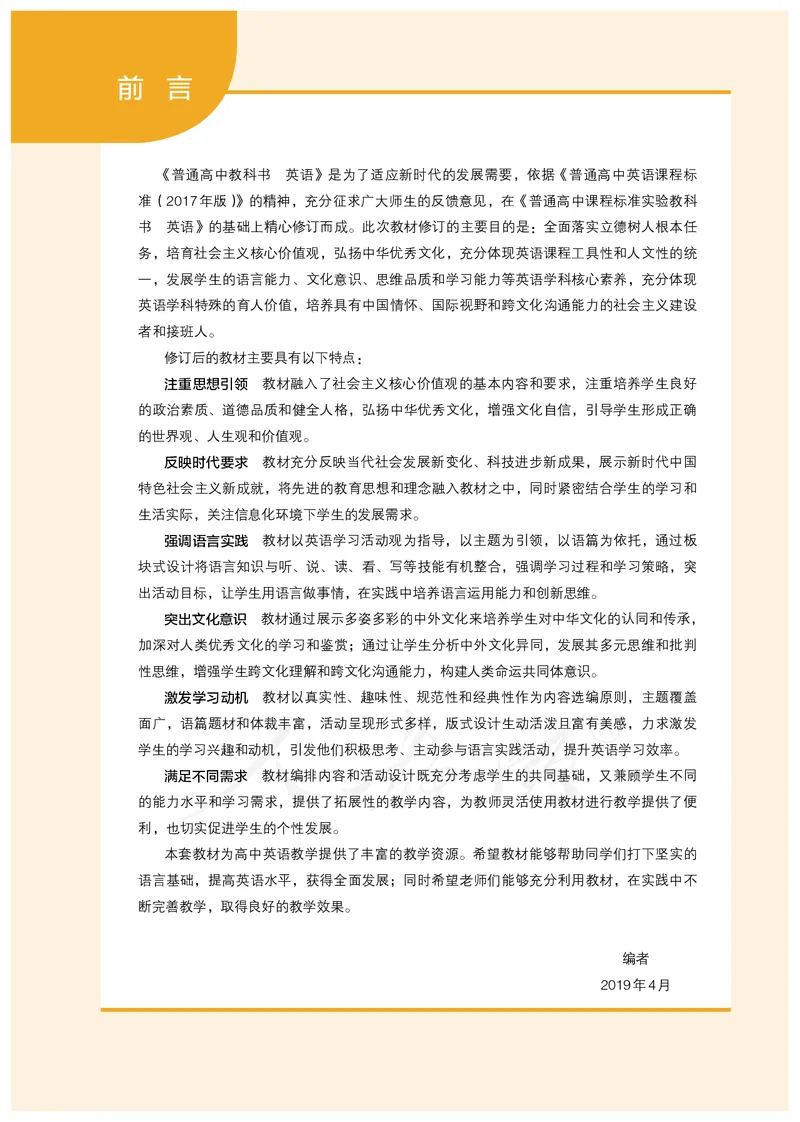
《普通高中教科书 英语》是为了适应新时代的发展需要,依据《普通高中英语课程标
准(2017年版)》的精神,充分征求广大师生的反馈意见,在《普通高中课程标准实验教科
书 英语》的基础上精心修订而成。此次教材修订的主要目的是:全面落实立德树人根本任
务,培育社会主义核心价值观,弘扬中华优秀文化,充分体现英语课程工具性和人文性的统
一,发展学生的语言能力、文化意识、思维品质和学习能力等英语学科核心素养,充分体现
英语学科特殊的育人价值,培养具有中国情怀、国际视野和跨文化沟通能力的社会主义建设
者和接班人。
修订后的教材主要具有以下特点:
注重思想引领 教材融入了社会主义核心价值观的基本内容和要求,注重培养学生良好
的政治素质、道德品质和健全人格,弘扬中华优秀文化,增强文化自信,引导学生形成正确
的世界观、人生观和价值观。
反映时代要求 教材充分反映当代社会发展新变化、科技进步新成果,展示新时代中国
特色社会主义新成就,将先进的教育思想和理念融入教材之中,同时紧密结合学生的学习和
生活实际,关注信息化环境下学生的发展需求。
强调语言实践 教材以英语学习活动观为指导,以主题为引领,以语篇为依托,通过板
块式设计将语言知识与听、说、读、看、写等技能有机整合,强调学习过程和学习策略,突
出活动目标,让学生用语言做事情,在实践中培养语言运用能力和创新思维。
突出文化意识 教材通过展示多姿多彩的中外文化来培养学生对中华文化的认同和传承,
加深对人类优秀文化的学习和鉴赏;通过让学生分析中外文化异同,发展其多元思维和批判
性思维,增强学生跨文化理解和跨文化沟通能力,构建人类命运共同体意识。
激发学习动机 教材以真实性、趣味性、规范性和经典性作为内容选编原则,主题覆盖
面广,语篇题材和体裁丰富,活动呈现形式多样,版式设计生动活泼且富有美感,力求激发
学生的学习兴趣和动机,引发他们积极思考、主动参与语言实践活动,提升英语学习效率。
满足不同需求 教材编排内容和活动设计既充分考虑学生的共同基础,又兼顾学生不同
的能力水平和学习需求,提供了拓展性的教学内容,为教师灵活使用教材进行教学提供了便
利,也切实促进学生的个性发展。
本套教材为高中英语教学提供了丰富的教学资源。希望教材能够帮助同学们打下坚实的
语言基础,提高英语水平,获得全面发展;同时希望老师们能够充分利用教材,在实践中不
断完善教学,取得良好的教学效果。
编者
2019年4月CONTENTS
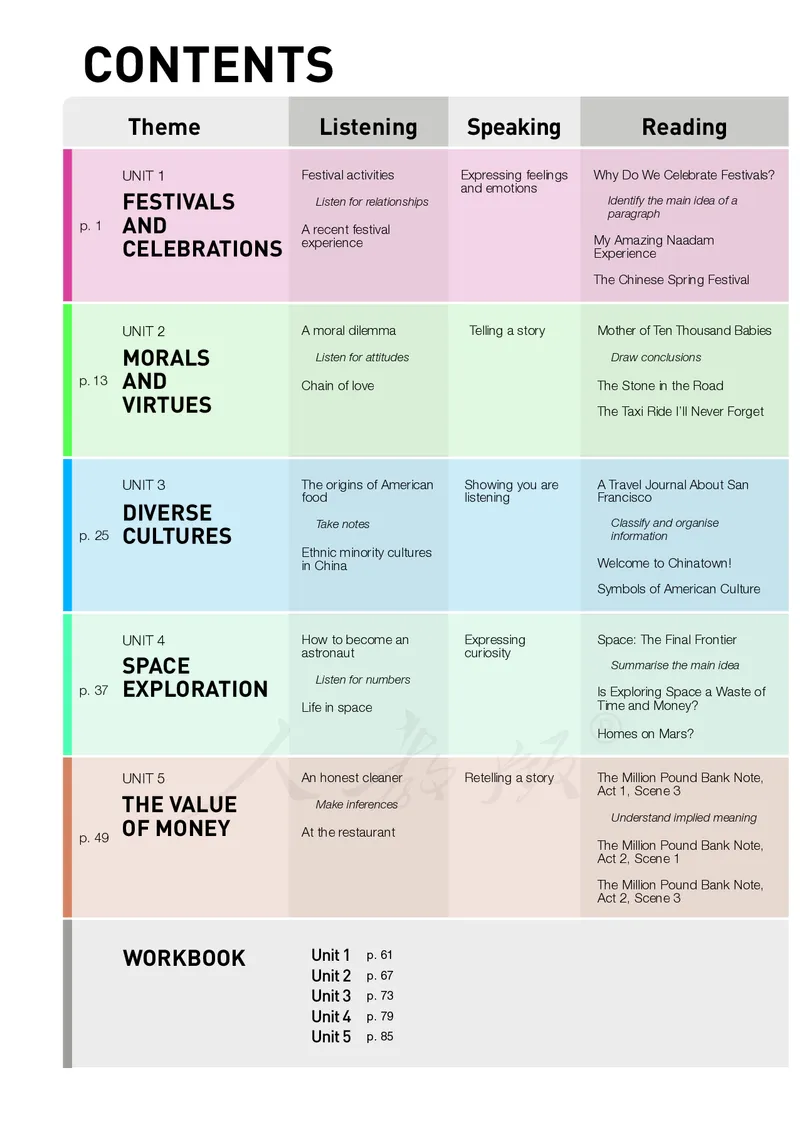
Theme Listening Speaking Reading
UNIT 1 Festival activities Expressing feelings Why Do We Celebrate Festivals?
and emotions
FESTIVALS
Listen for relationships Identify the main idea of a
paragraph
AND
p. 1
A recent festival
CELEBRATIONS experience My Amazing Naadam
Experience
The Chinese Spring Festival
UNIT 2 A moral dilemma Telling a story Mother of Ten Thousand Babies
MORALS
Listen for attitudes Draw conclusions
AND
p. 13
Chain of love The Stone in the Road
VIRTUES
The Taxi Ride I’ll Never Forget
UNIT 3 The origins of American Showing you are A Travel Journal About San
food listening Francisco
DIVERSE
Take notes Classify and organise
CULTURES
p. 25 information
Ethnic minority cultures
in China Welcome to Chinatown!
Symbols of American Culture
UNIT 4 How to become an Expressing Space: The Final Frontier
astronaut curiosity
SPACE
Summarise the main idea
EXPLORATION Listen for numbers
p. 37 Is Exploring Space a Waste of
Life in space Time and Money?
Homes on Mars?
UNIT 5 An honest cleaner Retelling a story The Million Pound Bank Note,
Act 1, Scene 3
THE VALUE
Make inferences
Understand implied meaning
OF MONEY
At the restaurant
p. 49
The Million Pound Bank Note,
Act 2, Scene 1
The Million Pound Bank Note,
Act 2, Scene 3
WORKBOOK Unit 1
p. 61
Unit 2
p. 67
Unit 3
p. 73
Unit 4
p. 79
Unit 5
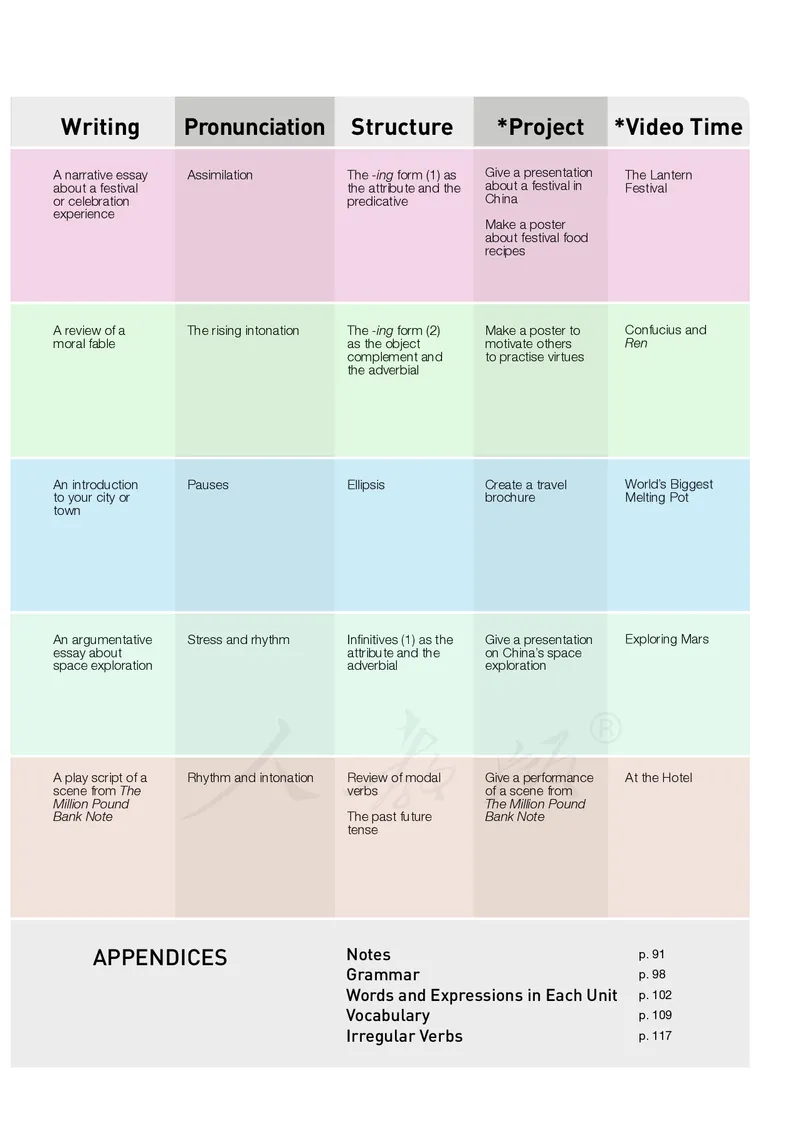
p. 85Writing Pronunciation Structure *Project *Video Time
A narrative essay Assimilation The -ing form (1) as Give a presentation The Lantern
about a festival the attribute and the about a festival in Festival
or celebration predicative China
experience
Make a poster
about festival food
recipes
A review of a The rising intonation The -ing form (2) Make a poster to Confucius and
moral fable as the object motivate others Ren
complement and to practise virtues
the adverbial
An introduction Pauses Ellipsis Create a travel World’s Biggest
to your city or brochure Melting Pot
town
An argumentative Stress and rhythm Infinitives (1) as the Give a presentation Exploring Mars
essay about attribute and the on China’s space
space exploration adverbial exploration
A play script of a Rhythm and intonation Review of modal Give a performance At the Hotel
scene from The verbs of a scene from
Million Pound The Million Pound
Bank Note The past future Bank Note
tense
APPENDICES Notes
p. 91
Grammar
p. 98
Words and Expressions in Each Unit
p. 102
Vocabulary
p. 109
Irregular Verbs
p. 117UNIT 1
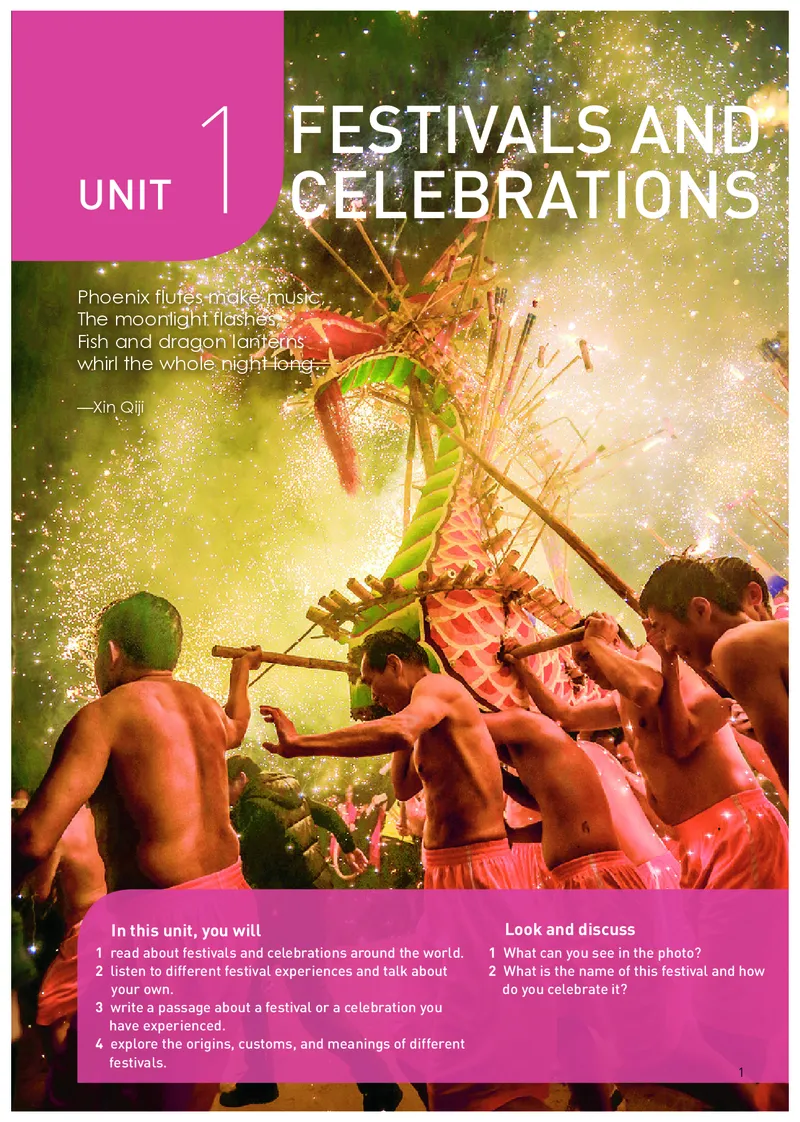
FESTIVALS AND CELEBRATIONS
FESTIVALS AND
1
CELEBRATIONS
UNIT
Phoenix flutes make music,
The moonlight flashes,
Fish and dragon lanterns
whirl the whole night long.
—Xin Qiji
In this unit, you will Look and discuss
1 read about festivals and celebrations around the world. 1 What can you see in the photo?
2 listen to different festival experiences and talk about 2 What is the name of this festival and how
your own. do you celebrate it?
3 write a passage about a festival or a celebration you
have experienced.
4 explore the origins, customs, and meanings of different
festivals.
FESTIVALS AND CELEBRATIONS UNIT 1 1Listening and Speaking
Talk about festival activities
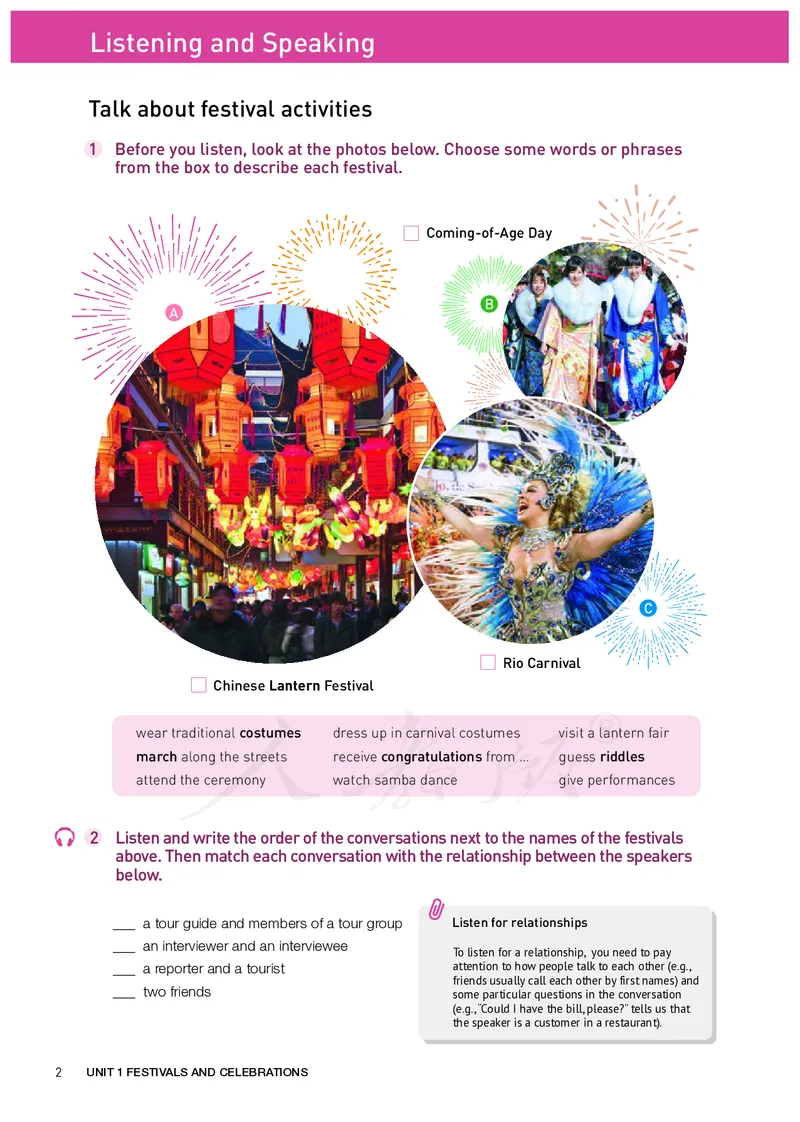
1 Before you listen, look at the photos below. Choose some words or phrases
from the box to describe each festival.
Coming-of-Age Day
B
A
C
Rio Carnival
Chinese Lantern Festival
wear traditional costumes dress up in carnival costumes visit a lantern fair
march along the streets receive congratulations from … guess riddles
attend the ceremony watch samba dance give performances
2 Listen and write the order of the conversations next to the names of the festivals
above. Then match each conversation with the relationship between the speakers
below.
a tour guide and members of a tour group Listen for relationships
an interviewer and an interviewee
To listen for a relationship, you need to pay
a reporter and a tourist attention to how people talk to each other (e.g.,
friends usually call each other by first names) and
two friends some particular questions in the conversation
(e.g., “Could I have the bill, please?” tells us that
the speaker is a customer in a restaurant).
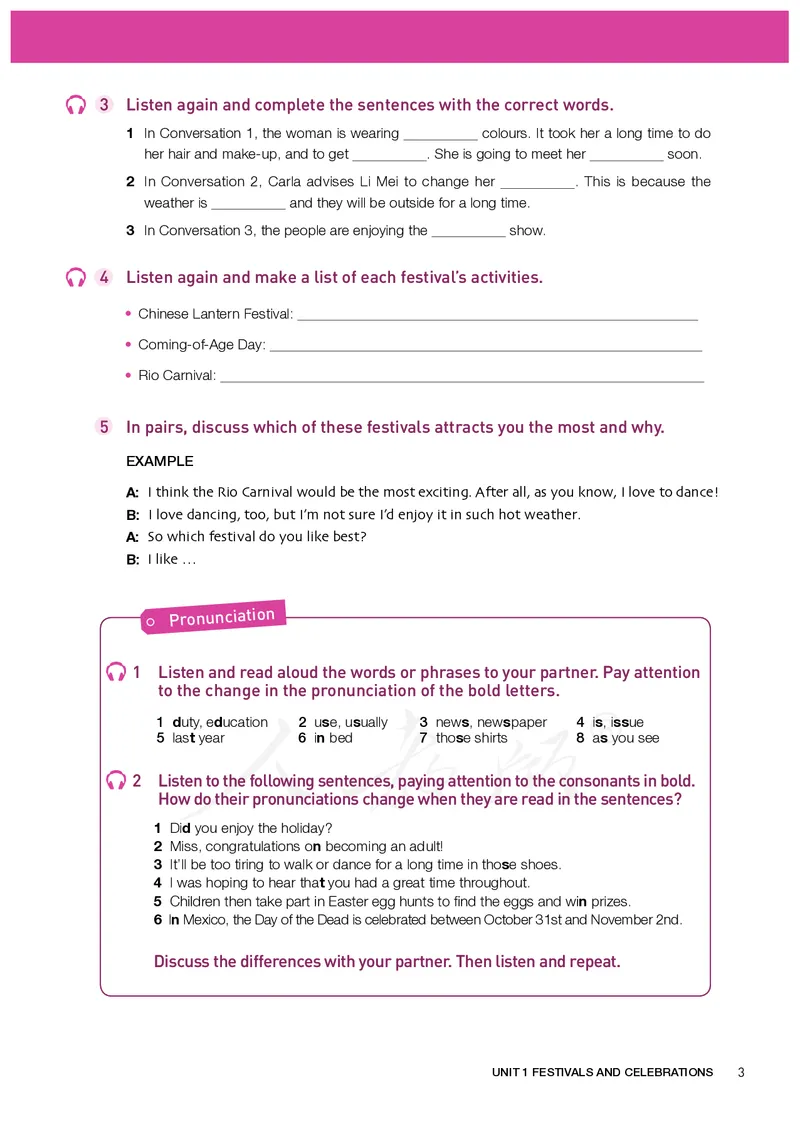
2 UNIT 1 FESTIVALS AND CELEBRATIONS3 Listen again and complete the sentences with the correct words.
1 In Conversation 1, the woman is wearing colours. It took her a long time to do
her hair and make-up, and to get . She is going to meet her soon.
2 In Conversation 2, Carla advises Li Mei to change her . This is because the
weather is and they will be outside for a long time.
3 In Conversation 3, the people are enjoying the show.
4 Listen again and make a list of each festival’s activities.
Chinese Lantern Festival:
Coming-of-Age Day:
Rio Carnival:
5 In pairs, discuss which of these festivals attracts you the most and why.
EXAMPLE
A: I think the Rio Carnival would be the most exciting. After all, as you know, I love to dance!
B: I love dancing, too, but I’m not sure I’d enjoy it in such hot weather.
A: So which festival do you like best?
B: I like …
Pronunciation
1 Listen and read aloud the words or phrases to your partner. Pay attention
to the change in the pronunciation of the bold letters.
1 duty, education 2 use, usually 3 news, newspaper 4 is, issue
5 last year 6 in bed 7 those shirts 8 as you see
2 Listen to the following sentences, paying attention to the consonants in bold.
How do their pronunciations change when they are read in the sentences?
1 Did you enjoy the holiday?
2 Miss, congratulations on becoming an adult!
3 It’ll be too tiring to walk or dance for a long time in those shoes.
4 I was hoping to hear that you had a great time throughout.
5 Children then take part in Easter egg hunts to find the eggs and win prizes.
6 In Mexico, the Day of the Dead is celebrated between October 31st and November 2nd.
Discuss the differences with your partner. Then listen and repeat.
UNIT 1 FESTIVALS AND CELEBRATIONS 3Reading and Thinking
Discover the reasons for festivals and celebrations
1 Before you read, discuss these questions in groups.
1 What festivals do you celebrate with your family each year?
2 Why do you think people celebrate different festivals?
2 Read the text and find out the answer to the question in the title.
WHY DO WE CELEBRATE FESTIVALS?
Festivals are celebrated all around the world. They
have a wide range of origins, such as the seasons
of the year, religions, famous figures, and important
events. Every festival has its different customs and
unique charms. However, no matter how different
they may seem, all over the world, the spirit of
sharing joy, gratitude, love, or peace is common in
all festivals.
Of all the traditional festivals, the harvest festival
can be found in almost every culture. This important
agricultural festival takes place after all the crops
have been gathered in. People celebrate to show
that they are grateful for the year’s supply of food.
In ancient Egypt, the harvest festival was celebrated
during the springtime—the Egyptian harvest season.
It featured a parade and a great feast with music,
dancing, and sports. Today, in some European
countries, people decorate churches and town
halls with flowers and fruit, and get together to celebrate over a meal. During the
Mid-Autumn Festival in China, families gather to admire the shining moon and enjoy
delicious mooncakes.
Customs play a significant role in festivals, but sometimes they can change over time.
With the development of modern society and the spread of new ideas, some traditions
may fade away and others may be established. One example is the typical Chinese
Spring Festival custom of lighting firecrackers to drive away the evil spirits and
celebrate the new year. Nowadays, many big cities have given up this custom in order
to avoid air pollution. Another example is Halloween, which slowly became an exciting
festival for children, in spite of its religious origins.
4 UNIT 1 FESTIVALS AND CELEBRATIONSFestivals are becoming more and more
commercial, with businesses taking
advantage of the celebrations. Online
shopping websites and social media
apps have made it much easier for the
public to spend more on gifts for their
loved ones. Although some believe
festivals should not be commercialised,
others believe the increase in spending
is good for the economy and public happiness.
Festivals are an important part of society. They reflect people’s wishes, beliefs, faiths,
and attitudes towards life. They are occasions that allow us to relax and enjoy life, and
forget about our work for a little while. They help us understand where we came from,
who we are, and what to appreciate. And if you study festivals carefully, you may be
surprised to find that different cultures actually have a lot in common after all.
Identify the main idea of a
paragraph
Identifying the main ideas of paragraphs
is necessary when analysing a text.
3 Read the text again and underline the Most paragraphs will have a “topic
sentence” that tells you the paragraph’s
topic sentence of each paragraph that
main idea. It is often the first sentence,
gives the main idea. but sometimes it is found elsewhere in
the paragraph.
4 In pairs, discuss the following questions.
1 What do most festivals seem to have in common? Why do you think people around the
world find these things important?
2 How do you feel about festival customs that have already faded away?
3 What is the writer’s attitude towards the commercialisation of festivals?
5 Complete the following passage using suitable words from the text. Be sure
to use the correct forms.
Today’s festivals have a wide of origins, including the seasons of the year, famous
, important events, and religions. The festival is one of the most popular
festivals and is celebrated in many cultures. Customs play a role in festivals, but
they can change over time. For example, some Chinese cities no longer allow firecrackers
during the Spring Festival, as they can increase air pollution. These days, festivals are becoming
more , with people spending more money on gifts. Festivals people’s
wishes, beliefs, faiths, and attitudes towards life. They are to spend time with family,
and to relax and enjoy life.
UNIT 1 FESTIVALS AND CELEBRATIONS 5Discovering Useful Structures
Describe festival activities
1 Read the sentences below and discuss the functions and meanings of the
italicised -ing form. Find more examples from the unit.
These lanterns are amazing.
During the Mid-Autumn Festival in China, families gather to admire the shining moon and
enjoy delicious mooncakes.
Families celebrating the Lunar New Year can enjoy exciting dragon dances and carnivals
together.
2 Read the following messages posted by some exchange students on an Internet
forum. Underline the -ing form used as the attribute or the predicative.
Discussion: Which festival is the best?
Today 9:05 am
Rio Carnival! I spent a really fun day there with my friends. It was great
Sunnyli
fun walking along the streets, enjoying the relaxing atmosphere! The
performances were just amazing.
The Spring Festival in China, especially the dinner on the Lunar New
Today 9:11 am
Year’s Eve! All family members get together. And I get lucky money in
Vincent1119 red envelopes from my parents and relatives, so it’s always an exciting
time for me.
Perhaps Thanksgiving. What could be better? Families getting together
Today 10:11 am and eating delicious food, people watching sports games on TV, friends
laughing and talking, etc. Plus there’s Black Friday, if shopping is your
Wizard_Oz
thing.
I think it’s Christmas. I just can’t take my eyes off the shining lights
Today 10:24 am
on the Christmas trees everywhere. Lots of smiling faces, and people
Cooper_08 singing Christmas carols and wishing each other “Merry Christmas!”
3 Complete the passage with the appropriate -ing form.
La Tomatina is a festival that takes place in the Spanish
town Buñol every August. I think many food festivals are
because people are just eating. However, this
festival is because people don’t actually eat
the tomatoes. Instead, they throw them at each other!
The number of people part in this tomato fight
can reach up to 20,000, and it is a very fight
that lasts for a whole hour. The thing is how
clean Buñol is after the tomatoes are washed away after
the fight. This is because the juice from tomatoes is really
good for making surfaces clean!
6 UNIT 1 FESTIVALS AND CELEBRATIONSLLiisstteenniinngg aanndd TTaallkkiinngg
Talk about festival experiences
1 Song Lin and Max are talking about a recent festival experience. Listen to their
conversation and answer the questions.
pumpkin pie
apple pie
pudding mashed potatoes roast turkey
1 What festival is Max talking about? 4 What did Max and his family do during
and after the dinner?
2 What did Max do during the festival?
5 What was the best part of the festival?
3 What dishes did Max’s mother cook?
2 Listen again and tick the phrases that Max or Song Lin uses.
Expressing feelings and emotions
It was fantastic! How wonderful! How exciting!
That’s amazing. It was great fun! It’s very exciting.
It was great to … I’m really happy that … I’m pleased to ...
3 Read the conversation below and underline the phrases that express feelings
about festivals. Role-play the conversation with your partner.
Joe: Did you enjoy the holiday, Song Lin?
Song Lin: Oh yes, it was great, thanks! The food, the parades, and the beautiful fireworks—
it’s always exciting for me. It’s good to spend time with my family, too, although
it can get a bit boring in my hometown after a while. How about you?
Joe: Well, this was my first Chinese New Year. I loved watching the traditional
performances, and I was invited to lots of delicious meals. But, to be frank, the
fireworks going off throughout the night were really annoying.
Song Lin: Oh, well, yes, I can see your point there! But it’s all part of the tradition to
frighten away the evil spirits.
Joe: Yes, well, there seemed to be a lot of them in my area! Anyway, except for that,
everything was fine. I’m really looking forward to the next festival.
4 Share a recent festival experience with your partner and tell him/her how
you felt about the festival and why.
UNIT 1 FESTIVALS AND CELEBRATIONS 7Reading for Writing
Write about your festival experience
1 Read the diary entry and answer the questions.
MY AMAZING NAADAM EXPERIENCE
Opening Paragraph:
I experienced the Naadam Festival in China’s Inner Mongolia
State the topic
Autonomous Region for the first time this year. The festival falls (e.g., where, when,
on the fourth day of the sixth month of the lunar calendar, usually and with whom
lasting for three days. Naadam means “games” in Mongolian, you celebrated the
and it is represented by three events: horse racing, wrestling, and festival, and also
your main feeling).
archery, which are all so exciting to watch!
On the first day, I set off to the games early with my friend Burin.
First Body
I saw a lot of people wearing fancy Mongolian robes. Some
Paragraph:
were feeding their horses, some were practising archery, and
others were chatting or taking photographs. Burin told me that Describe the start
of the festival and
Mongolians travel every year from near and far to attend the
the surroundings.
festival, just as their ancestors had done for centuries.
After the opening ceremony and some amazing performances,
the wrestling competition began. Mongolian wrestling is different
Second Body
from the wrestling in the Olympic Games. There are no rounds,
Paragraph:
and wrestlers are not separated by weight. The wrestler loses if
any part of his body above his knee touches the ground. After Describe in
singing some songs, the competitors danced onto the green field, detail the festival
activities.
waving their arms in the air as if they were eagles. I was quite
moved by their show of strength and grace.
I absolutely enjoyed the archery, too, but the horse races were
my favourite part. However, I was surprised to see that the riders
were boys and girls! I heard it is because children are lighter and Third Body
Paragraph:
the horses can run faster and farther. At first, I was a little worried
about the children’s safety, but Burin said, “Don’t worry. They’ve Describe in detail
been riding horses all their lives. They’ll be just fine.” That was the the festival activities.
moment I started to understand why people say “Horses are at
the heart of Mongolian culture”. ...
I’m finally back home now, feeling really tired, but celebrating
Closing Paragraph:
Naadam with my friend was totally worth it. He invited me back for
Give a brief
the winter to stay in a traditional Mongolian tent and eat hot pot. I
summary of the
can’t wait!
experience.
81 What does “Naadam” mean? Which events does it include?
2 What Naadam Festival customs did you learn about?
3 What in your opinion is the most impressive thing about the festival?
4 What else would you like to know about the festival and the writer’s experience?
2 Study the organisation and language features.
1 Read the sentence patterns below and use them to rewrite the opening sentence of the article.
This was my first time spending … and it was an enjoyable and exciting experience
for me.
I’ll never forget … because …
I’ll always … because …
2 Underline the sentences that describe the writer’s feelings and emotions.
3 Use what you have learnt to write about a festival or a celebration you have
experienced recently.
1 Make notes of your ideas in the table and then write your draft.
Outline
The name of the festival/celebration:
Main idea of each paragraph Details Feelings
1 The topic and my feeling
How I prepared for the
2
festival/celebration
The festival/celebration
3
activities
A summary of my festival/
4
celebration experience
2 Exchange drafts with a partner. Use the checklist to give feedback on your partner’s draft.
Is the writing well-organised?
Is there an opening sentence in the first paragraph?
Does each paragraph include the necessary details?
Does the writer describe his/her feelings and emotions?
Does the writer use the -ing form correctly in the writing?
Are there any grammar, spelling, or punctuation errors?
3 Get your draft back and revise it.
4 Put up your writing in your classroom or read it to the class.
UNIT 1 FESTIVALS AND CELEBRATIONS 9Assessing Your Progress
1 Fill in the blanks with the correct forms of the words in the box.
march brief media congratulation significant
moment roast lunar represent fancy
1 The beautiful flowers on cherry branches are the most sign of the arrival of spring.
2 In December, many companies have dress parties to celebrate the end of the year.
3 The female soldiers forming the biggest group in the National Day parade
attracted a lot of interest from the .
4 The most common colour you see during the Spring Festival is red because red life,
wealth, and good luck in Chinese culture.
5 The newly married couple received dozens of letters of from their friends.
6 If you are the best man at a wedding, it is best to keep your speech simple and .
7 She will never forget the when she saw all the audience clapping their hands and
cheering after her performance.
8 Falling on the 9th day of the 9th month, the Chongyang Festival is also called the
Double Ninth Festival. It is a day for people in China to show respect to seniors.
9 To be frank, this chicken tastes horrible.
2 Circle the correct word in each sentence.
1 Taking part in the celebration was a satisfying/satisfied experience for us.
2 Most of the people were amazing/amazed by the lion dances during the new year
celebrations.
3 The child seemed annoying/annoyed when he found his gift broken.
4 The man dressing/dressed in a ghost costume looks quite frightening/frightened.
5 Kate was surprising/surprised by the sight of the Kongming lanterns flying/flown up
into the sky.
REFLECTING
Which festival(s) mentioned in this unit was/were new to you?
Which festival did you find the most interesting? Why?
Do you wish to add one extra holiday in China? What would you like to celebrate? Why?
Which part of this unit did you find the most difficult?
Overall, I thought this unit was interesting useful so-so difficult.
10 UNIT 1 FESTIVALS AND CELEBRATIONS*Project 1: Give a presentation about a festival in China
In groups, choose one festival in China, research it, and then give a presentation
to the class. Use the example outline below to help you.
Facts about the Zhuang People’s Folk Song Festival
Time: On the third day of the third month of the
Chinese lunar year
Place: In the Guangxi Zhuang Autonomous
Region
Ethnic minority group: The Zhuang people
Festival activities: Sing songs, ...
Local festival food: five-coloured sticky rice,
duck in lemon sauce, ...
*Project 2: Make a poster about festival food recipes
In groups, collect some festival food recipes. If possible, learn to cook the food at
home and then make a poster with pictures for the class. Use the example below
to help you.
The Laba Festival usually occurs about a month before the Chinese Spring Festival. The
festival’s traditional food is Laba porridge.
Possible ingredients and steps:
15 Chinese dates 1/4 cup of peanuts
5 peeled longan fruit 1/4 cup of red beans
3 walnuts 1/4 cup of mung beans
1/2 cup of sticky rice 1/4 cup of raisins
1/4 cup of millet
1 2 3 4
Put these ingredients Wash the raisins,
Wash the rice, Turn off the
and the dates into a pot. walnuts, and longan
millet, peanuts, red heat and then
Pour in 6 cups of water, fruit, and then put
beans, and mung wait for 10
and bring the pot to a boil them into the pot
beans, and soak minutes before
before simmering for one with some sugar
them in 2 cups of serving the
and a half hours over low before simmering for
water overnight. porridge.
heat. another 30 minutes.
UNIT 1 FESTIVALS AND CELEBRATIONS 11* Video Time
The Lantern Festival
The Lantern Festival is one of the most
important traditional festivals in China. The
custom of joyfully celebrating the Lantern
Festival began in ancient times and still has
great influence on Chinese people today.
BEFORE YOU WATCH
How much do you know about the Lantern Festival? Look at the table below
and try to fill in the blanks.
WHILE YOU WATCH
Complete the table with the correct words.
Date • On the day of the month of the lunar year
• The day of the Chinese New Year celebrations
Festival 1 Looking at lanterns
activities
• Places to see the lanterns:
• Most cities will .
2 Guessing riddles
Riddles are often written .
3 Eating yuanxiao or tangyuan
• Different fillings are stuffed into balls of sticky .
• The symbolises reunion, harmony, and .
Interesting • The fire dragon dance in Puzhai Town in Province has a
events in history of over years.
history
• The Lantern Festival was known as the Chinese Day in the
past. It was a good day for .
• Many ancient poets wrote poems about the festival, which describe
happy and also the stories of young .
AFTER YOU WATCH
Work with a partner. Use the notes above to help you give a brief introduction
to the Lantern Festival.
12 UNIT 1 FESTIVALS AND CELEBRATIONSUNIT 2
MORALS AND VIRTUES
MORALS AND
2
VIRTUES
UNIT
The best portion of a good man’s life is his
little, nameless, unremembered acts of
kindness and of love.
—William Wordsworth
In this unit, you will Look and discuss
1 read about a compassionate doctor, Lin Qiaozhi. 1 What do you think the teenagers are doing?
2 listen to discussions about moral dilemmas and 2 Can you list some virtues that are admired
the power of kindness and talk about the virtues in every culture?
that we cherish.
3 write a review of a moral fable.
4 explore the importance of moral values and virtues.
MORALS AND VIRTUES UNIT 2 13Listening and Speaking
Talk about moral dilemmas
1 Before you listen, look at the definition and the picture below. Then discuss
the questions with your group.
A moral dilemma
is a situation in
which you have
two or more
difficult choices
to make. If you
choose one,
you might get in
trouble for not
choosing the
other(s).
1 What moral dilemma is the boy in the picture facing?
2 Have you ever faced a moral dilemma or heard of someone who did? Describe it.
2 Listen to the conversation and complete the table to describe the moral
dilemma that Jane is talking about.
The girl is taking the entrance examination for in
Situation
Beijing. During the exam, the student next to her fainted.
The girl’s
She can . She can .
choices
or
Possible , but , but
results
. .
3 Listen again and decide whether the statements
are true (T) or false (F).
Listen for attitudes
1 Jane is eager to share the magazine article
When you listen, you should pay
with Luke. T F attention not only to the words
but also to HOW the speaker is
2 Luke doubts that young people face moral talking. If people strongly disagree
dilemmas all the time. T F with something, they might
exaggerate their intonation. If you
3 Jane admires what the girl in the story did. T F hear people speaking very quickly
or loudly, they may be excited or
4 Luke doesn’t believe anybody would do what
angry. If they speak slowly or stop
the girl in the story did. T F often, they may be confused or not
sure about what they are saying.
5 Jane wonders how the girl became a doctor
later.
T F
14 UNIT 2 MORALS AND VIRTUES4 Listen to the conversation carefully and answer the questions.
1 What did the girl do to help the student?
2 What was the girl’s name? What was she famous for?
3 What did Jane say about the girl’s life?
5 Think about what you would do if you were ever faced with the same situation
as the girl. Then share your thoughts with your group, and explain the reasons
for your choice.
EXAMPLE
A: If I were ever in a situation like the girl faced, I think I would choose to …
B: Why? Are you sure?
A: Because I think that … is most important. What about you?
B: I think I would …
Pronunciation
1 Listen to the conversations and match each rising intonation with its
meaning.
1 A: You know Angela? A Having more to say.
B: Yes. B Hoping the other person will
2 A: You volunteer at the local shelter, continue to talk.
don’t you?
C Asking for confirmation.
B: Yes. It’s a great experience.
3 A: Did you hear that James helped an old woman who fell down while crossing
the street?
B: Yes. It was a bit dangerous, but he got all the cars to stop.
2 Read the conversation and mark in the correct places. Then listen to
the recording to check. Notice the meaning of each rising intonation.
Peter: It’s a nice day, isn’t it?
Nick: Yes, but it looks gloomy to me.
Peter: Why? What happened?
Nick: You know Tony?
Peter: Yes.
Nick: He asked me to write an essay for him. But I don’t think it’s the right thing to
do. Do you?
Peter: No, it’s not.
Nick: But I’m afraid to lose him as a friend.
Peter: Well, good friends should help each other. But it doesn’t mean you should
help him cheat! Why not help him with his schoolwork?
Nick: Good idea!
UNIT 2 MORALS AND VIRTUES 15Reading and Thinking
Learn to make choices in life
1 Before you read, think about this question and share your ideas with your
partner: What are some important life choices?
2 Read the text about Lin Qiaozhi and then answer the following questions.
1 What hard choices was Dr Lin faced with throughout her life? Underline the sentences about
these choices.
2 What were the results of her choices?
3 What does the author want to illustrate by mentioning Dr Lin’s life choices?
“Life is precious. … To a person nothing is more
precious than their life, and if they entrust me
with that life, how could I refuse that trust,
saying I’m cold, hungry, or tired?” These words of
Dr Lin Qiaozhi give us a look into the heart of this
amazing woman, and what carried her through a
life of hard choices.
As a five-year-old girl, Lin Qiaozhi was deeply
affected by her mother’s death. At age 18, instead
of following the traditional path of marriage like
the majority of girls, she chose to study medicine.
“Why should girls learn so much? Finding a good
husband should be their final goal!” her brother
complained, thinking of the high tuition fees.
She responded, “I’d rather stay single to study all
my life!”
Eight years later, Lin graduated from Peking
Lin Qiaozhi (1901—1983) Union Medical College (PUMC) with the Wenhai
Scholarship, the highest prize given to graduates. She immediately became the first woman
ever to be hired as a resident physician in the OB-GYN department of the PUMC Hospital.
Within six months, she was named a chief resident physician, a position that usually took four
years to achieve. After working for a few years, she was sent to study in Europe and then, in
1939, in the US. She greatly impressed her American colleagues, who invited her to stay. Dr
Lin, however, rejected the offer. She wanted to serve the women and children at home.
In 1941, Dr Lin became the first Chinese woman ever to be appointed director of the OB-GYN
department of the PUMC Hospital, but just a few months later, the department was closed
because of the war. Thinking of all the people still in need of help, Dr Lin opened a private
clinic. She charged very low fees to treat patients and often reduced costs for poor patients.
At times she was even seen riding a donkey to faraway villages to provide medical care.
16 UNIT 2 MORALS AND VIRTUESThe new People’s Republic of China saw Dr Lin Qiaozhi playing a key role. In 1954, she was
elected to the first National People’s Congress and, over the next several decades, she held
many important positions. Her heart, however, was elsewhere. She was more interested in
tending patients, publishing medical research on care for women and children, and training
the next generation of doctors. “The OB-GYN department cares for two lives,” she told new
staff in her department. “As doctors, we should
be responsible for the patients and treat them as
our sisters.”
Though Lin Qiaozhi never married, she was known
as the “mother of ten thousand babies”, having
delivered over 50,000 babies in her lifetime. Dr
Lin did not retire until the day she died, 22 April
1983. Since she had no children of her own, she
left her savings to a kindergarten and a fund for
new doctors. And even as she lay dying, her final
thoughts were for others. “I’m ready to go,” she
said. “Don’t try to rescue me any more. Don’t
waste the medicine any more.”
3 Read the text again and answer the questions.
Use the facts and details from the text to support
Draw conclusions
your conclusions.
As you read, pay attention to
facts and details mentioned
1 What was the main principle guiding Dr Lin through the
by the author, and put them
choices in her life? together to draw conclusions
about the topic.
2 What kind of person do you think Dr Lin was?
4 Complete the following sentences using suitable verbs from the text. Be sure
to use the correct forms.
1 Many studies have shown that shy, passive children tend to be socially by
their classmates.
2 She was so scared during the interview that she completely forgot how she should
to the questions.
3 Many Americans about the sharp increase in the cost of health care and
health insurance recently.
4 One of the advantages of energetic and positive young people is that they
to show interest in their work and they are eager to learn.
5 The student union will hold a special meeting in January to someone to
replace the secretary.
UNIT 2 MORALS AND VIRTUES 17Discovering Useful Structures
Describe people’s actions
1 Read the sentences below and discuss the function and meaning of each -ing
form. Then find more examples from the unit.
1 … her brother complained, thinking of the high tuition fees.
2 Thinking of all the people still in need of help, Dr Lin opened a private clinic.
3 The new People’s Republic of China saw Dr Lin Qiaozhi playing a key role.
2 Complete the sentences with the correct forms of the verbs in the box.
feel want face smile return worry hear knock
1 that his wife had been injured in an accident, Mr Johnson hurried to the hospital.
2 During the operation, she sat in the waiting room for over an hour about him.
3 I saw her whispering something into his ear, obviously not to be heard.
4 He suddenly woke up at midnight when he heard someone at his door.
5 higher import and export costs, the company is looking for ways to survive.
6 from the North Pole, the traveller wrote a book about his experience and had
it published the following year.
7 The child lay on her mother’s lap, sweetly.
8 hurt by the rejection, she bit her lip and quietly walked away.
3 Read the following story and rewrite the underlined parts using the -ing form.
Henry Norman Bethune was a Canadian doctor with a very
creative mind and a determination to help people. As a small
boy, he became very interested in medicine and decided to
become a doctor. After he graduated from medical college
in 1916, Bethune worked as a doctor in England, the
US, and Canada. He reinvented or redesigned over 10
medical instruments to make them more useful. In
1938, Bethune left for China, after he heard that many
people were dying in the war. Despite the difficult
situation, Dr Bethune did whatever he could to assist
the Chinese people. He helped to organise hospitals,
taught doctors and nurses, and showed people how to
give first aid. Sadly, Dr Bethune passed away in November
the following year and was buried in Shijiazhuang. After Dr
Bethune’s death, Chairman Mao Zedong wrote an article in
memory of him, in which he praised Dr Bethune as a hero to
be remembered in China.
18 UNIT 2 MORALS AND VIRTUESLLiisstteenniinngg aanndd TTaallkkiinngg
Talk about the importance of kindness
1 Listen to a radio show and answer these questions.
1 What is the name of the radio show?
2 What does “paying it forward” mean?
3 What does the guest want the listeners to do?
2 Listen to the radio show again and fill in the blanks to complete the story.
I’m sure you’ve heard the famous country music song “Chain of Love”. The song starts with
a man who helps a lady whose car . The lady wants to pay him, but he won’t
accept payment, instead telling the lady to just to another person. Later,
when the lady stops at a café, she notices her waitress is pregnant and . When
the lady finishes eating, she pays for her meal with a . Then the lady walks
out, the change and a note for the waitress. Her note tells the waitress to
continue the chain of kindness. The song has a ending. The waitress goes
home to her , happy because of the kindness the lady showed her. Finally we
find out that he is the man who first the chain of kindness!
3 Think of a story of showing or receiving kindness, either your own story or one
that you have heard of. Then share it with your group. Here are some words and
expressions that may help you.
Telling a story
I remember this happened when I was …
once upon a time long ago
I was on my way to …
first of all then after that
I was sitting … when …
later finally so
It was a … day/morning …
however although but
There were … on the street …
Tell a story
When telling a story, you can start by
saying what the story is about. Give the
background to the listeners, including
when and where it took place. Say what
happened step by step and be sure to
use correct tenses. Do not forget to use
sequencing words or linking words.
Finally, finish your story by saying why it is
important to you or why you remember it.
UNIT 2 MORALS AND VIRTUES 19Reading for Writing
Share your opinions about a moral story
1 Read the fable below and answer the questions.
1 What was the king’s idea for teaching an important lesson to his people?
2 What was the response from most of the people?
3 What did the young girl think and do when she saw the coins?
The Stone in the Road
Once upon a time there was a king who often thought, “Nothing good can come to a
nation whose people only complain and expect others to solve their problems.” One
day, he had an idea.
Early one morning, the king disguised himself and went to a local village. He placed
a large stone in the middle of the main street and hid gold coins under the stone.
Then he hid behind a huge maple tree and watched.
The first person down the street was a milkman with his cart. He crashed into the
stone, spilling the milk everywhere. “What fool put this stone here?” he shouted. He
picked himself up and angrily went away.
After a while, a group of women came along, each balancing a pot of water on her
head. One woman tripped over the stone and her water pot went crashing to the
ground. She picked herself up and limped away in tears. Neither she nor her friends
thought about moving the stone out of the road.
The king watched all day as many people complained about the stone, but he found
nobody making an attempt to move it. The king was in despair. “Is there no one in
this village who feels any responsibility to keep their neighbours from harm?”
Just then, the king saw a young girl coming along. She was the daughter of a local
farmer. She had been working all day and was very tired. But when she saw the
stone, she said to herself, “This stone is a danger to anyone who comes down the
street after dark. I’ll move it out of the way.”
The girl pushed the stone with all her might. After a great deal of effort, she
finally succeeded in moving it to the side of the street. Imagine her surprise when
she saw the gold coins where the stone had been!
Just then, the king stepped out from behind the tree. “Oh sir,” the girl said, “does
this gold belong to you? If not, we surely must find the owner, for he will certainly
miss it.”
The king said, “My dear, the gold is mine. I put it in the road and moved the stone
over it. Now the gold is yours, because you are the only person who has learnt the
lesson I wanted to teach my people.”
20 UNIT 2 MORALS AND VIRTUES2 This story presented different people’s emotions and responses when they came
across the same problem. Complete the table according to the story.
Person Experience Emotion Response
milkman crashed into the stone angry went away
woman with water
other villagers
young girl
3 Work in pairs. Discuss the questions.
Write a review
1 What do you think this fable is trying to tell us? Do you
The main purpose of a review
think the king was wise? Why or why not? is to give your opinion about a
piece of writing. You should first
2 Can you think of times in your own life when you felt
give a short description of the
and acted like the girl or like the other people in the writing, and then clearly state
story? Give examples. your opinion and your reasons.
4 Write a review of the fable. Use the outline below to help you.
Paragraph 1: • What is the title of the story?
Basic information • What kind of story is it?
about the story • What is the main idea of the story?
Paragraph 2: • What is the author’s purpose?
Your analysis of • Were the details of the story clear?
the story • Do you think the story achieved its purpose?
Paragraph 3: • What did you like about the story?
Your opinion about • What did you not like about the story?
the story • Would you recommend this story to others?
5 Exchange drafts. Use the checklist to give feedback on your partner’s draft.
Does the writer give a short description of the story?
Does the description include the most important details of the story?
Does the writer give his/her opinion about the characters or their actions?
Is the review well-organised?
Does the writer use the -ing form as the adverbial in the review?
Are there any grammar, spelling, or punctuation errors?
6 Get your draft back and revise it. Then put your review up in the classroom.
UNIT 2 MORALS AND VIRTUES 21Assessing Your Progress
1 Circle the correct word in each sentence.
1 Jack stood in front of the class, completely forgetting/forgotten every word that he had
prepared for his speech.
2 Seeing/Seen the tennis star leaving the court, the girl quickly picked up her camera and
ran over to him.
3 They were very proud to see their son awarded/awarding the university scholarship.
4 When asking/asked about their work schedules, many people preferred more flexible
work hours.
5 John watched the woman talking/talked to the air, thinking/thought that she might be
crazy.
6 Impressed/Impressing with her fluent English, the manager offered Julie a job interview.
2 Complete the passage with the correct forms of the words below. Then
answer the question: What is the author’s attitude towards the doctors?
clinic complain majority staff response harm physician
According to a recent survey, the of doctors believed their incomes did not match
how hard they worked. The survey found that about 50 percent of the doctors were not
satisfied with their working conditions, especially those from hospitals in small towns.
A working in a large public hospital often has to see 100 patients per day. The
researchers conducting the survey concluded that if hospitals and serving the
general public received more support, it would help to keep their medical from
leaving the profession, and therefore the public would continue to receive good health services.
In to a question about tensions between doctors and patients, some respondents
that misleading media reports about doctors have greatly society, causing
the public to distrust medical workers.
REFLECTING
My favourite story of this unit was because .
After studying this unit, I think is/are the most important of all virtues.
I found it to understand and use the grammar structures in this unit.
I had some problems with .
I would like to learn more about .
Overall, I thought this unit was interesting thought-provoking so-so difficult.
22 UNIT 2 MORALS AND VIRTUES*Project: Make a poster to motivate others to practise virtues
1 In groups, brainstorm more virtues to add to the list below. Then discuss which of
these virtues are most needed in our society today.
patriotism
thankfulness
generosity integrity
friendliness
honesty
cooperation
forgiveness
loyalty
courage
2 Make a poster to explain what virtue it is and to motivate people to practise it.
Divide up the work among your group members.
1 Collect sayings or quotations about the virtue.
2 Analyse the sayings and group them in a logical way.
3 Look for or draw a picture to illustrate the virtue.
Thankfulness is realising and appreciating what you have.
Be thankful, because you have more than others!
If you see no reason for giving thanks, the fault lies in yourself. (Indian proverb)
I had no shoes and complained, until I met a man who had no feet. (Indian proverb)
Be thankful, because you have been given much!
If you can read this, thank a teacher. (Anonymous)
When eating fruit, think of the person who planted the tree. (Asian proverb)
Be thankful, because it will shape your whole life!
Be thankful for what you have; you’ll end up having more. If you concentrate on
what you don’t have, you will never, ever have enough. (Oprah Winfrey)
UNIT 2 MORALS AND VIRTUES 23* Video Time
Confucius and Ren
The teachings of Confucius, one of the most
respected teachers of ancient China, are still
known and studied around the world today.
Confucius identified the concept ren as the most
important principle in life, a principle which is still
relevant in modern society.
BEFORE YOU WATCH
Complete each sentence with your best guess.
1 The teachings of Confucius have been an important part of Chinese culture for more than
years.
2 His teachings are all about the most basic of life.
3 Confucius thought that was the most important moral principle.
4 According to Confucius, this highest principle begins with love for .
5 Confucius said, “Whatever you don’t like done to yourself, don’t .”
WHILE YOU WATCH
1 Check your answers in Before You Watch.
2 Circle the correct words to complete the sentences below.
1 Confucian thought is still greatly valued in China and in other East/Southeast Asian countries.
2 If students really understood Confucian ideas, it could change society/their lives.
3 In English, only a few/many different words can be used to translate Confucius’s highest
moral principle.
4 Mencius/Zigong explained this principle as “loving one’s parents, loving people, loving
everything in the world”.
5 Confucius taught Zigong that the one single concept to take as a guide for all actions in
life is happiness/fairness.
AFTER YOU WATCH
Work in groups. Discuss the questions.
1 In what ways do you think Confucian thought still influences education and society in China?
2 Do you think that your life would change if you understood and practised ren every day?
3 How would the Confucian idea of fairness change society around you if everybody started
practising fairness in everything?
24 UNIT 2 MORALS AND VIRTUESUNIT 3
DIVERSE CULTURES
DIVERSE
3
UNIT CULTURES
The beauty of the world lies
in the diversity of its people.
—Unknown
In this unit, you will Look and discuss
1 read a travel journal about San Francisco and 1 Where do you think this photo was taken?
discover its Chinatown. 2 What can you see in the photo? How
2 listen to an interview about American food and would you describe it?
talk about Chinese ethnic minority cultures.
3 write a cultural introduction to your city or town.
4 explore the diverse cultures of the world.
DIVERSE CULTURES UNIT 3 25Listening and Speaking
Talk about the origins of American food
1 Look at the photos of American food and match them with their names. Then
guess which countries’ cuisine influenced the food’s invention.
hamburger fortune cookie gumbo nachos
A B
C D
2 Listen to a radio interview about American food and check whether your
answers to Activity 1 are correct.
3 Listen to the interview again and decide whether the statements are true (T)
or false (F).
1 No food was ever invented in America. T F
2 Hamburgers were invented in Germany. T F
3 Nachos were invented for Americans by a foreigner. T F
4 Every Chinese restaurant in America has fortune cookies. T F
5 American cooking often mixes things from around the world to make
something completely new. T F
26 UNIT 3 DIVERSE CULTURES4 Listen to the interview
Take notes
again and complete the
When taking notes, just write down the key words, such as names,
notes below.
dates, and numbers. They will help you remember things later
on. To save time and space, omit all articles (a, an, the) and use
abbreviations. For example, use “N.O.” for New Orleans, “bc” for
because, “yrs” for years, “+” for and, and so on.
Names of food Notes
Hamburger • mix of + cultures
• chips covered in cheese
Nachos
• made by cook for
• invented in about yrs ago
Fortune cookie
• a piece of with on it inside cookie
• spicy stew
Gumbo • invented in N.O. about yrs ago
• mixes , , , + Spanish cooking
5 Imagine you are invited to a potluck dinner at an American friend’s house. Work
in pairs and discuss what special dish(es) you will take. The following questions
may help you.
1 What food/snack from which area/ethnic group will you bring?
2 How is the food prepared and what is it made of?
3 How is this food special?
Pronunciation
1 Listen to the passage about Native Americans. Mark the pauses that you
hear. The first sentence has been done for you.
No one really knows exactly | when the first people arrived | in what we now know as
California. || It is likely that Native Americans moved to California at least fifteen thousand
years ago. Scientists believe that these settlers crossed the Bering Strait by a land
bridge which existed in prehistoric times. In the 16th century, the native people suffered
greatly after the arrival of the Europeans. Thousands of them were killed or forced into
slavery. In addition, many died from the diseases brought by the Europeans. However,
some survived these terrible times, and today there are more Native Americans living in
California than in any other state of America.
2 Listen again and repeat.
UNIT 3 DIVERSE CULTURES 27Reading and Thinking
Learn about a city that has diverse cultures
1 Find San Francisco on
the map and discuss this
question in groups: What
do you know and want to
know about the city?
2 Scan Li Lan’s travel
journal and find out the
places that she has been
to or plans to visit.
Wednesday, 21 June
Today was my first day back in San Francisco after camping in the Redwood Forest and
visiting the wine country of Napa Valley. I have to admit that it definitely feels good to be back
in the city again. And what a city—a city that was able to rebuild itself after the earthquake that
occurred in 1906. There are so many beautiful old buildings—many sitting on top of big hills,
offering great views of the city, the ocean, and the Golden Gate Bridge.
My hotel is near downtown, in the Mission District, one
of the oldest parts of the city. Many of the people living
here are from Mexico or Central America. This district
used to be a poor area of town, but is now a centre for
art, music, and food. In fact, an art movement called
the “Mission School” started here. It’s influenced by
graffiti art and comic art. I walked around looking at the
street art for a few hours. It was quite modern and lively.
Afterwards, I ate some delicious Mexican-Chinese
noodles from a food truck. A real mix of cultures here!
In the afternoon, I headed to a local museum that showed the
historical changes in California. I learnt that America got California
from Mexico in 1848. In the same year, gold was discovered
near San Francisco, which started a gold rush. Over 300,000
people came from all over the world to seek their fortune, and
San Francisco quickly became a big city. Many Chinese arrived
during this period. To earn a living, some opened up shops and
restaurants in Chinatown. Many others found jobs on farms, joined
the gold rush, or went to build the railway that joined California to
the eastern region of the country. The museum did a really good
job of showing how America was built by immigrants from different countries and cultures.
When these immigrants left their countries, they carried a bit of home in their hearts, and built a
new home here.
28 UNIT 3 DIVERSE CULTURESThis evening, I went to Chinatown. There were so many good cafés and restaurants to choose from.
I selected a Cantonese restaurant that served its food on beautiful china plates. What great food!
That’s enough for today. Tomorrow evening, I’m going to a jazz bar in the Richmond District. Can’t wait!
3 Read the travel journal again and complete the timeline of Li Lanʼs trip.
Classify and organise information
Before coming to San Francisco
We can better understand a passage by classifying
or organising the information in it. Classifying
means deciding the kind of information, e.g., dates,
numbers, opinions. Organising means putting things
in order, e.g., according to how old, how much, what
kind. Sometimes it is a good idea to draw a diagram
to organise the information in the passage.
Morning Afternoon Evening Tomorrow
4 Answer the questions using information from the travel journal.
1 What impressed the writer first about San Francisco?
2 What is so special about the Mission District?
3 Why did Chinese immigrants go to San Francisco?
4 What examples of ethnic diversity can you find in the journal?
5 Discuss these questions in groups.
1 Have you ever been to a place that has a diverse culture? What do you think brought about
the cultural diversity?
2 What are the benefits and challenges of cultural diversity?
6 Complete the following sentences using words from the travel journal. Be
sure to use the correct forms.
1 Over 3,000 lives were claimed in the 1906 San Francisco earthquake and the series of
fires that after it. More than 80% of the city was destroyed, including much of
the area. One area that was hit the hardest was the Mission .
2 Yunnan Province is one of the most diverse provinces that I have ever been to.
Apart from being the kingdom of flowers, it is home to many ethnic minority groups. After
visiting the southern part of Yunnan, I have to that it is the best of
China to escape the cold winter.
UNIT 3 DIVERSE CULTURES 29Discovering Useful Structures
Understand the use of ellipsis in English
1 Read the following sentences and find the words that have been omitted to
avoid repetition.
1 A: Oh, I just love nachos! Mexican corn chips covered in cheese!
B: Me, too.
2 A: So it’s the food of many different cultures, all in one dish?
B: Exactly.
3 A real mix of cultures here!
4 Can’t wait!
2 Rewrite the sentences by taking out the unnecessary parts.
1 You mean you are planning a trip across the Atlantic for a holiday? It sounds like a good
idea.
2 He tried to solve his financial problems, but he couldn’t solve the problems.
3 If it is necessary, I’ll finish my report on American poetry as soon as it is possible.
4 Are you going to dress like that? Wearing a dress might be better than wearing jeans and
boots.
5 Some wild mushrooms are poisonous and some are not poisonous.
6 I really like that paper folding book, and my son likes that paper folding book, too.
3 Read the conversation. Find out which words have been left out.
Justin: Linlin, I’m going to Guizhou Province next month. I’m super excited! Any
recommendations for places to visit?
Linlin: Wow, cool! Guizhou is a province with a lot of cultural diversity. Places to visit … well,
definitely the Huangguoshu Waterfall first.
Justin: What’s special about the waterfall?
Linlin: Well, have you ever heard of the Chinese novel Journey to the West?
Justin: Yes, I have. Why?
Linlin: In the back of the waterfall, you will find a cave, which is the home of the Monkey King.
Justin: Really? Cool! I’ll definitely check it out.
Linlin: And I strongly recommend the ethnic minority villages. You’ll find Chinese culture is
much more diverse than you thought.
Justin: Sounds great, thanks!
3300 UNIT 3 DIVERSE CULTURESListening and Talking
Talk about ethnic minority cultures in China
1 Look at the photos below and guess what ethnic minority groups might be
talked about.
2 Justin met a new friend while travelling in Guizhou. Listen to their conversation
and complete the summaries below.
Part 1
Justin and watched some people play the . The
instrument has a history of over years and it is even mentioned in the oldest
collection of Chinese poetry. Then they watched the . Justin wanted to buy
some hand-made accessories as souvenirs. He was told that the price will
depend on the percentage of .
Part 2
They will go to a pretty village called . They will see the
and the . They may also see a performance of .
3 Work in groups. Imagine Justin is telling some friends about his trip to
Guizhou. One of you is Justin and the rest of you are his friends. Ask Justin
questions about his trip and experience. The following expressions may help
you.
Showing you are listening
Exactly! You’re right! I see. I know what you mean.
No way! You’re kidding! Really? I can’t believe it!
Great!/Super! That’s interesting. Wow! Tell me about it!
UNIT 3 DIVERSE CULTURES 31Reading for Writing
Describe a place with distinctive cultural identity
1 Read the introduction to the Chinatown in San Francisco and answer the
questions.
1 What are the famous tourist sites in the Chinatown of San Francisco?
2 What else can you do there?
WELCOME TO CHINATOWN!
The Chinatown in San Francisco is the biggest in America, and also the oldest. It is a
very popular tourist draw that receives more visitors each year than even the Golden
Gate Bridge. The climate is mild all year round, meaning it is always a good time to visit.
Historically, Chinese immigrants settled in the area during the railroad construction and
gold rush period. What started as a residential area for Chinese immigrants then turned
into a centre for Chinese culture. The majority of residents in Chinatown are still ethnic
Chinese, many of whom do not speak English fluently. This allows visitors to experience
a real taste of China.
Most of Chinatown was destroyed in
the 1906 earthquake, but the city and
residents rebuilt it, taking care to include
lots of Chinese architecture. Traditionally,
visitors enter Chinatown through the
legendary Dragon Gate, which was built
using materials donated from China. Other
famous sites include the Tin How Temple
and Bank of Canton, to name but a few.
Visitors can also spend hours just exploring the interesting sights, smells, and sounds
of China. Portsmouth Square is also a key site, being the centre of Chinatown. It has a
long and famous history, with the author Robert Louis Stevenson having spent much
time writing there. These days, the square is a great place to see traditional Chinese
culture in real life, such as games of Chinese chess, and people practising tai chi.
The stores in the Chinatown offer a unique range of souvenirs, goods, and clothing. All
kinds of traditional Chinese herbal medicine can be found, too, and there are Chinese
tea stores, where visitors can taste and buy varieties of Chinese tea.
But perhaps what many tourists and San Franciscans treasure most about Chinatown
is its food. There is Chinese food to suit everyone’s taste, with traditional dishes from all
over China.
Chinatowns are an important part of the diverse culture of the USA. They allow visitors
who have never been to China to experience traditional Chinese culture first hand.
32 UNIT 3 DIVERSE CULTURES2 Study the organisation and language features.
1 What information is included in the introduction? Tick the items that are mentioned.
location climate history
population ethnic groups languages
famous figures legends/stories famous food/drink
businesses and other names for
tourist attractions
industries the city/town
2 Underline the sentences that are used to describe the items above.
3 Use what you have learnt to write an introduction to your city/town.
1 In groups, brainstorm as much information as possible about your city/town and its culture.
Then write an outline of your introduction.
2 Write an introduction to your city/town. The following phrases and expressions may help you.
is located in/on has a history of … years
is divided up into has a population of
is … in size is home to ... ethnic groups
the most popular/greatest/largest popular festivals/foods/tourist sights
include ...
3 Exchange drafts with a partner. Use the checklist to give feedback on your partner’s draft.
Is the city/town introduction clear?
Is the information specific and are the facts correct?
Does the city/town introduction contain all the important information?
Is the information arranged in a good order?
Does the passage have a proper beginning and conclusion?
Are there any grammar, spelling, or punctuation errors?
4 Get your draft back and revise it.
4 Put up your introduction in your classroom or read it to the class.
UNIT 3 DIVERSE CULTURES 33Assessing Your Progress
1 Complete the following sentences using the correct forms of the words in the box.
admit claim diverse downtown fold mild
mission occur select settle suit super
1 The population of this district is quite , with immigrants from many countries
here.
2 When Columbus landed in the New World, he the land for Spain.
3 The famous bar street is located in the area of the city. A large number of
restaurants and cafés have opened along the street since 2000.
4 I don’t think a man’s main in life is to earn as much money as possible. My dream
is to live a more meaningful life.
5 It was confirmed that a earthquake at 6:37 p.m. on Saturday evening in
Hebei Province, causing no damage.
6 She really did a job. I must that she is the best designer I have ever met.
7 We have a range of gifts to all tastes, and we also have a programme that can
make it quicker and easier for you to from our products.
8 He arranged all the books in a neat row and then put his clothes away.
2 Simplify the underlined sentences using ellipsis. Then role-play the
conversation. Pay attention to how ellipsis is used.
A: Weʼve got to write a paper on music in the US. Do you have any ideas about what kinds of
music are popular there? I only know hip-hop seems popular.
B: Yeah. Hip-hop is generally popular in the US, but different parts of the country listen to
different types of music.
A: Can you give an example of this?
B: Well, for example, in southern US, they have their own culture.
A: So, do you mean they have something like a subculture?
B: Right. The history in that region has given them a different identity.
A: Country music is popular there, right?
B: Well. Not only is country music popular in the south, but blues, rock and roll, bluegrass,
and jazz are popular in the south as well.
A: Ah, of course they are popular! I forgot about New Orleans jazz!
REFLECTING
What did you learn about cultural diversity in this unit?
What else would you like to know about different cultures around the world?
What was the most interesting thing that you learnt in this unit?
What problems did you have in learning this unit?
Overall, I thought this unit was interesting useful so-so difficult.
34 UNIT 3 DIVERSE CULTURES*Project: Create a travel brochure
Imagine you are working in a Chinese travel agency and you are supposed to create a
travel brochure for foreign travellers so that they can experience diverse cultures in
China.
1 In groups, discuss these questions.
1 How long will the travellers stay in China?
2 What kind of activities will they be interested in?
3 Which provinces or cities should be introduced? What cultures are these places famous for?
4 What attractions do these places have?
2 Search online for more information and then write out your travel brochure.
Use the information from this unit and the example below to help you.
New cultures, new experiences
Welcome to the United States, one of the most culturally diverse countries in the world!
Here, you can visit historical attractions and learn more about the cultural traditions of
different ethnic groups.
African Americans Asian Americans
Tennessee: Visit the National Civil California:
Rights Museum to listen to first-hand • Explore the oldest Chinatown in North
accounts of life before the American Civil America, one of the most popular tourist
War. attractions in the city of San Francisco.
• Take a boat ride to Angel Island and visit
Louisiana: Explore Tremé, New the state park to find out more about the
Orleans, the oldest African American experiences of the first Asian immigrants
neighbourhood in the United States, to the United States.
and enjoy amazing performances in the
hometown of jazz music.
Native Americans
Washington: Make a trip down to the
National Museum of the American
Indian, the first national museum that
showcases Native American heritage.
New Mexico: Learn more about Native
American arts, crafts and traditions
by participating in the Gathering of
Nations, the largest gathering in North
America with representatives from
hundreds of tribes.
3 Present your travel brochure to the class. Then vote on which trip your class
would like to take.
UNIT 3 DIVERSE CULTURES 35* Video Time
World’s Biggest Melting Pot
Queens is a neighbourhood in the city of New York.
It claims to be one of the most diverse places in the
world. With almost half of the population born in
another country, it is a great example of a melting
pot.
BEFORE YOU WATCH
Match each word or phrase with the correct definition. You may use a dictionary
to help you.
1 global village the fact of belonging to a particular race
2 multiculturalism without a set plan or pattern
3 resident used to describe a world where everything is connected
4 ethnicity someone who lives in a place
5 cherish a place where people of different backgrounds live together
6 Hispanic accepting and including people from different cultures
7 random treat with care and love
8 melting pot a person whose first language is Spanish, especially one
from Latin America living in the US
WHILE YOU WATCH
Complete the sentences with the correct words.
1 The residents of Queens come from different nations.
2 Almost different languages are spoken in Queens.
3 The family of one woman who was interviewed has been Puerto Rican for more than
generations.
4 A 2001 study measured diversity based on how likely it is for randomly
selected people to have different backgrounds.
5 This survey can prove that Queens is the place in the US.
AFTER YOU WATCH
Discuss the following questions in groups.
1 Do you think it would be easy to live in Queens if you were an immigrant? Why or why not?
2 Do you think China is a diverse country? Why or why not?
36 UNIT 3 DIVERSE CULTURESUNIT 4
SPACE EXPLORATION
SPACE
4
EXPLORATION
UNIT
Mystery creates wonder and
wonder is the basis of man’s
desire to understand.
—Neil Armstrong
In this unit, you will Look and discuss
1 read about the development and value of space 1 What can you see in the photo? Who do
exploration. you think took the photo?
2 listen to two interviews with astronauts and learn 2 What do you know about the history and
to talk about astronauts’ life in space. development of space exploration?
3 write an argumentative essay about the value of
space exploration.
4 explore the mysteries of the universe and the
achievements in space exploration.
SPACE EXPLORATION UNIT 4 37Listening and Speaking
Talk about how to become an astronaut
1 You are going to listen to an interview with an astronaut. Before you listen, discuss
the questions in groups.
1 Can you name any famous astronauts from China or abroad?
2 Do you know anything about the selection procedure for astronauts? Make a list of the
possible requirements.
2 Listen to the interview and tick the correct statements.
1 The audience is curious about how Yang Liwei became the first Chinese astronaut.
2 Mr Yang always believed that he would become an astronaut one day.
3 Mr Yang was selected to attend pilot training with 13 other people.
4 To become an astronaut in China, you have to have 1,350 hours of flying experience.
5 Astronauts not only had to learn how to use space equipment, but also had to do a lot
of mental and physical training.
3 Listen again and fill in the blanks with the correct numbers.
1 Yang Liwei graduated from college at the age of
.
2 Before joining China’s space programme, Mr Yang Listen for numbers
trained as a fighter pilot for about years.
Number questions are typically related
3 Mr Yang was one of the pilots who were to: time, telephone numbers, addresses,
chosen to train for space flights. prices, weights, distances, etc. When
you listen for numbers, you need to pay
4 At the time when Mr Yang entered the space special attention to big numbers as
well as those that sound quite similar,
programme, astronauts had to be shorter than
such as thirteen and thirty, fourteen
cm in height and less than kg in
and forty, etc.
weight.
5 Mr Yang became China’s first astronaut when he
was years old.
38 UNIT 4 SPACE EXPLORATION4 Listen to the interview again and make a list of the requirements for becoming an
astronaut.
Education background:
Experience:
Health condition:
Courses:
Special training:
5 Work in pairs. Discuss whether you would like to be an astronaut in the future and
give your reasons. Use what you have learnt from the interview to help you.
EXAMPLE
A: You know, I think being an astronaut would be cool.
B: Do you want to work in space in the future?
A: I’m not sure, but I think it might be too difficult for me. There are so many requirements.
First of all, you must be intelligent enough to get a related college degree. Then you
have to ...
B: So what might be the most difficult part for you?
A: I guess it might be the ...
Pronunciation
1 Read the poem. Mark the stressed syllables with and unstressed syllables with .
Then try reading the poem to each other with rhythm.
Gravity
One day, Isaac Newton sat Not only apples, but all of us
And saw an apple fall. Stay still though Earth spins round.”
Then he thought, “It’s not just fruit! Of course, we know that this is true!
Something pulls us all.” Earth goes round but we stay still.
“There is a force,” he said to himself, What goes up must come down,
“That pulls things to the ground, And it always will.
2 Listen and repeat after the recording. Check whether your mark-ups are correct.
UNIT 4 SPACE EXPLORATION 39Reading and Thinking
Learn about the development of space exploration
1 Before you read, look at the title and the photos. Discuss these questions in pairs.
1 What do you think are the main reasons for space exploration?
2 What do you expect to read about in this text?
2 Read the text. Several sentences have been removed from it. Choose the
correct sentence (A–D) to fill each gap.
A Although scientists try to make sure nothing
goes wrong, accidents can still happen. Summarise the main idea
B They also really wish to discover other planets When the main idea is not clearly
that are suitable enough to support life. stated in a topic sentence, you
should read the full paragraph
C The future of space exploration remains bright. or passage carefully and find
the words or ideas that repeat
D After many experiments, they succeeded in themselves. They are likely
making rockets that could escape Earth’s evidence of the author's main idea.
gravity.
SPACE: THE FINAL FRONTIER
“Are we alone? What’s out there?” Looking up at the stars, people have always wanted
to learn more about space, and scientists work hard to find answers. They make
vehicles to carry brave people into space to find out the secrets of the universe.
Before the mid-20th century, most people felt travelling into space was an impossible
dream. However, some scientists were determined to help humans realise their dream to
explore space. On 4 October 1957,
the Sputnik 1 satellite was launched by the USSR and successfully orbited around
Earth. Afterwards, the USSR focused on sending people into space, and on 12 April
1961, Yuri Gagarin became the first person in the
world to go into space. Over eight years later, on
20 July 1969, American astronaut Neil Armstrong
stepped onto the moon, famously saying, “That’s
one small step for [a] man, one giant leap for
mankind.” Following this, many more goals were
achieved. For example, America’s NASA space
agency launched Voyager 1 on 5 September 1977
to study deep space, and it still transmits data
today.
Apollo 11 Moon Landing
All the astronauts on the USSR’s Soyuz 11 and
America’s Challenger died during their missions.
40 UNIT 4 SPACE EXPLORATION3 Use your own words to summarise the main idea for each paragraph.
Paragraph 1:
Paragraph 2:
Paragraph 3:
Paragraph 4:
Paragraph 5:
4 What does the title “Space: The Final Frontier” mean to you? Share your ideas
with the whole class.
5 Complete the passage with words from the text.
M is exploring space in the hope of finding out more about the u . However,
exploring space is both dangerous and challenging. One of the most dangerous parts
of space exploration is helping people to escape Earth’s g . If there is a mistake
during the l , it can lead to an accident that kills everyone on b . Getting out
of o and back to Earth’s surface is also very dangerous. Despite the huge risks
though, people will always continue to explore this final f so as to learn its secrets.
These disasters made everyone sad and disappointed, but the desire
Challenger after
to explore the universe never died. This is because people believe in
the accident
the importance of carrying on space exploration despite the huge risks.
An example of this ongoing work is the International Space Station.
It orbits Earth and has astronauts from different countries on board,
providing a continuous human presence in space.
China’s space programme started later than those of Russia and the
US, but it has made great progress in a short time. China became
the third country in the world to independently send humans into
space in 2003, when Yang Liwei successfully orbited Earth in the
Jade Rabbit
Shenzhou 5 spacecraft. Then Shenzhou 6 and 7 completed a second
manned orbit and the first Chinese spacewalk, followed by the vehicle
Jade Rabbit being sent to the moon to study its surface. After that,
China launched the Tiangong 2 space lab into space and Tianzhou
1 to dock with it. This signalled one step further in Chinaʼs plan to
establish a space station in the future. More recently, China has sent
Chang’e 4 to explore the surface of the far side of the moon to make
measurements and observations.
Europe, the US, and China all have
plans to further study and explore planets like Mars and Jupiter. Despite the difficulties,
scientists hope future discoveries will not only enable us to understand how the universe
began, but also help us survive well into the future.
UNIT 4 SPACE EXPLORATION 41Discovering Useful Structures
Describe space facts and efforts to explore space
1 Look at the following sentences and focus on the italicised infinitives. In pairs,
discuss their functions and meanings. Find more examples from the unit.
1 I trained for a long time to fly airplanes as a fighter pilot.
2 As we all know, an astronaut needs to be healthy and calm in order to work in space.
3 First of all, you must be intelligent enough to get a related college degree.
4 Some scientists were determined to help humans realise their dream to explore space.
5 On 12 April 1961, Yuri Gagarin became the first person in the world to go into space.
2 Rewrite the sentences using infinitives or “in order to/so as to + do”. Change the
italicised parts accordingly.
1 In 2003 Yuri Malenchenko became the first person who got married in space.→
In 2003 Yuri Malenchenko became the first person to get married in space.
2 In space, astronauts collect all dirty water so that it can be recycled for later use.→
In space, astronauts collect all dirty water so as to recycle it for later use.
3 Mankind has always been curious about the universe and many people have dreamt that
one day they would fly into space.
4 Astronauts’ bones and muscles can get very weak in space due to the lack of gravity, so
they need to exercise every day, which will help them stay healthy.
5 Astronauts have to use tape to stick everything down while working in space because
everything would float off otherwise.
6 During a spacewalk, astronauts have to move slowly so that they can keep their bodies
under control.
3 Complete the passage with the correct forms of the verbs in brackets.
Sending people to other planets or even beyond the solar system is not an easy goal
(achieve). One of the problems is that the trip would take a very long time. For example,
(use) current technology, it would take over two years (get) to the closest
planet, Mars, and back. Although light is the fastest thing (know) in the universe, it
could take more than four years to reach the nearest star system. Will scientists figure out a way
(store) sufficient food and water for the long journey? Is it possible to travel faster
than light? No one knows the answers yet. However, space scientists never give up. They are
experimenting with growing crops in space so as (help) astronauts get enough food
on longer journeys through space.
42 UNIT 4 SPACE EXPLORATIONListening and Talking
Talk about life in space
1 Before you listen, look at the pictures below and guess whether they would be useful
for astronauts in space.
soap towel guitar shower
microwave pen tape tissue
2 Max is interviewing Captain Brown about his life in space. Listen to the interview
and answer the questions.
1 What did Captain Brown usually wear inside the station?
2 How did he prepare his food in space?
3 How did he keep himself clean in space?
4 How did he spend most of his time in space?
5 What did he do during his free time?
6 What did he look forward to most during his stay in space?
3 Work in groups. Imagine you are going to a space camp and Captain Brown has
been invited to give a talk. Discuss the questions you would like to ask him and
then make a list.
EXAMPLE
A: Hey, guys. We’re going to meet a real astronaut. Isn’t it exciting?
B: Yeah. I can’t wait to see Captain Brown! I’m really curious about his life in space. I have
plenty of questions to ask him.
C: Such as?
B: Oh, such as what facilities do they have in space to support their daily life?
C: That sounds like a good question. But I’d also like to know about how astronauts sleep.
What do they do so as not to float around while they sleep?
Expressing curiosity
I’d love to know … I wonder how/what/why/…
Well, I’d really like to find out … I’d particularly like to know …
I’m most curious about … I’m most interested to discover …
I’m very keen to know … I wish to know …
I hope you won’t mind me asking about …
UNIT 4 SPACE EXPLORATION 43Reading for Writing
Present an argument about space exploration
1 Read the argumentative essay about space exploration and answer the questions.
IS EXPLORING SPACE
A WASTE OF TIME AND MONEY?
Secondly, space exploration has already
promoted technological improvements that
benefit us all. High-end products around the
world are made to a higher standard now
because of advanced technology which was first
created to meet the requirements for space
exploration. For example, space technologies
have helped the research and development of
different types of new material. They have also
satellite image of a typhoon helped companies make better heart monitors
Countries around the globe are spending billions and other machines that doctors regularly use.
of dollars and lots of time on various space Today, space technologies are widely used in
missions, whether to Mars or other planets all kinds of industries, and everyday products,
much further away. Some people argue that we such as memory foam pillows and smartphone
should stop wasting time and money exploring cameras, are changing our lives.
space. Instead, we should feed the worldʼs poor
and find immediate solutions to other problems, Finally, sending astronauts into space has helped
such as pollution and fatal diseases. However, people to think about the worldʼs problems and
others feel this is a shallow view which fails to even to find ways to solve them. Seeing pictures
realise how exploring space helps us. of our planet as an island in a black sea made
people realise that our planetʼs resources are
Firstly, exploring space has already made a limited. In order to provide for such a rapidly
difference in the fight against world hunger. It increasing population, scientists are trying to
has directly resulted in the many satellites that find other planets that could one day be our new
now orbit Earth. A number of the satellites home. The greatest attention at present is on
record data on land and weather patterns. Mars because it is closer to Earth. In the future,
Then the data is transmitted to scientists on humans may live on both planets.
Earth. After careful analysis, the scientists
can provide useful recommendations and In closing, exploring space provides the world
advice for farmers. As a result, space-based with many different benefits. Therefore, it
science has helped farming in its efforts to should continue so as to provide new and better
grow enough food to feed Earthʼs increasing solutions to peopleʼs short-term and long-term
population. problems.
44 UNIT 4 SPACE EXPLORATION1 Why are some people against space exploration?
2 What has space exploration done for food production?
3 What did the pictures of Earth from space make people realise?
4 How does space exploration benefit the products that people use nowadays?
2 Study the organisation and language features.
1 Read the first paragraph and underline the different opinions about space exploration.
2 Find the three topic sentences that summarise the writer’s arguments about space
exploration.
3 Underline the sentence that repeats the writer’s opinion in the last paragraph.
3 Use what you have learnt to write about your opinion about space exploration.
1 Are these arguments for or against exploring space? Put them in the table below. Then add
your own ideas and write your essay.
A There are a lot of unsolved mysteries on Earth. So why are we going into space to
explore?
B It is necessary to find a new home for people in space, as the resources on Earth will
run out.
C I cannot understand spending all this money on expensive research and experiments
when so many people need food.
D Exploring space encourages scientists to improve technology that can help people in
other ways, too.
For space exploration Against space exploration
2 Exchange drafts with a partner. Use the checklist to give feedback on your partner’s draft.
Does the introduction state the topic?
Does the introduction express different opinions about the topic?
Does the body give arguments with suitable supporting information?
Does the closing express the writer’s opinion and end properly?
Are there any grammar, spelling, or punctuation errors?
3 Get your draft back and revise it.
4 Present your essay to the rest of the class.
UNIT 4 SPACE EXPLORATION 45Assessing Your Progress
1 Read the passage about Lee’s work in space and fill in the blanks with the
words and phrases in the box.
agency astronaut data determined
intelligent satellite figure out result in
Lee was busy at work. Unlike most people around the world though, his workplace was in
space. There was a problem with a(n) . It was supposed to send information about
the sun back to the on Earth, but the equipment for sending the was not
working properly. So it was Lee’s mission to the problem and solve it.
Lee was very as a(n) , and he was also very careful. He was to
make the satellite work properly again, but he would make sure to be safe. He knew that one
small mistake could death.
2 Complete the sentences with the correct forms of the words in the box.
send survive prevent reach breathe step land sleep use help
1 After having succeeded in satellites into space, people wanted to know if it was
safe for a human to go into space. On 3 November 1957, a dog named Laika became the
first living thing space. She was also the first one to die there.
2 The USSR and the US both wanted to be the first to send a person to the moon. Later,
the US succeeded, and Neil Armstrong became the first man onto the moon.
During the first moon landing, astronauts had no vehicles , so they had to
explore the moon on foot. On the fourth mission on the moon, astronauts took
a lunar vehicle so that they could explore places further away.
3 Astronauts must wear spacesuits when they work in space because there is no air
and it can be very cold outside the spacecraft. While , they must attach
themselves to something so as floating around.
4 The accident on the Apollo 13 spacecraft resulted in a loss of oxygen, water, and electrical
power. The astronauts on board had to fight . At the same time, Houston’s
Mission Control worked hard the astronauts return to Earth safely.
REFLECTING
What do you think is the most interesting part of an astronaut’s life? Why?
What new information did you learn from this unit?
Do you find it easier to use English to express curiosity now?
Do you feel more confident about writing an argumentative essay in English now?
Why or why not?
Overall, I thought this unit was inspiring interesting so-so difficult.
46 UNIT 4 SPACE EXPLORATION*Project: Give a presentation on China’s space exploration
1 Search online or in the library for information about Chinaʼs achievements in
space exploration, especially the important technological breakthroughs and
space missions. Organise the information into a table like the one below.
China’s Space Missions
Launch Launch
Missions Astronauts Mission Goals
Time Vehicles
Shenzhou 1
Shenzhou 2
Shenzhou 3
Shenzhou 4
Shenzhou 5
Shenzhou 6
Shenzhou 7
Tiangong 1
Shenzhou 8
Shenzhou 9
Shenzhou 10
Tiangong 2
Shenzhou 11
Tianzhou 1
...
2 Get into groups. Each group will be assigned several missions. Prepare for the
presentation by finding out more details.
Pictures Interesting stories Outcomes
News reports Videos
3 Prepare a slide presentation using the information you have found.
4 Show your slide presentation to the whole class.
UNIT 4 SPACE EXPLORATION 47* Video Time
Exploring Mars
Mars is truly a fascinating planet for people on
Earth. Although exploring the Red Planet has
never been easy, scientists are determined to
continue their explorations.
BEFORE YOU WATCH
How much do you know about Mars? Read the statements below and decide
whether they are true (T) or false (F).
1 Mars is the fourth planet from the Sun and the smallest planet in the
solar system. T F
2 It is one of the few planets that we can see with the naked eye. T F
3 Like Earth, Mars has volcanoes, valleys, polar ice caps, seasons, and
weather. T F
4 Olympus Mons, the largest volcano on Mars, is about twice as high as
Mount Qomolangma. T F
WHILE YOU WATCH
1 Check your answers in Before You Watch.
2 Put the events in the correct order.
The probe separates from the launch vehicle.
The lander lands on the surface of Mars.
1 The probe enters the Earth-Mars transfer orbit.
Controllers on Earth guide the probe into the orbit around Mars.
The lander discards the protective shield and the parachute.
The space-to-ground communications link is created.
The orbiter and the lander separate.
The rover transmits data back to Earth and receives orders from Earth.
The rover begins to explore the surface of Mars.
AFTER YOU WATCH
Work in pairs. One student acts as a space expert and the other acts as a
reporter. Use what you have learnt from the video to make up an interview.
48 UNIT 4 SPACE EXPLORATIONUNIT 5
THE VALUE OF MONEY
THE VALUE
5
UNIT
OF MONEY
Money is a good servant
and a bad master.
—Francis Bacon
In this unit, you will Look and discuss
1 read excerpts from the script of The Million 1 What does Francis Bacon’s saying mean?
Pound Bank Note. Do you agree with him?
2 listen to a news report and watch a film clip 2 What is the man holding in his hand?
about people's attitudes towards money. 3 What do you think this film is about?
3 write a scene for a play.
4 read more about how people feel about money
and its impact.
THE VALUE OF MONEY UNIT 5 49LLiisstteenniinngg aanndd SSppeeaakkiinngg
Discuss the good deed of returning lost money
1 Before you listen, discuss these questions in pairs.
1 What do people have to buy in order to lead a good life?
2 What can people not buy with money?
3 Is money the basis of a happy life? Why or why not?
2 Listen to the news report and match the people with the correct information.
1 Chen Liyan A the owner of the lost money
2 Wang Zheng B a cleaner at Taiyuan railway station
3 Ma Dongbao C a police officer living in Chen’s apartment building
4 Liu Xia D Chen’s 16-year-old daughter
3 Listen again and put these events in the correct order.
Chen Liyan found Wang Zheng’s money and returned it to him.
Chen gave an interview to the local newspaper.
Wang built a website to help raise funds for Liu Xia.
Ma Dongbao shared Chen’s story with Wang.
Chen spent all her savings and took out a large loan.
Wang offered Chen 5,000 yuan.
4 Listen again and decide if the following statements are true (T) or false (F).
1 It was the first time Chen Liyan’s story was reported. T F
2 Chen found 10,000 yuan in a small plastic bag in Taiyuan railway station. T F
3 Wang Zheng apologised to Chen because he couldn’t offer her more T F
money.
4 Chen took out a large loan to cure her daughter. T F
5 Wang set up a fundraising website for Chen’s daughter after Chen told T F
him about her situation.
5 Discuss your answers to the questions with your
partner and explain your reasoning. Make inferences
Sometimes things are not said
directly. However, you can make
1 What kind of person do you think Chen Liyan is?
logical guesses on the basis
2 Did Chen return the money because she didn’t need it? of what the speakers say. To
draw a conclusion, you need to
3 Is it common for people to do what Chen did? understand the given information
and use your background
4 How did Wang Zheng feel about the return of his money?
knowledge. Also, while listening,
5 Why did Ma Dongbao tell Wang about Chen’s family? donʼt ignore the speakersʼ tone
and intonation—these can be
6 How did the news reporter feel about Chen’s actions? important clues, too.
50 UNIT 5 THE VALUE OF MONEYEXAMPLE
A: What kind of person do you think Chen Liyan is?
B: I think she must be an honest person because …
A: I bet she’s really determined too. You can tell this by how …
6 Work in groups of four. Discuss the following questions.
1 Do you agree with Chen Liyan? What would you do if you were in her situation?
2 When we help someone, should we expect to get something in return?
3 What do you think is the best way to get money?
4 Should we judge people based on how much money they have?
EXAMPLE
A: I think that Chen Liyan did the right thing by returning the money and refusing to take
a single cent from Wang Zheng.
B: Well, I think that Chen Liyan was correct in returning the money, but she should have
accepted the money Wang offered.
Pronunciation
1 Listen to the short conversation and mark the intonation with , or
. Then discuss with a partner what they intend to convey by using
different intonation.
Owner: You know what? It’s a million-pound bank note.
Waiter 1: Really?
Waiter 2: Really!
Waiter 3: Really?!
2 Listen to the conversations. Underline the parts that are stressed and
mark the intonation. Then talk about the implied meanings of the
responses with different intonations. Listen again and repeat.
1 Henry: It’s a nice suit. 3 Henry: Well, to be honest, I have none.
Owner: Oh, it’s perfect! Oliver: (happily) What luck! Brother, what
luck!
2 Henry: Well, that’s very kind of you. Henry: Well, it may seem lucky to you
but not to me! If this is your idea
Owner: Kind, sir? No, it’s kind of you.
of some kind of joke, I don’t think
You must come whenever you
it’s very funny. Now if you’ll excuse
want and have whatever you
me, I ought to be on my way.
like. Just having you sit here is
a great honour! Roderick: Please don’t go …
UNIT 5 THE VALUE OF MONEY 51Reading and Thinking
Read about a bet between two wealthy men
1 What would you do if you had a million-pound bank note? Discuss the question
in pairs.
2 Read the scene and answer the questions.
THE MILLION POUND BANK NOTE
ACT 1, SCENE 3
Narrator: Two rich brothers, Roderick and Oliver, Henry: I’m afraid I don’t quite follow you, sir.
have made a bet. Oliver believes that
Roderick: Tell us, what sort of work did you do in
with a million-pound bank note a man
America?
could live a month in London. His
brother Roderick doubts it. They see a Henry: I worked for a mining company. Could you
poor young man walking outside their offer me work here?
house. It is Henry Adams.
Roderick: Patience. If you don’t mind, may I ask you
Roderick: Young man, would you step inside a how much money you have?
moment, please?
Henry: Well, to be honest, I have none.
Henry: Who? Me, sir?
Oliver: (happily) What luck! Brother, what luck!
Roderick: Yes, you.
Henry: Well, it may seem lucky to you but not
Servant: (opening a door) Good morning, sir. to me! If this is your idea of some kind
Would you please come in? of joke, I don’t think it’s very funny. Now
if you’ll excuse me, I ought to be on my
(Henry enters the house.)
way.
Roderick: How do you do, Mr ... er ...?
Roderick: Please don’t go. You mustn’t think we
Henry: Adams. Henry Adams. don’t care about you. Oliver, give him the
Oliver: Come and sit down, Mr Adams. letter.
Henry: Thank you. Oliver: Yes, I was about to go get the letter. Wait!
(getting it from a desk and giving it to
Roderick: You’re an American?
Henry) The letter.
Henry: That’s right, from San Francisco.
Henry: (taking it carefully) For me?
Roderick: May we ask what you’re doing in this
Roderick: For you. (Henry starts to open it.) Oh, no,
country and what your plans are?
you’d better not open it. You can’t open it
Henry: Well, I can’t say that I have any plans. until two o’clock.
As a matter of fact, I landed in Britain by
Henry: Oh, this is silly.
accident.
Roderick: Not silly. There’s money in it.
Oliver: How is that possible?
Henry: Oh, no. I don’t want your charity. I just
Henry: Well, I had my own boat. About a month
want a job that earns an honest income.
ago, I was sailing, and towards night
I found myself carried out to sea by a Roderick: We know you’re hard-working. That’s why
strong wind. The next morning I was we’ve given you the letter. (to the servant)
spotted by a ship. Show Mr Adams out.
Oliver: And it was the ship that brought you to Henry: Well, why don’t you explain what this is all
England. about?
Henry: Yes. I went to the American consulate to Roderick: You’ll soon know. In exactly an hour and a
seek help, but ... Anyway, I didn’t dare half.
to try again. (The brothers smile at each
Servant: This way, sir.
other.)
Roderick: Not until 2 o’clock. Promise?
Roderick: Well, you mustn’t worry about that. It’s
an advantage. Henry: Promise. Goodbye.
52 UNIT 5 THE VALUE OF MONEY1 What bet did Roderick and Oliver make?
2 How did Henry come to England?
3 How does Henry want the brothers to help him?
4 Why do you think Henry does not want the brothersʼ charity?
5 Why do you think the brothers chose Henry for their bet?
3 Read these sentences and describe Henry’s feelings using suitable adjectives.
1 Who? Me, sir?
2 Well, I can’t say that I have any plans. As a matter of fact, I landed in Britain by accident.
3 I’m afraid I don’t quite follow you, sir.
4 Well, it may seem lucky to you but not to me! If this is your idea of some kind of joke, I
don’t think it’s very funny.
5 Well, why don’t you explain what this is all about?
Understand implied meaning
4 Explain what the speakers mean by saying
Some sentences have an implied
these sentences.
meaning which is not clearly stated.
This implied meaning often indicates
1 I went to the American consulate to seek help, but people’s feelings, attitudes, or motives.
... Anyway, I didn’t dare to try again.
You can find this implied meaning
2 You mustn’t worry about that. It’s an advantage. by looking at the context. You have
to read between the lines because
3 What luck! Brother, what luck! the real messages are often hidden
beneath the literal meaning.
4 Oh, this is silly.
5 Complete the passage with words from Act 1, Scene 3.
The two gentlemen had been having a heated
argument for a couple of days, and had decided
to make a which would settle their
argument. They were going to find someone
to take part in their bet when they saw Henry
walking on the street outside. They invited him
into their house, where Henry told them he had
landed in Britain by . Although he had
gone to the American consulate to
help, he had not received any. Henry hoped that
the brothers would offer him some
of work because he had no money. Henry got
upset with the brothers when they seemed too happy about his bad luck. They quickly
told him not to feel that way and they gave him an envelope with money in it. They said the
letter inside would explain what it was all about, but he had to postpone opening it until 2
o’clock. Henry felt that was odd. The ended with Henry leaving their house and
promising that he would not open the letter until 2 o’clock.
6 Listen to Act 1, Scene 3 and role-play it with your partners.
UNIT 5 THE VALUE OF MONEY 53Discovering Useful Structures
Express modality and talk about future events in the past
1 Modal verbs have many functions, including the following (A–F). Find modal
verbs in previous sections and discuss their functions.
A necessity B possibility C obligation D request E advice F intention
2 Read the passage and fill in the blanks with suitable modal verbs in the box.
may must can ought to might had better would should
In the film The Million Pound Bank Note, Henry Adams is stuck in a foreign country without
money and friends, and with nowhere to stay. While this situation seem unusual,
it can sometimes happen to travellers. In case it happens to you on a trip abroad, what
you do? First, and most importantly, you stay calm. Fear
cause you to become confused. You need to think clearly. Second, you should go to your
nearest consulate. They be able to help to some extent. Third, you do
well to check with some local charities. They offer help to travellers in need. Fourth,
you avoid getting into trouble. You think that stealing some money or
food would help you, but you should not do so. Getting caught ruin your life.
3 Both “would do” and “was/were going to do” can be used to talk about future
events or intentions in the past. Complete the following sentences that
describe the future using either form of the given verbs.
1 Philip bought two tickets for The Phantom of the Opera. He (watch) this musical
with his girlfriend on the weekend.
2 I was so surprised at the news that David (play) the role of the dinosaur in the play
that I gave him a hug out of joy.
3 Lily decided that she (settle) in New York and pursue her dream of becoming an actress.
4 Hey, Timmy. I (call) you. But now that you are here, I don’t have to.
5 The competition was so close that no one was sure who (win) the Best Actor award.
6 Jim is not here right now. He said he (be) on duty at the library this afternoon.
4 Work in pairs. Discuss the scene from The Million Pound Bank Note on page 52
and share your understanding of the story. Use modal verbs when necessary.
The example below may help you.
EXAMPLE
A: I think it’s kind of Roderick and Oliver to give Henry the money.
B: I’m afraid I disagree. They shouldn’t be making a bet on him.
A: But Henry might get into trouble if they didn’t offer him the money.
B: Well, if they really wanted to help Henry, they could offer him a job.
A: Maybe you’re right. But I guess that would be a different story ...
54 UNIT 5 THE VALUE OF MONEYViewing and Talking
Describe people's changing attitudes in a film clip
1 You are going to watch part of the film The Million Pound Bank Note. Look at
these photos and guess what happens in the film.
a a
a
2 Watch the film clip and check if you are correct. Then discuss the questions.
1 Why does the owner of the restaurant want Henry to sit somewhere else?
2 What does Henry order? Why is the waiter surprised?
3 Why does the owner think Henry hesitates to pay the bill?
4 Why does the owner think the bank note is probably real?
5 What happens in the end?
3 Work in groups. Retell the story in the film clip you have just watched. The
pictures in Activity 1 may help you.
Retelling a story
A h r s e o f i t t s m e t d a r e o u , l w e r H a a n n e v a n t i . t n r y H a g w e t t a e h w b n e l a t e s b t w o r a o h b a e t o h n s u e m . t r . a . s to l ’ l A A f f t t e e r r l t e h a a S v t e in . q . g . u e th n e c in b g ro w th o e rd rs s ’ home ... . . . . . . C b s o o e n c n .. a e . u c s ti e n g .. w . ords
Then ... ... but ...
Later (on) ... However ...
In the end/Eventually ... To one’s surprise ...
4 Watch the film clip again and make up your own script to match it. Then
watch the film without sound and act out your script for the class.
UNIT 5 THE VALUE OF MONEY 55Reading for Writing
Write a dramatic scene
1 Read the scene and answer the questions.
THE MILLION POUND BANK NOTE
ACT 2, SCENE 1
Narrator: Henry is walking along the street holding Henry: In that case, there’s no problem. (He gives
the bank note in his hand. His coat is the clerk the bank note. The clerk drops
worn in several places. He sees a sign Henry’s coat. Then he folds the bill and
for a tailor’s shop. slowly unfolds it again, as if looking at
something he can’t believe is there.)
Henry: (entering the shop) I’d like to have a suit
coat. Owner: Well, what seems to be the trouble?
1st Clerk: (in a rude manner) See him there. Henry: I’m just waiting for my change.
(pointing to another clerk)
Owner: Give him his change, Todd. Get going …
2nd Clerk: Ready-made suits? Downstairs. (after getting the bank note from Todd)
Would it … could it be the one I saw in the
Henry: (after going down some stairs) Can you
papers last week? I remember thinking that
show me a suit, please?
never would I hold such a note as this ... (to
3rd Clerk: Yes, I can, sir. This way, please. Ah, here Henry) Oh, take off this coat, sir. (to Todd) Go
we are, the very thing you need. get the others, Todd! (to Henry again) Allow
me, sir! This way, sir.
1st Clerk: (pulling the 3rd clerk aside and
whispering) Mr Reid says you’d better (in another part of the shop, where there is a wide range of
serve him quick and get him out quick! options for Henry to choose from)
3rd Clerk: I know what I’m doing. I’ve got eyes, Henry: This is nice, but I really don’t need it.
haven’t I?
Owner: Never mind. (with a broad smile) Oh, it’s
Henry: It’s a little too bright, isn’t it? perfect! It was made for some king but he’ll
just have to wait. You’ll need many suits for
3rd Clerk: (looking at him with a frown) It’s all we many occasions. Yes, indeed you will.
have in your size.
Henry: Wait a minute. I only came here to get a suit
Henry: Well, I suppose it ought to do for now. I’ll coat to wear today. I dare not buy all these
take it. things. You would have to wait a long time to
get paid.
3rd Clerk: Good. Shall I put it in a box?
Owner: A long time, sir? Why, you donʼt have to
Henry: No. I’ll wear it. Oh, I’d rather not pay you
worry about that!
now. I’d like to pay in a month. You see,
I don’t have any small change. 3rd Clerk: Yes, we can wait forever!
3rd Clerk: (trying not to show he’s angry) I suppose Henry: Well, all right. I’ll take the suit coat for now
a gentleman like you only carries very
and get the others later.
large bills.
Owner: Fine, fine. Your address, sir?
Henry: Now, you shouldn’t judge people by their
clothes. I just don’t want to cause you Henry: I don’t have one. Er … I’m moving.
trouble with a large note.
Owner: Of course you are! That’s very normal! A
3rd Clerk: It’s no trouble at all. busy man, I’m sure.
56 UNIT 5 THE VALUE OF MONEY1 Where does Henry go? What does he want?
2 What do the clerks show Henry at first? Why?
3 What makes the people in the store change their attitudes towards Henry?
4 Why would the owner be willing to wait for a long time to get paid?
5 Is it right to judge people by their clothes? Why or why not?
2 Study the language features.
1 Underline the sentences that show how people’s attitudes change towards Henry.
2 Read the scene again and find an example for each of the following elements. Then
discuss with your partner how to write each element.
character names lines of dialogue
narration scene
stage directions title of play
3 Use what you have learnt to write a new scene for the play where Henry will
try to use the bank note.
1 Work in groups. Brainstorm a place that Henry will go to, and what difficulties he might face.
2 In your group:
A Make a list of the characters.
B Make an outline of the events in the scene.
C Decide how the characters’ feelings change during the scene.
D Think of an exciting ending.
E Write the dialogue.
F Write the stage directions which tell the actors what to do or how to say something.
3 In your group, use this checklist to help you revise the draft.
Are all the elements of a play included and in good order?
Do the characters use suitable language?
Are the stage directions clear and useful?
Is the plot clear and exciting enough?
Are there any grammar, spelling, or punctuation errors?
4 Perform your scene before the class.
UNIT 5 THE VALUE OF MONEY 57Assessing Your Progress
1 Complete the script below using the words in the box.
bet case downstairs duty occasions ought to settle tailor
THE MILLION POUND BANK NOTE
ACT 2, SCENE 2
N = Narrator A = Ambassador P = Portia H = Henry
N: After that, it seemed like everyone in London H: Yes, I’d love to ... with your permission.
was talking about Henry. The American Thank you, Miss.
ambassador to Britain invited Henry to
P: That poor, dear ambassador. He hates these
an upper-class party. Henry felt it was his
almost as much as I do. Nothing
to go. He wanted to maintain a
but talk, talk, talk. And no one says anything
good relationship with the ambassador in
anyone wants to hear, do they?
others found out just how poor he
really was. H: No, I they don’t.
A: Ah, there you are. P: The ambassador tells me you are a rich man.
He tells me you are the talk of London. Why,
P: (to Henry) How do you do?
it seems that every banker and in
A: Mr Adams, my special guest, Miss Portia the city is eager to meet you.
Langham.
H: Yes, I’ve heard. I can’t understand why, really.
H: How do you do? I’m not so special as that.
A: If you’ll excuse me, I must go to P: Are you planning to in London?
see the other guests. (He leaves.)
H: Well, I hadnʼt really thought about it much.
P: Won’t you sit down, please?
P: You think about it.
2 Complete the passages with suitable modal verbs or the correct forms of the
verbs in brackets. Add not if necessary.
1 The saying “Don’t judge a book by its cover” means that we judge the value of something
just based on its external appearance. This is a useful principle to remember when we meet new
people. We treat everyone we meet for the first time nicely, no matter how they look.
Most of us like to be judged on our appearance, because it be unfair to us. So
we remind ourselves to give new people we meet a fair chance. Anybody be
someone who is worth getting to know. In fact, this person end up becoming your good
friend if you take a chance and get to know him or her!
2 Three rich men talked about their ideas for next year. One said he (make) even more
money and keep it in the bank. Another said he (give) half of all his money to the
government to help poor people. The third man said he also (make) more money, but he
(use) half of this new money to build a new hospital for his hometown. Which of these
ideas do you think is the best and why?
REFLECTING
What did you learn about plays and scripts that you did not know before?
What did you learn about the value of money and wealth in society?
What part of this unit was the most difficult? What part was the most interesting?
Overall, I thought this unit was interesting meaningful so-so difficult.
58 UNIT 5 THE VALUE OF MONEY*Project: Give a performance of a scene from the play
You are going to perform one of the scenes from The Million Pound Bank Note, or
one that you wrote yourself.
Step 1 Choose a scene to perform.
Step 2 Choose the producer and the director.
The producer is the organiser of a play. He or she hires people, and makes
sure that everyone has what they need for their jobs.
The director guides the actors.
Step 3 (The producer) Decide on:
the main actors, including the narrator
the extras (actors without speaking parts)
the set decorator (the person who makes the set)
the prop person (the person who provides or makes the props)
the costume manager
Step 4 Have a rehearsal.
The actors should practise and remember their lines. They should pay
attention to their facial expressions, gestures, intonation, and actions.
The director should help the actors.
The producer should help the set decorator, the prop person, and the
costume manager to get everything they need.
Step 5 Have a dress rehearsal.
The actors perform together dressed in their costumes. The set, props,
music, etc. should be ready at the same time.
Step 6 Perform your scene for the class.
Step 7 After all the scenes have been performed, the class should then
give awards for the best scene, best producer, best director,
best actor, best costumes, etc.
RESTAURANT
UNIT 5 THE VALUE OF MONEY 59* Video Time
At the Hotel
In this scene from The Million Pound Bank
Note, the owner of the tailorʼs shop has called
the Bumbles Hotel and told them that a rich
American, Henry Adams, is coming and that they
should give him their best room.
BEFORE YOU WATCH
1 Look at the characters listed in the box and predict who will appear in the
film clip.
bellboy manager tailor police officer maid
waiter/waitress doorman driver secretary chef
2 What do you think this scene is about? Choose the best answer.
A Henry Adams lost his bank note at the hotel.
B Henry Adams fell in love with Portia at the hotel.
C Henry Adams received a warm reception at the hotel.
WHILE YOU WATCH
1 Check your answers in Before You Watch.
2 Put the events in the correct order.
The real Henry Adams appears.
Henry makes friends with the man.
The doorman thinks the man is Henry, and so he invites him inside.
A man appears wearing a hat.
The hotel manager realises he has made a mistake.
3 Answer the questions.
1 Why do the people at the hotel mistake the man for Henry Adams?
2 The man seems odd to the hotel workers. Why are they so nice to him?
3 How do the hotel workers treat the man when they discover that he is not Henry? Why?
4 What does the man do for a job?
5 Why does Henry want to make friends with the man?
AFTER YOU WATCH
Discuss the following questions with your classmates.
1 Why do people treat Henry and the man differently at the hotel?
2 Do you think “money makes the world go aroundˮ? Why or why not?
60 UNIT 5 THE VALUE OF MONEYWORKBOUNIOT 1 KFESTIVALS AND CELEBRATIONS
UNIT 1 FESTIVALS AND CELEBRATIONS
Using Words and Expressions
1 Match each word with its definition. 2 Look up the following words in
Then complete the sentences the dictionary. Then complete the
below with the correct forms of the sentences with the correct words.
suitable words.
joy/joyful agriculture/agricultural
riddle inner belief gather faith/faithful origin/original
respect crop origin grateful frank/frankly merry/merrily
typical/typically absolute/absolutely
A a feeling of admiration for
somebody or something 1 The Western festival Halloween has its
because of their good qualities in old beliefs about the return
B the feeling of being certain that of the spirits of dead people.
something exists or is true
2 With a smile of on his face,
C a plant that is grown by Timmy went up to the stage to get his prize.
farmers and used as food
3 According to the report, only 10%–15% of
D inside; private and secret
the land in China is good for .
E a question that is very
4 After seeing signs of improvement, she
confusing and that has a
began to have in the doctor’s
surprising answer
skills.
F to come together; to bring
people or things together 5 We have confidence in Sarah’s
abilities, and we believe she will solve the
G showing or expressing thanks
problem.
because somebody has done
something kind for you 6 We enjoy the fresh air and the sunshine
H the point from which in the countryside. We have picnics, read
something starts books under big trees, and listen to the birds
singing in the branches.
1 If you can solve the on the 7 Why don’t we sit down and have a
lanterns, you will get a prize. discussion about your future
2 Thanksgiving and the Mid-Autumn plan?
Festival are harvest festivals when people
8 Some themes of Chinese New
and celebrate what they are
Year paintings are folk tales and gods.
for.
3 There are various opinions about the
3 Translate the sentences into English,
of the Dragon Boat Festival,
using the words and expressions in
but the most popular one is related to the
brackets.
poet Qu Yuan.
4 Festivals of the dead, such as Obon, 1 婚礼宴会持续了几个小时,人们自始至
the Day of the Dead, or the Qingming 终边唱边跳,沉浸在欢乐的气氛中。
Festival, allow people to pay
(wedding, joyful, atmosphere)
to their ancestors.
61WORKBOOK
2 每年,人们都会举办各种各样的活动庆 D It’s a friend’s birthday.
祝国庆节,从升旗仪式到烟花表演。 E A baby was just born.
(range from … to …, flag-raising ceremony, F A couple is going to get married.
fireworks)
Using Structures
3 当夜幕降临,许多孩子装扮成吓人的样
子,然后去邻居家里索要糖果。(dress
1 Complete the sentences with the
up) correct forms of the verbs.
4 表演者从我们的视野里消失了,音乐和
嘈杂声也逐渐消散了。(fade away) 1 I don’t know exactly on which day Easter
5 每逢一个节日即将来临,你就能看到各 falls. The date changes. I feel totally
种商业机构利用社交平台销售它们的产 (confuse) .
品。(take advantage of, social media)
2 Do you know how to cook a turkey?
6 尽管雪下得很大,他还是赶在新年前夕 The instructions in the recipe are really
回到了家。(in spite of, New Year’s Eve)
(confuse) and I really need your
help.
4 Match the greeting cards to the occasions.
3 The sounds of the fireworks were terribly
(annoy). I was woken up by the
noise quite a few times.
1 2
4 The girl was (annoy) with her
boyfriend, who was late for her birthday
A
H
n
a
n
p
i
p
v
y
e r
S
sa
il
r
v
y
e
!
r party.
5 It was a rather (bore) party.
Congratulations Nothing was interesting and nobody talked
New Parents
to me.
4
Best wishes
3
Save the
f
a
o
n
r
d
th
h
e
a
h
p
o
p
li
i
d
ne
a
s
y
s
s 6
s
I’
h
m
o pping, an d
( b
al
o
l
r
t
e
h
)
a
w
t s
i
t
t
u
h
ff
c
.
o
I
o
ju
k
s
i
t
n
w
g,
a
c
n
le
t
a
to
n ing,
Date throughout the
Emma
New Year! have a relaxing holiday.
& David
2 Translate the sentences into English,
using the -ing form or the past participle
of the verbs in brackets.
5 6
1 赛龙舟是端午节最令人兴奋的部分。
I am so
grateful (excite)
It’s your special y
t
o
h
u
a t I have
2 孩子们兴致勃勃地去参加寻找复活节彩
May it d b a e y . h appy all with me. 蛋的活动。(excite)
in every way. 3 多么令人惊奇的表演啊!这是我经历过
的最棒的音乐节。(amaze)
4 我们都对她那顶滑稽的帽子感到惊讶。
(amaze)
A Your parents have been married for 25 years.
5 他在大会上振奋人心的演讲赢得了听众
B A friend wants to say “thank you” on 的赞赏。(inspire)
Thanksgiving Day. 6 这个具有挑战性的游戏考验你的记忆力
C New Year’s Day is coming. 和观察能力。(challenge)
62UNIT 1 FESTIVALS AND CELEBRATIONS
3 Rewrite the sentences by changing John: Oh, I’m you think
the relative clauses into the -ing form so. To be honest, I was rather
or past participle phrases. disappointed (失望的) with it.
Emily: Didn’t you think the hero of the
1 The little girl who is wearing a Snow White
story was attractive?
costume is my daughter.
John: He was handsome indeed, but I
wasn’t with the plot.
I felt most of the time.
2 The full moon that is reflected on the
surface of the lake reminds people of their 2 Linda: George, do you know the girl
next to Bob?
families far away.
George: Which girl? You mean the girl
a golden mask?
Linda: No, no, no, I’m talking about the
3 The Rio Carnival is a festival that is held
girl up as a princess.
before Lent (大斋期) every year and it is
considered the biggest carnival in the world. George: I’m afraid I don’t know her, but she
looks .
5 Complete the sentences using the
4 Halloween is a festival that is celebrated on -ing form or the past participle.
the night of 31st October.
1 The boy under the Christmas
tree seemed satisfied with his presents.
2 The flowers, the lights, the music, and the
5 On the night of the Lantern Festival, food in the house created a
atmosphere for all the guests.
the park is filled with people who are
appreciating the beautiful lanterns. 3 The woman in front of
the float is one of the most famous samba
dancers in Brazil.
4 Most of the guests to the
6 I ran through the crowd of people who were party left with light hearts.
hurrying to get on the train.
5 During the carnival, there was a street parade
of floats in flowers.
Use what you have learnt from the unit
to describe a scene at a celebration
4 Complete the conversations with the
party.
correct forms of the words in the box.
interest amaze wear
stand bore dress
surprise satisfy
1 Emily: That was an
Christmas movie, wasn’t it?
63WORKBOOK
Reading and Writing
1 Read the text below and then match the main ideas with the paragraphs.
THE CHINESE SPRING FESTIVAL
The Chinese Spring Festival is regarded as the most significant festival of the year among
the Chinese. It lasts for 15 days but Chinese people also consider the days of preparation
beforehand as an important part of the Spring Festival.
There are a number of things people usually
do before the Chinese Spring Festival. One
of these is cleaning the house for the Lunar
New Year. Dust makes people think of old or
outdated things. Therefore, sweeping dust out
of the house is a way of saying goodbye to
old things and welcoming new things. Another
important custom for families is to decorate
their doors with red couplets. The phrases on
the couplets express hopes for a prosperous
new year. In the southern part of China, people will buy fresh flowers or orange trees to decorate
their homes. The most important custom of the Chinese Spring Festival is the big family dinner
on the eve of the Lunar New Year. This is usually a big reunion of grandparents, parents, and
children. It reflects how important family is to Chinese people around the world. That is why
millions of Chinese people travel long distances to get home before the eve of the Lunar New
Year. Also, families typically eat certain types of lucky food at the family reunion dinner. Eating
fish, for example, is supposed to bring more wealth and prosperity than one needs, as the
pronunciation of “fish” in Chinese (yu) is also used for “surplus”.
When the New Year comes, there are many interesting festival
activities. Adults give children “lucky money” in red envelopes.
People greet family and friends with “Xinnian Hao” or “Gongxi
Facai” whenever they may meet. Another part of this custom
of sharing good wishes is to pay visits to relatives and bring
them gifts. Commonly exchanged gifts include food such as
fruit, sticky rice cakes, and homemade desserts. In addition,
friends and family go out to enjoy loud and colourful fireworks,
spend time at temple fairs, and watch exciting dragon and lion
dances.
The Chinese Spring Festival symbolises a farewell to the old year and a warm welcome to the
brand new year. More importantly, it is a special occasion to return home and gratefully reunite
with family members. This deeply rooted tradition has been an integral part of Chinese culture
for a very long time, and will continue to live forever in the hearts of the Chinese people.
64UNIT 1 FESTIVALS AND CELEBRATIONS
Paragraph 1 A What is the most important part of the festival?
Paragraph 2 B How long does the festival last?
Paragraph 3 C What do people do before the New Year comes?
Paragraph 4 D What do people do when the New Year arrives?
2 Read the text again and complete the table.
Festival customs Reasons for the customs
3 In groups, think of a better title for the text. Then write it down.
4 In groups, choose a local festival or celebration that you think is interesting
and make notes about it.
The name of the festival
The origin of the festival
The exact date(s) and location of the festival
The activities people usually do
The food people usually eat
5 Write an article about the festival or celebration based on your notes above.
65WORKBOOK
* Expanding Your World
WINTER CARNIVAL IN QUEBEC
A group of very cold tourists are sitting in a café in old Quebec,
drinking hot coffee to try to warm up. The windows are covered with
steam from the heat inside. Outside, the temperature is -32°C. Snow
covers the streets and is piled up along the sidewalks. The music and
the lights of the Quebec Winter Carnival continue, but after a whole
day of watching parades, riding in horse carriages, and listening to
music, the touristsʼ feet are freezing and their noses are red.
Bonhomme
Every year, hundreds of thousands of people come to Quebec to take
part in the week-long winter festival. Everyone who comes must be prepared to keep moving, as
it is too cold to stand and watch for long.
Early in the morning, you can watch the snowboarding competition on the hill overlooking the
river. Competitors speed down the track and through the air as though they could fly.
The more brave of heart may try the canoe races. Five or six men paddle each canoe across
the partly-frozen St Lawrence River. The river is full of big chunks of ice, and if you were to fall in,
you would freeze to death in under two minutes.
One of the favourite events is the dog-sled race, in which teams of about six husky dogs pull
long sleds at great speeds along a snowy track. One person drives the sled, shouting to the
dogs to encourage them. The sound of the dogs barking, the calls of the drivers, and the shouts
of the crowd create an exciting northern experience. The dogs are strong and beautiful animals
with thick fur, and many have blue eyes.
While admiring the ice sculptures everywhere in the city, much like those in Harbin in China, you
can stop off with other tourists in an igloo for hot tea or coffee. It is amazing how warm these ice
houses can be!
Later in the evening, you can join the crowd at the Ice Palace, where Bonhomme the snowman
is king. You can dance outside to the music of a band, whose members are all dressed in heavy
clothes—even some of their instruments are dressed up for winter.
Finally, you will probably want to sit down in a café to warm up and plan for the next day. You
might want to join the snowmobile races—or maybe you should just sleep in!
66UNIT 2 UNIT 2 MMOORRAALLSS AANNDD VVIIRRTTUUEESS
Using Words and Expressions
1 Write down the new words from the 3 Compare each pair of words
unit based on the definitions. with the help of a dictionary.
Then choose the correct word to
1 the relationship between two complete each sentence.
people who are married
2 a period of ten years majority/most
3 a school for children aged two 1 The survey says that the of
to five
citizens are satisfied with the governmentʼs
4 an amount of money that you efforts to reduce smog.
have not spent
2 When he came out of his office, it was
5 a moral rule or a strong belief already midnight and of the
that influences your actions restaurants were closed.
6 having a lot of energy or illustrate/describe
determination
3 This picture how water can be
7 twelve o’clock at night reused and recycled.
8 the upper part of your legs 4 Can you what your hometown
when you are sitting down
was like when you were young?
9 to say something very quietly, reject/refuse
using your breath rather than
5 You might not believe this, but even some
your voice
famous authorsʼ books were
10 the most northern or most
many times before being accepted and
southern point on a planet
published.
2 Match the words on the left to the 6 He offered her more coffee, but she
words on the right to make phrases. politely.
Then write sentences using five of
harm/damage
the phrases.
7 There is no in letting the child
A B read more books.
tuition case 8 The worst ever Ebola (埃博拉病毒)
health physician outbreak caused huge to West
African economies.
precious tree
tend/intend
heart pot
island fees 9 Do you think many parents
maple insurance to pressure their children to get stable jobs
instead of letting them pursue their own
resident operation
interests?
court income
10 I didnʼt to scare her away. I
coffee chain
was just playing a joke.
flexible stone
67WORKBOOK
per/every 3 搬入新家之前,母亲让人把房子重新装
修了一番,把地板都换了。(redecorate,
11 Kenya announced that it would export
replace)
much more crude oil (原油)
day the next year. 4 为了节省时间和避免更多的麻烦,他
们为这一案件聘请了一位律师。(hire a
12 A balanced diet and regular exercise can
lawyer)
help you stay energetic day.
5 在山间远足时,他的腿被一条蛇咬了一
4 Fill in the blanks with the words in the 口。(bite)
box. Then translate the sentences into
Using Structures
Chinese.
elsewhere majority might chains 1 Complete the conversations using
the correct forms of the words in
principle precious complain reject
brackets.
1 Of all possessions a friend is the most 1 A: You look really (tire). You
. —Herodotus should go home and have a rest.
2 The strongest of growth lies in B: Yes, well, a five-hour operation is pretty
human choice. —George Eliot (tire).
3 Whenever you find yourself on the side of 2 A: Did you hear that Susan and Bob got
the , it is time to pause and married?
reflect. —Mark Twain B: Really? That’s the most
(shock) news I have heard today.
4 The highest form of ignorance is when you
something you donʼt know 3 A: Harry, you forgot to return my phone call
last night!
anything about. —Wayne Dyer
B: Oh, I’m very sorry. I went to sleep
5 Anyone who does not know how to
(listen) to music.
make the most of his luck has no right to
if it passes by him. —Miguel 4 A: How can you sit inside (play)
games all day? Isn’t there anything more
de Cervantes
important you can do with your time?
6 Man was born free, and everywhere he is in
B: Come on, Mum. It’s a holiday.
. —Jean-Jacques Rousseau
5 A: The museum was (interest),
7 Whatever you do, do with all your wasn’t it?
. —Marcus Tullius Cicero
B: It was great. I was quite
8 When we are unable to find tranquility (interest) in those ancient pieces of jade.
(宁静) within ourselves, it is useless to
6 A: Are you sure this is the man you saw that
seek it . —Francois de La
night?
Rochefoucauld
B: That’s right. From my window, I saw him
5 Translate the sentences into English, (come) into the building.
using the words and phrases in
A: Did you hear a gunshot after that?
brackets.
B: No, but I heard people
1 赢得奖学金之后,他感到缴学费的压力 (shout) downstairs.
减轻了许多。(win a scholarship, fee)
A: What did you see when you came down?
2 他拥有敏锐的视觉,能很快辨认出两个
B: I saw an injured man (lie) on
双胞胎的不同。(sharp eyes)
the floor.
68UNIT 2 MORALS AND VIRTUES
2 Rewrite the following sentences using 8 After he gathered all his courage, he ran back
the -ing form or the past participle as into the burning house to rescue the child.
the adverbial.
EXAMPLE
Because I did not know anyone, I sat alone
in my seat for two hours. → 3 Complete the passage using the
-ing form or the past participle of
Not knowing anyone, I sat alone in my seat
the verbs in the box.
for two hours.
Although Joe was upset by the reporter’s
words, he responded to his questions hold get walk hear
politely. →
sing excite dance admire
Although upset by the reporter’s words, Joe
responded to his questions politely.
After that I was going to be my
1 As she was frightened by the noise, Amy aunt’s bridesmaid, I felt so that
turned on all the lights in the house.
I didn’t sleep very well the night before her
wedding day. Although I was tired, I didn’t
mind up early the next morning
to go to my aunt’s house to get dressed up. I
2 While they were driving along the freeway,
they noticed a kangaroo standing in the put on my blue dress and my aunt, of course,
middle of the road. wore a white silk dress. When my aunt finally
appeared at the back of the church,
a bunch of flowers, everybody looked at her
with smiles. After the wedding, I
3 After we watched the movie for ten minutes,
left the church slowly behind my
we felt so bored that we decided to leave.
aunt and her husband. In the evening, we had
a celebration party. Everybody was very happy,
and until midnight.
4 As I came out of my house, I saw the volcano
erupting (爆发). 4 Watch five minutes of a cartoon,
a sports event, a documentary,
or a film and take notes on what
happened. Then write a paragraph
describing the actions of the
5 After she turned fifteen, she became interested
characters. Use the -ing form in your
in travelling.
description.
6 Because she didn’t want to be late, Sally ran
to the subway station.
7 Tim was feeling tired, so he went to bed as
soon as he got home.
69WORKBOOK
Reading and Writing
1 Read the story and answer this question: Why will the writer never forget the
taxi ride?
THE TAXI RIDE I’LL NEVER FORGET
(adapted from the story of the same name by Kent Nerburn)
Twenty years ago, I drove a taxi. One time, I was called at midnight to pick
someone up. When I arrived, the building was completely dark except for one light
in a window.
I walked to the door and knocked. After a long wait, the door opened. A small
woman in her 80s stood before me. By her side was a small suitcase.
“Would you carry my bag out to the car?” she said. I took her suitcase and gave her
my arm. We walked slowly to the street. She kept thanking me for my kindness.
“It’s nothing,” I told her. “I try to treat my passengers how I want my mother
treated.”
“You’re such a good boy,” she said. When we got in the taxi, she gave me an
address. Then she asked, “Could you drive through the downtown?”
“It’s not the shortest way,” I answered.
“I don’t mind,” she said. “I’m in no hurry. I’m on my way to a hospice (临终安养院).”
I saw her eyes shining with tears.
“I don’t have any family left,” she continued. “The doctor says I don’t have very
long.”
I quietly turned off the meter. “What road do you want me to take?” I asked.
For hours, we drove through the city. She showed me the building where she had
once worked. We drove through the neighbourhood where she and her husband
had lived. Sometimes she asked me to just slow down while she sat staring into the
darkness, saying nothing.
As the sun was coming up, she suddenly said, “I’m tired. Let’s go now.”
We drove in silence to the hospice. As we pulled up, two nurses were waiting for us.
They helped her into a wheelchair.
“How much do I owe you?” she asked me, reaching for her purse.
“Nothing,” I said. Without thinking, I leaned down and gave her a hug. She hugged
me tightly.
70UNIT 2 MORALS AND VIRTUES
“You gave an old woman a little moment of joy,”
she said. “Thank you.”
I squeezed her hand and then walked back to my
taxi. For the rest of that day, I could hardly talk.
I believe I have never done anything more
important in my life. We usually think that our
lives are defined by great moments. But I now
realise that great moments catch us by surprise,
because they often seem quite small.
2 Analyse the story by filling in the table below.
Where does this story happen? mostly in a taxi
Who are the main characters in the story?
What are the main events in the story?
What is the main point of the story?
3 Discuss the following questions with a partner.
1 What is the author’s purpose in writing this story? Do you think he succeeded?
2 What did you like about this story? What did you not like? Why?
3 Would you recommend this story to others? Why or why not?
4 Write your own inspiring story about an act of kindness that you have seen or
experienced.
Story planner
Use an interesting sentence to
Beginning
catch the attention of your readers.
Describe how the events
developed.
Body
Use specific words to describe the
characters’ feelings and the scene.
Finish your story with one or two
Ending clear, strong sentences that tell
readers the main point of the story.
71WORKBOOK
* Expanding Your World
THE FIVE VIRTUES
Benevolence
Look at others with love, compassion, and
kindness, so as to stay in harmony with all people.
亲亲而仁民,仁民而爱物。—孟子 Confucius
Mencius: Men of virtue love and care for their loved ones, they are
therefore kind to other people. When they are kind to people, they
treasure everything on earth.
Righteousness
Always act according to what you know is right, so as to preserve your
own integrity.
子曰:君子喻于义,小人喻于利。
The Master said, “A gentleman takes as much trouble to discover
what is right as lesser men take to discover what will pay.”
Propriety
Always behave respectfully towards others.
子曰:非礼勿视,非礼勿听,非礼勿言,非礼勿动。
The Master said, “To look at nothing in defiance of ritual, to listen to
nothing in defiance of ritual, to speak of nothing in defiance of ritual,
and never to stir hand or foot in defiance of ritual.”
Wisdom
Learn as much as possible so that you can judge what is right
from what is wrong, and what is good from what is evil.
子曰:我非生而知之者,好古,敏以求之者也。
The Master said, “I for my part am not one of those who have innate knowledge.
I am simply one who loves the past and who is diligent in investigating it.”
Fidelity
Be true to yourself: be sure that what you do is true to what you
say, and what you say is true to what you think.
子曰:人而无信,不知其可也。
The Master said, “I do not see what use a man can be put to,
whose word cannot be trusted.”
72UUNNIITT 33 UN I T 3 SDDPIIVVOEERRRTSSSEE A CCNUUDLL TFTUUITRRNEEESSSS
Using words and expressions
1 Complete the crossword with the 2 Choose one word from each box
words that match the definitions. and then use the correct forms of
the words to make noun phrases.
Explain their meanings.
1
1 3
climate culture construction
dead fortune hike history
2
jazz love rescue travel
6
5
4 band boot change diverse
event journal mission
3
poetry poison site tell
4
Across:
1 the process of building things like houses,
bridges, or roads
2 the typical weather conditions in a certain
area
3 after an event that has been mentioned
4 very different from each other 3 Rewrite the following sentences using
the words and phrases in brackets.
1 Globalisation has had a huge impact on
Down:
people all around the world, including both
1 a small amount of food that is eaten between significant benefits and great challenges.
main meals (bring about)
2 a hard white material used for making cups,
plates, etc.
3 to be right or good for somebody or
something 2 The couple did all sorts of jobs to survive,
even though there were many difficulties in
4 a large area of land
the new environment. (earn a living, in spite
5 a simple drawing that shows where of)
something is, how something works, etc.
6 to bend something, especially paper or cloth,
so that one part lies on top of another part
73WORKBOOK
3 A large number of people are moving Using Structures
towards Times Square for the countdown to
midnight. (head to) 1 Read these sentences. In pairs,
decide which words can be left out.
1 A: How can we make Italian vegetable soup?
B: I don’t know how we can make it.
4 Have you heard of the new 24-hour 2 A: When did you get to Florence?
bookshop? I’m going to visit it tonight.
B: I got to Florence yesterday.
(check out)
3 A: Are you a student of English literature?
B: No, though I wish I were a student of
English literature.
4 A: Did he go to Egypt?
5 The boy hardly watches TV programmes, B: He said he would go, but he didn’t go.
except for nature documentaries. (apart
5 A: Would you like to try on this pair of jeans?
from)
B: Yes, I would like to try on that pair of jeans.
2 Match the questions to the most likely
answers. Notice how ellipsis is used in
the answers.
6 After Shenzhen became a special economic
zone in 1980, people from all over China
went to the city to get rich. (seek one’s Questions
fortune)
1 Do you think it’s going to rain this
afternoon?
2 We were quite surprised after we saw
the paintings in the gallery.
4 Complete the passage using the 3 Will you join our trip to South
correct forms of the words and
Africa?
phrase in the box.
4 Will the flight to Rome take off on
time?
claim contain diverse
earn occur percentage 5 Would you mind using a diagram
to explain these percentages to me?
seek one’s fortune settle
Capital cities usually a wide variety 6 Has Lily ever been to the Louvre
of people. This due to people Museum?
moving to the city to . Although Answers
many it is tough to
A Why so?
a good living in the city, most choose to
B Not at all.
there. The latest report shows that
C I hope not.
the of people moving to the city
D I’m afraid not.
is on the rise. This in turn increases the cultural
E Maybe not.
of the city, which makes the city
F I’d love to. / I’d be glad to.
even more attractive to outsiders.
74UNIT 3 DIVERSE CULTURES
3 Ellipsis is often used in public signs,
headlines, diaries, notes, or informal
been shocked after seeing a series of
letters. Rewrite these sentences
using ellipsis. events in which a tram’s brakes failed,
the conductor couldn’t control the
1 Taking photos is not allowed here.
situation, and the tram slipped down the
hill dragging the horses with it. Horrible
2 You should not walk on the grass.
accident indeed!
3 There will be roadworks ahead. Had a late lunch at Fisherman’s Wharf, the
district where Italian fishermen first came
4 There may be children crossing the road to San Francisco and set up the fishing
ahead. industry. Now it’s a tourist area with lots
of shops, restaurants, and bakeries. Did
5 The sooner it happens, the better it will be. so much exploring at Fisherman’s Wharf.
Exhausted and don’t feel like doing
6 A millionaire was poisoned in his home in
anything else. Early night tonight!
Beverly Hills.
7 The plane crash in Colorado last week
claimed 15 lives.
Wednesday, 14th June
8 There is an exhibition of fine china at the I hopped on a ferry to Angel Island this
museum.
morning. I had a good view of the Golden
Gate Bridge on the way.
4 Read George’s first diary entry and I read that from 1882 to 1940, Angel Island
underline the parts where ellipsis was a famous immigration station where
is used. Then revise his second
many Chinese immigrants applied to live
diary entry using ellipses when
in the USA. The cells in the station were
possible.
very small, cold, and damp; some did not
even have light, but the immigrants had
Monday, 12th June nowhere else to go. Their miserable stay
felt like punishment rather than justice
Arrived early this morning by bus. Went
and freedom. They wrote poems on the
straight to hotel to drop off my luggage,
walls about loneliness, and mourned their
shower, and shave. Went exploring
earlier life in China. The civil authorities
afterwards.
reformed the system in 1940, and many
Took a ride on a cable car first. Got more Chinese took the opportunity to
a spectacular view of San Francisco settle in the USA.
Bay and the city. Learnt that Andrew
The visit to Angel Island made me think
Hallidie invented the cable car system in
about my life. I am thankful for my easy life
1873 in order to find a form of transport
today.
better than horse-drawn trams. He’d
75WORKBOOK
Reading and Writing
1 Read the web page and fill in the blanks below.
1 America is called the “ Nation”.
2 For most people, is “America’s game”.
3 is often called “America’s music”.
SYMBOLS OF AMERICAN CULTURE
Each country has its own unique culture, often represented by symbols, such as foods,
sports, music, and clothes, which tell us something about it. When you think of America, what
symbols come to your mind first?
Perhaps one of the most famous symbols of the US is fast food. Fast-food restaurants became
popular when people began driving cars around the country. Many of the earliest fast-food
restaurants were drive-ins where people ate in their cars while they were parked. However,
now drive-throughs have become popular because people need to keep up with the speed
of modern life. With a drive-through, you can just drive up to a window, pick up the food, and
then drive away. About 20% of all American meals are eaten in the car, and Americans spend
about 10% of their income on fast food. No wonder America is called the “Fast-Food Nation”!
When it comes to seeing a game in person, baseball is by far the most popular sport in
America. In a typical year, more people attend baseball games than football and basketball
games combined. And for most people, baseball is “America’s game” in a way that football
and basketball are not, because it is a special symbol of the American spirit. For one thing,
while baseball is a team sport, every player can be a hero or star. For another, almost anyone
can play baseball, even if you do not have great skills or ability. Finally, there is nothing more
American than eating a hot dog while watching a baseball game on a hot summer afternoon.
Baseball still is the “national pastime”.
Jazz is often called “America’s music”. It is a music style completely created in the United
States by African American musicians. Jazz music broke through the colour barriers, and has
become a key part of American culture. One early jazz pioneer was the trumpet player Louis
Armstrong (1901–1971). Perhaps more than any other person, Armstrong helped spread
jazz beyond its home in New Orleans to the rest of the United States, and to the world. Jazz
musicians freely make up their own music to express their own feelings, even while playing in a
group. This freedom and individuality make jazz a popular symbol of America.
There are many other symbols of America, such as the Statue of Liberty, Hollywood, and
Broadway. These are but a few symbols that show something of American culture.
76UNIT 3 DIVERSE CULTURES
2 Read the text again and answer these questions.
1 What are some common cultural symbols of America?
2 What made fast food popular in the US?
3 Why is baseball important in the life of Americans?
4 What can a musician express with jazz?
5 Can you think of other symbols of American culture?
3 Note the organisation of the text.
1 Circle the topic sentence of each paragraph.
2 Underline explanations, reasons, or details that support the topic sentence.
4 In groups, brainstorm four symbols of China and discuss these questions about
each symbol. Take notes on your answers.
What is the history of this symbol?
Are there any famous people or events that
helped to make this a symbol of China?
Are there any sayings that connect this
symbol to China?
What does this symbol represent about
China or the Chinese people?
Why is this symbol loved by Chinese people?
5 Use the table below to help you arrange your notes into an outline. Write
down your topic sentences, and make notes of any reasons or details that
support the topic sentences.
Symbols of China
Symbol 1: Symbol 2:
Topic sentence: Topic sentence:
Reasons/Details: Reasons/Details:
Symbol 3: Symbol 4:
Topic sentence: Topic sentence:
Reasons/Details: Reasons/Details:
Use your notes to write a web page about the symbols of China. Make sure
that you include an introduction and a conclusion.
77WORKBOOK
* Expanding Your World
NEW ZEALAND AND MAORI CULTURE
—THE LAND OF THE LONG WHITE CLOUD
Due to its remote location in the Pacific Ocean, New Zealand was one of the last countries
to be discovered by humans. Although the majority of the current population is of European
descent, it was the ethnic minority group known as the Maori who were the first to settle
there. They named the country “Aotearoa”—the “Land of the Long White Cloud”. Today,
both past and present Maori culture can be found all over the country for all welcomed
visitors to appreciate.
Maori arts and crafts are world-renowned
and very popular with tourists. The Waka is a
traditional canoe that has been skillfully carved
out of a tree trunk, with beautiful carvings
added to show tribal history and culture. A large
war canoe could be up to 40 metres long and
hold up to 80 people. Visitors to Maori historic
buildings, such as tribal meeting halls, can
see beautifully carved wooden architecture.
In addition, there are countless smaller objects and masks that were made to honour
ancestors or legends, or to preserve a story for future generations.
Another well-known part of Maori culture is the traditional kapa
haka dance—made famous by New Zealandʼs national rugby
union team, who often perform it before games. The kapa haka is
a traditional dance performed for celebrations, special guests, and
battle ceremonies. The performance includes different dances and
songs that make up a whole. A common dance sequence could
be waiata tira (warm-up song), whakaeke (entrance song), waiata-
ā-ringa (action song), haka (challenge), pou (old-style singing), poi
(ball-swinging), and whakawātea (closing song).
Traditional tattoos, known as “moko”, are also a strong visual part
of Maori culture. They are most often done in spiral forms across
a man’s face, and on the chin and lips of a woman. They represent a person’s status, and
are also believed to increase attractiveness. Receiving moko is seen as a great honour, and
it is often part of a ritual to signal a person has passed an important milestone. As such, it
is usually added in stages as a person grows older and achieves more, in a sense telling a
unique story of a person’s life.
There is so much more for visitors to discover about Maori culture. It is an essential part of
what makes New Zealand the modern country that it is: a multicultural country that is forever
evolving in new and interesting ways.
78UNIT 4 UNIT 4 SSPPAACCEE EEXXPPLLOORRAATTIIOONN
Using Words and Expressions
1 Make phrases with the words in the two 3 Complete the sentences with the
columns and explain their meanings. correct forms of the words in the box.
Then make sentences with the phrases.
A B
argue determine independent
1 travel argument limited muscle orbit
2 regular facilities otherwise pattern procedure
3 mental resources sufficient
4 sports illness
5 shallow customer
1 Some satellites can go around Earth in 90
6 natural agency
minutes. Others that are much further away
can take a whole day to Earth.
2 Think of a word that best fits each
definition and complete the crossword. 2 Crop circles first began appearing in
Across: England in 1975. Some people believe these
1 information or facts mysterious are created by aliens.
4 a piece of equipment used to check or
record something 3 The musician hopes that he will have
5 a vehicle used for travelling or carrying time to make the new album.
things into space
4 Before you begin exercising, you should
8 enough for a particular purpose
spend five or ten minutes warming up your
Down:
.
1 a strong hope or wish
2 to be a sign that something exists or is going 5 Please write down a list of the things you
to happen
want to buy. You will forget them .
3 a piece of cloth used for washing or drying
things 6 If you encourage students to express their
4 something that things can be made from thoughts and creative ideas, they will learn
6 happening or existing now to become thinkers.
7 on or to the further side of something
7 You might be right, but don’t try to convince
2
people by . Because if they are
1
angry, they will be unable to hear you.
3
4 8 The safety video shows the proper
for leaving the cinema in case of fire.
5
9 The direction in which education starts a
man will his future life.
6 7
—Plato
8
10 This training is designed for anyone who has
knowledge of outdoor survival.
79WORKBOOK
4 Complete the following sentences with 5 Make compound words from groups A
the correct forms of the phrases or and B. Then write your own sentences
expressions in the box. using five of them. Use a dictionary to
help you.
carry on on board canʼt wait to
space man worth smart
as a result result in in closing
else world down through
run out in the hope of
A
high hard out narrow
heart long sight grown
kind walk wide phone
where out work while
B
see mind up end
go break term town
Using Structures
1 Complete the sentences using
1 Wang Yaping, the only female astronaut
infinitives as the attribute or the
the Shenzhou 10 spacecraft
adverbial.
taught a physics lesson to Chinese students
through a live video. 1 Q: Why is Yang Liwei famous in China?
2 The Challenger disaster that occurred on 28 A: Because he is
January 1986 the deaths of five
(第一个进入太空的中国宇航员).
NASA astronauts and two specialists.
2 Q: How do you feel about the film2 001:
3 , I would like to thank you for
A Space Odyssey?
all the happy times you shared with me, and
A: I’m afraid the film is
all the great memories you gave to me.
4 They visit the space museum (太长、太乏味而无法看完).
because a famous astronaut will give a lecture
3 Q: Why was the Russian space station
there.
Mir (和平号空间站) brought down
5 Thousands of people come to Loch Ness out of orbit?
each year seeing the famous A: One of the reasons is that Mir was too
monster. old and
(不再是安全的居所).
6 The water before they could
reach the next city. 4 Q: Would you like to travel into space some day?
A: Yes, and I want to become
7 If we polluting our planet, what
will happen to our children?
(登陆火星的第一个中国人).
8 Many people do not realise the importance
5 Q: Could you provide a simple introduction
of space exploration technology in their lives.
to how space rockets work?
, space exploration becomes a
A: I’m afraid the whole process is
waste of time and money in their eyes.
.
(太复杂了,无法用几句话解释清楚).
80UNIT 4 SPACE EXPLORATION
2 Complete the sentences using the
correct forms of the words in the box. make do be connect
get see send
hold build provide live
set carry select fall On 17 October 2016, China’s space agency
take launch
launched the Shenzhou 11 space vehicle
with the Tiangong 2 space laboratory.
1 The space shuttle (航天飞机) was created The vehicle carried the astronauts Jing Haipeng
as a reusable launch vehicle and Chen Dong. The connection between
astronauts and other equipment into space Shenzhou 11 and Tiangong 2 took about two
and back again. The shuttle looks like an hours to be completed.
ordinary plane but it has a cargo bay (货仓)
The astronauts had many tasks in
that is large enough a satellite.
space as part of their mission. Firstly, they had
2 Space probes (航天探测器) are often to float through a narrow 80-centimetre wide
sent to places that are too far away or too
tube so as on board Tiangong 2.
dangerous for a human foot in.
Once safely on board, the pair waved to the
For example, in 1977, the Voyager 1 space
camera on Tiangong 2, greetings to
probe was sent pictures of the
everyone back home.
planets Saturn and Jupiter.
Then they performed various experiments. For
3 The International Space Station was too
example, they grew rice in space. They also gave
big on Earth and
themselves medical check-ups how
into space, so different countries worked
their bodies were affected by in space.
together and built about 100 modules (分
离舱). Afterwards, these modules were
Jing Haipeng and Chen Dong finally returned
joined together in space living
to Earth 30 days later, their space
quarters, laboratories, and other equipment
mission the longest such mission by Chinese
for astronauts for months.
astronauts to date.
4 As the first woman to make a trip
into space, Tereshkova felt lucky and proud. 4 Use your own ideas to complete the
When the great day finally came, she was sentences.
almost too excited asleep!
1 I think is too difficult to
3 Complete the passage with the correct .
forms of the verbs in the box.
2 I think enough to
.
3 I hope scientists will invent a
to .
4 I think we need to find a to
.
5 I
so as to .
81WORKBOOK
Reading and Writing
1 Read the text below and answer the questions.
Humans Terraforming Mars
Some of the world’s most important scientists think the idea of people living on Mars will
come true one day. Stephen Hawking believed humans must move into space to survive.
“Once we spread out into space and establish independent colonies, our future should
be safe,” he said. Robert Zubrin, a rocket scientist, agrees and thinks starting with Mars
makes the most sense. He thinks sending people to Mars will allow us to learn a lot—for
example, about the ability of humans to live in a very different environment.
However, scientists will need to terraform Mars for people to be able to live. Terraforming
means changing the environment on a planet so that it is similar to Earth’s. One of the
main goals of terraforming Mars is to warm it up because the average temperature
there is about -60°C. One idea for warming Mars is to build factories there that produce
greenhouse gases. This could take many centuries. However, it should lead to rainfall and
the growth of plants, resulting in more air that people can breathe.
Another big concern for scientists is whether humans can move to Mars and still stay
healthy in mind and body. As a test, six people lived in a Mars-like environment in Hawaii
for a year before “returning to Earth” recently. It was a 1,200-square-foot room that was on
the side of a volcano and used the sun for energy. Christiane Heinicke, one of the people
who lived there, said that one of the biggest issues was feeling bored. So humans on Mars
would always need to keep themselves busy with various activities. Another important
finding was that the people living together should all be able to get along and work
together.
One particular organisation based in Europe is planning to send the first humans to Mars
before 2030. The organisation believes that its project is giving people worldwide the chance
to be part of the first human crew ever to live on Mars for good. However, many experts
think the project’s cost of US$6 billion is too low for it to be successful. The American space
agency NASA believes that sending people to Mars would cost about US$100 billion,
although this estimate is based on bringing them back to Earth, too. Regardless, it seems
that humans living on Mars may well happen a lot sooner than most people believe.
82UNIT 4 SPACE EXPLORATION
1 What was Stephen Hawking’s viewpoint on sending humans to other planets to live?
2 What does “terraforming” mean?
3 According to the test done in Hawaii, what might be one of the biggest problems for the first
humans living on Mars? What might be the solution?
4 What is the writer’s conclusion about living on Mars?
2 Look at the sentences taken from the text and explain the italicised parts in your own
words.
1 Robert Zubrin, a rocket scientist, agrees and thinks starting with Mars makes the most sense.
2 As a test, six people lived in a Mars-like environment in Hawaii for a year ...
3 However, many experts think the project’s cost of US$6 billion is too low for it to be successful.
3 In pairs, discuss what Stephen Hawking said in Paragraph 1.
4 Write an essay that gives your opinion about the idea of humans living on Mars. In your
essay, make sure to answer the following questions in detail.
Do you think this will happen in the future? If yes, when and why? If no, why not?
What do you think are the main advantages and disadvantages of humans living on Mars?
Do you think it is a good idea for some people to move to Mars for good? Why or why not?
Would you like to live on Mars? Why or why not?
83WORKBOOK
* Expanding Your World
What is the Big Bang Theory?
The Big Bang Theory is an idea about how our universe began. Many
scientists believe that everything in the universe used to be tightly
pressed together. Then this mass of high energy separated into
smaller pieces very quickly about 14 billion years ago to create the
universe. At the moment of creation, the universe was extremely hot
and everything was very close together. Then it began to spread out
and cool. Today, the universe is still getting bigger. The Big Bang is
considered to be the beginning of everything: time, space, and all the
matter in the universe.
What is the Hubble Space Telescope?
The Hubble Space Telescope is a very powerful telescope
and was put into low orbit around Earth in 1990. Its four main
instruments use a 2.4-metre mirror to look deep into space.
The telescope does not have to deal with the effects of
background light like telescopes on Earth, so it has been able
to take very detailed pictures of space. A big achievement of
the telescope has been to help scientists correctly measure
how quickly the universe is expanding.
What is FAST?
China’s Five-hundred-metre Aperture Spherical Telescope is better
known as FAST. Located in Guizhou Province in southwestern
China, FAST has been used since 25 September 2016. Its
500-metre dish is the world’s largest single-dish radio telescope.
As such, scientists can use it to look for various things in the
universe that are very far away. They can also use it to search for
signs of communication that are not coming from Earth. Finding
such things would prove that there is intelligent life somewhere else
in the universe!
What is a quantum satellite?
On 16 August 2016, China became the first country in the
world to launch a quantum communications satellite into
space. A quantum satellite is different from other satellites
because it links together very small things, called subatomic
particles, and uses them to send and receive information.
Unlike other information, this information is completely safe
from people who may want to steal it. If anyone tries, the link
between the subatomic particles changes and the information
becomes unreadable.
84UNIT 5 UNIT 5 TTHHEE VVAALLUUEE OOFF MMOONNEEYY
Using Words and Expressions
1 What does each word mean as a 10 She became a professional actress after she
noun and a verb? Complete the
was by a talent scout (星探)
sentences using the correct forms
who saw her perform in a school play.
of these words.
judge sort spot suit tailor 2 Complete the passage with the
phrases in the box.
1 We should all try to be the of
person who maintains a balance between in case in a direct manner by accident
as a matter of fact in that case
their income and expenses well.
2 Sam the film DVDs according
I came to love stage design . When
to genres (体裁), like action, comedy, and
I was in the ninth grade, my teacher Ms Weaver
horror.
asked me to join her stage design team for
3 All students are required to dress formally a play. I told her that I didn’t know anything
on this occasion, so each boy must wear a
about stage design. But Ms Weaver said, “Give it
and tie.
a try, you have a talent for it!”, so I
4 The director of the opera decided became part of her team. And ,
immediately during the woman’s audition Ms Weaver turned out to be right—I was good
(试唱) that the role her at stage design! Ms Weaver was strict and spoke
perfectly. , but she was always encouraging
and inspiring. For example, if we could not
5 They invited a famous singer-songwriter to
figure out what kind of stage design to create
be one of the on the newest
for a scene, she would say, “ , think
season of that popular talent show.
about the plot from a different point of view.
6 I feel that we should not people You never know what will pop into your mind!”
on the basis of how they look or how much I have to say, learning stage design greatly
money they have. Qualities like kindness and broadened my mind. And thanks to Ms Weaver,
honesty should not be ignored. I began to have more confidence in my own
creativity, and I developed such a strong interest
7 He won a Best Actor award for a film role
in stage design that I realised I wanted to spend
that had been specially for him.
the rest of my life doing it.
Critics (评论家) said this had been the best
performance of his career so far.
8 The school hired an experienced
to make the lifelike dinosaur
costumes the students needed for their
performance.
9 This is the where they filmed
that scene from F orrest Gump with him
saying “Life is like a box of chocolates. You
never know what you’re gonna get.”
85WORKBOOK
3 Complete the passage with the correct 4 这部剧讲的是小伙子买小船周游世界的
forms of the words in the box.
故事以及他回到家乡定居之前的冒险经
历。(settle down, sail)
settle whisper duty patience
5 得知女儿想考戏剧学院,他们每月都存
judge permission hesitate seek
一点儿钱,这样女儿上大学就不需要申
请贷款了。(set aside, loan)
Wearing blue jeans, Gary stood in front of an
expensive tailor’s shop. After for 6 当店员看到那张百万英镑的钞票时,吃
惊得说不出话来。他恢复常态后,因为
several moments, he finally went in and asked
不能兑开钞票而连声道歉。(normal, make
to see the suit in the window. The shop assistant
apologies, break the note)
looked down on Gary because of the way he
was dressed. Glancing at him impatiently, he
to the owner nearby. With the
Using Structures
owner’s , he said that the suit had
already been sold. Gary was angry that he was
1 Work out the meanings of the
being by his clothes. The next day
modal verbs from the context. Then
he returned to the same shop, dressed more
translate the sentences into Chinese.
properly this time. After out the
assistant, he asked to see an expensive-looking 1 had better and ought to
suit on an upper shelf. Not realising who Gary It’s hard to tell what will happen to someone
was, the assistant was eager to carry out his with a million-pound bank note. We’d
properly this time. With great better make a bet.
and difficulty, he climbed up to
We ought to find the perfect person for our
bring the suit down, apologising for keeping
bet.
Gary waiting. The moment Gary looked at it
2 must and can't
more closely, however, he said he did not like it.
Get him his change? You must be joking.
He enjoyed himself making the assistant bring
That can’t be true. It is £1,000,000!
almost everything in the shop to him before he
finally on buying a tie. Would you If you lose the bet, you must pay £20,000,
and you can’t eat your words!
do the same if you were Gary?
3 will and would
4 Translate the sentences into English
using the words and phrases in A: The gentlemen have left for the
brackets. Continent, and they said they would not
be back until a month later.
1 我坐在歌剧院外面的台阶上,欣赏着它
的外观,想起多年前在这里看演出的那 B: Will you tell them I’ve been here, and
一天。 (stair, opera, external) that I will keep coming till they tell me
what this is all about?
2 作者暗示,在一定程度上,男女主人公
对最后的悲惨结局都负有责任。(indicate, 4 may and might
to ... extent, tragic) May I tell you a story? What do you think
3 作为一个制片人,他的职责之一是为这部 may happen to a millionaire in rags?
剧中的角色寻找最佳演员,包括银行职员、
Henry played a passive role in the bet. What
裁缝、酒店经理、服务员、仆人这样的小
might have happened if he had known
角色。(duty, seek, clerk, tailor, servant)
from the beginning what it was all about?
86UNIT 5 THE VALUE OF MONEY
5 can and could Karen: No, they’re not. Someone
When the clerk saw the million-pound note, have taken them!
he couldn’t believe his eyes. “Could you
Sandy: Don’t worry. I can help you look for them
please come this way, sir?” he said. “Let me
if you like me to.
show you some of our best clothes.”
Karen: Oh, that would be great!
Some people never play any game for
you start searching from the other side of
fun. If they can’t make something or lose
the room? I’ll start from this side.
something—they don’t care which—they
won’t play. Sandy: Sure, no problem! But what will happen if
we find the earrings?
2 John is learning English proverbs.
Fill in the blanks with suitable Karen: Then I think of a solution
modal verbs to explain these
quickly! Those earrings are an important
proverbs to him.
part of my costume.
1 One good turn deserves (值得) another. Sandy: Hmm … Actually you have another
If someone does something nice for you, you option. You go to the store
do something nice in return. to buy another pair of earrings that looks
similar to the missing pair. They’re not
2 Hope for the best, but prepare for the worst.
expensive, right?
Bad things might happen, so you
be prepared. Karen: That’s a good idea! Thanks, Sandy!
3 Thereʼs no such thing as a free lunch.
4 Complete the sentences with would,
Things that are offered for free
was/were going to, and the words in
have a hidden cost. brackets.
4 God helps those who help themselves.
You (not) just wait for good things 1 The clerk in the consulate told Henry that
they (not, give, a
to happen to you. Work hard to achieve your
loan).
goals.
5 Beggars canʼt be choosers. 2 Henry entered the gentlemen’s house,
If you are asking for something from others,
wondering if they
(offer, a job).
you take whatever they give you.
3 Fill in the blanks with suitable modal 3 The gentlemen said that Henry
verbs in the box. Add not if necessary. (know, everything) in an hour
Some words can be used more than once. and a half.
4 Henry (explain
could must can
why, not pay, the bill) right away when the
ought to had better would
waiter became impatient.
Karen: Oh no! I find the earrings 5 The owner of the tailor’s shop never thought
that I’m supposed to wear in the first he (hold, such a
scene of the play! large note).
Sandy: You mean the silver earrings? They 6 After one month, Henry went to see the
be there beneath your play gentlemen with Portia. He
script. I saw them just now. (give back, note).
87WORKBOOK
Reading and Writing
1 Read the following scene from The Million Pound Bank Note and choose a
phrase to summarise it.
The winner of the bet Henry’s new job Money talks
A happy ending Falling in love The fate of the bank note
THE MILLION POUND BANK NOTE
ACT 2, SCENE 3
N = Narrator H = Henry P = Portia R = Roderick O = Oliver
N: Henry and Portia fell in love. Henry also P: Henry, I’m disappointed in you. You didn’t
met an old family friend who had money thank the gentlemen properly. May I do it for
troubles. His friend used Henry’s name to you?
get people to invest in his gold mine. This
H: Let me see you try.
made Henry rich. A month has passed.
Knowing the two brothers were back, (Portia walks over to Roderick and gives him a
Henry dressed himself in the finest clothes hug. Then she sits in Oliver’s lap, puts her arms
and went to see them with Portia. around his neck and kisses him on the cheek.
Oliver begins laughing.)
(At the brothers’ home, the servant lets them
in. The two brothers are seated, waiting.) P: Papa, he says he doesn’t want anything else
from you.
H: Good morning, gentlemen. (Roderick
seems very surprised to see Portia.) H: (surprised) My dear, is that your papa?!
Portia, these are the men who helped me. P: He’s my stepfather.
P: So very nice to meet you, kind sirs. (She H: Oh, my dearest dear sir, I apologise for what
gives Oliver a wink.) I said. You have got a job opening that I
H: Gentlemen, I’m ready to report.
want.
R: Er ... Portia, I ... O: Name it.
O: Now we can decide the result of the bet H: Son-in-law.
which Roderick and I made. If you’ve O: Well, well, well! But you’ve never had such a
won for me, you shall have any job as my job before. How can I be sure you can do it
gift. Have you got the million-pound bank successfully?
note?
H: Try me ... oh, do, I beg of you!
H: Here it is, sir.
O: Oh, well, all right.
O: I’ve won! Now what do you say, Roderick?
N: Were Portia and Henry happy? Words alone
R: I say that I’ve lost twenty thousand were not enough to describe it. Eventually,
pounds. Why, that is amazing, man! Portia’s stepfather took that bank note back
H: Come, let’s be going now, Portia.
to the Bank of England and cashed it. The
bank note was then useless for money but
O: But wait, wait! The job, you know. I ought was his wedding gift to the young couple.
to give you a job, as I promised.
Yes, the bank note was worth a million
H: Well, thank you very much, but I really pounds, but it was not worth even one tenth
don’t want one now. of what Henry felt for Portia.
88UNIT 5 THE VALUE OF MONEY
2 Put the following events in the correct order.
___ Oliver cashes the bank note.
___ Henry falls in love with Portia.
___ Henry finds out Oliver is Portia’s stepfather.
___ Roderick and Oliver come back from their trip.
___ Oliver offers Henry a job.
3 Answer the following questions.
1 How did Henry become rich?
2 Who won the bet, Roderick or Oliver? Why?
3 Why didn’t Henry want a job from Oliver?
4 What happened to Henry and Portia in the end?
5 What kind of person do you think Henry was at the beginning? How did he change during
the one month?
6 How did people treat Henry during that month? What do these people have in common?
7 What do you think the writer wanted to tell us through this story?
4 Write a review of the play The Million Pound Play reviews
Bank Note. There are two kinds of play reviews: a
review of a written play, and a review
of a performance. The purpose of a play
1 In pairs, discuss what elements are usually included
review is to give information to others
in a review of a written play.
so they can decide whether or not they
want to read or watch the play.
2 Use the outline below to make notes about your review.
An introduction:
What is the name of the play?
Who is the author?
A short summary of the play:
What is the play about? (Do not give away the ending of the play!)
Who are the characters and what are they like?
How do the characters’ attitudes towards Henry change during the play?
Your thoughts and feelings about the play:
Did you enjoy the play? Why or why not?
Would you recommend the play to other people? Why or why not?
3 Now write your review using full sentences. Remember you should explain your ideas.
89WWOORRKKBBOOOOKK
* Expanding Your World
MY UNCLE JULES (Adapted)
Henri René Albert Guy de Maupassant
When I was growing up in Havre, my family was very poor.
My father worked long hours to support our family. We ate the same food
every day, saved where we could, and tried our best to keep up appearances.
Every Sunday, we would put on our best clothes and go for a walk by the
sea. My parents would walk at the back with great dignity. My sisters, both
of marriageable age, would stride ahead, hoping to attract the right people.
On those days, when we saw the ships returning from distant countries, my father would remark:
“What a surprise it would be if Jules were on that one! Eh?”
My uncle Jules was the black sheep of the family. He had squandered both his inheritance and my
father’s, before setting forth for America. There, he set up a business in New York and wrote to say
that he would soon repay my father. The news caused a dramatic change. Once regarded as a hopeless
case by all, Uncle Jules was now considered a good and honest man, like all the other Davranches.
“When I am wealthy, I shall return to Havre,” he promised in another letter. “I hope it won’t be too
long and that we shall all live happily together.”
That letter was pulled out and read at every opportunity. The more time passed, the more hopeful my
family became. After all, our dreams were built on the wealth of Uncle Jules.
A few years later, one of my sisters got married to a clerk—a man whom I suspect to have seen the
letter—and my family celebrated by going on a rare holiday together. On the ship bound for Jersey,
we saw an old man shucking oysters for the passengers.
“That man looks extraordinarily like Jules,” my father muttered to my mother.
Astonished, my mother went to take a closer look. She, too, turned pale as a sheet. My father then
asked the captain for more information.
The captain said, “He’s a tramp whom I met in America. He’s avoiding his family in Havre because
he owes them money. I think his name is Jules—Jules Darmanche or Darvanche, or something like
that.”
“It’s he! What should we do?” moaned my father.
My mother, suddenly furious, exclaimed, “I knew that thief would remain useless! What else can we
expect from a Davranche!”
Only the three of us were in the know. Determined to keep it that way, my parents handed me five
francs and asked me to pay for the oysters discreetly.
“How much do we owe you, monsieur?” I asked.
“Two francs fifty,” he replied.
I handed him the money and received change from his poor wrinkled hand. I looked at his old and
unhappy face, and I, too, saw my uncle. Unable to help myself, I gave him back fifty centimes.
“Thank you so much, young sir!” he said gratefully, without recognising me.
“Are you insane?” my mother exclaimed when I returned with two francs. “Giving a tip to that
man—”
My father pointed at his son-in-law. Everyone fell silent. As we drew closer to Jersey, I wanted
desperately to see my Uncle Jules again and to console him with tender words, but he had long
disappeared below the deck.
90Notes
Appendices 附录
Notes 注释
Unit 1
1 Phoenix flutes make music, ... whirl the whole night long. 凤箫声动,玉壶光转,一夜鱼
龙舞。
这几句词源自我国宋朝词人辛弃疾(1140—1207)的著名词作《青玉案·元夕》,英译摘自《古
诗苑汉英译丛:宋词》(杨宪益、戴乃迭等译)。全词描绘了我国古代元宵节景人合一的民俗风情画卷。
该词作全文为:“东风夜放花千树。更吹落、星如雨。宝马雕车香满路。凤箫声动,玉壶光转,一夜鱼
龙舞。蛾儿雪柳黄金缕。笑语盈盈暗香去。众里寻他千百度。蓦然回首,那人却在,灯火阑珊处。”
2 Coming-of-Age Day 成人节
迈入成年是人生成长的重要标志,具有深远意义,因此,世界各国人民都非常重视,不仅有明确的
成年标准,还会举行仪式庆祝。有的国家还形成特有的节日,将其称作“成人礼”或“成人节”。日本
成人节为每年一月第二个星期一,成人式是该国的一种传统,以庆祝青年人年满20岁,迈入成年。日
本女性通常会穿着一种叫作“振袖”(furisode)的和服参加成人式,男性也会穿传统服饰,但现在很多
男性更愿意穿西式服装。
3 carnivals 狂欢节
狂欢节又称“嘉年华”,该节日的欢庆方式包括歌舞、音乐和多姿多彩的热闹的游行等。狂欢节起
源于中世纪,在每年的大斋期(Lent)前举办。也有专家认为狂欢节源于古罗马时代的仲冬节。世界
上有不少极负盛名的狂欢节,其中包括巴西里约狂欢节(Rio Carnival)和美国新奥尔良狂欢节(Mardi
Gras in New Orleans)。
里约狂欢节被认为是世界上最盛大的狂欢节,于每年二月或三月举办,时长五至七天。里约狂欢节
以各流派桑巴舞(samba)表演最为闻名。狂欢节期间,各舞蹈团体、歌唱团体、演奏团体之间相互竞
艺,欢庆的人们服装华丽,表演火热奔放且持续时间长,场面极为壮观。
4 This important agricultural festival takes place after all the crops have been
gathered in. 这一重要的农耕节日(一般)会在所有农作物收割完毕后举行。
During the Mid-Autumn Festival in China, families gather to admire the shining
moon and enjoy delicious mooncakes. 在中国中秋节期间,家庭成员团聚在一起,共赏明月,
品尝美味的月饼。
gather一词的含义非常丰富。上面所列的第一句中,gather sth (in) 表示“收割;收获”。第二句中
的gather表示“聚集;集合”,在表达这一含义时,gather之后还可接介词或副词,如round、together
等。例如:
Many people in the square were attracted by the beautiful music and they soon gathered round the
performers. 广场上许多人被那美妙的音乐所吸引,很快都聚集在演奏者的周围。
It is a tradition for most American families to gather together to celebrate Thanksgiving. 对于大多数
美国家庭而言,聚在一起庆祝感恩节是一种传统。
此外,gather还可表示“收拢;归拢”“搜集;采集”“认为;猜想”等含义。例如:
The boy gathered all his toys from the floor and then put away in a box. 男孩将地上所有的玩具收起
来,然后放在盒子里。
Gather ye rosebuds while ye may. 花开堪折直需折(意思是花开了可以折的时候要赶紧去折)。
I gather from your letter that you are not satisfied with your new job. 从你的来信中我了解到,你对
你的新工作不是很满意。
91Appendices
5 But, to be frank, the fireworks going off throughout the night were really annoying.
但是,说实话,整晚的烟花燃放声真的有些令人烦躁。
此句中going off throughout the night用作fireworks的定语,其中动词短语go off表示“爆炸”。除
了这一含义以外,go off 还可表达“ 离开”“(警报器)发出响声”“(设备)停止运转”“(食物)变质”
等含义。例如:
He hung up the phone and went off in a hurry. 他挂了电话,匆忙地离开了。
The central heating in the building goes off at 6 oʼclock. 大楼的中央供暖系统六点停止供暖。
The alarm clock went off at 6:40 and woke him up. 6点40分,闹钟响了,把他叫醒了。
Donʼt drink the milk; itʼs gone off. 别喝那牛奶,牛奶坏了。
【思考】你还学过哪些与go相关的短语?请将它们列出来并说明其意义和用法。
6 the Naadam Festival “那达慕”大会
“那达慕”大会是蒙古族传统节日,主要流行于我国内蒙古自治区、甘肃省、青海省、新疆维吾尔
自治区和蒙古国。“那达慕”大会举办时间一般在七八月,节期一至数日。“那达慕”为蒙古语,意为
“娱乐”“游戏”。“那达慕”源于蒙古族的“祭敖包”仪式。“敖包”以石块堆积而成,原是道路和境界
的标志,后来成为祭祀场所。人们意在通过祭敖包,祈求吉祥多福、人畜兴旺,同时也举行一些体育娱
乐活动,后来演变为“那达慕”大会,成为欢庆农业丰收和畜牧业兴旺的节日盛会。每年夏秋牧闲时
节,由一旗或数旗联合举办“那达慕”大会。届时,牧民身着盛装,骑马或乘车赶来。传统的“那达
慕”盛会要进行赛马、射箭和摔跤三项竞技,现在还增添了马球、马术、田径比赛以及文艺演出等新内
容,同时进行物资交流。大会期间,与会者相互邀请做客,敬酒祝愿。
7 I’m finally back home now, feeling really tired, but celebrating Naadam with my
friend was totally worth it. 现在我终于回到家了,感到十分疲倦,但是和我的朋友一起欢度“那
达慕”大会是完全值得的。
be worth it是一种非正式表达,常用来表示某事是否值得做。与之相反的表达是be not worth it,即
表示某事不值得做。例如:
It took us at least three hours to get to the top of the mountain, but the view up there is worth it. 到
山顶至少花了我们三个小时,但是(观赏)上面的景色还是值得的。
A: Shall we go and see the museum? 我们去不去看那个博物馆?
B: No, itʼs not worth it. 不去,不值得去。
Unit 2
1 To a person nothing is more precious than their life, ...对一个人来说,没有什么比他们的
生命更加珍贵了,……
此处“nothing is +( 形容词)比较级 + than ...”是一个常见的句型,表示“没有什么比……更
加……”。如:
To me, nothing can be more important than a healthy body. 对我来说,没有什么比健康的身体更重
要。
In my eyes, nothing is better than your presence. 依我看,没有什么比你亲自出席更好的了。
句中their相当于his or her。在现代英语中,人们对诸如person、somebody、anyone这类性别不
明的指代,除了宽泛地使用he or she、him or her或his or her外,更多时候会结合语境选用复数概念进
行指代,即使用they/them/their。再如:
Letʼs keep our voices low―someone is taking their naps in the classroom. 我们说话低声些,有人
在教室里午休呢。
If anyone finds my glasses, could they let me know? 如果有哪位看到我的眼镜了,麻烦告诉我好吗?
92Notes
2 These words of Dr Lin Qiaozhi give us a look into the heart of this amazing woman,
and what carried her through a life of hard choices. 林巧稚医生这一席话使我们得以窥见这
位非凡女性的内心世界,并了解是什么支撑她度过充满艰难抉择的一生。
林巧稚(1901—1983),中国著名医学家,我国妇产科学的先驱。1929年,林巧稚毕业于私立北
平协和医学院(后更名为北京协和医学院),被聘为协和医院妇产科大夫,为该院第一位毕业留院的中
国女医生。新中国成立后,她曾担任中华医学会副主席等职务,是中国科学院首届学部委员,在妇产医
学和妇幼保健领域作出了杰出贡献。
carry sb through为短语动词,表示“帮助或使得某人勇闯难关、战胜病魔等”。如:
My confidence, together with the skills you taught me, carried me through the exams. 我的信心,加
上您教给我的技巧,帮助我通过了考试。
It was your words that carried her through. 是你的话支撑着她渡过了难关。
3 At times she was even seen riding a donkey to faraway villages to provide medical
care. 有时人们甚至会看到她骑着毛驴到遥远的村庄给人看病。
与see 类似的表示感觉和心理状态的动词,如hear、feel、smell、watch、find等,其后都可接“宾
语+动词-ing形式”构成的复合宾语结构,动词-ing形式充当宾语补足语,用来补充说明宾语的动作和
情况。如:
We often see her dancing in front of the public. 我们常常看到她在公众面前翩翩起舞。
I didnʼt notice him leaving the building. 我没注意到他离开大楼。
faraway是一个形容词,主要用作前置定语,修饰具体的名词。如:
We enjoy his stories of all the faraway countries he has visited. 我们喜欢听他讲所有他去过的遥远国
度的故事。
而far away短语则不同,除用作状语外,还可作后置定语,对名词进行限定。如:
We could hear the sound of water not far away. 我们听得见不远处水的响声。
Sam lives far away from his school. 萨姆住的地方离他的学校很远。
4 And even as she lay dying, her final thoughts were for others. 即使在她弥留之际,她最
后惦念的仍是他人。
be/lie dying相当于汉语“弥留之际”,是一种地道的英语表达方式。如:
He was dying, but still thinking about the safety of others. 在他弥留之际,依然想着他人的安危。
5 After a while, a group of women came along, each balancing a pot of water on her
head. 过了一会儿,一群妇女走了过来,每个人头上都顶着一罐水。
本句中each balancing a pot of water on her head是一个由代词each和动词-ing形式短语组成的
独立结构,充当句子的状语,这种语法现象被称作“独立主格结构”。该结构通常由“名词或代词+动
词-ing形式短语或过去分词短语、不定式短语、介词短语等”构成。在该结构中,名词或代词和其后的
短语构成逻辑上的主谓关系,用来修饰谓语动词或整个句子,表示时间、条件、原因、伴随、目的或结
果等。如:
The day being hot, we went swimming. 天气炎热,我们去游泳了。
He lay on his back, his hands crossed under his head. 他仰面躺着,交叉的双手枕在头下。
Unit 3
1 a potluck dinner/party “百乐餐”
potluck dinner/party是美国很受欢迎的一种聚餐形式。它最早出现在16世纪的英格兰,取意于
“luck of the pot”,即“锅里正巧有的食物”,指非特意准备的家常便饭。potluck dinner/party的中文翻
译为“百乐餐”,后衍生成客人自带食物的聚会。被邀请的客人需自带一款亲自烹调的食物与大家一同
93Appendices
分享,这样所有人既可以品尝到丰盛的美味,还能帮助主人减少花销和准备时间。由于这样的聚会方式
既方便又省钱,因而成为美国一种大众化的请客方式。
2 Native Americans美洲土著居民
美洲土著居民,即印第安人,属蒙古人种美洲支系。他们使用印第安语,包括十几个语族。多数学
者认为,美洲印第安人是在大约两三万年前分多批从西伯利亚经白令海峡到达阿拉斯加,逐步向南迁
徙,一直抵达美洲最南端,散布于整个美洲。在哥伦布到达美洲时,印第安人人口众多,估计在2,000
万到4,000万之间。从16世纪起,由于遭受欧洲殖民者的入侵和屠杀,印第安人人口急剧减少。其后
缓慢回升,到21世纪初约有5,000万人。
印第安人对世界文化有特别显著的贡献。他们首先栽培了玉米、马铃薯、向日葵、木薯、可可、烟
草等农作物。其次是对艺术的创造,特别是安第斯地区印第安人的艺术,表现出对生活的丰富想象力和
细致的观察力。工艺品有木雕、编织、纺织、羽饰、刺绣和陶器等。独具一格的印第安艺术至今仍是现
代美洲人民艺术发展的基础。
3 gold rush 淘金热
19世纪40年代末,加利福尼亚发现金矿的消息很快传遍美国并轰动世界,人们蜂拥而至,形成空
前的淘金热潮。这一热潮使得美国吸引了更多来自世界各地的移民,极大地推动了西部地区的发展。作
为淘金热的中心地区,圣弗朗西斯科(又称三藩市)被称为“旧金山”。
1851年,人们在澳大利亚墨尔本也发现了金矿,并在那里形成淘金热,故墨尔本又被称为“新金
山”。
4 Apart from being the kingdom of flowers, it is home to many ethnic minority
groups. (云南)除了是花的王国以外,还是许多少数民族的居住地。
介词短语apart from 可表示“除了……外”“除了……还”“此外”等含义,相当于美国英语中的
aside from。例如:
Apart from the boring fight between the two heroes, it is a really good movie. 除了两个主人公之间
乏味的打斗以外,这部电影还真的不错。
Apart from being a painter, she is also a yoga coach. 除了是位画家,她还是个瑜伽教练。
【思考】你能再说出几个表示“除了……外”或“此外”的介词或介词短语吗?请用它们造句,说
明其用法。
5 What started as a residential area for Chinese immigrants then turned into a centre
for Chinese culture. 早先作为中国移民的住宅区的地方后来变成了中华文化的中心。
What started as a residential area for Chinese immigrants是一个主语从句,整句话的谓语是turned
into。
Unit 4
1 Space: The Final Frontier 太空:最后的边境
这个标题源于美国系列连续剧《星际迷航》(Star Trek)每一集最初的引语,是剧中人物James
Kirk舰长的一段独白,全文为:Space, the final frontier. These are the voyages of the starship Enterprise.
Its continuing mission, to explore strange new worlds, to seek out new life and civilisations, to boldly go
where no man has gone before.
94Notes
2 However, some scientists were determined to help humans realise their dream to
explore space. 然而,一些科学家决意要帮助人类实现探索太空的梦想。
此句中be determined to do sth 的意思是“下定决心做某事”,其中determined是形容词,表示
“有决心的;意志坚定的”。如:
She was determined to lose weight successfully this time. 这一次,她下定决心一定要减肥成功。
His father made a determined effort to quit smoking. 他爸爸决定努力戒烟。
动词determine则表示“决定;确定”,其后可接名词、从句或不定式。如:
Investigators are trying to determine the cause of the accident. 调查人员在设法弄清事故的原因。
Doctors have determined that the old man died of a heart attack. 医生们确定老人死于心脏病发作。
He determined to leave the city at once. 他决定马上就离开这个城市。
their dream to explore space的意思是“他们探索太空的梦想”,其中to explore space用作后置定
语,修饰their dream。不定式短语用作后置定语的情况在口语中也很常见。再如:
I have no time to go there. 我没有时间去那儿。
There is nothing to worry about. 没什么可担心的。
3 Yuri Gagarin 尤里·加加林
尤里·加加林是苏联航天员。他于1934年出生,1960年被选为航天员。1961年4月12日,他驾
驶“东方一号”飞船完成人类有史以来首次太空飞行。他被授予“苏联英雄”称号,曾获列宁勋章。
1968年,他因飞机失事遇难。为纪念他,他的出生地被改名为加加林区,国际航空联合会设立了加加
林金质奖章,月球表面的一座环形山也以他的姓氏命名。
4 That’s one small step for [a] man, one giant leap for mankind. ―Neil Armstrong
对一个人来说,这是一小步;对人类来说,这是一大步。——尼尔·阿姆斯特朗
这是1969年美国宇航员尼尔·阿姆斯特朗登月成功时所说的一句名言,充分表达出这次登月成功
是人类太空探索的重要里程碑。
5 This is because people believe in the importance of carrying on space exploration
despite the huge risks. 这是因为人们坚信太空探索的重要性,哪怕面临巨大的风险。
carry on sth/with sth这一短语的意思是“继续做某事”或“坚持做某事”。carry on也可接动词-ing
形式,表示“继续做某事”。如:
Donʼt stop. Please carry on. 别停,请继续。
She threw the ball back to the boy and then carried on reading her book. 她把球扔回给男孩,然后
继续看她的书。
Can you carry on with your work while I am away? 我不在的时候你能继续干你的活吗?
【思考】你还学过哪些表示“继续做某事”的短语?它们有何异同?请举例说明。
6 Then Shenzhou 6 and 7 completed a second manned orbit and the first Chinese
spacewalk, ... 此后,神舟六号和神舟七号分别完成了第二次载人环绕地球飞行以及中国人的第一次
太空行走,……
spacewalk意为太空行走,又称为出舱活动,指航天员离开载人航天器到舱外进行的活动。1965年
3月18日,苏联航天员列昂诺夫在“上升二号”飞船上借助供氧脐带进行了24分钟的舱外活动,这是
人类第一次太空行走。2008年9月27日,中国“神舟七号”载人飞船上的航天员翟志刚实现了中国航
天员首次太空行走。
95Appendices
Unit 5
1 The Million Pound Bank Note 《百万英镑》
《百万英镑》是美国著名作家马克·吐温的一部短篇小说,讲述了一个因帆船失事而陷入困境的美
国小伙子亨利·亚当斯在伦敦的一次奇遇。伦敦的两位富家兄弟打赌,把一张百万大钞借给亨利,看他
在一个月内能否生存。一个月的期限到了,亨利不仅没有饿死或被捕,反倒成了富翁,并且赢得了一位
漂亮小姐的芳心。小说以略带夸张的艺术手法和幽默的语言,辛辣地讽刺了20世纪初英国社会的拜金
主义思想。
马克· 吐温(Mark Twain,1835—1910)的真实姓名是塞缪尔· 兰霍恩· 克莱门斯(Samuel
Langhorne Clemens)。“马克·吐温”这个笔名原是密西西比河水手在航道上测量水的深度时所用的术
语。马克·吐温一生写了大量作品,其代表作有《百万英镑》《哈克贝利·费恩历险记》《汤姆·索亚历
险记》等。
2 Money is a good servant and a bad master. 金钱是善仆,也是恶主。
这是英国哲学家弗朗西斯·培根(Francis Bacon)的一句名言,它形象地阐明了金钱在人们生活中
的作用,提醒人们要做金钱的主人而不是奴隶。
3 And it was the ship that brought you to England. 是那条船把你带到了英国。
这是一个强调句,被强调的部分是the ship。在英语中,我们常用“It is/was + 被强调部分(通常
是主语、宾语或状语)+ that/who/whom + 其他”的结构突出强调句子的某一成分。在这个句型中,it
用来引出被强调的成分,没有实际意义。如果被强调的部分是人,可以用who、whom或that来连接。
如果被强调的是事物,则一律用that来连接,并且that不能省略。如:
It was his devotion and contribution that motivated me greatly. 是他的付出和贡献极大地激励了我。
It is our parents and teachers that/whom we should be most grateful to. 我们最该感恩的是我们的
父母和老师。
It was from my chemistry teacher that I learnt how to watch carefully when doing experiments.从我
的化学老师那里,我学到了如何在做实验的过程中仔细观察。
4 I was about to go get the letter. 我正要去拿信呢。
be about to表示即将发生的动作,在时间上指最近的将来,意思是“即将、正要做某事”。如:
Can I call you back later? Weʼre about to have dinner. 我晚点再给你回电话好吗?我们马上要吃晚
饭了。
在课文中,Oliver正想把信交给Henry,但是Roderick先他一步提到了信,所以Oliver说“I was
about to go get the letter.”。这里用了was而不是am,表示刚才他就打算这么做了,指的是过去的将
来。下面的例句也是用was about to表示过去的将来:
I was just about to ask you the same thing. 我刚才正要问你同一件事情。
We were just about to leave when Jerry arrived. 我们正要离开的时候,杰里来了。
【思考】你知道还有哪几种方式可以表示过去将来时态吗?在本单元中找一找!
5 I remember thinking that never would I hold such a note as this ... 记得当时我以为我
(手里)永远不会握着这样一张钞票……
这句话中包含一个宾语从句that never would I hold such a note as this,该从句是一个倒装句,正
常的语序为 I would never hold such a note as this。
倒装是一种语法手段,用于特定的句子结构或强调某一句子成分。英语的基本结构是主、谓结构,
倒装就是将这种比较固定的词序加以颠倒。否定词或词组放在句首时常用倒装。如:
He was not wrapped in grief. Nor did he let the disease stop him from living the kind of life he had
96Notes
always dreamt about. 他没有沉浸在悲伤中,疾病也没能阻止他追求梦想的生活。
Down came the rain and up went the umbrellas. 下雨了,伞都撑起来了。
By the window sat a young lady with a magazine in her hand. 窗边坐着一位年轻女士,手里拿着一
本杂志。
6 Go get the others, Todd! 托德,快去取别的衣服过来!
这句话相当于“Go to get the others, Todd!”或者“Go and get the others, Todd!”,口语中经常会
有这种非正式的用法。
戏剧为对话体,所以剧本中使用了较多具有口语特征的结构。英语的语体类型通常包括书面形式
(written form)和口语形式(spoken form)。书面表达较为正式,句子结构完整,而口语表达较随意,
且多用省略句,语句简短,如:See him there. Your address, sir? Ready-made suits? Downstairs. This
way, please.
【思考】你还能在课文中找到其他类似的句子吗?
7 I dare not buy all these things. 我不敢买这么多东西。
dare既可用作情态动词,又可用作实义动词。用作情态动词时,dare只有一种形式,即后接动词原
形,且主要用于否定句和疑问句。如:
Weʼd dare not give you money. 我们不敢把钱给你。
Iʼm so afraid that I dare not move. 我吓得一动也不敢动。
How dare you speak to me like that? 你怎么敢这么和我说话?
用作实义动词时,dare有动词的全部形式,可用于各种句式。如:
After receiving training for some time, she dared to sing in front of her class. 接受了一段时间的训练
后,她敢在全班同学面前唱歌了。
I didnʼt dare to tell her the truth. 我不敢告诉她真相。
He wonʼt dare to break his promise. 他不敢违背自己的诺言。
8 play戏剧
play即“剧本;戏剧”,是写出来让演员在舞台上表演的故事,并且通常有舞台说明来描绘人物的
外表和行为。剧本主要由剧中人物的对话、独白、旁白和舞台指示等组成。戏剧基本要素的英文表达如
下:
title of play剧名
scene场
characters人物(一般可分为主角和配角)
lines of dialogue台词(剧本的主要构成元素)
narration旁白;解说
stage directions舞台指示(剧本中关于演员上下场、表演动作等的说明)
【思考】对于一场成功的演出,有了剧本还要做哪些准备?如何进行排练?
97Appendices
Grammar 语法
I The -ing Form
动词-ing形式(1)(2)
动词-ing形式由“动词原形+ -ing”构成。动词-ing形式可在句中作主语、宾语、表语、定语、宾语
补足语和状语,但不能单独作谓语。
成 分 用 法 例 句
如果是单个的动词-ing形 It was great fun walking along the streets, enjoying the
式作定语,常放在被修饰 relaxing atmosphere!
词前作前置定语;如果是
动词-ing形式短语作定语, I just can’t take my eyes off the shining lights on the
定 语
则常放在被修饰词后作后 Christmas trees everywhere.
置定语。
Families celebrating the Lunar New Year can enjoy
exciting dragon dances and carnivals together.
一种表示主语的性质、特 You look amazing tonight.
征和状态,其作用相当于
表 语 形容词;另一种具体说明 Seeing is believing.
主语的内容,即主语等同
于表语,两者可互换。
The most important thing is getting there in time.
置于某些及物动词和宾语 Along the way, we saw many people playing music,
之后,补充说明宾语的动 singing, and dancing.
作或状态。在这种情况下,
宾 补 及物动词通常是表示感觉
She heard someone knocking at the door.
和心理状态的动词或使役
动词。
You have kept me waiting the whole morning.
可以表示时间、条件、原因、 Having dressed up nicely, we went out to have some
让步、结果、方式或伴随 good local food and enjoy the celebrations.
状况,其作用相当于状语
状 语 从句。此外,动词-ing形 Thinking of all the people still in need of help,
式的逻辑主语应与句中主 Dr Lin opened a private clinic.
语一致。
She sat at the desk reading a newspaper.
II Infinitives
动词不定式(1)
初中阶段大家已经学习了动词不定式作宾语、宾语补足语和目的状语的用法。动词不定式作定语和状
语的用法如下页表格所示:
98Grammar
成 分 用 法 例 句
Scientists were determined to help humans realise their
dream to explore space.
On 12 April 1961, Yuri Gagarin became the first person in
the world to go into space.
一般置于被修饰词
定 语
之后用作后置定语。 Sending people to other planets or even beyond the solar
system is not an easy goal to achieve.
Jessie got a new toy to play with.
She has no friend to depend on.
Scientists work hard to find out the secrets of the universe.
As we all know, an astronaut needs to be healthy and calm in
order to work in space.
可以表示目的、结 You must be intelligent enough to get a related college
状 语
果或原因等。 degree.
I’m afraid the whole process is too complicated to explain in a
few words.
We were surprised to find that he had already left.
III Modal Verbs
情态动词
情态动词表示说话人对某一动作或状态的态度。初中阶段大家已经学习了一些情态动词,这
里将对情态动词的特征、功能和用法进行总结。
1 情态动词的基本特征
(1) 在形式上,情态动词没有实义动词的各种变化,只有could、would、had to、might等几个过去式,
其他情态动词如must、ought to等的过去式皆与现在式同形。
(2) 在意义上,大多数情态动词有多个意义,如can可以表达“能力”“可能”“许可”等。
(3) 在用法上,情态动词与助动词一样,须后接动词原形,构成谓语动词。
2 情态动词的否定式及缩略形式
情态动词 否定式 缩略形式 情态动词 否定式 缩略形式
can cannot/can not can’t shall shall not shan’t
could could not couldn’t should should not shouldn’t
may may not / will will not won’t
might might not mightn’t would would not wouldn’t
must must not mustn’t need need not needn’t
dare dare not daren’t ought to ought not to oughtn’t to
99Appendices
3 情态动词的主要表意功能
用 法 例 句
The little boy can read and write.
表示能力
I could feel the ground shaking.
Those of you who are familiar with the game will know this.
They made a bet which would settle their argument.
Oh, you must be Sylvia’s husband.
表示可能和推测
It may seem lucky to you but not to me!
That might not be true.
There ought to be enough space for all of us.
You can go off duty now.
You can’t open it until two o’clock.
表示许可或禁止 You may not smoke in here.
You shouldn’t take her help for granted.
You mustn’t do that.
Will you please take her to the library?
Could you offer me work here?
表示发出指示或提出请求
Can I ask a question?
May we ask what you’re doing in this country?
Will you stay for lunch?
Wouldn’t you like to come with me?
表示提出帮助或发出邀请
May I help you?
Shall I put it in a box?
You could ask the teacher for help.
You should write him a letter.
表示提出建议
You’d better serve him quick and get him out quick.
The cookies Susan made are delicious. You ought to try some.
Would you recommend the play to other people?
I would like to know the date.
表示愿望
I’d love to go to your birthday party.
I’d rather not pay you now.
You must come at once.
表示义务和需要 We have to wear uniforms at school.
I ought to be on my way.
100Grammar
IV Tenses
时态(2)
过去将来时(The Past Future Tense)
过去将来时表示在过去某一时间将要发生的动作或存在的状态。过去将来时常用在主句谓语动词为过去
时态的宾语从句中。过去将来时句子中有时包含时间状语the next day、soon等。如:
They said the letter inside would explain what it was all about. 他们说里面的信会解释所有的事情。
The director said he would meet the famous actor the next day.导演说他会在第二天与那个著名男演员
见面。
过去将来时的基本结构是“would+动词原形”,否定式是在would后面加not。如:
Jeff knew he would be tired the next day. 杰夫知道他第二天会很累。
He promised that he would not open the letter until 2 o’clock. 他许诺两点钟之前不会打开信。
除了上述结构,be going to、be about to等结构也用在过去将来时中,如:
They were going to find someone to take part in their bet when they saw Henry walking on the street
outside. 他们正准备找一个人来参与他们的赌局,这时,他们看到亨利走在外面的大街上。
Mrs Thomson was about to sit down to watch the opera when her phone rang. 汤姆森夫人刚要坐下看
剧的时候,她的电话响了。
V Ellipsis
省略
在英语中,为了使语言简洁或避免重复,常常省略句中的一个或几个成分,这种语法现象称为省略。
被省略的部分 例 句
(I) Beg your pardon.
主语 (You) Sit down, please.
(It) Sounds like a good idea.
(Is there) Anything I can do for you?
谓语或谓语的一部分
(Is) Anybody here?
A: Where has Mr Smith gone?
宾语
B: Sorry, I don’t know (where he has gone).
(Are you) Hungry?
主语和谓语,或主语和谓
(I want) Orange juice, please.
语的一部分
(Do you) Understand?
A: Would you like to come to the party?
不定式to后省略动词 B: I’d love to (come to the party).
You don’t have to tell me if you don’t want to (tell me).
101Appendices
Words and Expressions in Each Unit
各单元生词和习惯用语
注:黑体部分为课标词和短语;白体部分为非课标词;专有名词在每单元词表后面单独列出。
Unit 1 grateful /greItfl/ adj. 感激的;表示感谢的
feature /fi:tS@(r)/ vt. 以……为特色
lantern /l{nt@n/ n. 灯笼;提灯 n. 特色;特征;特点
carnival /k:nIvl/ n. 狂欢节;嘉年华 decorate /dek@reIt/ vt. 装饰;装潢
costume /kQstju:m/ church /tS3:tS/ n. (基督教的)教堂;礼拜堂
n. (某地或某历史时期的)服装;戏装 significant /sIgnIfIk@nt/ adj. 有重大意义的;显著的
dress (sb) up 穿上盛装;装扮 fade /feId/ vi. & vt. 逐渐消失;(使)褪色;
march /m:tS/ vi. & n. 行进;前进;示威游行 (身体)变得虚弱
congratulation /k@n%gr{tSuleISn/ n. 祝贺;恭喜 fade away 逐渐消失;(身体)变得虚弱
congratulate /k@ngr{tSuleIt/
typical /tIpIkl/ adj. 典型的;有代表性的;平常的
vt. 向(某人)道贺;(因某事)为自己感到自豪
firecracker /fI@%kr{k@(r)/ n. 鞭炮;爆竹
riddle /rIdl/ n. 谜语;神秘事件 evil /i:vl/ adj. 邪恶的;有害的;罪恶的
ceremony /ser@m@ni/ n. 典礼;仪式
n. 邪恶;罪恶;恶行
samba /s{m@/ n. 桑巴舞;桑巴舞曲
in spite /spIt/ of 不管;尽管
make-up n. 化妆品;性格;构成方式
commercial /k@m3:Sl/
after all 毕竟;别忘了
adj. 商业(化)的;以获利为目的的
range /reIndZ/ n. 一系列;范围、界限
commercialise (NAmE also –ize)
vi. 包括;(在一定范围内)变化
/k@m3:S@lI/ vt. 使商业化;利用……牟利
range from ... to ... 包括从……到……之间
commercialisation (NAmE also –ization)
origin /QrIdZIn/ n. 起源;起因;出身
/k@%m3:S@lIeISn/ n. 商业化
religion /rIlIdZ@n/ n. 宗教;宗教信仰
take advantage of 利用;欺骗;占……的便宜
religious /rIlIdZ@s/ adj. 宗教的;笃信宗教的
medium /mi:di@m/
figure /fIg@(r)/ n. 人物;数字;身材
n. (pl. media /mi:di@/)媒介;手段;方法
vt. 认为;认定
adj. 中等的;中号的
charm /tS:m/ n. 魅力;迷人的特征;咒语
the media 大众传播媒介
joy /dZOI/ n. 高兴;喜悦
joyful /dZOIfl / adj. 高兴的;快乐的 reflect /rIflekt/ vt. 显示;反映;反射
gratitude /gr{tItju:d/ n. 感激之情;感谢 belief /Ili:f/ n. 信仰;信心;信任
harvest /h:vIst/ faith /feIT/ n. 宗教信仰;信任;相信
n. 收获季节;收获;收成 occasion /@keIZn/
vi. & vt. 收割(庄稼);捕猎(动物、鱼) n. 特别的事情(或仪式、庆典);(适当的)机会
agricultural /%{grIkVltS@r@l/ have sth in common
adj. 农业(劳动/生产) (兴趣、想法等方面)相同;有相同的特征
agriculture /{grIkVltS@(r)/ n. 农业;农艺 atmosphere /{tm@sfI@(r)/
crop /krQp/ n. 庄稼;作物;一季的收成 n. 气氛;氛围;(地球的)大气(层)
gather /g{D@(r)/ vi. 聚集;集合 lunar /lu:n@(r)/ adj. 阴历的;月球的;月亮的
vt. 聚集;搜集;收割 eve /i:v/ n. 前夕;前一天
102Words and Expressions in Each Unit
envelope /env@l@Up/ n. 信封;塑料封套 Carla /k:l@/ 卡拉
Christmas carol /k{r@l/ 圣诞颂歌 Halloween /%h{l@Ui:n/ 万圣节前夕
merry /meri/ adj. 愉快的;高兴的 Thanksgiving /%{NksvN/ (Day) 感恩节
Merry Christmas! 圣诞快乐! La Tomatina /%l: t@Um:tn:/ 番茄大战
pumpkin /pmpkn/ n. 南瓜 Buñol /%u:nl/布尼奥尔(西班牙小镇)
pudding /pUdN/ n.布丁;(餐末的)甜食 the Naadam /n:d@m/ Festival “那达慕”大会
mashed /m{St/ potatoes 土豆泥 Inner Mongolia /mN@Uli@/ Autonomous
roast /r@Ust/ adj. 烤的;焙的 Region 内蒙古自治区
vi. & vt. 烘烤;焙 Mongolian /mN@Uli@n/
turkey /t3:ki/ n. 火鸡;火鸡肉 adj. 蒙古人的;蒙古的;蒙古语的
roast turkey 烤火鸡肉 n. 蒙古语;蒙古人
pleased /pli:zd/ adj. 高兴的;满意的
firework /fa@w3:k/ n. 烟火;烟花;[pl.]烟花表演
Unit 2
frank /fr{Nk/ adj. 坦率的;直率的
to be frank 坦白说;坦率地说 moral /mr@l/ adj. 道德的;道义上的
go off 爆炸;走火;离开 n. 品行;道德;寓意
except for 除……之外 virtue /v3:tSu:/ n. 高尚的道德;美德;优秀品质
inner /n@(r)/ adj. 内部的;里面的;内心的 dilemma /dlem@/ n. 进退两难的境地;困境
autonomous /:tn@m@s/ adj. 自治的;有自治权的 moral dilemma 道德困境
region /ri:d@n/ n. 地区;区域;地带 faint /fent/ vi. 昏倒;晕厥
represent /%reprzent/ vt. 象征;代表;相当于 adj. 不清楚的;微弱的
wrestling /reslN/ n. 摔跤运动 illustrate /l@stret/
wrestle /resl/ vi. & vt. 摔跤;奋力对付 vt. (举例)说明;阐明;给(书或文章)加插图
wrestler /resl@(r)/ n. 摔跤运动员 precious /preS@s/ adj. 珍稀的;宝贵的
archery /:tS@ri/ n. 射箭术;射箭运动 entrust /ntrst/ vt. 委托;交付
set off 出发;动身;启程 carry sb through sth 帮助某人渡过难关
fancy /f{nsi/ adj. 花哨的;精致的;昂贵的 marriage /m{rd/ n. 结婚;婚姻
vt. 想要;倾慕;自认为是 majority /m@dr@ti/ n. 大部分;大多数
robe /r@U/ n. 袍服;礼袍 complain /k@mplen/ vi. & vt. 抱怨;发牢骚
eagle /i:l/ n. 雕 tuition /tjuSn/ n. (小组)教学;讲课
grace /res/ n. 优美;优雅;高雅 fee /fi:/ n. 专业服务费;报酬
absolutely /{s@lu:tli/ adv. 绝对地;完全地 tuition fees 学费
moment /m@Um@nt/ n. 片刻;瞬间 respond /rspnd/ vt. 回答;回复
tent /tent/ n. 帐篷 vi. 做出反应;回应
pot /pt/ n. 罐;壶;锅 response /rspns/ n. 反应;回答;回复
brief /ri:f/ adj. 简洁的;简单的;短暂的 union /ju:ni@n/ n. 协会;联合会;工会
branch /r:ntS/ n. 树枝;分支;支流 scholarship /skl@Sp/ n. 奖学金
wedding /wedN/ n. 婚礼;结婚庆典 hire /ha@(r)/ vt. 聘任;雇用;租用
clap /kl{p/ vt. 鼓掌;拍手;击掌 n. 租借;租用
n. 鼓掌;拍手;掌声 physician /fzSn/ n. 医师;(尤指)内科医生
respect /rspekt/ n. & vt. 尊敬;尊重 resident physician 住院医师
horrible /hr@l/ colleague /kli:/ n.同事;同僚
adj. 令人震惊的;恐怖的;极坏的 reject /rdekt/ vt. 拒绝接受;不录用
rejection /rdekSn/ n. 拒绝接受;否决
Coming-of-Age Day 成人节 appoint /@pnt/ vt. 任命;委派
Rio /ri:@U/ (全称Rio de Janeiro /%ri:@U d@ clinic /klnk/ n. 诊所;门诊部
d@n@r@U/)里约热内卢(巴西城市) faraway /f:r@we/ adj. 遥远的
103Appendices
elect /lekt/ vt. 选举;推选 disguise /dsaz/ vt. 装扮;假扮;掩盖
election /lekSn/ n. 选举;推选;当选 n. 伪装;化装用具
decade /deked/ n. 十年;十年期 maple /mepl/ n. 枫树;槭树
elsewhere /%elswe@(r)/ adv. 在别处;去别处 cart /k:t/ n. 手推车;运货马车
tend /tend/ vt. 照顾;照料 vi. 倾向;趋于 spill /spl/ vt. & vi.(spilt/spilled, spilt/spilled)
tend to do sth 易于做某事;往往会发生某事 (使)洒出;(使)溢出
publish /plS/ vt. 发表(作品);出版 trip over 被……绊倒
staff /st:f/ n. 员工;全体职员 limp /lmp/ vi. 跛行;一瘸一拐地走
retire /rta@(r)/ vi. & vt. 退休;退职;退出 tear /t@(r)/ n. 眼泪;泪水
saving /sevN/ n. 节省物;节省;节约; in tears 流着泪;含着泪
[pl.] 储蓄金;存款 despair /dspe@(r)/ n. 绝望
kindergarten /knd@:tn/ n. 学前班;幼儿园 vi. 绝望;感到无望
principle /prns@pl/ n. 道德原则;法则;原则 in despair 处于绝望中
passive /p{sv/ adj. 被动的;顺从的 harm /h:m/ n. & vt. 伤害;损害
scared /ske@d/ adj. 害怕的;对……感到惊慌或恐惧的 might /mat/ n. 力量;威力
scare /ske@(r)/ vt. 惊吓;使害怕 a great deal (of) 大量
vi. 受惊吓
fable /fel/ n. 寓言;寓言故事
sharp /S:p/ adj.(增长、下跌等)急剧的;锋利的; court /k:t/ n. (网球等的)球场;法院;法庭
明显的
flexible /fleks@l/ adj. 灵活的;可变通的
insurance /nSU@r@ns/ n. 保险;保险业
income /nkm/ n. 收入;收益
energetic /%en@detk/ adj. 精力充沛的;充满活力的
per /p@(r); p3(r):/ prep. 每;每一
replace /rples/ vt. 接替;取代;更换
therefore /De@f:(r)/ adv. 因此;所以
accident /{ksd@nt/ n.事故;车祸;失事
tension /tenSn/ n. 紧张关系;紧张;焦虑
operation /%p@reSn/ n. 手术;企业;经营
whisper /wsp@(r)/
Peking Union Medical College (PUMC)
vi. & vt. 悄声说;耳语;低语
北京协和医学院
n. 耳语(声);低语(声);传言;谣传
the Wenhai Scholarship “文海”奖学金
midnight /mdnat/ n. 子夜;午夜
the OB-GYN department (全称Department of
import /mp:t/ n. 进口;进口商品
Obstetrics and Gynecology)妇产科
/mp:t/ vt. 进口;输入;引进
the People’s Republic of China 中华人民共和国
export /eksp:t/ n. 出口;出口商品
the National People’s Congress /kNres/
/ksp:t/ vt. 出口;输出;传播
全国人民代表大会
pole /p@Ul/ n.(行星的)极;地极
the North/South Pole 北极/南极
lap /l{p/ n. (坐着时的)大腿部;(跑道等的)一圈
Henry Norman Bethune /henri n:m@n @ju:n/
bite /at/ vt. & vi.(it /t/, itten /tn/)咬;叮;蜇
亨利·诺曼·白求恩
n. 咬;(咬下的)一口;咬伤
lip /lp/ n. 嘴唇
assist /@sst/ vt. 帮助;援助 Unit 3
first aid 急救
diverse /dav3:s/ adj. 不同的;多种多样的
pass away 去世
diversity /dav3:s@ti/
chairman /tSe@m@n/ n.主席;主持人;董事长
memory /mem@ri/ n.记忆力;回忆
n.差异(性);不同(点);多样性
in memory of 作为对……的纪念 fortune /f:tSu:n; NAmE f:rtS@n/ n. 机会;运气
chain /tSen/ n. 一连串(人或事);链子;链条 fortune cookie 幸运曲奇
café /k{fe; NAmE k{fe/ n. 咖啡馆;小餐馆 gumbo /m@U/
waitress /wetr@s/ n. (餐馆的)女服务员;女侍者 n. 秋葵汤(用秋葵荚做的浓鸡汤或海鲜汤)
pregnant /pren@nt/ adj. 怀孕的;妊娠的 nachos /n{tS@Uz/ n.[pl.]墨西哥玉米片
104Words and Expressions in Each Unit
chip /tSp/ poisonous /pz@n@s/
n. (英)炸土豆条;(美)炸薯片;芯片;碎片 adj. 引起中毒的;有毒的;分泌毒素的
cheese /tSi:z/ n. 干酪;奶酪 poison /pzn/ n. 毒物;毒药;毒素
spicy /spasi/ adj. 加有香料的;辛辣的 vt. 毒死;毒害
ethnic /enk/ fold /f@Uld/ vt. 包;裹;折叠
adj. 具有民族特色的;异国风味的;民族的;种族的 vt. & vi.(可)折小;(可)叠平
admit /@dmt/ vi. & vt. 承认 super /su:p@(r); BrE also sju:p@(r)/
vt. 准许进入(或加入) adv. 特别;格外
definitely /defn@tli/ adv. 肯定;确实 adj. 顶好的;超级的
occur /@k3:(r)/ vi. 发生;出现 collection /k@lekSn/ n. 作品集;收集物;收藏品
downtown /%daUntaUn/ adv. 在市中心;往市中心 accessory /@kses@ri/ n. 配饰;附件;配件
mission /mSn/ n.传教(区);重要任务;使命 souvenir /su:v@n@(r)/ n. 纪念物;纪念品
district /dstrkt/ n.地区;区域 percentage /p@sentd/ n. 百分率;百分比
graffiti /r@fi:ti/ n.[pl.]涂鸦;胡写乱画 climate /klam@t/ n. 气候
comic /kmk/ n. 连环画杂志;漫画杂志;喜剧演员 mild /mald/ adj. 温和的;和善的;轻微的
adj. 滑稽的;使人发笑的 settle /setl/ vt. & vi. 定居;结束(争论);解决(纠纷)
afterwards /:ft@w@dz/ construction /k@nstrkSn/
(NAmE usually afterward) adv. 以后;后来 n. 建筑;建造;建造物;(句子、短语等的)结构
head to(朝……)前进;(向……)去 material /m@t@ri@l/ n. 材料;布料;素材
historical /hstrkl/ adj.(有关)历史的 adj. 物质的;实际的
seek /si:k/ vt. & vi. (sought /s:t/, sought) to name but a few 仅举几例
寻找;寻求;争取;(向人)请求 tai chi /%ta tSi:/ (also t’ai chi) 太极拳
seek one’s fortune 寻找成功致富之路;闯世界 clothing /kl@UDN/ n. 衣服;服装
earn /3:n/ vt. & vi. 挣得;赚得;赢得;博得 herbal /h3:l/ adj. 药草的;香草的
earn a living 谋生 suit /sju:t; NAmE also su:t/
immigrant /mr@nt/ n.(外来)移民;外侨 vt. 适合;满足……需要;相配;合身
select /slekt/ vt. 选择;挑选;选拔 n. 西服;套装
china /tSan@/ n. 瓷;瓷器 (at) first hand 第一手;亲自
jazz /d{z/ n. 爵士乐 item /at@m/ n. 项目;一件商品(或物品);一条(新闻)
bar /:(r)/ n. 酒吧;小吃店;小馆子 contain /k@nten/ vt. 包含;含有;容纳
diagram /da@r{m/ n. 简图;图解;图表;示意图 neat /ni:t/ adj. 极好的;整洁的;整齐的
journal /d3:nl/ n. 日志;日记;报纸;刊物
bring about 导致;引起 San Francisco /%s{nfr@nssk@U/
claim /klem/ vt. & n. 夺取(生命);宣称;断言 圣弗朗西斯科(旧金山)(美国城市)
series /s@ri:z/ n. 一系列;连续;接连 Napa Valley /%n{p@ v{li/纳帕谷(美国)
series of 一系列或一连串(事件) the Golden /@Uld@n/ Gate Bridge 金门桥
apart from(especially NAmE aside from) the Mission District 教会区(旧金山)
除了……外(还);此外 Mexico /meksk@U/ 墨西哥(北美洲国家)
minority /manr@ti/ n. 少数民族;少数派;少数人 California /%k{lf:ni@/ 加利福尼亚(美国州名)
escape /skep/ vi. & vt. 逃走;逃脱;避开 Cantonese /%k{nt@ni:z/ adj.广东的;粤语的
n. 逃跑;逃脱;解脱 n.粤语;广东人
Atlantic /@tl{ntk/ adj. 大西洋的 the Richmond /rtSm@nd/ District
financial /fan{nSl/ adj. 财政的;财务的;金融的 里士满区(旧金山)
poetry /p@U@tri/ n. 诗集;诗歌;诗作 Huangguoshu Waterfall /w:t@f:l/ 黄果树瀑布
jeans /di:nz/ n. 牛仔裤 Journey to the West 《西游记》
boot /u:t/ n. 靴子 Tin How Temple 天后古庙
mushroom /mSrUm/ n. 蘑菇;蕈 Bank of Canton /k{ntn/ 广东银行
105Appendices
Portsmouth /pO:tsm@T/ Square spacecraft /speIskr:ft/ n. 航天器;宇宙飞船
花园角广场(旧金山) spacewalk /speIswO:k/ n. 太空行走;太空行走的时间
Robert Louis Stevenson /rQb@t lu:i sti:@ns@n/ jade /dZeId/ n. 玉;翡翠;玉器
罗伯特·路易斯·斯蒂文森(英国作家) dock /dQk/ vi. & vt. (两架航天器)对接;(使)……进港
n. 码头;船坞
signal /sIgn@l/ vt. & vi. 标志着;标明;发信号
Unit 4
n. 信号;标志
astronaut /{str@nO:t/ n. 宇航员;太空人 in the hope of doing sth 抱着……的希望
procedure /pr@si:dZ@(r)/ n. 程序;步骤;手续 so as to (do sth) 为了;以便
mental /mentl/ adj. 精神的;思想的 recycle /%ri:saIkl/ vt. 回收利用;再利用
cm abbr. (centimetre /sentImi:t@(r)/ or muscle /mVsl/ n. 肌肉;实力;影响力
centimeter) 厘米 lack /l{k/ n. 缺乏;短缺 vt. 没有;缺乏
intelligent /IntelIdZ@nt/ float /fl@Ut/ vi. 浮动;漂流;漂浮
adj. 有智慧的;聪明的;有智力的 vt. 使浮动;使漂流
rocket /rQkIt/ n. 火箭;火箭弹 otherwise /VD@waIz/ adv. 否则;要不然
gravity /gr{@ti/ n. 重力;引力 beyond /bIjQnd/ prep. 在更远处;超出
frontier /frVntI@(r)/ n. 边境;国界;边远地区 solar /s@Ul@(r)/ adj.太阳的;太阳能的
vehicle /i:@kl/ n. 交通工具;车辆 solar system 太阳系;类太阳系
universe /ju:nI3:s/ n. 宇宙;天地万物 current /kVr@nt/ adj. 当前的;现在的
determined /dIt3:mInd/ n. 水流;电流;思潮
adj. 有决心的;意志坚定的 figure out 弄懂;弄清楚;弄明白
determine /dIt3:mIn/ vt. 查明;确定;决定 sufficient /s@fISnt/ adj. 足够的;充足的
satellite /s{t@laIt/ n. 人造卫星;卫星 soap /s@Up/ n. 肥皂
launch /lO:ntS/ vt. & n. 发射;发起;上市 towel /taU@l/ n. 毛巾;抹布
orbit /O:bIt/ microwave /maIkr@weI/
n. (环绕地球、太阳等运行的)轨道;势力范围 n. (also microwave oven)微波炉
vt. & vi. 沿轨道运行;环绕……运行 tissue /tISu:;tIsju:/ n. 纸巾;(人、动植物细胞的)
giant /dZaI@nt/ adj. 巨大的;伟大的 组织
n. 巨人;巨兽;伟人 facility /f@sIl@ti/ n. 设施;设备
leap /li:p/ n. 跳跃;剧增;剧变 keen /ki:n/ adj. 热衷的;渴望的
(leapt, leapt /lept/ or leaped, leaped) globe /gl@Ub/ n. 地球;世界;地球仪
vi. & vt. 跳过;跃过 argue /:gju:/ vt. & vi. 论证;争辩;争论
mankind /m{nkaInd/ n. 人类 argument /:gjum@nt/ n.争论;争吵;论点
agency /eIdZ@nsi/ fatal /feItl/ adj. 致命的;灾难性的
n. (政府的)专门机构;服务机构;代理处 shallow /S{l@U/ adj. 肤浅的;浅的
transmit /tr{nsmIt/ vt. & vi. 传输;发送 result in 导致;造成
data /deIt@/ n.[pl.]资料;数据 pattern /p{tn/ n. 模式;图案;模范
disappointed /%dIs@pOIntId/ adj. 失望的;沮丧的 analysis /@n{l@sIs/ n. (pl. analyses /@n{l@si:z/)
desire /dIzaI@(r)/ n. 渴望;欲望 (对事物的)分析;分析结果
vt. 渴望;期望 as a result 所以;结果(是)
carry on 继续做,坚持干 high-end adj. 高端的
ongoing /Qng@UIN/ monitor /mQnIt@(r)/ n. 监视器;监测仪
adj.持续存在的;仍在进行的;不断发展的 vt. 监视;监测;监控
on board在宇宙飞船上;在船上;在飞机上 regularly /regj@l@li/ adv. 经常;定期地
independently /%IndIpend@ntli/ regular /regj@l@(r)/ adj. 定期的;经常的;正常的
adv. 独立地;自立地 foam /f@Um/ n. 泡沫橡胶;泡沫
independent /%IndIpend@nt/ pillow /pIl@U/ n. 枕头
adj. 独立的;自立的 smartphone /sm:tf@Un/ n. 智能手机
106Words and Expressions in Each Unit
resource /rIsO:s/ n. 资源;财力;物力 narrator /n@reIt@(r)/
limited /lImItId/ adj. 有限的 n.(书、戏剧或电影中的)叙述者;讲述者;(电视
provide for sb 提供生活所需 节目中的)幕后解说员
closing /kl@UzIN/ adj. 结尾的;结束的 narration /n@reISn/ n. 叙述;讲述;解说
n. 停业;关闭;倒闭 bet /bet/ n. 打赌;赌注
in closing 最后 (bet, bet)vi. & vt. 下赌注;用……打赌
mystery /mIstri/ n. 神秘事物;谜 vt. 敢说
run out 用完;耗尽 make a bet 打个赌
attach /@t{tS/ vt. 系;绑;贴 servant /s3:v@nt/ n. 仆人;用人
oxygen /QksIdZ@n/ n. 氧;氧气 as a matter of fact 事实上;其实;说真的
by accident 偶然地;意外地
Sputnik /sptnIk/ 1 sail /seIl/
“旅伴一号”(苏联发射的人类第一颗人造卫星) vi. & vt.(船)航行;(人)乘船航行
the USSR abbr. the Union of Soviet Socialist spot /spQt/ vt. 看见;注意到;发现
Republics 苏联 n. 地点;处所;斑点;污迹
Yuri Gagarin /jU@ri g@g:rIn/ consulate /kQnsj@l@t; NAmE k:ns@l@t/ n. 领事馆
尤里·加加林(苏联宇航员) dare /de@(r)/ vi. & modal v. 胆敢;敢于
Neil Armstrong /ni:l :mstrQN/ sort /sO:t/ n.种类;类别
尼尔·阿姆斯特朗(美国宇航员) mining /maInIN/ n. 采矿;采矿业
NASA /n{s@/ abbr. National Aeronautics and Space patience /peISns/ n. 耐心;忍耐力;毅力
Administration (美国)国家航空与航天局 to be honest 说实话;坦率地说
Voyager /vOIIdZ@(r)/ 1“旅行者一号” ought /O:t/ to 应该;应当
Soyuz /sO:jUz=/ 11“联盟11号” be about to do sth 即将或正要(做某事)
Challenger /tS{lIndZ@(r)/“挑战者”号航天飞机 indicate /IndIkeIt/ vt. & vi. 表明;显示
the International Space Station 国际空间站 vt. 象征;暗示
Jade Rabbit “玉兔”月球车 beneath /bIni:T/
Mars /m:z/ 火星 adv. & prep. 在(或往)……下面;在……的表面之下
Jupiter /dZu:pIt@(r)/ 木星 postpone /p@sp@Un/ vt. 延迟;延期;延缓
odd /Qd/ adj. 奇怪的;怪异的;反常的
Unit 5 obligation /%QblIgeISn/ n. 义务;职责;责任
intention /IntenSn/ n. 打算;计划;意图;目的
basis /beIsIs/ n. 基础;根据;基点 nowhere /n@Uwe@(r)/ adv. 无处;哪里都不
on the basis of 在某事的基础上;根据某事 in case 以防;以防万一
loan /l@Un/ n. 贷款;借款 extent /Ikstent/ n. 程度;限度;大小;范围
take out a loan 取得贷款 to … extent 到……程度;在……程度上
plastic /pl{stIk/ n. 塑料 opera /Qpr@/ n. 歌剧
adj. 塑料制的;塑料的 musical /mju:zIkl/ n.音乐剧 adj.音乐的
apologise /@pQl@dZaIz/ (also apologize) dinosaur /daIn@sO:(r)/ n. 恐龙
vi. 道歉;谢罪 hug /hg/ vt. & vi. 拥抱;抱紧
ignore /IgnO:(r)/ vt. 忽视;对……不予理会 pursue /p@sju:/ vt. 追求;致力于
in return 作为回报;作为回应 duty /dju:ti; NAmE du:ti/ n. 责任;义务;职责;值班
judge /dZdZ/ vt. & vi. 评价;评判;判断 on duty 值班;值勤
n. 法官;审判员;裁判员 hesitate /hezIteIt/ vi. 犹豫;迟疑;顾虑
scene /si:n/ sequence /si:kw@ns/ vt.按顺序排列 n.顺序;一系列
n.(戏剧或歌剧的)场;现场;场面 eventually /IventSu@li/ adv. 最后;终于
107Appendices
tailor /teIl@(r)/ n.(男装)裁缝 plot /plQt/ n. 故事情节;布局;阴谋
vt. 专门制作;定做 ambassador /{mb{s@d@(r)/
clerk /kl:k; NAmE kl3:rk/ n. 职员;文书;店员 n. 大使;使节;代表
manner /m{n@(r)/ upper-class adj. 上流社会的;上等阶层的
n. 举止;行为方式;方法;[pl.] 礼貌;礼仪 upper /Vp@(r)/ adj. 上面的;上层的;靠上部的
in a … manner the upper class 上流社会;上等阶层
以一种……的方式;带着一副……的样子 maintain /meInteIn/
downstairs /%daUnste@z/ vt. 维持;保持;维修;保养
adv. 顺楼梯而下;在楼下;往楼下 permission /p@mISn/
stair /ste@(r)/ n. 楼梯;梯级 n. 准许;许可;批准;许可证
aside /@saId/ adv. 到旁边;在旁边;留;存 permit /p@mIt/ vt. & vi. 允许;准许;使有可能
frown /fraUn/ n. & vi. 皱眉 saying /seIIN/ n. 谚语;格言;警句
in that case 既然那样;假使那样的话 external /Ikst3:nl/ adj. 外部的;外面的;外来的
option /QpSn/
n. 可选择的事物;选择;选择权 Roderick /rQd@rIk/ 罗德里克
broad /brO:d/ adj. 宽阔的;广阔的;广泛的 Oliver /QlI@(r)/ 奥利弗
indeed /Indi:d/ adv. 其实;实际上;当然;确实 Henry Adams /henri {d@mz/ 亨利·亚当斯
normal /nO:ml/ The Phantom /f{nt@m/ of the Opera
adj. 典型的;正常的;一般的;精神正常的 《歌剧魅影》(音乐剧)
n. 常态;通常标准;一般水平 Reid /ri:d/ 里德
willing /wIlIN/ adj. 愿意;乐意 Todd /tQd/ 托德
be willing to do sth 愿意或乐意做某事 Portia Langham /pO:S@ l{N@m/ 波希亚·兰厄姆
element /elIm@nt/ n. 要素;基本部分
108Vocabulary
Vocabulary
词汇表
注:黑体部分为课标词和短语;白体部分为非课标词;带△符号的词汇为专有名词。
A atmosphere /{tm@sfI@(r)/
n. 气氛;氛围;(地球的)大气(层) (1)
(at) first hand 第一手;亲自 (3) attach /@t{tS/ vt. 系;绑;贴 (4)
a great deal (of) 大量 (2) autonomous /O:tQn@m@s/
absolutely /{s@lu:tli/ adv. 绝对地;完全地 (1) adj. 自治的;有自治权的 (1)
accessory /@kses@ri/ n. 配饰;附件;配件 (3)
accident /{ksId@nt/ n.事故;车祸;失事 (2) B
by accident 偶然地;意外地 (3)
admit /@dmIt/ vi. & vt. 承认 △Bank of Canton /k{ntQn/ 广东银行 (3)
vt. 准许进入(或加入) (3) bar /:(r)/ n. 酒吧;小吃店;小馆子 (3)
after all 毕竟;别忘了 (1) basis /eIsIs/ n. 基础;根据;基点 (5)
afterwards /:ft@w@d/ on the basis of 在某事的基础上;根据某事 (5)
(NAmE usually afterward) adv. 以后;后来 (3) be about to do sth 即将或正要(做某事) (5)
agency /eIdZ@nsi/ belief /Ili:f/ n. 信仰;信心;信任 (1)
beneath /Ini:T/
n. (政府的)专门机构;服务机构;代理处 (4)
adv. & prep. 在(或往)……下面;在……的表面之下 (5)
agriculture /{grIkVltS@(r)/ n. 农业;农艺 (1)
bet /et/ n. 打赌;赌注
agricultural /%{grIkVltS@r@l/
(et, et)vi. & vt. 下赌注;用……打赌
adj. 农业(劳动/生产) (1)
vt. 敢说 (5)
ambassador /{m{s@d@(r)/
make a bet 打个赌 (5)
n. 大使;使节;代表 (5)
beyond /IjQnd/ prep. 在更远处;超出 (4)
analysis /@n{l@sIs/ n. (pl. analyses /@n{l@si:/)
bite /It/ vt. & vi.(it /It/, itten /Itn/)咬;叮;蜇
(对事物的)分析;分析结果 (4)
n. 咬;(咬下的)一口;咬伤 (2)
apart from(especially NAmE aside from)
boot /u:t/ n. 靴子 (3)
除了……外(还);此外 (3)
branch /r:ntS/ n. 树枝;分支;支流 (1)
apologise /@pQl@dZI/ (also apologize)
brief /ri:f/ adj. 简洁的;简单的;短暂的 (1)
vi. 道歉;谢罪 (5)
bring about 导致;引起 (3)
appoint /@pOInt/ vt. 任命;委派 (2) broad /rO:d/ adj. 宽阔的;广阔的;广泛的 (5)
archery /:tS@ri/ n. 射箭术;射箭运动 (1) △Buñol /%u:nQl/布尼奥尔(西班牙小镇) (1)
argue /:gju:/ vt. & vi. 论证;争辩;争论 (4)
argument /:gjum@nt/ n.争论;争吵;论点 (4) C
as a matter of fact 事实上;其实;说真的 (5)
as a result 所以;结果(是) (4) café /k{feI; NAmE k{feI/ n. 咖啡馆;小餐馆 (2)
aside /@sId/ adv. 到旁边;在旁边;留;存 (5) △California /%k{lIfO:ni@/ 加利福尼亚(美国州名) (3)
assist /@sIst/ vt. 帮助;援助 (2) △Cantonese /%k{nt@ni:/ adj.广东的;粤语的
astronaut /{str@nO:t/ n. 宇航员;太空人 (4) n.粤语;广东人 (3)
Atlantic /@tl{ntIk/ adj. 大西洋的 (3) △Carla /k:l@/ 卡拉 (1)
109Appendices
carnival /k:nIvl/ n. 狂欢节;嘉年华 (1) costume /kQstju:m/
carry on 继续做,坚持干 (4) n. (某地或某历史时期的)服装;戏装 (1)
carry sb through sth 帮助某人渡过难关 (2) court /kO:t/ n. (网球等的)球场;法院;法庭 (2)
cart /k:t/ n. 手推车;运货马车 (2) crop /krQp/ n. 庄稼;作物;一季的收成 (1)
ceremony /ser@m@ni/ n. 典礼;仪式 (1) current /kVr@nt/ adj. 当前的;现在的
chain /tSeIn/ n. 一连串(人或事);链子;链条 (2) n. 水流;电流;思潮 (4)
chairman /tSe@m@n/ n.主席;主持人;董事长 (2)
△Challenger /tS{lIndZ@(r)/
D
“挑战者”号航天飞机 (4)
charm /tS:m/ n. 魅力;迷人的特征;咒语 (1) dare /de@(r)/ vi. & modal v. 胆敢;敢于 (5)
cheese /tSi:/ n. 干酪;奶酪 (3) data /deIt@/ n.[pl.]资料;数据 (4)
china /tSIn@/ n. 瓷;瓷器 (3) decade /dekeId/ n. 十年;十年期 (2)
chip /tSIp/ decorate /dek@reIt/ vt. 装饰;装潢 (1)
n. (英)炸土豆条;(美)炸薯片;芯片;碎片 (3) definitely /defIn@tli/ adv. 肯定;确实 (3)
Christmas carol /k{r@l/ 圣诞颂歌 (1) desire /dII@(r)/ n. 渴望;欲望
church /tS3:tS/ n. (基督教的)教堂;礼拜堂 (1) vt. 渴望;期望 (4)
claim /kleIm/ vt. & n. 夺取(生命);宣称;断言 (3) despair /dIspe@(r)/ n. 绝望
clap /kl{p/ vt. 鼓掌;拍手;击掌
vi. 绝望;感到无望 (2)
n. 鼓掌;拍手;掌声 (1)
in despair 处于绝望中 (2)
clerk /kl:k; NAmE kl3:rk/ n. 职员;文书;店员 (5)
determine /dIt3:mIn/ vt. 查明;确定;决定 (4)
climate /klIm@t/ n. 气候 (3)
determined /dIt3:mInd/
clinic /klInIk/ n. 诊所;门诊部 (2)
adj. 有决心的;意志坚定的 (4)
closing /kl@UIN/ adj. 结尾的;结束的
diagram /dI@gr{m/ n. 简图;图解;图表;示意图 (3)
n. 停业;关闭;倒闭 (4)
dilemma /dIlem@/ n. 进退两难的境地;困境 (2)
in closing 最后 (4)
dinosaur /dIn@sO:(r)/ n. 恐龙 (5)
clothing /kl@UDIN/ n. 衣服;服装 (3)
disappointed /%dIs@pOIntId/ adj. 失望的;沮丧的 (4)
cm abbr. (centimetre /sentImi:t@(r)/ or
disguise /dIsgI/ vt. 装扮;假扮;掩盖
centimeter) 厘米 (4)
n. 伪装;化装用具 (2)
colleague /kQli:g/ n.同事;同僚 (2)
district /dIstrIkt/ n.地区;区域 (3)
collection /k@lekSn/ n. 作品集;收集物;收藏品 (3)
diverse /dIv3:s/ adj. 不同的;多种多样的 (3)
comic /kQmIk/ n. 连环画杂志;漫画杂志;喜剧演员
diversity /dIv3:s@ti/
adj. 滑稽的;使人发笑的 (3)
△Coming-of-Age Day 成人节 (1) n.差异(性);不同(点);多样性 (3)
commercial /k@m3:Sl/ dock /dQk/ vi. & vt. (两架航天器)对接;(使)……进港
n. 码头;船坞 (4)
adj. 商业(化)的;以获利为目的的 (1)
commercialise (NAmE also –ize) downstairs /%dUnste@/
/k@m3:S@lI/ vt. 使商业化;利用……牟利 (1) adv. 顺楼梯而下;在楼下;往楼下 (5)
commercialisation (NAmE also –ization) downtown /%dUntUn/ adv. 在市中心;往市中心 (3)
/k@%m3:S@lIeISn/ n. 商业化 (1) dress (sb) up 穿上盛装;装扮 (1)
complain /k@mpleIn/ vi. & vt. 抱怨;发牢骚 (2) duty /dju:ti; NAmE du:ti/ n. 责任;义务;职责;值班 (5)
congratulate /k@ngr{tSuleIt/ on duty 值班;值勤 (5)
vt. 向(某人)道贺;(因某事)为自己感到自豪 (1)
congratulation /k@n%gr{tSuleISn/ E
n. 祝贺;恭喜 (1)
construction /k@nstrVkSn/ eagle /i:gl/ n. 雕 (1)
n. 建筑;建造;建造物;(句子、短语等的)结构 (3) earn /3:n/ vt. & vi. 挣得;赚得;赢得;博得 (3)
consulate /kQnsj@l@t; NAmE k:ns@l@t/ n. 领事馆 (5) earn a living 谋生 (3)
contain /k@nteIn/ vt. 包含;含有;容纳 (3) elect /Ilekt/ vt. 选举;推选 (2)
110Vocabulary
election // n. 选举;推选;当选 (2) firework /fa@w3:/ n. 烟火;烟花;[pl.]烟花表演 (1)
element /m@t/ n. 要素;基本部分 (5) first aid 急救 (2)
elsewhere /%sw@(r)/ adv. 在别处;去别处 (2) flexible /fs@b/ adj. 灵活的;可变通的 (2)
energetic /%@dZt/ float /f@Ut/ vi. 浮动;漂流;漂浮
adj. 精力充沛的;充满活力的 (2) vt. 使浮动;使漂流 (4)
entrust /trVst/ vt. 委托;交付 (2) foam /f@Um/ n. 泡沫橡胶;泡沫 (4)
envelope /v@@Up/ n. 信封;塑料封套 (1) fold /f@Ud/ vt. 包;裹;折叠
escape /sp/ vi. & vt. 逃走;逃脱;避开 vt. & vi.(可)折小;(可)叠平 (3)
n. 逃跑;逃脱;解脱 (3) fortune /fO:tu:; NAmE fO:rt@/ n. 机会;运气 (3)
ethnic /T/ fortune cookie 幸运曲奇 (3)
adj. 具有民族特色的;异国风味的;民族的;种族的 (3) frank /fr{N/ adj. 坦率的;直率的 (1)
eve /i:v/ n. 前夕;前一天 (1) to be frank 坦白说;坦率地说 (1)
eventually /vtu@i/ adv. 最后;终于 (5) frontier /frVt@(r)/ n. 边境;国界;边远地区 (4)
evil /i:v/ adj. 邪恶的;有害的;罪恶的 frown /fraU/ n. & vi. 皱眉 (5)
n. 邪恶;罪恶;恶行 (1)
except for 除……之外 (1) G
export /spO:t/ n. 出口;出口商品
/spO:t/ vt. 出口;输出;传播 (2) gather /g{D@(r)/ vt. 聚集;搜集;收割
extent /stt/ n. 程度;限度;大小;范围 (5) vi. 聚集;集合 (1)
to … extent 到……程度;在……程度上 (5) giant /dZa@t/ adj. 巨大的;伟大的
external /st3:/ n. 巨人;巨兽;伟人 (4)
adj. 外部的;外面的;外界的;外来的 (5) globe /g@Ub/ n. 地球;世界;地球仪 (4)
go off 爆炸;走火;离开 (1)
grace /grs/ n. 优美;优雅;高雅 (1)
F
graffiti /gr@fi:ti/ n.[pl.]涂鸦;胡写乱画 (3)
fable /fb/ n. 寓言;寓言故事 (2) grateful /grtf/ adj. 感激的;表示感谢的 (1)
facility /f@s@ti/ n. 设施;设备 (4) gratitude /gr{ttu:d/ n. 感激之情;感谢 (1)
fade /fd/ vi. & vt. 逐渐消失;(使)褪色; gravity /gr{v@ti/ n. 重力;引力 (4)
(身体)变得虚弱 (1) gumbo /gVmb@U/
fade away 逐渐消失;(身体)变得虚弱 (1) n. 秋葵汤(用秋葵荚做的浓鸡汤或海鲜汤) (3)
faint /ft/ vi. 昏倒;晕厥
adj. 不清楚的;微弱的 (2) H
faith /fT/ n. 宗教信仰;信任;相信 (1)
fancy /f{si/ adj. 花哨的;精致的;昂贵的 △Halloween /%h{@Ui:/ 万圣节前夕 (1)
vt. 想要;倾慕;自认为是 (1) harm /h:m/ n. & vt. 伤害;损害 (2)
faraway /f:r@w/ adj. 遥远的 (2) harvest /h:vst/
fatal /ft/ adj. 致命的;灾难性的 (4) n. 收获季节;收获;收成
feature /fi:t@(r)/ n. 特色;特征;特点 vi. & vt. 收割(庄稼);捕猎(动物、鱼) (1)
have sth in common
vt. 以……为特色 (1)
fee /fi:/ n. 专业服务费;报酬 (2) (兴趣、想法等方面)相同;有相同的特征 (1)
figure /fg@(r)/ vt. 认为;认定 head to(朝……)前进;(向……)去 (3)
n. 数字;人物;身材 (1) △Henry Adams /hri {d@mz/ 亨利·亚当斯 (5)
figure out 弄懂;弄清楚;弄明白 (4) △Henry Norman Bethune /hri O:m@
financial /fa{/ adj. 财政的;财务的;金融的 (3) b@Tu:/亨利·诺曼·白求恩 (2)
firecracker /fa@%r{@(r)/ n. 鞭炮;爆竹 (1) herbal /h3:b/ adj. 药草的;香草的 (3)
111Appendices
hesitate /hezIteIt/ vi. 犹豫;迟疑;顾虑 (5) jeans /dZi:nz/ n. 牛仔裤 (3)
high-end adj. 高端的 (4) journal /dZ3:nl/ n. 日志;日记;报纸;刊物 (3)
hire /haI@(r)/ vt. 聘任;雇用;租用 △Journey to the West 《西游记》 (3)
n. 租借;租用 (2) joy /dZOI/ n. 高兴;喜悦 (1)
historical /hIstQrIkl/ adj.(有关)历史的 (3) joyful /dZOIfl / adj. 高兴的;快乐的 (1)
horrible /hQr@bl/ judge /dZVdZ/ vt. & vi. 评价;评判;判断
adj. 令人震惊的;恐怖的;极坏的 (1) n. 法官;审判员;裁判员 (5)
△Huangguoshu Waterfall /wO:t@fO:l/ △Jupiter /dZu:pIt@(r)/ 木星 (4)
黄果树瀑布 (3)
hug /hVg/ vt. & vi. 拥抱;抱紧 (5) K
keen /ki:n/ adj. 热衷的;渴望的 (4)
I
kindergarten /kInd@g:tn/ n. 学前班;幼儿园 (2)
ignore /IgnO:(r)/ vt. 忽视;对……不予理会 (5)
illustrate /Il@streIt/ L
vt. (举例)说明;阐明;给(书或文章)加插图 (2)
immigrant /ImIgr@nt/ n.(外来)移民;外侨 (3) △La Tomatina /l: t@m:tIn:/ 番茄大战 (1)
import /ImpO:t/ n. 进口;进口商品 lack /l{k/ n. 缺乏;短缺 vt. 没有;缺乏 (4)
/ImpO:t/ vt. 进口;输入;引进 (2) lantern /l{nt@n/ n. 灯笼;提灯 (1)
in case 以防;以防万一 (5) lap /l{p/ n. (坐着时的)大腿部;(跑道等的)一圈 (2)
in return 作为回报;作为回应 (5) launch /lO:ntS/ vt. & n. 发射;发起;上市 (4)
in spite /spaIt/ of 不管;尽管 (1) leap /li:p/ n. 跳跃;剧增;剧变
in that case 既然那样;假使那样的话 (5) (leapt, leapt /lept/ or leaped, leaped)
in the hope of doing sth 抱着……的希望 (4) vi. & vt. 跳过;跃过 (4)
income /InkVm/ n. 收入;收益 (2) limited /lImItId/ adj. 有限的 (4)
indeed /Indi:d/ adv. 其实;实际上;当然;确实 (5) limp /lImp/ vi. 跛行;一瘸一拐地走 (2)
independent /%IndIpend@nt/ lip /lIp/ n. 嘴唇 (2)
adj. 独立的;自立的 (4) loan /l@n/ n. 贷款;借款 (5)
independently /%IndIpend@ntli/
take out a loan 取得贷款 (5)
adv. 独立地;自立地 (4)
lunar /lu:n@(r)/ adj. 阴历的;月球的;月亮的 (1)
indicate /IndIkeIt/ vt. & vi. 表明;显示
vt. 象征;暗示 (5)
M
inner /In@(r)/ adj. 内部的;里面的;内心的 (1)
△Inner Mongolia /mQg@li@/ Autonomous
maintain /meInteIn/
Region 内蒙古自治区 (1)
vt. 维持;保持;维修;保养 (5)
insurance /InS@r@ns/ n. 保险;保险业 (2)
majority /m@dZQr@ti/ n. 大部分;大多数 (2)
intelligent /IntelIdZ@nt/
make-up n. 化妆品;性格;构成方式 (1)
adj. 有智慧的;聪明的;有智力的 (4)
mankind /%m{nkaInd/ n. 人类 (4)
intention /IntenSn/ n. 打算;计划;意图;目的 (5)
manner /m{n@(r)/
item /aIt@m/ n. 项目;一件商品(或物品);
n. 举止;行为方式;方法;[pl.]礼貌;礼仪 (5)
一条(新闻) (3)
in a … manner
以一种……的方式;带着一副……的样子 (5)
J
maple /meIpl/ n. 枫树;槭树 (2)
jade /dZeId/ n. 玉;翡翠;玉器 (4) march /m:tS/ vi. & n. 行进;前进;示威游行 (1)
△Jade Rabbit “玉兔”月球车 (4) marriage /m{rIdZ/ n. 结婚;婚姻 (2)
jazz /dZ{z/ n. 爵士乐 (1) △Mars /m:z/ 火星 (4)
112Vocabulary
mashed /m{St/ potatoes 土豆泥 (1) △Neil Armstrong /ni:l:mstrN/
material /m@tI@ri@l/ n. 材料;布料;素材 尼尔·阿姆斯特朗(美国宇航员) (4)
adj. 物质的;实际的 (3) normal /nO:ml/
medium /mi:di@m/ adj. 典型的;正常的;一般的;精神正常的
n. 常态;通常标准;一般水平 (5)
n. (pl. media /mi:di@/)媒介;手段;方法
nowhere /n@Uw@(r)/ adv. 无处;哪里都不 (5)
adj. 中等的;中号的 (1)
the media 大众传播媒介 (1)
O
memory /mm@ri/ n.记忆力;回忆 (2)
in memory of 作为对……的纪念 (2)
obligation /%blIISn/ n. 义务;职责;责任 (5)
mental /mntl/ adj. 精神的;思想的 (4)
occasion /@kIZn/
merry /mri/ adj. 愉快的;高兴的 (1)
n. 特别的事情(或仪式、庆典);(适当的)机会 (1)
Merry Christmas! 圣诞快乐! (1)
occur /@k3:(r)/ vi. 发生;出现 (3)
△Mexico /mksIk@U/ 墨西哥 (3)
odd /d/ adj. 奇怪的;怪异的;反常的 (5)
microwave /maIkr@wIv/
△Oliver /lIv@(r)/ 奥利弗 (5)
n.(also microwave oven)微波炉 (4)
on board在宇宙飞船上;在船上;在飞机上 (4)
midnight /mIdnaIt/ n. 子夜;午夜 (2)
ongoing /n@UIN/
might /maIt/ n. 力量;威力 (2)
adj.持续存在的;仍在进行的;不断发展的 (4)
mild /maIld/ adj. 温和的;和善的;轻微的 (3)
opera /pr@/ n. 歌剧 (5)
mining /maInIN/ n. 采矿;采矿业 (5)
operation /%p@rISn/ n. 手术;企业;经营 (2)
minority /maInr@ti/ n. 少数民族;少数派;少数人 (3)
option /pSn/
mission/mISn/ n.传教(区);任务;使命 (3)
n. 可选择的事物;选择;选择权 (5)
moment /m@Um@nt/ n. 片刻;瞬间 (1)
orbit /O:bIt/
Mongolian /mN@Uli@n/
n. (环绕地球、太阳等运行的)轨道;势力范围
adj. 蒙古人的;蒙古的;蒙古语的
vt. & vi. 沿轨道运行;环绕……运行 (4)
n. 蒙古语;蒙古人 (1)
origin /rIdZIn/ n. 起源;起因;出身 (1)
monitor /mnIt@(r)/ n. 监视器;监测仪
otherwise /VD@waI/ adv. 否则;要不然 (4)
vt. 监视;监测;监控 (4)
ought /O:t/ to 应该;应当 (5)
moral /mr@l/ adj. 道德的;道义上的
oxygen /ksIdZ@n/ n. 氧;氧气 (4)
n. 品行;道德;寓意 (2)
moral dilemma 道德困境 (2)
P
muscle /mVsl/ n. 肌肉;实力;影响力 (4)
mushroom /mVSrUm/ n. 蘑菇;蕈 (3) pass away 去世 (2)
musical /m:Ikl/ n.音乐剧 (5) passive /p{sIv/ adj. 被动的;顺从的 (2)
mystery /mIstri/ n. 神秘事物;谜 (4) patience /pISns/ n. 耐心;忍耐力;毅力 (5)
pattern /p{tn/ n. 模式;图案;模范 (4)
N △Peking Union Medical College (PUMC)
北京协和医学院 (2)
nachos /n{tS@U/ n.[pl.]墨西哥玉米片 (3)
per /p@(r);p3(r):/ prep. 每;每一 (2)
△Napa Valley /%n{p@v{li/纳帕谷(美国) (3)
percentage /p@sntIdZ/ n. 百分率;百分比 (3)
narration /n@rISn/ n. 叙述;讲述;解说 (5)
narrator /n@rIt@(r)/ permit /p@mIt/ vt. 允许;准许
n.(书、戏剧或电影中的)叙述者;讲述者; vt. & vi. 允许;使有可能 (5)
(电视节目中的)幕后解说员 (5) permission /p@mISn/
△NASA /n{s@/ abbr. National Aeronautics and n. 准许;许可;批准;许可证 (5)
Space Administration (美国)国家航空与航天局 (4) physician /fIISn/ n. 医师;(尤指)内科医生 (2)
neat /ni:t/ adj. 极好的;整洁的;整齐的 (3) resident physician 住院医师 (2)
113Appendices
pillow /pIl@U/ n. 枕头 (4) represent /%reprIzen/ vt. 象征;代表;相当于 (1)
plastic /plIk/ n. 塑料 resource /rIO:/ n. 资源;财力;物力 (4)
adj. 塑料制的;塑料的 (5) respect /rIpek/ n. & vt. 尊敬;尊重 (1)
pleased /pli:zd/ adj. 高兴的;满意的 (1) respond /rIpQnd/ vt. 回答;回复
plot /plQ/ n. 故事情节;布局;阴谋 (5) vi. 做出反应;回应 (2)
poetry /p@U@ri/ n. 诗集;诗歌;诗作 (3) response /rIpQn/ n. 反应;回答;回复 (2)
poison /pOIzn/ n. 毒物;毒药;毒素 result in 导致;造成 (4)
vt. 毒死;毒害 (3) retire /rII@(r)/ vi. & vt. 退休;退职;退出 (2)
poisonous /pOIz@n@/ riddle /rIdl/ n. 谜语;神秘事件 (1)
adj. 引起中毒的;有毒的;分泌毒素的 (3) △Rio /ri:@U/ (全称Rio de Janeiro /%ri:@U d@
pole /p@Ul/ n.(行星的)极;地极 (2) dZ@nI@ r@U/)里约热内卢(巴西城市) (1)
△Portia Langham /pO:@ l@m/ roast /r@U/ adj. 烤的;焙的
波希亚·兰厄姆 (5) vi. & vt. 烘烤;焙 (1)
△Portsmouth /pO:m@/ Square roast turkey 烤火鸡肉 (1)
花园角广场(旧金山) (3) robe /r@Ub/ n. 袍服;礼袍 (1)
postpone /p@p@Un/ vt. 延迟;延期;延缓 (5) △Robert Louis Stevenson /rQb@ l:i i:@n@n/
pot /pQ/ n. 罐;壶;锅 (1) 罗伯特·路易斯·斯蒂文森(英国作家) (3)
precious /pre@/ adj. 珍稀的;宝贵的 (2) rocket /rQkI/ n. 火箭;火箭弹 (4)
pregnant /pregn@n/ adj. 怀孕的;妊娠的 (2) △Roderick /rQd@rIk/ 罗德里克 (5)
principle /prIn@pl/ n. 道德原则;法则;原则 (2) run out 用完;耗尽 (4)
procedure /pr@i:dZ@(r)/ n. 程序;步骤;手续 (4)
provide for sb 提供生活所需 (4) S
publish /pVblI/ vt. 发表(作品);出版 (2)
sail /eIl/
pudding /pUdI/ n.布丁;(餐末的)甜食 (1)
vi. & vt.(船)航行;(人)乘船航行 (5)
pumpkin /pVmpkIn/ n. 南瓜 (1)
samba /mb@/ n. 桑巴舞;桑巴舞曲 (1)
pursue /p@:/ vt. 追求;致力于 (5)
△San Francisco /%nfr@nIk@U/
圣弗朗西斯科(旧金山)(美国城市) (3)
R
satellite /@lI/ n. 人造卫星;卫星 (4)
range /reIndZ/ saving /eII/ n. 节省物;节省;节约;
vi. 包括(各种不同的人或物);(在一定范围内)变化 [pl.] 储蓄金;存款 (2)
n. 一系列;(变动或浮动的)范围、界限 (1) saying /eII/ n. 谚语;格言;警句 (5)
range from ... to ... 包括从……到……之间 (1) scare /ke@(r)/ vt. 惊吓;使害怕
recycle /%ri:Ikl/ vt. 回收利用;再利用 (4) vi. 受惊吓 (2)
reflect /rIflek/ vt. 显示;反映;反射 (1) scared /ke@d/
region /ri:dZ@n/ n. 地区;区域;地方 (1) adj. 害怕的;对……感到惊慌或恐惧的 (2)
regular /reg@l@(r)/ adj. 定期的;经常的;正常的 (4) scene /i:n/
regularly /reg@l@li/ adv. 经常;定期地 (4) n.(戏剧或歌剧的)场;现场;场面 (5)
△Reid /ri:d/ 里德 (5) scholarship /kQl@Ip/ n. 奖学金 (2)
reject /rIdZek/ vt. 拒绝接受;不录用 (2) seek /i:k/ vt. & vi. (ogh /O:/, ogh)
rejection /rIdZekn/ 寻找;寻求 (3)
n. 拒绝接受(相信……);否决 (2) seek one’s fortune 寻找成功致富之路;闯世界 (3)
religion /rIlIdZ@n/ n. 宗教;宗教信仰 (1) select /Ilek/ vt. 选择;挑选;选拔 (3)
religious /rIlIdZ@/ adj. 宗教的;笃信宗教的 (1) sequence /i:k@n/ vt.按顺序排列
replace /rIpleI/ vt. 接替;取代;更换 (2) n.顺序;一系列 (5)
114Vocabulary
series /sI@ri:z/ n. 一系列;连续;接连 (3) in tears 流着泪;含着泪 (2)
series of 一系列或一连串(事件) (3) tend /tend/ vt. 照顾;照料 vi. 倾向;趋于 (2)
servant /s3:v@nt/ n. 仆人;用人 (5) tend to do sth 易于做某事;往往会发生某事 (2)
set off 出发;动身;启程 (1) tension /tenSn/ n. 紧张关系;紧张;焦虑 (2)
settle /setl/ vt. 解决(分歧);确定;安排好 tent /tent/ n. 帐篷 (1)
vi. 和解;定居 (3) △Thanksgiving /%{ksgIvI/ (Day) 感恩节 (1)
shallow /S{l@U/ adj. 肤浅的;浅的 (4) △the Golden /g@Uld@n/ Gate Bridge 金门桥 (3)
sharp /S:p/ adj.(增长、下跌等)急剧的;锋利的; △the International Space Station 国际空间站 (4)
明显的 (2)
△the Mission District 教会区(旧金山) (3)
signal /sIgn@l/ vt. & vi. 标志着;标明;发信号
△the Naadam /n:d@m/ Festival “那达慕”大会 (1)
n. 信号;标志 (4)
△the National People’s Congress /kQgres/
significant /sIgnIfIk@nt/
全国人民代表大会 (2)
adj. 有重大意义的;显著的 (1)
△the North/South Pole 北极/南极 (2)
smartphone /sm:tf@Un/ n. 智能手机 (4)
△the OB-GYN department (全称Department
so as to (do sth) 为了;以便 (4)
of Obstetrics and Gynecology)妇产科 (2)
soap /s@Up/ n. 肥皂 (4)
△the People’s Republic of China
solar /s@Ul@r/ adj.太阳的;太阳能的 (4)
solar system 太阳系;类太阳系 (4) 中华人民共和国 (2)
sort /sO:t/ n.种类;类别;品种 (5) △The Phantom /f{nt@m/ of the Opera
souvenir /s:v@nI@r/ n. 纪念物;纪念品 (3) 《歌剧魅影》(音乐剧) (5)
△Soyuz /sO:jUz=/ 11“联盟11号” (4) △the Richmond /rItSm@nd/ District
spacecraft /speIskr:ft/ n. 航天器;宇宙飞船 (4) 里士满区(旧金山) (1)
spacewalk /speIswO:k/ △the USSR abbr. the Union of Soviet Socialist
n. 太空行走;太空行走的时间 (4) Republics苏联 (4)
spicy /spaIsi/ adj. 加有香料的;辛辣的 (3) △the Wenhai Scholarship “文海”奖学金 (2)
spill /spIl/ vt. & vi.(spilt/spilled, spilt/spilled) therefore /De@fO:r/ adv. 因此;所以 (2)
(使)洒出;(使)溢出 (2) △Tin How Temple 天后古庙 (3)
spot /spQt/ vt. 看见;注意到;发现 tissue /tIS:;tIsj:/ n. 纸巾;(人、动植物细胞的)
n. 地点;处所;斑点;污迹 (5) 组织 (4)
△Sputnik /sptnIk/ 1 to be honest 说实话;坦率地说 (5)
“旅伴一号”(苏联发射的人类第一颗人造卫星) (4) to name but a few 仅举几例 (3)
staff /st:f/ n. 员工;全体职员 (2) △Todd /tQd/ 托德 (5)
stair /ste@r/ n. 楼梯;梯级 (5)
towel /taU@l/ n. 毛巾;抹布 (4)
sufficient /s@fISnt/ adj. 足够的;充足的 (4)
transmit /tr{nsmIt/ vt. & vi. 传输;发送 (4)
suit /s:t; BrE also sj:t/
trip over 被……绊倒 (2)
n. 西服;套装
tuition /tjISn/ n. (尤指对小组的)教学;讲课 (2)
vt. 适合;满足……需要;相配;合身 (3)
tuition fees 学费 (2)
super /s:p@r; BrE also sj:p@r/
turkey /t3:ki/ n. 火鸡;火鸡肉 (1)
adj. 顶好的;超级的 (3)
△Typhoon Goni 台风天鹅 (4)
typical /tIpIkl/ adj. 典型的;有代表性的;平常的 (1)
T
tai chi /%taI tSi:/ also t’ai chi 太极拳 (3) U
tailor /teIl@r/ n.(男装)裁缝 vt. 专门制作;定做 (5)
take advantage of 利用;欺骗;占……的便宜 (1) union /j:ni@n/ n. 协会;联合会;工会 (2)
tear /tI@r/ n. 眼泪;泪水 (2) universe /j:nIv3:s/ n. 宇宙;天地万物 (4)
115Appendices
upper /p@r/ adj. 上面的;上层的;靠上部的 (5) whisper /wIsp@r/
the upper class 上流社会;上等阶层 (5) vi. & vt. 悄声说;耳语;低语
upper-class adj. 上流社会的;上等阶层的 (5) n. 耳语(声);低语(声);传言;谣传 (2)
willing /wIlI/ adj. 愿意;乐意 (5)
V be willing to do sth 愿意或乐意做某事 (5)
wrestle /resl/ vi. & vt. 摔跤;奋力对付 (1)
vehicle /vi:@kl/ n. 交通工具;车辆 (4) wrestler /resl@r/ n. 摔跤运动员 (1)
virtue /v3:tS:/ n. 高尚的道德;美德;优秀品质 (2) wrestling /reslI/ n. 摔跤运动 (1)
△Voyager /vOIIdZ@r/ 1“旅行者一号” (4)
Y
W
△Yuri Gagarin /jU@ri g@g:rIn/
waitress /weItr@s/ n. (餐馆的)女服务员;女侍者 (2) 尤里·加加林(苏联宇航员) (4)
wedding /wedI/ n. 婚礼;结婚庆典 (1)
116Irregular Verbs
Irregular Verbs 不规则动词
Verb Past tense Past participle Verb Past tense Past participle
be (am, is, are) was, were been forgive forgave forgiven
bear bore born, borne get got got/gotten
beat beat beaten give gave given
become became become go went gone
begin began begun grow grew grown
bet bet bet hang (悬挂) hung hung
bite bit bitten have (has) had had
blow blew blown hear heard heard
break broke broken hide hid hidden
bring brought brought hit hit hit
build built built hold held held
burn burnt/burned burnt/burned hurt hurt hurt
buy bought bought keep kept kept
catch caught caught know knew known
choose chose chosen lay laid laid
come came come lead led led
cost cost cost lean leant/leaned leant/leaned
cut cut cut leap leapt/leaped leapt/leaped
deal dealt dealt learn learnt/learned learnt/learned
dig dug dug leave left left
do (does) did done lend lent lent
draw drew drawn let let let
dreamt/ dreamt/ lie (躺) lay lain
dream
dreamed dreamed
light lit/lighted lit/lighted
drink drank drunk
drive drove driven lose lost lost
eat ate eaten make made made
fall fell fallen mean meant meant
feed fed fed meet met met
feel felt felt mistake mistook mistaken
fight fought fought overcome overcame overcome
find found found oversleep overslept overslept
fly flew flown pay paid paid
forget forgot forgotten put put put
117Appendices
Verb Past tense Past participle Verb Past tense Past participle
quit quit/quitted quit/quitted speed sped/speeded sped/speeded
read /ri:d/ read /red/ read /red/ spell spelt/spelled spelt/spelled
ride rode ridden spend spent spent
ring rang rung spill spilt/spilled spilt/spilled
rise rose risen spread spread spread
run ran run stand stood stood
say said said steal stole stolen
see saw seen stick stuck stuck
seek sought sought strike struck struck/stricken
sell sold sold sweep swept swept
send sent sent swim swam swum
set set set take took taken
shake shook shaken teach taught taught
shine shone shone tell told told
shoot shot shot think thought thought
show showed shown throw threw thrown
shut shut shut understand understood understood
sing sang sung upset upset upset
sit sat sat wake woke woken
sleep slept slept wear wore worn
slide slid slid win won won
smell smelt/smelled smelt/smelled write wrote written
speak spoke spoken
118普
®
通 普 通 高 中 教 科 书
高
中
教
科
书
英语
英
语
必 修
PUTONG GAOZHONG JIAOKESHU
YINGYU 第三册
第
三
册
绿色印刷产品
定价: 元
未命名-20 1 19-12-6 下午2:33