普
®
通 普 通 高 中 教 科 书
高
中
教 全国优秀教材二等奖
科
书
英语
英
语
必 修
PUTONG GAOZHONG JIAOKESHU
YINGYU 第一册
第
一
册
绿绿色色印印刷刷产产品品
定价: 元
人人教教教教材材封封面面 高高中中英英语语 必必修修一一 2200119900773300..iinndddd 11 22002222//66//77 1133::0099英语
普 通 高 中 教 科 书
ENGLISH
必 修
第一册
人民教育出版社 课程教材研究所
(中国)
英语课程教材研究开发中心 编著
(美国)圣 智 学 习 集 团
·北京·主 编:刘道义 郑旺全
副 主 编:吴 欣 张献臣
编写人员: Sarah H. Miller Nils-Olov Fors Patrick Wallace
生 平 辜翔宇 庄 力 葛炳芳 贵丽萍
责任编辑:辜翔宇 游晓霞
美术编辑:胡白珂
封面设计:
版面设计:
插图绘制:
普通高中教科书 英语 必修 第一册
人民教育出版社 课程教材研究所
(中国)
英语课程教材研究开发中心 编著
(美国)圣 智 学 习 集 团
出 版
(北京市海淀区中关村南大街17号院1号楼 邮编:100081)
网 址 http://www.pep.com.cn
版权所有·未经许可不得采用任何方式擅自复制或使用本产品任何部分·违者必究
如发现内容质量问题,请登录中小学教材意见反馈平台:jcyjfk.pep.com.cn
如发现印、装质量问题,影响阅读,请与×××联系调换。电话:×××-××××××××前 言
《普通高中教科书 英语》是为了适应新时代的发展需要,依据《普通高中英语课程标
准(2017年版)》的精神,充分征求广大师生的反馈意见,在《普通高中课程标准实验教科
书 英语》的基础上精心修订而成。此次教材修订的主要目的是:全面落实立德树人根本任
务,培育社会主义核心价值观,弘扬中华优秀文化,充分体现英语课程工具性和人文性的统
一,发展学生的语言能力、文化意识、思维品质和学习能力等英语学科核心素养,充分体现
英语学科特殊的育人价值,培养具有中国情怀、国际视野和跨文化沟通能力的社会主义建设
者和接班人。
修订后的教材主要具有以下特点:
注重思想引领 教材融入了社会主义核心价值观的基本内容和要求,注重培养学生良好
的政治素质、道德品质和健全人格,弘扬中华优秀文化,增强文化自信,引导学生形成正确
的世界观、人生观和价值观。
反映时代要求 教材充分反映当代社会发展新变化、科技进步新成果,展示新时代中国
特色社会主义新成就,将先进的教育思想和理念融入到教材之中,同时紧密结合学生的学习
和生活实际,关注信息化环境下学生的发展需求。
强调语言实践 教材以英语学习活动观为指导,以主题为引领,以语篇为依托,通过板
块式设计将语言知识与听、说、读、看、写等技能有机整合,强调学习过程和学习策略,突
出活动目标,让学生用语言做事情,在实践中培养语言运用能力和创新思维。
突出文化意识 教材通过展示多姿多彩的中外文化来培养学生对中华文化的认同和传承,
加深对人类优秀文化的学习和鉴赏;通过让学生分析中外文化异同,发展其多元思维和批判
性思维,增强学生跨文化理解和跨文化沟通能力,构建人类命运共同体意识。
激发学习动机 教材以真实性、趣味性、规范性和经典性作为内容选编原则,主题覆盖
面广,语篇题材和体裁丰富,活动呈现形式多样,版式设计生动活泼且富有美感,力求激发
学生的学习兴趣和动机,引发他们积极思考、主动参与语言实践活动,提升英语学习效率。
满足不同需求 教材编排内容和活动设计既充分考虑学生的共同基础,又兼顾学生不同
的能力水平和学习需求,提供了拓展性的教学内容,为教师灵活使用教材进行教学提供了便利,
也切实促进学生的个性发展。
本套教材为高中英语教学提供了丰富的教学资源。希望教材能够帮助同学们打下坚实的
语言基础,提高英语水平,获得全面发展;同时也希望老师们能够充分利用教材,在实践中
不断完善教学,取得良好的教学效果。
编者
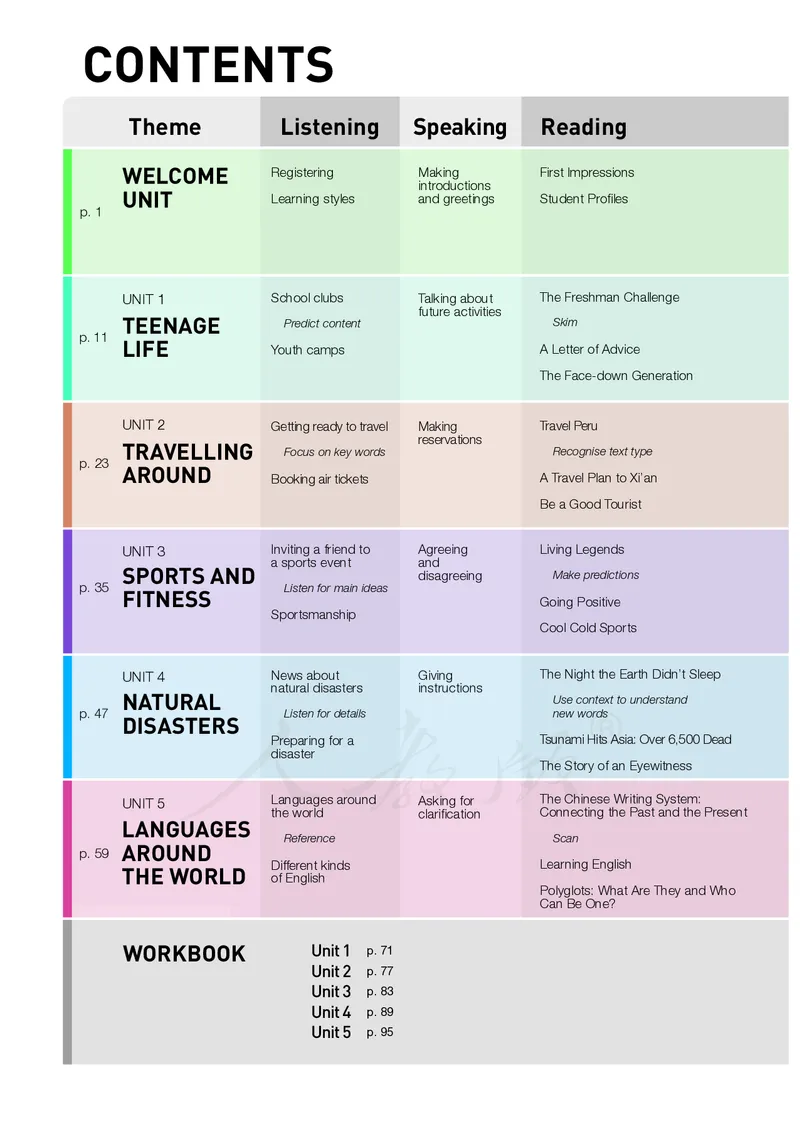
2019年4月CONTENTS
Theme Listening Speaking Reading
WELCOME Registering Making First Impressions
introductions
UNIT
Learning styles and greetings Student Profiles
p. 1
UNIT 1 School clubs Talking about The Freshman Challenge
future activities
TEENAGE Predict content Skim
p. 11
LIFE
Youth camps A Letter of Advice
The Face-down Generation
UNIT 2 Getting ready to travel Making Travel Peru
reservations
TRAVELLING
Focus on key words Recognise text type
p. 23
AROUND
Booking air tickets A Travel Plan to Xi’an
Be a Good Tourist
UNIT 3 Inviting a friend to Agreeing Living Legends
a sports event and
SPORTS AND
disagreeing Make predictions
p. 35 Listen for main ideas
FITNESS
Going Positive
Sportsmanship
Cool Cold Sports
UNIT 4 News about Giving The Night the Earth Didn’t Sleep
natural disasters instructions
NATURAL Use context to understand
p. 47 Listen for details new words
DISASTERS
Preparing for a Tsunami Hits Asia: Over 6,500 Dead
disaster
The Story of an Eyewitness
UNIT 5 Languages around Asking for The Chinese Writing System:
the world clarification Connecting the Past and the Present
LANGUAGES
Reference Scan
AROUND
p. 59
Different kinds Learning English
THE WORLD
of English
Polyglots: What Are They and Who
Can Be One?
WORKBOOK Unit 1
p. 71
Unit 2
p. 77
Unit 3
p. 83
Unit 4
p. 89
Unit 5
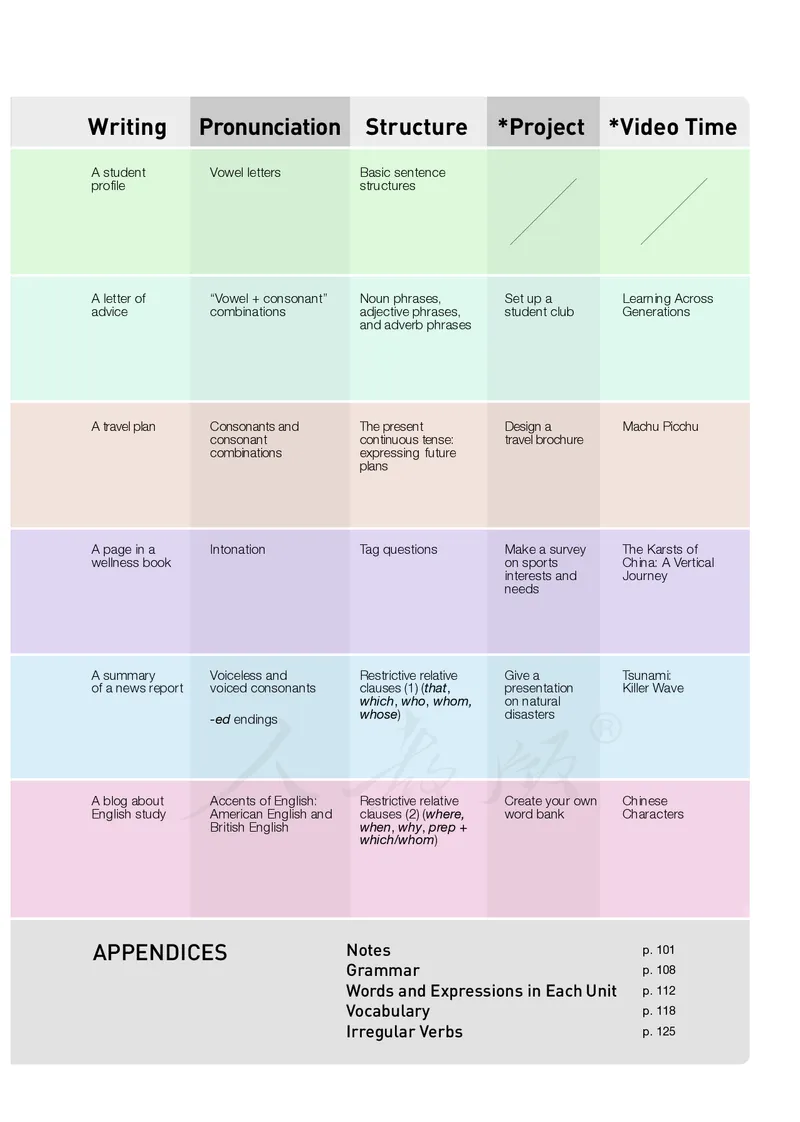
p. 95Writing Pronunciation Structure *Project *Video Time
A student Vowel letters Basic sentence
profile structures
A letter of “Vowel + consonant” Noun phrases, Set up a Learning Across
advice combinations adjective phrases, student club Generations
and adverb phrases
A travel plan Consonants and The present Design a Machu Picchu
consonant continuous tense: travel brochure
combinations expressing future
plans
A page in a Intonation Tag questions Make a survey The Karsts of
wellness book on sports China: A Vertical
interests and Journey
needs
A summary Voiceless and Restrictive relative Give a Tsunami:
of a news report voiced consonants clauses (1) (that, presentation Killer Wave
which, who, whom, on natural
-ed endings
whose) disasters
A blog about Accents of English: Restrictive relative Create your own Chinese
English study American English and clauses (2) (where, word bank Characters
British English when, why, prep +
which/whom)
APPENDICES Notes
p. 101
Grammar
p. 108
Words and Expressions in EachUnit
p. 112
Vocabulary
p. 118
Irregular Verbs
p. 125UNIT
WELCOME
WELCOME
UNIT
A thousand-mile journey
begins with the first step.
—Laozi
In this unit, you will Look and discuss
1 read about a student’s first day of school. 1 Where do you think these students are?
2 hear and talk about choosing and registering 2 How do you think they feel?
for courses. 3 How do you feel on the first day of school?
3 write a student profile.
4 learn about first-year senior high school students
in different countries.
WELCOME UNIT 1Listening and Speaking
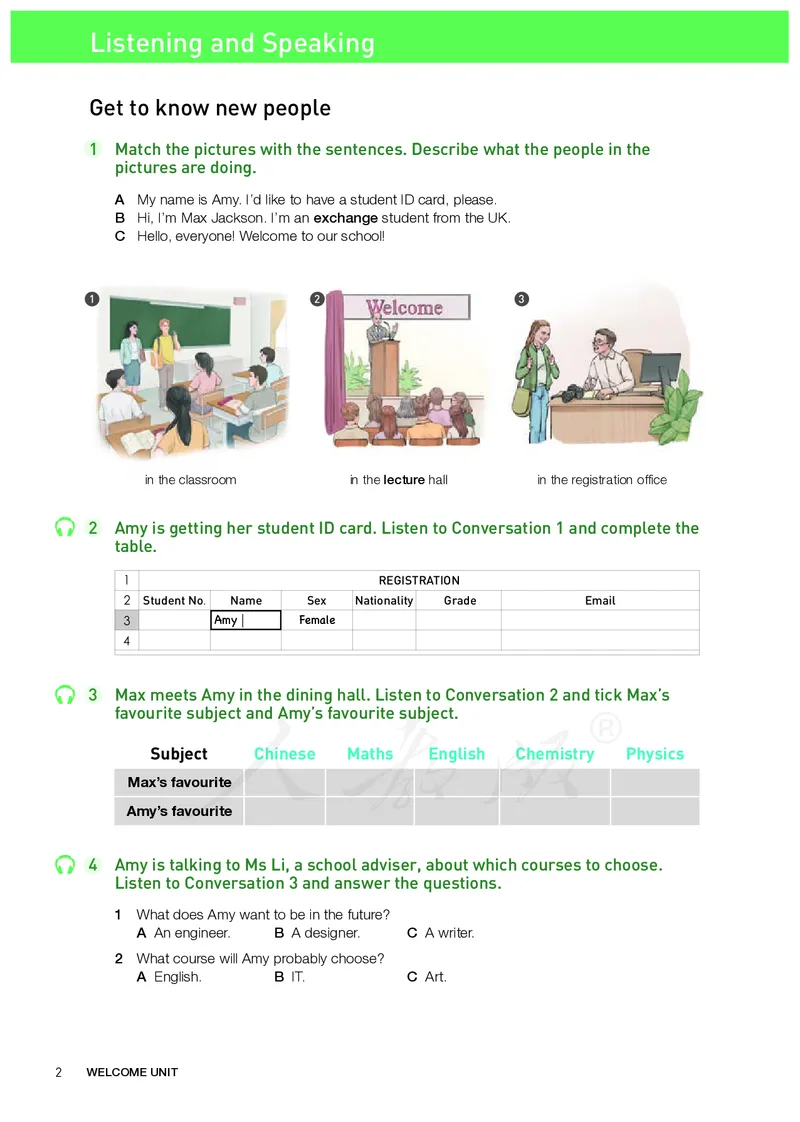
Get to know new people
1 Match the pictures with the sentences. Describe what the people in the
pictures are doing.
A My name is Amy. I’d like to have a student ID card, please.
B Hi, I’m Max Jackson. I’m an exchange student from the UK.
C Hello, everyone! Welcome to our school!
1 2 3
in the classroom in the lecture hall in the registration office
2 Amy is getting her student ID card. Listen to Conversation 1 and complete the
table.
1 REGISTRATION
2 Student No. Name Sex Nationality Grade Email
3 Amy Female
4
3 Max meets Amy in the dining hall. Listen to Conversation 2 and tick Max’s
favourite subject and Amy’s favourite subject.
Subject Chinese Maths English Chemistry Physics
Max’s favourite
Amy’s favourite
4 Amy is talking to Ms Li, a school adviser, about which courses to choose.
Listen to Conversation 3 and answer the questions.
1 What does Amy want to be in the future?
A An engineer. B A designer. C A writer.
2 What course will Amy probably choose?
A English. B IT. C Art.
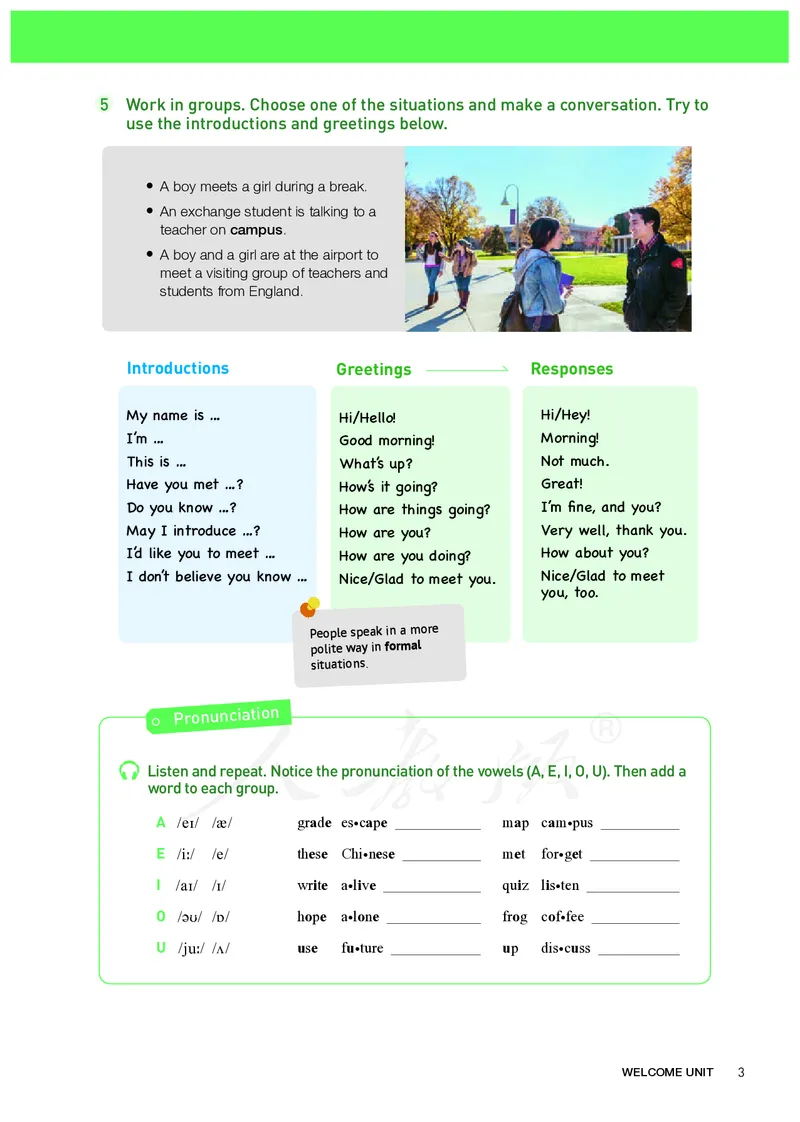
2 WELCOME UNIT5 Work in groups. Choose one of the situations and make a conversation. Try to
use the introductions and greetings below.
A boy meets a girl during a break.
An exchange student is talking to a
teacher on campus.
A boy and a girl are at the airport to
meet a visiting group of teachers and
students from England.
Introductions Greetings Responses
My name is … Hi/Hello! Hi/Hey!
I’m … Good morning! Morning!
This is … What’s up? Not much.
Have you met …? How’s it going? Great!
Do you know …? How are things going? I’m fine, and you?
May I introduce …? How are you? Very well, thank you.
I’d like you to meet … How are you doing? How about you?
I don’t believe you know … Nice/Glad to meet you. Nice/Glad to meet
you, too.
People speak in a more
polite way in formal
situations.
Pronunciation
Listen and repeat. Notice the pronunciation of the vowels (A, E, I, O, U). Then add a
word to each group.
A /eI/ // grade es•cape map cam•pus
E /i:/ /e/ these Chi•nese met for•get
I /aI/ /I/ write a•live quiz lis•ten
O /U/ // hope a•lone frog cof•fee
U /ju:/ // use fu•ture up dis•cuss
WELCOME UNIT 3Reading and Thinking
Describe your first senior high school day
1 How did you feel on your first day of senior high school? Circle the pictures
that describe how you felt.
happy anxious excited annoyed frightened
2 Read the text quickly and draw pictures to show Han Jing’s feelings on her first
school day.
FIRST IMPRESSIONS
10:45 p.m.
Han Jing's World
So this is it—senior high school at
last! I’m not outgoing so I’m a little
7:00 a.m.
anxious right now. I want to make a
good first impression. Will I make any
friends? What if no one talks to me?
9
I just had my first maths class
at senior high school! The 12:30 p.m. 5:32 p.m.
class was difficult, but the
teacher was kind and friendly. He even told
us a funny story, and everyone laughed so
This afternoon, we had our chemistry
much! I found most of my classmates and
class in the science lab. The lab is
teachers friendly and helpful.
new and the lesson was great, but the
guy next to me tried to talk to me the
whole time. I couldn’t concentrate
on the experiment. I really wanted to
tell him to please be quiet and leave
me alone!
2 6
What a day! This morning, I was worried that
no one would talk to me. But I was wrong. 10:29 p.m.
I didn’t feel awkward or frightened at all. I
miss my friends from junior high school, but
I believe I will make new friends here, and
there’s a lot to explore at senior high. I feel
much more confident than I felt this morning.
I think that tomorrow will be a great day!
11
4 WELCOME UNIT3 Read the text again and discuss the questions.
1 Why did Han Jing feel anxious before school?
2 How was her first maths class?
3 What happened in the chemistry class? What would you do if this happened to you?
4 What did Han Jing learn from her first day at senior high school?
4 Fill in the table with the words and phrases from the text, and tell a partner
about Han Jing’s day. Then talk about your own first day of senior high school.
Time What was Han Jing texting about?
7:00 a.m. senior high school, a little anxious
12:30 p.m.
5:32 p.m.
10:29 p.m.
Word Study
Complete the passage with the correct forms of the words and phrases below.
explore impression feel confident
senior experiment concentrate on
Tian Hua is a new student at a school in America.
She is studying at an American high school for
one year. In China, Tian Hua was in Grade 1 at
high school, but in America, she is in
Grade 10! She did not at all when she
arrived. Her first was that English was
difficult and people spoke too quickly, but soon
she found that if she the ideas, not the
single words, she could understand! She also made
friends and began to the city with them.
Her new friends were happy to explain things to her
after class. Her favourite class is chemistry because
the teacher lets the students do cool !
Tian Hua is not sure how well she will do at school
this year, but she is not nervous any more. She is
excited!
WELCOME UNIT 5Discovering Useful Structures
Analyse basic sentence structures
S (subject) V (verb) O (object) P (predicative) A (adverbial)
DO (direct object) IO (indirect object) C (object complement)
1 Study the sentence structures.
Sentence structure Sentence
SV All of us laughed!
SVO I miss my grandma.
SP The teacher was kind and friendly.
S V IO DO He told us a funny story.
SVOC I found most of my classmates and teachers friendly and helpful.
SVA He talked too much.
SVOA I had my first maths class at senior high school.
There be … There’s a lot to explore at senior high.
2 Read the sentences and analyse the structures.
EXAMPLE: We laughed.
S V
1 The 100-year-old school lies in the 5 My mum bought me a new dictionary.
centre of the city.
6 Tom is looking forward to meeting the
2 We must act. new exchange student.
3 The maths homework looks easy. 7 There is an English Corner at our school.
4 The teacher found the classroom empty. 8 We had chemistry in the newly built lab.
3 Read the passage and analyse the structures of the
underlined sentences.
How would you like to go to school and travel the world at the
same time? For Tim, that dream has come true! This term, Tim
and his classmates are living on a ship! They take the same
subjects as you do, like maths and English. They also learn
about ships and the sea. Tim writes his parents an email every
week and tells them what happened on the ship. Tim loves living
on the ship. There’s always something exciting to do. And, after
a long day of study, he likes to watch the sun go down and wait
for the stars to come out. Studying and doing homework seem
much more fun when you are at sea!
6 WELCOME UNITListening and Talking
Reflect on your learning styles and strategies
1 Li Ming and Amy are talking about learning strategies. Listen to their
conversation and tick what Li Ming likes to do.
work in groups
listen to the teacher
and take notes
watch videos
use flash cards
make mind maps
keep a learning diary
2 Listen again and answer the questions.
1 Why does Amy like group work?
2 How does Li Ming organise his thoughts?
3 Does Li Ming like to keep a learning diary? Why or why not?
3 How do you learn English? Rate the learning methods below. You can add
more of your own to the questionnaire.
1 I have learning goals and make plans for my English studies. ☆☆☆☆☆
2 I exchange learning experience with my classmates. ☆☆☆☆☆
3 I take notes while listening and reading. ☆☆☆☆☆
4 I read English newspapers and magazines. ☆☆☆☆☆
5 I write down new words in my notebook and review them often. ☆☆☆☆☆
6 I use dictionaries to check for new words. ☆☆☆☆☆
7 I like to write about what I read or hear in English. ☆☆☆☆☆
8 I like to watch movies in English. ☆☆☆☆☆
4 Work in pairs. Share your ideas with your partner and discuss the questions.
1 What learning strategies do you and your partner share?
2 What is the best strategy for you to learn new words? How about grammar?
3 What is the best way for you to improve your reading skills? How about writing?
WELCOME UNIT 7Reading for Writing
Write a student profile
1 Read the student profiles and discuss the questions.
Ann, 15 Thando, 16
Lakeside High School South Hill High School
USA South Africa
My name is Ann Wells and I’m a Grade I’m Thando Gowon. I’m 16 this year. I
10 student at Lakeside High School. I’m come from South Africa. I’m a Grade 10
an active person and I love sports. I’m student at South Hill High School. I look
curious about everything. I often ask good, think fast, and play hard. You’ll
questions, but I learn best by doing. My never see me without a book or a pen.
favourite subject is physics. Dancing and If I’m not in class, I’m either in the library
skating are my hobbies, and I also like to or in the computer lab. At the weekends,
read short stories. I plan to become an I play computer games if I’m not busy
engineer in the future. studying. My dream is to start my own IT
company!
1 What is Ann like? How do you know?
2 What does “You’ll never see me without a book or a pen” mean?
3 Which profile do you like better? Why?
8 WELCOME UNIT2 Study the organisation and language features.
1 A student profile can include the following parts. Fill in each part with the information from
the student profiles.
A Name, age, grade, school B Personality C Favourite subject
D Learning style E Hobbies F Future plans and dreams
A A
F B F B
E C E C
D D
2 Circle the phrases that Ann and Thando use to describe their personalities and underline
the sentences that they use to describe their learning styles.
3 Use what you have learnt to write your own student profile.
1 Complete the outline and use it to draft your student profile.
Name: Age:
Grade: School: My name is
Personality: and I’m a student
Favourite subject:
at .
Learning style:
Hobbies:
Future plans and dreams:
2 Exchange drafts. Use the checklist to give feedback on your partner’s draft.
Does the profile give you a good impression of the student?
Are all the parts in Activity 2 included and organised in a good order?
Are the sentence structures correct?
Do all the sentences begin with capital letters?
Are there any spelling mistakes?
3 Get your draft back and revise it.
4 Add a photo or drawing of yourself and show your student profile to your class.
4 Collect all the student profiles and create a class book.
WELCOME UNIT 9Building Up Your Vocabulary
1 Match the pictures with the best adjectives. Then describe each picture in
two or three sentences.
anxious awkward annoyed frightened confident curious excited
What if I make a mistake? Hi! Long time
Um, I ..., I don’t know
What is it?
I wish I didn’t have to do this! no see!
what to say.
1 2 3 4
Argh! Why do you always Help! Help! I think I’ll do very well in the exam!
do this? Leave me alone!
5 6 7
2 Match the verbs on the left with the nouns on the right. Then make sentences
with your new phrases.
exchange register (for) design a class a dress a lecture
explore give take ideas the world notes
EXAMPLE
Good morning. I’d like to register for a class. I’m interested in any classes on music!
3 Read the learning tips. Rewrite the underlined parts with the new words
from this unit that have the similar meaning.
Know yourself.
How you like to learn depends on what kind of person you are. If you like to talk, then it may be best
to study in groups. If you are quiet, you may concentrate best on your own.
Decide on what you want to learn.
Do you want to learn spelling rules? Do you want to learn how to take notes during a talk by a teacher?
No matter what you want to learn, it is important to decide on your goal before you make a plan.
Use the right strategy.
If you are learning new words, it is wise to use small cards with the words written on them. If you are
organising your thoughts or notes, try a mind map.
10 WELCOME UNITUNIT 1
TEENAGE LIFE
1 TEENAGE
UNIT LIFE
Good habits formed at youth
make all the difference.
—Aristotle
In this unit, you will Look and discuss
1 read about school life in the USA. 1 What are the teenagers doing in the photo?
2 hear and talk about extra-curricular activities 2 What do you do to relax outside of school?
of senior high school students. 3 What kind of life do you live? What kind of
3 write about teenage problems and solutions. life do you wish to live?
4 learn about teenage life in other countries.
UNIT 1 TEENAGE LIFE 11Listening and Speaking
Choose a school club
1 Match the photos with the names of the clubs. What do you think students do
in these clubs?
Ballet Club Nature Club Volunteer Club Debate Club
1
4
3
I enjoy discussing 2 I prefer helping I’m interested in
different questions. others. plants and animals.
I love dancing!
2 Listen to the first two conversations and choose the correct answers.
1 What are they learning about in Conversation 1?
Predict content
A Hearing. B Sounds. C Dogs.
Before you listen, you can
2 The students are discussing in Conversation 2. read the questions and the
A schoolwork B relationships C dating choices. It will help you to
predict what you will hear.
3 Circle the two clubs where these two conversations happened.
A Science Club. B Ballet Club. C Nature Club. D Debate Club.
3 Listen to Conversation 3. Then help Adam choose a club.
1 Tick the activities that happen in each club.
Ballet Club Nature Club Cartoon Club Volunteer Club
learn new movements listen to lectures watch cartoons help old people
watch dance programmes grow plants write stories clean up parks
make ballet clothes work in a greenhouse draw cartoons give directions
2 Adam says that he likes but is not so interested in .
A stories, cartoons B animals, plants C making friends, cleaning up
3 Which club do you think is suitable for Adam? Why?
I think Adam should join the Club because he says that he .
12 UNIT 1 TEENAGE LIFE4 Work in pairs. Help each other choose a school club.
EXAMPLE
A: Hi, Sam! I’ve decided to join the Music Club.
B: Good decision!
A: How about you? Are you going to join a club?
B: Yes. I’m wondering which one I should choose:
the Acting Club or the Ballet Club?
A: I guess the question is … Do you like dancing better
than acting?
B: Actually, I like acting better, but my friends go to the
Ballet Club and I want to be with them.
A: Hmm ... If you ask me, I think you should choose what
you like.
Pronunciation
1 Listen and repeat. Then add more words to each group.
al ay ai are ar er ir or or ur
talk pay paint care bar her bird horse word burn
wall stay daily declare hard prefer circus absorb work hurt
ee ea ea ear ear oa ow ow ou ore
keen clean head clear earn boat show now out more
tree eager ready appear heard coach grow shower loud bored
2 Listen to the proverbs and repeat. Notice the pronunciation of the letters in bold.
1 The early bird catches the worm.
2 Always prepare for a rainy day.
3 Actions speak louder than words.
4 All work and no play makes Jack a dull boy.
5 Distance tests a horse’s strength. Time reveals a person’s character.
UNIT 1 TEENAGE LIFE 13Reading and Thinking
Compare school life in different places
1 Work in groups. Discuss the questions.
1 What do you want to know about school life in other countries?
2 What would you tell a teenager from another country about school life in China?
2 Read the text quickly to find the main idea of each paragraph.
Paragraph 1: Senior high school is a challenge.
Skim
Paragraph 2:
You can find main ideas by
Paragraph 3: first taking a quick look at the
title, picture(s), key words and
Paragraph 4:
phrases, and topic sentences.
THE FRESHMAN CHALLENGE
Hi! My name is Adam and I’m a freshman at senior high school.
Going from junior high school to senior high school is a really big
challenge. The first week was a little confusing.
First, I had to think very carefully about which courses I wanted
to take. The school adviser helped me choose the suitable ones:
maths, English, chemistry, world history, and Chinese. I know that
Chinese is a very difficult language, but I hope to be fluent when
I graduate. My adviser recommended that I should sign up for
advanced literature because I like English and I’m good at it.
I had to choose extra-curricular activities, too. I tried to join the
school football team, but the coach told me that I didn’t play well
enough. Obviously, I was unhappy, but I won’t quit. I’ll find a
way to improve on my own so that I can make the team next year.
I joined a volunteer club instead. Every Wednesday, we work
at a soup kitchen and hand out food to homeless people in the
community.
I know I’ll have to study harder as a senior high school student
and get used to being responsible for a lot more. I’m a bit worried
about keeping up with the other students in my advanced course,
and it’ll be quite difficult to get used to all the homework. Still, I’m
happy to be here. Studying hard isn’t always fun, but I’ll be well
prepared for university or whatever else comes in the future.
14 UNIT 1 TEENAGE LIFE3 Read the text again and answer the questions.
1 What courses did Adam choose? Which one do you think would be his favourite? Why?
2 What does “make the team” in Paragraph 3 mean?
3 What is Adam worried about?
4 Is Adam confident that he will get used to senior high school life? How do you know?
4 Complete the outline. Then discuss the questions below with a partner.
Paragraph Challenge How Adam feels Solution
1 Confused
The school adviser
2 Choosing courses
.
He will find a way to
3
.
He will
4
.
1 What kind of person do you think Adam is? Why?
2 Do you face the same challenges as Adam? What other challenges are you facing?
How do you deal with them?
3 What are some differences between Adam’s school life and your school life?
5 Complete the sentences with the correct forms of the new words from the text.
1 I’m good at maths, so my teacher that I should choose advanced maths
in my first year.
2 Finding time for both studies and extra-curricular activities is a big , so I
need to make a workable schedule.
3 It’s a little to choose suitable courses. I hope that my adviser can help me
make a good decision.
4 We can try a course for two weeks after we up for it. After that, we cannot
change it.
5 The main purpose of the course is to help each student’s reading ability.
6 Some of the students want to become writers or editors after they , so the
teacher advised them to start a writing club.
7 The school is for the safety of all the students.
8 Whenever I’m facing a difficulty, I always tell myself, “Don’t let anything stop you. Don’t ever
.”
UNIT 1 TEENAGE LIFE 15Discovering Useful Structures
Improve a draft
1 Find and mark the phrases in the sentences that fit the categories below. Then
state their functions.
Noun Phrase (NP) Adjective Phrase (AdjP) Adverb Phrase (AdvP)
word group with a noun as word group with an adjective word group with an adverb as
its head word as its head word its head word
1 The first week was a little confusing.
NP AdjP
2 The building is so big that I’m completely lost.
3 The kids over there are putting something on a round paper plate.
4 Linda thinks and speaks quite quickly, and she can do well in the debate.
5 The new coach told me that I didn’t play well enough.
6 My first French class was very confusing. The teacher spoke so fast!
2 Answer the questions using the phrases in brackets.
1 How soon do you think you’ll finish your homework? (pretty soon)
2 What do you think of your new teachers? (very nice and patient)
3 How many clubs have you joined this year? (two clubs)
4 How well does Rita play the violin? We need a new violinist in our music club. (quite well)
5 What did your adviser say about the advanced literature course?
(too difficult but very interesting)
3 Joyce has just written a draft. Help her improve it by using noun/adjective/
adverb phrases to add more information.
Cheerleader Try-outs
I’ve always wanted to be a cheerleader. Yesterday, I tried out for the team. It was hard. First,
we had to dance. The teacher showed us how to move, and then we tried. Second, we
practised singing a song about the school basketball team. Finally, some girls had to lift their
partners. The other girls jumped and cheered. I think I did well, but the other girls were
better. I’m not sure if I’ll make the team or not.
I’ve always wanted to be a high school cheerleader. Yesterday, I tried out
for my school’s cheerleading team. It was really hard. First, …
16 UNIT 1 TEENAGE LIFEListening and Talking
Plan a camp for teenagers
1 Cao Jing and Max are talking about camps. Listen to the conversation and
tick what they are going to do at the camps.
Adventure Camp International Youth Camp
Talking about future activities
We’ll learn survival skills. I plan to improve my spoken English.
I’ll learn how to make a fire. We’ll talk about teenage life.
We’ll learn how to live in the wild from There’ll be students from different
some experts. countries at the camp.
We’re going to learn about wildlife. I’m going to give a speech.
I think it’s going to be fun. I hope to make some friends.
2 Listen again. Underline the expressions in the sentences above that Cao Jing
and Max use to talk about the future.
3 Work in groups. Plan a youth camp.
1 Think of ideas for the camp. You can use the questions below to get started.
What kind of camp is it? Who will be there?
What will they do? What will they learn?
2 Present your ideas for a youth camp to the class.
EXAMPLE
Camp
Do you want to have fun and learn at the same time? Then come to our camp. In
our camp, you can learn about ... There’ll be many interesting activities. First, we are
going to ... Then we’ll ... We also plan to ... Finally, we’ll ... Please come to our camp!
UNIT 1 TEENAGE LIFE 17Reading for Writing
Write a letter of advice
1 Susan Luo, an adviser for teenagers, has received a letter asking for some
advice. Read her reply and discuss the questions.
Date 10 September 2018
Dear Worried Friend,
Greeting
You wrote that you are very worried about your friend, Chen Lei.
I understand quite well that you are anxious and feel terrible.
You think that your friend plays computer games too often and
spends too much time online.
I recommend that you talk to your friend about his behaviour. It
is not unusual for teenagers of your generation to be attracted
to computer games and the online world. But spending too much
Body
time online is unhealthy and makes it very difficult to focus on
other things in life. Some students even become addicted to the
Internet and cannot concentrate on school and family life. I think
you should encourage your friend to try new hobbies. Why not
discuss the problem together? I am sure he will listen to you,
since you are his good friend.
Close All the best,
Signature
1 What is Worried Friend’s problem?
2 Do you think Ms Luo’s advice is useful? Why or why not?
3 What other kinds of advice would you give?
2 Study the organisation and language features.
1 Find and mark the parts of the letter that match the following points.
A I know what the problem is. B I understand how you feel.
C This is my advice and reason(s). D I think my advice will help.
2 What expressions does Ms Luo use to make suggestions? Circle them in the letter.
18 UNIT 1 TEENAGE LIFE3 Use what you have learnt to write a letter of advice to one of the teenagers below.
1 Work in groups. Choose one of the teenagers and discuss his/her problem. List possible
suggestions and reasons.
There is a girl I like in my
class, but I’m too shy to
talk to her. Please help me!
I always feel lonely after
school because my parents
work in another city. What
My parents won’t listen when
can I do?
I tell them things. I guess it’s
because they’re adults and
can’t understand me. Do Min Ho, 15, Seoul
you have any suggestions?
Eric, 15, Chicago
Suggestion Reason
Xu Ting, 14, Hangzhou
2 Draft your letter according to the outline below.
Write the date and greet the reader.
Show the reader that you know Dear ,
what the problem is.
Tell the reader that you You wrote that .
understand how he/she feels.
I understand that .
Tell the reader what you think I think
he/she should do.
because . I am sure
Explain your reason(s). that .
Tell the reader what you
think will happen. Best wishes,
Close and sign the letter.
3 Exchange drafts. Use the checklist to give feedback on your partner’s draft.
Are all the parts of a letter included and organised in a good order?
Does the writer give reasons for the advice?
Does the writer use proper expressions to give suggestions?
Does the writer use commas and stops correctly?
Is the handwriting easy to read?
4 Get your draft back and revise it.
4 Put up your letter in the classroom or read it to the class.
UNIT 1 TEENAGE LIFE 19Assessing Your Progress
1 Circle the correct word(s) in each sentence.
1 Today’s teenagers seem to prefer/like the Internet more than TV.
2 Martin did not enjoy pop music until he became a generation/teenager.
3 Which course did your teacher recommend to/with you?
4 Don’t quit trying/to try if there is still hope.
5 I think he is addicted/attracted to smoking. He just can’t seem to quit.
6 The library project has already fallen behind schedule/plan.
7 The research has focused on/for the relationship between a teenager’s sleep and health.
8 The instructions on the box made him confusing/confused, and he did not know what to do.
2 Find the noun/adjective/adverb phrases in the passage and state their functions.
If you have learnt some maths at school, you in poor countries, but there are also some
can quite quickly work out that one eleventh boys and girls who cannot go to school in
is about 9 percent. But did you know that 9 rich countries. If you are one of the lucky
percent is also the number of children who ones who can go to a senior high school,
are not at school? That’s right—one in 11 you should be grateful for the opportunity. So
children is not studying and probably even the next time you feel like you do not want to
cannot do the simple maths you just did so do boring, difficult homework or go to class,
very easily. They drop out of school because think about the children who don’t have the
their families are too poor and they have to chance to get a good education. Make the
work like adults. In 2013, millions of children most of your education and make the world
and teenagers were out of school. Most live a better place.
Do you agree with the writer’s opinion? Give your reasons.
REFLECTING
Which reading in this unit did you find the most interesting? Why?
What new things did you learn about teenage life from this unit?
What new vocabulary and structures did you learn in this unit? Did you use any of
them in your language activities? How well could you use them?
Do you think skimming was useful for you to understand the texts?
What problems did you or your friends have with this unit? How did you solve the
problems? What advice did you give each other?
20 UNIT 1 TEENAGE LIFE* Project: Set up a student club
1 You are going to set up a student club. Work in groups and choose one of the clubs
from below, or create a new club you think others would be interested in joining.
Basketball
Calligraphy Club Psychology
Club Club
Student
Photography Club
Club Club
Debate Biology
Club Club
Chess Club
2 Decide on the following details of your club.
Club name
Slogan
(Why form the club? What does it hope to achieve?)
Aim
(What will members usually do at the meetings? Any special events or
Activity
outings?)
(What should members prepare and bring?)
Requirement
Meeting time
and place
3 Design an eye-catching logo for your club and make a poster including the club’s
name, slogan, and logo.
4 Prepare an introduction to recruit new members during a school assembly.
Include some details that are not mentioned on your poster.
EXAMPLE
Hello, everyone! We’re very pleased to introduce our club to you. It is called … Our slogan
is …, and our club aims to …
UNIT 1 TEENAGE LIFE 21* Video Time
Learning Across Generations
Mamorena Chaane is a teenage girl. She
lives in the suburbs of Johannesburg, South
Africa with her mother, Tandi.
BEFORE YOU WATCH
Look through the title, introduction, and photos. Then guess whether the
statements are true (T) or false (F).
1 In South Africa, many teenagers graduate from university. T F
2 Mamorena’s life is the same as Tandi’s when she was young. T F
3 Tandi had a difficult childhood. T F
4 Tandi is now a successful businesswoman. T F
A shanty town is a poor
WHILE YOU WATCH area. People in a shanty
town make their own
1 Check your answers in Before You Watch. houses, often from
wood or materials that
2 Circle the correct word(s) in each sentence. have been thrown away.
1 Mamorena is a student at an expensive/inexpensive private school.
2 Tandi grew up in a poor/wealthy area of Johannesburg.
3 Mamorena does not understand/understands about her mother’s childhood.
AFTER YOU WATCH
Work in pairs. Discuss the questions.
1 In what ways is your life similar to or different from your parents’ life when they were young?
2 Tandi said, “I don’t think you become a person if you don’t know where you come from.”
Do you agree or disagree with this statement? Why or why not?
22 UNIT 1 TEENAGE LIFEUNIT 2
TRAVELLING AROUND
2 TRAVELLING
UNIT AROUND
Travel, in the younger sort,
is a part of education;
in the elder, a part of experience.
—Francis Bacon
In this unit, you will Look and discuss
1 read about tours to Peru and China. 1 Where do you think the travellers in the photo are?
2 listen to people discuss their travel plans. 2 Do you like travelling? Who do you like to travel with?
3 talk about preparing for travel and how to 3 What places have you travelled to? What words can
make reservations for a trip. you use to describe your trips?
4 write a travel plan.
5 learn about travelling at home and abroad.
UNIT 2 TRAVELLING AROUND 23Listening and Speaking
Get ready to travel
1 Before you listen, discuss the questions in groups.
1 If you have the chance to travel anywhere in the world, where will you go?
2 What do you need to do to prepare for the trip?
1 2 3 4
the Eiffel Tower, France Lijiang, China Neuschwanstein Castle, Germany Tianshan, China
get a passport apply for a visa book tickets book a hotel room
rent a car buy a guidebook pack some clothes research the local weather
2 Paul and Meilin are talking about the coming holiday. Listen to the first part
of the conversation and choose the correct answers.
Focus on key words
1 Circle the two places Meilin is going to for holiday.
A Germany. B England. C Iceland. D France. Do not try to catch every word
in a conversation. Instead,
2 How is she going to get there?
listen for key words and
A By sea. B By air. C By train. phrases. You should focus on
getting the main idea, not on
3 How is she planning to get around after she arrives?
single words or grammar.
A By car. B By train. C On foot.
3 Listen to the second part of the conversation and answer the questions.
1 Where is Paul’s family going over the holiday?
2 Why are they going there?
4 Listen to the whole conversation again and fill in the table below.
Travel Meilin Paul
Preparations
Get her passport a few light
for her visa sweaters and a coat
air tickets online a guidebook
a car
24 UNIT 2 TRAVELLING AROUND5 Choose a travel destination and think about what you would do to prepare to
travel there. Then share your travel plans with a partner.
Where: Neuschwanstein Castle, Germany Where: Jiuzhaigou, China
Why famous: the model for the castle Why famous: amazing waterfalls,
in Disneyland colourful lakes, beautiful mountains
Best time to visit: Best time to visit:
September/October (autumn) April/May or September/October
EXAMPLE
A: Hi, Julie! Do you have any plans for the holiday?
B: Hi, Wang Lei! Yes, I’m planning to travel to Jiuzhaigou. Actually, I’ve just
finished the travel arrangements!
A: Oh, good idea! Jiuzhaigou is an extremely beautiful place.
B: Yes, I’m looking forward to seeing the colourful lakes, amazing waterfalls ...
A: How are you getting ready for your trip?
B: I’m …
Pronunciation
1 Listen and repeat. Then add more words to each group.
ck ch tch ph sh th th wh wh ng qu
ticket search catch photo wish thing weather when who song quarter
pack check Dutch graph shock think neither what whose wing request
gu igh kn mb wr c c g g x x
guest high know climb write copy face green large text exam
guide night knee comb wrist local twice blog general except exact
2 Listen to the sentences below. Notice the pronunciation of the letters in bold.
1 A traveller without observation is a bird without wings. (Moslih Eddin Saadi)
2 To travel is to discover that everyone is wrong about other countries. (Aldous
Huxley)
3 I see my path, but I don’t know where it leads. Not knowing where I’m going is
what inspires me to travel it. (Rosalia de Castro)
UNIT 2 TRAVELLING AROUND 25Reading and Thinking
Explore Peru
1 Watch the video Welcome to Peru and answer the questions.
1 What did you see in the video?
2 What other sources of information can you find about Peru?
2 Below are two texts about Peru. Look through them quickly. What types of text
are they: encyclopedia or brochure?
PEru is a country on the Pacific coast
Recognise text
of South America with three main
type
areas: narrow, dry, flat land running
along the coast, the Andes Mountains, Before you read,
and the Amazon rainforest. look through the
text quickly for
In the 1400s and 1500s, Peru was the titles, headers,
centre of the powerful ancient Inca pictures, charts,
Empire. The Inca emperor lived in and any other
the now-famous site Machu Picchu. information that
Spain took control of Peru in the 16th might tell you
century and ruled until 1821. It is for what type of text
this reason that Spanish is the main it is.
official language of Peru.
TRAVEL PERU
Amazon Rainforest Tour Machu Picchu Tour
A short flight from Cusco takes you This four-day walking tour will take you
from the Andes into the Amazon on amazing paths through the Andes
rainforest. From there, you’ll spend Mountains on the way to the city of Machu
one day travelling by boat to your Picchu. After reaching your destination, you
accommodation in the middle of the will have a day to explore and be amazed
forest. You can then spend three days by this ancient city. Especially amazing is
exploring the rainforest with a local the Incas’ dry stone method of building.
guide and enjoying the plants and Inca builders cut stones to exact sizes so that
animals unique to the rainforest. nothing was needed to hold walls together
other than the perfect fit of the stones.
26 UNIT 2 TRAVELLING AROUND3 Complete the passage with the correct forms of the new words from the two texts.
Cusco is a popular d for tourists, because of its u place in the history
of South America. Cusco was the capital city of the Inca E which was the most
powerful in South America until the 1500s. There are two especially interesting things to
a about the Inca civilisation. The first is the roads and p they built to
connect their important cities. These Inca roads were made up of two north-south highways
and many small roads crossing the mountains east to west. The roads were for Inca soldiers
and their o . Second, the Incas built wonderful cities full of amazing architecture—
but there were no markets in these cities. One of the interesting questions of history is how the
Incas lived without shopping!
4 Read the text and fill in the table. Then discuss the question below with a partner.
Place AMAZON RAINFOREST MACHU PICCHU CUSCO LAKE TITICACA
CUSCO LAKE TITICACA
Number of days 4 days
Transport
Accommodation local home
local home
boating, hiking,
Activity
exploring nature
Which tour(s) would you recommend for people who enjoy history and culture?
Cusco Tour Lake Titicaca Tour
Spend four days enjoying the unique Spanish Enjoy the beautiful countryside as you
and local Indian culture high in the Andes spend a day driving along the new highway
at Cusco, the capital of the Inca Empire from connecting Cusco to Lake Titicaca. There, a
the 13th until the 16th century. Stay in a boat will take you to stay with a local Uros
local hotel, visit the museums, admire the family on an island for three days. Both
architecture, enjoy the excellent local food, the island and the Uros homes are made of
and go shopping at the local markets. water plants from the lake.
So come and experience what Peru has to offer: everything from the ancient Inca culture and centuries-old
Spanish villages to deep rainforests, high mountains, and a beautiful coastline.
For more brochures about other package tours around Peru, contact us at tourinfo@travelperu.org.
UNIT 2 TRAVELLING AROUND 27Discovering Useful Structures
Talk about your future plans
1 Look at the sentences. What do you think the tense in the sentences expresses?
I’m travelling around Europe for two weeks with my aunt and uncle.
We’re renting a car and driving!
My parents are taking me to Hong Kong during the October holiday.
2 Read the conversation and underline verbs in the present continuous tense.
Discuss with a partner when and how these verbs are used.
Amy: Hello, Jeremy! What are you doing this weekend?
Jeremy: Hi, Amy! Some friends and I are going to that new water park on Saturday. Do you
want to join us?
Amy: Sure, I’d love to! What time and where?
Jeremy: We’re meeting at 10:00 a.m. at the bus stop near our school.
Amy: How about lunch? Are you eating at the water park?
Jeremy: Well, I’m bringing my own lunch. I think some of the others are eating at the park,
but the food there is really expensive.
3 Read the sentences and tick those that express future plans. Rewrite them in the
present continuous tense.
1 I’ve just booked my air ticket! I’ll visit my grandparents in December.
2 Gary might visit China next year, but he’s still not sure.
3 Kate has been invited to a meeting in Iceland. She will apply for a visa soon.
4 Could you help me with this box, please? I’m afraid I’m going to drop it.
5 A: Hey, are you free for dinner tonight?
B: I’m sorry, no. I’ll have dinner with my cousins tonight.
4 Discuss weekend plans with a partner, based on the weather report below.
Saturday Sunday
Morning Afternoon Evening Morning Afternoon Evening
20℃ 25℃ 19℃ 21℃ 20℃ 17℃
weather: sunny weather: sunny weather: clear weather: cloudy weather: rainy weather: cloudy
wind: light wind: light wind: strong wind: strong wind: light wind: none
EXAMPLE
A: What are you doing on Saturday morning?
B: Well, it’s going to be sunny in the morning and not very windy, so I’m having a picnic
with my friends.
28 UNIT 2 TRAVELLING AROUNDListening and Talking
Make reservations
1 Listen to the phone call and answer the questions.
1 What are the two speakers talking about?
2 What is the relationship between the two speakers?
2 Listen again and complete the table with the words you hear.
Making reservations
to buy a plane
Opening can I help you?
ticket ...
Talking about are you On the 23rd of December.
time travelling?
There are two flights ...
Which ? The 9:30 flight, please.
Talking about Would travel to travel
what you prefer business class or economy? business class.
book a return No, . I’m taking
flight this time? the train back.
Other information your name, sir? Robert Williams.
Payment to pay? By credit card.
3 Imagine you are making plans for the holiday. Choose one of the situations
below and role-play a phone call with a partner.
Booking air tickets Booking a hotel room Booking a table for dinner
Details Details Details
travel date(s) check in/check out date
preferred time breakfast time
one-way or return Internet number of people
Flight class Kind of room Special requests
first class 2 single beds non-smoking area
business class double bed high chair(s)
economy class king bed other:
Other information Special requests
name a view
method of payment a non-smoking room
a quiet room
UNIT 2 TRAVELLING AROUND 29Reading for Writing
Write to a friend about a travel plan
1 Read Richard’s email to his friend and the brochure that he found. Do you think
his plan sounds interesting? Why?
To: xl@youthlife.com
Cc:
Subject: A travel plan to Xi’an
Dear Xiao Li,
My time here in China is going well. I love my new school and classmates. Over the
October holiday, my parents and I are planning to go to Xi’an to see the Terracotta
Army. I’ve heard that it is an amazing sight, and I can’t wait to go. To me, the story of
the Terracotta Army is almost unbelievable. It’s amazing that there are more than 8,000
statues, and no one in modern times knew about them until the 1970s.
We’re also planning to visit several other places in Xi’an. My dad and I are both
looking forward to going to the Shaanxi History Museum, because my dad loves
history and I have heard that this museum is known as a “Chinese treasure house”!
We’re also going to the Xi’an City Wall and a few other famous sights.
We’re taking the train, leaving the day before the October holiday begins. We’re arriving at
9:30 a.m. and will start sightseeing right away, so I hope we sleep well on the train!
I guess that’s all for now! I’ll write again soon and send photos! Do you have any plans for
the coming holiday? Hope to hear from you soon.
Your friend,
richard
TERRACOTTA ARMY
Come and see the Terracotta Army: more than 8,000 statues were made in
the third century BCE to guard the tomb of the Chinese Emperor Qinshihuang!
Each statue has a different face, leading researchers to believe that each one
is a copy of a real soldier. The statues fill only one part of the emperor’s huge
tomb, which still has not been completely unearthed. More than 700,000
people worked for nearly 40 years to build this tomb. However, no one in
modern times knew about the tomb or the terracotta statues until 1974, when
some farmers discovered the tomb while they were digging a well!
30 UNIT 2 TRAVELLING AROUND2 Study the organisation and language features.
1 Summarise the email in the table.
Paragraph Main idea Detail
1 main purpose for the trip
2 other plans for the trip
3 transport
4 final thoughts
2 Underline the words and phrases used to express emotion in the email. Then complete the
sentences below.
It is .
It is an amazing sight.
I’m amazed.
I can’t believe it.
... is almost unbelievable. It’s hard .
It’s an story.
3 Use the tables above to help you write a travel plan. Then follow the steps
below.
1 Pretend you are Xiao Li and reply to Richard’s email.
2 Exchange drafts. Assess each other’s work according to the checklist.
Is there a clear purpose for the trip?
Does each paragraph have a clear main idea?
Does the writer use the present continuous tense for future plans?
Does the writer use commas, stops, and question marks correctly?
Are all the words spelt correctly?
Are all the proper nouns capitalised?
3 Revise your draft according to your partner’s comments.
4 Put up your email in the classroom or read it to the class.
UNIT 2 TRAVELLING AROUND 31Assessing Your Progress
1 Complete the postcard with the correct forms of the words below.
destination sight pack credit detail amazing rent admire
Hi Paul,
Hello from our final —Neuschwanstein Castle! We arrived
in Europe about six days ago. I’m so glad that we a car.
The highways here are wonderful, and driving lets you see lots of
amazing . I’m also pleased I good walking
shoes, because we’ve walked A LOT in the last few days. I feel like
we drive for only a short time and then walk and walk and walk! Deutschland
I think what I most so far is the architecture. The
on the buildings here are so unusual, so different from
China. Of course, I’m also enjoying the shopping! I bought gifts for
all of my family and friends. I’m very glad my card works
here, so I don’t have to carry a lot of money. I hope I can come back
here some day and see all of these places again.
Your friend,
Meilin
2 Read the conversation and mark the phrases expressing future plans.
Paul: Hey Meilin. This is Paul, calling from the Old Town of Lijiang!
Meilin: Hi Paul! You are already in Lijiang?! Great to hear you! So what do you think of the Old
Town there?
Paul: Oh, we love it. You know, it is so different from big cities.
Meilin: Really? How long are you staying there?
Paul: About four days, since my dad has to go back to work next Monday. We arrived
yesterday and visited the Old Town. Tomorrow we’re going to Yulong Snow Mountain.
In order to save time, we’re taking the cable car up there. If we still have time, we’re
planning to see Blue Moon Valley and Yak Meadow.
Meilin: Sounds great! Oh, don’t forget it’s much colder on Snow Mountain. Be sure to keep
warm!
Paul: Thanks! We’re bringing sweaters and coats with us, so I hope we’ll be OK. I’ll see you in
a few days! Talk to you soon.
Role-play the conversation with a partner. Pay attention to your stress and intonation.
REFLECTING
My favourite part of this unit was because .
In this unit, I had a hard time with because .
I wish I could learn more about because .
Overall, I thought this unit was cool useful just OK difficult.
32 UNIT 2 TRAVELLING AROUND* Project: Design a travel brochure
1 Read the posts and find out what each student’s reason is for travelling.
Hi everybody! I’m Fraser, and I’m from the UK. I’m going to visit China
this year because I’m very interested in China’s history and culture. I’m
going to see the Great Wall, but other than that, I’m not sure where to go.
Any ideas?
Hello! My name is Anthony. I’m from France. I want to go hiking in
China over the summer holiday. I love nature, and I really want to
see the beautiful sights there. The mountains, the sky, the lakes—
the photos I’ve seen of China’s countryside are wonderful.
Hi! My name is Anna, and I’m from Russia. I’ve just started my last year
of high school, and I want to visit a few universities or colleges in China,
since I hope to study there next year. I want to experience some Chinese
culture and see the natural beauty there, but my main goal is to find out
which university is the best for me to attend.
2 Work in groups. Research, plan, and design a tour.
1 Brainstorm different types of tours and add them to the list below.
Education History Adventure Culture Cuisine
2 Choose one person and a tour he/she might like. Work out a week-long travel plan for the tour.
Time Place Activity
Day 1
Day 2
Day 3
Day 4
Day 5
Day 6
Day 7
3 Design a travel brochure for the tour. Make your brochure as attractive as possible.
UNIT 2 TRAVELLING AROUND 33* Video Time
Machu Picchu
Machu Picchu is an ancient city high up
in the Andes Mountains of Peru in South
America. It is very popular with tourists
and brings money into Peru.
BEFORE YOU WATCH
Complete the sentences with the words and phrases below. You may use a dictionary
to help you.
magnetic centre Inca civilisation outside world stalls business and money ruins
1 Machu Picchu was once part of the .
2 For many years, Machu Picchu was lost to the .
3 Machu Picchu is now made up of .
4 People believe that Machu Picchu is a(n) , attracting many tourists
each year.
5 Apart from being a magical place, Machu Picchu also brings a lot of to Peru.
6 Local people sell things at to tourists.
WHILE YOU WATCH
Choose the correct answers.
1 Another name for Machu Picchu is .
A Aguas Calientes B one of the magnetic centres of the ancient world
C the Lost City of the Inca
2 Machu Picchu was built .
A in 1911 B more than 500 years ago C 500 years ago
3 Some people worry that too many tourists going to Machu Picchu .
A will be bad for the environment B will be bad for business
C will be too noisy
4 The people in the town live completely .
A on the money from tourism B by selling art C by driving buses
5 Machu Picchu may be changed forever by .
A the weather B poverty C tourism
AFTER YOU WATCH
Work in groups. Discuss the questions.
1 Are there any places like Machu Picchu in China? In what ways are they alike?
2 Should tourism be stopped in places like Machu Picchu? Why or why not?
34 UNIT 2 TRAVELLING AROUNDUNIT 3
SPORTS AND FITNESS
3 SPORTS AND
UNIT FITNESS
All sports for all people.
—Pierre de Coubertin
In this unit, you will Look and discuss
1 read about famous athletes at home and abroad. 1 Do you jog often? What sports and
2 hear and talk about sports events and exercise do you like?
sportsmanship. 2 What do you think sports and exercise can
3 write about health and fitness. do for you?
4 learn about sports and games around the world.
UNIT 3 SPORTS AND FITNESS 35Listening and Speaking
Invite a friend to a sports event
1 Look at the posters. What sports events do you like to watch? Which sport
would you like to try?
B O X IN
G
Tickets
on sale
now
Do you want to watch
the boxing match?
Would you like
to go to the
soccer game?
Beijing International
Marathon Day
SOCCER GAME
3:00 p.m. October 22
Wuhan vs Guangzhou
Wuhan Stadium
16th
Why not run
an exciting
marathon?
No. 8 High School How about
BADMINTON watching
Sunday, 30 October
badminton this
MATCH Olympic Park, Beijing
afternoon?
Full Marathon and Half Marathon
2 Listen to Conversation 1. What is Shen Qi's main purpose for talking to Amy?
A To invite Amy to an e-sports event.
Listen for main ideas
B To invite Amy to a soccer match. Try to catch the main ideas
instead of trying to remember and
C To explain an e-sports event.
translate each word you hear.
3 Listen to Conversation 1 again and circle the words that the speaker stresses.
1 Did you hear that there’s an e-sports event this weekend?
2 Would you like to come along?
3 Really? I’d love to!
4 Why don’t you join us this Saturday afternoon?
5 Oh, sorry. I can’t.
36 UNIT 3 SPORTS AND FITNESS4 Adam is inviting Julie to a sports event. Listen to Conversation 2 and answer
the questions.
1 When will the event happen?
The event will happen .
2 What’s a “Blue Paint” run?
A “Blue Paint” run is a fun run that .
3 Why is it called a “Blue Paint” run?
Because people can buy water balloons filled with and
the runners.
4 If 200 people take part in the run and 400 balloons are sold, how much money will
they collect?
5 What event or activity would you like to invite your friend to? Make a conversation
with a partner.
Track Meet: A great
event for track-and-field
lovers on 26 October.
Gym Class: Come and work out
Ski Race: Zhangjiakou, a
at a gym! Sweat your way to
beautiful city in northern
good health! You can make it!
China, will host the Youth
Ski Race in December.
Pronunciation
1 Read the conversation. Decide whether the intonation of the tag questions is
rising or falling.
Dave: Wonderful gym, isn’t it?
Jack: Er… yes. It’s great.
Dave: This isn’t your first time here, is it?
Jack: Actually, it is. You come here often, don’t you?
Dave: Yep. At least three times a week.
Jack: You’ve lost some weight, haven’t you?
Dave: Yes. All that fat has become muscle now. If you want to lose weight, too, I
recommend using the spin bike.
Jack: OK, but it won’t make me too tired, will it?
Dave: Maybe at first, but you’ll get used to it. I used to come here every day when I
first started.
Jack: Oh, I don’t have to come here every day, do I?
Dave: No. Of course not. It’s up to you, isn’t it?
2 Listen and check your answers. Then practise it with a partner.
UNIT 3 SPORTS AND FITNESS 37Reading and Thinking
Choose your favourite athlete
1 Look at the titles and pictures below. What do you think the text is about?
Make predictions
Help us choose some “Living Legends of Sports”. They must be athletes Look at the pictures and think
who are masters in their sports and also set good examples for others. about the content before
Here are our first two choices. reading. This helps you to
relate what you read to what
you already know and to
understand the new text.
Lang Ping Michael Jordan
As a player, Lang Ping brought honour and When Michael Jordan’s feet left the ground,
glory to her country. As a coach, she led the time seemed to stand still. The player who
China women’s volleyball team to medals became known as “Air Jordan” changed
at world championships and the Olympics. basketball with his graceful moves and
As a person, Lang Ping is loved by fans at jumps. Jordan’s skills were impressive, but
home and abroad. When the Chinese team the mental strength that he showed made
was preparing for the 2015 World Cup, her him unique. In the final seconds of a game,
determination was tested. The team that Jordan always seemed to find a way to win.
Lang Ping had built was falling apart. One Jordan says that the secret to his success
of the best players had been injured, and the is learning from his failures. “I can accept
team captain had to leave because of heart failure; everyone fails at something. But
problems. Losing two important players was I can’t accept not trying.” Losing games
a big challenge, but Lang Ping did not lose taught him to practise harder and never
heart. She had faced difficulties before, and give up. In life, Jordan has learnt to share
she knew that her young players could win if his success with others. The Boys and Girls
they worked together as a team. Two weeks Club which he started in Chicago has been
later, they were world champions! Then in helping young people since 1996.
2016, Lang Ping led her volleyball team to
Olympic gold in Brazil. Send your suggestions for “Living Legends of
Sports” to LLS@sports.net.
38 UNIT 3 SPORTS AND FITNESS2 Read the text and decide what is stated in the text (S), what can be inferred (I),
and what you know to be true from experience (E).
Lang Ping won several championships before she became a coach.
Lang Ping believed that her young players could win.
Many people in China and the US love Coach Lang.
Michael Jordan is loved by basketball fans around the world.
Before people saw Michael Jordan play, they did not know that basketball could be played
that way.
Michael Jordan believes that it is important to help others.
3 Read the text again and answer the questions.
1 How was Lang Ping’s determination tested in the 2015 World Cup?
2 What examples does the writer use to describe Lang Ping?
3 What does the first sentence in the paragraph introducing Michael Jordan mean?
4 Why does the writer mention “the final seconds of a game”?
4 Work in groups. Discuss the questions.
1 What reasons does the writer give for choosing Lang Ping and Michael Jordan? Who would
you choose as another “living legend”? Give your reasons.
Yao Ming
Chinese
Basketball
2.26 m
Care for wildlife
2 What can we learn from successful athletes?
5 Use the words and phrases below to talk about Lang Ping, Michael Jordan, and
the athlete that you admire.
athlete champion determination captain bring glory and honour
injured impressive medal unique set a good example
give up strength graceful failure lose heart
Lang Ping:
Michael Jordan:
The athlete I admire:
UNIT 3 SPORTS AND FITNESS 39Discovering Useful Structures
Make small conversations
1 Read the conversations below and underline the tag questions and their answers.
What functions do the tag questions have?
1 Amy: It’s not a real sport, is it?
Shen Qi: Yes, it is.
2 Adam: That sounds interesting, doesn’t it?
Julie: Sure, it does.
3 Lin Tao: Hi! It’s a beautiful day, isn’t it?
Han Jing: Yes, it is. I’m going to play soccer. Can you come along and join us?
Lin Tao: Sorry, I can’t. I’ve got to meet my adviser. By the way, our school soccer team
won at last, didn’t they?
Han Jing: No, they didn’t. It’s too bad.
2 Complete the conversations with appropriate tag questions or correct answers.
Then act them out.
1 A: It’s not going to rain, is it?
B: . It’s a good day for sports.
A: Then we can play football, ?
B: . We don’t have a ball.
2 A: It’s Sports Day next Thursday, ?
B: You’re right, it is. Let’s ask Xia Lei if she wants to join a team.
A: She likes soccer, ?
B: . But she loves volleyball. She could be in the volleyball team.
3 A: It’s time for badminton class. Where is the coach? He’s late, ?
B: It’s been 10 minutes already. He isn’t coming, ?
A: Cool! We can have a good time. That’s great!
B: Shh!
A: Oh no, he’s right behind me, ?
C: Yes, I am!
3 Work in pairs. Use tag questions to role-play one of the situations below.
2
EXAMPLE
A: The Sports Day is coming soon, isn’t it?
B: Yes, it is. They need some volunteers, don’t they?
1 A: Yes, they do. …
40 UNIT 3 SPORTS AND FITNESSListening and Talking
Voice your opinion on sportsmanship
1 Three students are talking about sportsmanship. Listen to the conversation
and match each opinion with the right speaker. Who do you agree with? Why?
Cao Jing Lily Max
A An athlete should do his/her best to win.
B The girl should stop and help the other girl. Good sportsmanship is more important than winning!
C An athlete should think about honour and his/her fans if he/she is competing for his/her country.
2 Listen again and circle the expressions that you hear in the conversation.
Agreeing Disagreeing
I agree. Yes, I think so. I’m sorry, but I disagree/don’t agree.
So do I. Me too. I don’t think so.
Exactly! Sure./Certainly./Of course. That’s not right.
All right. You’re right/correct. That doesn’t make any sense!
Good idea. I guess so. That’s not how I see it.
I see what you mean, but …
3 Work in groups. Choose one of the situations below and make a conversation.
A soccer player should not pretend to
fall down even if it helps his/her team.
In school teams, everyone should get a
chance to play, not only the best players.
It is wrong to pay people millions of
yuan to play sports.
Athletes should play only for their own
country.
EXAMPLE
A: I agree with the idea that a soccer player should never pretend to fall down even if it
helps his or her team. You should never cheat.
B: Exactly! It’s important to do the right thing.
C: Well, I don’t think so. Many players do it, and they think it helps their team to win.
A: That doesn’t make any sense!
B: I see what you mean, but the audience wants fair play.
C: ...
UNIT 3 SPORTS AND FITNESS 41Reading for Writing
Write a page in a wellness book
1 A high school class has a wellness book in which they exchange ideas about
health and fitness. Read what Kayla wrote and answer the questions.
GOING POSITIVE
I always wanted to look like the
slim girls on TV even though I
knew that it was impossible.
I worried about my weight
and tried every new diet I
read about online. I tried no-
fat, low-fat, 5:2, only bananas,
no bananas—I almost went
bananas, too.
Then I read an article that said
instead of asking “Am I fat?” I
should be asking “Am I fit?” I had no idea a letter could make such a difference! Once
I started thinking about fitness rather than weight, things began to change. Instead
of saying “I want to lose three kilos”, I would say “I want to run two kilometres in eight
minutes” or “I want to be able to do 30 push-ups”. Rather than cutting out the foods I
enjoyed, I added healthy foods to my meals. I could still have a burger now and then,
but I would add a salad or an apple.
Finally, I stopped comparing myself with actresses and models and looking for things
that were wrong with my face or body. Instead, I made a list of the things I liked
about myself. By being positive about myself and my body, I became both happier
and healthier.
1 What problem did Kayla have in the past?
2 What does the sentence “I almost went bananas” mean?
3 What made her change her thinking?
2 Study the organisation and language features.
1 Complete the outline with the words and phrases from the text.
The past The present
worried about and tried think about
compared myself with
2 Underline the words and phrases used in the text to show similarities and differences.
42 UNIT 3 SPORTS AND FITNESS3 Write a page for a class wellness book.
1 Work in groups. Discuss the questions below.
Exercise Stress
What can you do to make exercise How can you plan your work and
like jogging more enjoyable? make sure that you also have time
to rest and relax?
Self-confidence
Food
What can you do to become more
How can you make your meals
confident and feel better about
healthier?
yourself?
2 Use the ideas from your discussion to list some positive changes.
• What you used to do/do now and results: • Useful expressions to show similarities
and differences
like so too still similarly
similar to the same (… as …)
• What you do now/will do in the future in common (with) both … and …
and possible results:
instead than however/but/though
different from rather than
instead of the difference is …
3 Write a short paragraph to describe and explain your changes.
• Start with a general statement about the topic and your situation.
• Tell the reader about how and why you changed or want to change.
• Describe the changes and compare the (possible) results.
• Tell the reader how the changes have improved or will improve your life.
4 Exchange drafts. Use the checklist to give feedback on your partner’s draft.
Does the writer explain why he/she changed/wants to change?
Does the writer tell how the changes have improved or will improve his/her life?
Is the text well-organised?
Does the writer use words and expressions to show similarities and differences?
Are there any grammar or spelling errors?
Does the writer use correct punctuation?
5 Get your draft back and revise it.
4 Collect the entries for a class wellness book.
UNIT 3 SPORTS AND FITNESS 43Assessing Your Progress
1 Read the passage and find suitable words for the blanks.
compete cheating master pretending events failure audience stress
Sports play a very valuable role in children’s lives. Children who in a sport will
learn how to deal with , because even though they work hard to
the skills needed for a sport, it does not mean they will always win. Sports also help children
see that is foolish. In sports, there is no use to fall down or be hurt,
because in the end, the will see through it. Taking part in sports is
fun but not always easy, so it helps children learn how to deal with , something
that everyone must learn to face in life.
2 Complete the conversation with appropriate tag questions or answers.
A: There’s a basketball game at our school this Saturday, ?
B: Yeah, our school is playing against No. 2 Senior High School.
A: Oh, good! I really want to see our team play. I missed the last game. You went, didn’t you?
B: Oh, yes, ! It was a great game. So you’re planning to go this Saturday,
? Do you want to go together?
A: Sure! I’d love to. What time shall we meet?
B: Well, the game starts at 1:00 p.m., so I can come to your home at 12:30 and we can walk
to school together. You’ll be coming from home, won’t you?
A: No, . I’ll be at the library all morning studying for that big test on Monday.
B: Oh, then why don’t we meet outside the library at 12:15?
A: I’ll need to stop at the noodle restaurant and get something to eat before the game. You
wouldn’t mind, ?
B: Not at all. I’ve never said no to food, ? How about meeting at 12:00, going
there for lunch together, and then heading to the game?
A: Sounds great!
Act out the conversation with a partner.
REFLECTING
In your opinion, what are the most useful words and expressions you learnt in this unit?
Do you think the grammar in this unit is more useful in spoken or written English?
Do you think sports are a valuable part of life? Why or why not?
Overall, I thought this unit was cool useful just OK difficult.
44 UNIT 3 SPORTS AND FITNESS* Project: Make a survey on sports interests and needs
Your school wants to start some new sports clubs. Which clubs would best fit students’
interests and needs? Do a survey and write up the survey results.
1 Work in groups of five. Read the questions below and then add one more that
you would like to ask your classmates.
1 What is your favourite sport?
2 At what time of day do you like to do sports?
3 How often do you every week?
4 How long ?
5 ?
2 Each group member chooses three classmates and asks the questions from
the list above. Write down their answers in the table.
Name Question 1 Question 2 Question 3 Question 4 Question 5
3 Use the data to write up the survey results. Be sure to include the following
points.
• The questions you asked
• The results of the survey
• Your suggestions to the school, based on the survey results
4 Work in groups. Complete your report.
EXAMPLE
This week, our group of five students did a survey of our classmates to find out what
sports interests and needs our students have. We hope that the results of our survey
will be useful to the school in deciding what new sports clubs should be set up.
The first question we asked was, “What is your favourite sport?” Eight out of 15
students said that playing one-on-one sports is their favourite way to get exercise,
like ping-pong or badminton. Five out of 15 said that they prefer team sports, such as
football. Only two said that they like to exercise alone, such as jogging or walking.
Our second question was …
UNIT 3 SPORTS AND FITNESS 45* Video Time
The Karsts of China:
A Vertical Journey
Karsts are found in many places in
southwestern China. Rock climbers
like to go there to enjoy climbing and
challenge themselves.
BEFORE YOU WATCH
Read the introduction of karsts and discuss the questions below.
Karsts are rock formations made of limestone. They have been
sculpted by wind and water and millions of years of erosion into
these beautiful natural sculptures. One of the most famous places
in the world for karsts is Guilin. The karsts there provide a lot of
exciting opportunities to rock climbers.
1 Would you like to have a go at karst climbing? Why or why not?
2 What can rock climbing bring to climbers?
WHILE YOU WATCH
Complete the sentences below with the adjectives in the box.
amazing natural adventurous spectacular unexplored gymnastic
1 For me, it’s important not just to go and see these __________ landscapes but to interact
with them, too.
2 The stone here offers up __________, athletic movement, but it can also be very __________,
sometimes dangerous, but always beautiful.
3 This is what we love to do—to come to these beautiful __________ areas and climb and
explore and push ourselves mentally and physically.
4 China is relatively __________ and new to climbers and to adventurers who want to go out
and see something new and __________.
AFTER YOU WATCH
Work in groups. Discuss the questions.
1 Describe your feelings after watching the video. How are they the same as or different from
the feelings the climber describes when he talks about climbing the karsts?
2 What is your opinion of extreme sports such as rock climbing? Is it something worthwhile
to do? Why or why not?
46 UNIT 3 SPORTS AND FITNESSUNIT 4
NATURAL DISASTERS
4 NATURAL
DISASTERS
UNIT
Live to Tell: Raising Awareness,
Reducing Mortality.
—United Nations International Strategy
for Disaster Reduction (2016)
In this unit, you will Look and discuss
1 read about natural disasters. 1 What’s going on in this photo?
2 listen to news reports about natural disasters 2 What kinds of natural disasters can you
and discuss disaster safety measures. think of?
3 write a summary.
4 learn about disaster relief work.
UNIT 4 NATURAL DISASTERS 47Listening and Speaking
Report natural disasters
1 Watch the video Natural Disasters and look at the photos. Do you know what
these disasters are? Write down their names.
1 2
3 4 5
2 Listen to the news reports and tick the disasters that you hear.
earthquake tornado wildfire drought
landslide tsunami flood volcanic eruption
3 Circle the key word(s) in the questions below and
Listen for details
write the kind of information they refer to. Then
Think about what you are
listen again and answer the questions.
listening for before you
listen: numbers, dates, times,
addresses, activities, people
or places, reasons, etc.
Question Type of information Answer
1 What was the magnitude of the earthquake in Ecuador?
number
2 How many people were killed or injured in Ecuador?
3 Where are the floods?
4 What are the rescue workers and soldiers doing in the flood-hit area?
5 When did people see the tornado in Memphis?
6 Which buildings were damaged in Seoul?
7 What caused the landslide in Seoul?
48 UNIT 4 NATURAL DISASTERS4 Read about the disasters below and prepare a short news report on one of
them. Then present your news report to a partner.
Earthquake Wildfire Flood
Wenchuan, China Alberta, Canada Colombo, Sri Lanka
14:28 Monday, 12 May Began on 1 May Began in May
Magnitude 7.8 (8.0) 2,400 homes destroyed 82 killed, 500,000 affected
At least 8,500 killed (by 13 Almost 88,000 people rescue teams provided food
May) evacuated and water
rescue workers (medical Hundreds of firefighters arrived Shelters set up by the
teams, troops, volunteers, Planes, helicopters used to government
etc.) organised quickly fight the fire
No deaths, no injuries
EXAMPLE
Good morning. Today is 13 May. A huge earthquake hit Wenchuan, China yesterday afternoon ...
Pronunciation
1 Listen and repeat. Pay attention to the letters in bold.
pipe brick tend death keen glory fond view
think they campus amaze flash garage French bridge
truly draw events friends
2 Read the words aloud. Pay attention to the pronunciation of the -ed endings.
Then write the words in the boxes.
begged breathed described concentrated confused debated
exchanged helped laughed learned depended embarrassed
pretended reserved shocked viewed watched wished
/t/ /d/ /Id/
3 Listen to the words in each box and repeat.
UNIT 4 NATURAL DISASTERS 49Reading and Thinking
Describe a natural disaster
1 Work in pairs. Discuss what can happen to a city during a big earthquake.
2 Look at the title and photo below and guess what the text is about. Then read
and check if you are right.
THE NIGHT THE EARTH DIDN’T SLEEP
Strange things were happening in the countryside of northeastern Hebei. For several days,
the water in the village wells rose and fell, rose and fell. There were deep cracks that
appeared in the well walls. At least one well had some smelly gas coming out of it. Chickens
and even pigs were too nervous to eat, and dogs refused to go inside buildings. Mice ran out
of the fields looking for places to hide, and fish jumped out of the water. At about 3:00 a.m.,
on 28 July 1976, bright lights were seen in the sky outside the city of Tangshan and loud
noises were heard. But the city’s one million people were asleep as usual that night.
At 3:42 a.m., everything began to shake. It seemed as if the world were coming to an end!
Eleven kilometres directly below the city, one of the most deadly earthquakes of the 20th
century had begun, a quake that even caused damage more than 150 kilometres away in
Beijing. Nearly one third of the whole nation felt it! A huge crack, eight kilometres long
and 30 metres wide, cut across houses, roads, and waterways. Hard hills of rock became
rivers of dirt. In less than one minute, a large city lay in ruins. Two thirds of the people
who lived there were dead or injured. Thousands of children were left without parents. The
number of people who were killed or badly injured in the quake was more than 400,000.
Everywhere survivors looked, there was nothing but ruins. Nearly everything in the city
was destroyed. About 75 percent of the city’s factories and buildings, 90 percent of its
homes, and all of its hospitals were gone. Bricks covered the ground like red autumn
leaves, but no wind could blow them away. Most bridges had fallen or were not safe to
cross. The railway tracks were now useless pieces of metal. Tens of thousands of cows,
hundreds of thousands of pigs, and millions of chickens were dead. Sand now filled the
wells instead of water. People were in shock— and then, later that afternoon, another big
quake shook Tangshan again. Even more buildings fell down. Water, food, and electricity
were hard to get. People began to wonder how long the disaster would last.
But hope was not lost. Soon after the quakes, the army sent 150,000 soldiers to Tangshan
to dig out those who were trapped and to bury the dead. More than 10,000 doctors and
nurses came to provide medical care. Workers built shelters for survivors whose homes
had been destroyed. Hundreds of thousands of people were helped. Water and food were
brought into the city by train, truck, and plane. Slowly, the city began to breathe again.
Tangshan started to revive itself and get back up on its feet. With strong support from the
government and the tireless efforts of the city’s people, a new Tangshan was built upon the
earthquake ruins. The new city has become a home to more than seven million people, with
great improvements in transportation, industry, and environment. Tangshan city has proved
to China and the rest of the world that in times of disaster, people must unify and show the
wisdom to stay positive and rebuild for a brighter future.
50 UNIT 4 NATURAL DISASTERS3 Read the text carefully and then write down the main idea of each paragraph.
Paragraph 1: Warning signs before the earthquake.
Paragraph 2:
Paragraph 3: Use context to
understand new words
Paragraph 4:
When you see a word you do
Paragraph 5: not know, do not stop and
look it up in a dictionary. If
you continue reading, the
4 Scan the text and find the words below. Guess what
context will probably help you
they mean from the context.
understand what it means.
ruin brick trap bury
5 Read the sentences describing what happened after a huge earthquake.
Complete the sentences with the correct forms of the new words and phrases
from the text.
1 The huge earthquake left nearly the whole city .
2 Everyone was , thinking the world must be coming to an end.
3 Millions of people were left without water, food, or .
4 Soldiers and volunteers worked as hard as they could to pull away and
rocks, and rescue those who were under the ruins.
5 Some were found alive, though they were suffering from terrible injuries, but others had
already stopped when they were discovered.
6 A few buildings were still standing, but people were afraid to use them as shelters,
worrying they would be if the buildings fell.
6 Read the text again and answer the questions.
1 What were some of the strange things happening before the earthquake? Do you think they
were warning signs? Why or why not?
2 What does the writer mean by “Slowly, the city began to breathe again”?
3 What kind of help do you think people who have suffered an earthquake need?
7 Work in groups. Discuss the questions.
1 What do you think helped in the revival of Tangshan city?
2 What other cities or towns have gone through similar changes? What lessons can we learn
from these events?
UNIT 4 NATURAL DISASTERS 51Discovering Useful Structures
Describe pictures of disasters
1 Find and underline the restrictive relative clauses in the sentences below.
What function do the restrictive relative clauses have?
The Tangshan earthquake was a terrible experience that my great-grandma cannot forget.
The couple who live next to us volunteered to help after the volcano erupted.
The supplies which were provided to the disaster area were collected from around the country.
Mr Li is an architect whose designs for the new town have won praise.
A doctor with whom James used to work died in the 2016 earthquake in Ecuador.
Find more sentences with restrictive relative clauses from the text on page 50.
2 Complete each sentence with that, which, who, whose, whom, or “/”. Then
translate the sentences into Chinese.
1 Here are some of the people homes were destroyed by the typhoon.
2 The terrible shaking of the building woke up all the people were asleep.
3 The next day, people put up shelters in the open air using anything they
could find.
4 Several days later, most of the buildings had been damaged by the hurricane
were repaired.
5 The injured boy mother was lost in the disaster was taken to the hospital.
6 The woman wrote a thank-you letter to the soldier by she was rescued.
7 Is this the young boy saved several other students trapped under buildings?
3 Work with a partner. Take turns to ask each other about the pictures. Make
sentences with restrictive relative clauses using that, which, who, whose, or
whom.
EXAMPLE
A: What’s the rescue worker doing?
B: She’s feeding the baby who survived the earthquake.
1 2 3
52 UNIT 4 NATURAL DISASTERSListening and Talking
Prepare for a disaster
1 Mrs Fors is a rescue worker. She and her dog, Lucky, are visiting a senior high
school. Listen to the conversation and complete the table below.
Before an earthquake Make a safety list of , , and .
During an earthquake
Remember to “ , , and ”.
(in a building)
During an earthquake Go to a(n) space away from ,
, or power lines.
(outdoors)
After an earthquake Use a(n) to get help.
(if you’re trapped) Tap on a pipe or or whistle for help.
2 Work in pairs. Choose a disaster and prepare a list of safety instructions. The
expressions below may help you.
Giving instructions
First/First of all, you should ... Cover your ... Call an emergency number.
Stay calm. Listen to the news. Stay away from ...
Don’t drive or walk outside. Move to a safe place. Make sure ...
Collect water and food if you can. Finally, ... Stay indoors.
3 Having an emergency kit prepared is also very important. Look at the
emergency supplies below. Discuss with a partner what else you would add.
EMERGENCY
whistle
radio
SUPPLIES
water and food flashlight first aid kit
for three days
4 Report to the class the safety instructions you listed and then explain what
emergency supplies people should keep on hand.
EXAMPLE
If you find yourself in danger from a forest fire, first of all, stay calm. Cover your face with ...
Then go to a safer place if you can. …
Now for our emergency supplies, we would suggest always having on hand enough water
and food for three days, a radio, …
UNIT 4 NATURAL DISASTERS 53Reading for Writing
Write a summary
1 Read the news report released the day after a tsunami and answer the
questions.
The Daily News
Tsunami HiTs asia:
Over 6,500 DeaD
By Robert Woodhouse Monday, 27 December 2004
The most powerful earth- alone, at least 1,870 people “I was having breakfast with
quake in the past 40 years were killed. my three children when water
caused a tsunami that crashed In Sri Lanka, some 1,600 started filling my home. We
into coastlines across Asia kilometres west of the quake had to leave everything and
yesterday, killing more than centre, the number of deaths run to safety,” said Chandra
6,500 people in Indonesia, stood at 2,498, and one million Theeravit, a local Thai woman.
India, Thailand, Malaysia, and more were affected by the Thousands of people are
at least four other countries. tsunami, government officials still missing, and the number
Fishermen, tourists, hotels, said. Indian officials said as of deaths is expected to grow
homes, and cars were swept many as 1,900 had been killed even higher over the next few
away by huge waves caused along the southern coast. days. Foreign aid is being
by the strong earthquake that Another 254 were found dead organised for the tsunami-hit
reached a magnitude of 9.0. in Thailand and 54 in three countries. However, dangerous
The undersea quake struck other countries. In southern conditions and damaged
around 7:00 a.m., Sunday off Thailand, 1,900 people were roads will make it difficult to
the west coast of Indonesia’s hurt and many more were deliver food and supplies.
Sumatra Island. In that area missing, local officials said.
1 When did the tsunami happen?
2 What caused the tsunami?
3 Why would it be difficult to deliver food and supplies?
54 UNIT 4 NATURAL DISASTERS2 Read the summary of the news report. Check the main points it includes.
Summary: On 26 December 2004, a tsunami killed more than 6,500 tourists, fishermen, and other
locals in Asia. Thousands of people are missing and the number of deaths is expected to grow. The
damage caused by the tsunami is making it difficult for rescue workers to help the survivors.
A summary is a short
date time place event
statement of main points.
A summary paragraph tells
cause effect following events
the main ideas and the most
important information of a
longer passage.
3 Follow the steps below to write a summary for the text on page 50.
1 Read the text and write a list of the main details.
• Strange things happened in the countryside before the earthquake.
• An earthquake hit China on 28 July 1976.
•
•
•
•
2 Write down the main idea of each paragraph based on the details above.
3 Organise the ideas and draft your summary. Pay attention to the following:
• A summary should be around one third the length of the original text.
• Write down the key supporting points for the topic.
• Do not include unimportant details or examples.
4 Exchange drafts. Use the checklist to give feedback on your partner̓s draft.
Does the summary give you a clear idea of what the text is about?
Does the summary include only the most important information of the text?
Is the summary the proper length?
Are there any spelling or punctuation errors?
Does the writer use correct tenses?
5 Get your draft back and revise it.
4 Put up your summary in the classroom or read it to the class.
UNIT 4 NATURAL DISASTERS 55Assessing Your Progress
1 Circle the correct word in each sentence.
1 The tornado that hit Mississippi last week caused a lot of damage/destroy.
2 The mother thanked the rescue/save worker who found her baby.
3 According to experts, the volcano could crash/erupt this week.
4 Thousands of people are suffering/trapping from illnesses after the disaster.
5 An emergency delivery/supply of food was transported to the area by the army.
6 The earthquake affected/effected an area of several hundred square kilometres.
7 During a natural disaster, the most important thing is to keep calm/quiet.
8 “She’s still breathing/surviving! Come and help me dig her out!” shouted the soldier.
2 Read the passage and fill in the blanks with relative pronouns.
The people live in Wenchuan
county will never forget the day 12 May, 2008. The
8.0-magnitude earthquake
killed over 80,000 people and left many more
injured turned many towns and counties into
ruins. The rescue work
followed was carried out by people from all
over the country, and even abroad.
Now, more than 10 years on, the people suffered the earthquake are living a
new life. Many live in new towns are earthquake-safe, in local communities
have been beautifully rebuilt by the government. The people will never forget
those rescued them and helped them rebuild their home. Out of gratitude,
many young adults were students during the earthquake have chosen
to study medicine or join the army in a wish to help more people. Wenchuan, the county
was completely destroyed and then completely rebuilt, has become a
symbol of the Chinese spirit of never giving up.
REFLECTING
What did you learn about natural disasters in this unit that you did not know before?
What else do you want to know about natural disasters?
What did you find the most difficult in this unit?
What in this unit motivated you most?
Overall, I thought this unit was interesting useful so-so difficult.
56 UNIT 4 NATURAL DISASTERS* Project: Give a presentation on natural disasters
1 BRAINSTORM: Work in groups of three or four. Choose one of the natural
disasters below and brainstorm answers to the questions.
earthquake
typhoon/hurricane
tornado
landslide/snowslide
wildfire
tsunami
volcanic eruption
drought
flood
Understanding the disaster
Are there any known causes of the disaster? What can be done to prevent it?
Preparing for the disaster
What are the possible effects of the disaster? What can be done to prepare for it?
In the event of a disaster
What can you do to stay safe during the disaster? What kind of help do survivors need?
2 RESEARCH: Which questions do you not know the answers to? Which ones do you
need more information on? Use the Internet or your school library to find out more.
3 ORGANISE: Put together a presentation using the information you have
gathered. Use the tips below to help you.
• Start your presentation with a “hook” (a story or fact to catch the attention of your
listeners).
On Monday, 5 September 20XX, 600 people disappeared when …
• Reduce your ideas to three main points to help listeners remember what you say.
So always remember to drop, cover, and hold on. …
• Prepare visual aids for your presentation (photos, charts, tables, etc.).
4 PRESENT: Give a group presentation to your class.
UNIT 4 NATURAL DISASTERS 57* Video Time
Tsunami: Killer Wave
Tsunami waves can strike out of nowhere
and cause a lot of destruction. Scientists
study and track tsunamis in order to warn
people and minimise deaths.
BEFORE YOU WATCH
Read the sentences about the formation and effects of tsunamis. Then match
each sentence with the correct picture.
A Tectonic plates push together.
B A series of waves expands in all directions.
C Whole sections of cities are destroyed.
WHILE YOU WATCH
1 Decide whether the statements are true (T) or false (F).
1 There are few warning signs just before a tsunami hits. T F
2 A tsunami breaks just like an ordinary wave but is bigger. T F
3 Scientists at the Pacific Tsunami Warning Center monitor the earth’s
movements 24 hours a day in order to track tsunamis. T F
2 Circle the correct word(s) in each sentence.
1 An earthquake occurs when plates below the earth’s surface push together/pull apart.
2 Tsunami waves deep at sea move fast and rise only a few/hundreds of feet.
3 As these killer waves enter shallow waters, their speed is reduced/raised.
4 Most tsunami damage is caused when the waves come in from/move back out to the sea.
AFTER YOU WATCH
Work in pairs. Discuss the questions.
1 What have you learnt about tsunamis?
2 What kind of help do you think people who have suffered from a tsunami need?
58 UNIT 4 NATURAL DISASTERSUNIT 5
LANGUAGES AROUND THE WORLD
LANGUAGES
5
AROUND
UUNNIITT
THE WORLD
One language sets you in a
corridor for life. Two languages
open every door along the way.
—Frank Smith
In this unit, you will Look and discuss
1 read about the development of Chinese characters 1 Do you know where the photo was taken?
and students’ difficulties in learning English. 2 Which languages do you think are officially
2 listen to a speech about learning foreign languages used here?
and talk about reasons why people study a foreign
language.
3 write a blog about language study.
4 learn about the history of the Oxford English Dictionary.
UNIT 5 LANGUAGES AROUND THE WORLD 59LLiisstteenniinngg aanndd SSppeeaakkiinngg
Explore languages around the world
1 Before you listen, match each photo with the correct country name. Then
discuss which languages are spoken in these countries.
Hallo!
Bonjour!
1 2 3
Здравствуйте! !
4 5 6
France Russia Germany Spain Canada India
2 Listen to a speech and tick the two languages with the most native speakers.
Circle the official languages of the United Nations (UN).
Russian Chinese Korean Japanese
Spanish Arabic English French
3 Listen to the speech again and answer the questions.
1 What is the main topic of this speech?
2 How many languages are there in the world?
3 How many billion people speak the UN’s official languages as their native or second
language?
4 What is the attitude of the speaker towards foreign language learning?
4 Listen to the speech again. What do the italicised
Reference
words refer to in the sentences?
Pronouns (it, they, she, etc.)
refer to something or somebody
1 They think it means better job chances in the future. mentioned earlier. Pay attention to
2 They are spoken by around 2.8 billion people ... the context of words to help you
understand what the pronouns
refer to.
60 UNIT 5 LANGUAGES AROUND THE WORLD5 Work in pairs or groups. Discuss which other language(s) you want to learn and why.
My father is doing business with Perhaps I should study French. I
I like watching Japanese cartoons,
Russians. I’d like to learn Russian think it sounds beautiful, and I
so I’d like to learn Japanese.
so I can help him in the future. know it’s used in many countries.
EXAMPLE
A: What language do you want to study?
B: I really want to study French. I think that the French language sounds beautiful.
A: Why? Do you want to go to France some day?
B: Yes, I’d love to. Also, French is used by many international organisations around the
world. Do you know that FIFA’s full name is in French?
A: Oh, I remember that. But I don’t know how to pronounce it.
Pronunciation
1 Work in pairs. Read the words to each other and see if you pronounce
them differently.
schedule hostile either address
direct laboratory advertisement shone
Listen and pay attention to how the speakers pronounce them.
*
2 Listen to the paragraph read by two different speakers. Which speaker
has a British accent and which has an American accent?
English is a crazy language. There is no egg in eggplant nor ham in hamburger; neither
apple nor pine in pineapple. English muffins weren’t invented in England or French fries
in France. Sweetmeats are candies while sweetbreads, which aren’t sweet, are meat.
... We find that quicksand can work slowly, boxing rings are square, and a guinea pig
is neither from Guinea nor is it a pig. And why is it that writers write but … hammers
don’t ham?(Richard Lederer)
UNIT 5 LANGUAGES AROUND THE WORLD 61Reading and Thinking
Explore the Chinese writing system
1 Look at the title and picture below. Predict what the text will be about.
2 Read the text quickly to find the main idea of each paragraph.
THE CHINESE WRITING SYSTEM:
CONNECTING THE PAST A ND THE PRESENT
China is widely known for its ancient civilisation which has continued all the way through into
modern times, despite the many ups and downs in its history. There are many reasons why this
has been possible, but one of the main factors has been the Chinese writing system.
At the beginning, written Chinese was a picture-based language. It dates back several thousand
years to the use of longgu—animal bones
and shells on which symbols were carved
by ancient Chinese people. Some of the
ancient symbols can still be seen in today’s
hanzi.
马 鱼 鹿 牛
By the Shang Dynasty (around 1600–
1046 BCE), these symbols had become a
well-developed writing system. Over the
人 大 子 止
years, the system developed into different
forms, as it was a time when people
马
were divided geographically, leading to
many varieties of dialects and characters.
This, however, changed under Emperor
燕 齐 赵 魏 韩 楚 秦 秦统一后
Qinshihuang of the Qin Dynasty (221–207 的文字
BCE).
Emperor Qinshihuang united the seven major states into one unified country where the Chinese
writing system began to develop in one direction. That writing system was of great importance in
uniting the Chinese people and culture. Even today, no matter where Chinese people live or what
dialect they speak, they can all still communicate in writing.
Written Chinese has also become an important means by which China’s present is connected
with its past. People in modern times can read the classic works which were written by Chinese
in ancient times. The high regard for the Chinese writing system can be seen in the development
of Chinese characters as an art form, known as Chinese calligraphy, which has become an
important part of Chinese culture.
Today, the Chinese writing system is still an important part of Chinese culture. As China plays
a greater role in global affairs, an increasing number of international students are beginning to
appreciate China’s culture and history through this amazing language.
62 UNIT 5 LANGUAGES AROUND THE WORLD3 Scan the text to find the words and phrases Scan
that describe a time. Then write down what
Scanning is looking at the
happened at each of those important times. text quickly to find specific
information, such as dates
or numbers.
4 Read the text again and discuss the questions.
1 How did written Chinese unify Chinese people divided by geography and dialects?
2 How does written Chinese connect Chinese people today with those of the past?
3 According to the writer, the Chinese writing system is one factor that has helped the
Chinese language and culture survive. What do you think are some of the other factors?
5 Complete the passage with the correct
words and phrase below.
system carving means
dates back classic civilisation
Chinese calligraphy has developed along with
China’s . It is difficult to say when
exactly calligraphy started. Chinese writing was
first done by symbols onto bones
and shells, but as it developed into a writing
, it also developed as a form of art
done with a brush. It is believed that Chinese
calligraphy to at least the Han
Dynasty (202 BCE–220 CE). Soon after that,
the idea developed that calligraphy was not only
a beautiful art form but also a of
showing the character of the “man behind the
brush”. Today, anyone from small children to old
people can enjoy practising the art of
Chinese calligraphy.
6 Guess the meaning of the underlined words in the sentences. Then look in
the text for the words they are related to.
1 Many Chinese characters symbolise their meanings, unlike English words which are spelt
out according to how they sound.
2 The basic forms of the English writing system are known as letters.
3 A unified writing system is considered to be an important part of civilised society.
4 Learning Chinese calligraphy will increase your appreciation of Chinese culture.
UNIT 5 LANGUAGES AROUND THE WORLD 63Discovering Useful Structures
Describe your favourite things
1 Look at these sentences and underline the restrictive relative clauses. What
kind of information does each clause communicate?
It was a time when people were divided geographically.
Emperor Qinshihuang united the seven major states into one unified country where the
Chinese writing system began to develop in one direction.
There are many reasons why people learn a foreign language.
These were animal bones and shells on which symbols were carved by ancient Chinese
people.
2 Fill in the table to complete each phrase with a restrictive relative clause.
Then use the phrases to make complete sentences.
the day when the reason why
the place where the place/time in/at which
3 Complete the passage with the correct relative adverbs or pronouns. Add a
preposition where necessary.
When I started studying German, it was a struggle. The words felt strange on my tongue,
and the grammar would not stay in my head. I told my mum that I wanted to give up, and
that I would never live in a country German was spoken. My mum told me that
studying a language was not just for my future. It was exercise for the brain; the more I learnt of
a language, the more my brain would grow. And I remember that day I suddenly
felt like German was no longer a foreign language. It felt like my brain had doubled in size. I had
finally come to a place I could think in this foreign language, and I could see the
world from a different point of view. I felt as if I had reached the goal I had been
fighting for. I could open a book and see meanings, not just a sea of words. I finally understood
the reason my mum had encouraged me not to give up. Thanks, Mum!
4 Work in pairs. Ask and answer the questions.
A: What kind of day makes you happy? B: It’s a day when …
A: What’s your favourite place at school? B: It’s …, because it is a place where …
A: What kind of teachers do you like best? B: I like teachers who …
A: Who do you admire most? Why? B: I admire … That’s the reason
why …
64 UNIT 5 LANGUAGES AROUND THE WORLDListening and Talking
Explore different kinds of English
1 Listen to the first part of the talk. What are the different kinds of English
mentioned?
2 Listen to the second part of the talk. What are the two pairs of words that the
student is confused by? Tick them in the boxes.
semester/term restroom/toilet gas/petrol subway/underground
3 Look at the pairs of words below. Which words are British English and which are
American English? Try to think of more pairs of words like these.
petrol sweet toilet honour mum flat
gas candy restroom honor mom apartment
4 Read and role-play the conversation. What misunderstanding has happened?
Martin: Hey, Zhou Wei, do you want to go shopping? There’s a sale at my favourite store.
Zhou Wei: Oh, yes! I really need to buy some pants.
Martin: Pants? That’s funny. I don’t usually go shopping with my friends for pants.
Zhou Wei: You don’t? Don’t you like to have somebody tell you if the pants look good or not?
Martin: Er… Not really … Hey, wait, do you mean trousers—what you and I are
wearing on our legs right now?
Zhou Wei: Oh, yes. That’s what I mean by pants! That’s American English, isn’t it?
Martin: Yes, it is! I knew what you meant, by the way. I was just joking with you. Did you
know that in British English, “pants” means something very different?
Zhou Wei: Really? So what does it mean?
Martin: In British English, the word “pants” means underwear. ...
5 Choose one or two pairs of words in Activity 3 and make a conversation. The
expressions below may help you.
Asking for clarification
Do you mean …? Does that mean …? I’m sorry. What does … mean?
I’m sorry. Would you mind repeating …? I beg your pardon.
So am I right in saying …? So what you’re really saying is …
UNIT 5 LANGUAGES AROUND THE WORLD 65Reading for Writing
Write a blog about English study
1 Read these posts from an online forum for Chinese students who are learning
English and fill in the table on page 67.
Learning English
login sign up
Hey, everybody, what are your biggest problems with learning English?
Wang Le
Hi! I’ve been studying English since primary school. I used to get high marks
in English, but now I’m having a lot of trouble with my listening. When I listen
to native English speakers talking in a video, I can catch only a few words. I
Liu Wen can never quite get the main idea. Any advice?
2 2 1
Listening to English radio programmes helps me get used to how fast native
speakers talk. I also repeat what I hear to help myself to experience the
feeling of the language. Sometimes I even record my voice so I can listen
Jia Xin to myself and compare my pronunciation with the radio host’s! My biggest
headache is how to be polite in English. It’s so much easier to just say “Open
the window!”, but in English that can sound really terrible. I have to think
about who I’m talking to and then decide whether to say, “Open the window,
please!” or “Could you open the window, please?” or even longer “Would you
mind opening the window, please?”
0 0 2
Yeah, that’s really hard! I think it all depends on who you’re talking to. If I’m
talking to a close friend, I can use short requests, like “Open the window”—our
Li Rui relationship is close and we’re equals, so I only need a few words to bridge
the gap between us. But if I’m talking to someone who isn’t very close to me, I
must make my request longer—and I must make it a question, not a demand,
e.g., “Could you open the window, please?” If I’m talking to someone senior
to me, then I should say, “Would you mind opening the window, please?” For
me, vocabulary is my biggest problem—there are just SO MANY new words!
I can’t keep all the new vocabulary straight in my head, and I certainly can’t
remember how to use them all properly. HELP!
4 0 0
1 2 3 4 5 6 7...12
66 UNIT 5 LANGUAGES AROUND THE WORLDName Problem Advice
Jia Xin’s advice
Liu Wen Listen to English radio programmes
Li Rui’s advice
Jia Xin
Your advice
Li Rui
2 Work in groups. List your problems in learning English and brainstorm some
useful advice.
I don t̓ know how to … I have no idea how/what …
… is a big difficulty for me. My biggest problem is …
I cannot … I (also) have trouble with …
You might try … My advice is …
It’s very important to … This worked for me.
Problem Advice
I cannot understand the teacher’s English
in class.
3 Choose one of the problems from your group discussion and write a blog about it.
1 Describe the problem clearly.
2 Write one or two ideas on how to solve the problem.
3 Exchange drafts. Assess each other’s work according to the checklist.
Does the writer give a clear description of the problem?
General content Is the advice clearly explained?
Does each sentence relate to the main idea?
Does the writer use pronouns to refer to things or people correctly?
Basic writing skills Does the writer use correct spelling, punctuation, and capitalisation?
Are there any grammar mistakes?
4 Get your draft back and revise it.
4 Put up your writing in the classroom or read it to the class.
UNIT 5 LANGUAGES AROUND THE WORLD 67Assessing Your Progress
1 Read the first part of a passage and find suitable words for the blanks.
attitude classic point of view civilisation
despite native related to struggle
Part I The first foreign language I ever learnt was French, but it didn’t go very well. My mother
asked our neighbour to teach me when I was seven. French wasn’t his language,
but he used to live in France, so he could speak a little. However, his help, I learnt
very little French. I just didn’t feel that it my daily life in any way, so I didn’t try.
When I entered senior high school, my towards language learning changed. I
had to learn Latin, which I’ve always been interested in because I want to study law. For this
reason, learning Latin wasn’t a for me like learning French. Soon I began to read
books in Latin. It certainly wasn’t easy, but I got to read lots of interesting stories
about ancient . Reading those books opened a window for me to another world
and gave me a new on my own world.
2 Read the second part of the passage and combine the words in the two boxes
to complete the restrictive relative clauses.
building class day way someone when in which where who that
Part II I became interested in learning more languages aside from English. Then I saw
an advertisement that offered a wonderful summer course in German, and that was the
I decided to take on a new language. The we met for classes was
quite small, but there was a whole world of language to explore. Our teacher was Mrs Haus:
a tall, thin, quiet, grey-haired lady. I’ll never forget the first she introduced herself
to us. She never once raised her voice, but as soon as she began to speak, the room fell
silent. What was the reason? Because Mrs Haus LOVED German language and culture—and
everybody who was in her classes couldn’t help but love the language, too. We all loved the
she talked about German food and traditions. And I realised what makes a good
teacher. A good teacher is is in love with what she or he is teaching.
What ways did the writer use to learn foreign languages?
REFLECTING
What did you think of the quote at the beginning of the unit?
Did you find it easy or difficult to talk about your reasons for learning a foreign language?
Why?
Did you learn anything new from the text about Chinese characters? If so, what did you
learn?
How does learning about different kinds of English affect your English study?
Overall, I thought this unit was good useful just OK difficult.
68 UNIT 5 LANGUAGES AROUND THE WORLD* Project: Create your own word bank
1 Study an English-English dictionary to help you create a word bank.
There are many different English-English dictionaries. Here is an entry from a commonly used
dictionary.
word demand /dImnd; dIm:nd/ pronunciation
n.1 [C] a firm request for something • a demand for equal pay
2 [pl.] ( of sth) things required that are usually difficult
˜
and/or tiring • the demands of the new job 3 [C, U] the request of
grammar
meaning customers for goods or services • There is an increasing demand
information
on English translators these days. IDM by popular demand; in
demand; on demand
v. 1 to ask for something strongly • I demand to know what’s going on.
• The boss demanded that all workers arrive in time. 2 to need
example
one’s effort, time, skill, etc. • Many sports demand speed and
strength.
2 Choose the words that are most difficult/useful to you and put them into your
word bank.
1 Decide how to organise the words. For example:
• in alphabetical order: A, B, C, etc.
• by group: all the words related to a certain topic, pronunciation, part of speech, etc.
• by commonly confused words, such as “chicken/kitchen”, “diary/dairy”, etc.
• by memory devices: words that you have memorised together, such as words with the
same roots, etc.
2 Complete the entries.
tongue
• English definitions
n. the soft part inside one’s mouth that
• grammar information
we use for speaking and eating
• one or two example sentences cab
n. a taxi
3 Illustrate them. calligraphy
n. the art of producing beautiful writing
• drawings • diagrams using special pens or brushes
• tables • cartoons
3 Work in pairs. Exchange ideas with each other about how you made your word
bank. Then discuss how you are going to use it to help your English study.
UNIT 5 LANGUAGES AROUND THE WORLD 69* Video Time
Chinese Characters
The Chinese writing system has evolved from
ancient times. Learning Chinese characters
can connect us with people from long ago.
Written Chinese has also been adapted so it
can be used by future generations.
BEFORE YOU WATCH
Complete the sentences with the words below.
carved classics era origins radicals
1 Ancient Chinese people symbols onto turtle shells or bones of animals.
2 Many of today’s characters have their in the observations of ancient Chinese
people.
3 About 80 percent of Chinese characters are made up of smaller parts, called .
4 If you can read Chinese characters, you can read Chinese from thousands of
years ago.
5 Chinese characters have been adapted into digital form in the modern .
WHILE YOU WATCH
Choose the correct answers.
1 How many tales or legends about the origin of Chinese characters are mentioned in the video?
A Three. B Four. C Five.
2 Today, written Chinese is the system of writing in the world.
A most complicated B oldest continuously used C hardest
3 The character jia probably originated from the idea that .
A animals should live in family homes B a good family home has plenty of food
C ancient homes always kept pigs
4 China’s unified writing system forms a strong bridge linking .
A China with the rest of the world B Asia, Africa, and Europe
C the present and the past
5 Written Chinese spreads wherever it goes.
A Chinese culture B Chinese classics C tales and legends
AFTER YOU WATCH
Work in groups. Discuss the questions.
1 Why do you think written Chinese has survived for so long?
2 Why do you think an increasing number of international students become interested in
learning the Chinese language?
70 UNIT 5 LANGUAGES AROUND THE WORLDWORKBOOK UNIT 1 TEENAGE LIFE
UNIT 1 TEENAGE LIFE
Using Words and Expressions
1 Look at the words below. Cross out give a(n) in class. Nearly half of the
the one that does not belong to this
teenagers think that their are too
group and think of more words to
busy. They wish they had not up for
add to this group.
so many courses and extra-curricular activities.
The older teenagers say that they
teenage freshman literature that freshmen wait until the second term before
outgoing greenhouse wildlife they join a team or club. What
online cheerleader extra-curricular
today’s teenagers the most? Not surprisingly,
listening to music and playing computer games
are common favourites. Watching videos is
Use the words below to make
popular, too, and 21 percent say that they
compound words and then explain
their meanings. reading.
3 Some words can be used as a verb
air line
and as a noun. Find these words
country man in the sentences and explain their
hand side meanings.
+
bed made
volunteer challenge
home room
focus graduate schedule
under sick
1 Oscar challenged me to a game of chess and
I accepted the challenge.
2 Complete the passage with the
correct forms of the words below. 2 Some experts worry that parents schedule
too many extra-curricular activities for their
kids. The kids have a busy schedule every
online sign debate
day and do not get enough sleep.
attract youth speech
3 OK, listen up, please! We need a volunteer
schedule prefer recommend
to help organise the school dance on
Saturday. Who wants to volunteer?
What are teenagers into and what turns them 4 The focus of today’s meeting is how to stay
off? A(n) questionnaire asked safe at school. Please focus on this problem.
1,000 senior high school students about their 5 My cousin Jim is a Tsinghua University
likes and dislikes. According to the results, graduate. After graduating, he now works as
taking exams and speaking in front of others are a designer .
among the least popular activities for today’s
. Many students like to Can you find other similar words
from the unit?
interesting topics with their classmates but feel
awkward or uncomfortable when they have to
71WORKBOOK
4 Complete the sentences with the Using Structures
correct forms of the phrases below.
1 Decide whether the underlined
be suitable for be concerned about parts are noun/adjective/adverb
be responsible for be addicted to phrases and state their functions.
be attracted to
1 The students will do group discussions,
timed writing, and research in the advanced
1 Sheila is the coach of the school badminton
literature course.
team; she training the
2 It’s raining quite heavily. He won’t be back
players.
very soon.
2 This course seems difficult and
3 What you learn at school plays a very important
(not) freshman students.
part in shaping your behaviour in society.
3 Many teenagers today
4 Just sign up for one activity for the joy of
online games, but they should manage their
trying something new.
time so that they won’t
5 Strangely enough, she didn’t seem to like
those games.
ballet very much.
4 You don’t have to
getting low grades at the end of the term if 2 Read the poem aloud and see how
you try your best now. the underlined parts work in the
poem.
5 Translate the English sentences
Nothing so rare
into Chinese.
As a day in June,
1 Some behaviours of my generation The air so fine
are considered strange by my parents’ And the blossoms all blue.
generation.
The weather just perfect,
2 We will try our best to give you a detailed
The skies never gray
schedule soon.
The bugs always buzzing
3 Recently, there has been a strong movement
And the trees seem to sway.
around the country encouraging people to
quit smoking. The sun beats so warmly
4 Adventure travel has become more and On the tenderness of my skin,
more popular, not only among the youth And the birds ... they fly,
but even among the middle-aged. Far away in the wind.
5 Obviously, students are required to ask their
June is the month
parents whether they can go on the school
That carries a tune.
trip, and they are also responsible for giving
Its beautiful melody
notice in advance if they cannot.
Floats like a balloon.
by Danielle Owens
72UNIT 1 TEENAGE LIFE
3 The words in some of the sentences 5 Complete the passage by translating
are not in the correct order. Put the Chinese in brackets into English.
them in the correct order. What do you think of Chinese tea
culture?
EXAMPLE
I’m very interested in Chinese modern Move over, mochaccino—Chinese tea culture
literature.→ is coming! If
I’m very interested in modern Chinese
literature. (一群来自杭州的高中生) get their way, the
world will (很快) be drinking
1 What a beautiful old French painting!
Chinese tea instead of coffee. The students
2 We can find a public reading quiet room.
created a project to make Chinese tea and
3 They plan to build a new volunteer centre in
tea culture more popular at home and
town.
abroad. They gave speeches on the history
4 She owns a white small cute cat.
and traditions of Chinese tea and organised
5 Don’t worry. He will do the job enough
(很多令人激
well.
动的活动). In (其中
4 Choose the phrases below to 一些活动中), people could taste
replace the underlined parts. (各种不同类
型的茶) and even try picking tea leaves.
well enough quite silly The students also used the Internet to make
some of the a very difficult test teenagers (更加感兴
very bad really angry
趣) in tea culture. The project was so successful
too many really great
very kind not such a big deal that the students won second prize in
(一次大型的国
际性的) competition. Best of all, they learnt to
A: Oh! What a day!
work as a team and use their creativity.
B: Why? What happened?
A: We had an impossible quiz in chemistry
class. I thought I’d prepared very well but
couldn’t answer a single question. I felt like a
fool!
B: Sorry to hear that. But it’s just a quiz. I’m
sure you got a few questions right. It’s not
the end of the world.
A: Oh, it’s terrible! My mum will be cross. She’s
told me a thousand times I need to become
a better student.
B: She won’t. She knows you tried your best.
Don’t worry. It’s nothing!
A: Yeah, I guess you’re right. I just wish I’d done
better.
B: Why don’t we study together next time?
A: That would be wonderful! You’re the best!
73WORKBOOK
Reading
1 Skim the text. Write down the main idea of the text.
THE FACE-DOWN GENERATION
If you’re reading this, you were probably born in
the 2000s. The oh-ohs. The 21st century. That
would make you young, creative, connected,
global, and no doubt smart. Maybe good-
looking, too. Right? But what do other people
think about your generation?
Some adults worry that you’re more interested
in the screen in front of you than the world
around you. They think of you as the “face-
down generation” because you use your phone
so much and they wonder how you will deal
with school, friends, and family. Are today’s teenagers too busy texting and taking selfies to become
successful in real life—or “IRL”, as you would say?
Other adults worry that today’s youth are spoilt (宠坏的) and don’t want to face the challenges of
adult life. Many children born in the 1990s and 2000s were raised by “helicopter parents” who were
always there to guide and help them with a busy schedule filled with homework and extra-curricular
activities such as dancing, drawing, or sports. With parents who do everything for them, today’s
youth seem to prefer to live like teenagers even when they are in their 20s or 30s.
Does the face-down generation need a heads-up? Well, probably not. The fact is that many of
today’s teenagers are better educated and more creative than past generations. They also seem to
be enthusiastic (热情的) and willing to become leaders. More young people than ever volunteer to
help their communities. There are also brave young people such as Malala Yousafzai, the teenager
who won the 2014 Nobel Peace Prize for pushing girls’ rights to go to school.
So if you’re one of the oh-ohs, there’s reason to be hopeful about the future. Things are looking up
for the face-down generation. Chances are that you will do GR8 (great) and LOL (laugh out loud).
2 Read the text carefully and answer the questions.
1 Was the writer born in the 2000s? How do you know?
2 Read the last sentence in Paragraph 2. How does the writer answer the question? How
would you answer the question?
3 What is a “helicopter parent”?
4 What does the writer think about the younger generation? Do you agree?
74UNIT 1 TEENAGE LIFE
Writing
Dear Talking Teens,
“Talking Teens” provides advice for
My son will turn 15 next week. I want to
parents. Read the parents’ questions.
give him something special, but I have
Choose one of the questions or one
from your parents’, and then write a no idea what to buy. It used to be easy
letter of advice. to know what he liked. Now it seems like
we don’t have the same taste any more.
Please help!
Sincerely,
Loving Father
Dear Talking Teens,
My daughter wants to study abroad but
I think she is too young. She is only 14.
Besides, it would cost a lot of money to
Dear Talking Teens,
send her to a school in another country. I
I have a daughter who has just started think she should finish senior high school
senior high school. She wants to choose first, and then maybe study abroad when
her own courses and decide everything she’s in university. What do you think?
by herself. In the past, she would always
Best wishes,
ask me for advice, but now she talks
Mum in Yunnan
to her friends instead. Why doesn’t she
want my advice any more?
Best regards,
Confused Mum
Dear Talking Teens,
My son is 16 and wants to get a
girlfriend. I think he is too young and
should focus on school instead. He says
that his friends have girlfriends and
that I am being too old-fashioned. Is he
right?
Yours truly,
Old-school Dad
75WORKBOOK
* Expanding Your World
TEENAGE LIFE
AROUND THE WORLD
Hi there! My name is Asha and I’m from
Tanzania. Like most teenagers, I start my
day early and end it late. After school, I
study at a night school to prepare for the
university entrance exam. When I have time
off, I prefer to be outdoors. I love nature and
animals. I’m quite upset about how we treat
the environment, so I do my best to help. I
volunteer to plant trees and I’m a member
of our school’s Nature Club.
Asha, Tanzania
Hi! I’m Samika and I’m 15. I wish I were a
student, but I’m not. I had to leave school
when I was 13 so that I could get a job and
help my family. I work in a garment factory. It’s
unbelievably hard work and the days are so long.
Although everyone works hard, we still find time
to play and laugh together. At times like these,
Samika, Bangladesh the world feels like a wonderful place.
Hi, Frieder here. So, I’m 16 and I go to a high school in
Munich. I’m not crazy about school—listening to a teacher
isn’t my thing—but I know I have to get an education. It’s
very difficult for young people to find a job in Europe, so I
worry a lot about the future. Oh, and I’m a gaming nerd. I
love Internet games so much that I have started a gaming
club at my school. Maybe I’ll see you online—my screen
name is FastFreddy.
Frieder, Germany
76UNIT 2 UN I T 2 TTRRAAVVEELLLLIINNGG AARROOUUNNDD
Using Words and Expressions
1 Make compound words and explain 2 Complete the passage with the
what they mean. Then use them to words and phrases below.
complete the sentences below.
amazing check in unique other than
guide night economy sights view destinations
high forest
One of the most relaxing ways to travel is a
pass port
cruise. A cruise needn’t be expensive! Cruise
water land
+ ships have lots of class rooms and
sight book
lots of free activities. the ticket, you
over way
don’t have to pay for anything you don’t want.
Ice seeing
You can enjoy food in the ship’s
rain fall many dining rooms and have a wonderful
ocean every day. You can experience
1 A(n) is a book which gives local cultures when the ship stops
information to visitors so they can know at different seaside . Of course, if the
more about the place they are visiting. ship stays at a city for several days, you can even
2 A(n) is flowing water that at a local hotel for a few nights, so you
drops from a high to a low place, often from can see more of the local .
a great height.
3 Complete the poster with the correct
3 A(n) is an important public
forms of the words from this unit.
road that connects cities and towns.
4 is the activity of visiting
Popular tourist destinations include the
interesting and/or beautiful places, usually
Zhongshan Walking Street, famous for its
as a tourist.
food and shopping, and the Island Ring
5 A(n) is a small book given by
Road, where tourists can cycle on the
your government to prove that you are a
43-km bike p that runs along the
citizen (公民) of your country.
seaside.
6 means during or for the night.
Other famous s are the Nanputuo
7 A(n) is a large forest, usually in
Temple and the Xiamen Botanical Garden
a hot place, that gets a lot of rain.
(植物园), which is m u
8 is a country that is beautiful
of more than 20 areas filled with beautiful
and green, although its name sounds like it
plants. Hulishan Fortress, built in the
is cold and icy.
Qing Dynasty, is also worth a visit. It
helped s stop any enemies from
t c o the city.
A must-see for visitors is Gulangyu Island,
with its n streets, beautiful
beaches, and unusual a . It has
a piano museum with over 200 pianos.
Visitors can enjoy a wonderful v
of the island from Dragon Head Hill.
77WORKBOOK
4 Use the words and phrases in Using Structures
brackets to translate the Chinese
into English.
1 Use the present continuous
tense of the verbs in brackets to
A: Do you have any plans for the holiday?
complete the sentences.
B: Yes! My parents and I are going to drive out
to the countryside and stay in a farmhouse. 1 He (apply for) a
A: Why aren’t you going to credit card next Tuesday.
(游览一个著名的旅游胜 2 He (not, visit) the
地)? (tourist destination) Eiffel Tower next week since he
B: Well, all of us really want to relax and enjoy (attend) a meeting in Seoul.
some peace and quiet. 3 I (not, pack) until the
(我们打算每天去山 day after tomorrow.
里远足,欣赏美景). (hike, admire, view) 4 I don’t know if she
A: That sounds nice. How did you hear about (check in) tonight or tomorrow.
this kind of holiday? 5 (you, check out) of
B: (我爸爸 the hotel tomorrow?
看到了一份乡村度假的宣传册). (brochure, 6 How long (you, stay)
countryside) So he decided to call and here?
see whether we could book a farmhouse.
(我迫不及待想 2 Combine the words and phrases to
要出发了). (can’t wait to) make sentences using the present
continuous tense.
5 Try to expand the mind map with
as many words and phrases as you 1 they/rent/a car/this weekend
can think of.
2 he/go hiking/with us/this Sunday/?
Preparing for a trip
3 where/you/go/for the Spring Festival/?
amazing sights
choose a 4 what time/the flight/take off/?
destination
5 I/pick up/package/from the post office/
after lunch
go online to look at
travel websites
collect
6 I/book/tickets/for the castle tour/tomorrow
information
book transport
make travel
arrangements
78UNIT 2 TRAVELLING AROUND
3 Decide whether will do or the present 5 Choose one of the two itineraries
continuous tense is better and fill in below. Write a few sentences to
the blanks. describe your travel plans, using
the present continuous tense.
1 I (always, love) you.
2 My parents and I (visit) Hangzhou, China
the Architecture Museum this weekend.
3 I think you (find) this
Mon 9:00 a.m.: flight to Hangzhou
guidebook useful.
afternoon: check in at the hotel
4 We (take) a trip to Tue West Lake
Hubei next month to see my grandmother. Wed Grand Canal (大运河)
5 (you, contact) the Thur Wuzhen: experience the beauty of the
travel agent this Friday? ancient water town
Fri morning: Botanical Garden
6 If you ask him, I’m sure he
afternoon: National Silk Museum
(give) you a ride to the airport.
Sat morning: go shopping
afternoon: pack
4 Tick the sentences expressing
Sun leave for home
future plans and change will do
into the present continuous tense.
Then complete the email.
The cruise will leave on 23 March and
return on 1 April.
We will take a cruise to Thailand!
I know you will want to read more about
the tour.
I will also send you the brochure soon.
Auckland, New Zealand
Mon 1:50 a.m.: flight to Auckland
Dear Dad,
late afternoon: check in at the hotel
Tue Te Papa (National Museum of New
I hope you and Mum are well! Mia and I want
Zealand)
to invite you to join us for our spring holiday. Wed take a cable car (缆车) up to the
Botanical Gardens
We found a great package tour for the end of Thur morning: go shopping
March. afternoon: visit the Sky Tower
Fri take a road trip into the mountains
Mia is especially excited about the trip. She Sat return to the city
loves warm weather! I really hope you can Sun leave for home
come with us.
You can find more information online.
Let me know what you think!
Love,
Paul
79WORKBOOK
Reading
1 Read the editorial below.
What is its main idea?
Tourism can be both good and bad. Yes, it brings in money for the local economy and
creates lots of jobs for locals, but it may also bring some problems.
One growing problem is tourists who want to prove that they have visited a destination.
Tourists have used paint, rocks, or even keys to write on the Luxor Temple in Egypt, the
Colosseum in Rome, Stonehenge in the UK, memorial stones at the bottom of Qomolangma,
and many, many other places. Thousands of tourist sites are being destroyed by tourists
who “love them to death”. I have three words for people like this: please stop it. If you want
to leave a mark on the world, do it by changing someone’s life with kindness and love. Pass
kindness along to future generations, not destruction (破坏).
Another big problem in some places has been tourists disturbing (打扰) the local people
and life. Some tourists wander around and take pictures of local people without asking for
their permission. For example, Chiang Mai University in Thailand and Yonsei University in
South Korea have great numbers of tourists visiting their campuses and walking through
their libraries and other public areas, taking pictures of students, and disturbing their studies.
Another example is Sanlitun, a neighbourhood in Beijing, China. Some tourists love to party
there late into the night, making it difficult for locals to sleep. I have three words for tourists
like this: please be considerate. Have fun in a way that does not disturb others.
The number of problems from tourists is endless: walking in large groups without considering
others who need to walk by, crossing roads without thinking of local traffic laws, and many
more. The only way to solve the problem of the terrible tourist is to make sure that you are not
one! Be the best, kindest, most polite tourist possible. Remember, whenever you step outside
your country’s borders, you are representing (代表) your country to the rest of the world.
2 Scan the text for answers to the questions.
1 What kind of mark does the writer suggest that tourists should make?
2 What does the writer say is the only way to solve the problem of the terrible tourist?
3 Look at the sentences. Which are facts (F) and which are opinions (O)?
( ) 1 Tourists have used paint, rocks, or even keys to write on some famous sites.
( ) 2 If you want to leave a mark on the world, do it by changing someone’s life with kindness and love.
( ) 3 Some tourists wander around and take pictures of local people.
( ) 4 Be the best, kindest, most polite tourist possible.
4 Do you agree with the writer’s suggestions for tourists? What other
suggestions do you have?
80UNIT 2 TRAVELLING AROUND
Writing
1 Look at the pictures below. Write down what the tourists are doing wrong in
each picture and think about the consequences.
1 2 3
2 What are some other wrong or foolish things that tourists do? What are some
good things that tourists should do?
3 Organise your ideas using one of the outlines below or your own.
Outline 1 Outline 2
1 Introduction 1 Introduction
2 Dos and don’ts: First ... 2 Be a good tourist by ...
3 Dos and don’ts: Second ... 3 Be a good tourist by ...
4 Dos and don’ts: Third ... 4 Be a good tourist by ...
5 Conclusion 5 Conclusion
Your Outline
4 Write a passage to express your opinions on how to be a good tourist.
81WORKBOOK
* Expanding Your World
Dear Sir,
Pisa is a fine old city. The houses are well-built; the streets open,
straight, and well-paved; the shops well-furnished; and the markets
well-supplied. There are some beautiful palaces. The churches are
built with taste and well decorated. There is a stone wharf on each
阿尔诺河
side of the Arno River ( ), which runs through the city, and
there are three bridges over it. The number of people there is rather
small. This gives the place an air of wonderful quietness, which is
very pleasant.
Of course, I visited the beautiful leaning tower, which is eight floors high, each having
a round of columns, rising one above another. It leans so far on one side that if you
dropped a stone from the top, which is 188 feet high, it would fall 16 feet from the base
of the tower. I would have never dreamt that this would have happened for any other
reason than an accident; but some people have said that it was done on purpose
by the architect! Anyone with eyes can see that the columns on one side have sunk
rather far. These leaning towers are not uncommon in Italy;
博洛尼亚 威尼斯
there is one in Bologna ( ), another in Venice ( ),
费拉拉
a third between Venice and Ferrara( ), and a fourth at
拉韦纳
Ravenna( ).
A most interesting person you might meet in Italy is the
Improvisatore; this is what they call certain people who have
the surprising ability to make up poems on any subject you
suggest. Mr Corvesi, my landlord, has a son who is amazingly
good at this. When a subject is given, his brother picks up
his violin to play along as he begins to make up poems with
wonderful speed and skill. He will, at a minute’s warning,
recite two or three hundred beautifully written verses, with
compliments to the listeners! The Italians are so fond of
poetry that many of them have memorised the best parts
of their great poets; these are the sources from which the
Improvisatori take their rhymes, rhythms, and expressions.
Tobias Smollett
Pisa today
82UUNNIITT 33 UNIT 3 SS PP SOOPRROTTRSST ASAN NADDN FDFI ITFTNINTEENSSESSSS
Using Words and Expressions
1 Match the two parts to make definitions. 1983. She became the first Chinese world
champion in and field.
a large sports area with 6 The became a modern Olympic
An athlete is
rows of seats all round it. event in 1896, though the distance was not
standardised until 1921.
a large room with things for
An event is
doing physical exercise. 3 Complete the sentences with the
correct forms of the phrases below.
someone who competes in a
A stadium is
sport. at home and abroad work out
come along give up
a thing that happens, especially even though fall apart
A gym is
learn from one’s failures lose heart
something important.
2 Which sports record is stated in each 1 Do not . You should
sentence? Fill in the blanks to find out. work harder to solve the problem.
2 It is a shame that their friendship finally
and they became
skiing marathon track
enemies.
boxing badminton soccer
3 we will certainly
fail at times, learning from the mistakes we
1 The first ever FIFA World Cup goal was
make will be invaluable.
scored by Lucien Laurent, a French
4 Even in the middle of his busiest schedule,
player, at the 1930 World Cup.
he three times a week
2 The greatest number of rounds in a
to keep fit.
match was 276 when Jack Jones beat Patsy
5 As much as we value our successes, we need
Tunney in Cheshire, England,1825.
to .
3 The longest time spent non-stop
6 Ping-pong has now become an international
is 202 hr 1 min by Nick Willey in Australia
sport; it is played .
in 2005. He skied over 1,150 km in the
7 I hope you can come to our party after the
process.
final game, and please feel free to invite a
4 The first Chinese Olympic gold medals in
friend if you like.
were won by Ge Fei and Gu Jun in
8 If you could choose to remember only six
Atlanta in 1996.
words in your life, remember these: “Never,
5 Xu Yongjiu won the gold medal in a 10-km
ever . Keep trying.”
walking race in the Norway World Cup in
31 32 33 34 35 36
31 32 33 34 35 36
83WORKBOOK
4 Write down as many phrases as you 1 What do all great athletes have in common?
can using make or out. Then make
2 How do all great athletes feel about
sentences with them.
themselves and their abilities?
3 What are all great athletes able to do to help
it
handle (处理) stress?
a difference 4 What makes it possible for all great athletes
make to focus on what is most important?
6 Translate the sentences into English
using the words and phrases in brackets.
1 有些女孩子进行不健康的节食,因为她
们想保持苗条的身材。(go on unhealthy
cut
diets, slim)
work 2 足球运动员在比赛中不应该假装摔倒,
out 这是一种作弊行为。 (pretend, cheat)
3 美式足球与英式足球没有可比性,因为
它们是两种截然不同的运动。(compare ...
with/to)
4 安娜喜欢打网球,而不是羽毛球。(prefer,
rather than, badminton)
5 Read the passage and answer the
questions. Do you agree with the 5 吉姆偶尔会买几本体育杂志。(now and
writer? then)
What is the difference between a
Using Structures
good athlete and a great one? What is
the difference between a player of a
1 Read the conversation aloud and
sport and a master of a sport? A sports
pay attention to the tones of the tag
psychologist (心理学家) suggests there
questions.
are four things that all great athletes
心理学家
have in common. First, all great
A: We’re all so busy, but we can’t just sit around
athletes love competition. They are not
and study all the time, can we?
afraid to compete with other people.
B: No, we can’t. Sometimes I just have to get
Second is their self-confidence; they
up and do a few jumping jacks.
are positive about themselves and their
A: Jumping jacks? Those are a kind of exercise,
abilities. Great athletes can also deal
aren’t they?
with stress well. They are able to cut
B: Yes, they are! You jump and bring your
out things from their lives that add to
hands together above your head and move
their stress, such as unhealthy food
your feet apart. Then you jump again,
or bad friendships. Finally, all great
bringing your hands to your side and your
athletes have the mental strength to
feet together. I’m sure you’ve done them
focus on what is most important. They
before, haven’t you?
will not let themselves be distracted (使
A: I know what you mean now. They are also
分心) from their goal. Great athletes set
called star jumps, aren’t they? Why don’t we
an example to all of us not only in how
do a few now?
to play sports well but also in how to
live life well. B: Sure.
84UNIT 3 SPORTS AND FITNESS
2 Add tag questions to the statements. 4 Complete the questionnaire for Chris.
Then fill in the blanks below and write
1 Let’s go and work out in the gym, an ending to the conversation, using
? tag questions where necessary.
2 You don’t take part in a marathon when
you’re ill, ?
3 Turn off the TV, ?
4 She’s doing all she can for us in times
of stress, so we must back her up, PRIME GYM
?
Be your best
5 Henry thinks you are cheating your friends,
Name: Chris Chang
?
Age: 17
6 Andy’s never been anything but a friendly
Gender: Male
guy, ?
7 Emily had to cut out sugar from her diet as her
doctor suggested, ? 1 How long have you been working out at
8 There’s going to be a talk on wellness and the gym?
fitness next week, ? ○√ Never. ○1–6 months. ○Over 6 months.
2 How many hours do you (plan to) spend
3 Complete the conversation with at the gym each week?
appropriate tag questions.
○2 hours. ○4 hours. ○6 hours.
3 What do you like to do at the gym?
○Running. ○Weight training. ○Yoga.
4 Why do you go to the gym?
○To keep fit. ○To build muscle. ○For fun.
A: Hi Chris! My name is Steve. I’m a trainer
here at the gym. So you’ve just filled out
Tom: Mum, I can have one more burger,
our questionnaire, ?
?
B: Yes. It’s nice to meet you, Steve.
Mum: No, you can’t. You’ve already had two!
A: It’s good to meet you, too! OK, let me
But you can have some yoghurt. Oh,
take a look at your answers. Hmm … So
what’s that noise?
you’ve never worked out in a gym before,
Dad: It isn’t a storm coming, ? ?
Tom: Yes, it is! But it’s on TV! B: No, I haven’t, Steve. Embarrassing (让人尴
Dad, come and see, ? 尬的 ), but true.
A: Oh, don’t be embarrassed! It’s never too
Dad: What movie are you watching?
late to start. But I have to ask … You think
Tom: The Day after Tomorrow.
working out for … hours a week is enough,
Mum: Let’s watch it together, ? ?
Family time! ...
Dad: Good idea!
85WORKBOOK
Reading
1 What do you know about the sports below? Match them with their descriptions.
1 Skiing … was originally a sport only in cold northern countries.
2 Skating … is named after the shape of the sleds (雪橇) used in the 1890s.
3 The skeleton … can involve speed and graceful figures.
2 Read the text and check your answers.
The Winter Olympic Games are not just an opportunity for athletes to win medals and honour for their
countries. Every four years, the Games also offer audiences a chance to get to know more about
winter sports from around the world. The Winter Olympics may not have the large crowds and huge
stars of its summer sibling, but they share the same Olympic spirit.
One of the most popular Skaters compete with The skeleton is one of the strangest-
sports of the Winter Olympic each other in speed named sports of the Olympics. The
Games is skiing. Skiers races or in figure- skeleton is named after the shape of the
compete in the downhill and skating events. The metal sleds used in the 1890s, when
slalom (回转赛), and in the figure-skaters are the sport first started. The skeleton is a
short and long cross-country generally considered downhill sled race, usually on ice. This
ski races. Skiing was originally to be the stars of the sport looks a little like the luge (无舵雪
a sport played only in cold Winter Olympic Games. 橇), where a person sits on the back of
northern countries, but now These ice princes and the sled with his or her feet forward, but
athletes from all over the princesses are so the skeleton is a lot more exciting and
world compete in this sport, graceful that it’s easy dangerous than that. In the skeleton,
even those from countries to forget that they are a person lies on his or her stomach on
without any snow! actually highly skilled the sled, with his or her head pointing
athletes. downhill!
3 Read the text again and answer the questions.
1 What is the “summer sibling” of the Winter Olympics? Why do you think the writer uses that
phrase?
2 How does the writer describe figure-skaters?
3 Which of these three Winter Olympics events do you find the most interesting? Why?
86UNIT 3 SPORTS AND FITNESS
Writing
Write a letter to the International Olympic Committee (IOC) to propose a new sport or
event that you think should be added to the Olympics. Use the outline below to help you.
The name of the sport or event
Where it comes from and a short history about it
Why you think it should be an Olympic sport or event
Li Hua
Room 301, Building 5 Postage stamp area
Jingyuan Road, Chaoyang District
Sender’s
Beijing, China, 10020
name
and address
IOC Headquarters
Route de Vidy 9 1007
Lausanne, Switzerland Recipient’s
name and
address
(Address of the sender)
(Title of the recipient)
(Address of the recipient)
(Date)
Dear Sir/Madam,
My name is , and I’m a student in , China. I’m writing to you to ask
whether
.
This sport comes from . It first started in
.
I think should be included as an Olympic sport because
.
Yours faithfully,
87WORKBOOK
* Expanding Your World
What makes a sports event a winner? Exciting action? Tick. Athletes competing to win honour
and glory for their club or motherland? Tick. History and tradition? Tick. Delicious snacks?
Tick. Most people think global events such as the Olympic Games and the World Cup are
the most exciting, but there is some serious competition. Here’s a look at some of the hottest
tickets in sports.
The World Series (baseball, USA)
The World Series is the final championship of the American
baseball leagues. The seven-game series is played in October
or November and attracts a great number of fans. Baseball is
one of America’s favourite sports and has many traditions,
such as the “seventh-inning stretch (七局伸展操)”. The song
“Take Me Out to the Ball Game” is played so that everyone
can get up after sitting for a long time. The break is also a
good time for a snack. Hot peanuts are a hit with hungry
baseball fans, but the hot dog is the real winner!
Indian Premier League (cricket, India)
Cricket is from England but has become as Indian as saris
and curry. The Indian Premier League has the largest
audience of all cricket leagues in the world and is the sixth
most-watched sports league in the world. Cricket is a unique
sport and may seem a little confusing at first, but once you
start learning the rules, you’ll love it. The most popular
cricket snacks are finger foods like biscuits and cucumber
sandwiches.
Wimbledon (tennis, England)
Wimbledon is a treat for all tennis fans. The tournament
started in 1877 and many of the rules are the same today.
For example, the players may only wear white clothes. The
event, however, is quite colourful since fans often dress up
for the games and wear amazing hats. And when it comes
to snacks, it’s “game, set, and match” at Wimbledon. Where
else can you enjoy champagne and strawberries as you cheer
for the champion?
88UNIT 4 UNIT 4 N ANTAUTRUARLA DL IDSIASSATSETRESRS
Using Words and Expressions
1 Match each word with its definition. snowstorm last night.
6 The child was from the ruins
electricity volcano flood by a young volunteer after the earthquake.
landslide drought shelter 7 I was shocked when I saw on TV that so
many people were in the
burning buildings.
1 : a long period of time with
little or no rain 8 The Red Cross Society of China is
the disaster-hit area with
2 : the falling of a lot of earth and
doctors and medical supplies.
rocks down a mountain
3 : a large amount of water
overflowing and causing a lot of damage
3 Complete the passage with the correct
4 : a form of power for lighting,
forms of the words below.
heating, machines, etc.
5 : a mountain from which gas, death destroy survive
ash, and hot rocks sometimes burst out
crash shelter disaster
6 : a place built to give protection,
especially from danger or bad weather Earthquakes are a form of natural .
They are so powerful that they can cause tall
2 Circle the verbs in the puzzle. Then buildings to to the ground in just
complete the sentences with the a few seconds. In fact, most of the
correct forms of the verbs.
in an earthquake are caused by falling houses or
buildings. New research data from earthquake
O U P C H F M O B G J N L
zones is helping architects to design safer
R U A R B M C R A C K Z U
buildings that will not be during
E L B A W T F S P H X W R
an earthquake. Instead of being fixed in place
S E N S I W A S M V D S E like most ordinary buildings, the new buildings
C Y M H T N S U R V I V E they have designed can move. Other researchers
U I S M O L H F I S Y D G have designed small round houses that will not
E E V A E H O F W T R A P fall down when there is a quake. Because the
houses are round, they can strong
T S U P P L Y E T C E C A
winds and floods, and are good
S T R I K E A R K K H H P
during a disaster.
1 He made a stupid decision and now he is The photo below shows a special earthquake-
for it. proof house in Sichuan, China. Do you have
any other ideas to make houses safer?
2 My brother a bone in his arm
when he fell off his bike.
3 A truck went out of control and
into the back of a bus.
4 An earthquake can suddenly,
but there may sometimes be warning signs.
5 Few sheep and cows the
89WORKBOOK
4 Translate the sentences into English Using Structures
using the words and phrases in brackets.
1 Fill in the blanks with that, which,
1 志愿者给被困在村子里的人送去了食物
who, whose, or whom.
和其他补给品。(trap, deliver, supply)
2 多年以后,他在乡下过着平静的生 1 A disaster is a very bad accident or a sudden
活,似乎灾难从未发生过。(calm, as if,
event usually causes great
disaster)
damage and can ruin many people’s lives.
3 在震区,因为没有栖身之所,人们只好 2 The woman wanted to find and thank the
露宿户外。(quake-hit area, in the open air,
firefighter rescued her from the
shelter)
fire.
4 这个援助项目将对非洲女童的教育产生 3 A typhoon is an extremely strong wind
巨大影响。(aid, effect)
often happens in the Western
5 虽然洪水没有影响我们的学校,但是却 Pacific Ocean.
冲毁了低地的许多房屋。(affect, ruin)
4 The children parents could not
6 幸运的是,志愿者手上有一些船只, be found were looked after by neighbours
可以帮助人们转移到安全的地方。(on
and friends.
hand)
5 A tsunami is a very large wave
is often caused by an earthquake under the
* 5 Gile, a girl in Bangladesh, is talking sea.
about floods in her country. Write her
6 People to much is given are
story with the help of the notes below.
people of much will be expected.
2 Use a restrictive relative clause to
Gile frightened a flood sweep over
combine each pair of sentences.
her village
EXAMPLE
neighbours sweep away huge waves
The baby was crying. The baby was rescued
Gile’s house destroy her family
from the building. (who)
safe now live a shelter
The baby who was rescued from the building
Bangladesh often affected disasters was crying.
like flooding OR
The baby who was crying was rescued from the
Gile think people better prepared
protect flooding building.
1 The CCTV reporter is interviewing a
woman. The woman’s family survived the
earthquake. (whose)
2 The soldier will remember the rescue
worker. The soldier worked with the rescue
worker during the quake. (with whom)
90UNIT 4 NATURAL DISASTERS
3 The rescue workers had to walk slowly *4 Add more information to the passage
through the bricks. The bricks covered the by using restrictive relative clauses
ground. (that/which) that answer the questions in brackets.
You may use a library or the Internet
to help you.
4 My family will always be thankful for the
people. We received aid from the people.
EXAMPLE
(from whom)
Who should be warned? →
5 The people lost everything in the quake. We people who might be in danger
need to help them prepare for the coming
winter. (who)
Tornadoes are strong winds (What
kind of winds are they?). It is not
3 Complete the passage with that, easy to know where they will go, so
which, who, whose, or prep + whom.
it can be difficult to warn people (Who
should be warned?). In order to learn
more about how tornadoes form and
move, some brave researchers (What
is their job?) do what most of us
would not. They chase (追赶) storms
in order to collect more detailed
information first hand. Of course, the
researchers have special equipment
(What kind of equipment?), but they
need to get close enough to use it
and still keep safe from the danger.
For people love the sun, summer
is a time of fun. But for people
families were destroyed by the super typhoon
hit East China in July 2016, that
summer was a time of great sadness. The floods
and landslides caused by the typhoon killed
161 people, left 61 missing, and forced the
evacuation of hundreds of thousands of people.
The victims the typhoon brought
death or great loss were in several provinces
along the Yangtze River. In the months
have passed since then, much has
been done to make things better and help the
thousands of people homes were
destroyed, although the sadness will never leave
those summer now marks the death
of a loved one.
91WORKBOOK
Reading and Writing
1 Read the text quickly. Who is the eyewitness? What event is the eyewitness
describing?
Jack London
San Francisco, May 5, 1906. now useless and there was no water in
The earthquake that hit San water pipes. All of the ways man had made
Francisco on April 18 to keep the city safe were gone in the 30
shook down hundreds seconds the earth moved.
of thousands of dollars’
By Wednesday afternoon, half the heart of
worth of walls and
the city was gone. At that time, I watched
chimneys (烟囱). But the
the disaster from a ship on the bay ( 海湾 ).
fire that followed burned
Out at sea it was calm. No wind came up. Yet
up hundreds of millions of
from every direction—east, west, north, and
dollars’ worth of buildings
south—strong winds blew upon the unlucky
and homes. Never before in
city and those whose homes had once stood
history has a city been so completely
in its green hills.
destroyed. San Francisco is gone. The factories,
Wednesday night saw the destruction of
the great stores and newspaper buildings, the
the very heart of the city. Man himself
hotels, and the great houses of the rich are all
had to make ruins of some of the city’s
gone.
best buildings so that they would not be
On Wednesday morning at a quarter past five a danger to those in the streets. Tens of
came the earthquake. A moment later, the thousands who had lost their homes left the
disaster was a fact. South of Market Street, city to look for shelter from the fires. Some
in the working-class neighbourhoods and in were dressed only in blankets and carried
the factories, fires started. Within an hour the things that they had been able to rescue
of the first quake, the smoke could be seen from the fires. But there were no fights
100 miles away. The sun was red in the dark and no pushing or shoving. Somehow
sky. There was no stopping the fires. The this worst of disasters brought out the
firefighters to whom the task was given did best in the survivors. Never in all of San
their best but there was no way to organise Francisco’s history were her people so kind
or communicate. The railway tracks were as on this night of terror.
92UNIT 4 NATURAL DISASTERS
2 Read the text again and answer the questions.
1 Which was more destructive, the earthquake or the
fire? Why?
2 Why couldn’t the firefighters put out the fires when
they first started?
3 Where was the writer? Did he suffer from the fire?
4 How long did it take for half of the city centre to
burn? Why did the fire spread so fast?
5 How did the people of San Francisco behave during
the disaster?
3 What do the underlined sentences mean? Rewrite each sentence in your own words.
1
2
4 Find answers to the questions from the text.
What was the first disaster?
When and where did it happen?
What was the second disaster?
What damage did it cause?
How did people behave?
Who described the event?
5 Use your answers to the above questions to write a summary of the text.
93WORKBOOK
* Expanding Your World
CHINA TO THE RESCUE!
The China International Search and Rescue Team (CISAR) was formed in 2001 and is now
made up of several hundred rescue workers and about 20 sniffer dogs. The team brings
help and hope to those whose lives are changed by a storm, flood, earthquake, or any other
natural disaster.
After long and careful training, the team went on its first international rescue missions in
2003. That year, the Chinese team helped save lives after earthquakes in Algeria (阿尔及利亚)
and Iran (伊朗). It was the first time that a Chinese team had worked outside China, and
the team won high praise for their bravery and skill.
Since then, the CISAR has completed many missions. The list of people to whom help has
been given is long. The team treated more than 3,000 people who were injured in the 2006
earthquake in Indonesia, helped 2,500 wounded people after the earthquake that hit Haiti (海
地) in 2010, and spent several months giving aid to over 25,000 victims of the 2010 floods in
Pakistan (巴基斯坦) .
Rescue workers are trained to find people, treat injuries, and hand out food, water, and
other supplies. They have to be able to do work that is difficult under conditions which can
be very dangerous. After a disaster, there is usually no electricity or water, and there may
be diseases and accidents. Rescue workers get to save lives, but they must also bury the
dead. That means they have to be strong in both body and mind.
Rescue workers must have big hearts, too. It takes a lot of love and courage to risk one’s
own life to save someone else’s. The members of the CISAR have plenty of both and are
always ready to go wherever help is needed.
94UNIT 5 UN I T 5 L LAANNGGUUAAGGEESS A ARROOUUNNDD T THHEE W WOORRLLDD
Using Words and Expressions
1 Read the definitions of each word
5 equal
below. Then choose the correct one
for each sentence.
[1] adj. the same as something else
[2] n. someone of the same importance
1 major
[3] v. to be exactly the same
[1] adj. more important than other things
He treats all his students as equals. [ ]
of the same kind
All work is of equal value. [ ]
[2] n. the most important subject that a
Two plus four equals six. [ ]
student studies in university
Sugar is a major cause of health problems. [ ]
His major is the French language. [ ] 2 Fill in the blanks with the correct forms
of the phrases below. Use a dictionary
to help you if there are words you do
2 base not know.
[1] n. the main part of something ups and downs (be) related to
as if no matter struggle for
[2] v. to be in the main place where a
company does its business
1 Money and fame are not
The company is based in Guangzhou. [ ] happiness. True happiness lies in being satisfied
This dish has a milk base. [ ] with your life and being grateful for all the
things you have received.
2 how much money you can
3 character
earn and how successful you become in the
[1] n. the qualities of a person or place that future, you should always remember where
make it different from others you are from and keep your family and friends
[2] n. a letter, number, or other mark used in close to your heart.
writing 3 Life is always full of . Be
[3] n. a person in a story or film brave and do not complain when you
experience hard times. Just be strong and
Old Korean and Japanese characters are related
make the best of things. You will get over
to Chinese characters. [ ]
tough times sooner than you think.
Work hard to be known as a person of good
character. [ ] 4 Studying is not easy for me at all. However,
The story is about two main characters, a I fully understand it is something worth
little boy and his mother. [ ] putting effort into. I am not
good scores in exams, but rather, a chance
for a better future.
4 affair
5 Be comfortable with who you are. Be happy
[1] n. a situation or matter that is being and laugh every day. Dance
considered nobody is watching. Sing
[2] n. an event no one is listening.
The meeting was a long and boring affair. [ ]
Hu Ming manages student union affairs. [ ]
95WORKBOOK
3 Complete the advertisement with the B: I guess it would be good to learn! After all,
correct forms of the words below.
there’re over a billion people who speak and
read Chinese. OK, I’ll find some time in my
classic equal demand native
schedule and try the class.
despite gap system struggle
Using Structures
1 Underline the clauses in the
sentences and decide whether they
are restrictive relative clauses or
object clauses.
1 The reason why he found German so
difficult was because of its grammar.
Have you ever tried to learn Chinese but 2 A: Have you decided where we should go
failed, your best efforts? Do you for our holiday yet?
with remembering vocabulary or B: After learning for two years, I really
lose heart over the writing ? Have want to visit a country where French is
you studied for the HSK (汉语水平考试) but spoken.
still feel there is a large to close 3 According to an old story, there was once a
before you can hope to pass? Do you want time when the whole world spoke only one
to read the great Chinese from language.
early Chinese dynasties? High Point Chinese 4 This passage introduces how Chinese
Language School has the answers to all of characters have changed over time.
these questions! We welcome students from
everywhere, because we believe everybody 2 Fill in the blanks with the correct
relative pronouns or adverbs. Add
should have a(n) opportunity to
a preposition where necessary.
learn Chinese! We have classes for all levels
and interests. But sign up soon, as all of our
1 Japanese uses three writing systems,
teachers are Chinese speakers
including kanji originated
and are in great !
(起源) in China.
2 Nineteen fifty-three was the year
Xinhua Zidian, or the New
4 Translate the underlined parts in the
Chinese Dictionary, first came out.
conversation into Chinese.
3 Bones symbols were carved,
known as “oracle bones”, have contributed a
A: Hey, I’m going to sign up for a Chinese
lot to our understanding of China’s past.
calligraphy class at that new language
school. Do you want to join me? 4 There are many reasons
English is so widely used around the world
B: You know, I’m learning Chinese at my
in the fields of science, business, and more.
school, and to be honest, my teacher’s
method is really boring. I’m not sure I want 5 Sign language is of great importance for
people are deaf or have poor
to take another Chinese class.
hearing.
A: I think learning calligraphy will help you
feel better about Chinese! Calligraphy is
regarded as an art form. Many people enjoy it.
96UNIT 5 LANGUAGES AROUND THE WORLD
3 Complete the passage with the 4 Match the sentence parts with the
correct relative pronouns or times, places, and reasons. Then
adverbs below. make complete sentences with
restrictive relative clauses.
that when where (in) which who why
when/prep + which
The United Nations (UN) is an organisation A Lu Xun was born
aims to promote international B I have my debating class
cooperation. It was founded in 1945 and has
about 190 member states. This is the reason 1 ( A ) 1881
Eighteen eighty-one was the year
the UN has a huge number of
when Lu Xun was born.
translators and interpreters, since international
2 ( ) Sunday
meetings in the UN are attended by people
speak so many different languages.
where/prep + which
Translators are people usually work
with written language, while interpreters work C the oldest written European language
with spoken language. Meetings has been found
only two languages are used may need only D language is processed
one interpreter, while larger events
leaders from many countries gather may need 3 ( ) the left part of the brain
over 70 interpreters.
4 ( ) modern Turkey
There are two main ways that an interpreter
can provide spoken translation. First is the why
method requires the speaker to
E some students like to do volunteer work
stop every few sentences, so the interpreter can
F people often choose to learn a foreign language
translate those sentences for the audience. The
second method is the one the 5 ( ) caring about others
interpreter listens and translates at the same
time. This second method is more difficult, but 6 ( ) spending some time abroad
the place the interpreter is located
is not so important. The interpreter can be in a
completely different location from the speaker, 5 Think about one of your favourite
listen through headphones, and translate for an memories, and then write a
short paragraph about it. Use the
audience sitting in another location!
expressions below to help you.
One of my favourite memories is of the time
when …
The place where it happened was …
That was the day when …
The reason why …
97WORKBOOK
Reading
1 Look at the pictures below. Do you know who they are? Can you think of any
similarities among these people? Read the text and check your answers.
POLYGLOTS:
WHAT ARE THEY AND WHO CAN BE ONE?
Some polyglots, who can speak quite a few languages, may seem especially talented.
Zhao Yuanren, a Chinese American linguist, could speak seven languages and more than
30 dialects. England’s Queen Elizabeth I could speak about 10 languages. A famous Italian
named Giuseppe Mezzofanti was reported to have been able to communicate in 30 to 40
languages. Polyglots are indeed amazing, but American teenager Tim Doner is living proof
that anyone can try to be one.
As a child, Tim studied French and Latin at school, but he found it difficult to be interested
in just words and grammar rules. When he was 13, Tim started listening to Hebrew rap
music. One day, he looked up the words in a dictionary and realised he could put them
together to make sentences! He started looking for people who spoke Hebrew so he could
practise, and then, he decided to sign up for a summer Arabic class. One evening, just for
fun, he posted a video of himself speaking Arabic and another of him speaking Hebrew.
Hebrew and Arabic speakers wrote nice comments on his videos and gave him advice. Tim
loved it. He could actually communicate with people! After that, Tim started looking for new
languages to learn, and posting more videos of himself speaking new languages, including
Chinese. Tim also began to use many other methods to make learning fun.
Tim wishes everyone would learn more than one language and not just as a school subject.
“Knowing a language is a lot more than knowing a couple of words out of a dictionary,”
Tim says. Languages are for communicating with people, learning about their culture, and
understanding how different people think. “Open up your mind to the fact that language
represents a cultural world view,” says Tim. “You can translate words easily, but you can’t
quite translate meaning.” Or, as Nelson Mandela said, “If you talk to a man in a language
he understands, that goes to his head. If you talk to him in his language, that goes to his
heart.”
2 Scan the text for answers to the questions.
1 How did Tim Doner first become interested in learning languages?
2 Do you think that Tim Doner would say that polyglots are “especially talented”? Explain.
3 Underline the ways that Tim Doner used to learn foreign languages. Which
ones did he find successful? Have you ever used any of the methods in your
language learning?
98UNIT 5 LANGUAGES AROUND THE WORLD
Writing
1 Discuss in groups: What is wrong or inappropriate in the pictures below?
What similar experiences have you had or heard of?
Thank you.
Put the kitchen LOST
i T n h a th n e k s c ! hicken. b A e s lo m n a g l i l n b g l a to ck a d g o ir g l No, thanks.
l
w
on
it
g
h
e
a
a
s
r
h
s.
ort tail and
How old
are
you?
2 Write a short description of your experiences in learning English. You can
refer to the outline below.
1
Introduction
How I felt when I started
learning English
2 3 4
Funny Learning Problems that
experiences/ methods that I still have
mistakes I use to learn in learning
in learning English English
English
5
Conclusion
How I hope to improve my
English in the future
99WORKBOOK
* Expanding Your World
THE BOOK THAT KEEPS ON GROWING
It is one of the most famous books in the
world; yet it has no story and no interesting
characters, no exciting beginning and no
satisfying ending. And yet this book keeps
being printed—and it keeps growing! At its last
printing, it was 20 volumes, with nearly 22,000
pages. This strangely popular book is one of
the most famous dictionaries in the English-
speaking world, the Oxford English Dictionary.
The Oxford English Dictionary, or OED for
short, began in 1857 as just an idea of a group
of people who thought the world needed an
English-language dictionary to show the history
of English words from 1150 CE to the present.
It wasn’t until the late 1870s, however, when
James Murray joined the project that it began to
grow. Murray planned for a dictionary of about 6,400 pages in four volumes, completed in
10 years.
James Murray (1837–1915) did most of his work in a small metal building called the
Scriptorium. That small building, hot in summer and cold in winter, was the place where
Murray and his assistants collected millions of pieces of paper, each one with a word and
an example sentence or phrase written on it. Murray and his assistants worked hard, but
after five years they had only reached the word ant!
It was not until 1928 that the dictionary was declared complete and published: 10 volumes
with over 400,000 words and phrases. James Murray did not live to see the completion of
his life’s work; he passed away in 1915, over a decade before the OED came out.
As soon as the dictionary was published, however, the editors started to update it! In
1933, the Oxford English Dictionary was reprinted in 12 volumes. Between 1972 and
1986, four more volumes were added with new technical and scientific vocabulary and
words from other English-speaking countries, such as Canada, the USA, Australia, New
Zealand, and South Africa. In 1989, the entire dictionary was reprinted in 20 volumes!
Three years later, all 20 volumes were put onto CD-ROM, and the entire dictionary is
available online today.
With about 600,000 words and three million quotations from over 1,000 years of English,
the OED not only is a record of where the English language has come from but has also
become an important part of the history of English-speaking cultures around the world.
100 UNIT 5 LANGUAGES AROUND THE WORLD【思考】本单
Notes
Appendices 附录
Notes 注释
Unit 1
1 Going from junior high school to senior high school is a really big challenge. 从初中
过渡到高中真是一项巨大的挑战。
going from junior high school to senior high school在句中作主语。英语中,当动词或动词短语用作
主语时,可以使用动词-ing形式。如:
Seeing is believing.【谚】百闻不如一见。
Reading outside school is necessary and important in learning English. 课外阅读对于英语学习既必
要又重要。
【思考】本单元使用动词-ing形式作主语的句子还有哪些?你能找出它们并理解其意义吗?
2 The school adviser helped me choose the suitable ones: maths, English, chemistry,
world history, and Chinese. 学校的指导老师帮我选择了适合我的课程:数学、英语、化学、世
界史和中文。
美国高中学制多为四年,采取学分制,不分文理科,一般按要求完成相应学分可以获得高中毕业证
书。高中课程设置分基础必修和选修两类。基础必修课程通常包括英语、数学、自然科学(如生物、化
学、物理、地理)、社会科学(如历史、经济学、心理学)。选修课程内容丰富,有视觉艺术(如绘画、摄
影)、行为艺术(如合唱、戏剧、舞蹈、电影)、职业课程(如木工、汽车修理)、计算机、商业、体育、新
闻、外语、家庭和消费者科学、健康等。
3 My adviser recommended that I should sign up for advanced literature because I
like English and I’m good at it. 我的指导老师建议我选修高级文学,因为我喜欢英语而且成绩不错。
recommend意为“建议;推荐”,其后常用that从句表示所推荐或建议的内容,从句谓语常用
“(should)+动词原形”。如:
We highly recommend that students (should) read some real-life materials from the English-speaking
countries. 我们强烈建议学生读一些来自英语国家的真实生活读物。
I recommend that you (should) see your doctor. 我建议你去看看医生。
recommend后面除了可以接that引导的宾语从句,也可以接名词或代词。如:
I recommended the novel to my pen pal. 我把这本小说推荐给了我的笔友。
【思考】你还知道哪些表达“建议;推荐”的动词?请写出来并查阅词典,看看它们是否具有与
recommend类似的用法。
sign up (for sth)是一个短语动词,意思是add your name to a list for something because you want
to take part in it,尤其指报名参加课程学习。如:
I have decided to sign up for evening classes this term. 我决定这个学期报名上夜校。
My sister is thinking of signing up for a yoga club. 我姐姐正考虑报名加入瑜伽俱乐部。
4 Every Wednesday, we work at a soup kitchen and hand out food to homeless people
in the community. 每周三,我们会在食品救济站里干活,把食物分发给社区里的无家可归者。
soup kitchen是为救济贫民、灾民而设的食品施舍场所,这里通常有志愿者团体承办的、向救济
对象免费发放或低于市价出售食品的活动。英语中,与soup kitchen具有类似功能的场所,还有meal
centre、food kitchen等。
101Appendices
Unit 2
1 the Eiffel Tower埃菲尔铁塔
埃菲尔铁塔位于法国巴黎塞纳河南岸的马尔斯广场,高300多米,为钢铁构架。铁塔最初是为
1889年巴黎世博会搭建的临时建筑。该建筑在设计竞标和建设过程中备受争议,但铁塔建成后却深受
法国人的喜爱。铁塔以其设计者居斯塔夫·埃菲尔的姓氏命名。如今它不仅是巴黎城市的地标、法国文
化的象征,也是吸引世界各地游客前来观光的旅游景点。
2 Neuschwanstein Castle 新天鹅堡
新天鹅堡位于德国巴伐利亚西南部,靠近奥地利边界。新天鹅堡建于1869年,是巴伐利亚国王路德
维希二世(Ludwig II)耗巨资建造的一座私人行宫。新天鹅堡外形独特,是许多童话城堡的灵感源泉,
美国加州迪士尼乐园中的睡美人城堡就是以此为原型设计建造。
3 Peru秘鲁
全称秘鲁共和国(Republic of Peru),国土面积100多万平方千米,拉美第四大国家。秘鲁位于南
美洲西部,濒临太平洋,首都利马(Lima),人口3,000多万,官方语言为西班牙语。秘鲁是印加文明
的发源地,旅游资源丰富。境内有库斯科古城、马丘比丘、的的喀喀湖等世界遗产。
库斯科(Cusco或Cuzco),位于秘鲁境内安第斯山脉的山谷中,是库斯科省首府。库斯科是印加
帝国的首都,是当时的政治、经济、文化及宗教中心。古城区内的建筑具有典型的古印加石建筑风格,
许多石板街道蜿蜒于建筑的石墙之间,游人行走其中犹如在石廊中穿行。除此以外,城内还有许多西班
牙殖民时代的建筑。
马丘比丘(Machu Picchu),秘鲁著名的印加帝国古城遗迹,位于库斯科西北方。马丘比丘大约建
于公元15世纪。全城分为两大部分:梯田和城区。城区内有广场、庙宇和居住区等。古城建筑风格独
特,全用巨石建成,打磨光滑且形状规则的石墙之间接缝严密,毫无灰浆痕迹。遗迹于1911年被考古
学家发现,并借用附近的山名将其称作“马丘比丘”。这一遗迹被认为是历史悠久的安第斯文化的集中
代表。
的的喀喀湖(Lake Titicaca),位于玻利维亚和秘鲁交界的科亚奥高原上,属两国共有。该湖是南
美洲第三大湖,某些地方水深超过270米,享有“高原明珠”的美誉,也是著名的游览胜地。湖中有很
多岛屿,一些岛屿上还有印第安文明遗址。
乌鲁斯人(the Uros,也作Uru),是生活在的的喀喀湖上的古老民族。他们长年生活在湖中的浮岛
上,主要以捕鱼和出售手工编织的芦苇工艺装饰品为生。
4 the Andes Mountains安第斯山脉
安第斯山脉纵贯南美洲西岸,是世界海平面以上最长的山系,拥有不少海拔6,000米以上且山顶终
年积雪的高峰。安第斯山脉有“南美洲脊梁”之称,植被和矿产资源丰富。
5 the Amazon rainforest 亚马孙热带雨林
亚马孙热带雨林位于南美洲的亚马孙盆地。雨林总面积的三分之二位于巴西境内,其余覆盖了玻利
维亚、秘鲁、厄瓜多尔、哥伦比亚及委内瑞拉等地区,是全球面积最大、物种最多的热带雨林。亚马孙
雨林占世界雨林总面积的一半,占全球森林面积的20%。如今大约10%的亚马孙雨林已遭破坏;砍伐、
采矿等还威胁着亚马孙热带雨林地区的土著居民文化。
102Notes
6 the Inca Empire印加帝国
印加帝国是南美洲古代印第安人建立的。帝国以首都库斯科为中心向外扩张,鼎盛时期版图几乎涵
盖了整个南美洲西部。印加帝国于16世纪因西班牙殖民者入侵而被颠覆瓦解。印加文明是南美洲古代
印第安人文明,它与玛雅文明、阿兹特克文明并称为“印第安三大古老文明”。
【思考】你还知道其他有关古印加文化的情况吗?如果你感兴趣,可以通过网络或者百科全书搜寻
更多详细的资料。
7 You can then spend three days exploring the rainforest with a local guide and
enjoying the plants and animals unique to the rainforest. 在接下来的三天里,您可以在当
地导游的陪同下,深入雨林进行探索,欣赏雨林特有的动植物。
unique to the rainforest是形容词短语,用作定语,修饰the plants and animals。英语中,形容词短
语用作定语可以位于被修饰词之后。如:
a book interesting to me 一本我觉得有趣的书
the student worried about the exams 担心考试的学生
形容词unique与介词to搭配,构成(be) unique to sb/sth结构,表示“(某人、地或事物)独具的、
特有的”。如:
This flower is unique to the area. 这种花是这一地区独有的。
8 Especially amazing is the Incas’ dry stone method of building. 特别令人惊叹的是印加人
的干式石头搭砌的建造方法。
这是一个倒装结构,因语篇衔接和语义需要而使用,表语especially amazing前置是为了突出和强
调。正常语序的句子为“The Incas’ dry stone method of building is especially amazing.”。如:
Higher up was an old castle where a king once lived. 再往高处去就是一座旧城堡,一位国王曾在此
居住。
9 Inca builders cut stones to exact sizes so that nothing was needed to hold walls
together other than the perfect fit of the stones. 印加的建筑工人将石头切割成精确的尺寸,
仅仅凭着石头间的完美契合,即可稳固墙体。
other than在句中是“除了”之意,用法较为正式,常用于否定语气之后。此处,other than的作用
相当于介词。如:
There is nobody here other than the teacher. 这里除老师外再无别人了。
The form cannot be signed by anyone other than yourself. 该表除了你本人,别人不能代签。
【思考】你能想出几个与other than意义相近的单词或短语吗?
Unit 3
1 Would you like to go to the soccer game? 你想去看足球比赛吗?
soccer足球,英式英语中用football表示。现代足球是世界上开展最广泛、影响最大的运动项目。
在北美地区,尤其是美国,soccer和football是两种完全不同的运动。美式英语中soccer指英式足球,
football则是美式足球,即美式橄榄球,是一种运动员必须穿戴规定服装和护具的强对抗性运动。在英
国,人们把橄榄球运动称作rugby footbal(l 简称rugby),把美式橄榄球称作American football。
2 e-sports 电子竞技
全称electronic sports,也译作“ 电子体育”。电子竞技运动是利用电子设备作为运动器械进行的、
人与人之间的智力对抗运动。2003年11月18日,中国国家体育总局正式批准将电子竞技列为第99个正
103Appendices
式体育竞赛项,2011年将其改批为第78个正式体育竞赛项。2017年10月国际奥委会同意将其视为一项
“运动”。
【思考】你对电子竞技如何客观评价?
3 One of the best players had been injured, and the team captain had to leave because
of heart problems. 最优秀的队员中有一人受伤了,而且队长也因心脏问题离队。
had been injured是过去完成时的被动语态。过去完成时态指先于过去某动作发生前完成的动作,
即“过去的过去”,用“had +过去分词”表示。在这里,had been injured与后半句the team captain
had to leave ...形成参照,指这名优秀队员受伤在前,队长因心脏问题离队在后。如:
By the time I rushed to the train station, the train had already left. 当我赶到火车站时,火车已经开走了。
She had finished her homework before she started to read the novel. 她看小说之前就已经完成了
作业。
【思考】现在完成时和过去完成时在形式上有何区别?其表达的意义有什么不同?
captain的基本词义是“队伍或团体的领导者(the leader of a group of people)”,在不同的语境中
有不同的中文翻译。在体育运动队中可译作“队长”;在航空飞行领域则是“机长”;在航海舰船上为
“舰长;船长”;在军队中则是“上尉;上校”等。captain还可以指在某一领域内有能力和影响力的人
物。如:
a captain of food industry 食品工业巨头
4 The Boys and Girls Club which he started in Chicago has been helping young people
since 1996. 他(乔丹)在芝加哥所创建的“男孩女孩俱乐部”从1996年至今一直在帮助年轻人。
本句主句时态为现在完成进行时,这一时态主要用于表示过去开始并一直延续的动作,可能刚刚停
止,也可能还在进行。如:
How long have you been waiting here? 您在这儿等了多久了?
He has been running since 4:00 p.m., but doesn’t want to stop at all. 他从下午四点开始跑,丝毫不
愿停下来。
5 I tried no-fat, low-fat, 5:2, only bananas, no bananas—I almost went bananas, too.
我尝试了无脂肪、低脂肪、5:2饮食法、只吃香蕉、不吃香蕉 ——我也几近疯狂。
作者采用幽默的方式陈述了自己所试过的各种节食疗法。其中5:2读作five to two,指the 5:2 diet,
即“一周有五天正常饮食,两天(不连续)以减肥为目的控制饮食”。
go bananas是非正式用法,用来表示“发疯;疯狂”,在本文中是双关语,一方面比喻作者几乎
要变成了香蕉,另一方面说明自己被节食疗法搞得几近疯狂。go用作系动词,多表示趋向消极意味的
“变得;变成”。如:
The jelly’s gone mouldy. 果酱发霉了。
My grandma’s hair is going grey. 我奶奶的头发日渐花白。
6 I want to be able to do 30 push-ups. 我希望能做30个俯卧撑。
push-up是由短语动词push up转化而来的名词。这是一种构词方式,用连字符或者连写的方式将
短语动词转化为名词。这种结构的名词具备名词的基本特征,如可数和不可数、单复数等。类似的名词
还有sit-up(仰卧起坐)、clean-up(大扫除)、check-up(体检,亦作checkup)等。遇到这些词语时,
可以先猜测词义,然后查阅词典进行核实。
【思考】你能说出下面句子中的lift-off和take-off的意思吗?
The rocket lift-off is set for 4:35 p.m., depending on the weather.
Our plane is on the runway, ready for take-off.
104Notes
Unit 4
1 It seemed as if the world were coming to an end! 仿佛世界末日即将来临!
as if是一个连词结构,用来引导从句,意为“好像;似乎;仿佛”。从句根据说话人所陈述内容的
真实性或可能性,可用陈述语气或虚拟语气。如:
The pot is smoking. It looks as if the food is overcooked. 锅在冒烟,看样子食物都煮过头啦。
He talks as if he knows everything. 他说话的口气好像是知道了一切。
She was sitting there as if nothing had happened. 她坐在那儿,若无其事的样子。
come to an end此处与the world搭配,表示“世界末日来临”的意思。come to 还常常与 decision、
conclusion、agreement 等词汇搭配,表示“达成;得到”等意思。如:
They finally came to an agreement after a long discussion. 他们在长时间讨论之后终于达成了一
致意见。
2 Nearly one third of the whole nation felt it! 全国几乎三分之一的地方均有震感。
one third表示“三分之一”。英语中分数词由基数词和序数词构成,分子用基数词(one, two, …),
分母用序数词(first, second, …)。当分子大于一时,分母用复数。如:
1 2 3 5
one fifth two thirds three fourths 2 two and five sixths
5 3 4 6
If an apple is cut into six equal slices, each slice is called one sixth. If you eat two slices, you eat
two sixths or one third. 如果一个苹果被平分为六块,每块就是六分之一。如果你吃掉两块,就是吃掉
了六分之二或三分之一。
3 Everywhere survivors looked, there was nothing but ruins. 幸存者目及之处无一不是废
墟。
everywhere在句中作连词用,引导状语从句。如:
Everywhere we go, we hear people predicting the election results. 无论我们走到哪里,都听见人们
在预测选举结果。
Everywhere they appeared, they were welcomed with applause and flowers. 他们不论在哪里出现,
都会得到掌声和鲜花的欢迎。
4 ... the army sent 150,000 soldiers to Tangshan to dig out those who were trapped
and to bury the dead. ……部队派出了15万名士兵奔赴唐山,将受困群众从废墟中挖出,并掩埋死者。
the dead意为“死者;逝者”。“the +形容词转化而来的名词”表达具有该形容词语义特征或状态
的“人”或“物”,为集合概念。这类名词无复数词尾,通常当作复数词使用。如:
The old sometimes help the young to enrich their social experiences. 长者有时帮助年轻人丰富社会
阅历。
For the disabled, life can sometimes be difficult. We should care for them in every way possible. 对
残疾人来说,生活有时会有困难。我们应该尽可能地关心他们。
【思考】 你还能举出类似the dead、the young、the old的例子吗?
5 In Sri Lanka, some 1,600 kilometres west of the quake centre, the number of deaths
stood at 2,498 ... 在斯里兰卡,震中以西约1,600千米处,死亡人数高达2,498人……
stand at sth表示“达特定水平(或数量、高度等)”。如:
It is said that the highest death toll caused by a lightning strike stands at 91, when a plane was
struck and crashed into the Amazon rainforest in 1971. 据说,被雷电击中造成死亡的最高纪录为91人。
那是1971年,一架飞机被击中并坠毁于亚马孙雨林。
105Appendices
Unit 5
1 It dates back several thousand years to the use of longgu ... 它可以追溯到数千年前使用龙
骨的时期……
date back常和to搭配,意为“追溯到……”,相当于date from。如:
His family history dates back to the 1700s. 他的家族历史可以追溯到18世纪。
longgu龙骨,英文为oracle bones,此处指我国上古时期(主要指商朝后期)镌刻在龟甲、兽骨上
向神灵、祖先叩问吉凶、解疑释惑时所记载下来的卜辞符号。这些符号统称为“甲骨文”。甲骨文已经
是一种相当成熟的文字,使用了象形、会意、形声、假借等造字方法。1899年,甲骨文被我国清代学者
王懿荣发现,至今发掘的甲骨文片已达16万片以上。甲骨文记录了商朝大量历史事件,是研究中国早
期历史的宝贵资料。
2 Even today, no matter where Chinese people live or what dialect they speak, they can
all still communicate in writing. 即使在今天,不论住在哪里,也不论说何种方言,中国人都仍能
通过书写(文字)进行交流。
no matter (what/how/where/when/whether) … 是一个引导让步状语从句的连词结构,意为“无论
(什么、怎样、哪里、何时、是否等)……”,可置于句首、句中和句尾。如:
No matter how fast the rabbit ran, it could not escape the big grey wolf. 无论这兔子跑多快,都无法
逃过那大灰狼。
Any person, no matter who they are, must go through an identity check. 任何人,无论是谁,都要
接受身份检查。
I’ll leave anyway, no matter what you say. 不管你说什么,我都要离开。
3 Chinese calligraphy 中国书法
书法是使书写优美的艺术。中国书法具有独特的艺术价值和悠久的历史,早在两千多年前就发展为
一种艺术形式。书法字体多样,最为知名的有楷书、行书、草书、隶书、篆书等。中国古代有许多著名
的书法家,如:王羲之、赵孟 、柳公权、颜真卿、欧阳询、黄庭坚等,这些书法家的作品是我国书法
艺术宝库中的瑰宝。除了作为一门艺术独立存在,优秀的书法还能装饰书籍和画稿,美化建筑物和其他
艺术品。研习书法不仅能够学习中国传统文化艺术,还能培养美感、陶冶性情、修身养性。
4 As China plays a greater role in global affairs, an increasing number of international
students are beginning to appreciate China’s culture and history through this amazing
language. 随着中国在全球事务中扮演着更为重要的角色,越来越多的国际学生开始通过汉语这一奇
妙的语言了解和欣赏中国的文化和历史。
a number of意为“很多;好些”,这时number还可被large、small、good、growing等形容词修
饰。increasing在句中修饰number,表示“不断增加;持续增多”。如:
A good number of my classmates agree with me. 我班上的不少同学都赞同我(的意见)。
Though she is quite a popular writer, only a small number of her works can be found in public
libraries. 尽管她是一位十分知名的作家,但公共图书馆中能够找到的她的作品却不多。
【思考】在第四单元我们学过另外一个短语the number of。 你能说出the number of与a number of
的用法有何不同吗?请查阅工具书,找出更多的例句并说明它们的不同。
5 I can never quite get the main idea. Any advice? 我从来就没能完全搞懂过大意。有什么建
议吗?
这是英语口语中的常用表达,句中never quite get sth意指说话人往往能听懂部分词句,但不敢保
证完全听明白了。这种表达的另一种近似说法为can’t always quite get sth。如:
106Notes
I’m afraid I can’t always quite get what he says. He has a strong accent, you know. 我担心自己总是
不能完全听懂他说的话。你知道的,他口音很重。
“Any advice?”是一个省略句,其完整形式是“Have you got any advice?”或“Do you have any
advice?”。这里的网络留言是非正式文体,所以作者使用了口语中常见的省略句形式。
【思考】除了“Sounds great!”“ How nice!”“Any questions?”等表达以外,你知道口语中还有哪
些省略形式的表达?
6 ... so I only need a few words to bridge the gap between us. ……因此我只需说几个字,就
能消除我们之间的距离。
句中bridge作动词,表示“减小、消除两者间的隔阂、鸿沟或分歧”。如:
The differences between two cultures can always be bridged if the people of these areas continue to
communicate. 只要两种文化地域的人们不断交流沟通,两种文化间的差异总是可以缩小的。
Sometimes it is really hard to bridge the generation gap. 有时候要消除代沟确实非常困难。
107Appendices
Grammar 语法
I Phrases
短语(1)
短语或词组(Phrases)是具有一定意义但不构成句子或从句的一组词。
1 名词短语(Noun Phrase):指以一个名词为中心构成的短语,在句中的功能相当于名词。
2 形容词短语(Adjective Phrase):指以一个形容词为中心构成的短语,在句中的功能相当于形容词。
3 副词短语(Adverb Phrase):指以一个副词为中心构成的短语,在句中的功能相当于副词。
短语类型 组成 功能 例子
名词短语 (限定词)+(形容 在句中当作名词用,
a beautiful campus
(Noun Phrase) 词、形容词短语、 一般用作主语、宾
some school clubs
描述性名词)+名 语、表语或宾语补
词+(介词短语) 语。 a beautiful campus of my school
形容词短语 (副词)+形容词+ 在句中当作形容词 very suitable
(Adjective Phrase) (介词短语) 用,可以修饰名词
really very confusing
或代词,还可以用
作表语或者宾语补 strong enough
语。
good for nothing
very quickly
副词短语 (副词)+副词 在句中当作副词用,
(Adverb Phrase) 可以修饰动词、形 quite well
容词或副词。
far too fast
much more creatively
说明:
1 在“组成”中,括号里的成分是可选项。
2 在名词短语的“组成”中,限定词包括冠词(a/an/the)、指示代词(this、that、these、those等)、
物主代词(my、your、his、her、our、their等)和不定代词(some、no、neither、both等)。
3 副词enough在修饰形容词或者副词构成形容词短语或者副词短语时,一般放在所修饰的形容词或者副
词后面。
II Tenses
时态(1)
现在进行时(The Present Continuous Tense)表示将来
初中阶段学习过be going to do 和will/shall do的形式表示将来意义。英语中还可以用现在进行时(be
doing)表示计划安排好要采取的行动或要做的事情。如:
What are you doing for the National Day holiday?你国庆假期打算做什么?
Sam is taking advanced literature next term. 萨姆下学期要选修高级文学。
We are spending the Spring Festival in Sanya. My parents have booked the air tickets. 我们打算在三亚
过春节。我爸妈已经订好机票了。
在使用现在进行时表示将来的句子中,除非上下文意思清楚,通常都需要时间状语。如:
Are you meeting your coach this weekend? 这个周末你要和教练见面吗?
We are having a few guests over tomorrow. 明天有几位客人要来。
108Grammar
be doing表示将来与be going to do和will do的比较
1 be doing、be going to do都可以表示即将要做的事情。前者更强调事先计划好的安排、确定要做的事情;
后者表示说话者的打算和意图,还可表示根据当前情况作出的预言。试体会下面两个句子的不同含义:
A: Hey, your room is really a mess … 嗨,你的房间真是一团糟……
B :I know. I’m cleaning it this afternoon. 知道啦,我打算今天下午就打扫。
1
B :I know. I’m going to clean it. 知道啦,我会打扫的。
2
2 be doing与will do表示即将发生的事情时, will更强调个人意愿和瞬间的决定。试体会下面句子中两者
的用法:
A:Oh, it’s 8:20. I’m going to be late for my class. I’m giving my students a very important test this
morning. 噢, 8:20啦, 我上课要迟到了。今天早上我要给学生一场重要考试呢。
B:Honey, don’t worry. I’ll drive you to your school right away. 亲爱的,别担心。我马上开车送你去学校。
III Tag Questions
附加疑问句
附加疑问句,又称反意疑问句,主要用于口语,其作用是说话人向对方验证自己的陈述或者判断,也
可以用于祈使句表示请求或者建议。
1 附加疑问句的组成
附加疑问句包括陈述部分和附加疑问部分。附加疑问部分一般由助动词、be动词或情态动词和表示主
语的代词构成。
组成 例句
You often play badminton, don’t you?
肯定式陈述部分 + 否定附加疑问部分
You’re going to the gym with me, aren’t you?
It’s not a real sport, is it?
否定式陈述部分 + 肯定附加疑问部分
They can’t finish it by Friday, can they?
Nobody saw him walk into the room, did they?
含有否定词的陈述部分 + 肯定附加疑问部分
You’ve never been to Paris, have you?
Come along with me, will you?/can you?/won’t
祈使句 + 附加疑问部分 you?/can’t you?
Don’t make any noise, will you?
2 附加疑问句的回答
附加疑问句的答语与一般疑问句类似,注意其与汉语表达习惯的差异。如:
(1) A:The 29th Olympic Games were held in Beijing, weren’t they?
B:Yes, they were. (Yes, that’s right.)
(2) A:Michael Jordan started to play basketball in college, didn’t he?
B:No, he didn’t. He first played in a team at senior high school.
(3) A:David has been to a boxing match, hasn’t he?
B:No, he hasn’t. He always watches boxing on TV.
(4) A:You can’t cook, can you? 你不会做饭,是吗?
B:Yes, I can. I’m good at cooking. 不,我会。我做饭很好。
3 附加疑问部分的读法
陈述部分一般用降调,而附加疑问部分既可用升调也可用降调,但含义有所不同。通常情况下,用升
调时,多表示疑问或请求;用降调时,多表示求证或希望对方同意。如:
The school team have won the gold medal, haven’t they?
The school team have won the gold medal, haven’t they?
109Appendices
IV Restrictive Relative Clauses
限制性定语从句(1) (2)
在复合句中,修饰名词或代词的从句叫作定语从句。
1 关系代词和关系副词
定语从句通常由关系代词或关系副词引导,说明事物的具体信息,从句位于被修饰词之后。如:
The man who lives next to us is a police officer. 住在我们隔壁的那位男士是一位警官。
A drone is an aircraft without a pilot that is operated by remote control.无人机是一种无飞行员、被遥
控操作的飞机。
We will start at the point where we left off last time.我们从上次结束的地方开始吧。
上面例句中的man、aircraft和point都是被定语从句修饰的词,叫作先行词。其后的黑体部分是定语从句,
其中who 和that 叫作关系代词,where叫作关系副词。引导定语从句的词通常有关系代词that、which、
who(宾格whom, 所有格 whose);关系副词where、when、why 等。
2 关系代词that、which、who(宾格whom) 引导的定语从句
关系代词 例句
This is a book that interests a large number of people. (作主语)
指物
that Is there anything (that) I can do for you? (作宾语)
在从句中作主语
或宾语 He that would eat the fruit must climb the tree. (作主语)
指人
He is a man (that) you can safely trust. (作宾语)
which The bus which has just left was the last one today. (作主语)
在从句中作主语 指物
或宾语 The fish (which) I bought this morning were not fresh. (作宾语)
The expert who visited our class yesterday is from Canada. (作主语)
who, whom Is he the boy who always wins maths competitions? (作主语)
在从句中分别作 指人
主语或宾语 The one (who/whom) we are talking about is a scientist. (作宾语)
This is the teacher to whom I referred. (作宾语)
说明:
关系代词that、which、who (宾格whom) 在从句中作宾语时,特别是在口语或非正式的书面表达中,
常常省略。
3 关系代词whose引导的定语从句
关系代词whose引导的定语从句先行词既可以是人,也可以是物。whose在从句中作定语。如:
She is the girl whose brother is studying abroad.
The room whose window faces south is mine.
I talked with the man whose house was destroyed in the flood.
He has written a book whose name I’ve forgotten.
4 关系副词when、where、why引导的定语从句
定语从句可以由关系副词when、where、why等引导,关系副词在从句中作状语。当when、where引
导定语从句时,其对应的先行词分别是表示时间的名词和表示地点的名词。
110Grammar
关系副词 例句
The first of October, 1949, is the day when ( = on which) the People’s Republic
when of China was founded.
在从句中作
I’ll never forget the time when ( = during which) we visited Xi’an.
时间状语
Do you remember the day when ( = on which) we first met?
This is the place where ( = at/in which ) we first met.
where The hotel where ( = at/in which ) we stayed was very clean.
在从句中作
地点状语 I recently went back to the town where ( = in which ) my father was born.
I’d like to live in a country where ( = in which ) there is plenty of sunshine.
why That’s the reason why ( = for which ) he missed his bus.
在从句中作
原因状语 I didn’t get a pay rise, but this wasn’t the reason why ( = for which ) I left.
111Appendices
Words and Expressions in Each Unit
各单元生词和习惯用语
注:黑体部分为课标词和短语;白体部分为非课标词;专有名词在每单元词表后面单独列出。
Welcome Unit impress /Impres/
vt. 使钦佩;给……留下深刻的好印象
exchange /IksteInd/ vi. 留下印象;引人注目
n. 交换;交流 make an impression 留下好印象
vt. 交换;交流;交易;兑换 what if 要是……会怎么样呢?
lecture /lekt(r)/ n. 讲座;讲课;教训 guy /gaI/ n. 小伙子;男人;家伙
vi. (开)讲座;讲课 concentrate /knsntreIt/
vt. 训斥 vi. & vt. 集中(注意力);聚精会神
registration /redIstreIn/ concentrate on 集中精力于
n. 登记;注册;挂号 experiment /IksperImnt/ n. 实验;试验
register /redIst(r)/ vt. & vi. 登记;注册 leave ... alone 不打扰;不惊动
sex /seks/ n. 性别 awkward /O:kwd/ adj. 令人尴尬的;难对付的
female /fi:meIl/ adj. 女(性)的;雌的 junior /du:nI(r)/
adj. 地位(或职位、级别)低下的
n. 雌性动(植)物;女子
male /meIl/ adj. 男(性)的;雄的 n. 职位较低者;(体育运动中)青少年
junior high school(美国)初级中学
n. 雄性动(植)物;男子
nationality /nnlti/ n. 国籍;民族 explore /IksplO:(r)/ vt. & vi. 探索;勘探
confident /knfIdnt/ adj. 自信的;有把握的
nation /neIn/ n. 国家;民族;国民
confidence /knfIdns/ n. 信心;信任
designer /dIzaIn(r)/ n. 设计者
forward /fO:wd/
design /dIzaIn/ n. 设计;设计方案
adv. (also forwards) 向前;前进
vt. 设计;筹划
adj. 向前的;前进的
campus /kmps/ n. 校园;校区
look forward to 盼望;期待
formal /fO:ml/ adj. 正式的;正规的
take notes 记笔记
anxious /Nks/ adj. 焦虑的;不安的
flash /fl/ n. 光;信号
annoyed /nOId/ adj. 恼怒的;生气的
vi. 闪耀;闪光;发出信号
annoy /nOI/ vt. 使恼怒;打扰
vt. 使闪耀;发出(信号)
frightened /fraItnd/ adj. 惊吓的;害怕的 flash card 教学卡片;识字卡
p.m. /pi:em/ abbr.(源自拉丁语)下午;午后 organise (NAmE -ize) /O:gnaIz/
a.m. /eIem/ abbr. vt. 组织;筹备;安排;组建
(源自拉丁语)上午;午前;午夜至正午
vi. 组建;成立
senior /si:nI(r)/ adj. 级别(或地位)高的 organisation (NAmE -ization)
n. 较年长的人 /O:gnaIzeIn/ n. 组织;团体;机构
senior high school (美国)高中 goal /gl/ n. 目标;球门;射门
at last 终于;最终 strategy /strtdi/ n. 策略;策划
outgoing /atgIN/ adj. 爱交际的;外向的 partner /p:tn(r)/ n. 同伴;配偶;合伙人
impression /Impren/ n. 印象;感想 improve /Impru:v/ vi. & vt. 改进;改善
112Words and Expressions in Each Unit
curious /kjris/ adj. 好奇的;求知欲强的 extra-curricular /ekstrkrIkjl/
company /kmpni/ n. 公司;商行;陪伴 adj. 课外的;课程以外的
personality /p:snlti/ n. 性格;个性 extra /ekstr/ adj. 额外的;附加的
style /staIl/ n. 方式;作风 obviously /bvisli/ adv. 显然;明显地
revise /rIvaIz/ vt. & vi. 修改;修订;复习 quit /kwIt/ vi. & vt. (quit, quit)
停止;戒掉;离开(工作职位、学校等)
Unit 1 responsible /rIspnsbl/ adj. 负责的;有责任的
responsibility /rIspnsbIlti/ n. 责任;义务
teenage /ti:neId/ be responsible for 对……负责
adj. 十几岁的(指13至19岁);青少年的 solution /slu:n/ n. 解决办法;答案
teenager /ti:neId(r)/ schedule /edju:l; NAmE skedu:l/
n. (13至19岁之间的)青少年 n. 工作计划;日程安排
ballet /bleI; NAmE bleI/ n. 芭蕾舞 vt. 安排;预定
volunteer /vlntI(r)/ n. 志愿者 editor /edIt(r)/ n. 主编;编辑;编者
debate /dIbeIt/ n. 辩论;争论 plate /pleIt/ n. 盘子;碟子
vt. & vi. 辩论;争论 adventure /dvent(r)/ n. 冒险;奇遇
prefer /prIf:(r)/ vt. 较喜欢 youth /ju:/ n. 青年时期;青春
prefer … to … 喜欢……多于…… survival /svaIvl/ n. 生存;幸存;幸存事物
content /kntent/ n. 内容;[pl.]目录; expert /eksp:t/ n. 专家;行家
(书、讲话、节目等的)主题 adj. 熟练的;内行的;专家的
movement /mu:vmnt/ n. 动作;运动;活动 behaviour /bIheIvj(r)/ n. 行为;举止
greenhouse /gri:nhas/ n. 温室;暖房 generation /denreIn/ n. 一代(人)
clean up 打扫(或清除)干净 attract /trkt/ vt. 吸引;引起……的注意(或兴趣)
suitable /su:tbl/ adj. 合适的;适用的 be attracted to 喜爱
suitable for 对……适合的 focus /fks/
actually /ktli/ adv. 事实上;的确 vi. & vt. 集中(精力、注意力等);(使)调节焦距
challenge /tlInd/ n. 挑战;艰巨任务 n. 中心;重点;焦点
vt. 怀疑;向……挑战 focus on 集中;特别关注
title /taItl/ n. (书、诗歌等的)名称; addicted /dIktId/ adj. 有瘾的;上瘾的;入迷的
标题;职称;头衔 addict /dIkt/ n. 对……入迷的人;吸毒成瘾的人
topic /tpIk/ n. 话题;标题 addicted to 对……很入迷
freshman /fremn/ n.(especially NAmE) adult /dlt/ n. 成年人
(大学或高中)一年级新生 adj. 成年的;成熟的
confusing /knfju:zIN/ adj. 难以理解的;不清楚的
confuse /knfju:z/ vt. 使糊涂;使迷惑 Chicago /Ik:g/ 芝加哥(美国城市)
confused /knfju:zd/ adj. 糊涂的;迷惑的 Seoul /sl/ 首尔(韩国首都)
fluent /flu:nt/ adj. (尤指外语)流利的;熟练的
graduate /grdueIt/ vi. & vt. 毕业;获得学位 Unit 2
/grdut/ n. 毕业生
recommend /rekmend/ vt. 建议;推荐;介绍 castle /k:sl/ n. 城堡;堡垒
sign up (for sth) 报名(参加课程) apply /plaI/ vi. & vt. 申请;请求
advanced /dv:nst/ vt. 应用;涂(油漆、乳剂)
adj. 高级的;高等的;先进的 apply for 申请
advance /dv:ns/ n. 前进;发展 visa /vi:z/ n. 签证
vi. 前进;发展 rent /rent/ vt. 租用;出租
vt. 发展;促进 vi. 租用;租金为
literature /lItrt(r)/ n. 文学;文学作品 n. 租金
113Appendices
pack /pk/ vi. & vt. 收拾(行李) soldier /sld(r)/ n. 士兵;军人
vt. 包装 transport /trnspO:t/ n.(especially BrE)
n. (商品的)纸包;纸袋;大包 (NAmE usually transportation)交通运输系统
amazing /meIzIN/ adj. 令人惊奇的;令人惊喜的 /trnspO:t/ vt. 运输;运送
amazed /meIzd/ adj. 惊奇的;惊喜的 hike /haIk/ vi. 徒步旅行
arrangement /reIndmnt/ n. 安排;筹备 vt. 去……远足
extremely /Ikstri:mli/ adv. 极其;非常 n. 远足;徒步旅行
source /sO:s/ n. 来源;出处 economy /Iknmi/ n. 经济;节约
narrow /nr/ adj. 狭窄的 economic /i:knmIk/
vi. & vt. (使)变窄 adj. 经济(上)的;经济学的
flat /flt/ adj. 平坦的;扁平的 credit /kredIt/ n. 借款;信用;称赞;学分
credit card 信用卡
n. 公寓;单元房
detail /di:teIl/ n. 细节;详情;细微之处
powerful /pafl/
check in (在旅馆、机场等)登记
adj. 强有力的;有权势的;有影响力的
check out 结账离开(旅馆等)
empire /empaI(r)/ n. 帝国
request /rIkwest/ n.(正式或礼貌的)要求;请求
emperor /empr(r)/ n. 皇帝
vt. (正式或礼貌地)要求;请求
site /saIt/ n. 地点;位置;现场
view /vju:/ n. 视野;景色;看法
take control of 控制;接管
sight /saIt/ n. 景象;视野;视力
official /fIl/ adj. 官方的;正式的;公务的
statue /sttu:/ n. 雕塑;雕像
n. 官员;要员
BCE /bi: si: i:/(= before the Common Era) 公元前
recognise (NAmE -ize) /rekgnaIz/ tomb /tu:m/ n. 坟墓
vt. 辨别出;承认;认可 unearth /n:/ vt. 挖掘;发掘
type /taIp/ n. 类型;种类 comment /kment/ n. 议论;评论
vi. & vt. 打字 vi. & vt. 发表意见;评论
flight /flaIt/ n. 空中航行;航班;航程
accommodation /kmdeIn/ the Eiffel Tower /aIflta(r)/ 埃菲尔铁塔
n. 住处;停留处;膳宿 Neuschwanstein /nOIv:ntaIn/ Castle
unique /juni:k/ adj. 唯一的;独特的;特有的 新天鹅堡
path /p:/ n. 小路;路线;道路 Iceland /aIslnd/ 冰岛(国家名)
destination /destIneIn/ n. 目的地;终点 Disneyland /dIznilnd/ 迪士尼乐园
other than 除……以外 Peru /pru:/秘鲁(国家名)
admire /dmaI(r)/ vt. 钦佩;赞赏 the Andes /ndi:z/ Mountains 安第斯山脉
architecture /:kItekt(r)/ the Amazon /mzn/ rainforest 亚马孙雨林
n. 建筑设计;建筑学 the Inca /INk/ Empire印加帝国
architect /:kItekt/ n. 建筑设计师 Machu Picchu /m:tu:pi:ktu:/ 马丘比丘
brochure /br(r); NAmE brour/ Spain /speIn/ 西班牙(国家名)
Spanish /spnI/ n. 西班牙语;西班牙人
n. 资料(或广告)手册
adj. 西班牙的
package /pkId/ n. 包裹;包装盒
Cusco /ksk/ 库斯科(秘鲁城市)
vt. 将……包装好
Lake Titicaca /tItIk:k:/ 的的喀喀湖
package tour 包价旅游
the Uros /ju:rz/ 乌鲁斯人
contact /kntkt/ vt. 联络;联系
the Terracotta /terkt/ Army 兵马俑
n. 联系;接触
civilisation (NAmE -ization) /sIvlaIzeIn/
Unit 3
n. 文明;文明世界
make up 构成;形成 fitness /fItns/ n. 健康;健壮;适合
114Words and Expressions in Each Unit
soccer /sk(r)/ n. 足球;足球运动 compete /kmpi:t/ vi. 竞争;对抗
stadium /steIdim/ n.(pl. stadiums or stadia) make sense 有道理;合乎情理;表述清楚
体育场;运动场 pretend /prItend/ vi. & vt. 假装;装扮
boxing /bksIN/ n. 拳击(运动) pretend to do sth 假装做某事
badminton /bdmIntn/ n. 羽毛球运动 even if/though 即使;虽然
marathon /mrn/ n. 马拉松赛跑 million /mIljn/ num. 一百万
event /Ivent/ n. 比赛项目;大事;公开活动 cheat /ti:t/ vi. 作弊;舞弊
come along 跟随;到达;进步;赶快 vt. 欺骗;蒙骗
n. 欺骗手段;骗子
ski /ski:/ adj. 滑雪的
audience /O:dins/ n. 观众;听众
vi. 滑雪
positive /pztIv/
host /hst/ vt. 主办;主持
adj. 积极的;正面的;乐观的;肯定的
n. 主人;东道主;节目主持人
slim /slIm/ adj. 苗条的;单薄的
track /trk/ n. 跑道;足迹;铁路轨道
diet /daIt/ n. 规定饮食;日常饮食
vt. & vi. 追踪;跟踪
vi.节食
track and field 田径
make a difference 有作用或影响
gym /dIm/ n. 健身房;体育馆 rather /r:(r)/ adv. 相当;有点儿
gymnastics /dImnstIks/ n.体操(训练) rather than 而不是
work out 锻炼;计算出;解决 push-up /pp/ n.(especially NAmE) 俯卧撑
sweat /swet/ vt. 使出汗;出汗弄湿 cut … out 停止做(或使用、食用);剪下
vi. 出汗;流汗 now and then 有时;偶尔
n. 汗水;出汗 compare … with/to … 与……比较
make it 获得成功;准时到达 jog /dg/ vi. 慢跑
legend /lednd/ n. 传奇故事(或人物) ;传说 n. 慢跑
athlete /li:t/ n. 运动员;运动健儿 stress /stres/ n. 压力;紧张;重音
master /m:st(r)/ n. 高手;主人 vt. 强调;重读;使焦虑不安
vt. 精通;掌握 vi. 焦虑不安
set an example 树立榜样 error /er(r)/ n. 错误;差错
honour /n(r)/ n. 荣誉;尊敬;荣幸
glory /glO:ri/ n. 荣誉;光荣;赞美 Unit 4
medal /medl/ n. 奖章;勋章
disaster /dIz:st(r)/ n. 灾难;灾害
championship /tmpinIp/
tornado /tO:neId/ n.(pl. -oes or -os)龙卷风;旋风
n. 锦标赛;冠军赛;冠军称号
drought /drat/ n. 旱灾;久旱
champion /tmpin/ n. 冠军;优胜者
landslide /lndslaId/
determination /dIt:mIneIn/ n. 决心;决定
n.(landfall)(山地或悬崖的)崩塌;滑坡
apart /p:t/ adv. 分离;分开;成碎片 slide /slaId/ vi. & vt.(slid, slid)(使) 滑行;滑动
fall apart 破裂;破碎;崩溃
tsunami /tsu:n:mi/ n. 海啸
injure /Ind(r)/ vt. 使受伤;损害 flood /fld/ n. 洪水;大量
injured /Indd/ adj. 受伤的;有伤的 vi. 淹没;大量涌入
injury /Indri/ n. 伤害;损伤 vt. 使灌满水;淹没
captain /kptIn/ n. (运动队)队长;船长;机长 volcanic eruption /vlknIk Irpn/
lose heart 丧失信心;泄气 火山喷发
graceful /greIsfl/ adj. 优美的;优雅的 magnitude/mgnItju:d/ n.(地)震级;重大
strength /streN/ n. 力量;体力 rescue /reskju:/ n. & vt.营救;救援
failure /feIlj(r)/ n. 失败;失败的人(或事物) damage /dmId/ vt. 损害;破坏
give up放弃;投降 n. 损坏;损失
115Appendices
destroy /dIstrOI/ vt. 摧毁;毁灭 power /pa(r)/ n. 电力供应;能量;力量;控制力
evacuate /IvkjueIt/ vt. 疏散;撤出 tap /tp/ vi. & vt. 轻叩;轻敲;轻拍
vi. 撤离 n. 水龙头;轻叩;轻敲
helicopter /helIkpt(r)/ n. 直升机 pipe /paIp/ n. 管子;管道
death /de/ n. 死;死亡 whistle /wIsl/ vi. 吹口哨;发出笛声
affect /fekt/ vt. 影响;(疾病)侵袭;深深打动 vt. 吹口哨
shelter /elt(r)/ n. 避难处;居所;庇护 n. 哨子(声);呼啸声
vt. 保护;掩蔽 emergency /im:dnsi/ n. 突发事件;紧急情况
vi. 躲避(风雨或危险) calm /k:m/ adj. 镇静的;沉着的
crack /krk/ n. 裂纹;裂缝 vt. 使平静;使镇静
vi. & vt. (使)破裂 aid /eId/ n. 援助;帮助;救援物资
gas /gs/ n. 气体;燃气;汽油 vi. & vt.(formal)帮助;援助
(especially BrE) (NAmE as if 似乎;好像;仿佛 kit /kIt/ n. 成套工具;成套设备
usually percent) ruin /ru:In/ n. & vt. 破坏;毁坏 first aid kit 急救箱
in ruins 严重受损;破败不堪 on hand 现有(尤指帮助)
percent /psent/ n. 百分之…… crash /kr/ vt. & vi. 碰撞;撞击
adj. & adv. 每一百中 n. 撞车;碰撞
brick /brIk/ n. 砖;砖块 sweep /swi:p/ vt. & vi. (swept, swept)打扫;清扫
metal /metl/ n. 金属 sweep away 消灭;彻底消除
shock /k/ n. 震惊;令人震惊的事;休克 wave /weIv/ n. 海浪;波浪
vt. (使)震惊 vi. & vt. 挥手;招手
in shock 震惊;吃惊 strike /straIk/
electricity /IlektrIsti/ n. 电;电能 vi. & vt. (struck, struck/stricken)侵袭;突击;击打
trap /trp/ vt. 使落入险境;使陷入圈套 n. 罢工;罢课;袭击
n. 险境;陷阱 deliver/dIlIv(r)/ vt. & vi. 递送;传达
bury /beri/ vt. 埋葬;安葬 vt. 发表
breathe /bri:/ vi. & vt. 呼吸 summary /smri/ n. 总结;概括;概要
revive /rIvaIv/ vt. & vi. 复活;(使)苏醒 effect /Ifekt/ n. 影响;结果;效果
revival /rIvaIvl/ n. 振兴;复苏 length /leN/ n. 长;长度
effort /eft/ n. 努力;艰难的尝试;尽力
unify /ju:nIfaI/ vi. & vt. 统一;(使)成一体 Ecuador /ekwdO:(r)/ 厄瓜多尔(国家名)
wisdom /wIzdm/ n. 智慧;才智 Memphis /memfis/ 孟菲斯(美国城市)
context /kntekst/ n. 上下文;语境;背景 Alberta /lb:t/ 艾伯塔省(加拿大省份)
suffer /sf/ vt. 遭受;蒙受 Colombo /klmb/ 科伦坡(斯里兰卡首都)
vi. (因疾病、痛苦、悲伤等)受苦 Sri Lanka /srI lNk/斯里兰卡(国家名)
volcano /vlkeIn/ n.(pl. -oes or -os)火山 Indonesia /Indni:/ 印度尼西亚(国家名)
erupt /Irpt/ Thailand /taIlnd/ 泰国(国家名)
vi. & vt.(火山)爆发;(岩浆、烟等)喷出 Malaysia /mleI/ 马来西亚 (国家名)
supply /splaI/ n. 供应(量);补给;[pl.] 补给品 Sumatra /sm:tr/ Island
vt. 供应;供给 苏门答腊岛
typhoon /taIfu:n/ n. 台风 Chandra Theeravit /t:ndr i:rvit/
in the open air 露天;在户外
钱德拉·特拉维
hurricane /hrIkn/ n. (尤指西大西洋的)飓风
survive /svaIv/ vi. 生存;存活
vt. 幸存;艰难度过
116Words and Expressions in Each Unit
Unit 5 calligraphy /klIgrfi/ n. 书法;书法艺术
global /glbl/ adj. 全球的;全世界的
billion /bIljn/ n. 十亿 affair /fe(r)/ n. 公共事务;事件;关系
native /neItIv/ adj. 出生地的;本地的;土著的 appreciate /pri:ieIt/ vt. 欣赏;重视;感激;领会
n. 本地人 vi. 增值
attitude /tItju:d; NAmE tItu:d/ specific /spsIfIk/ adj. 特定的;明确的;具体的
n. 态度;看法 CE /si: i:/(= Common Era)公元
reference /refrns/ n. 指称关系;参考 struggle /strgl/ n. & vi. 斗争;奋斗;搏斗
refer /rIf:(r)/ vi. 提到;参考;查阅 tongue /tN/ n. 舌头;语言
vt. 查询;叫……求助于 point of view 观点;看法
refer to 指的是;描述;提到;查阅 semester /sImest(r)/ n. 学期
system /sIstm/ n. 体系;制度;系统 petrol /petrl/ n.(NAmE gas)汽油
despite /dIspaIt/ prep. 即使;尽管 subway /sbweI/ n.(BrE underground)地铁
ups and downs 浮沉;兴衰;荣辱 apartment /p:tmnt/
factor /fkt(r)/ n. 因素;要素 n.(especially NAmE)公寓套房
based /beIst/ adj. 以(某事)为基础的; pants /pnts/ n. [pl.](BrE) 内裤;短裤;
以……为重要部分(或特征)的 (especially NAmE)裤子
base /beIs/ vt. 以……为据点;以……为基础 beg /beg/ vt. 恳求;祈求;哀求
n. 底部;根据 equal /i:kwl/ n. 同等的人;相等物
date back (to …) 追溯到 adj. 相同的;同样的
bone /bn/ n. 骨头;骨(质) gap /gp/ n. 间隔;开口;差距
shell /el/ n. 壳;壳状物 demand /dIm:nd/ n. 要求;需求
symbol /sImbl/ n. 符号;象征 vt. 强烈要求;需要
carve /k:v/ vt. & vi. 雕刻 vi. 查问
dynasty /dInsti; NAmE daI-/ n. 王朝;朝代 vocabulary /vkbjlri; NAmE -leri/ n. 词汇
variety /vraIti/ description /dIskrIpn/ n. 描写(文字);形容
n. (植物、语言等的)变体;异体;多样化 relate /rIleIt/ vt. 联系;讲述
major /meId(r)/ adj. 主要的;重要的;大的 relate to 与……相关;涉及;谈到
n. 主修课程;主修学生
vi. 主修;专门研究 Korean /kri:n/ n. 朝鲜(或韩国)语;
no matter where, who, what, etc.
朝鲜(或韩国)人
不论……;不管…… adj. 朝鲜(或韩国)的
dialect /daIlekt/ n. 地方话;方言 Danish /deInI/ n. 丹麦语;丹麦人
means /mi:nz/ n.方式;方法;途径 adj. 丹麦的
classic /klsIk/ adj. 传统的;最优秀的;典型的 Denmark /denm:k/ 丹麦(国家名)
n. 经典作品;名著 Arabic /rbIk/ n. 阿拉伯语
regard /rIg:d/ n. 尊重;关注 adj. 阿拉伯语的;阿拉伯文学的
vt. 把……视为;看待 FIFA /fi:f/ abbr. (源自法语)国际足联;
character /krkt(r)/ 国际足球联合会
n. 文字;符号;角色;品质;特点
117Appendices
Vocabulary
词汇表
注:黑体部分为课标词和短语;白体部分为非课标词;带△符号的词汇为专有名词。
A apply for 申请 (2)
appreciate /pri:ieIt/ vt. 欣赏;重视;感激;领会
accommodation /kmdeIn/ vi. 增值 (5)
n. 住处;停留处;膳宿 (2) △Arabic /rbIk/ n. 阿拉伯语
actually /ktli/ adv. 事实上;的确 (1) adj. 阿拉伯语的;阿拉伯文学的 (5)
addict /dIkt/ architect /:kItekt/ n. 建筑设计师 (2)
n. 对……入迷的人;吸毒成瘾的人 (1)
architecture /:kItekt(r)/
addicted /dIktId/ adj. 有瘾的;上瘾的;入迷的 (1)
n. 建筑设计;建筑学 (2)
addicted to 对……很入迷 (1) arrangement /reIndmnt/ n. 安排;筹备 (2)
admire /dmaI(r)/ vt. 钦佩;赞赏 (2)
as if 似乎;好像;仿佛 (4)
adult /dlt/ n. 成年人
at last 终于;最终 (w)
adj. 成年的;成熟的 (1)
athlete /li:t/ n. 运动员;运动健儿 (3)
advance /dv:ns/ n. 前进;发展
attitude /tItju:d; NAmE tItu:d/
vi. 前进;发展
n. 态度;看法 (5)
vt. 发展;促进 (1)
attract /trkt/ vt. 吸引;引起……的注意(或兴趣)(1)
advanced /dv:nst/
be attracted to 喜爱 (1)
adj. 高级的;高等的;先进的 (1)
audience /O:dins/ n. 观众;听众 (3)
adventure /dvent(r)/ n. 冒险;奇遇 (1)
affair /fe(r)/ n. 公共事务;事件;关系 (5) awkward /O:kwd/ adj. 令人尴尬的;难对付的 (w)
affect /fekt/ vt. 影响;(疾病)侵袭;深深打动 (4)
aid /eId/ n. 援助;帮助;救援物资 B
vi. & vt.(formal)帮助;援助 (4)
badminton /bdmIntn/ n. 羽毛球运动 (3)
△Alberta /lb:t/ 艾伯塔省(加拿大省份) (4)
a.m. /eIem/ abbr. ballet /bleI; NAmE bleI/ n. 芭蕾舞 (1)
base /beIs/ vt. 以……为据点;以……为基础
(源自拉丁语)上午;午前;午夜至正午 (w)
amazed /meIzd/ adj. 惊奇的;惊喜的 (2) n. 底部;根据 (5)
amazing /meIzIN/ based /beIst/ adj. 以(某事)为基础的;
adj. 令人惊奇的;令人惊喜的 (2)
以……为重要部分(或特征)的 (5)
annoy /nOI/ vt. 使恼怒;打扰 (w) BCE /bi: si: i:/(= before the Common Era) 公元前 (2)
annoyed /nOId/ adj. 恼怒的;生气的 (w) beg /beg/ vt. 恳求;祈求;哀求 (5)
anxious /Nks/ adj. 焦虑的;不安的 (w) behaviour /bIheIvj(r)/ n. 行为;举止 (1)
apart /p:t/ adv. 分离;分开;成碎片 (3) billion /bIljn/ n. 十亿 (5)
apartment /p:tmnt/ bone /bn/ n. 骨头;骨(质) (5)
n.(especially NAmE)公寓套房 (5) boxing /bksIN/ n. 拳击(运动) (3)
apply /plaI/ vi. & vt. 申请;请求 breathe /bri:/ vi. & vt. 呼吸 (4)
vt. 应用;涂(油漆、乳剂) (2) brick /brIk/ n. 砖;砖块 (4)
118Vocabulary
brochure /br(r); NAmE brour/ confused /knfju:zd/ adj. 糊涂的;迷惑的 (1)
n. 资料(或广告)手册 (2) confusing /knfju:zIN/
bury /beri/ vt. 埋葬;安葬 (4) adj. 难以理解的;不清楚的 (1)
contact /kntkt/ vt. 联络;联系
C n. 联系;接触 (2)
content /kntent/ n. 内容;
calligraphy /klIgrfi/ n. 书法;书法艺术 (5) [pl.]目录;(书、讲话、 节目等的)主题 (1)
calm /k:m/ adj. 镇静的;沉着的 context /kntekst/ n. 上下文;语境;背景 (4)
vt. 使平静;使镇静 (4) crack /krk/ n. 裂纹;裂缝
campus /kmps/ n. 校园;校区 (w) vi. & vt. (使)破裂 (4)
captain /kptIn/ n. (运动队)队长;船长;机长 (3) crash /kr/ vi. & vt. 碰撞;撞击
carve /k:v/ vt. & vi. 雕刻 (5) n. 撞车;碰撞 (4)
castle /k:sl/ n. 城堡;堡垒 (2) credit /kredIt/ n. 借款;信用;称赞;学分 (2)
CE /si: i:/(= Common Era)公元 (5) credit card 信用卡 (2)
challenge /tlInd/ n. 挑战;艰巨任务 curious /kjris/ adj. 好奇的;求知欲强的 (w)
vt. 怀疑;向……挑战 (1) △Cusco /ksk/ 库斯科(秘鲁城市) (2)
champion /tmpin/ n. 冠军;优胜者 (3) cut … out 停止做(或使用、食用);剪下 (3)
championship /tmpinIp/
n. 锦标赛;冠军赛;冠军称号 (3) D
△Chandra Theeravit /t:ndr i:rvit/
damage /dmId/ vt. 损害;破坏
钱德拉·特拉维 (4)
n. 损坏;损失 (4)
character /krkt(r)/
△Danish /deInI/ n. 丹麦语;丹麦人
n. 文字;符号;角色;品质;特点 (5)
adj. 丹麦的 (5)
cheat /ti:t/ vi. 作弊;舞弊
△Denmark /denm:k/ 丹麦(国家名) (5)
vt. 欺骗;蒙骗
date back (to …) 追溯到 (5)
n. 欺骗手段;骗子 (3)
death /de/ n. 死;死亡 (4)
check in (在旅馆、机场等)登记 (2)
debate /dIbeIt/ n. 辩论;争论
check out 结账离开(旅馆等) (2)
vt. & vi. 辩论;争论 (1)
△Chicago /Ik:g/ 芝加哥(美国城市) (1)
deliver/dIlIv(r)/ vt. & vi. 递送;传达
civilisation (NAmE -ization) /sIvlaIzeIn/
vt. 发表 (4)
n. 文明;文明世界 (2)
demand /dIm:nd/ n. 要求;需求
classic /klsIk/ adj. 传统的;最优秀的;典型的
vt. 强烈要求;需要
n. 经典作品;名著 (5)
vi. 查问 (5)
clean up 打扫(或清除)干净 (1)
description /dIskrIpn/ n. 描写(文字);形容 (5)
△Colombo /klmb/ 科伦坡(斯里兰卡首都)( 4)
design /dIzaIn/ n. 设计;设计方案
come along 跟随;到达;进步;赶快 (3)
vt. 设计;筹划 (w)
comment /kment/ n. 议论;评论 designer /dIzaIn(r)/ n. 设计者 (w)
vi. & vt. 发表意见;评论 (2)
despite /dIspaIt/ prep. 即使;尽管 (5)
company /kmpni/ n. 公司;商行;陪伴 (w) destination /destIneIn/ n. 目的地;终点 (2)
compare … with/to … 与……比较 (3) destroy /dIstrOI/ vt. 摧毁;毁灭 (4)
compete /kmpi:t/ vi. 竞争;对抗 (3) detail /di:teIl/ n. 细节;详情;细微之处 (2)
concentrate /knsntreIt/ determination /dIt:mIneIn/ n. 决心;决定 (3)
vi. & vt. 集中(注意力);聚精会神 (w) dialect /daIlekt/ n. 地方话;方言 (5)
concentrate on 集中精力于 (w) diet /daIt/ n. 规定饮食;日常饮食
confidence /knfIdns/ n. 信心;信任 (w) vi.节食 (3)
confident /knfIdnt/ adj. 自信的;有把握的 (w) disaster /dIz:st(r)/ n. 灾难;灾害 (4)
confuse /knfju:z/ vt. 使糊涂;使迷惑 (1) △Disneyland /dIznilnd/ 迪士尼乐园 (2)
119Appendices
drought /drat/ n. 旱灾;久旱 (4) fitness /fItns/ n. 健康;健壮;适合 (3)
dynasty /dInsti; NAmE daI-/ n. 王朝;朝代 (5) △FIFA /fi:f/ abbr. (源自法语)国际足联;
国际足球联合会 (3)
E flash /fl/ n. 光;信号
vi. 闪耀;闪光;发出信号
economic /i:knmIk/ vt. 使闪耀;发出(信号) (w)
adj. 经济(上)的;经济学的 (2) flash card 教学卡片;识字卡 (w)
economy /Iknmi/ n. 经济;节约 (2) flat /flt/ adj. 平坦的;扁平的
△Ecuador /ekwdO:(r)/ 厄瓜多尔(国家名) (4) n. 公寓;单元房 (2)
editor /edIt(r)/ n. 主编;编辑;编者 (1) flight /flaIt/ n. 空中航行;航班;航程 (2)
effect /Ifekt/ n. 影响;结果;效果 (4) flood /fld/ n. 洪水;大量
effort /eft/ n. 努力;艰难的尝试;尽力 (4) vi. 淹没;大量涌入
electricity /IlektrIsti/ n. 电;电能 (4) vt. 使灌满水;淹没 (4)
emergency /im:dnsi/ n. 突发事件;紧急情况 (4) fluent /flu:nt/ adj. (尤指外语)流利的;熟练的 (1)
emperor /empr(r)/ n. 皇帝 (2) focus /fks/
empire /empaI(r)/ n. 帝国 (2) vi. & vt. 集中(精力、注意力等);(使)调节焦距
equal /i:kwl/ n. 同等的人;相等物 n. 中心;重点;焦点 (1)
adj. 相同的;同样的 (5) focus on 集中;特别关注 (1)
error /er(r)/ n. 错误;差错 (3) formal /fO:ml/ adj. 正式的;正规的 (w)
erupt /Irpt/ forward /fO:wd/
adv. (also forwards) 向前;前进
vi. & vt.(火山)爆发;(岩浆、烟等)喷出 (4)
adj. 向前的;前进的 (w)
evacuate /IvkjueIt/ vt. 疏散;撤出
look forward to 盼望;期待 (w)
vi. 撤离 (4)
even if/though 即使;虽然 (3) freshman /fremn/ n.(especially NAmE)
event /Ivent/ n. 比赛项目;大事;公开活动 (3) (大学或高中)一年级新生 (1)
frightened /fraItnd/ adj. 惊吓的;害怕的 (w)
exchange /IksteInd/
n. 交换;交流
G
vt. 交换;交流;交易;兑换 (w)
experiment /IksperImnt/ n. 实验;试验 (w)
gap /gp/ n. 间隔;开口;差距 (5)
expert /eksp:t/ n. 专家;行家
gas /gs/ n. 气体;燃气;汽油 (4)
adj. 熟练的;内行的;专家的 (1)
generation /denreIn/ n. 一代(人) (1)
explore /IksplO:(r)/ vt. & vi. 探索;勘探 (w)
give up放弃;投降 (3)
extra /ekstr/ adj. 额外的;附加的 (1)
global /glbl/ adj. 全球的;全世界的 (5)
extra-curricular /ekstrkrIkjl/
glory /glO:ri/ n. 荣誉;光荣;赞美 (3)
adj. 课外的;课程以外的 (1) goal /gl/ n. 目标;球门;射门 (w)
extremely /Ikstri:mli/ adv. 极其;非常 (2) graceful /greIsfl/ adj. 优美的;优雅的 (3)
graduate /grdueIt/ vi. & vt. 毕业;获得学位
F /grdut/ n. 毕业生 (1)
greenhouse /gri:nhas/ n. 温室;暖房 (1)
factor /fkt(r)/ n. 因素;要素 (5) guy /gaI/ n. 小伙子;男人;家伙 (w)
failure /feIlj(r)/ n. 失败;失败的人(或事物) (3) gym /dIm/ n. 健身房;体育馆 (3)
fall apart 破裂;破碎;崩溃 (3) gymnastics /dImnstIks/ n.体操(训练) (3)
female /fi:meIl/ adj. 女(性)的;雌的
n. 雌性动(植)物;女子 (w)
H
male /meIl/ adj. 男(性)的;雄的
n. 雄性动(植)物;男子 (w) helicopter /helIkpt(r)/ n. 直升机 (4)
120Vocabulary
hike /haIk/ vi. 徒步旅行 legend /lednd/ n. 传奇故事(或人物);传说 (3)
vt. 去……远足 length /leN/ n. 长;长度 (4)
n. 远足;徒步旅行 (2) literature /lItrt(r)/ n. 文学;文学作品 (1)
honour /n(r)/ n. 荣誉;尊敬;荣幸 (3) lose heart 丧失信心;泄气 (3)
host /hst/ vt. 主办;主持
n. 主人;东道主;节目主持人 (3)
M
hurricane /hrIkn/ n. (尤指西大西洋的)飓风 (4)
△Machu Picchu /m:tu:pi:ktu:/ 马丘比丘 (2)
I magnitude/mgnItju:d/ n.(地)震级;重大 (4)
major /meId(r)/ adj. 主要的;重要的;大的
△Iceland /aIslnd/ 冰岛(国家名) (2)
n. 主修课程;主修学生
impress /Impres/
vi. 主修;专门研究 (5)
vt. 使钦佩;给……留下深刻的好印象
vi. 留下印象;引人注目 (w)
make a difference 有作用或影响 (3)
impression /Impren/ n. 印象;感想 (w) make it 获得成功;准时到达 (3)
make an impression 留下好印象 (w) make sense 有道理;合乎情理;表述清楚 (3)
improve /Impru:v/ vi. & vt. 改进;改善 (1) make up 构成;形成 (2)
in the open air 露天;在户外 (4) △Malaysia /mleI/ 马来西亚 (国家名) (4)
△Indonesia /Indni:/ 印度尼西亚(国家名) (4) marathon /mrn/ n. 马拉松赛跑 (3)
injure /Ind(r)/ vt. 使受伤;损害 (3) master /m:st(r)/ n. 高手;主人
injured /Indd/ adj. 受伤的;有伤的 (3) vt. 精通;掌握 (3)
injury /Indri/ n. 伤害;损伤 (3) means /mi:nz/ n. 方式;方法;途径 (5)
medal /medl/ n. 奖章;勋章 (3)
J
△Memphis /memfis/ 孟菲斯(美国城市) (4)
metal /metl/ n. 金属 (4)
jog /dg/ vi. 慢跑
million /mIljn/ num. 一百万 (3)
n. 慢跑 (3)
junior /du:nI(r)/ movement /mu:vmnt/ n. 动作;运动;活动 (1)
adj. 地位(或职位、级别)低下的
n. 职位较低者;(体育运动中)青少年 (w) N
junior high school(美国)初级中学 (w)
narrow /nr/ adj. 狭窄的
K vi. & vt. (使)变窄 (2)
nation /neIn/ n. 国家;民族;国民 (w)
kit /kIt/ n. 成套工具;成套设备 (4) nationality /nnlti/ n. 国籍;民族 (w)
first aid kit 急救箱 (4) native /neItIv/ adj. 出生地的;本地的;土著的
△Korean /kri:n/ n. 本地人 (5)
n. 朝鲜(或韩国)语;朝鲜(或韩国)人
△Neuschwanstein /nOIv:ntaIn/ Castle
adj. 朝鲜(或韩国)的 (5)
新天鹅堡 (2)
no matter where, who, what, etc.
L
不论……;不管…… (5)
△Lake Titicaca /tItIk:k:/ 的的喀喀湖 (2) now and then 有时;偶尔 (3)
landslide /lndslaId/
n.(also landfall)(山地或悬崖的)崩塌;滑坡 (4) O
leave ... alone 不打扰;不惊动 (w)
lecture /lekt(r)/ n. 讲座;讲课;教训 obviously /bvisli/ adv. 显然;明显地 (1)
vi. (开)讲座;讲课 official /fIl/ adj. 官方的;正式的;公务的
vt. 训斥 (w) n. 官员;要员 (2)
121Appendices
on hand 现有(尤指帮助) (4) R
organise (NAmE -ize) /O:gnaIz/
vt. 组织;筹备;安排;组建 rather /r:(r)/ adv. 相当;有点儿 (3)
vi. 组建;成立 (w) rather than 而不是 (3)
organisation (NAmE -ization) recognise (NAmE -ize) /rekgnaIz/
/O:gnaIzeIn/ n. 组织;团体;机构 (w) vt. 辨别出;承认;认可 (2)
other than 除……以外 (2) recommend /rekmend/ vt. 建议;推荐;介绍 (1)
outgoing /aUtgUIN/ adj. 爱交际的;外向的 (w) refer /rIf:(r)/ vi. 提到;参考;查阅
vt. 查询;叫……求助于 (5)
P refer to 指的是;描述;提到;查阅 (5)
reference /refrns/ n. 指称关系;参考 (5)
pack /pk/ vi. & vt. 收拾(行李) regard /rIg:d/ n. 尊重;关注
vt. 包装 vt. 把……视为;看待 (5)
n. (商品的)纸包;纸袋;大包 (2) register /redIst(r)/ vt. & vi. 登记;注册 (w)
package /pkId/ n. 包裹;包装盒 registration /redIstreIn/
vt. 将……包装好 (2)
n. 登记;注册;挂号 (w)
package tour 包价旅游 (2) relate /rIleIt/ vt. 联系;讲述 (5)
pants /pnts/ n. [pl.](BrE) 内裤;短裤; relate to 与……相关;涉及;谈到 (5)
(especially NAmE)裤子 (5) rent /rent/ vt. 租用;出租
partner /p:tn(r)/ n. 同伴;配偶;合伙人 (w)
vi. 租用;租金为
path /p:/ n. 小路;路线;道路 (2)
n. 租金 (2)
percent /psent/ n. 百分之……
request /rIkwest/ n.(正式或礼貌的)要求;请求
adj. & adv. 每一百中 (4)
vt. (正式或礼貌地)要求;请求 (2)
personality /p:snlti/ n. 性格;个性 (w)
rescue /reskju:/ n. & vt.营救;救援 (4)
△Peru /pru:/秘鲁(国家名) (2)
responsible /rIspnsbl/ adj. 负责的;有责任的 (1)
petrol /petrl/ n.(NAmE gas)汽油 (5)
responsibility /rIspnsbIlti/ n. 责任;义务 (1)
pipe /paIp/ n. 管子;管道 (4)
be responsible for 对……负责 (1)
plate /pleIt/ n. 盘子;碟子 (1)
revise /rIvaIz/ vt. & vi. 修改;修订;复习 (w)
p.m. /pi:em/ abbr.(源自拉丁语)下午;午后 (w)
revive /rIvaIv/ vt. & vi. 复活;(使)苏醒 (4)
point of view 观点;看法 (5)
revival /rIvaIvl/ n. 振兴;复苏 (4)
positive /pztIv/
ruin /ru:In/ n. & vt. 破坏;毁坏 (4)
adj. 积极的;正面的;乐观的;肯定的 (3)
in ruins 严重受损;破败不堪 (4)
power /paU(r)/ n. 电力供应;能量;力量;控制力 (4)
powerful /paUfl/
S
adj. 强有力的;有权势的;有影响力的 (2)
prefer /prIf:(r)/ vt. 较喜欢 (1)
schedule /edju:l; NAmE skedu:l/
prefer … to … 喜欢……多于…… (1)
n. 工作计划;日程安排
pretend /prItend/ vi. & vt. 假装;装扮 (3)
vt. 安排;预定 (1)
pretend to do sth 假装做某事 (3)
semester /sImest(r)/ n. 学期 (5)
push-up /pUp/ n.(especially NAmE)俯卧撑 (3)
senior /si:nI(r)/ adj. 级别(或地位)高的
n. 较年长的人 (w)
Q
senior high school (美国)高中 (w)
quit /kwIt/ vi. & vt. (quit, quit) △Seoul /sUl/ 首尔(韩国首都) (1)
停止;戒掉;离开(工作职位、学校等) (1) set an example 树立榜样 (3)
122Vocabulary
sex /seks/ n. 性别 (w) supply /splaI/ n. 供应(量);补给;[pl.] 补给品
shell /el/ n. 壳;壳状物 (5) vt. 供应;供给 (4)
shelter /elt(r)/ n. 避难处;居所;庇护 survival /svaIvl/ n. 生存;幸存;幸存事物 (1)
vt. 保护;掩蔽 survive /svaIv/ vi. 生存;存活
vi. 躲避(风雨或危险) (4) vt. 幸存;艰难度过 (4)
shock /k/ n. 震惊;令人震惊的事;休克 sweat /swet/ vt. 使出汗;出汗弄湿
vi. 出汗;流汗
vt. (使)震惊 (4)
n. 汗水;出汗 (3)
in shock 震惊;吃惊 (4)
sweep /swi:p/ vt. & vi.(swept, swept) 打扫;清扫 (4)
sight /saIt/ n. 景象;视野;视力 (2)
sweep away 消灭;彻底消除 (4)
sign up (for sth) 报名(参加课程) (1)
symbol /sImbl/ n. 符号;象征 (5)
site /saIt/ n. 地点;位置;现场 (2)
system /sIstm/ n. 体系;制度;系统 (5)
ski /ski:/ adj. 滑雪的
vi. 滑雪 (3)
T
slide /slaId/ vi. & vt.(slid, slid)(使) 滑行;滑动 (4)
slim /slIm/ adj. 苗条的;单薄的 (3) take control of 控制;接管 (2)
soccer /sk(r)/ n. 足球;足球运动 (3) take notes 记笔记 (w)
soldier /sld(r)/ n. 士兵;军人 (2) tap /tp/ vi. & vt. 轻叩;轻敲;轻拍
solution /slu:n/ n. 解决办法;答案 (1) n. 水龙头;轻叩;轻敲 (4)
source /sO:s/ n. 来源;出处 (2) teenage /ti:neId/
adj. 十几岁的(指13至19岁);青少年的 (1)
△Spain /speIn/ 西班牙(国家名) (2)
teenager /ti:neId(r)/
△Spanish /spnI/ n. 西班牙语;西班牙人
n. (13至19岁之间的)青少年 (1)
adj. 西班牙的 (2)
△Thailand /taIlnd/ 泰国(国家名) (4)
specific /spsIfIk/ adj. 特定的;明确的;具体的 (5)
△the Amazon /mzn/ rainforest
△Sri Lanka /srI lNk/斯里兰卡(国家名) (4)
亚马孙雨林 (2)
stadium /steIdim/ n.(pl. stadiums or stadia) △the Andes /ndi:z/ Mountains 安第斯山脉 (2)
体育场;运动场 (3) △the Eiffel Tower /aIflta(r)/ 埃菲尔铁塔 (2)
statue /sttu:/ n. 雕塑;雕像 (2) △the Inca /INk/ Empire印加帝国 (2)
strategy /strtdi/ n. 策略;策划 (w) △the Terracotta /terkt/ Army 兵马俑 (2)
strength /streN/ n. 力量;体力 (3) △the Uros /ju:rz/ 乌鲁斯人 (2)
stress /stres/ n. 压力;紧张;重音 title /taItl/
vt. 强调;重读;使焦虑不安 n. (书、诗歌等的)名称;标题;职称;头衔 (1)
vi. 焦虑不安 (3) tomb /tu:m/ n. 坟墓 (2)
strike /straIk/ tongue /tN/ n. 舌头;语言 (5)
topic /tpIk/ n. 话题;标题 (1)
vi. & vt. (struck, struck/stricken)侵袭;突击;击打
tornado /tO:neId/
n. 罢工;罢课;袭击 (4)
n. (pl. -oes or -os)龙卷风;旋风 (4)
struggle /strgl/ n. & vi. 斗争;奋斗;搏斗 (5)
track /trk/ n. 跑道;足迹;铁路轨道
style /staIl/ n. 方式;作风 (w)
vt. & vi. 追踪;跟踪 (3)
subway /sbweI/ n.(BrE underground)地铁 (5) track and field 田径 (3)
suffer /sf/ vt. 遭受;蒙受 transport /trnspO:t/ n. (especially BrE)
vi. (因疾病、痛苦、悲伤等)受苦 (4) (NAmE usually transportation)交通运输系统
suitable /su:tbl/ adj. 合适的;适用的 (1) /trnspO:t/ vt. 运输;运送 (2)
suitable for 对……适合的 (1) trap /trp/ vt. 使落入险境;使陷入圈套
△Sumatra /sm:tr/ Island 苏门答腊岛 (4) n. 险境;陷阱 (4)
summary /smri/ n. 总结;概括;概要 (4) tsunami /tsu:n:mi/ n. 海啸 (4)
123Appendices
type /taIp/ n. 类型;种类 volcano /vlkeIn/ n.(pl. -oes or -os)火山 (4)
vi. & vt. 打字 (2) volunteer /vlntI(r)/ n. 志愿者 (1)
typhoon /taIfu:n/ n. 台风 (4)
W
U
wave /weIv/ n. 海浪;波浪
unearth /n:/ vt. 挖掘;发掘 (2) vi. & vt. 挥手;招手 (4)
unify /ju:nIfaI/ vt. 统一;(使)成一体 (4) wisdom /wIzdm/ n. 智慧;才智 (4)
unique /juni:k/ adj. 唯一的;独特的;特有的 (2) what if 要是……会怎么样呢? (w)
ups and downs 浮沉;兴衰;荣辱 (5) whistle /wIsl/ vi. 吹口哨;发出笛声
vt. 吹口哨
V n. 哨子(声);呼啸声 (4)
work out 锻炼;计算出;解决 (3)
variety /vraIti/
n. (植物、语言等的)变体;异体;多样化 (5) Y
view /vju:/ n. 视野;景色;看法 (2)
visa /vi:z/ n. 签证 (2) youth /ju:/ n. 青年时期;青春 (1)
vocabulary /vkbjlri; NAmE -leri/ n. 词汇 (5)
volcanic eruption /vlknIk Irpn/
火山喷发 (4)
124Irregular Verbs
Irregular Verbs 不规则动词
Verb Past tense Past participle Verb Past tense Past participle
be (am, is, are) was, were been give gave given
bear bore born, borne go went gone
beat beat beaten grow grew grown
become became become hang hung hung
begin began begun have (has) had had
blow blew blown hear heard heard
break broke broken hide hid hidden
bring brought brought hit hit hit
build built built hold held held
burn burnt/burned burnt/burned hurt hurt hurt
buy bought bought keep kept kept
catch caught caught know knew known
choose chose chosen lay laid laid
come came come lead led led
cost cost cost learn learnt/learned learnt/learned
cut cut cut leave left left
deal dealt dealt lend lent lent
dig dug dug let let let
do (does) did done lie (躺) lay lain
draw drew drawn light lit/lighted lit/lighted
dream dreamt/dreamed dreamt/dreamed lose lost lost
drink drank drunk make made made
drive drove driven mean meant meant
eat ate eaten meet met met
fall fell fallen mistake mistook mistaken
feed fed fed overcome overcame overcome
feel felt felt oversleep overslept overslept
fight fought fought pay paid paid
find found found put put put
fly flew flown quit quit quit
forget forgot forgotten read /ri:d/ read /red/ read /red/
get got got/gotten ride rode ridden
125Appendices
Verb Past tense Past participle Verb Past tense Past participle
ring rang rung spell spelt/spelled spelt/spelled
rise rose risen spend spent spent
run ran run spread spread spread
say said said stand stood stood
see saw seen steal stole stolen
sell sold sold stick stuck stuck
send sent sent strike struck struck/stricken
set set set sweep swept swept
shake shook shaken swim swam swum
shine shone shone take took taken
show showed shown teach taught taught
shut shut shut tell told told
sing sang sung think thought thought
sit sat sat throw threw thrown
sleep slept slept understand understood understood
slide slid slid wake woke woken
smell smelt/smelled smelt/smelled wear wore worn
speak spoke spoken win won won
speed sped/speeded sped/speeded write wrote written
126普
®
通 普 通 高 中 教 科 书
高
中
教 全国优秀教材二等奖
科
书
英语
英
语
必 修
PUTONG GAOZHONG JIAOKESHU
YINGYU 第一册
第
一
册
绿绿色色印印刷刷产产品品
定价: 元
人人教教教教材材封封面面 高高中中英英语语 必必修修一一 2200119900773300..iinndddd 11 22002222//66//77 1133::0099