Period 5 Grammar
The General Idea of This Period
This period lays emphasis on grammar, that is, the past participle used as the object
complement, which is also one of the difficult points in Senior English grammar.
First, revise what the students have learnt in the last period by checking their homework,
including some important phrases and translating some sentences from Chinese into English.
In this unit the students should learn about the past participle used as the object complement.
First, the teacher presents one sentence containing a past participle used the object complement,
which was taken from the reading passage.Teacher tries to analyze the function of the past
participle and help the students have a general idea about it.Then the students are asked to find all
the sentences that contain a past participle used as the object complement in the Reading
passage.Then the students can come to a conclusion of the basic structure of the past participle
used as the object complement, that is, have/get/find/...+object +past participle.Next the teacher
will explain the differences between the present participle and the past participle.The teacher
compares them when are used as the attributive, predicate, object complement and adverbial.In
order to do so, the teacher always shows some typical examples.After that, the students will find
out the difference between them.Then they are provided with some exercises for them to
consolidate what they have learned.
In order to consolidate the grammar points, the students will do some oral practice.In this
practice, the students will ask and answer some questions in pairs, using the past participle as the
object complement.The students should not only learn about the grammar, but also learn how to
use them, which is much more important.Also this part can help the students to communicate with
each other using the language that they have learned, and this is the real purpose of learning the
target languages.
Teaching Important Point
Learn grammar: the past participle used as the object complement.
Teaching Difficulties
Know the differences between the present participle and the past participle when they are
used as the attributive, predicate, object complement and adverbial.
Learn to make a choice between the present participle and the past participle according to the
different context.
Teaching Aids
a tape recorder
a projector
the blackboard
Three Dimensional Teaching Aims
Knowledge Aims
Learn the past participle used as the object complement.
Know the differences between the present participle and the past participle when they are
used as the attributive, predicate, object complement and adverbial.
Ability Aims
Learn to make a choice between the present participle and the past participle according to the
different context.
Learn to communicate with each other by using the language that they have learned.
1Emotional Aims
Learn to cooperate with each other.
Teaching Procedure
Step 1 Greetings
Teacher greets the students as usual.
Step 2 Revision
T: At the beginning of this period, let’s check your homework.First, please write down the
phrases according to the Chinese explanations.
S: 1) 与……连结 be linked to
2) 令某人惊讶的是 to one’s surprise
3) 到处寻找, 观光 look around
4) 睁大眼睛 keep one’s eyes open
5) 在特殊的场合 on special occasions
6) 为了纪念…… in memory of
7) 拍一张照片 have a photo taken
8) 展出 on show
9) 为……感到骄傲 be proud of
10) 遗留, 漏掉 leave out
T: Good.Now, let’s check your translations of the five sentences.
S: When David Beckham arrived in Japan, the thrilled fans all went to meet him.
1
S: In order to celebrate my cousin’s wedding, my aunt and uncle had an evening party
2
arranged.
S: It is probably puzzling, but to set an example can help to clarify the puzzle.
3
S: Don’t be influenced by her words.You must decide for yourself.
3
S: Polar took the place of her father to treat the guests at the party, since her father was not
4
available to.
Step 3 Discovering Useful Structures
T: In the last unit we learnt about the past participle used as the attributive.Now let’s look at
the following sentence taken from the passage.Please tell me what function is the past participle.
Now when people refer to England you find Wales included as well.
S: It is used as the object complement.
T: You are right.So in this unit we will learn about the past participle used as the object
complement.The structure is often formed with have /get /find/...+object +past participle.Please
find three more sentences from the reading passage with past participles used as the object
complement.
(After several minutes.)
S: To their surprise, the three countries found themselves united peacefully instead of by
1
war.(Para.3)
S: However, just as they were going to get Ireland connected to form the United Kingdom,
2
the southern part of that country broke away to form its own government.(Para.3)
S: You find most of the population settled in the South, but most of the large industrial cities
3
in the Midlands ad North of England.(Para.5)
T: Yes, you are very clever.Now, look at Part 2 (Discovering useful structures) on Pages 12-
13.Complete the sentences by using the words in brackets and the structure have /get /find
2something done.
T: Let’s do No.1 as an example.We are having the house mended now.
(After several minutes.)
S: No.2 You look different today.Have you had your hair cut?
1
S: No.3 Do you want to get the dictionary delivered to your house or would you prefer to
2
come to the shop for it?
S: No.4 Sorry, I haven’t had the film developed yet.
3
S: No.5 On my way to the station my car broke down.When I got to the repair shop I found
4
it closed.
S: No.6 The computer doesn’t seem to work well.You’d better get it repaired.
5
S: No.7 Jill and Eric had all their money stolen while they were on holiday.
6
S: No.8 Chris had some flowers sent to Sarah on her birthday.Then Chris asked Sarah to
7
marry hem and they had it announced in the newspaper.They had no time to arrange their own
wedding, so they had it organized by a company.
T: Excellent.Past participle used as the object complement can also be put after such words
as see, hear, notice, watch, keep, make, feel, etc.Please put the following sentences into English.
1.她高兴地看到孩子们在托儿所受到很好的照顾。
2.我感到心里轻松了好些。
3.我们应该让他知道这儿发生的情况。
4.你说话至少要让别人听懂。
5.他曾听人用德语唱过这支歌。
Suggested answers:
1.She was glad to see her children well taken care of in the nursery.
2.I felt a great weight taken off my mind.
3.We should keep him informed of what is going on here.
4.When you talk, you have to at least make yourself understood.
5.He once heard the song sung in German.
T: You did a very good job.Now let’s look at three sentences with“have/get sth.sth.done”.
Please try to find out the differences between them.
1.I had(=got) my teeth filled yesterday afternoon.
2.We must have(=get) the work finished by Tuesday.
3.I had my leg broken when I got off the bus.
T: Do you think the structure“have /get sth.done”has the same meaning in the three sentences
Ss: No.
T: Then can you explain the differences?
S: In the first sentence, “have /get sth. done”means“to ask someone else to do sth.”.In the
second sentence, the subject himself or herself may take part in the work.But in the third sentence,
“have /get sth. done”means“to meet with something unpleasant”.
T: You are very clever.
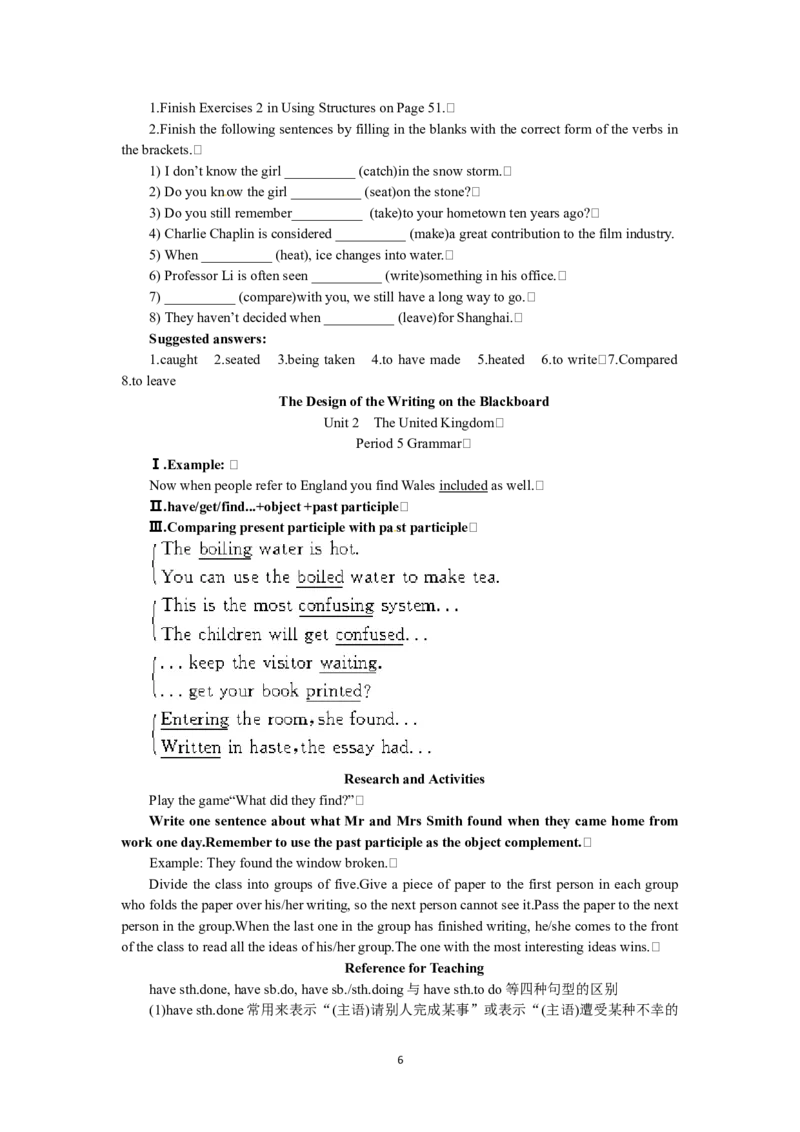
T: Now, let’s compare the use between the present participle and the past participle.Look at
the following examples:
The boiling water is hot.
You can use the boiled water to make tea.
T: Can you tell me the differences between boiling water and boiled water?
3S: “Boiling water”refers to the water that is boiling at the moment, while“boiled water”refer
to the water that has been boiled.
T: Yes, they are different both in voices and time.Try to finish the following sentences using
the proper forms of the verbs.
1.Come tomorrow and give the application to the man __________ (sit) at that desk.
2.Is this the book __________ (recommend) by our teacher?
3.We have to pay duties on goods __________ (import) from abroad.
4.The house __________ (stand) at the corner of the street was built in 1955.
(Teacher gives the students several minutes to think about these sentences.)
T: Now, let’s check your answers.
Suggested answers:
1.sitting
2.recommended
3.imported
4.standing
T: You are right.Please look at the following two sentences.
1.This is the most confusing system I have ever seen.
2.The children will get confused if asked to learn too much at a time.
T: What are the meanings of “confusing”and“confused”?
S: “Confusing”means“令人困惑的”and“confused”means“感到困惑的”.
T: You are right.When referring to something, we often use the present participle, with the
meaning of“令人……的”.When referring to somebody, we often use the past participle, with the
meaning of“感到……的”.Look at the following words and write down their meanings in the
brackets.
amazing ( ) amazed ( )
annoying ( ) annoyed ( )
boring ( ) bored ( )
surprising ( ) surprised ( )
S: amazing (令人惊讶的) amazed (感到惊讶的)
annoying(令人生气的) annoyed(感到生气的)
boring(令人厌倦的) bored(感到厌倦的)
surprising(令人惊讶的) surprised(感到惊讶的)
T: You are right.Now let’s look at another two sentences:
1.Don’t keep the visitor waiting.
2.Where did you get your book printed?
T: Both“waiting”and“printed”are used as object complement.What’s the difference
between them?
S: In the first sentence it is the visitor that is waiting.In the second sentence your book is
printed.
T: So we can summarize the difference as follows: if the object is the logical subject of the
participle, we often use the present participle.If the object is the object of the participle, we often
use the past participle.Now, try to translate the following sentences into English, using the present
participle and the past participle as the object complement.
1.忽然他听见有人轻轻敲窗子。
42.我进屋时发现他在朗读什么。
3.你还是请人把鞋子补一补吧。
4.他惊奇地发现房间给彻底地打扫了。
(Teacher gives the students several minutes to finish the task.)
T: Now, let’s check your answers.
Suggested answers:
1.Suddenly he heard someone knocking gently on the window.
2.When I entered the room, I found him reading something aloud.
3.You’d better have your shoes mended.
4.He was surprised to find his room thoroughly cleaned.
T: You did an excellent job.As we all know, the present participle and the past participle can
also be used as adverbial.Look at the following two sentences:
1.Entering the room, she found the wall newly painted.
2.Written in haste, the essay had some errors.
T: Now, I will explain the difference between them.When the act that the participle refers to
is done by the subject of the main clause, we often use the present participle.When the subject of
the main clause is the object of the participle, we often use the past participle.Next finish the
following sentences by filling in the blanks according to the translations in the brackets.
1. __________(顺大路往前走)she saw a tall building.
2. __________(由于不知道她的地址), we couldn’t get in touch with her.
3. __________(由于在农民中工作多年), he knew them very well.
4. __________(如果管理得好一些), the cabbages could have grown better.
5. __________(在他事迹的影响下), they performed countless good deeds.
(After a few minutes.)
Suggested answers:
1.Walking down the road
2.Not knowing her address
3.Having worked among the peasants for many years
4.Given better attention
5.Influenced by his example
T: Yes, you have done a very good job.
Step 4 Consolidation
T: Turn to Page 50, and look at Exercise 1 in Using Structure.Answer the following questions
using the past participle as the object complement.Do them with your partner.If you have any
trouble, I will come to help you.
(The students practice in pairs; meanwhile the teacher goes around the classroom and helps
them if they have any trouble.)
T: Now I will ask pairs of to ask and answer these questions.
S: What did you find had happened to your flower pots when you got home?
S: I found it broken.
S: What did you do when the paths were covered in snow and you were away?
S: I had them cleared up.
(Teacher asks other pairs to demonstrate their dialogues.)
Step 5 Homework
51.Finish Exercises 2 in Using Structures on Page 51.
2.Finish the following sentences by filling in the blanks with the correct form of the verbs in
the brackets.
1) I don’t know the girl __________ (catch)in the snow storm.
2) Do you know the girl __________ (seat)on the stone?
3) Do you still remember__________ (take)to your hometown ten years ago?
4) Charlie Chaplin is considered __________ (make)a great contribution to the film industry.
5) When __________ (heat), ice changes into water.
6) Professor Li is often seen __________ (write)something in his office.
7) __________ (compare)with you, we still have a long way to go.
8) They haven’t decided when __________ (leave)for Shanghai.
Suggested answers:
1.caught 2.seated 3.being taken 4.to have made 5.heated 6.to write7.Compared
8.to leave
The Design of the Writing on the Blackboard
Unit 2 The United Kingdom
Period 5 Grammar
Ⅰ.Example:
Now when people refer to England you find Wales included as well.
Ⅱ.have/get/find...+object +past participle
Ⅲ.Comparing present participle with past participle
Research and Activities
Play the game“What did they find?”
Write one sentence about what Mr and Mrs Smith found when they came home from
work one day.Remember to use the past participle as the object complement.
Example: They found the window broken.
Divide the class into groups of five.Give a piece of paper to the first person in each group
who folds the paper over his/her writing, so the next person cannot see it.Pass the paper to the next
person in the group.When the last one in the group has finished writing, he/she comes to the front
of the class to read all the ideas of his/her group.The one with the most interesting ideas wins.
Reference for Teaching
have sth.done, have sb.do, have sb./sth.doing与have sth.to do等四种句型的区别
(1)have sth.done常用来表示“(主语)请别人完成某事”或表示“(主语)遭受某种不幸的
6情况”, 其中have可用get替换。
例如:
①Why don’t you have(=get) that suit cleaned?
你为什么不请人把那套衣服洗一洗?
②I can’t have(=get) the car started.我不能启动这辆车。
③I had(=got) my watch broken.我的手表给弄坏了。
“have sth.done”用于否定句中时, 表示“不允许……”“不让”。
例如: ①I won’t have anything said against her.我不会允许有任何反对她的言论。
②I won’t have my house turned into a hotel.我不会让我的房子变成一个旅馆。
(2)have sb.do 表示“请某人完成某事”, 可以用“get sb.to do”结构来替换。
例: ①I had him repair my bike.(=I got him to repair my bike.) 我请他修理自行车。
②Don’t forget to have him come.别忘了叫他来。
“have sb.do”结构还有以下用法:
1)表示主语无意识的行为, 这时“have”作“有”解。
例: These small animals seem glad to have people visit them.
这些小动物很高兴有人看他们。
2)主语“经历”某事。
例: He had his mother die.他遭丧母。
3)在否定句中, 作“容忍”“允许”。
例: I won’t have you say such things about her.我不允许你说她这样的话。
(3)have sb./sth.doing 常表示“让某人做某事”, “让某情况发生”之意, 含有动作正在进
行之意。
例: ①He soon had them all laughing.他很快让他们都笑了起来。
②I have a car waiting for me.我让一部车在等我。
在否定结构中, 表示“不能让”“不允许”。
例: We can’t have that sort of thing happening.我们不能让那类事情发生。
(4)have sth.to do 表示“有某事要完成”, 其中不定式作定语, 且常用主动形式。
例: ①I have some letters to write.我有几封信要写。
②He has a large family to support.他有一大家人要养活。
如果不定式所表示的动作不是由句子的主语来完成, 该不定式则须用被动形式。
例: “Do you have any clothes to be washed today?”the servant asked.
佣人问道: “你今天有没有衣服要(我)洗?”
Something about the UK
English Manners and Etiquette
The first rule English children come across at an early age is the importance of
saying“please”and“Thank you.”Supplication, gratitude and, most important of all, apology are
central to English social intercourse.
“Excuse me, ”“I’m sorry to tell...”when apology, regret or fear have nothing to do with it are
all forms of social lubrication which spare others’ feelings and make life a little easier.
It is difficult for outsiders to learn how to wield the vocabulary necessary, but the starting
point is to understand that it is almost impossible linguistically to be over-grateful, over-
apologetic or over-polite when it comes to the point.Thus, the English man or woman whose toe
you tread on will be“so sorry”presumably earlier.He or she will thank you“so much”when you
stop treading on it or, if you do not, ask you to with a routine of pleases and thank-yous that would
7last any other national half a lifetime.It’s just the English way.
The English Sense of Humour
The English have an island culture-quirky(古怪的) and self-contained(持重的, 有自制力
的).Much of their humour is highly sophisticated and elusively(难以理解地)subtle(隐晦的, 深
奥难测的).
The English rarely say what they mean and tend towards reticence ( 节 制 ) and
understatement. So, while in conversation they avoid truths which might lead to confrontation, in
their humour they mock(嘲笑)that avoidance.For instance:
At dinner in a great country house, one of the guests drinks too much wine, and slumps(陷
落)across the table.The host rings for the butler and says: “Smithers, could you please prepare a
room.This gentleman has kindly consented to stay the night.”
The English often happily poke fun at themselves.Complain about some aspect of English
life that is quite awful and they will gleefully tell stories of trains that never arrive, of bureau-
cratic bungling that has driven honest citizens to suicide, or of food so disgusting even a dog
wouldn’t eat it.
The English love irony and expect others to appreciate it too.For example, one hill walker to
another: “It’s only six miles by the map, yet your navigation made it ten.” Yes, but doing it in ten
gives one a much greater feeling of accomplishment.”
English Homes and Gardens
It is largely thanks to the variable climate in England that the English lavish so much
attention on their homes and gardens.They employ their leisure hours with an endless cycle
of“home improvements”without which no home can ever be considered fully improved.
Inside and out they busy themselves installing electronic gadgets, shower, and built-in
furniture.
The English man drives his impeccably polished vehicle up on to ramp, which he buys from
the DIY shop, and tinkers around underneath it for hours on end.
You might think that, with all these self-servicing, self-decorating and improving, English
skilled labourers would be out of a job or two.But this is not the case.Sooner or later, these experts
have to be called in to make good for the damage caused by the amateur.
The English Adore Animals
It is an English maxim that a person who likes animals cannot be all bad.The English adore
animals—all kinds of animals.They keep them, not, as other nations do, primarily to guard their
property, for scientific interest or for status, but for company.
Animals, especially pets, are vital to English life.They are not always very good at talking to
each other, but they excel in conversation with their animal.
Pet owners’ homes are shrines to their animals.The best seats, the warmest spots, the choicest
morsels are handed over to these household gods as a matter of course.The British spend around
1.7 billion annually on pet food, twice as much as the total market for tea and coffee.
Cats and dogs, parrots and guinea pigs are excused behaviour which if seen in the children
of the household might well end in assault.They are deemed to be incapable of almost any
misdemeanour.So when dog bites man, it is always man’s fault, even if he is just a passer-by.
Margaret Thatcher
Margaret Thatcher was Britain’s first female prime minister.A graduate of Somerville
College, Oxford, with a master of arts degree from the University of Oxford she worked as a
8research chemist and a barrister, concentrating on tax law, before being elected to the House of
Commons in 1953.She held several ministerial appointments including education minister (1970-
1974). Elected leader of her Party (the Opposition) in 1975, she became prime minister in
1979.Known as a strong leader and an“astute Parliamentary tactician, she knew how to handle
disagreement, no matter from which bench it issued.
In 1982 she ordered British troops to the Falkland Islands to retake them from Argentina.She
took a strong stand against the trade unions during the miner’s strike (1984-1985), and moved
Britain toward privatization, selling minor interests in public utilities to the business interests.She
also introduced“rate capping”which effectively took control of expenditures out of the hands of
city councils, part of her policies aimed at reducing the influence of local governments.In 1989,
she introduced a community poll tax.In 1990, her cabinet was divided over issues including the
European Community which forced her resignation.In 1992, she entered the House of Lords,
created Baroness Thatcher of Kesteven.Her memoirs are being published by Harper Collins.The
first volume, “The Downing Street Years”was published in 1993.
Oxford University
Oxford, University of English autonomous institution of higher learning at Oxford, Oxford
shire, Eng.It lies along the Upper River Thames, 50 miles (80 km) north-northwest of London.
Sketchy evidence indicates that schools existed at Oxford as soon as the early 12th century.
By the end of that century a university was well established, perhaps resulting from the barring of
English students from the University of Paris about 1167.Oxford was modeled on the University
of Paris, with initial faculties of theology, law, medicine, and the liberal arts.
During the early history of Oxford its reputation was based on theology and the liberal
arts.But it also gave more serious treatment to the physical sciences than did the University of
Paris: Roger Bacon, after leaving Paris, conducted his scientific experiments and lectured at
Oxford from 1247 to 1257.In the early 16th century professorships began to be endowed, and in
the latter part of the 17th century interest in scientific studies increased substantially.During the
Renaissance, Desiderius Erasmus carried the new learning to Oxford, and such scholars as
William Grocyn, John Colet, and Sir Thomas More enhanced the university’s reputation.Since that
time Oxford has traditionally held the highest reputation for scholarship and instruction in the
classics, theology, and political science.
In the 19th century the university’s enrollment and its professorial staff were greatly
expanded. The first women’s college at Oxford, Lady Margaret Hall, was founded in 1878, and
women were first admitted to full membership in the university in 1920.In the 20th century
Oxford’s curriculum was modernized.Science came to be taken much more seriously and
professionally, and many new faculties were added, including ones for modern languages, political
science, and economics.Post-graduate studies also expanded greatly in the 20th century.
Oxford houses the Bodleian Library and the Ashmolean Museum.The Oxford University
9Press, established in 1478, is one of the largest and most prestigious university publishers in the
world.
Oxford has been associated with many of the greatest names in British history, from John
Wesley and Cardinal Wolsey to Oscar Wilde and Sir Richard Burton to Cecil Rhodes and Sir
Walter Raleigh.The astronomer Edmond Halley studied at Oxford, and the physicist Robert
Boyle performed his most important research there.Prime Ministers who studied at Oxford include
William Pitt the Elder, George Canning, Sir Robert Peel, William Gladstone, Lord Salisbury,
H.H.Asquith, Clement Attlee, Anthony Eden, Harold Macmillan, Edward Heath, Sir Harold
Wilson, and Margaret Thatcher.
University of Cambridge
University of Cambridge is an English autonomous institution of higher learning at
Cambridge, Cambridge shire, 50 miles (80 km) north of London.
The start of the university is generally taken as 1209, when scholars from Oxford migrated to
Cambridge to escape Oxford’s riots of“town and gown”(townpeople versus scholars).To avert
possible troubles, the authorities in Cambridge allowed only scholars under the supervision of a
master to remain in the town.It was partly to provide an orderly place of residence that (in
emulation of Oxford) the first college, Peterhouse, was founded in 1284.Over the next three
centuries another 15 colleges were founded, and in 1318 Cambridge received formal recognition
as a studium generale from Pope John ⅩⅫ.
Cambridge remained fairly insignificant until about 1502, when a professorship of divinity
was founded—the oldest in the university.In 1546 Henry Ⅷ founded Trinity College (which was
and still remains the largest of the Cambridge colleges).In 1570 Elizabeth Ⅰgave the university a
revised body of statutes, and in 1571 the university was formally incorporated by act of
Parliament.The new statutes, which remained in force for nearly three centuries, vested the
effective government of the university in the heads of colleges.
In 1663 the Lucasian professorship of mathematics was founded under the will of a former
member of the university, and six years later the first holder resigned in favour of Issac Newton,
then a young fellow of Trinity.Newton held the chair for over 30 years and gave the study of
mathematics a unique position in the university.
In 1871 the university established the Cavendish professorship of experimental physics and
began the building of the Cavendish Laboratory.James Clerk Maxwell was the first
professor.Here, too, the team of Max Ferdinand and Perutz and John Cowdery Kendrew and the
team of Francis Crick and James Watson elucidated the structures of proteins and of the double-
helix DNA, to found the modern science of molecular biology.Earlier came the work of Sir
Frederick Gowland Hopkins, who, more than perhaps any other man, can be hailed as the founder
of biochemistry. Noted Cambridge scholars in other fields have been the naturalist Charles
Darwin, the economist John Maynard Keynes, and the historian G.M.Trevelyan.
Many of the college buildings are rich in history and tradition.King’s College Chapel, begun
in 1446, is one of Britain’s most magnificent buildings.The mulberry tree under which the poet
John Milton is reputed to have written Lycidas is on the grounds of Christ’s College.Samuel
Pepys’s library, hosed in the original cases, is at Magdalene College.
The university library with well over 3 000 000 volumes is one of a handful in the country
that is entitled to a copy of every book published in Great Britain.
1011