►第 14 讲 特殊句式和情景交际
(讲义)
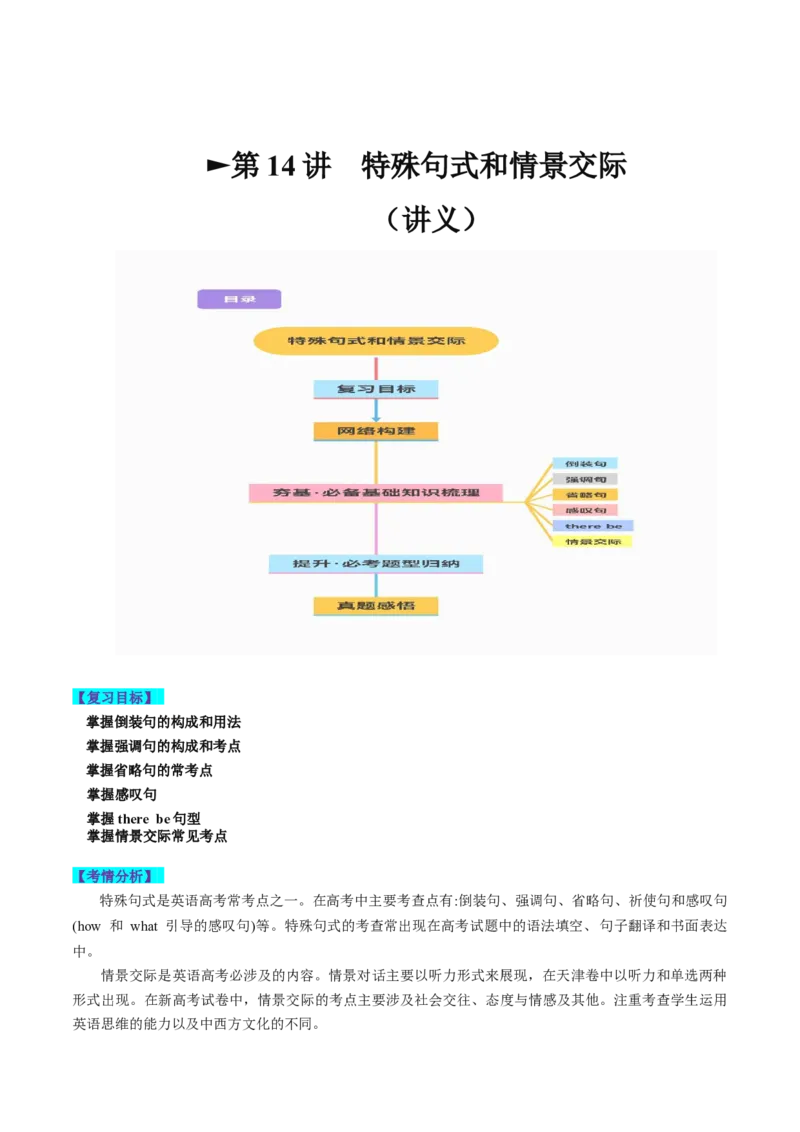
【复习目标】
掌握倒装句的构成和用法
掌握强调句的构成和考点
掌握省略句的常考点
掌握感叹句
掌握there be句型
掌握情景交际常见考点
【考情分析】
特殊句式是英语高考常考点之一。在高考中主要考查点有:倒装句、强调句、省略句、祈使句和感叹句
(how 和 what 引导的感叹句)等。特殊句式的考查常出现在高考试题中的语法填空、句子翻译和书面表达
中。
情景交际是英语高考必涉及的内容。情景对话主要以听力形式来展现,在天津卷中以听力和单选两种
形式出现。在新高考试卷中,情景交际的考点主要涉及社会交往、态度与情感及其他。注重考查学生运用
英语思维的能力以及中西方文化的不同。预计2024年特殊句式和情景交际仍旧是考查热点。
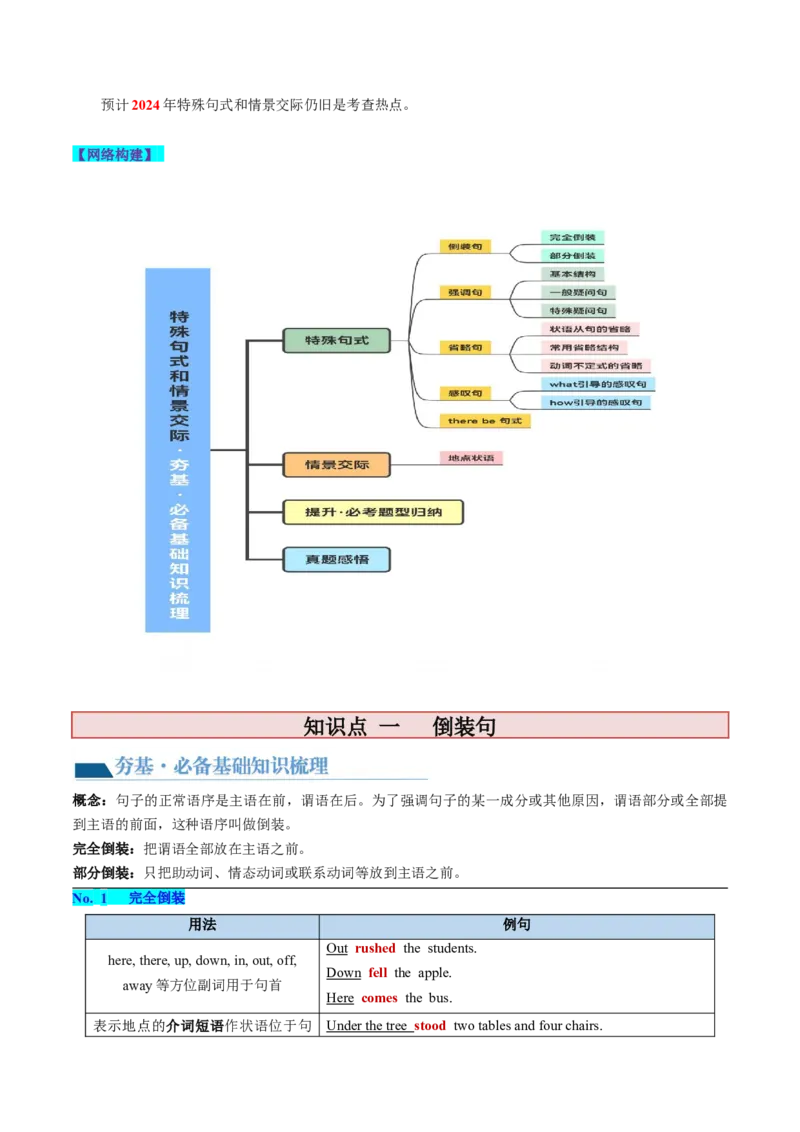
【网络构建】
知识点 一 倒装句
概念:句子的正常语序是主语在前,谓语在后。为了强调句子的某一成分或其他原因,谓语部分或全部提
到主语的前面,这种语序叫做倒装。
完全倒装:把谓语全部放在主语之前。
部分倒装:只把助动词、情态动词或联系动词等放到主语之前。
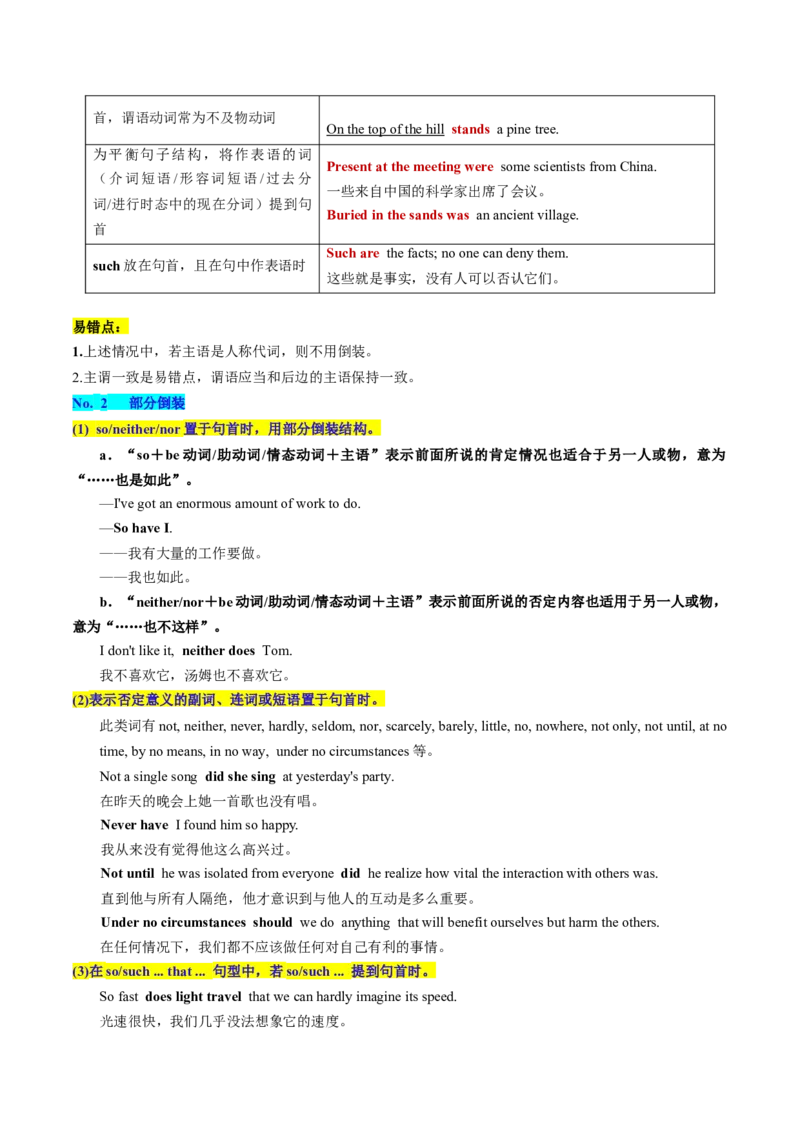
No. 1 完全倒装
用法 例句
O ut rushed the students.
here, there, up, down, in, out, off,
Down fell the apple.
away等方位副词用于句首
Here comes the bus.
表示地点的介词短语作状语位于句 Under th e tree stood two tables and four chairs.首,谓语动词常为不及物动词
On the top of the hill stands a pine tree.
为平衡句子结构,将作表语的词
Present at the meeting were some scientists from China.
(介词短语/形容词短语/过去分
一些来自中国的科学家出席了会议。
词/进行时态中的现在分词)提到句
Buried in the sands was an ancient village.
首
Such are the facts; no one can deny them.
such放在句首,且在句中作表语时
这些就是事实,没有人可以否认它们。
易错点:
1.上述情况中,若主语是人称代词,则不用倒装。
2.主谓一致是易错点,谓语应当和后边的主语保持一致。
No. 2 部分倒装
(1) so/neither/nor置于句首时,用部分倒装结构。
a.“so+be动词/助动词/情态动词+主语”表示前面所说的肯定情况也适合于另一人或物,意为
“……也是如此”。
—I've got an enormous amount of work to do.
—So have I.
——我有大量的工作要做。
——我也如此。
b.“neither/nor+be动词/助动词/情态动词+主语”表示前面所说的否定内容也适用于另一人或物,
意为“……也不这样”。
I don't like it, neither does Tom.
我不喜欢它,汤姆也不喜欢它。
(2)表示否定意义的副词、连词或短语置于句首时。
此类词有not, neither, never, hardly, seldom, nor, scarcely, barely, little, no, nowhere, not only, not until, at no
time, by no means, in no way, under no circumstances等。
Not a single song did she sing at yesterday's party.
在昨天的晚会上她一首歌也没有唱。
Never have I found him so happy.
我从来没有觉得他这么高兴过。
Not until he was isolated from everyone did he realize how vital the interaction with others was.
直到他与所有人隔绝,他才意识到与他人的互动是多么重要。
Under no circumstances should we do anything that will benefit ourselves but harm the others.
在任何情况下,我们都不应该做任何对自己有利的事情。
(3)在so/such ... that ... 句型中,若so/such ... 提到句首时。
So fast does light travel that we can hardly imagine its speed.
光速很快,我们几乎没法想象它的速度。(4)当“only+状语(副词、介词短语或从句)”置于句首时。
Only by this means is it possible to explain it. (介词短语)
只有用这种方法才能可能解释它。
Only when the war was over in 1918 was he able to get happily back to work. (从句)
直到1918年战争结束后,他才得以满怀高兴地重返工作岗位。
(5)表语、状语或动词原形+as/though+主语+其他时,句子要倒装。
Much as I like it, I'll not buy it.
尽管我很喜欢它,但我不会买。
Pretty as she is, she is not proud.
尽管她很漂亮,但她一点也不自负。
Try as he would, he might fail again.
尽管他要尝试,但可能还会失败。
(6) hardly ... when ..., no sooner ... than ..., not only ... (but) also ... 等结构中,
把hardly, no sooner和not only提到句首时,其所在的主句要倒装。
Hardly/Scarcely had he heard the news when he began to cry.
他一听到这个消息就哭了。
Not only does he know French, but also he is expert at it.
他不仅懂法语,而且也精通法语。
(7)在省略if的虚拟条件句中(当条件从句中有were,had,should时)。
Had you reviewed your lessons, you might have passed the examination.
要是早复习了功课,你有可能就通过考试了。
Should it not rain tomorrow, we would go for a picnic.
要是明天不下雨,我们就可以去野餐。
(8)用于某些表示祝愿的句子里。
May you succeed!祝你成功!
Long live the People’s Republic of China! = May the People’s Republic of China (should) live long.
中华人民共和国万岁!
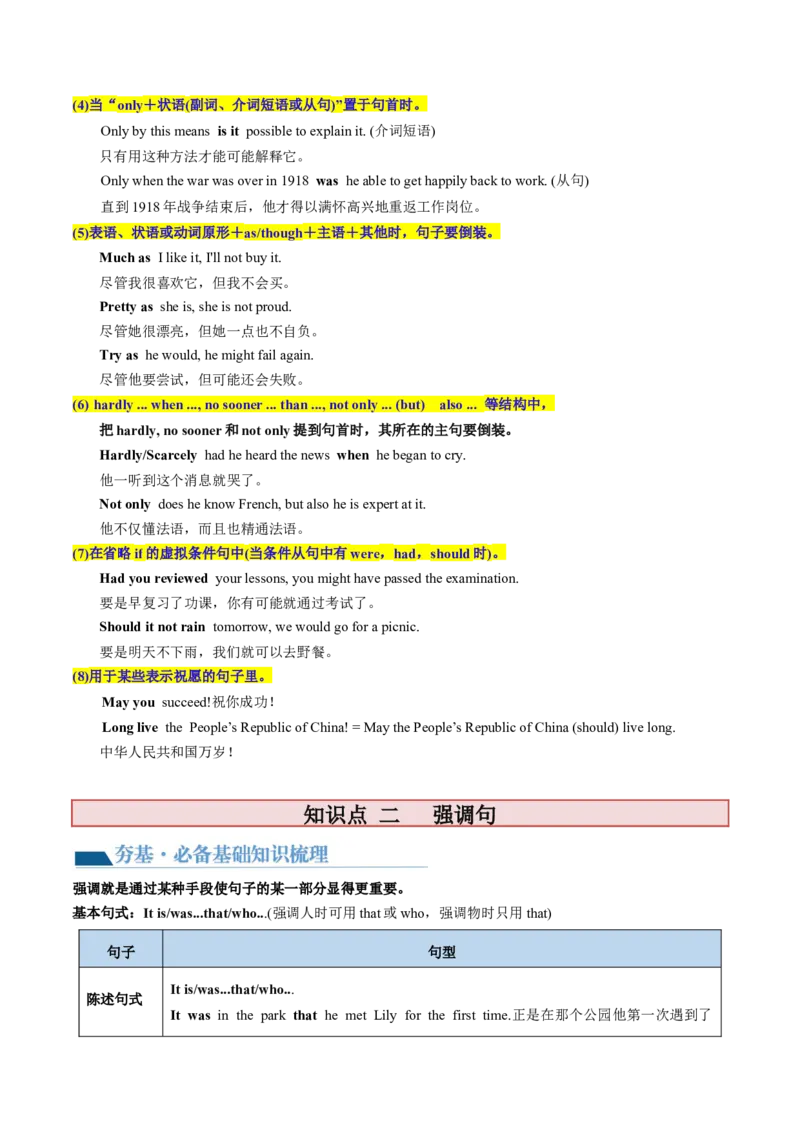
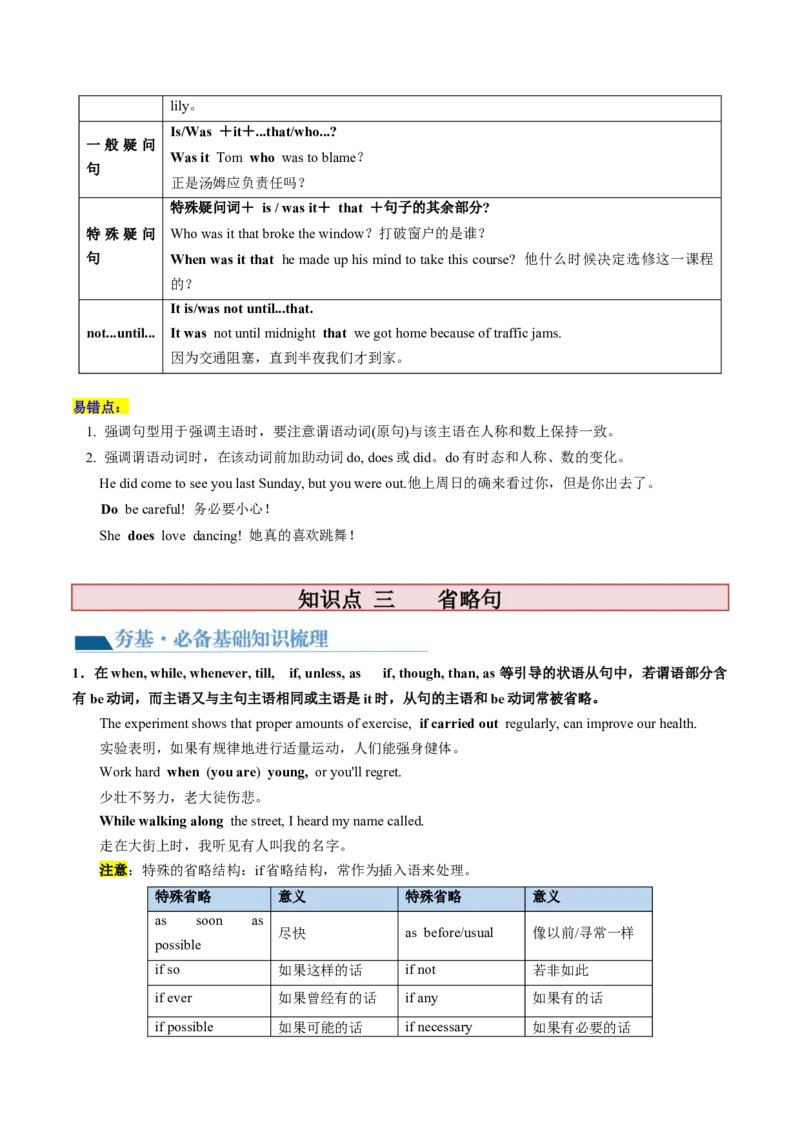
知识点 二 强调句
强调就是通过某种手段使句子的某一部分显得更重要。
基本句式:It is/was...that/who...(强调人时可用that或who,强调物时只用that)
句子 句型
It is/was...that/who...
陈述句式
It was in the park that he met Lily for the first time.正是在那个公园他第一次遇到了lily。
Is/Was +it+...that/who...?
一 般 疑 问
Was it Tom who was to blame?
句
正是汤姆应负责任吗?
特殊疑问词+ is / was it+ that +句子的其余部分?
特 殊 疑 问 Who was it that broke the window?打破窗户的是谁?
句 When was it that he made up his mind to take this course? 他什么时候决定选修这一课程
的?
It is/was not until...that.
not...until... It was not until midnight that we got home because of traffic jams.
因为交通阻塞,直到半夜我们才到家。
易错点:
1. 强调句型用于强调主语时,要注意谓语动词(原句)与该主语在人称和数上保持一致。
2. 强调谓语动词时,在该动词前加助动词do, does或did。do有时态和人称、数的变化。
He did come to see you last Sunday, but you were out.他上周日的确来看过你,但是你出去了。
Do be careful! 务必要小心!
She does love dancing! 她真的喜欢跳舞!
知识点 三 省略句
1.在when, while, whenever, till, if, unless, as if, though, than, as 等引导的状语从句中,若谓语部分含
有be动词,而主语又与主句主语相同或主语是it时,从句的主语和be动词常被省略。
The experiment shows that proper amounts of exercise, if carried out regularly, can improve our health.
实验表明,如果有规律地进行适量运动,人们能强身健体。
Work hard when (you are) young, or you'll regret.
少壮不努力,老大徒伤悲。
While walking along the street, I heard my name called.
走在大街上时,我听见有人叫我的名字。
注意:特殊的省略结构:if省略结构,常作为插入语来处理。
特殊省略 意义 特殊省略 意义
as soon as
尽快 as before/usual 像以前/寻常一样
possible
if so 如果这样的话 if not 若非如此
if ever 如果曾经有的话 if any 如果有的话
if possible 如果可能的话 if necessary 如果有必要的话If possible,let me know beforehand. 如有可能,事先通知我。
Whenever (it is) possible, he will come to my help.
他会在任何可能的时候来帮助我。
2.I'm afraid, I think, I believe, I hope, I guess等作答句,后面跟so与not分别相当于肯定或否定,宾语从
句可省去。
① —Do you think it will rain?你认为会下雨吗?
—I hope not/that it will not rain.我希望不要下。
② —Do you believe our team will win?你相信我们队会赢吗?
—I guess so.我猜会赢。
3.不定式省略,即单独使用不定式符号to。
a. 如果不定式中含有be, have, have been,通常保留be, have和have been,而把其余部分省略。
—Are you a student?
—No, but I used to be (a college student).
——你是大学生吗?
——不,但我曾经是。
(3)省略不定式符号to的情况。
b.当主语部分含有动词do的某种形式时,作表语的不定式可省略to。
The only thing you have to do is press the button.
你唯一要做的事情就是按按钮。
c.不定式作介词but, except的宾语,前面有实义动词do的某种形式时,不定式常省略to。
I had nothing to do but wait here.
今天下午我除了在这等待无事可做。
d.当两个或两个以上的不定式并列时,后面的不定式符号to可省略,但表示对比关系时则不能省略。
I'm really puzzled what to think of and express.
我真的不知道想什么和表达什么。
It is easier to make a plan than to carry it out.
制订计划比执行计划容易。
e.在see, watch, hear, feel, observe, notice, look at, listen to 等感官动词及使役动词let, make, have后作
宾语补足语的不定式不加to,但当宾语补足语变为主语补足语时,不定式要加上to。
She saw him walk into the house.
她看到他走进了那座房子。
He was seen to walk into the house.
有人看到他走进了那座房子。
He had two boys wash his car.
他让两个男孩给他洗车。f.you'd better/why not后跟不带to的不定式。
Why not try it again?
为什么不再试试?
You'd better get up early when you want to keep up with others.
当你想追赶他人时,你最好起得早些。
3. 省略主语
祈使句一般省略主语。
(I)Wish you were here. 如果你在这就好了
(It)Don’t give up.不要放弃。
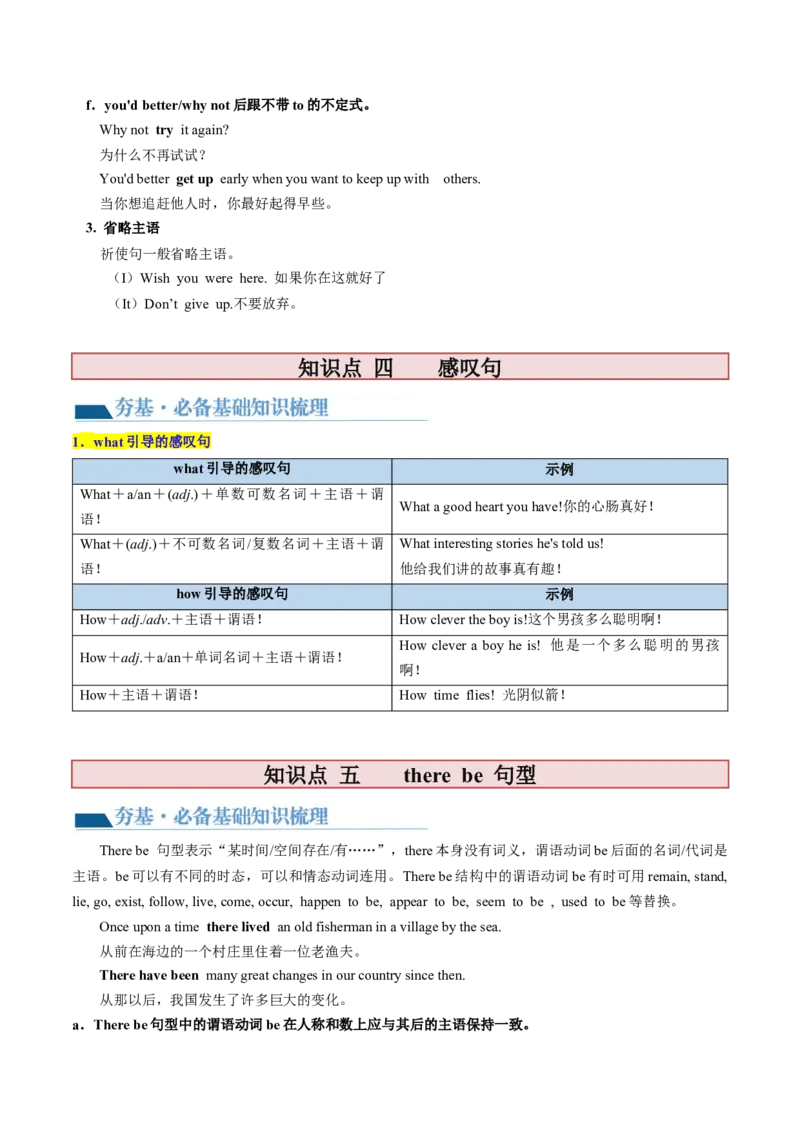
知识点 四 感叹句
1.what引导的感叹句
what引导的感叹句 示例
What+a/an+(adj.)+单数可数名词+主语+谓
What a good heart you have!你的心肠真好!
语!
What+(adj.)+不可数名词/复数名词+主语+谓 What interesting stories he's told us!
语! 他给我们讲的故事真有趣!
how引导的感叹句 示例
How+adj./adv.+主语+谓语! How clever the boy is!这个男孩多么聪明啊!
How clever a boy he is! 他是一个多么聪明的男孩
How+adj.+a/an+单词名词+主语+谓语!
啊!
How+主语+谓语! How time flies! 光阴似箭!
知识点 五 there be 句型
There be 句型表示“某时间/空间存在/有……”,there本身没有词义,谓语动词be后面的名词/代词是
主语。be可以有不同的时态,可以和情态动词连用。There be结构中的谓语动词be有时可用remain, stand,
lie, go, exist, follow, live, come, occur, happen to be, appear to be, seem to be , used to be等替换。
Once upon a time there lived an old fisherman in a village by the sea.
从前在海边的一个村庄里住着一位老渔夫。
There have been many great changes in our country since then.
从那以后,我国发生了许多巨大的变化。
a.There be句型中的谓语动词be在人称和数上应与其后的主语保持一致。There is a flower in the bottle.
瓶中有一朵花。
There are five books on the desk.
桌上有五本书。
b.若There be句型中主语为并列结构,be的数和人称遵循就近原则。
There is a boy, a girl and two women in the house.
房子里有一个男孩、一个女孩和两个妇女。
There are ten students and a teacher in the office.
办公室里有十个学生和一个老师。
c. there be结构的非谓语动词形式
There be 结构的非谓语动词形式是there to be 和there being 两种形式。在句中作主语、宾语和状语。
I expect there to be no argument about this.
我希望在这方面不会有任何争论。
I never dreamed of there being any good chance for me.
我从没想过会有什么好机会。
There being nothing else to do,we went home. (there be句型的独立主格结构)
由于我们无事可做,我们就回家了。
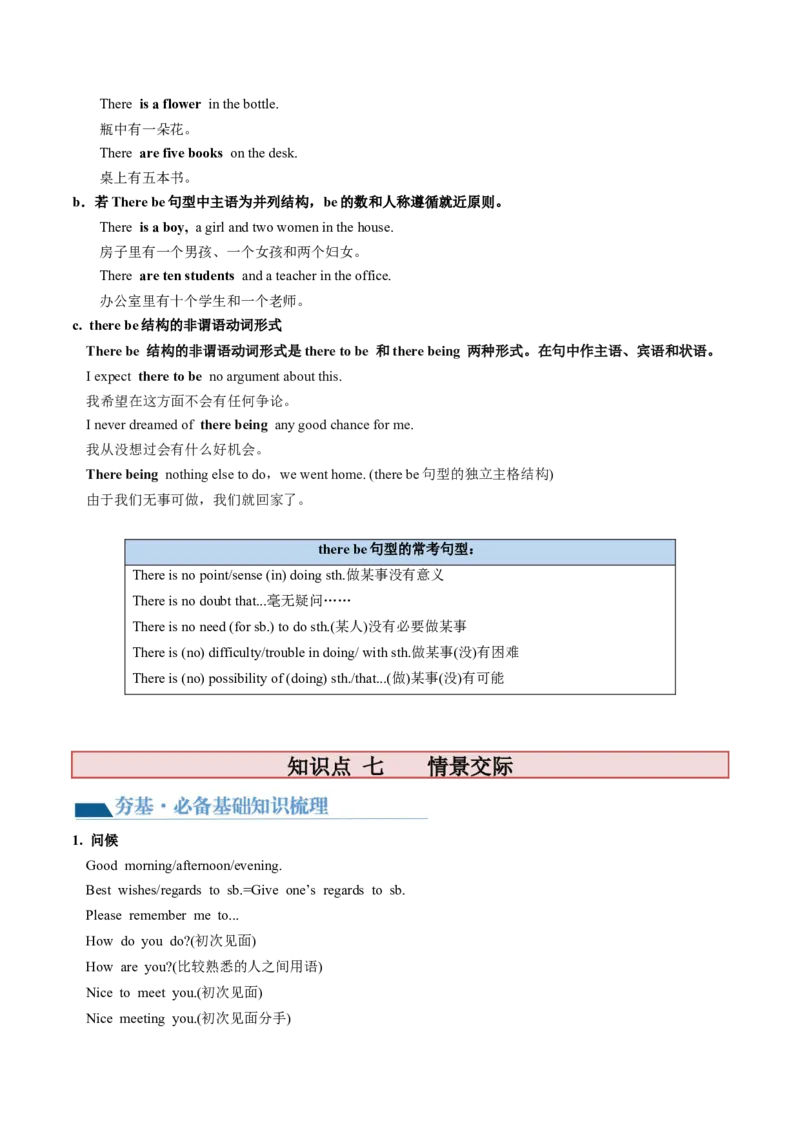
there be句型的常考句型:
There is no point/sense (in) doing sth.做某事没有意义
There is no doubt that...毫无疑问……
There is no need (for sb.) to do sth.(某人)没有必要做某事
There is (no) difficulty/trouble in doing/ with sth.做某事(没)有困难
There is (no) possibility of (doing) sth./that...(做)某事(没)有可能
知识点 七 情景交际
1. 问候
Good morning/afternoon/evening.
Best wishes/regards to sb.=Give one’s regards to sb.
Please remember me to...
How do you do?(初次见面)
How are you?(比较熟悉的人之间用语)
Nice to meet you.(初次见面)
Nice meeting you.(初次见面分手)2. 告别
Good bye/See you/See you later!
So long! Farewell!
I’d like to say goodbye to everyone.
I’m afraid I must be leaving/off now.
I think it’s time for us to leave now.
Good night/Night!(仅限于晚上告别或上床睡觉时用)
Have a nice day!仅限于白天告别时用
3. 感谢答语
Not at all. 不用谢。
That's all right.不用谢。
You're welcome. 不用谢。
It's really nothing. 没什么。
Don't mention it. 不用谢。
4. 道歉
Sorry.
Excuse/Pardon me(for...)
Please forgive me for...
5. 道歉答语
That’s OK. /That’s all right./It's quite all right./Never mind.
It doesn’t matter (at all). Not at all. It’s nothing. That's nothing.(没关系)
Please don’t worry. It’s nothing to worry about. Not to wor- ry.Don't mention it.
That's okay. Don't let it bother you.没事,别想的太多了。
We really didn't mean that at all.我们真的没有那样的意思。
6. 提供帮助
Can/Could/Shall I help you?
What can I do for you?
Is there anything(else) I can do for you?
Would you like some...?
Would you like to...?
Do you want me to...?
7. 接受帮助
Thanks. That would be nice/fine.That’s very kind of you. He
Thank you for your help. He
Yes,please. Here, take this/my...
8. 拒绝帮助
No, thanks/thank you. I can manage it myself. HeThank you all the same. That's very kind of you,but...
9. 约会
1.提出约会:
Shall we meet at 4:30 at...? Let's make it at 4:30.
When/Where shall we meet? What time is convenient for you?
I'd like to make an appointment with...
2. 肯定回答:
Yes, that's all right. Yes,I'll be free then. All right. See you then.
3. 否定回答:
No, I won't be free then. But I'll be free... I’m afraid I have no time then.
10. 电话用语
Hello! May I speak to...? Hello!Is Tom in?
May/Could I speak to...? Is that... (speaking)? Hold on, please.
Hello, who is it/that?
11. 就餐
(1)主问客:
What would you like (to have)...? Would you like some thing (to eat/drink)?
Would you like some more...? How about some more...?(2)主请客:
Help yourself to some... Let me give you... Make yourself at home.
(3)答语:
Id like... Cake/Two eggs..., please.
Yes, please. Just a little, please. Thank you. I've had enough. I'm full,thank you. No,thanks.
2.常用句型
(1)找餐桌
A table for four,please
(2) 安排座位
Could you follow me, please? You can sit where you like.
(3) 询问就餐者是否准备点菜了
Are you ready to order, sir? Can/May I take your order now?
(4) 询问就餐者想吃什么
Do you want anything to start with?
And what to follow? Anything else?
And any vegetables? Anything to drink?
(5) 解餐馆今天有什么菜肴
Could we see the menu, please? Let's have a look at the menu first.
12. 赞同
That’s right.(那是对的)I can’t agree with you more.=I’m with you on that.=I wouldn’t say no./All right=OK./By all means./You guess it.
(你说对了!)
13. 疑问句
So what? 那又怎么样?
How come? 怎么会这样?
What for? 为什么啊?
Why bother? 何必麻烦啊!
Why not? 为什么不啊!
What if? 如果……怎么办?
What’s up? 怎么了?
Pardon? 请再重复一遍。
Could I take your order? 我能为您点餐吗?
Is it as bad as that? 有那么糟糕吗?
14. 向路
1.基本用语
can you tell me the way to...? how can I get to...?
Excuse me, where is...?
where is the nearest...? which is the way to...?
(2)指路:
Go straight ahead till you see... Go down this street till you get to...
Go through the gate and you will find the entrance to... It's about... yards/metres down this street.
15. 偏爱与爱好
I prefer tea to coffee. I'd prefer to go by train.
I like English better/the best. My favourite subject is physics. I'd rather drink coffee than tea.
Where would you rather go,London or Tokyo?
16. 意愿与打算
I intend/mean/plan to...(我打算……) I'm ready to...(我随时可以……)
I would rather not tell you.(我真不想告诉你。)
I would do it if I should have the chance(如果有机会,我一定会做。)
If only I could see him.(如果我能看到他就好了。)
17. 其他
Go ahead. 请继续、去吧
Hold on. 别挂断, 等一下
My treat. 我请客
At your service.我听您吩咐。
With pleasure. 愿意为您效劳。
Take it easy./Take your time.(尤指时间)放轻松,别着急。Look out. 小心
All depends!/That depends. 看情况。
Got it! 明白了。
It’s up to you. 听你的。
Not really. 完全不知道。
Not exactly. 我略知一二,不是很了解。
Sounds great! 听起来真棒!
No kidding! 别开玩笑
No wonder. 难怪
It doesn’t hurt to ask. 问问也无妨。
It counts for nothing. 这不算什么。
Make sense. 有意义,说得通。
I hate to say this. 我不愿意说,但又不得不说。
It’s not my cup of tea.
A piece of cake.小菜一碟。
Tomorrow is another day. 明天是崭新的一天。
You’ve got me there.你可把我难住了。
You bet. 当然
Drop it! 别说了,别提了
Believe it or not.无论你相信与否
Be my guest. = Help yourself.请自便
考向一 特殊句式
1.(2023年全国高三专题练习)It is the test system, rather than the teachers, _____ is to blame for the students’
heavy burden nowadays.
【答案】that
【解析】考查强调句。句意:如今学生们的负担沉重,该为此受到责备的是应试体制,而非老师。“it
is/was +被强调部分+ that/who...”是强调句型,强调部分为人时,可使用 who,其余情况均用
that。“rather...than...”意为“是……而不是……”,此处强调的是test system而不是teachers,应使用that。
故填that。
2. (2023年全国高三专题练习)We expect there __________(be) a lot of discussions about the problem.
【答案】to be
【解析】考查there be的特殊句式。句意:我们期望能对这个问题展开更多的讨论。此处考查动词短语
expect to do,意为“期待去做”,设空处应用 there be的不定式结构,作expect的宾语,构成固定结构
expect there to be,意为“期望有”。故填to be。3. (2023年全国高三专题练习)Though not ________(know) to use tools in the wild, the birds have proved skilful
at tool use while kept in the cage.
【答案】known
【解析】考查状语从句中的省略。句意:虽然在野外还不知道它们会使用工具,但在笼子里的时候,这些
鸟已经证明了它们熟练地使用工具。分析可知,此处为状语从句中的省略,在状语从句中从句的主语和主
句的主语相同且有be动词时,需要省略主语和be动词,即完整形式为Though not the birds are known to use
tools in the wild。故填known。
4. (2023 年河北衡水校考)It is for these reasons ______ I am firmly convinced that this rule will promote the
learning atmosphere and our teamwork spirit.
【答案】known
【解析】考查强调句型。句意:正是因为这些原因,我坚信这一规则将提升学习氛围和我们的团队精神。
“It + is/was + 被强调部分 + that/who + 句子其它部分”是强调句,在强调句中,当被强调部分是人时,
可以使用who代替that;结合句意,分析句子可知,本句是强调句型,被强调部分的是作原因状语的介词
短语“for these reasons”,句子其它部分只能由that引出。故填that。
考向二 情景交际
1. (2023年新高考I卷听力Text 5)
What are the speakers talking about?
A. Writing a book.
B. Holding a celebration.
C. Buying a present.
【答案】C
【解析】W: Do you think we should get Steve a book for the new year?
M: Books are good. But Steve wouldn’t take just any book. He has had this particular one on
geography.
2. (2023年天津南开中学模拟预测)
— Why didn’t you come back last night? I waited long.
— ______ You were playing games the whole night.
A.Don’t trust to chance. B.Don’t dream away your time.
C.Don’t give me that. D.Don’t beat around the bush.
【答案】C
【详解】考查情景交际。句意:—你昨晚为什么没回来?我等了很久。—别跟我来这套。你整晚都在玩游
戏。A. Don’t trust to chance.不要碰运气;B. Don’t dream away your time.不要虚度光阴;C. Don’t give me
that.别跟我来这一套;D. Don’t beat around the bush.不要拐弯抹角。根据“You were playing games the whole
night.”可知,回答的人不相信询问者的话,此处表示“别跟我来这一套”。故选C。
3. (2023年广东高三统考学业考试)—What do you think of the movie?
- I like it. I think ______.
A.it’s great B.it’s possible C.it’s terrible D.it’s ordinary
【答案】A
【详解】考查情景交际。句意:——你觉得这部电影怎么样?——我喜欢。我觉得很棒。A. it’s great极好
的;B. it’s possible可能的;C. it’s terrible可怕的;D. it’s ordinary普通的。根据上文“I like it.”可知是积极
的评价。故选A。
1.(2021年天津卷)I told you! I really am ranked the lowest. Number 25 out of 25 players.
________ You've got nowhere to go but up.
A.Tell me a bit more.
B.I'm not so sure about that.
C.Look on the bright side!
D.That is absolute nonsense!
【答案】C
【详解】考查交际用语。句意:——我告诉过你!我真的是排名最低的。25名球员中的第25名。——抱
乐观态度吧。你会越来越好的。A.Tell me a bit more再多告诉我一些;B.I'm not so sure about that对此我不
确定;C.Look on the bright side!抱乐观态度;D.That is absolute nonsense!这完全是胡说八道。根据“You've
got nowhere to go but up. ”可知,此处是指抱乐观态度吧。你会越来越好的。故选C项。
2.(2015年重庆卷)Bach died in 1750, but it was not until the early 19th century____ his musical gift was fully
recognized.
A.while B.though C.that D.after
【答案】C
【解析】考查强调句。句意:巴赫死于1750年,但直到19世纪初期他的音乐天赋才被承认。强调句与not
until连用,It be not until that …。故选C项。
3.(2018年天津卷)What was it ______ brought you two together? Was it your love of music?
A.as B.who C.that D.Which
【答案】C
【详解】考查强调句式。句意:是什么让你们走到一起的?是因为你对音乐的热爱吗?。分析句子可知,本
句为强调句式It is/ was + 被强调部分(通常是主语、宾语或状语)+ that/ who(当强调主语且主语指人)+
其他部分。特殊疑问句的强调句型:疑问代词或疑问副词+ is/ was + it + that/ who + 其他部分。故选C项。