文档文本内容
Unit 3 Travel journal
The First Period
●从容说课
This is the first period of this unit.This unit is about travel,so the teacher can first
brainstorm the words or phrases about travel.Since there are some new words for the
names of the countries and cities in Southeast Asia,the teacher can first deal with them
with the help of a map.Then Ss are supposed to find out the one-way fare to get to the
destination for different kinds of transportation.This task gives Ss a chance to practise
getting information through the Internet.Later Ss are required to talk in pairs about the
following six questions:(1)When are you leaving?(2)How are you going to...?(3)
When are you arriving in/at...?(4)Where are you staying?(5)How long are you staying
in...?(6)When are you coming back?This part is designs to smooth away Ss’ difficulty
in understanding the present continuous for future use.
To lead in the text,the teacher can ask Ss to discuss why a river is great or what a
river can be used for.Then tell Ss the Mekong is a great river like the Changjiang River,
and it is the birthplace of old civilization and lifeblood of the Southeast Asia.
Reading skills are very important for senior students.For the first reading,we intend
to cultivate Ss’ skimming ability.They are required to list the words referring to different
topographical features in the text.Then they are required to match these words with the
English explanations.Through this part we can develop Ss’ ability of guessing the
meanings of new words according to the contexts.To stimulate Ss to take part in the class
activity more actively,the teacher can organize a group competition,to see which group
can finish the task fastest and best.To show Ss the different topography,the teacher can
present some pictures.Later on,the teacher will teach some other new words in the text
and ask Ss to pronounce these words correctly.For the second reading,the teacher will
present five statements for the students to judge.This part is designed to get Ss into the
habit of reading a passage as a whole,that is,to get the general idea.Another purpose of
this part is to ask Ss to pay attention to the details.
The teacher asks Ss to read the title and subtitle in order to make them think about
the organization of the whole passage,and this method can help them not only in their
understanding but also in writing a passage.To develop Ss’ scanning ability,the teacher
designs five questions,some of which are very difficult.So the teacher will help them to
read between the lines,thus Ss can gradually get the ability to understand the writer’s
implied meanings.
To consolidate the new words in the passage,the teacher asks Ss to finish Part 1 and
Part 3 on Page 20 after class.At the same time,they are required to find out what they
should pay attention to when going traveling.This part is designed to help Ss to get the
sense of protecting themselves and nature.
●三维目标
1.Knowledge:
1(1)Learn the following new words and their pronunciation:
journal,fare,transport,Vientiane,Laos,Phnom Penh,Cambodia,Ho Chi Minh,
Vietnam,Mekong,finally,cycle,persuade,stubborn,insist,source,proper(ly),detail,
determine,determined,altitude,atlas,glacier,Tibetan,rapids,valley,waterfall,plain,delta.
(2)Get to know that the present continuous tense can be used for future use.
(3)Get to know what a river can be used for.
2.Ability:
(1)Learn to get information through the Internet.
(2)Grasp some reading skills.
3.Emotion:
Stimulate Ss’ love for nature by getting them to know the greatness of a river.
●教学重点
Get Ss to learn different reading skills,especially the abilities of understanding the
implied meanings.
●教学难点
(1)Know the meanings and pronunciation of the new words.
(2)Learn different reading skills for different reading purposes.
●教具准备
Multi-media classroom and other normal teaching tools.
●教学过程
Step 1 Greetings
Teacher:Hello,my friends.
Students:Hello,Miss Xu.
Step 2 Warming-up
T:We have known each other for 2 weeks and I think we have become friends.Can
you tell me what your hobbies are?
S:I like singing and dancing/football/surfing on the Internet/skiing/traveling...
T:Good.Then when you come across the word “traveling”,what will you think
of?
S:Travel cost/means/destination/plan...
T:Yes.Before we set off,we should first make travel plan,I mean we should first
decide the destination,the means of transport and its fare.(Write the three words on the
blackboard.)
Here “destination” means “a place to which sb.is going”.
We can go to our destination by different means of transport,for example,by bus,by
train,by plane and so on.
“Transport fare” refers to how much you pay for the plane/train ticket.
Now,look at the screen,read after me the three words.
Suppose you and your friend are going to Southeast Asia,which country or city do
you suggest visiting?Here is a map to help you.
S:Thailand,Philippines,Singapore,越南,柬埔寨,老挝...
T:Good,I can see you are good at geography.But you’d better say these names in
English and pronounce them correctly.Please read after me:
Vientiane,Laos,Phnom Penh,Cambodia,Ho Chi Minh,Vietnam.
2T:Now I give you several minutes to complete the chart.
T:Please tell me what you have got.
S:...
T:Then,I’ll ask you and your partner to ask and answer the following six questions:
(1)When are you leaving?
(2)How are you going to...?
(3)When are you arriving in/at...?
(4)Where are you staying?
(5)How long are you staying in...?
(6)When are you coming back?
T:Tell me what tense is used in each sentence?
S:The present continuous tense.
T:Do you think it describes what is happening now or at present?
S:...
T:No,it describes what will happen in the future.
Question 1 means “When are you going to leave/When will you leave?”Can you
say the rest five questions in another two ways?
S:...
Step 3 Pre-reading
T:Now look at the map again and we can see a great river flows through the
countries mentioned above.Do you know its name?
S:眉公河。
T:Yes,the Mekong.By the way,what can a river bring us?Or what do we use a
river for?
S:A river can provides us with drinking water.
1
S:We can use a river to wash different things like clothes,vegetables.
2
S:We can get fish from a river.
3
S:Our crops and plants need to be watered.(We can use a river for irrigation.)
4
S:A river was and now still is one of the great means of transport.
5
S:Water can be used to make electricity.
6
T:Great,so we always say a river is the birthplace of civilization and lifeblood of a
certain place.And the Mekong is one such river.Today our text will show us around the
great river.
Step 4 First reading
T:Along the Mekong,we can see different topographical features.Go through the p
assage quickly and find out 7 such words.
Have you finished the job?Here are the seven words:waterfall,rapids,valley,delta,
glacier,plain,canyon.
Now I’ll divide our class into four groups.Each group chooses one student to take
part in the competition.We will see who can match the new words with the English
explanations correctly,and use the least time.
(1)waterfall
(2)rapids
(3)valley
3(4)delta
(5)glacier
(6)plain
(7)canyon
a.the low place where a river enters the sea
b.a large flat place
c.a large body of ice moving slowly down a high valley
d.a deep,very wide valley,usually with a river.
e.a long low wide place between hills
f.a fast-moving part of a river
g.a high place from which a river suddenly goes down
S:...
1
S:...
2
S:...
3
S:...
4
T:waterfall:a high place from which a river suddenly goes down
rapids:a fast-moving part of a river
valley:a long low wide place between hills
delta:the low place where a river enters the sea
glacier:a large body of ice moving slowly down a high valley
plain:a large flat place
canyon:a deep,very wide valley,usually with a river
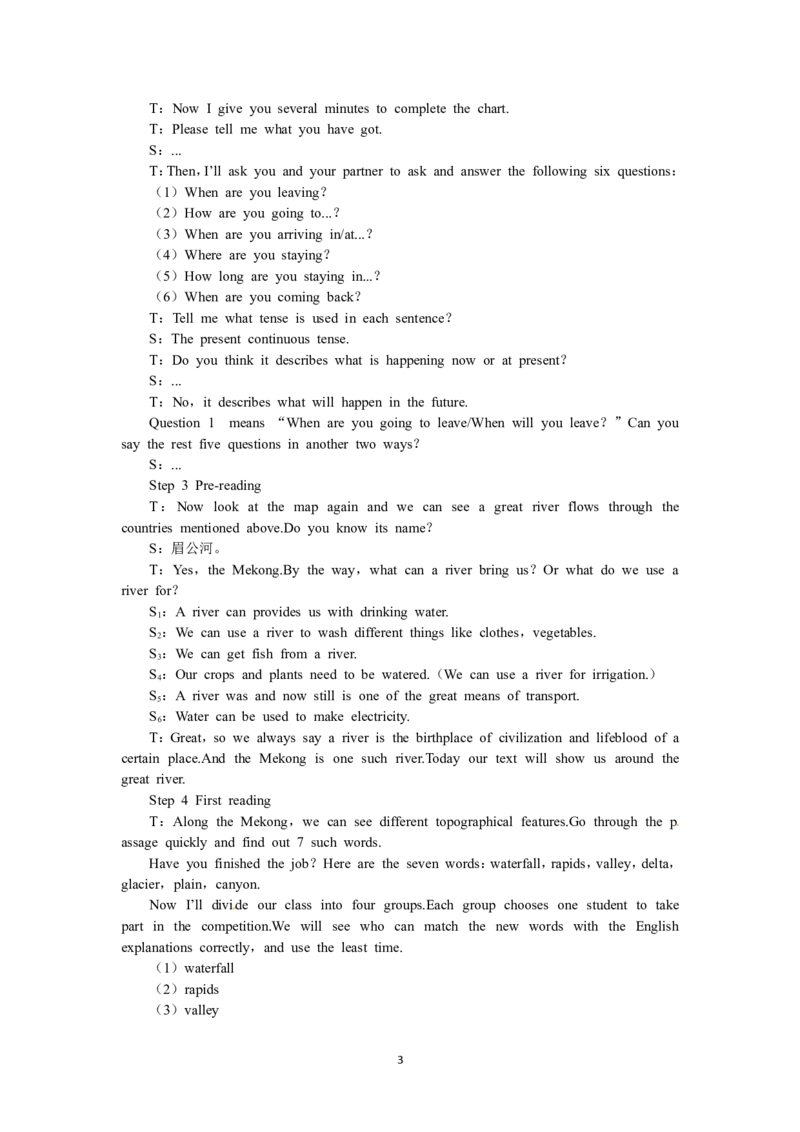
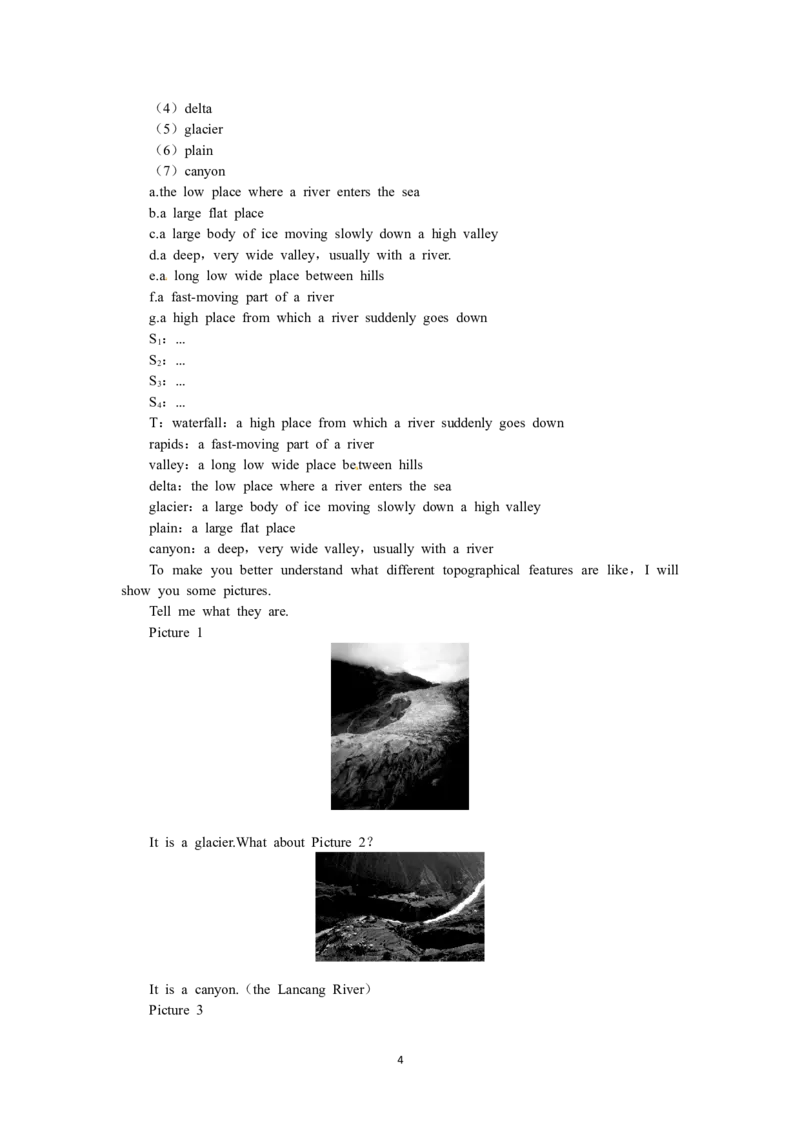
To make you better understand what different topographical features are like,I will
show you some pictures.
Tell me what they are.
Picture 1
It is a glacier.What about Picture 2?
It is a canyon.(the Lancang River)
Picture 3
4It’s the Mekong Delta.The Mekong Delta is the bottom half of Vietnam’s two rice
baskets.
(The other is the Red River Delta in the North.)
Of course,Picture 4 shows us a wonderful scene of waterfalls.
Picture 5
The picture shows us a man is rafting on rapids.
There are some other new words in the passage:
Please read after me.(with Chinese meaning after each word)
finally,
cycle,
persuade,
stubborn,
insist,
source,
proper(ly),
detail,
determine,determined,
altitude,
atlas,
Tibetan,
Step 5 Second reading
Now I think there should be little difficulty in your understanding the text.
Please read the passage and judge whether the following statements are true or false.
1.Wang Kung first had the idea to cycle along the Mekong.
52.Wang Kung and Wang Wei have had the dream to cycle along the Mekong since
middle school.
3.They decided to begin their trip from the source of the Mekong.
4.Wang Wei didn’t think much about the difficulty of the trip.
5.The Mekong flows through five countries.
S/S /S /S /S :...
1 2 3 4 5
T:Statement 1 is false.Not Wang Kung but Wang Wei first had the idea.
Statement 2 is false.They have had their dream to take a great bike trip since middle
school.
Statement 3 is true.
Statement 4 is true.
Statement 5 is false.The Mekong actually flows through six countries:China,Burma,
Thailand,Cambodia,Laos and Vietnam.
Step 6 Reading aloud
T:Please look at the subtitle:The Dream And The Plan.How many parts can the
passage be divided into?
S:From the subtitle,we know the passage can be divided into two parts.Part 1 talks
about their dream,while Part 2 talks about their plan.
T:You are clever.Part 1 is Paragraph One.Part 2 consists of Paragraph 2 and
Paragraph 3.Now please read the second part aloud.Pay attention to their plan.
Now,please discuss with your partners about the answers to the questions:
(1)Who are Dao Wei and Yu Hang?
(2)Where is the source of the Mekong River?
(3)Which sea does the Mekong enter?
(4)Is it a difficult journey along the Mekong River?Why?
(5)Is Wang Kung very eager for the trip?
S:Dao Wei and Yu Hang are their cousins.
1
S:The source of the Mekong River is in Qinghai Province.
2
S:The Mekong enters the South China Sea.
3
S :Yes.Because the Mekong begins at a glacier on a Tibetan mountain,then it
4
becomes rapids when it passes through deep valleys,sometimes enters wide valleys and
becomes a waterfall.
T:Yes,in short,we may say the trip is difficult because the topography along the
river is very complicated.
S:...
5
T:Still look at the second paragraph,“I know the proper way is always her way.”
That means Wang Kung doesn’t completely agree with his sister and is not very pleased
with her;meanwhile,from the sentence “I told her the air would be hard to breathe and
it would be very cold.”,we can see that Wang Kung is afraid of the difficulty that
might meet with,so he is very eager for the trip.
Step 7 Homework
Finish Part 1 and Part 3 on Page 20.
●板书设计
Unit 3 Travel journal
The First Period
6New words Discussion
What can a river be used
1.fear 9.Phnom Penh
for?
2.stubborn 10.Cambodia transport
3.delta 11.Ho Chi Minh drinking water
4.glacier 12.Vietnam washing
5.Transport ... irrigation
7.Vientiane fish
8.Laos
●活动与探究
Form your own traveling group,discuss what you should do and what you
should never do when traveling.
Don’ts Dos
no littering protect animals
no feeding animals
If you have more to say,you can change the form.
●备课资料
1.Mekong River—The Lifeblood of Southeast Asia
The Mekong River is the heart and soul of mainland Southeast Asia.The 12th longest
river in the world,the Mekong runs 4800 kilometers from its headwaters on the Tibetan
Plateau(高原) through Yunnan Province of China,Burma,Thailand,Cambodia,Lao PDR
and Vietnam.
Over 60 million people depend on the Mekong and its branches for food,water,
transport and many other aspects of their daily lives.Its annual flood drought cycles are
essential for the sustainable production of rice and vegetables on the floodplains(洪泛区)
and along the riverbanks during the dry season.Known as the Mother of waters,the river
supports one of the world’s most diverse(多种经营的)fisheries(渔场),second only to the
Amazon.This vital ecosystem and lifeblood of the region is currently under threat.Over the
past ten years,more than 100 large dams have been proposed for the Mekong basin by
institutions like the Asian Development Bank ( ADB ) and the Mekong River
Commission.Some of these projects have already been built.
One of the greatest threats is China’s plans to construct eight dams on the Upper
Mekong Lancang.Two of these dams have already been completed,and construction on the
third project,Xiaowan,began in January 2002.These dams will have widespread impacts
on the livelihoods of Mekong communities and on the natural ecology of the river system.
In Laos,IRN is working to stop World Bank support for the Dam and ensure that
communities receive just compensation for losses suffered due to the ADB-funded Nam
and Dams.IRN is also monitoring broader regional water resource developments ,
particularly those funded by the ADB.
In Thailand,IRN has been working with communities affected by the Pak Mun and
Rasi Salai dams who are campaigning for the gates of both dams to be permanently
opened and for the Mun River to be restored.
IRN is also monitoring the impacts of the Yali Falls Dam in Vietnam,which has
affected communities in both Vietnam and Cambodia.
2.the Mekong Delta
7The Mekong Delta is the bottom half of Vietnam’s two rice baskets,the other being
the Red River Delta in the North.
This vast delta is formed by the deposition of the multiple tentacles and tributaries
(支流) of the mighty Mekong River which has its origin in the Tibetan highland plateau
2800 miles away.From its source,the river makes its way through China.
Myanmar (Burma),Laos,Cambodia and South Vietnam before flowing out into the
South China Sea.The Mekong’s—the people of South Vietnam are often very proud of the
richness and vastness of this land.When referring to the rice fields in this area,they often
say,“co bay thang canh”,meaning the land is so large that the cranes can stretch their
wings as they fly.Today,the region is one of Vietnam’s highest producer of rice crops,
vegetables and fruits.
8