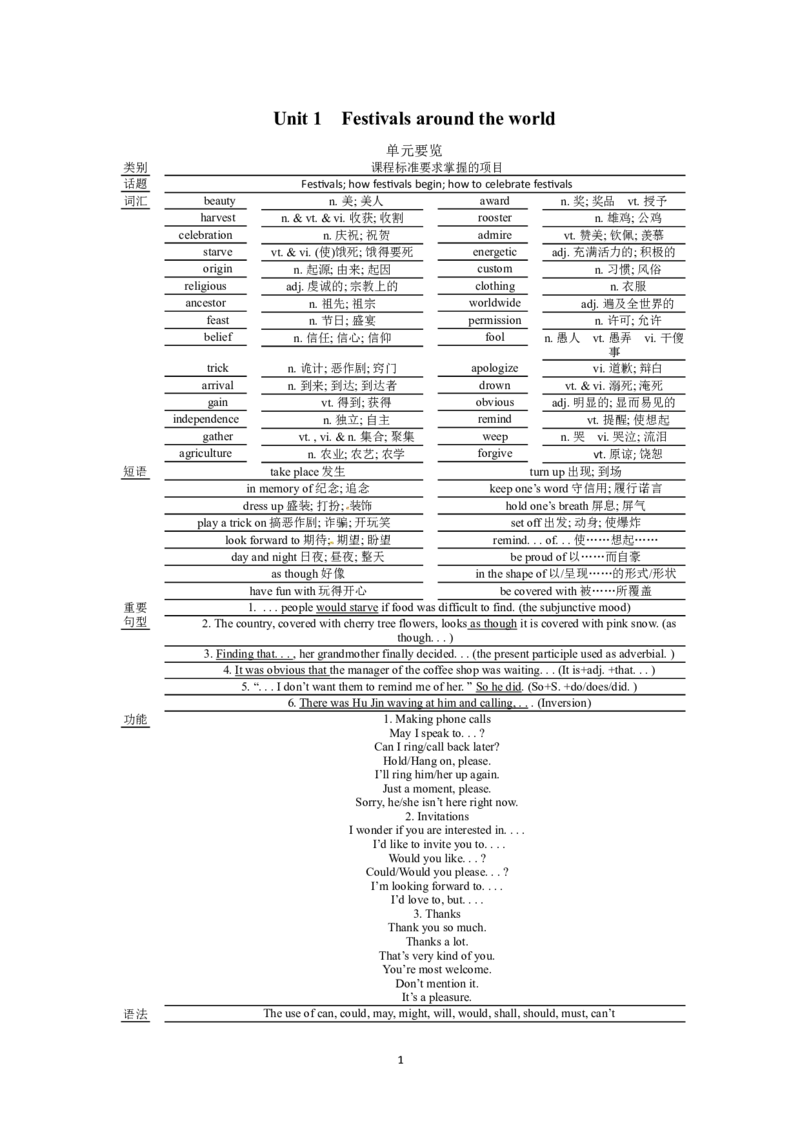
Unit 1 Festivals around the world
单元要览
类别 课程标准要求掌握的项目
话题 Festivals; how festivals begin; how to celebrate festivals
词汇 beauty n. 美; 美人 award n. 奖; 奖品 vt. 授予
harvest n. & vt. & vi. 收获; 收割 rooster n. 雄鸡; 公鸡
celebration n. 庆祝; 祝贺 admire vt. 赞美; 钦佩; 羡慕
starve vt. & vi. (使)饿死; 饿得要死 energetic adj. 充满活力的; 积极的
origin n. 起源; 由来; 起因 custom n. 习惯; 风俗
religious adj. 虔诚的; 宗教上的 clothing n. 衣服
ancestor n. 祖先; 祖宗 worldwide adj. 遍及全世界的
feast n. 节日; 盛宴 permission n. 许可; 允许
belief n. 信任; 信心; 信仰 fool n. 愚人 vt. 愚弄 vi. 干傻
事
trick n. 诡计; 恶作剧; 窍门 apologize vi. 道歉; 辩白
arrival n. 到来; 到达; 到达者 drown vt. & vi. 溺死; 淹死
gain vt. 得到; 获得 obvious adj. 明显的; 显而易见的
independence n. 独立; 自主 remind vt. 提醒; 使想起
gather vt. , vi. & n. 集合; 聚集 weep n. 哭 vi. 哭泣; 流泪
agriculture n. 农业; 农艺; 农学 forgive vt. 原谅; 饶恕
短语 take place发生 turn up出现; 到场
in memory of纪念; 追念 keep one’s word守信用; 履行诺言
dress up盛装; 打扮; 装饰 hold one’s breath屏息; 屏气
play a trick on搞恶作剧; 诈骗; 开玩笑 set off出发; 动身; 使爆炸
look forward to期待; 期望; 盼望 remind. . . of. . . 使……想起……
day and night日夜; 昼夜; 整天 be proud of以……而自豪
as though好像 in the shape of以/呈现……的形式/形状
have fun with玩得开心 be covered with被……所覆盖
重要 1. . . . people would starve if food was difficult to find. (the subjunctive mood)
句型 2. The country, covered with cherry tree flowers, looks as though it is covered with pink snow. (as
though. . . )
3. Finding that. . . , her grandmother finally decided. . . (the present participle used as adverbial. )
4. It was obvious that the manager of the coffee shop was waiting. . . (It is+adj. +that. . . )
5. “. . . I don’t want them to remind me of her. ” So he did. (So+S. +do/does/did. )
6. There was Hu Jin waving at him and calling, . . . (Inversion)
功能 1. Making phone calls
May I speak to. . . ?
Can I ring/call back later?
Hold/Hang on, please.
I’ll ring him/her up again.
Just a moment, please.
Sorry, he/she isn’t here right now.
2. Invitations
I wonder if you are interested in. . . .
I’d like to invite you to. . . .
Would you like. . . ?
Could/Would you please. . . ?
I’m looking forward to. . . .
I’d love to, but. . . .
3. Thanks
Thank you so much.
Thanks a lot.
That’s very kind of you.
You’re most welcome.
Don’t mention it.
It’s a pleasure.
语法 The use of can, could, may, might, will, would, shall, should, must, can’t
11. can and could
Jin can speak English well. (ability)
Could you please show me the way to Beihai Park? (request)
2. may and might
May we see the awards for the teams? (permission; request)
She might give you some new clothing. (possibility)
3. will and would
The Spring Festival is the most fun. The whole family will come for dinner. (promise; agreement)
Often he would dress up like a rich man. (past habit; custom)
4. shall and should
The harvest festival begins on Sunday. We shall be there with our friends. (promise; agreement)
You should arrive at the airport two hours before he goes. (advice)
5. must and can’t
Wang Feng wins an award every year. He must be very strong. (speculation)
You must be joking. That can’t be true. (guessing)
教学 1. Get students to know about festivals around the world.
重点 2. Have students learn some useful new words and expressions about festivals and customs and let
them learn effective ways to remember English vocabulary.
3. Enable students to grasp and use the expressions of request and thanks.
4. Let students learn the new grammar item: the use of can, could, may, might, will, would, shall,
should, must and can’t.
5. Develop students’ listening, speaking, reading and writing abilities.
教学 1. Enable students to master the use of can, could, may, might, will, would, shall, should, must and
难点 can’t.
2. Let students learn to write a different ending of a story.
3. Develop students’ integrative skills.
课时 Periods needed: 7
安排 Period 1 Warming up and reading
Period 2 Learning about language: Important language points
Period 3 Learning about language: Grammar
Period 4 Using language: Listening and speaking
Period 5 Using language: Extensive reading
Period 6 Using language: Speaking and writing
Period 7 Revision: Summing up and learning tip
Period 1 Warming up and reading
整体设计
教材分析
This is the first teaching period of this unit. At the beginning of the class, the teacher can lead
in the topic of the unit by having a free talk with students about their winter holidays and the
Spring Festival.
The Warming Up is intended to have students start thinking about the variety of events and
festivals that are celebrated in China, and connect them with seasons of the year and reasons for
the celebrations. The teacher can use this part to introduce information that Chinese students
should have about their country’s cultural events.
The Pre-reading is a continuation of the Warming Up and it moves the discussion to a more
personal level. It is intended to help students enter imaginatively into a discussion of festivals and
their importance to the society. It also directs their attention to the variety of events and activities
those festivals include. The teacher should let students discuss the questions and predict what kind
of information will be introduced in the Reading.
The reading passage titled FESTIVALS AND CELEBRATIONS briefly describes the earliest
kinds of festivals with the reasons for them, and then four different kinds of festivals that occur in
most parts of the world. Encourage students to look at the pictures and the heading of each section
to guess what the text might be about. Then let them skim for the general idea for each section,
and scan for further understanding. Because this passage introduces a lot of useful new words and
2expressions which are only used for festivals, in order not to let students feel much difficult, the
teacher should deal with any language problems while they are reading. After reading, students
are required to do the four exercises in the Comprehending to see how much they have understood
the reading passage. The teacher can first let them work in pairs or in groups to find the answers
cooperatively, and then check their answers with the whole class.
To consolidate the contents of the reading passage, students should be required to talk about
festivals in their own words at the end of the class. In order to arouse students’ interest, the teacher
can hold a competition between groups.
教学重点
1. Let students learn more about history and basic knowledge of festivals.
2. Get students to learn different reading skills.
教学难点
1. Develop students’ reading ability.
2. Enable students to talk about festivals and celebrations.
三维目标
知识目标
1. Get students to learn the useful new words and expressions in this part: beauty, harvest,
starve, origin, religious, ancestor, Mexico, feast, bone, belief, poet, arrival, gain, independence,
gather, agriculture, award, rooster, admire, energetic, Easter, clothing, Christian, custom, take
place, in memory of, dress up, play a trick on, look forward to, day and night, as though, have fun
with
2. Let students learn about history and basic knowledge of festivals both in and out of China.
能力目标
1. Develop students’ reading ability and let them learn different reading skills.
2. Enable students to talk about festivals and celebrations.
情感目标
1. Stimulate students’ love for their own national culture and customs.
2. Develop students’ sense of cooperative learning.
教学过程
设计方案(一)
→Step 1 Leading-in
Have a free talk with students. Ask them the following questions:
Did you have a good time in your winter holidays?
When did you feel most happy and excited? Why?
(At the Spring Festival. Because it’s the most important festival in our country. . . )
→Step 2 Warming up
1. Let students brainstorm the other Chinese festivals.
(Lantern Festival, Pure Brightness Festival, Dragon Boat Festival, Mid-Autumn Festival,
New Year’s Day, Chung Yeung Festival. . . )
2. Let students read the information about Chinese festivals below and discuss another three
Chinese festivals:
When does the festival come?
3What do people celebrate?
What do people do?
Festivals Date Festivals Date
New Year January 1st Teachers’ Day September 10th
International Women’s March 8th National Day October 1st
Day
Arbor Day March 12th The Spring Festival Lunar New Year
International Labor Day May 1st Dragon Boat Festival the fifth day of the fifth lunar month
International Children’s June 1st Mid-Autumn Festival the 15th day of the 8th lunar month
Day
Army Day August 1st Lantern Festival the 15th day of the 1st lunar month
Chinese Youth Day May 4th Pure Brightness Day April the fifth
3. Ask students to fill in the following form and ask some to share their
opinions with the whole class. The first one is given as an example.
Festivals Time of year/date What it celebrates What people do
Mid-Autumn Festival autumn/fall the beauty of the full give/eat moon cakes and
moon, harvest, time with watch the full moon with
family and friends family and friends
4. Talk about some foreign festivals with students.
(Christmas, April Fools’ Day, Easter, Halloween, Valentine’s Day, Thanksgiving Day, . . . )
→Step 3 Pre-reading
1. Let students discuss the following questions:
What festivals or celebrations do you have in your city or town? What part of a festival do
you like best—the activities, the music, the sights, the food or the people who visit?
2. Ask students to look at the pictures and title of the passage in Reading. Discuss in pairs
what kind of information will be introduced in the passage.
→Step 4 Reading
1. Fast reading
Ask students to skim the reading passage and then fill in the following
chart.
Kinds of Festivals Names of Festivals Countries
Festivals
Festivals
Harvest
Spring
(Let students look through the chart and then read the text silently. Three minutes later, check
the answers with the whole class. Show the suggested answers on the screen. )
2. Intensive reading
Allow students to read carefully this time to understand the main ideas of each paragraph and
the important details, and then finish the following:
1)Choose the best answer to each question or to finish each sentence according to the text.
(1)Why do Japanese people light lamps during the Festival of the Dead?
A. Because they want to make the festival colorful.
B. Because they want to light up their rooms.
C. Because they want to light up their way.
4D. Because they want to lead their ancestors to return to earth.
(2)Which of the following was not mentioned as a famous person in the text?
A. Mohandas Gandi.
B. Christopher Columbus.
C. Abraham Lincoln.
D. Qu Yuan.
(3)The place where people will usually decorate churches and town halls with flowers and
fruits is ______________.
A. India
B. America
C. Europe
D. China
(4)Easter is held in memory of the return of Jesus for Christians and also celebrates
______________.
A. the coming of spring
B. the autumn harvest
C. the Lunar New Year
D. the end of a year
Suggested answers: (1)D (2)C (3)C (4)A
2)Use the information from the reading passage to answer the following questions.
(1)What are festivals of the dead usually for?
(2)What makes autumn festivals happy events?
(3)What do people usually do at spring festivals?
(4)What is one important reason to have festivals and celebrations?
(5)Compare the festivals of the dead in Mexico, Japan and China. What things are similar?
What things are different?
3. Reading and discussion
Read the text a third time and then work in pairs to do the following.
1)Based on the reading passage, what do most festivals seem to have in
common? Why do you think these things might be important to people everywhere?
Talk with your partner and fill in the chart below.
Three common things Reasons why they are important to people everywhere
1.
2.
3.
2)Discuss in pairs which festivals you think are the most important and
which are the most fun. Then fill in the chart with your ideas.
Type of festival Example of festival Reasons for your choice
Most important
Most fun
(Let students have enough time to read the passage carefully and discuss the questions and
charts with their partners. Encourage them to expand their answers according to their own
experiences. )
4. Explanation
Help students analyze some difficult, long and complex sentences and guess the meanings of
some new words. Encourage them to try to deal with the language points in the context.
5Discuss the following important sentences and phrases in the passage.
1)Some festivals are held to honour the dead, or to satisfy the ancestors, who might return
either to help or to do harm.
2)in memory of
3)India has a national festival on October 2 to honour Mohandas Gandhi, the leader who
helped gain India’s independence from Britain.
4)People are grateful because their food is gathered for the winter and the agricultural work is
over.
5)The most energetic and important festivals are the ones that look forward to the end of
winter and to the coming of spring.
6)The country, covered with cherry tree flowers, looks as though it is covered with pink
snow.
Suggested explanations:
1)The sentence contains a non-restrictive attributive clause who might return either to help or
to do harm. It means people hold some festivals either to show respect to the dead or to make their
ancestors happy in case they might come back to do harm.
2)in memory of: serving to recall sb. , to keep him fresh in people’s minds
He wrote a poem in memory of his dearest wife, who died in an accident.
in honor of: showing great respect or high public regard
3)the leader who helped gain India’s independence from Britain: a noun phrase followed by
an attributive clause as the appositive
4)two clauses for reason
5)energy n. → energetic adj. : full of or done with energy
look forward to: “to” is a preposition here.
I’m looking forward to hearing from you.
be devoted to; be/get used to; get down to; stick to. . .
6)covered with cherry tree flowers: a past participle phrase equal to “which is covered with
cherry tree flowers”
as though: as if
He talks as though he knew all about it.
He looks as if he had seen a ghost.
5. Reading aloud and underlining
Ask students to read the passage aloud to the tape and let them pay attention to the
pronunciation of each new word and the pauses within each sentence. Tell them to pick out all the
useful expressions or collocations from the passage while reading and copy them to the notebook
after class as homework.
→Step 5 Consolidation
Ask students to talk about festivals in their own words according to the text. Then let them
complete the following passage with proper words or phrases.
There are all kinds of festivals and ______________ around the world, which are held for
different ______________. The ancient festivals were mainly held at three times a year—the end
of the cold ______________, planting in spring and ______________ in autumn. Some festivals
are held to ______________ the dead or ______________ the ancestors, who might return either
to help or ______________, while other festivals are held to honor famous people or to the
6______________, such as Dragon Boat Festival, Columbus Day, and so on. Harvest and
______________ festivals are happy events because their food is ______________ for the winter
and the ______________ work is over, to which Mid Autumn Festival belongs. And the most
______________ and important festivals are the ones that ______________ the end of winter and
to the coming of ______________ such as the Lunar New Year, at which people have a very
______________.
Suggested answers: celebrations; reasons; weather; harvest; honor; to satisfy; to do harm;
gods; Thanksgiving; gathered; agricultural; energetic; look forward to; spring; good time
→Step 6 Homework
1. Learn the useful new words and expressions in this part by heart.
2. Read the reading passage again and again and try to talk about festivals both in and out of
China.
设计方案(二)
→Step 1 Leading in the topic by learning vocabulary about festivals
1. Make a circle on the blackboard and write the word “FESTIVAL” in it.
2. Ask students, “We have learned ‘festival’. Can you name some festivals? ”
3. Students list as many festivals as possible. Then the teacher adds some students can’t think
of, such as Halloween, Easter, Thanksgiving, Valentine’s Day.
4. Let students read them aloud and try to learn them by heart.
→Step 2 Warming up by talking about festivals
Work in groups and list three more Chinese festivals that you know. Discuss when they take
place, what they celebrate and what people do at that time. Then tell the group which festival is
their favorite and why.
Festivals Time of year/date What it celebrates What people do
Mid-Autumn Festival autumn/fall the beauty of the full give/eat moon cakes and
moon, harvest, time with watch the full moon with
family and friends family and friends
→Step 3 Predicting by looking and discussing
1. Look at the pictures and title of the reading passage and discuss in pairs what the passage
might be about.
2. Two or three students are to give their opinions.
→Step 4 Reading
1. Give students 2 minutes, and ask them to skim the passage for information to tell if the
following sentences are True or False.
1)The ancient people needn’t worry about their food. (F)
2)Halloween used to be a festival intended to honor the dead. (T)
3)Qu Yuan was a great poet who people honor a lot in China. (T)
4)The Mid-autumn Festival is held to celebrate the end of autumn. (F)
5)Easter celebrates the birth of Jesus. (F)
2. Give students 5 minutes to read the passage carefully, and complete the
chart according to the passage.
Festivals of the Dead Obon in Japan
___________________
Halloween
7Festivals to Honor People ________________
________________
A national festival in____________
Harvest Festivals _________ in European countries
_________ in China and Japan
Spring Festivals ________________
Carnivals in some Western countries
________________
________________ in Japan
3. Listening and reading aloud
Play the tape of the text for students and let them pay attention to the pronunciation of each
new word and the pauses within each sentence. Then ask them to read the text aloud to the tape.
→Step 5 Closing down by spoken practice
1. Have students get prepared in 3 minutes or so and then ask them to talk about festivals and
celebrations.
2. Ask as many students as possible to have a try in front of the class.
→Step 6 Homework
1. Go over the text and try to learn all the useful words and expressions in this part by heart.
2. Finish the exercises in Comprehending on Page 3.
板书设计
Unit 1 Festivals around the world
Festivals and celebrations
Kinds of Festivals Names of Festivals Countries
Festivals
Festivals
Harvest
Spring
活动与探究
Group discussion & speech
As is known from the reading passage, festivals of all kinds are celebrated around the world.
Most festivals have celebrations that include food, music, clothing and dances. These events
originated from some similar ideas, but they take different forms in different regions and societies.
What festivals and celebrations do you know all over the world? Have you ever taken part in
them and enjoyed yourself? Discuss festivals in groups and then make speeches.
Step 1: The teacher divides the class into four groups and gives the tasks to students in each
group. Group 1 will list the festivals around the world as many as possible, and then categorize
them according to the origins of these festivals. And they should prepare for a short speech. Group
2 will discuss two traditional Chinese festivals and prepare for their presentation. Group 3 will
discuss two Western festivals and prepare for their presentation. Group 4 will discuss the
differences between Chinese festivals and Western festivals, then contrast and compare their
styles, celebrations, dates and so on. And they should prepare for a short speech.
Step 2: Groups 1, 2 and 3 give their speeches on the festivals they have discussed. Group 4
gives their speech on the differences between Chinese festivals and Western festivals.
Step 3: The teacher makes proper remarks about students’ speeches and sums up the different
cultural practices between China and other countries according to them.
89