考点 14 情态动词和虚拟语气(核心考点精讲精
练)
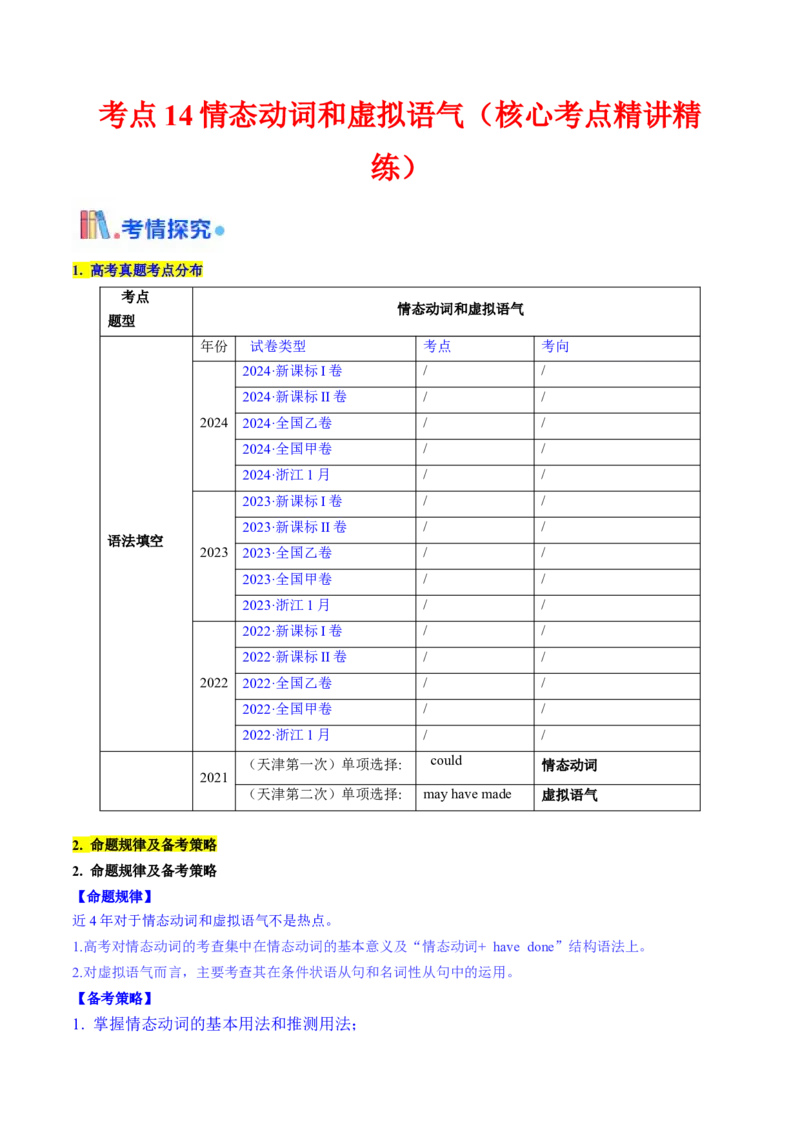
1. 高考真题考点分布
考点
情态动词和虚拟语气
题型
年份 试卷类型 考点 考向
2024·新课标I卷 / /
2024·新课标II卷 / /
2024 2024·全国乙卷 / /
2024·全国甲卷 / /
2024·浙江1月 / /
2023·新课标I卷 / /
2023·新课标II卷 / /
语法填空
2023 2023·全国乙卷 / /
2023·全国甲卷 / /
2023·浙江1月 / /
2022·新课标I卷 / /
2022·新课标II卷 / /
2022 2022·全国乙卷 / /
2022·全国甲卷 / /
2022·浙江1月 / /
(天津第一次)单项选择: could 情态动词
2021
(天津第二次)单项选择: may have made 虚拟语气
2. 命题规律及备考策略
2. 命题规律及备考策略
【命题规律】
近4年对于情态动词和虚拟语气不是热点。
1.高考对情态动词的考查集中在情态动词的基本意义及“情态动词+ have done”结构语法上。
2.对虚拟语气而言,主要考查其在条件状语从句和名词性从句中的运用。
【备考策略】
1. 掌握情态动词的基本用法和推测用法;2. 掌握情态动词+have done的用法;
3. 掌握if虚拟条件下的虚拟语气(包括省略if的虚拟条件句);
4. 掌握含蓄虚拟条件下的虚拟语气;
5. 掌握特殊句式中的虚拟语气。
【命题预测】
情态动词和虚拟语气在历年全国卷高考中并非重点,但是在天津卷中是重点,仍然是高中英
语语法学习中的重难点。
必备基础知识:
情态动词本身有词义,但是没有人称和数的变化。情态动词有时态的变化,但是不能独立作谓语。情态动
词可以表示:能力、义务、可能性和允许等等意义;情态动词还可以用来给人们:提出请求、建议、意见以及
提供帮助等等。
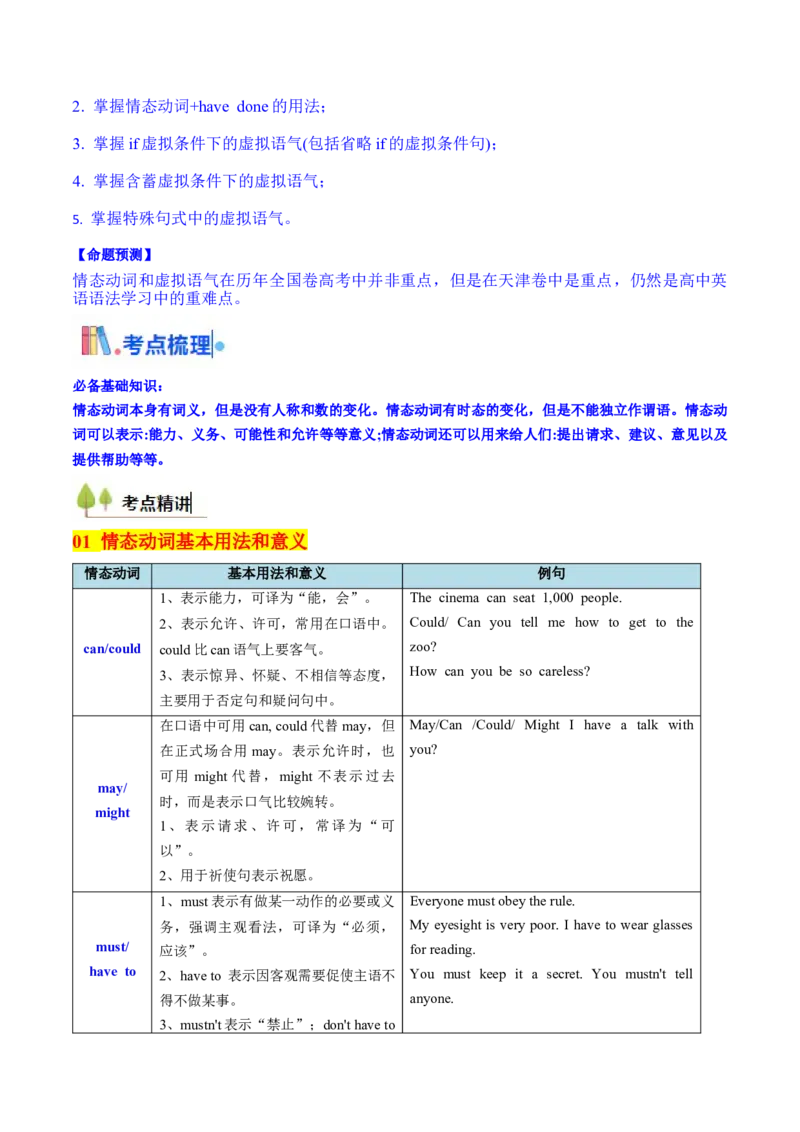
01 情态动词基本用法和意义
情态动词 基本用法和意义 例句
1、表示能力,可译为“能,会”。 The cinema can seat 1,000 people.
2、表示允许、许可,常用在口语中。 Could/ Can you tell me how to get to the
can/could could比can语气上要客气。 zoo?
3、表示惊异、怀疑、不相信等态度, How can you be so careless?
主要用于否定句和疑问句中。
在口语中可用can, could代替may,但 May/Can /Could/ Might I have a talk with
在正式场合用may。表示允许时,也 you?
可用 might 代替,might 不表示过去
may/
时,而是表示口气比较婉转。
might
1、表示请求、许可,常译为“可
以”。
2、用于祈使句表示祝愿。
1、must表示有做某一动作的必要或义 Everyone must obey the rule.
务,强调主观看法,可译为“必须, My eyesight is very poor. I have to wear glasses
must/ 应该”。 for reading.
have to 2、have to 表示因客观需要促使主语不 You must keep it a secret. You mustn't tell
得不做某事。 anyone.
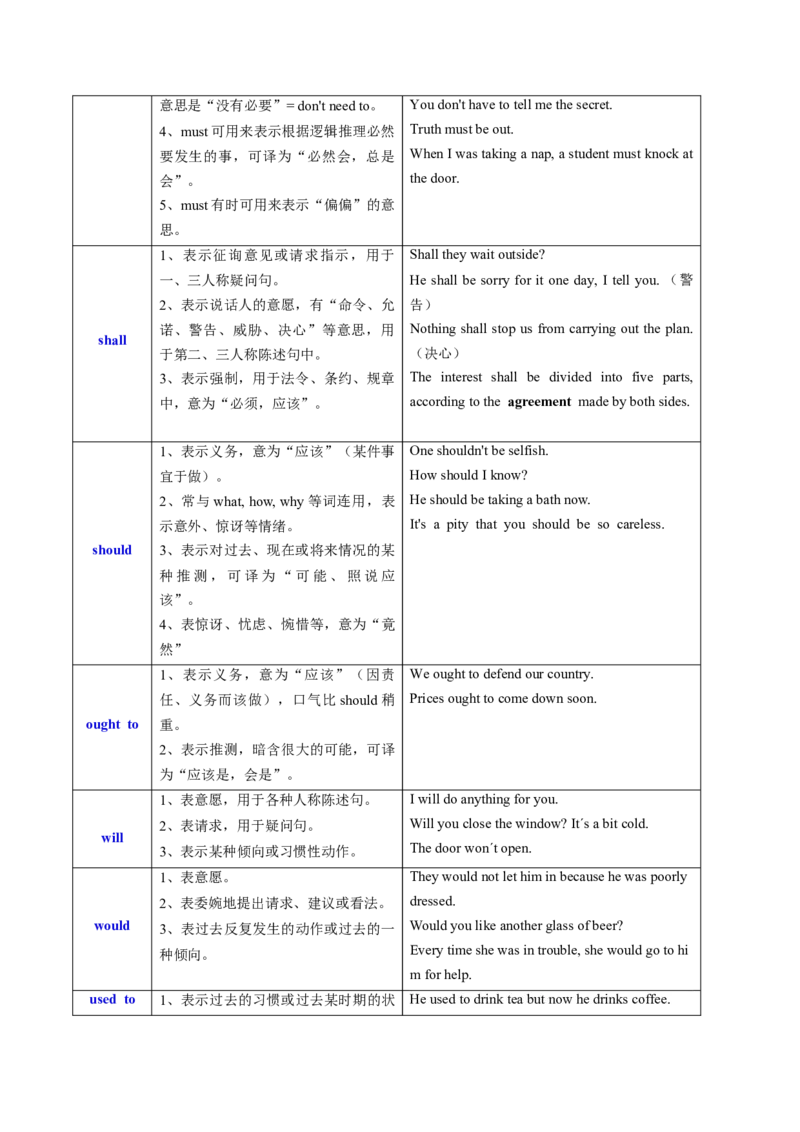
3、mustn't表示“禁止”;don't have to意思是“没有必要”= don't need to。 You don't have to tell me the secret.
4、must可用来表示根据逻辑推理必然 Truth must be out.
要发生的事,可译为“必然会,总是 When I was taking a nap, a student must knock at
会”。 the door.
5、must有时可用来表示“偏偏”的意
思。
1、表示征询意见或请求指示,用于 Shall they wait outside?
一、三人称疑问句。 He shall be sorry for it one day, I tell you. (警
2、表示说话人的意愿,有“命令、允 告)
诺、警告、威胁、决心”等意思,用 Nothing shall stop us from carrying out the plan.
shall
于第二、三人称陈述句中。 (决心)
3、表示强制,用于法令、条约、规章 The interest shall be divided into five parts,
中,意为“必须,应该”。 according to the agreement made by both sides.
1、表示义务,意为“应该”(某件事 One shouldn't be selfish.
宜于做)。 How should I know?
2、常与what, how, why等词连用,表 He should be taking a bath now.
示意外、惊讶等情绪。 It's a pity that you should be so careless.
should 3、表示对过去、现在或将来情况的某
种推测,可译为“可能、照说应
该”。
4、表惊讶、忧虑、惋惜等,意为“竟
然”
1、表示义务,意为“应该”(因责 We ought to defend our country.
任、义务而该做),口气比 should稍 Prices ought to come down soon.
ought to 重。
2、表示推测,暗含很大的可能,可译
为“应该是,会是”。
1、表意愿,用于各种人称陈述句。 I will do anything for you.
2、表请求,用于疑问句。 Will you close the window? It´s a bit cold.
will
3、表示某种倾向或习惯性动作。 The door won´t open.
1、表意愿。 They would not let him in because he was poorly
2、表委婉地提出请求、建议或看法。 dressed.
would 3、表过去反复发生的动作或过去的一 Would you like another glass of beer?
种倾向。 Every time she was in trouble, she would go to hi
m for help.
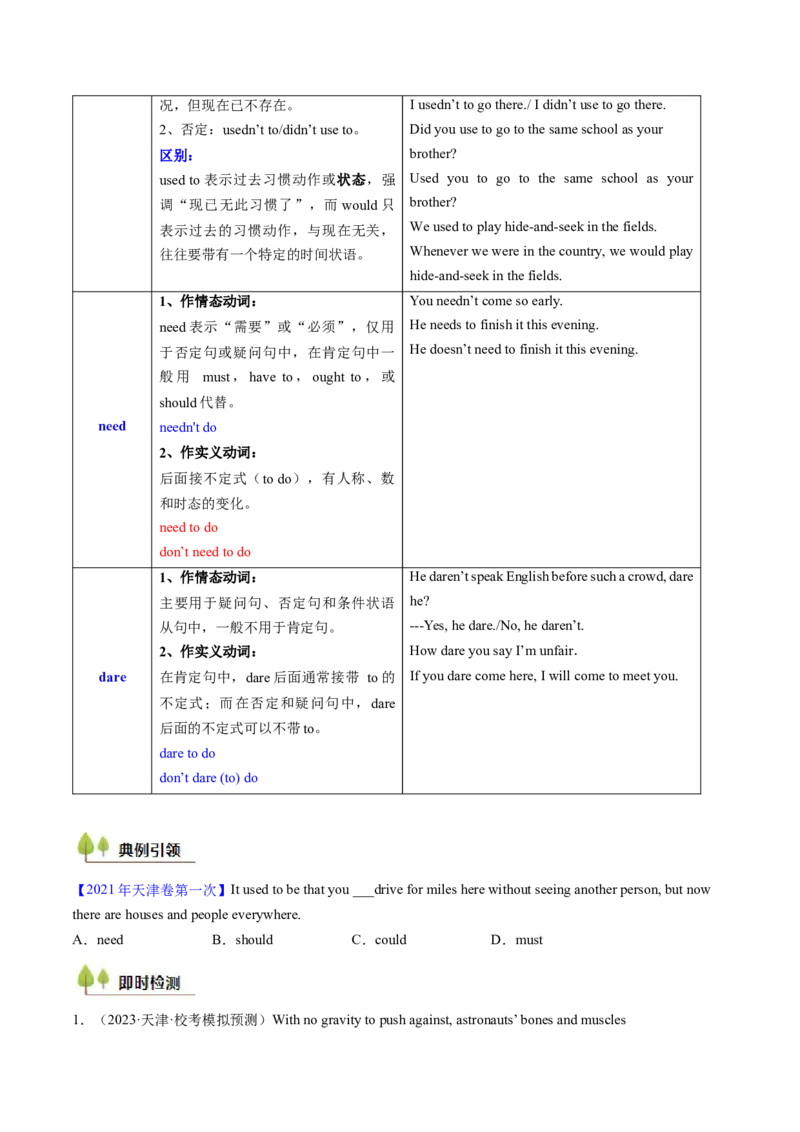
used to 1、表示过去的习惯或过去某时期的状 He used to drink tea but now he drinks coffee.况,但现在已不存在。 I usedn’t to go there./ I didn’t use to go there.
2、否定:usedn’t to/didn’t use to。 Did you use to go to the same school as your
区别: brother?
used to表示过去习惯动作或状态,强 Used you to go to the same school as your
调“现已无此习惯了”,而 would只 brother?
表示过去的习惯动作,与现在无关, We used to play hide-and-seek in the fields.
往往要带有一个特定的时间状语。 Whenever we were in the country, we would play
hide-and-seek in the fields.
1、作情态动词: You needn’t come so early.
need表示“需要”或“必须”,仅用 He needs to finish it this evening.
于否定句或疑问句中,在肯定句中一 He doesn’t need to finish it this evening.
般用 must,have to,ought to,或
should代替。
need needn't do
2、作实义动词:
后面接不定式(to do),有人称、数
和时态的变化。
need to do
don’t need to do
1、作情态动词: He daren’t speak English before such a crowd, dare
主要用于疑问句、否定句和条件状语 he?
从句中,一般不用于肯定句。 ---Yes, he dare./No, he daren’t.
2、作实义动词: How dare you say I’m unfair.
dare 在肯定句中,dare后面通常接带 to的 If you dare come here, I will come to meet you.
不定式;而在否定和疑问句中,dare
后面的不定式可以不带to。
dare to do
don’t dare (to) do
【2021年天津卷第一次】It used to be that you ___drive for miles here without seeing another person, but now
there are houses and people everywhere.
A.need B.should C.could D.must
1.(2023·天津·校考模拟预测)With no gravity to push against, astronauts’ bones and muscles________become weak.
A.should B.must C.can D.need
2.(2023·天津·模拟预测)It’s eleven o’clock already. ______ you watch the movie at such a late hour?
A.Can B.Must C.May D.Shall
02情态动词表推测和虚拟语气
1)情态动词+ have done"”的用法
①、must have done
表示对过去已发生动作的肯定推测,意为“想必/一定做了”,用于肯定句中,语气强。
●The children must have got lost in the woods; otherwise, they would have been at the lakeside camp as
scheduled.孩子们一定在森林里迷路了,否则,他们会按照计划出现在湖边营地。
②、can't have done
表示对过去情况把握较大的否定推测,意为“不可能做了”。
● I saw Mr.. Li just now. He can't have gone to Beijing. 我刚才看见李先生了。他不可能去了北京。
③、could have done
表示对过去情况的推测,意为“可能已经做了”
●Don't worry-- they could have just forgotten to call. 别担心,他们可能只是忘了打电话。
表示对过去的虚拟,意为“本来能做”,但实际上没做。
●You could have done better, but you were too careless. 你本来能做得更好些,但你当时太粗心了。
④、may have done
表示对过去情况的推测,意为“也许/或许已经做了”,用于肯定句中,一般不用于疑问句中,语气较
弱,其否定形式为 may not have done.
● She may have bought the dictionary,but I' m not sure..她也许已经买了那本词典,但我不太确信。
⑤、might have done
表示对过去情况的推测,意为“也许/或许已经做了”,用于肯定句中,一般不用于疑问句中,语气较
may have done更弱,其否定形式为 might not have done。
●Smith might have gone to see the movie yesterday.史密斯也许昨天已经去看过这部电影了。
表示对过去的虚拟,意为“本来可以做”,但实际上没做。
● You might have given him more help, though you were busy. 你本可以给他更多帮助的,虽然你当时很忙。
⑥、should/ought to have done
表示对过去的虚拟。用于肯定句,意为“本该做”,而实际上未做;其否定式为 shouldn't / ought notto have done,意为“本不该做”,而实际上做了,表示责备或惋惜之情。
●He is sad. You shouldn't have told him the bad news.他感到难过。你本不应该告诉他这个坏消息。
⑦、needn’t have done
表示对过去的虚拟,意为“本来不必做”,而实际上做了。
● We needn't have bought so much food now that Suzie won't be with us for dinner.
既然苏西不与我们一起吃晚饭,我们原本不必买那么多食物。
⑧、would rather have done
意为“宁愿当时做了”,其否定式为 would rather not have done。两者都含有后悔之意。
●I raised objections at the meeting, but now I would rather not have done that.
会上提出异议,但现在我宁愿自己没那么做。
⑨、would like/love to have done
表示过去本打算做,但实际上未做成。
●I would love to have attended the meeting last Sunday, but I had to finish my report.
上周日我本来很想去参加会议的,但我得完成报告。
●Was there anything you would like to have done during high school?
在高中时期,有没有什么事是你想做却没有做成的?
2)情态动词表推测的反意疑问句
情态动词表推测的反意疑问句,以情态动词后的时态为淮,如句子里有明确的时间状语,则以其为准。
E.g. 1. You must be hungry now, aren ’ t you?
2. He must be watching TV , isn ’ t he ?
3 Tom must have lived her for a long time, hasn ’ t he ?
4. She must have arrived yesterday, didn ’ t she?
【2021年天津卷第二次】 ---I honestly don't think I'm going to be admitted.
---Wel1, you never know! You________ a better impression than you think.
A. may have made
B. should have made
C. couldn’t have made
D. needn't have made(2023·天津·校联考一模)Zhang Guimei, a famous moral model, ________ a better life, but caring for neither,
she devoted herself to changing the fates of children in the mountains.
A.could have enjoyed B.may enjoy C.must have enjoyed D.can enjoy
03 虚拟语气
一、虚拟语气用于非真实条件句
虚拟语气 条件状语从句谓语动词 主句谓语动词
与现在事实相反的假设 过去式(be动词一般用were) would/should/could/might+动词原形
与过去事实相反的假设 had+过去分词 would/should/could/might+have+过去分词
与将来事实相反的假设 过去式或 were to / should+动词 would/should/ could/ might+动词原形
原形
●If I were you, I would read it again. 如果我是你的话,我会再读一遍。(与现在事实相反)
●We would have called a taxi yesterday if Harold hadn't offered us a ride home.
假如昨天哈罗德没有开车送我们回,我们就乘出租车回来了。(与过去事实相反)
●If it rained tomorrow, the sports meet would be put off. 要是明天下雨,运动会就会推迟。(与将来事实相反)
【特别注意】
(1)、在if引导的虚拟条件状语从句中,谓语动词含有had,were, should时,可以把if省略,将had, were,
should提到句首,变为倒装句。
●Had you (=If you had)come earlier, you would have caught the early bus. 如果你早点来,就能赶上早班车了。
●Were I you (= If I were you), I would not do it. 我要是你,就不会做这件事
●Should he come(= If he should come), tell him to ring me up. 他要是来了,让他给我打个电话。
(2)、当条件状语从句和主句表示的动作或行为所发生的时间不一致时,该条件句就被称为“错综时间条件
句”,动词的形要根据它所表示的时间作出相应的调整。
●If you had followed the doctor's advice, you would be better now.
如果你当时遵循医生的建议的话,你现在就好多了。
●If you had spoken to him yesterday, you would know what to do now.
如果你昨天跟他谈过了,你现在就知道该做什么了。
(3)、有时假设的条件不通过条件状语从句表达出来,而是隐含在某些词或短语中,或隐含在上下文中,这
叫含蓄条件句。
常用的这类词或短语有:
without((要是)没有 in case万一,以防 but for要不是 for fear that唯恐 otherwise否则 or否则●I couldn't have gone through that bitter period without your generous help.
如果没有你慷慨相助的话,我不可能熬过那段艰苦的日子。
●We would have put John's name on the race list yesterday but for his recent injury.
要不是约翰最近受伤了,我们昨天就把他的名字加到参赛名单上了。
●We lost our way in that small village, otherwise we would have visited more places of interest yesterday.
我们在那个小村庄迷路了,要不然昨天我们就能参观更多的名胜。
二、虚拟语气用于名词性从句
Point 1 虚拟语气在wish后的宾语从句中的用法
虚拟语气 从句谓语动词
与现在事实相反 过去式(be动词一般用were)
与过去事实相反 had+过去分词
对将来的愿望 would/ could+动词原形
●--Where are the children? The dinner's going to be complete ruined.
--I wish they weren't always late.
--孩子们在哪里?晚餐就要被(他们给)彻底破坏了。
一我希望他们不要总是迟到。
●I wish I had told him the way to the supermarket. 我真希望我已经告诉了他到超市的路线。
●I wish you would go with us tomorrow. 我希望明天你和我们一起去。
Point 2 在表示建议、提议、命令、要求等的动词后的宾语从句中,常用虚拟语气,即从句谓语动词用
“( should-+)动词原形”。常见的此类动词有
一坚持: insist
二命令: order, command
四建议: suggest, advise, propose, recommend
五要求: require, request, demand, desire ,urge
●The graduate insisted that he should go to work in the south.
这位大学毕业生坚持要到南方工作。
●The leaders ordered that a fact-finding group should be formed. 领导们命令成立一个事实调查小组。
●Her mother suggested that she (should)go and see the doctor. 她妈妈建议她去看医生。
●The panel demanded that the report (should) be made public.专家小组要求公开这份报告。
【特别注意】
当 suggest意为“暗示,表明”,,insist意为“坚持认为,坚持说”时,后接的宾语从句应当用陈述语
气,不用虚拟语气。
●His silence suggested that he agreed with my decision. 他的沉默表明他同意我的决定。
●He insisted that he hadn't stolen the money. 他坚持说他没有偷过钱。
Point 3 在“It is/was+形容词/过去分词+that"句型中,that引导的主语从句使用虚拟语气,即从句谓语动词用“( should-+)动词原形”或“ should have+过去分词”。常见的此类形容词和过去分词有
desirable值得拥有的;值得做的 advisable明智的 fitting合适的 essential极其重要的 important重要的
natural自然的;正常的 necessary必要的 proper合适的 strange奇怪的 urgent急迫的
suggested建议 requested要求 proposed建议 desired渴望 ordered命令 recommended建议
required要求 resolved决定
●It is necessary that we (should) put theories into practice. 我们有必要将理论付诸实践。
●It is strange that he should have gone away without telling us. 真奇怪,他竟然没有告知我们就走了。
Point 4 表示建议、提议、命令、要求等的名词后的表语从句或同位语从句中,谓语动词用“( should++)
动词形”。常见的这类名词有:
advice建议 demand要求 desire渴望 idea想法 motion动议,提议 order命令 plan计划
proposal提议 request要求 suggestion建议
●His demand is that the boy (should) go with them. 他的要求是这个男孩和他们一起去。(表语从句)
●We agreed to the order that the task should be completed before5o' clock.
我们都同意这个命令:在五点前完成这项任务。(同位语从句)
Point 5 在 would rather后的宾语从句中,从句如果表示对现在或将来的虚拟,从句用一般过去时(be动
词一般用were);如果表示对过去的虚拟,从句用过去完成时。
●I would rather I left now. 我宁愿现在离开。
●I would rather you came next month. 我宁愿你下个月来。
●I would rather he had passed the exam 我宁愿他已经通过了考试。
三、虚拟语气在其他句型中的应用
Point 1 虚拟语气用于as if/ as though引导的表语从句和方式状语从句
虚拟语气 从句谓语动词
与现在事实相反 过去式(be动词一般用were)
与过去事实相反 had+过去分词
与将来事实相反 would/ could/ might+动词原形
●You treat them as if they were your parents. 你对待他们如同他们是你的父母。(与现在事实相反)
●He acted as though nothing had happened. 他表现得若无其事。(与过去事实相反)
● They talked and talked as if they would never meet again.
他们谈了又谈,好像永远不会再见面了。(与将来事实相反)
【特别注意】
当句子所叙述的是真实的或极有可能发生或存在的事实时,从句要用陈述语气。
●It sounds as if it is raining. 听起来像是在下雨。
●.He talks as if he is drunk. 从他谈话的样子来看他像是醉了
Point 2 在It's(high/ about)time(that)...句型中,that引导的定语从句通常用虚拟语气,即从句谓语动词
用过去式(did)或“ should-+动词原形”( should不能省略),意为“该是…的时候了”
●Jack is a great talker. It's high time that he did/should do something instead of just talking.杰克是一个夸夸其谈的是时候他应该去做点什么而不是仅仅空谈了。
●It is time that you went/should go to bed, Tom. 汤姆,你该去睡觉了。
Point 3 虚拟语气用于 if only引导的条件句或感叹句
虚拟语气 从句谓语动词
与现在事实相反 过去式或(be动词一般用were)
与过去事实相反 had+过去分词
与将来事实相反 would/ could/ might-+动词原形
●If only I were younger now! 要是现在我年轻一些该多好啊!(与现在事实相反)
●If only you had worked with greater care! 要是你更细心地工作该多好啊!(与过去事实相反)
●If only I could go to the moon one day! 要是我有一天能到月球上该多好啊!(与将来事实相反)
only if:意为“只有…(才)’引导条件状语句,不用虚拟语气。
●I told him he would succeed only if he tried hard. 我告诉他,只要他努力就会成功。
【2024届河南省部分重点高中高三毕业班 5月份大联考】It is necessary that initiatives calling for alternative
transportation modes 9 (support) to keep company with these efforts, and that unsustainable
practices, such as reliance solely on private vehicles, be disposed of in the near future.
(最新模拟试题演练)
一、单项选择
1.(2024·天津·二模)I love spring because I______ endure the cold of winter or avoid the burning sun of
summer in spring.
A.mustn’t B.needn’t C.can’t D.shouldn’t
2.(2024·天津·模拟预测)When weather permitted, he __________ go to the tea house after dinner to talk with
other old partners every day.
A.might B.should C.could D.would
3.(2024·天津·二模)—Sorry, Tony. I’m too busy to attend the meeting this Saturday.
—Well, you ________ attend it if you truly can’t spare the time.A.shouldn’t B.needn’t C.can’t D.mustn’t
4.(2024·天津·二模)The HR director announced, “Candidates _______ remain in your seats until all the papers
have been collected.”
A.can B.shall C.would D.need
5.(2024·天津和平·三模)My laptop ______ be old, but it still works really well.
A.can B.could C.may D.would
6.(23-24高三下·天津南开·阶段练习)I can’t find my wallet now. I________ it in the bus just now, but I’m
not sure.
A.should leave B.could have left
C.must have left D.might leave
7.(2024·天津滨海新·三模)The first attempt at making a lantern proved more challenging than the boy ever
______ have imagined.
A.could B.must C.needn’t D.shouldn’t
8.(2024·天津北辰·三模)The high school student answered all the questions properly. In my view, he ______
have read many books.
A.must B.should C.need D.could
9.(2024·天津南开·一模)I know he was wrong, but I ________ tell him because he never listens.
A.mustn’t B.daren’t C.needn’t D.oughtn’t
10.(2024·天津和平·一模)People liked O. Henry’s stories, because simple as the tales were, they ______
finish with a sudden change at the end, to the readers’ surprise.
A.could B.would C.might D.must
11.(2024·天津·一模)Whenever I visited my grandmother’s house, I ______ rush to the kitchen for the stinky
tofu with excitement.
A.shall B.would C.must D.may
12.(2024·天津·一模)Look, double yellow lines! You park here.
A.wouldn’t B.mustn’t C.needn’t D.daren’t
13.(23-24高二下·天津·阶段练习)During our trip to the Great Wall last week, I couldn’t stop thinking about
how huge a project it ________ have been to build it in ancient times.
A.must B.could C.should D.need
14.(23-24高三下·天津·阶段练习)I advise you to stay away from Mary. Although she is usually easy-going,
she ______be quite annoying sometimes.
A.can B.need C.must D.should
15.(2024·天津河东·一模)I ______ you about your mistakes, but I didn’t think you would listen to me.
A.could have toldB.must have told C.should tell D.might tell
16.(23-24高三下·天津南开·开学考试)It is very important that we be honest about what we do not know.
A.need B.will C.must D.can
17.(2024·天津河北·一模)—The test is very important to us. Do you think so?—Yes, so we ________ be too careful during the test.
A.mustn’t B.daren’t C.needn’t D.can’t
18.(23-24高三下·重庆·开学考试)Look at the school rules. It says we___________ be late for school.
A.can B.must C.needn’t D.mustn’t
19.(23-24高三上·天津和平·期末)According to the agreement in the World Meteorological Congress, the
resolution come into effect upon signature.
A.should B.shall C.would D.must
20.(23-24高三上·天津·期末)—I’m leaving for Shanghai tomorrow for the Spring Festival holiday.
—Good for you. Remember to bring more clothes because the winter in Shanghai _______ be very cold
sometimes.
A.would B.shall C.can D.may
21.(23-24高三上·天津河东·期末)I ______ pay Tracy a visit, but I am not sure whether I will have time this
Sunday.
A.should B.might C.would D.could
22.(23-24高三上·天津西青·期末)Peter have been so anxious about the deadline, for he had plenty of time
to complete the project.
A.dare not B.needn’t C.mustn’t D.won’t
23.(23-24高三上·天津和平·期末)They ______ finished the project; it was due on last Friday.
A.must have B.ought to have C.would have D.might have
24.(23-24高三上·天津河西·期末)There were no signs that the fire had been set deliberately. It ________ by
a cigarette end, I guess.
A.would have been caused B.should have been caused
C.might have been caused D.must have been caused
25.(23-24高三上·天津·阶段练习)My nephew William is still a puzzle to me—sometimes he is as quiet as a
mouse, while he______be fairly active at other times.
A.should B.need C.must D.can
26.(23-24高三上·天津·阶段练习)I didn’t see Fred in the library this morning. He_____have borrowed that
book.
A.mustn’t B.shouldn’t C.couldn’t D.needn’t
(2024·辽宁·模拟预测)阅读下面短文,在空白处填入1个适当的单词或括号内单词的正确形式。
The oldest art forms in China are music and dance. Music played 21 important role in ancient China.
In ancient times, bronze (铜) bells were instruments of official ceremonies. A bronze bell set from a tomb in the
ancient state of Zeng in Hubei Province, contains 64 bells,each of 22 produces two distinct, tuned strike
notes. More than 120 instruments 23 (dig)out of the same tomb. Music and related ceremonies managed
24 (provide) a structure for activities in the courts of rulers at all levels at that time.Theatre, once the most important popular art form in China, remains important for some people. However, in
recent years, its popularity 25 (fall) compared to television dramas, especially serials.
Chinese theatre originated in early religious dances, 26 (perform) at festivals for various reasons,
such as preparing for harvest, hunting, or warfare. Yuan dramas-or operas, as they are more 27 (accurate )
called-consisted 28 songs and dances organized around plots on historical or contemporary themes. The
operas were performed in special theatres, with elegant 29 (costume) and decorated stages. From Yuan
drama, later 30 (region) forms developed, including contemporary Peking opera.
2022-2021年
1.【2021年天津卷第一次】It used to be that you ___drive for miles here without seeing another person, but
now there are houses and people everywhere.
A.need B.should C.could D.must
2.【2021年天津卷第二次】 ---I honestly don't think I'm going to be admitted.
---Wel1, you never know! You________ a better impression than you think.
A. may have made
B. should have made
C. couldnt have made
D. needn't have made
2020年
1.【2020年新课标Ⅰ】 I like eating frying tomatoes with eggs, and I thought it must to be easy to cook.2.
【2020·天津】Jim says we ______ stay in his house as long as we leave it clean and tidy .
A.must B.can C.need D.should
3.【2020·天津】You ____________ have scolded him for his poor performance. After all, he had done his best.
A.must B.should C.mustn’t D.shouldn't
4 【2020年江苏卷】If I hadn’t been faced with so many barriers, I _____where I am.
A. won’t be B. wouldn’t have been C. wouldn’t be D. shouldn’t have been