主题 06 航天领域重大成就
主题简析
初中八年级英语航天领域重大成就这一主题,将前沿科技与英语学习有机融合,对学生有着多方面的
积极意义。在语言层面,学生能够接触到 “space exploration”“astronaut”“spacecraft” 等与航天紧密
相关的词汇,大幅丰富词汇库;还能通过写作和口语练习,灵活运用现在完成时等时态,阐述各国在航天
领域取得的进展。从认知角度来说,该主题能拓宽学生的视野,激发他们对宇宙科学的浓厚兴趣,引导学
生思考航天成就背后科研人员的不懈努力与创新精神。在价值观塑造上,促使学生增强民族自豪感,培养
对科学的热爱,助力学生将语言学习和对科技发展的关注、自身的理想追求紧密相连,全方位提升英语综
合运用能力与科学素养 。
词句积累
主题表达示例
一、词汇
1.航天设施与设备
rocket(火箭),satellite(卫星),spacecraft(宇宙飞船),space station(空间站),telescope(望远
镜),probe(探测器),launch pad(发射台),space probe(太空探测器),lunar rover(月球车),
reusable rocket(可重复使用火箭),space debris(太空碎片),spaceport(航天发射场)
2.航天人员与职业
astronaut(宇航员),cosmonaut(俄国宇航员),mission control(任务控制员),scientist(科学家)
3.航天活动与成果
launch(发射),orbit(轨道运行),landing(着陆),exploration(探索),discovery(发现),
moonwalk(月球漫步),spacewalk(太空行走)
二、短语
1.航天探索动作
send a satellite into space(将卫星送入太空),launch a rocket(发射火箭),orbit the Earth(绕地球轨道运
行),land on the moon(在月球上着陆),conduct space experiments(进行太空实验),carry out
spacewalks(进行太空行走),collect lunar samples(采集月球样本),monitor space weather(监测太空天
气),establish a space base(建立太空基地)
2.航天成果描述
make significant discoveries(取得重大发现),achieve a milestone(实现里程碑),advance space
technology(推进航天技术),expand our understanding of the universe(拓展我们对宇宙的认知)
三、句式
1.成果陈述China has successfully launched many satellites into space.(中国已成功将许多卫星送入太空。)
The space station plays a crucial role in long - term space exploration.(空间站在长期太空探索中发挥着关键作
用。)
2.意义阐述
Space exploration helps us learn more about the origin of the universe.(太空探索帮助我们更多地了解宇宙的起
源。)
These achievements not only show our scientific strength but also inspire future generations.(这些成就不仅展示
了我们的科学实力,也激励着后代。)
Astronauts have conducted a series of experiments in space.(宇航员在太空中进行了一系列实验。)
Thanks to space exploration, we have made remarkable progress in many fields.(多亏了太空探索,我们在许多
领域取得了显著进展 。)
拓展阅读
Great Achievements in the Aerospace Field
In the past few decades, the aerospace field has witnessed remarkable progress. Scientists and astronauts
around the world have been working hard to explore the universe, and their efforts have led to many great
achievements.
One of the most significant achievements is sending humans into space. In 1961, Yuri Gagarin from the Soviet
Union became the first person to orbit the Earth in a spaceship. This event opened a new era of human space
exploration. Since then, many countries, including the United States and China, have also sent astronauts into
space. In 2003, China successfully launched its first manned spacecraft, Shenzhou 5, with Yang Liwei on board.
This made China the third country in the world to independently carry out manned spaceflight.
Another major achievement is the construction of space stations. Space stations provide a long - term living
and working environment for astronauts in space. The International Space Station (ISS) is a well - known example.
It is a joint project of many countries. China has also made great progress in this area. The Tiangong Space Station
was gradually built and is now operating smoothly. Astronauts can conduct various scientific experiments and
research there, which helps us better understand the effects of long - term space living on the human body and
promotes the development of space technology.
The exploration of the moon and other planets is also an important part of aerospace achievements. In 1969,
American astronauts Neil Armstrong and Buzz Aldrin landed on the moon for the first time. They left the first
human footprints on the lunar surface, which was a huge leap for mankind. In recent years, China's Chang'e lunar
exploration program has also achieved remarkable results. The Chang'e series of probes have carried out lunar
orbiting, landing, and sample - return missions, providing valuable data for our understanding of the moon.
Moreover, China's Tianwen - 1 probe successfully landed on Mars in 2021, making China one of the few countries
to achieve Mars landing.
In addition, the development of rockets and satellites has made great progress. More powerful and reliablerockets have been developed, which can send heavier payloads into space. Satellites are widely used in various
fields, such as communication, weather forecasting, and Earth observation. They help us stay connected around the
world, accurately predict the weather, and monitor environmental changes on Earth.
These achievements in the aerospace field not only satisfy our curiosity about the universe but also bring many
practical benefits to our daily lives. They show the power of human wisdom and the spirit of continuous
exploration. As technology continues to advance, we can expect even more amazing achievements in the future.
参考译文:
航空航天领域的重大成就
在过去的几十年里,航空航天领域取得了显著的进展。世界各地的科学家和宇航员一直在努力探索宇
宙,他们的努力带来了许多重大成就。
其中一项最重要的成就是将人类送入太空。1961 年,苏联的尤里・加加林成为第一个乘坐宇宙飞船
绕地球轨道飞行的人。这一事件开启了人类太空探索的新时代。从那时起,包括美国和中国在内的许多国
家也将宇航员送入了太空。2003 年,中国成功发射了其第一艘载人飞船神舟五号,杨利伟搭载其中。这
使中国成为世界上第三个独立开展载人航天飞行的国家。
另一项重大成就是空间站的建设。空间站为宇航员在太空中提供了一个长期的生活和工作环境。国际
空间站(ISS)是一个著名的例子。它是许多国家的联合项目。中国在这方面也取得了巨大进展。天宫空
间站逐步建成,目前运行顺利。宇航员可以在那里进行各种科学实验和研究,这有助于我们更好地了解长
期太空生活对人体的影响,并推动太空技术的发展。
对月球和其他行星的探索也是航空航天成就的重要组成部分。1969 年,美国宇航员尼尔・阿姆斯特
朗和巴兹・奥尔德林首次登上月球。他们在月球表面留下了人类的第一个脚印,这是人类的一大步。近年
来,中国的嫦娥探月工程也取得了显著成果。嫦娥系列探测器进行了绕月、着陆和采样返回任务,为我们
了解月球提供了有价值的数据。此外,中国的天问一号探测器在 2021 年成功登陆火星,使中国成为少数
几个实现火星着陆的国家之一。
此外,火箭和卫星的发展也取得了巨大进步。更强大、更可靠的火箭被研制出来,它们可以将更重的
有效载荷送入太空。卫星广泛应用于通信、天气预报和地球观测等各个领域。它们帮助我们在全球范围内
保持联系,准确预测天气,并监测地球上的环境变化。
航空航天领域的这些成就不仅满足了我们对宇宙的好奇心,也给我们的日常生活带来了许多实际好
处。它们展示了人类智慧的力量和不断探索的精神。随着技术的不断进步,我们可以期待在未来取得更惊
人的成就。
、 综合演练
1
On April 26, the Shenzhou XVⅢ manned (载人) spaceship’s three astronauts successfully entered the space
station and met with the Shenzhou XVⅡ astronauts.
There were more than 90 experiments that they would carry out in space. They would also study
microgravity (微重力), medicine and many other science topics, reported China Daily.
This mission (任务) is special because it features (以……为特色) China’s first space-based study of waterecosystems. The astronauts brought a fish tank filled with water to the space station. Four zebrafish (斑马鱼) and
algae (水藻) live inside it. The algae give the fish oxygen, keeping them alive. The tank can control the temperature
and lighting, and collect fish eggs by itself.
Li Cong was proud to be an “astronaut” and couldn’t wait for it. After several days in the space, he found
that there was more difficult than expected. This made him uncomfortable. He was not sure if it would affect his
work. But things improved and changed better soon. He and his partners succeeded in completing the tasks. After
that, he had great confidence and work on tasks with cheers. After the study of water ecosystems, they would plan
on bringing mice to space for further study.
The Shenzhou XVⅢ crew is expected to return in October after six months in space. Right now, China is
about to finish picking its fourth batch (批) of astronauts. These new astronauts will join the team already working
on space station missions and help achieve China’s first manned landing on the moon.
1.What is the feature of the Shenzhou XVⅢ mission?
A.It sent the youngest members to the station.
B.It will study water ecosystems in space.
C.It will carry out more than 90 experiments.
D.It will study medicine and microgravity in space.
2.Which can best describe Li Cong’s change in feelings in Paragraph 4?
A.Happy-angry-crazy.
B.Stressful-doubtful-hopeful.
C.Excited-worried-pleased.
D.Curious-nervous-serious.
3.What can we infer from the last paragraph?
A.China will continue its journey in space exploration
B.More Chinese astronauts will set off in November.
C.China has sent astronauts to the moon.
D.China has taken the lead (率先) in space exploration.
4.Which of the following best shows the structure of the passage?
A. B. C. D.
2
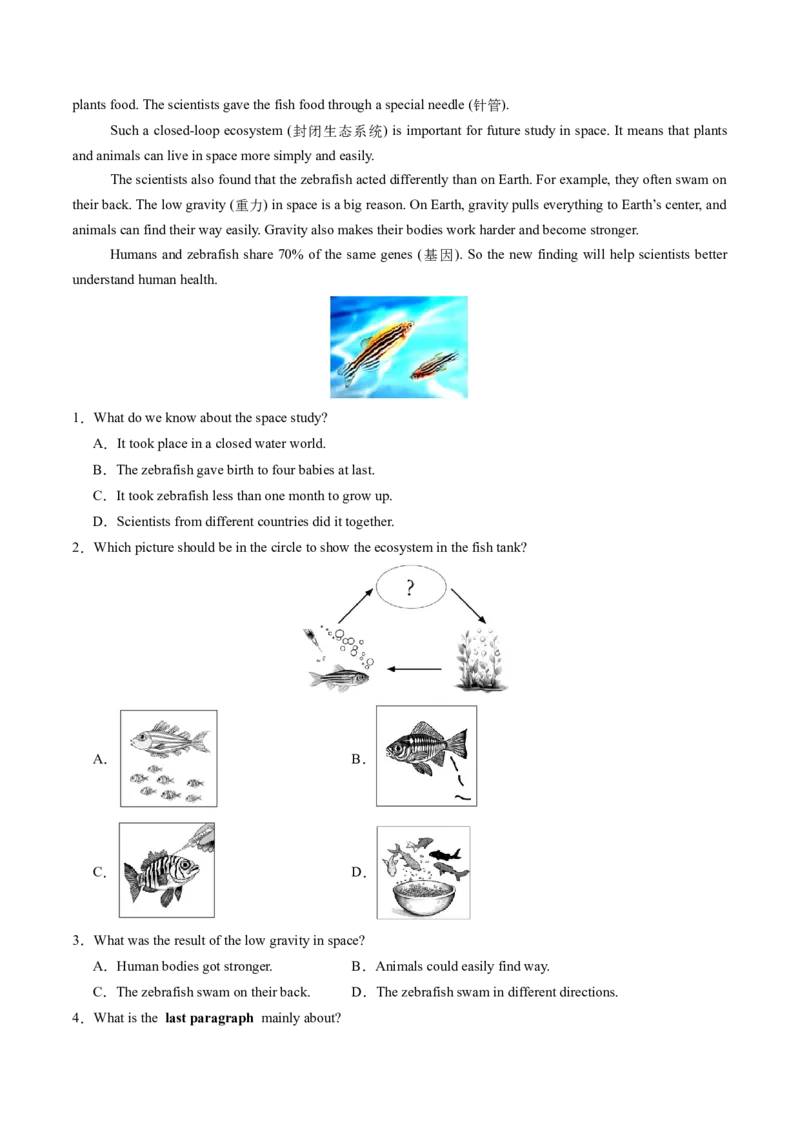
Fish babies in space? In a space study on zebrafish, Chinese had a new record. They successfully got four
zebrafish to live and grow in a closed water world.
The zebrafish went to China’s space station on the Shenzhou18 spaceship on April 25 they then lived in a
closed fish tank with some plants. The fish grew up and had babies in 43 days.
In their special closed water world, the plants made air for the fish and the fish’s waste (排泄物) gave theplants food. The scientists gave the fish food through a special needle (针管).
Such a closed-loop ecosystem (封闭生态系统) is important for future study in space. It means that plants
and animals can live in space more simply and easily.
The scientists also found that the zebrafish acted differently than on Earth. For example, they often swam on
their back. The low gravity (重力) in space is a big reason. On Earth, gravity pulls everything to Earth’s center, and
animals can find their way easily. Gravity also makes their bodies work harder and become stronger.
Humans and zebrafish share 70% of the same genes (基因). So the new finding will help scientists better
understand human health.
1.What do we know about the space study?
A.It took place in a closed water world.
B.The zebrafish gave birth to four babies at last.
C.It took zebrafish less than one month to grow up.
D.Scientists from different countries did it together.
2.Which picture should be in the circle to show the ecosystem in the fish tank?
A. B.
C. D.
3.What was the result of the low gravity in space?
A.Human bodies got stronger. B.Animals could easily find way.
C.The zebrafish swam on their back. D.The zebrafish swam in different directions.
4.What is the last paragraph mainly about?A.The plan of the space study. B.The course of the space study.
C.The meaning of the space study. D.The finding of the space study.
3
China has successfully sent a large number of satellites (卫星) and spaceships into space. Space scientists
have been greatly inspired (赋予灵感) by the old stories and famous people when giving them names.
Chinese people dream of going to the moon for many years. Chang’e Flies to the Moon is one of the most
popular stories. As you can see, China’s first man-made satellite to circle around the moon was named Chang’e I.
More interestingly, the moon rover (巡视器) was named after the Jade Rabbit, who is the partner of Chang’e in the
story. These old stories carry people’s best wishes and dreams. With the development of science and technology,
our scientists make them come true.
Kua Fu Runs After the Sun is another story to show how much our Chinese people wanted to know about the
unknown world. Now, Kua Fu is going with the scientists to “visit” the sun, because we have a space project called
KuaFu Mission.
Space scientists also get ideas from ancient (古代的) famous people. For example, Mozi, an ancient
scientist, found that light travels in a straight line over 2,000 years ago. The result made space study take a big step
at that time. So, China’s first quantum (量子) science satellite was named Mozi.
From such simple things like giving names to the satellites, we can see how great our traditional culture is
and what an important role it plays on science and technology.
1.In China, space scientists get ideas from ________ when naming satellites.
①old stories ②traditional projects ③ancient famous people ④popular music
A.①② B.①③ C.②③ D.③④
2.What do we know about Chang’e I according to the passage?
A.It moves around the moon.
B.It is also called the Jade Rabbit.
C.It “visits” the sun with the scientists.
D.It is the world’s first man-made satellite.
3.How does the writer write Paragraph 4?
A.By listing numbers. B.By telling a joke.
C.By giving an example. D.By asking questions.
4.The writer wrote this passage to tell us ________.
A.the names of some famous space scientists
B.the development of science and technology
C.the stories from our traditional Chinese culture
D.the relationship between our culture and science
4
The Shenzhou XV workers returned to Earth on June 4th, 2023 after a six-month task that watched the
completion of the Tiangong space station. They all “felt pretty good” after landing on the ground. Deng Qingming,who achieved (实现) his space dream through this task, was one of them.
The name of Deng, 56 years old, wasn’t known by many people until China launched (发射) the Shenzhou
XIII spaceship. The story of Deng who relentlessly followed his space dream despite serving as a backup (后援)
for years moved many people.
Born in a farming family in Jiangxi Province, Deng joined the PLA Air Force in June 1984 and started
training as a pilot at a flight college in Hebei Province. After graduating in November 1987, the young pilot began
working at a fighter jet regiment (喷气机) in Jilin Province.
In 1996, Deng was finally chosen as an astronaut candidate (候选人) with another 13 pilots. They became
the first members of the PLA Astronaut Division in January 1998.
In the following years, Deng spent almost all of his time training and spared no effort to find a chance to fly
into space. He was a backup crew member for the Shenzhou IX, X, XI, and XIII missions (任务).
“Being a backup doesn’t mean you don’t need to work. I must watch closely in the control center and offer
all I know about the mission and the spacecraft in case of an emergency (紧急事件),” Deng said. “Only when the
crew returns to the Earth will my mission be completed.”
No matter how difficult the road to space flight was, Deng never once thought of giving up. “Whether it is a
crew or a backup, it is a job. And the success of the mission comes before my personal wishes.” Deng once said.
1.Which helped Deng achieve his dream?
A.Shenzhou IX. B.Shenzhou XI. C.Shenzhou X. D.Shenzhou XV.
2.What does the underlined word “relentlessly” mean?
A.不停地 B.疲惫地 C.急切地 D.繁忙地
3.What’s the correct order of the events?
①Deng joined the PLA Air Force.
②Deng achieved his space dream.
③Deng worked at a fighter jet regiment.
④Deng became a member of the PLA Astronaut Division.
A.③④②① B.①③④② C.③①④② D.③④①②
4.What’s the best title for the passage?
A.Chinese Space Develops Smoothly B.“Stay-at-home”Astronaut’s Dream Came True
C.Astronauts’ Mission Changes in Space D.Astronauts’ Hard Training Happens All the Time
5
①Stephen Hawking, one of the world’s most famous scientists, once said, “Once we step into space, our
future should be safe (安全的),” Do you agree with him?
②Today, many countries such as the United States, Russia, China, are building space stations and sending
astronauts there. These stations will prepare humans to visit and later live on Mars (火星) or other earth-like
planets.
③Robert Zubrin, a rocket scientist, thinks it is a right thing for the countries to do so. Humans should moveto other planets and build new homes there. He wants to start with Mars. Why? He thinks sending people to Mars
will help us to learn a lot of things—for example, the ability (能力) of humans to live in a very different
environment. In the end, we could work and live on other planets. Besides, any improvement we make in science,
medicine and health will do good to people here on Earth.
④Elon Musk, the founder and CEO of Space X, a company (公司) that builds rockets, also believes we
should send humans to Mars. His plan is to put about one million people there if some bad things happen to us here
on Earth.
⑤ ▲ . Many people say it’s too expensive. Also, most space trips are not short. A one-way trip to Mars, for
example, would take at least six months. People who have such a long way to travel could face many health
problems. What’s more, these first people would find life really difficult in space. On the moon’s surface (表面),
for example, the sun’s rays (光线) are very dangerous. People would have to stay indoors most of the time.
⑥Although there will be lots of difficulties, sending people into space seems certain. As the saying goes,
“My conquest (征途) is the sea of stars.” In the future, we might see cities or even new human cultures on other
planets.
1.How does the writer start the passage?
A.By using a science report. B.By using a man’s idea.
C.By using a famous saying. D.By using a study result.
2.What do both Robert Zubrin and Elon Musk probably agree?
A.It’s impossible to send humans into space.
B.People should live on the moon in the future.
C.It’s not a good idea to live on the Earth.
D.It’s necessary to send humans to other planets like Mars.
3.Which of the following sentences can be put in ▲ in Paragraph 5?
A.As a result, it is not easy to build space stations on the moon.
B.Many people also worry about the cost of space trips.
C.Not everyone thinks sending humans into space is a smart idea.
D.Sending humans to Mars is the only way to solve Earth’s problems.
4.Which shows the right structure of the passage?
A. B.
C. D.
6What is the far side of the moon like? Dark, cold and empty. But it will soon have a visitor—China’s
Chang’e 6 probe (探测器).
The Chang’e 6 probe will be the first in the world to take stone and soil samples from the moon’s far side.
The probe was launched successfully from Hainan on May 3.
Humans have done 10 missions (任务) to the moon to bring back moon samples, including China’s Chang’e
5 mission in 2020. However, all these missions so far have visited the side of the moon that faces Earth.
Because the moon turns at the same speed as it circles Earth, we can never see the far side of the moon. This
makes it hard to stay in contact with any spacecraft that goes there.
To help the Chang’e 6 space probe “talk” to Earth, China sent a new relay satellite (中继卫星) called
Queqiao 2 into space to travel around the moon, helping send messages back.
The Chang’e 6 probe also has new smart tools to help it collect samples better. “Even if the probe loses
contact with Earth, it can do important work by itself,” Wang Qiong, deputy chief designer of the Chang’e 6
mission.
The Chang’e 6 mission to the moon will take 53 days. During this time, the probe will go into orbit (轨道)
around the moon and land in a place called the South Pole-Aitken Basin. It is a huge crater (撞击坑) on the far side
of the moon. There, it will collect up to 2 kilograms of stone and soil to bring back to Earth. Scientists will study
these samples to learn more about the moon.
1.How is Chang’e 6’s mission different from other missions before it?
A.People can see where the probe works from Earth.
B.The mission will start from the moon’s near side.
C.The probe will bring back stone and soil samples.
D.The probe will work on the far side of the moon.
2.What is the role of Queqiao 2?
A.Sending the Chang’e 6 probe into orbit.
B.Moving between Earth and the moon.
C.Acting as a bridge between Earth and Chang’e 6.
D.Helping people on Earth talk on the phone better.
3.Why is challenging (挑战性) to communicate with a spacecraft on the far side of the moon?
A.The far side is always dark and cold.
B.The far side is out of sight from Earth, making communication difficult.
C.The Chang’e 6 probe does not have the necessary communication tools.
D.The South Pole-Aitken Basin blocks (阻碍) communication signals.
4.What can we learn from the passage?
A.The Chang’e 6 mission will last over two months.
B.Astronauts will collect 2 kilograms of moon samples.
C.The Chang’e 6 mission makes a great achievement in lunar exploration (探索).
D.The Chang’e 6 probe completely depends on people’s control.7
The Earth has just been sent a message from space. People around the world are now trying to find out what
the message says. But the message wasn’t from aliens (外星人). Instead, it’s part of a project designed to see how
humans might react if they did get a message from aliens.
The idea that there might be aliens is popular in books and films. But so far, there’s been no known signs that
they exist (存在). Still, many scientists believe the universe is large enough that it’s likely that other intelligent
creatures could exist somewhere.
▲ The most well-known group is called Search for Extraterrestrial Intelligence (SETI,搜寻地外文明计
划). SETI scientists are working to find signs of life in other parts of the universe. One of the big questions about
such creatures is, if they existed, would we be able to communicate with them? Daniela de Paulis is an artist who’s
working with scientists at SETI. She wanted to know what would happen if the Earth actually received a message
from space. What would people do? Would people be able to work together to find out what the message said?
Ms. de Paulis came up with a project designed to find out what people would do after receiving such a
message. She calls the project “A Sign in Space”. She worked with a group of scientists at SETI to come up with a
secret message. On 24th May, the European Space Agency’s TGO spacecraft beamed the message back to the Earth
from Mars. The signal (信号) was picked up by several radio telescopes (射电望远镜) around the world. The
information from the message has now been put on the Internet. Anyone can download it and try to find out what it
means. A Special website has been set up for people to report their ideas about the message, and talk about any
progress they make in trying to translate it.
1.We may find the passage from a magazine about ________ .
A.environmental protection B.natural disasters
C.life on another planet D.fashion design
2.Why did people send a message from space?
A.To know how people react.
B.To let us know aliens’ lifestyle.
C.To tell that we haven’t found aliens.
D.To use radio telescopes around the world.
3.Which of the following sentences is the most suitable for ▲ ?
A.So far, scientists have already found out the message.
B.In fact, everyone is interested in what the message says.
C.A number of scientists are trying to find signs of such creatures.
D.The aliens try their best to talk to people on the Earth these years.
4.What do we know about Daniela de Paulis according to the passage?
A.She has little interest in aliens.
B.She thought of a secret message by herself.
C.She is a scientist who shows great interest in art.
D.She worked with scientists at SETI on the project.8
The Starlink system, is a main product of an American company called Space X. The company plans to send
about 42,000 satellites to offer much faster and less expensive satellite (卫星) internet around the world.
In order to send information faster, Space X has put built-in lasers (激光) on its newest Starlink satellites.
With the higher speed of light in vacuum (真空) and the shorter path than undersea fiber (纤维), the laser links in
orbit (轨道) help send satellite internet faster. And by getting closer to our planet and networking, Starlink satellites
can quickly send a large amount of information to any point on Earth, even across oceans.
However, some astronomers are afraid that bright satellites in Earth’s orbit will make them difficult to
“watch” the universe. And some scientists are worried that there will probably be more space junk when the
satellites are out of use or when the satellites hit others. The junk of course will be harmful to spaceships or space
stations. And when some of the falling junk burn up in Earth’s atmosphere (大气层), it will cause uncertain changes
in Earth’s climate (气候).
Although the company promised that the satellites seemed impossible to hit others, the risk is still there. In
2021, China’s space station had to change its orbit to avoid the possible danger when Starlink satellites came close
to it.
So does the Starlink system really have more advantages to humans in the long term? Or will the risks
outweigh its advantages? We still do not know the answers.
1.Why can the newest Starlink satellite send information faster?
A.Because it has used built-in lasers. B.Because it is close to space stations.
C.Because it has used undersea fiber. D.Because it is far from Earth’s orbit.
2.What does Paragraph 3 mainly talk about?
A.It’s about how the Starlink system works.
B.It’s about what the Starlink system looks like.
C.It’s about why the Starlink system is impossible.
D.It’s about what risks Starlink system may cause.
3.Which of the following statement is TRUE according to the passage?
A.The Indian company has sent the Starlink satellites.
B.The Starlink system needs 420,000 satellites in total.
C.The return of useless satellites may cause more space junk.
D.The Starlink satellite changed its orbit to avoid danger in 2021.
4.What is the purpose of the passage?
A.To encourage people to use the Starlink in their daily life.
B.To introduce the bright future of a new invention of Space X.
C.To show some worries about the development of the Starlink system.
D.To provide some latest news about the progress of the Starlink system.
9
We have always been interested in the moon. 2000 years ago people already knew it moved around the earthand where it would be in the sky at different times of the year. At that time, everything about the moon was learned
by watching it carefully in the sky.
When scientists could use telescopes (望远镜) to study the moon more closely, their ideas began to change.
They could see the moon was made of rocks. Most scientists thought moon rocks would be different from those on
Earth. This was because they believed the moon had once been a planet (行星) that had been caught in the earth’s
gravity (重力) millions of years earlier.
In 1969 moon rocks were finally brought to the earth and studied. Much to their surprise, scientists found
that, except for water, the moon and the earth were made of the same things. Once again new ideas were needed for
this new information.
After years of study, most scientists now think that the moon was once part of Earth. They believe very early
in its history, maybe 4 million years ago, something about the size of Mars hit Earth. This sent billions of rocks into
space around our planet. These rocks slowly joined together and after many years became the moon.
In the future, even though our ideas about the moon may change again, we will still be interested in it.
1.From the passage we know the moon was made of ________.
A.rocks B.earth C.water D.metal
2.In the passage the writer wants to tell us ________.
A.why people are always interested in the moon
B.how ideas about the moon have changed over time
C.where the moon came from in the past
D.that people have learned everything about the moon.
3.Before 1969 most scientists thought the moon was ________.
A.part of the earth billions of years earlier
B.much older than the earth in age
C.a planet caught by the earth’s gravity
D.made of the same things as the earth
4.Where can you read the passage?
A.In a storybook. B.In an advertisement.C.In a novel. D.In a science magazine.
10
Research shows that the discovery of exoplanets (planets outside our solar system) has changed science
fiction (小说). Now, books and movies present these planets more exactly, making science fiction more important
than before.
Imagine learning about stars in a classroom. You could start with complex (复杂的) pictures and facts, or
you could watch the movie Star Wars where Luke Skywalker sees two suns from his home planet, Tatooine.
Which will more easily awaken the interest of a sleepy high school class?
Science fiction has always caught our attention and it has inspired (激励) scientists to go for their dreams.
For this reason, it is sometimes used to communicate science to the public, even complex ideas. To be sure that this
is a useful way, it is necessary to understand how science fiction shows actual science.Emma Johanna Puranen and her team from the University of St Andrews and the Austrian Academy of
Sciences did some research, studying a lot of science fiction works, including novels, movies, TV shows, podcasts,
and video games to see how science fiction reflects (反映) real scientific discoveries about exoplanets. “Most
stories that are set in space will finally have a scene (场景) on an exoplanet,” explains Puranen. “The reason for
using exoplanets is that there was a huge change in our scientific understanding in 1995 when the first exoplanet
around a sun-like star was discovered.”
“Traditionally in science fiction, mostly there have been Earth-like planets,” explains Puranen. “But what has
changed since the discovery of real exoplanets is that the fictional exoplanets have actually become a bit less Earth-
like.”
According to real science, many exoplanets are very different from Earth and often not in the “Goldilocks
zone”, where conditions are friendlier to life as we know it. “I can guess that maybe writers of science fiction are
reading all these headlines about worlds that are covered in lava or where it’s raining diamonds, which you see in
the media,” says Puranen.
Science fiction, in a way, reflects the knowledge and discoveries of its time. This makes it a valuable tool for
science communication. It can introduce people to new scientific ideas in an interesting and understandable way.
This research highlights the connection between scientific discoveries and creativity. While exploring the
universe, science fiction can develop curiosity (好奇心) and make further research possible, making the subject of
exoplanets an important example of how science and imagination improve each other.
1.The writer mentioned the movie Star Wars to ________.
A.explain what an exoplanet is like in a humorous way
B.present the result of the latest research about exoplanets
C.show an interesting way of sharing science with everyone
D.introduce a popular scientific movie by a famous director
2.How has science fiction changed after the discovery of the first exoplanet?
A.It gives more attention to Earth.
B.It describes the Earth differently.
C.Science fiction has lost interest in explaining exoplanets.
D.Exoplanets in science fiction have become less Earth-like.
3.The words “Goldilocks zone” in Paragraph 6 most probably mean ________.
A.a space found on an exoplanet B.an important part of our solar system
C.an area which is good for scientific activities D.a place that provides living environment for life
4.The writer probably agrees that ________.
A.science fiction has played an active part in communicating science
B.scientific discoveries have slowed the development of imagination
C.science fiction has become less popular because of scientific discoveries
D.new scientific discoveries have made science fiction easier to understand