主题 13 污染治理及其方法
主题简析
初中八年级英语阅读中污染治理及其方法这一主题,紧密联系社会现实,兼具语言学习与社会教育价
值。从语言层面看,学生能够积累 “pollution”“recycle”“sustainable development” 等专业词汇,以
及 “reduce waste”“combat pollution”“raise environmental awareness” 等实用短语,提升英语表达的
准确性和多样性。在阅读文本时,学生需梳理作者对不同污染类型(如空气污染、水污染、垃圾污染)的
描述,以及对相应治理方法的阐释逻辑,锻炼文本分析与归纳总结能力。从社会教育角度而言,这一主题
促使学生关注日益严峻的环境问题,认识到污染对人类健康、生态平衡的危害,激发学生的环保责任感。
引导学生将理论知识转化为实际行动,在日常生活中践行绿色生活方式,比如进行垃圾分类、节约水电,
甚至带动身边人共同参与环保行动,实现语言学习与环保素养的协同提升 。
词句积累
主题表达示例
一、描述污染类型
1. 词汇
pollution(污染)、air pollution(空气污染)、water pollution(水污染)、noise pollution(噪音污染)、
litter(垃圾;废弃物)
2. 短语
industrial pollution(工业污染)、plastic waste(塑料垃圾)、rubbish pile(垃圾堆)、chemical pollution
(化学污染)
3. 句式
Air pollution is a serious problem that affects our daily lives.(空气污染是一个影响我们日常生活的严重问
题。)
Water pollution is mainly caused by industrial waste.(水污染主要由工业废料造成。)
二、描述污染治理行动
1. 词汇
recycle(回收利用)、reduce(减少)、reuse(重复使用)、plant(种植)、clean(清理)
2. 短语
reduce waste(减少浪费)、sort garbage(垃圾分类)、save energy(节约能源)、plant trees(植树)、
clean up rivers(清理河流)
3. 句式
We should recycle plastic bottles to save resources.(我们应该回收塑料瓶以节约资源。)
Sorting garbage is an effective way to reduce pollution.(垃圾分类是减少污染的有效方法。)三、描述污染危害及治理意义
1. 词汇
harm(危害)、damage(破坏)、benefit(益处)、protection(保护)
2. 短语
do harm to(对…… 有害)、damage the environment(破坏环境)、environmental protection(环境保
护)、improve air quality(改善空气质量)
3. 句式
Pollution does great harm to our health and the environment.(污染对我们的健康和环境危害极大。)
Environmental protection is crucial for the future of our planet.(环境保护对我们星球的未来至关重要。)
Taking actions to combat pollution can improve our living conditions.(采取行动对抗污染可以改善我们的生活
条件。)
拓展阅读
Environmental Protection in Daily Life
Nowadays, environmental protection has become an important issue. Although we are just middle school
students, we can still do a lot to help protect the environment in our daily lives.
First, we can reduce waste. For example, bring your own reusable bag when you go shopping instead of using
plastic bags. By doing this, we can cut down on plastic waste. Also, try to avoid buying things with too much
packaging. Many products come in layers of boxes and plastic, which is a huge waste. Refusing single - use items
like chopsticks and straws is another good way to reduce waste.
Second, recycling is a great way to protect the environment. We can separate waste into different groups.
Paper, plastic, glass, and metal can all be recycled. In many communities, there are special recycling bins. Put your
recyclable waste in the right bin, and it can be made into new products. This helps save natural resources.
Third, we can save energy at home. Remember to turn off the lights when you leave a room. Unplug chargers
and other electronics when they are not in use. Take shorter showers to save water. These small actions can add up
and make a big difference.
Moreover, planting trees is also a simple yet effective way to protect the environment. Trees can clean the air,
reduce noise pollution, and provide homes for wildlife. We can join tree - planting activities in our free time.
Environmental protection starts with small actions in our daily lives. Let’s all work together to make the earth
a better place.
参考范文:
日常生活中的环境保护
如今,环境保护已成为一个重要议题。尽管我们只是中学生,但在日常生活中,我们仍然可以做很多
事情来帮助保护环境。
首先,我们可以减少浪费。例如,购物时带上自己的可重复使用的袋子,而不是使用塑料袋。通过这
样做,我们可以减少塑料垃圾。此外,尽量避免购买过度包装的商品。许多产品有层层盒子和塑料包装,这是巨大的浪费。拒绝使用一次性筷子和吸管等一次性物品,也是减少浪费的好方法。
其次,回收利用是保护环境的好方法。我们可以将垃圾进行分类。纸张、塑料、玻璃和金属都可以回
收利用。在许多社区,都有专门的回收垃圾桶。将可回收垃圾放入正确的垃圾桶,它们就能被制成新产
品。这有助于节约自然资源。
第三,我们可以在家节约能源。离开房间时记得关灯。不用充电器和其他电子产品时,拔掉它们的插
头。缩短洗澡时间以节约用水。这些小行动积累起来会产生很大的影响。
此外,植树也是一种简单而有效的环保方式。树木可以净化空气、减少噪音污染,并为野生动物提供
栖息地。我们可以在空闲时间参加植树活动。
环境保护始于日常生活中的小行动。让我们共同努力,让地球变得更美好。
综合演练
1
Most of the energy we use for heating, lighting, transportation and manufacturing (制造业) comes from
fossil (化石) fuels. These are carbon-based fuels from oil, coal and natural gas.
There are three main disadvantages to using these fuels. Firstly, they are causing climate problems because
of the greenhouse effect. When we burn fossil fuels they produce carbon dioxide which causes global warming.
Secondly, when we have used up all our coal, oil and natural gas, we will have nothing left to burn. Thirdly, they
are not very efficient. The internal combustion engine (内燃机) that we use in most cars, trucks and buses, for
example, is only about14% efficient.
Scientists are working on another fuel-hydrogen (氢). There are a couple of advantages to using hydrogen as
a fuel. Firstly, because two-thirds of the Earth’s surface is water and water is made of hydrogen and oxygen. There
is an almost unlimited supply of hydrogen. Secondly, burning hydrogen does not cause global warming. Thirdly, it
is much more efficient than carbon-based fuels.
Unfortunately, there are problems with hydrogen at the present time. We don’t know how to separate it from
water cheaply, and there is difficulty of storing it. It can be stored under pressure but high pressure tanks are far
from safe. It can also be stored as a liquid but only at extremely low temperatures. It seems likely, therefore, that
there will have to be a completely new technology before hydrogen replaces fossil fuels. Solving these problems is
an urgent matter. Although China, India and Australia have huge amounts of cheap coal, and there are still large oil
and gas reserves (储藏量) elsewhere, the effects on the planet’s climate will be worse if they are still used.
1.________ isn’t carbon-based fuel.
A.Hydrogen B.Natural gas C.Coal D.Oil
2.Using carbon-based fuels can ________.
A.cause traffic accidents B.cause floods and forest fires
C.produce hydrogen and oxygen D.produce carbon dioxide
3.Which of the following is NOT true according to the passage?
A.It’s difficult to store hydrogen.
B.Storing hydrogen is dangerous in high pressure tanks.C.There are almost unlimited carbon-based fuels on the Earth.
D.Water is made of hydrogen and oxygen.
4.The underlined word “global” means “________”.
A.ball-shaped B.world-wide C.atmosphere’s D.the Earth’s surface’s
5.Perhaps ________ can reduce the air pollution.
A.China, India and Australia B.a new technology to get hydrogen
C.the greenhouse effect D.the internal combustion engine
6.The best title for the passage is “________”.
A.Fossil Fuels’ Reserves B.Oxygen and Carbon Dioxide
C.The World’s Most Important Fuels D.Using New and Efficient Fuels
2
Do you think of white when someone talks about a polar bear? In fact, the polar bear does not have white fur.
It just seems to be white when the sun shines on ice. Polar bears have a very good sense of smell. It helps them find
food. During summer, polar bears sleep longer, because they are able to find their food more easily at night.
Usually, after a meal, polar bears have a short sleep. A polar bear can have 2-3 babies at a time. They live with their
mothers until they are about two and a half years old.
However, polar bears will die out soon because of people. There are only 20,000 to 25,000 polar bears in the
world. Those polar bears left are trying to survive (生存) today. The number of them is becoming smaller and
smaller because of the loss of sea ice-polar bears mostly live in the sea ice, not the land ice. This is happening
because of global warming. Besides, they also have to face pollution, hunting and so on.
Some people don’t care, but other people want to save tigers, fight for giant pandas and save polar bears.
Join them and try to make the world a better place for those beautiful and lovely animals.
1.What do Polar bears have?
A.A good sense of touch. B.A good sense of hearing.
C.A good sense of sight. D.A good sense of smell.
2.According to the passage, what problems are polar bears facing?
A.Pollution and global warming. B.Sleeping and hunting.
C.Food and the loss of land ice. D.Bad sense of smell and pollution.
3.What can we learn from the passage?
A.Polar bears’ fur is white.
B.Polar bears have a good, happy life.
C.Polar bears can have more than three babies at a time.
D.It’s easier for polar bears to find food at night in summer.
4.What is the main idea of this passage?
A.To let people know why polar bears are in danger.
B.To show the number of polar bears is getting smaller.
C.To talk about polar bears and ask people to protect them.D.To tell people that polar bears will soon have nowhere to live.
3
①Have you ever chatted with a smart AI assistant on your phone or computer, like asking it to help you with
your homework? They’re pretty amazing, right? ★ . Scientists from the Chinese Academy of Sciences and
Reichman University in Israel have found that these clever AI helpers, also called LLMs (Large Language Models)
might be causing some trouble for our environment.
②Have you noticed that your phone lends to heat up when you are playing video games? That’s because it
uses a lot of energy (能源). AI systems, especially the ones that can chat and create stuff (东西), need even more
energy. They’re like power-hungry brains that need lots of computer parts and special places to live, which means
they use up a lot of resources (资源).
③Now, think about your old toys that you’ve outgrown and thrown away. Last year, we only had to throw
away 2.6 thousand tons of electronic stuff that was used just for AI. But by 2030, because of these AI systems, we
might have to throw away between 1.2 million and 5 million metric tons more. And here’s the kicker: the total
amount of electronic waste from all our tech is expected to jump by about a third to 82 million metric tons by
2030.
④So, while these AI systems are super cool and helpful, they’re also making our already big problem of
electronic waste even bigger. It’s something we should all be aware (意识) of as we use more and more technology
in our lives.
1.Which of the following can be put in ★ ?
A.Well, there’s something you should know. B.However, it won’t work any more.
C.Why is it so popular now? D.Let’s have a try.
2.What BIG question does paragraph 2 answer?
A.What are LLMs?
B.How do LLMs cause trouble for our environment?
C.What can LLMs do for us?
D.How much energy do LLMs use?
3.The underlined word “jump” to paragraph 3 probably means ________.
A.move quickly B.pass over C.leave out D.rise suddenly
4.By 2030, electronic waste is expected to up to ________.
A.2.6 thousand tons B.a third of all our lech
C.82 million metric tons D.Between 1.2 and 5 million metric tons
5.What can we learn from the passage?
A.We should be more aware of the environmental problems as we use more technology.
B.Let’s focus on the bright side of AI and take action to improve it.
C.AI systems are designed to be environmentally friendly.
D.There is no need to worry about AI’s impact on electronic waste.
4Microplastics (微塑料) are very small. But they bring big problems. A new study said that by 2040,
microplastic pollution (污染) could be twice as bad as it is now. Scientists learned this by looking at 20 years of
studies on microplastics.
Microplastics are very small pieces of plastic. They come from many places. For example, About 60 percent
of material made into clothing is plastic Every time they are washed, they shed (掉落) microplastics. When water
bottles and other big plastic items are left outside, they break down slowly into microplastics.
According to National Geographic, microplastics are usually less than five millimeters (毫米) in size. This
small size lets them go everywhere, even in water and air. They don’t break down (分解) easily and can stay in the
environment (环境) for hundreds of years.
This can be bad for our health. In August, The Conversation reported that scientists found microplastics in
people’s brains for the first time. They may hurt brain cells (脑细胞) and change how the brain works.
Wild animals are also at risk from microplastic pollution. Each year, up to three million tons of microplastics
end up in the sea. Since they are too small to be seen, fish may eat them by mistake and become very sick.
To deal with the problem, scientists think the best way right now is to make and use less plastic.
1.What do we know about microplastics?
A.They showed up 20 years ago. B.They are causing more pollution.
C.They mainly come from making clothes.D.They are usually about-ID millimeters.
2.Why are microplastics a problem for the environment?
A.Because they take a long time to break down. B.Because they mainly end up in water.
C.Because they are too small to be reused.D.Because they can move fast in the air.
3.What are Paragraphs 4-5 mainly about?
A.Microplastic pollution is hard to deal with.
B.Microplastics can cause different kinds of pollution.
C.Microplastics can hurt certain kinds of fish.
D.Microplastics can bring health problems to humans and animals.
4.What do scientists think is the best way to deal with microplastic pollution?
A.Taking plastic out of the sea. B.Making and using less plastic.
C.Governments making laws about it. D.Helping microplastics break down.
5
Hundreds of years ago, life was much harder than it is today. People didn’t have modern machines. There
was no modern medicine, either.
Life today has brought new problems. One of the biggest is pollution. Water pollution has made our rivers
and lakes dirty. It kills our fish and pollutes our drinking water. Noise pollution makes us talk louder and become
angry more easily. Air pollution is the most serious kind of pollution. It is bad to all living things in the world.
Cars, planes and factories all pollute our air every day. Sometimes the polluted air is so thick (厚的) that it is
like a quilt over a city. This kind of quilt is called smog (烟雾).
Many countries are making rules to fight pollution. Factories must now clean their water before it is thrownaway (倾倒) and they mustn’t blow dirty smoke into the air.
We need to do many other things. We can put waste things in the dustbin and not throw them on the ground.
We can go to work by bus or with our friends in the same car. If there are fewer people driving, there will be less
pollution.
Rules are not enough. Every person must help to fight pollution.
1.Hundreds of years ago, life was much harder because ________.
A.there was no modern medicine
B.there were not any modern machines
C.both A and B
2.What is the biggest problem in today’s life?
A.Water pollution B.Air pollution C.Pollution
3.The most serious kind of pollution is ________.
A.water pollution B.air pollution C.noise pollution
4.Factories must clean their water ________.
A.before it is thrown away
B.after it is thrown away
C.while it is thrown away
5.From the passage, we know that ________.
A.people are making rules to fight pollution
B.today people don’t have to talk to each other in a loud voice
C.we can drink water from the polluted rivers and lakes
6
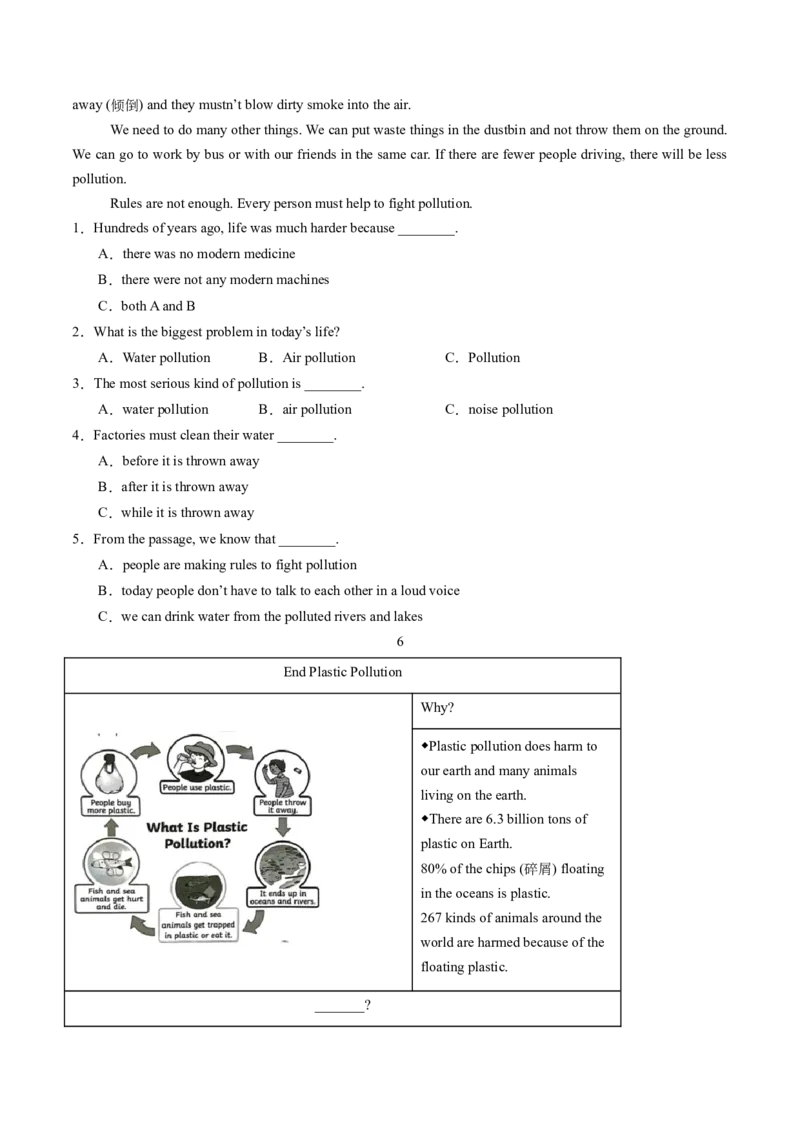
End Plastic Pollution
Why?
◆Plastic pollution does harm to
our earth and many animals
living on the earth.
◆There are 6.3 billion tons of
plastic on Earth.
80% of the chips (碎屑) floating
in the oceans is plastic.
267 kinds of animals around the
world are harmed because of the
floating plastic.
_______?◆Reduce: say no to single-use plastic,such as plastic
straws and cups.
◆Reuse:make sure you use the plastic items you have
many times instead of buying new ones.
◆Recycle:check for the recycling symbol before buying
plastic items and make sure always recycle plastic.
1.The material above is a ________.
A.notice B.diary C.survey D.poster
2.Which word is the most suitable for _______?
A.Where B.Why C.How D.When
3.According to the chart above, ________ may badly hurt because of plastic pollution.
A.sea animals B.long rivers C.little kids D.wild plants
4.The writer tells us plastic has been a disaster to our earth by ________.
A.asking questions B.listing numbers C.telling stories D.sharing
experiences
5.The material above was designed mainly to ________.
A.encourage people eat fewer fish in oceans
B.call on people to help end plastic pollution
C.teach people how to recycle plastic properly
D.ask people not to throw rubbish into oceans
7
Earth is often called the Blue Planet. That’s because about three-fourths of the earth is covered by water.
People think we are not short of water. In fact, they are wrong. Most of the water is salt water. We can find it in the
world’s oceans. Only about 3% is fresh water that we can drink.
Although you might think that most of the fresh water on the earth is found in the lakes and rivers, in fact,
less than 1% of the fresh water can be found in these places. Around 70% of the earth’s fresh water is ice in the
polar (极地的) places. They are far from us. And the water there is tough to transport (运输).
The second greatest source (资源) of fresh water on the earth is under the ground. This kind of water is
called groundwater. Places that don’t have fresh water from rivers and lakes depend on groundwater for drinking
and other uses. Groundwater also can’t get away from pollution. Chemicals (化学制品) that are used in farming
and factories can get into the ground.
The earth has little usable water. Luckily, each of us can do something to save water. Kids and adults are
trying their best to save water in their own communities (社区). If we work together, we will have a better world.
1.What percentage of the earth is covered by water?
A.About 25%. B.About 75%. C.About 43%. D.About 85%.
2.What does the underlined word “tough” in Paragraph 2 mean?
A.危险的 B.普通的 C.困难的 D.简单的3.Which one can lead to the pollution to underground water according to the passage?
A.Chemicals. B.Ice. C.Rubbish. D.Rain.
4.Which of the following is TRUE?
A.People are not short of water.
B.Most of the water in oceans is fresh water.
C.We can find most of the fresh water in the rivers on the earth.
D.About 70% of the earth’s fresh water is ice in the polar places.
8
Each year a large number of new cars are made. Most Americans won’t live without cars! However, the
problem of air pollution made by cars becomes serious.
One way to make air cleaner is to make a new kind of car. That’s what large car factories are trying to do.
But to make this kind of car is easier said than done. Progress in this field has been slow. Another way is to take the
place of the car engine (发动机) by something else.
To stop the world from being polluted by cars, we’ll have to make some changes in the way we live.
Americans, for example, have to cut down the number of their cars. They are encouraged (鼓励) to travel and go to
work by bike.
But this change does not come easily — a large number of workers may lose their jobs if a car factory closes
down. The problem of air pollution may become less important than the problem of unemployment (失业).
Although cars have brought us a better life, they have also brought us new problems.
1.Some large car factories are trying to make a new kind of car which ________.
A.is clean itself B.can clean streets
C.makes less polluted air D.is easier to make
2.If the number of the cars is cut down, the most serious problem for workers is to ________.
A.have no work to do B.improve their environment
C.make their factories richer D.go to work by bike
3.The writer wants to tell us that ________.
A.riding a bike is the only way to stop air pollution
B.the number of the cars must be cut down
C.people won’t live without cars
D.cars bring us not only a better life but also new problems
4.Which of the following is TRUE?
A.Every American worker in car factories hasn’t got a car.
B.To make a new kind of car is one way to make air cleaner.
C.It is easy to change the way of life in the USA.
D.In the USA bikes will take the place of cars in the future.
5.Which is the best title for the passage?
A.A New Way to Stop Air Pollution B.Cars and Air PollutionC.Many Serious Problems in the USA D.Changes in Car Production
9
Do you know the Air Quality Index (空气质量指数)or AQI reported in the newspaper? The AQI helps us
understand what the air quality around us means to our health. The AQI uses colors, numbers and words to tell us
about the air. What do these colors and numbers mean? Let’s have a look.
AQI Colors AQI Numbers Health Words
Green 0—50 Good
Yellow 51—100 Moderate (适中的)
Orange 101—150 Unhealthy for sensitive (敏感的) groups
Red 151—200 Unhealthy
Purple 201—300 Very Unhealthy
When the AQI color is green, just enjoy the clean air! Yellow shows the air quality is fine for most people.
Orange tells us that people with lung disease (肺病) should spend less time outdoors. When the AQI color is red,
people shouldn’t spend too long time outdoors. Everybody else should try to spend less time outside. Purple shows
everybody should try not to go outside.
1.The AQI doesn’t use ________ to show the air quality.
A.picture B.colors C.numbers D.words
2.If the AQI color is ________, the air quality is good for most people.
A.orange B.red C.purple D.yellow
3.If the weather report says today’s AQI is 250, we should ________.
A.enjoy the clean air B.try not to go outside
C.spend more time outside D.stay inside some of the time
4.The ________ the AQI numbers are, the ________ the air quality is.
A.bigger; better B.bigger; worse C.small; good D.smaller; worse
5.Which of the following is true according to the passage?
A.When the AQI number is 140, the AQI color is red.
B.If the AQI color is purple, the air is the best for people.
C.People with lung disease are very sensitive to the air.
D.The AQI can’t help people to know the air quality.
10
Today I’m here to talk about noise pollution. Not all noise is noise pollution. Noise becomes noise pollution
when it’s loud, when it’s not necessary and when it begins to harm human and animal life.
Examples of noise pollution include the sounds of cars, buses, lorries, trains and planes. When you stand
near a busy road, sometimes the noise can hurt your ears. And people living near airports often find it difficult to
sleep. Noise pollution can also be from machines. We often use very noisy machines around the house or at ourjobs. Factory noise is also a big problem. Finally, sometimes, loud music can be a form of noise pollution. For
example, the music from a club or from your next-door neighbour.
We must think that noise pollution is just a small problem, but actually it can be dangerous. Some people
have become deaf because of noise pollution. What’s more, when people lose sleep because of noise pollution, they
become careless. This can lead to accidents, and people can get hurt or even killed. Finally, noise pollution makes
people feel stressed. This can lead to heart disease.
What can we do about the problem of noise pollution? We need stronger laws against loud noises. The
government also needs to put up walls next to roads and airports to protect people from noise. Finally, we can all
help with the problem of noise pollution by turning down our music and TVs, and using a softer voice when we
talk.
1.Noise becomes noise pollution when ________.
A.it’s low enough for people to hear B.it’s necessary to be loud
C.it begins to harm human and animal life D.it comes from your earphone
2.How many kinds of noise pollution are mentioned in this passage?
A.Five. B.Six. C.Seven. D.Eight.
3.The main idea of paragraph 3 is ________.
A.the causes of the noise pollution B.the harm of the noise pollution
C.to reduce the noise pollution D.to enjoy the noise pollution
4.We can all help with the problem of noise pollution by ________.
A.turning off our music and TVs B.putting up walls next to our homes
C.making laws against factories and airports D.using a softer voice when we talk
11
A new study has found that light pollution is making the night sky brighter and the stars dimmer (暗淡).
The study examined data (数据) from more than 50,000 star watchers across the world. It found that man-
made lighting is making the night sky about 10 percent brighter each year.
Data for the study was collected from 2011 to 2022. The research findings recently were written in a book.
The result was a much faster rate of change than scientists had guessed in the past.
“We are losing, year by year, the chance to see the stars,” said Fabio Falchi. He is a physicist at the
University of Santiago de Compostela in Spain. He was not a researcher in the study.
“If you can still see the dimmest stars, you are in a very dark place.” Falchi said. “But if you see only the
brightest ones, you are in a very light-polluted place.”
As cities expand (扩大) and put up more lights, a “sky glow” is created in the sky. “Sky glow” is a word
scientists use to describe light that becomes more intense (强烈的).
The research team gave an example to make the result clear. If a child is born where 250 stars can be seen on
a clear night, by the time that child turns 18, only 100 stars will be seen.
1.What kind of pollution is the passage talking about? ________
A.Waste pollution.B.Land pollution.
C.Noise pollution.
D.Light pollution.
2.How long was data for the study collected? ________
A.For about eight years.
B.For about ten years.
C.For about twelve years.
D.For about fourteen years.
3.What do we know about Fabio Falchi? ________
A.He is a researcher in the study.
B.He is a physicist at a university.
C.He is an environmental protector.
D.He is a star watcher.
4.Which of the following is NOT true according to the passage? ________
A.The study examined data from over 50,000 star watchers across the world.
B.The research findings recently were written in a book.
C.Fabio Falchi thinks we are losing chances to see the stars year by year.
D.If you can see only the brightest stars, you are in a very dark place.
5.The passage wants to tell us that ________.
A.light pollution is bad for the environment
B.man-made lighting is making the night sky more beautiful
C.“sky glow” is a word that scientists use to describe dim light
D.children can only see 100 stars when they grow up
12
Trash (垃圾) for Toilet Use
In recent years, tourism has developed rapidly in West China. This has led to a huge increase in trash. Most
of it has been left behind by tourists. In 2021, photos of plastic waste along the Qinghai-Xizang Highway (青藏公
路) were shared online. This made local people worried about the local environment.
Local governments (当地政府) and nonprofits (非营利组织) have tried many different ways to deal with
this problem. One project uses a new idea: trash for toilet use. The project sets up special restrooms in scenic areas.
There’s one such restroom on Mount Zheduo (折多山).To use it, visitors must throw an empty plastic bottle into an
intelligent box. The box will then give them a “green coin.” They can use the green coin to unlock the door of the
restroom.
The project began last November. “Tens of thousands of visitors have taken part in it,” the nonprofit Green
River said in a post on Weibo. “Millions of pieces of trash have been collected.” For some visitors, however, the
project is confusing. One of them shared his experience on social media. “It’s a good idea,” he said. “But it’s
impossible for visitors to always have an empty bottle on hand.” What do you think of this project?1.What can we know about West China from Paragraph 1?
A.Fewer and fewer tourists liked to travel there in recent years.
B.Tourism in West China has led to a huge increase in trash.
C.We only saw a photo of the Qinghai-Xizang Highway online.
D.Local people were not worried about the local environment.
2.What is “trash for toilet use”?
A.One project. B.One restroom. C.One visitor. D.One coin.
3.Who has tried many different ways to deal with this problem?
A.Mount Zheduo. B.Local governments and nonprofits.
C.An intelligent boxer. D.The people who were on business.
4.What can we infer from the third paragraph?
A.The nonprofit Green River has many bottles.
B.Millions of pieces of trash haven’t been collected.
C.Not all visitors think “trash for toilet use” is a good idea.
D.One of local people shared his experience on social media.