26 新人教版八下英语语法总结表
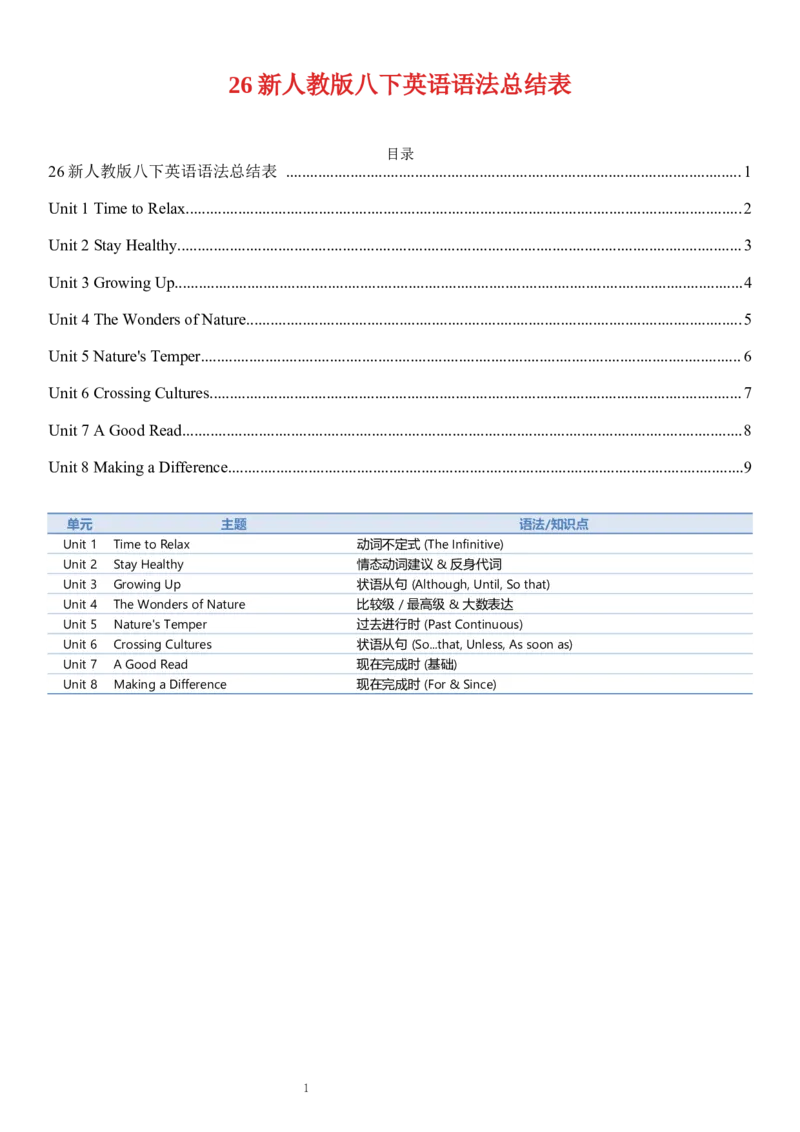
目录
26新人教版八下英语语法总结表 .................................................................................................................1
Unit 1 Time to Relax..........................................................................................................................................2
Unit 2 Stay Healthy............................................................................................................................................3
Unit 3 Growing Up.............................................................................................................................................4
Unit 4 The Wonders of Nature...........................................................................................................................5
Unit 5 Nature's Temper......................................................................................................................................6
Unit 6 Crossing Cultures....................................................................................................................................7
Unit 7 A Good Read...........................................................................................................................................8
Unit 8 Making a Difference................................................................................................................................9
单元 主题 语法/知识点
Unit 1 Time to Relax 动词不定式 (The Infinitive)
Unit 2 Stay Healthy 情态动词建议 & 反身代词
Unit 3 Growing Up 状语从句 (Although, Until, So that)
Unit 4 The Wonders of Nature 比较级 / 最高级 & 大数表达
Unit 5 Nature's Temper 过去进行时 (Past Continuous)
Unit 6 Crossing Cultures 状语从句 (So...that, Unless, As soon as)
Unit 7 A Good Read 现在完成时 (基础)
Unit 8 Making a Difference 现在完成时 (For & Since)
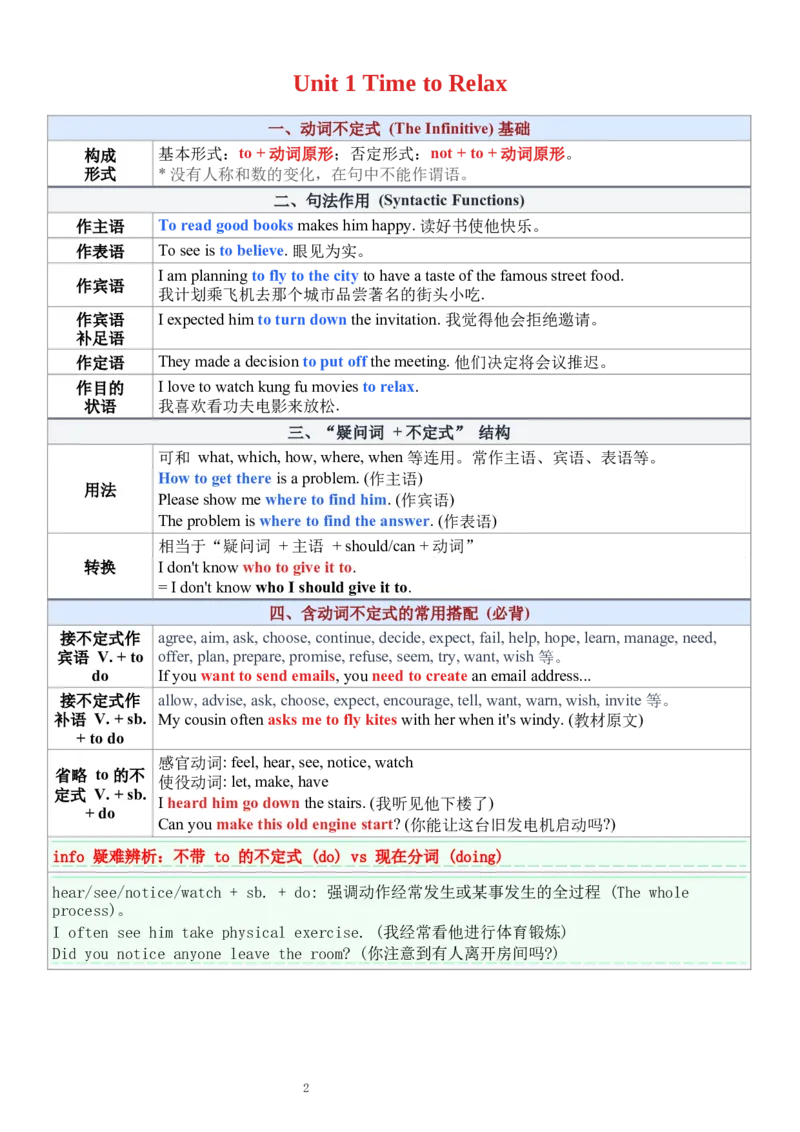
1Unit 1 Time to Relax
一、动词不定式 (The Infinitive) 基础
构成 基本形式:to + 动词原形;否定形式:not + to + 动词原形。
形式 * 没有人称和数的变化,在句中不能作谓语。
二、句法作用 (Syntactic Functions)
作主语 To read good books makes him happy. 读好书使他快乐。
作表语 To see is to believe. 眼见为实。
I am planning to fly to the city to have a taste of the famous street food.
作宾语
我计划乘飞机去那个城市品尝著名的街头小吃.
作宾语 I expected him to turn down the invitation. 我觉得他会拒绝邀请。
补足语
作定语 They made a decision to put off the meeting. 他们决定将会议推迟。
作目的 I love to watch kung fu movies to relax.
状语 我喜欢看功夫电影来放松.
三、“疑问词 + 不定式” 结构
可和 what, which, how, where, when 等连用。常作主语、宾语、表语等。
How to get there is a problem. (作主语)
用法
Please show me where to find him. (作宾语)
The problem is where to find the answer. (作表语)
相当于“疑问词 + 主语 + should/can + 动词”
转换 I don't know who to give it to.
= I don't know who I should give it to.
四、含动词不定式的常用搭配 (必背)
接不定式作 agree, aim, ask, choose, continue, decide, expect, fail, help, hope, learn, manage, need,
宾语 V. + to offer, plan, prepare, promise, refuse, seem, try, want, wish 等。
do If you want to send emails, you need to create an email address...
接不定式作 allow, advise, ask, choose, expect, encourage, tell, want, warn, wish, invite 等。
补语 V. + sb. My cousin often asks me to fly kites with her when it's windy. (教材原文)
+ to do
感官动词: feel, hear, see, notice, watch
省略 to 的不
使役动词: let, make, have
定式 V. + sb.
I heard him go down the stairs. (我听见他下楼了)
+ do
Can you make this old engine start? (你能让这台旧发电机启动吗?)
info 疑难辨析:不带 to 的不定式 (do) vs 现在分词 (doing)
hear/see/notice/watch + sb. + do: 强调动作经常发生或某事发生的全过程 (The whole
process)。
I often see him take physical exercise. (我经常看他进行体育锻炼)
Did you notice anyone leave the room? (你注意到有人离开房间吗?)
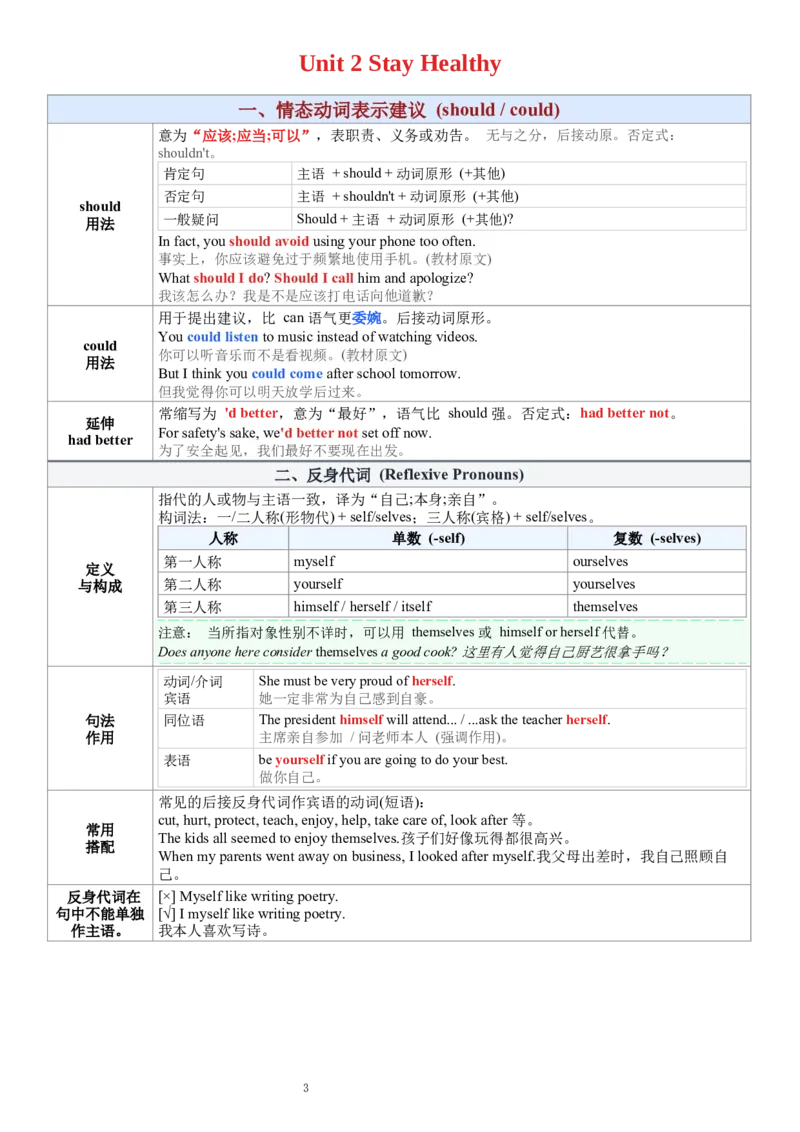
2Unit 2 Stay Healthy
一、情态动词表示建议 (should / could)
意为“应该;应当;可以”,表职责、义务或劝告。 无与之分,后接动原。否定式:
shouldn't。
肯定句 主语 + should + 动词原形 (+其他)
否定句 主语 + shouldn't + 动词原形 (+其他)
should
一般疑问 Should + 主语 + 动词原形 (+其他)?
用法
In fact, you should avoid using your phone too often.
事实上,你应该避免过于频繁地使用手机。(教材原文)
What should I do? Should I call him and apologize?
我该怎么办?我是不是应该打电话向他道歉?
用于提出建议,比 can 语气更委婉。后接动词原形。
You could listen to music instead of watching videos.
could
你可以听音乐而不是看视频。(教材原文)
用法
But I think you could come after school tomorrow.
但我觉得你可以明天放学后过来。
常缩写为 'd better,意为“最好”,语气比 should 强。否定式:had better not。
延伸
For safety's sake, we'd better not set off now.
had better
为了安全起见,我们最好不要现在出发。
二、反身代词 (Reflexive Pronouns)
指代的人或物与主语一致,译为“自己;本身;亲自”。
构词法:一/二人称(形物代) + self/selves;三人称(宾格) + self/selves。
人称 单数 (-self) 复数 (-selves)
第一人称 myself ourselves
定义
与构成 第二人称 yourself yourselves
第三人称 himself / herself / itself themselves
注意: 当所指对象性别不详时,可以用 themselves 或 himself or herself 代替。
Does anyone here consider themselves a good cook? 这里有人觉得自己厨艺很拿手吗?
动词/介词 She must be very proud of herself.
宾语 她一定非常为自己感到自豪。
句法 同位语 The president himself will attend... / ...ask the teacher herself.
作用 主席亲自参加 / 问老师本人 (强调作用)。
表语 be yourself if you are going to do your best.
做你自己。
常见的后接反身代词作宾语的动词(短语):
cut, hurt, protect, teach, enjoy, help, take care of, look after 等。
常用
The kids all seemed to enjoy themselves.孩子们好像玩得都很高兴。
搭配
When my parents went away on business, I looked after myself.我父母出差时,我自己照顾自
己。
反身代词在 [×] Myself like writing poetry.
句中不能单独 [√] I myself like writing poetry.
作主语。 我本人喜欢写诗。
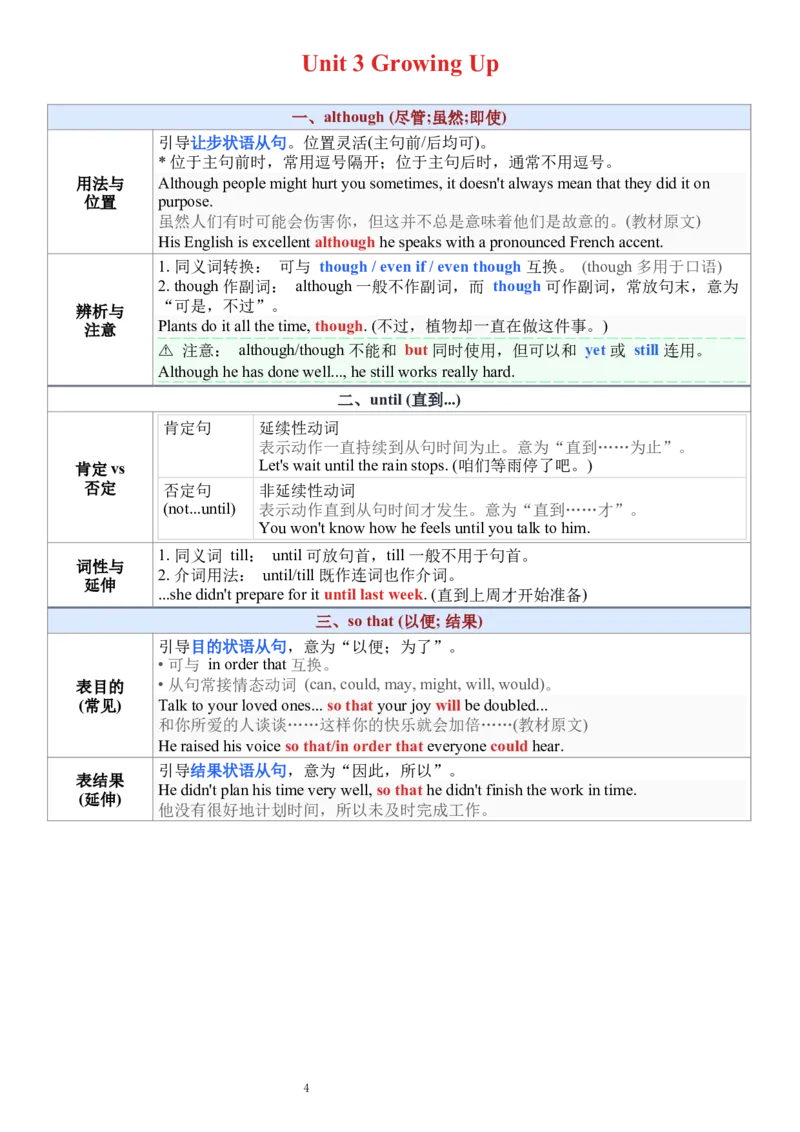
3Unit 3 Growing Up
一、although (尽管;虽然;即使)
引导让步状语从句。位置灵活(主句前/后均可)。
* 位于主句前时,常用逗号隔开;位于主句后时,通常不用逗号。
用法与 Although people might hurt you sometimes, it doesn't always mean that they did it on
位置 purpose.
虽然人们有时可能会伤害你,但这并不总是意味着他们是故意的。(教材原文)
His English is excellent although he speaks with a pronounced French accent.
1. 同义词转换: 可与 though / even if / even though 互换。 (though 多用于口语)
2. though 作副词: although 一般不作副词,而 though 可作副词,常放句末,意为
“可是,不过”。
辨析与
注意 Plants do it all the time, though. (不过,植物却一直在做这件事。)
⚠️ (cid:2)注意: although/though 不能和 but 同时使用,但可以和 yet 或 still 连用。
Although he has done well..., he still works really hard.
二、until (直到...)
肯定句 延续性动词
表示动作一直持续到从句时间为止。意为“直到……为止”。
肯定vs Let's wait until the rain stops. (咱们等雨停了吧。)
否定 否定句 非延续性动词
(not...until) 表示动作直到从句时间才发生。意为“直到……才”。
You won't know how he feels until you talk to him.
1. 同义词 till: until 可放句首,till 一般不用于句首。
词性与
2. 介词用法: until/till 既作连词也作介词。
延伸
...she didn't prepare for it until last week. (直到上周才开始准备)
三、so that (以便; 结果)
引导目的状语从句,意为“以便;为了”。
• 可与 in order that 互换。
表目的 • 从句常接情态动词 (can, could, may, might, will, would)。
(常见) Talk to your loved ones... so that your joy will be doubled...
和你所爱的人谈谈……这样你的快乐就会加倍……(教材原文)
He raised his voice so that/in order that everyone could hear.
引导结果状语从句,意为“因此,所以”。
表结果
He didn't plan his time very well, so that he didn't finish the work in time.
(延伸)
他没有很好地计划时间,所以未及时完成工作。
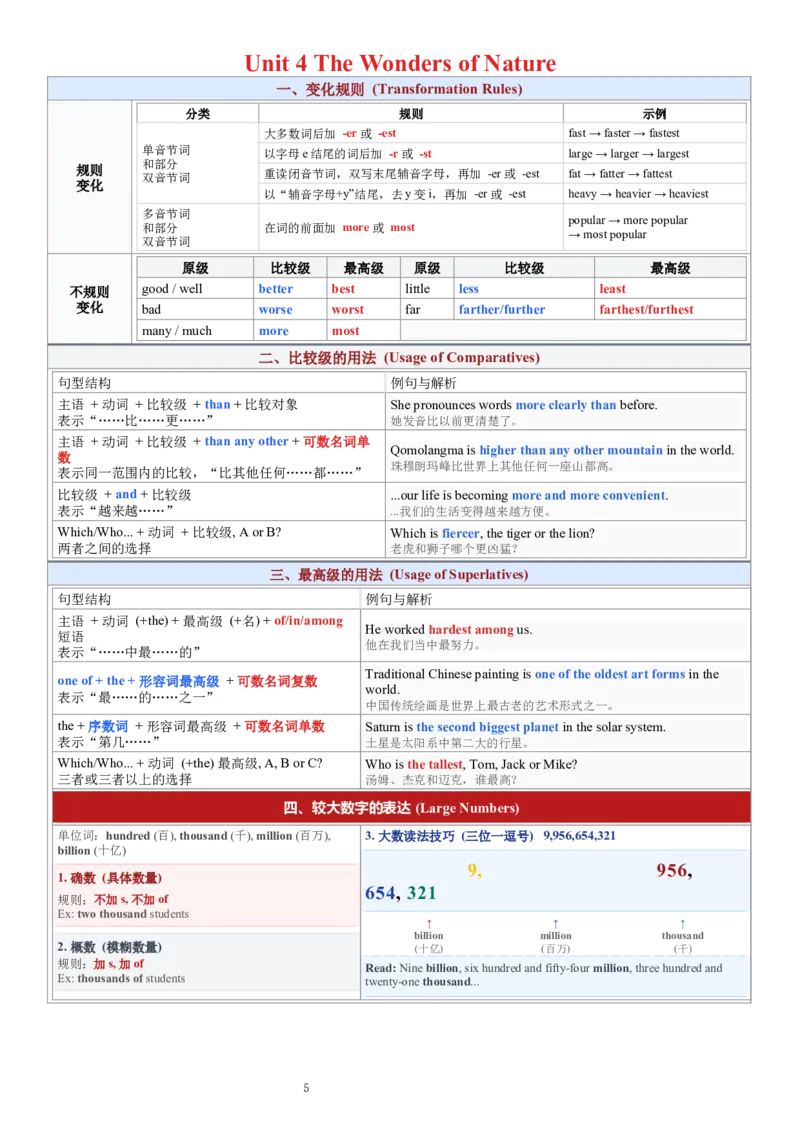
4Unit 4 The Wonders of Nature
一、变化规则 (Transformation Rules)
分类 规则 示例
大多数词后加 -er 或 -est fast → faster → fastest
单音节词 以字母e结尾的词后加 -r 或 -st large → larger → largest
和部分
规则
双音节词 重读闭音节词,双写末尾辅音字母,再加 -er 或 -est fat → fatter → fattest
变化
以“辅音字母+y”结尾,去y变i,再加 -er 或 -est heavy → heavier → heaviest
多音节词
popular → more popular
和部分 在词的前面加 more 或 most
→ most popular
双音节词
原级 比较级 最高级 原级 比较级 最高级
不规则 good / well better best little less least
变化 bad worse worst far farther/further farthest/furthest
many / much more most
二、比较级的用法 (Usage of Comparatives)
句型结构 例句与解析
主语 + 动词 + 比较级 + than + 比较对象 She pronounces words more clearly than before.
表示“……比……更……” 她发音比以前更清楚了。
主语 + 动词 + 比较级 + than any other + 可数名词单
Qomolangma is higher than any other mountain in the world.
数
珠穆朗玛峰比世界上其他任何一座山都高。
表示同一范围内的比较,“比其他任何……都……”
比较级 + and + 比较级 ...our life is becoming more and more convenient.
表示“越来越……” ...我们的生活变得越来越方便。
Which/Who... + 动词 + 比较级, A or B? Which is fiercer, the tiger or the lion?
两者之间的选择 老虎和狮子哪个更凶猛?
三、最高级的用法 (Usage of Superlatives)
句型结构 例句与解析
主语 + 动词 (+the) + 最高级 (+名) + of/in/among
He worked hardest among us.
短语
他在我们当中最努力。
表示“……中最……的”
Traditional Chinese painting is one of the oldest art forms in the
one of + the + 形容词最高级 + 可数名词复数
world.
表示“最……的……之一”
中国传统绘画是世界上最古老的艺术形式之一。
the + 序数词 + 形容词最高级 + 可数名词单数 Saturn is the second biggest planet in the solar system.
表示“第几……” 土星是太阳系中第二大的行星。
Which/Who... + 动词 (+the) 最高级, A, B or C? Who is the tallest, Tom, Jack or Mike?
三者或三者以上的选择 汤姆、杰克和迈克,谁最高?
四、较大数字的表达 (Large Numbers)
单位词:hundred (百), thousand (千), million (百万), 3. 大数读法技巧 (三位一逗号) 9,956,654,321
billion (十亿)
9, 956,
1. 确数 (具体数量)
654, 321
规则:不加s, 不加of
Ex: two thousand students
↑ ↑ ↑
billion million thousand
2. 概数 (模糊数量) (十亿) (百万) (千)
规则:加s, 加of
Read: Nine billion, six hundred and fifty-four million, three hundred and
Ex: thousands of students twenty-one thousand...
5Unit 5 Nature's Temper
一、过去进行时的用法和基本结构
1. 定义:表示在过去某一时刻或某一段时间正在进行的动作。
2. 结构: was/were + 现在分词 (v-ing)
3. 标志词: then, at this/that time yesterday, at ... last night 等。
I was travelling on the train then.
定义与
那时我正坐火车旅行。(教材原文)
构成
We were not shopping at this time yesterday.
昨天这个时候我们没在购物。
🌟 延伸: 过去进行时还常用于铺叙故事情节的背景。
A fire was burning and a cat was sleeping... A girl was playing the piano...
二、句式变化
肯定句 主语 + was/were + 现在分词 + 其他.
否定句 主语 + was/were + not + 现在分词 + 其他.
一般疑问句 Was/Were + 主语 + 现在分词 + 其他?
Yes, 主语 + was/were.
No, 主语 + wasn't/weren't.
三、过去进行时 vs 一般过去时 现在分词的变化规律:
过去进行时
口
强调动作在过去某时刻正在进行的过程,未必定完成。 情况 变化规则
He was doing his homework... 诀
他一直在做作业。(强调过程) 直 一般情况 直接加 -ing
It was raining all night.
去 以不发音字母 e 结尾 去 e 加 -ing
区别 下了一夜雨。(侧重持续时长)
辨析 一般过去时 重读闭音节结尾,且末尾 双写词尾辅音字
双
表示过去发生的事实或完成的动作。
只有一个辅音字母 母再加 -ing
He did his homework...
改 ie 为 y 再加
他把作业做完了。(强调完成)
改 以 ie 结尾
It rained last night. -ing
昨夜里下过雨。(强调事实)
四、when 和 while 与过去进行时搭配
主句时态 连词 从句时态
一般过去时 / 过去进行时 when 一般过去时
一般过去时 / 过去进行时 while 过去进行时
搭配 When my neighbour called, my family were having dinner.
规则 当邻居打电话来时(瞬间),我们一家人正在吃晚饭(进行)。
While I was waiting at the bus stop, three buses went by...
当我在车站等车时(持续),三辆公车开过去了(事实)。
People were asking... while some were starting...
人们互相询问(进行)...与此时,一些人正开始(进行)...
注意:通常不用进行时的动词
心理情感: love, hate, like, know 等。
连系动词: seem, appear 等。
感官动词: see, hear, smell, feel, taste 等。
6Unit 6 Crossing Cultures
一、so ... that 的用法 (如此……以至于……)
引导结果状语从句,so 修饰形容词/副词。
常用结构:
① 系动词 + so + adj. + that ...
② 行为动词 + so + adv. + that ...
结构含义 ③ so + adj. + a/an + 单数名词 + that ...
The bus was so crowded that they had to wait for the next one.
这辆公共汽车如此拥挤,以至于他们不得不等下一辆。
Everything happened so quickly that I didn't have time to think.
一切都发生得这么快,我都来不及去思考。
可与 too...to... (太……而不能) 或 (not)...enough to... 互换。
The girl is so short that she can't reach the top.
句型转换
= The girl is too short to reach the top.
= The girl is not tall enough to reach the top.
such ... that 也表“如此...以至于”,但 such 修饰 名词。
• such + (a/an) + adj + noun + that...
延伸辨析
Water is such an important substance that we cannot live without it.
(such..that)
⚠️ (cid:2)特殊情况:名词前有 many, much, few, little 时,必用 so。
They bought so much beef that they couldn't finish it.
二、unless 的用法 (如果不;除非)
引导条件状语从句。遵循“主将从现”原则 (主句将来时,从句一般现在时)。
In Türkiye, people don't kiss one another unless they are good friends.
用法时态 在土耳其,除非是好朋友,否则人们不会亲吻彼此的脸颊。(教材原文)
I won't let you go unless you tell me the truth.
我不会让你走的,除非你告诉我真相。
同义转换: if ... not 相关短语: as long as (只要)
转换与短语 You will fail unless you work hard. Everything is possible as long as you work
= You will fail if you do not ... hard.
三、as soon as 的用法 (一……就……)
引导时间状语从句。强调动作紧接着发生。同样遵循“主将从现”。
In Japan, we bow as soon as we meet a teacher.
用法精讲 I will phone you as soon as I get home.
位置 可放在句首(加逗号)或句中。
转换 可与 the moment 互换。
易混淆点与高频考点速记
1. so vs such 2. “主将从现”适用范围
• so + adj / adv • 条件状语从句 (if, unless, as long as)
• so + many/much/few/little • 时间状语从句 (when, as soon as)
• such + (a/an) + adj + 名词
3. 常用句型转换 4. 逻辑关系记忆
• so...that = too...to... • unless (除非) = 条件否定
• so...that = not...enough to... • as soon as (一...就...) = 动作紧凑
• unless = if ... not
7Unit 7 A Good Read
一、现在完成时的构成与用法概述
have / has + 过去分词 (past participle)
肯定句 主语 + have/has + 过去分词 + 其他.
基本
结构 否定句 主语 + haven't / hasn't + 过去分词 + 其他.
一般疑问 Have/Has + 主语 + 过去分词...? (Yes, I have. / No, I haven't.)
① 影响性用法: 动作发生在过去,但对现在造成了影响或结果。
I have already had lunch. (Implies: I am full now.)
两大 我已经吃过午饭了。(言外之意:我现在不饿)
用法 ② 持续性用法: 动作开始于过去,一直持续到现在。
He has lived here for ten years.
他住在这里已经十年了。(现在还住在这)
二、标志词与句型搭配
already / yet already 用于肯定句 (句中/句末); yet 用于否定/疑问句 (句末)。
Have you finished it yet? / No, not yet.
常用 ever / never ever (曾经) 多用于疑问句; never (从不) 表示否定。
副词 Have you ever been to the space museum?
just 意为“刚刚”,常位于 have/has 之后。
I've just made some cookies.
用于“持续性用法”,谓语动词必须是延续性动词。
for + 时间段 (e.g., for two years, for a long time)
since + 时间点 (e.g., since 2010, since last week)
for 与 since + 一般过去时的从句 (e.g., since he came here)
since
⚠️ (cid:2)瞬间动词转换: borrow → keep; buy → have; die → be dead; join → be in; leave →
be away
(错) He has died for 2 years. → (对) He has been dead for 2 years.
三、难点辨析:have been / have gone
have/has been to have/has gone to have/has been in
去过 (已回) 去了 (未回) 待在 (持续)
表示曾经去过某地,现在已经回来 表示去了某地,现在不在说话 表示在某地待了多久。常
了。常与 ever, never, twice 等连用。 现场 (在途中或到达)。 与 for/since 连用。
I have been to Shanghai twice. —Where is Tom? She has been in New York
—He has gone to the library. for a month.
8Unit 8 Making a Difference
一、for 和 since 的用法
常与现在完成时连用,表示动作或状态从过去一直延续到现在。
for for + 时间段 (表示“长达...”)
I have lived here for ten years.
since ① since + 过去的时间点
基本
② since + 一般过去时的从句
区别
I have known him since 2010.
We have been friends since we met at school.
📌 常用句型: It is / has been + 时间段 + since + 主语 + 一般过去时.
It has been three years since he left home. (他离家已经三年了。)
对 for / since 引导的时间状语提问,通常用 How long。
提问
— How long have you had this bike?
方式
— For about two months.
二、非延续性动词的转换 (重难点)
非延续性动词 (instant verbs) 表示瞬间发生,不能与表示一段时间的状语
(for/since/how long) 连用。若要连用,须转为对应的延续性动词或状态短语。
非延续性动词 (瞬间) 延续性动词/短语 (状态) 例句对比
buy (买) have I have had it for 2 weeks. (√)
I have bought it for 2 weeks. (×)
转换 borrow (借) keep How long can I keep the book?
规则
die (死) be dead His dog has been dead for a year.
join (加入) be in / be a member of He has been in the club since 2019.
leave (离开) be away (from) She has been away for an hour.
begin / start (开始) be on The film has been on for 10 mins.
arrive / come / go be in / be at He has been in Beijing for 3 days.
三、现在完成时 vs 一般过去时
一般过去时 (Simple Past) 现在完成时 (Present Perfect)
强调“过去的事实” 强调“对现在的影响”
动作发生在过去,与现在无关。只陈述过去发生 动作发生在过去,但对现在有影响或结果;或
过这件事。 动作延续到现在。
标志词: yesterday, last week, in 1990, just now, 标志词: already, yet, ever, never, just, before, so
when I was young... far, since, for...
I lost my key yesterday. I have lost my key.
(含义:昨天丢了。现在找到没有?不知道。) (含义:现在钥匙还没找到,我进不去门。)
考点速记:
1. 看到 yesterday, ago, last... 铁定选一般过去时。
2. 看到 for / since,优先考虑现在完成时 (注意动词是否延续)。
3. 句中有 just now (刚才) 用过去时;只有 just (刚刚) 常用于完成时。
9