Unit 1 Time to Relax!
课时 5 Section B (2a-2c) 分层作业
核心知识速记 01 基础达标 02 能力提升 03 拓展培优 0 4 思维进阶
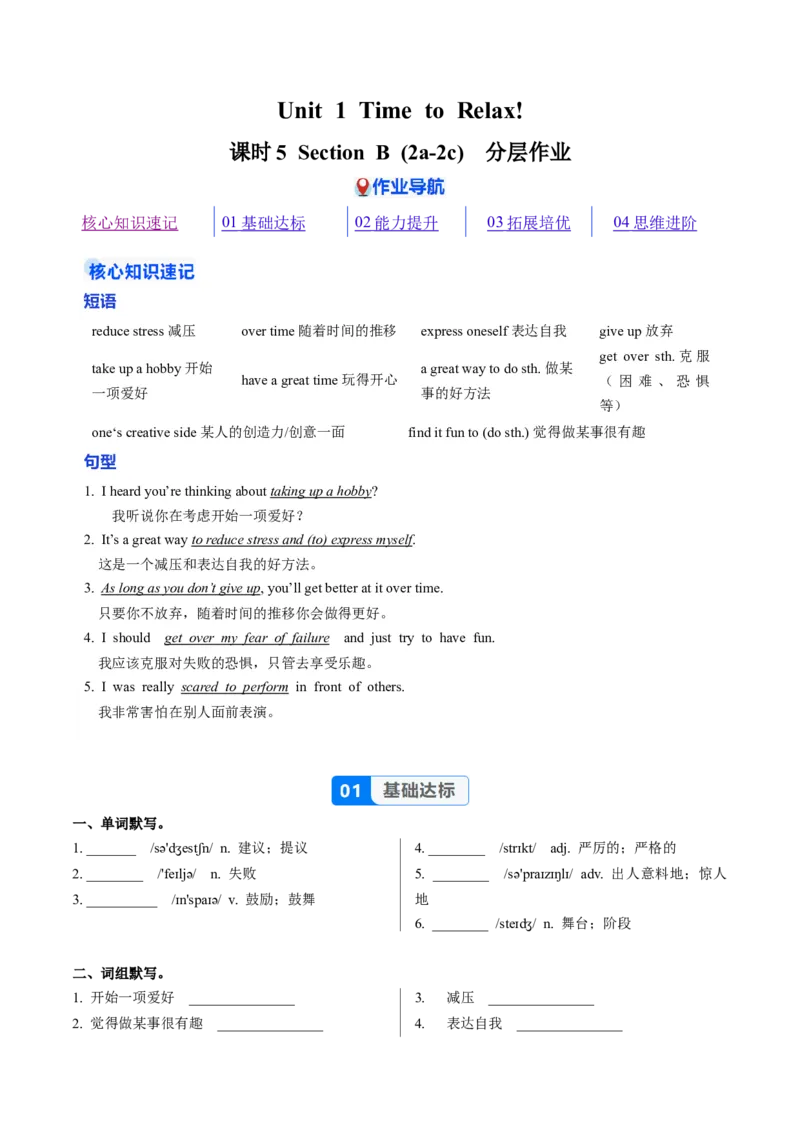
短语
reduce stress 减压 over time 随着时间的推移 express oneself 表达自我 give up 放弃
get over sth. 克服
take up a hobby 开始 a great way to do sth. 做某
have a great time 玩得开心 ( 困 难 、 恐 惧
一项爱好 事的好方法
等)
one‘s creative side 某人的创造力/创意一面 find it fun to (do sth.) 觉得做某事很有趣
句型
1. I heard you’re thinking about taking up a hobby?
我听说你在考虑开始一项爱好?
2. It’s a great way to reduce stress and (to) express myself.
这是一个减压和表达自我的好方法。
3. As long as you don’t give up , you’ll get better at it over time.
只要你不放弃,随着时间的推移你会做得更好。
4. I should get over my fear of failure and just try to have fun.
我应该克服对失败的恐惧,只管去享受乐趣。
5. I was really scared to perform in front of others.
我非常害怕在别人面前表演。
一、单词默写。
1. _______ /sə'dʒestʃn/ n. 建议;提议 4. ________ /strɪkt/ adj. 严厉的;严格的
2. ________ /'feɪljə/ n. 失败 5. ________ /sə'praɪzɪŋlɪ/ adv. 出人意料地;惊人
3. __________ /ɪn'spaɪə/ v. 鼓励;鼓舞 地
6. ________ /steɪdʒ/ n. 舞台;阶段
二、词组默写。
1. 开始一项爱好 _______________ 3. 减压 _______________
2. 觉得做某事很有趣 _______________ 4. 表达自我 _______________5. 放弃 _______________ 9. 某人的创造力/创意一面 _______________
6. 克服(困难、恐惧等)_______________ 10. 玩得开心 _______________
7. 做某事的好方法 _______________ 11. 到目前为止 _______________
8. 随着时间的推移 _______________
三、根据要求完成句子。
1. To __________, many students choose to listen to
music after class.
为了减轻压力,很多学生选择在课后听音乐。
2. Don‘t easily __________! Try again and you might
succeed.
别轻易放弃!再试一次你可能会成功。
3. At first he found the piano difficult, but
__________, he plays better and better.
起初他觉得钢琴很难,但随着时间的推移,他弹得
越来越好了。
4. We __________ in the park yesterday.
昨天我们在公园里玩得很开心。
5. Drawing is a great way to __________.
画画是表达自我的一种绝佳方式。
6. __________ keep practicing, your English will
surely improve.
只要你坚持练习,你的英语一定会进步。
7. My brother wants to ___________ , like
programming or photography.
我哥哥想开始一项新的爱好,比如编程或摄
影。
8. Finally, he successfully __________ public
speaking.
最终,他成功地克服了对公开演讲的恐惧。四 、用方框内所给词的适当形式填空(每次只使用一次)。
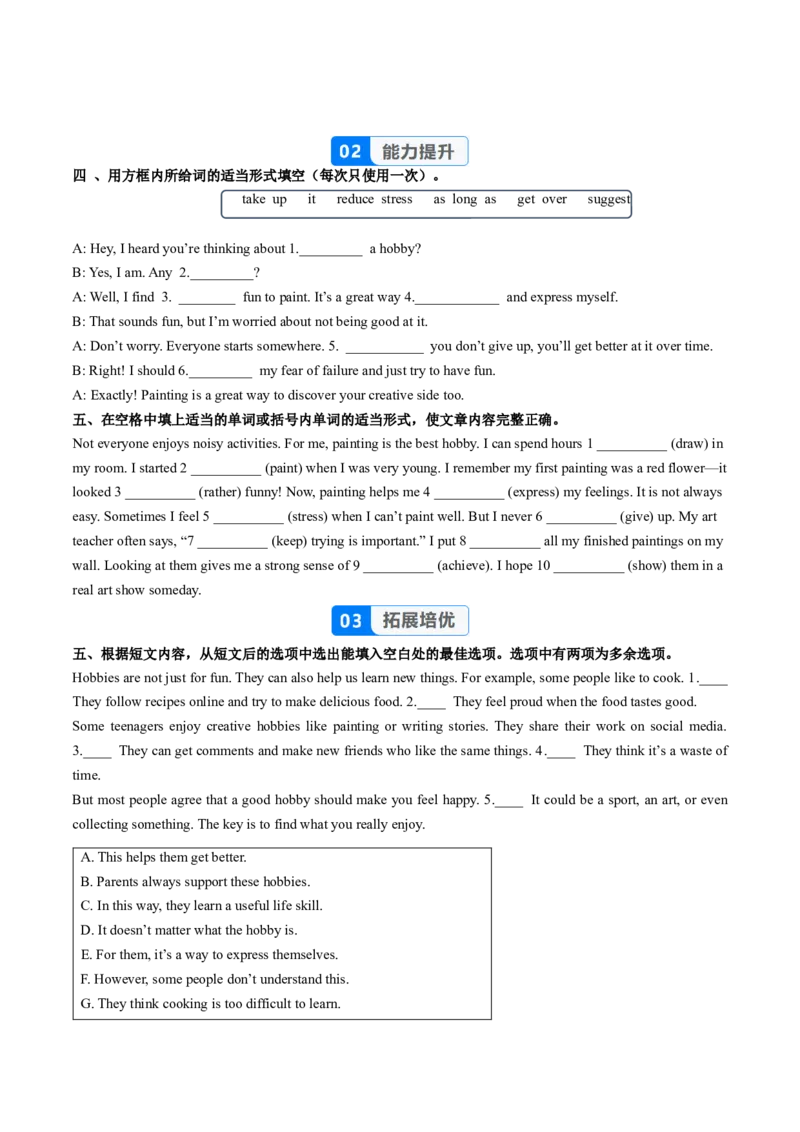
take up it reduce stress as long as get over suggest
A: Hey, I heard you’re thinking about 1._________ a hobby?
B: Yes, I am. Any 2._________?
A: Well, I find 3. ________ fun to paint. It’s a great way 4.____________ and express myself.
B: That sounds fun, but I’m worried about not being good at it.
A: Don’t worry. Everyone starts somewhere. 5. ___________ you don’t give up, you’ll get better at it over time.
B: Right! I should 6._________ my fear of failure and just try to have fun.
A: Exactly! Painting is a great way to discover your creative side too.
五、在空格中填上适当的单词或括号内单词的适当形式,使文章内容完整正确。
Not everyone enjoys noisy activities. For me, painting is the best hobby. I can spend hours 1 __________ (draw) in
my room. I started 2 __________ (paint) when I was very young. I remember my first painting was a red flower—it
looked 3 __________ (rather) funny! Now, painting helps me 4 __________ (express) my feelings. It is not always
easy. Sometimes I feel 5 __________ (stress) when I can’t paint well. But I never 6 __________ (give) up. My art
teacher often says, “7 __________ (keep) trying is important.” I put 8 __________ all my finished paintings on my
wall. Looking at them gives me a strong sense of 9 __________ (achieve). I hope 10 __________ (show) them in a
real art show someday.
五、根据短文内容,从短文后的选项中选出能填入空白处的最佳选项。选项中有两项为多余选项。
Hobbies are not just for fun. They can also help us learn new things. For example, some people like to cook. 1.____
They follow recipes online and try to make delicious food. 2.____ They feel proud when the food tastes good.
Some teenagers enjoy creative hobbies like painting or writing stories. They share their work on social media.
3.____ They can get comments and make new friends who like the same things. 4.____ They think it’s a waste of
time.
But most people agree that a good hobby should make you feel happy. 5.____ It could be a sport, an art, or even
collecting something. The key is to find what you really enjoy.
A. This helps them get better.
B. Parents always support these hobbies.
C. In this way, they learn a useful life skill.
D. It doesn’t matter what the hobby is.
E. For them, it’s a way to express themselves.
F. However, some people don’t understand this.
G. They think cooking is too difficult to learn.六、阅读理解。
In our fast-paced world, a new trend called the “slow hobby” movement is gaining popularity. These are activities
that require patience, focus, and cannot be rushed. Examples include knitting, woodworking, birdwatching, or
practicing calligraphy. Followers of this movement argue that such hobbies act as a form of “mental training.” They
force you to be present in the moment, reducing anxiety about the future or regrets about the past. Unlike finishing
a video game level, there is no instant reward. The reward, they say, is the peaceful state of mind during the process
and the deep satisfaction upon completing a long-term project. It’s a conscious choice to slow down.
1. What is a “slow hobby” according to the passage?
A. A hobby that takes very little time.
B. A hobby that is popular on social media.
C. A hobby that needs patience, focus, and cannot be done quickly.
D. A hobby that is only for old people.
2. What is the main benefit of “slow hobbies” suggested by followers?
A. They help people make money quickly.
B. They allow people to win competitions.
C. They train the mind to focus on the present and reduce anxiety.
D. They are the easiest hobbies to learn.
3. The word “conscious” in the last sentence is closest in meaning to ______.
A. sleepy B. intentional C. lucky D. public
4. How is the “reward” of a slow hobby different from that of a video game?
A. It is more expensive. B. It is more digital.
C. It is instant and exciting. D. It is the peaceful process and long-term satisfaction.
七、完形填空。
For many, a hobby has evolved into a “side hustle” — a way to earn extra money. While this can be financially
rewarding, finding balance is 1.___. Maya loved painting and started selling her artwork online. Success came
quickly, and orders poured in. Soon, her relaxing hobby became a source of 2.___ as she struggled to meet
deadlines. The joy of creating was 3.___ by pressure and fatigue.
Realizing this, Maya made a crucial 4.___ . She now limits the number of commissions she accepts each month.
She also keeps one day a week for “free painting” — creating 5.___ she wants, with no goal of selling. This
practice helps her 6.___ her original passion. “My side hustle supports my art, but my art must not
become 7.___ my side hustle,” she reflects. Her experience highlights a key distinction: when a hobby becomes
purely transactional, its 8.___ to refresh and inspire us can fade. The challenge is to protect the space where
creativity can play 9.___ the shadow of commerce. For Maya, balance means ensuring that her art remains, first and
foremost, a personal 10.___ .
1. ( )A. easy B. key C. strange D. public
2. ( )A. joy B. stress C. wealth D. data
3. ( )A. replaced B. followed C. increased D. discovered
4. ( )A. mistake B. decision C. painting D. promise5. ( )A. what B. when C. why D. who
6. ( )A. remember B. sell C. forget D. teach
7. ( )A. according to B. proud of C. because of D. only about
8. ( )A. ability B. plan C. cost D. time
9. ( )A. under B. without C. behind D. after
10. ( )A. business B. lesson C. failure D. joy
八、阅读短文,并按要求完成下面小题。
The Power of “Micro-hobbies”
Not everyone has large blocks of free time. This is where “micro-hobbies” come in — small, satisfying activities
that fit into 10-15 minute breaks throughout the day. Examples include sketching a quick drawing, solving a puzzle,
listening to a short podcast in a foreign language, or tending to a small desk plant.
Psychologist Dr. Lee explains, “The value of micro-hobbies lies not in their scale, but in their ability to create a
‘mental switch’. They force your brain to shift focus from work or study, providing a mini-reset. This can boost
creativity and reduce stress more effectively than a longer but unfocused break.” Unlike scrolling through social
media, which often leaves people feeling more scattered, a micro-hobby provides a sense of completion and
control. It’s a way to claim personal moments in a busy world, proving that leisure is about quality, not quantity.
1. What are “micro-hobbies”? (No more than 15 words)
______________________________________________
2. According to Dr. Lee, what is the main benefit of a micro-hobby? (No more than 10 words)
______________________________________________
3. How are micro-hobbies different from scrolling through social media in terms of result? (No more than 12
words)
______________________________________________
4. What does the last sentence “leisure is about quality, not quantity” mean in this context? (No more than 15
words)
______________________________________________