Unit 1 Time to Relax!
课时 7 Section B (4a-4c) 分层作业
核心知识速记 01 基础达标 02 能力提升 03 拓展培优 0 4 思维进阶
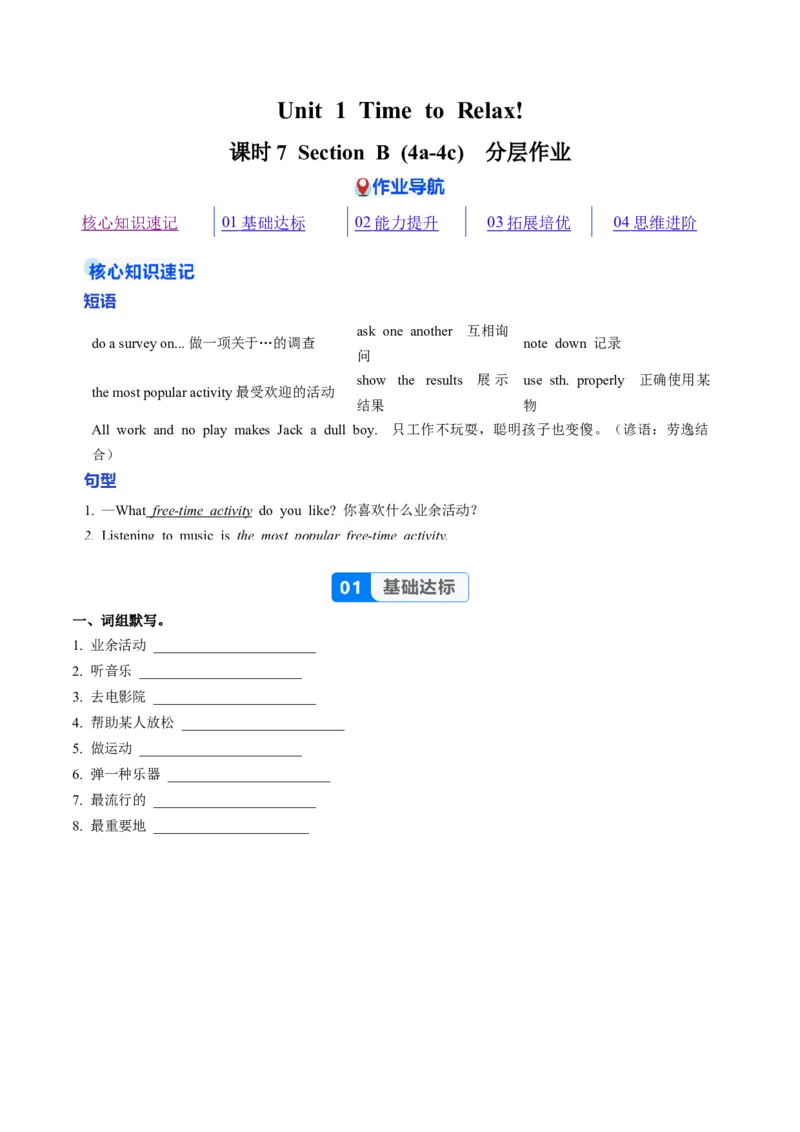
短语
ask one another 互相询
do a survey on... 做一项关于…的调查 note down 记录
问
show the results 展 示 use sth. properly 正确使用某
the most popular activity 最受欢迎的活动
结果 物
All work and no play makes Jack a dull boy. 只工作不玩耍,聪明孩子也变傻。(谚语:劳逸结
合)
句型
1. —What free-tim e activit y do you like? 你喜欢什么业余活动?
2. Listening to music is the most popular free-time activity .
一、词组默写。
1. 业余活动 _______________________
2. 听音乐 _______________________
3. 去电影院 _______________________
4. 帮助某人放松 _______________________
5. 做运动 _______________________
6. 弹一种乐器 _______________________
7. 最流行的 _______________________
8. 最重要地 ______________________二、根据要求完成句子。
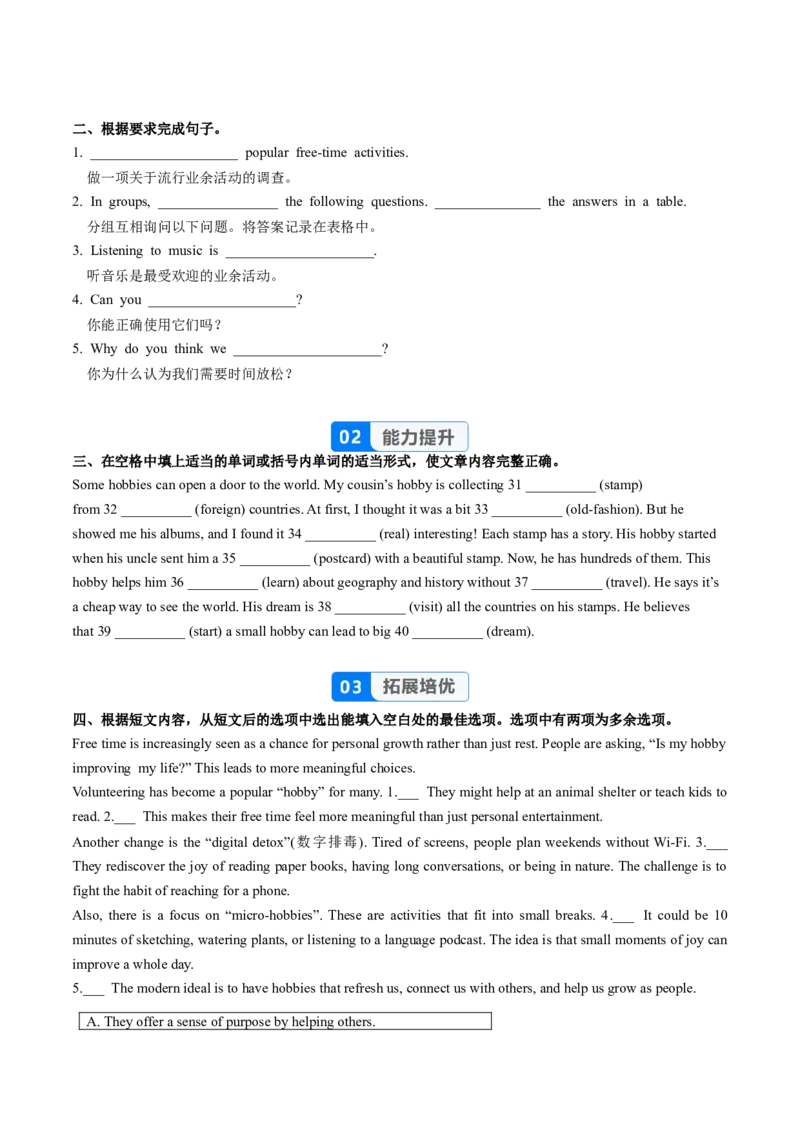
1. _____________________ popular free-time activities.
做一项关于流行业余活动的调查。
2. In groups, _________________ the following questions. _______________ the answers in a table.
分组互相询问以下问题。将答案记录在表格中。
3. Listening to music is _____________________.
听音乐是最受欢迎的业余活动。
4. Can you _____________________?
你能正确使用它们吗?
5. Why do you think we _____________________?
你为什么认为我们需要时间放松?
三、在空格中填上适当的单词或括号内单词的适当形式,使文章内容完整正确。
Some hobbies can open a door to the world. My cousin’s hobby is collecting 31 __________ (stamp)
from 32 __________ (foreign) countries. At first, I thought it was a bit 33 __________ (old-fashion). But he
showed me his albums, and I found it 34 __________ (real) interesting! Each stamp has a story. His hobby started
when his uncle sent him a 35 __________ (postcard) with a beautiful stamp. Now, he has hundreds of them. This
hobby helps him 36 __________ (learn) about geography and history without 37 __________ (travel). He says it’s
a cheap way to see the world. His dream is 38 __________ (visit) all the countries on his stamps. He believes
that 39 __________ (start) a small hobby can lead to big 40 __________ (dream).
四、根据短文内容,从短文后的选项中选出能填入空白处的最佳选项。选项中有两项为多余选项。
Free time is increasingly seen as a chance for personal growth rather than just rest. People are asking, “Is my hobby
improving my life?” This leads to more meaningful choices.
Volunteering has become a popular “hobby” for many. 1.___ They might help at an animal shelter or teach kids to
read. 2.___ This makes their free time feel more meaningful than just personal entertainment.
Another change is the “digital detox”(数字排毒). Tired of screens, people plan weekends without Wi-Fi. 3.___
They rediscover the joy of reading paper books, having long conversations, or being in nature. The challenge is to
fight the habit of reaching for a phone.
Also, there is a focus on “micro-hobbies”. These are activities that fit into small breaks. 4.___ It could be 10
minutes of sketching, watering plants, or listening to a language podcast. The idea is that small moments of joy can
improve a whole day.
5.___ The modern ideal is to have hobbies that refresh us, connect us with others, and help us grow as people.
A. They offer a sense of purpose by helping others.B. This break helps them reconnect with the real world.
C. Therefore, passive activities are losing their popularity.
D. People no longer see free time as empty hours to fill.
E. In other words, the quality of free time matters more now.
F. For example, they use spare time between tasks.
G. They find that helping others also reduces their own stress.
五、阅读理解。
The Weekend Warrior vs. The Daily Ritual
There are two common patterns in how people engage with hobbies. The “Weekend Warrior” packs all their passion
into Saturdays and Sundays—going on intense hikes, playing full-day sports matches, or attending workshops. The
“Daily Ritualist” prefers to weave small doses of their hobby into everyday life, like practicing guitar for 20
minutes each evening or reading before bed. Each has its merits. Weekend Warriors often achieve bigger, more
exciting goals and enjoy strong social bonding. Daily Ritualists, however, benefit from the consistent mental break
and the compound effect of daily practice, which often leads to deeper skill mastery. The choice reflects one’s
personality and lifestyle more than the hobby itself.
1. What is the main purpose of the first paragraph?
A. To introduce two different patterns of practicing hobbies.
B. To argue that being a Weekend Warrior is better.
C. To explain why people need hobbies.
D. To describe the history of a specific hobby.
2. What is a potential advantage of being a “Daily Ritualist”?
A. Achieving bigger and more exciting goals on weekends.
B. Enjoying stronger social bonding with large groups.
C. Gaining deeper skill mastery through consistent daily practice.
D. Saving a lot of money on hobby equipment.
3. According to the passage, what does the choice between these two patterns mainly show?
A. How rich a person is.
B. A person’s skill level in the hobby.
C. A person’s character and way of life.
D. Which hobby is the most popular.
4. What does the phrase “compound effect” most likely refer to in this context?
A. The effect of spending a lot of money.
B. The social effect of making many friends.
C. The significant result of small, repeated actions over time.
D. The negative effect of doing too much on weekends.
六、完形填空。
The Art of “Digital Detox”
In an age where screens demand constant attention, the idea of a “digital detox” — voluntarily turning away fromdigital devices — is becoming a necessary life skill for many. It is no longer seen as a strange practice but as a wise
way to regain balance.
My friend Lisa decided to try it last month. She felt that her phone was stealing her time and 1.___ . Every evening,
instead of 2.___ through social media, she now reads a book or has a real conversation with her family. The first
few days were 3.___ ; she kept reaching for her phone out of habit. However, she soon noticed positive changes.
Her sleep quality improved, and she felt more 4.___ and less anxious during the day.
Lisa’s experience shows that a digital detox doesn’t mean abandoning technology 5.___ . It’s about creating
healthy 6.___ . She now sets “phone-free” hours, especially during meals and before bed. “It’s not
about 7.___ technology,” she explains, “but about 8.___ it wisely so that it serves me, not controls me.” Her story
reminds us that in a connected world, 9.___ might be the most valuable connection we can make — the connection
with 10.___ and the people right beside us.
1. ( )A. money B. joy C. health D. data
2. ( )A. searching B. scrolling C. typing D. selling
3. ( )A. exciting B. expensive C. difficult D. boring
4. ( )A. nervous B. focused C. lonely D. tired
5. ( )A. completely B. suddenly C. quietly D. recently
6. ( )A. hobbies B. habits C. games D. devices
7. ( )A. using B. refusing C. repairing D. inventing
8. ( )A. ignoring B. fearing C. using D. changing
9. ( )A. disconnecting B. downloading C. programming D. sharing
10. ( )A. ourselves B. strangers C. celebrities D. machines
七、阅读短文,并按要求完成下面小题。
“Gamifying” Your Leisure
Some people find it hard to stick with hobbies. To solve this, they start “gamifying” their leisure time — using
elements from games like challenges, points, and rewards to make activities more engaging. For example, a
language learner might use an app that gives points for daily practice. A runner might set a goal to run a certain
distance each month and treat herself to a massage after achieving it.
This approach works because it taps into our natural love for achievement and progress. It turns a vague intention
like “read more” into a clear mission: “read for 30 minutes daily to earn a week’s badge.” However, experts warn
that the reward should not become the only focus. The real joy should still come from the activity itself. Otherwise,
once you stop getting points, you might lose interest. The healthiest way is to use gamification as a beginning to
build a habit. Once the habit is formed and you find inner satisfaction, the external rewards can fade away. The final
“win” is discovering that you genuinely enjoy the hobby for its own sake.
1. According to the passage, what is "Gamifying your leisure"? Explain in one sentence. (within 20 words)
______________________________________________________________
2. According to the passage, put the ideal steps of how gamification helps build a healthy hobby in the correctorder. Write the letters (A-E) in order.
A. External rewards fade, and inner satisfaction becomes the main drive.
B. Set challenges, points, or rewards for a leisure activity to make it more attractive.
C. A stable habit is formed with the help of gamification.
D. Discover that you do the hobby for its own sake, for the real joy it brings.
E. Use people's natural love for achievement and progress to push action.
Correct Order: ( ) → ( ) → ( ) → ( ) → ( )
3. The passage points out a main risk of the gamification method. Fill in the blank with the original word(s)
from the passage.
Experts warn that the ________ should not become the only focus.
4. Your friend wants to build a habit of "drawing every day" but can't stick to it. You suggest trying
"gamification".
• Design: Give one simple gamification idea (e.g., what challenge? what reward?).
_________________________________________________________
• Evaluate: According to the passage, how can your friend avoid drawing just for the reward? Give one piece of
advice.
_________________________________________________________