Unit 2 I’ll help to clean up the city parks.
第2课时 Section A (3a-4c)
1.重点单词的含义及用法:several;strong;feeling;satisfaction;joy;owner;
journey;raise;alone
重点词汇
2.重难短语:at the age of;try out;come true;at the same time;raise money;
travel alone
1.I get such a strong feeling of satisfaction when I see the animals get better and
the look of joy on their owners’ faces.
2.Volunteering here is a dream come true for me.
3.I can do what I love to do and help others at the same time.
重点句型
4.She could read by herself at the age of four.
5.Last year, she decided to try out for a volunteer after-school reading program.
6.Some people even stop doing their jobs for a few months to a year to move to
another place, like one of the countries in Africa, and help people there.
技能目标
能向别人提供帮助或提出如何帮助他人的建议
重难单词默写与词性变换
1. 几个;数个;一些 pron.
2. 强烈的;强壮的 adj. → 强烈地 adv.
3. 感觉;感触 n.
4. 满足;满意 n.
5. 高兴;愉快 n.
6. 物主;主人 n.
7. (尤指长途)旅行;行程 n.
8. 募集;征集 v.
9. 单独;独自 adv.
经典短语默写:1. 放弃
2. 想成为
3. 学习有关……
4. 有强烈的满足感
5. 在……岁时
6. 决定做某事
7. 参加……选拔
8. 同时
9. 忙于某事
10. 至少
11. 担心
12. 在某人空闲时间
13. 为了取乐
14. 筹钱
15. 独自旅行
16. 志愿做某事
经典句型过关:
1. 当我看到动物们(病情)渐好,看到它们主人脸上的喜悦表情时,我产生出那么一种极强的满足感。
I such a when I see the animals get better
and the look of on their faces.
2.在这里当志愿者对我来说是梦想成真。
here is a dream for me.
3.她在四岁时就能独自阅读。
She could read by herself four.
4.我能做我喜欢做的事情,同时也能帮助别人。
I can do what I love to do and help others .
5.她决定去参加一个志愿者课外阅读选拔活动。
Last year, she decided to a volunteer after-school reading program.
6.一些人甚至离职几个月到一年去另一个地方,比如非洲的一个国家,帮助那儿的人们。
Some people even their jobs for a few months to a year to move to another place,
like one of the countries in Africa, and help people there.1. Mario Green and Mary Brown from Riverside High School give up several hours each week to
help others. 来自河畔高中的马里奥·格林和玛丽·布朗每周腾出几个小时的时间去帮助别人。
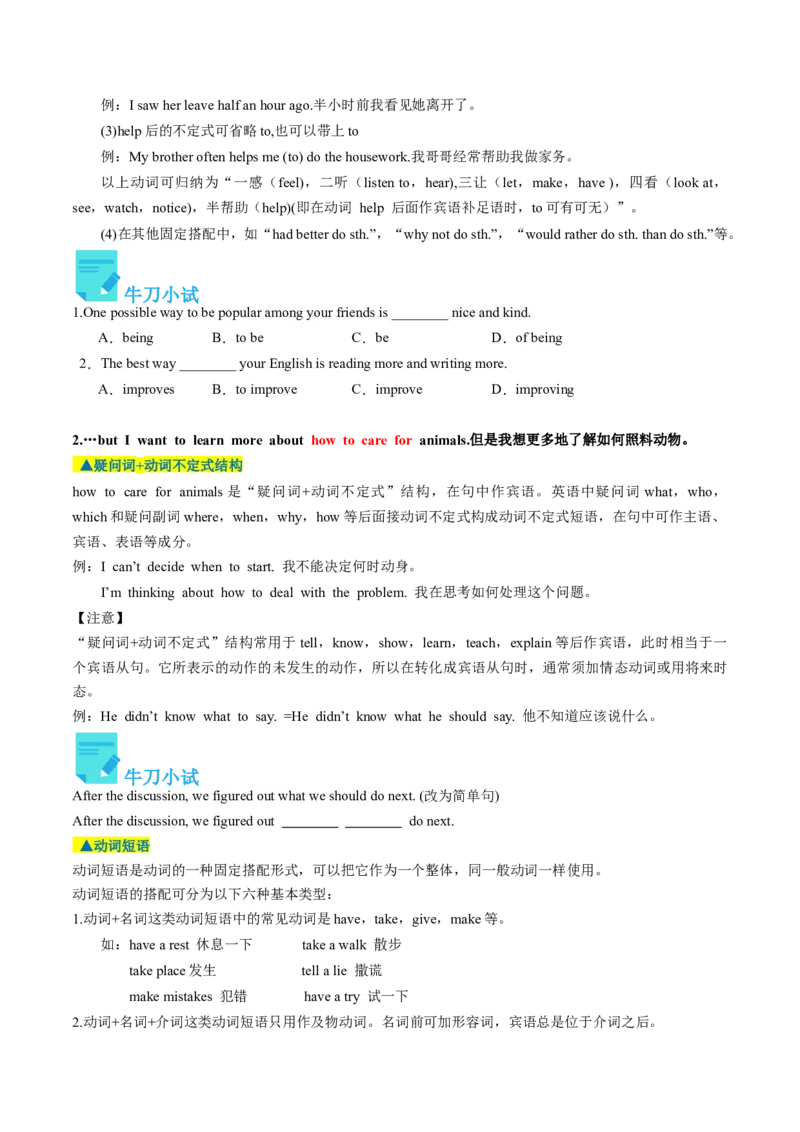
▲each与every辨析
each和every是一对近义词,但各自的侧重点不同。
1) 从语义上看,两者都可表示 “每个”, “一切的”,且every和each用于主语时,谓语均要求单数匹
配。很多时候,两词可以互换使用,但意思略有差别:each强调个性,着眼于整体中的个体;every强调
共性,着眼于整体。
例:Each man has his own name. 每个人都有名字。
Each time you practice, you get better at playing tennis.你每练习一次,你网球就打得越好。
I get sick every time I eat seafood. 我每次吃海鲜都不舒服。
Every one of you must attend the meeting.你们每个人必须参加会议。
2) 从语法上看,each可用作形容词和代词, 而every只用作形容词。
例:He gave two apples to each (person). 我们给每个人两个苹果。
Each (school) has its own library. 每所学校都有自己的图书馆。
We have every reason to believe that the operation will be a success. 我们有充分的理由相信这场手术会成功。
3) 两种不可使用each的情况:
①切勿将each和almost, nearly及not搭配使用,应用every:
例:Almost every cake was sold. 几乎所有蛋糕都卖出去了。
Not every student went on holiday. 不是所有学生都在度假。
②切勿在否定结构中使用each, 应用none:
例:None of the books are mine. 没有哪本书是我的。牛刀小试
________ of the students has his own opinion about that topic.
A.Every B.Each C.All D.Both
▲动词不定式用法
1.动词不定式的形式动词不定式的基本形式是“to+动词原形”,使用时有时可以不带to。动词不定式没有
人称和数的变化,在句子中不能作谓语,但仍保留动词的特点,即可以有自己的宾语和状语。动词不定式同
它的宾语或状语构成动词不定式短语。
例:He wants to sit down.他想坐下。
Let him have a rest.让他休息一下。
动词不定式的否定形式是在动词不定式前面加not。
例:Tell him not to leave alone.告诉他不要一个人离开。
2.动词不定式的用法动词不定式具有名词、形容词和副词的特征,因此在句中可以作主语、表语、宾语、
补足语、定语、状语等。
(1)不定式作主语不定式作主语一般位于句首,谓语动词用单数。为了避免句子“头重脚轻”,往往用it
代替不定式作形式主语,而将不定式放在后面作真正的主语。
例:To learn foreign languages is very useful.学外语很有用。
It's very useful to learn foreign languages.学外语很有用。
(2)不定式作表语
例:My work is to take care of the sick boy.我的工作是照顾那个生病的男孩。
(3)不定式作宾语不定式作宾语有两种情况:一种是及物动词后直接跟带to的不定式,另一种是“及物
动词+疑问词+带to的不定式”。
例:He promised to help me.他答应帮我。
He showed me how to use a computer.他给我演示怎样使用电脑。
(4)不定式作宾语补足语常接不定式作宾语补足语的词有 tell,ask,want,teach,allow,promise,
order,advise,expect,wish,invite,encourage 等。
例:They asked him to sing a pop song at the party.他们请他在宴会上唱一首流行歌曲。
(5)不定式作定语不定式作定语应放于被修饰词之后。
例:I want to have something to eat.我想吃点东西。
She got a job to take care of an old man.她得到一份照顾一位老人的工作。
(6)不定式作状语不定式常在句中作目的状语。
例:You should run quickly to catch the last bus.你应该快点儿跑去赶末班车。
3.省略to的动词不定式的四种情况
(1)在使役动词have, make,let之后
例:I like him because he makes me laugh.我喜欢他是因为他能逗我笑。
(2)在感官动词feel,hear,see,watch,notice,listen to,look at 之后例:I saw her leave half an hour ago.半小时前我看见她离开了。
(3)help后的不定式可省略to,也可以带上to
例:My brother often helps me (to) do the housework.我哥哥经常帮助我做家务。
以上动词可归纳为“一感(feel),二听(listen to,hear),三让(let,make,have ),四看(look at,
see,watch,notice),半帮助(help)(即在动词 help 后面作宾语补足语时,to可有可无)”。
(4)在其他固定搭配中,如“had better do sth.”,“why not do sth.”,“would rather do sth. than do sth.”等。
牛刀小试
1.One possible way to be popular among your friends is ________ nice and kind.
A.being B.to be C.be D.of being
2.The best way ________ your English is reading more and writing more.
A.improves B.to improve C.improve D.improving
2.…but I want to learn more about how to care for animals.但是我想更多地了解如何照料动物。
▲疑问词+动词不定式结构
how to care for animals是“疑问词+动词不定式”结构,在句中作宾语。英语中疑问词 what,who,
which和疑问副词where,when,why,how等后面接动词不定式构成动词不定式短语,在句中可作主语、
宾语、表语等成分。
例:I can’t decide when to start. 我不能决定何时动身。
I’m thinking about how to deal with the problem. 我在思考如何处理这个问题。
【注意】
“疑问词+动词不定式”结构常用于tell,know,show,learn,teach,explain等后作宾语,此时相当于一
个宾语从句。它所表示的动作的未发生的动作,所以在转化成宾语从句时,通常须加情态动词或用将来时
态。
例:He didn’t know what to say. =He didn’t know what he should say. 他不知道应该说什么。
牛刀小试
After the discussion, we figured out what we should do next. (改为简单句)
After the discussion, we figured out do next.
▲动词短语
动词短语是动词的一种固定搭配形式,可以把它作为一个整体,同一般动词一样使用。
动词短语的搭配可分为以下六种基本类型:
1.动词+名词这类动词短语中的常见动词是have,take,give,make等。
如:have a rest 休息一下 take a walk 散步
take place发生 tell a lie 撒谎
make mistakes 犯错 have a try 试一下
2.动词+名词+介词这类动词短语只用作及物动词。名词前可加形容词,宾语总是位于介词之后。如:make friends with与……交朋友 make fun of取笑
pay attention to注意 have a look at看一看
3.be+形容词(包括过去分词作形容词)+介词这类动词短语也相当于及物动词,宾语位于介词的后面,形
容词是动词短语的真正含义。
如:be different from 与……不同 be good for 对……有益
be friendly to 对……友好 be interested in 对……感兴趣
be famous for 因……而著名 be serious about 对……认真
4.动词+副词
(1)“动词+副词”相当于不及物动词有的“动词+副词”相当于不及物动词,在句中直接作谓语,后面
不加任何宾语。常用的此类副词有away,along,back,down,in,off,on,out,up等。
如:break out 爆发 break up 分解 come up 出现
fall behind 落后 get along 进展 give in屈服
grow up长大 hold on等一会儿
(2)“动词+副词”相当于及物动词有的“动词+副词”相当于及物动词,后接宾语时,宾语如果是人称
代词,需将其放在动词和副词之间;如果宾语是名词或 nothing、everything等不定代词时,则可以放在动
词和副词中间,也可以放在副词后面。
如:cheer up使高兴起来 clean up打扫干净 put up张贴
fix up修理 give away 赠送 give out 分发
use up用完 hand in上交 put off推迟
pick up捡起 think over仔细考虑 turn down调低音量
5.动词+介词动词与介词构成的短语相当于一个及物动词,它的宾语总是在介词后面。
如:break into破门而入 care for照顾 come across偶然碰到
laugh at嘲笑 look after 照顾 look into 调查
look for寻找 stand for 代表
6.动词+副词+介词在这类动词短语中,动词、副词、介词紧密结合,是动副词组和动介词组的合成体,相当
于一个及物动词。但宾语总是位于介词之后。
如:come up with 想出 catch up with 赶上
look forward to 盼望 go on with 继续
keep away from 远离 get along with 相处融洽
牛刀小试
—May I be a member of the team?
—Sorry, I’m afraid you must ________ first.
A.come out B.try out C.take out D.work out
3. I get such a strong feeling of satisfaction when I see the animals get better and the look of joy
on their owners’ faces. 当我看到动物们(病情)渐好,看到它们主人脸上的喜悦表情时,我产生出那么一种极强的满足感。
▲such与so辨析
二者都表示程度,意为“如此,这样”,其区别为:
such+a/an+形容词+单数可数名词
such 形容词 such+形容词+复数可数名词/不可数名词
so+形容词/副词
so 副词 so+形容词+a/an+单数可数名词
so+many/much/few/little(少)+名词
例:It’s such an interesting story. 这是个非常有趣的故事。
I have such good books to read. 我有这么好的书可读。
I’m so glad to hear from you. 我很高兴收到你的来信。
It’s so nice a day!今天天气真好!
There are so many visitors in the park today. 今天公园里有如此多的人。
【注意】
“such+a/an+形容词+单数可数名词”结构可与“so+形容词+a/an+单数可数名词”结构进行互换。
例:She is such a kind girl.=She is so kind a girl. 她是个如此善良的女孩。
牛刀小试
1.Tom has ________ little education that he is unsuitable for this job.
A.so B.such C.so a D.such a
2.The dishes are fantastic! They taste ________ nice. You are ________ a good cook.
A.so; so B.so; such C.such; such D.such; so
3.It is ________ that we’d like to go out for a walk.
A.a lovely day B.too lovely a day
C.so lovely a day D.such lovely a day一、单项选择
1.________ student has a new book. And ________ of them has a new pencil, too.
A.Each; every B.Every; every C.All; each D.Every; each
2.—Why are you looking so hungry?
—I slept at my grandma’s last night. And ________ the early bus to school this morning, I didn’t eat breakfast.
A.catch B.catching C.to catch D.caught
3.There are many cultural relics(文物) in Shanxi. I really want to go on a ________ this summer vacation.A.journey B.training C.change D.business
4.Although my grandfather lives ________, he never feels ________ because he loves living in the beautiful
country.
A.lonely; alone B.alone; lonely C.lonely; lonely D.alone; happy
5.These books are very popular and they are going to sell out. There are only ________ left now.
A.many B.several C.little D.much
6.She got great _________ from helping people to learn.
A.discussion B.satisfaction C.preparation D.prediction
7.This is my _________ house. I’m the _________ of the house.
A.owner; owner B.own; owner C.owner; own D.own; own
8.________ a writer for her school newspaper is a dream ________ for Jenny.
A.Be; comes true B.Being; came true C.Be; coming true D.Being; come true
9.My mother asks me ________ in the bed.
A.don’t read B.not read C.not to read D.to not read
10.The little girl tried ________ after hearing the bad news, but she failed.
A.to stop to cry B.to stop crying
C.stopping to cry D.stopping crying
二、根据所给提示填空,每空一词
1.John wants (be) a teacher when he grows up.
2.They want to (筹募) enough money to help the people in poor areas.
3.You can spread j and happiness with a bright smile. It’s one of the best gifts that you can give to
others.
4.—Do you know the (own) of the schoolbags, Eric?
—Yes. They are Tom’s and Jeff’s.
5.When the rainstorm came, it began to rain hard and the wind blew (strong).
6.Peter’s mother gets up early (make) breakfast for him every morning.
7.It brings me a feeling of (satisfy) when others become better because of my help.
8.The policeman gave us much advice on how (protect) personal information.
9.After the accident, the poor young man had no (feel) in his legs.
10. (volunteer) in a sports center is interesting for me.
三、完成句子
1.今天早晨我们好多同学都同时到达学校。
This morning many of our classmates arrived at school .
2.你可以考虑在空闲时帮忙做家务。
You can think about with housework in your time.3.They don’t know what they should do.(同义句)
They don’t know what .
4.My parents always worry about me.(同义句)
My parents are always me.
5.她正在参加学校足球队的选拔。
She is the school soccer team.
四、选词填空
根据语境,从方框中选择恰当的单词填空,有的需要变换形式。
as joy she and send volunteer feel several quick change
A few months ago, I learned that the city food bank needed some 1 . I used to be the organizer of my
group of friends. So I 2 letters to 10 friends. I’d like to set up a group that would volunteer to make and
serve dinner for the disabled people. I wanted to invite my friends to be part of the group 3 almost all of
my friends agreed.
One day, 4 of my friends brought some food and helped prepare the meal. “I got such a strong
5 of satisfaction when I saw the disabled people get the food!” said one friend. Later, another friend made a list
about serving, so we could do 6 . Now each month there are new faces that join the group. One woman
even invited another group of 7 friends to serve.
It’s hard to imagine that simple letters made a great difference. At first, I just wanted to be an organizer. Now, I
8 my idea. I also love to work 9 a volunteer, because I can get more 10 from the happy
faces of the disabled people.
五、补全对话
根据对话内容,从A到G选项中,选出能填入空白处的最佳选项,每个选项只使用一次。选项中有两项为
多余项。
A: Hey, Bill. What are you doing?
B: 1
A: I worked there last month. Do you need my help?
B: Sure. 2
A: I helped to do many things like doing the cleaning and telling stories.
B: 3
A: And I also sang and danced for the old.
B: 4
A: Yes, they thought I could bring them happiness. 5
B: That’s a good idea. Thank you.
A: You’re welcome.
A.That sounds good.
B.Let’s come up with an idea.C.I’m making a plan to work at the Old People’s Home.
D.Why don’t you list them in your plan?
E.You are right.
F.Could you tell me what kind of volunteer work you did?
G.They were interested in those, right?
六、完形填空
Lots of people are calling for September 11 to become a national day of volunteering in America.Helping others
in need is a(n) 1 part of the American way of life,so many high schools ask their students to 2 a certain
number of hours volunteering in order to graduate (毕业).So what can you volunteer to do?
Help kids learn and grow
Become a Big Brother or Big Sister for them.You can also take 3 in an afterschool sports program.These are
great 4 to get to know kids who have special needs.
Do something over the holidays
5 Thanksgiving dinner for the poor people,volunteer at your local (当地的) food bank,or 6 toys to
kids.
Work at a local animal center
Most centers often need many volunteers to look after the cats and dogs.And to become a volunteer there,you
must 7 animals very much.
Protect the environment
Join a group and help 8 the environment.There are many things you can do such as cleaning the river,
9 trees and using less paper.
If you have more than one thing you love,find a 10 to put them together.For example,if you love kids
and are good at art,visit your local children's hospital and play some art games with them.After volunteering for
some time,you will be surprised to find that great changes are coming to your life.
1.A.small B.hard C.important D.enough
2.A.come B.spend C.stay D.grow
3.A.part B.place C.picture D.note
4.A.ways B.letters C.results D.changes
5.A.Buy B.Sell C.Fix D.Give
6.A.try out B.give up C.give away D.put up
7.A.hate B.love C.forget D.play
8.A.protect B.pollute C.train D.take
9.A.cutting B.painting C.planting D.cleaning
10.A.way B.problem C.knife D.joy