Unit 2 I’ll help to clean up the city parks.
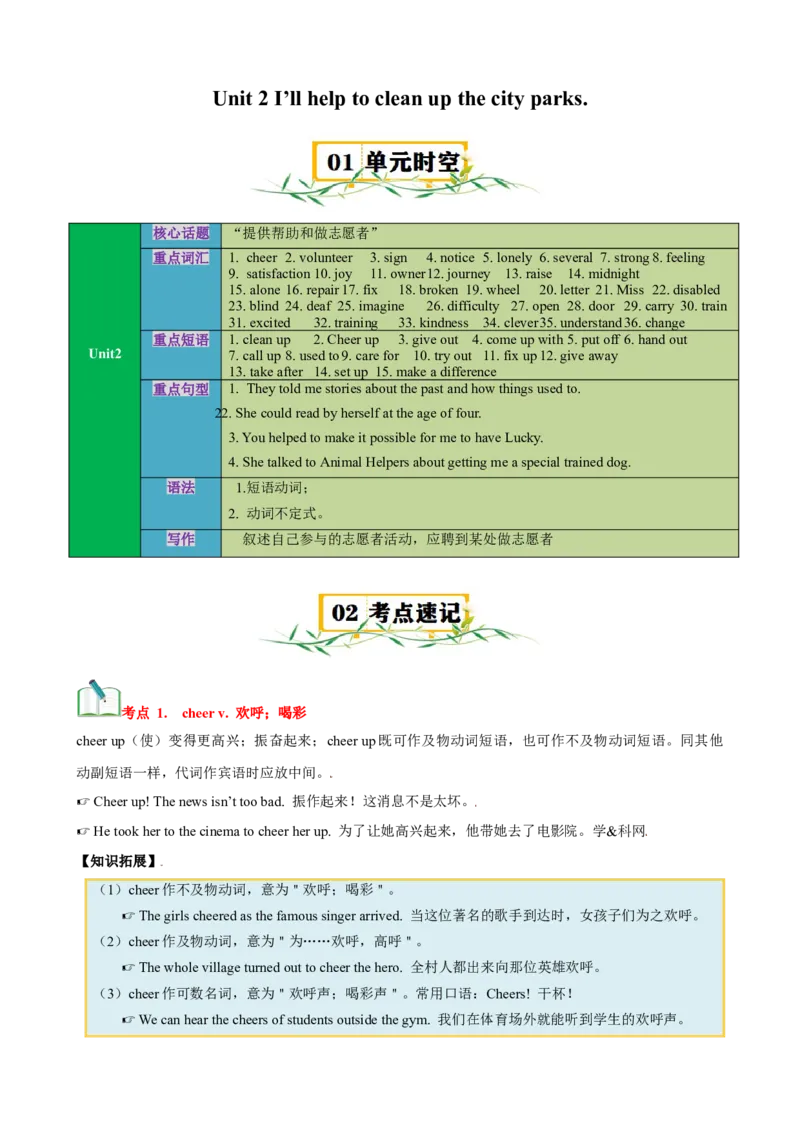
核心话题 “提供帮助和做志愿者”
重点词汇 1. cheer 2. volunteer 3. sign 4. notice 5. lonely 6. several 7. strong8. feeling
9. satisfaction10. joy 11. owner12. journey 13. raise 14. midnight
15. alone 16. repair17. fix 18. broken 19. wheel 20. letter 21. Miss 22. disabled
23. blind 24. deaf 25. imagine 26. difficulty 27. open 28. door 29. carry 30. train
31. excited 32. training 33. kindness 34. clever35. understand36. change
重点短语 1. clean up 2. Cheer up 3. give out 4. come up with 5. put off 6. hand out
Unit2 7. call up 8. used to9. care for 10. try out 11. fix up12. give away
13. take after 14. set up 15. make a difference
重点句型 1. They told me stories about the past and how things used to.
22. She could read by herself at the age of four.
3. You helped to make it possible for me to have Lucky.
4. She talked to Animal Helpers about getting me a special trained dog.
语法 1.短语动词;
2. 动词不定式。
写作 叙述自己参与的志愿者活动,应聘到某处做志愿者
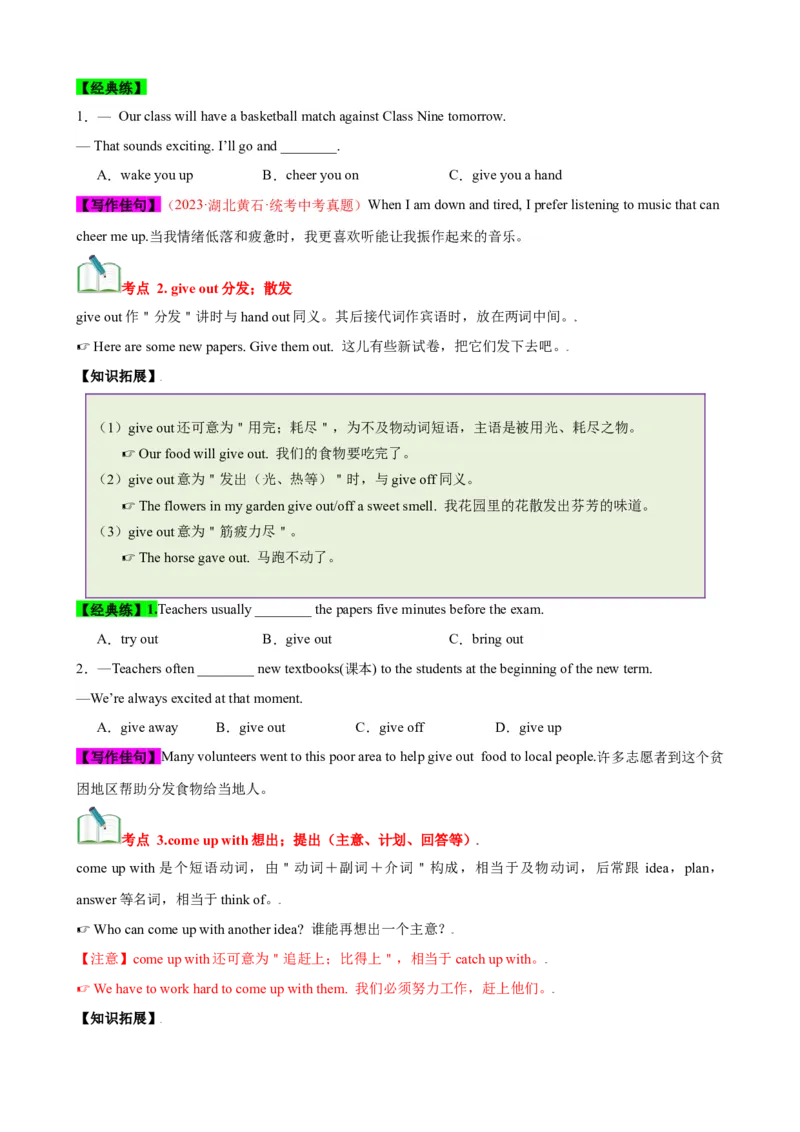
考点 1. cheer v. 欢呼;喝彩
cheer up(使)变得更高兴;振奋起来;cheer up既可作及物动词短语,也可作不及物动词短语。同其他
动副短语一样,代词作宾语时应放中间。
☞ Cheer up! The news isn’t too bad. 振作起来!这消息不是太坏。
☞ He took her to the cinema to cheer her up. 为了让她高兴起来,他带她去了电影院。学&科网
【知识拓展】
(1)cheer作不及物动词,意为"欢呼;喝彩"。
☞ The girls cheered as the famous singer arrived. 当这位著名的歌手到达时,女孩子们为之欢呼。
(2)cheer作及物动词,意为"为……欢呼,高呼"。
☞ The whole village turned out to cheer the hero. 全村人都出来向那位英雄欢呼。
(3)cheer作可数名词,意为"欢呼声;喝彩声"。常用口语:Cheers! 干杯!
☞ We can hear the cheers of students outside the gym. 我们在体育场外就能听到学生的欢呼声。【经典练】
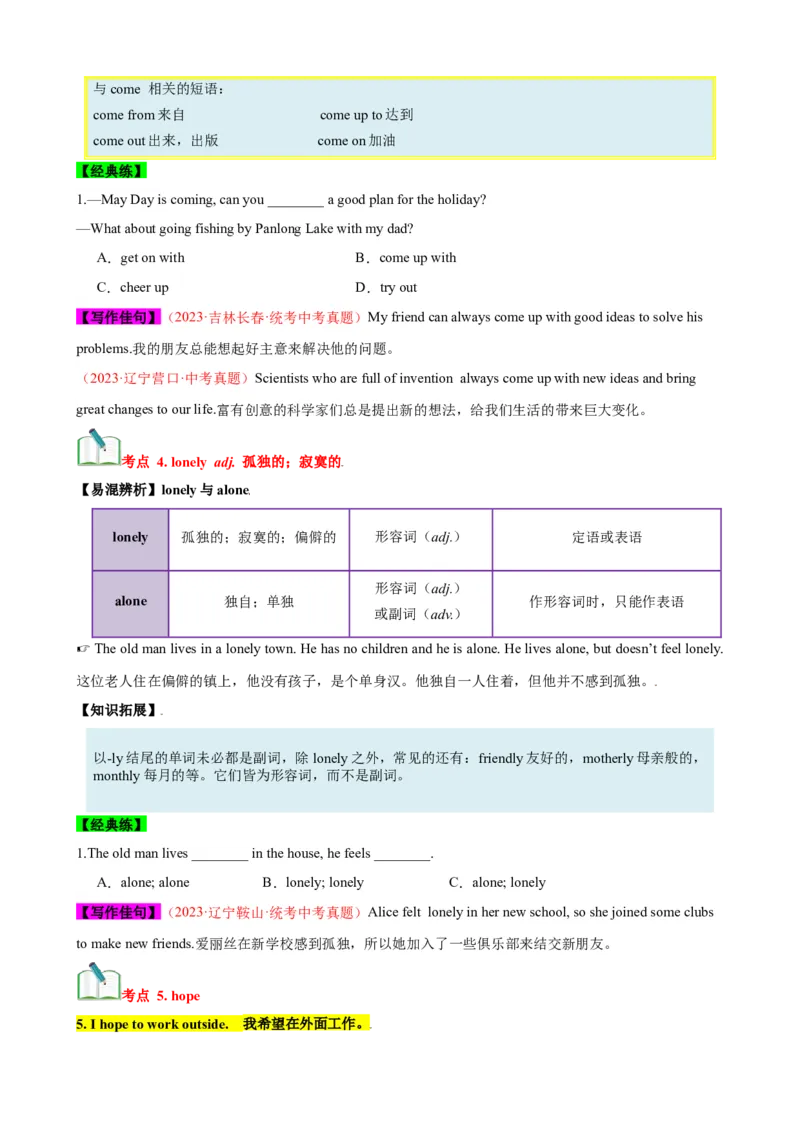
1.— Our class will have a basketball match against Class Nine tomorrow.
— That sounds exciting. I’ll go and ________.
A.wake you up B.cheer you on C.give you a hand
【写作佳句】(2023·湖北黄石·统考中考真题)When I am down and tired, I prefer listening to music that can
cheer me up.当我情绪低落和疲惫时,我更喜欢听能让我振作起来的音乐。
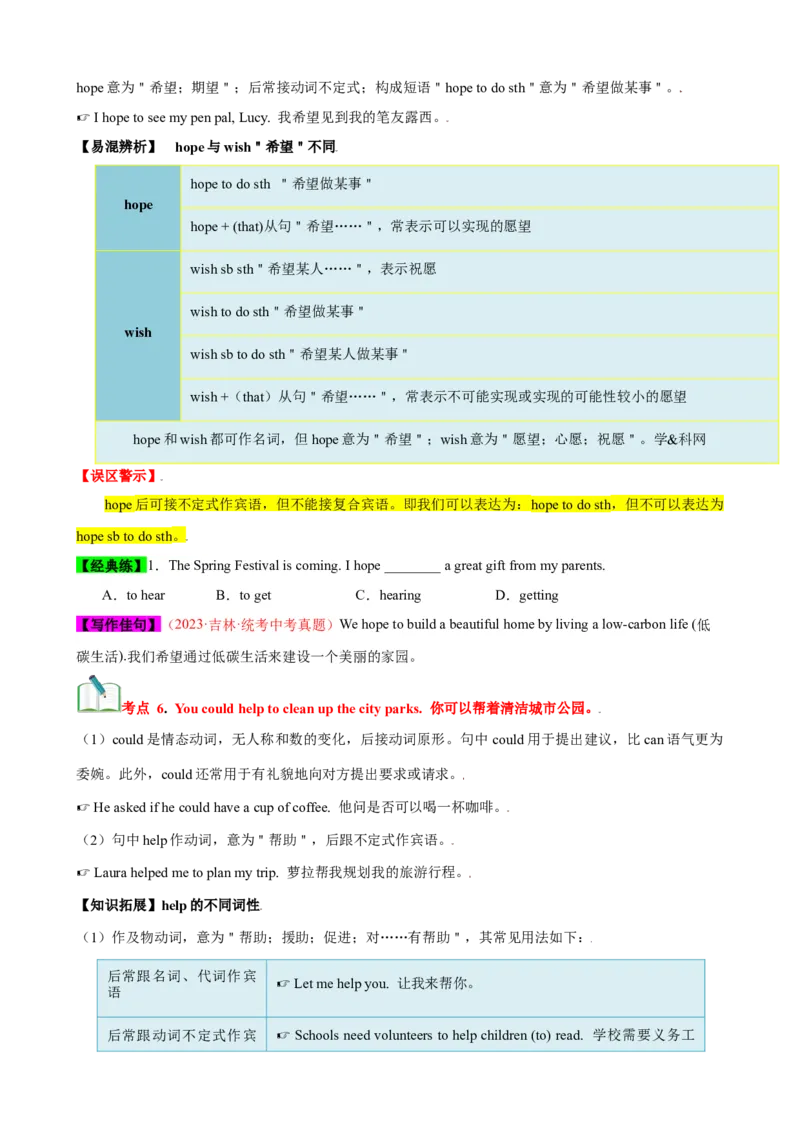
考点 2. give out分发;散发
give out作"分发"讲时与hand out同义。其后接代词作宾语时,放在两词中间。
☞ Here are some new papers. Give them out. 这儿有些新试卷,把它们发下去吧。
【知识拓展】
(1)give out还可意为"用完;耗尽",为不及物动词短语,主语是被用光、耗尽之物。
☞ Our food will give out. 我们的食物要吃完了。
(2)give out意为"发出(光、热等)"时,与give off同义。
☞ The flowers in my garden give out/off a sweet smell. 我花园里的花散发出芬芳的味道。
(3)give out意为"筋疲力尽"。
☞ The horse gave out. 马跑不动了。
【经典练】1.Teachers usually ________ the papers five minutes before the exam.
A.try out B.give out C.bring out
2.—Teachers often ________ new textbooks(课本) to the students at the beginning of the new term.
—We’re always excited at that moment.
A.give away B.give out C.give off D.give up
【写作佳句】Many volunteers went to this poor area to help give out food to local people.许多志愿者到这个贫
困地区帮助分发食物给当地人。
考点 3.come up with想出;提出(主意、计划、回答等)
come up with是个短语动词,由"动词+副词+介词"构成,相当于及物动词,后常跟 idea,plan,
answer等名词,相当于think of。
☞ Who can come up with another idea? 谁能再想出一个主意?
【注意】come up with还可意为"追赶上;比得上",相当于catch up with。
☞ We have to work hard to come up with them. 我们必须努力工作,赶上他们。
【知识拓展】与come 相关的短语:
come from来自 come up to达到
come out出来,出版 come on加油
【经典练】
1.—May Day is coming, can you ________ a good plan for the holiday?
—What about going fishing by Panlong Lake with my dad?
A.get on with B.come up with
C.cheer up D.try out
【写作佳句】(2023·吉林长春·统考中考真题)My friend can always come up with good ideas to solve his
problems.我的朋友总能想起好主意来解决他的问题。
(2023·辽宁营口·中考真题)Scientists who are full of invention always come up with new ideas and bring
great changes to our life.富有创意的科学家们总是提出新的想法,给我们生活的带来巨大变化。
考点 4. lonely adj. 孤独的;寂寞的
【易混辨析】lonely与alone
lonely 孤独的;寂寞的;偏僻的 形容词(adj.) 定语或表语
形容词(adj.)
alone 独自;单独 作形容词时,只能作表语
或副词(adv.)
☞ The old man lives in a lonely town. He has no children and he is alone. He lives alone, but doesn’t feel lonely.
这位老人住在偏僻的镇上,他没有孩子,是个单身汉。他独自一人住着,但他并不感到孤独。
【知识拓展】
以-ly结尾的单词未必都是副词,除lonely之外,常见的还有:friendly友好的,motherly母亲般的,
monthly每月的等。它们皆为形容词,而不是副词。
【经典练】
1.The old man lives ________ in the house, he feels ________.
A.alone; alone B.lonely; lonely C.alone; lonely
【写作佳句】(2023·辽宁鞍山·统考中考真题)Alice felt lonely in her new school, so she joined some clubs
to make new friends.爱丽丝在新学校感到孤独,所以她加入了一些俱乐部来结交新朋友。
考点 5. hope
5. I hope to work outside. 我希望在外面工作。hope意为"希望;期望";后常接动词不定式;构成短语"hope to do sth"意为"希望做某事"。
☞ I hope to see my pen pal, Lucy. 我希望见到我的笔友露西。
【易混辨析】 hope与wish"希望"不同
hope to do sth "希望做某事"
hope
hope + (that)从句"希望……",常表示可以实现的愿望
wish sb sth"希望某人……",表示祝愿
wish to do sth"希望做某事"
wish
wish sb to do sth"希望某人做某事"
wish +(that)从句"希望……",常表示不可能实现或实现的可能性较小的愿望
hope和wish都可作名词,但hope意为"希望";wish意为"愿望;心愿;祝愿"。学&科网
【误区警示】
hope后可接不定式作宾语,但不能接复合宾语。即我们可以表达为:hope to do sth,但不可以表达为
hope sb to do sth。
【经典练】1.The Spring Festival is coming. I hope ________ a great gift from my parents.
A.to hear B.to get C.hearing D.getting
【写作佳句】(2023·吉林·统考中考真题)We hope to build a beautiful home by living a low-carbon life (低
碳生活).我们希望通过低碳生活来建设一个美丽的家园。
考点 6. You could help to clean up the city parks. 你可以帮着清洁城市公园。
(1)could是情态动词,无人称和数的变化,后接动词原形。句中 could用于提出建议,比can语气更为
委婉。此外,could还常用于有礼貌地向对方提出要求或请求。
☞ He asked if he could have a cup of coffee. 他问是否可以喝一杯咖啡。
(2)句中help作动词,意为"帮助",后跟不定式作宾语。
☞ Laura helped me to plan my trip. 萝拉帮我规划我的旅游行程。
【知识拓展】help的不同词性
(1)作及物动词,意为"帮助;援助;促进;对……有帮助",其常见用法如下:
后常跟名词、代词作宾
☞ Let me help you. 让我来帮你。
语
后常跟动词不定式作宾 ☞ Schools need volunteers to help children (to) read. 学校需要义务工语或宾语补足语,不定
作者帮助儿童阅读。
式符号to可省略
help sb with sth"帮助某人做某事"
用于某些固定结构中 help oneself to... "自用,自取(食物、饮料等)"
can’t help doing sth"忍不住;情不自禁做某事"
(2)作名词,意为"帮助;帮忙",常用作不可数名词,其常用短语为 with the help of..."在……的帮
助下"。
考点 7. put off
7. We can’t put off making a plan. 我们不能推迟制订计划。
put off意为"推迟;拖延",是由"动词+副词"构成的短语动词,其后可接名词、代词或动词-ing形式
作宾语。
☞ We can’t put off having the meeting. 我们不能推迟召开这次会议。
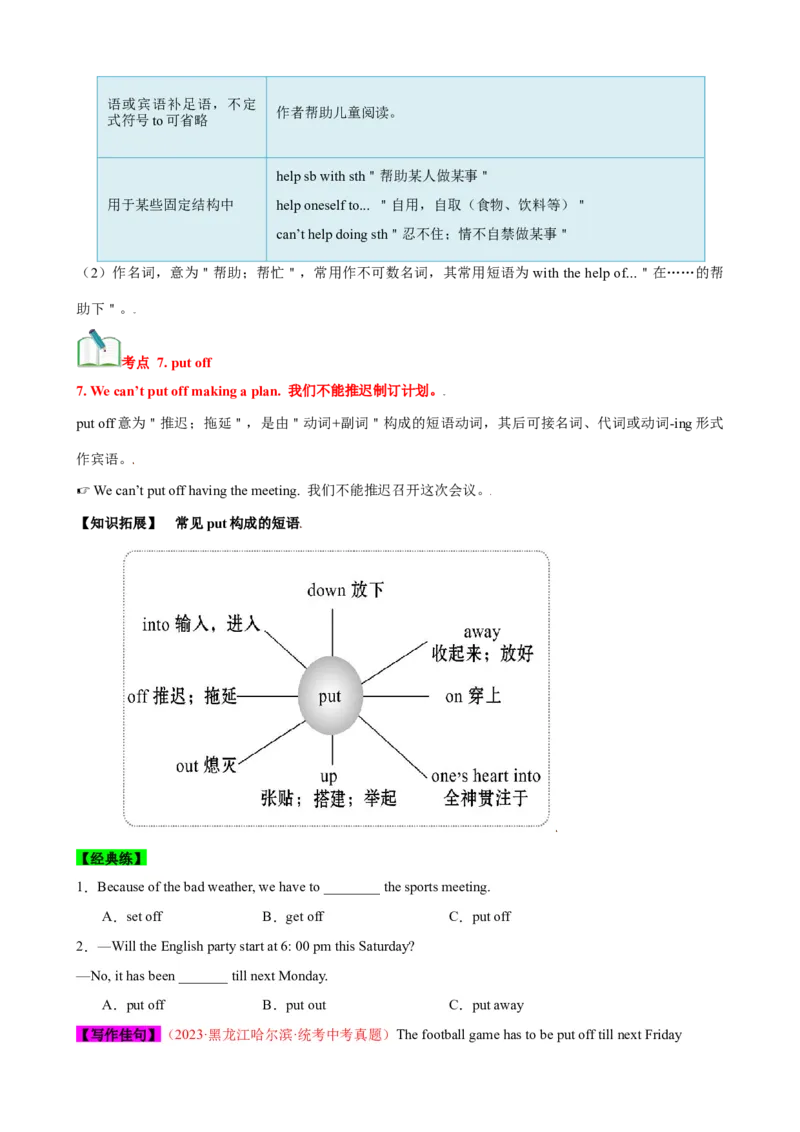
【知识拓展】 常见put构成的短语
【经典练】
1.Because of the bad weather, we have to ________ the sports meeting.
A.set off B.get off C.put off
2.—Will the English party start at 6: 00 pm this Saturday?
—No, it has been _______ till next Monday.
A.put off B.put out C.put away
【写作佳句】(2023·黑龙江哈尔滨·统考中考真题)The football game has to be put off till next Fridaybecause of the bad weather.由于天气不好,足球赛不得不推迟到下周五。
考点 8 take after
8. I take after my mother. 我像我的妈妈。
take after意为"(在外貌、性格等方面)与(父母等)相像"。其同义短语为:be similar to"与……相
似"。
☞ Steve takes after his father. They are both creative. 史蒂夫像他父亲。他们都富有创造力。
☞ She was a smart, brave woman. You take after her. 她是一名聪明、勇敢的女子。你像她。
【知识拓展】
look like表达"像"
look like意为"看起来像……",常指外貌、长相相似。
☞ Lucy looks like her twin sister Lily. They both have big eyes. 露西看起来像她的双胞胎姐姐莉莉。她
们都长着一双大眼睛。
【经典练】1.Don’t stay at home. Let’s go out to ________ fresh air.
A.take after B.take in C.take down
【写作佳句】(2023·湖北荆州·统考中考真题) I take after my father. He always volunteers to help people.我
像我的爸爸。他总是自愿帮助别人。
考点 9 fix up
2. I fixed it up. 我把它修理好了。
fix up意为"修理;修补",是由"动词+副词"构成的短语动词,名词作宾语可放在短语中间或短语后
面。代词作宾语时应置于fix与up之间。
☞ The computer doesn’t work. Can you fix it up? 这台电脑坏了,你会修理吗?
【经典练】1.They __________ the old bikes and sent them out to the poor.
A.fixed up B.called up C.dressed up
【写作佳句】(2021·湖南岳阳·统考中考真题)My best friend and I were fixing up the broken machine when
the rainstorm came.暴风雨来临时,我和我最好的朋友正在修理坏机器。
考点 10. set up建立;设立
☞ Many volunteers would like to set up an organization to help poor people. 许多志愿者想设立一个机构来帮助穷
人。
【易混辨析】 set up与buildset up 意为"建立,设立,开办",后常接某一组织、机构、团体等。
build 意为"建造,修建",后常接建筑物、机械等。
【一语辨异】They set up an organization to help the poor build houses. 他们设立了一个组织来帮助穷人建造房
子。
【知识拓展】
set up也可意为"竖立,架起,建起"。
☞ They are going to set up a bridge between the two islands. 他们打算在这两个岛之间架起一座桥梁。
【经典练】1.Zhang Guimei is an unusual teacher. She ________ the first free girls’ high school in 2008.
A.cheered up B.set up C.picked up D.looked up
2.(2022·湖北襄阳·统考中考真题)—It’s reported that Chinese researchers climbed to the top of
Qomolangma on May 4th.
—Yes. And they also _________ the world’s highest weather station.
A.took up B.gave up C.set up D.used up
【写作佳句】(2022·江苏盐城·统考中考真题)UNICEF is part of the United Nations. It was set up in Europe
in 1946.联合国儿童基金会是联合国的一部分。它于1946年在欧洲成立。
You helped to make it possible for me to have Lucky. 你帮助我, 使我能够拥有Lucky。
(1)句中make是使役动词,意为"使;使成为",后常跟复合结构,即"make+宾语+宾语补足语(形容
词)"。☞ Computers make it easy to learn English. 电脑使英语学习变得容易。
(2)句中it作形式宾语,真正的宾语是后置的动词不定式复合结构for me to have Lucky。
【知识拓展】
it作形式宾语的用法
(1)当不定式作宾语,且其后有宾语补足语时,常用it作形式宾语,而将动词不定式置于句末。
☞ We find it important to learn English well. 我们发现学好英语很重要。
(2)常跟it作形式宾语的动词有:make/find/feel/consider/think等。
考点 11. make a difference 有影响,有作用
其后可跟to sb /sth,意为"对某人或某事产生影响"。
☞ The recent talk between Tom and his parents made a big difference to him.
最近汤姆和他父母之间的一次谈话对他产生了很大的影响。
【知识拓展】make no difference 没有作用,没有影响
☞ It makes no difference to me. 这对我没什么影响。
【经典练】1.Volunteering in the local shelter can make ________ difference to those in need.
A.a B.an C.the D./
2.Before buying expensive things, you’d better think about them over and over, then make a ________.
A.information B.notice C.decision D.difference
【写作佳句】(2018·广东深圳·统考中考真题) She sets us a good example. Hard work always makes a
difference.她给我们树立了一个好榜样。努力总是会产生影响。
考点 12. imagine v. 想象;设想
(1)imagine可用作及物动词,后加名词、代词、动名词或从句作宾语。
☞ We often imagine living in a big house. 我们经常想象住在一所大房子里。
☞ Close your eyes and imagine (that) you’re in the forest. 闭上眼睛,想象你在森林里。
【巧记口诀】
巧记后接动名词的词
特殊动词接动名,使用它们要记清。
放弃(give up)享受(enjoy)可后悔(regret),
坚持(keep)练习(practice)必完成(finish)。
延期(put off) 建议(advise)勿介意(mind),
掌握它们今必行。
(2)imagine可用作不及物动词。
☞ He became very angry after he knew the truth. It is very easy to imagine. 知道真相后,他很生气。这很容易
想象得到。
【经典练】
1.Please ________ you see a boy lying on the road in great pain. What should you do?
A.imagine B.describe C.improve D.suggest
【写作佳句】It seems that AI(人工智能)can do much more than what we have ever imagined . It has played
an important part in our everyday life.人工智能似乎能做的比我们想象的多得多。它在我们的日常生活中起
着重要的作用。
考点 13.difficulty13. Most people would never think about this, but many people have these difficulties. 大多数人从没考虑
过这一点,但是许多人有这样的困难。
difficulty此处用作可数名词,通常用作复数形式,表示具体概念,意为"困难;难题;难事",其形容
词形式为difficult,意为困难的。
☞ There are lots of children with reading difficulties. 有很多存在阅读困难的儿童。
☞ He met with many difficulties when traveling. 他在旅行中遇到了许多困难。
【知识拓展】
difficulty表示抽象意义上的"困难"时,是不可数名词,have difficulty (in) doing sth表示"做某事
有困难",=have trouble (in) doing sth
☞ I had great difficulty (in) finishing the task. 完成这项任务我觉得很困难。
【经典练】
1.I have _________ in finishing the task. Could you help me?
A.fun B.advice C.success D.difficulty
【写作佳句】(2023·江苏南通·统考中考真题) We should learn to deal with all kinds of difficulties.我们应
该学会处理各种各样的困难。
(2022·黑龙江绥化·统考中考真题)If you have difficulty working out the problem, you 如果你做这道题有困
难,你可以请老师帮忙。
考点 14 carry
8. I can’t use my arms or legs well, so normal things like answering the telephone, opening and closing
doors, or carrying things are difficult for me. 因为我不能灵活地使用胳膊和腿, 因此像接电话、开关门或
提东西等这些正常的事对我来说都很困难。
(1)句中like作介词,意为"像;如同",后接名词或动词-ing形式作宾语。
☞ I have many hobbies, like painting, dancing, collecting stamps and so on. 我有许多爱好,像画画、跳舞、
集邮等。
(2)carry作动词,意为"拿;提;扛",后接名词作宾语。
☞ Let me help you carry the box. 让我来帮你提箱子吧。
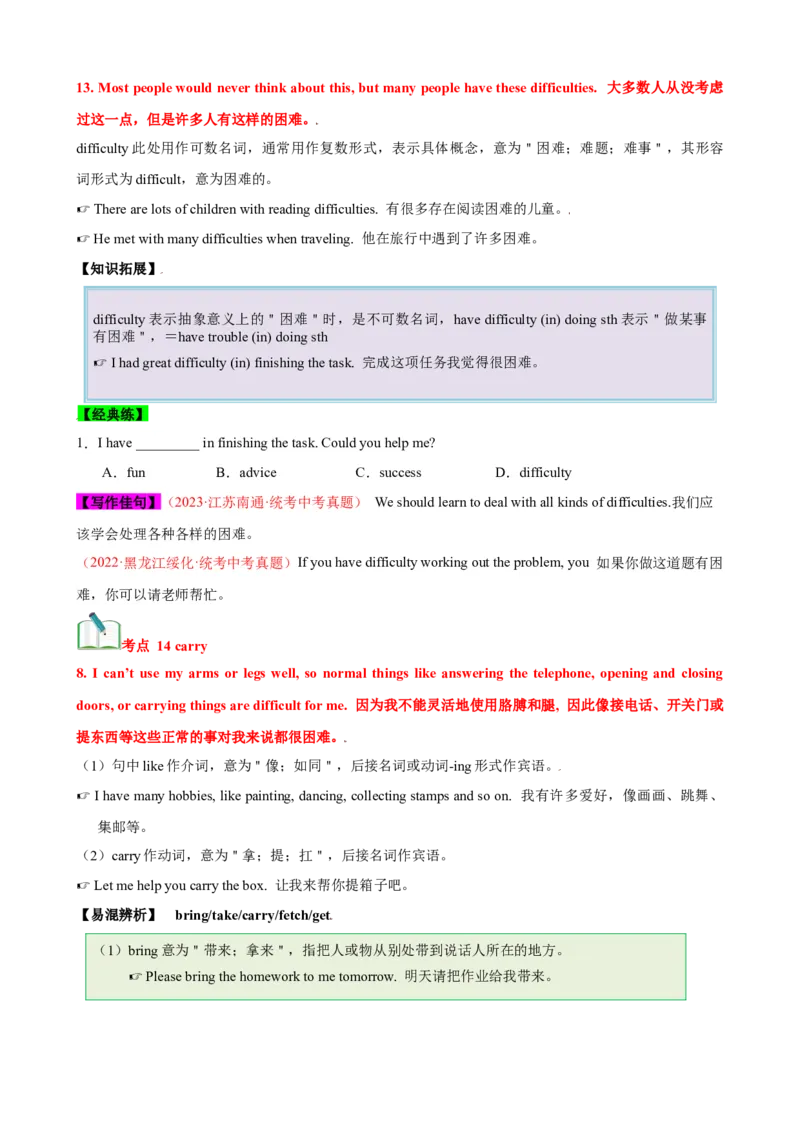
【易混辨析】 bring/take/carry/fetch/get
(1)bring意为"带来;拿来",指把人或物从别处带到说话人所在的地方。
☞ Please bring the homework to me tomorrow. 明天请把作业给我带来。(2)take意为"拿走;取",指把人或物从说话人所在地带到别处去。
☞ Take an umbrella with you, please. 请随身带把伞。
(3)carry无方向性,含"负重"之意,一般指随身携带,如手提、肩扛等。
(4)fetch指从说话者所在地到别处去把人或物带回来。
(5)get与fetch同义,但更口语化。
【图解助记】
【经典练】
1.They are ________ some paintings to the art gallery for tomorrow’s exhibition. Let’s go and help them.
A.carrying B.taking C.bringing D.fetching
2.Bingbing is _______ strong _______ he can carry the heavy box.
A.too; to B.to; too C.so; that D.such; that
【写作佳句】(2023·辽宁丹东·统考中考真题)Jim can carry the heavy box because he is much stronger
than the others in his class.吉姆能搬动这个重箱子,因为他比班上其他人强壮得多。
考点 15 put up
15. He put up some signs asking for old bikes... 他张贴了一些海报求购旧自行车……
(1)put up意为"张贴;搭建",是"动词+副词"构成的短语动词,名词作宾语时既可置于短语之间又
可置于短语后面。
☞ Many blocks of flats were put up in the 1990’s. 许多公寓式建筑群都是20世纪90年代建的。
(2)代词作宾语时应置于短语中间。
☞ Here are some new pictures. Please put them up on the wall. 这儿有几张新画,请把它们贴到墙上去。考点 16 work out
16. The ideas that he came up with worked out fine. 他想出的主意效果非常好。
work out意为"产生结果;发展;成功"。可以单独使用。
☞ I think that this interesting program will work out. 我认为这个有趣的方案将会成功。
☞ The plan worked out badly. 计划进行很不成功。学科*网
【知识拓展】
work out的其他含义
(1)算出/做出
☞ The math problem is too difficult. I can’t work it out. 这道数学题太难了,我不能算出来。
(2)解决
☞ She worked out the problem with his help. 在他的帮助下,她解决了这个问题。
(3)制定
☞ We worked out a plan very soon. 我们很快就制订出一项计划。
【注意】 work out是动副结构,代词作宾语时,应放在work out中间。
【经典练】1.Life is like a journey with trouble, but with care and wisdom (智慧) you can ______ any problem
you face.
A.find out B.hand out C.work out
【写作佳句】(2023·安徽·统考中考真题)Our team worked out what to do about the project and successfully
completed it on time.我们的团队制定出了这个项目的方案,并成功地按时完成了。
一.语法精讲
(一)动词不定式
动词不定式是一种非谓语动词形式,其结构为"to+动词原形",其中to不是介词,而是动词不定
式的符号,称为小品词,动词不定式没有人称和数的变化。动词不定式和其后面的名词等构成不定式短
语,在句子中可以用作主语、表语、宾语、补足语、定语、状语等。本单元主要学习其作宾语、状语、
宾补的用法。
◆ 动词不定式的形式及性质
(1)动词不定式的基本形式:to do(to有时可省略);(2)动词不定式变否定:not (to) do;
(3)动词不定式无人称变化;
(4)动词不定式仍保留动词特点,可以有自己的宾语和状语。
☞ to speak at the meeting 在会议上发言 to read newspapers 看报纸
◆ 动词不定式的句法作用
一、作宾语
动词不定式(短语)可以放在一些动词后面用作宾语,能以动词不定式作宾语的动词有:begin,
want,remember,agree,learn,like,decide,fail,pretend,demand,refuse等。
☞ You must learn to look after yourself. 你必须学着照顾自己。
☞ They volunteer to clean up the house for the old lady. 他们自愿给老人打扫房子。
☞ They would like to come by bus. 他们想乘公共汽车来。
二、作宾语补足语。
☞ I tell him to arrive on Sunday. 我让他周日到达。
☞ Li Lei asked his deskmate to help him with English. 李磊请同桌帮他学英语。
☞ The teacher asked the students to read it again. 那个老师让学生们又把它读了一遍。
动词不定式作宾语补足语,表示宾语所做的动作,可以用动词不定式作宾语补足语的动词有:tell,
ask,want,like,invite,encourage,help等。但在see,watch,hear,feel,notice等感官动词或let,
make,have等使役动词后面作宾语补足语的动词不定式一般要省略动词不定式符号"to",可以归纳为
以下三种句式:
1. 不可以省to的不定式作宾语补足语:tell /ask / want / would like / wish / suppose / invite / encourage /
teach / depend on等+ sb + to do sth
☞ The teacher told us to come earlier tomorrow. 老师告诉我们明天早点来。
☞ Her parents wish her to be a teacher. 她的父母希望她成为一名教师。
2. 省"to"的不定式作宾语补足语:
(1)Let / make / have + sb +do sth
☞ Let the boy go out now. 让那个男孩现在出去。
☞ They made the children play the piano 6 hours a day last month. 上个月他们让这些孩子每天弹6个
小时的钢琴。学&科网
(2)see / watch / hear / notice / feel + sb +do sth
☞ I heard them argue this morning. 今天早上我听到他们吵架了。(强调整个过程)
【注意】
①help带不带to均可以。
☞ I often help my mother (to) do housework. 我经常帮助妈妈做家务。②此类动词后用不带to的不定式作宾补,当变被动时,必须还原to。
☞ William is often seen to play Chinese kung fu in the park. 人们常看到威廉在公园练中国功夫。
4. 否定形式:
(1)动词不定式的否定式是直接在to前加上not。
☞ Tell them not to play football in the street.
(2)省to的动词不定式的否定式是直接在动词前面加not。
☞ Let the boy not go. 不要让那个男孩走。
三、作状语
(1)作目的状语。
☞ He stopped to have a rest. 他停下来休息。
强调动词不定式所表示的目的时,动词不定式可用in order to或so as to +动词原形,so as to不可用
于句首。
☞ The bus stopped so as to pick up passengers. 公共汽车停下来以便接乘客。
(2)作结果状语。
☞ He woke up only to find everybody gone. 他醒来时才发现所有的人都走了。
☞ His grandma lived to see the liberation of China. 他奶奶活到了中国解放。
☞ He is old enough to go to school. 他年龄足够大了,可以去上学了。
(3)在某些表示喜、怒、哀、乐等的形容词后作原因状语。
☞ I’m proud to have taken part in the competitions. 很荣幸参加了这些竞赛。
☞ I’m happy to have found many things I can do. 很高兴找到了很多我能做的事。
◆ 动词不定式可以和what,which,how,where,when等特殊疑问词连用。
☞ The question is I don’t know when to start. 问题是我不知道什么时候开始。
☞ You do not know what to do and how to do it. 你不知道要去做什么或者怎么做。
(二)动词短语
短语动词是一种固定词组,由动词加介词或副词等构成,其作用相当于一个动词。
◆ 构成:
常见的形式有:1. 动词+副词,如:put up
2. 动词+介词,如:look at
3. 动词+副词+介词,如:run out of
4. 动词+名词+介词,如:take care of
◆ 动词+副词
(1)常见的相当于及物动词的这类短语动词有:cheer up(振奋起来),clean up(打扫干净),set up(建立),put up(搭建,张贴),cut up(切
碎),fix up(修理),work out(算出),give out(分发),give away(赠送),think over(仔细思
考),turn over(把……翻过来),hand in(上交)等。
【注意】此类短语相当于及物动词时,后面必须跟宾语,若名词作宾语,可以放在副词前面或后面,但
代词作宾语时,必须置于副词之前。
(2)常见的相当于不及物动词的这类短语动词有:
get up(起床),start off(动身),come back(回来),get down(下来),hold on(等一下;别挂
断),look out(当心,小心),get away(逃离)等。
◆ 动词+介词
这种结构的短语动词在句中作谓语时,后面必须接宾语。常见的有:
look for(寻找),stand for(代表),wait for(等待),pay for(付费),send for(派人去请),
take after(像),hear from(收到……的来信),hear of(听说),depend on(依靠)等。
◆ 动词+副词+介词
这种短语动词相当于及物动词,介词后面须跟宾语。常见的有:
add up to(总共是),catch up with(赶上),look down upon(瞧不起),run out of(耗尽,用光)
◆ 动词+名词+介词
这种短语动词相当于及物动词,后面需接宾语,有时名词前可以加形容词修饰。常见的有:make fun
of(取笑),make use of(利用),pay attention to(注意),take care of(照顾)等。
【注意】这类短语动词后面的宾语无论是名词还是代词,都要放在介词之后。
☞ He is taking care of his little brother. 他在照顾他弟弟。
☞ We shouldn’t make fun of others. 我们不应该嘲笑他人。
二、提供帮助和做志愿者
一,话题分析:
本单元的话题是“提供帮助和做志愿者”,应用文体裁居多,该话题属于中考常考话题之一。主要是
叙述自己参与的志愿者活动,提供给别人的帮助,包括应聘到某处做志愿者,会做的志愿者活动,能为
别人或者机构提供的帮助等内容。重点考查学生以下能力:
1. 掌握并熟练使用表达出活动的要点;
2. 会写一些简单的应聘信;
3. 清晰表达自己的能力。
二,写作步骤:
1.总分总结构。短文通常分为三个部分:
总------第一部分:开篇点题,引出话题。分-------第二部分:活动内容以及提供的帮助。
总——第三部分:活动的感受。
2.人称:第一人称。
3.时态:一般将来时、一般过去时。
三,词汇积累:
1. help to do...帮助做.....
2. clean up打扫
3. cheer up使高兴起来
4. give out food分发食物
5. teach kids教学生
6. volunteer志愿者
7. give some advice给出建议
8. make a plan制定计划
9. come up with想出......
10. work in an old people’s home在敬老院上班
11. help out with想办法解决
12. lonely孤独的
13. care for照顾
14. decide to决定做
15. give up放弃
16. at the age of在.....岁时
17. try out参加.....选拔
18. tried doing尝试做
19. come true实现
20. learn something important学到了重要的东西
21. be interested in对......感兴趣
22. at the same time同时
23. volunteer to do自愿去做.....
24. put up张贴
25. repair修理
26. give away捐赠
27. thank you for...因......而感谢
28. change my life改变我的生活四,句型积累:
1. I’d like to help to clean up the city parks.我想去帮忙打扫市里的公园。
2. I can teach kids to learn English.我会教孩子们学英语。
3. Let’s make some notices.咱们做些通知吧。
4. Iwant to be a volunteer in an old people’s home.我想在敬老院做志愿者。
5. I like reading newspaper to them.我喜欢读报给他们听。
6. We should listen to them and care for them.我们应该倾听他们并且照顾他们。
7. I love animals and want to be an animal doctor.我喜欢小动物想成为一名兽医。
8. I get such a strong feeling of satisfaction when I see the animals get better and the look of joy on their
owners’ faces.我得到强烈的满足感当我看见他们主人脸上的喜悦感。
9. Volunteering here is a dream come true.能在这做志愿者,我的梦想实现了。
10. I can do what I love to do and help others at the same time.我可以做我喜欢做得去帮助别人。
11. Helping others can bring us happiness.帮助别人能给我们带来快乐。
12. I think we’d better....我觉得我们最好....
13. In my free time I like to...so I think I’d be good at this job.在业余时间我喜欢做所以我觉得我擅长这
项工作。
14. I’m strong in....我强烈想加入....
15. I want to help out as a volunteer in your group.我想在你们的团队里做一名志愿者。
假如你叫Lucy,是一名中学生,你想成为国际动物救助中心 “IAH(International Animal Helper)”的一名志
愿者,请用英文写一封自荐信。提示要点:1.能参加周末活动;2.到救助中心的距离近;3.喜爱小动物,
愿意帮助它们;4.懂一点医学知识;5.补充1-2点个人信息和想法。词数90词左右
Dear Sir/Madam,
___________________________________________________________________________________________
___________________________________________________________________________________________
___________________________________________________________________________________________
___________________________________________________________________________________________
___________________________________________________________________________________________
___________________________________________________________________________________________
___________________________________________________________________________________________
Yours sincerely,
Lucy
Dear Sir/Madam,My name is Lucy.I’m a middle school student.I want to help out as a volunteer at IAH.I love animals and
I’d like to help them.I have some medical knowledge.I believe I can be a good helper.I live near IAH and it only
takes about ten minutes to get there by underground.What’s more,I’m free on weekends and I can take part in the
activities.If I get the chance,I won’t let you down.
Looking forward to your reply.
Yours sincerely,
Lucy
Unit2 单元要点梳理总结
重点短语
Section A 部分
1.清洁、打扫 clean up 2.使振奋、高兴 cheer up
3.分发、散发 give/ hand out 4.过去、曾经 used to
5.志愿去做某事 volunteer to do 6.提出,想出 come up with
7.推迟 put off 8.张贴;搭建 put up
9.打电话 call up 10.照顾,照料 care for/look after/take care of
11.在……岁 at the age of 12.参与选拔;试用 try out
13.同时 at the same time 14.一个强烈的满足感 a strong feeling of satisfaction
15.为……而筹钱 raise money for 16.为……发愁 be worried about
Section B 部分
1.修理、装饰 fix up 2.用光,用尽 run out (of)
3.(外貌/行为)像… take after 4.捐赠、赠送 give away
5.与……相似 be similar to 6.建立;设立 set up
7.残疾人 disabled people 8.对……有影响/作用 make a difference to
9.帮助某人摆脱困境 help sb. out 10.对……感到兴奋 be excited about
重点知识梳理
1. You could help to clean up the city parks.
(1) ① help sb. with sth. 帮助某人某事
② help sb. (to) do sth. 帮助某人做某事
(2) clean up意为“打扫干净”
2. The girl could visit the sick kids in the hospital to cheer them up.cheer up意为“使开心, 使振作、振奋”,代词用作宾语时,要当在cheer和up之间。
3. The boy could give out food at the food bank.
give out意为“分发、散发”,相当于hand out。
4. The girl could volunteer in an after-school study program to teach kids.
volunteer用作动词,表示“义务做、自愿做”,后接不定式作宾语,volunteer to do sth.“志愿做某事”;
作名词,表示“志愿者”,为可数名词。
5. Let’s make some notices, too.
also, too, as well与either都可以表示“也”,但是用法不同。
also 放在句中行为动词前,be动词、助动词和情态动词之后。 He also wants to go.
too 用于肯定句中,放在句尾,前面用逗号隔开。 He wants to go, too.
as well 用于肯定句中,放在句尾,前面不用逗号隔开。 He wants to go as well.
either 用于否定句句末,句前不用逗号隔开。 He doesn’t want to go either
6. We need to come up with a plan for the City park Clean-Up Day.
come up with表示“想出、提出(主意或者想法)”。
7. Oh, what did they ask you to help out with?
help out意为“帮忙分担、帮某人摆脱困境”。
8. They told me stories about the past and how things used to be.
辨析:be /get used to doing sth., used to do sth.与be used to do sth.
辨析: used to do sth;be used to do sth;与 be /get used to doing sth
used to do sth. 过去常常做某事 记忆口诀:used to do 常常做;
be used to do sth. 被用来做某事 be used to do 被用做;
be /get used to doing sth. 习惯于做某事 be used to doing 习惯做
9. Yeah, a lot of old people are lonely.
lonely作形容词表示“孤独的、荒凉的、偏僻的”;
alone既可以作形容词也可以作副词,作形容词时只能作表语,不能作定语。
10. We should listen to them and care for them.
care for意为“照顾、照料”,后接名词或者代词作宾语,相当于look after或者take care of。
11. I get such a strong feeling of satisfaction when I see the animals get better and the look of joy on their
owners’ faces.
such用作形容词,表示“这样、如此”,用来修饰名词,可以修饰可数名词单数,也可以修饰可数名
词复数或者不可数名词。
12. She could read by herself at the age of four.
at the age of表示“在……岁时”,表示年龄。
13. Last year, she decided to try out for a volunteer after-school reading program.try out for意为“参加……选拔、争取成为……”。
14. I can do what I love to do and help others at the same time.
at the same time意为“同时”。
15. Our class is trying to...
① try to do sth. “尽力做某事”
② try doing sth. “尝试做某事”
16. I take after my mother.
take after意为“长得像”。
17. I fixed it up.
fix up意为“修理”,代词作宾语时,放在fix和up中间。
18. I gave it away.
give away意为“捐赠、赠送”,还可以表示“泄露(秘密)”。
19. I’m similar to her.
be similar to意为“与……相似”,be similar in“在……方面类似”。
20. I didn’t keep it.
① keep sth. 保留某物
② keep doing sth. 一直做某事
③ keep+adj. 保持……
④ keep sb./sth.+adj./介词短语 保持某人/某物……
⑤ keep sb. doing sth. 保持某人做某事
21. Who wrote the letter to Miss Li?
write a letter to sb.=write sb. a letter=write to sb. “给某人写信”
22. You helped to make it possible for me to have Lucky.
有些动词后面接复合宾语时,常用it作形式宾语,而真正的宾语则由动词不定式来担当,并位于宾语补
足语之后。常见的这样的动词有find,think,feel,make等。
23. Lucky makes a big difference to my life.
make a difference to意为“对…有影响、对…起作用”,后接名词、代词、动名词作宾语。
24. Or imagine you can’t walk or use your hands easily.
imagine表示“想象”时,后常接动名词或者从句作宾语。
25. I can’t use my arms or legs well, so normal things like answering the telephone, opening and closing
doors, or carrying things are difficult for me.
bring表示“带来”,强调从别的地方带到说话的地方,常与副词here连用;take表示“带走”,强调
从说话的地方带去别的地方,常与副词there连用;carry表示“搬、抬”,没有方向性。26. She talked to Animal Helpers about getting me a special trained dog.
train用作及物动词,表示“训练、培训”,train sb./sth. to do sth.“训练某人/某物做某事”。
27. After six months of training with a dog at Animal Helpers, I was able to bring him home.
be able to意为“能,会”,表示能力,与can同义。
In the future, students will be able to study at home with the help of computers.
【拓展】辨析:be able to与can
be able to强调通过努力而获得的能力,而can强调自身已具有的能力。
She can sing the song in English. He will be able to sing this song in English, too.
重点语法
一、作主语
为避免句子的头重脚轻,常用it作为形式主语,而真正的主语动词不定式后置。
常用句型:It +be+adj./n.+(for/of sb.) to do sth. It takes sb. some time to do sth.
二、作宾语
动词agree (同意); offer (提出); intend, plan (打算,计划); demand, ask (要求); promise (答
应); help (帮忙); prepare (准备); decide (决定); refuse (拒绝);dare (敢于); choose (选择);
wish,hope,want, expect (希望,想要); fail (不能;忘记); pretend (假装); manage (设法);
determine (决心)常接动词不定式作宾语。
【记忆口诀】
同意提出做计划,要求答应来帮忙。
准备决定遭拒绝,敢于选择有希望。
不能做到莫假装,设法做成决心强。
三、作(后置)定语
常用于“have/has+sth.+to do”或“enough+名+to do” “It’s time to do sth.” 等结构中。
四、动词不定式作状语
主要用来修饰动词,表示目的,结果或原因。为了强调目的,有时可以把动词不定式放在句首,或在
不定式前加in order (to) 或so as (to) “为了,目的是”。常用结构有too + adj./adv. + to do sth.等。
五、作宾语补足语
tell, ask, want, invite, teach, like, call 等可接带 to 的动词不定式作宾语补足语,构成 tell/ask/want
/call/invite sb. to do sth.结构。
【注意】动词不定式作使役动词和感官动词的宾语补足语时应省去to:
“一感(feel),二听(listen to, hear),三让(let, make, have,,四看(look at, see, watch, notice),半帮助
(help)”。
六、固定句式中动词不定式的用法 常见的形式有:had better (not) do sth. 最好(不)做……
Would you like to do sth.? 你想做……?
Why not do sth.? 为什么不做……?
Would you please (not) do sth.? 请你(不)做……好吗?