Unit2 I'll help to clean up the city parks.
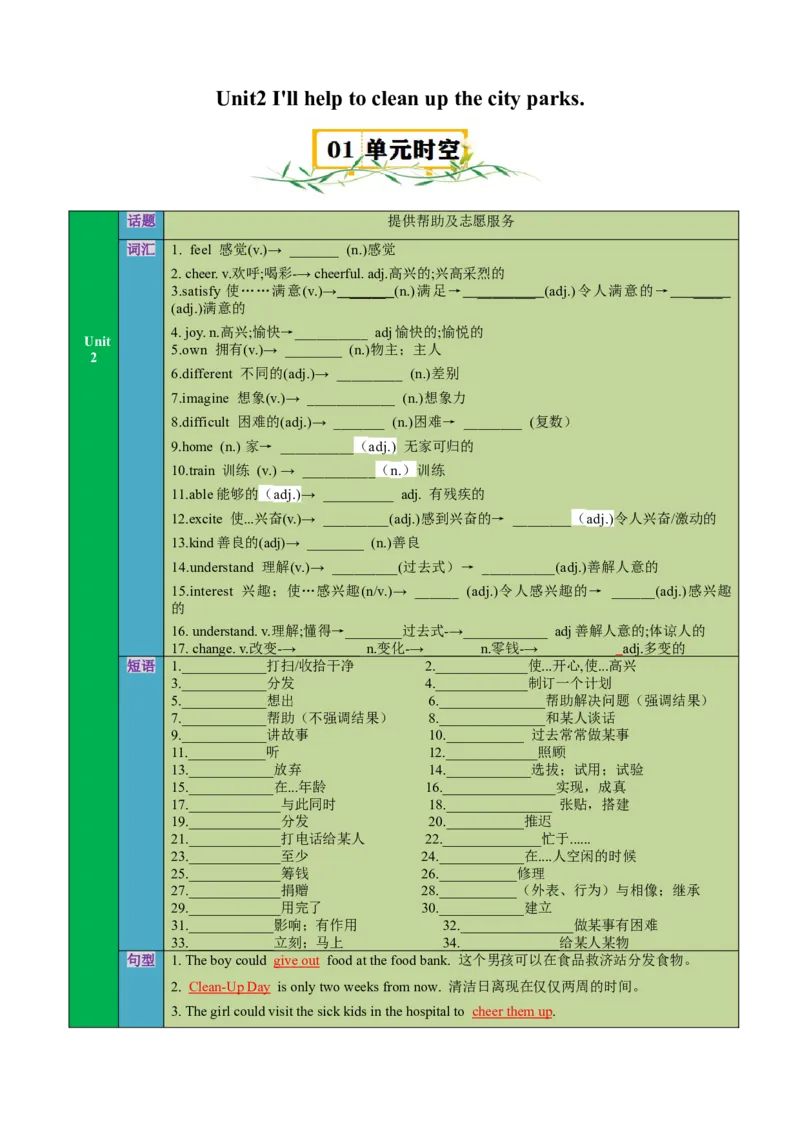
话题 提供帮助及志愿服务
词汇 1. feel 感觉(v.)→ _______ (n.)感觉
2. cheer. v.欢呼;喝彩-→ cheerful. adj.高兴的;兴高采烈的
3.satisfy 使……满意(v.)→ _____ (n.)满足→ _______ _ (adj.)令人满意的→ ___ _
(adj.)满意的
4. joy. n.高兴;愉快→__________ adj愉快的;愉悦的
Unit
5.own 拥有(v.)→ ________ (n.)物主;主人
2
6.different 不同的(adj.)→ _________ (n.)差别
7.imagine 想象(v.)→ ____________ (n.)想象力
8.difficult 困难的(adj.)→ _______ (n.)困难→ ________ (复数)
9.home (n.) 家→ __________(adj.) 无家可归的
10.train 训练 (v.) → __________(n.)训练
11.able能够的(adj.)→ __________ adj. 有残疾的
12.excite 使...兴奋(v.)→ _________(adj.)感到兴奋的→ ________(adj.)令人兴奋/激动的
13.kind善良的(adj)→ ________ (n.)善良
14.understand 理解(v.)→ _________(过去式)→ __________(adj.)善解人意的
15.interest 兴趣;使…感兴趣(n/v.)→ ______ (adj.)令人感兴趣的→ ______(adj.)感兴趣
的
16. understand. v.理解;懂得→________过去式-→____________ adj善解人意的;体谅人的
17. change. v.改变-→_________ n.变化-→________n.零钱-→___________ adj.多变的
短语 1.____________打扫/收拾干净 2._____________使...开心,使...高兴
3.____________分发 4._____________制订一个计划
5.____________想出 6._______________帮助解决问题(强调结果)
7.____________帮助(不强调结果) 8._______________和某人谈话
9.____________讲故事 10.___________ 过去常常做某事
11.___________听 12._____________照顾
13.____________放弃 14.____________选拔;试用;试验
15.____________在...年龄 16.________________实现,成真
17._____________与此同时 18._______________ 张贴,搭建
19._____________分发 20.___________推迟
21._____________打电话给某人 22.______________忙于......
23._____________至少 24.____________在....人空闲的时候
25._____________筹钱 26.___________修理
27._____________捐赠 28.___________(外表、行为)与相像;继承
29._____________用完了 30.____________建立
31.____________影响;有作用 32.________________做某事有困难
33.____________立刻;马上 34.______________给某人某物
句型 1. The boy could give out food at the food bank. 这个男孩可以在食品救济站分发食物。
2. Clean-Up Day is only two weeks from now. 清洁日离现在仅仅两周的时间。
3. The girl could visit the sick kids in the hospital to cheer them up.女孩子可以去医院看望生病的小孩,让他们振奋起来。
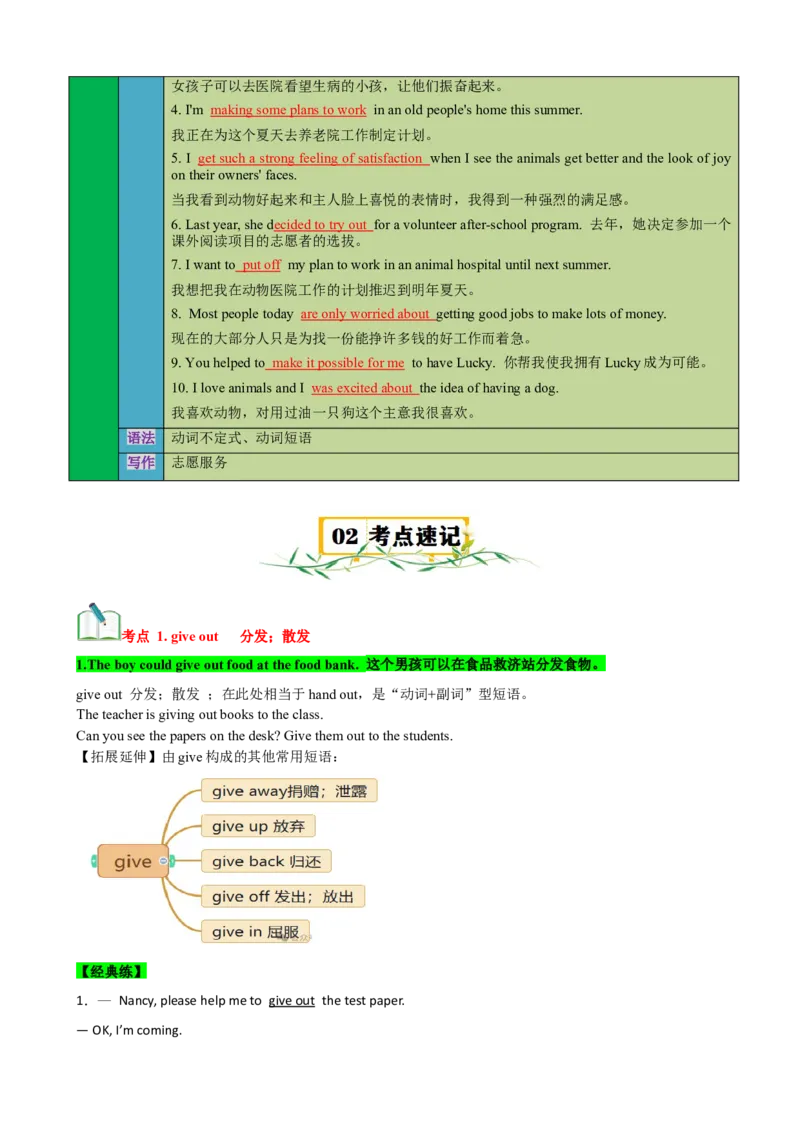
4. I'm making some plans to work in an old people's home this summer.
我正在为这个夏天去养老院工作制定计划。
5. I get such a strong feeling of satisfaction when I see the animals get better and the look of joy
on their owners' faces.
当我看到动物好起来和主人脸上喜悦的表情时,我得到一种强烈的满足感。
6. Last year, she decided to try out for a volunteer after-school program. 去年,她决定参加一个
课外阅读项目的志愿者的选拔。
7. I want to put off my plan to work in an animal hospital until next summer.
我想把我在动物医院工作的计划推迟到明年夏天。
8. Most people today are only worried about getting good jobs to make lots of money.
现在的大部分人只是为找一份能挣许多钱的好工作而着急。
9. You helped to make it possible for me to have Lucky. 你帮我使我拥有Lucky成为可能。
10. I love animals and I was excited about the idea of having a dog.
我喜欢动物,对用过油一只狗这个主意我很喜欢。
语法 动词不定式、动词短语
写作 志愿服务
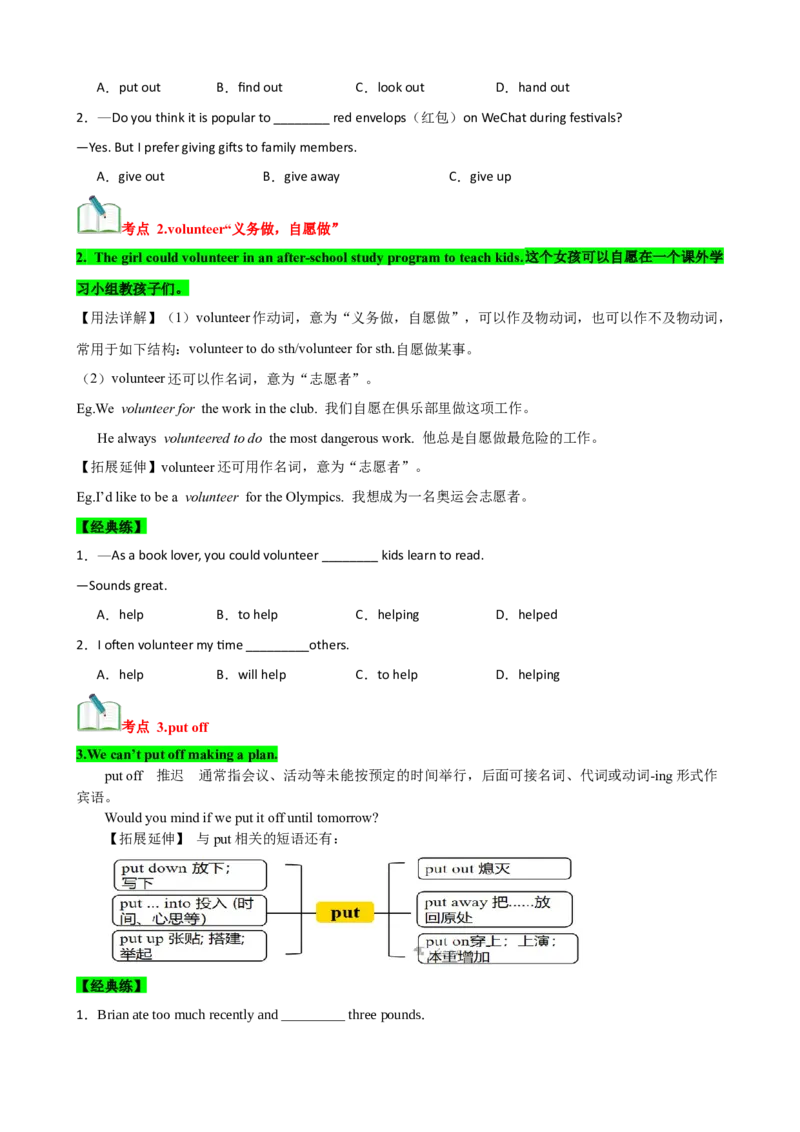
考点 1. give out 分发;散发
1.The boy could give out food at the food bank. 这个男孩可以在食品救济站分发食物。
give out 分发;散发 ;在此处相当于hand out,是“动词+副词”型短语。
The teacher is giving out books to the class.
Can you see the papers on the desk? Give them out to the students.
【拓展延伸】由give构成的其他常用短语:
【经典练】
1.— Nancy, please help me to give out the test paper.
— OK, I’m coming.A.put out B.find out C.look out D.hand out
2.—Do you think it is popular to ________ red envelops(红包)on WeChat during festivals?
—Yes. But I prefer giving gifts to family members.
A.give out B.give away C.give up
考点 2.volunteer“义务做,自愿做”
2. The girl could volunteer in an after-school study program to teach kids.这个女孩可以自愿在一个课外学
习小组教孩子们。
【用法详解】(1)volunteer作动词,意为“义务做,自愿做”,可以作及物动词,也可以作不及物动词,
常用于如下结构:volunteer to do sth/volunteer for sth.自愿做某事。
(2)volunteer还可以作名词,意为“志愿者”。
Eg.We volunteer for the work in the club. 我们自愿在俱乐部里做这项工作。
He always volunteered to do the most dangerous work. 他总是自愿做最危险的工作。
【拓展延伸】volunteer还可用作名词,意为“志愿者”。
Eg.I’d like to be a volunteer for the Olympics. 我想成为一名奥运会志愿者。
【经典练】
1.—As a book lover, you could volunteer ________ kids learn to read.
—Sounds great.
A.help B.to help C.helping D.helped
2.I often volunteer my time _________others.
A.help B.will help C.to help D.helping
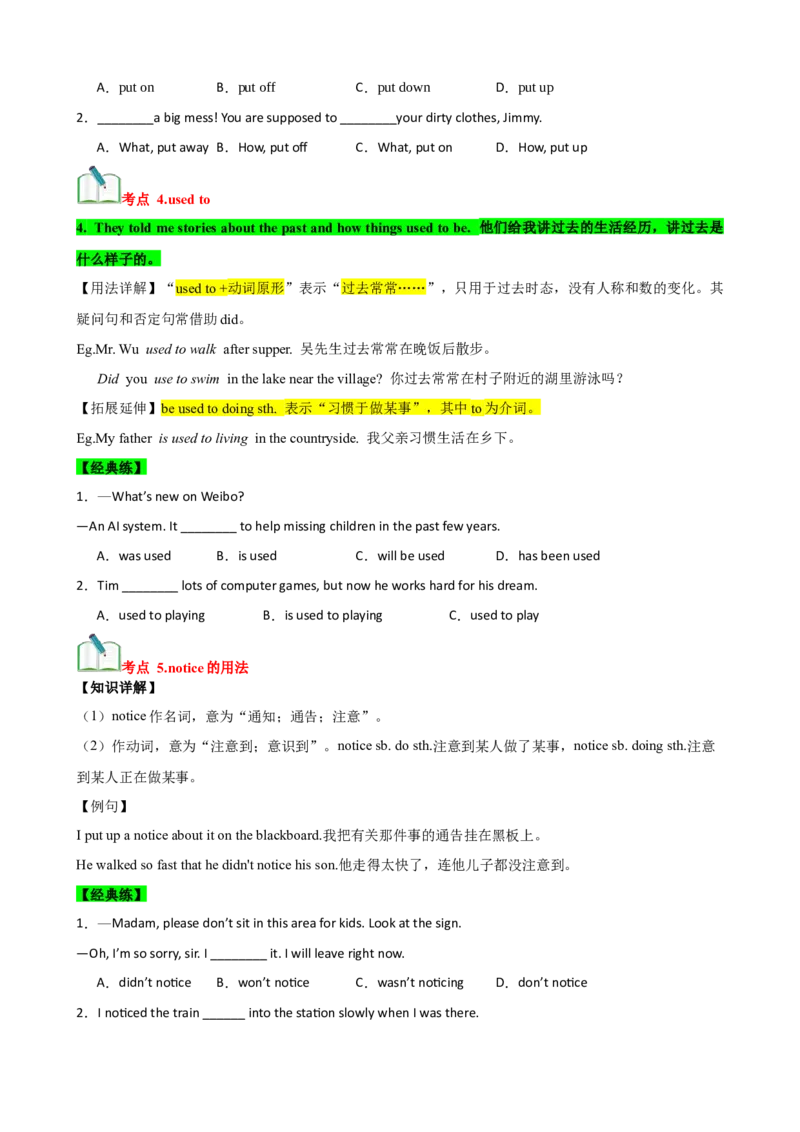
考点 3.put off
3.We can’t put off making a plan.
put off 推迟 通常指会议、活动等未能按预定的时间举行,后面可接名词、代词或动词-ing形式作
宾语。
Would you mind if we put it off until tomorrow?
【拓展延伸】 与put相关的短语还有:
【经典练】
1.Brian ate too much recently and _________ three pounds.A.put on B.put off C.put down D.put up
2.________a big mess! You are supposed to ________your dirty clothes, Jimmy.
A.What, put away B.How, put off C.What, put on D.How, put up
考点 4.used to
4. They told me stories about the past and how things used to be. 他们给我讲过去的生活经历,讲过去是
什么样子的。
【用法详解】“used to +动词原形”表示“过去常常……”,只用于过去时态,没有人称和数的变化。其
疑问句和否定句常借助did。
Eg.Mr. Wu used to walk after supper. 吴先生过去常常在晚饭后散步。
Did you use to swim in the lake near the village? 你过去常常在村子附近的湖里游泳吗?
【拓展延伸】be used to doing sth. 表示“习惯于做某事”,其中to为介词。
Eg.My father is used to living in the countryside. 我父亲习惯生活在乡下。
【经典练】
1.—What’s new on Weibo?
—An AI system. It ________ to help missing children in the past few years.
A.was used B.is used C.will be used D.has been used
2.Tim ________ lots of computer games, but now he works hard for his dream.
A.used to playing B.is used to playing C.used to play
考点 5.notice的用法
【知识详解】
(1)notice作名词,意为“通知;通告;注意”。
(2)作动词,意为“注意到;意识到”。notice sb. do sth.注意到某人做了某事,notice sb. doing sth.注意
到某人正在做某事。
【例句】
I put up a notice about it on the blackboard.我把有关那件事的通告挂在黑板上。
He walked so fast that he didn't notice his son.他走得太快了,连他儿子都没注意到。
【经典练】
1.—Madam, please don’t sit in this area for kids. Look at the sign.
—Oh, I’m so sorry, sir. I ________ it. I will leave right now.
A.didn’t notice B.won’t notice C.wasn’t noticing D.don’t notice
2.I noticed the train ______ into the station slowly when I was there.A.comes B.is coming C.to come D.coming
3.—Have you ever noticed your son ________ much harder than before?
—Yes. He seldom goes out at weekends.
A.to work B.worked C.work D.works
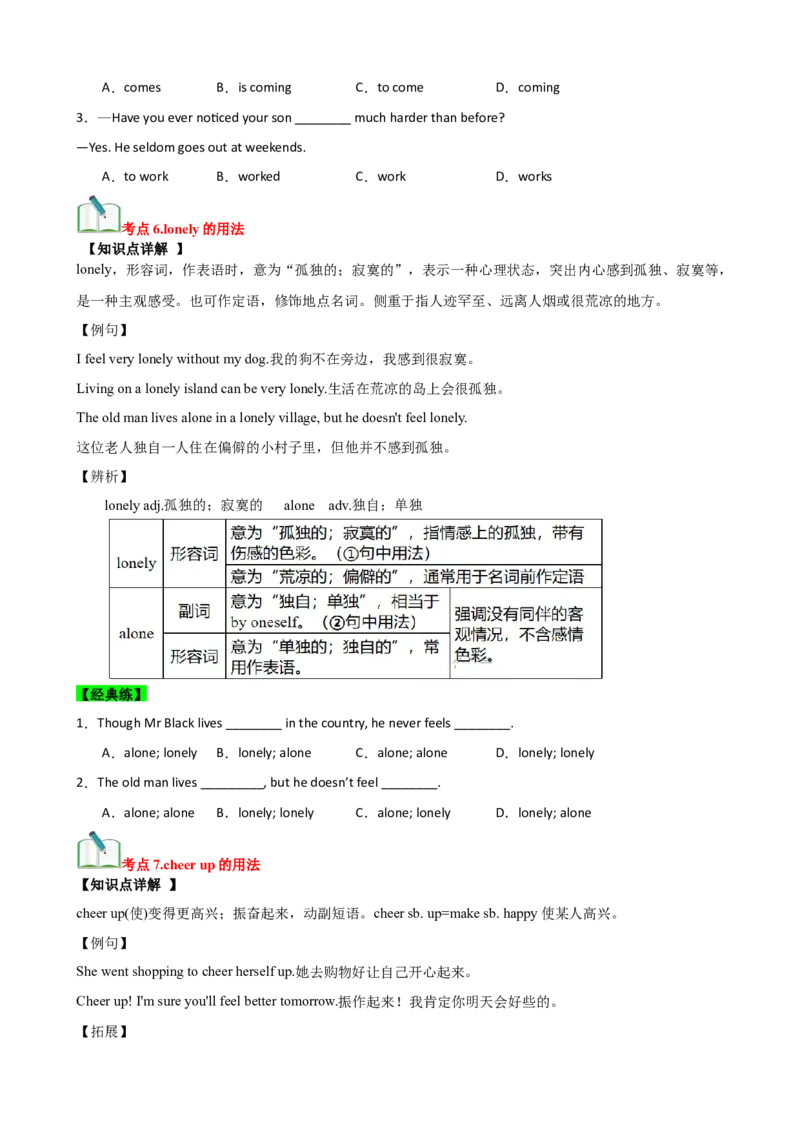
考点6.lonely的用法
【知识点详解 】
lonely,形容词,作表语时,意为“孤独的;寂寞的”,表示一种心理状态,突出内心感到孤独、寂寞等,
是一种主观感受。也可作定语,修饰地点名词。侧重于指人迹罕至、远离人烟或很荒凉的地方。
【例句】
I feel very lonely without my dog.我的狗不在旁边,我感到很寂寞。
Living on a lonely island can be very lonely.生活在荒凉的岛上会很孤独。
The old man lives alone in a lonely village, but he doesn't feel lonely.
这位老人独自一人住在偏僻的小村子里,但他并不感到孤独。
【辨析】
lonely adj.孤独的;寂寞的 alone adv.独自;单独
【经典练】
1.Though Mr Black lives ________ in the country, he never feels ________.
A.alone; lonely B.lonely; alone C.alone; alone D.lonely; lonely
2.The old man lives _________, but he doesn’t feel ________.
A.alone; alone B.lonely; lonely C.alone; lonely D.lonely; alone
考点7.cheer up的用法
【知识点详解 】
cheer up(使)变得更高兴;振奋起来,动副短语。cheer sb. up=make sb. happy使某人高兴。
【例句】
She went shopping to cheer herself up.她去购物好让自己开心起来。
Cheer up! I'm sure you'll feel better tomorrow.振作起来!我肯定你明天会好些的。
【拓展】(1) cheer v.鼓舞;加油;快活起来;欢呼
The people cheered the runners when they started running.
当运动员开始跑步时,人们为运动员加油鼓劲。
(2) cheer也可作名词。作可数名词,意为“欢呼声;喝彩声”;作不可数名词,意为“欢乐;高兴;兴
奋”。
Three cheers for the winning team!让我们为获胜队欢呼三声!
【经典练】
1.You sing well. I think you could sing songs to cheer ________ up.
A.theirs B.their C.them D.themselves
2.As a volunteer, when we meet people in need, we should help ________.
A.to cheer him up B.to cheer up him
C.to cheer them up D.to cheer up them
3.You could visit ___________ children in the hospital and ___________ them ___________.
A.ill; set; up B.sick; cheer; up C.sick; clean; up
考点8.satisfaction的用法
【知识点详解 】
① satisfaction: 满意(名词) with satisfaction满意的 to one’s satisfaction令某人满意的是
② satisfy:满意(动词)
③ satisfied 满意的(形容词,人做主语)
④be satisfied with sth 对某物是满意的
⑤satisfying 令人满意的(修饰物)
例1:To my satisfaction,I am satisfied with your satisfying answer.
令我满意的是,我对你令人满意的答案感到满意
例 2:I get such a strong feeling of satisfaction when I see the animals get better and the look of joy on their
owners’ faces.
当我看到动物们病情见好,看到主人们脸上的喜悦之情时,我产生出那么强烈的满足感来(注意:a feeling
of satisfaction 满足感 the look of joy喜悦之情)
【经典练】
1.The writer had the ________ of seeing his book become a bestseller.
A.satisfaction B.situation C.discussion D.invitation
2.—Were your parents satisfied ________ the clean-up?
—To their ________, the room was very clean and tidy.A.with; satisfaction B.in; satisfy C.to; satisfied
考点9.repair的用法
【知识点详解】
repair动词,意为“修理;修补”。fix up修理;装饰。fix on选定,确定。
【例句】
I repaired the kite with beautiful flowers.我修好了那个带着漂亮的花的风筝。
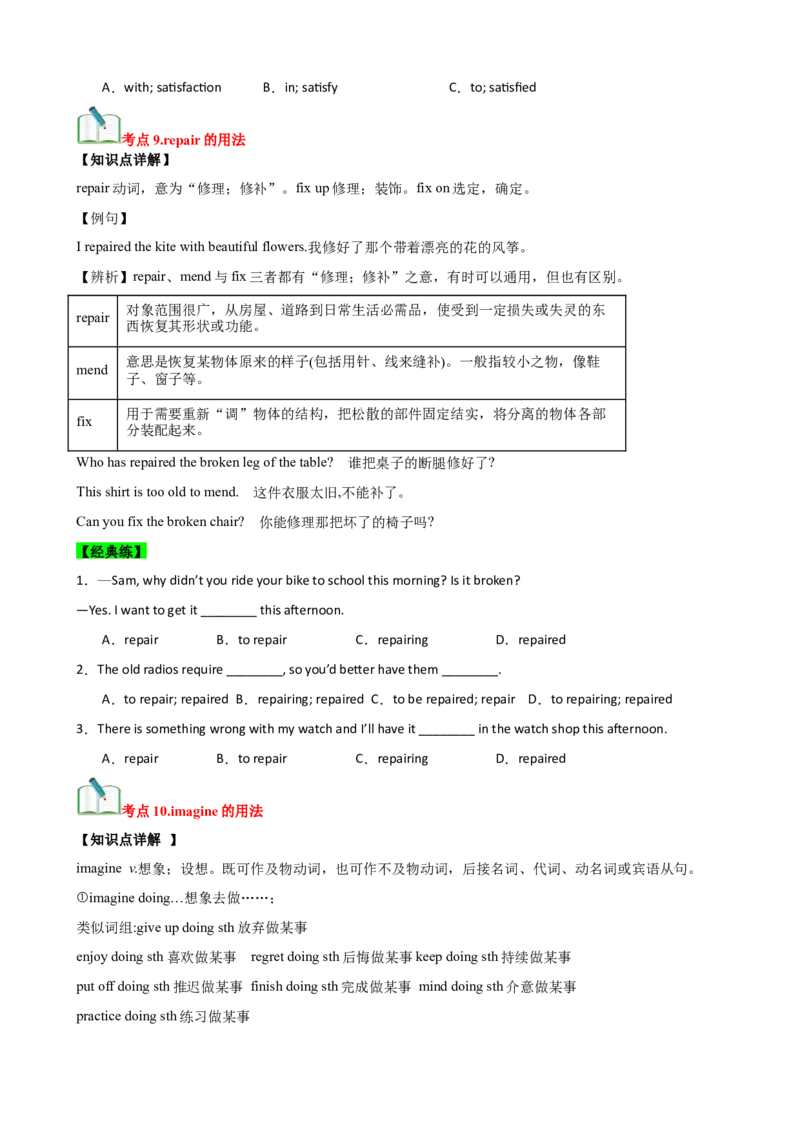
【辨析】repair、mend与fix三者都有“修理;修补”之意,有时可以通用,但也有区别。
对象范围很广,从房屋、道路到日常生活必需品,使受到一定损失或失灵的东
repair
西恢复其形状或功能。
意思是恢复某物体原来的样子(包括用针、线来缝补)。一般指较小之物,像鞋
mend
子、窗子等。
用于需要重新“调”物体的结构,把松散的部件固定结实,将分离的物体各部
fix
分装配起来。
Who has repaired the broken leg of the table? 谁把桌子的断腿修好了?
This shirt is too old to mend. 这件衣服太旧,不能补了。
Can you fix the broken chair? 你能修理那把坏了的椅子吗?
【经典练】
1.—Sam, why didn’t you ride your bike to school this morning? Is it broken?
—Yes. I want to get it ________ this afternoon.
A.repair B.to repair C.repairing D.repaired
2.The old radios require ________, so you’d better have them ________.
A.to repair; repaired B.repairing; repaired C.to be repaired; repair D.to repairing; repaired
3.There is something wrong with my watch and I’ll have it ________ in the watch shop this afternoon.
A.repair B.to repair C.repairing D.repaired
考点10.imagine的用法
【知识点详解 】
imagine v.想象;设想。既可作及物动词,也可作不及物动词,后接名词、代词、动名词或宾语从句。
①imagine doing…想象去做……;
类似词组:give up doing sth放弃做某事
enjoy doing sth喜欢做某事 regret doing sth后悔做某事keep doing sth持续做某事
put off doing sth推迟做某事 finish doing sth完成做某事 mind doing sth介意做某事
practice doing sth练习做某事②imagine sb. doing…想象某人做……;
③imagine + that从句/wh-从句 想象……;料想……(◆不可用于进行时)。
【例句】
Imagine you can’t walk or use your hands easily. 想象你不能走或手不能灵活运用。
I imagine(that) you are very tired. 我猜想你很累了。
【经典练】
1.—My teacher suggested ________ all the work in just two days.
—Really? It’s hard to imagine ________ so much work in such a short time.
A.to finish; doing B.to finish; to do C.finishing; to do D.finishing; doing
2.— I can’t imagine ________ all the work in such a short time.
— Well, we have no choice but ________ it.
A.to finish; to do B.to finish; doing C.finishing; to do D.finishing; doing
考点11.carry的用法
【知识点详解 】
carry动词,意为“拿;提;扛”。
常见短语:
carry on继续下去;carry out开展,执行;
carry through完成,渡过难关;carry over(在不同情况下)继续存在
【例句】
He was carrying a box on his shoulder.他正扛着个盒子。
The woman carried her baby in her arms.妇女怀抱着孩子。
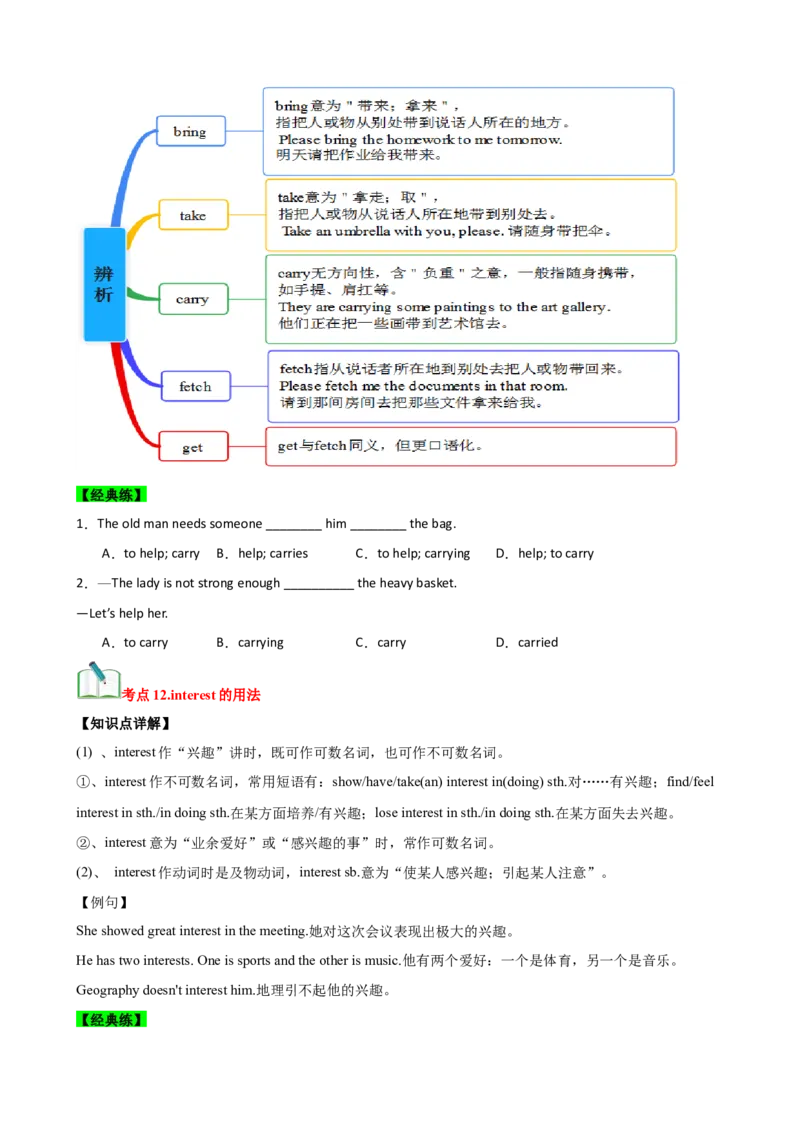
【易混辨析】 bring/take/carry/fetch/get【经典练】
1.The old man needs someone ________ him ________ the bag.
A.to help; carry B.help; carries C.to help; carrying D.help; to carry
2.—The lady is not strong enough __________ the heavy basket.
—Let’s help her.
A.to carry B.carrying C.carry D.carried
考点12.interest的用法
【知识点详解】
(1) 、interest作“兴趣”讲时,既可作可数名词,也可作不可数名词。
①、interest作不可数名词,常用短语有:show/have/take(an) interest in(doing) sth.对……有兴趣;find/feel
interest in sth./in doing sth.在某方面培养/有兴趣;lose interest in sth./in doing sth.在某方面失去兴趣。
②、interest意为“业余爱好”或“感兴趣的事”时,常作可数名词。
(2)、 interest作动词时是及物动词,interest sb.意为“使某人感兴趣;引起某人注意”。
【例句】
She showed great interest in the meeting.她对这次会议表现出极大的兴趣。
He has two interests. One is sports and the other is music.他有两个爱好:一个是体育,另一个是音乐。
Geography doesn't interest him.地理引不起他的兴趣。
【经典练】1.In my school, we have a big library ________ lots of ________ books.
A.has; interesting B.has; interested C.with; interesting D.with; interested
2.I am ________ in reading different kinds of ________books.
A.interesting; interested B.interested; interested
C.interested; interesting D.interesting; interesting
考点13.take after的用法
【知识点详解】
take after(外貌或行为)像,指由于血缘关系而在外貌、行为等方面相似,其中after是介词,其后
常接名词或代词,相当于be similar to。(look like意为“看上去像”,多指外貌方面;be like意为“像”,
可指外貌,也可指性格方面。)不能用于进行时。
【例句】
Your daughter doesn’t take after you at all.你的女儿长得一点都不像你。
【易混辨析】take after与look like
take after 指由于血缘关系而在外貌、性格等方面相似
look like 意为“看起来像……”,尤指外貌相像
【经典练】
1.—Are you similar ________ your mother?
—No. I take ________ my father.
A.after; after B.to; to C.to; after
2.My brother is old enough himself.
A.looking after B.taking care of
C.to look after D.to take care
考点14.try的用法
【知识点详解】
① try out for 为···参加选拔
② try on试穿
③ try doing sth试着干某事
④ try to do sth努力去做某事
⑤ try my best to do sth尽我最大努力去干某事
例句:Last year , she decided to try out for a volunteer after-school reading program.
去年,他决定去参加一个课外阅读活动的志愿者活动【经典练】
1.________ problems, we need to face them first and then ________ our best.
A.To solve; try B.Solve; try C.Solving; to try D.Solved; to try
2.Friendship is like treasure. If a friend of yours is in need, ________ your best to help him or her to show your
kindness.
A.try B.to try C.trying
考点15.come up with的用法
【知识点详解】
① come up with 想出来=think up
② come out: 开花; 出版; 出来
③ come on加油!
④come in进来
⑤come over顺便来访
例1:We need to come up with a plan for it。我们需要为它想出计划
例2:Our class is trying to come up with some ideas to cheer up sick children because they are often sad. 我们
班正在努力想出一些主意让生病的孩子高兴起来,因为她们经常难过。
例3:The ideas that he came up with worked out fine.
他想出的这些方法很有效(注意:work out fine=work out well奏效)
【经典练】
1.They ______ a good idea for the coming party.
A.hurry up B.call up C.come up with
2.Our class is trying to ________________ some ideas to help old people because they are lonely.
A.take after B.look through C.put up D.come up with
考点16.it作形式主语
16. You helped to make it possible for me to have Lucky. 有了你的帮助,我才有可能拥有“幸运儿”(狗
名)。
【用法详解】“make it +形容词(+ for sb.)+动词不定式(短语)”是一个固定句型,其中it是形式宾
语,真正的宾语时后面的动词不定式短语,形容词作宾语补足语。
Eg.Sports can make it easier for people to unify. 体育可以让人们更容易地统一起来。
【拓展延伸】类似此用法的动词还有feel, find, consider, think等。
Eg. I feel it possible to get there before eight. 我觉得八点前到那里是有可能的。I think it easy to make up a sentence with the word. 我认为用这个单词造句很简单。
【经典练】
1.—It’s impossible ________ me to finish the work in three days.
—Why not ________ Philip for help?
A.of; ask B.for; ask C.for; to ask D.of; asking
考点17.be excited about 对……感到兴奋
17.I love animals and I was excited about the idea of having a dog.
be excited about 对……感到兴奋
这是一个固定短语,后接名词、代词或动词-ing形式。be excited about doing sth.= be excited to do sth.
意为“做某事感到兴奋”。
Are you excited about the new work place?
Jack was excited about traveling there by plane.(= Jack was excited to travel there by plane.)
【拓展延伸】 excited 与exciting
【经典练】
1.Today, Kitty was very ______ because she saw an ______ film on TV.
A.excited; excitingB.exciting; excite C.excited; excited D.excited; excite
2.We were all ________ at this ________ animal show.
A.excited; excitingB.excited; excited C.exciting; excited D.exciting; exciting
考点18.change的用法
【知识点详解】
(1) change ① 改变(动词) ②改变(名词) ③零钱(不可数名词)
(2) change one’s mind改变某人的主意
(3) change one’s life改变某人的生活
(4) change·· into··把···变成···
例句:Thank you again for changing my life.再次谢谢你改变了我的生活。
【经典练】
1.Nothing will make me ________ my mind.
A.to change B.changing C.change D.changed
2.I’m nearly lost in my hometown because it ________ a lot since I left.
A.has changed B.changed C.changes D.is changing一.语法精讲
一.不定式的用法归纳
①不定式含义:动词不定式的基本结构形式为:“to+动词原形”,有时可省略不定式符号to。否定形式
为“not to+动词原形”。不定式没有人称和数的变化。
②不定式的句法功能
1.不定式作主语:用作主语的不定式通常表示一个具体的,特定的行为或将来的动作,其谓语动词用第三
人称单数。
e.g.To learn Chinese well is difficult.
To get to school early, I will take the taxi tomorrow.
2. 不定式作宾语:不定式可以在及物动词后用作宾语。如果作宾语的不定式有宾语补足语时,常用it作
形式宾语,而将真正的宾语后置。
e.g. I hope to be a nurse when I grow up.(不定式作宾语)
I found it not easy to work out the math problem.
真正的宾语
常见的不定式作宾语的(短语)动词
decide to do 决定... ; choose to do 选择...; plan to do 计划...; agree to do 同意....
except to do 期待...; refuse to do 拒绝...;hope to do希望....; arrange to do 安排...
3. 不定式作宾语补足语:大多数及物动词后用带to的不定式作的宾语补足语来补充说明宾语的动作,状
态。
e.g. Lucy asked me to turn down the radio.
宾语补足语,补充说明宾语me的动作
My mother allows me to play computer games for one hour.
宾语补足语,补充说明宾语me的动作
常见的跟带to的不定式作宾语补足语的(短语)动词
Persuade说服;allow允许;order命令;teach教;ask要求
Invite邀请;forbid禁止;encourage鼓励;advise建议4. 不定式作状语:不定式可作目的状语(可以单独放句首,句中或句末),原因状语(常用在 sorry,
surprised等表示情感的词后),结果状语(常用于“enough...to”,“too...to”的结构中)。
e.g. To arrive there on time, I got up one hour earlier than usual.(不定式作目的状语)
I am so excited to get the flower.(不定式作原因状语)
The room is large enough to live in.(不定式作结果状语)
He is too young to go to school.(不定式作结果状语)
【特殊用法】
1.不定式(短语)做主语时,常用it代替它做形式主语,而将不定式放到后面,有三种情况:
(1)It is+名词+to do sth.
It’s our duty to protect the environment.保护环境是我们的责任。
(2)It takes/took sb.+some time+ to do sth.
How long did it take you to finish your homework?你花了多长时间完成作业?
(3)It is+形容词(easy/kind/important/diffcult/foolish/right/silly/nice…)+(for/of sb.)+to do sth.
It is clever of you to do that.你那样做很聪明。
2. feel, find, make, think等动词后如果是不定式做宾语,宾语补足语是形容词或名词,常用it做形式主语,
把不定式后移。
I find it difficult to learn English well.我发现学好英语很难。
3.省略to的动词不定式的四种情况。
(1)在使役动词have, make, let之后。
His mother makes him sweep the floor.他妈妈让他扫地。
(2)在感官动词(短语)feel, hear, see, watch, notice, listen to, look at之后。
Did you notice her leave the room?她离开房间时你注意到了吗?
(3)help后的不定式可省略to,也可带上to。
He often helps me(to)learn maths.他经常帮助我学数学。
(4)在一些固定搭配中,如“had better do sth.”,“Why not do sth.?”,“would rather do sth. than do
sth.”等。
二.动词短语
英语中一些常用的动词可以和某些介词,副词或其他类词构成意义不同的习惯搭配,这些组合一般只能
作为一个整体使用,因此被称为短语动词。常见以下几种类型:
①“动词+介词”型:该类动词短语相当于及物动词,宾语不管是名词还是代词只能放在介词后
ask for 要求;care about 关心;worry about 担心;laugh at嘲笑;depend on 依靠
listen to 听;go over 仔细检查;arrive at 到达;look at 看②“动词+副词”型:该类短语动词即可作及物动词也可作不及物动词,当宾语为代词时,只能放在动词
和副词之间。
put on 穿上;break in 打断;put away 收拾起来;put down 放下
turn off 关闭;give up放弃;find out 查明;work out 算出
③“动词+副词+介词”型:此类短语动词相当于及物动词,可以有自己的宾语宾语放在介词的后面
catch up with 赶上;get away from 摆脱;put up with 忍受;go on with 继续
look forward to 期盼;come up with 提出
④“动词+名词”型:该类动词短语中,有的名词需要在前加冠词,有的名词需要用复数形式。
make a difference 有影响;lose weight 减肥 ;make progress取得进步
have a try 尝试;make faces做鬼脸;have a cold 感冒
三.情态动词could的用法
①could表示过去的能力
e.g. She could play the piano when she was five.
②could表示推测:could表示推测时,即可以表示过去的可能性,又可以表示现在的可能性,比can的语
气更弱一些。可用于肯定句,否定句,疑问句中。
e.g. Your mother looks so young,she couldn’t be over forty.
③could表示有礼貌地请求:could表示委婉的语气,用来委婉地提出请求,建议,想法。不表示过去。用
于疑问句时,回答用can。
e.g.You could ask hospitals to let you visit the kids and cheer them up.
二、提供帮助及志愿服务
【写作分析】
本单元的写作内容是提供帮助与志愿服务,围绕这一话题谈论提供帮助、倡导公益活动等。通过一
些志愿活动和慈善事业树立自己的责任意识和社会意识,培养乐于参加公益事业的情怀。写此类文章可
以从以下几方面作为切入点:
一是根据所给提示信息写一封申请信,申请担任志愿者,句子表达要用第一人称且以一般现在时为
主;二是写自荐信,写信的目的是想成为一名志愿者,根据提示内容适度发挥。
如何写好这类文章,主要需要掌握以下词汇和句型句式:
※常用的词汇
join in/take part in参加
care for喜欢
do/try one’s best to do尽某人最大努力去做……
volunteer志愿/志愿者
be good at擅长look forward to期望,盼望
※常用的句型句式
I’d like to help...我愿意帮助…...
You could ask...你可以问..….
He volunteers...to hep...他志愿......来帮助……
I think we’d better...我认为我们最好..….
※常用开头结尾句
I’d like to volunteer as...我愿意作为..….参加志愿活动。
You ask me what I can do for...你问我能为.…...做什么。
I wish...to have a better future.我希望…...有一个更好的未来。
So I’m glad to have joined in...and gained some valuable experience from...所以我很高兴加入.…..并从中
获得了一些有价值的经验。
【经典试题】
1.(2024·江苏淮安·中考真题)假如你是李华,你所在的阳光社区将于下个月开放社区图书馆,现
面向全社区招募志愿者。请根据以下要点,用英语写一封自荐信。
你的优势 热爱阅读,乐于助人,做事细心
工作设想 鼓励居民多读书,每周推荐一本好书,……
志愿工作的意义 ……从对他人和对自己两方面进行阐述
参考词汇:志愿工作 voluntary work
注意:
1. 100词左右,已给出部分不计入总词数;
2. 可适当发挥,使短文连贯通顺;
3. 文中不得出现真实的人名、校名和地名。
Dear Sir/Madam.
My name is Li Hua. I’m writing to recommend myself to be the volunteer of the library in our community.
___________________________________________________________________________________________
___________________________________________________________________________________________
___________________________________________________________________________________________
___________________________________________________________________________________________
___________________________________________________________________________________________
___________________________________________________________________________________________
___________________________________________________________________________________________will be thankful if I get the chance.
【答案】例文
Dear Sir/Madam,
My name is Li Hua. I’m writing to recommend myself to be the volunteer of the library in our community.
I have some advantages for this volunteer work. I love reading and I am always willing to help others. I am
also careful and responsible in my work.
If I am lucky enough to be a volunteer, I will try my best to do the following things. I will organize reading
activities to encourage residents to read more books. I will recommend a good book every week to inspire their
interest in reading. I also plan to set up a reading corner where residents can share their reading experiences.
I believe that doing voluntary work is very meaningful. It can not only help others improve their reading
skills but also enrich my own life.
I will be thankful if I get the chance.
Best wishes,
Li Hua
【详解】[总体分析]
①题材:本文是一封自荐信;
②时态:时态为一般现在时和一般将来时;
③提示:根据所给提示完成写作,不能遗漏信息,以第一人称为主。
[写作步骤]
第一步,介绍自己的优势;
第二步,介绍自己的工作设想;
第三步,介绍志愿工作的意义。
[亮点词汇]
①be willing to do sth.乐意做某事
②encourage sb. to do sth.鼓励某人做某事
③set up建立
[高分句型]
①If I am lucky enough to be a volunteer, I will try my best to do the following things. (if引导的条件状语从句)
②I also plan to set up a reading corner where residents can share their reading experiences. (where引导的定语从
句)
2.(2024·内蒙古包头·中考真题)你校英语报社组织同学们分享自己在社区进行志愿活动的经历,
请你根据以下提示写一篇短文投稿。内容包括:
1.简要描述;2.体验和感受。
Topic Volunteer Work in Hongxing Community
Time last Sunday
made eco-friendly (环保的) products
Activities gave out reusable water bottles and bags
worked at the learning stalls (摊位)
注意:
1.词数为80左右;
2.可适当增加细节,以使行文连贯;
3.文中不能出现真实姓名及学校名称;
4.短文的题目和开头已给出,不计入总词数。
Volunteer Work in Hongxing Community
Last Sunday I worked in Hongxing Community as a volunteer.
___________________________________________________________________________________________
___________________________________________________________________________________________
___________________________________________________________________________________________
___________________________________________________________________________________________
___________________________________________________________________________________________
___________________________________________________________________________________________
___________________________________________________________________________________________
【答案】One possible version,
Volunteer Work in Hongxing Community
Last Sunday I worked in Hongxing Community as a volunteer.
Before the event began, we gathered at the entrance of Hongxing Park at 9 o’clock. We volunteers were
then divided into groups. Some made eco-friendly products. Others gave out reusable water bottles and the bags
we made. I went all out to work at the learning stalls, teaching neighbors how to properly recycle and how to
reduce trash here in town.
I shared what I know with others through the activity. Sharing is caring. Wish everyone could care about
our community and earth.
【详解】[总体分析]
①题材:本文是一篇记叙文,为材料作文;
②时态:以“一般过去时”为主;③提示:写作要点已给出,注意不要遗漏信息,着重突出“活动”部分,可适当补充细节。
[写作步骤]
第一步,首先介绍志愿者活动的时间、地点、人物等;
第二步,具体介绍志愿者活动内容;
最后一步,表达个人感悟。
[亮点词汇]
①be divided into被分成
②give out分发
③go all out全力以赴
④care about关心
[高分句型]
①Before the event began, we gathered at the entrance of Hongxing Park at 9 o’clock.(before引导时间状语从
句)
②I went all out to work at the learning stalls, teaching neighbors how to properly recycle and how to reduce trash
here in town.(疑问词+动词不定式)
③I shared what I know with others through the activity.(what引导宾语从句)
Unit2 I'll help to clean up the city parks.
一、重点短语
1.clean up 打扫(清除)干净 2.cheer up(使)变得高兴;振奋起来
3.give out 分发;散发 =hand out 4.come up with 想出
5.put off making a plan推迟制订计划 6.volunteer to do 志愿去做某事
7.call up 打电话给(某人);征召 8.care for 照顾;非常喜欢;关心
9.try out for 参加…选拔 10.stop hunger 阻止饥饿
11.Clean-up Day 大扫除 12.used to do 过去,常常
13.help out with 给予帮助 14.make a notice 制作公告牌
15.several hours 几个小时 16.a strong feeling of satisfaction 一种强烈的满足感
17.the look of joy 喜悦的表情 18.go on a journey 去旅行
19.at the age of… 在…岁时 20.get his future dream job 得到他未来梦想工作
21.at the same time 同时 22.be difficulty in doing sth 在做某事方面有困难
23.at least / most 至少/最多 24.in an after-school reading program 课后阅读项目
25.be worried about 担心 26.sb run out of sth 用尽 =sth run out
27.fix up 修理;安排 = repair 28.give away 捐赠;泄露
29.set up 建起;设立 30.be similar to 与…相似 / take after 像31.make a difference to 对…有影响;有作用
32.open/ close the door 开/ 关门 keep the door open
33.a friend of mine 我的一个朋友 = one of my friends
34.be strong in 在某方面强
35.be excited about 对…激动;兴奋
36.a special trained dog 一只特别训练的狗
37.six months of training 六个月的训练
38.at once 立刻;马上
39.change one’s life 改变某人的生活
40.be satisfied with 对…满意
41.work out 算出;产生结果
42.live alone 独自居住 feel lonely 感到孤独
43.raise money for homeless people为无家可归的人筹款
44.help sb out 帮助某人解决问题
45.a dream come true 梦想成真
46.make it possible for sb to do 使某人做某事成为可能
47.take / have an interest in 对…感兴趣
二、重点句子
1.The girl could visit the sick kids in the hospital to cheer them up.
这个女孩可以去医院看望生病的孩子以使他们高兴起来。
2.We need to come up with a plan to tell people about the city park clean-up.
我们需要想出一个计划来告诉人们关于清扫城市公园的事。
3.Clean-up Day is only two weeks from now.We can’t put off making a plan.
清洁日离现在只有两个星期了。我们不能推迟制订计划的时间了。
4.They told me stories about the past and how things used to be.
他们给我讲了过去的故事,和过去是什么样子的。
5.We should listen to them and care for them.我们应该听他们说话并照顾他们。
6.I want to learn more about how to care for animals.我想更多地了解如何照顾动物。
7.I get such a strong feeling of satisfaction when I see the animals get better and the look of faces. 当我看到
动物(病情)渐好,看到它们的主人脸上的喜悦表情时,我有一种非常强烈的满足感。
8.Last year,she decided to try out for a volunteer after-school reading program.
去年,她决定参加一个课外阅读项目的志愿者选拔。
9.Volunteering here is a dream come true for me.在这里当志愿者对我来说是梦想成真。
10.I can do what I love to do and help others at the same time.
我可以做我喜欢做的事情,同时也帮助别人。
11.Our class is trying to come up with some ideas to cheer up sick children.
我们班正在努力想出一些主意使生病的的孩子高兴起来。
12.We will give away the money from the sale to homeless people.
我们将会把销售所得的钱捐给无家可归的人。
13.Most people today are only worried about getting good jobs to make lots of money.
现在大多数人只是为找到能挣许多钱的好工作而发愁。
14.However,few people think about what they can do to help others.
然而,很少有人考虑他们能做什么来帮助别人。15.The ideas that he came up with worked out fine.他想出的这些办法很有效。
16.Because of your kindness,you helped to make it possible for me to have Lucky.
因为你的好心,有你的帮助,才使拥有“幸运儿”成为可能。
17.She talked to Animal Helpers about getting me a special trained dog.
她与“动物帮手”洽谈,给我找一只经过特殊训练的狗。
三、重点知识点
1.hope to do sth.希望去做某事
hope +句子(一般现在时或一般将来时)
2.clean up(动+副)打扫 Clean-up Day 大扫除日.
3.visit the sick kids in the hospital
看望医院里生病的孩子.
4.cheer up (动+副)使变得高兴,振奋起来
5.give out food at the food bank在食品救助站分发食品
give out 分发.散发(动+副)
6.volunteer in an after-school study program
在一家课外学习中心做志愿工作
7. a plan
come up with a good idea
some solutions
想出(提出)一个计划/好办法/解决的方法.
8.two weeks from now = in two weeks 两周以后
9.put off 推迟(动+副)put off doing sth.
10.put up 张贴.举起.搭建(动+副)
11.make some notices 制作一些布告.
notice sb. do sth. 注意到某人做了某事
doing sth 注意到某人正在做某事
12.hand out分发(动+副) hand in上交(动+副)
13.call up = ring up(动+副)给……打电话
14.in an old people's home 在敬老院
15.help out with sth .帮助做某事.
16.tell me stories about the past and how things used to be给我讲关于过去的故事和过去的事情是怎样的
17.used to do sth. 过去常做某事.
be used to doing sth.习惯于做某事
18.feel lonely(adj) 感到孤独
a lonely(adj) mountain village 一个偏僻的山村
live /travel alone (adv.) 单独生活/独自去旅行
19.care for 照顾.非常喜欢
20.give up doing sth. 放弃做某事give up smoking戒烟.
21.a feeling of… ……的感受
get such a strong feeling of satisfaction
得到一种如此强烈的满足
22.the look of joy on their owners' faces.
the look of… ……的表情
23.read by herself 独自阅读by+反代.单独地.独自地
24.at the age of 在...岁时
25.try out (动+副)参加...的选拔.试用try out for a volunteer after-school reading program 参加课外阅读项目的志愿者试用工作
26.go on a different journey with each new book
伴随着每一本新书进行着不同的旅行
27.a dream come true 梦想成真
28.do what I love to do 宾语从句做我喜欢做的事情
29.at the same time 同时
30.let/make/have sb. do sth. 让某人做某事
31.be busy with sth 忙于某事:
be busy doing sth. 忙着做某事
32.at least - at most 至少 至多
33.be worried about doing sth.=worry about doing sth.
担忧做某事
34..in one's free time 某人的空闲时间里
35.a good way to spend our free time
度过我们空闲时间的一个好方法.
36.raise money for homeless people为无家可归的人捐款
raise a family 养家 raise one's hands举起手来
37.run out/run out of 用尽用光.
I ran out of all my money = All my money ran out.
38.take after=be similar to
look like. 像=>与……相似=>看起来像
39.fix up = repair修理;安装
40.give away (动+副)赠送.捐赠
41.Thanks for sth./ doing sth.
42.set up 建立,设立,成立
43.make / find it + adj.+ for sb. to do.
形式宾语 真正宾语
44.make a (big) difference to sb./sth.
对某人或某物产生(大的)影响
45.a friend of mine = one of my friends我的一个朋友
46.get sb. sth. = get sth. for sb.使某人得到……
为某人拿某物
47.be excited about sth./doing sth.
对某事或做某事感到激动
be excited to do sth. 对做某事感到兴奋
48. after six months of training with a dog
在经过六个月和一条狗的训练之后.
49.give sb. orders 向某人发出指令
50.a photo of sb./ sth. 一张某人/某物的照片
a photo of me/him
51.change...into...把……变成……
52.train sb. to do sth. 训练某人去做某事
53.imagine doing sth. 想象做某事
sb.doing sth.想象某人做某事
that + 从句 想象……
+反代+to be + adj.想象自己54.be good at = be strong in + n /代/doing 擅长于……
55.set up a call-in center for parents
设立一个家长热线中心
56.to one's satisfaction 令某人满意
to one’s joy 令某人高兴
to one’s surpruise 令某人吃惊的是
57.be able/unable to do sth. 能够/不能做某事