Unit 3 Could you please clean your room
单元话题阅读理解练习
基础语篇巩固练
(23-24 八年级下·新疆克拉玛依·期末)In America, there are chores for children of different ages.
American people think it’s important to tell children their duty (职责) in the family. Use this list of age chores for
your children.
Ages 2—3
Ages 4—5
Help make the bed;
Clear and set the table;
Pick up toys and books;
◆
Help cook dinner;
◆
Take laundry (要洗的衣服) to the laundry room;
◆
Put away groceries (食品杂货).
◆
Help feed pets.
◆
◆
◆ Ages 9—12
Ages 6—8
Help wash the car;
Take care of pets;
Learn to wash the dishes;
◆
Take out the rubbish.
◆
Clean the bathroom.
◆
◆
1.American people think children should do chores in the family b◆ecause ________.
A.parents are lazy
B.it’s important to let children know their duty in the family
C.children should work hard
D.children have nothing to do except (除了) playing
2.If Bob is 5 years old, he can ________.
A.set the table B.help wash the car
C.wash the dishes D.take out the rubbish
3.Which of the following is true?
A.A five-year-old boy can help take care of pets.
B.Jack is three years old and he can help his mom cook dinner.
C.Children under 6 years old don’t have to do chores around the house.
D.Jenny is a ten-year-old girl and she can help clean the bathroom.
4.According to the passage, what chores should a 15-year-old teenager do in an American family?
A.Take laundry (要洗的衣服) to the laundry room.
B.Put away groceries (食品杂货).C.We don’t know.
D.Both A and B.
5.What’s the passage mainly about? ________
A.Chinese children’s duty in the family.
B.What chores American children of different ages should do.
C.Why children around the world should do chores.
D.Different opinions (观点) on whether (是否) children should do chores in the family.
(23-24 八年级下·辽宁朝阳·期末)Are you ready to cook, clean or grow plants? As we all know,
students in primary and middle school in China have at least one labor (劳动) class a week. They will try different
kinds of labor and learn different life skills.
Kids from a school in Chongqing had a class about catching coaches (泥鳅) in the field and learned about
their habits. Kids in Fenyi, Jiangxi, made tofu with a millstone (磨盘). They also tasted tofu made by themselves.
Some kids in Ziyang, Sichuan, also grew vegetables at school, like carrots and potatoes. They learned how these
vegetables were planted, how to take care of them and how to cook them.
Labor education can help people to be active, creative and happy in life. Through such classes, students can
learn the meaning of labor and its value (价值).
1.How often do students have labor classes?
A.At most twice a week. B.At least once a day.
C.At most twice a month. D.At least once a week.
2.What did kids in Fenyi do in their labor class?
A.Made tofu. B.Planted potatoes.
C.Caught loaches. D.Took care of carrots.
3.What would kids in Ziyang finally do with the vegetables they planted?
A.Sell the vegetables. B.Cook the vegetables.
C.Water the vegetables. D.Clean the vegetables.
4.What’s the meaning of labor education?
A.To teach students all the life skills.
B.To let students know the importance of study.
C.To give students a chance (机会) to try different kinds of labor.
D.To help students to be active, creative and happy in life.(23-24八年级下·山西晋中·期末)请阅读下面短文,从每小题所给的A、B、C三个选项中,选出一个最
佳选项,并在答题卡上将该项涂黑。
MAY 1, 2024 TEENS JUNIOR 2
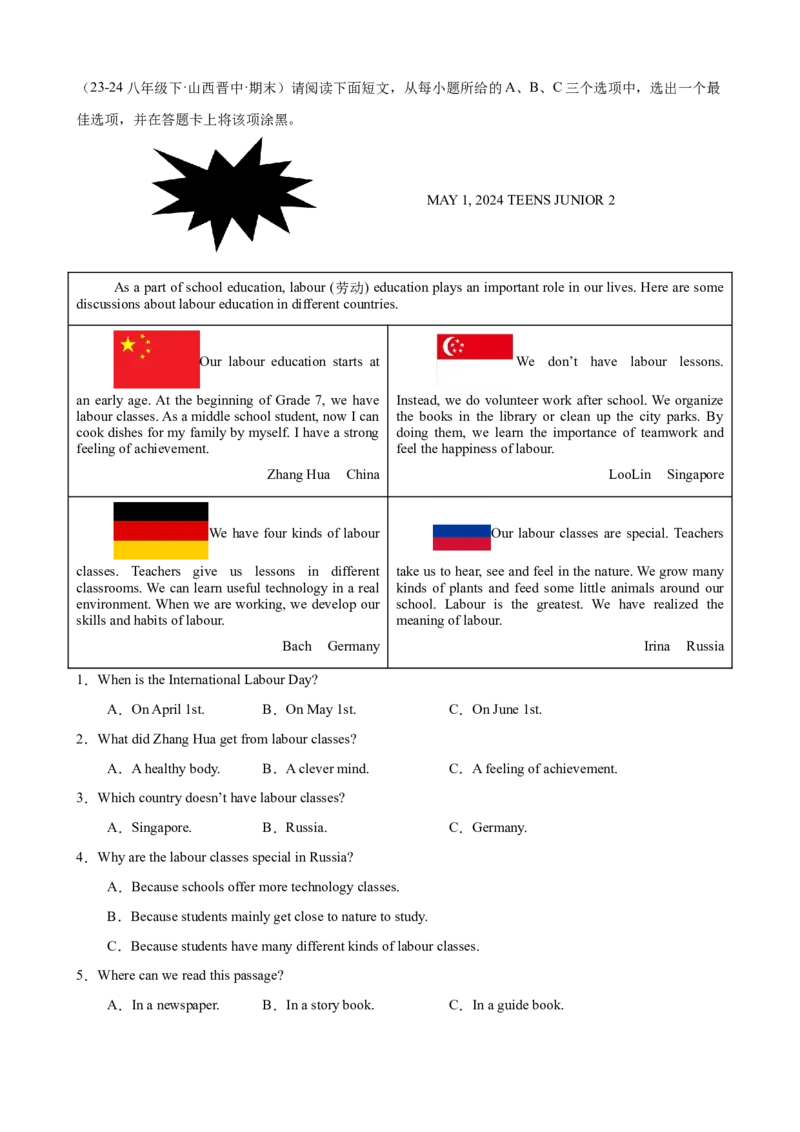
As a part of school education, labour (劳动) education plays an important role in our lives. Here are some
discussions about labour education in different countries.
Our labour education starts at We don’t have labour lessons.
an early age. At the beginning of Grade 7, we have Instead, we do volunteer work after school. We organize
labour classes. As a middle school student, now I can the books in the library or clean up the city parks. By
cook dishes for my family by myself. I have a strong doing them, we learn the importance of teamwork and
feeling of achievement. feel the happiness of labour.
Zhang Hua China LooLin Singapore
We have four kinds of labour Our labour classes are special. Teachers
classes. Teachers give us lessons in different take us to hear, see and feel in the nature. We grow many
classrooms. We can learn useful technology in a real kinds of plants and feed some little animals around our
environment. When we are working, we develop our school. Labour is the greatest. We have realized the
skills and habits of labour. meaning of labour.
Bach Germany Irina Russia
1.When is the International Labour Day?
A.On April 1st. B.On May 1st. C.On June 1st.
2.What did Zhang Hua get from labour classes?
A.A healthy body. B.A clever mind. C.A feeling of achievement.
3.Which country doesn’t have labour classes?
A.Singapore. B.Russia. C.Germany.
4.Why are the labour classes special in Russia?
A.Because schools offer more technology classes.
B.Because students mainly get close to nature to study.
C.Because students have many different kinds of labour classes.
5.Where can we read this passage?
A.In a newspaper. B.In a story book. C.In a guide book.(23-24八年级下·四川内江·期末)Lisa’s Weekly Housework
Lisa’s parents want her to do some housework every day. They don’t want Lisa to depend on them too
much. Lisa can learn some life skills and get some pocket money at the same time. Let’s see what housework Lisa
does in a week.
Paid Housework
Monday Do the dishes $1
Tuesday Sweep the floor $1
Wednesday Take out the rubbish $1
Thursday Help cook dinner $3
Friday Wash clothes $2
Saturday Clean the bathroom $5
Sunday Wash the car $6
Unpaid Housework (Every day)Make her bed, walk the dog, set the table, collect her own things (toys, books,
clothes…)
1.What do Lisa’s parents want her to do?
A.Be strong. B.Be independent.
C.Be happy. D.Be hard-working.
2.How much can Lisa get in a week?
A.$6. B.$11. C.$19. D.$20.
3.What housework does Lisa help her parents do on Tuesday?
A.Cook dinner, walk the dog. B.Sweep the floor, set the table.
C.Set the table, wash clothes. D.Walk the dog, clean the bathroom.
(23-24八年级下·山东临沂·期末)I grew up in the countryside. I didn’t understand what it brought to
me until I became an adult. It helped me learn more practical skills (实践技能) than those who grew up in cities.
The first skill I learned was cooking. Since my parents often came home late and a prepared meal would
help them have supper soon. I learned to make dough (面团) at around 10 years old. It sounds easy but very
difficult to do. However, it didn’t take too long for me to find the right way. A year after that, I learned to cook
different things like noodles and dumplings. I fell in love with cooking because it’s really relaxing. More
importantly, thanks to my cooking skill, I live better during the pandemic (疫情) because I cook every meal
instead of ordering online. It saves money and I don’t have to wait for drivers to feed me.Besides cooking, I did a lot of farm work in my childhood. I got to know how to plant vegetables. Though
it was hard work, the experience did teach me things. For example, I learned that the fruits of peanut (花生) and
ginger (生姜) plants grow under the earth. Also, the truth of happiness sometimes comes from learning firsthand
(直接地). You’ll treasure everything on your plate.
The practical skills I learned not only improve my self-care ability but also provide me with a new way to
look at the world. So when I heard in China students in primary and middle school will have at least one class
every week to learn some skills like cooking and cleaning, I was much too happy. Trust me. The labor (劳动)
education will help you for the rest of your life.
1.According to the passage, the writer didn’t learn ________.
A.cooking skills B.cleaning skills C.planting skills
2.Which one is TRUE according to Paragraph Two?
A.It took the writer a long time to learn to make dough.
B.Since the writer was 10, he has been in love with cooking.
C.During the pandemic, the writer cooks by himself every day.
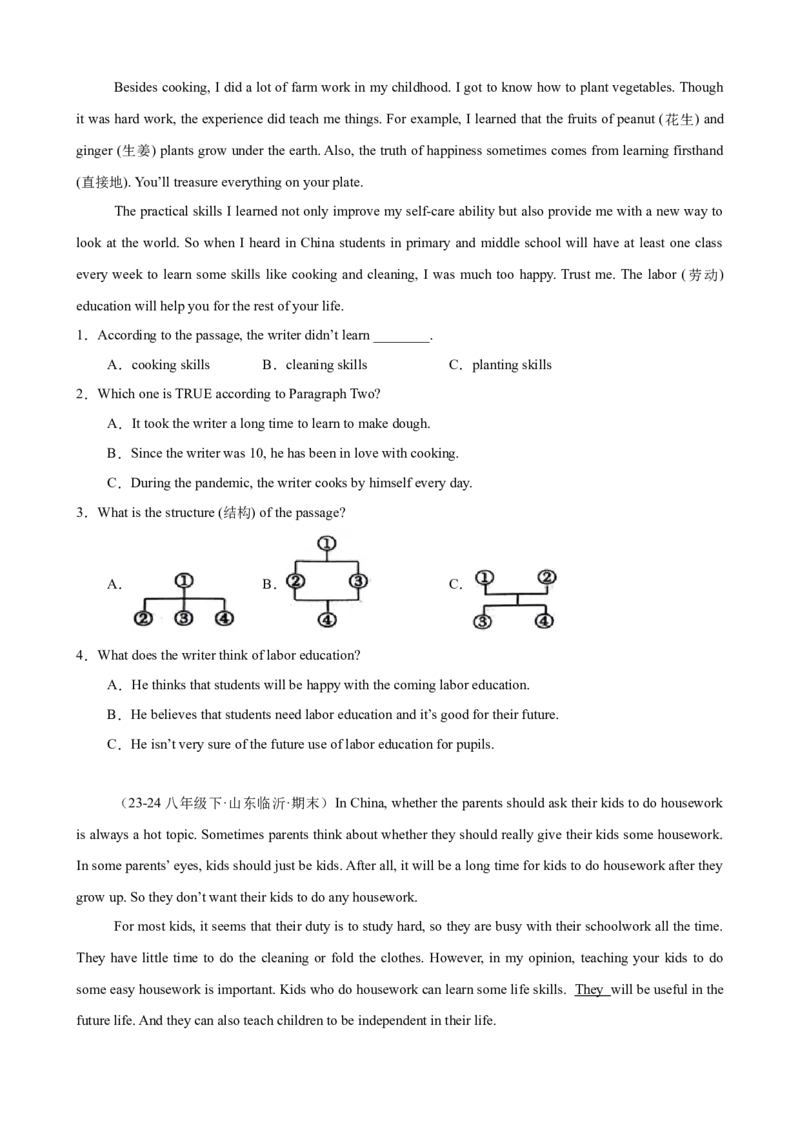
3.What is the structure (结构) of the passage?
A. B. C.
4.What does the writer think of labor education?
A.He thinks that students will be happy with the coming labor education.
B.He believes that students need labor education and it’s good for their future.
C.He isn’t very sure of the future use of labor education for pupils.
(23-24八年级下·山东临沂·期末)In China, whether the parents should ask their kids to do housework
is always a hot topic. Sometimes parents think about whether they should really give their kids some housework.
In some parents’ eyes, kids should just be kids. After all, it will be a long time for kids to do housework after they
grow up. So they don’t want their kids to do any housework.
For most kids, it seems that their duty is to study hard, so they are busy with their schoolwork all the time.
They have little time to do the cleaning or fold the clothes. However, in my opinion, teaching your kids to do
some easy housework is important. Kids who do housework can learn some life skills. They will be useful in the
future life. And they can also teach children to be independent in their life.Once kids start going to school, you can ask them to do some simple things at home. For example, teach
your kids to put away their shoes and schoolbags. Then, you can gradually give more jobs to them. As the jobs
become more difficult, you can teach your kids slowly how to finish each of them. For example, when kids do the
dishes, tell them as clearly as possible how much washing-up liquid (洗涤剂) they need to use. It is common that
kids can’t do everything very well at their first try. But don’t worry. Just give them more chances, and they will do
the jobs better and better.
1.In the writer’s eyes, it’s ________ for kids to do housework. Please give your kids some suitable (合适的)
housework. This is good for their future.
A.boring B.enjoyable C.necessary
2.What does the underlined word “They” refer to (指的是)?
A.Parents. B.Life skills. C.Easy housework.
3.What does the underlined word “gradually” mean in Paragraph 3?
A.step by step B.clearly C.especially
4.What’s the main idea of the third paragraph?
A.Kids must do housework that they’re able to do.
B.Parents should teach kids how to do housework quickly.
C.Parents should make kids do housework from simple things.
5.What does the passage mainly talk about?
A.Parents should let kids do some housework.
B.Children should finish their homework first.
C.Parents should do housework with their kids.
(23-24八年级下·吉林长春·期末)Do teenagers in small villages do chores at home? How about the
teenagers in big cities? To know the answers, we made a survey (调查) last month. We asked 4,000 teenagers in
China. Half of them come from big cities like Beijing, Shanghai and Guangzhou. The others are from small
villages. We made a chart (图表) according to our survey. Let’s have a look at it.We can find out that teenagers in small villages do more chores than those in big cities. Maybe it is because
they live a harder life. We will give our advice to parents in big cities. We think parents should give their children
some chores to do because it’s a good chance for teenagers to learn how to take care of themselves.
根据短文和图表内容,选择最佳答案。
1.They surveyed _________ teenagers from big cities.
A.1000 B.2000 C.3000 D.4000
2.1,000 teenagers from the cities ________.
A.take out the rubbish B.do the dishes
C.make the bed D.fold the clothes
3.The number of teenagers in big cities is bigger than that in small villages only in ________.
A.taking out the rubbish B.making the bed
C.sweeping the floor D.doing the dishes
4.They made the survey because________.
A.they wanted to know more about teenagers in China
B.they didn’t want teenagers in China to do chores at home
C.they wanted to know if (是否) teenagers in China do chores at home
D.they thought doing housework could help teenagers to take care of themselves
5.From the passage, we can know________.
A.more than 3000 teenagers take out the rubbish
B.fewer than 1000 teenagers in big cities make the bed
C.more than 1500 teenagers in Beijing fold the clothes
D.4000 teenagers from small villages take part in the survey(22-23八年级下·江西宜春·期末)Housework is a great disciplinary (纪律的) tool to use for raising
children. However, not all chores are suitable for every age. The following is advice on activities parents can use
to develop their children’s useful habits.
Two-year-olds can learn how to take out the rubbish. They can also help their parents carry light things and
hang up clothes. At this age children should learn how to put their toys away before going to bed.
At the age of three, children can learn how to water plants and feed pets carefully. They should learn how to
make their beds and put their dishes away. Children at this age can pick up the daily newspapers, and begin to
learn how to wash clothes.
Four-year-olds should be old enough to do what the two and three year olds can do and more. They can
make their beds, set the table, and clean up after dinner. They should also learn how to fold their clothes and put
them in the correct cabinets (柜子), as well as how to choose their clothes for the following day.
Children aged five should help clean the table and change their bed sheets. They can also prepare their
schoolbags, as well as anything else related to (与……有关) the next school day. At this age they should learn to
clean up their toys and lady up their rooms.
Children grow through personal experiences. The more things they do, the faster they will develop. Others
help them only when it is necessary, it is important that they learn how to be independent and try to finish the
tasks by themselves.
1.Match the ages with suitable activities.
a. 2-year-olds b. 3-year-olds c. 4-year-olds d. 5 year-olds
①change bed sheets ②fold clothes ③hang up clothes ④wash clothes
A.a-④; b-③; c-①; d-② B.a-③; b -④; c-①; d-②
C.a-③; b-④; c-②; d-① D.a-④; b-②; c-③; d-①
2.What does the underlined word “They” in Paragraph 4 refer to?
A.Two-year-old children. B.Three-year-old children.
C.Four-year-old children. D.Five-year-old children.
3.What makes children grow according to the passage?
A.Personal experiences. B.Help from parents.
C.Relationship between friends. D.Schoolwork.
4.What’s the purpose (目的) of the passage?
A.To ask parents to do more chores at home.
B.To advise parents to let children do chores.
C.To explain the importance of raising children.D.To show children how to do chores.
5.Which of the following best shows the structure of the passage?
A. B. C. D.
重难语篇拔高练
(22-23八年级下·江苏南京·期末)There is always a discussion about whether you should get your kids
to do chores at home or not. However, getting kids to do housework is really good for children in many ways. So I
find it hard to understand why you wouldn’t get them to do chores.
The most important reason is that getting children to do chores teaches them a lot of life skills. They need
to know how to clean, how to cook, how to shop, etc. It is, however, one of the things that schools don’t teach
completely, so it is one of the main parts of learning that parents should provide for children before they leave
home.
Children like to feel proud about their achievements. Making them help around the house can really help to
give them a sense of pride. Also, giving them praise for helping will make them want to do more. They will feel
happy to be able to help around the house.
Giving your children a job to do or an area in the house to look after will help them learn how to be
responsible in their future life. They will see the benefit (益处) of keeping things organized, clean and tidy—and
also be more thankful for what you do for them as they grow up.
Planning is a life skill that can be got from helping around the house. As children get older, you can start to
teach them how to understand the needs of themselves and others and plan by themselves. For example, if they
help with the washing, let them make sure that they do it in time. They may start to plan ahead.
All these reasons for getting kids to help around the house mean that they’ll grow up with a great set of
skills that can be good for them throughout their lives. Why not get started today?
1.Who does the underlined word “they” in Paragraph 2 refer to?
A.Parents. B.Workers. C.Teachers. D.Children.
2.What can give children a sense of pride?
A.Helping around the house. B.Learning all by themselves at school.
C.Learning some life skills. D.Understanding the needs of themselves.3.How can children learn to be responsible?
A.By planning ahead. B.By finishing homework in time.
C.By being given a job to do. D.By being thankful for what they get.
4.What does the writer think about letting kids do chores?
A.He is against it. B.He is surprised at it.
C.He agrees with it. D.He doesn’t care about it.
5.Which of the following best shows the structure of the passage?
A. B. C. D.