文档文本内容
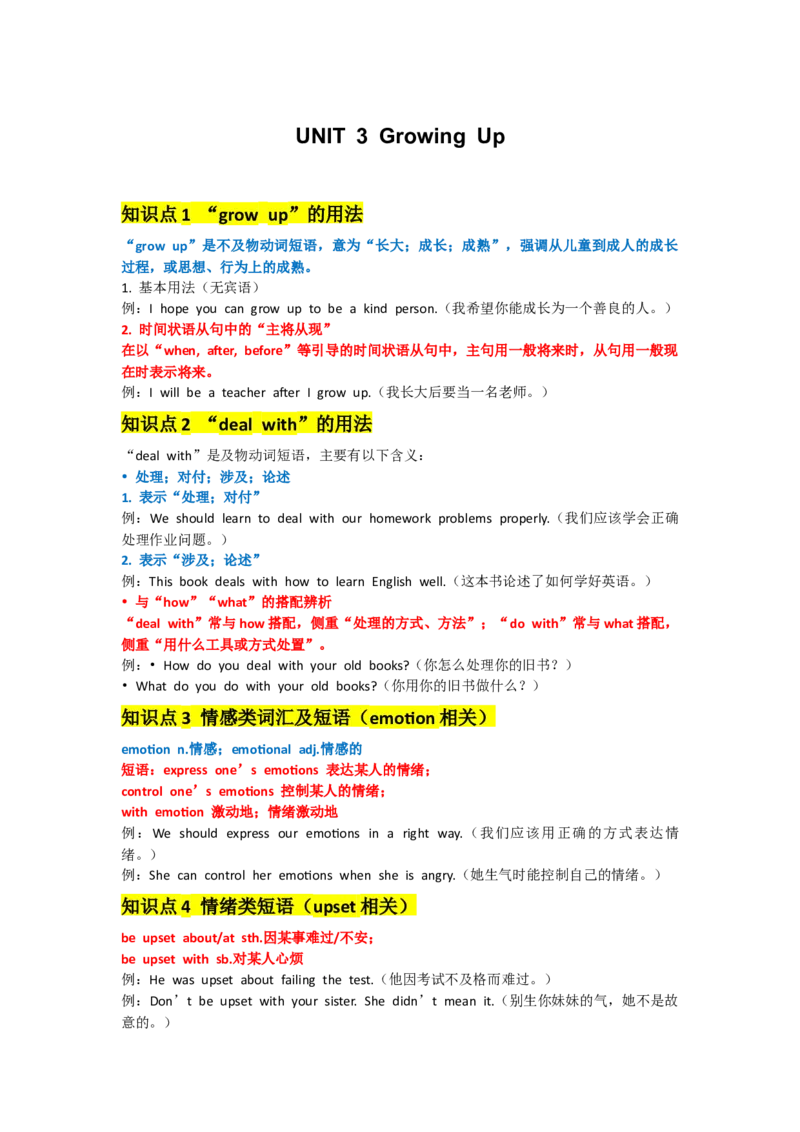
UNIT 3 Growing Up
知识点1 “grow up”的用法
“grow up”是不及物动词短语,意为“长大;成长;成熟”,强调从儿童到成人的成长
过程,或思想、行为上的成熟。
1. 基本用法(无宾语)
例:I hope you can grow up to be a kind person.(我希望你能成长为一个善良的人。)
2. 时间状语从句中的“主将从现”
在以“when, after, before”等引导的时间状语从句中,主句用一般将来时,从句用一般现
在时表示将来。
例:I will be a teacher after I grow up.(我长大后要当一名老师。)
知识点2 “deal with”的用法
“deal with”是及物动词短语,主要有以下含义:
• 处理;对付;涉及;论述
1. 表示“处理;对付”
例:We should learn to deal with our homework problems properly.(我们应该学会正确
处理作业问题。)
2. 表示“涉及;论述”
例:This book deals with how to learn English well.(这本书论述了如何学好英语。)
• 与“how”“what”的搭配辨析
“deal with”常与how搭配,侧重“处理的方式、方法”;“do with”常与what搭配,
侧重“用什么工具或方式处置”。
例:• How do you deal with your old books?(你怎么处理你的旧书?)
• What do you do with your old books?(你用你的旧书做什么?)
知识点3 情感类词汇及短语(emotion相关)
emotion n.情感;emotional adj.情感的
短语:express one’s emotions 表达某人的情绪;
control one’s emotions 控制某人的情绪;
with emotion 激动地;情绪激动地
例:We should express our emotions in a right way.(我们应该用正确的方式表达情
绪。)
例:She can control her emotions when she is angry.(她生气时能控制自己的情绪。)
知识点4 情绪类短语(upset相关)
be upset about/at sth.因某事难过/不安;
be upset with sb.对某人心烦
例:He was upset about failing the test.(他因考试不及格而难过。)
例:Don’t be upset with your sister. She didn’t mean it.(别生你妹妹的气,她不是故
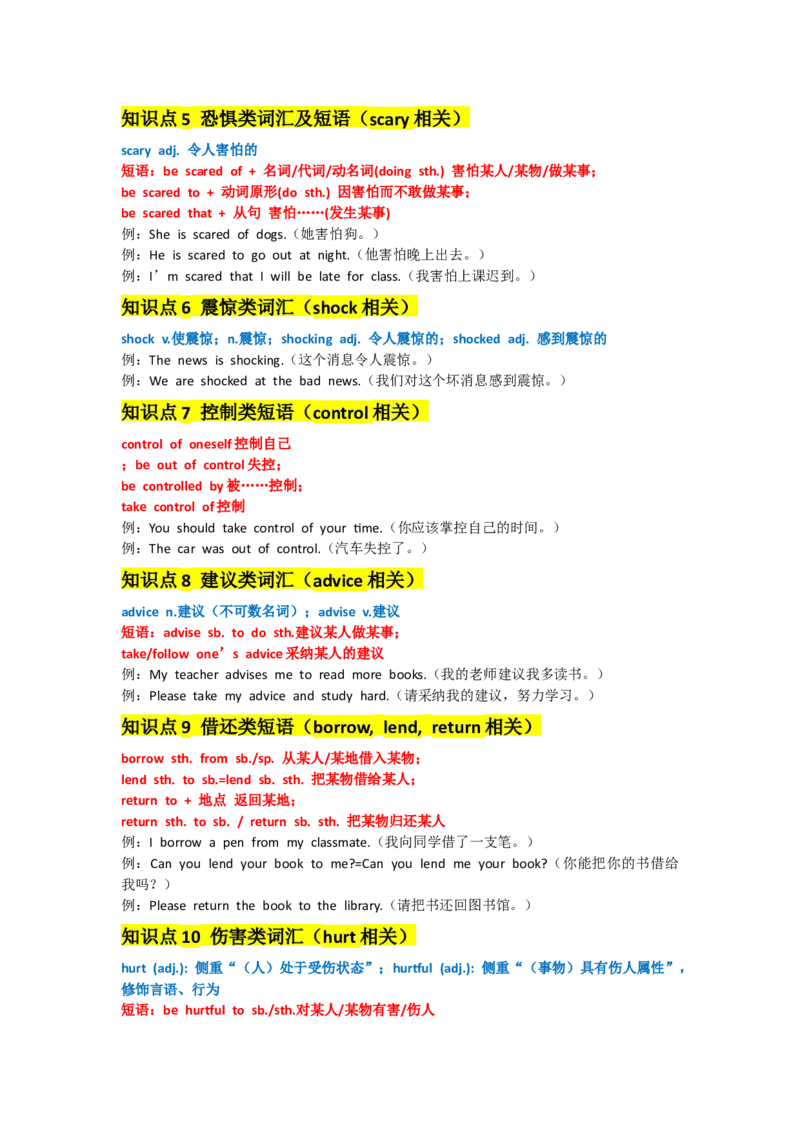
意的。)知识点5 恐惧类词汇及短语(scary相关)
scary adj. 令人害怕的
短语:be scared of + 名词/代词/动名词(doing sth.) 害怕某人/某物/做某事;
be scared to + 动词原形(do sth.) 因害怕而不敢做某事;
be scared that + 从句 害怕……(发生某事)
例:She is scared of dogs.(她害怕狗。)
例:He is scared to go out at night.(他害怕晚上出去。)
例:I’m scared that I will be late for class.(我害怕上课迟到。)
知识点6 震惊类词汇(shock相关)
shock v.使震惊;n.震惊;shocking adj. 令人震惊的;shocked adj. 感到震惊的
例:The news is shocking.(这个消息令人震惊。)
例:We are shocked at the bad news.(我们对这个坏消息感到震惊。)
知识点7 控制类短语(control相关)
control of oneself控制自己
;be out of control失控;
be controlled by被……控制;
take control of控制
例:You should take control of your time.(你应该掌控自己的时间。)
例:The car was out of control.(汽车失控了。)
知识点8 建议类词汇(advice相关)
advice n.建议(不可数名词);advise v.建议
短语:advise sb. to do sth.建议某人做某事;
take/follow one’s advice采纳某人的建议
例:My teacher advises me to read more books.(我的老师建议我多读书。)
例:Please take my advice and study hard.(请采纳我的建议,努力学习。)
知识点9 借还类短语(borrow, lend, return相关)
borrow sth. from sb./sp. 从某人/某地借入某物;
lend sth. to sb.=lend sb. sth. 把某物借给某人;
return to + 地点 返回某地;
return sth. to sb. / return sb. sth. 把某物归还某人
例:I borrow a pen from my classmate.(我向同学借了一支笔。)
例:Can you lend your book to me?=Can you lend me your book?(你能把你的书借给
我吗?)
例:Please return the book to the library.(请把书还回图书馆。)
知识点10 伤害类词汇(hurt相关)
hurt (adj.): 侧重“(人)处于受伤状态”;hurtful (adj.): 侧重“(事物)具有伤人属性”,
修饰言语、行为
短语:be hurtful to sb./sth.对某人/某物有害/伤人例:He was hurt in the game.(他在比赛中受伤了。)
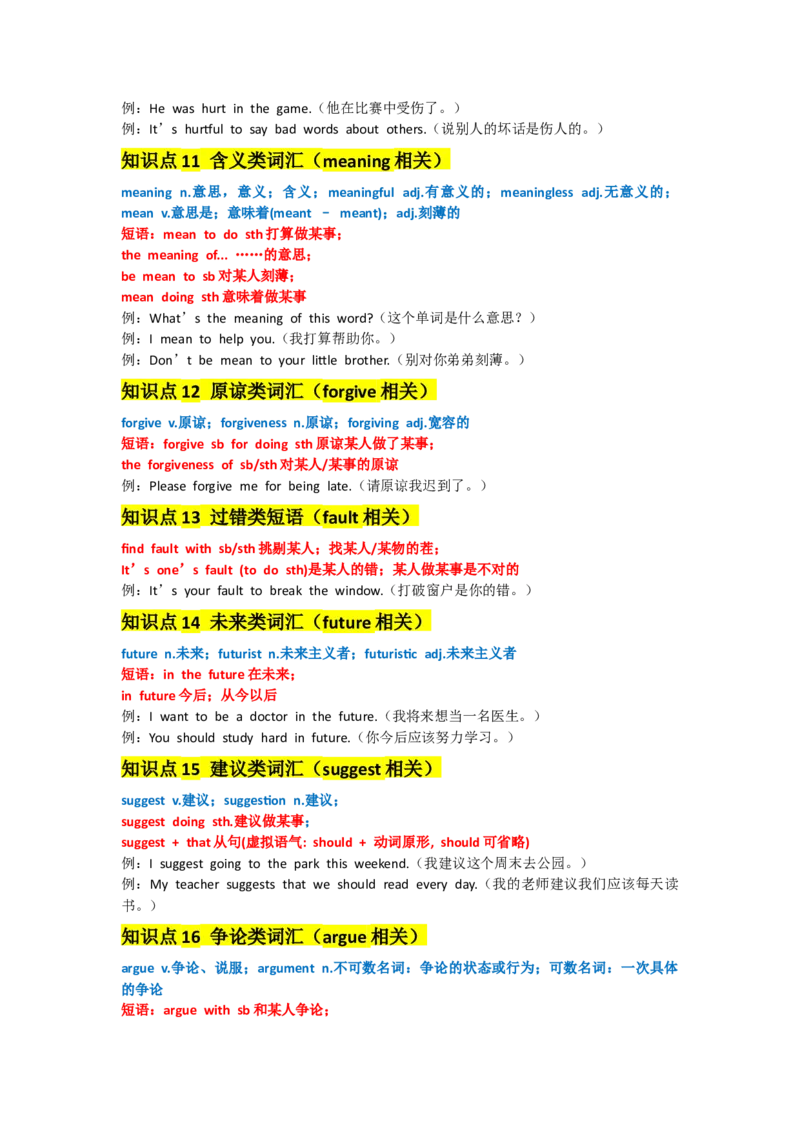
例:It’s hurtful to say bad words about others.(说别人的坏话是伤人的。)
知识点11 含义类词汇(meaning相关)
meaning n.意思,意义;含义;meaningful adj.有意义的;meaningless adj.无意义的;
mean v.意思是;意味着(meant – meant);adj.刻薄的
短语:mean to do sth打算做某事;
the meaning of... ……的意思;
be mean to sb对某人刻薄;
mean doing sth意味着做某事
例:What’s the meaning of this word?(这个单词是什么意思?)
例:I mean to help you.(我打算帮助你。)
例:Don’t be mean to your little brother.(别对你弟弟刻薄。)
知识点12 原谅类词汇(forgive相关)
forgive v.原谅;forgiveness n.原谅;forgiving adj.宽容的
短语:forgive sb for doing sth原谅某人做了某事;
the forgiveness of sb/sth对某人/某事的原谅
例:Please forgive me for being late.(请原谅我迟到了。)
知识点13 过错类短语(fault相关)
find fault with sb/sth挑剔某人;找某人/某物的茬;
It’s one’s fault (to do sth)是某人的错;某人做某事是不对的
例:It’s your fault to break the window.(打破窗户是你的错。)
知识点14 未来类词汇(future相关)
future n.未来;futurist n.未来主义者;futuristic adj.未来主义者
短语:in the future在未来;
in future今后;从今以后
例:I want to be a doctor in the future.(我将来想当一名医生。)
例:You should study hard in future.(你今后应该努力学习。)
知识点15 建议类词汇(suggest相关)
suggest v.建议;suggestion n.建议;
suggest doing sth.建议做某事;
suggest + that从句(虚拟语气: should + 动词原形, should可省略)
例:I suggest going to the park this weekend.(我建议这个周末去公园。)
例:My teacher suggests that we should read every day.(我的老师建议我们应该每天读
书。)
知识点16 争论类词汇(argue相关)
argue v.争论、说服;argument n.不可数名词:争论的状态或行为;可数名词:一次具体
的争论
短语:argue with sb和某人争论;argue about/over sth就某事争论;
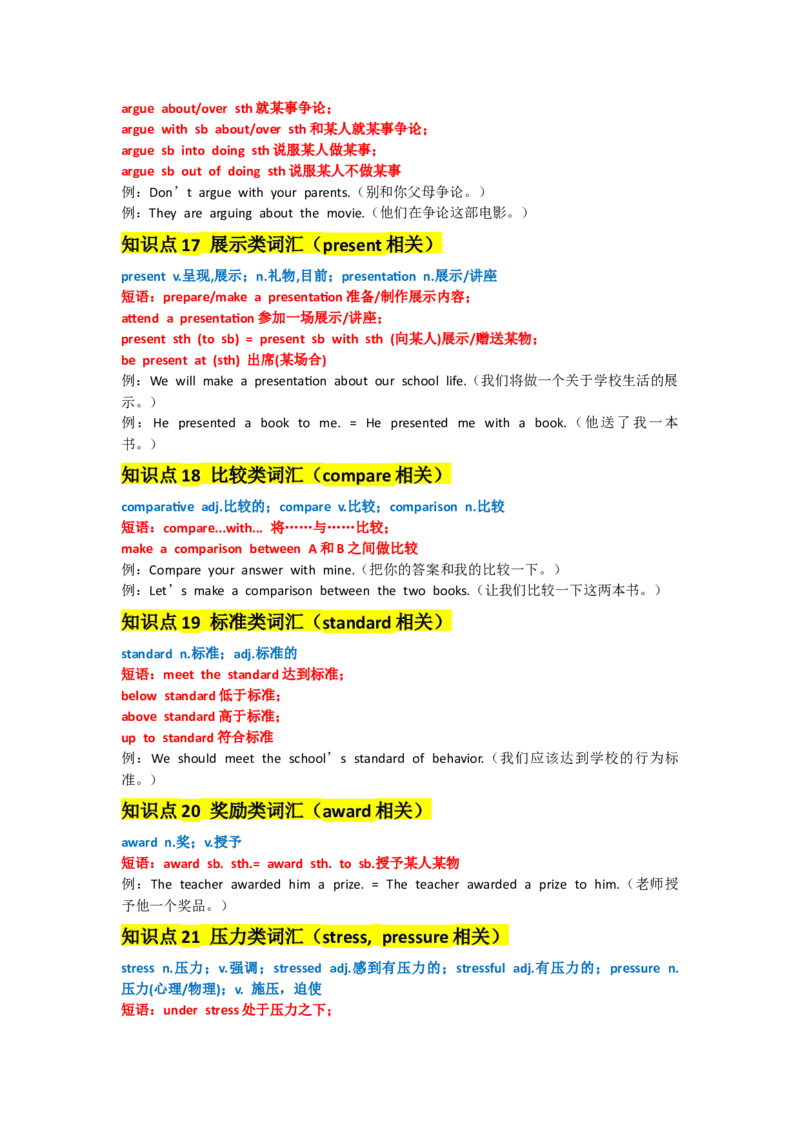
argue with sb about/over sth和某人就某事争论;
argue sb into doing sth说服某人做某事;
argue sb out of doing sth说服某人不做某事
例:Don’t argue with your parents.(别和你父母争论。)
例:They are arguing about the movie.(他们在争论这部电影。)
知识点17 展示类词汇(present相关)
present v.呈现,展示;n.礼物,目前;presentation n.展示/讲座
短语:prepare/make a presentation准备/制作展示内容;
attend a presentation参加一场展示/讲座;
present sth (to sb) = present sb with sth (向某人)展示/赠送某物;
be present at (sth) 出席(某场合)
例:We will make a presentation about our school life.(我们将做一个关于学校生活的展
示。)
例:He presented a book to me. = He presented me with a book.(他送了我一本
书。)
知识点18 比较类词汇(compare相关)
comparative adj.比较的;compare v.比较;comparison n.比较
短语:compare...with... 将……与……比较;
make a comparison between A和B之间做比较
例:Compare your answer with mine.(把你的答案和我的比较一下。)
例:Let’s make a comparison between the two books.(让我们比较一下这两本书。)
知识点19 标准类词汇(standard相关)
standard n.标准;adj.标准的
短语:meet the standard达到标准;
below standard低于标准;
above standard高于标准;
up to standard符合标准
例:We should meet the school’s standard of behavior.(我们应该达到学校的行为标
准。)
知识点20 奖励类词汇(award相关)
award n.奖;v.授予
短语:award sb. sth.= award sth. to sb.授予某人某物
例:The teacher awarded him a prize. = The teacher awarded a prize to him.(老师授
予他一个奖品。)
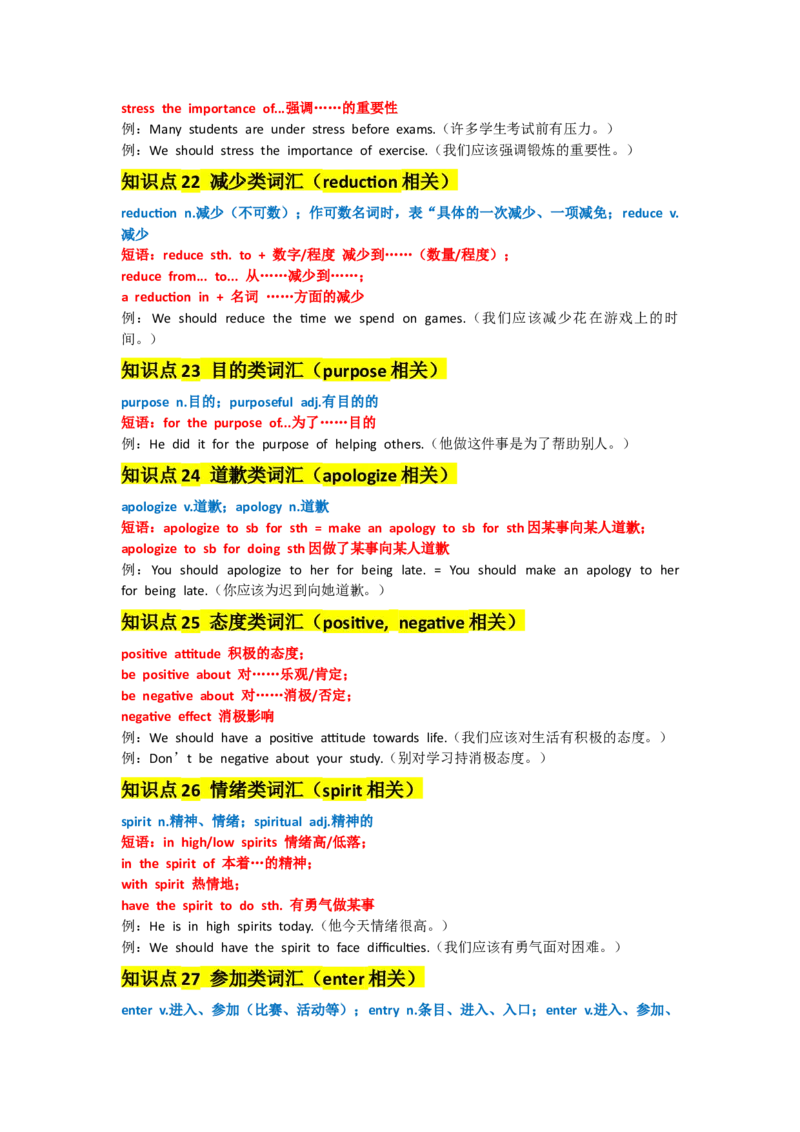
知识点21 压力类词汇(stress, pressure相关)
stress n.压力;v.强调;stressed adj.感到有压力的;stressful adj.有压力的;pressure n.
压力(心理/物理);v. 施压,迫使
短语:under stress处于压力之下;stress the importance of...强调……的重要性
例:Many students are under stress before exams.(许多学生考试前有压力。)
例:We should stress the importance of exercise.(我们应该强调锻炼的重要性。)
知识点22 减少类词汇(reduction相关)
reduction n.减少(不可数);作可数名词时,表“具体的一次减少、一项减免;reduce v.
减少
短语:reduce sth. to + 数字/程度 减少到……(数量/程度);
reduce from... to... 从……减少到……;
a reduction in + 名词 ……方面的减少
例:We should reduce the time we spend on games.(我们应该减少花在游戏上的时
间。)
知识点23 目的类词汇(purpose相关)
purpose n.目的;purposeful adj.有目的的
短语:for the purpose of...为了……目的
例:He did it for the purpose of helping others.(他做这件事是为了帮助别人。)
知识点24 道歉类词汇(apologize相关)
apologize v.道歉;apology n.道歉
短语:apologize to sb for sth = make an apology to sb for sth因某事向某人道歉;
apologize to sb for doing sth因做了某事向某人道歉
例:You should apologize to her for being late. = You should make an apology to her
for being late.(你应该为迟到向她道歉。)
知识点25 态度类词汇(positive, negative相关)
positive attitude 积极的态度;
be positive about 对……乐观/肯定;
be negative about 对……消极/否定;
negative effect 消极影响
例:We should have a positive attitude towards life.(我们应该对生活有积极的态度。)
例:Don’t be negative about your study.(别对学习持消极态度。)
知识点26 情绪类词汇(spirit相关)
spirit n.精神、情绪;spiritual adj.精神的
短语:in high/low spirits 情绪高/低落;
in the spirit of 本着…的精神;
with spirit 热情地;
have the spirit to do sth. 有勇气做某事
例:He is in high spirits today.(他今天情绪很高。)
例:We should have the spirit to face difficulties.(我们应该有勇气面对困难。)
知识点27 参加类词汇(enter相关)
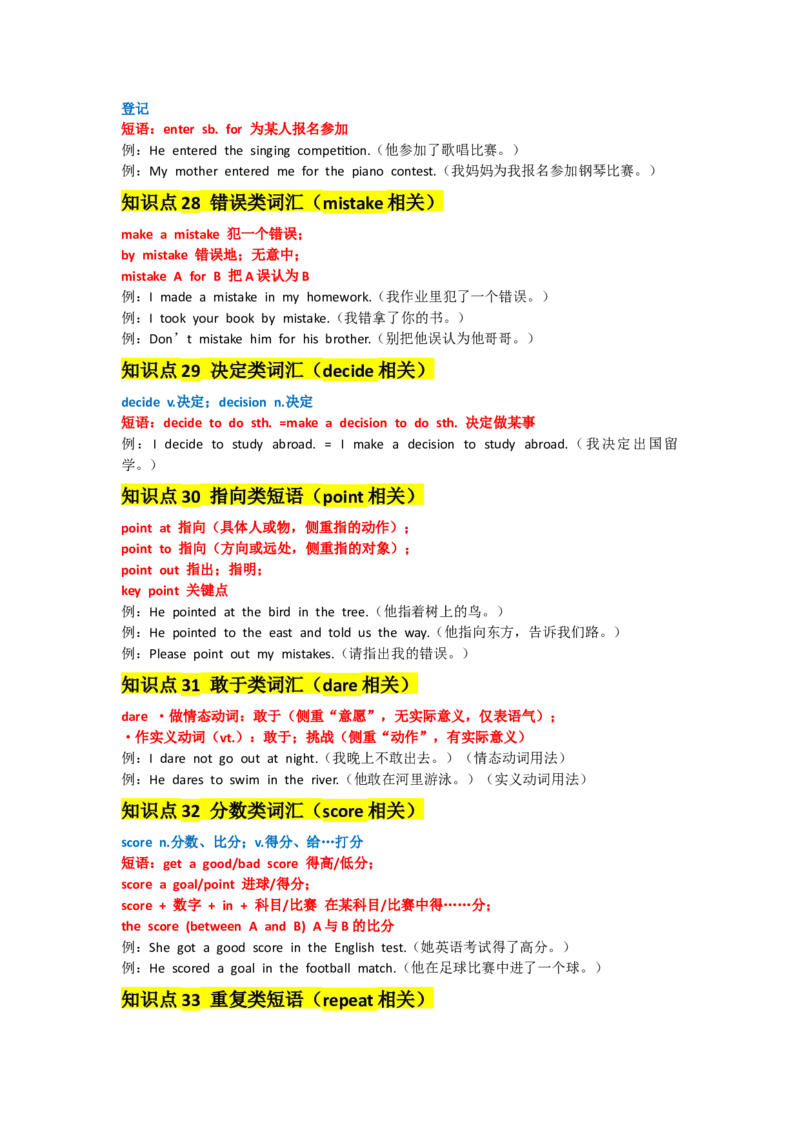
enter v.进入、参加(比赛、活动等);entry n.条目、进入、入口;enter v.进入、参加、登记
短语:enter sb. for 为某人报名参加
例:He entered the singing competition.(他参加了歌唱比赛。)
例:My mother entered me for the piano contest.(我妈妈为我报名参加钢琴比赛。)
知识点28 错误类词汇(mistake相关)
make a mistake 犯一个错误;
by mistake 错误地;无意中;
mistake A for B 把A误认为B
例:I made a mistake in my homework.(我作业里犯了一个错误。)
例:I took your book by mistake.(我错拿了你的书。)
例:Don’t mistake him for his brother.(别把他误认为他哥哥。)
知识点29 决定类词汇(decide相关)
decide v.决定;decision n.决定
短语:decide to do sth. =make a decision to do sth. 决定做某事
例:I decide to study abroad. = I make a decision to study abroad.(我决定出国留
学。)
知识点30 指向类短语(point相关)
point at 指向(具体人或物,侧重指的动作);
point to 指向(方向或远处,侧重指的对象);
point out 指出;指明;
key point 关键点
例:He pointed at the bird in the tree.(他指着树上的鸟。)
例:He pointed to the east and told us the way.(他指向东方,告诉我们路。)
例:Please point out my mistakes.(请指出我的错误。)
知识点31 敢于类词汇(dare相关)
dare ・做情态动词:敢于(侧重“意愿”,无实际意义,仅表语气);
・作实义动词(vt.):敢于;挑战(侧重“动作”,有实际意义)
例:I dare not go out at night.(我晚上不敢出去。)(情态动词用法)
例:He dares to swim in the river.(他敢在河里游泳。)(实义动词用法)
知识点32 分数类词汇(score相关)
score n.分数、比分;v.得分、给…打分
短语:get a good/bad score 得高/低分;
score a goal/point 进球/得分;
score + 数字 + in + 科目/比赛 在某科目/比赛中得……分;
the score (between A and B) A与B的比分
例:She got a good score in the English test.(她英语考试得了高分。)
例:He scored a goal in the football match.(他在足球比赛中进了一个球。)
知识点33 重复类短语(repeat相关)repeat after sb跟着某人重复;
repeat sth to sb把某事重复给某人听
例:Please repeat after me: “I love English.”(请跟我重复:“我爱英语。”)
例:Please repeat the story to your parents.(请把这个故事重复给你父母听。)
知识点34 自豪类短语(proud相关)
take pride in=be proud of以……为傲;
be proud of sb./sth.为……感到自豪;
be proud to do sth.做某事感到自豪
例:I take pride in my school. = I am proud of my school.(我为我的学校感到自豪。)
例:I am proud to be a Chinese.(我为自己是中国人而自豪。)
知识点35 表达类词汇(expression相关)
expression n.表达、表情;express v.表达;expressive adj.有表现力的
例:Your expression is very funny.(你的表情很有趣。)
例:We should learn to express our ideas.(我们应该学会表达自己的想法。)
知识点36 失望类词汇(disappoint相关)
disappointment n.失望;disappoint v.(使)失望;disappointing adj.令人失望;
disappointed adj.感到失望的
短语:be disappointed at / with ... 对……感到失望;
to one’s disappointment 令人失望的是
例:The movie is disappointing.(这部电影令人失望。)
例:I am disappointed with my exam result.(我对考试结果感到失望。)
知识点37 价值类词汇(value相关)
valued n.价值;valuable adj.有价值的;invaluable/ ɪnˈvæljuəbl /极其宝贵;valueless adj.
无价值的;没用的
短语:of value 有价值的;
be valuable to...对……有价值;
value sth/sb (as...)把……(视为……)来重视;
value doing sth重视做某事;
place value on...重视……
例:Time is valuable to us.(时间对我们很有价值。)
例:We should value studying hard.(我们应该重视努力学习。)
知识点38 归属类词汇(belong相关)
belong v.属于;belonging n.归属感;belongings n.财物
短语:take one’s belongings 带好个人财物;
belong to + 名词/代词宾格 属于……
例:These books belong to me.(这些书属于我。)
例:Please take your belongings when you leave.(离开时请带好你的财物。)
知识点39 表现类词汇(behave相关)behave v.表现;behaviour n.行为
短语:good behavior 良好的行为;
behave oneself 表现得体
例:We should have good behavior in public.(我们在公共场合应该有良好的行为。)
例:Please behave yourself in class.(课堂上请表现得体。)
知识点40 替代类短语(instead of相关)
instead of doing sth. 代替;而不是
例:We should study instead of playing games.(我们应该学习而不是玩游戏。)
知识点41 深度类词汇(deep相关)
deep adj.深的,低沉的,深沉的;depth n.深度;deeply adv.深地
例:There is a deep river near our school.(我们学校附近有一条很深的河。)
例:He was deeply moved by the story.(他被这个故事深深感动了。)
知识点42 生气类短语(get mad相关)
get mad at sb.: 对某人生气
例:Don’t get mad at your friend. It’s just a small mistake.(别生你朋友的气,只是
个小错误。)
知识点43 呼吸类词汇(breath相关)
breath n.呼吸;breathe v.呼吸
短语:breathe in吸入
breathe out呼出;
breathe a sigh of relief松一口气
例:Please breathe in and then breathe out slowly.(请慢慢吸气然后呼气。)
知识点44 机会类词汇(opportunity, chance相关)
opportunity更正式,侧重“有价值、需主动把握的机会;
chance更口语化,侧重“偶然、随机出现的机会
短语:opportunity to do sth.做某事的机会;
It’s an opportunity for sb. to do sth.对某人来说,这是做某事的机会
例:It’s an opportunity for us to visit the museum.(对我们来说,这是参观博物馆的机
会。)
例:I have a chance to meet a famous singer.(我有机会见到一位著名歌手。)
知识点45 鼓励类词汇(encourage相关)
encourage v.鼓励;encouragement n.鼓励;encouraging adj.令人鼓舞的;encouraged adj.
受鼓舞的
短语:encourage sb. to do sth. 鼓励某人做某事
;be encouraged by sth. 被……激励
例:My teacher encourages me to join the club.(我的老师鼓励我加入俱乐部。)
例:I am encouraged by my parents’ words.(我被父母的话激励了。)知识点46 自信类词汇(confidence相关)
confidence n.自信;confident adj.自信的
短语:with confidence 自信地;
have confidence in sb./sth.对……有信心;
build up confidence 树立信心
例:She speaks English with confidence.(她自信地说英语。)
例:We should build up confidence in learning math.(我们应该树立学习数学的信心。)
知识点47 留存类词汇(remain相关)
remain to be done 有待被做
例:The work remains to be done.(这项工作有待完成。)
知识点48 真诚类词汇(sincere相关)
sincere adj.真诚的;sincerely adv.真诚地;sincerity n.真诚
短语:in all sincerity 真心实意地;
be sincere about...对……是真诚的
例:I am sincere about making friends with you.(我真心想和你做朋友。)
知识点49 关系类词汇(relation相关)
relation n.关系、亲戚;related n.相关的 亲戚的;relative adj.相对的;relate v.与…有关
短语:be related to 与……有关;
relate to 涉及;与……有关
例:This event is related to our daily life.(这件事与我们的日常生活有关。)
知识点50 害怕类短语(be afraid相关)
be afraid to do sth.= be afraid of doing sth.害怕做某事(侧重因恐惧而不敢做)
例:I am afraid to swim in the sea. = I am afraid of swimming in the sea.(我害怕在
海里游泳。)
知识点51 参加类词汇辨析(join, join in, take part in, attend)
join: 加入“组织/团体”或“加入某人”;
join in: 加入“正在进行的活动”;
take part in: 参与“活动/事件”,强调“积极参与”;
attend: “出席”正式场合,强调“到场”
例:I want to join the music club.(我想加入音乐俱乐部。)
例:Let’s join in the game.(让我们加入这个游戏。)
例:He takes part in the sports meeting every year.(他每年都参加运动会。)
例:We will attend the meeting tomorrow.(我们明天将出席会议。)
单元短语总结
1. deal with our emotions 处理我们的情 3. live alone 独自生活
绪 4. hear about a sick friend 听说一个朋友
2. fail a test 考试不及格 生病了5. meet old friends 遇见老朋友 43. take care of oneself 照顾自己
6. watch a scary movie 看恐怖电影 44. reduce stress 减轻压力
7. fight with a friend 和朋友吵架 45. stay positive 保持积极
8. see an accident happen 目睹一场事故 46. take it back 收回(话)
发生 47. respect his decision 尊重他的决定
9. meet a new person 结识新人 48. have a good chance to win 有很好的
10. control one’s fear/anger 控制某人的 获胜机会
恐惧/愤怒 49. kick myself 自责
11. feel upset/shocked 感到沮丧/震惊 50. look on the bright side 看到好的一面
12. say sorry 道歉 51. be proud of 为……骄傲
13. feel bad about 对……感到难过 52. learn from mistakes 从错误中学习
14. don’t worry about 不要担心 53. repeat in future 将来重复
15. be more careful 更小心 54. work together as a team 作为团队一
16. forgive you 原谅你 起工作
17. it was my fault 是我的错 55. one for all, and all for one 我为人人,
18. didn’t mean to do 不是故意做 人人为我
19. make you feel better 让你感觉好点 56. pull together 齐心协力
20. although 尽管 57. have a sad expression 有悲伤的表情
21. until 直到 58. let the team down 让团队失望
22. so that 以便;为了 59. the referee’s decision 裁判的决定
23. if 如果 60. be careful 小心
24. argue with 和……争论 61. lose the game 输掉比赛
25. close friends 亲密的朋友 62. win all the time 一直赢
26. talk to 和……交谈 63. Positive emotions 积极情绪
27. write to 给……写信 64. Negative emotions 消极情绪
28. a light heart/a heavy heart 轻松的心 65. a sense of belonging 归属感
情/沉重的心情 66. fight the feeling of loneliness 对抗孤
29. feel blue/feel on top of the world 感 独感
到沮丧/感到非常开心 67. be shocked to hear 听到……很震惊
30. have a long face/be all smiles 愁眉苦 68. under stress 在压力下
脸/满面笑容 69. be worried about 担心
31. in low spirits/in high spirits 情绪低 70. control anger 控制愤怒
落/情绪高涨 71. express in bad ways 用不好的方式表
32. enter the classroom 进入教室 达
33. greet sb. 和某人打招呼 72. take a deep breath 深呼吸
34. let sb. down 让某人失望 73. calm down 冷静下来
35. be hard on oneself 对自己苛刻 74. a little less angry 不那么生气一点
36. push a player 推一名球员 75. up to you 由你决定
37. free throws 罚球 76. thank-you letter 感谢信
38. manage stress 管理压力 77. take the time to help 花时间帮助
39. take a break 休息一下 78. do badly in class 课堂表现差
40. clear one’s mind 理清思绪 79. grow more confident 变得更自信
41. share problems 分享问题 80. pass away 去世
42. shut oneself away 把自己封闭起来 81. listen to me and talk with me 听我说话并和我交谈 94. a problem shared is a problem halved
82. remain in my mind 留在我的脑海里 分享一个问题,问题就解决了一半
83. not only...but also... 不仅……而
且……
84. share and solve problems 分享并解决
问题
85. common teenage problems 青少年常
见问题
86. too much stress 太多压力
87. poor relationships 糟糕的人际关系
88. worries about the future 对未来的担
忧
89. school bullying 校园欺凌
90. find it hard to make friends 发现很难
交朋友
91. join a sports club 加入运动俱乐部
92. focus on the sport 专注于运动
93. work together with a team 和团队一
起工作
状语从句全总结
一、时间状语从句(核心:回答“主句动作何时发生”)
1. 核心定义
限定主句动作的“时间背景”,比如“当……时”“直到……”“一……就……”,是初
中状语从句考频最高的类型。
2. 常考引导词(3类核心,附用法+例句)
• (1)“当……时”:when/while/as(关键辨“动词类型”)
◦ when:可接“延续性动词”(如study、sleep)或“非延续性动词”(如come、
arrive),主从句动作可先后/同时发生;
例:When I got home(非延续), my mom was cooking(延续,同时).(我到家时,妈
妈在做饭)。
◦ while:只接“延续性动词”,表“主从句动作同时进行”,还可表“对比”;
例:While I do homework(延续), my sister listens to music(延续,同时).(我写作
业时,妹妹听音乐)。
◦ as:表“一边……一边……”,强调动作同步,语气最弱;
例:As we walk, we talk about school.(我们一边走,一边聊学校)。
• (2)“直到……”:until/till(关键辨“主句肯否定”)
◦ 主句肯定:表“动作持续到……为止”(一直做,到点停);
例:I wait for you until you come back.(我等你到你回来)。
◦ 主句否定(not...until...):表“直到……才做”(之前不做,到点才做),中考高频;
例:I didn’t go to bed until I finished homework.(我做完作业才睡觉)。
• (3)“一……就……”:as soon as(必记“主将从现”)
◦ 主从句动作间隔短,主句用“一般将来时(will+动原)”,从句用“一般现在时(动
原/三单)”;例:As soon as the bell rings(从句,现单三), class will start(主句,将来时).(铃一
响,课就开始)。
3. 易错点
• while不能接非延续性动词(如arrive、start),错:While he arrived, I read.(正:
When he arrived, I read.);
• as soon as不遵循“主将从现”,错:He will call you as soon as he will arrive.(正:
He will call you as soon as he arrives.)。
二、让步状语从句(核心:回答“主句动作不顾什么阻碍发生”)
1. 核心定义
先承认一个“阻碍事实”,再强调“主句动作仍发生”,即“尽管……”“即使……”。
2. 常考引导词(2类核心,附用法+例句)
• (1)though/although:表“虽然、尽管”,用法一致,可互换,从句可放句首/句中;
例:Though he is weak in math, he studies hard.(尽管他数学弱,仍努力学)。
• (2)even if/even though:表“即使、纵然”,让步语气比though更强,常假设极端
情况;
例:Even if it snows, we will go to school.(即使下雪,我们也上学)。
3. 易错点
• though/although与but连用(冗余),错:Although he is tired, but he works on.
(正:Although he is tired, he works on.);
• although不能放句末(though可以),错:He is tired, although.(正:He is tired,
though.)。
三、目的状语从句(核心:回答“主句动作为什么发生”)
1. 核心定义
说明“主句动作的目的”,即“为了……”“以便于……”,初中考频低但易混淆,抓
“情态动词”标志。
2. 常考引导词(2类,附用法+例句)
• (1)so that:表“为了”,从句常接can/could/may等情态动词(表“期望实现的目
的”);
例:She studies hard so that she can get good grades.(她努力学是为了考高分)。
• (2)in order that:语气比so that强,用法完全一致,从句也接情态动词,可互换;
例:He gets up early in order that he can catch the bus.(他早起是为了赶公交)。
3. 易错点
• 与“结果状语从句(so)”混淆:so that表“目的(有态动词,译‘为了’)”,so表
“结果(无态动词,译‘所以’)”;
例:He reads to know more(目的,so that he can know more);He reads, so he
knows more(结果)。