Unit 4 The Wonders of Nature
课时 2 Section A 2a-3d 分层作业
核心知识速记 01 基础达标 02 能力提升 03 拓展培优 0 4 思维进阶
词汇
depth n. 深(度);纵深 dive v. & n. 潜水;跳水;俯冲
research v. & n. 研究;调查 vessel n. 大船;轮船
unusual adj. 特别的;不寻常的 bottom n. 底部;最下部
waterfall n. 瀑 布
civilization n. 文明
means n. (复数)方式;途径 development n. 发展;壮大
desert n. 沙漠;荒原
短语
reach the depth 到达深度 deep sea 深海
dive into 潜入 research on/about 关于……的研究
by all means 无论如何,务必 protect... by all means 尽力保护
ancient civilization 古代文明 the development of ……的发展
rest at... (depth) 位于……(深度) create light 发光
be blind but can “see” 失明但能“看见” be important to
us 对我们很重要
句型
一、询问与说明事实
1. What do you know about...? 你对……了解多少?
2. Do you know why...? 你知道为什么……吗?
3. I remember that... 我记得……
二、描述特征与现象
1. Many... are large and unusual. 很多……又大又特别。
2. Some... are blind, but they can “see” as well as others.有些……虽然失明,但它们能像其他生物一样“看
见”。3. It travels the farthest and is about... kilometres long.它流得最远,大约……公里长。
三、表达观点与态度
1. We should protect them by all means.我们应该尽全力保护它们。
2. That’s terrible! We should do something about it. 太糟糕了!我们应该为此做点什么。
一、单词默写。
1. ______ [depθ] n. 深(度);纵深 2. ______ [daɪv] v. & n. 潜水;俯冲
3. ______ [rɪˈsɜːtʃ] v. & n. 研究;调查 4. ______ [ˈvesl] n. 大船;轮船
5. ______ [ʌnˈjuːʒuəl] adj. 特别的;不寻常的 6. ______ [ˈbɒtəm] n. 底部;最下部
7. ______ [ˈwɔːtəfɔːl] n. 瀑布 8. ______ [ˌsɪvəlaɪˈzeɪʃn] n. 文明
9. ______ [miːnz] n. (复数)方式;途径 10. ______ [dɪˈveləpmənt] n. 发展;壮大
11. ______ [ˈdezət] n. 沙漠;荒原
二、词组默写。
1. 到达深度 ______ 2. 深海 ______
3. 潜入 ______ 4. 关于……的研究 ______
5. 无论如何,务必 ______ 6. 尽力保护 ______
7. 古代文明 ______ 8. ……的发展 ______
9. 位于……(深度) ______ 10. 对我们很重要 ______
三、根据要求完成句子
1. 人们对深海仍然了解不多。
People still don’t know much about the ______.
2. 中国的“奋斗者”号在2020年潜入深海并进行了拍摄。
In ______, China’s Fendouzhe dived into the deep sea and ______ it.
3. 很多深海动物又大又特别。
Many deep-sea animals are ______ and ______.
4. 有些动物虽然失明,但它们能“看见”。
Some animals are ______ but can “______”.
5. 我们应该尽全力保护这些河流。
We should ______ these rivers ______.
四、请根据所给的首字母写出单词,使句子意思完整正确。
1. People still don’t know much about the d______ sea.
2. China’s Fendouzhe is a special research v______ that can dive very deep.
3. Some deep-sea animals can c______ their own light.
4. The Yellow River is 5,464 kilometres long, but the Yangtze River is l______.5. We should protect our rivers by all m______.
6. The Nile River is very important in Egypt’s ancient c______.
7. Many deep-sea animals look very u______, not like animals we usually see.
8. The Titanic r______ at a depth of about 3,800 metres.
五 、同义句转换。
1. The Yangtze River is the longest river in China.
The Yangtze River is ______ than any ______ river in China.
2. Some animals cannot see, but they can still “see”.
Some animals are ______, but they can “see” ______.
3. We should do our best to protect the rivers.
We should protect the rivers ______.
4. The Yellow River is called our “mother river”.
We ______ the Yellow River our “mother river”.
5. The deep sea begins at about 200 metres.
The deep sea ______ at about 200 metres.
六、对话补全
A: 1.______ do you know about the deep sea?
B: People still don’t know much about it, but in 2020, China’s Fendouzhe filmed it.
A: 2.______ is the Yellow River called “mother river”?
B: Because it helped ancient Chinese civilization to develop.
A: 3.______ is the longest river in China?
B: It’s the Yangtze River.
A: 4.______ are deep-sea animals like?
B: Many of them are large and unusual.
A: 5.______ should we protect the deep sea?
B: Because it is important to us and there is even rubbish deep down.
七 、用括号内所给词的适当形式填空。
1. China’s Fendouzhe is a great ______ (vessel) for deep-sea research.
2. Many deep-sea animals have ______ (usual) abilities.
3. We should protect our “mother river” by all ______ (mean).
4. The ______ (develop) of ancient civilizations depended on rivers.
5. The Yellow River carries yellow and brown ______ (earth) in some parts.
6. The Titanic ______ (rest) on the ocean floor for over 100 years.
7. There is too much ______ (rubbish) even in the deep sea.
8. Many countries are ______ (research) the deep sea now.
八、选词填空。用方框中所给单词的适当形式填空,使短文意思完整正确。(每个单词限用一次。每空限填一个单词。)
blue look part be thing clean protect see take year
Taihu Lake is a famous place of interest. If visitors look at Taihu Lake, they will 1 clean water. Boats run
under the white clouds and the 2 sky. However, 15 years ago, the lake 3 very different.
The lake is a 4 of the Yangtze River and covers more than 2,000 square kilometers. About 17,000,000
people get water from it now, but the water was not so clean before. Since 2007, our country has done many 5
to clean the water of the lake. So far workers have 6 lots of algae (藻) out of the lake.
The water of Taihu Lake is much 7 than before. After more than ten 8 hard work, our country has
thought of a scientific (科学的) way to treat the algae. Now few algae grow in the lake. There 9 23 kinds of
water birds and more than 50 kinds of plants in Taihu Lake.
Our country will try other ways to 10 the lake and make the pollution less. Taihu Lake will be greater in
the future.
九、阅读下面短文,从短文后的选项中选出可以填入空白处的最佳选项 ,有一个选项多余。
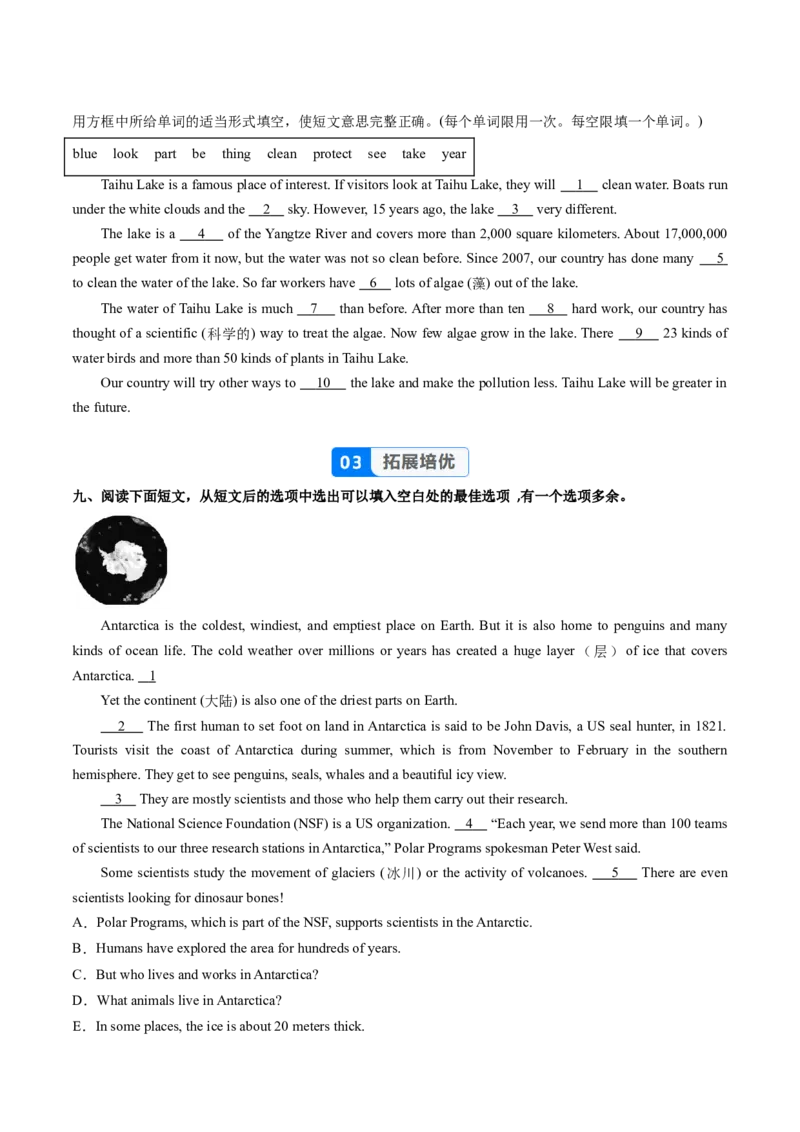
Antarctica is the coldest, windiest, and emptiest place on Earth. But it is also home to penguins and many
kinds of ocean life. The cold weather over millions or years has created a huge layer(层)of ice that covers
Antarctica. 1
Yet the continent (大陆) is also one of the driest parts on Earth.
2 The first human to set foot on land in Antarctica is said to be John Davis, a US seal hunter, in 1821.
Tourists visit the coast of Antarctica during summer, which is from November to February in the southern
hemisphere. They get to see penguins, seals, whales and a beautiful icy view.
3 They are mostly scientists and those who help them carry out their research.
The National Science Foundation (NSF) is a US organization. 4 “Each year, we send more than 100 teams
of scientists to our three research stations in Antarctica,” Polar Programs spokesman Peter West said.
Some scientists study the movement of glaciers (冰川) or the activity of volcanoes. 5 There are even
scientists looking for dinosaur bones!
A.Polar Programs, which is part of the NSF, supports scientists in the Antarctic.
B.Humans have explored the area for hundreds of years.
C.But who lives and works in Antarctica?
D.What animals live in Antarctica?
E.In some places, the ice is about 20 meters thick.F.Others study animals such as whales, seals, birds, and fish.
十、阅读理解。
(A)
The Roe River, lies in Montana, the USA, is believed to be the shortest river in the world. It’s only about 201
feet long, which is really short compared to other well-known rivers.
The Roe River connects (连接) Giant Springs to the Missouri River. Giant Springs is a large spring (泉) that is
full of fresh water. It produces a huge amount of water. This water runs through the Roe River and then joins the
Missouri River.
The history of the Roe River is pretty interesting. A.H. Thayer found it in the late 19th century. Thayer was
traveling in the area when he came across this unusual short river. However, it wasn’t until later that many people
around the world believed the Roe River was the shortest river in the world. In 1989, the Guinness Book of World
Records accepted the Roe River as the world’s shortest river.
Even though it’s short, the Roe River is very special. It has a special ecosystem (生态系统). Small fish and all
kinds of plants live in its water. Many visitors are interested in its clear water. They come to see this amazing
natural wonder and take pictures. It shows that size doesn’t always matter; even a short river like the Roe River can
be a fascinating part of our planet.
1.Where is the Roe River?
A.In America. B.In Canada. C.In Australia. D.In England.
2.新考向 代词指代 What does the underlined word “It” refer to?
A.The Roe River. B.The Missouri River.
C.Giant Springs. D.Montana.
3.What can we know about the Roe River?
A.It is over 300 feet long.
B.It was found in the early 20th century.
C.It is the second shortest river in the world.
D.It has a special ecosystem with small fish and plants.
(B)
When you first hear about the Dead Sea, it might sound scary, but the truth is quite different. Let’s get closer to
the Dead Sea and learn more about it.
The Dead Sea is located in Southwest Asia. It is about 50 kilometers long and 15 kilometers wide at its widest
point. It sits at about 430 meters below sea level, making it the lowest point on earth’s land.
What’s interesting is that the Dead Sea isn’t actually a sea. It’s a lake. The salt concentration (盐浓度) in it is
more than 30 percent, which is about eight times saltier than typical seawater. This makes it one of the saltiest
bodies of water on earth.
The Dead Sea stays so salty because of its special natural conditions. Each year, it receives very little rainfall,
and only a small amount of freshwater flows into it. And the hot weather around the Dead Sea causes the freshwater
to evaporate (蒸发) quickly, which makes the salt concentration even higher. For these reasons, it is also known asthe Salt Sea.
If you are to swim in the Dead Sea, you won’t see any sea life — no plants or animals. The high salt
concentration makes it impossible for them to live there. That’s actually why it’s called the Dead Sea.
However, don’t let the name or not having any sea life scare you. Even if you fall into the Dead Sea and can’t
swim, you won’t die. The high concentration of salt in the Dead Sea allows anyone to float well, without the need
for life buoys (救生圈) . In fact, many people visit the Dead Sea every year on vacation. If you walk along the
lakeside, you’ll likely see many people floating in the water, reading books or magazines.
1.What do we know about the Dead Sea?
A.It is the largest place in Asia.
B.It is the widest sea in the world.
C.It is the deepest point in America.
D.It is the lowest lake on earth’s land.
2.What makes the Dead Sea so salty?
A.A lot of seawater runs into it.
B.Human activities improve the salt levels.
C.Little rainfall and rapid evaporation of freshwater.
D.The high temperature stops the water from freezing.
3.Why do people call it the Dead Sea?
A.Because they cannot swim in it.
B.Because it has something dangerous.
C.Because it has the low salt concentration.
D.Because no plants or animals can live in it.
4.What does the underlined word “float” probably mean?
A.Sing in the room. B.Stay above water.
C.Fly in the sky. D.Walk on the road.
5.What can we infer from the last paragraph?
A.People feel scared when swimming in the Dead Sea.
B.The Dead Sea is dangerous for people who can’t swim.
C.If people can’t swim, they’ll still be safe in the Dead Sea.
D.A life buoy is necessary when swimming in the Dead Sea.
十一、任务型阅读。
阅读下面的短文,然后根据短文内容回答问题,并将答案填写在答题卡上对应题号的横线上。
Rivers are one of our most important natural resources(自然资源). Many of the world’s great cities are
located on rivers, and almost every country has at least one river flowing through. That plays an important part in
the lives of its people.
Most rivers begin in mountains and end in the oceans. Since the beginning of history, people have used riversfor transportation. The longest one in the USA is the Mississippi. The lifeline of Egypt is Nile. To the people of
India, the Ganges is great, but it is also important for transportation. Ships can travel along it for a thousand miles.
The greatest of all for navigation(航海), however, is the Amazon in Brazil. It is so wide and so deep that large
ships can go about two thousand miles upon it.
Besides transportation, rivers give food to eat, water to drink, water for crops, and chances for fun and
recreation for people who live along their banks. In order to increase the supply of water for crops, engineers
sometimes build a dam(大坝)across a river and let a lake from behind the dam. Then people can use the water
not only to irrigate(灌溉)their field but also to make electricity for their homes and industries. However, large
cities and industries that are located upon rivers often make problems. As the cities grow in size and industries
increase in number, the water in the rivers becomes polluted. People are learning the importance, however, of doing
more to keep their rivers clean if they want to enjoy the benefits of the natural resources.
1.How many rivers does almost every country have flowing through?
____________________________________________________________.
2.Where do most rivers begin?
____________________________________________________________.
3.What is the greatest river for navigation?
____________________________________________________________.
4.Can people use the water from the dam to make electricity?
____________________________________________________________.
5.Why is the water in the river polluted?
____________________________________________________________.
十二、完形填空。
Do you know about our mother river, the Yangtze River? It starts from the Geladandong Peak, the main peak
of the Tanggula Mountains in the Plateau of Qinghai-Xizang. It 1 about 6,300 km to the East China Sea. It is the
longest river in China and the 2 longest in the world. Its drainage basin (流域) 3 one fifth of the land area of
China. The river has played an important part in Chinese 4 , culture, and economy (经济). For thousands of
years, people have used it for 5 , shipping, growing plants and fishing. There are about 400 kinds of 6 in the
river. But because of too much fishing, 7 kinds of fishes have gone. To protect the river, the Chinese
government has put a 10-year 8 ban (禁令) starting in 2021. Wang Mingwu was a 9 . When he was asked
whether that would be bad for his living, he said, “The ban is a good thing. It 10 people to work together to love
and to save our mother river.”
1.A.runs B.has C.lasts
2.A.most B.third C.best
3.A.goes B.flows C.covers
4.A.food B.history C.rivers
5.A.washing B.watering C.drinking
6.A.plants B.fishes C.animals7.A.some B.all C.few
8.A.shipping B.swimming C.fishing
9.A.fisher B.farmer C.villager
10.A.protects B.educates C.prevents
The Last Dark Frontier: The Deep Sea
Part 1: Read and Explore
The deep sea is one of the last unexplored places on Earth. It begins at about 200 metres below the surface
and reaches down to the deepest point—the Mariana Trench, which is nearly 11,000 metres deep.
In 2020, China’s deep-sea submersible Fendouzhe (“Striver”) dived into the Mariana Trench and reached a
depth of over 10,000 metres. It was one of the deepest dives ever made by a human vessel. The Fendouzhe not only
reached great depths but also filmed the dark, cold world of the deep sea.
Life in the deep sea is strange and wonderful. Many animals are large and look unusual because they have
adapted to the dark, high-pressure environment. Some are blind but use other senses to “see”. Others can create
their own light—a process called bioluminescence.
However, the deep sea is facing problems. Scientists have found rubbish even at 11,000 metres deep. This
shows that human activities are affecting even the most remote places on Earth. Protecting the deep sea is now an
important task for all of us.
Task 1:Choose the best answer.
1. Where does the deep sea begin?
A. At 100 metres. B. At about 200 metres. C. At 500 metres. D. At 1,000 metres.
2. What did Fendouzhe do in 2020?
A. It found a new deep-sea animal. B. It cleaned rubbish in the Mariana Trench.
C. It dived and filmed the Mariana Trench. D. It helped whales dive deeper.
3. Why do deep-sea animals look unusual?
A. Because they live in warm water. B. Because they have adapted to the dark and high pressure.
C. Because they eat special food. D. Because they are very small.
4. What is “bioluminescence”?
A. Animals creating their own light. B. Animals being blind.
C. Animals living in groups. D. Animals eating plants.
5. What problem does the deep sea face?
A. Too many animals. B. Too much light.
C. Rubbish even in deep places. D. Not enough water.
Task 2 : Fill in blanks
请根据本课内容,填写以下关于“深海”的思维导图表格。The Deep Sea Definition Exploration Life
Begins at about 1. ______ A Chinese 2. ______ called Animals are large and 3.
Fendouzhe ______
Mariana Trench is the 4. ______ In the year 5. ______, it dived Some are blind but can "6.
point and filmed. ______".
Some can create light (7.
________________).
Problems Protection Importance
There is 8. ______ even at We should protect it 9. It helps us 10.
11,000m deep. __________________. ________________ the
Earth.
Human activities affect it. There is still much to 11.
______.
Task 3 :Think and Write
1. What can we do to protect the deep sea even if we live far from the ocean?
____________________________________________________________________.
2. Why do you think it is important to learn about places like the deep sea that most people will never see?
____________________________________________________________________.
3. If you could design a deep-sea research project, what would you like to find out?
____________________________________________________________________.