Unit 6 Crossing Cultures
核心语法精练(unless, as soon as, so…that 引导的状语从句)
目录
A 考点概览·知识回顾..............................................................................................................................................1
B 考点夯基·专项突破..............................................................................................................................................3
一、单项选择.........................................................................................................................................................3
二、完成句子.........................................................................................................................................................9
C 综合攻坚·能力跃升............................................................................................................................................12
题型一 语法填空...............................................................................................................................................12
题型二 阅读理解.................................................................................................................................................15
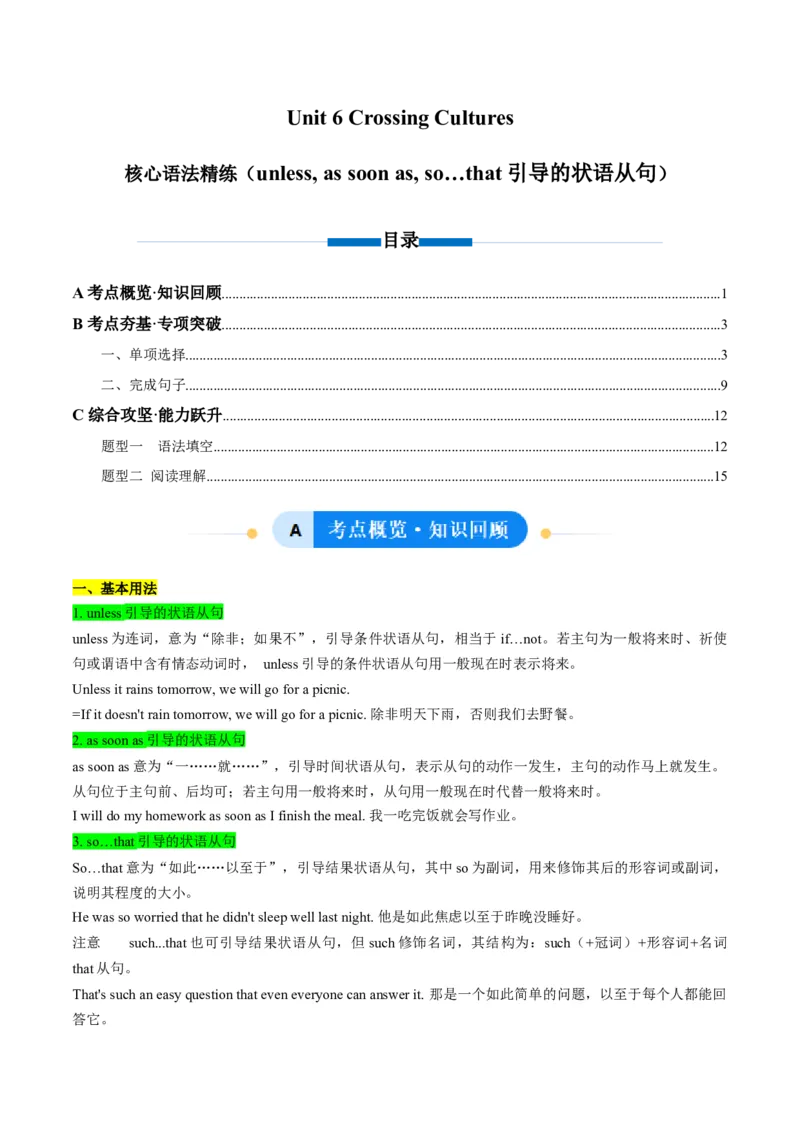
一、基本用法
1. unless引导的状语从句
unless为连词,意为“除非;如果不”,引导条件状语从句,相当于 if…not。若主句为一般将来时、祈使
句或谓语中含有情态动词时, unless引导的条件状语从句用一般现在时表示将来。
Unless it rains tomorrow, we will go for a picnic.
=If it doesn't rain tomorrow, we will go for a picnic. 除非明天下雨,否则我们去野餐。
2. as soon as引导的状语从句
as soon as意为“一……就……”,引导时间状语从句,表示从句的动作一发生,主句的动作马上就发生。
从句位于主句前、后均可;若主句用一般将来时,从句用一般现在时代替一般将来时。
I will do my homework as soon as I finish the meal. 我一吃完饭就会写作业。
3. so…that引导的状语从句
So…that意为“如此……以至于”,引导结果状语从句,其中so为副词,用来修饰其后的形容词或副词,
说明其程度的大小。
He was so worried that he didn't sleep well last night. 他是如此焦虑以至于昨晚没睡好。
注意 such...that也可引导结果状语从句,但such修饰名词,其结构为:such(+冠词)+形容词+名词
that从句。
That's such an easy question that even everyone can answer it. 那是一个如此简单的问题,以至于每个人都能回
答它。二、特殊用法
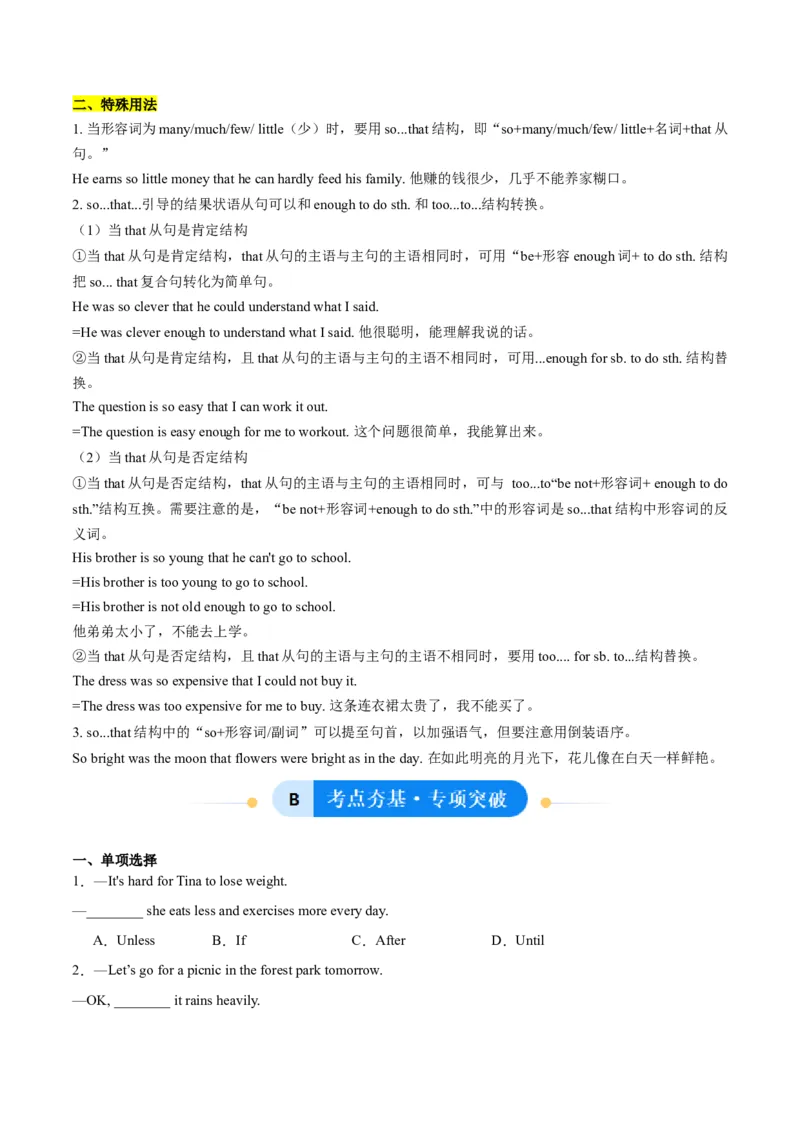
1. 当形容词为many/much/few/ little(少)时,要用so...that结构,即“so+many/much/few/ little+名词+that从
句。”
He earns so little money that he can hardly feed his family. 他赚的钱很少,几乎不能养家糊口。
2. so...that...引导的结果状语从句可以和enough to do sth. 和too...to...结构转换。
(1)当that从句是肯定结构
①当that从句是肯定结构,that从句的主语与主句的主语相同时,可用“be+形容enough词+ to do sth. 结构
把so... that复合句转化为简单句。
He was so clever that he could understand what I said.
=He was clever enough to understand what I said. 他很聪明,能理解我说的话。
②当that从句是肯定结构,且that从句的主语与主句的主语不相同时,可用...enough for sb. to do sth. 结构替
换。
The question is so easy that I can work it out.
=The question is easy enough for me to workout. 这个问题很简单,我能算出来。
(2)当that从句是否定结构
①当that从句是否定结构,that从句的主语与主句的主语相同时,可与 too...to“be not+形容词+ enough to do
sth.”结构互换。需要注意的是,“be not+形容词+enough to do sth.”中的形容词是so...that结构中形容词的反
义词。
His brother is so young that he can't go to school.
=His brother is too young to go to school.
=His brother is not old enough to go to school.
他弟弟太小了,不能去上学。
②当that从句是否定结构,且that从句的主语与主句的主语不相同时,要用too.... for sb. to...结构替换。
The dress was so expensive that I could not buy it.
=The dress was too expensive for me to buy. 这条连衣裙太贵了,我不能买了。
3. so...that结构中的“so+形容词/副词”可以提至句首,以加强语气,但要注意用倒装语序。
So bright was the moon that flowers were bright as in the day. 在如此明亮的月光下,花儿像在白天一样鲜艳。
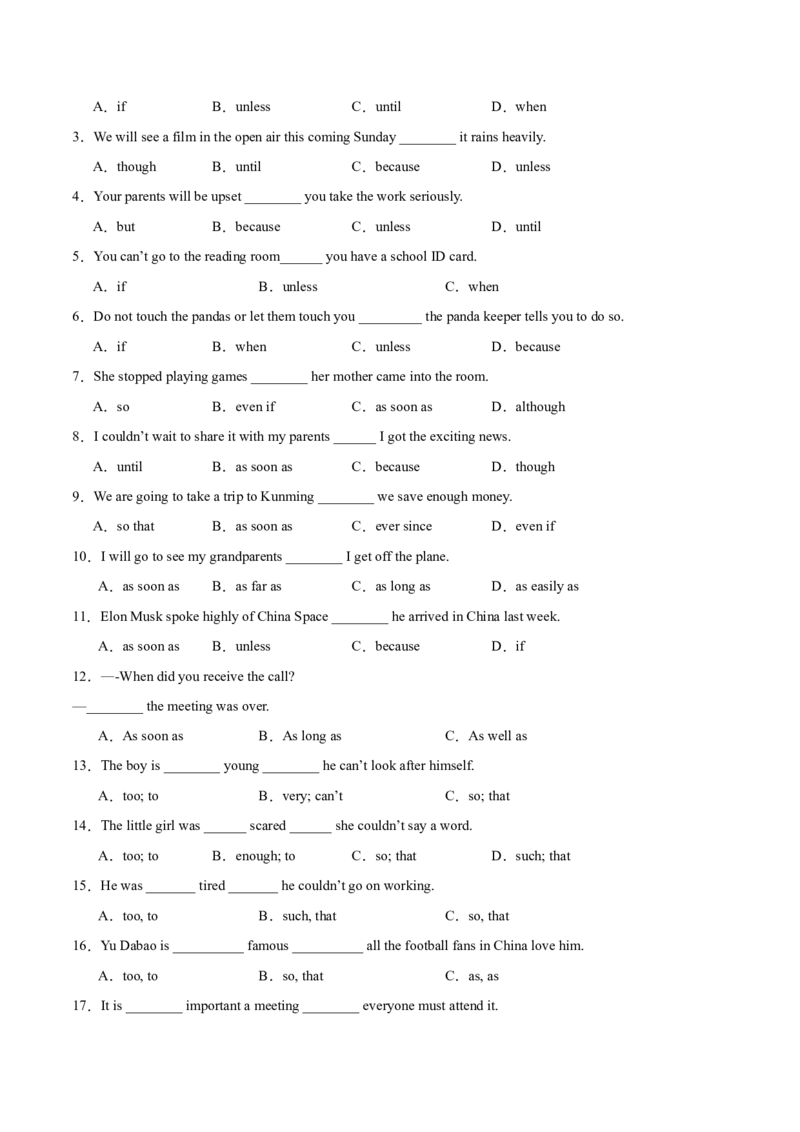
一、单项选择
1.—It's hard for Tina to lose weight.
—________ she eats less and exercises more every day.
A.Unless B.If C.After D.Until
2.—Let’s go for a picnic in the forest park tomorrow.
—OK, ________ it rains heavily.A.if B.unless C.until D.when
3.We will see a film in the open air this coming Sunday ________ it rains heavily.
A.though B.until C.because D.unless
4.Your parents will be upset ________ you take the work seriously.
A.but B.because C.unless D.until
5.You can’t go to the reading room______ you have a school ID card.
A.if B.unless C.when
6.Do not touch the pandas or let them touch you _________ the panda keeper tells you to do so.
A.if B.when C.unless D.because
7.She stopped playing games ________ her mother came into the room.
A.so B.even if C.as soon as D.although
8.I couldn’t wait to share it with my parents ______ I got the exciting news.
A.until B.as soon as C.because D.though
9.We are going to take a trip to Kunming ________ we save enough money.
A.so that B.as soon as C.ever since D.even if
10.I will go to see my grandparents ________ I get off the plane.
A.as soon as B.as far as C.as long as D.as easily as
11.Elon Musk spoke highly of China Space ________ he arrived in China last week.
A.as soon as B.unless C.because D.if
12.—-When did you receive the call?
—________ the meeting was over.
A.As soon as B.As long as C.As well as
13.The boy is ________ young ________ he can’t look after himself.
A.too; to B.very; can’t C.so; that
14.The little girl was ______ scared ______ she couldn’t say a word.
A.too; to B.enough; to C.so; that D.such; that
15.He was _______ tired _______ he couldn’t go on working.
A.too, to B.such, that C.so, that
16.Yu Dabao is __________ famous __________ all the football fans in China love him.
A.too, to B.so, that C.as, as
17.It is ________ important a meeting ________ everyone must attend it.A.such; that B.so; that C.too; to D.as; as
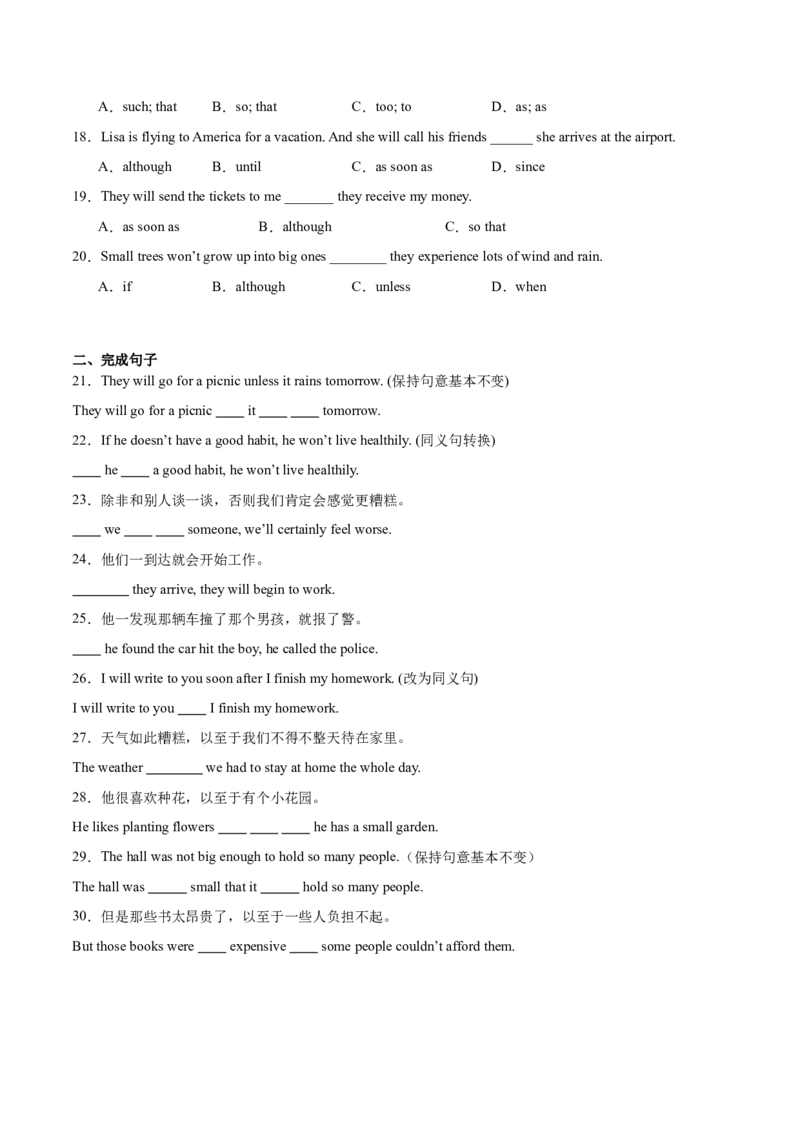
18.Lisa is flying to America for a vacation. And she will call his friends ______ she arrives at the airport.
A.although B.until C.as soon as D.since
19.They will send the tickets to me _______ they receive my money.
A.as soon as B.although C.so that
20.Small trees won’t grow up into big ones ________ they experience lots of wind and rain.
A.if B.although C.unless D.when
二、完成句子
21.They will go for a picnic unless it rains tomorrow. (保持句意基本不变)
They will go for a picnic it tomorrow.
22.If he doesn’t have a good habit, he won’t live healthily. (同义句转换)
he a good habit, he won’t live healthily.
23.除非和别人谈一谈,否则我们肯定会感觉更糟糕。
we someone, we’ll certainly feel worse.
24.他们一到达就会开始工作。
they arrive, they will begin to work.
25.他一发现那辆车撞了那个男孩,就报了警。
he found the car hit the boy, he called the police.
26.I will write to you soon after I finish my homework. (改为同义句)
I will write to you I finish my homework.
27.天气如此糟糕,以至于我们不得不整天待在家里。
The weather we had to stay at home the whole day.
28.他很喜欢种花,以至于有个小花园。
He likes planting flowers he has a small garden.
29.The hall was not big enough to hold so many people.(保持句意基本不变)
The hall was small that it hold so many people.
30.但是那些书太昂贵了,以至于一些人负担不起。
But those books were expensive some people couldn’t afford them.题型一 语法填空
阅读下面短文,在空白处填入一个适当的单词或括号内单词的正确形式(不超过3词)。
Food in China and Western countries is different. China 1 (have) about 5,000 years’ history. Chinese
people may spend half of their time 2 food. Chinese people choose food very 3 (careful). They only use
fresh materials (材料) to make food. For example, they only eat fresh fish. Western countries, like England or
America, don’t have fresh food 4 they buy their food from supermarkets which only sell stored (贮存的)
materials. The Chinese have a lot of 5 (idea) for cooking. They can cook chicken in over ten ways. Western
people do not have many skills for cooking. They only boil, steam (蒸) and bake (烘烤) the food. By the way, Western
people are very good at 6 (make) desserts and chocolate. These foods are very sweet and they can make you
7 (become) fat quickly.
In China, the person who invites other people for 8 meal would pay for the meal, but it’s not the same
situation (状况) in Western countries. In Western countries, people will 9 (think) you only invite them. They
won’t be happy if you pay for 10 (they).
阅读下面短文,在空白处填入一个适当的词或填入括号中所给单词的正确形式。
In China, table culture is part of each meal, whether it is in a restaurant or in someone’s home. Learning 1
(act) properly at table will make people around us more comfortable. Then 2 should we pay attention to when
dining?
The first one is the order of seats. Usually, round tables are the first 3 (choose) for Chinese dining. The
seat facing the door is the best one, usually for the main guest. As for the other seats, the 4 (close) they are to
the main guest, the better they are.
Second, if we are the host, we should arrive earlier at the door and introduce them to their seats. If we are
invited to the meal, we should listen to the host and take 5 seat.
Third, we shouldn’t ask the waiters the 6 (dish) prices or bargain (讨价还价) with them when we order,
which shows we are not generous. And that makes guests 7 (feel) uncomfortable.
The last point to note is about eating manners. It is 8 (polite) to urge (力劝) guests to take the dish, but
it’s acceptable to introduce the special dish. Whether they eat or not 9 (depend) on themselves. It’s also unwise
to take a dish for guests, 10 we are not sure whether they like it.题型二 阅读理解
Different countries have different customs in giving presents.
You must never give a clock to a Chinese person, because the sound of the
word for “clock” is similar to the sound for “death” in Chinese. Also, don’t wrap 包(
In China 裹) a present in white, black, or blue paper, because these are the colors for
funerals (葬礼). Don’t give a knife, because something sharp (锋利的) can cut a
friendship.
If we give flowers as a present, we have to give odd numbers of them (one,
In Russia three, five, etc.) because even numbers (偶数) of flowers (two, four, six, etc.) are
for funerals.
Flowers are a good present to take to your dinner hostess, but don’t take
her red roses because it means you are in love with her. Don’t take thirteen of
In Germany
anything because it’s an unlucky number. Don’t take an even number of anything,
either. Don’t wrap your present in white, brown, or black paper.
根据以上表格内容,选择最佳答案。
1.Why can’t we give a clock as a present to a Chinese person?
A.Because the word “clock” means “dangerous”.
B.Because the word “clock” has the same sound as the word “death”.
C.Because the word “clock” has the same meaning as the word “death”.
2.What may you take if you go to a birthday party in Russia or in Germany?
A.9 flowers. B.10 flowers. C.11 red roses.
3.In which country thirteen is an unlucky number?
A.In China. B.In Russia. C.In Germany.
4.What does the underlined phrase “odd number” mean in Chinese?
A.幸运数字 B.奇数 C.自然数
5.What do we know from the text?
A.Don’t wrap presents in brown in China.
B.Don’t give a knife as a present in China.
C.Don’t wrap presents in green in Germany.
When it comes to Western food, we can easily think of pizza, hamburgers and salad. For Chinese food, we
usually think of rice, noodles and soup.
The main difference is that in Western dishes, there is usually a larger piece of meat with some light salad on
the side. However, meat is only part of the dish in Chinese cooking. In Chinese dishes, meat and vegetables areusually mixed together in a balanced way.
Western people often see rice as a side dish. But in most Chinese dishes, rice is important, as well as noodles.
If we don’t eat rice or noodles in a meal, we may feel like we don’t eat anything. In Western dishes, people use
ingredients that taste similar, while Chinese dishes often mix different ingredients together to make the food taste
special. That’s why China has eight cuisines (菜系) in total.
However, the taste of the eight cuisines is not always the same. When different cultures come together, people
from different countries can share their food and make new dishes. For example, in America, many cooks change
some popular Chinese dishes to suit (适合) American tastes. What’s more, mixing food is also popular now.
1.How does the writer start the text?
A.By telling stories. B.By comparing facts.
C.By listing numbers. D.By asking questions.
2.What do Chinese usually do with meat and vegetables?
A.They serve them with noodles.
B.They use them to make soup.
C.They mix them in a balanced way.
D.They cook them with some light salad.
3.What do Western people often think of rice?
A.It is a side dish. B.It is the main dish.
C.It is very important. D.It should be mixed with meat.
4.What does the text mainly talk about?
A.Different kinds of Western food.
B.Ways to make Chinese and Western food.
C.Importance of sharing food among different cultures.
D.Differences between Chinese and Western food.
5.Which of the following shows the structure of the text? (P=Paragraph 1,…)
A. B. C. D.