Unit 6 Crossing Cultures
语法填空10篇
内容导航
单元话题 基础语篇练习 重难语篇练习
单元话题聚焦
文化差异
基础语篇练习
稳扎稳打 必拿分数:聚焦稳拿分数题目,确保基础分值
重难语篇练习
突破瓶颈 争夺高分:聚焦高难度题目,争夺关键分数
基础语篇练习
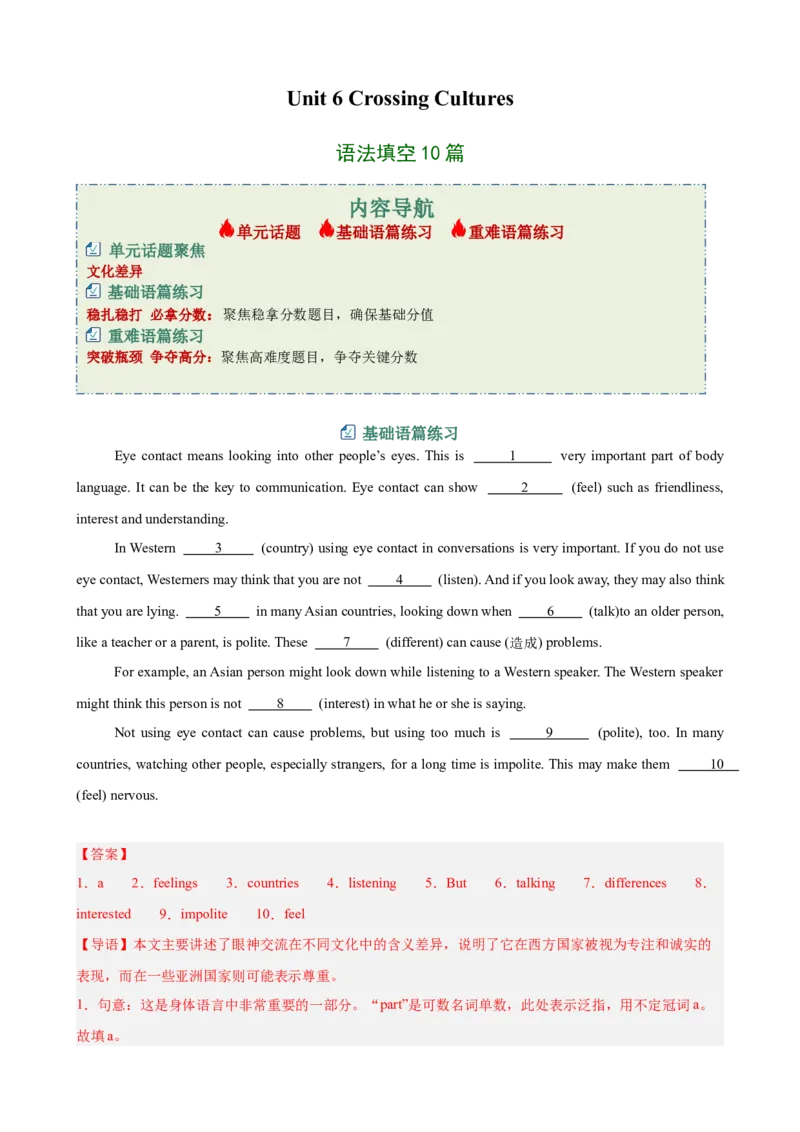
Eye contact means looking into other people’s eyes. This is 1 very important part of body
language. It can be the key to communication. Eye contact can show 2 (feel) such as friendliness,
interest and understanding.
In Western 3 (country) using eye contact in conversations is very important. If you do not use
eye contact, Westerners may think that you are not 4 (listen). And if you look away, they may also think
that you are lying. 5 in many Asian countries, looking down when 6 (talk)to an older person,
like a teacher or a parent, is polite. These 7 (different) can cause (造成) problems.
For example, an Asian person might look down while listening to a Western speaker. The Western speaker
might think this person is not 8 (interest) in what he or she is saying.
Not using eye contact can cause problems, but using too much is 9 (polite), too. In many
countries, watching other people, especially strangers, for a long time is impolite. This may make them 10
(feel) nervous.
【答案】
1.a 2.feelings 3.countries 4.listening 5.But 6.talking 7.differences 8.
interested 9.impolite 10.feel
【导语】本文主要讲述了眼神交流在不同文化中的含义差异,说明了它在西方国家被视为专注和诚实的
表现,而在一些亚洲国家则可能表示尊重。
1.句意:这是身体语言中非常重要的一部分。“part”是可数名词单数,此处表示泛指,用不定冠词a。
故填a。2.句意:眼神交流可以表现出友好、兴趣和理解等情感。such as后应列举名词,feel的名词形式为
feelings,意为“情感”,且根据下文“friendliness, interest and understanding”可知此处应用复数形式表示
多种情感。故填feelings。
3.句意:在西方国家,在交谈中使用眼神交流非常重要。country为可数名词,根据Western可知此处应
用复数形式表示泛指。故填countries。
4.句意:如果你不使用眼神交流,西方人可能会认为你没有在听。are not后应接动词的现在分词构成现
在进行时,listen的现在分词为listening。故填listening。
5.句意:然而,在许多亚洲国家,与长辈交谈时低头是礼貌的。前后句为转折关系,用But表示转折。
故填But。
6.句意:与长辈交谈时低头是礼貌的。when引导的时间状语从句中,主语与主句主语一致,且含有be
动词时,可省略主语和be动词,此处完整形式为when you are talking,省略后为when talking。故填
talking。
7.句意:这些差异可能会导致沟通问题。these后应接可数名词复数,different的名词形式为difference,
其复数为differences。故填differences。
8.句意:西方演讲者可能会认为这个人对他或她所说的内容不感兴趣。be interested in为固定搭配,意为
“对……感兴趣”,此处应用interested作形容词。故填interested。
9.句意:不使用眼神交流可能会造成问题,但使用太多也是不礼貌的。根据too可知,此处表示“也不
礼貌”,且与前面的problems形成并列,应用形容词impolite。故填impolite。
10.句意:这可能会让他们感到紧张。make sb. do sth.为固定搭配,意为“使某人做某事”,此处应用动
词原形feel。故填feel。
请认真阅读下面短文,填入一个适当的单词或括号内单词的正确形式。
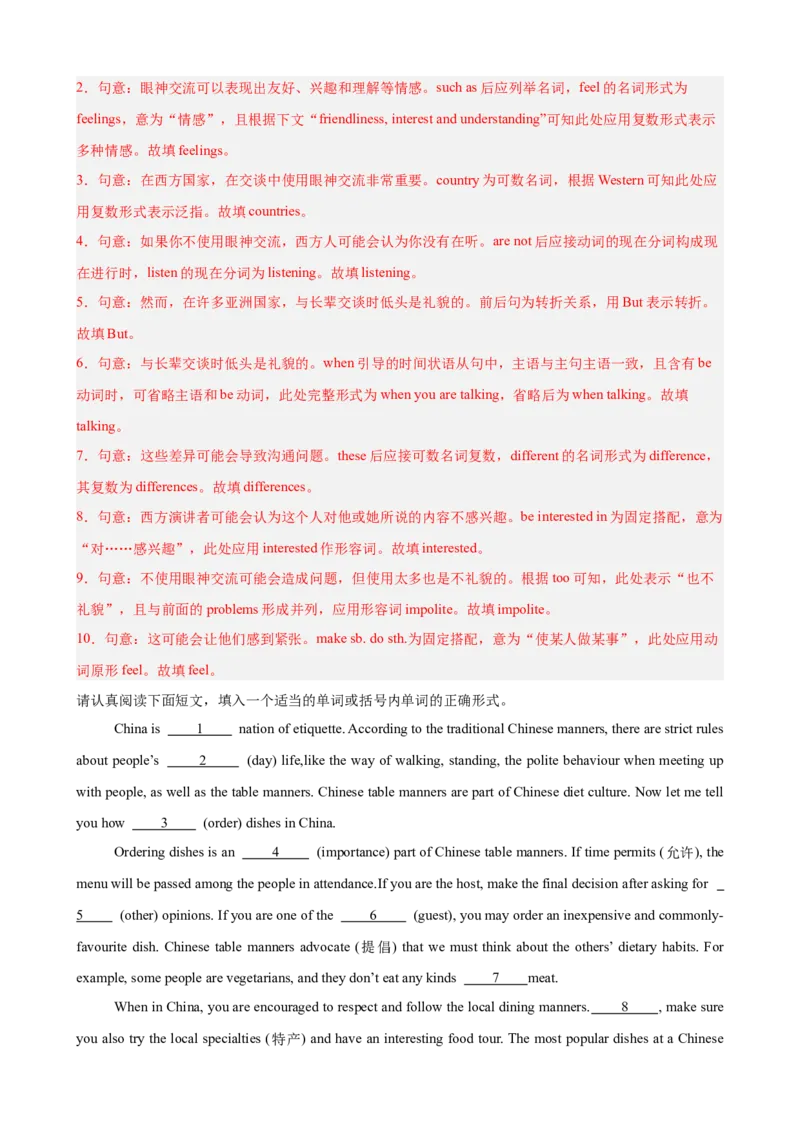
China is 1 nation of etiquette. According to the traditional Chinese manners, there are strict rules
about people’s 2 (day) life,like the way of walking, standing, the polite behaviour when meeting up
with people, as well as the table manners. Chinese table manners are part of Chinese diet culture. Now let me tell
you how 3 (order) dishes in China.
Ordering dishes is an 4 (importance) part of Chinese table manners. If time permits (允许), the
menu will be passed among the people in attendance.If you are the host, make the final decision after asking for
5 (other) opinions. If you are one of the 6 (guest), you may order an inexpensive and commonly-
favourite dish. Chinese table manners advocate (提倡) that we must think about the others’ dietary habits. For
example, some people are vegetarians, and they don’t eat any kinds 7 meat.
When in China, you are encouraged to respect and follow the local dining manners. 8 , make sure
you also try the local specialties (特产) and have an interesting food tour. The most popular dishes at a Chinesebanquet (宴会) 9 (be) fried spring rolls, dumplings, large meatballs, Kung Pao Chicken. If you 10
(travel) around, don’t miss the Pita Bread Soaked in Lamb Soup(羊肉泡馍)in Xi’an, hot pot in Chengdu or
Chongqing, instant-boiled mutton (涮羊肉) in Beijing, beer fish in Yangshuo, and so on.
【答案】
1.a 2.daily 3.to order 4.important 5.others’ 6.guests 7.of 8.However
9.are 10.are travelling/are traveling/travel
【导语】本文主要讲了中国是一个礼仪之邦,介绍了传统中国礼仪以及餐桌礼仪中如何点餐的内容。
1.句意:中国是一个礼仪之邦。“nation”是可数名词,此处表示泛指“一个国家”,且“nation”以辅音
音素开头,需用不定冠词“a”。故填a。
2.句意:根据传统的中国礼仪,人们的日常生活中有严格的规则,比如走路、站立的方式,与人见面时
的礼貌行为,以及餐桌礼仪。“daily life”是固定短语,意为“日常生活”,“day”的形容词形式“daily”
修饰名词“life”,符合语境。故填daily。
3.句意:现在让我告诉你在中国如何点餐。“疑问词+不定式”是固定结构,“how to order”表示“如何
点餐”,符合语境。故填to order。
4.句意:点餐是中国餐桌礼仪的一个重要部分。“importance”的形容词形式“important”修饰名词
“part”,表示“重要的部分”,符合语境。故填important。
5.句意:如果你是主人,在询问其他人的意见后再做最终决定。“others’”是名词所有格,意为“其他人
的”,修饰名词“opinions”,表示“其他人的意见”,符合语境。故填others’。
6.句意:如果你是客人之一,你可以点一道便宜且大家普遍喜欢的菜。“one of + 可数名词复数”是固
定结构,“guest”的复数形式是“guests”,表示“客人之一”,符合语境。故填guests。
7.句意:例如,有些人是素食主义者,他们不吃任何种类的肉。“any kinds of”是固定短语,意为“任何
种类的”,符合语境。故填of。
8. 句意:然而,也要确保你品尝当地特色美食,来一场有趣的美食之旅。“However”作为转折连词,
承接上文“要尊重遵循当地用餐礼仪”,引出“也要尝试当地特色”的补充内容,符合语境。故填
However。
9.句意:中国宴会上最受欢迎的菜肴有炸春卷、饺子、大肉丸、宫保鸡丁。主语“The most popular
dishes”为复数,句子描述客观事实用一般现在时,be动词用“are”。故填are。
10.句意:如果你正在旅行/四处旅行,不要错过西安的羊肉泡馍、成都或重庆的火锅等美食。强调“在
旅行过程中”,现在进行时表示正在进行的动作,用“are travelling/are traveling”;if引导的条件状语从句,
遵循“主将从现”原则,从句用一般现在时表示将来,用“travel”。 故填are travelling/are
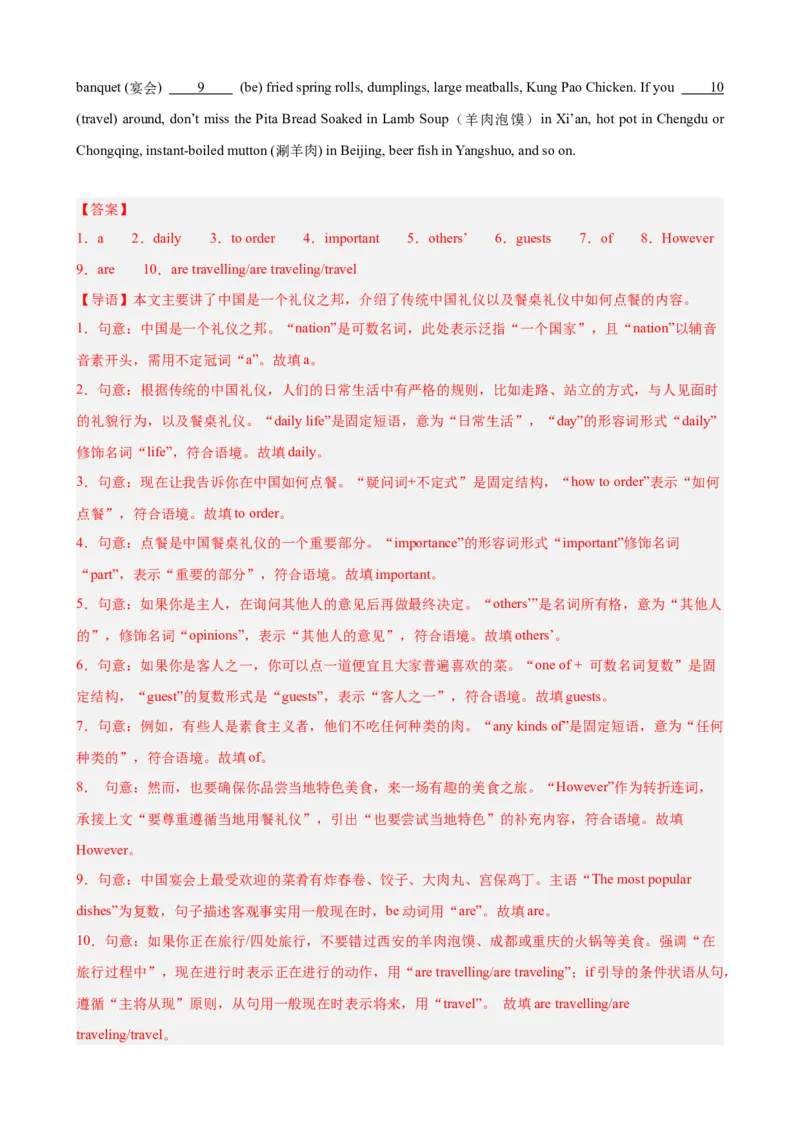
traveling/travel。A small talk is a good way to kill time and make friends. If you travel to other 1 (country), do
you know what to say to start an excellent small talk with local (当地的) people?
In the UK the best topic is the weather. British weather changes quite often. You can start to talk by saying
“Wow, it is 2 (rain) heavily now. Maybe it will be sunny a few hours later.” Besides 3
weather, you can talk about gardens. For example, you could say, “Those flowers look really beautiful, don’t
they?” English people love their pets. 4 it’s nice to begin with “What a lovely dog! What’s 5
(it) name?”
In America, people like to talk about sports, such as American football and basketball. You can also begin
talking 6 (easy) with clothes. “It’s a nice shirt. Where did you get it?” “I 7 (buy) it in a store
near my home.”
Of course, you shouldn’t talk about some topics. Don’t 8 (ask) people “How old are you?” Age is
usually a secret for women. Never ask “How much money do you make?” It 9 (make) people unhappy.
Don’t ask strangers (陌生人) whether (是否) they have a girlfriend 10 a boyfriend.
【答案】
1.countries 2.raining 3.the 4.So 5.its 6.easily 7.bought 8.ask 9.
makes 10.or
【导语】本文介绍了在不同国家进行闲聊的合适话题和禁忌,帮助读者在旅行时更好地与当地人交流。
1.句意:如果你去其他国家旅行,你知道该说些什么来和当地人开启一段愉快的闲聊吗?“other”后接
可数名词复数,“country”的复数形式为“countries”,故填countries。
2.句意:哇,现在雨下得真大。“is”后接现在分词构成现在进行时,“rain”的现在分词为“raining”,故
填raining。
3.句意:除了天气,你还可以谈论花园。“the weather”是固定表达,特指双方都知道的天气话题,故填
the。
4.句意:所以,用 “多可爱的狗啊!它叫什么名字?”来开启对话很不错。前文提到英国人喜欢宠物,
此处用“So”承接上文,引出结果,故填So。
5.句意:它叫什么名字?此处需要形容词性物主代词修饰名词“name”,“it”的形容词性物主代词为
“its”,故填its。
6.句意:你也可以轻松地从衣服聊起。此处需要副词修饰动词“begin”,“easy”的副词形式为
“easily”,故填easily。
7.句意:我在我家附近的一家商店买的它。问句用一般过去时,答句也用一般过去时,“buy”的过去式
为“bought”,故填bought。8.句意:不要问别人 “你多大了?”“Don’t”后接动词原形,故填ask。
9.句意:这会让人们不开心。句子为一般现在时,主语“It”是第三人称单数,谓语动词“make”用第三
人称单数形式“makes”,故填makes。
10.句意:不要问陌生人他们是否有女朋友或男朋友。在否定句中表示“和”用“or”,故填or。
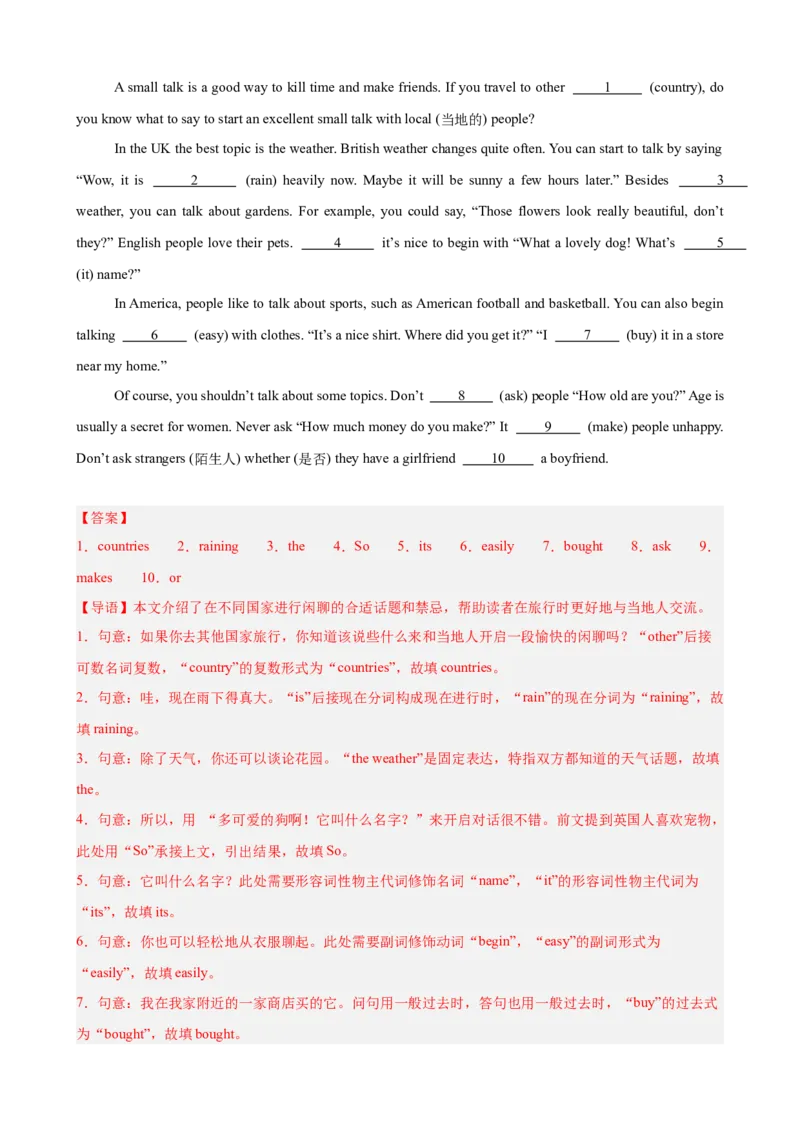
If you go to another country, you might feel 1 (confuse), strange, or anxious. This feeling is
called “culture shock”. People have culture shock 2 different reasons. Maybe they don’t know the
language or the local culture. They might also miss their family and friends back home.
Culture shock usually has four stages. People call this “the model of 3 (culture) adjustment”.
4 (come) to a foreign country is exciting. Everything is new and 5 (familiar). It’s fun to look around
the new place and learn about the local culture. After some time, you start to feel unhappy with life in the new
country. Everything seems hard. You get angry or sad very 6 (easy). It’s not easy to talk with people
around you. You may feel very homesick and lonely. In this stage, you slowly start to deal with the hard things.
You know what 7 (expect) in most cases. The host country doesn’t feel all that new anymore. You begin
to accept the local culture. You also learn how to deal with 8 things you don’t like. At last, you start to
feel at home in the new culture. The 9 (different) between cultures are not a big problem anymore.
It can be hard to get used to things 10 you go back to your home country after being away for a
long time. Some people have a new culture shock when they return home. This is called reverse culture shock.
【答案】
1.confused 2.for 3.cultural 4.Coming 5.unfamiliar 6.easily 7.to expect
8.the 9.differences 10.when
【导语】本文主要介绍了文化冲击的四个阶段。
1.句意:如果你去另一个国家,你可能会感到困惑、陌生或焦虑。根据“strange, or anxious”可知,空处
需填形容词confused,作表语,修饰人。故填confused。
2.句意:人们会因为不同的原因而经历文化冲击。根据“People have culture shock ..different reasons.”可
知,空处表原因。故填for。
3.句意:人们称之为“文化适应模式”。根据“the model of...adjustment”可知,空处修饰名词,需用形
容词。故填cultural。
4.句意:来到国外是令人兴奋的。根据“...to a foreign country is exciting.”可知,空处作主语,需用动名
词coming作主语,句首首字母要大写。故填Coming。
5.句意:一切都是新的、陌生的。根据“new and”可知,空处与new并列,需填unfamiliar“不熟悉的”,
是形容词,作表语。故填unfamiliar。6.句意:你很容易生气或难过。分析句子可知,空处修饰动词get,用副词。故填easily。
7.句意:在大多数情况下,你知道会发生什么。根据“You know what ... in most cases.”可知,此处是
“疑问词+动词不定式”结构作know的宾语。故填to expect。
8.句意:你也学会了如何应对你不喜欢的事情。根据“things you don’t like”可知,空处应用the修饰
things,表示特指。故填the。
9.句意:文化差异已不再是一个大问题。根据“are”可知,该句主语为名词复数。故填differences。
10.句意:在离开家乡很长时间后回到家乡时,你会很难适应一些事情。根据“It can be hard to get used
to things...you go back to your home country”可知,此处指“当你回到你的家乡”,空处缺“当……时”,
应填when,引导时间状语从句。故填when。
阅读下面材料,在空白处填入适当的内容 (1个单词) 或括号内单词的适当形式。
Diwali, a Hindu (印度的) festival of lights, 1 (hold) in honour of Lakshmi, the goddess of
wealth. It has long been a cultural holiday, during 2 people get together, have parties, give gifts to each
other and generally pray for 3 better-off future. For some communities the day after Diwali marks the
beginning of the new year.
4 (it) dates change each year because they are based on the Hindu lunar calendar but typically the
festival is celebrated in October or November. The celebration usually 5 (last) for several days. People
will often line candles and lamps throughout their houses and along their driveways 6 (light) up the
surroundings.
For Hindus, Diwali is a time 7 charitable giving and selfless service. They are required to reflect
on 8 they are grateful for and how they can shine light on others as well. Hindus 9
(traditional) perform a deep cleaning of their homes and surroundings as cleanliness is believed to be a prayer for
the presence of wealth and well-being. If you came to Diwali, you 10 (see) colorful patterns of flower
powder, rice or sand on the floor, which is meant to bring good luck.
【答案】
1.is held 2.which 3.a 4.Its 5.lasts 6.to light 7.for 8.what 9.
traditionally 10.would see
【导语】本文介绍了印度的排灯节,阐述了其庆祝目的、时间、传统活动以及在印度教徒心中的意义等
内容。
1.句意:排灯节是印度的灯节,是为了纪念财富女神拉克希米而举行的。根据“Diwali…(hold) in honour
of Lakshmi”可知,Diwali和hold是被动关系,且是客观事实,用一般现在时的被动语态,故填is held。
2.句意:它长期以来一直是一个文化节日,在此期间人们聚在一起,举办派对,互相赠送礼物,通常祈求一个更富裕的未来。根据“during…people get together”可知,during which引导非限制性定语从句,修
饰先行词a cultural holiday,which在从句中作介词during的宾语,故填which。
3.句意:它长期以来一直是一个文化节日,在此期间人们聚在一起,举办派对,互相赠送礼物,通常祈
求一个更富裕的未来。根据“pray for…better-off future”可知,a better-off future表示“一个更富裕的未
来”,不定冠词a表泛指,故填a。
4.句意:它的日期每年都在变化,因为它们是基于印度阴历的,但通常这个节日在10月或11月庆祝。
根据“…(it) dates change”可知,修饰名词dates要用形容词性物主代词,it的形容词性物主代词是Its,句
首首字母大写,故填Its。
5.句意:庆祝活动通常持续几天。根据“The celebration usually…(last) for several days”可知,主语The
celebration是单数,且是客观事实,用一般现在时,谓语动词用第三人称单数形式,故填lasts。
6.句意:人们通常会在房子里和车道上摆满蜡烛和灯,以照亮周围的环境。根据“line candles and
lamps…(light) up the surroundings”可知,to light up是动词不定式作目的状语,表示“为了照亮”,故填to
light。
7.句意:对印度教徒来说,排灯节是慈善捐赠和无私服务的时刻。根据“a time…charitable giving” 可知,
a time for…表示“……的时刻/时期”,for表对象,故填for。
8.句意:他们需要反思自己感恩的事物,以及如何也能照亮他人。根据“reflect on…they are grateful for”
可知,reflect on后接宾语从句,从句中缺少宾语,表示“……的事物”,用what引导,故填what。
9.句意:印度教徒传统上会对他们的家和周围环境进行深度清洁,因为清洁被认为是对财富和幸福存在
的祈祷。根据“Hindus…(traditional) perform”可知,修饰动词perform要用副词,traditional的副词形式是
traditionally,故填traditionally。
10.句意:如果你参加排灯节,你会看到地板上有花粉、大米或沙子组成的彩色图案,这是为了带来好
运。根据“If you came to Diwali, you…(see)”可知,if引导的虚拟条件句,从句用一般过去came,主句用
“would+动词原形”,故填would see。
Let’s read the information about school uniforms from the following 1 (country).
School dress code (着装规定) is very strict in England. The 2 (one) uniform was blue. They
believed this colour could be 3 (help) for kids to be organized and calm. Boys wear white shirts, long
grey or black trousers, sweaters, school ties and black shoes. Girls have 4 same clothes as boys. But
they can wear school skirts or dresses in summer.
Australia 5 (borrow) many things from England. Their school uniforms look like the British ones
very much, 6 they are easier and lighter. Boys wear polo shirts or button-up (带纽扣的) shirts together
7 shorts or long trousers, usually in grey. Girls wear dresses with blouses, polo shirts or button-up ones with
skirts. Students also wear hats when the weather is much 8 (hot).Almost all the students 9 Singapore need to wear uniforms. The colours are different from school
to school. The uniforms for boys 10 (be) shorts or long trousers with white shirts, while girls wear
white blouses and blue or black skirts.
【答案】
1.countries 2.first 3.helpful 4.the 5.borrows 6.but 7.with 8.hotter
9.in 10.are
【导语】本文主要介绍了英国、澳大利亚和新加坡三个国家的校服情况。
1.句意:让我们来看看以下国家关于校服的信息。因为后文提到不止一个国家,“following”后接可数名
词复数。故填countries。
2.句意:第一套校服是蓝色的。此处表示“第一”,用序数词“first”。故填first。
3.句意:他们认为这种颜色有助于孩子们变得有条理和冷静。“be helpful for”表示“对……有帮助”。
故填helpful。
4.句意:女孩们穿着和男孩们一样的衣服。“the same as”是固定搭配,意为“和……一样”。故填
the。
5.句意:澳大利亚从英国借鉴了很多东西。主语“Australia”是第三人称单数,时态为一般现在时,谓语
动词用“borrows”。故填borrows。
6.句意:他们的校服看起来很像英国的校服,但它们更简单、更轻便。前后句是转折关系,用“but”。
故填but。
7.句意:男孩们穿马球衫或带纽扣的衬衫,搭配短裤或长裤,通常是灰色的。“together with”表示
“和……一起”,是固定搭配。故填with。
8.句意:天气热得多的时候,学生们也戴帽子。“much”后接形容词比较级,“hot”的比较级是
“hotter”。故填hotter。
9.句意:新加坡几乎所有的学生都需要穿校服。“in Singapore”表示“在新加坡”,用介词“in”。故填
in。
10.句意:男孩的校服是短裤或长裤配白衬衫,而女孩穿白衬衫和蓝或黑裙子。主语“The uniforms”是复
数,时态为一般现在时,be动词用“are”。故填are。
阅读短文,在空白处填入一个适当的单词或用括号内所给词的正确形式填空,使短文通顺、连贯。
Many people go to different countries in their lifetime. Maybe one day you will go abroad as 1
exchange student. There are different table manners in different countries. If you go to a 2 (west)
country, do you know how 3 (behave) at the dinner table? Here are some basic table manners. They are
worth remembering.To start 4 , put the napkin (餐巾纸) on your lap (腿部). This protects your clothes from food in
your mouth. It can also be 5 (use) to clean your hands and mouth.
Hold the knife in your right hand 6 the fork in your left hand. Cut the meat or fish into 7
(piece) as you eat.
Do not reach 8 (cross) the table or in front of another person. Ask someone to pass whatever you
want.
Try to be relaxed when having dinner. Eating in silence isn’t any fun. 9 if you want to talk,
remember to do it when you aren’t 10 (eat).
Use a handkerchief (手帕) when you cough or blow your nose.
【答案】
1.an 2.western 3.to behave 4.with 5.used 6.and 7.pieces 8.across
9.But 10.eating
【导语】本文通过介绍西方国家的基本餐桌礼仪,为读者提供了实用的用餐行为指南,帮助大家在出国
赴宴时能够举止得体、避免文化尴尬。
1.句意:也许有一天你会作为一名交换生出国。exchange以元音音素开头,不定冠词用an,“as an
exchange student”是固定表达,意为“作为一名交换生”。故填an。
2.句意:如果你去一个西方国家,你知道如何在餐桌上表现吗?west的形容词形式为western,意为“西
方的”,用于修饰名词“country”,a western country“一个西方国家”。故填western。
3.句意:如果你去一个西方国家,你知道如何在餐桌上表现吗?“疑问词 + 不定式”是固定结构,
“how to behave”意为“如何表现”。故填to behave。
4.句意:首先,把餐巾放在腿上。“to start with”是固定搭配,意为“首先;一开始”,用于引出第一条
建议。故填with。
5.句意:它也可以被用来清洁你的手和嘴。此处为被动语态,结构为“be + 过去分词”,use的过去分
词是used,“be used to do sth.”是固定结构,意为“被用来做某事”。故填used。
6.句意:右手拿刀,左手拿叉。前后两个分句为并列关系,用and连接。故填and。
7.句意:吃的时候把肉或鱼切成小块。“cut ... into pieces”是固定搭配,意为“把……切成小块”,piece
是可数名词,此处用复数形式泛指“多块”。故填pieces。
8.句意:不要伸手越过桌子或在别人面前拿东西。“reach across”是固定表达,意为“越过……伸手去
拿”,reach是不及物动词,后接宾语时需加介词,cross的介词形式为across。故填across。
9.句意:沉默地吃饭没有任何乐趣。但是如果你想说话,记得在没吃东西的时候说。前后句为转折关系,
用but连接,句首首字母大写。故填But。10.句意:但是如果你想说话,记得在没吃东西的时候说。此处为现在进行时,结构为“be + 现在分
词”,表示“正在吃东西”的状态,eat的现在分词为eating。故填eating。
阅读下面短文,在空白处填入1个适当的单词或括号内单词的正确形式。
If you travel to the UK, you need to greet people there in a polite way. British people usually say “hello” or
“nice to meet you” and shake hands when they meet you for the 1 (one) time. They only greet relatives
or close friends with a kiss. They like to start a conversation with subjects 2 the weather, holidays,
music or books. They avoid 3 (talk) about ages, weight or money. Most of the British people have good
manners. They think it’s rude to push in before others 4 they always queue for their turn. They 5
(apologize) if they bump into you by accident in the street. When you are 6 their way, they will always
be patient enough to wait for you to move. They pay great attention to their 7 (behave) in public. For
example, they seldom shout or laugh 8 (loud) when others are around. When 9 (chat) with a
Briton, you will also find that they say “please”or “thank you” all the time. 10 (keep) these manners in
your mind, and I’m sure they will be helpful to you in the future.
【答案】
1.first 2.like 3.talking 4.so 5.will apologize 6.in 7.behavior 8.loudly
9.chatting 10.Keep
【导语】本文介绍了去英国旅行时需要了解的当地礼貌礼仪,包括见面问候、聊天话题、公共行为等方
面的习惯。
1.句意:英国人第一次见到你时,通常会说“你好”或“很高兴认识你”并和你握手。根据“for the…
time”的固定表达可知,此处需用“one”的序数词“first”,表示“第一次”。故填first。
2.句意:他们喜欢以天气、假期、音乐或书籍之类的话题开启对话。根据后文列举的“the weather,
holidays, music or books”这些话题可知,此处需用介词“like”表示“像”。故填like。
3.句意:他们避免谈论年龄、体重或金钱。根据“avoid doing sth.”(避免做某事)的固定用法可知,此
处需用“talk”的动名词“talking”。故填talking。
4.句意:他们认为插队是粗鲁的,所以总是排队等候。根据原文“they think it’s rude to push in before
others”和“they always queue for their turn”的因果关系可知,此处填连词“so”。故填so。
5.句意:如果他们在街上不小心撞到你,会道歉。根据“if”引导的条件状语从句(主将从现)的规则可
知,此处需用“apologize”的一般将来时“will apologize”。故填will apologize。
6.句意:当你挡着他们的路时,他们会耐心等待你移动。根据“in one’s way”(挡某人的路)的固定短
语可知,此处填介词“in”。故填in。
7.句意:他们非常注意自己在公共场合的行为。根据“their”(形容词性物主代词)后接名词的用法可知,此处需用“behave”的名词形式“behavior”。故填behavior。
8.句意:例如,当周围有人时,他们很少大声喧哗或大笑。根据修饰动词“shout or laugh”的语法要求可
知,此处需用“loud”的副词形式“loudly”。故填loudly。
9.句意:和英国人聊天时,你也会发现他们总是说“请”或“谢谢”。根据“when”后接动名词的用法
可知,此处需用“chat”的动名词“chatting”。故填chatting。
10.句意:记住这些礼仪,我相信它们将来会对你有帮助。根据祈使句以动词原形开头的规则可知,此
处需用“keep”的原形,且位于句首,首字母大写。故填Keep。
重难语篇练习
阅读下面短文,在空白处填入一个适当的单词或括号内单词的正确形式。
I still remember my first experience with cultural differences. When I 1 (be) in eighth grade, our
school hosted some exchange students 2 came from Japan. We 3 (suppose) to help them feel
welcome and show them around our city.
One day, something 4 (expect) happened. I gave a small gift to Yuki, one of the Japanese
students. Instead 5 opening it immediately, she politely put it aside. It made me 6 (feel) a
little disappointed at first, thinking she didn’t like it. Later, our teacher explained that in Japanese culture, people
often don’t open gifts right away to show respect and modesty (谦虚).
This experience taught me that we shouldn’t always expect others 7 (behave) the same way we
do. What seems natural in one culture might be 8 (complete) different in another. Now I find learning
about cultural differences is absolutely (完全地) fascinating.
Since then, I 9 (become) more interested in understanding different customs. I even started to
learn Japanese! The world is full of surprises waiting to be discovered 10 we keep an open mind.
【答案】
1.was 2.who/that 3.were supposed 4.unexpected 5.of 6.feel 7.to behave
8.completely 9.have become 10.if
【导语】本文讲述了作者第一次体验文化差异的经历,通过与日本交换生的互动,作者了解到不同文化
背景下人们的行为习惯可能截然不同,并因此对了解不同习俗产生了浓厚兴趣。
1.句意:当我在八年级的时候,我们学校接待了一些来自日本的交换生。根据“When I...in eighth grade”
可知,此处描述的是过去某个时间点的状态,应用一般过去时,主语为I,be动词用was。故填was。
2.句意:当我在八年级的时候,我们学校接待了一些来自日本的交换生。根据“our school hosted some
exchange students...came from Japan”可知,此处为定语从句,修饰先行词students,关系词在从句中作主语,
应用关系代词who或that。故填who/that。3.句意:我们应该让他们感到受欢迎,并带他们参观我们的城市。根据“We...to help them feel welcome”
可知,此处表示“应该做某事”,应用be supposed to do sth.,描述过去的事情,be动词用were。故填
were supposed。
4.句意:一天,意外的事情发生了。根据“It made me...a little disappointed at first”可知,作者一开始感
到失望,说明发生的事情是出乎意料的,应用形容词unexpected“出乎意料的”作后置定语修饰
something。故填unexpected。
5.句意:我给了日本学生Yuki一个小礼物,她没有马上打开,而是礼貌地把它放在一边。根据
“Instead...opening it immediately”可知,此处表示“没有立即打开礼物”,应用固定短语instead of doing
sth.“代替做某事,而不是做某事”。故填of。
6.句意:一开始这让我有点失望,以为她不喜欢。根据“It made me...a little disappointed”可知,此处表
示“使某人做某事”,应用固定短语make sb. do sth.,动词用原形。故填feel。
7.句意:这段经历告诉我,我们不应该总是期望别人和我们表现得一样。根据“we shouldn’t always
expect others...the same way we do”可知,此处表示“期望某人做某事”,应用固定短语expect sb. to do
sth.。故填to behave。
8.句意:在一种文化中看似自然的事情,在另一种文化中可能完全不同。根据“What seems natural in
one culture might be...different in another”可知,此处修饰形容词different,应用副词completely“完全地”。
故填completely。
9.句意:从那以后,我对了解不同的习俗更感兴趣了。根据“Since then”可知,此处表示从过去某一时
间点开始一直持续到现在的动作或状态,应用现在完成时,主语为I,助动词用have。故填have
become。
10.句意:如果我们保持开放的心态,世界就充满了等待被发现的惊喜。根据“The world is full of
surprises waiting to be discovered...we keep an open mind”可知,此处表示条件关系,即“如果我们保持开放
的心态,世界就充满了惊喜”,应用if引导条件状语从句。故填if。
阅读下面短文,在空白处填入适当的单词或括号内单词的正确形式。
In the eyes of many Westerners, Chinese are the best hosts but the worst guests in 1 world. This is
probably because the guest-host relationship in China is much different 2 that in some Western 3
(country).
In China, guests are almost like gods. When I get into a Chinese person’s home, there is always some fruit
on the table for me, and someone is quick to bring me a cup of tea or water. In the West, things are different. It is
common behavior for guests to act according to the host’s way of 4 (do) things. And there are lots of
things Westerners find difficult to adapt (适应) to. For example, my Chinese wife doesn’t smoke. So when I seesome of her guests smoking in our house, 5 a non-smoker, I feel really unhappy. Usually I want to stop
them 6 (direct). But I must realize that, to be a good host in China, I mustn’t do that. However, in most
North American homes, you should not smoke in the same situation. You could ask, “Is it OK if I smoke?” But
don’t be 7 (surprise) if you get a “no”. In our culture, it’s not considered 8 (polite) at all.
In China, you probably won’t need 9 (change) the guest-host relationship very much because you
will probably only be the host, and Chinese are naturally very good hosts. But if western hosts invite you to their
houses, try not to be too surprised if their style of treating you is not 10 you have expected.
【答案】
1.the 2.from 3.countries 4.doing 5.as 6.directly 7.surprised 8.
impolite 9. to change 10.what
【导语】本文讲述了中西方在待客之道上的差异,指出中国客人像神,主人会热情招待,西方客人需适
应主人做事方式,不同文化下对吸烟等行为的态度不同,提醒人们若西方主人邀请做客,对其待客风格
别太惊讶。
1.句意:在许多西方人眼中,中国人是世界上最好的主人,但却是最糟糕的客人。根据“in...world”可知,
此处表示在世界上,用定冠词“the”表示特指。故填the。
2.句意:这可能是因为中国的宾主关系与一些西方国家的宾主关系大不相同。根据“is much
different...that”可知,此处考查短语“be different from”,意为“与……不同”,因此用介词“from”。故填
from。
3.句意:这可能是因为中国的宾主关系与一些西方国家的宾主关系大不相同。根据“some Western...”可
知,此处表示一些西方国家,“country”是可数名词,应用复数形式“countries”。故填countries。
4.句意:客人按照主人的做事方式行事是常见的行为。根据“the host’s way of...”可知,此处考查短语
“the way of doing sth.”,意为“做某事的方式”,因此用“do”的动名词形式“doing”。故填doing。
5.句意:所以当我看到她的一些客人在我们家吸烟时,作为一个不吸烟的人,我真的感到很不高兴。根
据“...a non-smoker”可知,此处表示作为一个不吸烟的人,用介词“as”表示“作为”。故填as。
6.句意:通常我想直接阻止他们。根据“stop them...”可知,此处修饰动词“stop”,应用副词
“directly”,意为“直接地”。故填directly。
7.句意:但是如果你得到一个“不”的回答,不要感到惊讶。根据“don’t be...”可知,此处考查短语
“be surprised”,意为“感到惊讶”,因此用“surprise”的形容词形式“surprised”。故填surprised。
8.句意:在我们的文化中,这完全不算不礼貌。根据“it’s not considered...at all”以及前文提到得到
“不”的回答可知,此处表示这完全不算不礼貌,“polite”的否定形式为“impolite”,意为“不礼貌的”。
故填impolite。9.句意:在中国,你可能不需要太多地改变宾主关系,因为你可能只会是主人,而中国人天生就是很好
的主人。根据“need...”可知,此处考查短语“need to do sth.”,意为“需要做某事”,因此用“change”的
不定式形式“to change”。故填to change。
10.句意:但是,如果西方主人邀请你去他们家,如果他们对待你的方式不是你所期望的那样,尽量不
要感到太惊讶。根据“is not...you have expected”可知,此处引导表语从句,且在从句中作“expected”的宾
语,指物,因此用连接代词“what”。故填what。