Unit 6 An old man tried to move the mountains.
单元话题语法填空练习
基础语篇巩固练
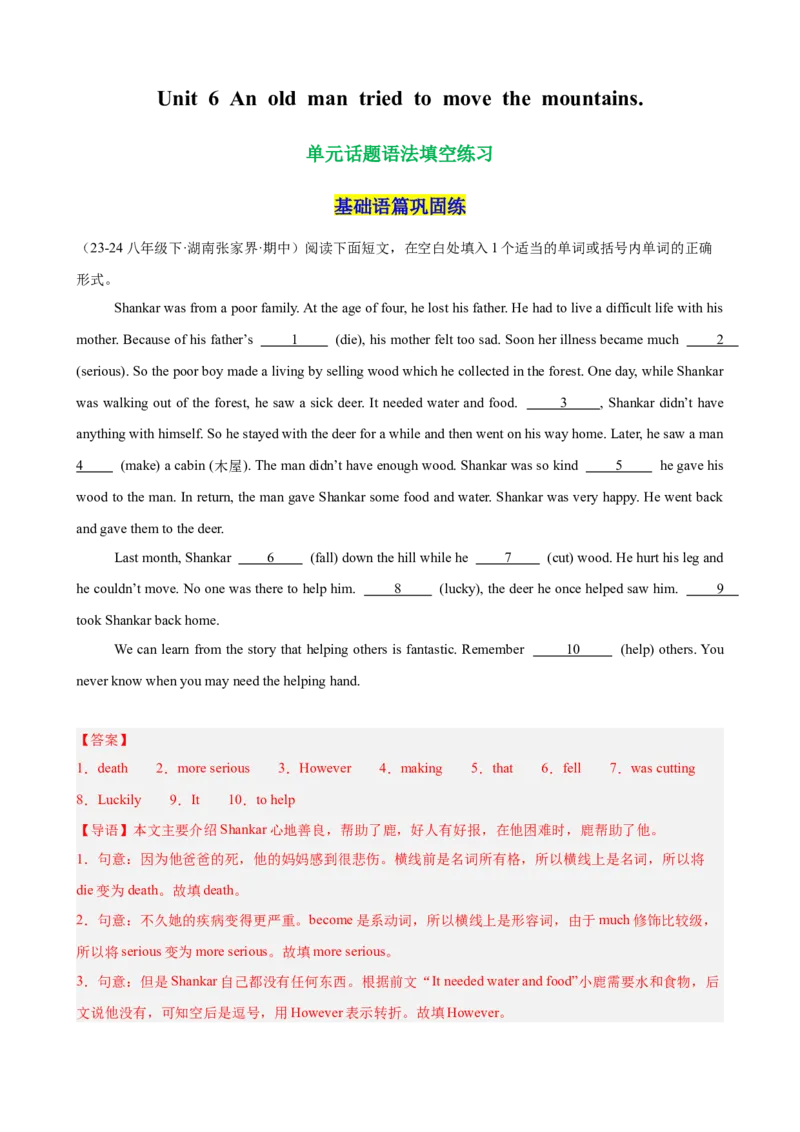
(23-24八年级下·湖南张家界·期中)阅读下面短文,在空白处填入1个适当的单词或括号内单词的正确
形式。
Shankar was from a poor family. At the age of four, he lost his father. He had to live a difficult life with his
mother. Because of his father’s 1 (die), his mother felt too sad. Soon her illness became much 2
(serious). So the poor boy made a living by selling wood which he collected in the forest. One day, while Shankar
was walking out of the forest, he saw a sick deer. It needed water and food. 3 , Shankar didn’t have
anything with himself. So he stayed with the deer for a while and then went on his way home. Later, he saw a man
4 (make) a cabin (木屋). The man didn’t have enough wood. Shankar was so kind 5 he gave his
wood to the man. In return, the man gave Shankar some food and water. Shankar was very happy. He went back
and gave them to the deer.
Last month, Shankar 6 (fall) down the hill while he 7 (cut) wood. He hurt his leg and
he couldn’t move. No one was there to help him. 8 (lucky), the deer he once helped saw him. 9
took Shankar back home.
We can learn from the story that helping others is fantastic. Remember 10 (help) others. You
never know when you may need the helping hand.
【答案】
1.death 2.more serious 3.However 4.making 5.that 6.fell 7.was cutting
8.Luckily 9.It 10.to help
【导语】本文主要介绍Shankar心地善良,帮助了鹿,好人有好报,在他困难时,鹿帮助了他。
1.句意:因为他爸爸的死,他的妈妈感到很悲伤。横线前是名词所有格,所以横线上是名词,所以将
die变为death。故填death。
2.句意:不久她的疾病变得更严重。become是系动词,所以横线上是形容词,由于much修饰比较级,
所以将serious变为more serious。故填more serious。
3.句意:但是Shankar自己都没有任何东西。根据前文“It needed water and food”小鹿需要水和食物,后
文说他没有,可知空后是逗号,用However表示转折。故填However。4.句意:后来,他看见一个男子正在造木屋。“see sb. doing”看见某人正在做某事,所以将make变为
making。故填making。
5.句意:Shankar是如此善良以至于他给男子木头。根据“Shankar was so kind...he gave his wood to the
man.”可知,考查短语“so...that”如此……以至于。故填that。
6.句意:上个月,当Shankar正在砍木头时,他从山上掉下来。根据“Last month”可知,时态为一般过
去时,动词填过去式。故填fell。
7.句意:上个月,当Shankar正在砍木头时,他从山上掉下来。根据“while”可知,横线上是进行时,由
于描述过去的时间,所以是过去进行时。由于主语是he,故填was cutting。
8.句意:幸运的是,他从前帮助过的鹿看见他。分析句子可知,横线上是副词修饰整个句子,所以将
lucky变为luckily。故填Luckily。
9.句意:它把Shankar带回家。横线上代指小鹿,所以是it。故填It。
10.句意:记得去帮助他人。考查短语“remember to do”记得去做某事,所以是to help。故填to help。
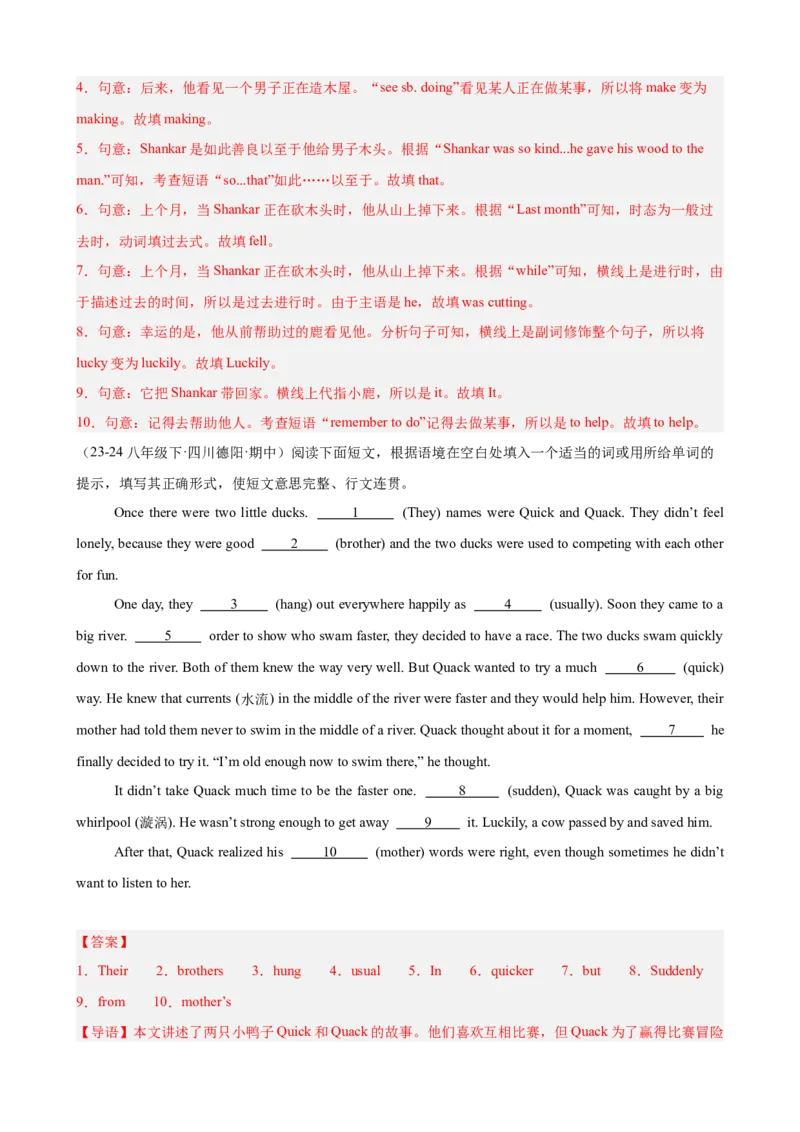
(23-24八年级下·四川德阳·期中)阅读下面短文,根据语境在空白处填入一个适当的词或用所给单词的
提示,填写其正确形式,使短文意思完整、行文连贯。
Once there were two little ducks. 1 (They) names were Quick and Quack. They didn’t feel
lonely, because they were good 2 (brother) and the two ducks were used to competing with each other
for fun.
One day, they 3 (hang) out everywhere happily as 4 (usually). Soon they came to a
big river. 5 order to show who swam faster, they decided to have a race. The two ducks swam quickly
down to the river. Both of them knew the way very well. But Quack wanted to try a much 6 (quick)
way. He knew that currents (水流) in the middle of the river were faster and they would help him. However, their
mother had told them never to swim in the middle of a river. Quack thought about it for a moment, 7 he
finally decided to try it. “I’m old enough now to swim there,” he thought.
It didn’t take Quack much time to be the faster one. 8 (sudden), Quack was caught by a big
whirlpool (漩涡). He wasn’t strong enough to get away 9 it. Luckily, a cow passed by and saved him.
After that, Quack realized his 10 (mother) words were right, even though sometimes he didn’t
want to listen to her.
【答案】
1.Their 2.brothers 3.hung 4.usual 5.In 6.quicker 7.but 8.Suddenly
9.from 10.mother’s
【导语】本文讲述了两只小鸭子Quick和Quack的故事。他们喜欢互相比赛,但Quack为了赢得比赛冒险游到河流中央,结果陷入漩涡,幸好被一头牛救起。这次经历让Quack意识到母亲的话是正确的。
1.句意:它们的名字是Quick和Quack。空处位于名词names前,填形容词性物主代词。They“他们”,
主格,形容词性物主代词为Their。位于句首,首字母大写。故填Their。
2.句意:它们并不感到孤独,因为它们是很好的兄弟。brother“兄弟”,可数名词。根据“they were
good”可知,此处用复数名词brothers,指Quick和Quack,作表语。故填brothers。
3.句意:有一天,它们像往常一样开心地到处闲逛。根据“One day”可知,此句时态为一般过去时。空
处位于主语they后,填动词过去式作谓语。根据“out everywhere happily”可知,此处指闲逛。hang“徘
徊”,动词,过去式为hung。故填hung。
4.句意:它们像往常一样开心地闲逛。as usual“像往常一样”,固定搭配,介词短语作状语。usual“惯常
的”,形容词。故填usual。
5.句意:为了展示谁游得更快,它们决定比赛。根据“they decided to have a race”可知,比赛的目的是为
了展示谁游得更快。in order to“为了”,位于句首,in的首字母大写。故填In。
6.句意:但Quack想尝试一条更快的路线。空处位于a much后,填形容词比较级作定语。quick“快速
的”,形容词,比较级为quicker。故填quicker。
7.句意:Quack考虑了一会儿,但他最终决定尝试。根据“Quack thought about it for a moment”和“he
finally decided to try it.”可知,前后表示转折关系,虽然思考了一会,但还是要尝试。空后无逗号,填连词
but“但是”,表示转折关系。故填but。
8.句意:突然,Quack被一个大漩涡困住了。空处修饰整个句子,填副词,作状语。sudden“突然的”,
形容词,副词为suddenly“突然”。位于句首,首字母大写。故填Suddenly。
9.句意:它不够强壮,无法挣脱漩涡。根据“He wasn’t strong enough to get away”可知,Quack摆脱不了
漩涡。get away from“摆脱”,固定搭配。故填from。
10.句意:在那之后,Quack意识到他母亲的话是对的,尽管有时他不想听她说话。空处位于名词words
前,填名词所有格。mother“母亲”,可数名词,此处用单数,表示Quack的母亲,所有格为mother’s。
故填mother’s。
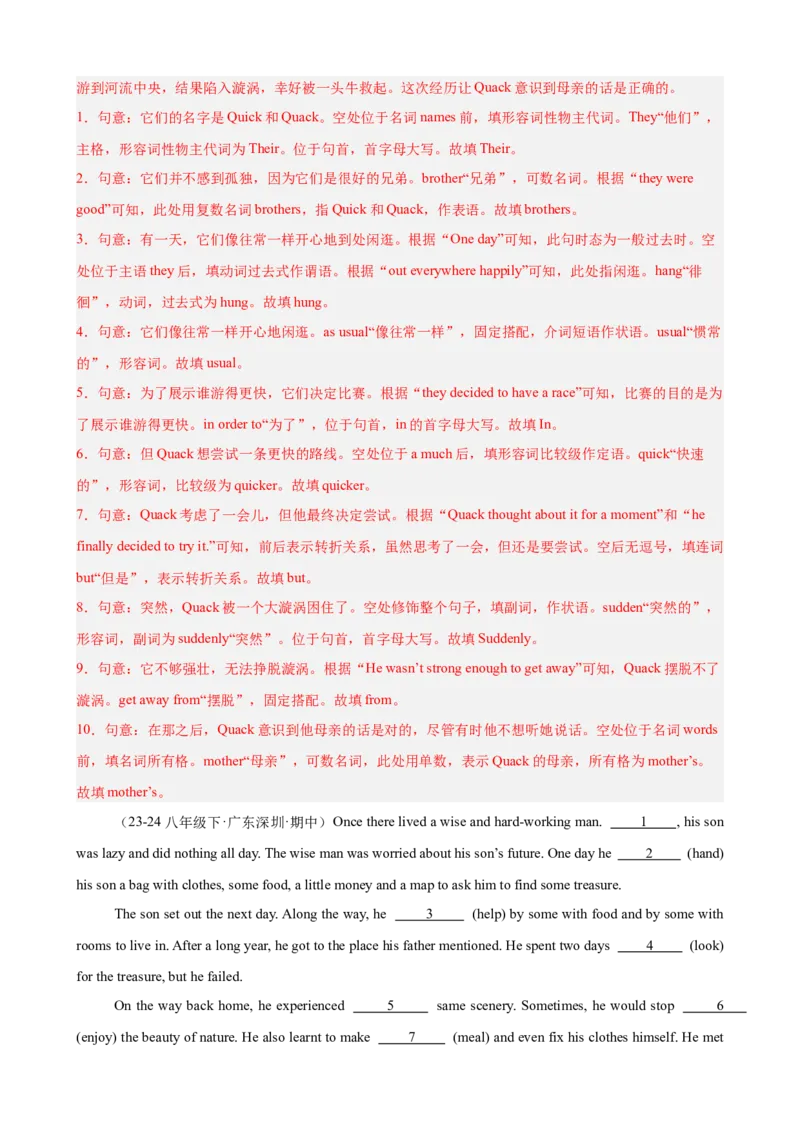
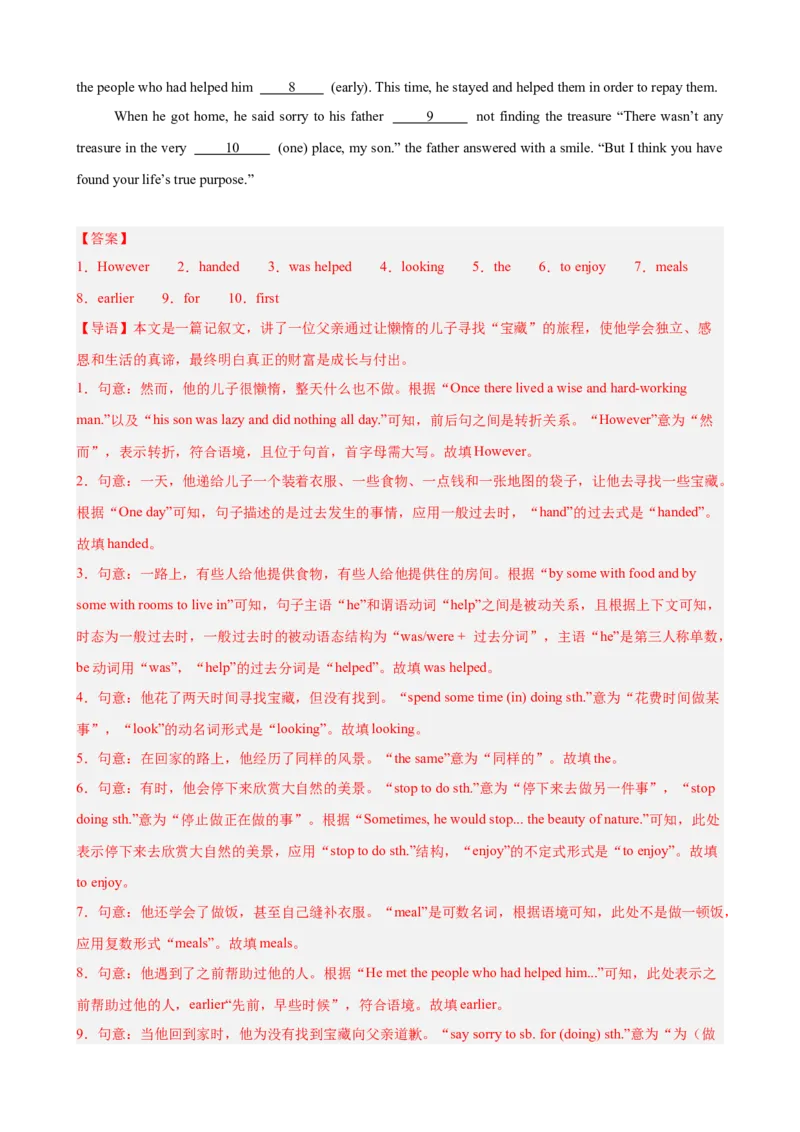
(23-24八年级下·广东深圳·期中)Once there lived a wise and hard-working man. 1 , his son
was lazy and did nothing all day. The wise man was worried about his son’s future. One day he 2 (hand)
his son a bag with clothes, some food, a little money and a map to ask him to find some treasure.
The son set out the next day. Along the way, he 3 (help) by some with food and by some with
rooms to live in. After a long year, he got to the place his father mentioned. He spent two days 4 (look)
for the treasure, but he failed.
On the way back home, he experienced 5 same scenery. Sometimes, he would stop 6
(enjoy) the beauty of nature. He also learnt to make 7 (meal) and even fix his clothes himself. He metthe people who had helped him 8 (early). This time, he stayed and helped them in order to repay them.
When he got home, he said sorry to his father 9 not finding the treasure “There wasn’t any
treasure in the very 10 (one) place, my son.” the father answered with a smile. “But I think you have
found your life’s true purpose.”
【答案】
1.However 2.handed 3.was helped 4.looking 5.the 6.to enjoy 7.meals
8.earlier 9.for 10.first
【导语】本文是一篇记叙文,讲了一位父亲通过让懒惰的儿子寻找“宝藏”的旅程,使他学会独立、感
恩和生活的真谛,最终明白真正的财富是成长与付出。
1.句意:然而,他的儿子很懒惰,整天什么也不做。根据“Once there lived a wise and hard-working
man.”以及“his son was lazy and did nothing all day.”可知,前后句之间是转折关系。“However”意为“然
而”,表示转折,符合语境,且位于句首,首字母需大写。故填However。
2.句意:一天,他递给儿子一个装着衣服、一些食物、一点钱和一张地图的袋子,让他去寻找一些宝藏。
根据“One day”可知,句子描述的是过去发生的事情,应用一般过去时,“hand”的过去式是“handed”。
故填handed。
3.句意:一路上,有些人给他提供食物,有些人给他提供住的房间。根据“by some with food and by
some with rooms to live in”可知,句子主语“he”和谓语动词“help”之间是被动关系,且根据上下文可知,
时态为一般过去时,一般过去时的被动语态结构为“was/were + 过去分词”,主语“he”是第三人称单数,
be动词用“was”,“help”的过去分词是“helped”。故填was helped。
4.句意:他花了两天时间寻找宝藏,但没有找到。“spend some time (in) doing sth.”意为“花费时间做某
事”,“look”的动名词形式是“looking”。故填looking。
5.句意:在回家的路上,他经历了同样的风景。“the same”意为“同样的”。故填the。
6.句意:有时,他会停下来欣赏大自然的美景。“stop to do sth.”意为“停下来去做另一件事”,“stop
doing sth.”意为“停止做正在做的事”。根据“Sometimes, he would stop... the beauty of nature.”可知,此处
表示停下来去欣赏大自然的美景,应用“stop to do sth.”结构,“enjoy”的不定式形式是“to enjoy”。故填
to enjoy。
7.句意:他还学会了做饭,甚至自己缝补衣服。“meal”是可数名词,根据语境可知,此处不是做一顿饭,
应用复数形式“meals”。故填meals。
8.句意:他遇到了之前帮助过他的人。根据“He met the people who had helped him...”可知,此处表示之
前帮助过他的人,earlier“先前,早些时候”,符合语境。故填earlier。
9.句意:当他回到家时,他为没有找到宝藏向父亲道歉。“say sorry to sb. for (doing) sth.”意为“为(做了)某事向某人道歉”。故填for。
10.句意:“儿子,一开始就没有什么宝藏。”父亲微笑着回答。“in the first place”意为“首先,一开
始”。故填first。
(23-24八年级下·山东临沂·期中)阅读下面短文,在空白处填入适当的单词或括号内单词的适当形式。
There once was a Prince who wished to marry a Princess, but then she must be a real Princess. He traveled
all over the world 1 (find) such a lady, but there was always something wrong. He found many
Princesses, but it was impossible for him to make a 2 (decide) whether they were real Princesses. At
last, he returned to his palace 3 (lonely).
One evening a scary rainstorm came. It rained so heavily 4 everywhere was full of water. 5
(sudden) someone knocked at the door. The old King, the Prince’s father, went out himself to open it. A girl 6
(stand) outside the door, cold and wet, when the King opened the door. She said she was a real Princess. The old
Queen-mother didn’t say a word of what she was going to do, but went into the bedroom in 7 (silent),
took all the bed-clothes off the bed, and put three little peas (豌豆) on the bed. She then laid twenty mattresses (床
垫) one upon another over the three peas, and put twenty feather quilts over the mattresses. The Princess was to
pass the night on this bed.
The next morning she was asked how she had slept. “Oh, very badly indeed!” she replied. “I have hardly
closed my eyes the whole night. 8 I do not know what was in my bed, there was something hard under
me. It hurt me so much! And now I have a 9 (head).” Now it was clear that the lady must be a real
Princess, because she had been able to feel the three little peas through the twenty mattresses and twenty feather
quilts. None but a real Princess 10 (feel) that there was something hard on the bed. Because they were
just small peas. Finally the Prince got married to the real Princess.
【答案】
1.to find 2.decision 3.alone 4.that 5.Suddenly 6.was standing 7.science
8.Although/Though 9.headache 10.could feel
【导语】本文主要讲述了一位王子想娶一位真正的公主,他找遍世界都没找到合适的;在一个暴风雨的
夜晚,来了一位自称是公主的女孩,老皇后通过在床垫下放三颗豌豆的测试,确认了她是真正的公主,
最后王子和这位真正的公主结了婚。
1.句意:他走遍世界寻找这样一位女士,但总是有些不对劲。分析句子结构可知,这里应用动词不定式
作目的状语,表示王子环游世界的目的是找到这样一位公主。故填to find。
2.句意:他发现了很多公主,但他无法决定她们是否是真正的公主。make a decision“做决定”,动词短
语,所以这里应用decide的名词形式 decision。故填decision。3.句意:最后,他独自回到了他的宫殿。根据上文“He found many Princesses, but it was impossible for
him to make a … whether they were real Princesses.”可知,他找到了很多公主,但无法确定她们是否是真正
的公主,所以此处是指他独自回到了宫殿,应用将lonely改为alone“独自,单独”,在句中作状语。故填
alone。
4.句意:雨下得如此大以至于到处都是水。so...that...“如此……以至于……”,引导结果状语从句。故填
that。
5.句意:突然有人敲门。分析句子结构可知,这里应用sudden的副词形式suddenly“突然”,在句中作
状语,修饰整个句子,位于句首,首字母要大写。故填Suddenly。
6.句意:当国王打开门时,一个女孩站在门外,又冷又湿。根据下文“when the King opened the door”可
知,此处是指当国王打开门时,女孩正在外面站着,句子时态应用过去进行时,其结构为was/were
doing;主语为“A girl”,be动词应用was,动词stand的现在分词为standing。故填was standing。
7.句意:老王后没有说她要做什么,只是默默地走进卧室,把床上所有的被褥都拿下来,在床上放了三
粒小豌豆。in silence“沉默地,无声地”,介词短语,所以这里应用silent的名词形式silence。故填
silence。
8.句意:尽管我不知道我的床上有什么,但我下面有硬东西。分析句子结构可知,前后句子为让步关系,
应用although/though引导让步状语从句,位于句首,首字母要大写。故填Although/Though。
9.句意:现在我头疼。根据上文“it hurt me so much”可知,此处是指现在 “我”头疼;考查have a
headache“头疼”,动词短语,应将head改为headache。故填headache。
10.句意:只有真正的公主才能感觉到床上有硬东西。根据语境可知,此处是指只有真正的公主能够感
觉到床上有硬东西;句子时态为一般过去时,所以这里应用 “could”表示过去的能力,后接动词原形。
故填could feel。
(23-24八年级下·吉林·期中)根据上下文,在空白处填入一个单词的正确形式,使短文完整通顺。
One day a farmer’s donkey fell into a well. Since 1 well was deep, the donkey couldn’t get out
and cried for hours. The farmer tried 2 possible to get the donkey out but didn’t make it.
3 (final), the farmer had to give up any more tries and made a 4 (decide) to cover up
the donkey with dirt. The farmer invited all his neighbors 5 (come) over and help him. All the people
started to shovel (铲) dirt into the well.
At first, the donkey realized what 6 (happen) and he started crying even 7 (loud).
After some time, to everyone’s surprise, the donkey quieted down. The farmer looked down the well and was 8
(surprise) at what he saw.
With every shovel of dirt that fell on his back, the donkey shook it off and took a step up. After a couple of
minutes, the donkey was closer 9 getting out of the well and this story came to a happy ending— thedonkey jumped off!
So, friends. 10 (what) problems we will meet in life are like dirt to the donkey. When life throws
“dirt” at you, never fail to shake it off and take a step up!
【答案】
1.the 2.everything 3.Finally 4.decision 5.to come 6.was happening 7.louder
8.surprised 9.to 10.Whatever
【导语】本文是一篇记叙文,讲述了一头驴掉进深井后,农夫和邻居们试图用土掩埋它,但驴子通过抖
落身上的土并一步步爬出井的故事,寓意生活中遇到的困难可以通过积极应对来克服。
1.句意:因为井很深,驴子无法出来,哭了好几个小时。此处特指前文提到的“well”,需用定冠词
“the”表示特指。故填the。
2.句意:农夫尝试了一切可能的方法让驴子出来,但没成功。“try everything possible”固定搭配,表示
“尝试所有可能”。故填everything。
3.句意:最终,农夫放弃了尝试,他做了一个决定,用土掩埋驴子。根据提示词及空格所在位置可知,
需用副词“Finally”作时间状语,位于句首,首字母大写,故填Finally。
4.句意:最终,农夫放弃了尝试,他做了一个决定,用土掩埋驴子。根据提示词可知,不定冠词“a”后
需接名词,“decide”的名词形式为“decision”。故填decision。
5.句意:农夫邀请他所有的邻居们来帮忙。“invite sb. to do”是固定搭配,表示“邀请某人做某事”。故
填to come。
6.句意:起初,驴子意识到正在发生什么,哭得更厉害了。根据“At first”和上下文,动作是过去某一时
刻正在进行的,用过去进行时。故填was happening。
7.句意:起初,驴子意识到正在发生什么,哭得更厉害了。由“even”可知需用比较级,“loud”的比较
级为“louder”。故填louder。
8.句意:农夫往井里看,对所见感到惊讶。“be surprised at”是固定搭配,表示“对……感到惊讶”。故
填surprised。
9.句意:几分钟后,驴子离井口更近了,这个故事有一个圆满的结局——驴子跳了出来!“closer to”是
固定搭配,表示“更接近……”。故填to。
10.句意:无论生活中遇到什么问题,都要像驴子对待泥土一样。空格引导让步状语从句,表示“无论
什么”,用“Whatever”。故填Whatever。
(23-24八年级下·福建厦门·期中)Long long ago, there was a little girl called Nuwa. She was the 1
(young) daughter of Emperor Yan.
One day, the sun shone on the calm sea. Princess Nuwa smiled at its reflection (倒影). It looked like a goldpebble (鹅卵石) in the water. Nuwa walked down to the beach. She slid her small boat into the water.
She rowed out to sea. 2 (sudden), a strong wind came. The waves were as high as mountains.
Nuwa drowned (淹死) in the sea.
After she died, she turned 3 a bird with red claws and a white beak. The bird lived on 4
mountain near the sea. And the bird made the sad cry of “Jingwei, Jingwei”, so Nuwa got her new 5 ,
Jingwei.
Jingwei hated the sea, so she wanted to 6 it up. Every day, she carried a pebble or a twig (小树
枝) from the mountain to the sea, then threw it into the sea.
The sea laughed at Jingwei, “Poor little bird, stop 7 (do) this! It’s meaningless. You’ll never fill
me up.”
“I will fill you up, even if it will take me 8 (thousand) of years.” said Jingwei.
Year 9 year, Jingwei did the same work and never stopped. Jingwei teaches a lesson. She shows
us to never give up even 10 it is hard.
【答案】
1.youngest 2.Suddenly 3.into 4.the 5.name 6.fill 7.doing 8.thousands
9.after 10.though
【导语】本文主要介绍了精卫填海的传说故事。
1.句意:她是炎帝最小的女儿。根据“She was the ”可知,此处指的“最小的女儿”,需用最高级形式,
故填youngest。
2.句意:突然,刮起了大风。修饰这个句子,需用副词形式suddenly“突然”,首字母大写。故填
Suddenly。
3.句意:她死后变成了一只红爪子白喙的鸟。“turn into”为固定搭配,表示“变成”,故填into。
4.句意:那只鸟住在海边的山上。根据“mountain near the sea.”可知,此处特指“海边的那座山”,用
定冠词the。故填the。
5.句意:这只鸟悲伤地叫着“精卫,精卫”,所以女娲有了她的新名字,精卫。根据上下文“得到新名
字”,name“名字”。故填name。
6.句意:精卫讨厌大海,所以她想把它填满。根据“Jingwei hated the sea, so she wanted to…it up.”可知,
此处用“fill up”表示“填满”,不定式to后接动词原形fill。故填fill。
7.句意:可怜的小鸟,别这样做了!“stop doing”表示“停止做某事”,动词需用动名词doing。故填
doing。
8.句意:我要把你填满,即使要花几千年的时间。“thousands of”为固定短语,表示“成千上万的”,故填thousands。
9.句意:年复一年,精卫做着同样的工作,从未停止过。“year after year”是固定表达,意为“年复一
年”,故填after。
10.句意:她告诉我们即使困难也不要放弃。“even though”引导让步状语从句,表示“即使”,填
though。故填though。
(24-25八年级下·山东滨州·开学考试)阅读下面短文,用括号内所给词的适当形式填空,必要时可加助
动词或情态动词。
Once upon a time, in a beautiful village near some green 1 (hill), there was a boy who watched
over the village’s sheep. Being alone up on the hill was very 2 (bored). The boy came up with a(n) idea.
He thought it would be fun 3 (scare) the villagers, so he shouted, “Wolf! Wolf!” The villagers got
whatever they could and 4 (run) up the hill to fight the wolf.
When they 5 (reach) the top, they realized the boy was just cheating them. The boy laughed and
laughed until the villagers 6 (angry) walked back down the hill. This excited the boy. He continued
7 (call) “wolf”. The villagers told him that they would not believe him anymore. The boy 8 (not
listen) to them and lay down for a rest. One afternoon, the boy heard a terrible sound. Before he could even
prepare 9 (him), a wolf appeared right before him, and was running after all the sheep! The boy
shouted, “Wolf! Wolf!” But nobody 10 (believe) him. The wolf killed many sheep and the other sheep
all ran away. The boy was left crying on the hill. Now he knew how stupid he was.
【答案】
1.hills 2.boring 3.to scare 4.ran 5.reached 6.angrily 7.to call 8.didn’t
listen 9.himself 10.believed
【导语】本文讲述的是《狼来了》的故事,一个男孩因为无聊,多次谎称狼来了,导致村民对他失去信
任,最终,狼真的来了,男孩后悔不已。
1.句意:从前,在一个美丽的村庄里,有一些绿色的山丘,村里有一个男孩,他负责看管村庄的羊群。
根据前面的“some”可知,some修饰可数名词复数或者不可数名词,hill是可数名词,因此这里用其复数
形式。故填hills。
2.句意:一人在山丘上非常无聊。bored通常用来形容人的感受,而此处形容“Being alone up on the hill”
这种情况非常“无聊”,因此用boring,用来形容事物或者情况本身是无聊的。故填boring。
3.句意:他觉得吓唬村民会很有趣,于是他喊道:“狼来了!狼来了!”根据“it would be fun … the
villagers”可知,此处是固定用法,be fun to do sth.“某事做起来有趣”。故填to scare。
4.句意:村民们拿起手边的东西,跑上山去打狼。and表示并列,前后形式一致,前面是过去式“got”,因此这里也用过去式。故填ran。
5.句意:当他们到达山顶时,他们意识到男孩只是在骗他们。根据“Once upon a time”可知,这篇文章
讲述的是过去的事情,因此用过去式。故填reached。
6.句意:男孩哈哈大笑,直到村民们生气地走下山丘。根据“the villagers … walked back down the hill.”
可知,此处需要副词修饰后面的动词。故填angrily。
7.句意:他继续喊“狼来了”。continue to do sth.“继续做某事”。故填to call。
8.句意:男孩不听他们的,躺下休息。此句是否定句,实义动词前需要借助助动词;此句为一般过去时,
因此助动词用didn’t。故填didn’t listen。
9.句意:还没等他准备好,一只狼就出现在他面前,追着所有的羊!prepare oneself“为自己做准备”,
表示使自己处于准备好的状态,为固定用法。故填himself。
10.句意:但是没有人相信他。根据“Once upon a time”可知,这篇文章讲述的是过去的事情,因此用过
去式。故填believed。
重难语篇拔高练
(24-25八年级上·江苏宿迁·期末)Long long ago, there was a man. He had a hen and the hen 1
(lay) two eggs every day. That man was very happy. Every day he 2 (take) the two golden eggs and sold
them in the market. With the money, he and his family lived 3 (happy).
One day, one of his 4 (friend) said to him, “Every day you take these two eggs to the market and
sell them there. There is too much trouble. Why not take out all eggs from her stomach once?”
He liked the idea, but couldn’t make a decision 5 (kill) that hen. 6 few days later, he
decided to kill the hen because he thought his friend’s advice was very good, and he was really tired of 7
(take) those eggs to the market daily.
The next day, he killed the hen and then opened the 8 (hen) stomach. But 9 his
surprise, after he opened the stomach, he couldn’t find 10 (something) in it. He looked for the eggs here
and there, left and right, up and down, but there was still nothing inside.
【答案】
1.laid 2.took 3.happily 4.friends 5.to kill 6.A 7.taking 8.hen’s
9.to 10.anything
【导语】本文主要讲述了杀鸡取卵的故事。
1.句意:他有一只母鸡,这只母鸡每天下两个蛋。根据“had”可知,是一般过去时,lay的过去式是
laid。故填laid。2.句意:每天他都把两个金蛋拿到市场上卖。根据“sold”可知,是一般过去时,take的过去式是took。
故填took。
3.句意:有了这笔钱,他和他的家人生活得很幸福。此处用happy的副词happily修饰动词lived。故填
happily。
4.句意:一天,他的一个朋友对他说:“你每天都带着这两个鸡蛋去市场卖。麻烦太多了。为什么不把
她肚子里的蛋全部取出一次呢?”friend意为“朋友”,one of+名词复数,表示“……之一”。故填
friends。
5.句意:他喜欢这个主意,但无法决定是否杀死那只母鸡。make a decision to do sth.意为“决定做某事”,
所以该空用kill的动词不定式。故填to kill。
6.句意:几天后,他决定杀了这只母鸡,因为他认为他朋友的建议很好,他真的厌倦了每天带着那些鸡
蛋去市场。A few days later是指几天后。故填A。
7.句意:几天后,他决定杀了这只母鸡,因为他认为他朋友的建议很好,他真的厌倦了每天带着那些鸡
蛋去市场。空前面的of是介词,因此空处用动名词,take的动名词为taking。故填taking。
8.句意:第二天,他杀了母鸡,然后打开了母鸡的胃。根据空后名词“stomach”可知,要填名词所有格,
表示“母鸡的”,用hen’s。故填hen’s。
9.句意:但令他惊讶的是,打开胃后,他什么也没找到。to one’s surprise令某人惊讶的是,是固定用法。
故填to。
10.句意:但令他惊讶的是,打开胃后,他什么也没找到。something意为“某物”,用于肯定句。根据
couldn’t可知,否定句中用anything,表示“任何东西”。故填anything。
(24-25八年级上·江苏常州·期末)阅读下面短文,在空白处填入1个适当的单词或括号内单词的正确形
式。
Have you heard that a fish can bring people luck? Let’s read a story 1 a girl and a fish.
In a small and pretty village by a river, there lived a girl 2 (call) Jenny. One day, she saved a
3 (shine) fish. The fish said, “You saved me. I will give you three wishes” Jenny was excited but thought
carefully about her wishes and what was 4 (real) important.
For her first wish, she asked for a big meal to feed everyone in the village. The fish made her wish come
true. The villagers were very happy and 5 (celebrate) together.
For her 6 (two) wish, Jenny wished for a special spring (泉) 7 (help) the sick people
in her village. Then the fish made it happen, and soon the spring water healed (治愈) people’s 8 (ill).
As she thought about her last wish, Jenny found that she didn’t need anything more. Instead of 9
(wish) for herself, she wished for the fish to be free and go back to the river. The fish left happily.
Jenny’s story taught the villagers that the real riches are not in money or things, 10 in helpingand caring for one another and sharing what you have. From then on, all the villagers lived a happy life and
passed this lesson on to their children.
【答案】
1.about 2.called 3.shiny/shining 4.really 5.celebrated 6.second 7.to help
8.illness(es) 9.wishing 10.but
【导语】本文通过讲述女孩和鱼的故事,告诉我们真正的财富不是金钱或物质,而是互相帮助和关心,
并且分享你所拥有的。
1.句意:让我们读一个关于一个女孩和一条鱼的故事。根据“Let’s read a story”可知,此处是说一个关于
女孩和鱼的故事。about“关于”,介词,故填about。
2.句意:在河边的一个美丽的小村庄里,住着一个名叫珍妮的女孩。根据“there lived a girl”可知,此处
是说这个女孩叫珍妮。此处用过去分词called作定语,修饰名词“girl”,意为“叫做……的”,故填
called。
3.句意:一天,她救了一条闪闪发光的鱼。根据“a...fish”可知,此处用形容词shiny/shining修饰名词
“fish”,意为“闪闪发光的”,故填shiny/shining。
4.句意:珍妮很兴奋,但她仔细考虑了她的愿望和真正重要的是什么。此处应用副词really修饰形容词
“important”,意为“真正地”,really important“真正重要的”,故填really。
5.句意:村民们都很高兴,一起庆祝。根据“The villagers were very happy”可知,此处用一般过去时,
故填celebrated。
6.句意:对于她的第二个愿望,珍妮希望有一个特别的泉水来帮助她村里的病人。“wish”表示单数,应
用序数词second修饰名词“wish”,意为“第二”,故填second。
7.句意:对于她的第二个愿望,珍妮希望有一个特别的泉水来帮助她村里的病人。根据“Jenny wished
for a special spring”可知,此处用动词不定式作目的状语,故填to help。
8.句意:然后,鱼让它发生了,不久,泉水治好了人们的病。根据“people’s”可知,此处应用名词
illness,意为“疾病”,此处可用单数或复数,故填illness(es)。
9.句意:她没有为自己许愿,而是希望鱼儿能自由自在地回到河里去。句中“Instead of”为介词短语,
此处用动名词作宾语,故填wishing。
10.句意:珍妮的故事告诉村民们,真正的财富不是金钱或物质,而是互相帮助和关心,分享你所拥有
的。“the real riches are not in money or things,”和“in helping and caring for one another and sharing what you
have”构成转折关系,应用but,意为“但是”,故填but。