2025-2026学年八年级英语下册单元模块满分必刷题(新教材人教版)
Unit 6 Crossing Cultures【刷题型】(语法填空精准练)
话题:人与社会-文化习俗
基础篇
01
(25-26八年级上·河北秦皇岛·期末)A small talk is a good way to kill time and make friends. If you travel
to other 1 (country), do you know what to say to start an excellent small talk with local (当地的) people?
In the UK the best topic is the weather. British weather changes quite often. You can start to talk by saying
“Wow, it is 2 (rain) heavily now. Maybe it will be sunny a few hours later.” Besides 3 weather, you can talk
about gardens. For example, you could say, “Those flowers look really beautiful, don’t they?” English people love
their pets. 4 it’s nice to begin with “What a lovely dog! What’s 5 (it) name?”
In America, people like to talk about sports, such as American football and basketball. You can also begin
talking 6 (easy) with clothes. “It’s a nice shirt. Where did you get it?” “I 7 (buy) it in a store near my
home.”
Of course, you shouldn’t talk about some topics. Don’t 8 (ask) people “How old are you?” Age is usually a
secret for women. Never ask “How much money do you make?” It 9 (make) people unhappy. Don’t ask strangers 陌( 生
人) whether (是否) they have a girlfriend 10 a boyfriend.
02
(22-23八年级下·广东深圳·期中)阅读下面短文,在空格处填入一个适当的词或使用括号中所给词语的正
确形式填空,并将答案填写在答题卡规定的位置上。
The Lunar New Year is called the Year of the Rabbit in China and the Year of the Cat in Vietnam (越南).
Ancient storytellers said the Jade Emperor 1 (organize) a race across a river for all the animals in the world. The
Jade Emperor decided 2 (choose) the first 12 animals that reached the other side to appear in the zodiac (生肖).
In the Chinese story, the cat and the rat were riding across a river on an ox 3 one side to the other side
when the rat pushed the cat into the water. In the story, 4 (turn) the two animals into enemies is the result of this
race. That is why cats have been hunting rats ever since. In the Chinese story, the rabbit crossed the river by jumping
on 5 top of stones in the river. When the rabbit got there, no others were around, it 6 (simple) thought the
race was too easy. The rabbit was 7 (bore) with the race so it went off to the side and slept. By the time the rabbitwoke up, three animals had already arrived. 8 , in the Vietnamese story — which did not have a rabbit — the cat
could swim and ended up arriving fourth. The top twelve finishers are rat, ox, tiger (or rabbit), dragon, snake, goat,
monkey, dog, and pig.
One explanation for changing rabbit with cat might have to do with people’s 9 (impress) on the two
animals. In Chinese, the rabbit 10 (describe) as a lucky animal which is loved by people. The Vietnamese think
the cat is a lucky animal.
03
(23-24八年级下·黑龙江绥化·期中)根据短文内容用所给词的适当形式填空。
In Colombia, people are pretty 1 (relax) about time. People often don’t mind 2 (be) a little late. They
like to enjoy their time 3 (slow) and don’t like to rush around. They 4 (value) the time they spend with their
family and friends in their everyday lives. They don’t have to make 5 (plan) to meet their friends. When they
see each other, it’s polite for boys 6 (shake) hands and for girls to kiss each other on the side of the face.
Things are different in Switzerland. It’s very important to be on time there. In Switzerland, if someone 7
(invite) you to meet him or her at noon, then you’re 8 (expect) to be there at noon. If you’re even 15 minutes
late, your friend may get mad. So the Swiss (瑞士人) always make an 9 (effort) to be on time when they meet
somebody. They think it’s to impolite to keep others 10 (wait). Also, they never visit a friend’s house without
calling first. They almost always make plans to see friends.
培优篇
04
(24-25八年级下·辽宁沈阳·期末)阅读短文,在空白处填入一个适当的单词或用括号内所给词的正确形式
填空,使短文通顺、连贯。
Chopsticks are useful tools for having meals in China. According to records, the 1 (early) chopsticks
appeared before Shang Dynasty in ancient China. They 2 (use) to pick up food at that time. Over time, people
have improved them a lot.
Most people believe that Chinese invented chopsticks. There are many 3 (story) about the inventor of
chopsticks. Someone says that Jiang Ziya, a wise man, created chopsticks. 4 (actual), no one knows for sure. We
can only say the inventor was a clever ancient Chinese.
Chopsticks are usually 5 the shape of being square above and circle below. Chinese believe that 6
Earth is square and the sky is circle. This 7 (show) respect to the nature. Many people think it’s difficult to use
chopsticks. In fact, it’s not. Hold them between the thumb (拇指) 8 other fingers. The key is to hold one piecetight and move the other to control movement and force.
Chopsticks are also an 9 (importance) part of Chinese culture. In China, it is nice to pick up food for the
old by using chopsticks. But it’s not good to point at others with them. And never make 10 (you) chopsticks
stand straight in a rice bowl.
05
(24-25八年级下·江苏无锡·期末)阅读短文,用括号内单词的正确形式填空。
In China, there are many rules for eating. These rules are an important part of Chinese culture. Whether at a
restaurant or someone’s home, knowing these rules 1 (help) you fit in. People around you will feel more
comfortable, too.
Chinese table manners come from old traditions. You must follow these rules. If not, you may make people
2 (happy). In fact, many Chinese families 3 (teach) their children these manners since they were very little.
Here are some easy rules to remember.
Food is served in big dishes. Most of the time, shared chopsticks 4 (provide) on the table. Use them 5
(take) food to your plate. If there are no shared chopsticks, 6 (watch) others and do the same. Sometimes, a host
puts food in your bowl. This is normal.
Eat the food people give you. If you can’t eat something, finish the rest. 7 (leave) a little food shows you
are full.
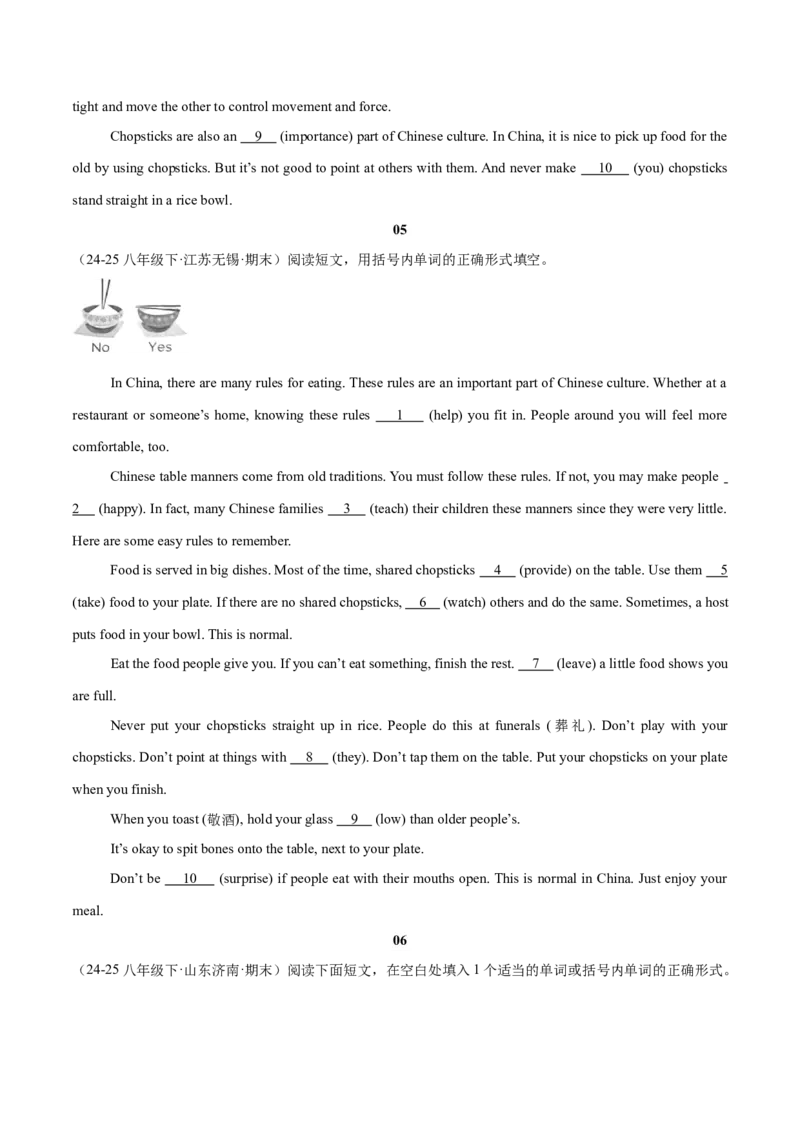
Never put your chopsticks straight up in rice. People do this at funerals (葬礼). Don’t play with your
chopsticks. Don’t point at things with 8 (they). Don’t tap them on the table. Put your chopsticks on your plate
when you finish.
When you toast (敬酒), hold your glass 9 (low) than older people’s.
It’s okay to spit bones onto the table, next to your plate.
Don’t be 10 (surprise) if people eat with their mouths open. This is normal in China. Just enjoy your
meal.
06
(24-25八年级下·山东济南·期末)阅读下面短文,在空白处填入1个适当的单词或括号内单词的正确形式。The traditional Chinese lunar calendar divides the year into 24 solar terms (节气). The solar term culture 1
(be) useful in guiding people’s lives until now. People eat special foods, do cultural activities and even have 2
(health) living tips with each solar term at present. Here are different ways to know Summer Solstice (夏至).
Summer Solstice, the 3 (ten) solar term of the year, falls on June 21 this year. On the Summer Solstice,
daylight lasts the 4 (long) for the whole year in the northern hemisphere. According to the experts, it lasts nearly
17 hours. Daylight hours get shorter and shorter 5 this day. And temperatures become higher and higher in the
northern part of China.
There is a 6 (say) in Shandong province, “Eat dumplings on the Winter Solstice and noodles on Summer
Solstice.” So on this day, people in different areas of Shandong province eat chilled noodles (冷面). Other people
around China, including 7 (that) in Beijing, also have a tradition of eating noodles. This tradition is still in our
life today, with some activities full of 8 (exciting).
Summer Solstice 9 (mark) the first day of summer. You can take some time 10 (enjoy) the warmth
and joy in the coming summer.
07
(24-25八年级下·江苏常州·期末)阅读下面短文,在空白处填入一个适当的单词或括号内单词的正确形式。
Now more and more people would like to visit Xizang. What manners should you learn about if you visit a
Tibetan (西藏的) family? When you’re entering the house, don’t walk on the doorsill (门槛) 1 Tibetans see it as
unlucky. In some 2 (situation), you need to sit cross—legged. Make sure your soles (鞋底) won’t face the family
members. What’s more, be sure to avoid 3 (touch) their heads. It’s not polite.
If you call a family member by name, add “la” at the end. This will make him or her 4 (feel) closer to
you. Tibetan people are warm and friendly. For them, sticking out the tongue (伸出舌头) is a way 5 (show)
respect for others. If they put their palms (手掌) together, it means they are sending their best wishes to you. Don’t
be 6 (surprise) at these actions.
Hada, the white scarf, stands 7 good luck in Xizang. Offering it is the 8 (high) form of etiquette
(礼节) among Tibetan people. When you receive one, you should accept it 9 (polite) by bending your body and
using both hands. Wish all of you 10 good time in Tibetan family!
08
(23-24八年级下·广东深圳·期中)阅读下面短文,在空白处填入一个适当的单词或括号内单词的正确形式。How should you behave when you meet someone 1 the first time. An American shakes your hand 2
(firm) while looking at you straight in the eye. In many parts of Asia, there is no physical contact at all. In Japan, you
should bow, and the 3 (much) respect you want to show, the deeper you should bow. In Thailand, people greet
each other by 4 (press) both hands together at the chest. In both countries, eye contact is avoided as a sign of
respect.
In Spain, lunch is often 5 biggest meal of the day, and can last two or three hours. For this reason, many
people eat a light breakfast and a late dinner. In Mexico, lunch is a time 6 (relax), and many people prefer not to
discuss business as they cat, in Britain, it’s not unusual to have a business meeting over breakfast.
In most countries, an exchange of business cards 7 (be) necessary for all introductions You should include
your company name and your position. If you are going to a country 8 your language is not widely spoken, you
can get the back side of your card 9 (print) in the local language. In a word, when 10 (travel) abroad, we
should follow local habits." Aleta said.
09
(22-23八年级下·全国·期中)阅读下面短文,在空白处填入1个适当的单词或括号内单词的正确形式。
“You are what you eat.” Nutrition experts often use this saying to promote better eating habits. What we put
in our 1 (mouth)does become part of us. But we can look at this statement 2 another way. What we eat
shows who we are as people and as a culture. Do you want 3 (understand)another culture? Then you should
find out about its food. Learning about American food can give 4 (we)a real taste of American culture.
Except for Thanksgiving turkey, it’s 5 (hard) to find a typically(典型的) “American” food. The United
States is a land of immigrants(移民). So Americans eat food from many different 6 (country). American
culture is a good show of the 7 (say) “You are what you eat.” Americans stand for a wide area of backgrounds
and ways of 8 (think). The different kinds of foods enjoyed in the U.S. 9 (shows)the many kinds of
personal tastes. The food may be international or in small places. Sometimes it’s fast, and sometimes it’s not so fast.
It might be junk food, or maybe it’s 10 (nature)food. However, the style is all-American.
10
(24-25八年级下·浙江金华·期中)阅读下面短文,在空白处填入一个适当的词或填入括号中所给单词的正
确形式。
In China, table culture is part of each meal, whether it is in a restaurant or in someone’s home. Learning 1
(act) properly at table will make people around us more comfortable. Then 2 should we pay attention to when
dining?The first one is the order of seats. Usually, round tables are the first 3 (choose) for Chinese dining. The
seat facing the door is the best one, usually for the main guest. As for the other seats, the 4 (close) they are to
the main guest, the better they are.
Second, if we are the host, we should arrive earlier at the door and introduce them to their seats. If we are
invited to the meal, we should listen to the host and take 5 seat.
Third, we shouldn’t ask the waiters the 6 (dish) prices or bargain (讨价还价) with them when we order,
which shows we are not generous. And that makes guests 7 (feel) uncomfortable.
The last point to note is about eating manners. It is 8 (polite) to urge (力劝) guests to take the dish, but
it’s acceptable to introduce the special dish. Whether they eat or not 9 (depend) on themselves. It’s also unwise
to take a dish for guests, 10 we are not sure whether they like it.