2025-2026学年八年级英语下册单元模块满分必刷题(新教材人教版)
Unit 6 Crossing Cultures【刷题型】(语法填空精准练)
话题:人与社会-文化习俗
基础篇
01
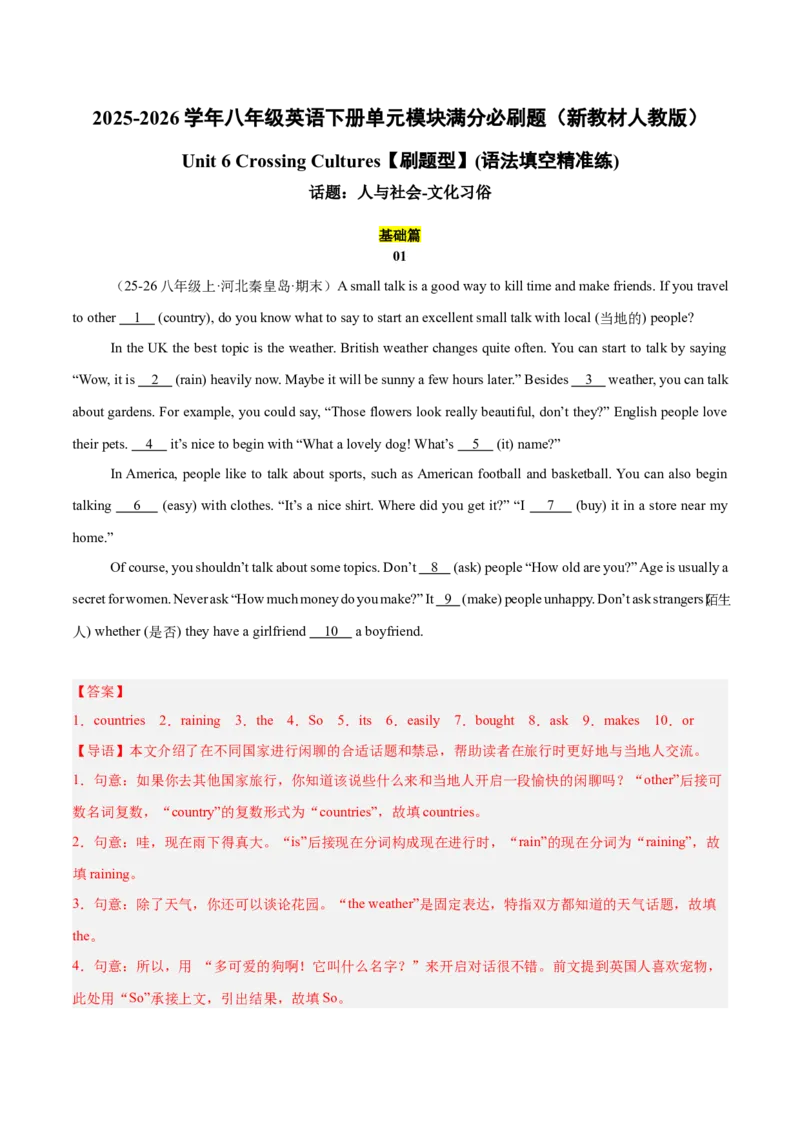
(25-26八年级上·河北秦皇岛·期末)A small talk is a good way to kill time and make friends. If you travel
to other 1 (country), do you know what to say to start an excellent small talk with local (当地的) people?
In the UK the best topic is the weather. British weather changes quite often. You can start to talk by saying
“Wow, it is 2 (rain) heavily now. Maybe it will be sunny a few hours later.” Besides 3 weather, you can talk
about gardens. For example, you could say, “Those flowers look really beautiful, don’t they?” English people love
their pets. 4 it’s nice to begin with “What a lovely dog! What’s 5 (it) name?”
In America, people like to talk about sports, such as American football and basketball. You can also begin
talking 6 (easy) with clothes. “It’s a nice shirt. Where did you get it?” “I 7 (buy) it in a store near my
home.”
Of course, you shouldn’t talk about some topics. Don’t 8 (ask) people “How old are you?” Age is usually a
secret for women. Never ask “How much money do you make?” It 9 (make) people unhappy. Don’t ask strangers 陌( 生
人) whether (是否) they have a girlfriend 10 a boyfriend.
【答案】
1.countries 2.raining 3.the 4.So 5.its 6.easily 7.bought 8.ask 9.makes 10.or
【导语】本文介绍了在不同国家进行闲聊的合适话题和禁忌,帮助读者在旅行时更好地与当地人交流。
1.句意:如果你去其他国家旅行,你知道该说些什么来和当地人开启一段愉快的闲聊吗?“other”后接可
数名词复数,“country”的复数形式为“countries”,故填countries。
2.句意:哇,现在雨下得真大。“is”后接现在分词构成现在进行时,“rain”的现在分词为“raining”,故
填raining。
3.句意:除了天气,你还可以谈论花园。“the weather”是固定表达,特指双方都知道的天气话题,故填
the。
4.句意:所以,用 “多可爱的狗啊!它叫什么名字?”来开启对话很不错。前文提到英国人喜欢宠物,
此处用“So”承接上文,引出结果,故填So。5.句意:它叫什么名字?此处需要形容词性物主代词修饰名词“name”,“it”的形容词性物主代词为
“its”,故填its。
6.句意:你也可以轻松地从衣服聊起。此处需要副词修饰动词“begin”,“easy”的副词形式为“easily”,
故填easily。
7.句意:我在我家附近的一家商店买的它。问句用一般过去时,答句也用一般过去时,“buy”的过去式
为“bought”,故填bought。
8.句意:不要问别人 “你多大了?”“Don’t”后接动词原形,故填ask。
9.句意:这会让人们不开心。句子为一般现在时,主语“It”是第三人称单数,谓语动词“make”用第三人
称单数形式“makes”,故填makes。
10.句意:不要问陌生人他们是否有女朋友或男朋友。在否定句中表示“和”用“or”,故填or。
02
(22-23八年级下·广东深圳·期中)阅读下面短文,在空格处填入一个适当的词或使用括号中所给词语的正
确形式填空,并将答案填写在答题卡规定的位置上。
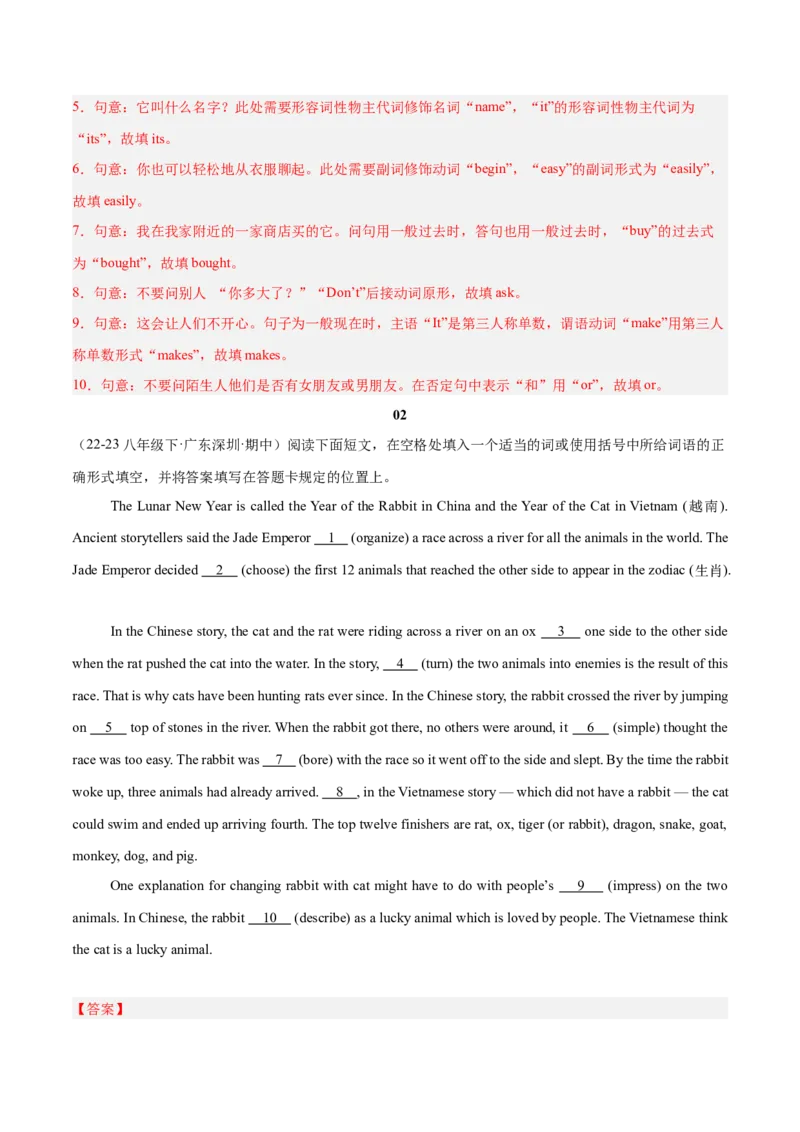
The Lunar New Year is called the Year of the Rabbit in China and the Year of the Cat in Vietnam (越南).
Ancient storytellers said the Jade Emperor 1 (organize) a race across a river for all the animals in the world. The
Jade Emperor decided 2 (choose) the first 12 animals that reached the other side to appear in the zodiac (生肖).
In the Chinese story, the cat and the rat were riding across a river on an ox 3 one side to the other side
when the rat pushed the cat into the water. In the story, 4 (turn) the two animals into enemies is the result of this
race. That is why cats have been hunting rats ever since. In the Chinese story, the rabbit crossed the river by jumping
on 5 top of stones in the river. When the rabbit got there, no others were around, it 6 (simple) thought the
race was too easy. The rabbit was 7 (bore) with the race so it went off to the side and slept. By the time the rabbit
woke up, three animals had already arrived. 8 , in the Vietnamese story — which did not have a rabbit — the cat
could swim and ended up arriving fourth. The top twelve finishers are rat, ox, tiger (or rabbit), dragon, snake, goat,
monkey, dog, and pig.
One explanation for changing rabbit with cat might have to do with people’s 9 (impress) on the two
animals. In Chinese, the rabbit 10 (describe) as a lucky animal which is loved by people. The Vietnamese think
the cat is a lucky animal.
【答案】1.organized 2.to choose 3.from 4.turning 5.the 6.simply 7.bored 8.However 9.
impressions 10.is described
【导语】本文介绍了新的一年在中国被称为兔年,在越南被称为猫年,文中讲到了原因。
1.句意:古代讲故事的人说玉皇大帝组织了一场世界上所有动物的过河比赛。句子时态为一般过去时,
此处应用动词的过去式形式。故填organized。
2.句意:玉皇大帝决定选择最先到达另一边的十二只动物出现在十二生肖中。decide to do sth.“决定做某
事”,固定词组。故填to choose。
3. 句意:在这个中国故事中,猫和老鼠骑在牛上从一边到另一边过河,这时老鼠把猫推进了水里。
from…to…“从……到……”,固定词组。故填from。
4.句意:在这个故事中,把这两只动物变成敌人是这个比赛的结果。分析句子结构可知,此处应用所给
词的动名词形式作主语。故填turning。
5.,句意:在中国的故事中,兔子跳到河里的石头顶上渡河。on the top of“在……的顶部”,固定词组。故
填the。
6.句意:当兔子到达那里时,周围没有其他动物,它只是觉得比赛太容易了。分析句子结构可知,此处
应用所给词的副词形式,修饰动词,作状语。故填simply。
7.句意:兔子对比赛感到厌烦,所以它跑到一边睡着了。be bored with…“厌倦……”,固定词组。故填
bored。
8.句意:然而,在越南故事中——没有兔子——这只猫会游泳,最终排名第四。根据空前后句的句意可
知,此处句意发生了转折,且空后有逗号,所以应用however。故填However。
9.句意:把兔子换成猫的一种解释可能与人们对这两种动物的印象有关。根据空前的“people’s”可知,此
处应用所给词的名词形式,impression“印象”,可数名词,此处应用复数形式表示概数概念。故填
impressions。
10.句意:在中国,兔子被描述为一种幸运的动物,深受人们的喜爱。根据句子主语“the rabbit”与谓语为
逻辑上的动宾关系可知,此处应用被动语态,句子时态为一般现在时,此处应用动词的三单形式。故填is
described。
03
(23-24八年级下·黑龙江绥化·期中)根据短文内容用所给词的适当形式填空。
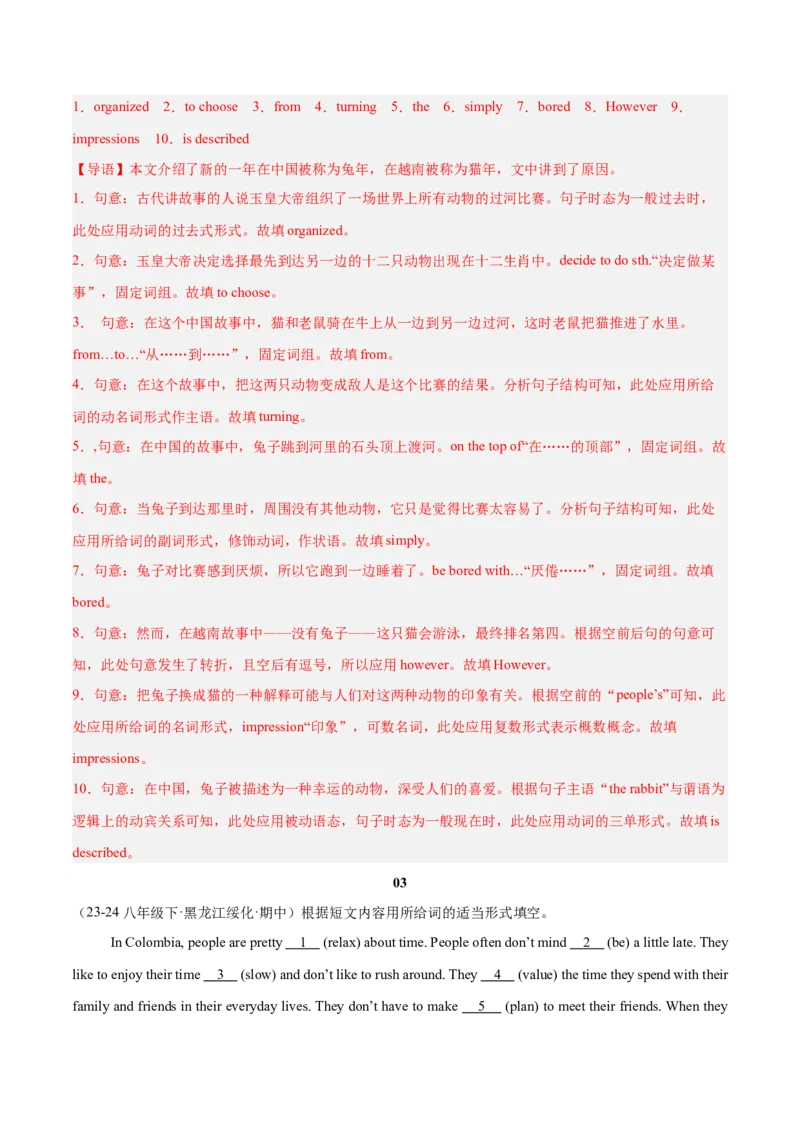
In Colombia, people are pretty 1 (relax) about time. People often don’t mind 2 (be) a little late. They
like to enjoy their time 3 (slow) and don’t like to rush around. They 4 (value) the time they spend with their
family and friends in their everyday lives. They don’t have to make 5 (plan) to meet their friends. When theysee each other, it’s polite for boys 6 (shake) hands and for girls to kiss each other on the side of the face.
Things are different in Switzerland. It’s very important to be on time there. In Switzerland, if someone 7
(invite) you to meet him or her at noon, then you’re 8 (expect) to be there at noon. If you’re even 15 minutes
late, your friend may get mad. So the Swiss (瑞士人) always make an 9 (effort) to be on time when they meet
somebody. They think it’s to impolite to keep others 10 (wait). Also, they never visit a friend’s house without
calling first. They almost always make plans to see friends.
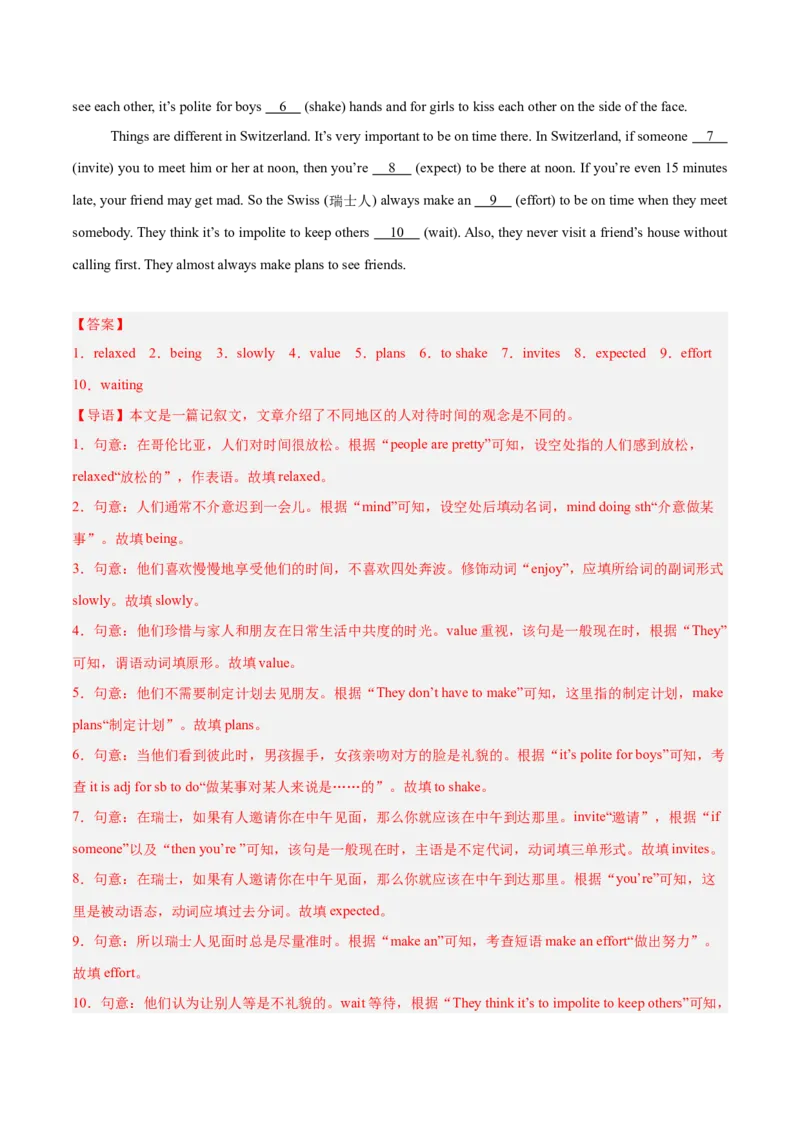
【答案】
1.relaxed 2.being 3.slowly 4.value 5.plans 6.to shake 7.invites 8.expected 9.effort
10.waiting
【导语】本文是一篇记叙文,文章介绍了不同地区的人对待时间的观念是不同的。
1.句意:在哥伦比亚,人们对时间很放松。根据“people are pretty”可知,设空处指的人们感到放松,
relaxed“放松的”,作表语。故填relaxed。
2.句意:人们通常不介意迟到一会儿。根据“mind”可知,设空处后填动名词,mind doing sth“介意做某
事”。故填being。
3.句意:他们喜欢慢慢地享受他们的时间,不喜欢四处奔波。修饰动词“enjoy”,应填所给词的副词形式
slowly。故填slowly。
4.句意:他们珍惜与家人和朋友在日常生活中共度的时光。value重视,该句是一般现在时,根据“They”
可知,谓语动词填原形。故填value。
5.句意:他们不需要制定计划去见朋友。根据“They don’t have to make”可知,这里指的制定计划,make
plans“制定计划”。故填plans。
6.句意:当他们看到彼此时,男孩握手,女孩亲吻对方的脸是礼貌的。根据“it’s polite for boys”可知,考
查it is adj for sb to do“做某事对某人来说是……的”。故填to shake。
7.句意:在瑞士,如果有人邀请你在中午见面,那么你就应该在中午到达那里。invite“邀请”,根据“if
someone”以及“then you’re ”可知,该句是一般现在时,主语是不定代词,动词填三单形式。故填invites。
8.句意:在瑞士,如果有人邀请你在中午见面,那么你就应该在中午到达那里。根据“you’re”可知,这
里是被动语态,动词应填过去分词。故填expected。
9.句意:所以瑞士人见面时总是尽量准时。根据“make an”可知,考查短语make an effort“做出努力”。
故填effort。
10.句意:他们认为让别人等是不礼貌的。wait等待,根据“They think it’s to impolite to keep others”可知,考查keep sb doing“使得某人做某事”。故填waiting。
培优篇
04
(24-25八年级下·辽宁沈阳·期末)阅读短文,在空白处填入一个适当的单词或用括号内所给词的正确形式
填空,使短文通顺、连贯。
Chopsticks are useful tools for having meals in China. According to records, the 1 (early) chopsticks
appeared before Shang Dynasty in ancient China. They 2 (use) to pick up food at that time. Over time, people
have improved them a lot.
Most people believe that Chinese invented chopsticks. There are many 3 (story) about the inventor of
chopsticks. Someone says that Jiang Ziya, a wise man, created chopsticks. 4 (actual), no one knows for sure. We
can only say the inventor was a clever ancient Chinese.
Chopsticks are usually 5 the shape of being square above and circle below. Chinese believe that 6
Earth is square and the sky is circle. This 7 (show) respect to the nature. Many people think it’s difficult to use
chopsticks. In fact, it’s not. Hold them between the thumb (拇指) 8 other fingers. The key is to hold one piece
tight and move the other to control movement and force.
Chopsticks are also an 9 (importance) part of Chinese culture. In China, it is nice to pick up food for the
old by using chopsticks. But it’s not good to point at others with them. And never make 10 (you) chopsticks
stand straight in a rice bowl.
【答案】
1.earliest 2.were used 3.stories 4.Actually 5.in 6.the 7.shows 8.and 9.important
10.your
【导语】本文介绍筷子的起源、形状、使用方法及其在中国文化中的意义。
1.句意:据记载,最早的筷子出现在中国古代的商朝之前。根据空格前定冠词“the”和空格后名词
“chopsticks”可知,括号内形容词“early”需用最高级形式。最高级形式“earliest”作定语修饰名词,符合语
境。故填earliest。
2.句意:它们那时被用来夹食物。根据句中“to pick up food”和“at that time”可知,此处表示过去的被动
语态。主语“They”(指筷子)是复数,用过去式被动语态“were used”。故填were used。
3.句意:关于筷子的发明者有许多故事。空格前有many表示“许多”,需用可数名词的复数形式;story
的复数形式是stories,符合语法规则。故填stories。4.句意:事实上,没有人能确定。空格处位于句首,修饰整个句子,应使用副词形式;actual为形容词,
其副词形式是actually,首字母需大写。故填Actually。
5.句意:筷子通常是上方方形、下方圆形的形状。根据句中“the shape of...”可知,此处为固定搭配“in
the shape of...”,表示“呈……的形状”。故填in。
6.句意:中国人认为地是方的,天是圆的。根据句中“Earth”可知,表示特指的地球,前面应加定冠词
the;同时该句为表达传统观念中“天圆地方”的思想结构,因此the Earth符合用法。故填the。
7.句意:这表现了对自然的尊重。主语“This”为第三人称单数,句子陈述的是一个客观现实,谓语动词
需用一般现在时第三人称单数形式。show的第三人称单数为shows。故填shows。
8.句意:把它们夹在拇指和其他手指之间。根据句中“between the thumb ... other fingers”可知,between后
面常用and连接两个对象,此处应填and。故填and。
9.句意:筷子也是中国文化中重要的一部分。空格后接名词“part”,形容词用来修饰名词,故需用形容
词形式。importance是名词,其形容词形式是important。故填important。
10.句意:永远不要让你的筷子直立在饭碗里。空格后接名词“chopsticks”,需用形容词性物主代词修饰,
表示“你的筷子”,you的形容词性物主代词为your。故填your。
05
(24-25八年级下·江苏无锡·期末)阅读短文,用括号内单词的正确形式填空。
In China, there are many rules for eating. These rules are an important part of Chinese culture. Whether at a
restaurant or someone’s home, knowing these rules 1 (help) you fit in. People around you will feel more
comfortable, too.
Chinese table manners come from old traditions. You must follow these rules. If not, you may make people
2 (happy). In fact, many Chinese families 3 (teach) their children these manners since they were very little.
Here are some easy rules to remember.
Food is served in big dishes. Most of the time, shared chopsticks 4 (provide) on the table. Use them 5
(take) food to your plate. If there are no shared chopsticks, 6 (watch) others and do the same. Sometimes, a host
puts food in your bowl. This is normal.
Eat the food people give you. If you can’t eat something, finish the rest. 7 (leave) a little food shows you
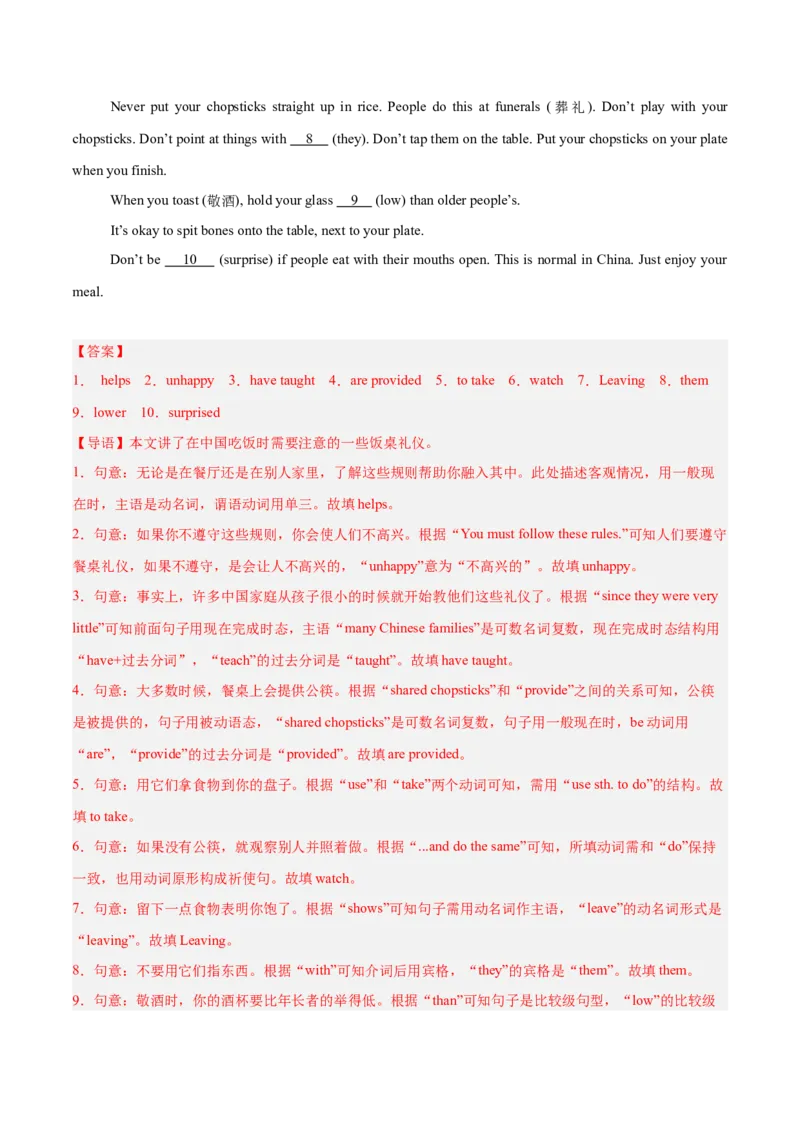
are full.Never put your chopsticks straight up in rice. People do this at funerals (葬礼). Don’t play with your
chopsticks. Don’t point at things with 8 (they). Don’t tap them on the table. Put your chopsticks on your plate
when you finish.
When you toast (敬酒), hold your glass 9 (low) than older people’s.
It’s okay to spit bones onto the table, next to your plate.
Don’t be 10 (surprise) if people eat with their mouths open. This is normal in China. Just enjoy your
meal.
【答案】
1. helps 2.unhappy 3.have taught 4.are provided 5.to take 6.watch 7.Leaving 8.them
9.lower 10.surprised
【导语】本文讲了在中国吃饭时需要注意的一些饭桌礼仪。
1.句意:无论是在餐厅还是在别人家里,了解这些规则帮助你融入其中。此处描述客观情况,用一般现
在时,主语是动名词,谓语动词用单三。故填helps。
2.句意:如果你不遵守这些规则,你会使人们不高兴。根据“You must follow these rules.”可知人们要遵守
餐桌礼仪,如果不遵守,是会让人不高兴的,“unhappy”意为“不高兴的”。故填unhappy。
3.句意:事实上,许多中国家庭从孩子很小的时候就开始教他们这些礼仪了。根据“since they were very
little”可知前面句子用现在完成时态,主语“many Chinese families”是可数名词复数,现在完成时态结构用
“have+过去分词”,“teach”的过去分词是“taught”。故填have taught。
4.句意:大多数时候,餐桌上会提供公筷。根据“shared chopsticks”和“provide”之间的关系可知,公筷
是被提供的,句子用被动语态,“shared chopsticks”是可数名词复数,句子用一般现在时,be动词用
“are”,“provide”的过去分词是“provided”。故填are provided。
5.句意:用它们拿食物到你的盘子。根据“use”和“take”两个动词可知,需用“use sth. to do”的结构。故
填to take。
6.句意:如果没有公筷,就观察别人并照着做。根据“...and do the same”可知,所填动词需和“do”保持
一致,也用动词原形构成祈使句。故填watch。
7.句意:留下一点食物表明你饱了。根据“shows”可知句子需用动名词作主语,“leave”的动名词形式是
“leaving”。故填Leaving。
8.句意:不要用它们指东西。根据“with”可知介词后用宾格,“they”的宾格是“them”。故填them。
9.句意:敬酒时,你的酒杯要比年长者的举得低。根据“than”可知句子是比较级句型,“low”的比较级是“lower”。故填lower。
10.句意:如果人们张着嘴吃饭,不要感到惊讶。根据“be”可知后面要填一个形容词,“surprise”的形容
词形式“surprised”意为“惊讶的”,可以表达人的感受。故填surprised。
06
(24-25八年级下·山东济南·期末)阅读下面短文,在空白处填入1个适当的单词或括号内单词的正确形式。
The traditional Chinese lunar calendar divides the year into 24 solar terms (节气). The solar term culture 1
(be) useful in guiding people’s lives until now. People eat special foods, do cultural activities and even have 2
(health) living tips with each solar term at present. Here are different ways to know Summer Solstice (夏至).
Summer Solstice, the 3 (ten) solar term of the year, falls on June 21 this year. On the Summer Solstice,
daylight lasts the 4 (long) for the whole year in the northern hemisphere. According to the experts, it lasts nearly
17 hours. Daylight hours get shorter and shorter 5 this day. And temperatures become higher and higher in the
northern part of China.
There is a 6 (say) in Shandong province, “Eat dumplings on the Winter Solstice and noodles on Summer
Solstice.” So on this day, people in different areas of Shandong province eat chilled noodles (冷面). Other people
around China, including 7 (that) in Beijing, also have a tradition of eating noodles. This tradition is still in our
life today, with some activities full of 8 (exciting).
Summer Solstice 9 (mark) the first day of summer. You can take some time 10 (enjoy) the warmth
and joy in the coming summer.
【答案】
1.has been 2.healthy 3.tenth 4.longest 5.after 6.saying 7.those 8.excitement 9.marks
10.to enjoy
【导语】本文主要介绍了中国传统二十四节气中的夏至,包括其时间、特点以及相关的饮食文化和习俗。
1.句意:节气文化至今仍然对人们的生活有指导作用。根据“until now”可知,此处表示从过去持续到现
在的状态,需用现在完成时。主语“culture”是第三人称单数,故填has been。
2.句意:如今,人们在每个节气会吃特殊食物、进行文化活动,甚至遵循健康的生活建议。根据“living
tips”可知,其是名词短语,故空格处需用形容词修饰,即healthy“健康的”,故填healthy。
3.句意:夏至是一年中的第十个节气,今年在6月21日。根据“Summer Solstice, the...solar term of the
year”可知,此处表示顺序,需用序数词tenth“第十”,故填tenth。4.句意:夏至这天,北半球的白昼时间是一年中最长的。根据“the”和“for the whole year”可知,夏至这
天,北半球的白昼时间应是一年中最长的,故此处需用最高级longest“最长的”,故填longest。
5.句意:这天之后,白天的时间变得越来越短。结合常识,夏至是白天最长的一天,之后白天逐渐变短,
此处表示“在……之后”after,故填after。
6.句意:山东省有句俗语:“冬至吃饺子,夏至吃面条。”根据“a”可知,其后接可数名词单数,say是
动词,其名词形式为saying“谚语”,故填saying。
7.句意:中国其他地区的人们,包括北京的那些(人们),也有吃面条的传统。此处指代前文的复数名
词“people”,应用that的复数形式those“那些”,故填those。
8.句意:这一传统至今仍在延续,伴随一些充满乐趣的活动。根据“with some activities full of”可知,空
格处需接名词,exciting的名词形式为excitement,故填excitement。
9.句意:夏至标志着夏季的第一天。结合语境可知,句子时态为一般现在时,主语“Summer Solstice”是
第三人称单数,故谓语动词需用三单形式marks,故填marks。
10.句意:你可以花些时间去享受即将到来的夏天的温暖和快乐。take time to do“花时间做某事”,故填to
enjoy。
07
(24-25八年级下·江苏常州·期末)阅读下面短文,在空白处填入一个适当的单词或括号内单词的正确形式。
Now more and more people would like to visit Xizang. What manners should you learn about if you visit a
Tibetan (西藏的) family? When you’re entering the house, don’t walk on the doorsill (门槛) 1 Tibetans see it as
unlucky. In some 2 (situation), you need to sit cross—legged. Make sure your soles (鞋底) won’t face the family
members. What’s more, be sure to avoid 3 (touch) their heads. It’s not polite.
If you call a family member by name, add “la” at the end. This will make him or her 4 (feel) closer to
you. Tibetan people are warm and friendly. For them, sticking out the tongue (伸出舌头) is a way 5 (show)
respect for others. If they put their palms (手掌) together, it means they are sending their best wishes to you. Don’t
be 6 (surprise) at these actions.
Hada, the white scarf, stands 7 good luck in Xizang. Offering it is the 8 (high) form of etiquette
(礼节) among Tibetan people. When you receive one, you should accept it 9 (polite) by bending your body and
using both hands. Wish all of you 10 good time in Tibetan family!
【答案】1.because 2.situations 3.touching 4.feel 5.to show 6.surprised 7.for 8.highest 9.
politely 10.a
【导语】本文主要讲述了去拜访一个西藏家庭时应该注意些什么。
1.句意:当你进入房子时,不要走在门槛上,因为藏族人认为这是不吉利的。根据“don’t walk on the
doorsill (门槛)”与“Tibetans see it as unlucky”可知,空处前后应为因果关系,前果后因,因此应用
because“因为”。故填because。
2.句意:在某些情况下,你需要盘腿而坐。situation“情况”,可数名词,some后应用名词复数形式
situations。故填situations。
3.句意:更重要的是,一定要避免触摸他们的头。touch“触摸”,动词,avoid doing sth“避免做某事”,
因此此处应用动名词作宾语。故填touching。故填touching。
4.句意:这会让他或她觉得和你更亲近。根据“make him or her … closer to you”结合提示词可知,feel“感
觉”,动词,make sb. do sth.“使某人做某事”,因此此处应用动词原形。故填feel。
5.句意:对他们来说,伸出舌头是对别人表示尊重的一种方式。根据“a way … respect”可知,a way to do
sth.“做某事的一种方式”,因此应用不定式。故填to show。
6.句意:不要对这些行为感到惊讶。根据“be”结合提示词可知,此处应表示不要惊讶,因此应用
surprised“惊讶的”,形容词作表语。故填surprised。
7.句意:哈达,白色的围巾,在西藏代表好运。根据“Hada, the white scarf, stands … good luck in Xizang.”
结合常识可知,哈达在西藏代表好运,stand for“代表”。故填for。
8.句意:献上它是藏族人民最高形式的礼仪。根据“the”结合提示词可知,high“高的”,形容词,此处应
指献哈达是最高礼仪,因此应用形容词的最高级highest。故填highest。
9.句意:当你收到礼物时,你应该弯曲身体,用双手礼貌地接受。根据“you should accept it”结合提示词
可知,此处应用politely“礼貌地”,副词修饰动词accept。故填politely。
10.句意:祝大家在西藏大家庭过得愉快!a good time“玩得开心,过得愉快”,固定表达。故填a。
08
(23-24八年级下·广东深圳·期中)阅读下面短文,在空白处填入一个适当的单词或括号内单词的正确形式。
How should you behave when you meet someone 1 the first time. An American shakes your hand 2
(firm) while looking at you straight in the eye. In many parts of Asia, there is no physical contact at all. In Japan, you
should bow, and the 3 (much) respect you want to show, the deeper you should bow. In Thailand, people greet
each other by 4 (press) both hands together at the chest. In both countries, eye contact is avoided as a sign ofrespect.
In Spain, lunch is often 5 biggest meal of the day, and can last two or three hours. For this reason, many
people eat a light breakfast and a late dinner. In Mexico, lunch is a time 6 (relax), and many people prefer not to
discuss business as they cat, in Britain, it’s not unusual to have a business meeting over breakfast.
In most countries, an exchange of business cards 7 (be) necessary for all introductions You should include
your company name and your position. If you are going to a country 8 your language is not widely spoken, you
can get the back side of your card 9 (print) in the local language. In a word, when 10 (travel) abroad, we
should follow local habits." Aleta said.
【答案】
1.for 2.firmly 3.more 4.pressing 5.the 6.to relax 7.is 8.where 9.printed 10.
traveling/travelling
【导语】本文主要讲述了不同国家和地区的文化习俗差异,包括初次见面时的礼仪、用餐习惯以及商务场
合的注意事项等。
1.句意:当你第一次见到某人时应该如何表现。第一次见面用“for the first time”。故填for。
2.句意:美国人会坚定地握着你的手,同时直视你的眼睛。此处修饰动词shakes,需用副词形式。故填
firmly。
3.句意:在日本,你应该鞠躬,你想表现的尊重越多,鞠躬就应该越深。根据句型“the+比较级…the+比
较级…”可知,此处是比较级。故填more。
4.句意:在泰国,人们通过双手合十放在胸前互相问候。介词by后接动名词形式。故填pressing。
5.句意:在西班牙,午餐通常是一天中最大的一餐,可以持续两三个小时。形容词最高级前需加定冠词
the。故填the。
6.句意:在墨西哥,午餐是放松的时间,许多人喜欢吃饭时不谈生意。此处用不定式作定语修饰time。
故填to relax。
7.句意:在大多数国家,交换名片是所有介绍中必要的。主语an exchange是单数,且陈述客观事实用一
般现在时,be动词用is。故填is。
8.句意:如果你要去一个你的语言不被广泛使用的国家,你可以让你的卡片背面印上当地的语言。此处
引导定语从句修饰country,从句成分完整,空处在从句中作地点状语,应填where。故填where。
9.句意:如果你要去一个你的语言不被广泛使用的国家,你可以让你的卡片背面印上当地的语言。此处
是get sth done结构,过去分词作宾语补足语。故填printed。10.句意:总之,在国外旅行时,我们应该遵循当地的习惯。when引导时间状语从句,主语we与travel
是主动关系,用现在分词。故填traveling/travelling。
09
(22-23八年级下·全国·期中)阅读下面短文,在空白处填入1个适当的单词或括号内单词的正确形式。
“You are what you eat.” Nutrition experts often use this saying to promote better eating habits. What we put
in our 1 (mouth)does become part of us. But we can look at this statement 2 another way. What we eat
shows who we are as people and as a culture. Do you want 3 (understand)another culture? Then you should
find out about its food. Learning about American food can give 4 (we)a real taste of American culture.
Except for Thanksgiving turkey, it’s 5 (hard) to find a typically(典型的) “American” food. The United
States is a land of immigrants(移民). So Americans eat food from many different 6 (country). American
culture is a good show of the 7 (say) “You are what you eat.” Americans stand for a wide area of backgrounds
and ways of 8 (think). The different kinds of foods enjoyed in the U.S. 9 (shows)the many kinds of
personal tastes. The food may be international or in small places. Sometimes it’s fast, and sometimes it’s not so fast.
It might be junk food, or maybe it’s 10 (nature)food. However, the style is all-American.
【答案】
1.mouths 2.in 3.to understand 4.us 5.hard 6.countries 7.saying 8.thinking 9.show
10.natural
【导语】本文讲述了食物可以反映一个人的特点和一种文化的特征。美国作为一个庞大的移民国家,食物
种类也来自不同文化,这反映了它“文化大熔炉”的特点。
1.句意:入嘴的东西确实成为我们的一部分。因为空前有our所以后面名词应该用复数形式。故填
mouths。
2.句意:但是我们能用另一种方式来看到这种叙述。in another way“用另一种方式”,为固定短语。故填
in 。
3.句意:你想要理解别国的文化吗?want to do sth“想要做某事”,为固定短语。故填to understand。
4.句意:学习美国的食物能够给我们一个真实的美国文化的品味,因为空前有动词give,所以此处应该用
宾格形式,故填us。
5.句意:除了感恩节火鸡之外,很难找出典型的美国食物。hard“困难的”,形容词。it is adj. to do sth“做
某事是……的”,是固定句型。故填hard。
6.句意:因此美国人吃来自不同国家的食物。country“国家”,可数名词,different后面用名词复数形式。故填countries。
7.句意:美国文化很好地诠释了“你吃什么就变成什么样子”这句话。因为空前面有定冠词the,所以此
处用say的名词形式saying“谚语”,故填saying。
8.句意:美国人代表了广泛的背景领域和思考方式。think“思考”,动词,空前有介词,动词应用动名词,
故填thinking。
9.句意:在美国享受的不同种类的食物显示了不同的个人口味。本空缺谓语动词,又因为主语是复数形
式,所以谓语动词应用原形。故填show。
10.句意:它可能是垃圾食品,也可能是天然食品。因为空后面是名词food,所以本空应该用形容词形式
natural“自然的”,故填natural。
10
(24-25八年级下·浙江金华·期中)阅读下面短文,在空白处填入一个适当的词或填入括号中所给单词的正
确形式。
In China, table culture is part of each meal, whether it is in a restaurant or in someone’s home. Learning 1
(act) properly at table will make people around us more comfortable. Then 2 should we pay attention to when
dining?
The first one is the order of seats. Usually, round tables are the first 3 (choose) for Chinese dining. The
seat facing the door is the best one, usually for the main guest. As for the other seats, the 4 (close) they are to
the main guest, the better they are.
Second, if we are the host, we should arrive earlier at the door and introduce them to their seats. If we are
invited to the meal, we should listen to the host and take 5 seat.
Third, we shouldn’t ask the waiters the 6 (dish) prices or bargain (讨价还价) with them when we order,
which shows we are not generous. And that makes guests 7 (feel) uncomfortable.
The last point to note is about eating manners. It is 8 (polite) to urge (力劝) guests to take the dish, but
it’s acceptable to introduce the special dish. Whether they eat or not 9 (depend) on themselves. It’s also unwise
to take a dish for guests, 10 we are not sure whether they like it.
【答案】
1.to act 2.what 3.choice 4.closer 5.a 6.dishes’ 7.feel 8.impolite 9.depends 10.
because
【导语】本文主要介绍了中国的餐桌礼仪。1.句意:学会在餐桌上举止得体会让我们周围的人感觉更舒服。learn to do sth“学习做某事”,空处填不
定式作宾语。故填to act。
2.句意:那么我们在用餐时应该注意什么呢?根据“should we pay attention to”可知,此处是指注意的内
容,用what“什么”提问。故填what。
3.句意:通常,圆桌是中国人用餐的首选。根据“the first”可知,空处填名词形式,choose的名词
choice。故填choice。
4.句意:至于其他座位,离主宾越近越好。此处为“the+比较级,the+比较级”结构,表示“越……,就
越……”,此空应填close的比较级closer。故填closer。
5.句意:如果我们被邀请用餐,应该听从主人的安排并就座。此处泛指一个座位,且seat是辅音音素开
头的单词,用a修饰。故填a。
6.句意:第三,我们点餐时不应该问服务员菜的价格或与他们讨价还价,这表明我们不慷慨。dish“菜
肴”,此空应填名词复数表泛指;同时此空修饰名词prices,应填名词所有格形式。故填dishes’。
7.句意:这会让客人感到不舒服。make sb do sth“让某人做某事”。故填feel。
8.句意:力劝客人吃菜是不礼貌的,但介绍特色菜是可以接受的。根据“to urge (力劝) guests to take the
dish”及常识可知,力劝客人吃菜是不礼貌的,impolite“不礼貌的”,形容词作表语。故填impolite。
9.句意:他们吃不吃取决于他们自己。本文时态是一般现在时,主语“Whether they eat or not”是单数概念,
谓语动词用第三人称单数“depends”。故填depends。
10.句意:给客人夹菜也是不明智的,因为我们不确定他们是否喜欢。空后句是前句的原因,用
because“因为”,引导原因状语从句。故填because。