Unit 8 Have you read Treasure Island yet?
单元小结
知识目录
学习目标:本单元围绕“文学和音乐”话题展开叙述,让学生掌握动词的完成时态的用法,以此为谈论
最近发生的事件和经历奠定基础。也学习掌握谈论文学和音乐的基本语言材料。
语法目标:现在完成时态
听说目标:能在日常交际情景中听懂接近正常语速的听懂谈论读书经历或某一个喜欢的歌手
或作家的经历。
写作目标:写一篇最喜欢的歌手或作家的文章。
目录
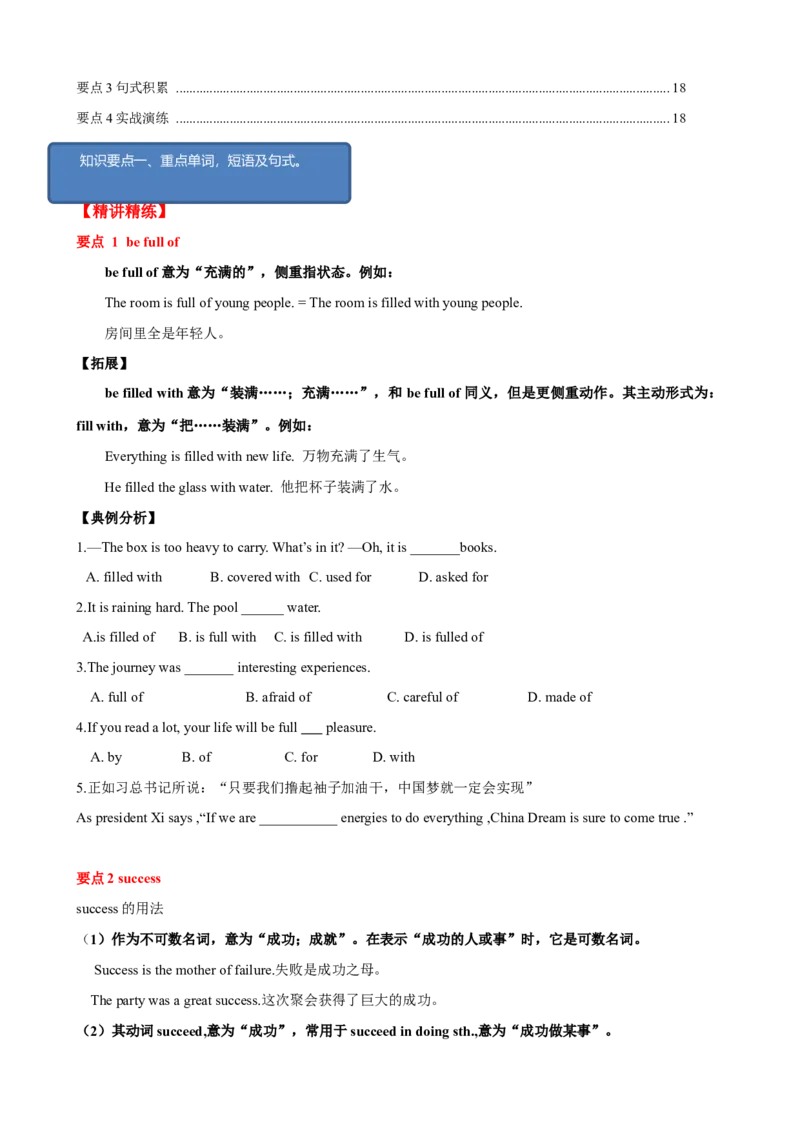
知识要点一、重点单词,短语及句式
要点1 be full of的用法................................................................................................................................练习
要点2 success的用法........................................................................................................................................练习
要点3 Hurry的用法........................................................................................................................................练习
要点4 mark的用法............................................................................................................................................练习
要点5 else用法..................................................................................................................................................练习
要点6 lose用法..................................................................................................................................................练习
要点7 belong to的用法.....................................................................................................................................练习
要点8 introduce的用法.....................................................................................................................................练习
要点9 yet, already的用法................................................................................................................................练习
要点10 see sb. do/ see sb. doing的用法............................................................................................................练习
要点11 rest的用法............................................................................................................................................练习
要点12 the number of/ a number of的用法......................................................................................................练习
要点13 used to的用法.......................................................................................................................................练习
要点14 put 构成的短语.....................................................................................................................................练习
要点19 重点短语...............................................................................................................................................练习
要点20重点句式...............................................................................................................................................练习
知识要点二、语法
要点1 现在完成时态 ...........................................................................................................................................14
知识要点三、书面表达
要点1 话题分析.....................................................................................................................................................16
要点2 词汇短语积累 ...........................................................................................................................................17要点3句式积累 ...................................................................................................................................................18
要点4实战演练 ...................................................................................................................................................18
知识要点一、重点单词,短语及句式。
【精讲精练】
要点 1 be full of
be full of 意为“充满的”,侧重指状态。例如:
The room is full of young people. = The room is filled with young people.
房间里全是年轻人。
【拓展】
be filled with意为“装满……;充满……”,和 be full of 同义,但是更侧重动作。其主动形式为:
fill with,意为“把……装满”。例如:
Everything is filled with new life. 万物充满了生气。
He filled the glass with water. 他把杯子装满了水。
【典例分析】
1.—The box is too heavy to carry. What’s in it? —Oh, it is _______books.
A. filled with B. covered with C. used for D. asked for
2.It is raining hard. The pool ______ water.
A.is filled of B. is full with C. is filled with D. is fulled of
3.The journey was _______ interesting experiences.
A. full of B. afraid of C. careful of D. made of
4.If you read a lot, your life will be full pleasure.
A. by B. of C. for D. with
5.正如习总书记所说:“只要我们撸起袖子加油干,中国梦就一定会实现”
As president Xi says ,“If we are ___________ energies to do everything ,China Dream is sure to come true .”
要点2 success
success的用法
(1)作为不可数名词,意为“成功;成就”。在表示“成功的人或事”时,它是可数名词。
Success is the mother of failure.失败是成功之母。
The party was a great success.这次聚会获得了巨大的成功。
(2)其动词succeed,意为“成功”,常用于succeed in doing sth.,意为“成功做某事”。The young man succeeded in passing the driving test.
年青人成功地通过了驾照考试。
(3)其形容词successful,意为“成功的”,其反义词为unsuccessful,意为“不成功的”。它们的副词分
别为successfully, unsuccessfully。
The old man is a very successful writer. 老人是一个非常成功的作家。
【典例分析】
1. success, succeed, successful , successfully填空。
1)He is a _______ business man.
2)At last Mike _______ passing the exam.
3)Failure is the mother of _______.
4)You can finish this task _______ by hard working.
5)At last he __________ in solving the problem.
6)His new book was a great ____________.
2.他终于把那个问题解决了。
At last he _________ _________solving the problem.
3. David has became a ______ writer. He wrote a book ___________.
A.successful successful B.success successful
C.succeed successful D.successful successfully
4.The ______ man ______ in finishing the work on time.
A. successfully; successful B. succeeded; successful
C. success; successful D. successful; succeeded
5. Please remember, “Failure is the mother of ________.” And I’m sure you will be ________ in teaching.
A. success; succeeded B. succeed; successful
C. success; a success D. a success; a success
6.Frederick ____ entered the final competition last month. His hobby has brought him ____.
A. successful; success B. successful; successfully
C. successfully; success D. successfully; successful
要点3
Hurry v.匆忙;赶快
1) hurry做动词的时候,意为 “匆忙,赶紧”,hurry to do sth意为"急急忙忙做某事"hurry up,意为"赶紧"
hurry off动词短语.意为"匆忙离去"。
Doctors and nurses hurried to save that injured boy .大夫和护士匆忙地去救那个重伤的男 孩。
Don't hurry ! We're not late .别着急,我们没有迟到。
John's father hurried off to see his friend in the hospital.约翰的爸爸匆忙离去了去看他在医 院的朋友。
2) hurry还可用作名词。
in a hurry意为"匆忙地,急促地",可做副词短语使用
do (sth.) in a hurry迅速的做某事,赶紧的做某事。
I have to do my homework in a hurry.我不得不赶紧做我的作业。
It's 8 a.m. now. I must get up in a hurry and go to school right away.现在 8 点了。我必须 赶紧起床并且立即
去上学。
主语+be+ in a hurry.意为"主语(的状态)是匆忙的"。
Sorry, I don't have time to talk to you. I am in a hurry now.对不起.我现在没有时间和你说 话。我现在很匆忙。
John is always in a hurry.约翰总是很匆忙。
You will make a lot of mistakes if you do things in a hurry .如果你做事情匆匆忙忙的话会 犯很多错误的。
【典例分析】
1.—If we don’t ________, we may miss the beginning of the concert.
—Well. let’s take a taxi to get there. It can save us much time.
A.hurry up B.grow up C.stay up D.use up
2.—Jenny, be quick! Or we’ll be late.
—Don’t ________ me. I’m coming as fast as I can.
A.force B.expect C.include D.hurry
要点4 mark
Mark n.迹象;记号;分数;v.做记号;打分
1) mark作可数名词,意为"痕迹;记号"。他用刀在桌子上刻下标记。
He made marks on the table with that knife.
2) mark用作可数名词,还可意为"分数”。
She got 80 marks in English.她的英语得了 80 分。
3) mark用作及物动词,意为"做记号;打分"。
He marked the important sentences with a red pen.他用红笔标出了重要的句子。
【典例分析】
1.— The terrible accident has left its ________ on Bonnie.— Until now, it is still nightmare for her.
A.role B.joke C.prize D.mark
2.—Excuse me, sir. You can’t walk your dog on the lawn.
— Sorry, I didn’t see the ________ “Keep off the grass”.
A.mark B.sign C.symbol D.risk
3.—I don’t know where the restaurant is. Please help me ________ it on the map.
—All right.
A.mark B.record C.hold D.report
4.Beth is always very happy when she gets good ________ in the exam.
A.messages B.lessons C.marks D.projects
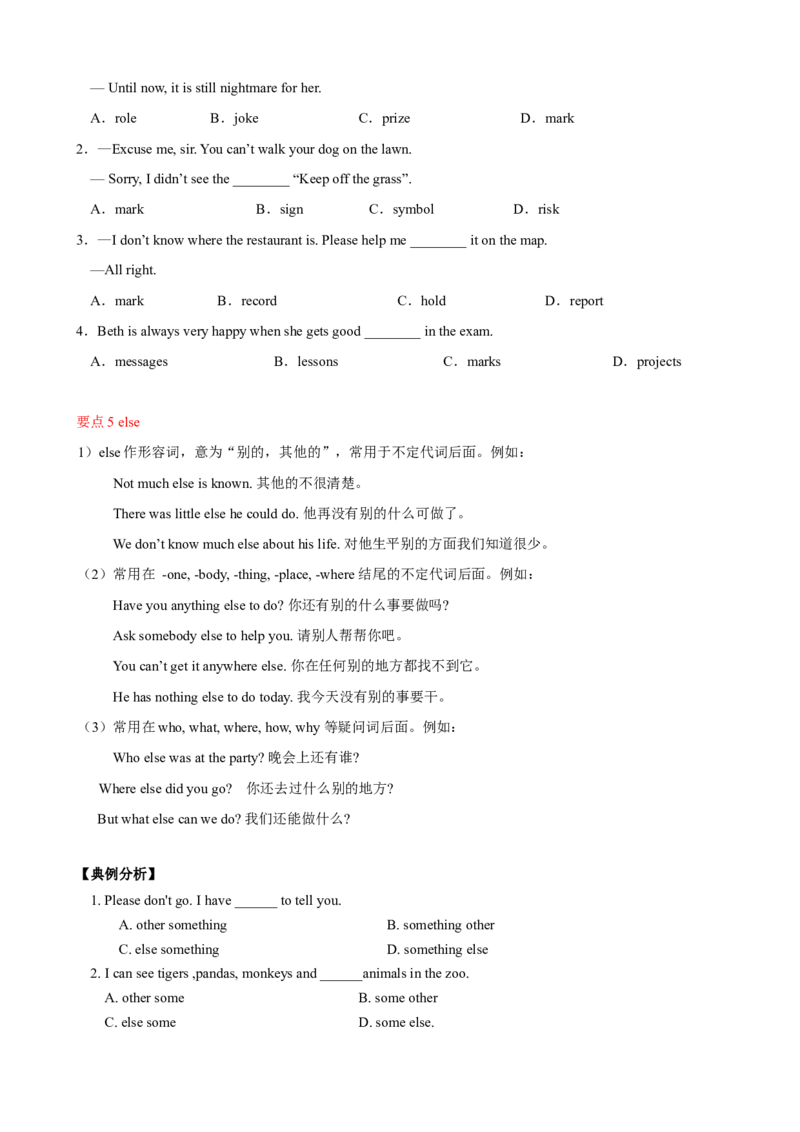
要点5 else
1)else作形容词,意为“别的,其他的”,常用于不定代词后面。例如:
Not much else is known. 其他的不很清楚。
There was little else he could do. 他再没有别的什么可做了。
We don’t know much else about his life. 对他生平别的方面我们知道很少。
(2)常用在 -one, -body, -thing, -place, -where 结尾的不定代词后面。例如:
Have you anything else to do? 你还有别的什么事要做吗?
Ask somebody else to help you. 请别人帮帮你吧。
You can’t get it anywhere else. 你在任何别的地方都找不到它。
He has nothing else to do today. 我今天没有别的事要干。
(3)常用在who, what, where, how, why 等疑问词后面。例如:
Who else was at the party? 晚会上还有谁?
Where else did you go? 你还去过什么别的地方?
But what else can we do? 我们还能做什么?
【典例分析】
1. Please don't go. I have ______ to tell you.
A. other something B. something other
C. else something D. something else
2. I can see tigers ,pandas, monkeys and ______animals in the zoo.
A. other some B. some other
C. else some D. some else.3.Will you please tell him to stop playing computer games? Your words carry more weight than ______.
A.anybody’s B. anybody's else C. anybody else’s D.anybody elses’
要点6 lose
(1)lose作及物动词,意为“丢失;失败;走失;(使)失踪”。例如:I lost my wallet yesterday.
我昨天丢了钱包。
It’s only the second time the team has lost a match this season.那仅仅是本赛季该队的第二次失利而已。
(2)lose作不及物动词,意为“失败;经受损失”。例如:
The enemy lost heavily in the battle.
敌人在战争中损失惨重。
We have got so many debts; we have nothing more to lose.
我们已经背负了这么多债务,实在损失不起了。
They lost themselves in the strange city.
他们在陌生的城市里迷了路。
Two ships were lost in the storm.
两艘船在这场暴风雨中遇难。
用法延伸
lose的过去式及过去分词一样,为lost。loser为其名词形式,意为“失败者”。
【典例分析】
1.I'm the _________ in this game. 我是这场比赛中的输家。
2.They are looking for their_________ child. 他们在寻找他们丢失的孩子。
3. It's easy to_________ __________ ________in Venice. 在威尼斯很容易迷路。
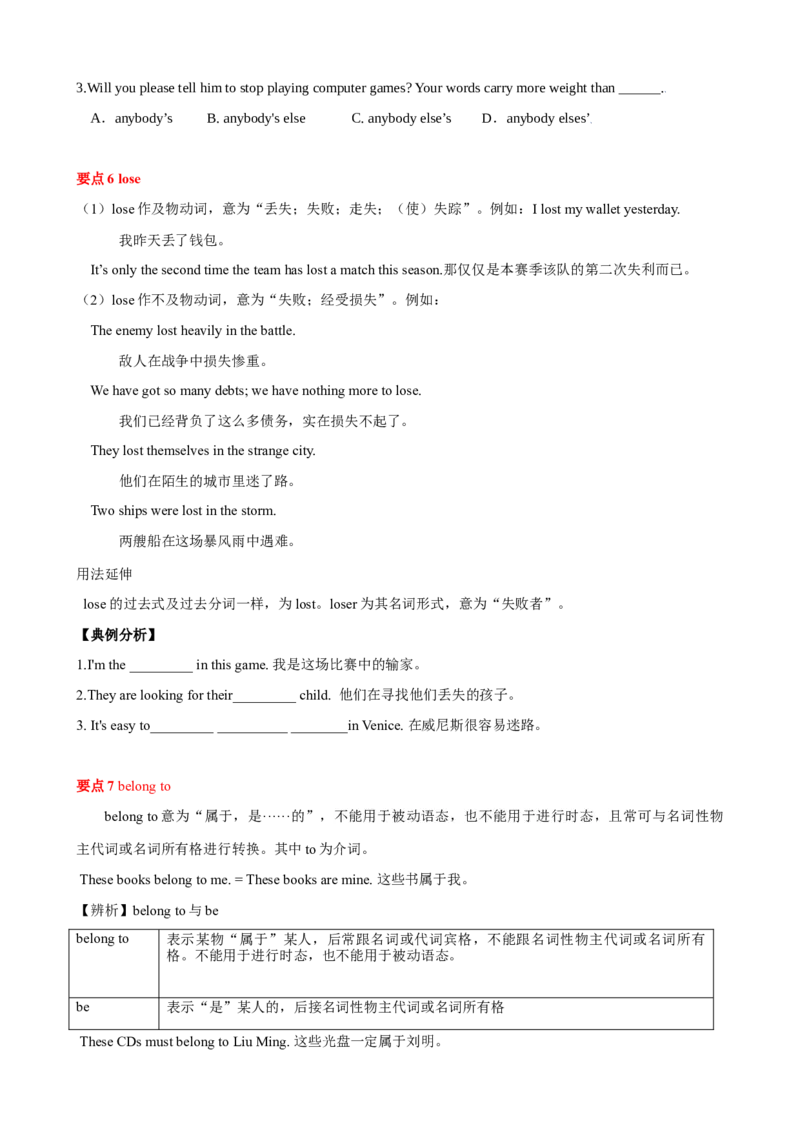
要点7 belong to
belong to意为“属于,是······的”,不能用于被动语态,也不能用于进行时态,且常可与名词性物
主代词或名词所有格进行转换。其中to为介词。
These books belong to me. = These books are mine. 这些书属于我。
【辨析】belong to与be
belong to 表示某物“属于”某人,后常跟名词或代词宾格,不能跟名词性物主代词或名词所有
格。不能用于进行时态,也不能用于被动语态。
be 表示“是”某人的,后接名词性物主代词或名词所有格
These CDs must belong to Liu Ming. 这些光盘一定属于刘明。The basketball must be Bob's. 这个篮球一定是鲍勃的。
【典例分析】
1.The book must . She’s the only one who’s studying French.
A. belong to Li Ying’s B. be Li Ying
C. belong Li Ying’s D. belong to Li Ying
2. The red car is Jim’s and the blue one me.
A. belongs B. belongs to C. belonged to D. is belonged to
3.The sweater belongs to _____________ .( Tom) = The sweater is____________.
4.Tai Wan ____________(属于) China.
要点8 introduce
(1)introduce作及物动词,意为“介绍”,常用搭配introduce sb. to sb. else….把某人介绍给另一人;
introduce oneself 自我介绍。例如:
Allow me to introduce a friend to you.让我给你介绍一个朋友。
May I introduce myself? 我可以自我介绍吗?
Let me introduce myself. 让我做了个自我介绍。
introduce sb. to sth. 使某人初次了解……;使尝试。
introduce sb. to sb. 介绍某人给某人认识
【典例分析】
【典例分析】
1.杰克让我了解了这款新型手机。
Jack_________ __________ _________ the new type of mobile phone.
1.Read the carefully. They will help you know how to use the machine.
A. instructions B. decisions C. results D. introductions
2. Always read the ________ carefully before you start. It tells you how to use the machine.
A. instructions B. decisions C. results D. introduction
要点 9 yet, already
already 意为“已经”,表示在此之前或某个特定时间之前,一般用于肯定句。如:
We have already met. 我们已经见过面了。
yet 意为“还;尚未”,常用于疑问句或否定句。在疑问句中用来询问某事是否发生,在否定句中用来表
示某事尚未发生但有可能发生。—你们见过面了吗? —我们还未见面。
—Have you met yet?
—We haven’t met yet.
ever 意为“在任何时候;从来”,用于疑问句或否定句。
我们曾见过面吗?
Have we ever met?
never 意为“从不”,表示否定意思。
我们从未见过面。
We’ve never met.
【典例分析】
1.—Have you finished your homework _______?
—Yes, I have _______ finished it.
A. just; just B. yet; just C. just; yet D. yet; yet
2.—Has Mike come ________?
—Yes, he has ________ been here for 10 minutes.
A. yet; already B. already; yet C. yet; yet D. already; already
要点10
see sb. do sth. 意为“看到某人做了某事”,强调看到动作的全过程。而see sb. doing sth.意为“看到某
人正在做某事”,强调看到的动正在进行。
Mary saw him clean the classroom.
玛丽看见他打扫教室了。
Mary saw him cleaning the classroom.
玛丽看见他正在打扫教室。
还有hear 和watch 还有类似用法
【典例分析】
1.—Is Tom in the next room?
—Well, it's hard to say. But I heard him _____ loudly when I passed by just now.
A speak B. to speak C. spoken D. speaking
2.While I was walking along the lake, I saw some fish________ out of the water.
A.jumped B.to jump C.jumping D.are jumping
3.I saw some boys basketball on the playground.A. play B.to play C. played D. playing
4.突然,我看到一只小熊在玩一些树枝和石头。
Suddenly, I ________ a baby bear ________ ________ some sticks and stones.
5.He saw his mother___________(do)housework when he got up earlier.
6. I often see her ____________(dance) in the park.
要点 11
1)rest在本句中意为“剩余部分”,用作名词。
(2)rest作主语时,谓语动词的单复数形式取决于of后面的名词。some、分数词、百分数作主语时也是同
样的用法。
【举例】
The rest of the books were lost. 剩下的书丢失了。
【拓展】
(1)rest作名词时,意为“休息”,常用词组有:have a rest, take a rest。
She needs rest after her long illness. 她在久病之后需要静养。
(2)rest作动词时,意为“休息”。
If you are tired, we’ll stop and rest for a while. 如果你累了,我们就停下来歇一会儿。
【典例分析】
1.The rest of the students ____ in the classroom.
A. is studying B. are studying C. be studying D. is studied
要点12 the number of/ a number of
(1)a number of 意为“许多”,后面接可数名词的复数形式,谓语动词用复数形式。number前面可
以用large,great,small等修饰,构成a large number of; a small number of等。例如:
I have a number of letters to write. 我有许多信件要写。
A large number of students in our school are from the countryside.
我们学校许多学生来自农村。
A small number of students in our class went swimming yesterday.
昨天我们班一小部分学生去游泳了。
(2)the number of意为“……的数量”,后接可数名词复数,谓语动词用单数形式。例如:
The number of people speaking Chinese is larger than that of those speaking English.
说汉语的人数要大于说英语的人数。【典例分析】
1.The number of people invited to the party________ fifty, but a number of them________ absent for different
reasons.
A. were; was B. was; was
C. was; were D. were; were
2.As we all know, __________ number of people learning Chinese is increasing rapidly.
A. a B. an C. the D. \
3.There _____ a number of books in the library and the number of them _____ increasing.
A. has; is B. have; are C. are; is D. is; are
4. ________ students in the school is over 2, 000.________ them are from the city.
A. The number of; A number of B. The number of; The number of
C. A number of; A number of D. A number of; The number of
要点 13:used to
used to 意为“过去常常”
(1)be used to (doing) sth. 意为“习惯于(做)某事”,
(2)be used to do sth. 意为“被用来做某事”
(3)be used for doing sth. 意为“被用来做某事”,be used for doing=be used to do。
(4) be used as... 意为“被用来作为……”
used to do 和be used to doing
过去常常做某事,意思是现在不做了,主语常是人,当然也可以是能实施动作的动物等。
used to
I used to get up early and took an hour's walk before breakfast. 我过去常常起床很早并且在早
do sth.
餐前散步一小时。
习惯于做某事,主语也通常是人,但是也可以是能实施动作的动物等。“get used to doing
be used to
sth.”相当于“be used to doing sth.”。
doing sth.
He is/gets used to living like this. 他习惯了这样生活。
【典例分析】
1. My grandparents used to__________ in a small village, and now they aren’t used to_________ in the big city.
A. live; living B. live; live C. living; live D. living; living
2.John _________with a knife but now he _________with chopsticks after living in Beijing for several months.A. used to eat; is used to eat B. used to eating; gets used to eat
C. used to eat; is used to eating D. was used to eating; is used to eat
2.用 used to 和 be used to 的适当形式填空。
1. My uncle _____________ live in a big city, but he _________________ living in a village now.
2. I _________________ get up late when I was in the middle school.
3. The child _________________ watch too much TV at night. So he has poor eyesight now.
4. We students ___________________ doing morning exercises every day.
5. There _______________ be a beautiful park.
要点14 put 构成的短语归纳
put down 还意为“写下,记下”,等于write down,take down。
Let me put down your telephone number.让我记下你的电话号码。
put on
1.表示“穿上;戴上”
It’s much too cold outside. You should put on your coat.
2.表示“上演;举办”
We will put on a talent show next month.
Put up
(1)put up 是由“动词+副词”构成的动词短语,意为“张贴;公布”。例如:
The principal put up the exam result. 校长公布了这次考试的结果。
(2)put up 意为“提高;增加;抬高(租金、价格等)”。例如 :
My landlord was threatening to put the rent up by 10 dollars a week.
我房东要挟说要把每周房租提高10美元。
Put构成的短语
put up挂;张贴;公布;举起;搭起;
put off 推迟 put away 收起来
put on 穿上;戴上;体重上升 put down 放下
put up with 忍受 put out 扑灭;熄灭
【典例分析】
1.—It’s cold outside, Jimmy! You should your sweater.
—Thanks, Mom.
A.take off B.take in C.put on D.put up2.The 32nd Olympic Games have been ________ to 2021 because of the outbreak of COVID-19.
A. put away B. put out C. put off D. put up
3.—Jason, would you please _________this notice?
—With pleasure.
A. put on B. put off C. put up D. put out
4. Tony bought a photo of his favourite sports star and________ on his bedroom wall.
A. gave it up B. found it out
C. looked it through D. put it up
5.用put构成的短语填空
1)We will _________ the new play next month.
2)The sports meet will be ____________because of the bad weather.
3)_________ the books ________ after reading.
4)__________the gentleman’s address.
5)It took the fire---fighters four hours to _________ the fire.
6)Many new high buildings have been __________ in our city.
【重点词组】
1.放下
2.至少
3.砍倒
4.科幻小说
5.一首乡村音乐
6.逐渐意识到
7.自从那以
8.乡村音乐之乡
9.属于
10.充满
【重点句式】
1.Have you decided yet which book to write about for English class?
你己经决定为英语 课本写那本书了吗?2.It’s about four sisters growing up.它是关于四姐妹成长的故事。
3.It was really good, so I couldn’t put it down.它真得很好因此我舍不得放下。
4. The book report is due in two weeks.读书报告两周后必须交。
5. Although I have lost everything, I have not lost my life.
尽管我失去 了 一切,但我没有失 去我的生命。
6.One of them died but the other ran towards my house.
其中一个人死了,但是另一个人跑 向了我的房子.
7.Listening to The Toms is a good way to wake up.听汤姆乐队的音乐是打 起精神的好方法。
8.While she was studying abroad in England, she heard a song full of feelings about returning home on the
radio.正在英格兰留学时,她通过收音机听到了一首充满返乡感情 的歌曲。
9.1 hope to see him sing live one day.
我希望有一天看到他现场演唱。
10.Have you introduced this singer to others?
你把这个歌手介绍给其他人了吗?
知识要点二:语法
1.构成
现在完成时是由“助动词have(has)+动词的过去分词”构成
2.用法
(1)表示动作发生在过去某个不确定的时间,但对现在产生了某种影响或造成了某种结果。句中常有
just, already, yet等副词修饰。(注意与一般过去时的区别)
Have you had lunch yet?
你已经吃过午饭了吗?
Yes, I have. I’ve just had it.
是的,我刚刚吃过。
(2)表示从过去某一时刻开始一直持续到现在的动作或状态。这个动作可能刚停止,也可能仍然在进行。
句中常有for(+时间段)或since(+时间点)引导的表示时间的状语。(注意与现在进行时态和过去进
行时态的区别)
He has taught here since 1981.
(3)表示说话前发生过一次或多次的动作,现在成为一种经历,一般意为汉语“.......过”,常带有
twice, ever, never,three times等时间状语。I have been to Beijing twice.我去过北京两次。
just 刚刚 肯定句,have/has 后
never 从来没有 否定句,have/has 后
ever 曾经 疑问句,have/has +主语+ever+过去分词
before 用于句末
yet 仍然 用于疑问句,否定句句末,或not之后
already 已经 肯定句,have/has 后或句末
so far 到目前为止 句首或句末
【语法练习】
一、用just, already, yet, ever填空。
1.Have you been to Japan?
2.I have finished my homework.
3.I have finished my homework .
4.I haven’t finished my homework .
二、选择题
1.—Mum, I want to watch the news about our school. Change the channel, please!
—What a pity! It is eight o'clock now. It___________ for a while.
A. has been over B. was over C. has finished D. finished
2.—It's ten years since we came here
—How time flies! We ____ in China for so long.
A. work B. worked C. will work D. have worked
3 — The room is very clean. Who __________?
A. cleaned B. have cleaned C. has cleaned D. will clean
4. Have you ever _________to the Great Wall? It’s very beautiful.
A. gone B. been C. went D. go
三、完成句子
1.— 杰克已经买了新手机吗?(yet)
— 没,他还没买新手机。(yet)
2. 你曾参观过博物馆吗?(ever)
— 没,我没有。我从未参观过博物馆。(never)3. — 你曾在图书馆借过书没有?(ever)
— 有啊,我借过。我已借了三次了。(already)
4.他已经找到他的自行车了。
5. 你曾经去过北京吗?
知识要点三:书面表达
【话题分析】
本单元的话题是“文学与音乐”。与话题有关的书面表达通常是要求学生用一般现在时、现在完成时
来写关于一位作家、一本书或一名歌手、一个乐队等的短文。写作时首先点明你想写的人或物,描述他
们的经历和故事。然后具体阐明相关情况和喜欢的原因,最后表达自己的感受或愿望等。
1.引出话题,介绍人物
My favorite singer is …
2.介绍歌手/作家的作品
His first album was …
His albums have enjoyed great success …
3.讲述感受、对自己的影响
It is pop music, but it …
Many of his songs are … One of my favorite songs is …
I feel … I have introduced …
【词汇积累】
1.放下
2.至少
3.砍倒
4.科幻小说
5.对…感兴趣
6.迫不及待做某事
7.演奏流行音乐8.一首乡村音乐
9.逐渐意识到
10.自从那以
11.一个美国乡村音乐迷
12.乡村音乐之乡
13.属于
14.相互信任
15.最成功的音乐家之一
16.充满______________________
【句型积累】
1.乡村音乐是来自美国南部的一种传统的音乐类型。
2.我已经听了他的大部分歌曲。我希望有一天能看到他现场演唱。
3.他是中国历史上最成功的音乐家家之ー。他已经卖了数以百万的唱片。
4.他的歌曲是如此的美妙以至于我获得一种满足感并让我一整天都开心。
5. 尽管我一无所有了,但至少我还活着。
6. 我已经读过那本书了。
7. 我妈还没决定买哪件衣服。
8. 读书报告的上交期限只有两周了
9.听他的音乐是一种醒来的好方式。
10.我喜欢他的音乐因为他的音乐声音很大并充满了精力。当我听的时候我感到兴奋。
【实战演练】
请你用英语写一篇短文,介绍一位你最喜欢的作家、歌星或演员等。写作内容:
1.简要介绍你最喜欢的作家、歌星或演员(如出生日期、特长、爱好等);
2.简单介绍他或她给你印象最深刻的作品;
3.你自己未来的工作愿望。
写作要求:
1.不得照抄原文;不得出现学校的真实名称和学生的真实姓名。
2.条理清晰,意思连贯,词数70个左右。
My Favorite ________
___________________________________________________________________________________________
___________________________________________________________________________________________
___________________________________________________________________________________________
___________________________________________________________________________________________
___________________________________________________________________________________________
_________________________________________________________