Unit9 Have you ever been to a museum?
课时 1 Section A(1a-2d)
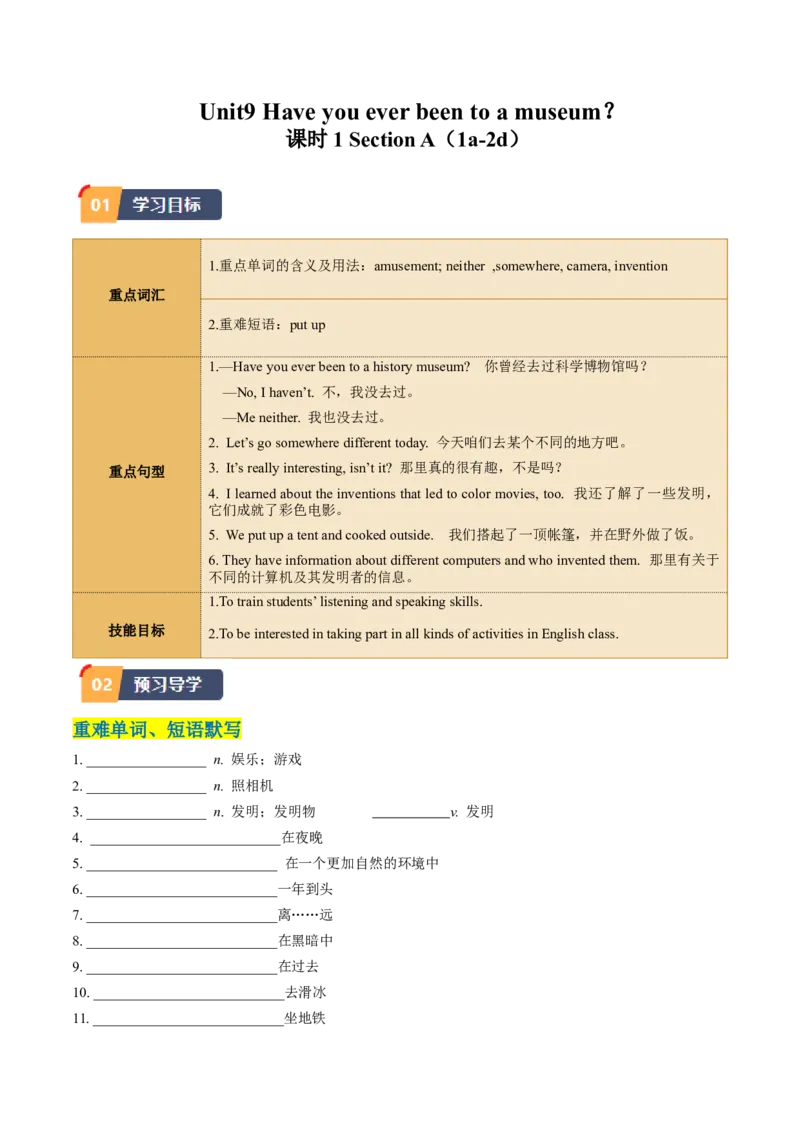
1.重点单词的含义及用法:amusement; neither ,somewhere, camera, invention
重点词汇
2.重难短语:put up
1.—Have you ever been to a history museum? 你曾经去过科学博物馆吗?
—No, I haven’t. 不,我没去过。
—Me neither. 我也没去过。
2. Let’s go somewhere different today. 今天咱们去某个不同的地方吧。
重点句型 3. It’s really interesting, isn’t it? 那里真的很有趣,不是吗?
4. I learned about the inventions that led to color movies, too. 我还了解了一些发明,
它们成就了彩色电影。
5. We put up a tent and cooked outside. 我们搭起了一顶帐篷,并在野外做了饭。
6. They have information about different computers and who invented them. 那里有关于
不同的计算机及其发明者的信息。
1.To train students’ listening and speaking skills.
技能目标
2.To be interested in taking part in all kinds of activities in English class.
重难单词、短语默写
1. _________________ n. 娱乐;游戏
2. _________________ n. 照相机
3. _________________ n. 发明;发明物 v. 发明
4. ___________________________在夜晚
5. ___________________________ 在一个更加自然的环境中
6. ___________________________一年到头
7. ___________________________离……远
8. ___________________________在黑暗中
9. ___________________________在过去
10. ___________________________去滑冰
11. ___________________________坐地铁12. ___________________________了解有关……的情况
13. ___________________________在周末
答案:
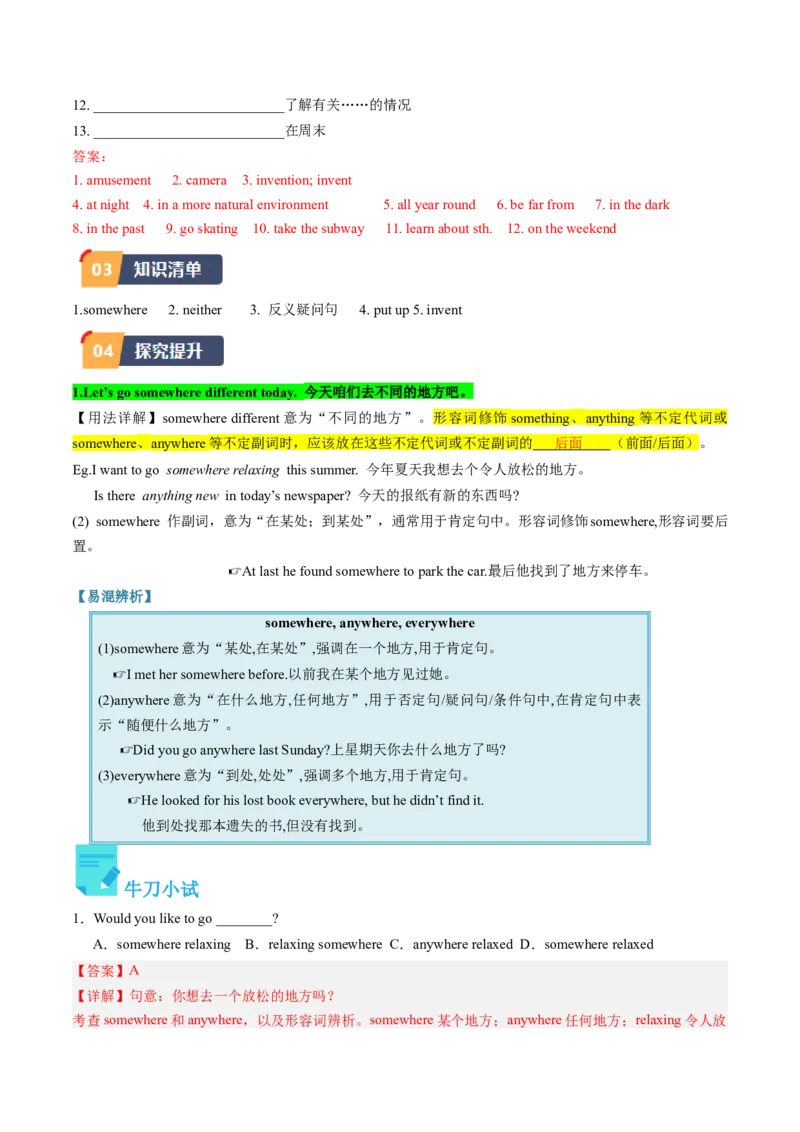
1. amusement 2. camera 3. invention; invent
4. at night 4. in a more natural environment 5. all year round 6. be far from 7. in the dark
8. in the past 9. go skating 10. take the subway 11. learn about sth. 12. on the weekend
1.somewhere 2. neither 3. 反义疑问句 4. put up 5. invent
1.Let’s go somewhere different today. 今天咱们去不同的地方吧。
【用法详解】somewhere different意为“不同的地方”。形容词修饰something、anything等不定代词或
somewhere、anywhere等不定副词时,应该放在这些不定代词或不定副词的 后面 (前面/后面)。
Eg.I want to go somewhere relaxing this summer. 今年夏天我想去个令人放松的地方。
Is there anything new in today’s newspaper? 今天的报纸有新的东西吗?
(2) somewhere 作副词,意为“在某处;到某处”,通常用于肯定句中。形容词修饰somewhere,形容词要后
置。
☞At last he found somewhere to park the car.最后他找到了地方来停车。
【易混辨析】
somewhere, anywhere, everywhere
(1)somewhere意为“某处,在某处”,强调在一个地方,用于肯定句。
☞I met her somewhere before.以前我在某个地方见过她。
(2)anywhere意为“在什么地方,任何地方”,用于否定句/疑问句/条件句中,在肯定句中表
示“随便什么地方”。
☞Did you go anywhere last Sunday?上星期天你去什么地方了吗?
(3)everywhere意为“到处,处处”,强调多个地方,用于肯定句。
☞He looked for his lost book everywhere, but he didn’t find it.
他到处找那本遗失的书,但没有找到。
牛刀小试
1.Would you like to go ________?
A.somewhere relaxing B.relaxing somewhere C.anywhere relaxed D.somewhere relaxed
【答案】A
【详解】句意:你想去一个放松的地方吗?
考查somewhere和anywhere,以及形容词辨析。somewhere某个地方;anywhere任何地方;relaxing令人放松的(修饰物);relaxed放松的(修饰人)。问句以“would you like...”来提问,此问句通常希望得到对方
的肯定回答,句中应用somewhere;修饰somewhere应用形容词relaxing,且形容词应置于其后,故
somewhere relaxing符合语境。故选A。
2.I’m sure I’ve seen her ________, but I can’t remember the right place.
A.somewhere B.anywhere C.everywhere D.nowhere
【答案】A
【详解】句意:我确信我在哪里见过她,但是我想不起准确的地点。
考查不定副词。somewhere 某个地方,一般用于肯定句;anywhere 任何地方,一般用于否定句或疑问句;
everywhere 每个地方;nowhere 没有什么地方。根据“I’m sure I’ve seen her”可知句子是肯定句表达肯定意
义,排除选项B和D;结合“but I can’t remember the right place”,可知是表达“在某个地方见过她”,故
用somewhere。故选A。
3.—Where would your parents like to live after they retire?
—They’d like to live ______ relaxing.
A.something B.anywhere C.somewhere
【答案】C
【详解】句意:——你父母退休后想住在哪里?——他们想住在一个放松的地方。
考查地点副词。something某件事情;anywhere任何地方;somewhere某个地方。根据“Where would your
parents like to live after they retire?”可知,此处指居住的地方,本句为肯定句,应用somewhere。故选C。
4.—Where are you going for your holiday?
—I’m going ________ because it’s too cold here.
A.somewhere warm B.everywhere warm
C.warm somewhere D.warm everywhere
【答案】A
【详解】句意:——你打算去哪里度假?——我要去一个暖和的地方,因为这里太冷了。
考查地点副词以及定语后置。somewhere某地;everywhere所有地方。根据“I’m going...”可知要去一个暖
和的地方,用somewhere,形容词修饰somewhere用进行后置。故选A。
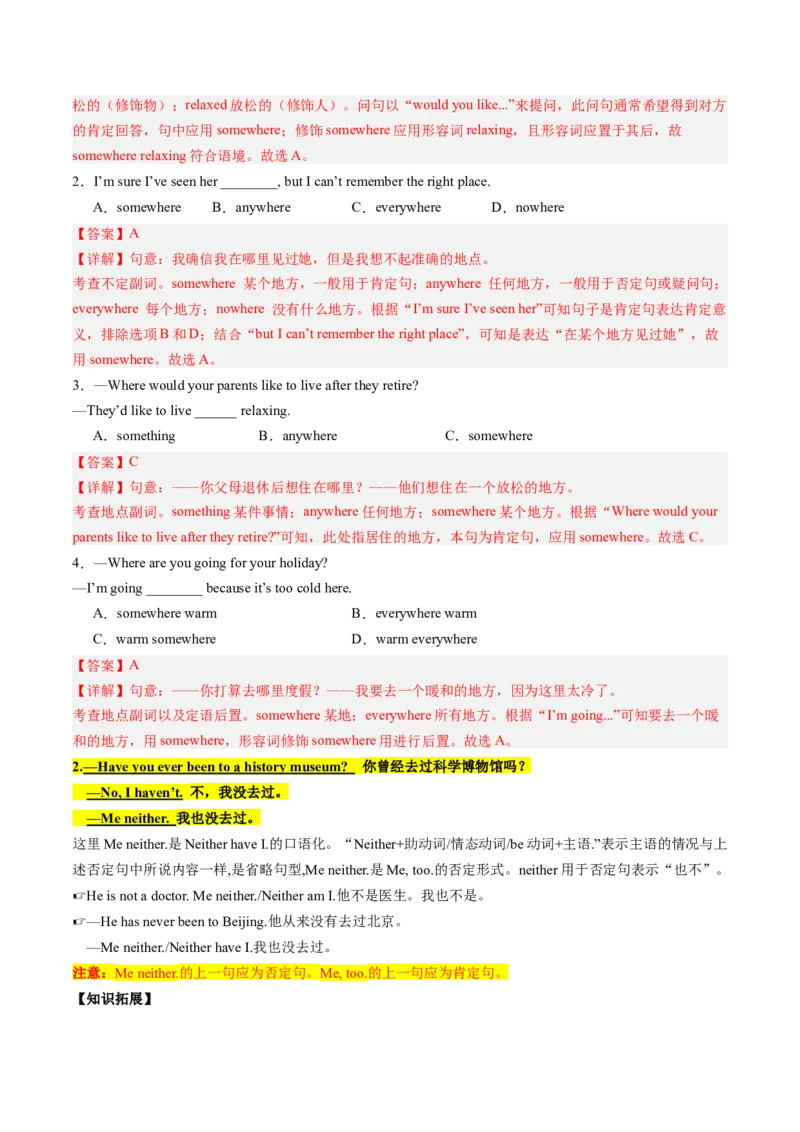
2.—Have you ever been to a history museum? 你曾经去过科学博物馆吗?
—No, I haven’t. 不,我没去过。
—Me neither. 我也没去过。
这里Me neither.是Neither have I.的口语化。“Neither+助动词/情态动词/be动词+主语.”表示主语的情况与上
述否定句中所说内容一样,是省略句型,Me neither.是Me, too.的否定形式。neither用于否定句表示“也不”。
☞He is not a doctor. Me neither./Neither am I.他不是医生。我也不是。
☞—He has never been to Beijing.他从来没有去过北京。
—Me neither./Neither have I.我也没去过。
注意:Me neither.的上一句应为否定句。Me, too.的上一句应为肯定句。
【知识拓展】(1)“So+助动词/be动词/情态动词+主语I.”相当于Me, too.。
☞They have been to England. So have I.(Me, too.) 他们去过英国。我也去过。
☞He is from Beijing. So am I.(Me, too.) 他来自北京。我也来自北京。
(2)neither也可用作形容词,意为“两者都不”,放在单数名词前。
☞Neither student is from Canada.两个学生都不是来自加拿大。
(3)neither也可用作代词,常与of连用,表示“两者都不”。也可单独用作宾语或主
语。
☞Neither of them is very clever but both study hard.
他们两个都不是很聪明,但学习都挺刻苦。
牛刀小试
1.— When shall we go swimming, this Friday or Saturday?
— ________ is OK. I’ll be free next week.
A.Both B.Either C.Neither
【答案】C
【详解】句意:——我们什么时候去游泳,这个星期五还是星期六?——都不行。我下周有空。考查代词
辨析。Both两个都;Either两个中的一个;Neither两个都不。由“I’ll be free next week”可知,这星期五和
星期六都没有时间。故选C。
2.—We have two plans for the game.
—I’m afraid ________ plan will work. We have to come up with another one.
A.all B.both C.neither D.none
【答案】C
【详解】句意:——我们对这场比赛有两个计划。——恐怕这两个计划都行不通。我们必须想出另一个办
法。
考查不定代词。all所有;both两个;neither两者都不;none没有一个。根据“We have two plans for the
game.”以及答句中的“We have to come up with another one.”可知,设空处是说两个计划都行不通。故选
C。
3.I have read two of your articles, but ________ of them is good enough to get a high mark.
A.both B.either C.neither D.none
【答案】C
【详解】句意:我读了你的两篇文章,但是它们都不够好,不能得高分。
考查不定代词。both两者都;either两者其一;neither两者都不;none没有一个。 根据“I have read two of
your articles”并结合but可知,应用neither,表示两篇作文都不够好。故选C。
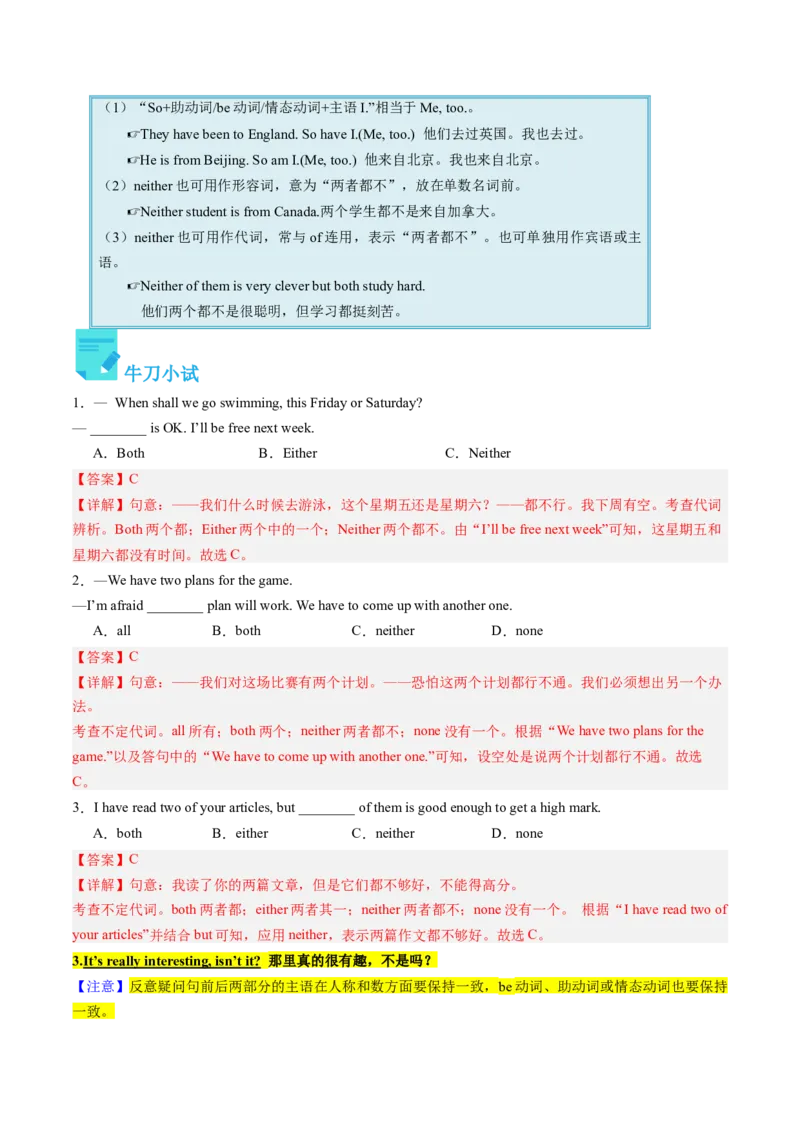
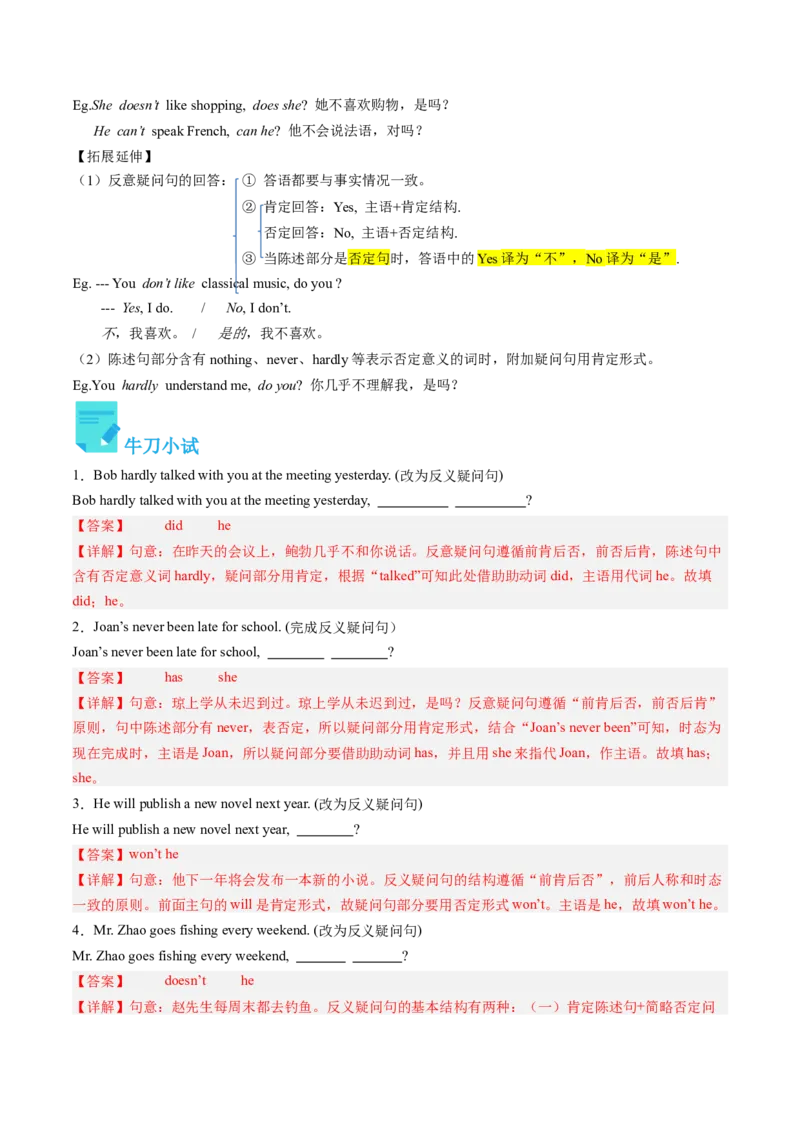
3.It’s really interesting, isn’t it? 那里真的很有趣,不是吗?
【注意】反意疑问句前后两部分的主语在人称和数方面要保持一致,be动词、助动词或情态动词也要保持
一致。Eg.She doesn’t like shopping, does she? 她不喜欢购物,是吗?
He can’t speak French, can he? 他不会说法语,对吗?
【拓展延伸】
(1)反意疑问句的回答: ① 答语都要与事实情况一致。
② 肯定回答:Yes, 主语+肯定结构.
否定回答:No, 主语+否定结构.
③ 当陈述部分是否定句时,答语中的Yes译为“不”,No译为“是”.
Eg. --- You don’t like classical music, do you ?
--- Yes, I do. / No, I don’t.
不,我喜欢。 / 是的,我不喜欢。
(2)陈述句部分含有nothing、never、hardly等表示否定意义的词时,附加疑问句用肯定形式。
Eg.You hardly understand me, do you? 你几乎不理解我,是吗?
牛刀小试
1.Bob hardly talked with you at the meeting yesterday. (改为反义疑问句)
Bob hardly talked with you at the meeting yesterday, ?
【答案】 did he
【详解】句意:在昨天的会议上,鲍勃几乎不和你说话。反意疑问句遵循前肯后否,前否后肯,陈述句中
含有否定意义词hardly,疑问部分用肯定,根据“talked”可知此处借助助动词did,主语用代词he。故填
did;he。
2.Joan’s never been late for school. (完成反义疑问句)
Joan’s never been late for school, ?
【答案】 has she
【详解】句意:琼上学从未迟到过。琼上学从未迟到过,是吗?反意疑问句遵循“前肯后否,前否后肯”
原则,句中陈述部分有never,表否定,所以疑问部分用肯定形式,结合“Joan’s never been”可知,时态为
现在完成时,主语是Joan,所以疑问部分要借助助动词has,并且用she来指代Joan,作主语。故填has;
she。
3.He will publish a new novel next year. (改为反义疑问句)
He will publish a new novel next year, ?
【答案】won’t he
【详解】句意:他下一年将会发布一本新的小说。反义疑问句的结构遵循“前肯后否”,前后人称和时态
一致的原则。前面主句的will是肯定形式,故疑问句部分要用否定形式won’t。主语是he,故填won’t he。
4.Mr. Zhao goes fishing every weekend. (改为反义疑问句)
Mr. Zhao goes fishing every weekend, ?
【答案】 doesn’t he
【详解】句意:赵先生每周末都去钓鱼。反义疑问句的基本结构有两种:(一)肯定陈述句+简略否定问句;(二)否定陈述句+简略肯定问句。本句是一般现在时,主语是Mr. Zhao,谓语动词是goes,且是肯
定句,反义疑问的形式则是doesn’t he。故填doesn’t;he。
4. We put up a tent and cooked outside. 我们搭起帐篷并在外面做饭。
【用法详解】put up意为“搭起;建造”,为“动词+副词”型短语。名词作宾语时,可放在动词和副词之
间或副词后面;代词作宾语时,只能置于动词和副词之间。
Eg.They are putting up several new buildings in that block. 他们正在那个街区建几幢新楼房。
【拓展延伸】put up的其他含义:
(1)张贴:We’d better put up a notice here. 我们最好在这儿贴一张通知。
(2)举起;拾起:Please put up your hand if you have any question. 如果你有任何问题,请举手。
牛刀小试
1.Never ________ till tomorrow what you can do today.
A.put up B.put on C.put down D.put off
【答案】D
【详解】句意:不要把今天能做的事拖到明天。
考查动词短语。put up张贴;put on穿上;put down放下;put off推迟。根据“till tomorrow what you can do
today.”可知,指的是不要把今天能做的事拖到明天。故选D。
2.We ________ new clothes on the first day of Chinese New Year.
A.put on B.put up C.put away D.put off
【答案】A
【详解】句意:在中国新年的第一天,我们穿上新衣服。
考查动词短语。put on穿上;put up张贴;put away放好;put off推迟。根据“new clothes on the first day of
Chinese New Year”以及常识习俗可知,在新年第一天穿上新衣服,故选A。
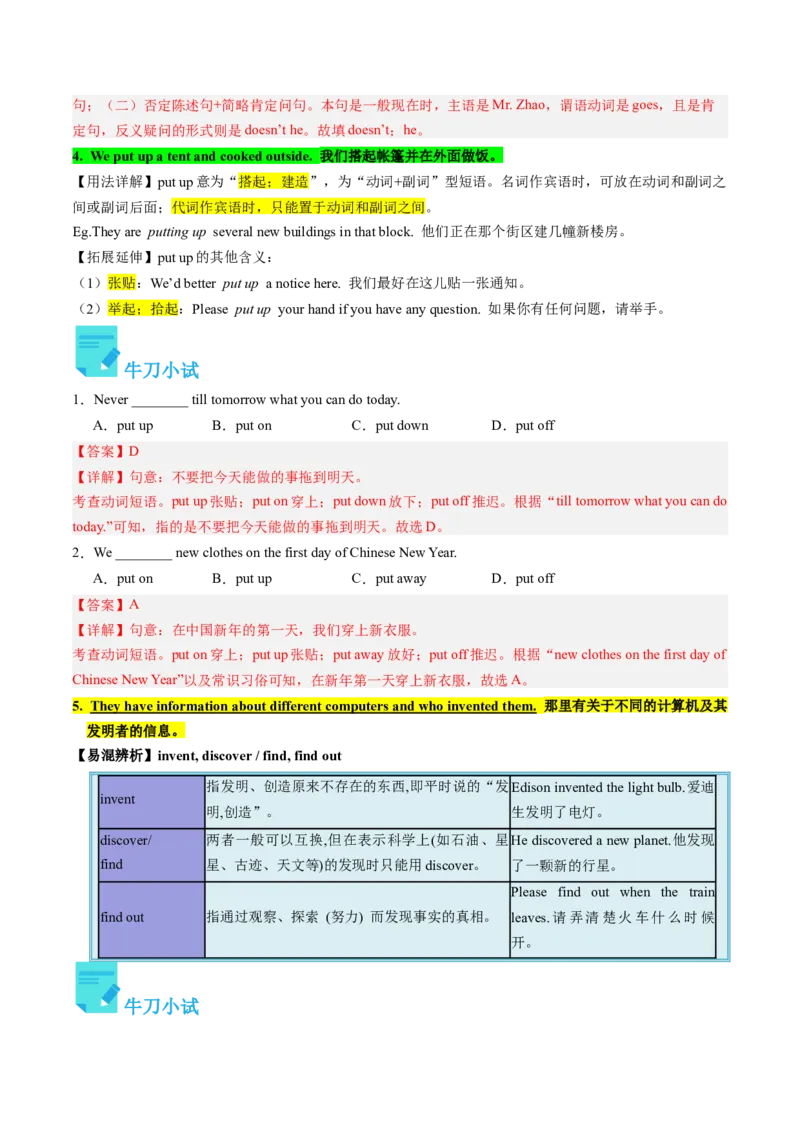
5. They have information about different computers and who invented them. 那里有关于不同的计算机及其
发明者的信息。
【易混辨析】invent, discover / find, find out
指发明、创造原来不存在的东西,即平时说的“发Edison invented the light bulb.爱迪
invent
明,创造”。 生发明了电灯。
discover/ 两者一般可以互换,但在表示科学上(如石油、星He discovered a new planet.他发现
find 星、古迹、天文等)的发现时只能用discover。 了一颗新的行星。
Please find out when the train
find out 指通过观察、探索 (努力) 而发现事实的真相。 leaves.请弄清楚火车什么时候
开。
牛刀小试1.Many people believe that the ________ of the wheel was a turning point in human history.
A.invention B.instrument C.instruction D.introduction
【答案】A
【详解】句意:许多人认为轮子的发明是人类历史的一个转折点。
考查名词辨析。invention发明;instrument仪器;instruction用法说明;introduction介绍。根据“of the
wheel was a turning point in human history.”可知,轮子的“发明”是人类历史的一个转折点。故选A。
2.Yang Jun’ao, a 16-year-old student from Hunan province, ________ a lotus root harvesting (采藕) robot.
A.invented B.invited C.interviewed D.included
【答案】A
【详解】句意:杨骏奥,一个来自湖南省的16岁学生,发明了一种采藕机器人。
考查动词辨析。invent发明;invite邀请;interview采访;include包含。根据“a lotus root harvesting robot”
可知,此处是发明机器人,故选A。
1. Target language:
1).Lets' go somewhere different today.
2).Have you ever been to…? Yes, I have./ No, I haven’t.
3).How about/what about…? 4).How are we going to get there?
5).We can take the subway/…
2.To train students’ listening and speaking skills.
3.To be interested in taking part in all kinds of activities in English class.
一、完型填空
My daughter Mary is seven. She has had all kinds of soft toys since she was a(n) 16 . She plays with
the toys almost every day.
Mary had a bad habit. She often left her toys 17 . This gave me much trouble in picking them up and
putting them in their 18 places.
One day, Mary and I went out into our garden to 19 an hour in the fresh air. I took my work with me.
Mary ran about and played with Dash, her pet dog, and was having 20 .
Then, in a corner of the garden, Mary saw her favorite toy bear, dirty and 21 . She knew that Dash did
this. She got angry and showed the toy bear to me.
I asked, “You left the toy bear outside in the garden last time, right?”
Mary had to answer, “Yes, Mom.”
“So you shouldn’t blame(责备)the dog. I hope this will teach you a 22 . That is, always 23your toys when you have finished playing with them.”
“I will try 24 best,” said Mary. “OK, then I’ll mend(修补)the toy bear as 25 as I can.”
Hearing this, Mary smiled widely.
16.A.baby B.teenager C.adult D.keeper
17.A.anywhere B.everywhere C.somewhere D.nowhere
18.A.wide B.high C.right D.small
19.A.spend B.make C.cost D.lend
20.A.test B.risk C.dinner D.fun
21.A.magic B.broken C.bright D.sick
22.A.truth B.record C.lesson D.mark
23.A.give up B.check out C.fix up D.put away
24.A.his B.my C.her D.your
25.A.well B.loudly C.much D.simply
【答案】
16.A 17.B 18.C 19.A 20.D 21.B 22.C 23.D 24.B 25.A
【分析】本文介绍了作者的七岁的女儿,不爱惜玩具,扔的到处都是。后来在妈妈的教育下,知错就改。
16.句意:她从小就有各种各样的毛绒玩具。
baby“婴儿”;teenager“青少年”;adult“成年人”;keeper“饲养员”。根据上文的“My daughter Mary is
seven.”及下文的“She plays with the toys almost every day.”可推知,当她是一个“婴儿”时,她就有各种各
样的毛绒玩具。故选A。
17.句意:她经常把玩具丢得到处都是。
anywhere“在任何地方”;everywhere“处处”;somewhere“在某处”;nowhere“无处”。上文提及“Mary
had a bad habit.”,由此可知此处表示她经常把她的玩具放得“到处都是”。故选B。
18.句意:这让我很难把它们捡起来放在正确的地方。
wide“宽的”;high“高的”;right“正确的”;small“小的”。根据“This gave me much trouble in picking
them up”可知,应该把玩具放在“正确的”位置。right符合语境。故选C。
19.句意:一天,玛丽和我到花园里去呼吸一个小时的新鲜空气。
spend“花费”,常用人作主语,后接时间或金钱;make“制造”;cost“花费”,常用物作主语,后接金钱;
lend“借出”。本句主语是Mary and I,此处指“花费”一个小时在花园中呼吸新鲜空气。故选A。
20.句意:玛丽到处跑,和她的宠物狗达什玩耍,玩得很开心。
test“测验”;risk“危险”;dinner“晚餐”;fun“享乐”。由“Mary ran about and played with Dash, her pet
dog,”可知,此处是说Mary和Dash正玩得开心。have fun意为“玩得开心”,是固定搭配,符合语境。故
选D。
21.句意:然后,在花园的一个角落里,玛丽看到了她最喜欢的玩具熊,又脏又破。
magic“有魔力的”;broken“损坏的”;bright“明亮的”;sick“生病的”。由下文的mend(修补)the toy
bear可推知玩具熊是“损坏的”。故选B。
22.句意:我希望这能给你一个教训。truth“真相”;record“记录”;lesson“课程”;mark“符号”。teach sb. a lesson是固定搭配,意为“给某人
教训”,符合语境。故选C。
23.句意:也就是说,玩完玩具后,一定要把它们收起来。
give up“放弃”;check out“结账离开”;fix up“修理”;put away“放好”。上文提及Mary把玩具到处乱
放,由此可知此处表示“放好”玩具。故选D。
24.句意:“我会尽力的,”玛丽说。
his他的;my我的;her她的;your 你的。try one’s best意为“尽某人最大的努力”,为固定搭配;主语为
I,其对应的形容词性物主代词应用my。故选B。
25.句意:好吧,那我就把玩具熊修好。
well“好”;loudly“大声地”;much“很”;simply“仅仅”。联系上文“I’ll mend(修补)the toy bear ”可知,
此句句意为“我将尽可能修理好玩具熊”。as well as意为“和……一样好”,是固定用法。故选A。
二、阅读理解
A
The loveliest house that I have ever lived in is Crosslands. I lived there with my grandparents when I was a
child.
The house seemed so huge to me as a child. And it had a lovely living room with a piano in it. And there was a
strange room. It was the drawing room. We only used it on Sundays, or when visitors came for tea. There was the
best furniture in it but it was covered with sheets—it was as if all the furniture wore clothes. We couldn’t enjoy this
beautiful furniture.
I went back to the house a few weeks ago. It has changed a lot. My uncle has modernized (使……现代化) it
inside, and taken away the lovely furniture. And he has knocked a wall down so the drawing room and the living
room have become one big room.
Although it becomes modern, its old style is the most beautiful in my heart. When I see the house, I know I can’t
go back and catch it. But there’s still a beautiful memory.
26.From the first paragraph we mainly know________.
A.the house has been changed greatly
B.the writer used to live with his grandparents in Crosslands
C.the writer used to study in Crosslands
D.the writer didn’t love Crosslands
27.When the writer was a child, he thought the house was________.
A.big B.small C.modern D.ugly
28.The underlined word “sheets” means “________” in Chinese.
A.床单 B.头 C.被子 D.拖把
29.What does the writer think of the house now?
A.It seems much bigger now.
B.It seems more comfortable.
C.There is still a good memory there.
D.It is a big mistake to change its style.30.Which of the following is TRUE?
A.The writer likes today’s room better.
B.The room seems smaller now.
C.The old house is really bigger.
D.The writer likes the old style better.
【答案】26.B 27.A 28.A 29.C 30.D
【导语】本文讲述了作者觉得自己曾经住过的最可爱的房子是在克罗斯兰德和祖父母一起住过的房子。短
文介绍了房子里面有什么。现在这座房子有了很大变化,但是作者认为旧风格是自己心中最美的,因为那
里有自己最美好的回忆。
26.细节理解题。根据“The loveliest house that I have ever lived in is Crosslands. I lived there with my
grandparents when I was a child.”可知,这位作者过去和他的祖父母住在克罗斯兰德。故选B。
27.细节理解题。根据“The house seemed so huge to me as a child”可知,作者小时候认为房子很大。故选
A。
28.词义猜测题。根据“There was the best furniture in it but it was covered with sheets—it was as if all the
furniture wore clothes.”可知,盖住家具的应该是床单,故选A。
29.细节理解题。根据“When I see the house, I know I can’t go back and catch it. But there’s still a beautiful
memory”可知,作者现在认为房子仍然是美好的回忆,故选C。
30.细节理解题。根据“Although it becomes modern, its old style is the most beautiful in my heart.”可知,作
者更喜欢旧风格。故选D。
B
A few weeks ago, my friend had a yard sale. I thought it would help to clean my 9-year-old son’s room. We
agreed that whatever we sold in toys would be his money.
The night before the sale, we put toys on the truck as well as a little bike that was too short for my son now. This
little bike had at least 2 owners before it came to my son. It was not in the best shape and it certainly was not shiny
new but it was still a bike, and the tires(轮胎)were still good.
We put a price of $10 on it but it didn’t sell. So after the sale was over, my friend put it on the sidewalk with a
sign that said “FREE BIKE”. Within five minutes, a little girl was standing there. She asked if the bike was really
free. My friend said yes. The girl smiled and rode away quickly.
Later that evening when I told my son how much money he had made at the yard sale, he smiled. When he asked
about the bike, I told him that a little girl was very happy because she got the bike for free. The grin(咧嘴笑)on
my son’s face was much more than when I told him how much he had made. He was so thrilled to hear that someone
else would get good use of that little bike.
The bike was given to us, so in this way, I guess we got to pay it forward!
31.The money from toys at the yard sale belonged to ________.
A.the boy’s parents B.the friend C.the boy D.the girl
32.How did the little girl get the bike?
A.She bought the bike on the sidewalk. B.She paid ten dollars for the bike.C.She asked my son for the bike. D.She got the bike for free.
33.According to the passage, the little bike ________.
A.was in the best shape B.had very bad tires
C.was very new D.had at least 4 owners
34.The underlined word “thrilled” probably means ________ in the passage.
A.worried B.excited C.interested D.relaxed
35.We can infer(推断)from the passage that ________.
A.the writer was proud of his son
B.the writer was sorry for the bike
C.the writer was angry with the friend
D.the writer was satisfied with the girl
【答案】31.C 32.D 33.D 34.B 35.A
【导语】本文是一篇记叙文。文章介绍了在一次庭院拍卖中,“我”儿子的一辆小自行车无偿地给了一个
小女孩,儿子知道对自行车的处理方式后高兴地咧嘴笑,“我”也觉得通过这种方式爱心得到了传递。
31.细节理解题。根据第一段最后一句“We agreed that whatever we sold in toys would be his money.”可知,
玩具售卖的钱属于男孩。故选C。
32.细节理解题。根据第三段“…She asked if the bike was really free. My friend said yes…”可知,小女孩得
知这辆自行车免费时,便立刻骑走了。故选D。
33.细节理解题。根据第二段“This little bike had at least 2 owners before it came to my son.”可知,在小女孩
之前,这辆自行车已经有过三个主人,故连同小女孩,这辆自行车到现在为止已经有四个主人了。故选
D。
34.词句猜测题。根据第四段“…The grin(咧嘴笑)on my son’s face was much more than when I told him
how much he had made. He was so thrilled to hear that someone else would get good use of that little bike.” 可知,
当小男孩听说一个小女孩免费得到了那辆自行车,她很高兴时,小男孩脸上的笑容更灿烂了。由此可推知,
小男孩在得知别人会很好地使用这辆自行车时,应感到很兴奋。故选B。
35.推理判断题。根据最后一段可知,作者感觉通过自行车这件事情,爱心得到了传递,从而为有这样的
儿子感到自豪。故选A。
三、补全对话
根据对话内容,在空白处填上合适的单词、短语或句子补全对话。
A: I called you at 9:00 this morning but you didn’t answer. What were you busy with?
B: 36 .
A: Why did you do it?
B: We will have a school sale next Friday.
A: Oh, I almost forget. I also have something for sale.B: 37 ?
A: Well, I will sell some old storybooks that I will never read anymore.
B: 38 ?
A: I’m not sure. Maybe I will buy a new schoolbag. What’s your plan?
B: 39 . They really need help.
A: That sounds great! I will do the same thing as you. 40 .
B: I think so. I hope we can help more people.
【答案】36.I was busy collecting my used books/old clothes 37.What will you sell 38.How will you
deal with the money you make on the school sale/What will you do with the money you make on the school sale
39.I’m going to give away the money to the children in poor areas 40.It’s always great to help others
【导语】本文是A和B之间的对话,两人讨论了学校售卖的事情。
36.根据“What were you busy with?”及“We will have a school sale next Friday.”可知,此处在说我忙于整理
不用的旧东西,故填I was busy collecting my used books/old clothes。
37.根据“Well, I will sell some old storybooks that I will never read anymore.”可知,此处在问你要卖什么,
故填What will you sell。
38.根据“Maybe I will buy a new schoolbag.”可知,此处在问你打算用校园售卖的钱干什么,故填How
will you deal with the money you make on the school sale/What will you do with the money you make on the
school sale。
39.根据“I hope we can help more people.”可知,此处在说我打算把钱捐给贫困地区的儿童,故填I’m
going to give away the money to the children in poor areas。
40.根据“I think so. I hope we can help more people.”可知,此处在说帮助别人真的很棒,故填It’s always
great to help others。