Unit9 Have you ever been to a museum?
课时 2 Section A(3a-4c)
1.重点单词的含义及用法:1.unbelievable, progress, rapid, unusual, toilet, encourage,
social, peaceful, performance, perfect, itself, collect
重点词汇
2.重难短语:
1. It’s unbelievable that technology has progressed in such a rapid way! 很难相信科技
竟以如此快速的方式发展!
2. 2. I wonder how much more computers will be able to do in the future. 我想知道将
来计算机还能够做些什么事情。
3. It also encourages governments and social groups to think about ways to improve toilets
in the future. 它也鼓励政府和社会团体想出办法去改进未来的厕所。
4. It’s a relaxing and peaceful place near a lake. 它坐落在湖附近,是一个休闲安宁的
重点句型
地方。
5. The tea art performances show how to make a perfect cup of tea with beautiful tea sets.
茶艺表演展示了如何用精美的茶具沏一杯完美的茶。
6. Watching the tea preparation is just as enjoyable as drinking the tea itself. 看沏茶的
过程和饮茶本身一样令人愉快。
7. There are some special German paintings there right now. 那里现在有一些特别的德
国油画。
1.To train students’ reading ability and get students know some knowledge about many
kinds of museums.
技能目标
2.To understand and use the present perfect tense.
重难单词、短语默写
1. _________________ adj. 难以置信的,不真实的
2. _________________ v. & n.进步;进展
3. _________________ adj. 迅速的
4. _________________ adj. 特别的,不寻常的
5. _________________ v. 鼓励
6. _________________ adj. 社会的
7. _________________ adj. 和平的;安宁的
8. _________________ n. 表演;演出9. _________________ adj. 完美的;完全地
10. _________________ pron. 它自己
11. _________________ v. 收集;采集
12. _________________ n. 主题
13. _________________ n. 短途旅程
14. _________________ n. 省份
15. 以如此迅猛的方式
16. 各种各样的
答案:
1. unbelievable 2. progress 3. rapid 4. unusual 5. encourage 6. social 7. peaceful 8. performance 9.
perfect 10. Itself 11. collect 12. theme 13. ride 14. province 15. in such a rapid way
16. different kinds of
1、progress 2. wonder 3. encourage 4. peaceful 5. perfect 6.German
7.现在完成时表示经历的用法
1. It’s unbelievable that technology has progressed in such a rapid way! 很难相信科技竟以如此快速的方
式
发展!
(1)progress此处用作不及物动词,意为“进步;进展”。
☞Medical science is progressing rapidly in our country.在我国医学进步迅速。
【拓展】progress作不可数名词,意为“进步”。常用短语:make (good)progress (in...)意为“(在……方面)
取得(大的)进步”。
☞Study hard and make progress every day.好好学习,天天向上。
☞You have made good progress in your English.
你在英语方面取得了很大的进步。
牛刀小试
1.—This course allows the students to _________ at their own speed.
—That’s great. They are different after all.
A.process B.support C.progress D.expect
【答案】C
【详解】句意:——这门课程允许学生以自己的速度进步。——太好了。他们毕竟是不同的。考查动词辨析。process处理;support支持;progress进展;expect期待。根据“That’s great. They are
different after all.”可知,指这门课程允许学生按各自的速度学习。 故选C。
2.Shenzhou-17 was a success. It shows China has made great ________ in the field of space science.
A.teamwork B.result C.progress D.decision
【答案】C
【详解】句意:神舟17号取得了成功。这表明中国在空间科学领域取得了巨大的进步。
考查名词辨析。teamwork团队合作;result结果;progress进步;decision决定。根据“in the field of space
science”和“make great...in”可知,在科学领域取得了巨大的进步,故选C。
3.Chinese scientists have made great _________ in space technology recently.
A.trade B.progress C.information D.knowledge
【答案】B
【详解】句意:中国科学家最近在太空技术方面取得了巨大的进步。
考查名词辨析。trade贸易;progress进步;information消息;knowledge知识。分析题干可知,本题考查短
语make great progress“取得巨大的进步”。故选B。
2. I wonder how much more computers will be able to do in the future. 我想知道将来计算机还能够做些什
么事情。
wonder意为“想知道”,后接if 或whether引导的宾语从句时,表委婉的请求或疑问。wonder后还可以接
who, what, why, how much 等引导的宾语从句或“疑问词+不定式”结构。wonder后接that引导的宾语从句
时,表示“感到惊讶……”。
☞I wonder if you would mind giving me a hand.我不知道你是否能帮我一下。
☞He wondered what happened.他想知道发生了什么事。
☞I wonder that she has won the race.我对她赢了比赛感到惊讶。
【知识拓展】
wonder n.奇迹 wonderful adj.精彩的
wonderfully adv.精彩地
The Great Wall is one of the wonders in the world.长城是世界上的奇迹之一。
牛刀小试
1.The new-designed car is on show in Changchun Auto Expo. I wonder ________.
A.how much it will cost B.how much it costs C.how much did it cost
【答案】B
【详解】句意:新设计的汽车在长春汽车博览会上展出。我想知道它要多少钱。
考查宾语从句。wonder后接宾语从句,从句用陈述语序,排除C选项。主句为一般现在时,从句时态不限,
根据语境可知,此处在陈述客观事实,时态为一般现在时。故选B。
2.— I ________ how Jeff achieved success.
— Through his own effort.A.wonder B.suppose C.imagine
【答案】A
【详解】句意:——我想知道杰夫是如何取得成功的。——通过自己的努力。
考查动词辨析。wonder想知道;suppose假定; imagine想象。根据“Through his own effort”可知,想知
道杰夫是如何取得成功的。故选A。
3. It also encourages governments and social groups to think about ways to improve toilets in the future.
它
也鼓励政府和社会团体想出办法去改进未来的厕所。
encourage 及物动词,意为“鼓励”,常用结构为encourage sb. to do sth.“鼓励某人去做某事”。
☞My parents often encourage me to do more volunteer jobs.我的父母经常鼓励我做更多的志愿工作。
牛刀小试
1.My best friend, Kangkang, often encourages me ______ to my dream.
A.stick B.stuck C.to stick D.sticking
【答案】C
【详解】句意:我最好的朋友康康经常鼓励我坚持自己的梦想。
考查非谓语动词。encourage sb to do sth“鼓励某人做某事”,为固定短语,故选C。
2.Nowadays, many schools ________ students to plant vegetables to let them understand where foods come from.
A.encourage B.imagine C.believe D.promise
【答案】A
【详解】句意:现在,许多学校鼓励学生种植蔬菜,让他们了解食物来自哪里。
考查动词辨析。encourage鼓励;imagine想象;believe相信;promise承诺。encourage sb. to do sth.“鼓励某
人做某事”,根据“to let them understand where foods come from.”可知,如今许多学校鼓励学生种植蔬菜。
故选A。
3.—Have you heard of the new robot that can help us do the housework?
—Yes. That’s great, but some people worry that it may ________ laziness.
A.encourage B.protect C.fear D.prevent
【答案】A
【详解】句意:——你听说过能帮助我们干家务活的新型机器人吗? ——是的。太棒了,但有些人担心
这可能会助长懒惰。考查动词辨析。encourage鼓励,促进;protect保护;fear害怕;prevent阻止。根据
“laziness”可知,有些人担心这可能会助长懒惰。故选A。
4. It’s a relaxing and peaceful place near a lake. 它坐落在湖附近,是一个休闲安宁的地方。
peaceful作为形容词,表示“和平的;安宁的”,可作表语和定语。它是由名词peace“和平”+后缀-ful
派生而来。副词形式为peacefully。
☞To realize the Chinese Dream will bring peace to the world.实现中国梦将给世界带来和平。
☞The little boy falls asleep peacefully.这个小男孩安静地入睡了。【知识拓展】
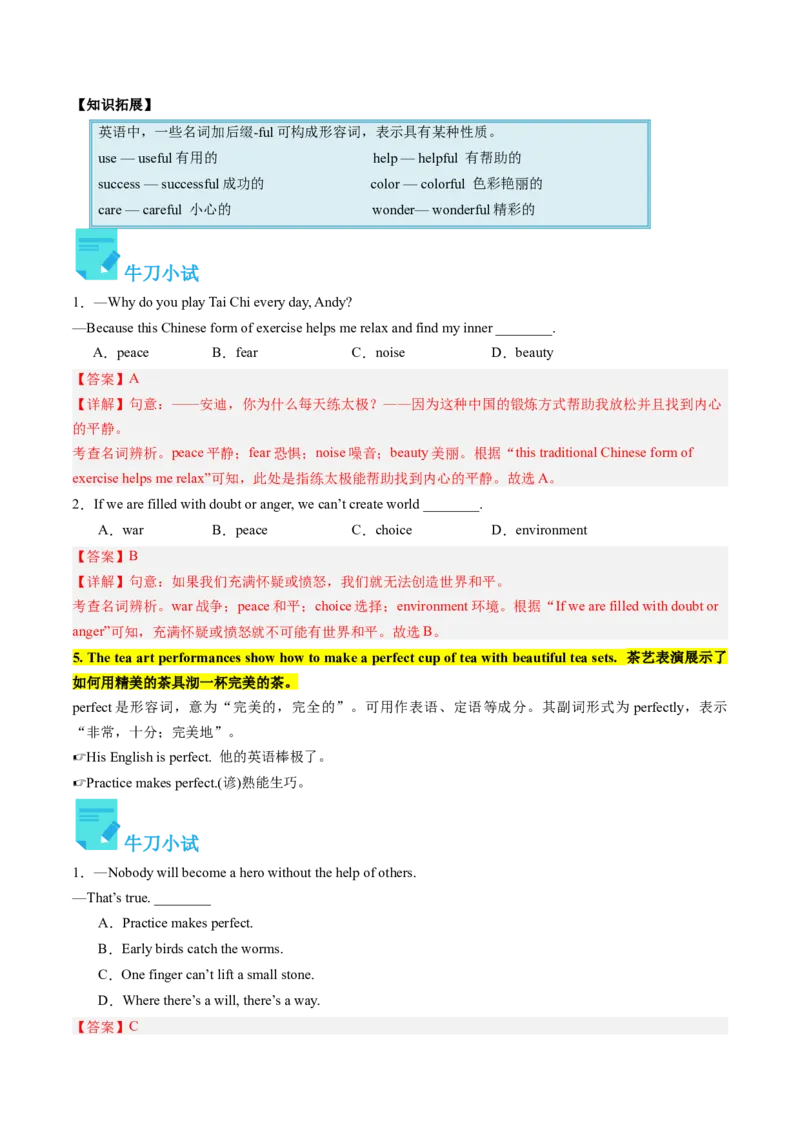
英语中,一些名词加后缀-ful可构成形容词,表示具有某种性质。
use — useful有用的 help — helpful 有帮助的
success — successful成功的 color — colorful 色彩艳丽的
care — careful 小心的 wonder— wonderful精彩的
牛刀小试
1.—Why do you play Tai Chi every day, Andy?
—Because this Chinese form of exercise helps me relax and find my inner ________.
A.peace B.fear C.noise D.beauty
【答案】A
【详解】句意:——安迪,你为什么每天练太极?——因为这种中国的锻炼方式帮助我放松并且找到内心
的平静。
考查名词辨析。peace平静;fear恐惧;noise噪音;beauty美丽。根据“this traditional Chinese form of
exercise helps me relax”可知,此处是指练太极能帮助找到内心的平静。故选A。
2.If we are filled with doubt or anger, we can’t create world ________.
A.war B.peace C.choice D.environment
【答案】B
【详解】句意:如果我们充满怀疑或愤怒,我们就无法创造世界和平。
考查名词辨析。war战争;peace和平;choice选择;environment环境。根据“If we are filled with doubt or
anger”可知,充满怀疑或愤怒就不可能有世界和平。故选B。
5. The tea art performances show how to make a perfect cup of tea with beautiful tea sets. 茶艺表演展示了
如何用精美的茶具沏一杯完美的茶。
perfect是形容词,意为“完美的,完全的”。可用作表语、定语等成分。其副词形式为perfectly,表示
“非常,十分;完美地”。
☞His English is perfect. 他的英语棒极了。
☞Practice makes perfect.(谚)熟能生巧。
牛刀小试
1.—Nobody will become a hero without the help of others.
—That’s true. ________
A.Practice makes perfect.
B.Early birds catch the worms.
C.One finger can’t lift a small stone.
D.Where there’s a will, there’s a way.
【答案】C【详解】句意:——没有别人的帮助,没有人会成为英雄。——的确是这样。一个手指不能举起一块小石
头。
考查谚语及常识。Practice makes perfect熟能生巧;Early birds catch the worms早起的鸟儿有虫吃;One
finger can’t lift a small stone一个手指不能举起一块小石头;Where there’s a will, there’s a way有志者,事竟
成。根据“Nobody will become a hero without the help of others.”可知,在没有别人的帮助下,没有人能成为
英雄,也就意味着势单力薄,无法成就大事,即“一个手指不能举起一块小石头”,故选C。
2.—It’s a shame, I made a mistake in the yard sale.
—Never mind. Nobody is ________. You can be careful next time.
A.stupid B.weak C.modern D.perfect
【答案】D
【详解】句意:——真遗憾,我在庭院销售中犯了一个错误。——不要介意。没有人是完美的。下次你可
以细心点。考查形容词辨析。stupid愚蠢的;weak虚弱的;modern现代的;perfect完美的。根据“Nobody
is ...You can be careful next time.”可知,此处是说没有人是完美的。故选D。
6. There are some special German paintings there right now. 那里现在有一些特别的德国油画。
German作形容词,意为“德国的;德语人的;德语的”。
☞She is an accountant in a German company.
她在一家德国公司当会计。
【拓展】
German作名词“德国人”时,复数形式是Germans,而不是变a为e。表示“德国”
要用Germany。
Five Germans went back to Germany. 五个德国人回德国了。
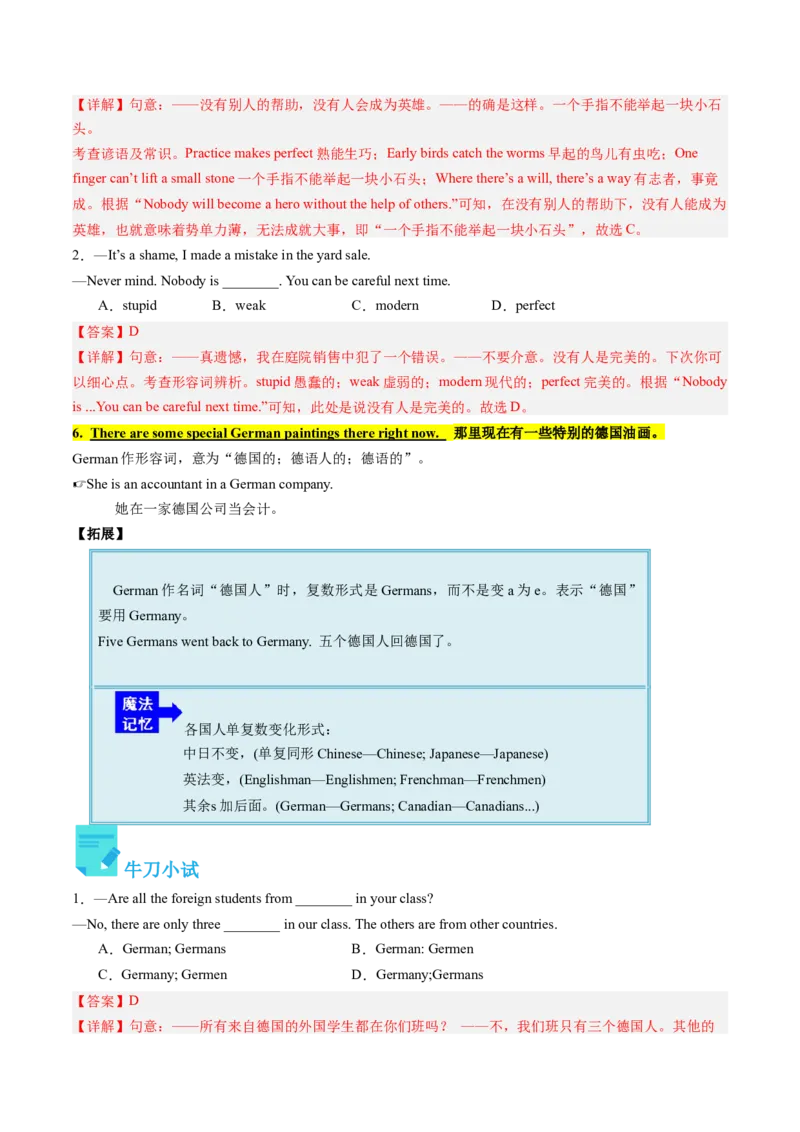
各国人单复数变化形式:
中日不变,(单复同形Chinese—Chinese; Japanese—Japanese)
英法变,(Englishman—Englishmen; Frenchman—Frenchmen)
其余s加后面。(German—Germans; Canadian—Canadians...)
牛刀小试
1.—Are all the foreign students from ________ in your class?
—No, there are only three ________ in our class. The others are from other countries.
A.German; Germans B.German: Germen
C.Germany; Germen D.Germany;Germans
【答案】D
【详解】句意:——所有来自德国的外国学生都在你们班吗? ——不,我们班只有三个德国人。其他的来自其他国家。
考查名词辨析以及名词复数。German德国人;Germany德国。第一空,根据“Are all the foreign students
from…”可知,此处是指来学生来自德国,排除A和B;第二空,根据“there are only three…”可知,此处
是指三个德国人,且German的复数为Germans,排除C。故选D。
2.—Are the visitors all from ________?
—No, there are only 5 ________ in the group.
A.Germany; Germans B.German; Germany C.Germany; Germen
【答案】A
【详解】句意:——游客都来自德国吗?——不,小组里只有5个德国人。
考查名词辨析以及名词复数。Germany德国;German德国人。根据“all from”可知是来自德国,排除B;
数词5后加可数名词复数Germans“德国人”。故选A。
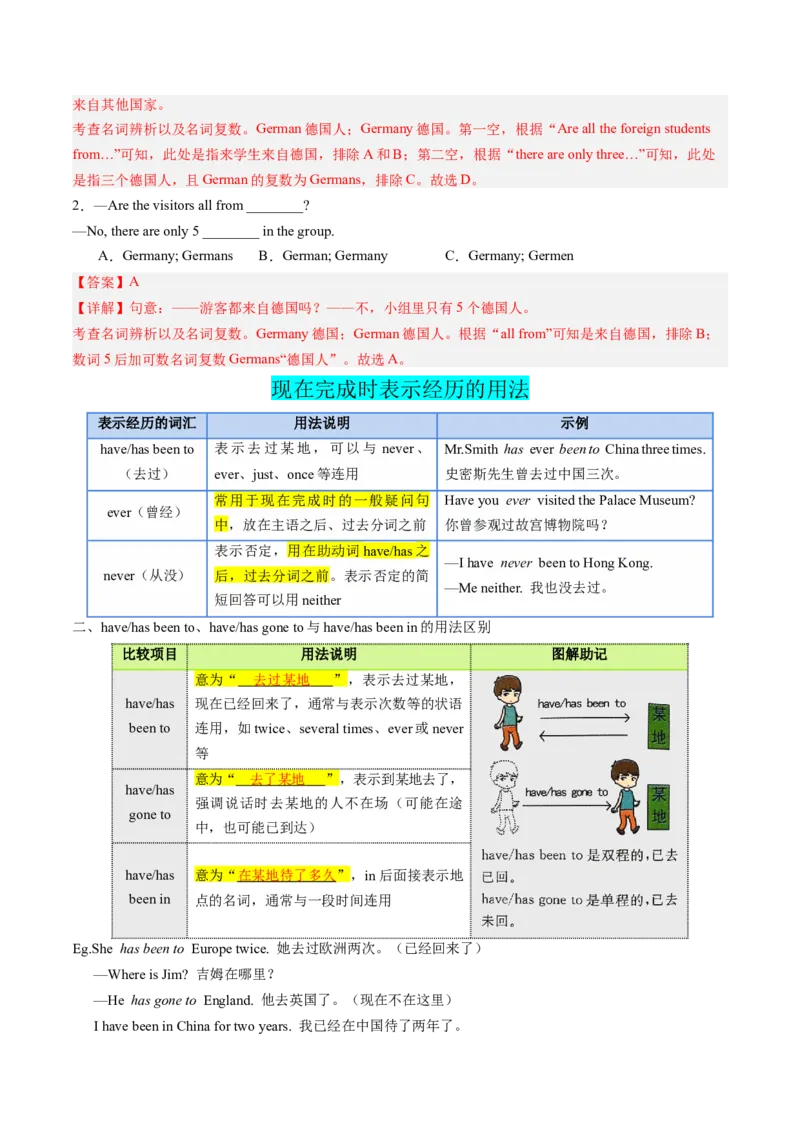
现在完成时表示经历的用法
表示经历的词汇 用法说明 示例
have/has been to 表示去过某地,可以与 never、 Mr.Smith has ever been to China three times.
(去过) ever、just、once等连用 史密斯先生曾去过中国三次。
常用于现在完成时的一般疑问句 Have you ever visited the Palace Museum?
ever(曾经)
中,放在主语之后、过去分词之前 你曾参观过故宫博物院吗?
表示否定,用在助动词have/has之
—I have never been to Hong Kong.
never(从没) 后,过去分词之前。表示否定的简
—Me neither. 我也没去过。
短回答可以用neither
二、have/has been to、have/has gone to与have/has been in的用法区别
比较项目 用法说明 图解助记
意为“ 去过某地 ”,表示去过某地,
have/has 现在已经回来了,通常与表示次数等的状语
been to 连用,如twice、several times、ever或never
等
意为“ 去了某地 ”,表示到某地去了,
have/has
强调说话时去某地的人不在场(可能在途
gone to
中,也可能已到达)
have/has 意为“在某地待了多久”,in后面接表示地
been in 点的名词,通常与一段时间连用
Eg.She has been to Europe twice. 她去过欧洲两次。(已经回来了)
—Where is Jim? 吉姆在哪里?
—He has gone to England. 他去英国了。(现在不在这里)
I have been in China for two years. 我已经在中国待了两年了。【拓展延伸】若have/has been to或have/has gone to后接here、there、home等副词时,则省略介词to。
Eg.He has gone home. 他回家去了。
牛刀小试
1.—Why are you worried?
—I’m expecting a call from my daughter. She ________ New York for three days.
A.has gone to B.has been to C.has been in
【答案】C
【详解】句意:——为什么你很焦急?——我正等待着我女儿的电话。她已经去纽约三天了。
考查动词短语辨析。has gone to去了某地(现在不在说话地);has been to去过某地(现在在说话地);
has been in在某地。由“for three days”可知,此处表示待在某地,与时间段连用用has been in。故选C。
2.—Hello, John. Tom told me you are on holiday. Where have you gone?
—I ________ Hainan since last week. You know sand and sea are my favourite.
A.went to B.have gone to C.have been to D.have been in
【答案】D
【详解】句意:——你好,约翰。汤姆告诉我你在度假。你去哪儿了?——从上周起我就一直在海南。你
知道沙滩和大海是我的最爱。
考查现在完成时用法。根据“since last week”可知,空处用现在完成时;故排除A;have gone to去了某地
(现在人还没回来); have been to去过某地(现在人已经回来);have been in待在某地。根据
“I ...Hainan since last week.”可知,此处指从上周以来就待在海南,应用延续性动词表达。故选D。
3.—Jim isn’t in the classroom. Where is he?
—He ________ to the teacher’s office.
A.had gone B.has been C.had been D.has gone
【答案】D
【详解】句意:——吉姆不在教室里。他在哪里?——他去了老师的办公室。
考查时态。have gone to去了某地还未回来;have been to去过某地已经回来。根据“Jim isn’t in the
classroom. Where is he?”可知已经去了老师的办公室,现在还未回来,用现在完成时has gone。故选D。
4.Everyone except Tom and Mike London before.
A.has gone to B.have been to C.have gone to D.has been to
【答案】D
【详解】句意:除了汤姆和迈克之外,每个人都曾经去过伦敦。
考查现在完成时和主谓一致。have been to去过(已回来);have gone to去了(还未回来)。根据
“before”可知,已经回来,用结构have been to;根据“Everyone except Tom and Mike”可知,此处except
连接的成分作主语时,遵循“就远原则”,谓语动词和Everyone保持一致,助动词用has。故选D。
5.—Is your mother at home now?
—No. She ________ the market to buy some vegetables.A.has gone to B.has been to C.is going to D.has been in
【答案】A
【详解】句意:——你妈妈现在在家吗?——不。她去市场买蔬菜了。
考查动词短语。has gone to已经去了(还未回来);has been to曾经去过(已回来);is going to打算(还
没去);has been in已经待在……了。根据“Is your mother at home now?”和回答“No.”可知,妈妈现在不
在家,说明她去了市场,还没有回来。has gone to符合语境。故选A。
1. Key vocabulary: unbelievable, progress, rapid, unusual, toilet, encourage,
social, peaceful, performance, perfect, itself, collect
2. Target language:
1) I wonder how much more computer will be able to do in the future
2) Watching them prepare the tea with the beautiful tea sets is just as enjoyable as drinking the tea
itself
3) Have you ever been to a science museum?
Yes, I’ve been to a science museum./ No, I’ve never been to a science museum.
4) Have you ever visited the space museum?
Yes, I have. I went there last year./ No, I haven’t.
5) I’ve been to the art museum many times. Me, too. And I’ve also visited the nature museum.
3.To train students’ reading ability and get students know some knowledge about many kinds of
museums.
4.To understand and use the present perfect tense.
一、单项选择
1.When I face difficulties, my teacher always encourages me ________ hard.
A.to work B.works C.working D.worked
【答案】A
【详解】句意:当我遇到困难时,我的老师总是鼓励我努力学习。
考查动词的非谓语。encourage sb. to do sth.“鼓励某人做某事”,固定短语。故选A。
2.The woman couldn’t find her son ________. She’s very worried.
A.anywhere B.somewhere C.nowhere D.where【答案】A
【详解】句意:这个女人到处都找不到她的儿子。她很担心。
考查副词辨析。anywhere在任何地方;somewhere在某处;nowhere无处;where在哪里。根据“The
woman couldn’t find her son... She’s very worried.”可知,在任何地方都找不到她的儿子,所以她很担心。故
选A。
3.Let’s ________ the tent and then we can sleep in it.
A.put on B.look up C.put up D.run out
【答案】C
【详解】句意:让我们搭建这个帐篷,然后我们可以在里面睡觉。
考查动词短语。put on穿上;look up查阅;put up搭建;run out用完。根据“the tent”及“we can
sleep in it”可知,此处指搭建帐篷,故选C。
4.—Have you ________ been to Nanjing, Han Mei?
—No, never. I plan to go there this summer holiday.
A.ever B.still C.yet D.already
【答案】A
【详解】句意:——韩梅,你去过南京吗?——没有,从来没有。我计划这个暑假去那里。
考查副词辨析。ever曾经;still仍然;yet仍然,还;already已经。根据“Have you ... been to Nanjing, Han
Mei?”可知,此处指是否曾去过南京,一般疑问句中用ever。故选A。
5.—I can’t find my lost dog ________.
—Don’t worry. Maybe you can find it ________.
A.anywhere; anywhere
B.somewhere; everywhere
C.anywhere; somewhere
D.everywhere; somewhere
【答案】C
【详解】句意:——我哪儿也找不到我丢失的狗。——不要担心。也许你可以在某个地方找到它。
考查地点副词辨析。anywhere任何地方;everywhere每个地方;somewhere某个地方。根据“I can’t find
my lost dog”可知是在任何地方都找不到自己的狗,否定句中用anywhere;根据“you can find it...”可知是会
在某个地方找到,用somewhere。故选C。
6.Harry ________ that beautiful village for half a month and he will come back next week.
A.has been to B.has been in
C.has gone to D.has gone in
【答案】B
【详解】句意:哈里已经在那个美丽的村庄待了半个月了,下星期他将回来。
考查现在完成时。have been to去过(已回);have gone to去了(未回);have been in在某地待一段时间。
根据“beautiful village for half a month”可知,此处表示在某地待一段时间,应用have been in。故选B。7.—Have you ever ________ Guilin before?
—Yes. I went there with my mother last year.
A.gone in B.gone to
C.been in D.been to
【答案】D
【详解】句意:——你之前曾经去过桂林吗?——是的。去年我和妈妈一起去了那里。
考查时态。have gone to去了某地,还未回来;have been to去过某地,已经回来;have been in待在某地。
根据“I went there with my mother last year.”可知是去过桂林,但是已经回来,用have been to。故选D。
8.—May I speak to Mary, please?
—Sorry, she is not here now. She ________ the library.
A.went B.was going to
C.has been to D.has gone to
【答案】D
【详解】句意:——我可以和Mary说话吗?——对不起,她现在不在这里。她去了图书馆。
考查时态。have been to去过,已经回来;have gone to去了,还未回来。根据“she is not here now. She...the
library”可知她去了图书馆,还未回来,用have gone to。故选D。
9.Alexander Graham Bell ________ the telephone in 1876.
A.discovered B.invented C.found D.produced
【答案】B
【详解】句意:亚历山大·格雷厄姆·贝尔在1876年发明了电话。
考查动词辨析。discovered发现;invented发明;found找到;produced生产。根据“the telephone”可知,贝
尔在1876年发明了电话,故选B。
10.The children enjoyed ________ at the party yesterday afternoon.
A.himself B.herself C.themselves D.itself
【答案】C
【详解】句意:学生们在昨天下午的派对玩得很开心。
考查反身代词。himself他自己;herself她自己;themselves他们自己;itself它自己。enjoy oneself“玩的开
心”,句子的主语是the children“孩子们”是复数,因此这里用themselves指孩子们自己。故选C。
二、完型填空
Mohamed moved to the United States last week. He looked at the 11 in a restaurant. However, he didn’t
want to have sandwiches. Mohamed 12 that he would just get dessert (甜品) instead. And then he ordered
some ice—cream in a 13 . Mohamed was so excited about moving to the United States before, but now he
felt a little 14 .
Several minutes later, a woman 15 with a tall paper cup full of some kind of drink. Mohamed took the
cup and thanked her, thinking that it was 16 that he had used the wrong word.
“It’s the soda. You 17 it,” she said, “a kind of ice-cream drink in a cup.”
He 18 at the woman and started drinking. Why was English so 19 for him in his classes inTunisia? But when he went to the United States, he couldn’t even express(表达)what he wanted to eat. Mohamed
wondered if an American moving to Tunisia would have the same 20 —wondering what to eat, how to ask
for it, and even how to eat it. He also wondered if he would find that his French was not as good as he thought.
11.A.book B.menu C.mirror D.magazine
12.A.seemed B.wondered C.decided D.disliked
13.A.spoon B.table C.cup D.bowl
14.A.worried B.shy C.excited D.enjoyable
15.A.dressed up B.cut out C.turned into D.came over
16.A.usual B.possible C.magic D.lucky
17.A.dropped B.compared C.ordered D.invented
18.A.smiled B.shouted C.cried D.beat
19.A.creative B.necessary C.difficult D.easy
20.A.relationship B.feeling C.meaning D.character
【答案】
11.B 12.C 13.C 14.A 15.D 16.B 17.C 18.A 19.D 20.B
【分析】本文讲述了一个搬到美国的突尼斯人在饭馆点餐的一次经历。
11.句意:他看了看餐馆的菜单。
book书;menu菜单;mirror镜子;magazine杂志。根据后文“However, he didn’t want to have sandwiches…
And then he ordered some ice—cream…”可知,此处应该是看菜单,故选B。
12.句意:穆罕默德决定点一些甜点。
seemed似乎;wondered想知道;decided决定;disliked不喜欢。根据后一句“However, he didn’t want to
have sandwiches.”可知,这里是指决定点一些甜点,故选C。
13.句意:然后他点了一些装在杯子里的冰淇淋。
spoon勺子;table桌子;cup杯子;bowl碗。根据下文“…a kind of ice-cream drink in a cup.”可知,此处指
装在杯子里的冰淇淋,故选C。
14.句意:穆罕默德以前对搬到美国感到非常兴奋,但现在他感到有点担心。
worried担忧的;shy害羞的;excited激动的;enjoyable愉快的。根据转折连词but可知,此处应该与之前
的激动形成对比,故选A。
15.句意:几分钟后,一个女人拿着一个高高的纸杯过来,里面装满了某种饮料。
dressed up打扮;cut out切断;turned into变成;came over过来。根据句中“with a tall paper cup full of
some kind of drink”可知,这里指服务员走过来,故选D。
16.句意:穆罕默德拿起杯子向她表示感谢,认为自己可能用错了词。
usual通常的;possible可能的;magic有魔力的;lucky幸运的。根据文中可知,服务员带来的不是他想要
的,所以这里指他认为自己可能用错了词,故选B。
17.句意:“是苏打水。你点的,”她说,“一种装在杯子里的冰淇淋饮料。”
dropped落下;compared比较;ordered点单;invented发明。根据上文“And then he ordered some ice—
cream…”可知,服务员认为穆罕默德点的是苏打水,故选C。18.句意:他朝那个女人笑了笑,开始喝那个饮料。
smiled微笑;shouted大喊;cried哭泣;beat击打。结合全文可知,此处指他笑了笑,故选A。
19.句意:为什么在突尼斯的课堂上英语对他来说那么容易?
creative有创造性的;necessary必须的;difficult困难的;easy容易的。根据后一句“But when he went to
the United States, he couldn’t even express what he wanted to eat.”可知,当他在突尼斯的时候,英语对他是很
简单的事情,故选D。
20.句意:穆罕默德想知道一个搬到突尼斯的美国人是否也会有同样的感受——不知道吃什么,怎么点,
甚至怎么吃。
relationship关系;feeling感受;meaning意思;character性格。根据后半句“wondering what to eat, how to
ask for it, and even how to eat it”可知,这里是指是否也会有同样的感受,故选B。
三、阅读理解
A
Welcome to www.youthtravel.com
Would you like to join us this summer vacation? Here are tours of four amazing museums. You can not only
enjoy your life, but also learn something interesting.
The Underwater MuseumTime: July 5—10 Age: 8—18
Ticket: ¥50
You can enjoy fishes in different colors.
There are also excellent dolphin shows. If you are brave enough, have a try to swim underwater to see the sea
life clearly. Buy some gifts for your family if necessary.
The Museum of MoviesTime: July 16—21 Age: 8—15
Ticket: ¥20
This is a museum about movies and cameras. It has very old cameras and you can learn a lot about the history of
them. To relax yourself, you may watch famous movies from all over the world.
The China (瓷器) Museum of the Song DynastyTime: August 3—8 Age: 12—18
Ticket: free
More than 120 china pieces from ancient China are on show here. You can make your clay art works in person at
a very good price. Come and have fun with your friends! It is open every day except Monday.
Suining Science and Technology MuseumTime: August 23—28 Age: over 6
Ticket: free
You may learn something about space and increase your science knowledge. You can experience wonderful
activities, such as VR games, driving games, recycling games and so on. Children under 12 must be with at least
one adult.
21.Jenny is a 7-year-old girl. Which museum can she visit?
A.The Underwater Museum.B.The Museum of Movies.
C.The China Museum of the Song Dynasty.
D.Suining Science and Technology Museum.
22.If a boy has an interest in the old cameras, he can go to the museum on ________.
A.July 6 B.July 18 C.August 5 D.August 24
23.Helen wants to visit the Underwater Museum with her classmate Sally. How much do they have to pay?
A.¥20. B.¥50. C.¥100. D.¥150.
24.At Suining Science and Technology Museum, you can ________.
A.watch movies B.swim underwater C.make clay art piecesD.experience VR games
25.The reading may come from ________.
A.the Internet B.a textbook C.a storybook D.science fiction
【答案】21.D 22.B 23.C 24.D 25.A
【导语】本文是四个令人惊叹的博物馆的活动广告,包括时间,票价,特点等信息。
21.细节理解题。根据“Suining Science and Technology Museum Age: over 6”可知,7岁的詹妮可以去遂
宁科技馆,故选D。
22.细节理解题。根据“The Museum of Movies Time: July 16—21 It has very old cameras and you can learn
a lot about the history of them.”可知,如果一个男孩对旧相机感兴趣,他可以在7月16日至21日去电影博
物馆,故选B。
23.细节理解题。根据“The Underwater Museum Ticket: ¥50”可知,水下博物馆的票价是50元/人,所
以两个人是100元。故选C。
24.细节理解题。根据“Suining Science and Technology Museum You can experience wonderful activities,
such as VR games, driving games, recycling games and so on.”可知,在遂宁科技馆你可以体验精彩的活动,比
如VR游戏、驾驶游戏、回收游戏等等。故选D。
25.推理判断题。根据“Welcome to www.youthtravel.com”可知,可以在网上看到这篇文章,故选A。
B
Recently, several unhappy things happened to Gina. One afternoon she called a friend to talk about them. After
hearing her words, the friend invited her to her home for tea and said, “All trouble will disappear after tasting tea.”
Gina couldn't believe her, but she still decided to go for relaxation. At the friend's home, her friend took out a
square box and said, “I asked someone to buy the tea from China. It's said that there are five tastes.” Then, her friend
opened the box slowly, took out a spoon of tea carefully, put it into a teapot(茶壶)gingerly, and then poured in boiled
water softly.
Only one minute later, the friend poured out a cup of tea and asked Gina to taste it. Gina drank it but nearly
puked(吐)it out. She shouted, “Is this tea? It tastes like medicine!”
The friend just smiled. She re-poured boiled water into the teapot. After a minute, the friend poured out another
cup and asked Gina to try the second one. Gina took a drink and found it was not as terrible as the first one but still
bitter(苦的). This time she didn't shout. When Gina drank the fifth cup, a sunny smile shone on her face. She said,
“It tastes good! I've never tasted such a wonderful flavor(味道).”The friend said, “Life is just like this! Only when we taste it patiently can we feel happy.”
26.One afternoon Gina called her friend to talk about her ________.
A.life B.study C.trouble D.health
27.Gina's friend asked someone to buy the tea from ________.
A.America B.China C.Britain D.Japan
28.The underlined word “gingerly” means ________.
A.carelessly and bravely B.secretly and angrily
C.suddenly and impolitely D.carefully and slowly
29.Gina thought the first cup of tea was ________.
A.bitter B.salty C.sweet D.hot
30.What's the main idea of the passage?
A.Unhappy things always happened to Gina.
B.Gina was invited to her friend's home for tea.
C.When we taste life patiently, we can feel happy.
D.Whenever we have trouble, we should drink tea.
【答案】26.C 27.B 28.D 29.A 30.C
【分析】最近Gina遇到了很多不开心的事情,她把这些事情和自己的一个朋友说了说。她的朋友邀请她去
家里喝茶,说喝完茶后,这些麻烦就都会消失了。Gina去了朋友家,朋友给她煮茶并告诉她只有耐心品味
生活才会感觉到幸福。
26.细节理解题。根据短文第一段 “Recently, several unhappy things happened to Gina. One afternoon she
called a friend to talk about them.”可知,Gina和朋友谈的是自己遇到的不开心的事情,也就是trouble“麻烦,
烦恼”。故选C。
27.细节理解题。根据短文第二段 “her friend took out a square box and said, “I asked someone to buy the tea
from China.”可知,Gina的朋友是让人从中国买的茶叶。故选B。
28.词义猜测题。根据划线单词所在的语境 “Then, her friend opened the box slowly, took out a spoon of tea
carefully, put it into a teapot(茶壶)gingerly, and then poured in boiled water softly.”可以看到,Gina的朋友打开
盒子、拿出茶匙、往茶壶里放茶叶、倒进开水里,这一系列的动作都使用了slowly, carefully, softly修饰,
是“慢慢地、小心地、温柔地”,因此gingerly与这几个副词的意思应该是相近的,所以A中的bravely、
B中的angrily和C中的impolitely都不符合语境。故选D。
29.细节理解题。根据短文第三段 “Gina drank it but nearly puked(吐)it out. She shouted, “Is this tea? It
tastes like medicine!””可知,Gina喝了第一杯茶,感觉像喝药一样;再根据第四段 “Gina took a drink and
found it was not as terrible as the first one but still bitter”,Gina喝的第二杯不像第一杯那样苦了。因此Gina觉
得第一杯茶太苦了。故选A。
30.主旨大意题。这篇短文先是讲述了Gina去朋友家里喝茶的故事,通过叙事告诉我们一个道理。因此最
后一段是点明文章主旨的句子,根据最后一段 “The friend said, “Life is just like this! Only when we taste it
patiently can we feel happy.”可知,作者想要告诉我们的是:只有当我们耐心品味生活的时候,我们才会感
到幸福。故选C。【点睛】这是一篇记叙文,但也不全是叙事,通过叙事讲述一个道理,有记叙、有议论。文章内容不难理
解,题型是阅读理解,考查学生们通过阅读短文获取文章主旨以及细节信息、猜测生词含义以及进行合理
的推测和判断的能力。这个题目设置了细节题、猜词题和主旨题。细节题往往较为简单,答案常可以直接
在原文找到,做题时可根据题干所问,或利用题干中的关键词,在原文中锁定相关信息作答。如第1小题
和第2小题,这两个题目就比较简单。猜词题需要学生们结合上下文语境、利用构成法的知识等进行猜测,
如第3小题,首先从构成法上gingerly应该是一个副词,从它所在的句子里,我们可以发现其他的一些修
饰词,如slowly, carefully, softly等,这些都是表示“慢地、小心地、温柔地”等意思,因此gingerly应该
与它们意思相近,这样就可以知道答案。