八年级下册英语 Unit 1 知识点与语法精讲精练
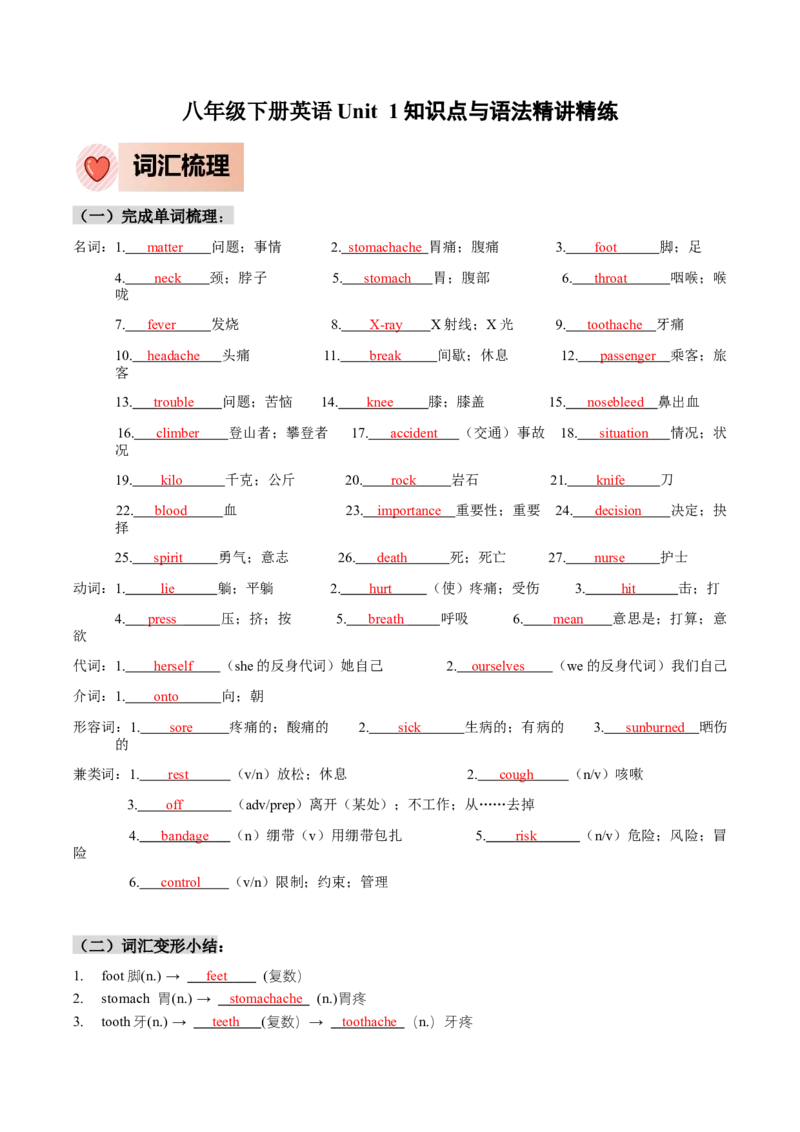
词汇梳理
(一)完成单词梳理:
名词:1. matte r 问题;事情 2. stomachach e 胃痛;腹痛 3. foo t 脚;足
4. nec k 颈;脖子 5. stomac h 胃;腹部 6. throa t 咽喉;喉
咙
7. feve r 发烧 8. X-ra y X射线;X光 9. toothach e 牙痛
10. headach e 头痛 11. break 间歇;休息 12. passenge r 乘客;旅
客
13. troubl e 问题;苦恼 14. kne e 膝;膝盖 15. noseblee d 鼻出血
16. climbe r 登山者;攀登者 17. acciden t (交通)事故 18. situation 情况;状
况
19. kil o 千克;公斤 20. roc k 岩石 21. knif e 刀
22. bloo d 血 23. importanc e 重要性;重要 24. decision 决定;抉
择
25. spiri t 勇气;意志 26. deat h 死;死亡 27. nurs e 护士
动词:1. li e 躺;平躺 2. hur t (使)疼痛;受伤 3. hi t 击;打
4. pres s 压;挤;按 5. breath 呼吸 6. mean 意思是;打算;意
欲
代词:1. hersel f (she的反身代词)她自己 2. ourselve s (we的反身代词)我们自己
介词:1. ont o 向;朝
形容词:1. sor e 疼痛的;酸痛的 2. sick 生病的;有病的 3. sunburned 晒伤
的
兼类词:1. res t (v/n)放松;休息 2. coug h (n/v)咳嗽
3. of f (adv/prep)离开(某处);不工作;从……去掉
4. bandag e (n)绷带(v)用绷带包扎 5. risk (n/v)危险;风险;冒
险
6. contro l (v/n)限制;约束;管理
(二)词汇变形小结:
1. foot脚(n.) → feet (复数)
2. stomach 胃(n.) → stomachache (n.)胃疼
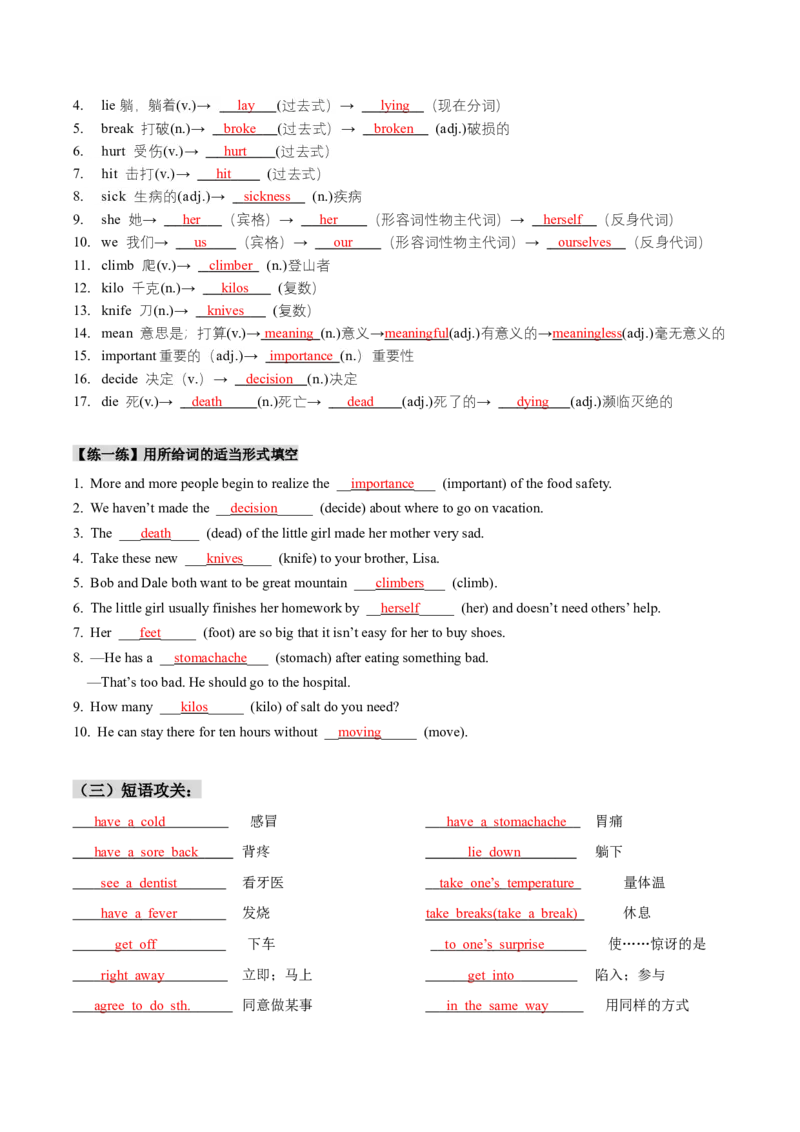
3. tooth牙(n.) → teeth (复数)→ toothache (n.)牙疼4. lie 躺,躺着(v.)→ lay (过去式)→ lying (现在分词)
5. break 打破(n.)→ broke (过去式)→ broken (adj.)破损的
6. hurt 受伤(v.)→ hurt (过去式)
7. hit 击打(v.)→ hit (过去式)
8. sick 生病的(adj.)→ sickness (n.)疾病
9. she 她→ her (宾格)→ her (形容词性物主代词)→ herself (反身代词)
10. we 我们→ us (宾格)→ our (形容词性物主代词)→ ourselves (反身代词)
11. climb 爬(v.)→ climber (n.)登山者
12. kilo 千克(n.)→ kilos (复数)
13. knife 刀(n.)→ knives (复数)
14. mean 意思是;打算(v.)→ meaning (n.)意义→meaningful(adj.)有意义的→meaningless(adj.)毫无意义的
15. important重要的(adj.)→ importance (n.)重要性
16. decide 决定(v.)→ decision (n.)决定
17. die 死(v.)→ death (n.)死亡→ dead (adj.)死了的→ dying (adj.)濒临灭绝的
【练一练】用所给词的适当形式填空
1. More and more people begin to realize the __importance___ (important) of the food safety.
2. We haven’t made the __decision_____ (decide) about where to go on vacation.
3. The ___death____ (dead) of the little girl made her mother very sad.
4. Take these new ___knives____ (knife) to your brother, Lisa.
5. Bob and Dale both want to be great mountain ___climbers___ (climb).
6. The little girl usually finishes her homework by __herself_____ (her) and doesn’t need others’ help.
7. Her ___feet_____ (foot) are so big that it isn’t easy for her to buy shoes.
8. —He has a __stomachache___ (stomach) after eating something bad.
—That’s too bad. He should go to the hospital.
9. How many ___kilos_____ (kilo) of salt do you need?
10. He can stay there for ten hours without __moving_____ (move).
(三)短语攻关:
hav e a col d 感冒 hav e a stomachach e 胃痛
hav e a sor e bac k 背疼 li e dow n 躺下
se e a dentis t 看牙医 tak e on e ’ s temperatur e 量体温
hav e a feve r 发烧 take breaks(take a break) 休息
ge t of f 下车 t o on e ’ s surpris e 使……惊讶的是
righ t awa y 立即;马上 ge t int o 陷入;参与
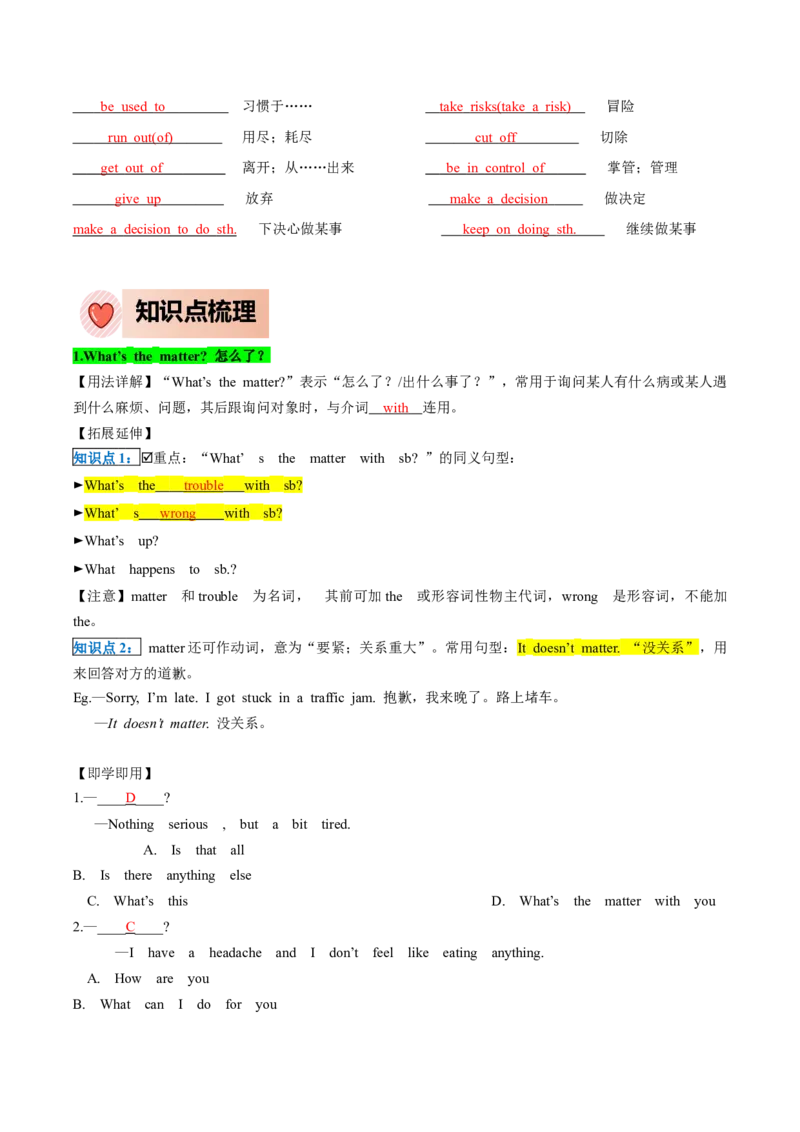
agre e t o d o sth . 同意做某事 i n th e sam e wa y 用同样的方式b e use d t o 习惯于…… tak e risks(tak e a risk ) 冒险
ru n out(of ) 用尽;耗尽 cu t of f 切除
ge t ou t o f 离开;从……出来 b e i n contro l o f 掌管;管理
giv e u p 放弃 mak e a decisio n 做决定
make a decision to do sth . 下决心做某事 kee p o n doin g sth . 继续做某事
知识点梳理
1.What’s the matter? 怎么了?
【用法详解】“What’s the matter?”表示“怎么了?/出什么事了?”,常用于询问某人有什么病或某人遇
到什么麻烦、问题,其后跟询问对象时,与介词 wit h 连用。
【拓展延伸】
知识点1:重点:“What’ s the matter with sb? ”的同义句型:
►What’s the troubl e with sb?
►What’ s wron g with sb?
►What’s up?
►What happens to sb.?
【注意】matter 和trouble 为名词, 其前可加the 或形容词性物主代词,wrong 是形容词,不能加
the。
知识点2: matter还可作动词,意为“要紧;关系重大”。常用句型:It doesn’t matter. “没关系”,用
来回答对方的道歉。
Eg.—Sorry, I’m late. I got stuck in a traffic jam. 抱歉,我来晚了。路上堵车。
—It doesn’t matter. 没关系。
【即学即用】
1.—____D____?
—Nothing serious , but a bit tired.
A. Is that all
B. Is there anything else
C. What’s this D. What’s the matter with you
2.—____C____?
—I have a headache and I don’t feel like eating anything.
A. How are you
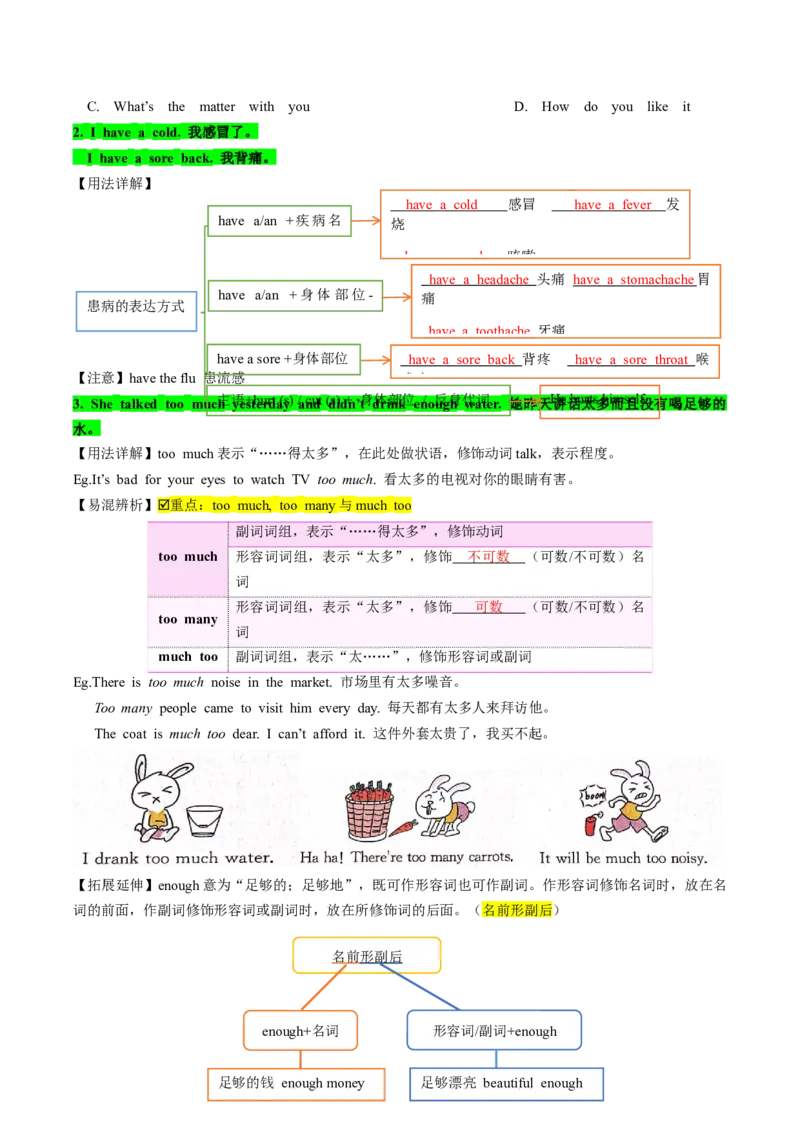
B. What can I do for youC. What’s the matter with you D. How do you like it
2. I have a cold. 我感冒了。
I have a sore back. 我背痛。
【用法详解】
hav e a cold 感冒 hav e a feve r 发
have a/an +疾病名 烧
称
hav e a coug h 咳嗽
hav e a headach e 头痛 have a stomachache 胃
have a/an +身体部位- 痛
患病的表达方式
ache
hav e a toothach e 牙痛
have a sore +身体部位 hav e a sor e back 背疼 hav e a sor e throa t 喉
【注意】have the flu 患流感 咙疼
3. She talked too muc 主 h 语 ye + st h e u r r d t a ( y s) / a n cu d t ( d s i ) d + n ’ 身 t d 体 ri 部 nk 位 e n / o 反 ug 身 h 代 wa 词 ter. 她昨天 H 讲 e 话 hu 太 rts 多 hi 而 ms 且 elf 没 . 有喝足够的
水。
【用法详解】too much表示“……得太多”,在此处做状语,修饰动词talk,表示程度。
Eg.It’s bad for your eyes to watch TV too much. 看太多的电视对你的眼睛有害。
【易混辨析】重点:too much, too many与much too
副词词组,表示“……得太多”,修饰动词
too much 形容词词组,表示“太多”,修饰 不可数 (可数/不可数)名
词
形容词词组,表示“太多”,修饰 可数 (可数/不可数)名
too many
词
much too 副词词组,表示“太……”,修饰形容词或副词
Eg.There is too much noise in the market. 市场里有太多噪音。
Too many people came to visit him every day. 每天都有太多人来拜访他。
The coat is much too dear. I can’t afford it. 这件外套太贵了,我买不起。
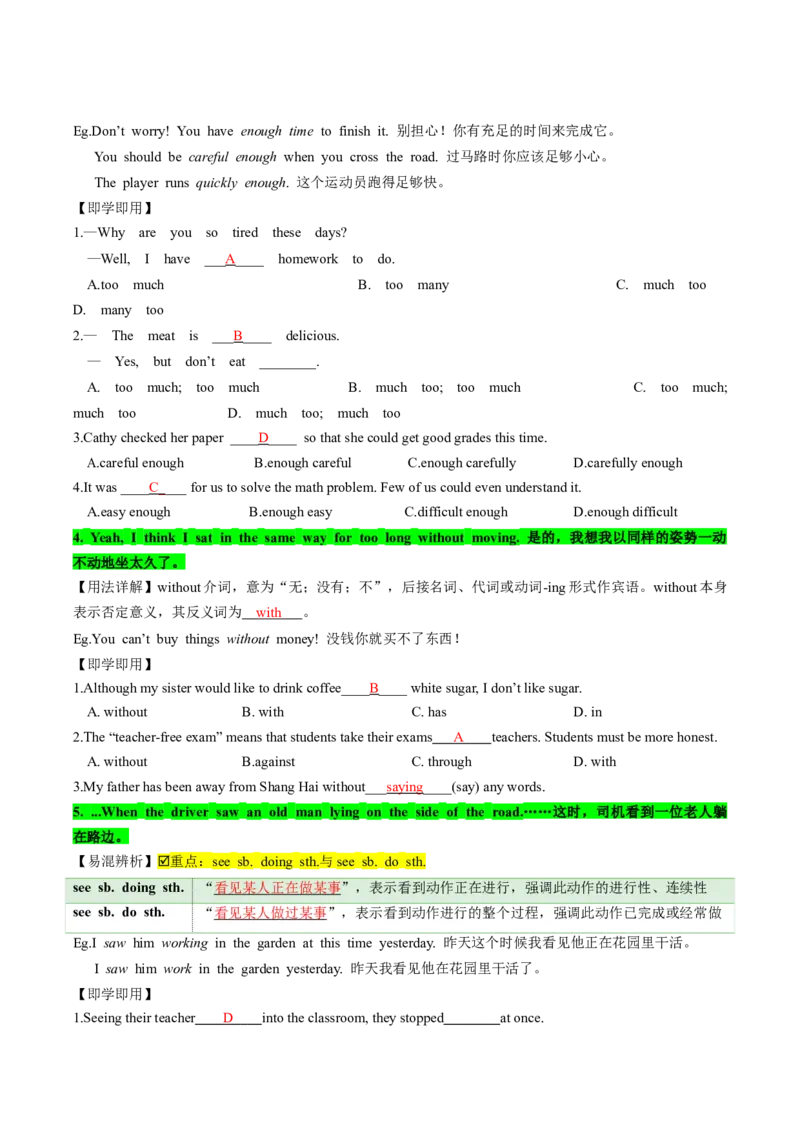
【拓展延伸】enough意为“足够的;足够地”,既可作形容词也可作副词。作形容词修饰名词时,放在名
词的前面,作副词修饰形容词或副词时,放在所修饰词的后面。(名前形副后)
名前 形副后
enough+名词 形容词/副词+enough
足够的钱 enough money 足够漂亮 beautiful enoughEg.Don’t worry! You have enough time to finish it. 别担心!你有充足的时间来完成它。
You should be careful enough when you cross the road. 过马路时你应该足够小心。
The player runs quickly enough. 这个运动员跑得足够快。
【即学即用】
1.—Why are you so tired these days?
—Well, I have ___A____ homework to do.
A.too much B. too many C. much too
D. many too
2.— The meat is ___B____ delicious.
— Yes, but don’t eat ________.
A. too much; too much B. much too; too much C. too much;
much too D. much too; much too
3.Cathy checked her paper ____D____ so that she could get good grades this time.
A.careful enough B.enough careful C.enough carefully D.carefully enough
4.It was ____ C _ ___ for us to solve the math problem. Few of us could even understand it.
A.easy enough B.enough easy C.difficult enough D.enough difficult
4. Yeah, I think I sat in the same way for too long without moving. 是的,我想我以同样的姿势一动
不动地坐太久了。
【用法详解】without介词,意为“无;没有;不”,后接名词、代词或动词-ing形式作宾语。without本身
表示否定意义,其反义词为 wit h 。
Eg.You can’t buy things without money! 没钱你就买不了东西!
【即学即用】
1.Although my sister would like to drink coffee____B____ white sugar, I don’t like sugar.
A. without B. with C. has D. in
2.The “teacher-free exam” means that students take their exams A teachers. Students must be more honest.
A. without B.against C. through D. with
3.My father has been away from Shang Hai without___saying____(say) any words.
5. ...When the driver saw an old man lying on the side of the road.……这时,司机看到一位老人躺
在路边。
【易混辨析】重点:see sb. doing sth.与see sb. do sth.
see sb. doing sth. “看见某人正在做某事”,表示看到动作正在进行,强调此动作的进行性、连续性
see sb. do sth. “看见某人做过某事”,表示看到动作进行的整个过程,强调此动作已完成或经常做
Eg.I saw him working in the garden at this time yesterday. 昨天这个时候我看见他正在花园里干活。
I saw him work in the garden yesterday. 昨天我看见他在花园里干活了。
【即学即用】
1.Seeing their teacher D into the classroom, they stopped at once.A. walk; telling B. entering; to speak C. enter; to tell
D. walking; talking
2.—I tired to make Alice D her mind but I found it difficult.
—Well, I saw you that when I went past.
A. changed ; do B. changes ; doing C. change ; to do D. change ; doing
3.When I walked past the park, I saw some old people C Chinese t’ai chi.
A.do B. did C. doing D. are doing
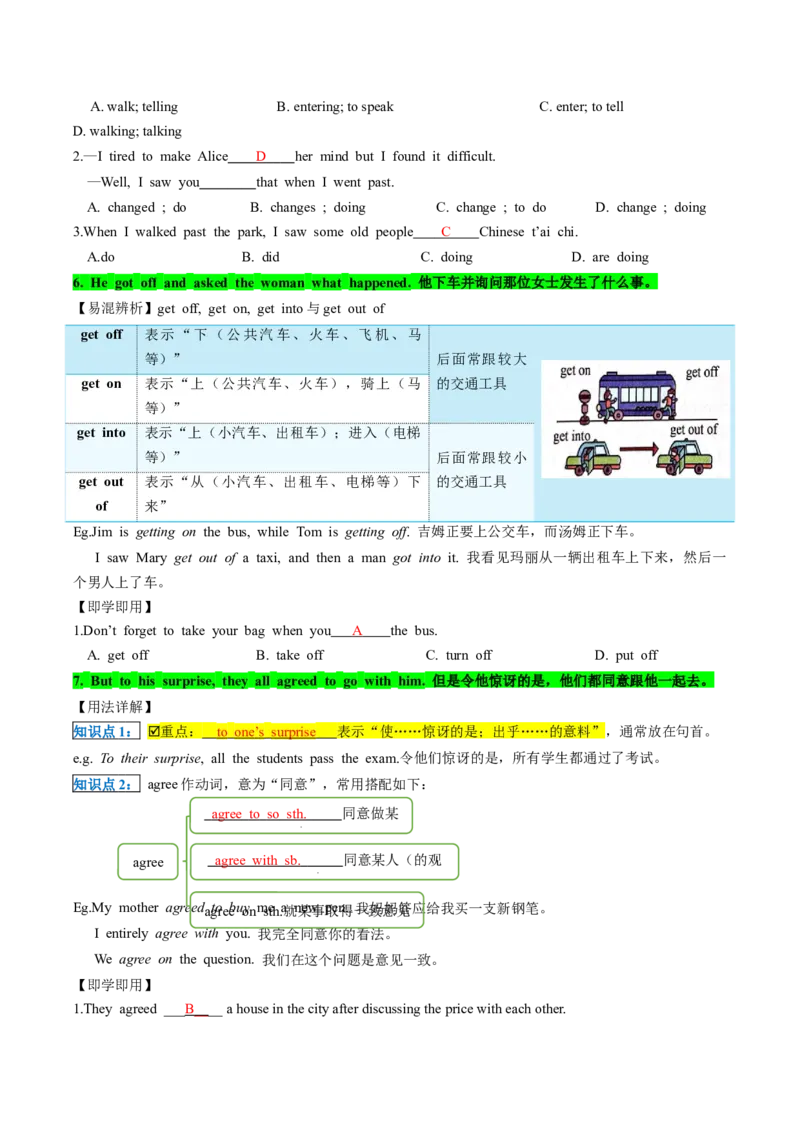
6. He got off and asked the woman what happened. 他下车并询问那位女士发生了什么事。
【易混辨析】get off, get on, get into与get out of
get off 表示“下(公共汽车、火车、飞机、马
等)” 后面常跟较大
get on 表示“上(公共汽车、火车),骑上(马 的交通工具
等)”
get into 表示“上(小汽车、出租车);进入(电梯
等)” 后面常跟较小
get out 表示“从(小汽车、出租车、电梯等)下 的交通工具
of 来”
Eg.Jim is getting on the bus, while Tom is getting off. 吉姆正要上公交车,而汤姆正下车。
I saw Mary get out of a taxi, and then a man got into it. 我看见玛丽从一辆出租车上下来,然后一
个男人上了车。
【即学即用】
1.Don’t forget to take your bag when you A the bus.
A. get off B. take off C. turn off D. put off
7. But to his surprise, they all agreed to go with him. 但是令他惊讶的是,他们都同意跟他一起去。
【用法详解】
知识点1: 重点: t o on e ’ s surpris e 表示“使……惊讶的是;出乎……的意料”,通常放在句首。
e.g. To their surprise, all the students pass the exam.令他们惊讶的是,所有学生都通过了考试。
知识点2: agree作动词,意为“同意”,常用搭配如下:
agre e t o s o sth . 同意做某
事
agree agre e wit h sb . 同意某人(的观
点)
Eg.My mother agreed agtor eeb uoyn mseth .a就 n某ew事 p取en得. 一我致妈意妈见答应给我买一支新钢笔。
I entirely agree with you. 我完全同意你的看法。
We agree on the question. 我们在这个问题是意见一致。
【即学即用】
1.They agreed ___ B __ __ a house in the city after discussing the price with each other.A.buy B.to buy C.buying D.bought
2.To ____our_____ (we) surprise, Tom didn’t give up climbing mountains after the accident.
8. Thanks to Mr. Wang and the passengers, the man was saved by the doctors in time. 多亏了王先
生和乘客们,医生及时挽救了老人的生命。
【用法详解】thanks to表示“由于;多亏”,在句中作状语,常位于句首。可与 because of或with the
help of进行转换。
Eg.Thanks to you help, we finished the task on time. 多亏了你的帮助,我们才按时完成了任务。
【易混辨析】thanks to 与 thanks for
thanks to 多亏;由于 介词to后跟表示感谢的对象,可以是名词、代词或动词-ing形式
thanks for 因……而感谢 介词for后跟感谢的原因,可以是名词、代词或动词-ing形式
Eg. Thanks to you, I am not lost. 幸亏你我才没迷路。
Eg. Thanks for sending me such a nice present. 谢谢你寄给我这么好的一个礼物。
【即学即用】
1.___B____ her husband, she has now become a famous film star.
A. Because B. Thanks to C. Thanks for
D. With the help
9.have problems breathing 呼吸困难
【用法详解】have problems (in) doing sth. 表示“做某事有困难或麻烦”,相当于have trouble/difficulty
(in) doing sth.
Eg.I have problems/trouble/difficulty (in) learning English. 我学习英语有困难。
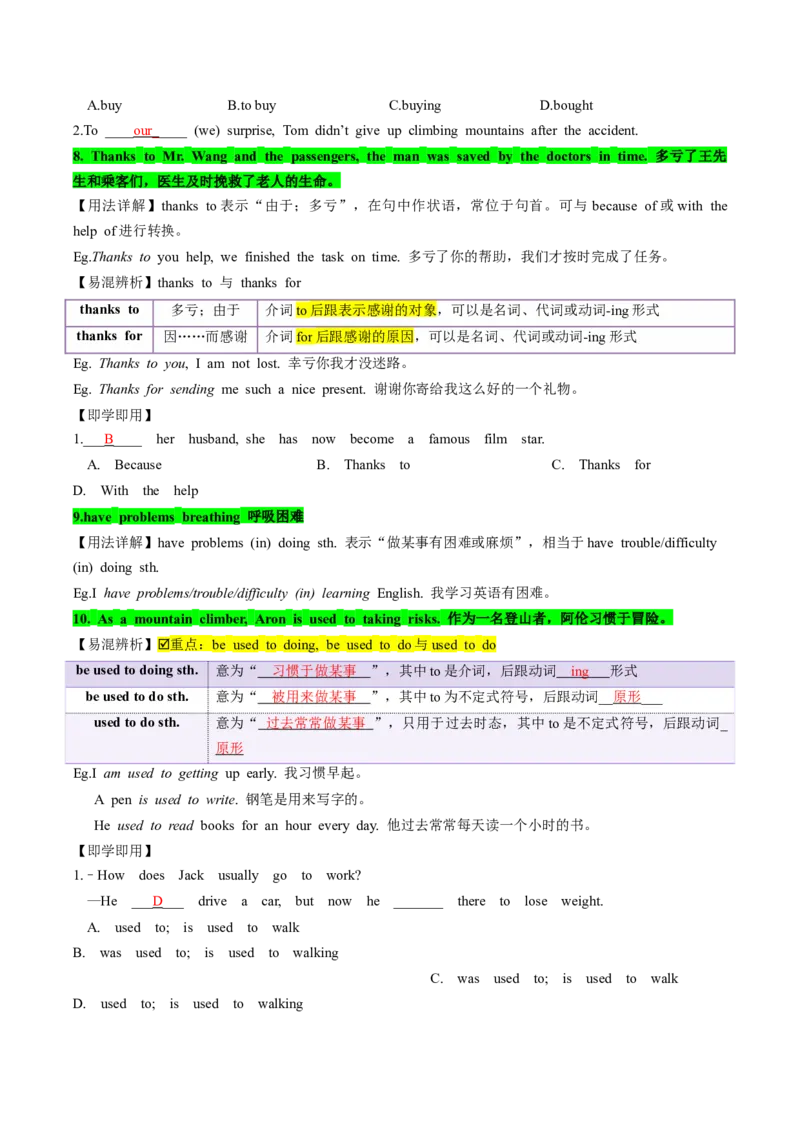
10. As a mountain climber, Aron is used to taking risks. 作为一名登山者,阿伦习惯于冒险。
【易混辨析】重点:be used to doing, be used to do与used to do
be used to doing sth. 意为“ 习惯于做某事 ”,其中to是介词,后跟动词 in g 形式
be used to do sth. 意为“ 被用来做某事 ”,其中to为不定式符号,后跟动词__原形___
used to do sth. 意为“ 过去常常做某事 ”,只用于过去时态,其中to是不定式符号,后跟动词_
原形
Eg.I am used to getting up early. 我习惯早起。
A pen is used to write. 钢笔是用来写字的。
He used to read books for an hour every day. 他过去常常每天读一个小时的书。
【即学即用】
1.–How does Jack usually go to work?
—He ___D___ drive a car, but now he _______ there to lose weight.
A. used to; is used to walk
B. was used to; is used to walking
C. was used to; is used to walk
D. used to; is used to walking2.She ___C___ live alone. But she _______ living alone because she feels lonely.
A. used to; doesn’t used to
B. is used to; was used to
C. used to; is not used to
D. was used to; doesn’t used to
3.Mary used to ___B____ in the countryside, but now she is used to _______ in the city.
A.live ; live B.live ; living C.living ; live D.living ; living
4.My grandfather is used to ___D___ a newspaper at the table before breakfast.
A.buying B.buy C.read D.reading
11. There were many times when Aron almost lost his life because of accidents. 有好多次,阿伦差点
因为意外丢掉生命。
【易混辨析】because of与because“因为;由于”
because of 短语介词,后接表示原因的名词、代词或动词-ing形式,但不能引导从
句
because 连词,引导原因状语从句
Eg.My sister didn’t go to school today because of her illness. 今天我妹妹因为生病没有去上学。
= M y siste r did n ’ t g o t o schoo l toda y becaus e sh e wa s il l .
【即学即用】
1.I didn’t go to the mountains ___B____ the bad weather.
A.so B.because of C.because D.but
2.The traffic was very bad ___B____ the snowstorm.
A.because B.because of C.for D.as
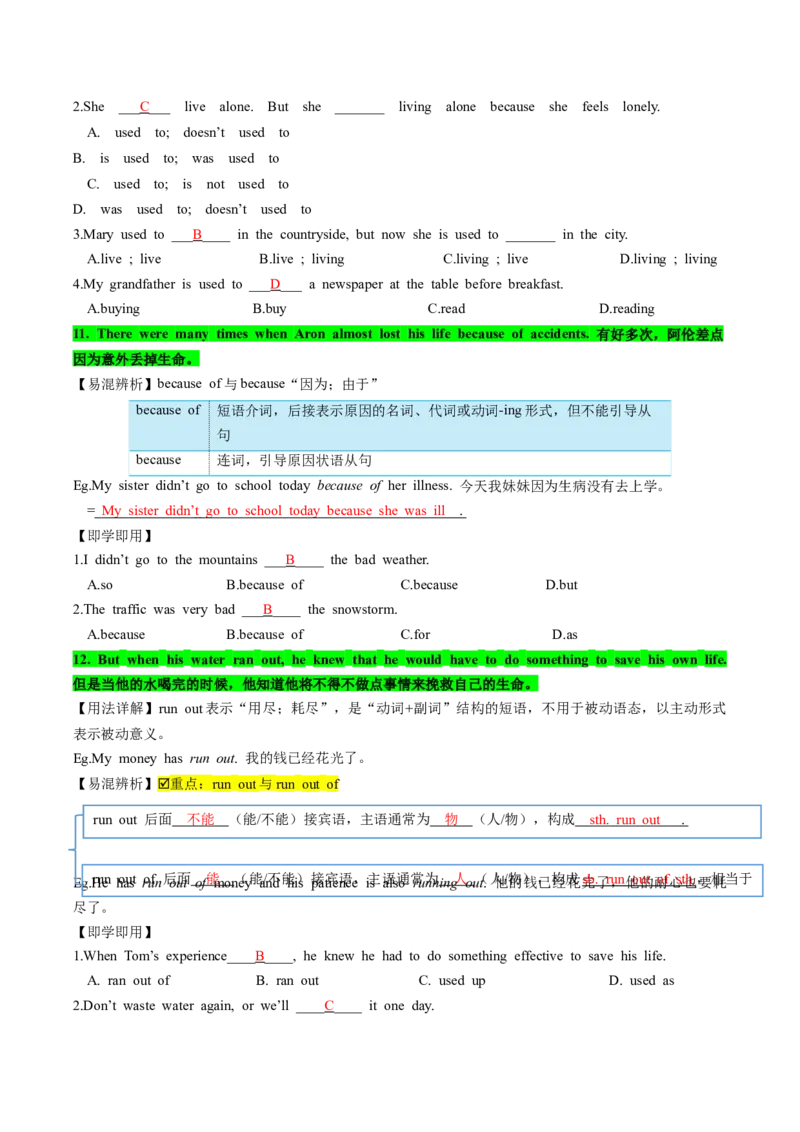
12. But when his water ran out, he knew that he would have to do something to save his own life.
但是当他的水喝完的时候,他知道他将不得不做点事情来挽救自己的生命。
【用法详解】run out表示“用尽;耗尽”,是“动词+副词”结构的短语,不用于被动语态,以主动形式
表示被动意义。
Eg.My money has run out. 我的钱已经花光了。
【易混辨析】重点:run out与run out of
run out 后面 不能 (能/不能)接宾语,主语通常为 物 (人/物),构成 sth . ru n ou t .
Eg.Hruen hoaust roufn 后 ou 面 t o f 能 m o n ( ey 能 a/n 不 d 能 hi ) s 接 pat 宾 ien 语 ce , i 主 s 语 als 通 o 常 ru 为 nn in g 人 o u ( t. 人他/物的)钱,已构经成花完 sb. 了 ru,n 他 ou的t 耐 of 心 st也h. ,要相耗当于
use up
尽了。
【即学即用】
1.When Tom’s experience____B____, he knew he had to do something effective to save his life.
A. ran out of B. ran out C. used up D. used as
2.Don’t waste water again, or we’ll ____C____ it one day.A.take out B.run out C.run out of D.work out
13. So he used his knife to cut off half his right arm. 于是他用刀子切断了自己的半条右臂。
【用法详解】知识点1: knife意为“刀”,其复数形式为 knive s 。
Eg.It is dangerous for children to use knives. 儿童用刀很危险。
【拓展延伸】以-f或-fe结尾的名词变复数时,要变 f 或 f e 为 v ,再加 e s 。
wife(妻子)——__wives__ self(自己)——__selves__ knife(刀)——__knives__
life(生命)——__lives___ half(一半)——__halves__ leaf(叶子)——__leaves__
知识点2: cut off表示“切除;剪掉”,是由“动词+副词”构成的短语,名词作宾语时,可放在动词与
副词之间或副词的后面;而代词作宾语时,只能放在动词与副词之间。
Eg.Mary cut off some flowers from the bush. 玛丽从灌木丛中剪下一些花。
They had to cut it off. 他们不得不把它切下来。
【拓展延伸】与cut 相关的短语:
cut up 切碎 cut down 砍倒;削减 cut in 插嘴 cut out 删除;删掉
【即学即用】
1.The doctors and nurses are trying their best to save people’s ___lives___(life)as many as possible during
Novel Coronavirus Pneumonia(NCP) in 2020.
2.There are two __knives___(knife) and a fork on the table.
14. ... he bandaged himself so that he would not lose too much blood. 用绷带为自己包扎了伤口,免
得失血过多。
【用法详解】重点:so that意为“ 以便;为了 ”,引导目的状语从句,相当于in order that。so
that引导目的状语从句时,从句常出现情态动词may/ might/can/ could等。
【拓展延伸】重点:so......that与such......that的用法
so+ ad j / ad v + that
如此…… such + a/an + ad j + n 单 +
that
以至于……
such + ad j + n 复 / n 不 + that
【即学即用】
1.The teacher speaks very loudly ____A____ all the students can hear her.
A. so that B. because C. since
D. when
2.They spoke ____B____ quietly _________ I could hardly hear them.
A.such ; that B.so ; that C.neither ; nor D.both ; and
3.—Did you watch the soccer game last night? Our school team won the game in the last minute!
—Yes. I was ____D____ excited _________ I could not fall asleep.
A.as ; as B.so ; as C.too ; to D.so ; that
4.Some word puzzles in this book are ____C____ difficult that _________ students can solve them.
A. such; few B. such; little C. so; few
D. so; little
5.Story Sign is ____B____ a useful app _________it can make it easier for deaf children and their
parents to read bedtime stories.
A. so; that B. such ; that C. too ;to do D. as; as
6.---Mom, I took my partner’s math book home by mistake. What should I do?
---Well, you should call her___B___ you can say sorry to her .
A.as if B.so that C. even though D. ever since
15. This means being in a difficult situation that you cannot seem to get out of. 书名的意思是“处
于一个你似乎无法摆脱的困倦之中”。
【用法详解】mean作动词,意为“意思是;意味着;打算;意欲”,其过去式为 mean t 。
常用搭配: mea n doin g sth . “意味着做某事” mea n t o d o sth . “打算做某事”
Eg. A red traffic light means stop. 红色交通信号灯表示停下。
It means wasting more time. 那意味着浪费更多的时间。
I meant to go to the exhibition but I forgot. 我本打算去参观展览,但忘了。
16. Aron did not give up after the accident and keeps on climbing mountains today. 阿伦在这起事故
之后没有放弃,现在仍坚持登山。
【用法详解】give up表示“放弃”,后可接名词、代词或动词-ing形式作宾语。代词作宾语时,要把代词
放在give与up之间。 giv e u p doin g sth . “放弃做某事”
Eg.I have to give up the plan. 我不得不放弃那个计划。
It is good for you to give up smoking. 戒烟对你有好处。
That’s bad for your health; please give it up. 那对你的健康不利,请戒掉它。
【拓展延伸】“动词+up”结构的短语:
chee r u p 使……振作 pic k u p 捡起;开车接;接电话
pu t u p 举起;张贴;搭建 tak e u p 占用;开始从事
sta y u p 熬夜 us e u p 用完;耗尽
【即学即用】
1.As we know,many successful people never____D____no matter what difficulties they’ve had.
A.stay up B.cheer up C.take up D.give up
2.—Don’t smoke any more. It’s bad for your health.
—I’m trying to____B____. But you know it’s really hard.
A.give up it B.give it up C.give up them D.give them
up
3.The doctors advised my grandfather to give up__smoking__(smoke).课堂小测
一、单项选择
1.—What’s ___C_____ matter with you?
—I have _________ toothache.
A. /; the B. the; / C. the; a D. /; /
2.—I find it difficult to learn English well. I want to drop it.
—English is very important in our daily life. Never ___B_____.
A. give up it B. give it up C. give away it
D. give it away
3.We’re talking about “China Dream”these days. It’s ___B_____ exciting _________ all of the Chinese
people are interested in it.
A. such; that B. so; that C. too; to D. too; so
4.—Did your teacher tell you anything ___D____?
—Yes, he told us the ________ of learning English well.
A. important; important B. importance; important
C. importance; importance D. important; importance
5.—What did you see?
—I saw many boys____B___ games near the river.
A. played B. playing C. plays D. to play
6.There’s ___A____ rain on the road, so she should drive carefully.
A.too much B.too many C.much too D.many too
7.—What’s your brother?
—He ___A____ a teacher, but now he is a doctor and he ________ his work.
A.used to be; is used to B.was used to; is used C.was used to be; used to D.is used to be;
used to
8. Helen took her temperature and found she had a ___D____.
A. cough B. toothache C. cold D. fever
9.—What’s the matter with you?
—___B___.
A. Sounds good B. I have a cold
C. I have something to do D. Sorry, I don’t know
10. I finished my work ___B___ because I had _______.
A. good enough ; enough time B. well enough ; enough time
C.good enough ; time enough D. enough good ;enough time
11.—Don't ___B___ hope.Everything will be over soon.
—Yes.We should learn to be brave when we are in trouble.A.turn up B.give up C.clean up D.take up
12.Tom has ____C____ in learning Maths well, so he’s often worried about it.
A.fun B.interest C.trouble D.question
13.Nobody could solve this difficult problem alone ___C____ others' help.
A.with B.for C.without D.from
14. ---What a mess! The books are everywhere in the reading room.
--- Let’s put them in the bookcase ___B____ others can find them easily.
A.as long as B.so that C.in order to D.although
15.I think I should keep on ___D____ the guitar at home.
A.play B.to play C.played D.playing
二、用所给词的适当形式填空
1. When I came into the room, I saw a cat ___lying____ (lie)under the chair.
2. How excited the ___climbers___ (climb)were when they got to the top of the mountain!
3. He has problems __breathing____ (breathe) when he is swimming.
4. Our teacher told us about the _importance__ (important) of studying English.
5. After that experience, he kept on _climbing_____ (climb) mountains.
6. The little girl is very sad because of her dog’s ___death____ (die).
7. They are used to __taking_____ (take) a walk after dinner.
8. They don’t mind __climbing____ (climb) the mountain.
9. Did you make a __decision____ (decide) to study medicine?
10. Jane had a __headache_____ (head) and she couldn’t move her neck this morning.
三、完形填空
All over the world people enjoy sports. Sports help people to keep __1__, happy and to live __2__. People
play different games in winter and summer.__3__ is good for swimming. And in winter people often go skating.
Some sports are very __4__ and people everywhere like them. For example, football is very popular. In China,
most people, men, __5__ boys and girls, like to watch football games. They often talk about them.__6__ and
jumping began long, long ago. But basketball and volleyball are rather __7__. People began to play them not long
ago. And people are__8__ new sports. Water skiing(滑水) is one of __9__. People __10__ different countries may
not be able to understand each other, but after a game they often become friends.
( C )1.A. health B. busy C. healthy D. lazy
( B )2.A. long B. longer C. happy D. short
( B )3.A. Winter B. Summer C. Autumn D. Spring
( D )4.A. boring B. difficult C. expensive D. interesting
( B )5.A. woman B. women C. old D. people
( C )6.A. Run B. Runs C. Running D. To run
( A )7.A. new B. interesting C. popular D. old
( C )8.A. start B. play C. playing D. starting
( D )9.A. oldest B. newest C. the oldest D. the newest( C )10.A. in B. of C. from D. at
语法精讲
一、情态动词should的用法
情态动词should意为“应当;应该”,后接动词 原形 ,没有人称和数的变化。
一、should的句式结构
句式 结构 例句
肯定句 主语+ should +动词原形+其他 We should help the people in trouble.
否定句 主语+ shouldn’t +动词原形+其他 They shouldn’t eat too much.
特殊疑问句 特殊疑问词+ should +主语+动词原形+其他? Where should we meet?
Should +主语+动词原形+其他? — It’s too cold. Should I close the
window?
一般疑问句
肯定回答 Yes, 主语+ should. —Yes, you should.
否定回答 No, 主语+shouldn’t. —No, you shouldn’t.
二、should的基本用法及示例
用法 示例
表示劝告、建议 You should answer the question in English.你应该用英语回答这个问题。
表示义务、责任 Children should do their homework by themselves.孩子们应该独自做作
业。
表示推断、判断 They should be at home now, I think.我认为,他们现在应该在家。
表示惊讶、赞叹、不满等 How should I know?我怎么会知道?
【即学即用】
1.Dogs ___B____ run through soccer games at the park. It's dangerous!
A. should B. shouldn't C.need D.
needn't
2.To keep children safe, we ___B____ put the things like knives and medicine away in our house.A. may B.should C. can D. might
3.You should __ _ B __ __ more fruit.
A.eats B.eat C.eating D.to eat
4.If you have a headache, I think you ___C____ see a doctor.
A.will B.shall C.should D.can
二、反身代词
一、语法概述
反身代词常表示“某人自己”,在人称代词宾格或形容词性物主代词后加-self(单数)/ -selves(复
数)构成反身代词。
二、反身代词的分类
第一人称 第二人称 第三人称
单数 myself yourself himself herself itself
我自己 你自己 他自己 她自己 它自己
复数 ourselves yourselves themselves
我们自己 你们自己 他们自己
三、反身代词的用法
1.反身代词多用于动词或介词后作宾语,表示“某人自己”
Eg. He learned to ride a bicycle by himself.他自己学会了骑自行车。
2.反身代词应与它所指代的名词或代词在人称和数上保持一致。
Eg. In 1955, Walt Disney himself opened the first Disney Park.在1955年,沃尔特·迪士尼自己开了第一
个迪士尼公园。
3.反身代词常考短语:
►by oneself 独自 ►teach oneself 自学
►enjoy oneself玩得开心 ►hurt oneself 伤到自己
►look after oneself 照顾自己 ►cut oneself 切到自己
►help oneself to随便吃,随便用 ►dress oneself 自己穿衣服
【即学即用】
1. Could you help me clean the floor? I can't do it ___myself____ (I).
2. You must look after ___yourself___(you) well while I'm away, Tom.
3. Your sister is too young, so she can’t go to school by hersel f (she).
4. Don’t worry. We can solve our problems by ourselve s (we).
5.---Dad, could you please teach___D____ English?
---Sure! But it's more important to learn it by ________.
A. my ; English B. my; you C. me; you D. me;
yourself语法小测
一、单项选择
1. You are the future of this country. Don't keep asking what this country can do for you. Ask
___D____what you can do for this country.
A.us B. ourselves C.you D. yourselves
2.—Do you know who taught ___C____ French?
—Nobody. He learned it by ________.
A. his; himself B. him; him C. him; himself D. his; him
3.-Your uncle is very good at cooking! How did he learn it?
-He learned it by ___B____.
A.him B.himself C.her D.herself
4. You ___B____ drive your car so fast. It's very dangerous.
A.wouldn't B.shouldn't C.couldn't D.mightn't
5. Boys, don’t lose ___D__ in playing Angry Birds. It is bad for your eyes to play computer games for
a long time.
A. himself B. yourself C. themselves D. yourselves
6. —I’ll have a tennis game tomorrow. I’m a little bit nervous.
—Believe in ___C___. You’re the best in our club.
A. herself B. myself C. yourself D. himself
7. Be careful with the knife. You may hurt ___D___.
A.himself B.ourselves C.myself D.yourself
8.—Will my car be ready by the end of the day?
—It ___D____ be, sir. I’ll call if there’s any problem.
A.must B.could C.shall D.should
9. We ___A____ eat or drink in the museum. It is against the rule.
A.shouldn’t B.needn’t C.would D.could
10. My son is older than ___D____, and he can look after ________ now.
A.your; himself B.yours; him C.yourself; him D.yours;
himself
二、用所给词的适当形式填空
1. As a student, I should try to finish my homework by __myself____ (I).
2. Without my parents' help, you should look after __yourself___. (you)
3. You shouldn’t always think about __yourself___(you).
4. The little girl usually finishes her homework by __herself____ (her) and doesn’t need others’ help.
5. We are old enough to control _ourselves__(we) well.
三、书面表达
根据图示,请你写一篇短文,谈谈如何才能保持健康。要求:词数80词左右。
How to keep healthy
____________________________________________________________________________________________
____________________________________________________________________________________________
____________________________________________________________________________________________
____________________________________________________________________________________________
____________________________________________________________________________________________
____________________________________________________________________________________________
____________________________________________________________________________________________
____________________________________________________________________________________________
【参考范文】
How to keep healthy
It’s important for us to keep healthy. As a middle school student, we should have a healthy lifestyle. Here is
some advice.
First, we should do exercise at least one hour a day, such as running and walking. Second, have a healthy diet.
Eat more fruit and vegetables. Try not to eat junk food. Third, we shouldn’t spend too much time going online. It is
bad for/It is harmful to our eyes and study. Fourth, go to bed early and don’t stay up too late, because enough sleep
is good for our health. Finally, be happy as possible as we can. Learn to smile at ourselves at any time.
If we do so, I believe we can keep healthy.